Friends, I am here to apologize to Matt Keeley, who wrote this great piece for me many months ago and has waited patiently (or maybe fumed silently) for me to publish it. I have no good excuse: I got busy and forgot. Terrible. Anyway, this really is a case of better late than never.
Matt is a freelance writer living in Boston.
Ilse Bing, East River with Boat, New York (1936)
Being a reader and working with books can, oddly enough, feel like mutually exclusive propositions. I spent most of 2024 underemployed, but what work I had before starting a new full-time job in October was mainly book-related. I copyedited and wrote pitches for a Dutch literary agency; I did brief manuscript reports for a literary scouting firm; I did occasional reviews for Reactor, The Washington Post, and The Boston Globe. I spent so much time on “professional” reading, including dozens of titles that I would normally have no interest in, that my personal reading suffered.
E.L. Doctorow’s Ragtime was not the book I expected it to be: one somehow doesn’t expect a book this strange to sell a million copies, end up on movie screens, and inspire a Broadway musical. This is an almost essayistic historical novel, with an intrusive and opinionated narrator, major characters who go titled (Father, Mother, Younger Brother) but unnamed, and plot lines that don’t tangle so much as split. Henry Ford and JP Morgan discuss reincarnation in front a stolen Egyptian mummy; Emma Goldman befriends a notorious “kept woman;” in the epilogue, we learn that one character gets killed in the Mexican Civil War, that another sinks with the Lusitania, and that a third creates the Little Rascals franchise. It’s a deeply weird book. [Ed. – Colour me intrigued…]
The movie, incidentally, is quite good, with James Cagney’s final performance, an uncredited appearance by a young Samuel L. Jackson, and Norman Mailer as an ill-fated libidinous architect. I wonder how many New York literati of the 1980s especially enjoyed watching his death scene? [Ed. – Probably still satisfying today.]
Ruth Scurr’s John Aubrey: My Own Life is an unusual biography that repurposes the words of the great antiquarian and his contemporaries to create a sort of hypothetical autobiography. There’s much that remains unknown about Aubrey’s life, and Scurr would rather leave open a gap than speculate. That means, for example, that we get more about the stones of Avebury than we do about Aubrey’s romantic life, more tossed-off preference than deeply felt emotion. This is an eccentric book about an eccentric man; most readers won’t much like it, but a few, like me, will love it. [Ed. – In the immortal slogan of Halifax’s Alexander Keith’s brewery: “Those who like it, like it a lot.”]
Gone: The Last Days of The New Yorker is Renata Adler’s score-settling memoir about the departure of William Shawn, the arrival of Robert Gottlieb, and the eventual appearance of Tina Brown. At one point, Adler compares Adam Gopnik to Anthony Powell’s Widmerpool. If you recognize the names in the last few sentences, you’ll likely enjoy this book, even if you don’t entirely trust it. Otherwise, you’d best avoid.
Rejection by Tony Tulathimutte is the dirtiest book I’ve read in ages. [Ed. — !] It seemed to come out of nowhere: I’d never heard of book or author until an editor asked me to review it. I invoked Philip Roth in my review, and I stand by that comparison:
Its heights, or depths, of exuberant filth reminded me of Philip Roth in Portnoy’s Complaint or Sabbath’s Theater. Like Roth, Tulathimutte knows desire can be as ludicrous as it is urgent; like Roth, he likes a good dirty joke.
Other highlights of 2024’s reading include:
Peter Straub’s Koko, a serial killer story with fine writing, memorable characters, and all too much exoticizing of the mysterious Orient [Ed. – It’s so mysterious tho]
Six of Georges Simenon’s Maigret novels — I really need to get back to the romans durs soon, but there’s something comforting about Maigret even when the plots are, in fact, quite harrowing
Amit Chaudhuri’s A Strange and Sublime Address, his first novel, as elegantly written and absorbingly plotless as later books like Friend of My Youth and Sojourn [Ed. – Read this last year as well: good stuff]
Paolo Bacigalupi’s Navola, the sequel to which cannot come soon enough. (Dorian — There’s a strong Guy Gavriel Kay influence here. I think you’d like) [Ed. – I appreciated this tip enough to check it out of the library—it indeed looks quite my thing—but not, apparently, enough to read it yet…]
M.T. Anderson’s Nicked, a fantastical medieval heist novel and queer romance [Ed. – Octavian Nothing was fantastic.]
Adam Roberts’s Lake of Darkness, a science fiction novel about Satan, post-scarcity, and what happens when you let AI do all your thinking
Howard Norman’s My Darling Detective, a thoroughly charming tale hampered only by the author’s difficulties with continuity and his editor’s failing to notice the innumerable discrepancies and inconsistencies. Read for the vibes, not the details. [Ed. – Yikes!]
Two that got away
One sad effect of all my book work was that I struggled to finish long and complicated books. I got maybe eighty pages into Oakley Hall’s classic Western Warlock before I gave up. The prose so fine, the type so small, the pages so numerous: I enjoyed and admired the book, but it took two weeks to traverse less than a hundred pages. [Ed. – Ha! Nicely put! It’s not easy, that one. Took me a while to fall under its spell.] I felt myself losing the thread, and put the book back on the shelf for a less fraught day.
Something similar happened with Iris Murdoch’s The Black Prince, which I’ve had on my shelves since 2007. In a burst of optimism, I’d bought three Murdoch paperbacks when I was a college student studying abroad in Dublin. I quickly read A Severed Head and hated it, and so The Sea, the Sea and The Black Prince sat unread for more than a decade. I knew, however, the problem was more with Matt than with Murdoch, so every year I vainly promised myself I’d give Murdoch another shot. When I finally took the plunge last June, I was thrilled to find that The Black Prince was smart, funny, and satirical, bursting with memorable images and sparkling with ideas. Except, once again, I found myself losing the thread and regretfully set the book aside.
I ended up reading The Bell, another Murdoch, in January of 2025. Perhaps I’ll get through The Black Prince later this year? [Ed. – Because it took me so damn long to get this up, maybe he has!]
John Constable, Cloud Study
Last year’s books, this year
Finally, there are a few 2024 books that I bought and fully intended to read, but haven’t quite gotten around to. First is Percival Everett’s James, a novel which sold a million copies and made nearly as many end-of-year lists. I’ve enjoyed Everett’s past novels and I’m sure I’ll tear through this one when I get around to it. Incidentally: I wonder when Everett’s next book will be? He usually seems to write about a book a year; I wonder if they’re holding off publication until James sales begin to taper off?
Next is Cahokia Jazz by Francis Spufford. I pitched it for review, but the pitch was declined. [Ed. – Boo!] I’m reading it now and am impressed: It’s simultaneously a murder mystery, a literary novel, and an alternate history. Spufford dedicates the book to “Prof. Kroeber’s daughter;” I wonder if Prof. Kroeber makes an appearance in the book. The period is right, Kroeber was an anthropologist interested in Native Americans, and there are lots of Native American characters in the book. [Ed. – SO good!]
Last is Ed Park’s Same Bed Different Dreams, which looks to be a polyphonic metafictional conspiratorial genre bender. I’ll probably turn to this once I finish Cahokia Jazz. [Ed. – Also good, with plenty of hockey. Thanks, Matt! Sorry again for dropping the ball!]
Pleased to once again present reading reviews from some of my favourite readers. Today’s installment, his fourth, is bythat titanic reader, the one and only James Morrison. James lives and works in Adelaide, on unceded Kaurna territory.
John H. Glenn Jr., “Fireflies Outside Friendship 7; First Human-Taken Color Photograph from Space”, 1962
BEST BOOKS READ IN 2024: An Annotated Index of Limited Utility
Books—there’s never any end to them, despite my attempts to read them all. Of the 280-odd I read in 2024 (no, you get a life!), these are the best of those that were new to me. In order to make this as useful(?) as possible, in in the endless quest for cheap novelty, they are presented as annotation to an index of themes. [Ed. – Sorry, missed that last bit. Still thinking about the 280…] Four writers appear twice (Kate Kruimink, Joseph Roth, Percival Everett and Walter Kempowski) and for what I think is the first time, both parties in an extant marriage also make the list (Everett again, with Danzy Senna).
Age, Coming of: Gwendolyn Brooks, Maud Martha & Diane Josefowicz, L’Air du Temps
Two opposing approaches to stories of young girls growing up. Brooks’s 1953 novel is a collage of vignettes stretching over years, the growing up of a Black girl in Chicago, unlucky but resilient, dreaming of a high-class life in the face of her own limited opportunities, Josefowicz’s novella covers just a short period of time in the life of a 13-year-old girl, when the shooting of a neighbour proves to be the catalyst for the peeling back of various local secrets. Brooks was primarily a poet and Josefowicz is a historian, but both of them show themselves to be tremendous fiction writers.
Art, Making of and Prehistory of: Maylis de Kerangal, Painting Time (translated by Jessica Moore)
De Kerangal is a personal favourite, and her best books usually involve a deep dive into some fascinating technical process (organ transplants, restaurant-level cooking, infrastructure engineering, or, in this case, both ancient cave art and trompe-l’œil painting), balanced with beautifully judged explorations of its human pressures and consequences. A compressed, deeply involving history of visual trickery and the impulse to make art.
Art, Making of from Deceased Father’s House: Jen Craig, Wall
In 2023 Craig’s two earlier novels were among my most loved discoveries, and I wasn’t wrong in thinking her third book would also be fantastic. A woman who is and isn’t Craig herself returns home to Australia to empty out her dead father’s house, with an eye to making the contents into an art exhibition. Multiple levels of consciousness rooted in different frames of time, deftly handled so as to be both convincing and presented with clarity, Craig’s prose is a wonder. I was lucky enough to be able to speak with her about one of her earlier books as part of the Wafer-Thin Books discussion series I co-hosted with Brad Bigelow of Neglected Books (neglectedbooks.com) through 2024—video here.
Biracialism, Literature of, Now an Award-Winning TV Series: Danzy Senna, Colored Television
Breezier in style than most of the books here, but far from shallow, Senna’s book features a protagonist obsessed with her own mixed-race nature, author of an undisciplined manuscript that’s becoming “the mulatto War and Peace.” She makes the mistake of getting involved with the Hollywood “prestige TV” world, and complications, as they say, ensue. Race, art, theft, infidelity; it’s all in there, making the sort of book that’s likely to be a big commercial success. Except this time it’s actually a good book. And yes, it does pain me to have to keep spelling the title the (wrong, but in this case “correct”) American way. [Ed. – They’re wrong, the Americans. And they will never admit it, James.]
George Hendrik Breitner, “Marie Jordan Nude, Seen from the Back”, 1889
Black Hole, Haunted by in Silicon Valley: Sarah Rose Etter, Ripe
A Silicon Valley satire—no, wait, come back! It’s well worth your time, and not just because the main character is haunted by her own personal tiny black hole, a physical manifestation of her depression. Things are not improved by her getting pregnant, nor by her various other ill-conceived life choices. A downbeat comedy of unforced errors.
Blitz: Francis Cottam, The Fire Fighter
Look, I have a weakness for Blitz fiction—people trying to go about their ordinary lives each day while having their world hammered each night by bombs is something I’m apparently able to read about endlessly. [Ed. – Same!] Cottam’s 2001 novel about a man given the task of protecting five specific London buildings from firebombs, without knowing why these sites are so important, is vividly convincing about the textures of daily life at the time, as well as exploring duty and treachery under ludicrously extreme circumstances. I’ve not read any of Cottam’s other books, which mostly seem to be supernatural fiction, but if they’re as strong as this they will not disappoint. (For more Blitz fiction, see Norah Hoult under Brains, below)
Boxing, Junior, Internal Thought Processes During: Rita Bullwinkel, Headshot
I enjoyed but didn’t love Bullwinkel’s story collection Belly Up, so if I hadn’t already bought Headshot I might have given it a miss. Yet again, incontinent book purchasing saves the day! [Ed. – As is so often the case!] Basically a series of internal monologues (though in the third person), from each of the teenaged girl contestants in an ill-attended second-rate female boxing tournament in a dusty gym over the course of one weekend, it’s a marvel. Kicks your Hemingway-style boxing crap out the door.
Brains, Decaying: Norah Hoult, There Were No Windows (also Cocktail Bar)
One of the Persephone Books rediscoveries that I can no longer afford due to most British people being dickheads and causing Brexit, thus making it prohibitively expensive to have British books sent to Australia, this 1944 novel by an Irish writer was both depressing and very funny, in the way that you can laugh afterwards about an awful relative, though their physical presence makes you squirm. It’s a pitch-perfect rendering of a deluded snob, hit with encroaching dementia and lowered circumstances, as the German bombs fall on London and servants become scarce. [Ed. – Oof, this sounds like something that might be called “unflinching”!] It was so good I immediately bought her story collection Cocktail Bar, from 1950, and it was similarly full of great things.
British People, Fucking Up Overseas in the Face of Imminent Implied Arachnid Apocalypse: Olivia Manning, The Rain Forest
Olivia Manning, man, such a great writer. Why isn’t all her stuff in print, instead of mainly just the (admittedly brilliant) two Fortunes of War trilogies? The Rain Forest, from 1974, is an intriguing twist on her common theme of a not entirely well-matched married couple doing duty for Britain overseas, in this case in a thinly disguised Madagascar (there are lemurs). Well-meaning ineptness in the face of political intrigue shades into an unexpected hint of global catastrophe to come from humans encroaching into a reservoir of toxic biology deep in an unexplored forest. Wonderful stuff. [Ed. – Wow! Sounds amazing! I, for one, welcome our imminent arachnid overlords.]
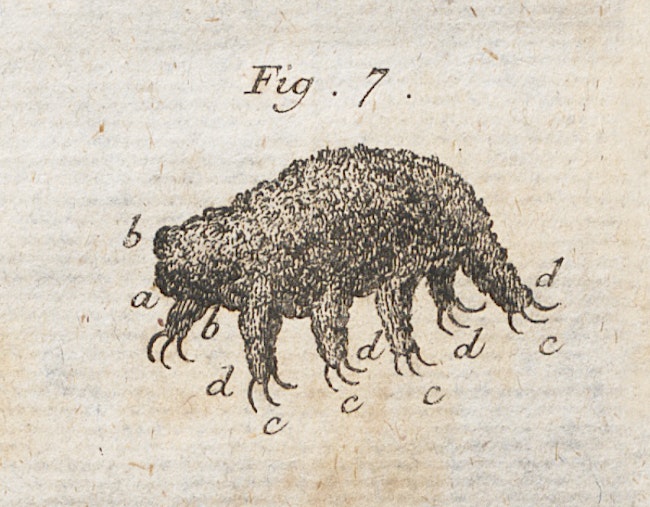
Johann August Ephraim Goeze, “Little Water Bear”, 1773
Century, Twentieth, Horrors and Absurdity of: Patrik Ouředník, Europeana (translated by Gerald Turner)
When spellcheck can’t cope with the author name or the title, you’re doing something right. Europeana is a brief but rambling survey of the Twentieth Century in all its ghastliness, where every fact, major or minor, is given equal weight, like a lecture by the most brilliant autistic raconteur in the world. If, like me, you buy the Dalkey Archive Essentials edition, you can also enjoy the brutally trimmed pages that slice off the outer edges of the marginalia.
Convicts, Female, Transcontinental Aquatic Journey of: Kate Kruimink, Astraea
The first of two Kruiminks on this list (see Grief, below), and the inaugural winner of the Weatherglass Novella Prize, this is the entirely shipbound story of a group of women being transported to New South Wales (not Tasmania, as every single review incorrectly states) in the early 1800s, to be servants and breeding stock in the new colony. Plagued by overbearing and/or predatory men in the shape of ship’s captain, crew, and minister, and haunted by their own miseries and guilts, their story is nevertheless a darkly funny one, full of unexpected insights and, for the reader, delights. [Ed. – Yep, getting this one for sure.]
Displacement, Linguistic, Psychological Aftereffects of: Antigone Kefala, The Island
Antigone Kefala is a (deep breath) ethnically Greek Romanian cum Australian via post-WWII refugee resettlement camps, writing in English, her fourth language. This 1984 book, being reprinted in North America this year, is, inevitably, out of print in Australia. It’s a subtle, destabilising, discursive meditation on place and belonging and language; very hard to pin down and quite unusual. [Ed. – Yep, getting this one for sure.]
Domestic Life, Oppressive Atmosphere Within: Fumiko Enchi, The Waiting Years (translated by John Bester)
A wife forced to choose and manage her husband’s concubine, who is still effectively a girl and not an adult, is the core of this disturbing but unsensationalised brief novel from 1957. Enchi was a distinguished, prizewinning novelist, and one of the great female writers of Japan. It’s criminal how little of her work is translated into English. [Ed. – Yep, getting this one for sure.]
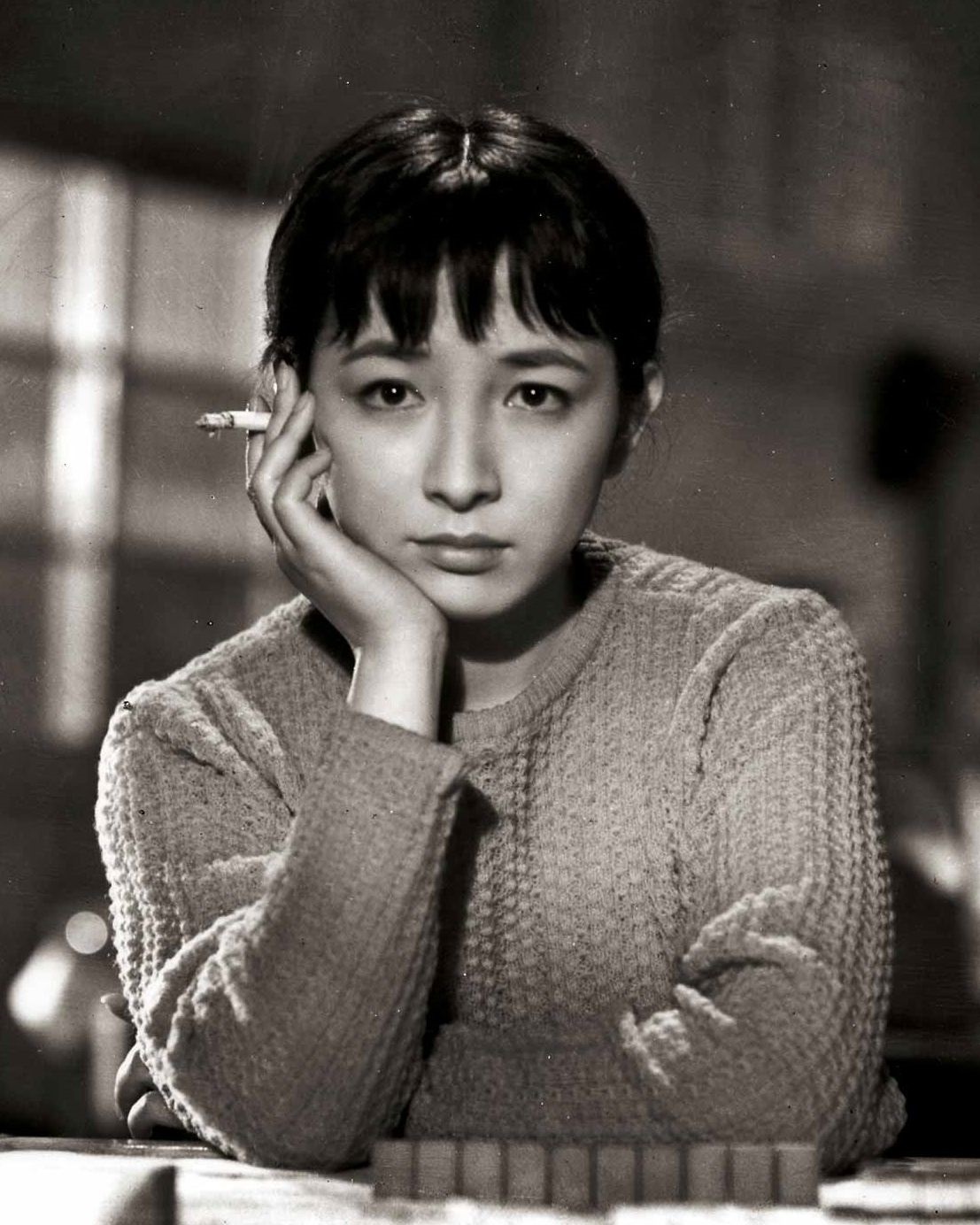
Ineko Arima in Tokyo Twilight (Tôkyô boshoku) (Yasujirô Ozu, 1957)
Epics, Tiny and Incomplete: Joseph Roth, Perlefter (translated by Richard Panchyk)
This was the year that, despite pacing myself carefully, I ran out of Joseph Roth fiction. He was one of the greats, a genius and an alcoholic of astonishing powers, and the supreme chronicler of the Habsburg Empire, its collapse, and the darkness that followed. Perlefter is an incomplete novella, found in his papers and published posthumously, yet still substantial enough to hold its own. A wealthy Austrian, observed by an orphaned relative, enthusiastically grapples with the technological and social developments of the early Twentieth Century, all observed with Roth’s characteristically subtle and quirky eye and voice. See also Napoleon, below.
Failure, Artistic, Afterlives of: A. Valliard, The City of Lost Intentions: A Guide for the Artistically Waylaid
I can guarantee you’ve not read anything like this: a consistently inventive tourists’ guide to a netherworld of endless artistic failure and pretension, packed with more ideas per square inch than most books could even dream of, and written with a style recalling the sarcastically decadent fin-de-siècle classics. You’ll probably see yourself in it, and not be happy about it.
Grief, All-Enveloping Nature and Absurdity of: Kate Kruimink, Heartsease
Kruimink’s other novel of 2024 was the longer Heartsease, set in modern Tasmania [Ed. – Sure you don’t mean New South Wales???], and spikily hilarious even though it’s all about loss and grief and neglect. Wryly, unsentimentally Australian in the best way, and including a fine joke about musk sticks. [Ed. – Probably lands better if you know what that is.]
Lesbians, Ancient and Fragmented: Sappho, If Not, Winter: Fragments of Sappho (translated by Anne Carson)
As when trying to describe Ulysses in a previous one of these round-ups, sometimes there’s not a lot you can usefully say about a great book; you just have to point at it and marvel. I’ve read other translations of Sappho before, and loved them, but this really must be the ultimate take in English.
Life, Viewed Askew, in Small Portions: Jessica Westhead, And Also Sharks & Percival Everett, Half an Inch of Water
Two wide-ranging short story collections from the back catalogues of writers I deeply admire. Westhead is Canadian and belongs more to the George Saunders school of fiction (though better and more inventive), while Everett is much harder to pin down—if there’s any American writer working today with a broader, less predictable bibliography then I’ll eat any number of hats. Both books are full of gems, and are frequently genuinely funny.
Nanotechnology, Inadvertent Consequences of treating Cancer with: Anton Hur, Toward Eternity
An industrious and talented translator into and out of Korean, Hur’s first novel is cheeringly excellent: a full-on literary science-fiction exploration of nanotechnology, identity, social collapse, cloning, warfare, and the possibility of a human future, no matter how altered that definition of ‘human’ might be. It’s really enjoyable to see someone so talented engage with the genre in such a serious, productive way, though the results are often pretty bleak. [Ed. – Now I’m mad I had to return it to the library before I could read it.]
Napoleon: Joseph Roth, The Hundred Days (translated by Richard Panchyk)
The second Joseph Roth in this list, and something of an outlier in his work, being a fictional patchwork view of Napoleon through minor figures in his orbit, rather than being set in the Austro-Hungarian Empire. Roth was always great, though, and stepping outside his usual area doesn’t dim his powers one bit. That I now have no fiction by him left unread is a cause of great psychological pain for me. Financial donations to ease my distress will be accepted. [Ed. – Please contribute to James’s GoFundMe. He asks so little.]
Nazis, Fleeing From in Company of Unreliable Man: Helen Wolff, Background for Love (translated by Tristram Wolff)
How did a book this good end up sitting for decades in a drawer, unpublished? Imagine a lost Jean Rhys novel, only with a female protagonist who has agency (alright, so it’s not an exact match) [Ed. – genuine lol], beginning with a couple fleeing to the Côte d’Azur one hot summer to get away from the growing Nazi power at home in Germany. Wolff wrote this book in 1932, but never tried to publish it, even though she later went on to found Pantheon Books in America with her husband. What other masterpieces like this are out there, sitting unpublished in a world where Haruki Murakami and Dan Browns’ every fart gets the hardcover treatment? Truly we live in a fallen world.
Nazis, Revenge on Collaborators with: Martha Albrand, Remembered Anger
In many ways this is ‘just’ an above-average crime/espionage novel, about an American man imprisoned by the Nazis who gets out at the war’s end and tries to find out who sold him out. But what lifts it above that is the fact it was written just as the events it was describing were happening, in the early months of 1945, as Paris wobbled back to the start of normality, by an author (born Heidi Huberta Freybe Loewengard) who was herself politically active against and then a refugee from the Fascists, and it beautifully captures the numerous little details of its time and place to give it a real kick of verisimilitude. [Yep, I’ll be getting this one, and actually reading it!]
Nazis, Rise and Collapse of: Walter Kempowski, All for Nothing (translated by Anthea Bell) & An Ordinary Youth (translated by Michael Lipkin)
A pair of stone-cold masterpieces, looking at Germans in World War II from opposite ends, geographically and temporally. Youth is about boyhood under growing Fascist power and then war, sneaking jazz records and trying to get out of the Nazi Youth, not for political reasons but because you don’t like enforced physical activity. Nothing, on the other hand, is the tale of the slow destruction of a German household on the Eastern Front as the Russians draw closer and closer. Both are wonderfully written, and attempt no form of exculpation of the author or the characters. These are people who didn’t like the Nazis because they were not their social class of person, not because of any ethical qualms. Youth is apparently part of a whole series of books Kempowski wrote in German, and we need all the rest translated NOW. [Ed. – Amen]
Palestine, Staging Hamlet in: Isabella Hammad, Enter Ghost
Even at the best of times trying to stage Hamlet in with an all-Palestinian cast under Israeli rule seems like a logistical nightmare, and these are not the best of times. A Palestinian-born, London-based actress returns to her birthplace and her sister, and almost involuntarily gets caught up in the theatrical project of a distant acquaintance, as well as attempting to reckon with her family and its history. It made me immediately buy Hammad’s first novel, The Parisian, though I haven’t read it yet because it’s huge. [Ed. – I just bought this too, and it’s so huge!]
Sanatorium, Satire of Male Attitudes Within: Olga Tokarczuk, The Empusium (translated by Antonia Lloyd-Jones)
I get the feeling not everyone loved Tokarczuk’s latest book translated into English, but it was very much my kind of thing. A bunch of guys, self-deluded and not as smart as they think they are, discussing the issues of the day and their philosophies, while living in a tuberculosis sanatorium? A strange, supernatural observer/narrator? Sign me up!
Slavery, Literature Of, Remixed: Percival Everett, James
On the other hand, pretty much everyone seems to have loved this, and rightly so. As I mentioned above, Everett is one of the least predictable writers alive, and his take on Huckleberry Finn from Jim’s code-switching point of view is a gripping, funny masterclass in rewriting a classic without redundancy. This is an angry, exciting and surprising book that doesn’t always match the original’s plot. I hope this gets the author the huge audience he deserves, though it’ll also be funny to see this bigger audience attempt to process some of his earlier books.
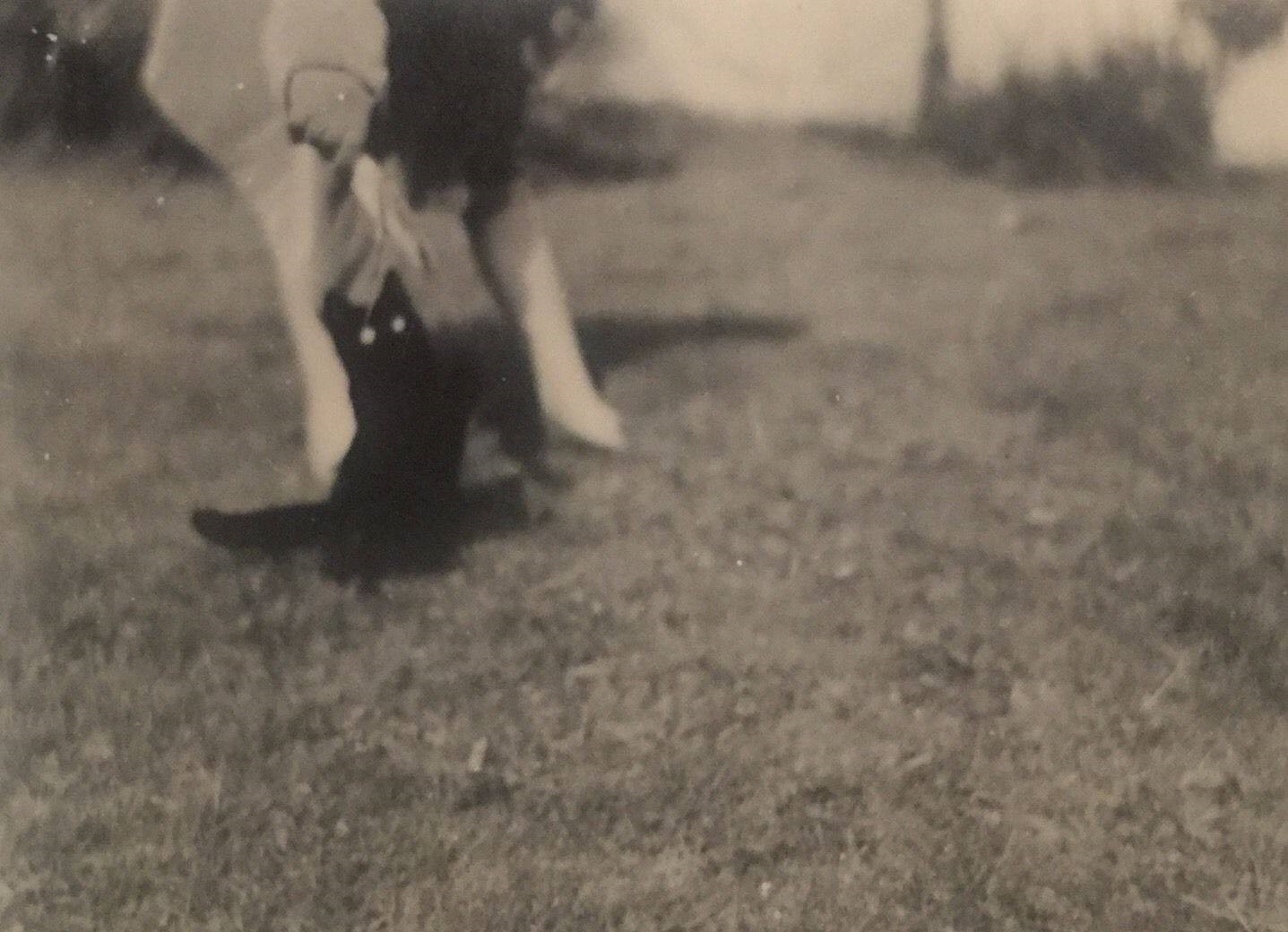
Unknown photographer, Cat, Year unknown [Ed. — Spooky-ass cat]
Smallpox, Alternative History of World Due to: Francis Spufford, Cahokia Jazz
You know those stories where what begins with a couple of beat cops investigating a crime scene ends up being a whole-of-society-spanning investigation of conspiracy and political intrigue? Well, imagine one of those, written with the perfect mix of style, insight and originality. And it’s set in a version of history where it was the less virulent form of smallpox that was brought to the Americas by Europeans, meaning what has become the United States has done so in the face of much vaster, stronger First Nations. And imagine it’s a huge amount of fun. That’s Cahokia Jazz, baby. [Ed. – Look for this on my year-end list too!]
Troubles, The, Childhood During: Jennifer Johnston, Shadows on OurSkin
Jennifer Johnston is a writer who I idiotically ignored for years because her current UK publisher cursed her with the sort of soft-focus-photo-of-a-woman-in-a-fancy-dress-turned-away-from-the-camera-with-her-head-cropped-off cover photos more commonly found on flimsy commercial fiction. [Ed. – I prefer house-lit-from-within-against-a-nighttime-sky myself.] But then I came across a copy of How Many Miles to Babylon? with a good cover, read it, and was hooked. She’s phenomenally good, a brilliant and unsentimental Irish writer whose particular interest is the way the British occupation of Ireland leaks into and impacts upon the lives of ordinary people. Shadows is one of her best, following the life of a young boy in Derry in the 1970s, half in love with a school teacher who in turn is half in love with the boy’s older brother, who has come back home from England with big ideas and a gun in his back pocket. [Ed. – Damn, I just looked her up and she has so many books!]
Wildfire, Californian: George R Stewart, Fire
A Californian wilderness on fire, with the fire itself as the main character, and telling the story of all the people arrayed against or caught by it. Stewart, who also wrote Earth Abides (a wonderful novel and now a terrible TV series), describes everything with a dispassionate but not cruel eye, and the result, published in 1948, is all too horribly relevant now.
[Ed. — Ladies and gentlemen, give it up for James Morrison, always all too horribly relevant! Seriously, thanks James, this was amazing and budget-busting, as usual.]
Today’s reflection on a year in reading is by Martin Schneider, a freelance copyeditor (of books!) who lives in Cleveland, tweets at @wovenstrap, and used to write for Dangerous Minds. He’s part-Austrian and can occasionally can be found in that country.
Look for more reflections from a wonderful assortment of readers every day this week and next. Remember, you can always add your thoughts to the mix. Just let me know, either in the comments or on Twitter (@ds228).
Charles E. Martin
The global pandemic has been very good for my reading life.
I’ve read novels my entire adult life but the raw totals in any given year might not have been very high, maybe 30 per year. When COVID-19 arrived, I had an empty work patch in my freelance schedule and I responded by attempting to read one novel per day for 30 days (!) as a way of distracting myself from the fact that I might have a hard time finding freelance work. I made it to Day 19 but some work came in, thank god, and I didn’t get to Day 30. That stretch sparked a period of high novel consumption: I read 72 novels in 2020 and 70 novels in 2021. Those are very high totals for me.
I’m grateful for the particular cluster on Twitter that orbits around Caustic Cover Critic and Damian Kelleher and of course Dorian for improving my general experience on Twitter as well as giving me inspiration for new books and a community of like-minded people, etc. I should also say a word about the Backlisted podcast as additional inspiration (obviously that also overlaps with Twitter in some ways). I appreciate the monthly bookstack photographs and other visual ephemera that Book Twitter is always providing me with.
I’m a volume whore, by which I mean I favor reading short novels so that the raw book count stays as high as possible and I don’t get stuck for a month reading Moby-Dick or whatever. [Ed. — Ah, but what a month it would be!] 275 pages already begins to seem a high total to me, my sweet spot is about 191. ABC, always be churning. [Ed. – Hahaha!]
It goes without saying that 2021 was a very good reading year for me, cycling through 70 books in a calendar year is pretty close to an ideal way for me to spend my free time.
OK, here are about 20 books I wanted to say something about, listed in chronological order except where books are joined.
Michaela Roessner, Vanishing Point
The first read of the year for me, and one of the year’s finest. Vanishing Point is hard to track down but this exemplar of heady, sinuous ’80s sci-fi is worthwhile for those who like that kind of thing. The setup has much in common with Tom Perrotta’s The Leftovers — it also came first — which most likely is what drew me to seek it out. I don’t want to divulge too much about it, but I greatly enjoyed this intelligent, immersive book, and I think about it often.
Josephine Tey, The Franchise Affair
I’ve never been much enamored of The Daughter of Time, which has always seemed implausible and overbaked. This left me unprepared for the astonishing authorial control of The Franchise Affair. I think you’d be hard-pressed to find a better representation of midcentury England than this book; the sheer exuberance of the jolly/obliging/diffident/snappish voices — literally, speaking voices — is tough to top. What’s the cricket equivalent of “a home run”? [Ed. – Knocked it out of the oval here, my friend: such a good book.]
Gilbert Adair, Love and Death on Long Island
Quite simply, my #1 read of 2021. I adore thinking about this book. Every page is a treat. I would urge those who like their fiction subtle and incisive to consume this immediately. Adair’s performance — and it is definitely a performance — feels thoroughly under-heralded. I had seen bits of the movie years ago and had always found the central predicament original and delicious and rich. Who can fail to relate to the sorrows/joys of being a bookish hideaway in a world that produces, almost unthinkingly, Hotpants College II?? [Ed. – Admittedly, not a patch on Hotpants I.] The ways Giles and Ronnie fail to comprehend each other are a wellspring of comedy that will never stop nourishing me. I never reread books but will likely return to this “jewel-like” 1930s-type book set in the age of the vulgar teenage sex farce (rented from the local video shop, natch); those 1980s details are decisively additive, at least for me. I sorely crave books like this but alas, strong comps are surely thin on the ground…… [Ed. – Ooh, a challenge: do your best, Team. Whatcha got for Martin?]
Colson Whitehead, The Underground Railroad
I am a fan of Whitehead’s, but I was disappointed by The Underground Railroad. It seems unusually weak for a Pulitzer winner (then again, there is The Goldfinch, oof). I appreciated the comparative tour of antebellum contexts, but the failure to develop the literalized choo-choos nagged at me. Does that metaphor explain anything to anybody? I can’t see how. It’s such a great idea but also a massive missed opportunity. This is the rare case of a book that needs another 200 pages, I think. I also worry that Whitehead has bought into the hype surrounding him. Give me another John Henry Days, man — please!
C.S. Forester, The African Queen
In 2020 I read The Good Shepherd and found it utterly compelling. Then dang if the same thing didn’t happen all over again with The African Queen. I am a little leery of the Hornblower books — I prefer the 20th century, thanks — but Forester’s way of imparting information really does it for me.
Patricia Lockwood, No One Is Talking About This
Jonathan Lethem, The Arrest
No One Is Talking About This is a relatively celebrated recent novel that I cluster together with the works of Jenny Offill and Rachel Khong, and not in a positive way. I think of all of these books as jammed with clever, postmodern witticisms/jokes that you could rearrange in any order and it wouldn’t make much difference to the narrative. That’s a little unfair to No One Is Talking About This, which Lockwood does take pains to instill with an Act I/Act II structure, but I still found it a complete failure in terms of ordinary novel-building. Meanwhile, Lethem is not much in fashion lately, especially after The Feral Detective, which did not work. I suspect there was scant interest in his stab at Post-Apocalypse, but I still found The Arrest as intelligent, engaging, and sharp as much of his stuff — I admire Chronic City particularly. His books don’t always hang together, but on the paragraph and thematic levels, Lethem seems to me the equal of anyone out there right now and, as such, under-appreciated.
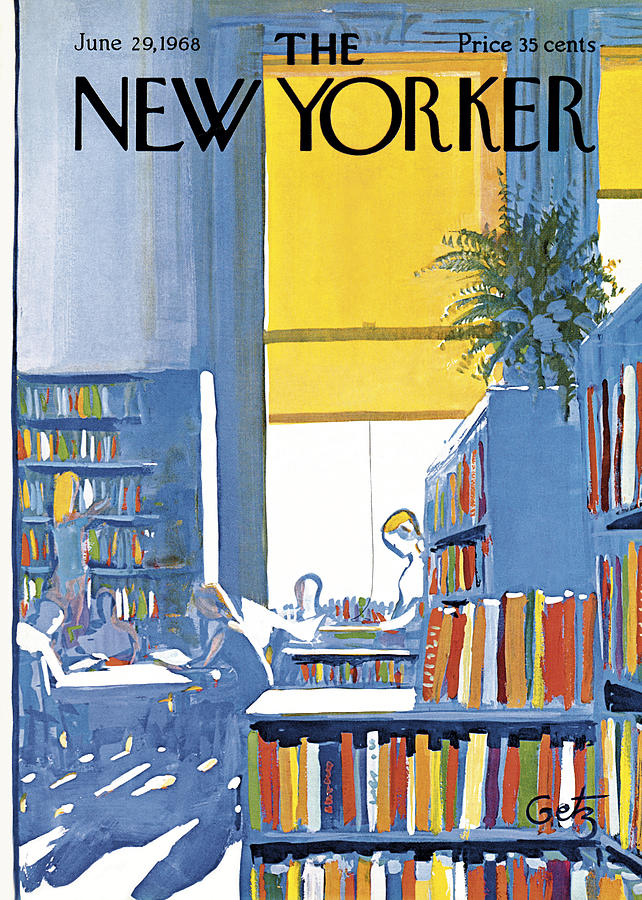
Arthur Getz
Margaret Drabble, The Millstone
Oh, boy. I was more than a little surprised how conventional and bourgeois (and therefore tiresome) I found this book, which in 1965 represented such a brave “new” perspective — or did it? From the perspective of 2021 it reads as so much more aligned to Drabble’s (presumably) hated predecessors than to us. To the reader of today, I submit, so many of Rosamund’s choices are unintelligible, particularly that of concealing the existence of her child from her parents. Rosamund’s whole setup (enormous apartment, rent-free) is so contrived and refuses to serve as the societal basis for anything (as I think was intended or at least was regarded). Jerusalem the Golden, a humble tale of growth about a woman from humble origins I read and esteemed decades ago, seems the antithesis of this. Drabble really leans into her privilege here, thus undoing the point. Next! [Ed. – *popcorn gif *]
Quentin Tarantino, Once Upon a Time in Hollywood
The last few years I have found myself increasingly disenchanted with the MFA-influenced “well-crafted” masterpieces that dominate (say) the Tournament of Books. The writing is frequently too tidy and pristine and there’s too much overlap/groupthink in the authors. In my mind, these books are not composed by individuals; too many of the nasty, idiosyncratic details have been sanded off. An antidote to this is Once Upon a Time in Hollywood, far from a great book but I found its termite-ish perambulations entirely refreshing and (am I crazy for believing this?) an explicit callback to the shaggy-dog ways of Dickens. I do suspect that Tarantino thought of this “novelization” (a favorite form of his) as an attack on all the bloodless hifalutin volumes that get adopted by reading groups. I’m ready to sign on to this agenda; modern fiction could surely stand to ingest the unkempt, untoward essence of this book.
Elena Ferrante, The Lost Daughter
I admire the guts it took to be so unflinching about the unvirtuous aspects of shirked motherhood. The Lost Daughter dares you to dislike its protagonist, which I did not — or not very much; Ferrante works in the class signifiers to make her readers side with her heroine over the swinish, unreaderly family that intrudes on her interlude — and then forces those same readers to think about that. It’s encouraging that a writer of Ferrante’s gifts has found such widespread success.
Susanna Clarke, Piranesi
Everybody’s favorite recent puzzle box, it seems. The first half of this book constituted one of the reading high points of the year for me. Nothing wrong with the second half, to be sure, but you just can’t top the sheer blazing WTF “where is this going?” quality of this book’s setup. [Ed. – Yeah, can’t argue with that.] As with Love and Death on Long Island, I desperately want to find books with this vibe, but I doubt that any are out there (I did think of David Mitchell’s Slade House, however).
Joseph Hansen, Fadeout
One of my top reads of 2021. I learn from the internet that Hansen was a pioneer of the gay detective novel. This book introduced Dave Brandstetter, Hansen’s recurring hero of a dozen or so mysteries. The gay angle functions as the lever that furnishes Hansen’s situation/solution with complexity, but it wasn’t just that; Hansen also had the ability and the interest to write textured, complex thrillers. That’s the kind of shit I live for! This was published in 1970, but I thought it stood up dazzlingly well today.
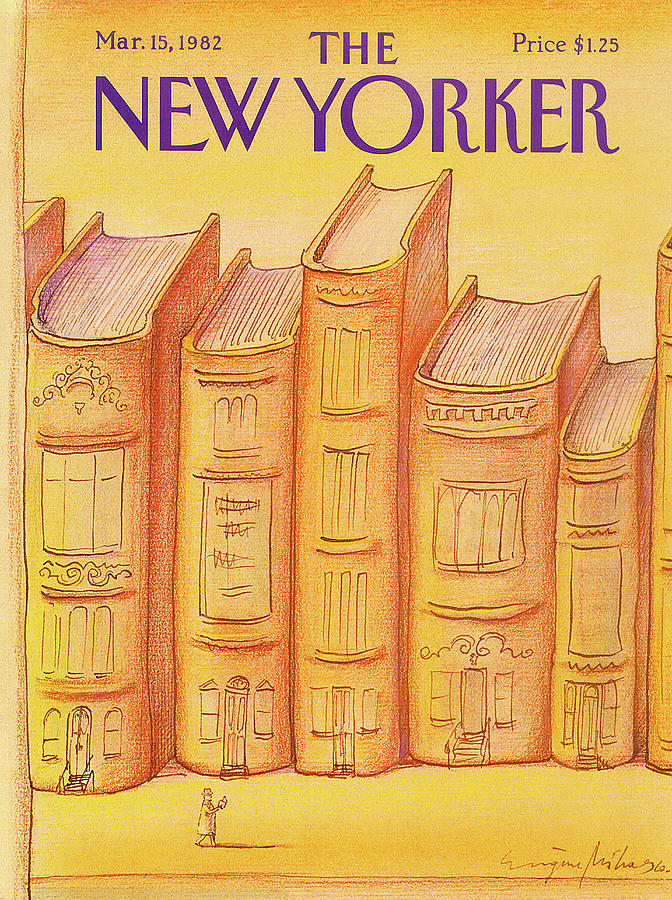
Eugene Mihaesco
Percival Everett, Cutting Lisa
This somehow pairs with The Lost Daughter in the author seeking out, nay, embracing unpleasantness to spectacular effect. This was on my shortlist of reading experiences for the year, a strikingly original work that forthrightly countenanced negativity while resisting the impulse to pin everything on a villain. Every character has corners; every situation is layered. My first Everett, Cutting Lisa has a chewiness I associate with the finest output of the 80s, and I can’t wait to read more by him.
William Maxwell, So Long, See You Tomorrow
Katherine Anne Porter, Noon Wine
So Long, See You Tomorrow is one of those “writerly” novellas that hit me entirely the wrong way. Maxwell was a smalltown escapee who later found tenure at The New Yorker and thereby invested himself of the power to imbue these “simple midwestern people” (yuck) with meaning. If ever a narrative should have dispensed with the pretentious framing device of the events filtered through the memories of a child, it’s this one. I guess I can see why people admire this book, but for me it was just a succession of false notes. [Ed. – Ooh, fighting words!] Noon Wine reveals the falsity of Maxwell’s methods; another short novel — Porter, it seems, detested the term novella — but in this case authentically empathetic towards its figures, in contrast to Maxwell’s self-serving projections/lies. Noon Wine has the guts to put real people on the page — and real stakes.
William Lindsay Gresham, Nightmare Alley
One of the much-mentioned texts of 2021, due to the Guillermo del Toro adaptation that landed late in the year. Later on, I found it significant that Gresham is not celebrated for any other work. This book is certainly adept and not devoid of virtues, but I found it labored and tiresome, every point underlined in every paragraph, nothing allowed to breathe, as a real novelist would do it. I resorted to a new strategy: just grind through 10 pages per day until done, just to get it behind me (while starting a different novel, I seldom double dip). I should go back and finish Geek Love as an antidote (not that Dunn let things breathe, either).
Louise Erdrich, The Sentence
Simply put, I cannot think of another novel as generous-minded as this.
Today’s reflection on a year in reading is by Matt Keeley, a marketer and freelance editor who reads too much. He lives in Massachusetts. You can find him on Twitter at @mattkeeley.
Look for more reflections from a wonderful assortment of readers every day this week and next. Remember, you can always add your thoughts to the mix. Just let me know, either in the comments or on Twitter (@ds228).
Vija Celmins, Night Sky #2, 1991
My favorite of all the books I read in 2021 was John Crowley’s Little, Big. Like my favorite book from 2020, Sylvia Townsend Warner’s chronicle of medieval life The Corner That Held Them, I believe it to be a masterpiece but hesitate to recommend it widely. Crowley’s 1981 novel follows the fortunes of the Drinkwater family through the twentieth century and into a bleakly imagined twenty-first. The family is connected, Somehow (Crowley always capitalizes this word), to the fairies and to a mysterious Tale (again, capitalized) that may encompass more worlds than ours. While no one, the author included, would deny that it’s a fantasy novel, it’s far different from and much superior to most everything published in the genre since Tolkien. It’s a long, beautiful, stately, and oblique novel; I look forward to returning to it.
Alan Garner’s Treacle Walker was a surprise and felt like a gift: When he published his memoir Where Shall We Run To? in 2018, Garner was already in his mid-eighties, and he’s a slow writer. Although I read it in just a few hours, Treacle Walker is precisely as long as it needs to be. I wouldn’t recommend it as an introduction to Garner, but it’s a fine (apparent) capstone to his six-decade career.
I read two books by Janet Malcolm in close succession early in the year; Two Lives is about Gertrude Stein and Alice B. Toklas: their lives, their love, their art, and the mystery of their survival as Jewish lesbians in occupied France. Malcolm’s précis of Stein’s The Making of Americans is particularly wonderful; I had no idea how strange, unmannered, and unedited that pseudo-novel is. I wouldn’t want to brave its nine hundred pages of dropped plots, failed experiments, and abandoned philosophical musings, but I’m glad to know what’s in there. The other Malcolm title was Iphigenia in Forest Hills, true crime about a murder, more sad than sordid, in Queens. I don’t think either book achieves the heights of The Journalist and the Murderer, but both titles are exemplary models of craft and sympathy.
Dorothy Dunnett’s The Spring of the Ram is the second novel in the House of Niccolò series. While her books, with their dense prose, unglossed allusions, and cunningly withheld character motivations, aren’t for everyone, I’m happy to reflect that I have a whole six more books in this series to read.
I went on a minor Philip Roth kick as the pre-scandal publicity around Blake Bailey’s biography kicked into gear. The Factsand The Dying Animal were minor, but Sabbath’s Theater is a masterpiece, the most exhausting, most dyspeptic, and most sinisterly compassionate novel I read this year.
Colson Whitehead’s The Colossus of New York comprises thirteen impressionistic essays about life in New York. Although it’s a distinctly minor work by a major writer, it was a balm for me at a moment when I was missing the city I’d made my home for six pre-pandemic years.
Rachel Eisendrath’s Gallery of Cloudsis a book about, among other things, Sir Philip Sidney’s mostly forgotten sixteenth-century poetry, academic life, manuscripts, Walter Benjamin, and Virginia Woolf. I admit that I remember the book’s mood more than its matter — I had to consult the book’s publicity page to recall which writers feature in it. Perhaps that’s my failure as a reader. Or, if there really is something evanescent about Gallery of Clouds, maybe that’s only appropriate for a book of wisps and reverie and free association?
The Trial of Lady Chatterley’s Loverby Sybille Bedford is a brief account, just under a hundred pages long, of the 1960 British lawsuit against Penguin Books, which had published the unexpurgated version of D.H. Lawrence’s novel. Bedford attended the trial; sixty years on, her account remains witty and infuriating.
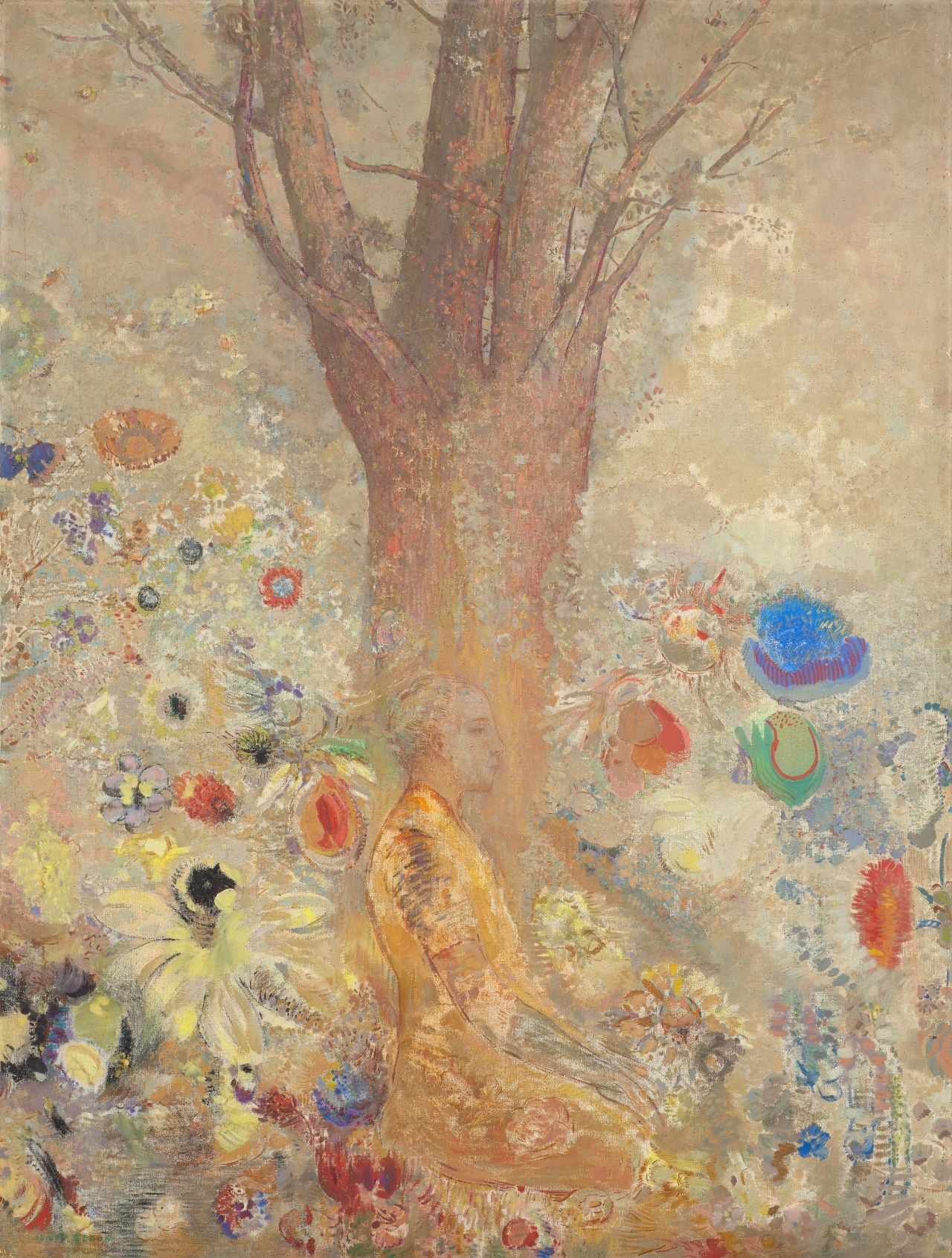
Odilon Redon, Buddha, 1904
Some final thoughts and suggestions:
I think Dorian told me about the Willem Frederik Hermans novella An Untouched House, which was as good as I’d been led to believe. [Ed. – Not me, sadly. It’s still on Mount TBR. Will Matt’s recommender please step forward?] I finally got around to reading Frank Herbert’s Dune, which I’d tried and failed to read when I was eleven or so.As someone who is occasionally paid to review science fiction, it’s a relief to finally cross this off my reading list. The prose isn’t great, but the novel is more than the sum of its parts. I don’t think that The Trees, Percival Everett’s comic guignol procedural about America’s history of racism, with bonus zombies,entirely succeeds, but I now have a whole stack of other Everett novels to read. Adam Mars-Jones’s Batlava Lakeis extremely funny until, on the last page, it isn’t. Anthony Doerr’s Cloud-Cuckoo Land might be too commercial for some readers of this blog, but is absolutely enthralling. [Ed. –For some maybe, but the editor is willing to try all the things.] Small Things Like These by Claire Keegan lived up to the reviewers’ unanimous praise.
Today’s reflection on a year in reading is by Daniel Syrovy, his first for the blog. Daniel is Senior Lecturer in Comparative Literature at the University of Vienna, Austria; he tweets at @daniel_syrovy.
Look for more reflections from a wonderful assortment of readers every day this week and into next. Remember, you can always add your thoughts to the mix. Just let me know, either in the comments or on Twitter (@ds228).
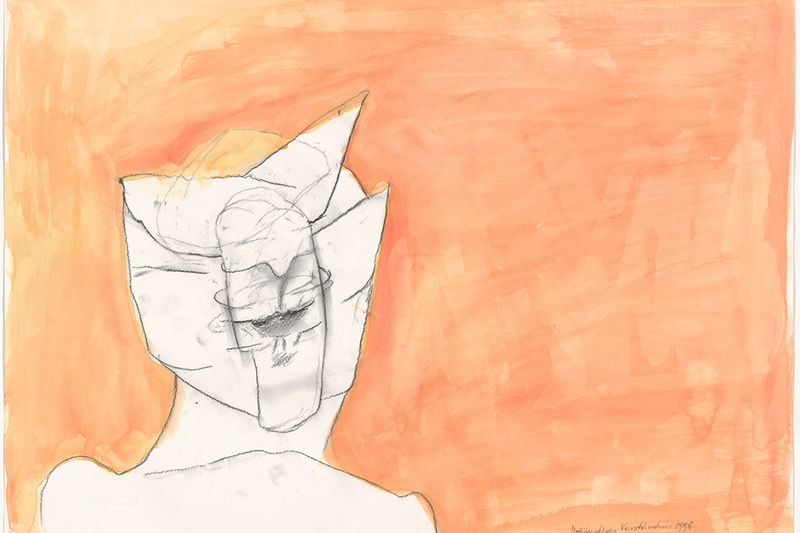
Maria Lassnig, Necessary Understanding, 1998
The last book I finished in 2021 was Milo Dor’s Tote auf Urlaub (called Dead Men on Leavein an out-of-print 1962 translation; some used copies can be found). Despite a number of reprints after 1952, it’s not a well-known novel. Set mostly in Belgrade and the surrounding countryside (and, eventually, in Vienna), it focuses on the Serbian Resistance to Nazi Germany between 1941 and 1945. Its ostensible protagonist, with hints of autobiography, is Mladen Raikow, but a character list included in the 500-page book lists forty characters in addition to “communists, Trotskyists, dreamers, cowards, traitors, real and false heroes, fallen angels, idiots, bootlickers, liars, drunkards, gluttons, whores, blackmailers, and torturers.”
This is not light reading, and despite a good pinch of gallows humor, the novel offers a rather bleak view of humanity. There is not much by way of a plot, but the novel is crammed with short scenes that depict small gestures of solidarity as well as acts of depravity. Dor must have been compelled to put everything into his manuscript, sparing no-one, and it is telling that even my 1992 edition quotes reviews that question whether this should properly be called a novel at all. Of course it’s a novel—but it must have been uncomfortably close to lived experience just after the war.
In fact, I first learned about it in Evelyne Polt-Heinzl’s reassessment of Austrian postwar literature, Die grauen Jahre (2018), which I re-read this past year for a work-related project. One of her central theses is that Austrians in the 1950s mostly rejected realistic texts about the war, but that such texts did exist. I had already spent a summer with a number of books unearthed by this indefatigable scholar, but it turned out there were quite a few interesting titles I had overlooked (including Dor’s collaborations with Reinhard Federmann: a series of crime novels from the 1950s; Federmann’s own novels Das Himmelreich der Lügner and Chronik einer Nacht; books by Hertha Pauli, Dorothea Zeemann, Hans Flesch-Brunningen, Hans Weigel). I’m going to stop naming names in a minute. [Ed. – I hope not!]
With me, such reading projects seem to crop up unexpectedly from time to time, and for the most part they are neither completely work-related (I am a literary scholar and I teach at university) nor exactly spare-time reading. But I do enjoy filling gaps in my knowledge of different literatures, so I follow loose reading lists, for instance on the Celtic Revival: several plays by Yeats, Lady Gregory, Synge, and related material occupied me this past summer. Austrian literature often figures large, too. In 2021, I reread some Thomas Bernhard, and was surprised at the intermittent tenderness of the first half of Correction (1975). I also read Friederike Mayröcker, Helmut Zenker, Alexander Lernet-Holenia and Leo Perutz. Yet, much of this reading follows rather obvious patterns like stepping stones. In preparing these notes, I kept asking myself whether I couldn’t come up with some more interesting observations. [Ed. – Yeah, enough of this boring stuff filled with enticing, new-to-me names.]
It turns out, I loved reading some new old books (a series of newly rediscovered and partly very funny Proust manuscripts published as Les soixante-quinze feuillets in March) and some brand new ones (especially Lisa McInerney’s brilliant third volume of her Cork-based crime trilogy, The Rules of Revelation, Emine Sevgi Özdamar’s autofictional Ein von Schatten begrenzter Raum, and Shida Bazyar’s mindblowing Drei Kameradinnen,reviewed in English here); I also enjoyed some classics – which I would mostly read in bed chapter by chapter over longer stretches of time (from Olivia Manning’s Balkan and Levant Trilogies to Middlemarch to Samuel Butler’s The Way of All Flesh). I took my cues from friends and Twitter-friends [Ed. – Wait, so we’re not like your real friends?], from the LRB, from other books. I was happy to break open volumes I already owned (Yoko Tawada’s Memoirs of a Polar Bear; Susanna Clarke’s Piranesi; Bely’s Petersburg) and to pick up new ones (Pola Oloixarac’s Mona; Percival Everett’s Erasure). Hopping between languages and centuries was always something of a comparatist’s credo with me [Ed. — Comparatists 4eva!]. But I hesitate to call this a noteworthy pattern.
It does not escape my attention that despite buying new books at a steady rate, I picked up stacks of books from the library as well, often going there twice a week. A reduced social life will do that sometimes. And perhaps it is true that during the pandemic I was a more restless reader than usual. Unsurprisingly, there are quite a few books I did not finish. Looking at my rather disparate and unsystematic notes (I have neither a Goodreads account nor physical lists), I can’t come to any definitive conclusions. I know that I listened to an incredible amount of Grateful Dead live shows in 2021, something I had never done before. But to relate all of my reading habits to the state of the world and my own preoccupations? To quote from a recent read, Anna Wood’s book of short stories Yes Yes More More, “I kn[o]w better than to think for too long about my internal organs after taking acid.”
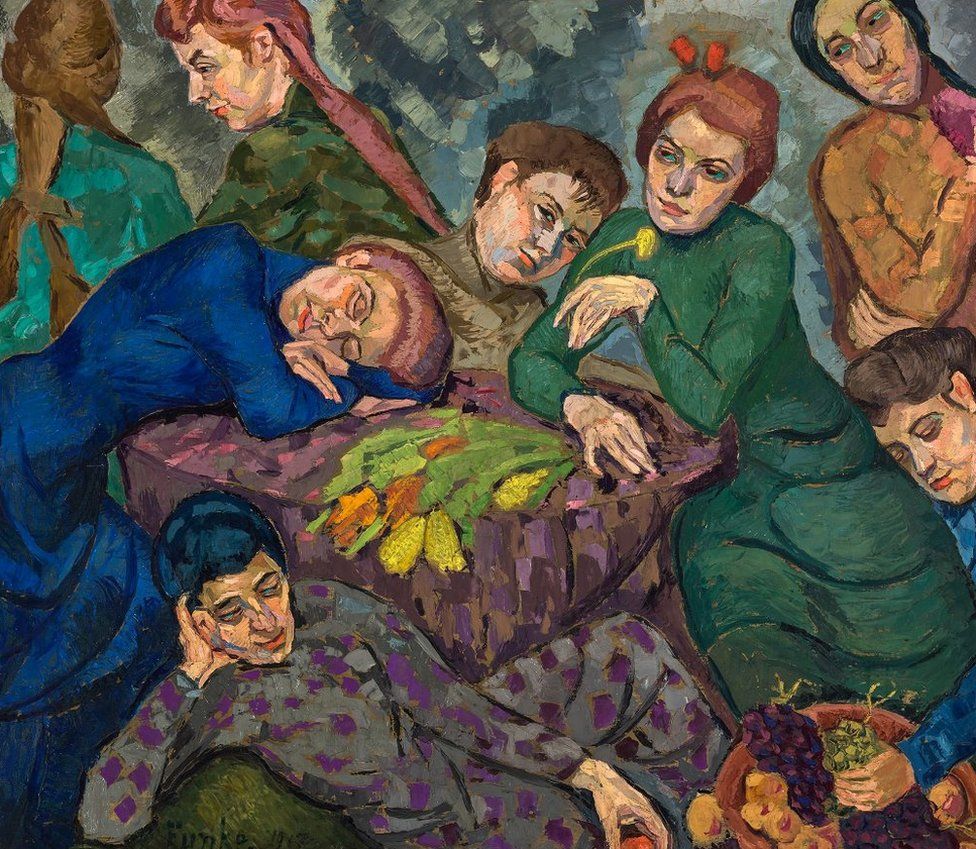
Helene Funke, Dreams, 1913
Maybe, one day such patterns will emerge more clearly, and I’ll be the wiser for it. In the meantime, I’d rather mention another discovery that is already turning into a reading project. I always liked concrete poetry (well-established in Austria with writers such as Ernst Jandl, seen here performing at the Royal Albert Hall in 1965), and between that interest and preparing an introductory lecture about poetry, I came across a recent volume by the Brooklyn-based publisher Primary Information, Women in Concrete Poetry1959–1979. Since overlooked women writers are always a high priority, I couldn’t resist, and the volume doesn’t disappoint. It features 50 poets from all over the world (from Sonja Åkesson to Chima Sunada to Rosmarie Waldrop), with a selection that mostly follows a 1978 Venice Biennale exhibition curated by Mirella Bentivoglio. Accordingly, the volume looks very much like an exhibition catalogue, with thick glossy paper. The nature of the poetry lends itself to it, as well, written as it is in many languages, partly in color, with striking visual aspects and often presented as collages with repurposed images. Standing out for me were a few pages by the American Madeline Gins, in particular a page showing layers of text thickly typed over one another with a typewriter that I tweeted about in early December. The page ends with the lines “The body is composed 98% of water. This page contains every word in the book.” So I read on. The passage comes from Gins’s bookWord Rain(1969) which is reproduced in full in the 2020 Madeline Gins Reader The Saddest Thing is That I Have Had To Use Words (Siglio Press; ed. Lucy Ives), which I have only skimmed so far. Some of this is not exactly concrete poetry, but it is very appealing, so who cares. And anyway, filling some gaps in my knowledge of the contemporary Austrian writer Ann Cotten (herself a poet, novelist, and translator of Rosmarie Waldrop), especially the wonderful lecture series Was geht (2018), I was alerted to Liesl Ujvary, a Viennese poet who started out with a very funny volume in 1977, Sicher & Gut,some of which would certainly be classified as concrete poetry. These converging patterns are what keep me going. Ideally, two or three of them at once.







 Eiger, Mönch & Jungfrau