What I Read, September 2023

Don’t ask me what happened in September, it was a long time ago. I’m amazed I’m even writing this post.

Alex Katz, Lake Light (1992)

Dwyer Murphy, The Stolen Coast (2023)

I liked Murphy’s debut, An Honest Living. But I liked the follow-up even more. So much so that I’d have to call this my most enjoyable reading experience of the year. Murphy seems to know stuff: how to use the law to do things that aren’t really kosher, how to order in a dive bar, how to post in a pickup game. Jack, our narrator, has a pedigreed law degree, but he lives in his hometown, an appealingly ramshackle Massachusetts coastal town that is for sure not the Cape. He works with his father in the family business: helping people shed their identities and giving them new ones so they can start over. People on the run from criminal outfits, companies they’ve stolen intellectual property from, pasts that got too hot. I loved this premise and wanted even more of it.

Here’s Jack reflecting on how you can’t start totally from scratch in creating a new identity—everyone’s been damaged and that’s important:

You want to preserve a little trace of that damage. From parents, boyfriends, husbands, estranged siblings, jilted nobodies, pissed-off bosses who put a credit check on you ten years back for no good reason except you were leaving with two weeks’ notice. A past is a string of resentments and grievances. Grudges that never amounted to anything but were felt for a time. I paid a kid in Iceland to handle the digital traces. It might have been a pack of kids for all I knew. Healthy wind-kissed boys in front of computers, Viking aggression moving through their blood and no lands left to pillage, but they wanted money to walk around with and this was the work they had chosen.

That old-fashioned reference to “walking around money” turns those wind-kissed boys into something from the Rat Pack. Love it.

The quote gives you get a sense of Jack’s voice (Murphy keeps on like he started, he’s gonna be our next Portis.) And he’s not the only great character, either. Jack’s father is a delight, a man who knows how to eat, and chat up the ladies, and perform spycraft: he may be suffering from an incurable illness, though, and maybe things are going to change in Jack’s life.

When an old flame/best friend/absolute pistol, herself a lawyer working at the edge of the law, comes home for the summer, things definitely change. Jack gets involved in an elaborate heist, the machinations of which are pure pleasure. Speaking of pleasure, the main appeal of the book is Dwyer’s prose, which snaps with epigrams (“sincerity unmans me”) and jokes that don’t try too hard:

I went inside for a while and sat at the bar. It was a long block of wood nailed into legs and looked like something you might build in your basement and then forget about for several years.

I read this book over Labour Day weekend and that was a nice thing I did for myself.

Yiyun Li, The Book of Goose (2022)

After getting along with Li’s first novel, I turned to her most recent. I disliked it! Rohan’s take mirrors mine. I really didn’t understand why this novel had to be set in France. On the one hand, Frenchness seems to matter to it a lot. On the other hand, not at all. Feels like Emperor’s New Clothes to me.

Christine Mangan, The Continental Affair (2023)

If “atmospheric” as a term of literary praise means “set in European locales, especially those off the beaten track,” then this is a highly atmospheric novel.

In other words, we get Paris, yes, but we get more of Belgrade. Still more unexpected are Grenada and the peripherally European spaces of Istanbul and Algiers. But Mangan’s latest is more Hitchcock than Bourne. The best literary comp might be Highsmith.

A woman enters a train compartment otherwise occupied only by a ruggedly handsome man. They exchange pleasantries, watch the countryside of 1960s Europe flash by from the windows of the dining car, and warily seek to move past each other’s defenses. Part meet cute, part slow burn. But they’re acting. They know each other already. In fact, the man has been following the woman across the continent, tasked with retrieving some stolen money—something he could have done ten times over already, but can’t find it in him to do.

Brainy thrillers with nice locales are catnip to me, even though Mangan freights her characters a little heavily: they share a dramatic past neither can let go of. But she nails the ending, and even if The Continental Affair is a mere diversion—the title is so generic it’s like a parody—it’s adeptly done. Can’t wait for Cate Blanchett to star in the inevitable adaptation. Get this for the dad in your life who fancies himself a man of taste: he won’t be able to resist.

Simon Jimenez, The Vanished Birds (2020)

I can’t remember who put me on to this remarkable space opera. Adam Roberts? (Google search drew a blank.) I do remember where I bought it: a little shop in Missoula a couple of years ago. (Not the Shakespeare one. The other one.) I don’t remember what made me take it off the shelf. (I went back and forth between the audio and the paper book. Good narrator.)

I can say that The Vanished Birds will be on my end of year list. It’s that moving, that smart, that surprising.

It’s a long, complicated book. (Though not a patch on his most recent, The Spear Cuts Through Water, which I had to give up listening to, it was just too hard for my commute, but that book too astonishes right from its kickass dedication, “This one’s for me.”) My summary won’t do it justice. But here goes. In a galaxy owned by a single company, a spaceship arrives every five years on a small “resource planet” to take the accumulated harvest to the galaxy’s central planet. At the festival celebrating the ship’s arrival, the captain, Nia, hooks up with a local. They meet each time she returns, but the thing is that, thanks to time manipulation technology, what’s five years to him is only 15 months to her. She barely changes while he leaps forward in age.

But this poignant story is only the beginning of Jimenez’s tale. One year, in between spaceship arrivals, an unknown ship crashes into the fields. The man who loves Nia takes in the only survivor, a mute young boy, before passing him on to her on her next visit (the last one the now elderly man will live to see). Nia names the boy Ahro. It takes years before he speaks, but his musical abilities suggest there’s something special about him. That quality is recognized by Fumiko Nakajima, the lead designer/engineer/physicist of the company that runs the galaxy. Thanks to cryogenic technology, Fumiko is thousands of years old; Jimenez diverts us to her story, which begins on a near-future earth that she escapes just before it collapses due to climate change, but not without leaving behind her lover, a woman determined to see the place through to its end. Fumiko suspects that Ahro has a talent that could undo her past mistakes—but she knows the company that owns everything, even her, would subject him to vivisectionist experiments if it knew what the boy is capable of. She hires Nia on a mission to keep the boy, now a young man, on the fringes of the galaxy, away from company patrols. In the process, Nia becomes his parent. When Ahro is captured despite her efforts, only she can save him…

That’s a lot, right? The Vanished Birds is a novel of found family, colonialism, ecological change, time the revelator. Big stuff. It’s bold and beautiful (the prose is a cut above) and too carefully constructed to be called sprawling. I think about it a lot, several months after having read it, not least the section set on a planet that has bought by the company and stripped of its people, populated now by dozens of feral dogs and one last man, left behind to man the radio tower. I shed a tear at the end, I tell ya.

Garth Greenwell, Cleanness (2020)

I first read Cleanness in March—I never wrote up that month, and I probably never will. I’m glad of the chance to say something here, because I love this book. I already thought it was great the first time, but having had the chance to teach it, I’m convinced it’s brilliant. Like “we will read this in a hundred years” brilliant.

A companion piece to his wonderful debut, What Belongs to You, Cleanness is also narrated by an American teaching in Bulgaria. But the new novel is richer, its power coming from the montage of its seemingly disparate, almost stand-alone sections. To my mind, it is also better in that its references to the narrator’s childhood are cut to the bone. The handful of references hit that much harder than the extended section in the previous book.

I read Cleanness as a novel about different ways bodies can come together. Readers are most often drawn to the scenes of anonymous BDSM sex, but several chapters feature the narrator’s more placid relationship with another foreigner, a student from the Azores. Others describe a writing retreat, two describe encounters with current and former students in which the narrator wrestles with what it means to be a gay role model in a country where LGBTQ life is harshly penalized. A particularly fascinating chapter describes a series of spontaneous street protests that convulse Sofia, and the narrator’s admiration and fear of the unpredictable power of masses of bodies in public space. Even when we try to reduce ourselves to pure flesh, Greenwell implies, we can’t escape identity. But identity isn’t fixed; the roles we’ve been given are just that, roles. They can change, we can push against them even when their forms are ossified and seemingly inescapable. (That’s what politics is for.) This idea comes across most clearly in a chapter called “The Little Saint,” whose titular character, a bottom who lets men bareback him, gently explains to the narrator that the violence he begs the narrator to unleash upon him, which brings the narrator to tears, since the sounds of the whipping he lays on the young man seem to have turned him into a version of his father, who was never shy with his belt, the violence that is demanded by one person of another, can never be the same as violence enacted in hate or rage.

The book ends with a beautiful scene involving an elderly dog who wanders the campus of the international school where the narrator teaches. The narrator, drunk and alone, having narrowly avoided making a mess of some important things, takes the dog into his rooms even though it’s strictly forbidden to bring her inside because she’s meant to have fleas. He makes up a bed for her and then lies down next to her. An indelible scene. Here I take Greenwell to be saying that we can’t take the cleanness granted by the Little Saint and wished for by the protestors who want to sweep a corrupt government out of power too seriously. Cleanness but not too much: it’s good to lie down with beings, human or not, that others think of as dirty.

Seriously, this book is something else. Greenwell has such intelligence and such beautiful prose. Thrilling.

Sadly, most of my students did not feel the same way, though some of them were big enough to admit that they were kink shaming. No matter, Imma teach it again!

Georges Simenon, Cécile is Dead (1942) Trans. Anthea Bell (2015)

Day after day Cécile Pardon waits for Maigret at police headquarters, unwilling to see anyone but the great man, and when she does she has nothing more definitive to report than a suspicion that someone has been in the apartment she shares with an elderly aunt. When he sees her in the waiting room (the lads call it “the aquarium”) on a day when he’s just not feeling it, he slips out the back. She’s gone when he gets back to the office. But then the aunt is reported dead, and Cécile is nowhere to be found. (You can guess the rest; the title is not a metaphor.) Plottier than the average Maigret, this early-ish installment is further enlivened by the presence of an American detective who comes to see how the big man does his thing. (Simenon liked this idea: there’s one where someone from Scotland Yard does the same thing.)

The investigation centers on the apartment building where Cécile lived with her aunt. You could read Cécile is Dead, with its depiction of the space and the people who inhabit it, as a slantwise homage to Zola’s Pot Luck.

Annie Ernaux, Happening (2000) Trans. Tanya Leslie (2001)

Having taught Happening this semester in a class called Bodies in Trouble, I was interested to go back and read what I had to say about it three years ago. I see that I was damning with faint praise already then; spending a lot more time with the book didn’t make me care for it more. As for my students, they seemed to like it well enough. Understandably they couldn’t help but read it in terms of their post Dobbs American life; more surprisingly, they were mostly worked up by what they perceived as Ernaux’s class striving: they saw her as both a victim of and complicit in the denigration of working class lives. Their end of semester feedback revealed that they could take it or leave it as a course text. Good to hear, since I’d already decided not to repeat the experiment. I get that Ernaux is doing a thing; I just don’t care much for the thing. And her prose, as shaped by her various no doubt able translators (here Tanya Leslie), does not lend itself to the kind of close reading that is my pedagogical bread-and-butter. Whatever, Ernaux will get along just fine without my reservations.

Joseph Hansen, Troublemaker (1975)

I thought I wrote about the first novel in the Dave Brandstetter series, Fade Out, when I read it a couple of years ago but now I can’t find it in the perhaps-not-reliable index of this blog. In this, the third book (they’re all being reissued but the store didn’t have the second one in stock), the owner of a local gay bar is found naked and dead. A local hustler is found next to him. An open and shut case. Not to insurance agent Brandstetter. Surprise, surprise, he’s right, and soon he’s neck-deep in a twisty plot that once again makes the 70s seem both shitty and terrific.

These books are great above and beyond any talk of “pioneering representation” (tho that matters), it’s great that they’re back in print, it sucks that my local library does not have them.

David Brintzenhofe Applying Makeup (II) (1982)

There you have it, friends. Have at me, Ernaux lovers, The Book of Goose partisans, and anyone who thinks all the books I liked are overrated…

What I Read, November 2023

Thanksgiving is the best time at the farm. You can walk without fear of ticks. Down to the creek—entirely dry at the end of a year of terrible drought—then up Acorn Hill and along the ridge. Contour down past the old and new ponds to the cornfield and take the long flat path back to the creek. At Thanksgiving, you can see the bones of the land: the rolling hills, the sharp edges between scrub forest and fields, everything clear now that the leaves have fallen. This year a big pin oak was down over the Acorn Hill trail; my father- and brother-in-law cleared it, happily messing about with chainsaws. The days were more cold than warm with a sharp northwest wind: good weather for running the gravel road to the blacktop and back. At night you can see a heap of stars. If you leave the cozy house to crane your neck at the sky the barn cat sometimes comes out of his little house to check on you. He is a meeower, a winder through the legs; one day he’s going to kill someone. You can stay inside and read too. That’s what I did.

Lowell Birge Harrison, A Wintry Walk (undated)

Marian Engel, The Tattooed Woman (1985) 

Even more of a mixed bag than most story collections. Engel’s stories do not hit me the way her novels The Honeyman Festival and of course Bear do. But even though the latter is much the most interesting thing she ever wrote, I don’t think she’s a one-hit wonder.

I read The Tattooed Woman because I was meant to talk about it with James and Shawn in our continuing series of Engel conversations, but then we collectively decided we weren’t sure how much we liked the book and I was too exhausted from the semester to find out. I regret that now, though; I suspect we would have talked our way into liking it more than we did on our individual readings.

Engel died young of cancer (this collection was published shortly after her death) and some of the best stories here feature characters with that illness—or, in “Two Rosemary Road, Toronto,” the one I liked best, a man whose wife has died from it. The narrator writes a letter responding to one he’s recently received from a neighbor, a screed insisting that the narrator’s wife must have brought the illness on herself. The narrator reacts to this vitriol with understandable scorn but as he fulminates he gives in to his own loneliness and the suggestion of sexual intimacy hinted at by the letter writer, a possibility he is willing to explore, despite, or perhaps because of, the aggression he imagines such a relationship would involve.

Unsettling stuff.

I shivered pleasantly at “The Country Doctor,” a ghost story about a woman sent by a Toronto-based magazine to an unnamed but easily recognizable St John’s, Newfoundland, who is taken up by a doctor who might a Bluebeard. I liked “The Smell of Sulphur,” about a woman who returns to a faded resort on Lake Huron where she spent a summer as a solitary teenager.

What struck me most about the book is how foreign the 60s, 70s, and 80s Canadian settings felt to me, even though I lived through much of them. A function, I suppose, of Engel’s enmeshment in an adult world I wasn’t yet part of.

I’m not saying you need to run out and find this collection. Nor that Mavis Gallant or Alice Munro need worry about being dethroned as the champions of Canadian short fiction. I’m guessing Engel wrote these stories for money, writers could still do that back then, and too many feel, well, maybe not listless but a little pat. But when she gets her strange on, she’s good.

Celia Dale, A Helping Hand (1966) 

Disquieting and gripping novel à la Highsmith or Rendell and just as good. A married couple holiday in Italy as a reward after the rigors of taking care of an elderly aunt. Josh ogles every woman he meets, especially one of the chambermaids at their pensione; Maisie ignores this, as she has other fish to fry and knows how to turn her husband’s roving eye to advantage. The pair fall in with a young woman and her elderly aunt by marriage, two more Brits squabbling their way through a holiday of piazzas, frescoes, and, to their sensitive tummies, too-greasy food. (Bowel movements and bedpans feature prominently.) I say “fall in” but “latch on” would be more accurate. The couple has its routine down: Josh courts the old woman with little attentions that remind her of her late husband, while Maisie commiserates with the niece, who feels her life wasting away with nights spent pouring out tea. Working together as ruthlessly as a pair of collies with a flock, they separate the women, leading to their final move: they offer to take in the old woman as a PG, a paying guest. It’s enough to make you wonder what happened to that other woman, the aunt who turns out to have been an “aunt”…

Dale wrote a lot of books, seems like, but went forgotten until Daunt started reissuing her books. (The valiant folks at Valancourt have brought some back into print in the US, but I’m ashamed to say I plumped for the Daunt because I liked the cover better.) If A Helping Hand, with its brilliantly ominous title, is any guide, that neglect is a scandal. Dale mixes a palpable atmosphere of menace—she savages suburban England even more than Rendell in, say, One Across, Two Down—with a hint of decency, just enough to keep our gorge down. But then comes a stunning ending, a real stinger, that reverses much of what we thought we knew.

A perfect book for a November weekend.

Ann Petry, The Street (1946) 

The title of Petry’s debut—the first novel by an African-American woman to sell a million copies—refers to 116th Street in Harlem. The beautiful Lutie Johnson, separated from her husband after a job as maid to a rich couple in Connecticut put too much distance between them, moves into a dingy tenement with her young son, Bub. She hates the place, no amount of scrubbing ever gets anything clean. but it’s all she can afford, and she’ll do anything to save enough to move somewhere better.

Well, not anything. She rejects with frosty contempt the offer of a woman on the main floor—stocky, bewigged, inscrutable Mrs. Hedges, always at the window—to work at her brothel. But her desperate economies never get her ahead, and before long she’s spending too much of her energy fending off the incoherent, animalistic advances of the building’s super, Jones. (I wonder what Richard Wright made of that guy—did he see an homage to his own work there?) Meanwhile, Min, the woman who lives with Jones (I don’t know what to call her: not his lover: kept woman maybe; she is more a slave than anything else), seeks out a rootworker to keep her man. The cross and powder work on Jones, but even more on Min, who finds the strength to leave. She is the most fascinating character in what, as I hope my summary suggests, is a novel filled with vivid characters.

At the only bar on the street, run by an enigmatic white man named Junto who has a history with Mrs. Hedges, Lutie meets a jazz musician who offers her the chance to sing with his band. Finally, a different life lies within reach, the life promised by Lutie’s to-me surprising guiding star, Benjamin Franklin, in which hard work and talent will be rewarded. That’s good, because Bub is spending too much time with Jones. Trouble looms. And then things get a whole lot worse.

The Street is one of the more exciting works of social realism I’ve read. Picture the milieu of Bernard Malamud’s early stories—I’m thinking the likes of “The Bill” or “The Mourners”—but with more hopelessness and even less upward mobility and you’ll have a sense of this depressing, riveting novel.

I started Petry’s other well-known novel, The Narrows, a year or two back, but it wasn’t the right time and I couldn’t get on with it. Seems like it’s time to try again.

Nick Harkaway, Titanium Noir (2023) 

Sf/noir mashup in which our dogged PI protagonist, Cal Sounder, is called in to investigate a murder. (He plumbs the depths, like.) The victim seems to have been a mild-mannered academic but two things suggest otherwise: he’s over seven feet tall and doesn’t look a day over 30, even though he’s actually 90.

That means he’s a Titan, and Titans don’t get murdered. These genetically modified humans basically live forever and grow each time they take one of the patented T7 infusions, operations that send their bodies into such paroxysms that are incapacitated for months afterward. To undergo more than two or three such procedures is beyond risky. Too bad that a side effect is a corresponding change in personality. Titan appetites are typically as gargantuan as their bodies. There are only a thousand or so Titans; the technology is carefully guarded by its developer. (Titanium Noir allegorizes the predations of our own global oligarchy.) Cal is a Titan expert: his ex is the developer’s daughter. Ex because he refused the chance to get the shot

Like Marlow, Spade, Archer, and dozens before him, Cal stirs up some shit: gigantic, immortal shit, to be precise. Good fun.

I’d tried Harkaway once before and it didn’t stick. But I might have to revise that opinion. Quality non-taxing stuff.

Ed Park, Same Bed Different Dreams (2023) 

I devoured this epic, Pynchonesque novel over Thanksgiving. I can’t even remember all the multitudes it contains, but its central conceit imagines that the Korean Provisional Government (KPG), a real-life group founded in 1919 by exiles in China to protest Korea’s occupation by Japan, continued past the Japanese surrender in 1945. Its goal? A free, independent, reunited Korea. The KPG’s machinations—some real, many invented—are revealed in a series of enigmatic manuscripts that fall into the hands of a Korean American writer named Soon Sheen who works for a tech behemoth, half-Amazon, half-Google, known by its “acronym” GLOAT. The letters don’t stand for anything; much of Soon’s job is to create similar acronyms for company practices and products.

As in early Pynchon, the idea of meaning—something we need and will do anything to create even though doing so often leads us astray—lies at the heart of Park’s novel. Fascinatingly, many of the strands woven into the shape of this novel feature Park’s home town of Buffalo: the assassination of President McKinley at the Pan-American Exhibition at the hand of an anarchist in love with Emma Goldman; an African American fighter pilot who returns to the city after being shot down in MIG alley and imprisoned by the Communists, whereupon he works the family appliance repair shop and writes paranoia-infused science fiction that goes unnoticed in the mainstream but gains a cult following, not least by the KPG which sees in the lurid texts secrets to political change; the history of board games and how they contributed to the early development of AI; the downing of Korean Airlines flight 007 by the Soviets in 1983, an event I was sure would launch nuclear war; and, most delightful to me, the history of the Buffalo Sabres, including a close reading of the notorious Brett Hull goal that cost that often-luckless team the Stanley Cup in 1999. (He was in the blue paint!)

Who knows if this book will stay with me long term—but I relished its exuberant ride through painful 20th century history. The title refers to a Korean maxim about the projections foisted by foreigners on that peninsula for centuries. But it also reminds us that everything can be different than it is: we never dream in the same bed twice, that sort of thing.

Maybe that paean to dreaming and imaged futures is the reason the novel is filled with fathers who, no matter how feckless or absent, dote on their precocious daughters. (The number of precocious daughters in contemporary American fiction is all out of proportion, it seems to me. But as a father who dotes on a precocious daughter, I’m hardly one to complain.)

Thanks to Levi Stahl for repping this.

Adania Shibli, Minor Detail (2017) Trans. Elisabeth Jaquette (2020) 

Many of you will know that Adania Shibli was due to receive a prize for this novel at this year’s Frankfurt Book Fair when organizers postponed it indefinitely due to the situation in Gaza. (If it walks like cancellation, talks like cancellation etc., etc.) Don’t get me started on the upside-down world of “memory culture” in Germany today, of which this ignominious decision is part. The only good news is that a lot of people went out and read the book (or bought it, anyway). I’d had it sitting on the shelf for a couple of years and was glad when a new book club I’m part of made it our first selection. Several in the group had read it before: I benefited enormously from their familiarity with the text and thoughtful interpretations. I’m grateful to them all. As the title suggests, in Minor Detail every little thing counts; it’s a book that invites re-reading—even as it points out the dangers of definitive interpretations (obsession, paranoia, the fantasy that constant vigilance can make ideology come true).

Precisely divided into two obliquely-connected halves, the novel tells two stories. The first, set in August 1949, concerns a squad of Israeli soldiers who happen upon a Bedouin family in a “mopping up” mission in the Negev. The encounter ends disastrously: the entire family is murdered, even its camels, except for a teenage girl, who is brought back to the soldiers’ camp, where she is raped and eventually murdered. The second centers on a woman in near-present day Ramallah whose obsession with the crime has everything to do with its having happened exactly 25 years before her birth. Her quest to uncover the details (which as readers we already know) leads her to undertake a dangerous journey outside the West Bank, one that ends in failure and tragedy.

Shibli’s book might be short, but the questions it provokes are not. Are representations of traumatic history (including this very novel) fundamentally different from official representations of a violently conquered space (maps and archives)? Can the past be told in a way that evades representation’s tendency toward reduction, circumscription, and closure? When we read can we avoid the fantasy of conclusiveness? (No accident that this so carefully shaped text opens and closes with references to the atmospheric phenomenon of the mirage.)

It’s too late for next semester, but I’ll teach this important book in my Literature after Auschwitz class going forward.

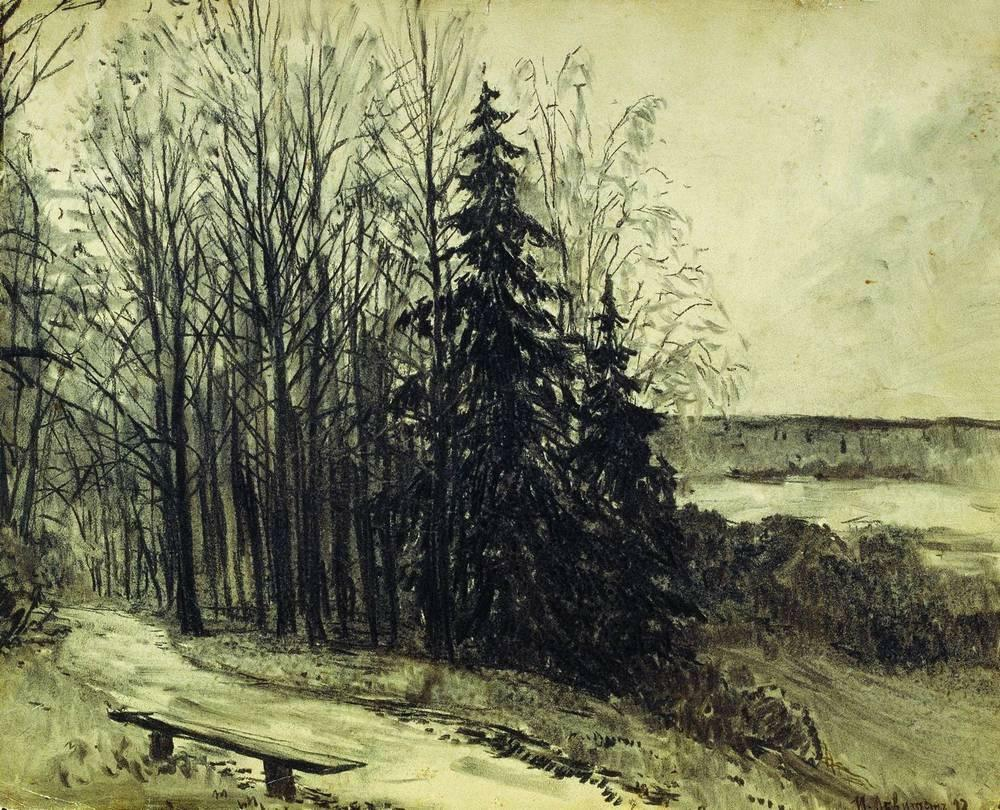
Isaac Levitan, Landscape (1892)

That was November. More on December soon.

“A Canadian Loser”: Brian Moore’s The Mangan Inheritance

Now as he came closer the man reached up to the collar of his slicker and opened it, letting it fall back to reveal his windburned face, which was partly hidden by a few weeks’ growth of beard. But even with the beard, even in the shadow cast by the low-brimmed hat, Mangan saw it clear. It was his face.

Now that’s some Daphne Du Maurier or Patricia Highsmith-level doubling right there. But this passage isn’t from either of those wonderful writers. Instead it’s from another underappreciated 20th century writer who, like those precursors, works primarily in the realist vein but flirts with its representational others: the fantastic, the Gothic and, especially, the uncanny. Brian Moore was born in Northern Ireland, came to Canada in the late 1940s, and eventually settled in California. He wrote 20 novels and, if The Mangan Inheritance (1979) is any indication, I have a lot of satisfying reading ahead of me.

13_valerie_anex_ghost_estates-17

The character who sees his own face in another man’s is James Mangan, a former poet, a former journalist, and the former husband of a famous actress. This encounter is in some respects the climax of the novel. It’s precipitated by a moment early in the text, in which Mangan, rummaging through some old family papers while visiting his father, finds a daguerreotype of a man who looks just like him. The image, dated 1849, has the initials J. M. penciled on the back. Mangan believes he is looking at the (actual, I was surprised to learn) 19th century poéte maudit James Clarence Mangan, and, moreover, that the man is his direct ancestor, even though most biographies claim he died childless.

Having suddenly come into a large fortune, and freed of all responsibilities, Mangan travels overseas in order to confirm his suspicion. It is January, and Ireland is cold and rainy and poor. Many of the people he meets are suspicious, even hostile. But he feels ever more alive on the trip, especially when he meets some previously unknown cousins. And always he carries the daguerreotype, carefully wrapped in plastic, in the inside pocket of his coat, for every time he looks at it he feels an electric spark. Some kind of force makes itself felt, convincing him he is connected to his lookalike.

Various misadventures on the wild coasts of southwestern Ireland lead him to the encounter described in that passage, which turns out to be with an uncle everyone thinks is dead. Which means there are three identical men. What connection binds them? Has a creative force, a virtuosic artistic talent, been mysteriously passed among them?

220px-TheManganInheritance

One of the things I like best about the book is how far Mangan and the novel have travelled to reach this point. The book begins with Mangan in his apartment in New York. The door bell rings. It’s the super, come to fix a leaking faucet. “You have bathroom trouble?” he asks. This trouble is easily fixed, but before long Mangan has plenty of other, less remediable troubles. (Impossible not to read that word without thinking of Ireland’s Troubles, not to mention the wonderful J. G. Farrell novel, also from the 1970s, of the same name.) In the end, the man Mangan discovers, the man who shares his face, has bathroom troubles of his own, albeit of a more disturbing, irreparable, and corporeal sort.

But the swerve away from the domestic (the simple business of replacing a washer) is characteristic of the book’s trajectory, which is to break away from all that seems familiar. (This seems to be a real preoccupation of 1970s English-language fiction: I’m thinking of some of my favourite novels: The Summer before the Dark, Desperate Characters, Bear. Make of that what you will.) The book keeps moving, ever onward, from New York to Montreal to the snowy Laurentians and on to Ireland, and, once there, from small towns to a shuttered and ominous Big House to a windswept headland and a man in a tumbled down Norman keep. Only in the last handful of pages is there a return of any sort, and even then it is only geographic. Mangan goes back to Montreal, his home town, but to greatly changed circumstances that will require him to live a different life, if he is willing to do so.

Mangan’s isolation is as much emotional as geographic. Just as he is led further and further off the beaten track so too do his connections to other people fray. His initial exultation at meeting his extended family doesn’t last; before long, Mangan finds himself increasingly adrift. The more he learns about the men who share his face, the less he wants to be like and with them.

That uneasiness appears in a scene in which Mangan, blundering in the dark through a house that once belonged to the family but has been sold to a foreigner, comes across a mirror. He’s led to an uncomfortable thought:

He stared in terror at the face: a narrow old mirror framed in a gold-scrolled leaf and in it, glaring at him, ghostly pale, eyes glittering with the steely hysteria of an insane person, the features frighteningly bruised, lip swollen, missing front tooth: himself. And in that moment he knew why the house resisted him. I am the ghost that haunts it. (Moore’s italics)

How about that first sentence? That second colon, unusual where we might expect a comma to complete the itself incomplete (since the verb is elided) clause “and in it himself,” has the effect of suggesting that he himself is essentially this bruised and swollen figure. (He’s been jumped in a bar—and in so doing becomes ever more like the 19th century poet, not only in his dissolute-ness but also in his physique: the daguerreotype shows him missing the same tooth.)

And how about that final sentence? I am the ghost that haunts it. Creepy! Yet here is where Moore diverges from writers like Du Maurier or Highsmith. Whereas those writers would ask us to take the haunting seriously, as a way to make a point about identity, say, Moore ends up rejecting it. Or, rather, his ghosts are more mundane, if no less scarring. The Mangan family isn’t the repository of creative vitality, the flip side of which would be demonic grandiosity. More upsettingly, the family is ordinary in its cruelty. Some dramatic and sordid things have happened to its members, but they result from common, though terrible, bad behaviour.

All of which is to say that the terror Mangan experiences in front of the mirror is as misguided as the exultation he feels later when, in a sample of the lovely description of landscapes that Moore almost offhandedly weaves into the text, he makes his way to the encounter that he thinks will change his life:

On the other side of the wall was a footpath, a narrow, little-used track in the long rush grasses, leading back up the headland to a white, two-story farmhouse overlooking the sea. It seemed to be about half a mile away, and as he settled down to the uphill walk, the intermittent rain through which he had driven all morning was hurried off by strong, gusty winds coming in from the sea. High cumulus clouds sailed over the blue dome of the sky. Below, to his left, the sea fielded a platoon of angry whitecaps to race on top of its blue-marine depths. The bare green headland, the white house, the azure sky, all of it reminded him of a painting harshly etched, lonely as a Hopper landscape. He felt alive with expectation, as though, like someone in an old tale, he at last approached the sacred place to meet the oracle who knew all secrets. He put his hand in his pocket and touched the daguerreotype as though it were a charm.

When he passes the farmhouse and toils to another slope to his final destination and encounters a man who looks just like him, as described in the passage I quoted at the beginning of this post, he feels “elated as though he had stumbled on a treasure.” But the vision of “a man amid his books in a ruined Norman tower, living liked a hermit writing his verse” quickly sours.

Indeed, the promise of his own artistic rejuvenation, passed from the 19the century poet through the hermit and his verses reverses itself: rather than passing down genius perhaps his doubles can offer him only sordidness. Mangan speculates that “his double, like some scabrous sufferer from a dread disease, signaled that his listener was also infected.”


valerie-anex-1340810897-4894

In the end, this speculation is a fanciful as the one that led him there. No genius throbs in the Mangan blood, but neither does there lurk degeneracy. The Mangan Inheritance is ironic in its title, and indeed its disposition. It rejects genetics as an explanatory force. The inheritance of anything more than mere physical appearance proves to be a myth. There were and are no poetic geniuses in the family, but that’s okay since genius has been used to whitewash abuse. The book has no time for the idea of inherited traits. Nothing is passed down; rather, things are passed onward. Mere circulation matters more to the novel than any idea of fate or destiny. After all, the most important inheritance, the only one that has any actual force, is the one that comes to Mangan from his ex-wife. And that one, the Abbot Inheritance, wasn’t even earned by her, despite her fame.

Transmission in The Mangan Inheritance takes the form of capital, not genes: and capital doesn’t care who it belongs to or what right they think they have to it, what belief systems they’ve created to legitimize it. It just wants to be spent, like a virus blindly seeking out a new host. (A salutary lesson for our own era, which is as obsessed with genes as with capital, and, with every advertisement for genetics testing, binds them more tightly and ruinously together.)

bf6b5e0

James Clarence Mangan, looking suitably diabolical

The only thing I didn’t like about the book is its depiction of Kathleen, Mangan’s young, beautiful, and damaged cousin, with whom he quickly becomes obsessed. She is consistently objectified, and even though the book makes it clear that this is Mangan’s vision, and that he is taking advantage of her (even as it allows us the possibility that she might be doing the same to him), and that this is just one of many things that have gone wrong in the family—not because there’s some mysterious taint in their blood but because they behave badly to each other—I couldn’t get passed the feeling that the book also enjoyed the objectification. This is the only way in which the book felt dated.

But in general Moore’s use of description is compelling. I wouldn’t call it a lyrical book, but there are lots of lovely bits, whether arresting word choices (surprised by a visit from his ex-wife, Mangan feels “his heart hit”—the intransitive use of the verb is evocative in its amorphousness, capturing how lost he feels), memorable phrases (castigating himself for losing his wife to a rival, Mangan tells himself, “And if she ditches you, it’s because you’re a loser. A Canadian loser.” (Is there any other kind?)), meta-reflections on the nature of the narrative masquerading as reflections of the main character (“To sit here in the car while the priest administered extreme unction to a dying Irish woman seemed a dream which like all true dreams moved at its own mysterious pace, without logic, toward a purpose he did not understand”), and evocative descriptions. Here, for example, is Montreal in winter: “Mangan… saw the steaming exhausts of other cars, the high dirty slabs of shoveled snow, the cleared lanes of traffic racing in the smoking Arctic air: a landscape of death.” Yep, been there.

764

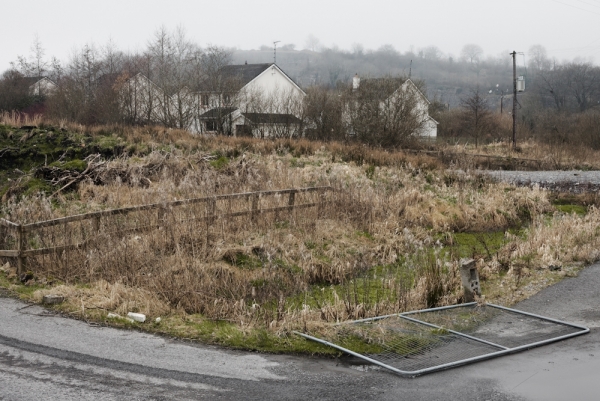
Like so many 20th century writers, Moore is stranger than he first appears. In this sense, his use of Gothic tropes is a ruse. For Freud, the uncanny, by virtue of its connotation in German of domesticity and coziness (das Unheimliche), is only truly evident when the familiar reveals itself as strange. Only the things we think we know can really spook us. That’s why there’s nothing as uncanny as a house. And The Mangan Inheritance has a haunted house, not to mention a ruined keep (as I was reading I kept thinking of the contemporary Irish version of this space, the housing estates left half-finished in the Crash of 2008, so brilliantly depicted by the Swiss-Irish photographer Valérie Anex). But the real uncanniness of the book lies in its prose. Take for example, the passage I cited at the beginning:

Now as he came closer the man reached up to the collar of his slicker and opened it, letting it fall back to reveal his windburned face, which was partly hidden by a few weeks’ growth of beard. But even with the beard, even in the shadow cast by the low-brimmed hat, Mangan saw it clear. It was his face.

I’m stuck on that “clear.” Yes, it’s not so strange to use an adjective in place of an adverb, especially to mimic speech. But although Moore’s dialogue is pitch-perfect, his narration hasn’t seemed interested in aping speech, and, anyway, Mangan is a pretty formal guy, who’s made his living wielding language, so it seems out of place as a representation of his speech/thought pattern. Instead I think Moore wants us to think not of seeing something (a face) clearly, but of seeing something clear. To see something clear might be to see it off, to pass beyond it. Fanciful, maybe, but this book is all about keeping things moving, and rejecting the past when it is taken as a hypostasized fantasy.

*

It’s thanks to Jacqui that I read this book. Her review of The Lonely Passion of Judith Hearne generated so much praise for Moore that I was inspired to finally get to him. Hearne sounded a bit relentless, but I also had Mangan on the shelf. I’ve now started Hearne (40 pp in and I can tell there’s going to be heartbreak, though not quite at Jean Rhys level, I hope) and checked out several other Moores from the library. Everyone agrees that the variety of his substantial output is one of his strengths. If I even find one or two more I like as much as Mangan I’ll be pleased. Do you have a favourite Moore? Or a suggested reading order? I’d love to hear about it.