Anja Willner’s Year in Reading, 2024

Pleased to once again present reading reviews from some of my favourite readers. Today’s installment, her third, is by my friend Anja Willner. Anja lives and works in Berlin.
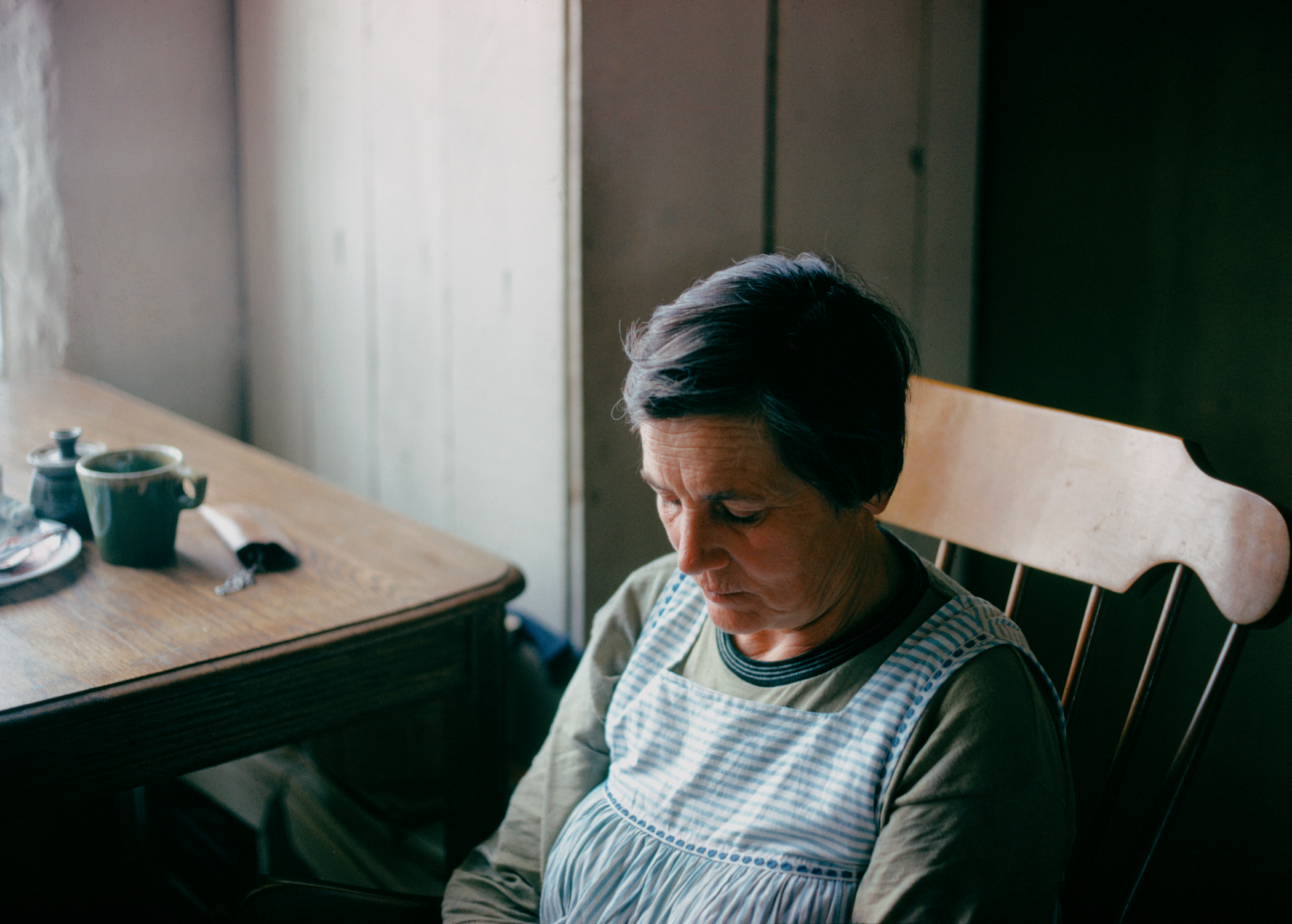
Lizzie Borden (no, not that one), Agnes Martin (1970s)

I’ve been logging my reading for seven years now. (A fairy-tale number, seven. I can’t name any other thing I’ve been doing for that long.)

2024 was different because burnout and depression ate up most of my year. [Ed. – So sorry to hear it, Anja. Lots of things to be depressed about and burned out by.] But thank god there’s always a but: And that’s the books that made it through the mind fog (doesn’t that make a great blurb) and stood out for me:

Christoph Ransmayr: The Terrors of Ice and Darkness (Die Schrecken des Eises und der Finsternis, 1984)

A great book about the price of discovery and adventure. The title is accurate, and if after reading it you still feel like starting your day with an icy shower or in a barrel filled with ice, I cannot help you. [Ed. – Ha! No fear there on my part!]

So you have this story about the Austro-Hungarian North Pole expedition going terribly wrong (skip this book if you feel strongly about dogs…) and getting almost no viable results, strung together with the story of a young Italian who goes missing while researching the same expedition more than a hundred years later. Some nice playing around with what is fact and what is fiction included.

(If you read this in winter, and your winters are still cold, make sure your heating works so you don’t get too authentic a reading experience.)

“Quiet” heroes

Something that almost always gets me is what you might call a “third row” hero: The protagonist is, at least on the surface, some ordinary person leading an uneventful life.

Of course, this only works if two requirements are met: First, the protagonist not really being dull (or so dull it’s already entertaining), and second, the writer is skillful enough to carry off this kind of story.

Claire Keegan’s Small Things Like These was such a read for me. A quiet hero, a quiet life, but so much going on under the surface it’s almost impossible to lay the book aside. [Ed. – You hear people say „I read this book in one sitting a lot, and I feel like that must mostly be exaggeration, but I actually did that with this one!]

I’m also a sucker for narrators looking back on things not said or done in the right time. For me, J.L. Carr’s A Month in the Country is a gem full of wistfulness and melancholy (without self-pity), and musings about craftsmanship and memory, art and history. (It’s not so widely read here in Germany as it probably is in English-speaking countries.) [Ed. – Just going to leave this here…]

But hey, I don’t want this to sound dull (depression and books with hardly any plot, duh!) or as if I don’t like action-packed novels.

There was also my first Henry James! I had planned that ages ago, but I also wanted to read 300 hundred other things, and then… umm… life. [Ed. – We all know how that goes!]

Anyway, Portrait of a Lady. Wow. So many twisted marriage offers turned down in queer ways. So many plot turns, so many multi-layered characters (and the super creepy girl)! [Ed. – An action-packed novel indeed! So good, so pulpy, in its own way.]

I can’t help thinking James would have been great at scripting reality shows, and he’d also have to be in charge of the casting. Just imagine, a reality dating show written and produced by Henry James! I’d be so addicted I’d hardly get anything else done.

But back to supposedly “dull” books and on to one of my private reading obsessions: Anita Brookner novels. Despite crying for two days after reading my first Brookner in 2022, I’ve been sticking with her strange books.

Strange because often, they read like an abstract summarizing a novel or like a construction plan rather than like a novel in the flesh. Not to speak of her heroines (and occasionally heroes) whose rigidly organized lonely lives are so similar to one another I’m not always sure what happened in which book (not that it would matter very much, it’s not Henry James). Yet somehow, it works out great – at least for me. [Ed. – Amen!]

In 2024, I added three more Brookner novels to my reading log: Lewis Percy, Bay of Angels, and A Friend from England. Of those three, I liked Bay of Angels best (presumably the Brookner with the most sun, but that’s just the weather). Of course not as much as Look at Me, my all-time favourite of hers. [Ed. — Look at Me is hard to top!]

Gwen John, Self Portrait with Letter (1907)

And finally, out of the brain fog emerges Nicole Seifert’s book about the women writers of “Gruppe 47” (group 47), an influential post-war German literary coterie. I already was familiar with some of the female members of “Gruppe 47”, but so many of them I was taught not to take as seriously as the alpha males who were the stars of the group, like Günter Grass.

In my reading log, I wrote down a single word about Seifert’s Einige Herren sagten etwas dazu (“Some gentlemen said something about it”): Brilliant. And I’ll stick with that. And boy, this book has led to some serious running after backlisted books! Meaning that I can never* buy a book again because I’ve still got two packages of literature waiting to be rediscovered standing around in my apartment. [Ed. — Tell us what they are in the comments, Anja!!!!!]

*never = not before the end of February 2025 or something like that [Ed. – That is modest indeed. I mean, it’s almost the end of February now! You can probably start reordering… Thanks for this lovely piece, Anja!]
Sarah Raich’s Year in Reading, 2021

Today‘s reflection on a year in reading is by Sarah Raich (@geraeuschbar). Sarah is a writer who studied comparative literature, North American studies, and criminal law. A volume of short stories, dieses makellose Blau, was published by mikrotext and the dystopian YA novel All that’s left by Piper. Two of her stories have appeared in English translation by Eilidh Johnstone in https://no-mans-land.org/article/that-i. She lives in Munich.

Look for more reflections from a wonderful assortment of readers every day this week. Remember, you can always add your thoughts to the mix. Just let me know, either in the comments or on Twitter (@ds228).

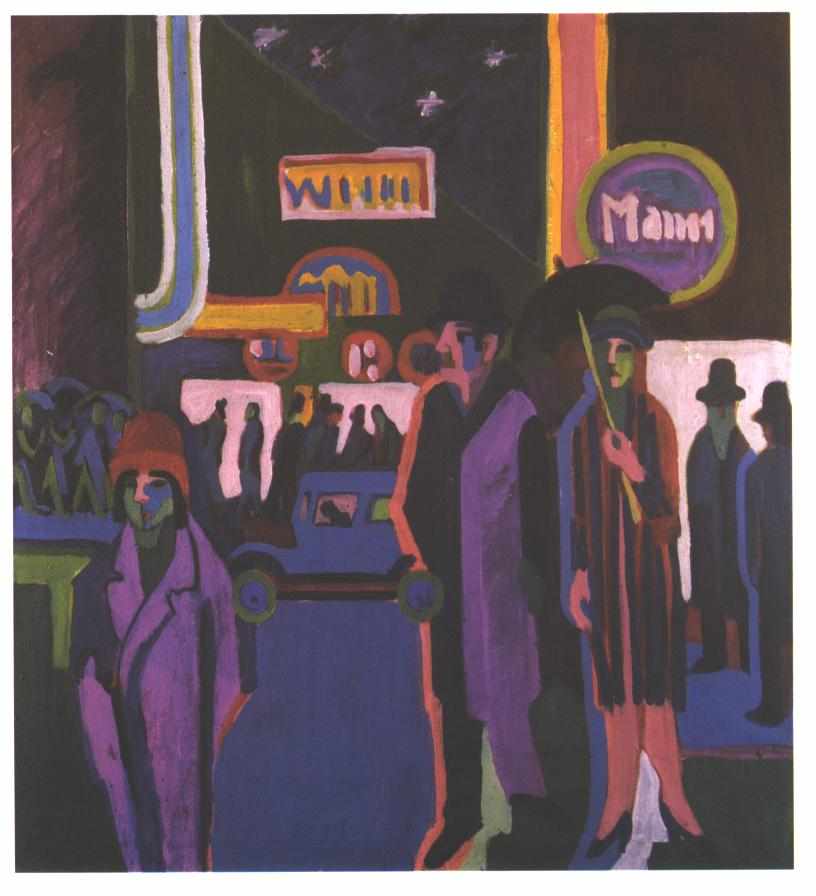
Ernst Ludwig Kirchner, Street Scene at Night, 1926-7

2021 was a special year for me as a reader, because it was the first year my own books—ones I’d written and published–were being read. Not just by my doting husband and proud parents – but by real readers. [Ed. – Ouch! Tough on that “fake reader” husband!] And, yes, that changed things for my reading. I became gentler in my judgement. And yes, sometimes I was envious while reading as a published writer.

2021 also was the year I tried to read more diversely, meaning less white, and that is how I came across my favorite book of the year: Tsitsi Dangarembga’s This Mournable Body. I don’t know if I would have read this if I hadn’t made the conscious decision to diversify my reading. I remember buying the book in Cologne at the event Insert Female Artist, a little reluctantly because I found the cover so unappealing (yeah, I’m superficial). [Ed. – Same!] And then I started reading it and couldn’t stop because it was like being severely punched and gently caressed at the same time. And to me those are the very best books. The story is set in Zimbabwe and has in Tambudzai one absolutely loathsome protagonist. [Ed. – So interesting! I’ve only read Nervous Conditions, where Tambu is not loathsome, IMO, but certainly hard to like…] And Dangarembga manages the magic trick of showing the very many dark sides of her character—and still making the reader feel for her. Suffering didn’t make Tambudzai good. It made her selfish and greedy and needy. And the story doesn’t end well: how could it? Dangarembga tells this story in such fierce language in an unusual second person account that my brain got rattled in a way only brilliant books can do. (That her work appears in Germany from a niche publishing house speaks volumes by the way.)

What This Mournable Body shared with many books I read this year is its dark humor. And maybe that was just the right thing for the sobering and dragging experience of living through a second year of a global pandemic. Take for example Sarah Moss’s Ghost Wall, which I read in the supreme translation by Nicole Seifert, which describes severe physical and psychological abuse – and yet I laughed so hard. Because the most brutal things contain humor and patriarchs are clowns with bloody swords and dirty underwear they need to have washed. [Ed. – Ah to be a patriarch! Seriously, though, this really gets at an important aspect of the book.]

For me, Bear by Marian Engel also falls in this category. [Ed. – Hell to the yeah!] A book that was wildly discussed and promoted on Twitter—to a considerable extent by the owner of this blog. [Ed. – “To a considerable extent” = German for “What a fucking nut that guy is, always banging on about that book!] I liked the unforgiving yet loving eye Engel casts on the protagonist which also leads to weirdly comical passages while the librarian stumbles through her life in a “molelike existence”, a phrasing I will never forget. In a way this librarian has a lot in common with the heroine in Ghost Wall. They both live a life they haven’t chosen, pushed around and overseen—and view this miserable situation with an acidic view on themselves and the world, and then one of them (Silvie in Ghost Wall) finds friends, the other one (the librarian in Bear) finds, well, Bear.

And yes, while writing this down, I realize my taste for this kind of book grew strong during this year of reading. Books that intertwine the horrible with the comical. One of those books was Adas Raum by Sharon Dodua Otoo who has the admirable audacity to throw her mostly German readers into a whirlwind of perspectives, places, and times. Ranging from rebirth and gods and eternal entities that hope for liberation from earthly existence while quarreling with God, into the overburdened subjects of the Shoah, racism, and colonialism, Otoo blasts established narrative boundaries and writes down the shiny pieces. Which left many German critics profoundly confused. I enjoyed the ride very much and I am very curious how the English-speaking audience will respond to this text.

The book contains my favorite quote of the year 2021:

Gott rollte als Steppenpflanze an mir vorbei.

(Einfach so.)

(Als wäre ich gar nicht da.)

(Eine Frechheit.)

Ich ließ alles –  no fee no [im Original in phonetischen Alphabet] – auf mich einwirken, in der Hoffnung, dass diese Sensation aller abendländlichen Farben zeitnah nachlassen würde. Hinter meiner Hoffnung steckte ein Hauch Erwartung. Ich gestand es mir aber selbst nicht ein. Ich wollte solchen banalen Gefühle längst hinter mir gelassen haben. Ich wartete.

God rolled past me as a tumbleweed.

(Just like that.)

(As if I was not even there.)

(The nerve.)

I allowed myself to be moved by everything—nɔ fɛɛ nɔ—hoping that the sensation of these occidental colors would soon wane. A breath of expectation cowered behind my hope. But I could not admit it to myself. I had wanted to leave such banal feelings far behind me. I waited.

(Translated by Jon Cho-Polizzi; translation forthcoming)

One more theme flows through my 2021 reading year, now that I look at it: the difference between serious and entertaining literature, as we put it in German. A difference which part of the cultural establishment in Germany seems obsessed by.

It affects my own writing, as I‘ve published one book of short stories, which some consider one of the intellectual forms of writing, and a second book that’s a dystopian YA novel, which the same people consider a rather grimy genre (unless Margaret Atwood writes it—then it’s different). As a very nice and slightly drunk person from the literary establishment told me once: the problem is, your book doesn’t really fit in anywhere.

Maybe being in this position has made me more sensitive to writers writing books that are misfits. But this feeling was also influenced by the work of Nicole Seifert, especially as expressed in her book Frauen Literatur, published in 2021. In it she describes so many books by female writers being belittled and shoved aside. Seifert’s book was eye-opening, even though I had already read so much of her blog posts, articles, and tweets. And the most important thing I learned from this superb work is how systemic the degradation of female writing is.

One of my most precious serendipities of books being labeled pure entertainment was the writing of Shirley Jackson, starting with Hangsaman. In Germany, Jackson has been considered a horror genre writer, which she is, but through this genre she writes pure literature. [Ed. – Hmm this does seem to uphold that literature/entertainment binary…] Jackson died without experiencing the literary appreciation she should have received. I don’t know why, but this realization really got to me. That a woman of her abilities got overlooked so brutally during her life time. (I rejoiced at the Wikipedia article describing how her otherwise shitty husband fought for her recognition and ranted ferociously against the literary establishment unwilling to give Jackson credit for her genius.)

But the list of undervalued writers goes on, leading to the books of Vicki Baum, whom I had always considered easy entertainment. But when I read them they proved to be epic. I cherished Hotel Shanghai: the vastness of the tableau she created leaves me awestruck.

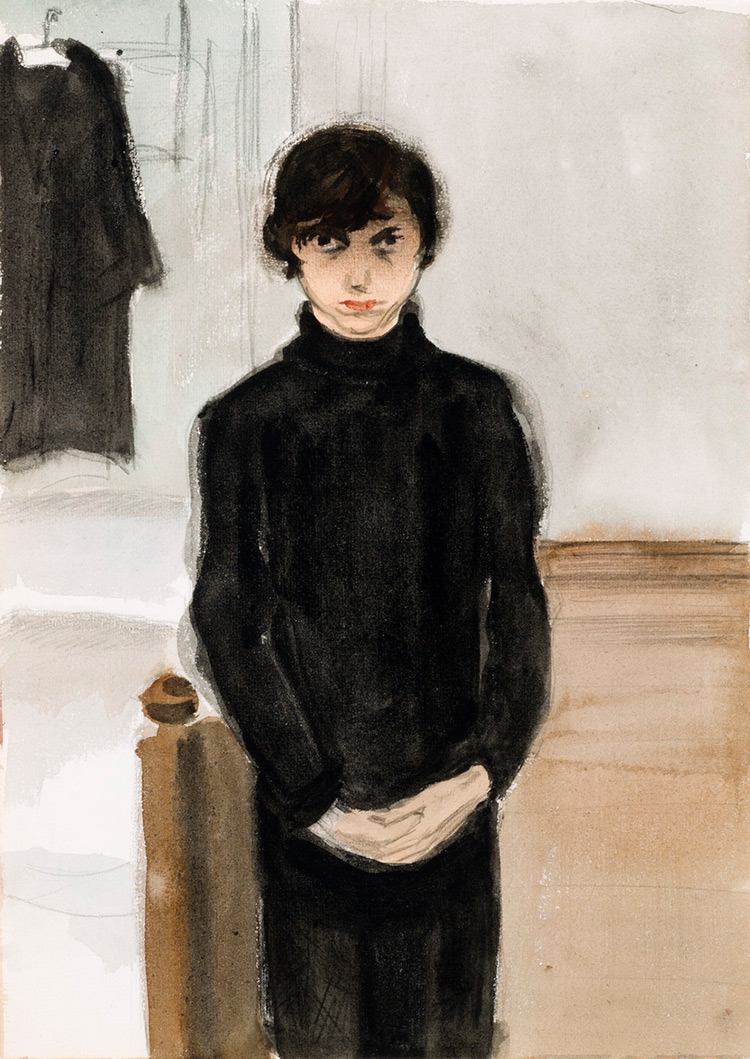
Jeanne Mammen, Self-portrait, ca. 1926

So this is what I will carry into my year of reading 2022: a thirst for misfits and dark humor. Very dark.