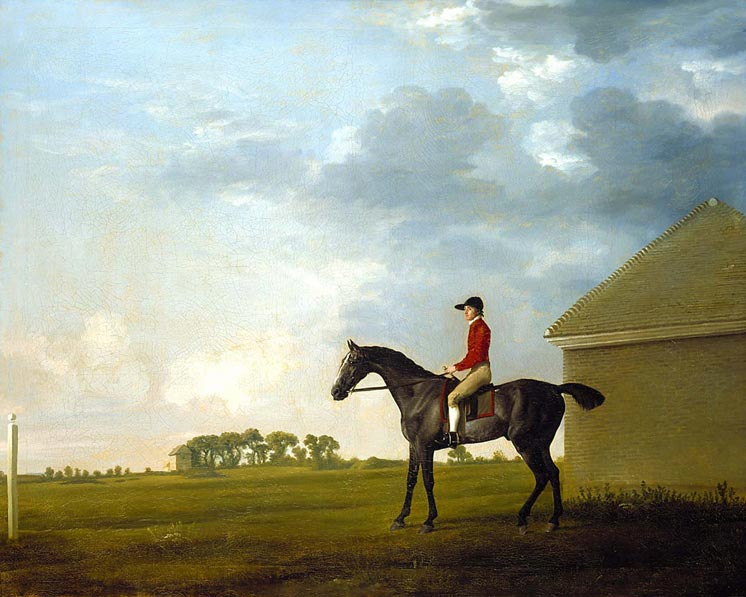
Nat Leach’s Year in Reading, 2024

Excited to once again present reading reviews from some of my favourite readers. Today’s installment, his sixth, is by my longtime friend Nat Leach. Nat is a nineteenth-century scholar turned college administrator who has spent the last 7 years reading the books on his shelves in alphabetical order. He lives in Ontario.
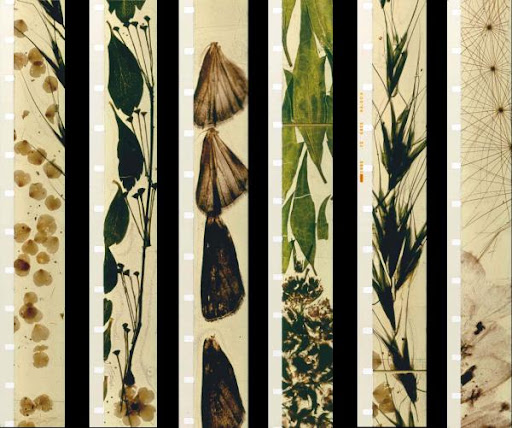
Saul Leiter, 1961

After complaining about my reading in 2023 in this space last year, 2024 was, on the surface, a much better year. I read 30 books as opposed to 20 in the previous year, and was on pace for an even higher total before hitting a wall at the end of the year (of which more anon). However, if we get into what the sports statisticians call “advanced metrics,” the numerical advantage is diminished; 6 of those books were either less than 100 pages or only slightly more, and 9 were works of theory, criticism, and/or anthologies that I had been working on for years and just completed this year. So, probably my actual reading for 2024 was not much better than 2023 in terms of quantity, but the quality was high, and that’s what really matters, right? [Ed. – Right!]

As for my overall reading project of working through my unread books alphabetically, now in its 7th year, I once again only progressed by one letter of the alphabet, finishing “L” and making a very small start on “M”. If I’m able to get through “M” in 2025 (a big if- it’s a pretty immense shelf), I will hit the halfway point of the alphabet and surely it’s gotta be downhill after that, right? [Ed. – Surely! Well, probably. Possibly?] The second half of the alphabet has the likes of “Q”, “X” and “Z” so there is hope! [Ed. – Insert Zola side-eye gif here.] In fact, of the 298 books on my list, exactly 200 are “A-M” so I’m actually closing in on the 2/3 mark of my project (although that list keeps growing every year, so who really knows?)

More importantly, for the purposes of this piece, I actually found some time, in the early part of the year at least, to write capsules for each book that I finished as I went along. Which is just as well, because I can scarcely remember what I read last January right now, and as I write this opening, I’m just as curious as you to see what comes next (probably more so).

Larsen, Nella – Passing (1929)

I had seen this book recommended so widely, I couldn’t resist adding it to this project, and it certainly does live up to the hype. The book is about the tensions in racial ideologies in early 20th century America, and seems no less relevant today. Clare Kendry “passes” as white despite a mixed-race bloodline that would see her excluded from white society. The very fact that she is able to do this so successfully mocks the white supremacist ideology that believes that racial differences are fixed and self-evident. The book’s focus also demonstrates the problematic intersection of these racial tensions with similarly oppressive gender expectations. Irene Redfield’s love/hate relationship with Clare is at the core of the book, so that it demonstrates also the ways in which expectations around “racial purity” are particularly focused on women. In this respect, Passing reminds me of another book I wrote about on here some years ago, Morley Callaghan’s The Loved and the Lost; although that book focuses on a white woman who circulates in black society in Montreal, the similarly tragic outcomes both speak to the violence and panic produced in white society by such blurring of racial lines. [Ed. – About to teach this tomorrow for the nth time: it’s an all-timer!]

Laski, Marghanita – The Victorian Chaise-Longue (1953)

When I received this book as a gift (in a lovely Persephone Books edition), I assumed, because of the title, that it was because of my academic interest in the nineteenth century. It didn’t take long for me to realize that it was in fact because of my academic interest in the Gothic. The plot itself smacks of the absurd: a tubercular new mother is transported back in time to the Victorian period while lying on the titular piece of furniture during her recovery. But this does not do justice to the book, which explores (as so many Gothic texts do) the relationship between mind and body, and the nature of identity. A fascinating read. [Ed. – Sounds great!]

Lathom, Francis – Italian Mysteries (1820) and The Midnight Bell (1797)

These days, Francis Lathom is little more than an answer to a literary trivia question (Name the authors of the 7 “horrid novels” on the reading list of Isabella Thorpe and Catherine Morland in Jane Austen’s Northanger Abbey!) but he was a successful novelist and playwright in his time. The Midnight Bell is the book mentioned in Austen’s novel, while Italian Mysteries was written considerably later. Both make extensive use of the Gothic conventions popularized by Ann Radcliffe in The Mysteries of Udolpho (and spoofed in Northanger Abbey), including apparently supernatural activity explained by natural means, banditti inhabiting abandoned castles [Ed. – They do be inhabiting the abandoned castles, the banditti], and lustful noblemen pursuing innocent heroines, who invariably faint whenever captured (By my count, Lauretta, heroine of The Midnight Bell, faints five times in the course of a single abduction!) [Ed. – Maybe some iron pills for that girl?] Lathom’s use of these conventions is, at least, skillful and coherent, which is more than can be said of many Radcliffe imitators of this period. As David Punter points out in his fascinating introduction to the Valancourt Books edition of The Midnight Bell, Lathom’s works are heavy on events, to the exclusion of character development, and his plots are so extensive and intricate that they invariably require quite elaborate explanations—indeed, the entirety of the 3rd and final volume of Italian Mysteries is essentially an extensive explanation of all the mysteries developed of the first two volumes. While both books owe much to Radcliffe, there are certain predilections of Lathom’s own that show through as well; for example, his books include many siblings who function as doubles of each other, and are usually moral opposites of one another. The books are a pleasure to read, though not, perhaps, especially notable examples of the genre. [Ed. – Look, you’re not getting this kind of content anywhere else, are you?]

Laurence, Margaret – This Side Jordan (1960)

Like every good Canadian of my generation, my literary education was steeped in Margaret Laurence; I read The Stone Angel in high school, and The Diviners in university. [Ed. – Same! I wonder what they read now?] And if that weren’t enough, I now find myself living just 15 minutes away from the small town of Lakefield, Ontario, where Laurence spent the last years of her life, and wrote The Diviners. All that being said, I really didn’t know what to expect from this book, Laurence’s first novel, which is much less recognizable in the canon of CanLit, not least because of its foreign setting. Laurence’s husband was an engineer who worked in Africa in the 1950s, so she spent some years living in what was then called the “Gold Coast” but was soon to become the independent country of Ghana. The book is largely about the difficulties posed by this transition, both for the British colonizers and for the people of Ghana, equally caught between a past they cannot return to and a future in which they cannot yet find their place (hence the biblical allusion of the book’s title; the characters are all looking ahead to a “promised land” they cannot enter). The book focuses on Johnnie Kestoe, a British accountant in a textile company; Miranda Kestoe, his well-meaning but sometimes clueless wife; and Nathaniel Amegbe, a struggling Ghanaian schoolteacher. Johnnie, following Miranda’s advice, tries to get ahead by supporting the company’s “Africanization” of its workforce, which his racist bosses refuse to accept, while Nathaniel tries to modernize his family and move away from the tribal customs that he sees as belonging to the past. The future, though, is not easy for any of them to grasp. It’s a strong debut novel, though it does not entirely show the brilliance that was yet to come from Laurence. As an aside, this book also scores points for having a main character named Nathaniel, a literary feature notable by its absence in all the other books on this list. [Ed. – Ha! Justice for Nathaniels!]

Le Fanu, Sheridan – Carmilla (1872) and “A Chapter in the History of a Tyrone Family” (1839)

There are not many classic Gothic texts of the 19th century that I have not read, so it was time that I finally read Carmilla. All I knew about it was that it was about a lesbian vampire and, yeah, it’s pretty much what it says on the tin, using the familiar conventions of the genre, with that added twist. As for “A Chapter in the History of a Tyrone Family,” my first thought upon reading it was “was this written before or after Jane Eyre?” There are many parallels, including a bigamous marriage and a potentially murderous first wife being kept in concealment. Turns out the answer is “before”. This story apparently influenced Brontë’s novel, and in turn, after the success of Jane Eyre, Le Fanu developed this story into a longer work in order to capitalize on it.

Le Guin, Ursula K. – The Left Hand of Darkness (1969)

Another book that I added because of a large number of recommendations, I must admit that I went back and forth on this one a bit. The author’s preface is one of the smartest things I have read about science fiction (or about fiction full stop!), but then the first chapter seemed so replete with science fiction clichés that I started to question what all the fuss was about. I also wonder if science fiction just isn’t my genre, or if I am just overly picky about the details of world-building; much as I admire the carefully prepared appendix on the “Gethenian Calendar and Clock,” which differ significantly from those of Earth, I also find it slightly off-putting that this entirely foreign world not only measures temperature in degrees (in itself not necessarily natural), but it uses a scale that seems strikingly similar to the Fahrenheit scale (with no additional context or explanation). [Ed. – Fahrenheit sucks!] Nevertheless, the book certainly grew on me as it increasingly developed the more philosophical implications of its sf premise. Le Guin claims not to be attempting to predict the future, but this book from 1969 is quite prescient in exploring the idea of gender fluidity, as the inhabitants of the planet on which the book is set share male and female characteristics and can transform into either. Less prescient than oddly coincidental is the fact that the narrator’s name is Genly Ai; it occurs to me that it would be impossible to include a character of that name in a book written today without readers assuming that he was some kind of embodied form of generative artificial intelligence. [Ed. – AI sucks! Like, a lot more than Fahrenheit. Which sucks, to be clear.]

Levi, Primo – Moments of Reprieve (1981) Trans. Ruth Feldman

Levi’s American publishers have been consistent, at least, in their dogged attempts to make his books sound as optimistic as possible; If This is a Man becomes Survival in Auschwitz, The Truce becomes The Reawakening, and Lilith, and other Stories becomes Moments of Reprieve. While it is true that to a certain extent, the stories recounted in this book have a lighter tone than his earlier memoirs, there is really very little “reprieve” to be had here. [Ed. – Yup. That piece about the Roma inmate he meets? Dark.] The book consists of descriptions of people and incidents from Levi’s time in Auschwitz which had not been included in the two earlier memoirs, as well as narratives that follow up on the post-war experiences of individuals who are mentioned in those books. And certainly, all of the qualities that make the earlier books so great are still on display here, especially Levi’s keen eye for character and his deep understanding of moral complexity. And yet, everybody seems to want more optimism, from the publishers to Chumbawamba, who recorded a song based on one of the most optimistic anecdotes herein, “Rappoport’s Testament” about a man who uses a very philosophical theory of life to endure Auschwitz, arguing that his previous pleasures in life are simply being counter-balanced by the horrors of the camp, and therefore he has nothing to complain about in the grand scheme of things. [Ed. – I did not know this!!!!] An admirable perspective, perhaps, but just one of the many that Levi explores—yet the only one to get a song written about it, with an incessant chorus of “I never gave up” as though this were the only praiseworthy, or even acceptable, attitude. (Having said that, I have to admit that I actually love this song. I mean, how critical can you be about a rousing anti-Nazi anthem? Look it up.)

Lindsay, Joan – Picnic at Hanging Rock (1967)

I was already very familiar with Peter Weir’s 1975 film adaptation of this novel, so I fully expected this book to be as good as it is. I found that Weir adapted the book quite faithfully; in both the book and the film, the plot about the uncanny disappearance of Australian boarding school girls is perhaps secondary to the reflections on the connectedness of people and things that are triggered by this incident. The most significant differences come from the fact that the novel is able to demonstrate more links in this web of inter-connectedness; from my perspective of having seen the film first, I was quite fascinated to see how Lindsay connects some of the more minor characters to each other and to the mysterious themes of the book in ways not shown in the film. Ultimately, what makes both book and film work so well is how expertly they manage the fantastic in Tzvetan Todorov’s sense of the term, hesitating between rational and supernatural responses to the mystery, but never fully embracing either perspective. [Ed. – Now I want to read this and see the movie again.]

Lively, Penelope – Moon Tiger (1987)

I’m at a bit of a loss as to how to describe this fascinating tour through both world history and the personal history of a dying historian, Claudia Hampton. These histories are linked and predictably (and unpredictably!) take many twists and turns along the way. But the most interesting thing about the novel is the way it plays with point of view, emphasizing that history depends on perspective as we move between Claudia’s first-person perspective, a more “objective” narrative voice, and the points of view of other characters. It may defy description, but it really works.

Lodge, David – Changing Places (1975), Small World (1984), Nice Work (1988)

I must admit that I felt that I had missed the cultural moment in which I should have read this trilogy. After all, any satirical work on academia these days would surely have to focus on the absurdities of governmental policies and the excesses of administrative oversight rather than the hijinks of carefree globetrotting academics (seriously, is there even any such thing as a carefree, globetrotting academic any more?) [Ed. – There is not.] Not to mention the fact that cultural values have shifted significantly in ways that make these books somewhat uncomfortable to read at times (thinking especially of the distressingly casual way that the idea of professors sleeping with their students is treated in these books). Despite all this, though, there is something enduring about these books, not only for their humour—based in the first book on the incongruities between Morris Zapp, brilliant but obnoxious American professor, and Philip Swallow, reserved English lecturer, and developed in many different directions from there—but also for their satisfying use of the conventions of comic narrative. Lodge is particularly knowing about this, and all three novels are highly self-referential (or “meta” as the kids say). [Ed. – I fear they do not actually say this anymore, at least judging from the blank stares I get…] Changing Places features a number of quotations from a (fictional) textbook that Swallow wants to use for his course on novel-writing, and which provides rules for writing a good novel—rules that Lodge himself proceeds to break in every instance. Small World (subtitled “an academic romance”) employs the conventions of the grail quest romance, adapted comically to the academic context. And Nice Work is an adaptation of, and contains frequent references to, the genre of the Victorian industrial novel. Moreover, in each book, the threads are pulled together in improbable but highly satisfying ways, as if Lodge is acknowledging both the artificiality of the conventions and the fact that we still desire such conclusions despite our awareness of their artifice. I learned recently that Lodge passed away on New Year’s Day, 2025, so I guess there was indeed some timeliness to my reading of these books. I also learned in the course of my reading that Lodge had been at the University of Birmingham while my parents were graduate students there. It really is a small world, I guess.

MacIntyre, Linden – The Bishop’s Man (2009)

Having lived on Cape Breton Island for 15 years, I found that this book resonated with me, not because of the plot about the sexual abuse scandal in the Catholic church, but because of the settings, the feelings of isolation brought about by the landscape and the weather, and the descriptions of tightly-knit but also highly insular communities. All very familiar to me. The plot that unfolds against this backdrop revolves around the titular character, Father Duncan MacAskill, who acts on behalf of his Bishop to address situations involving abuse committed by priests. He initially believes that he is helping to rehabilitate perpetrators and support victims, but struggles with his conscience as he increasingly realizes that he is just the front line of an extensive cover up operation. MacIntyre is a native of Cape Breton, and a prominent journalist so perhaps not surprisingly his fictionalization of these real situations and characters is believable and powerful.

WOMEN IN TRANSLATION MONTH

I always try to set aside two books for Women in Translation month in August (given that 2 is pretty much my monthly average, this makes sense to me). However, since my reading project as a whole has slowed down, I’m finding that I’m reaching further forward on my shelves each year. This year, I read a couple of books from further along the “M” shelf.

Millu, Liana – Smoke Over Birkenau (1947) Trans. Lynne Sharon Schwartz

Dorian recommended this book a few years ago and of course he is right about what a tremendous book it is. [Ed. – Damn right he is. That guy really knows a thing or two.] Millu recounts the stories of six women whom she encountered in the women’s camps at Auschwitz. In many ways, the content of these tales is not unlike other Holocaust testimonies in the brutality, suffering and impossible moral situations that they depict, but it is also quite different in its specific focus on female experience in the camps. It must also be said that the stories are well crafted as stories. In both respects, the book reminded me in a strange way of the stories of Ida Fink, even though the latter are fictional. [Ed. – Absolutely!] Both writers provide keen observations of the brutality and suffering caused by Nazi oppression, particularly as it affects women. There is probably something more to be said about the relationship between the fictional and the non-fictional here, but that’s more Dorian’s territory. [Ed. – Certainly true that Millu uses an overtly narrative style in these pieces. Maybe Sara Horowitz’s idea about the Fink stories—that we sometimes need fiction to tell us what nonfiction can’t (it’s smarter than that, but that’s the gist)—might be useful here.]

Müller, Herta – The Passport (1986) Trans. Martin Chalmers

I had never read Müller before, so I didn’t really know what to expect, nor do I really know how to describe the experience of reading this book but here goes: it is a series of dark prose poems that build a feeling much more than they build the plot, which is ostensibly about the efforts of a miller to emigrate to West Germany. The images, though, vividly construct a picture of a hostile natural world, and the tensions of living amongst a foreign people. I commented earlier on the changes of Levi’s titles for an English-speaking audience; in this case, the effect of calling the book The Passport seems to be a rather banal attempt to focus on the plot, unlike the original German title, Der Mensch ist ein großer Fasan auf der Welt (“Man is a Great Pheasant in the World”) which better captures the poetic feel and the tension between the human and the natural world developed throughout the book.

IN PROGRESS

So, about that wall I mentioned… things were going swimmingly (yes, for me, the above is what swimmingly looks like) until the end of October/beginning of November. In the space of a fateful week, I began three new books. Little did I know that 2 ½ months later, despite putting almost all of my reading time and energy into them, all three would remain unfinished. Anyway, here’s a brief report on the books I didn’t quite finish in 2024 (with up to date completion percentages as of early 2025)

Lessing, Doris – The Golden Notebook (1962) Completed: 26%

First, not having included Doris Lessing in my original project, I was tempted to join a readalong of The Golden Notebook organized by the ever-encouraging @paperpills10.bsky.social. However, a combination of my usual lack of time, my inability to get my hands on a good physical copy of the book, and my struggles with the book itself led to my dismal failure to keep up. As for the book itself, it seems to me very original in terms of form (3rd person narration combined with 1st person in the form of notebooks kept by one of the characters) while seeming quite mundane (thus far) in terms of content and style. Perhaps that is what I’m struggling with, though I also wonder if it is part of the point (this is what notebooks are like). I will persist with this, but I have quite a way to go yet. [Ed. – Hmm I like this one: not sure you’re going to change your mind if you aren’t into it yet.]

Mann, Thomas – Doctor Faustus (1948) Trans. H.T. Lowe-Porter Completed: 73%

At about the same time, I was starting this book, which I had bought at a time when I was collecting Faust stories, but I had only managed to read the first few chapters at that time. I have done better this time, and what I have learned from this experience is that 1) I need to read more of Mann’s novels and 2) I may not have enough years left in me to read them all. This is a tremendous book, but one that requires much time and focus. I have been making slow but consistent progress, and there is now at least some light at the end of the tunnel. Despite the title, the Faustian theme is more an undercurrent than the book’s focus, which has more to do with reflections on the nature of art and its relation to culture. But what has perhaps most struck me about this book is its descriptions of the rise of Nazism and the psychology behind it, all of which feel chillingly contemporary.

Márai, Sandor – Embers (1942) Trans. Carol Brown Janeway Completed: 67%

Now this wonderful little (at least, comparatively) book is one that I would have finished long ago, had I not been saving it to cleanse my palate after working on the previous two books (gotta respect the alphabetical order after all). It is a much quicker, and highly engaging read. Last year, I commented on how my reading system often provides me with strange and unexpected correlations, and it has been somewhat strange reading this book alongside Doctor Faustus. Both books are written in the 1940’s but make use of a dual time frame split between the narrative present and a past in the late 19th and early 20th centuries. Both are set in central Europe and are thus framed against the background of the wars in these time periods, and both focus heavily on the relationship of a pair of male friends, one of whom is musical and artistic, the other more material and practical. But they are of course very different books; Embers tells the story of a friendship broken in youth that comes to a reckoning in old age. I’m still not sure what this reckoning is going to look like, but the suspense is building. So far, this is pretty great.

James Whistler, View across the Lagoon (1879 – 80)

LOOKING AHEAD TO 2025

My one final comment on all of the above is that one of the benefits of writing these entries shortly after finishing the books is that I can look back and see how my immediate response to the book varies from what my memory of it is now. For example, despite the lukewarm write-up, I thought about the Le Guin a lot after I finished it, and despite really loving the Lively, I haven’t really thought about it at all since then. I’m not sure that this is necessarily a measure of a book’s quality, but it is a measure of something. [Ed. – Yes! But what? I think about this a lot too.]

As for next year, I did have a fleeting desire to join a Proust reading group, since that is probably the book that I am most looking forward to on my remaining list, but my recent track record with group reads and the fact that I am probably not in the right head space at the moment has caused me to hold off (it’ll probably be a couple of years before I get to “P”)

So, my goal will be to try to get through “M” this year, although as I said, it’s a pretty formidable letter. I will at least see the benefits of having participated in group reads of some of the chunkier books on this shelf over the past few years (The Balkan Trilogy, The Levant Trilogy, Moby Dick, The Man Without Qualities) but I still have a lot to look forward to, from Gabriel Garcia Marquez to Cormac McCarthy to Brian Moore to Toni Morrison to Iris Murdoch and many more in between. Wish me luck, and let me know if there are any indispensable M authors that you think I need to make sure I read this year. [Ed. – Thank you as always, Nat!]

Nat Leach’s Year in Reading, 2023

Excited to once again present reading reviews from some of my favourite readers. Today’s installment, his fifth, is by my longtime friend Nat Leach. Nat is a nineteenth-century scholar turned college administrator who has spent the last 6 years reading the books on his shelves in alphabetical order. He has recently doubled his social media presence by becoming mostly inactive on not one but two platforms, posting occasionally as @gnatleech on Twitter and @gnatleech.bsky.social on Blue Sky.

Berthe Morrisot, Hide and Seek, 1873

For reasons not worth going into, 2023 was actually a pretty rotten reading year for me. I read sporadically, finished only 20 books, and only progressed through one letter in my alphabetical reading project, finishing K, and making a brief start on L (so, after 6 years, I’m not even halfway through the alphabet; my 10-year plan, which was originally a 5-year plan, is looking like it will become a 15-year plan). [Ed. – Very Stalinist of you, Nat.] I wasn’t even able to write entries for each book as I went along, as I’ve done in the past, and was considering foregoing my annual post, but Dorian threatened to sue for breach of contract, so here we are. [Ed. – Look, a deal’s a deal. You want the glory, you gotta write the post.]

One meaningful reflection I was able to draw from my year’s reading is a better understanding of why I enjoy reading the way that I do, progressing alphabetically through my shelves rather than making conscious decisions about where my reading should take me. Thomas de Quincey, in a wonderful essay on “Sortilege and Astrology,” explains that he believes in astrology, but not in astrologers; there is indeed a pattern connecting all events in the world, but anyone who claims to know it is a charlatan. And yet, practices such as sortilege (the opening of a book at random and putting one’s finger on a passage as a means of divining the future) entail putting ourselves in the hands of this unknowable force of fate. [Ed. – Ah, finally I have a name for what my students do when I throw out a question in class.] My reading practice is then a kind of sortilege in which I trust that fate will put in my hands the right book at the right time. And very often, as I discovered this year, I’m able to trace out patterns and connections that I may not have been exposed to had I more rigorously organized my reading.

 I often found myself reading two books at the same time—books that offered unexpected congruences, and paths leading from one to the other. And thus, since I did not manage to write entries for individual books this year, I present my reading by category, which often means: by categories I would not always have chosen to adopt in advance, but discovered while reading.

Books Written in 1989 that Challenge Canonical Western Conventions of Storytelling: Thomas King – Medicine River and Maxine Hong Kingston – Tripmaster Monkey

A super-specific first category, but these are two very different books. For many years, my office was just around the corner from a poster with a quotation from Thomas King: “the truth about stories is that that’s all we are.” The narrative structure of Medicine River seems to be an illustration of that axiom. Each chapter cuts (in a way that feels very cinematic) between an action in the narrative present and one in the past. We thus gradually learn how the past of the protagonist, Will, shapes the person he’s become in the present. The book also suggests how this is true at a deeper cultural level, referring to significant events in Indigenous history such as the battle of Little Bighorn and the occupation of Wounded Knee, but for the most part the focus is personal and the tone is lightly comic, but also somewhat melancholic.

Kingston’s novel, on the other hand, is much more explicitly disruptive of literary expectations in its use of Chinese legends and stories to revise American literary and cultural norms. The novel’s protagonist is a Chinese-American hippie whose hybrid status is reflected in his name, Wittman Ah Sing (geddit?) and whose life in 1960s San Francisco is inflected with wild imaginings that superimpose figures of Chinese legend onto the American present, culminating with the performance of an extravagant play that ends with a chaotic collapse of the distinction between actor and audience. [Ed. — !] Like King’s novel, we see how stories create, and do not simply reflect, identities.

Kingston’s book segued nicely into the next book I read, Rudyard Kipling’s Kim. At one point, Kingston includes an extensive quotation from Kipling’s narrative of his visit to the United States. In that book, Kipling becomes a spokesperson for a racist past whose perspective persists in the present, a tendency that can certainly be seen in Kim, the story of a boy who gets caught up in the political intrigue of maintaining English power in the Indian sub-continent. It still works as an adventure story, though Kipling’s colonial perspective on India is consistent with the account of the Chinese inhabitants of San Francisco that Kingston critiques.

Holocaust Memoirs and Diaries: Gerda Weissman Klein – All But My Life, Victor Klemperer – I Will Bear Witness 1942-1945, Ruth Kluger – Still Alive

These were sitting next to each other on my alphabetically ordered shelves. I have much less experience with Holocaust texts than Dorian, so I will not pretend to any expertise here, but in the small teaching experience I have had, my approach has been to encourage students to notice differences—the atrocities of the Nazis took many forms, and were experienced differently based on a whole range of factors including location, age, gender et cet.—but also to notice significant similarities and patterns. [Ed. – Nat is too modest: I still use a terrific assignment he designed on the topic of Holocaust diarists.] Each of these texts describes some distinctive aspect of Nazi terror: Klein was part of one of the infamous “death marches,” which she describes more thoroughly than any account I had previously read [Ed. – absolutely agree], Klemperer describes the everyday psychological tortures endured by Jews living in Germany, as well as the horrors of the fire-bombing of Dresden, while Kluger’s account spans a range of locations and forms of violence from Vienna to Theresienstadt to Auschwitz. Looking for patterns, it is evident that each also benefits from a number of timely pieces of good fortune that contribute to their survival: for example, Klein was able to live through most of the war in the relatively protected confines of a weaving factory, Klemperer avoided deportation because his wife was Aryan, and the bombing of Dresden in fact provided him with an opportunity to remove the yellow star from his clothing and escape from the city, and Kluger benefited from timely advice to lie about her age at Auschwitz, and a well-timed decision to escape from a death march. A somewhat more curious parallel is that both Klemperer and Kluger fled to Bavaria, and both would have been in fairly close proximity when the war ended. [Ed. – Good point! A function of how the regime decided to compress this remaining pool of slave labour into a central, contiguous section of the Reich: the Sudetenland, x, y, and Bavaria.] In short, three very different books, with some similar lessons, including an awareness of the very narrow line between survival and destruction.

Classic postmodern novels from when it was still OK to use the word “postmodern”: Robert Kroetsch – The Words of My Roaring, Milan Kundera – The Unbearable Lightness of Being

Yeah, I know it’s cool to dump on the word “postmodern” in our enlightened 21st century, but I still find it a useful way to speak about texts that reflect on, and engage critically with, their own status as text. Both books use postmodern strategies to explore the construction of individual identity and that of a national past. Kroetsch’s book experiments with the genre of the folk tale, and is narrated by Johnny Backstrom, a political candidate in Alberta during the Depression who promises the voters—all farmers struggling with drought conditions—that it will rain. Kundera’s novel reflects more philosophically on the nature of chance and coincidence (coincidentally all the stuff I wrote about in my introduction) against the backdrop of Czechoslovakia in the Communist era. As with King and Kingston, these are books that think about how stories create identities.

Books set in the 1970’s (but written later): Hanif Kureishi- The Buddha of Suburbia and Rachel Kushner – The Flamethrowers

I was reading these at the same time, and all the ‘70s cultural references kept getting me confused as to which one I was reading. But the easy way to tell the difference was that one of these books harnesses that cultural anxiety/nostalgia in an interesting way, and the other… not so much. Kureishi’s book is great, exploring his familiar territory of cosmopolitan London and the racial and political tensions of the period. It moves deliberately from the idealism of the hippies to the backlash of punk, and ends with the election of “the new Prime Minister,” unnamed but obviously Thatcher, as represented in the striking images at the conclusion of the BBC miniseries. Things would never be the same again…

As for The Flamethrowers, if I were being charitable, I would say that the book wasn’t for me, as I simply didn’t find the subject matter interesting. If I were being uncharitable, I would say that the book cobbles together a whole bunch of supposedly “cool” images and events of the ‘70s just because they are cool, not because they serve any narrative logic. And the author’s Afterword kind of confirms that hypothesis in describing her process of starting with striking images.

Books set against the backdrop of 17th/18th century nationalist revolutions: Lady Caroline Lamb – Glenarvon and Giuseppe di Lampedusa – The Leopard

Again, a category that features one very good book, and one very bad book. Lamb’s novel was really written only as an attempt to avenge herself on Lord Byron, with whom she had a scandalous affair before he unceremoniously dumped her. The structure of the novel is bizarre, as the description of the affair between Glenarvon (Byron) and Calantha (Lamb) is sandwiched between a Gothic narrative that seems to make very little sense (the explanation provided at the end doesn’t seem to match with the beginning, but I have no desire to try to figure it all out). And, oh yeah, Glenarvon is made into an Irish patriot leader in the 1798 rebellion. For some reason. [Ed. – Very moody, the Irish. Just like Byron.]

The Leopard, on the other hand, is a fantastic book, often hailed as one of the great historical novels of the 20th century. What makes it great, I would argue, is that it represents a moment of critical historical change from a multivalent perspective that shows just how complex change is. Don Fabrizio is essentially the last in a long line of Sicilian nobility. His time is coming to an end, he knows that it is coming to an end, and he even recognizes that in some ways it is right that it is coming to an end. But we also see that good things are being lost along with the bad, and that a different form of badness is ascending. In short, Lampedusa shows historical change in all its ambivalence, as well as the conflicting emotions that it gives rise to. [Ed. – I gotta read this again: been far too long.]

Books read for Women in Translation month: Svenja Leiber- The Last Country and Clarice Lispector – Agua Viva

Well, in my case it was Women in Translation two and a half months, but that’s OK. I was hoping that the Leiber book would be the one to break me out of my slump of disliking 21st century novels, but it was not to be. It hooked me at first, but this is a book with an epic scope (the life of a musician through the vicissitudes of 20th century Germany) but an episodic structure, which I grew to find infuriating more than anything. The prose also felt very abstract—there were many moments when I honestly couldn’t tell whether a sentence was meant to be literal or metaphorical—but I’m not sure if this was a translation effect or inherent in the original. As for the Lispector, it was my first experience with her, and seemed to me an interesting cross between literary and theoretical prose; she reminded me of nobody more than Maurice Blanchot. Which, if you know me, is a compliment. [Ed. – He’s understating things. That’s like his highest compliment. Well, maybe if he’d said it reminded him of Levinas.]

Books read with the #NYRBWomen23 Group: Eleanor Perenyi – More Was Lost, Elizabeth Taylor – A View of the Harbour

I wish I’d had more time to participate in this wonderful series choreographed by @joiedevivre9 but these were the two that were on my shelves already (and hey, I’m going to get to “P” and “T” eventually, right?). Two very different books, Perenyi’s a non-fictional account of her life and marriage to a Hungarian nobleman before and during World War II, and Taylor’s an account of lives of quiet desperation in an English seaside town. Both excellent. [Ed. – So excellent]

A few classics: Honoré de Balzac – Le Père Goriot, Heinrich von Kleist – The Prince of Homburg, D. H. Lawrence – Sons and Lovers

Kleist’s play (like much of his work) is ahead of his time, a proto-Freudian reflection on dreams, reality, desire and death. This was a re-read for me, and confirmed its greatness.

OK, I haven’t actually finished the Lawrence yet (2 chapters left), but I figured mentioning it would score me points with Dorian. [Ed. – It does. You now have 7,967.] Lawrence’s prose is utterly compelling, and even though I find that most of the characters fall into the literary-critical category of “big idiots,” I am absolutely glued to the book. [Ed. – Ha! Accurate!] I’m also enamored of the fact that the book is set in the area of Derbyshire/Nottinghamshire that my grandparents used to live in, and I recognize many of the places mentioned from visits in my youth. When the characters go to Alfreton or Crich Tower, I internally cheer as if a rock band has just casually mentioned how great it is to be in <insert your city here>.

Saving the best for last, I started the Balzac shortly after joining Twitter some 6 years ago, and read it in French, which made it slow going for me. Appropriate then, that I finally finished it in 2023, the year of Twitter’s demise (or whatever you want to call the transformation it has undergone). In any case, this is such a wonderful book about the perils and temptations of society and money, and the challenges of maintaining a moral compass in the face of them. Apparently, I now have a whole lot of Balzac that I’m going to need to read. [Ed. – Hell yeah lfg!!!!!]

Felix Nussbaum, Shore at Rapallo, 1934

That’s about it. Will 2024 be a better year? Who knows how far I’ll get through the L shelf, and who knows how long it’ll take to get through that monstrously large stack of M’s (now is the time that joining those recent group reads of The Balkan Trilogy, The Levant Trilogy, Moby Dick, and The Man Without Qualities is really going to pay off!). But with Nella Larsen, Margaret Laurence and Ursula Le Guin among the next authors on my list, I am guaranteed some treats in the coming year. [Ed. – You sure are. Thanks as always, Nat.]

Nat Leach’s Year in Reading, 2022

still hope to write up my reflections on my 2022 reading year. (Though look how well that worked last year…) In the meantime, I’ve solicited guest posts from friends and fellow book lovers about their own literary highlights. Today’s post is from Nat Leach, who used to be a specialist in 19th century literature, but now writes exclusively for this blog (exactly once a year). [Ed. – Exclusive content, y’all!] He lives and works in Peterborough, Ontario, and tweets sporadically about literature and film @GnatLeech

Look for more reflections from a wonderful assortment of readers in the days to come. And remember, you can always add your thoughts to the comments.

Charley Harper, Red-tailed Hawk

            Regular readers of my yearly round-ups (if any such there be) [Ed. – hell yeah!] will recall that shortly after joining Twitter, my new year’s resolution in 2018 was to complete all the partially-read books on my shelves by proceeding through them in alphabetical order. At the time, I thought of this as a five-year plan, but exactly five years later, I find myself only about halfway through, as the plan has expanded to include a good many newly purchased books as well, though my original alphabetical progression continues. So my five-year plan is now a ten-year plan, but the main thing is that I’m still reading a lot of good books, and making headway through those books that have been staring reproachfully at me from the shelves for many long years. For those keeping score at home, I have now completed 158 of the 289 books currently on my list (but of course, the list keeps growing).

            Despite the arbitrariness of my system, each year gives me something to reflect on regarding my reading tendencies. In this case, my most significant reflection is simply that, when it comes to reading, I am who I thought I was: a reader of classics and obscure older texts who frequently struggles to get on with more contemporary fiction. My most inspiring reading experiences of the year were re-reads of The Iliad, The Odyssey and Moby-Dick, while, under the influence of the many good people of Book Twitter, I experimented with more contemporary fiction that I usually do, with mixed results. There were a couple of big winners (Ishiguro’s Never Let Me Go and Kertész’s Fatelessness) but I found that many other highly-recommended late-twentieth/early-twenty-first century books just didn’t do much for me. So, it’s not exactly a revelation, and I’m not complaining; after all, it’s not entirely a bad thing to have one’s choice of lane confirmed, and it’s probably too late to change myself anyway. Even so, I don’t see myself shying away from contemporary literature altogether; I do value my Twitter interactions, as there are many wonderful authors I probably wouldn’t have found on my own, although I may now take a closer look before plunging into anything written within the last 50 years or so. [Ed. – Honestly, this seems wise…]

            In terms of the bigger picture of my project, after two years of spending an entire year on a single letter (who knew that G and H would be so much work?), this year, I finished off H, flew through I and J (mercifully short shelves!) and got started on K. Here are synopses of what I read:

Hines, Barry – A Kestrel for a Knave (1968)

I picked up this book after watching Ken Loach’s film adaptation, Kes, for the fourth or fifth time and wondering why I had never read the source novel. I discovered, unsurprisingly, that the book is equally great, and that the film is quite a faithful adaptation. Both tell the story of Billy, a working-class Yorkshire youth with an abusive brother, an absentee father, and a neglectful mother, who captures and trains a young bird of prey. The one significant difference I would note between the novel and the film is that the protagonist has slightly more agency, resourcefulness, and expertise in the book than in the film. Loach’s intention seems to be to show that Billy’s victimization by the social structure—embodied especially in the bullying he suffers at school, both from other students and the teachers—is essentially an inescapable result of his class position, while Hines shows some very brief glimmers of hope for challenging the oppressions of the system. The book’s ending, which includes a somewhat surprising (given the gritty realism of the rest of the book) fantasy sequence, also differentiates it from the film.

Holcroft, Thomas – Hugh Trevor (1794-97)

I went on a bit about Holcroft last year, when I read his Anna St. Ives. Hugh Trevor is another didactic novel clearly intended to illustrate Holcroft’s theories about human perfectibility. The book is a bildungsroman that draws in parts on Holcroft’s own life and career, including his experience as a playwright and his imprisonment on charges of sedition. The protagonist goes through a series of adventures, incidentally touching on just about all the careers thought appropriate for a gentlemen at that time (the church, law, politics—only the military is missing, rejected from the start as too barbaric), each of which is exposed as corrupt. Trevor learns the necessity of controlling his passions and exerting his reason. One of the great scenes in the novel is a riff on the Gothic, as Trevor and his companion, wandering in a stormy night, believe themselves to have stumbled on a den of murderous bandits, only to discover they are very mistaken. Enjoyable for the most part, although Holcroft’s invention seems to fail him at times, as Trevor is coincidentally in the right place at the right time to come to the rescue of the heroine on three separate, but very similar occasions involving runaway horses and imperiled carriages.

Holtby, Winifred – Anderby Wold (1923)

Holtby’s first novel anticipates her posthumously published masterpiece, South Riding, in interesting ways. Most significantly, they are connected by her detached representations of social class; we see all her characters as rounded individuals, not as representatives of a particular class position. Mary Robson, the protagonist, is a farm-owner with a very maternal—and proprietary—attitude to the townsfolk, an attitude that some, like Michael O’Brien, whom she nursed in sickness, reciprocate with unthinking obedience, and others, like Coast, the schoolmaster, whose career growth she stunted, strongly resent. David Rossitur is a young socialist who strikes up a friendship with Mary but warns her that he will have to rouse the villagers against the values she represents, which he proceeds to do. Holtby invites us to like both characters, but also to see their flaws. Mary is dissatisfied at heart and using the love of the villagers as a crutch, while David is schooled in Marx, but lacks any concrete understanding of farming or the men whose minds he is trying to change. By the end of the novel, we get some hints of Holtby’s own sentiments, but we never feel that Holtby is didactically steering us towards a particular conclusion, which is perhaps why the book feels so satisfyingly ambiguous in the end. [Ed. – Well, this sounds good!]

Homer- The Iliad and The Odyssey (trans. Robert Fagles)

I hadn’t read Homer’s epics since I was a child, so I thought it was about time to revisit them. There’s not much I can add in terms of praise of The Iliad’s literary merits, classic as it is, but I sure did learn a great deal about the ancient arts of hand-to-hand combat, such as:

  • If you defeat your opponent, just stop in the middle of the battlefield and strip his armour from him; sure, there’s a really good chance you’re going to get picked off by a spear or arrow while you’re doing it, but you can’t just let the shiny bronze breastplate go. [Ed. – I mean, that shit doesn’t just grow on trees.]
  • Even if you’re carrying around powerful weapons specifically designed to optimize your attack on the enemy, sometimes you’ve just got to pick up a big honking boulder and throw it at someone. You wouldn’t think that would work very often, but apparently it does. [Ed. – BHB FTW!]
  • Before engaging in hand-to-hand combat with your enemy, be sure to tell him your entire life story. There’s absolutely no way something bad could happen to you while you’re doing that. [Ed. – Reasonable.]

The Odyssey, of course, presents its violence in a very different way; by the time I reached the inevitable bloodbath at the end, I was rooting for it to happen. Much of that has to do with the narrative brilliance of the work. While reading Bernard Knox’s impressive introduction to my edition, which touches on so many of the important events and themes of the poem, my main thought was: “how on earth is Homer going to cram all of those many, many events into a book that is actually 100 pages shorter than the Iliad?” But somehow, it does not feel rushed, the narrative switches smoothly between the parallel narratives of Odysseus and Telemachus, with multiple time frames and stories within stories all driving towards the necessary conclusion that we know is coming but is still so thoroughly satisfying. It’s just sheer narrative pleasure.

Hornby, Nick – About a Boy (1998)

Having read High Fidelity last year, I had a pretty good idea of what I was getting into: another book about a male protagonist approaching middle age without a clue about how to maintain a stable relationship. There’s even a cheeky Hornby-verse cross-over towards the beginning of the book when this book’s protagonist, Will, meets a woman in Championship Vinyl, the record shop owned by Rob, the protagonist of High Fidelity. In the end, I’m not sure if I enjoyed this book quite as much as the previous one; for one thing, Will comes off as less redeemable than Rob—the book’s premise is that he invents an imaginary child to help him pick up women at a single parents’ support group—and for another, the book’s third person narration distances us from Will in a way that makes it harder to root for the redemption of his flawed masculinity in the same way that Rob’s first-person narration does in the earlier book. In the end, though, Hornby has a wonderful, sardonic sense of humour, especially apparent in the dialogue sequences between Will and Marcus, the awkward 12-year-old boy who challenges Will’s world view.

Hugo, Victor – Hernani (1830) Trans. Camila Crossland

According to the introduction of my edition, every play that Hugo wrote has been adapted into an opera. Reading Hernani, it’s not hard to see why; every plot development, every emotion, is huge, theatrical, and melodramatic. The plot revolves around three men—a king, an outlaw, and an aged nobleman—who love the same woman. The plot twists and turns are endless, and the circulation of debts of honour and their transference, deferral, and repayment, culminating in suitably excessive climax, is quite dizzying. In short, it is all a wonderfully grand spectacle; not, perhaps, for everyone, but bound to satisfy lovers of opera, melodrama, and spectacle.

Ibsen, Henrik – Peer Gynt (1867), The Wild Duck (1884), The Master Builder (1892) Trans. Rolf Fjelde

It may be banal to say that a work of literature changed one’s life, but the performance of Peer Gynt that I attended at Brock University when I was a teenager was certainly one of the most influential artistic experiences I have ever had. [Ed. – Same thing happened to me with Glass Menagerie, though it’s surely the lesser work.] Possibly, I was just the right age for it, but even re-reading it now, there is something enduringly powerful about Ibsen’s attack on the Romantic cult of selfhood. So, maybe it’s not a coincidence that I have spent my academic career studying theories that challenge conventional ideas about how the “self” is understood and represented.

As for the other plays, the rather random selection I dipped into suggests something about the development of Ibsen’s dominant themes from the early Peer Gynt through to the later period of The Master Builder. In the earlier play, Ibsen satirizes the Romantic ego through a parable that connects this obsession with “being oneself” with destructive (troll-like) masculinity which both supports and struggles with the strictures of a repressively moralistic society. As Ibsen moves from parable to realism, in The Wild Duck, these themes become embodied in the titular animal, a wild creature that is shot, but not killed, because of the failing eyesight of the flawed patriarch, and cared for by the young daughter of the man who has been married off to the patriarch’s former mistress. Within the realist context of the play, virtually every character is at some point likened to this multi-layered symbol: victim of patriarchy, survivor of misfortune, helpless dependent, enabler of fantasy, et cet. Finally, The Master Builder, while not devoid of this level of metaphor and fantasy (the trolls make a comeback!) reads as a much more complex exploration of the abnormal psychology of its characters. Hilda, the woman who comes to visit the master builder and his family, comes across as almost an analyst figure, bringing the neuroses of the family to the fore and precipitating the final crisis of the play. It feels like a very Freudian play, written just before the rise of Freudianism.

Imlay, Gilbert – The Emigrants (1793)

This one had been on my shelf for a long time—I remember picking it up the year of my first real teaching gig—and I’m sure I was mostly attracted by Imlay’s notoriety as the American who fathered a child with Mary Wollstonecraft [Ed. — !], then abandoned her [Ed. — !!], causing her to attempt suicide twice [Ed. — !!!]. This is an epistolary novel with a clear ideological point; England, the “old country,” is a place of corrupted values while the settlers of America embody a utopian opportunity to reconstruct relationships and communities. England’s backwardness is especially seen in the near impossibility for women to obtain a divorce, and the double standards that bind women to worthless men. [Ed. – Sounds like dude knew what he was talking about.] The plot provides numerous examples of the injustice of England’s laws, as opposed to the freedom of America. The problem, though, is that the book really isn’t very good; the plot events are perfunctory, related with very little sense of dramatic action, and the epistolary structure feels very contrived—to the point where one letter-writer tells his story not all at once, but in a series of letters… not unlike the chapters of a novel. Moreover, even Imlay’s attempt at some kind of early feminist point falls flat; the women of his novel are still prizes to be won and objects to be rescued. I’m sure Wollstonecraft was not impressed. Still, it was interesting to read during a tumultuous year for women’s rights in the U.S.A., especially with much rhetoric flying about what the founding fathers intended in creating the country’s Constitution. Imlay’s point in this novel is that America represents the potential for change and freedom, and freedom is defined as not being ruled by the outdated laws of the past (i.e. those of England). Ironic, then, that many Americans are citing the very people who rejected the idea that the past should be allowed to impose laws upon the present in order to justify doing precisely that.

Ionesco, Eugene – The Killer (1957)

I read this as a student and loved it. Revisiting it, I found that it has not lost any of its power. The plot—such as it is—revolves around Berenger (Ionesco’s perpetual everyman figure) visiting a “radiant district” in the city, a wonder of modern urban planning, only to discover that a killer has been luring its inhabitants to their deaths and drowning them in a fountain. The play is both absurdist and grim, leading towards a harrowing, existential conclusion. The dystopian world of this play feels as relevant as when it was written—if not more so.

Ishiguro, Kazuo – Never Let Me Go (2005)

Having never read Ishiguro before, I was uncertain what to make of the science-fiction sounding plot synopsis of this book, but by the end of the book, I realized what a clever ruse it is; you keep turning the pages in hopes of understanding the thing, the sci-fi concept that finally explains the truth behind the characters’ lives, only to run aground on an explanation that is anti-climactic (to the characters as well) and even slightly ludicrous (our very curious protagonists spend years in the outside world without learning some very basic information about themselves that appears to be generally well known to the public). In short, it’s a textbook example of what Hitchcock would call a “MacGuffin.” Because then you realize that none of that actually matters very much; even the moral questions characteristic of the science fiction genre, while pertinent, are not the point. Rather, what you get is a finely crafted narrative about the nuances of human relationships and a low-key reflection on the human condition and the inevitability of mortality. In the end, probably my favourite book of the year.

Henry James – The Tragic Muse (1890)

I originally picked up this book at a time when every book I was reading seemed to have some variety of “tragedy” or “tragic” in the title. I realize it’s one of the lesser-read James novels, but given my ongoing interest in 19th century theatre, it continued to hold an interest for me. Picking it up again, I struggled to figure out exactly why it has been so maligned over the years; the rap against it is that it is “un-Jamesian,” and I’m not sufficiently familiar with his oeuvre to be a great judge of that, but I also wonder whether its lack of popularity has something to do with the way it treats art. For one thing, 19th century theatre was largely seen as a form of popular culture rather than art, and its practitioners were considered socially “low” (a problem that the novel itself engages with, but still could have prejudiced many contemporary readers). For another, characters in the book debate questions of art directly and at length; James even includes a character—Gabriel Nash—who comes off as a stand-in for Oscar Wilde, and who makes the case for a thoroughly aesthetic view of life. But for the most part, the life/art debate is played out amongst the novel’s three main characters: Nick Dormer is torn between wanting to be a painter and to follow in his father’s political footsteps. His cousin, Peter Sherringham, is a diplomat with a love of the theatre. Miriam Rooth is an aspiring actress who attracts both of them, and becomes the subject of the titular portrait, posing for Nick as the “tragic muse”. Each character is pulled between their artistic aspirations and their worldly realities and duties in ways that are not always tragic, but certainly involve the necessity of finding an appropriate compromise between them. Meanwhile, the discussion of “art” is further nuanced by the differences between Nick’s painting—a solitary, peaceful, but largely unprofitable pursuit—and Miriam’s acting—a communal, chaotic, and very public process that nevertheless brings her fame and money.

Jansson, Tove – The Summer Book (1972) trans. Thomas Teal

Perhaps the most unanimous opinion I have ever seen expressed on Book Twitter is a love for this book (although outrage over Bob Dylan’s Nobel Prize might run a close second). Superlatives abound, with nary a dissenting voice, which almost made me feel guilty that I didn’t like it more than I did. Which isn’t to say that I didn’t like it—I really did—just that for me it didn’t quite live up to the high bar of praise that it was given. And maybe I’m missing the point; part of what is great about the book is how unassuming it is in its simple vignettes about a young girl and her grandmother living on a small Scandinavian island. [Ed – Totally!] This scenario could produce a book that is excessively sweet and idyllic (and frankly, these days, the prospect of living on a remote Scandinavian island sounds pretty darn idyllic) but, as Kathryn Davis points out in her astute introduction to the NYRB Classics edition, the crucial fact, easily neglected as it is only mentioned once in passing, is that the girl’s mother has died. The book is very quietly about the act of mourning and working through, with the grandmother and the island itself both supporting and frustrating those efforts. There is always a darker side to the relationships described. [Ed. – Ok, I thought we were heading for a smashup in our friendship, but all is well now.]

Jerome, Jerome K. – Three Men in a Boat (1889)

By contrast, this is one of the most divisive books I’ve ever seen discussed on Book Twitter; some declare it the funniest thing they’ve ever read, others are unable to get past the first few chapters, and still others declare that it is good, but the sequel (Three Men on the Bummel) is even better. After reading it, I can understand the extreme variance of points of view; while I did find it very funny, I can see how the “shaggy dog” style of narrative could frustrate some readers. For one thing, Jerome seems unable to tell a joke just once. To wit: the narrator says, “I like work; it fascinates me. I can sit and look at it for hours.” This pithy, almost Wildean epigraph made me laugh, but the narrator proceeds to riff for three paragraphs, saying things like “And I am careful of my work, too. Why some of the work that I have by me now has been in possession for years and years, and there isn’t a finger-mark on it.” Still funny, but by the law of diminishing returns, it loses some of its impact. Nevertheless, there are some wonderful comic bits; the story about the fish on the wall of an inn that every local who comes in claims to have caught, is my favourite. I should also add that the book works quite well as travel literature too; even though my edition of the book did not have a map (boo!), I found myself compelled to get one out and trace the journey taken by the three men (and a dog) up the Thames from Kingston to Oxford. [Ed. – ALL books should have maps. God, I love a map.]

Jin, Ha – Waiting (1999)

This is another book that came highly recommended but got a very mixed reaction from me. The premise is engaging; a doctor in China’s revolutionary army is married to one woman (a loveless marriage driven by family obligation) but in love with another. His attempts to get a divorce are continually deferred (hence the title). I had no trouble getting into the book, and I found the characters convincingly drawn for the most part, although the good-natured long-suffering wife felt like a stereotype. But the deeper I got into it, the less convincing it felt, and the end was hugely disappointing. It seemed to me that there was much potential for the book to develop this basic situation in many different directions; for example, the opposition between the traditional wife from the protagonist’s rural village and the urban modern woman he loves seemed to be setting up some kind of reflection on China’s changing cultural landscape, but the book didn’t explore the topic. More significantly, I expected the book to reflect on the nature of human desire; how does the protagonists’ relationship alter over this extensive period of waiting? While it does show the answer to this question, the conclusions it comes to feel over-simplistic and inconsistent with what has come before. The ending left me feeling grumpy, and as time has gone by, the grumpiness has increased rather than decreased, which I think is a telling sign.

Jones, Lewis – We Live (1939)

As a graduate student, I read Jones’ Cwmardy, a semi-autobiographical novel about a youth, Len Roberts, growing up in a mining town in south Wales in the early 20th century. I liked it a lot, and was inspired to seek out its sequel, which tells of Len’s involvement in the labour struggles of the 1920’s and 1930’s. The book interestingly traces out the ideological complexity of these times; Len joins the Communist Party, and clashes with Ezra Jones, his wife’s father, a long-time leader of the miners, who nevertheless adopts a more conciliatory attitude towards the mining company. Like its predecessor, We Live interweaves the lives of the people with their political struggles in a way that drives home the point that these are inseparable facets of the workers’ lives. I only wish that I hadn’t waited 20 years between reading the two books.

Jones, Lloyd – Mister Pip (2006)

Although this is the most recent book I read this year, having been written only 15 years ago, it did make me think about how values have changed even in that short time. In particular, I can’t help wondering whether a book by a white man with a black, teenaged girl as the narrator and protagonist would be heralded as much as this book was if it had been written today, although I would also hasten to add that the possibilities and limitations of such imaginative engagements with an “other” are precisely the theme of the book. The narrator, Matilda, lives on Bougainville Island in the South Pacific, and details her encounters with the only white man on the island, Mr. Watts. When the island is cut off from the outside world by civil war, Mr. Watts takes charge of the school, but, not being a teacher by trade, mostly just reads Great Expectations to the children. [Ed. – I mean, could be worse…] Matilda’s attempt to understand Mr. Watts now expands to include an attempt to understand the protagonist of that novel, Pip, and the world of Victorian London in which he lives. The beginning interestingly explores Matilda’s fascination with Mr. Watts and with Pip, even as her efforts meet with limited success and lead to increased complications for all the inhabitants of her village. To my mind, though, subsequent developments are much less interesting, as Pip ceases to be a challenge for Matilda, and simply becomes a model for her own life story, which is a much less satisfying, over-simplistic flattening out of cultural differences.

Jonson, Ben – The Alchemist (1610) and Bartholomew Fair (1614)

Comparisons between Jonson and Shakespeare are as unfair as they are inevitable. Both can be very funny in their comedic works, but their scope is entirely different, with Jonson’s plays largely set in the time and place in which the author lived—London in the early 17th century—while Shakespeare’s comedies mostly based on source material from the past and set in other European countries. Because of this, Shakespeare’s plays have been attributed a “universal” applicability (but that’s a debate too long for this space) while Jonson’s world has been considered narrow. While it is true that a great deal of Jonson’s humour in these two plays hinges on in-jokes (in particular, the Puritans do not come off well) [Ed. – Do they ever?], but part of Jonson’s genius is the detailed range of characters he is able to accommodate within this narrow space. Sure, he’s not as readable today as Shakespeare is, but he’s worth the effort.

Keane, Molly – The Rising Tide (1937)

I liked my first Molly Keane book, Young Entry, enough to cheat and add another one to my list (having read Young Entry under “F” as it was published under the pseudonym of M.J. Farrell). While Young Entry was one of Keane’s early books, The Rising Tide demonstrates a more mature style and carefully crafted structure. And yet, in the end, I liked it less; the energy, chaos, and irreverence that appealed to me in the earlier book are more subdued here. The scope is grander, essentially focusing on the changes in lives and fashion in an Irish house, Garonlea, from 1900 to the 1930s, as it passes from its ancestral mistress, Lady Charlotte French-McGrath, to her free-spirited daughter-in-law Cynthia, to Cynthia’s disapproving son, Simon. Keane outlines the decline of the aristocracy and the decadence of the nouveau riche, but largely ignores the bigger political issues of Ireland at this time. In the end, the book felt somewhat limited and restrained, in much the same way that its protagonists themselves are unable to escape their narrow perspectives of the world.

Kenneally, Thomas – Schindler’s List (Schindler’s Ark) (1982)

In my past life, I wrote a critique of Spielberg’s film, and have since felt the need to finish reading the book on which it is based. The book’s largely objective, journalistic account of Oskar Schindler’s rescue of Jews from Nazi concentration camps presumably inspired Spielberg’s imitation of documentary representational strategies and careful replication of historical detail in the film. But where Spielberg uses this illusion of documentary realism to manipulate emotional reactions in his audience, Keneally shows quite directly how the facts he reports disable simplistic emotional responses and moral judgments. To confine myself to one example, I wrote about a scene in the film where melodramatic tension is wrought around the rescue from Auschwitz of a group of women who are specifically important to Schindler—and therefore to the viewer—even as it is clear that others will suffer in their place. [Ed. – That scene, ughhhh…] The rescue of a few specific individuals creates an emotional reaction that overshadows the destruction of the many. In the book, by contrast, Keneally frames this, and other incidents with an acknowledgment of the limited scope possible for Schindler’s actions. For example, he is referred to as a “minor god of rescue” at one point when he manages to rescue 30 Jewish prisoners from a death march that started out with 10 000. The point here is not to minimize Schindler’s actions—which were indeed remarkable—but to understand them within a wider context that complicates the simplistic emotional responses encouraged by Spielberg’s film.

Kertész, Imre – Fatelessness (trans. Tim Wilkinson) (1975)

By contrast, Kertész’s novel takes an opposite, highly subjective approach, presenting the first-person account of György, a Jewish teenager from Hungary who is deported to Auschwitz and then Buchenwald. This narrative approach emphasizes the contingency and singularity of his experience, which is not contextualized by more objective historical information that could be used to minimize the details of the experience in the name of some larger explanation. This, it seems to me, is the point of the book’s title, which alludes to the fact that none of what happens to him necessarily had to happen; it is the product of choices made by many people, and of sheer arbitrariness, and therefore cannot be made to conform to the rationalizations and justifications that the narrator meets with upon his return home. [Ed. – Exactly!] This idea of “fatelessness,” emphasizes both that the events of the Holocaust were the responsibility of individuals—perpetrators and bystanders who did nothing—and did not simply “come about” (a phrase that György finds in common use upon his return, and the hypocrisy of which he objects to) and that individual lives could be lost or saved by the slightest of causes, not controlled by some overarching plan or structure. I initially picked up this book after reading Dorian’s post about teaching it, which addresses all this far better than I can, especially that very interesting final chapter. [Ed. – Thank you, good sir!] It is notable that Kertész extends the narrative beyond the end of the war, demonstrating that release from the camps is not the end, and challenging conventional notions of “survival” or “liberation.” As with Keneally, there are no simple answers.

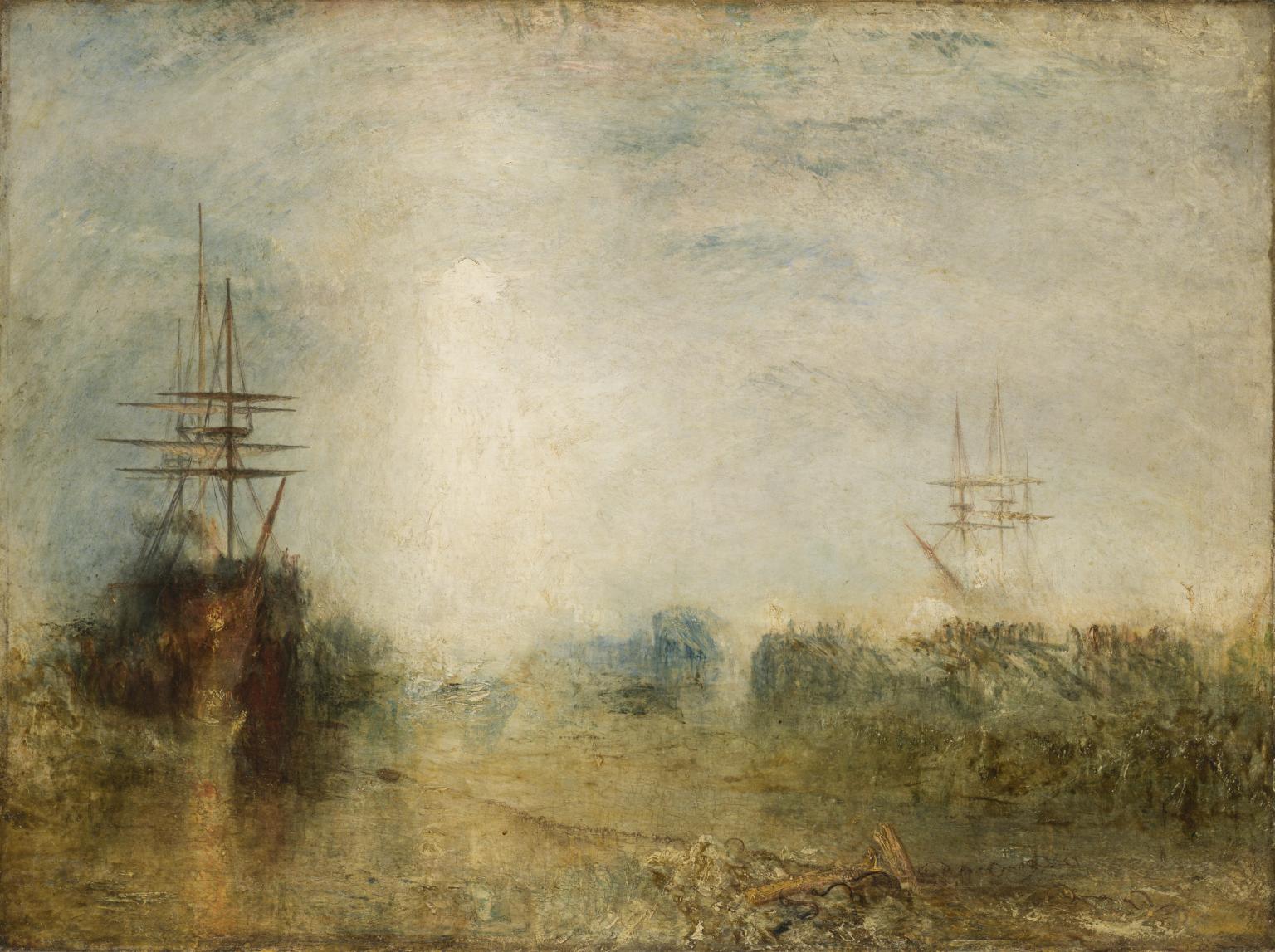
J M W Turner, Whalers (Boiling Blubber) Entangled in Flaw Ice, Endeavouring to Extricate Themselves (1846)

Melville, Herman – Moby-Dick (1851)

This was my one out-of-sequence read for the year, as I joined a Twitter group read of this book, which, like The Iliad and The Odyssey, I had not read since my precocious childhood. (I note also that, having read The Man Without Qualities, The Balkan Trilogy, and The Levant Trilogy in recent years, I have relieved some of the pressure that will inevitably brought to bear when I reach the M shelf.) I remembered the book as mostly the story of Ahab’s obsession with the white whale, but had forgotten that the book is a strange and wonderful mixture of psychological exploration of human nature, allegorical tale, shaggy dog story and detailed account of the workings and history of the whaling industry. The latter part, I must admit, I found strangely compelling; as abhorrent as the idea of the killing of whales may be, the intricacies of the process are quite astonishing, but no more so than the sheer scope of the book. As I said at the outset, I am a reader of the classics, but if the word “classic” has come to refer to a predictable and stable literary form, this book is a reminder that classics became classics not by following the rules, but by rewriting them. [Ed. – So well put! Thanks, Nat. Same place next year?]

Nat Leach’s Year in Reading, 2021

Today’s reflection on a year in reading is by Nat Leach, a longtime friend of mine and of this blog. Nat now lives and works in Peterborough, after returning home to Ontario from Cape Breton last year. He tweets @Gnatleech.

Look for more reflections from a wonderful assortment of readers every day this week and next. Remember, you can always add your thoughts to the mix. Just let me know, either in the comments or on Twitter (@ds228).

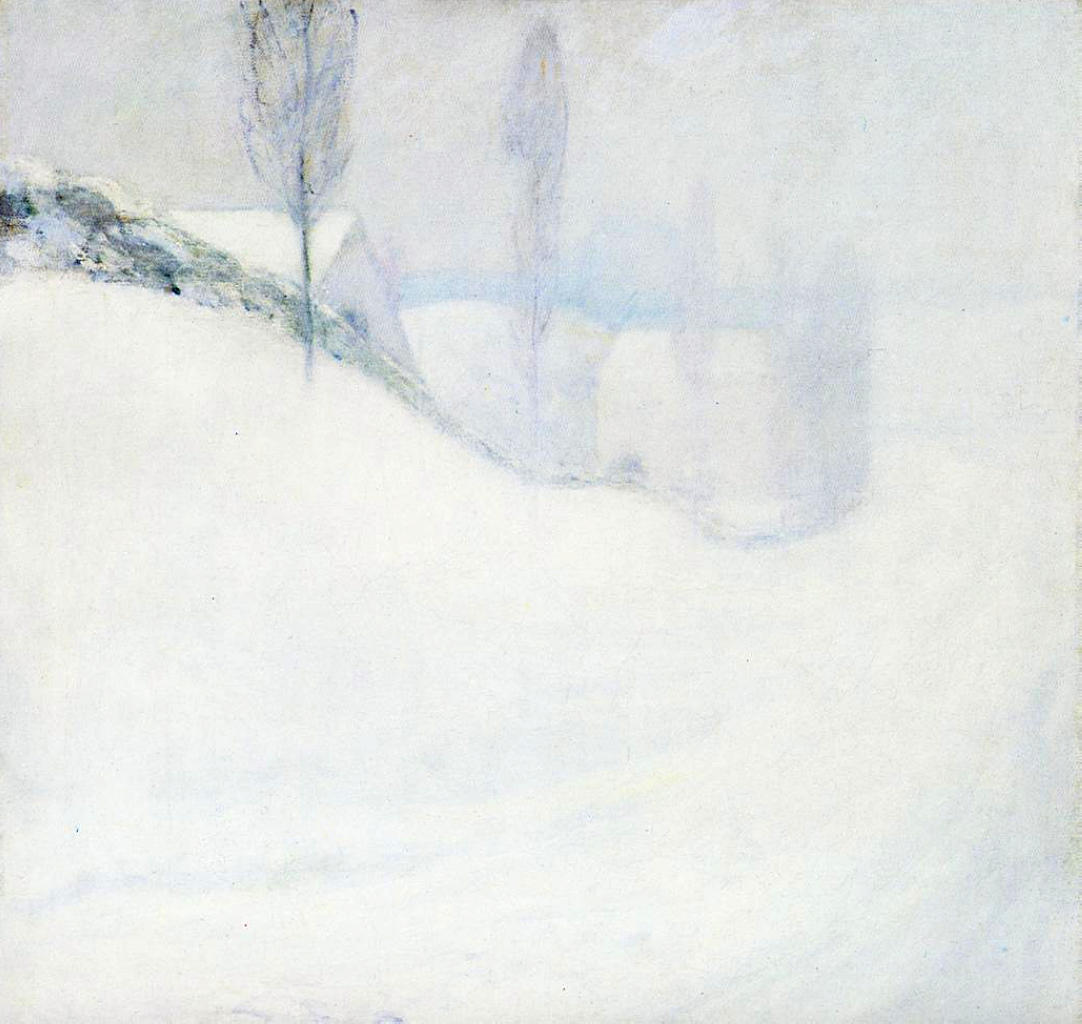
John Henry Twachtman, Round Hill Road, ca. 1890 — 1900

Readers who may have caught my annual posts over the last couple of years know that I am trying to work through all the partially read books on my shelves and am proceeding methodically, in alphabetical order. I’ve just wrapped up my fourth year, and I must admit that I have not been entirely happy with my progress lately; I spent all last year on “G” and this year I didn’t even finish “H”. Of course, given the year that I’ve had—getting a new job, working remotely for half the year, then moving halfway across the country during a pandemic—it’s a minor miracle that I’ve read anything at all. [Ed. – The country is Canada. Halfway is like all the way across twelve ordinarily sized countries.] And indeed, when I think back to the last time I had a similarly challenging year, when my daughter was born a few months before I was made Chair of my department, I recall that at that time I really did read absolutely nothing that was not work-related, so maybe I’m not really doing too badly. [Ed. – Absolutely!]

One of the key differences between then and now is that I joined Twitter four years ago, right at the start of my project, and was able to connect with a wonderful and supportive group of readers who frequently entice me into joining in collective reading endeavours [Ed. — Please admire this correct spelling] and who tacitly encourage me to take some time—however little—out of my day to read. Even though I never keep pace with any proposed reading schedule, the idea of reading collectively keeps me going, and I do always finish eventually. So, while I may joke about Twitter distracting me from my project, feeling like part of a reading community has really helped to keep me grounded and to make sure that I take time for myself in the midst of a chaotic schedule, and for that I am very grateful.

And besides, I’m not sure that it is true that these group reads are delaying my progress; fortuitously, I was able to participate in three reads of “H” authors (Hartley, Hasek, Hrabal), and besides, as will become clear, I was also able to put a pretty large dent in my “M” shelf, which will surely save me some time later on. In total, I finished 28 books this year, 18 from the “H” shelf, in addition to sampling some 19th century poetry (Hardy, Heine, Hemans, Hogg, Hölderlin), non-fiction (Hazlitt), and drama (Ralph Hamilton, J.G. Holman), not to mention a smattering of philosophy/theory (Hegel, Heidegger, Geoffrey Hartman).

Looking ahead to next year, I still have some significant “H” books ahead of me (Homer promises to be a highlight) and hope to get through “I” and “J” as those shelves are much less populated, so if anybody has any 2022 group reads planned for that particular alphabetical neighbourhood, just let me know.

Alex Colville, Traveller, 1992

In the mean time, here is a brief summary of my 2021 reading:

A Walk through H

Hardwick, Michael – The Private Life of Dr. Watson (1983)

I was given this book as a child when I was a young Sherlock Holmes enthusiast, but it didn’t really catch my interest, as it seemed too “grown up” for me at the time. Many years later, I have come to realize that it just isn’t a very interesting book. It doesn’t flesh out Watson’s character in any meaningful way, and in fact Watson just seems a vehicle to incorporate various famous Victorian individuals (Henry Ward Beecher, Sarah Bernhardt) and contexts (gold mining in Australia, war in Afghanistan), sometimes prompted by the most minimal of hints in Conan Doyle’s stories.

Hardy, Thomas – Jude the Obscure (1894-95)

I have long cited this as my favourite Hardy novel; I read it as an undergraduate and its representation of its protagonist as an aspiring intellectual and frustrated social outsider certainly resonated with me at the time. Re-reading it in middle age, I still think it is a great book, but was slightly less satisfied with it. I couldn’t help perceiving, in the midst of Jude’s tragic fate, the web of artifice behind his sufferings. The most inconvenient things happen at the most inopportune times, and characters change their minds about things just at the moment when it will do the most damage. Such misfortunes are the nature of tragedy, of course, and Hardy writes it very effectively—it’s just that those moments where I could see him pulling the strings felt more disruptive to me this time around. Hardy gave up novel-writing after this one because he was accused of immorality after having written what he thought was a morally didactic novel, and I’m starting to think he was a little bit too right about that.

Hartley, L.P. – The Eustace and Hilda Trilogy (1944-49)

Hartley is one of the authors I’ve read the most, and when he’s good, he’s brilliant, but when he’s not, he can be infuriating. Reading this trilogy, I experienced plenty of both. Readers of The Go-Between know how good Hartley is at representing children, and the first book of the trilogy, The Shrimp and the Anemone, amply demonstrates this strength. Eustace and Hilda are brother and sister living in a seaside town in Norfolk in the early 20th century; most of the book is focalized through Eustace (who stands in for Hartley himself in this semi-autobiographical trilogy) and his anxieties and misunderstandings of the adult world are highly poignant because they ring true to the way children think (or at least to the way I thought as a child). The second two books, which deal with Eustace and Hilda as young adults, did not seem as strong to me, and I think part of the reason is that while the characters age, they do not seem to change or grow from their experience. Part of this is no doubt deliberate— Eustace receives an inheritance that shelters him from having to deal with many real-world problems— but Eustace’s thought processes no longer have the same ring of truth in a grown adult. And in the final book, Hilda’s extreme physical debilitation in reaction to a failed love affair seems so absurd (if not anti-feminist) that it strains all credulity.

Hartley, L.P. – Simonetta Perkins (1925)

In the final book of the trilogy, while vacationing in Venice, Eustace more or less accidentally writes a book (his hostess tells everyone he is a writer, so he feels obliged to write something to live up to it). [Ed. – Maybe this should be my strategy. Please help me by inviting me to Venice.] A publisher accepts the book, but warns Eustace not to expect it to sell because it’s too long to be a short story and too short to be a novel. Interestingly, this description closely fits Hartley’s own first book, Simonetta Perkins, which is also set in Venice, and is about a young American woman who becomes infatuated with a gondolier. It’s a powerful, if slight, exploration of the nature of desire, which is even suggested by the title; the woman’s name is Lavinia Johnson not Simonetta Perkins— that’s the name she makes up when she seeks advice about her situation and claims to be “asking for a friend.” The title thus gives prominence to what might otherwise have been a minor scene in the book; Simonetta is the desiring alter ego upon whom Lavinia’s suppressed sexual urges are projected.

Hašek, Jaroslav – The Good Soldier Švejk (1921-23) (Trans. Cecil Parrott)

I had not intended to read this, but a Twitter reading group was starting just after I finished Hartley, so it was alphabetical fate. The book is a satire about World War I, but its satire is wide-ranging and sometimes a bit ambiguous. Švejk is zealously patriotic, but, as his superiors incessantly point out, he is also an idiot who screws up every task he is assigned; so is he really a “good” soldier, or is that moniker ironic? Or is the implication that the qualities of a “good” soldier (mindless obedience and patriotic fervor) are inherently idiotic? Moreover, Švejk’s overzealous efforts for the cause very often have subversive effects, whether intended or not, so it can be hard to separate incompetence from sabotage; for this reason, Švejk is often suspected of being a traitor, though we have no indication that this is actually the case. As for the satire, sometimes, the joke is on Švejk, but he always manages to get out of the scrapes he gets himself into. More often, the joke is on the absurdity of military bureaucracy, which appears to be the primary target of the book’s satire; Švejk’s idiocy is nothing compared to the massive failures of logic and planning attributed to so-called “military intelligence.” It’s a pity Hašek died before he could finish the book, as it breaks off in the middle of the war, leaving me wanting more of Švejk.

Hays, Mary – The Victim of Prejudice (1799)

I first read this as an undergraduate, and was less than charitable towards it, but later read Hays’s Memoirs of Emma Courtney (a better book) and resolved to give this one another chance. The titular character, Mary, narrates her progression from a child of mysterious parentage, raised by a benevolent father figure, through a period of young love, to her persecution by a vicious and lustful landowner. It reads as a feminist take on the Richardsonian seduction narrative with a bleak vision of a victim-blaming culture that really hasn’t changed in 200+ years.

Haywood, Eliza – Eovaii (1736)

This was my first introduction to Haywood, and possibly not the best choice, since it does not seem to be characteristic of her work, but it was the only one I had. If Hays’s book is a feminist version of Richardson, this is a feminist version of Gulliver’s Travels:the titular princess loses her kingdom, is abducted by an evil magician and goes through a number of weird, magical adventures in order to return to her rightful place. It’s all meant as political satire, as the evil magician stands for Sir Robert Walpole, but most of the topical allusions are now quite obscure. Still an enjoyable, fantastical, narrative.

Hébert, Anne – Kamouraska (1970) (Trans. Norman Shapiro)

Over the years, I’ve written quite a bit about the Gothic, and the texts that interest me the most are the ones that represent the instability of human identity not just at the level of content (e.g. ghosts and monsters that disrupt our belief that the world—and our place in it—is rational) but also at the level of form. If Gothic phenomena disrupt what we think we know about our place in the world, they must also disrupt our attempts to represent that world to ourselves and to others. Hébert’s novel is exemplary in this regard. Its content is Gothic in that it represents extremes of passion and revolves centrally around a murder, but it has no supernatural trappings. Rather, it is Hébert’s narrative devices that convey the Gothic haunting that afflicts the protagonist, a woman whose first husband was murdered, and whose second husband is on his deathbed. The novel’s fluid shifts between past and present tense and between first and third person convey her struggles with her memories, which seem to come unbidden and which challenge the identity she has crafted for herself since childhood. She is haunted not by ghosts but by her past selves and the persistence of her memories. An intense and breathtaking narrative, and quite possibly my favourite book of the year.

Hession, Rónán – Leonard and Hungry Paul (2019)

I don’t read a lot of contemporary fiction, but when I do, it’s usually because Dorian has recommended a book highly, as with this one. And, as usual, I didn’t regret it; reading this was just good for my soul. [Ed. – I love to hear it!] It’s a gentle book with simple problems, heart-warming solutions and socially awkward characters that I could relate to far more than I’d like to admit. It’s also very funny, in its low-key way.

Hillesum, Etty – An Interrupted Life/Letters from Westerbork (1941-43) (Trans. Arnold J. Pomerans)

I first read Hillesum’s diary describing her life in the Nazi-occupied Netherlands when I was a graduate student, and fear I was quite uncharitable to the book at the time. (Noticing a theme yet? Student Nat was quite a mean reader.) Her philosophical approach, which involves accepting evil, forgiving Nazis, and refusing to resist, seemed infuriatingly defeatist to me at the time, and while I certainly can’t wish that more people shared this view, with age has come a greater appreciation for the moral strength required to hold this position. I had not read the letters appended to her diary before; these were written during Hillesum’s time in the Westerbork camp before being deported to Auschwitz where she was killed. These letters deal mostly with practical matters: begging friends for food, thanking them for sending it, and apologizing for being such a burden on them (she had an extensive network that helped keep her and her family alive in terrible conditions). There are, however, some surprisingly poetic moments, as Hillesum proves able to see beauty even in a concentration camp, and some predictably brutal ones; her last long letter is a harrowing description of the preparations for the transport prior to the one on which she herself was forced to leave. She tries to help where she can, but recounts commenting to a companion, in a way that is both painfully matter-of-fact and as close to violent passion as Hillesum gets: “this is what hell is like.”

Hoess, Rudolf – Commandant of Auschwitz (1946) (Trans. Constantine FitzGibbon)

By an appalling coincidence in my alphabetical system, I went from Etty Hillesum to this, the autobiography of Hoess, the Commandant of Auschwitz, written while awaiting his execution, a book that Primo Levi in his introduction describes as “filled with evil” and as having “no literary quality” and as being “agony” to read. [Ed. – Too fuckin right.] It is probably pointless to attempt to add to that description except to say that it was somehow even worse than I expected. Obviously, that’s a low bar for a book written by a Nazi, but having read some of Albert Speer’s diaries, I know that some degree of post-war self-reflection was possible. But Levi is right; the degree of disingenuousness and refusal to take responsibility for his actions is utterly appalling. The passive voice does a lot of heavy lifting in this book (things “were done” to prisoners, nobody did them) and ditto formulations involving the imperative (Hoess “had to” do the things he describes, he never has any agency). Despite his plea of loyalty to the Reich, he spends most of the book throwing his superiors under the bus; to read his account, Auschwitz would have been a model camp if he had just been given the resources to run it properly along with competent underlings who would not have behaved with such unsanctioned brutality towards prisoners (and this is not even to mention the casually awful throwaway bits he chooses to include, such as his extensive explanation of his theories about how to cure homosexuality.) [Ed. – ugh]

Holcroft, Thomas – Anna St. Ives (1792)

I certainly understand why Holcroft is no longer widely read; his novels are highly political responses to philosophical and social debates specific to the late eighteenth century. If that doesn’t put you off, though, there’s a great deal to admire in his work. Like his contemporary, William Godwin, Holcroft uses his narratives to explore the concrete implications of radical philosophical ideals, often teasing out resolutions much more complex than those of other political radicals of the time. Anna St. Ives is an epistolary novel that details a love triangle between the title character, and Frank Henley, a Godwinian idealist who believes in the perfectibility of the human species in its gradual development towards an ever-increasing level of truth, and Coke Clifton, a libertine and all-around cad. [Ed. – Those libertines, why they always gotta be cads?] That this novel is as engaging as it is, is in itself a challenge to Frank’s principles, as the truth is nowhere near as obvious as Frank hopes it should be. Like Hays, Holcroft rewrites the Richardsonian narrative didactically. Preachiness notwithstanding, the book culminates in a suspenseful and action-packed sequence that kept me on the edge of my seat. If I have a quibble, it’s with the way that characters, as so often in epistolary novels, just happen to have access to writing implements in the most unlikely of places, deciding to write their narratives even when there is nobody within the book likely to be able to read them.

Hornby, Nick – High Fidelity (1995)

I admit that I can be quite grumpy about film adaptations of good books, but I was grumpy about the film version of High Fidelity long before I ever read the book. It sounded like a great concept, was being made by a director I like a lot (Stephen Frears), but turned out to be a mess. Part of the problem, no doubt, was the Hollywood tendency to cast characters who are supposed to lack charm, charisma and good looks with Hollywood stars who embody those very qualities. It’s hard to find a character unlikeable when he’s played by John Cusack. [Ed. – Truth.] By contrast, I ended up liking the book a great deal, as it does a much better job of keeping its protagonist/narrator/second-rate record store owner/obsessive list-maker/terrible boyfriend teetering on the edge of unlikeability just enough to keep you rooting for him, not to simply get what he wants (whatever that is) but to become a better person. The book is just very smart about the flaws in conventional standards of masculinity, and about relationships more generally.

Hrabal, Bohumil – Too Loud a Solitude (1976) (Trans. Michael Henry Heim)

Although they are very different kinds of book, it really helped to have read Švejk before this, as Hrabal’s narrator echoes Švejk’s garrulity, and gossipy tone about Czech life. The book also inherits a satirical strain from Hašek, as both criticize the unthinking inefficiency of political authorities. The brief narrative reads very allegorically: it is narrated by a man who works crushing paper, and incidentally rescues much classic literature, but his manual process is ultimately supplanted by modern methods, which embody both the modern socialist state and the ephemeral nature of popular culture, both of which threaten the more enduring forms of literature and knowledge for which the narrator stands.

Christopher Pratt, Placentia Bay: A Boat in Winter, 1996

Best of the Rest

Barthes, Roland – A Lover’s Discourse (1977) (Trans. Richard Howard)

I was excited to participate in a theory-based Twitter group read, although I admit that I found it rather difficult to say something sensible about the book in that forum, needing a bit more time to process theoretical texts. I happened to be reading this book at the same time as I was revisiting Éric Rohmer’s Six Moral Tales on film, and I think I’ve come to understand this book better by opposition. Rohmer’s characters are all very discursive lovers (lots of talk, little action) but in a different way to that described by Barthes. In each of the tales, a male protagonist engages in a tentative kind of relationship with an inappropriate female partner (inappropriate because of age, disposition or worldview, but most importantly for the tautological reason that they are not the appropriate partner). By working through these relationships and avoiding the potential entanglements they entail, the protagonist in most of the films becomes free to pursue, or return to, the genuine object of his passion. Rohmer’s characters calculate and overthink their relationships in a way entirely antithetical to the discourse that Barthes writes about, which is that of the desperate, passionate lover of whom Goethe’s Werther is presented as the archetype. We do see a few moments of passion in Rohmer’s tales, but for the most part, that kind of love is the absent centre around which the action takes place. Barthes writes, “most often, I am in the very darkness of my desire” and it is from this darkness that this “lover’s discourse” originates. Barthes structures the book as a series of fragments based on various discursive positions taken by the lover (e.g. jealousy, languor, ravishment et cet.), all of which are ways of expressing in some way the maddening delusions of love. But these forms of expression do not fully enlighten the “darkness of my desire”; rather, they express the position of the lover in all its irrationality. The “lover’s discourse” is thus at the limits of language, challenging the systems of language that structure the world in a rational way, even as it cannot entirely escape those systems.

Bennett, Arnold – The Old Wives’ Tale (1908)

This book was not on my radar until Dorian & Rohan suggested it for a group read; I found it intriguing and mostly enjoyable, though not exactly what I expected. Not that I’m sure just what I expected except that the book begins in a manner reminiscent of a Victorian novel that made me feel that it was establishing some kind of moral framework through which I was supposed to read it. Hence, when the narrative diverges, telling the separate stories of two sisters, one who stays home and runs the family business in the Midlands of England, while the other runs off to Paris, I was expecting some kind of moral judgment to be attached to the two stories. In the end, though, I’m not sure that ever happened. The novel speaks to the inevitability of aging and death and to the value of the experiences that take place in the course of that process, but it doesn’t seem to reflect on the relative value of those experiences. [Ed. – Well put!] Both sisters experience happiness and sadness, successes and failures, and perhaps, despite their many differences, we are meant to see how much they actually have in common. So maybe it was just more modern than I expected? (But knowing Woolf’s hate for Bennett, maybe I shouldn’t say that.)

Dostoevsky, Fyodor – Demons (1872) (Trans. Constance Garnett)

It wasn’t until I was halfway through this book that I realized what it was really about, and I’m not sure I grasped all of the intricacies of the plot even by the end. The book is a convoluted web of intrigues, which take to an extreme the typical Dostoyevskyian representation of characters who embody extreme challenges to conventional moral values. I probably shouldn’t be shocked by Dostoevsky any more, but the title really isn’t an exaggeration: the book is filled with unpleasant, violent, and diabolically evil characters. Moreover, I wasn’t prepared for the political angle, although it spurred me on to learn a lot about 19th century Russia along the way.

Lowry, Malcolm – Under the Volcano (1947)

As a student, I tended to avoid literature of the early 20th century, in part because I had little interest in the seemingly wide swath of canonical literature (especially American) that either romanticizes the lives of over-privileged alcoholics, or treats their sufferings as some kind of archetype of the human condition. This book falls squarely in the latter camp, and is certainly a superior example of the genre; it’s brilliantly written and cleverly plotted (in a way that calls for a reread to piece together all the details), but I just couldn’t muster up the sympathy — or even much of the interest—- that I thought I was supposed to feel for the protagonists.

Manning, Olivia – The Balkan Trilogy (1960-65) and The Levant Trilogy (1976-80)

I had read (and loved!) Manning’s School for Love, so was eager to read more by her, although I doubt that I would have had the focus to get through these six books had I not been reading in the company of an intrepid group of Twitterers, whose companionship in this journey was greatly appreciated. And quite a journey it is too, as we follow Guy and Harriet Pringle, who are forced, during the course of World War II, from Bucharest to Athens to Cairo. They are more acted upon than acting, forced to adapt to circumstances beyond their control, but because we are made to care so much about the characters, even descriptions of their everyday activities remain absolutely gripping. [Ed. – Also well put.] These books are sheer character-based narrative pleasure; we come to know the characters intimately and become entirely immersed in their world despite the general lack of highly dramatic events (which do come occasionally, and always shockingly, out of the blue). To be completely honest, I still have about 100 pages of the Levant Trilogy left to go, and I am not rushing to finish it; judging by the responses of some of my companions, I will feel quite bereft without Harriet & Co. and I’m not quite ready for that yet.

Musil, Robert – The Man Without Qualities (1930-43) (Trans. Sophie Wilkins)

After 18 months, numerous library renewals, and ultimately photographing the last 200 pages of notes and fragments, I finally finished this book. I’m not sure how to do the experience justice, though I can say it was entirely worthwhile. No plot summary would be adequate, especially as Musil died before completing the book, and the edition I read was filled with drafts which sketch out very different directions for the characters. In any case, the plot felt entirely secondary to Musil’s powerful ability to sum up the incipient crises of the emerging modern age with devastating clarity; the book feels shockingly current.

Nat Leach’s Year in Reading, 2020

In the next week or so I’ll be writing up my reflections on my 2020 reading year. In the meantime, I’ve solicited guest posts from friends and fellow book lovers about their own literary highlights. I’m always looking for new contributors; let me know here or on Twitter (@ds228) if you have something you want to share.

The fourth post is by Nat Leach (@Gnatleech). Nat has written several posts for the blog over the years, all wonderful. He lives and works on Cape Breton Island.

An Alphabetical Odyssey: Year 3

Like so many things in 2020, my reading did not exactly go according to plan. Readers of my Year in Review post from last year will know that my current project is to work through my shelves alphabetically in order to finish the many partially-read books on them. But while I managed to work my way through almost three letters of the alphabet during each of my first two years of this project, I ended up devoting most of this year to the letter “G”. There are a number of reasons for this: my own tendency to expand this project by creating mini-projects (e.g. exploring 6 translations of Goethe’s Faust or almost 2000 pages of Vasily Grossman) or by adding new books to my shelves thanks to a number of irresistible NYRB Classics titles and some very strong recommendations from Dorian (a Venn diagram of which would basically be a circle), and, of course, my Achilles heel—Twitter read-alongs (Malicroix, Our Mutual Friend, The Man Without Qualities). But if this sounds like complaining, it’s absolutely not—if ever there was a project where the point was the journey and not the destination, it’s this one. After all, what’s going to happen when I reach “Z” (assuming I live that long)? I’m just going to start all over again.

Over the course of the year, I realized something about myself that might help to account for my previous system of rotating my reading between an excessively large number of books: I enjoy beginnings a lot more than endings. A new book introduces us to a new world populated by new characters whom we desire to know better. The potential is boundless. But the closer a book gets to its end, the more it forecloses the possibilities it has opened up, and (often), the more we feel that nothing can surprise us, or, worse, that the ending is not consistent with what went before. Put another way, endings are a lot harder than beginnings; creating the broad outline of a narrative world and its characters is one thing, but sketching in the detail and bringing it to a satisfying conclusion is quite another. Over the years, I think I’ve enjoyed having read only a few chapters of certain books, and having their potential frozen in place like Keats’s urn. But now that I’m getting older, the impulse for completion is getting stronger.

Maybe this is all pretty obvious, but this year really brought it home to me, as I was enticed by the openings of a number of books only to find my interest lagging in the second half. If I could have stopped reading at a certain point, my memories of some of these books would be fonder. Fortunately, I still had mostly positive reading experiences this year; I read 33 books from 11 countries (including 6 from France, making me wonder if there is something about the letter “G” and French surnames), and enjoyed most of them. Here are some short synopses:

Ford, Richard- The Sportswriter (1986)

The only thing I learned from this book is that this middle-aged white guy has no patience for the angst of other middle-aged white guys. The protagonist of this book, Frank Bascombe, is divorced because he has been horrible to his wife, continues to be horrible throughout the entire book, and somehow I’m supposed to care about his faux-profound reflections on life? I could have tolerated this book if there was some sense of distance between its author and his protagonist, but from the light way the book tosses off Frank’s casual sexism and racism to (spoiler alert, if anyone cares) the way he is rewarded at the end of the book with an incipient relationship with a seemingly interesting, intelligent, and attractive 20-year old woman, I can’t help feeling that Ford is thoroughly endorsing Frank’s perspective. I hate to use sophisticated literary-critical terms, but this book was just too “icky” for me. In fairness, Dorian warned me not to read it, but would I listen? I know it’s a bad start to be this grumpy about my first book of the year, but at least if I get a bullet in the mail, I’ll know who it’s from.

Garner, Hugh– Cabbagetown (1968)

Another book from my list of Canadian classics, this novel focuses on the life of an impoverished community in Toronto during the Great Depression. The book’s strength comes from its powerful, vivid depiction of the struggles of its characters as each of them attempts to come to terms with the reality of the Depression in a different way. Here’s a typically great descriptive passage, of a chocolate factory at which one character is fortunate enough to be employed:

The mixing room was heavy with the smell of chocolate. The walls, the floor, the machinery, even Billy, reeked of it. It permeated his clothing, hair, and even his comb, nailfile and wallet, so that he was a permanent olfactory advertisement for Besty-Tasty products. His appetite for chocolate had been satisfied forever during his first week in the mixing room. He had imbibed his fill, not only by mouth and gullet but by absorption through his pores. Now he could no longer even smell chocolate, for it was his own body odour.

It’s far from the bleakest passage in the book, but given the unfortunate fate this character suffers in the mixing room, it appropriately attests to the way in which characters are victims of their concrete circumstances.

Genet, Jean- Our Lady of the Flowers (1943) (trans. Bernard Frechtman)

Usually, when an author has a reputation for being shocking, I find myself highly disappointed when I actually read them. Genet, however, completely lives up to his reputation. Written clandestinely in prison, the book challenges all conventions and taboos. But, going beyond Genet’s detailed and explicit attention to bodily emissions and his multiple slang terms for “penis,” two things particularly struck me. 1) The guy can write. Given his subject matter, it’s hard to call his writing beautiful, but it has a rhythm and flow that captivates, even as his digressive style is continually shifting narrative tracks. 2) At the root of the narrative is actually a very sensitive story of someone who would today be called a trans youth, told without embellishment or censorship.

Gide, André- The Immoralist (1902) (trans. Dorothy Bussy)

Call this Exhibit A of the phenomenon I mentioned above; this book captured me at the beginning, but lost much of my interest by the end. It’s an appropriate book for this year, I suppose, insofar as it is concerned with the way that illness—and recovery—test relationships. I enjoyed this book, but I somehow expected it to go further than it did. Maybe I’ve just become jaded by subsequent anti-heroes, but the climax of the book did not particularly shock me, nor did it inspire much moral reflection. In his Preface, Gide says, “I have not tried to prove anything, but only to paint a picture well”; he does that much, but I couldn’t help wanting something more.

Ginzburg, Natalia- Family Lexicon (1963) (trans. Jenny McPhee)

Call this one Exhibit B: I liked this book a lot, but I loved the first half of it and felt it ran out of steam a little bit towards the end. It opens in a really interesting way, exploring how a family’s language constructs its own particular place in the world. This thread carries through the book, of course, but at a certain point, Ginzburg becomes much more informational, describing what happened to each member of the family and its associated friends. Not coincidentally, this point is the outbreak of World War II, and the various traumas and divisions in the family are noted without being extensively described. Given that Ginzburg notoriously recommended the rejection of Primo Levi’s seminal Holocaust memoir, If This is a Man, because of its subject matter, it is perhaps not surprising to find that she is reticent about describing her own war experiences, including her husband being tortured to death by the Nazis. I liked it enough to give the book to my mother for her birthday, and her take was that the book starts from a child’s perspective, so you don’t expect very much interpretation, but once it shifts to an adult’s perspective, we feel that absence of context a lot more. Which I thought was a good point. All of this is by way of explaining why I felt the latter half of the book somewhat flatter than the first part, but I still enjoyed it a lot.

Giono, Jean- Hill (1929) (trans. Paul Eprile)

This was a late addition to my list, thanks to the recommendation of Dorian, and others on Twitter, and was certainly one of my favourite books of the year. Written in 1929, it reads in a very contemporary way because of its treatment of environmental concerns. I jokingly referred to it as “The Rime of the Ancient Mariner” meets Picnic at Hanging Rock because it involves a violation of nature that is punished, but in a mysterious, uncanny way. The events take place in a tiny village in Provence, where the inhabitants struggle with the forces of nature, and the book wonderfully illustrates the precarious coexistence of the human and natural worlds.

Gissing, George- The Odd Women (1893)

This book had been sitting on my shelf for some 20 years, and now that I’ve finally gotten around to reading it I could kick myself for waiting so long. Another book that feels very contemporary despite its age, and that rarest of things, a book that deals with social issues (in this case, the Victorian “woman question”) without sounding preachy. Clearly, there are characters we are expected to identify with more than others, but Gissing brings great sensitivity and understanding even to the characters who are clearly shown to be ideologically flawed. My one criticism of this book would be its use of implausible coincidences to move the plot along; for example, when complete strangers meet and realize that they live in exactly the same building in the huge and bustling city of London, you just know that plot complications are going to follow. (On the other hand, I forgive Dickens for stuff like this ten times in a single book, so I guess I can’t really complain.) This is one of the exceptions to my tendency of the year, since it actually gets the ending just right, which is especially difficult for novels about social problems; a happy ending is liable to make readers complacent about real social ills, while an overly tragic ending makes them feel hopeless. Gissing strikes just the right balance between hope for the future and mourning for what might have been.

Godwin, William- Deloraine (1833)

Having read all of Godwin’s “mature” novels (I haven’t read his three “juvenile” novels) except this, his last, I figured it was time. It’s far from his best, and might be accused of being a re-tread of Godwin’s dominant themes: social alienation, class injustice, the haunted perspective of a pursued criminal, and an abrupt reversal of philosophical perspective at the end. He does, however, also do a characteristically good job of using conventional melodramatic situations to raise deeper philosophical questions. Is it worth saving your life, Godwin asks, if you lose your identity in the process?

Gogol, Nikolai- The Inspector General (1836) (trans. B.G. Guerney)

Sadly, this nineteenth century satire on political corruption and deceptive appearances is just as relevant now as it was then. A buffoonish but minor civil servant is mistaken for an important government inspector in disguise; hilarity ensues as local officials seek to conceal their misdeeds and appease the fake inspector, but as the play’s conclusion reminds us, the subject is not all that funny.

Goethe- Faust, Parts 1 and 2 (1808, 1832) (various translators)

I embarked on an ambitious project of beginning 6 translations, and ended up finishing 2 (the Bayard Taylor and Charles Passage versions). Part of the reason for this is that Part 1 has been much more frequently translated than Part 2; two of my translations were of Part 1 only. To summarize briefly, Part 1 was pretty much exactly what I expected it to be (Faust makes deal with Mephistopheles, seduces Gretchen, lots of witches and devilish imagery et cet.), and Part 2 was utterly and completely not (complex allegory about everything from contemporary politics to poetry to geology). I would say that it completely changed my view of Goethe, but now that I think about it, I had a similar reaction to Wilhelm Meister’s Apprenticeship, so maybe I should just admit that I have no idea what to expect from him.

Goethe- The Sorrows of Young Werther (1774) (trans. Elizabeth Mayer and Louise Brogan)

When I was an undergraduate, my classmates and I created a list of “big idiots of English literature,” to which virtually every character in every book we read would be added for one reason or another. Werther would probably have earned his own category on that list. I actually suspect that undergraduate me would have totally loved this book, but given the suicide craze that it sparked in Germany on its publication, it’s probably just as well that I did not read it until I was older and wiser. Now, I’m more inclined to say that it’s a good book, but man, that guy is a big idiot.

Gracq, Julien- Chateau d’Argol (1938) (trans. Louise Varèse)

I had heard such wonderful things about Gracq that I was very keen to read one of his books. Having received this one (his first, as it happens) as a gift some years ago, I chose it, which may not actually have been the best place to start. The writing is gorgeous, the plot minimal—a  man buys a remote castle in Brittany, his frenemy comes to visit, and brings a woman, leading to a love triangle of sorts—and some of the chapters are utterly compelling. One in which the three protagonists swim too far out into the sea and struggle to return to shore was particularly gripping. Given my interest in the Gothic, I was also intrigued by the exploration of the castle and the vivid, often grotesque, imagery, but, finally, I wasn’t sure if the book adds up to much. It gave the impression of housing some hermetic secret, but search me what that might be. But the writing itself is enough to make me want to explore Gracq further.

Grass, Günter- The Tin Drum (1959) (trans. Ralph Manheim)

Exhibit C? At least I’d been warned that the first half of this book is much better than the second. And having seen Volker Schlöndorff’s film adaptation three times, I certainly had some vivid memories of the beginning: Oskar Matzerath—unreliable narrator extraordinaire—tells the improbable story of his mother’s conception, eventually arriving at his own birth, and the novel’s pivotal event: he is given a drum for his third birthday and decides to stop growing. I was a bit puzzled that I had no recollection of any events from the second half of the book, but after watching the film for a fourth time, I realized that Schlöndorff only adapted the first 2 of the novel’s 3 books. Probably a wise choice since the third book is pretty forgettable, and Schlöndorff ends his film by foregrounding the Holocaust context that Grass himself has been accused of minimizing. As Ernestine Schlant puts it, “there is an ingrained obtuseness and insensitivity to those who suffered and died, evident in a language where silence is veiled in verbal dexterity and a creative exuberance rooted in pre-Holocaust aesthetics.” Schlöndorff does a much better job of addressing this context in his film, foregrounding German anti-Semitism; having Charles Aznavour sympathetically portray Sigismund Markus, the store owner who supplies Oskar with his drums, and one of the few Jewish characters in the book; and, finally, ending with the arrival of Fajngold, a camp survivor who displaces Oskar’s family. I liked the book well enough, but I think Schlant has a point: Grass loves his own creativity in a way that overshadows his book’s troubling subject matter.

Gray, Alasdair- Poor Things (1992)

A playfully postmodern riff on Frankenstein in particular and nineteenth century fiction more generally, this book starts with “Alasdair Gray” discovering and surreptitiously pocketing a manuscript written by a Victorian physician and gets progressively wilder from there. Impossible to write too much about without giving something away, but brilliant in the way that each successive level of documentation works to throw into question what has come before.

Green, Henry- Loving (1945)

This book bucked the trend of the year: it grabbed me from the beginning and never let go. The plot concerns the servants in an Irish manor during World War II, and depicts their lives with a remarkable fullness, rarely showing much of the lives of the upper-class characters at all. Highly recommended to anybody except those who can’t stand when adjectives are used as adverbs.

Greene, Graham- The Heart of the Matter (1948)

This was my third Greene novel (after The Power and the Glory and A Burnt-Out Case) and certainly the one I enjoyed the most. I suspect this has as much to do with my age as anything else; I read those first two in my 20’s, but Greene’s heroes always seem to be world-weary and cynical, a position with which I am becoming increasingly sympathetic. I could certainly feel for Scobie, a morally upright but generally insignificant colonial policeman whose conscience gets tested both in his public and his private life. The other challenge I find with reading Greene is the centrality of the Catholic beliefs of many of his characters; in this case, the entire final third of the book hinges on Scobie’s Catholic definition of sin, and even though one of the women in his life points out the inconsistency between his actions and beliefs, it is clear that readers are supposed to be aligned with Scobie’s views. George Orwell disliked the book for this reason, dismissing Scobie’s character as implausible (that, and the fact that the book is set in Africa, but is exclusively concerned with “white people problems”). So, I did enjoy the book, but also felt that I couldn’t sufficiently engage with its moral problem.

Greenwood, Walter- Love on the Dole (1933)

Another very fitting book to read this year, this account of life in a Northern English city during the Great Depression is filled with simmering, impotent frustration with the system, and one very explosive protest. Greenwood does an excellent job of showing the texture of life within the limiting constraints of “Hanky Park,” the slum neighbourhood where the characters live, from the cradle to the grave. We see highs as well as lows, but are always reminded that the system is designed in precisely this way, as the lows get progressively lower.

Grossman, Vasily- Stalingrad (1952) (trans. Robert Chandler and Elizabeth Chandler) and Life and Fate (1960) (trans. Robert Chandler)

I bought Life and Fate on Dorian’s recommendation, but before I could read it, I heard about NYRB’s publication of Stalingrad. I tried to decide which to read first, as there seem to be many opinions on that question. In his introduction to Life and Fate, Robert Chandler says that it is “better seen as a separate novel that includes some of the same characters,” but in his Introduction to Stalingrad, he refers to the two novels as a closely connected “dilogy.” I can certainly see the logic in both claims; one does not need to have read Stalingrad to appreciate Life and Fate. As a stand-alone novel, the latter can simply be seen as opening in medias res, and its ideological perspective is markedly different from the earlier novel anyway. However, I ended up reading the “dilogy” in sequence, which did help me to feel the continuity of Grossman’s intricately depicted world. In fact, Life and Fate begins with characters who had been captured by the Germans about halfway through Stalingrad, and whom I had almost forgotten already, so I’m sure that if I had read them separately, I would have missed many of the connections between them. I enjoyed both books, although Stalingrad is much more ideologically orthodox than Life and Fate, which is more complex (and subversive) in its exploration of the dynamics of totalitarianism, both in Germany and in Russia.

Grushin, Olga- The Dream Life of Sukhanov (2005)

This was a wonderful follow-up to Grossman, exploring the history and psychology of the Soviet era with a specific lens on visual art. The novel positions surrealism as an imaginative artistic movement repressed by the official dictates of socialist realism; that repression returns with a vengeance in the psyche of the main character. The book is narratively breath-taking and deftly switches from third-person to first-person at significant moments, building to a remarkable crescendo.

Haasse, Hella- The Scarlet City (1952) (trans. Anita Miller)

Normally, I’m a sucker for all forms of historical fiction, but this one gets mixed reviews from me. Its central narrative revolves around Giovanni Borgia, who is searching for answers to the mysteries of his birth (Is he really a Borgia? And if so, through which member (or members!) of the Borgia line can he trace his lineage?) It’s interesting to note that this character does seem to be based on a real historical figure, albeit one who was murdered before the events of this narrative begin, and who does not seem to have had such mysterious parentage; so the narrative is counter-factual, but not in a way that an average reader would recognize. Giovanni explains that he writes his narrative because there is nobody in Rome he can trust. So far, so good—and this part of the narrative was quite enjoyable—but interspersed with Giovanni’s narrative are the stories of a number of other related characters, presented in a weird combination of omniscient third person narrative and unmotivated first person reflections. The fact that Giovanni’s narrative situation is explained, but these others are not, was confusing enough, but to top it off, Haasse breaks the Sir Walter Scott rule, and makes actual historical personages central figures in a way that feels very jarring from a historical point of view (Michelangelo is the focus of two segments, and we also read letters supposedly written by Machiavelli). Those parts really did not work for me, nor did the whole thing come together in any meaningful way at the end, as I had hoped, although the vivid and brutal depiction of the Sack of Rome of 1527 was a powerful segment.

Hamsun, Knut- Hunger (1890) (trans. Robert Bly)

This book does exactly what it says on the tin: there really is an awful lot of hunger in it. It is psychologically gripping, as the narrator attempts in various ways to get money for food and very often finds reasons to reject it or give it away when he is fortunate enough to have the opportunity to get some. I took issue with the translator’s Afterword, in which Bly claims that the trajectory of the narrative is one in which the narrator comes to learn what he needs. I question whether any learning takes place in this book at all; the last event seems like yet another in a series, not a resolution. One interesting note from the Afterword, though, is that Hamsun apparently cured himself of tuberculosis by riding on the roof of a train to fill his lungs with air; I wonder what he would have done if he were alive this year.

Haushofer, Marlen- The Wall (1963/1968) (trans. Shaun Whiteside)

Possibly my favourite book of the year, but I’m not sure how to do it justice. It’s impossible to write a plot summary that doesn’t make it sound a little bit boring: woman thinks she is the last person on earth, tries to survive along with her animals. But it is absolutely riveting to follow the narrator’s thought processes, which are both practical in nature (how to accomplish the necessary tasks to survive) and very human in her need for affection and interaction (provided mostly by her dog, but also cats and cows) and in her reflection on her past life, thrown into perspective by her current situation. I knew I wouldn’t do it justice, but it’s a fantastic book.

Best of the Rest

Bosco, Henri- Malicroix (1946)(trans. Joyce Zonana)

It feels like a long time since I read and wrote about this book, but it still ranks as one of my favourite reading experiences of the year.

Dickens, Charles- Our Mutual Friend (1864-1865)

I had read this in my youth and was very pleased that it held up as well as I remembered. I know some people complain that the ending comes off as artificial and contrived, but as someone with a great fondness for melodrama, I appreciate a good melodramatic revelation scene when it is well done, and Dickens does indeed do it very well.

Musil, Robert- The Man Without Qualities (trans. Sophie Wilkins and Burton Pike)

Technically, I haven’t finished this book yet, but any time I read 1053 pages of a book, I’m going to mention it. Very good so far.

Smith, Charlotte- The Young Philosopher (1798)

Charlotte Smith is a Romantic period author who never seems to get the recognition she deserves. She thought of herself as a poet (and her 1784 Elegiac Sonnets enjoyed a great deal of popularity) but she wrote novels to pay the bills. Her novels combine radical politics and melodrama; the “young philosopher” of the title is George Delmont, who offends society by believing that a person’s merit can be determined by their actions not their status. But the novel’s focus is on his beloved, Medora Glenmorris, and her mother, embattled heroines relentlessly pursued and tormented by representatives of patriarchal culture. The melodramatic situations may be conventional, but the political use to which they are put is pointed.

“Hidden Within the Darkest Part of Myself”: Malicroix, the Gothic, and the Experience of the Unknown by Nat Leach

As always, I’m delighted to post writing by my friend Nat Leach. Here Nat contextualizes Henri Bosco’s Malicroix (1948) twice over: by thinking about its uneasy relation to Gothic literature, and by comparing it to contemporary works by the theorists Maurice Blanchot and Emmanuel Levinas. The resulting essay made sense of much of the novel for me. Enjoy!

Peter-Doig-100-Years-Ago-2001-via-peterdoig.mbam_.qc-ca1-865x577

Literature can create an experience that, illusory or not, appears as a means of discovery and an effort not to express what one knows but to experience what one does not know.

—Maurice Blanchot, The Work of Fire, 1949, trans. Charlotte Mandell.

Reading Henri Bosco’s Malicroix (originally published in 1948, and recently re-published by NYRB in a new translation by Joyce Zonana) put me in mind of the work of some of his contemporary French writers of the late 40’s, such as Blanchot and Emmanuel Levinas, and the above passage from Blanchot resonated very much with my experience of reading the book. Not only does the protagonist, alone on a strange island, reflect on his own strange experience, but readers are confronted with an unknown world that does not entirely correspond either with their sense of the real world or with their expectations of fiction. While Bosco employs conventions from genres such as the adventure novel and the Gothic novel, he takes them in unfamiliar directions.

The plot itself appears straightforward: the protagonist, Martial de Mégremut, inherits his uncle’s property on the condition that he not leave the remote island on which his house is located for a period of three months, and that he accomplish an as yet unspecified action after that period has expired. The inheritance is not particularly lucrative, but Martial’s determination (which surprises even himself) to remain on the island creates conflict with his uncle’s notary, Dromiols, who tries to induce him to leave. While this is the stuff of adventure novels, it’s also significant that the most dramatic encounter with this antagonist takes place about 2/3 of the way through the book. This underscores that the book is much more about Martial’s internal struggles, of which he himself is sometimes only dimly aware.

Bosco establishes the dominant conflict within his protagonist in the first few pages of the book. Martial belongs to the “gentle and patient” Mégremut family, which is characterized by its amiable sociability, but his uncle Cornélius, from whom he inherits, was, conversely, the last of the line of the Malicroix, a passionate and prideful lineage. Cornélius himself was a wild and anti-social being, and we soon learn that these characteristics were the product of an unhappy past linked to these negative qualities of his line.

Many of the characters, Martial himself included, question whether he is a “true” Malicroix, possessing as he does the “blood” but not the “name” of Malicroix. From the beginning, Martial acknowledges the presence of the Malicroix blood “hidden within the darkest part of myself” and this hidden force often seems to dictate his actions throughout the book, as when his conscious mind decides to leave the island even as he unconsciously determines to stay. The structure of the book suggests that Martial’s journey is a progression from Mégremut (the title of the book’s first section) to Malicroix (the title of its final section), but the ending actually complicates this opposition, showing the Mégremuts to have an unexpected toughness, while Cornélius’ final request has an unexpectedly redemptive quality to it. One significant question raised by the ending, then, is whether Martial’s actions succeed in harmonizing these two dimensions of his character, or whether he remains fundamentally split between them.

Another way of framing this opposition is that the Mégremuts represent sociability and communicability, or the beautiful as opposed to the obscurity and secrecy of the Malicroix sublime. Martial notes of his family: “We are not given to unvoiced sorrow or silent reproach. Faces and gestures speak; voices confirm. In this gentle family we love each other too much not to confess everything, especially the reproaches, the sorrow, the deep roots of tenderness.” Martial moves from the family hearth where everything is expressed directly on the surface to the mysterious island where nothing is clear. His solitude and the force of the elements (powerful winds and blinding snow) produce insomniac reveries and, eventually, feverish dreams as he falls ill after collapsing in the snow. At the height of his solitary anxiety, he observes that “I suspected that because my situation was not reasonable, it concerned my whole self, not just my reason. It was up to my soul to speak, but my soul was silent.” This sums up much about the book; it takes us beyond a merely rational apprehension of events towards their deeper, hidden meanings, which nevertheless remain mysterious. In other words, it reveals the Malicroix at the heart of every Mégremut.

This lesson is also suggestive of the book’s associations with the Gothic genre. On the surface, it is a very Gothic book indeed, with its solitary, foreboding house, mysterious will, passionate, anti-social ancestor with a traumatic past and even a woman with a strange ghost-like quality. The troubling of the distinction between Mégremut and Malicroix is also typical of the Gothic’s tendency to blur boundaries between the rational and the irrational, the human and the inhuman, communal order and individual desire. Categories that, on the surface, appear to be opposites are shown in fact to be intricately implicated with one another at a deeper, unconscious or secret level.

The book also Gothically hints at the possibility of supernatural agency, but these hints are neither confirmed nor rationalized away, leaving it in the category designated by Tzvetan Todorov as “the fantastic,” which constitutes a “hesitation” between the real and the imaginary. The action of the book thus takes on a dreamlike quality, resistant to the faculty of reason and consequently to the limiting logic of genre. For example, when Martial is rescued by a mysterious woman (who later gives her name as Anne-Madeleine, while insisting that this is just her “name of this earth”), we are made to wonder whether she is a supernatural figure come to nurse him back to health, a femme fatale come to deceive him, or just an ordinary woman who lives nearby. She functions in the narrative, variously, as all of these things, but in the end, there is no definitive answer, and only the rational mind would insist on one; it is Martial’s often indistinct perceptions of her that are most significant in this book.

In fact, this is a book full of ambiguous and shifting characters, which seem to correspond to some dimension of Martial’s psyche rather than following their own internal logic. Like Anne-Madeleine, Dromiols’ clerk, “Uncle Rat,” and the old shepherd Balandran veer abruptly between appearing as threats or helpers; for example, Balandran’s initial surliness, coupled with the fact that he stands to inherit if Martial defaults on the conditions of the will, lead us to expect him to become a significant obstacle in the narrative. Instead, he quite suddenly transfers his loyalty to Martial. Only Bréquillet, Balandran’s dog, is consistent in his character, one of steadfast canine loyalty.

Even Bosco’s brief “Notice” to the reader at the beginning of the book frames it as a Gothic text, explaining that some 40 pages that “form a separate, private account” have been removed and that “only someone truly qualified for such revelations might one day break the seal”. This minor detail already suggests the major themes of the book: its secrecy and the notion that there is a single “proper” reader of the secret, just as Martial is the single proper reader of the codicil to Cornelius’ will.

But this centrality of Martial—which is undeniable, as everything is focalized through him—is troubled the fact that his own sense of identity is uncertain and shifting. For example, before his final confrontation with Dromiols, he observes the face of his adversary, unperceived:

Into this mask had flowed a massive thought whose immobility revealed savagery, stubbornness. It fascinated me. For this thought was me, and most likely Dromiols was actually seeing me, inside himself. Troubling impression of presence. I was there. I was solely there. Did I have a life, a will, outside that savage head whose slow meditation revolved around my weak figure? I obsessed him; I was his anxiety, what haunted him.

Bosco goes beyond the convention of the Gothic double in which the antagonist mirrors the protagonist and represents his darker impulses; rather, the distinction between the two characters seems to collapse completely as Martial describes Dromiols by describing his perception of himself within Dromiols, while simultaneously demonstrating Dromiols’ power over him, as they mutually “obsess” and “fascinate” one another.

The “troubling impression of presence” described here characterizes much of the book, and suggests a more troubling experience of the unknown than is typically conveyed in the Gothic. Martial speaks of himself as inhabiting some level of being that goes beyond his experience of his own identity. It is in this respect that the book particularly made me think of Levinas and Blanchot, whose works of the late ‘40s (and beyond) articulate a sense of a self that is not an autonomous master of the world, but is inescapably chained to it. Levinas, for example, writes about what he calls the “there is,” the inescapable fact of being that eludes the rational mind’s attempt to reduce all phenomena to objects of knowledge. Martial is plagued by this kind of anxiety-inducing awareness of the world around him. Compare, for example, Martial’s reflections:

The sharpness of these sensations soon grew so strong I began to suffer from a kind of pure insomnia. Not a normal state of wakefulness, in which confusion alternates with mental effort and is prolonged. I felt as if I had fallen prey to a dry lucidity. A hypervigilance refused to surrender any shadow to self-forgetfulness, and I remained painfully aware of everything.

to Levinas’s:

Insomnia is constituted by the consciousness that it will never finish—that is, that there is no longer any way of withdrawing from the vigilance to which one is held. Vigilance without end (Time and the Other, 1948, Trans. Richard A. Cohen)

This experience of the anonymous, unshakeable awareness of “being” seems to be something more than the anti-social “blood” of the Malicroix talking, a more profound experience of the unknown than that associated with the Gothic.

This contrasts with the book’s ending, which is active as opposed to passive, and describes an action that can only be completed by one person: Martial. One might therefore be tempted to read this as a progression from Martial’s initial state of undifferentiated being on the island to his specialized status as the last of the Malicroix, but again, this seems too simple; the final action is less a resolution than a gesture in the direction of some kind of new order. The book ends without dispelling its profoundly unsettling apprehension of something not just unknown, but perhaps unknowable, because, as Martial says, it is not simply rational but concerns the “whole” silent, irrational “self”.