My Year in Reading, 2024

If you’re reading this, you are faithful indeed. And I am grateful. Long silence here, I know. As my adopted country tumbles into authoritarianism, things have also been changing, though more positively, chez EMJ.

Igor Razdrogin, Book Bazar (1975)

My wife, daughter, and I are moving to St Louis in a month’s time! We’ve spent quite a bit of time there these past few years, and we like it a lot. We’ll have a little more space in our new home (which, combined with some collective efforts to tame my unruly library, might mean that our house will at least briefly not be overflowing with books), and, best of all, we’ll be living in a walkable neighbourhood with sidewalks, which is something we’ve been missing these past 18 years in Little Rock.

The other big transition concerns my career. I’m leaving my job at Hendrix, of course, but I’m also leaving academia in general. People keep asking how I’m feeling about this and I keep saying: Terrific! I was pretty burned out and starting to get a little Old Man Yells at Clouds about All the Changes that affected the classroom experience: the pervasiveness of AI and LLMs (something no one, as far as I know, ever asked for), and, more distressingly, the difficulty even the best-prepared students are having reading sustained works of literature, by which I mean, an entire book, no matter how straightforward the prose. This isn’t about their intelligence, or even their phones. It’s about the strictures placed on secondary school teachers. As instruction moves ever more toward preparing for testing centered on multiple choice reading comprehension questions about utterly decontextualized chunks of texts, teachers aren’t assigning much reading, which means students simply don’t have much practice at it.

(I also have a pet theory that for all its flaws Harry Potter (to be clear: it sucks) helped Millennials think of reading as both exciting and habitual, and Gen Z hasn’t had anything like that. The Harry Potter to Jane Austen to English Major pipeline kept our department afloat for a lot of years. These days, students dislike both Rowling and Austen…)

I still love many things about teaching, and it’s possible I’ll miss it so much that I’ll return to it in some fashion. (I’m never getting another job like this one, though. Those don’t exist anymore.) But for now, I feel relief, and curiosity—along with a lot of trepidation—about the chance to try something new. For now, it feels a bit unreal. Because the academic year is cyclical—summer is always a time of collapse and, if lucky, regeneration—I don’t yet feel as a though I’ve made much of a change. Talk to me in the fall, or next spring, or five years from now.

Luckily—and this is another reason for the silence around here—I’ve been working as a consultant for the Educator Programs arm of the William Levine Family Institute of Holocaust Education at the United States Holocaust Memorial Museum in DC. The people I work with are absolutely fabulous: smart, funny, kind, devoted to their work without having delusions of grandeur about it. It’s eye-opening—and fun—to work as part of a team, after decades of the isolation of academic life. I’ve helped them create resources for K – 12 English Language Arts classrooms, and have taken great satisfaction in the work.

I’ll need full-time work sooner rather than later, though, so if you have any ideas or leads, hit me up! Like, what are some jobs people do? What do y’all do all day? I need advice!

What I’m saying is, I had a lot going on these last months. But I did manage to keep reading. Maybe not as much as usual, but whenever I could make time. I get that it’s ridiculous to offer a 2024 reflection halfway through 2025, but FWIW here are the things that stuck with me last year.

Eight standouts

Francis Spufford, Cahokia Jazz (2023)

So much to love in this novel about an alternate 1920s in which a sizeable indigenous population thrives in a nation called Deseret centered on the bustling city of Cahokia. Spufford weaves his world-building throughout a procedural, in which our hero, a cop who moonlights as a jazz pianist, investigates a murder with vast political implications, to the point of threatening Deseret’s independence.

Cahokia Jazz is the most referenced title in the Year in 2024 Reading pieces I posted earlier this year, which means either that everybody loves this book, or that people like me love this book. Anyway, given my upcoming move to Missouri, it won’t surprise you to hear that the scene that most sticks in my mind is when Barrow pursues a lead in a village at the end of the Cahokia streetcar line, a fly-swept place he can’t wait to leave. Its name? St Louis…

I look forward to visiting the ruins of the actual Cahokia, once the biggest city north of Mexico City.

Katrina Carrasco, The Best Bad Things (2019)

Fabulous and underrated crime novel set in 1880s Port Townsend, where the most valuable commodity passing through the busy port is opium smuggled in from north of the border. Alma Rosales, who once worked for the now-shuttered Woman’s Bureau of the Pinkerton Detective Agency, has left San Francisco for Washington Territory to work for the seductive, brilliant, coolly calculating Delphine Beaumond, who runs most of the drug smuggling on the west coast.

When product goes missing, Delphine puts Alma on the case. Alma goes undercover as a dockworker—not a problem, because Alma is also Jack Camp, a slight yet wiry man who can hold their liquor and likes ladies and men equally. Did I mention that Alma and Delphine are lovers? Or that Jack starts a torrid affair with the man they’re investigating? Or that they’re also still working as a Pinkerton agent—in a desperate attempt to get their old job back?

Cue double-, triple-, even quadruple-crossing; witty repartee; and some pretty hot sex. Most crime novels are let down by their endings, but this one… let me tell you, friends, I literally gasped. A brilliant debut. I want everyone to read it.

Émile Zola, La Bête Humaine (1890, translated by Roger Pearson) and The Assommoir (1877) Trans Brian Nelson (2021)

Even by Zola’s lofty standards, these two are bangers. Push comes to shove, I guess I’d choose Bête over Assommoir, just because I love the crime story trappings, but the latter might be the more impressive accomplishment, especially if you could read it in French to see what Zola does with the argot of his lumpenprotelariat characters. They’re equally—which is to say, tremendously—depressing, but also viciously alive. Zola’s naturalist doom is regularly leavened by his prose, which zips from one brilliant set-piece to another. I’m talking about stuff like the bruising fight between two laundresses in front of an audience of delighted, shouting onlookers in the opening scene of The Assommoir, or the berserk vision of a driverless train, filled with drunk soldiers in full war frenzy heading to their doom at the hands of the Prussians, in the last pages of La Bête Humaine. Feels like a good time to study Zola’s fascinated descriptions of all things irrational.

Hernán Diaz, In the Distance (2017)

Quasi-Western in which the protagonist—a hulking, nearly mute Swede named Håkan whose only goal is to find the brother he was separated from on the voyage to the New World, and whose body and psyche seem to be able to take any amount of suffering—travels east, south, and north as much as west. This is a brainy book: Diaz riffs on Frankenstein, and probably a lot of other stuff I missed. But its allegories are always concrete. In this novel of a man stubbornly going against the westward direction of Manifest Destiny, I most remember the section in which, after suffering a terrible loss, Håkan literally burrows into the ground, eventually building a maze-like underground shelter where he lives in ambivalent isolation for years.

I read Diaz’s Trust last year too: also great. Probably not telling you anything you don’t know. But if like me you are late to Diaz, move him up your list. Smart guy and beautiful writer.

Leah Hagar Cohen, To & Fro (2024)

Last year I served as a judge for the US Republic of Consciousness Prize, which honors literature published by small presses. Yes, I tossed aside some duds and waded through many competent but unexceptional novels, but I also discovered some terrific stuff I wouldn’t have otherwise read. My favourite was this delightful and thoughtful literary experiment, a novel written in two halves that can be read in either order. You can start with “To” and flip the book over halfway through to read “Fro,” or do the reverse. You could call this a Jewish Alice in Wonderland (I love how deeply and unapologetically Jewish the book is: it takes such pleasure in asking questions), but that wouldn’t give you the sense of how the book is both realist and fantastic, a genre-bender that sometimes reads like a middle-grade book and sometimes like a historical “what if” novel, if those were written by someone whose lodestar was Maimonides. Magic!

Thanks to Lori Feathers, the genius behind this award, and to my fellow judges, who always brought it. Serving on this panel was time well spent.

Elizabeth Bowen, The House in Paris (1935)

A book of arrivals and departures, whether longed-for, dreaded, or uncertain. It feels both constricted and expansive: a neat trick. Bowen often gets called Jamesian. That is true not in style but only in a shared preoccupation with cruelty. Hard to say which fictional universe is meaner. Another thing I liked about The House in Paris is that it offers further evidence for my theory that British modernism is just another name for Gothic literature about children.  

Martin MacInnes, In Ascension (2023)

Here we have two sisters. One becomes a scientist who explores the depths of the ocean floor and the vastness of space (she develops nutrition-dense and fast-growing algae for interstellar travel); the other sets aside her career as an international lawyer to find out what happened to the first. I can’t remember everything that happened in the book, but I do remember being enthralled from start to finish. (This is another long book that never felt slow.) The final scene, set in the remotest place on earth, Ascension Island, foregrounds another kind of foreign place: our memories. “A family”, MacInnes writes, showcasing his epigrammatic mode, “is a group of strangers with a destructive desire for common nostalgia.” MacInnes’s big question, asked as much of a sibling relationship as of humanity’s ability to inhabit the stars, is whether the only way to get beyond the destructiveness of the human species is to destroy the individual self Beejay Silcox, one of my favourite critics, gets it right when she calls the book “a primer to marvel.”

Sally Michel Avery, Father and Daughter, 1963

Thoughts on the rest

Ones I keep thinking about: Manjula Martin’s The Last Fire Season (2024): I still haven’t prepped a go-bag—how foolish is that? Catherine Leroux’s The Future (2020, translated by Susan Ouriou): What if the French had never lost Detroit? What if climate change and resultant socioeconomic crises meant that most of the trappings of a functioning state had fallen away? And what if bands of roving children built hardscrabble lives in overgrown parks? Peter Heller’s The Last Ranger (2023): Conventional but satisfying novel about a ranger in Yellowstone, filled with scenes in which the hero drinks early morning coffee on the porch of his cabin: Heller knows the landscape and describes it beautifully. (Given what the chuckleheads at DOGE did, this title resonates differently now…) Jill Ciment’s Consent (2024): Revelatory memoir in which the author reassesses her decades-long marriage to her now deceased husband, with whom she took a painting class when she was 17 and he was 47. Can the relationship really have been good given that they met when she was a child?

Best study of xenophobia, told in an atmosphere of creeping dread: Georges Simenon’s The Little Man from Archangel (1956, translated by Sian Reynolds).

A Russian Jew, brought to rural France as a child, French in every way, has his life turned upside down because of a casual remark. Chilling. Best Simenon I’ve read.

Best study of deprogramming: Emily Tesh, Some Desperate Glory (2023).

Maybe useful these days.

Best case of “it’s not you, it’s me”: Nisi Shawl’s Everfair (2016)

Steampunk set in an alternate late 19th century in which the Fabians buy tracts of land from King Leopold to protect refugees fleeting the horrors of Belgium’s rule in the Congo. At first, this new nation—Everfair—prospers. European benefactors and missionaries work with Africans to create trade networks based on clean airship technology. They develop intelligence networks to navigate the region’s politics. They promote or at least allow social experiments concerning family structure, marriage, and sexual politics. But the internal tensions become too much, and the utopia falls apart. Even as I’m writing this I’m thinking, Honestly this sounds pretty good, maybe I’ve misjudged the book. And at the level of idea it’s intriguing. The execution, though: that’s the problem. The prose is leaden, the relation between action and exposition awkward. Maybe the book actually needed to be longer? A strange thing to say since I felt like it was never going to end. This book is a darling to many (Jo Walton loves it, for example). Probably just the wrong time for me. Can’t imagine giving it another try, though.

Best (and most) coffee: Mark Haber’s Lesser Ruins (2024).

Things are not going well for the narrator of this Bernhardian novel, ever since his wife died and he lost his job. That’s a tough spot. And he tries to do the right thing, sometimes. He reaches out to his son, whose passion for house music means he will dilate on the perfect set list for as long as his father will hold the phone near his ear. Like so many of us (me, anyway), he struggles to surmount the gap between idea and execution, endlessly trying to write something good. You’d think we might like the guy. But… He’s a terrible snob. He lambastes his students, neglecting his work to the point of installing an espresso machine under the desk in classroom. (That an instructor at a community college would have a dedicated classroom is the book’s only false note.) His unfinished, maybe unfinshable, book on Montaigne is probably not really going to be all that. So he ain’t easy to like.

All of this is beside the point, though, because this novel is about the way sentences can mimic the swerves and circles of a mind endlessly thinking. One of the things our narrator thinks about most is coffee. He drinks a lot of coffee. Long sections concern the various roasts, the preparation, the anticipation, the enjoyment. I’m not a coffee snob on his level, but I found nothing to ironize or criticize in the man’s love for the perfectly pulled shot. Lesser Ruins is great for other reasons, too (it’s Haber’s best IMO), but if you like coffee at all, you gotta read this.

Most ingenious conceit: Kenneth Fearing’s The Big Clock (1946)

A drudge at a magazine publisher modelled on Time-Life is tasked with finding—for purposes of eliminating—a witness to a crime. Only thing is, he is that witness…

Dark and boozy. This is the good stuff.

Best crime fiction: Carrasco, obviously. Also obviously, the latest Tana French. (At least I can say I was alive while Tana French was writing novels that will be read in a hundred years…) The latest Garry Disher, Sanctuary (2023), is a satisfying standalone about theft and friendship. I read a couple of Gary Phillips’s books about a Black Korean-war vet turned crime-scene photographer: good stuff. (I learned a lot about Watts.) Start with One-Shot Harry (2022). Years ago I devoured Scandinavian crime novels: seemed like the most exciting thing in the genre. Bloom’s been off that rose for a while, but Cristoffer Carlsson’s Blaze Me a Sun (2021, translated by Rachel Wilson-Broyles) took me back. Marcie R. Rendon’s Where They Last Saw Her (2024) is her first book set in the present, and much as I love the Cash Blackbear series, probably her best. How nice to read a book about an indigenous woman who has a good man in her life. I regularly think about the scenes of women jogging through the snowy Minnesota woods.

Best sff: In addition to MacInnes and Tesh, I most enjoyed Ann Leckie’s Ancillary Justice (2013), Shelley Parker-Chan’s She Who Became the Sun (2021), and various works by Guy Gavriel Kay, who continues to be a source of reliable pleasure, even if no one would call his books cutting edge. (So humane, though! I need that right now.) Alas, I am not yet a dedicated enough sff reader to have figured out how to overcome the “stalling out in a series because I didn’t get to the next one right away and then forgetting what happened” problem.

Best poetry: Louise Glück’s The Wild Iris (1992). Ok, the only poetry collection I read, but I liked it enough to assign it this past semester and the students loved it. Teaching it made me both appreciate it more and notice its limitations (it hoes rather a narrow furrow). I ought to read some of her later stuff: I bet it’s even better.

Best book of the kind I could imagine myself writing and yet am mostly allergic to reading: A tie between Jakuta Alikavazovic’s Like a Sky Inside (published 2021 and translated by Daniel Levin Becker) and Chris Bachelder & Jennifer Habel’s Dayswork (2023).

The whole quasi-essay, quasi-memoir with novelistic elements thrown in for good measure—mostly that stuff leaves me cold. But these two won my heart. Alikavozovic describes a night she spent in the Louvre, a place that she often visited with her father, a ne’er-do-well from the former Yugoslavia. After each excursion, her father would ask, How would you go about stealing the Mona Lisa? This question, and the reflections on her father’s life of petty crime and her own experience growing up in a culture and language that he never perfected, lies at the heart of this beautiful little book.

Bachelder and Habel have done something remarkable: written a book together, about themselves as a couple, that feels written in a single voice. The text centers on the Habel character’s fascination with Herman Melville: it’s about his life, and their lives, and what it means to write a life, with copious references to the man they call The Biographer, Herschel Parker, who seems to have been really something. And by that I mean kind of a dogged genius, but also a pain in the ass.

Best literary fiction:

Laurie Colwin’s Shine On, Bright and Dangerous Object (1975) is sad and delightful, filled with loving anger. A splendid beginning to a marvelous though much too short career. William Maxwell’s So Long, See You Tomorrow (1980) is famous for good reason. Audacious structure and play with time, heartbreaking story, even a section told from the point of view of a dog. Joan Chase’s During the Reign of the Queen of Persia (1983) deserves its resurrection thanks to the good people at NYRB. Another story of childhood in the American Heartland, at once bucolic and traumatic.

You can see I am deep into the “my favourite artworks are the ones created while I was a child and too young to experience at the time” years. I read new things too, though, and the best of these was Kaliane Bradley’s The Ministry of Time (2024), which I finished in a cabin at the Grand Canyon during a thunderstorm that had the rain pounding on the metal roof. The book is as memorable as the setting of my reading: an experiment in time travel, in which a 19th century Arctic explorer is brought to a near-future UK and given to a handler from the titular government agency whose background happens to be Cambodian. In addition to its speculative elements, and a terrific love story, the novel considers differing cultural responses to trauma. More Bradley soon, please!  

Henri Matisse, Woman Reading in a Violet Dress, 1898

Short story collection: Only read one, but it was a good one. I liked all the stories in Jamel Brinkley’s Witness (2023), but “At Barstow Station” is an all-timer. Even a class full of students who did not care much for reading agreed.

Most unexpected page-turner: Karl Ove Knausgaard’s The Morning Star (2020, translated by Martin Aitken) blends his signature interest in mundane middle-class life with some weird shit (a blazing star that no one can explain, a ritual murder, shenanigans at a mental institution). I raced through it and bee-lined for the bookstore to but the next one (in an expensive and gigantic hardcover edition), only to ignore it for the rest of the year. Honestly, the hardcover might be the problem. Most of the time I’m a “give me the paperback” guy. Anyway, will read the others in this series.

Most fun: The audiobook of Jesse Q. Sutanto’s Vera Wong’s Unsolicited Advice for Murderers (2023), read with obvious affection by Eunice Wong, made me laugh aloud. As I feared, the strains of keeping the conceit going already show in the second book, which I listened to a couple of months ago. But I’ll stick with Vera a while longer; she’s a treat.

Best sequel: Waubgeshig Rice’s Moon of the Turning Leaves (2023) is a big advance over its predecessor, Moon of the Crusted Snow. A rare case of a longer book being better. It’s ten years since the mysterious event down south that sent the grid down. The small indigenous community at the heart of the first book has been thriving, but its inhabitants realize they have reached the limit of the resources in their immediate area. After painful debate, they send a search party to find out if anyone else is out there—specifically, anyone indigenous. Exciting, well-drawn, and smart about the cost of giving up part of your identity to gain the benefits of joining something. (a community, a culture) larger.

Grimmest ending: Edith Wharton’s Summer (1917), really a hell of a book. Even if you haven’t read Wharton before you know things aren’t going to end well. But I at least did not anticipate them to end quite that dispiritingly. Thanks to Shawn Mooney and the rest of the Wharton gang for the invitation to read.

Hurts so good: Elliott Chaze, Black Wings Has My Angel (1953)

Liked at the time, but has now faded from memory:

Jean Giono’s Fragments of a Paradise (1944/48 and newly translated by Paul Éprile); Suzumi Suzuki’s Gifted (2022, translated by Allison Markham Powell); Ariane Koch’s Overstaying (2021, translated by Damion Searls);and Jón Kalman Stefansson’s Your Absence is Darkness (2020, translated by Philip Roughton). Don’t get me wrong: these are all good books (especially the Giono). I don’t regret reading any of them. Just not top-notch, for me.

Meh:

These did nothing for me, and even left me a little grumpy. Ari Richter’s Never Again Will I Visit Auschwitz: A Graphic Family Memoir of Trauma & Inheritance (2024): you’d think I’d be the perfect reader for this, but honestly I did not think this book was very smart. Dorothy West’s The Wedding (1995): I get it, she was old when she wrote this. Plus, the existence of a Black elite on Martha’s Vineyard was news to me: interesting stuff. But this felt wispy, and not in that good Belle and Sebastian way. Two crime novels by Arnaldur Indridason: sometimes you just want to turn pages and remember your Iceland vacation but at the same time you know you’ll never get these hours back.

Most ambivalent toward:

Tried to explain why I felt this way about Lily Tuck’s The Rest is Memory in The Washington Post.

It wouldn’t be an end-of-year list from me without some thoughts on Holocaust-related books, which I’ve divided into categories:

History: Dan Stone’s The Holocaust: An Unfinished History (2023). All due respect to Doris Bergen, this is the best single-volume history of the event I know, and it’s pretty short too. I went long on it for On the Seawall. Honorable mentions: Linda Kinstler’s Come to this Court and Cry: How the Holocaust Ends (2022), and Rebecca Donner’s All the Frequent Troubles of Our Days (2021). The latter admittedly not a Holocaust book, but rather a resistance to the Third Reich book. Pretty damn good tho.

Memoir: József Debreczeni’s Cold Crematorium: Reporting from the Land of Auschwitz (1950, translated by Paul Olchváry). If I could legislate that people had to read one Holocaust book, I’d choose this one. Indelible. You think the Holocaust was bad? You don’t know from. Honorable mention: Michael Frank’s One Hundred Saturdays: Stella Levi and the Search for a Lost World (2022), which I wrote about in 2023 but read again for a book group last fall. If anything, it was even better the second time. To read about Stella is to love her.

YA: Elana K. Arnold’s The Blood Years (2023). Gonna do what I can to see that this one gets more traction.

Comic: Emil Ferris’s My Favorite Thing is Monsters [Vol 1] (2017). What an accomplishment! Your heart will hurt but you won’t be able to stop turning the pages. Ten-year-old Karen Reyes lives in Chicago in the late 1960s. She adores her brother, who is sometimes a gentle artistic soul but sometimes a man pushed to violence by racism and poverty, almost as much as she loves monsters. (She draws herself as a werewolf.) She’s fallen in love with her best friend, Missy, who now shuns her at school while being drawn to her in private. Her mother is diagnosed with cancer, leaving the family’s fortunes ever more precarious. When Karen’s upstairs neighbour, Anka Silverberg, a married Holocaust survivor with whom her brother had been having an affair, is found dead under mysterious circumstances, Karen takes it upon herself to investigate. She stumbles on some cassette tapes, in which the woman tells her life story, a lurid and painful one: Anka was brought up in a brothel by her abusive mother, a sex worker, and then sold into a child prostitution ring from which she is “rescued” by a client who later abandons her when she gets too old for him. After the fall of the Weimar Republic and the rise to power of the Nazis, Anka is persecuted for her Jewishness and eventually deported to the camps. How she survived, how she made her way to America, and what led to her death—these questions are presumably answered in volume 2, which was released last fall. Volume 1 is 400 pages, with plenty of tiny lettering. It would be an effort to read it even without its distressing subject matter. But it’s damn good and deserves more attention than it’s got. Ferris uses dense cross-hatching to give her images texture: I don’t how else to say it other than the images seem tense. Amazingly the book is drawn almost entirely with Bic ballpoints. The whole story of its creation, which took six years, is remarkable, starting with Ferris’s partial paralysis after contracting West Nile disease.

Holocaust-adjacent text: Svetlana Alexievich”s Last Witnesses: An Oral History of the Children of World War II (1985, translated by Richard Peaver and Larissa Volokhonsky) impressed me with the pathos of its subject matter (children, many orphaned either permanently or temporarily when Germany invaded the USSR in 1941) and the success of its method (her now well-known quasi-anthropological style, in which witnesses speak for themselves, with seemingly little input or shaping from Alexievich herself, other than the ordering and structuring, not to mention the selecting of excerpts from what are presumably much longer testimonies: which is to say, thoroughly shaped…)

Book I Never Expected to Spend This Much Time With:

Lois Lowry’s Number the Stars (1989), the classic middle-grade novel about the (anomalous) experience of Danish Jews during the Holocaust. I created a lot of materials about this book for teachers. Yes, it has certain limitations, but I’m honestly impressed by how much richness I’ve found in this text. It seems to be fading a bit from the classroom—but not anymore, if I can help it!

Edouard Vuillard, Madame Losse Hessel in Vuillard’s Studio (1915)

There you have it. I don’t know what my life is going to look like going forward—but I hope at least in the short term to have more time for this poor little blog. Thanks as always for reading! I would love to hear your thoughts on anything I wrote about here.

What I Read, March 2024

March 2024 was a big month in our family: my daughter became a bat mitzvah on the 29th of Adar I. She worked hard for months beforehand to prepare, and even though the process wasn’t always easy, she did great. Like, better than great. Services were moving, lunch was a whirlwind (no time to eat much but we had delicious leftovers for days), and the party at our beloved local indie bookstore was a blast. (Including a Haftorah Smackdown, where guests who had ben bnai mitzvahed were encouraged to show off how much of their portion they could remember.) Celebrating with friends and family—including one of my oldest friends, who came all the way down from Ottawa, how about that??—was incredible. Suffice it to say, Marianne and I were kvelling big time. We were also very tired. For a couple of weeks afterward, the energy level in this house was low. Like, come home from work, lie down on the couch, wake up two hours later with a crease down your cheek kind of low. All the reading took place around the edges.

Henri Matisse, The Ballet Dancer, Harmony in Grey (1927)

Ann Leckie, Ancillary Justice (2013)

First volume in the already canonical space opera set in the Radch Empire (expansionist, like all empires). Breq is an ancillary, a human body that acts as an extension of the hive mind AI that controls the empire, or a bit of the consciousness of a starship (these amount to the same thing, I think: it’s confusing), and the only survivor of a starship destroyed twenty years earlier. The Wikipedia entry helpfully explains the plot; I found the reading experience pleasurably disorienting. Basically, the action moves between the present, in which Breq seeks revenge for the destruction of her ship, and the past, in which the treacherous circumstances of that destruction become clear.

James told me to read the next one right away so I didn’t forget everything, but I didn’t. Uh oh.

David Downing, Union Station (2024)

Downing knows his readers can’t get enough of his John Russell books, even though he wrote his way to the end of WWII. He first solved the problem by writing a prequel. Now he’s taken a page from Philip Kerr and continued the adventures of journalist and former reluctant spy Russell and his actress wife Effie Koenen into the postwar period. Union Station finds the couple in Los Angeles, where Effie is making a go in an American sitcom while Russell grits his teeth and interviews movie stars. One day he realizes he’s being tailed and life gets more interesting. (Downing has great fun taking Russell on routes all over the metropolis.) But who’s after him? The Soviets, reneging on the deal that released him from their services? The Americans, suspicious of his thinly-disguised hostility to McCarthyism? As in all spy novels, the answer can only be found by returning to Berlin. (The occasion is the third annual Berlin Film Festival, where Effie is honoured with a retrospective.) A bittersweet return for both husband and wife: a new war has spring up on what aren’t even the ashes of the old.

The John Russell books are often great and never less than serviceable. This isn’t the best of the bunch, but if Downing keeps writing them I’ll keep reading.

Tana French, The Hunter (2024)

As a helpless Tan French simp I had the release date for her latest circled on my calendar months ago. The Hunter came out the week of the bat mitzvah—perfect timing: I demolished it on my spring break the week after. A sequel to The Searcher, which I wrote about at length here, it offers more of that French good stuff. Pitch-perfect command of voice, slow burn, delicious uncertainty about who is playing what game and whether they know that others think they’re on to them. (Lotta pronouns there, I admit.) Honestly, the book could have been longer: the last 75 pages or so were too hurried for my taste. French is good with dogs. Gamboling across the fields after a scent, huffing the occasional dramatic sigh while lolling on the wood floor, barking at a strange car juddering down the drive. Gimme more!

Dan Stone, The Holocaust: An Unfinished History (2023)

I reviewed this for On the Seawall. What a terrific, impressive book. If you only have the appetite for one history of the Holocaust, this is the one. I especially loved how Stone shows the Holocaust to be an ongoing phenomenon, the meaning of which continues to be contested in the most unlikely ways.

Tessa Hadley, After the Funeral and Other Stories (2023)

Push comes to shove I prefer Hadley’s novels to her stories, but I like her stories a lot too. (I once wrote about one of my favourite early ones.) I read these in a rush, one after the other, which is a terrible way to read a collection. I’d read a couple before, in The New Yorker. They were still good on a second reading. Not quite Alice Munro-levels of shifting-narrative-times-to-narrate-striking-events-in-otherwise-ordinary-middle-class-lives, but close.

Louise Glück, The Wild Iris (1992)

Another book I wouldn’t have read were it not for One Bright Book. Huge thanks to Rebecca for choosing this terrific collection of poems addressed to and spoken by flowers and gardens and times of day. Listen to the pod for the details of our reactions, but I’ll just reiterate here that what delighted me most in these poems is their syntax. Glück’s punctuation is an arresting joy.

Turns out I’ll be teaching our intro to the English major course next year, and I’m thinking hard about assigning these.

Guy Gavriel Kay, Sailing to Sarantium (1998)

Kay is the homme moyen sensuel of fantasy writers, which makes him catnip to me.

Henri Matisse, Olga Merson (1911)

That’s it for now. See anything you like here?

James Morrison’s Year in Reading, 2021

Today’s reflection on a year in reading is by James Morrison, an Australian reader and editor (sadly, not of books) who tweets at @unwise_trousers and blogs (increasingly infrequently) at http://causticcovercritic.blogspot.com.

Look for more reflections from a wonderful assortment of readers every day this week and into next. It’s a stellar lineup. Remember, you can always add your thoughts to the mix. Just let me know, either in the comments or on Twitter (@ds228).

Francesa Woodman, Untitled, Rome, Italy 1977 – 78

2021 was like much of the rest of my life: I didn’t accomplish much, but I did read a shitload of books. If you take as true the dubious proposition that literature makes us better people, then virtue must positively drip from my pores. Sadly, the behaviour of nearly every great writer shows instead that constant contact with great literature makes you absolutely repellent.

Reading a lot can mean that when you look back on what you’ve read over the course of a year there are a number of surprises. I read that this year? It feels like a lifetime ago. What book is that? I have no memory of it at all. I only gave that three stars on Goodreads? It’s really hung around in my brain, more so than some of the obvious winners.

Some people have reading plans they stick to. I have no plans, or at least none that last more than a day or two in the face of the constant deluge of new and old books that keep yelling out for attention. I’m also a sucker for pretty books—I will absolutely fall for a book with a clever or beautiful cover design, knowing nothing else about it. [Ed. – Hard same, I’ll often ignore a book with an ugly cover and then decide I have to have it if it’s released in a better design.] Despite this, I will pretend not to be shallow as I talk about some of the things I read last year, in loosely thematic clumps.

Magyars

One of my favourite literary sources is Hungary. Little Hungarian writing gets translated compared to that from most other European countries, but the main reason I like it is that the general quality of what does get translated into English is astonishingly high. Three books from Hungary particularly struck me this year.

Progressive Transylvanian aristocrat Count Miklós Bánffy is best remembered for his massive They Were Counted/Divided/Found Wanting trilogy, but was also excellent on a small scale; and two collections of his short stories came out at roughly the same time from two different publishers, with some overlap. Probably the better of the two is The Enchanted Night, translated by Len Rix, full of elusive stories that range from brutal military realism to strange and spooky Transylvanian folktales.

The selected short stories of Tibor Déry, who was imprisoned for political reasons both before and during the Communist regime, are collected in Love, translated by George Szirtes. Life in Budapest under the Nazis and the Stalinists is beautifully, if bleakly, rendered.

László Krasznahorkai is easily the best-known Hungarian writer on the world stage today, and his novella-with-music (each chapter has a QR code you can scan to summon the accompanying track) Chasing Homer is a compressed marvel of paranoia, pursuit and weapons-grade bile. Surely one day they’ll run out of overrated Sixties singers and lovers of war criminals and give him the Nobel. [Ed. – Could be a while though; spoilt for choice there.]

Egon Schiele, Seated Woman with Bent Knee, 1917

Poets

Speaking of the Nobel, I finally read Louise Glück for the first time, and her Averno is genuinely wonderful, so I suppose they don’t only give the prize to the undeserving. Even more marvellous and long-neglected by me was Inger Christensen’s Alphabet, translated from the Danish by Susanna Nied, a book in which the poetry really does attain the qualities of music, pure and wise and breathtaking.

Homecoming by Magda Isanos, translated from Romanian by Christina Tudor-Sideri, was another small revelation, full of the fog and ghosts and forests of interwar Central Europe. And then there was Notes on the Sonnets by Luke Kennard: if you’re not intrigued by a collection of funny/sad prose poems, each set at the same deranged house party and each taking as its launching point one of Shakespeare’s sonnets, then I can’t help you.

Novels in verse are one of my many obsessions, and there were two that stood out. Fighting Is Like a Wife by Eloisa Amezcua (due out in April) uses as raw material the life and marriage of a historical boxing champion and his wife in formally clever and emotionally moving ways. And then there is Deep Wheel Orcadia by Harry Josephine Giles. How a major publishing house was persuaded to take a gamble on a hard science-fiction verse novel written in the Scottish-Norse hybrid Orkney dialect is a mystery to me, but that it happened shows this is not yet an entirely fallen world.

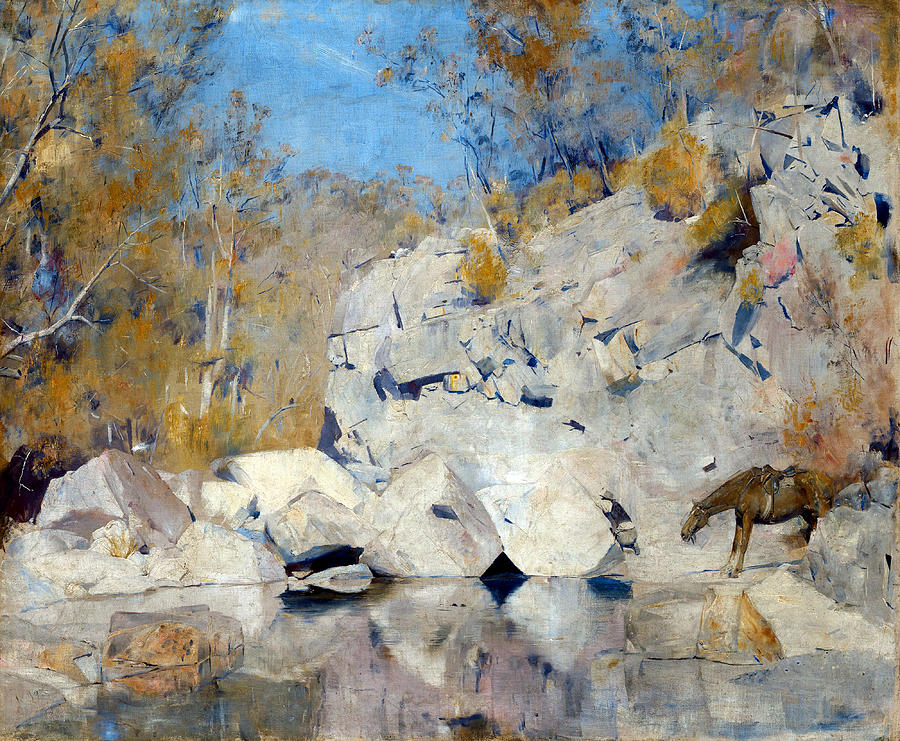
Tom Roberts, In a Corner on the Macintyre, 1895

Space

The host of this blog doesn’t give a shit about space [Ed. – correct], because he is Wrong [Ed. – possibly correct], but I’m going to talk about it a bit here anyway because Dorian made the mistake of giving me the microphone [Ed. – absolutely incorrect; no mistake was made]. Continuing the astro-poetry theme we have Ken Hunt’s The Lost Cosmonauts, a collection about the accidents and deaths of the Space Race, much of it constructed from the texts of official reports and radio transcripts. Then there’s Omon Ra by Victor Pelevin, a bleak black comedy about the Soviet space program.

Pushing further into the future was the story collection Terminal Boredom by Izumi Suzuki (multiple translators), a downbeat set of 1970s/1980s Japanese countercultural tales of sexual and pharmaceutical weirdness. Further still takes us to Olga Ravn’s The Employees, translated from Danish by Martin Aitken, a genuine little masterpiece of a “workplace novel” set on a Generation Starship.

Finally, the biggest thing I read in 2021 was XX by Rian Hughes, a 1000-page monster about first contact and artificial intelligence. It’s a beautifully designed book in which the spirit of the 19th Century talks in multi-typeface pamphlets and that of the 20th in Futurist broadsides, which includes an entire pulp SF novella serialised in magazines that never existed, and which is the first book I have ever seen with a reversible dustjacket designed to make it look like a shelf of the fictional publications contained within the text [Ed. — !].

World War Two

Dutch genius Willem Frederik Hermans is having something of a revival, and A Guardian Angel Recalls (translated by David Colmer) is a great book new to English: a public prosecutor, weak and lovelorn, races around Holland as the Nazis invade, wreaking inadvertent havoc as he tries to save himself, protected and frustrated in equal measure by his similarly flawed guardian angel.

The Passenger by Ulrich Alexander Boschwitz (translated from German by Philip Boehm) is from 1938: perhaps too late to be called prescient, but even years later people were denying its truths. Otto Silbermann is a Jewish German who fought for his country in World War One, too slow to realise that what is happening to other Jews will happen to him too. Finally he has to go on the run, trying to find a way to escape across the border to safety.

Marga Minco’s The Glass Bridge (translated by Stacey Knecht) is another Dutch novel, a tangential look at the Holocaust in fragments from the life of Stella, a Jewish artist hiding out under a dead woman’s name, moving from safe house to safe house, fending off the advances of a sexually predatory ‘protector’.

David Piper’s Trial by Battle (originally published in 1959 as by Peter Towry) is a deeply anti-triumphalist novel about Britain in Asia during World War Two, outclassed and outfought, living on a faltering diet of nationalistic smugness. Frances Faviell’s A Chelsea Concerto is a fascinating memoir of the first few months of the Blitz in London. Finally, Donald Henderson’s 1943 novel Mister Bowling Buys a Newspaper, despite its religiose ending, is a fine black comedy about a polite serial killer for people who have read all of Patrick Hamilton and now have a sad void in their lives.

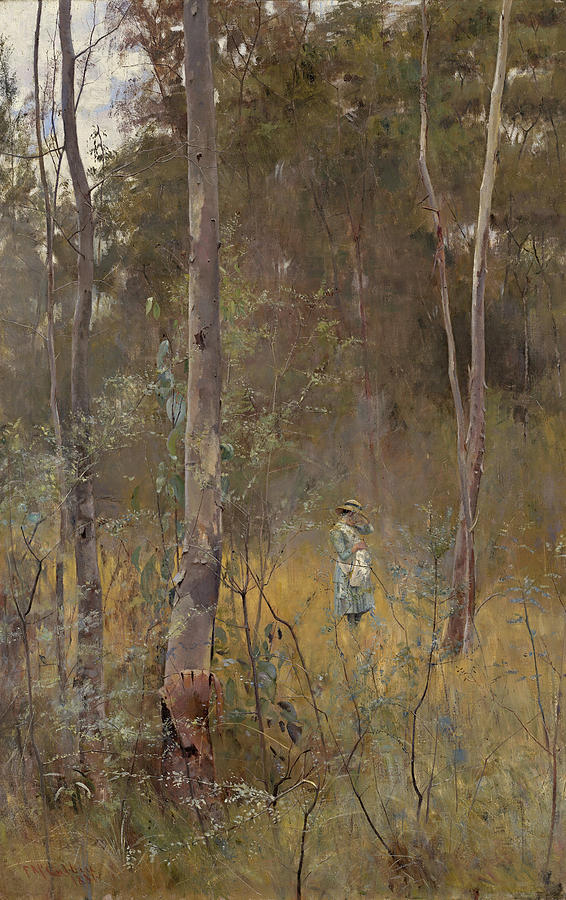
Frederick McCubbin, Lost, 1907

Random Others

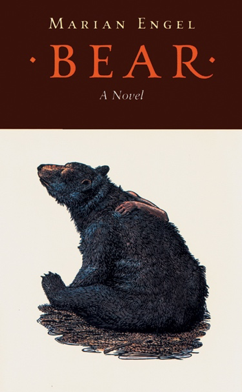
Marian Engel’s Bear has no greater champion than the management of this blog, so I shall say nothing other than that Dorian is absolutely right about it in every way, despite the ludicrousness of the premise. [Ed. – THANK YOU! Another satisfied customer! You can watch James admit this truth to me here.] Another weirdly charged masterpiece is Denton Welch’s In Youth is Pleasure, a strange and astonishing novel about a boy helpless in the grip of his aesthetic and sensual needs.

I don’t even like boxing, yet Michael Winkler’s Grimmish is the second boxing novel on this list: a wonderful and weird book about masculinity and physical pain, full of great jokes which I have stolen: There are two types of people: those who can extrapolate from incomplete data. [Ed. – But that’s only one… ohhh…] Checkout 19 by Claire-Louise Bennett, which is sort of about the disparity between literature and life but also about everything else, is a genuine marvel. Minae Mizumura’s An I-Novel (translated by Juliet Winters Carpenter) is the story of two Japanese sisters transplanted to New York, a deep and rich and perceptive work enriched by numerous photographs. It’s not quite the equal of her A True Novel, but then what is?

Jeffrey Smart, Cahill Expressway, 1962

[DISTANT, MUFFLED NOISE]

The Surprise Party Complex by Ramona Stewart, criminally out of print for decades, is a beautiful and hilarious bit of work about a group of neglected and eccentric teenagers at a loose end in Hollywood. The deeply weird Mount Analogue: A Novel of Symbolically Authentic Non-Euclidean Adventures in Mountain Climbing by René Daumal (translated by Roger Shattuck) was never finished, but what we do have is a surrealist masterpiece. Flesh by Brigid Brophy is a near-as-damnit perfect novel about appetites, both sexual and gastronomic. And everybody who enjoys the atmosphere of a good grotty 1950s London boarding house needs to read Babel Itself by Sam Youd (better known as science-fiction writer John Christopher), another unjustly forgotten bit of comic brilliance about a group of lodgers running spiritualist experiments, having affairs and betraying each other.

[SOUND OF SECURITY FORCES BANGING ON DOOR, YELLS OF ‘YOUR TIME IS UP!’]

Then there’s the Patricia Lockwood’s No One is Talking About This, which really is as good as everyone says, and Jim Shepard’s Phase Six, an unfortunately timed global pandemic novel that’s also a splendidly moving look at female friendship, and Hilma Wolitzer’s career-summary story collection Today a Woman Went Mad in the Supermarket, and…

[DOOR BREAKS DOWN]

..and Nathalie Sarraute’s Tropisms, which I finally read years after everybody else, and Giorgio Bassani’s The Heron, the only book of his I’d never read, and…

[MUFFLED SHOUTING, SOUNDS OF SOMEONE BEING DRAGGED AWAY]

Keith Bresnahan’s Year in Reading, 2021

In the next week or so I’ll be writing up my reflections on my 2021 reading year. In the meantime, I’ve solicited guest posts from friends and fellow book lovers about their own literary highlights. I’m always looking for contributors; let me know here or on Twitter (@ds228) if you have something you want to share.

First up is my old friend Keith Bresnahan (@designhist, follow him, he’s funny and awesome), who’s previously contributed several terrific pieces on Zola. You can read his 2020 reflections here. Keith lives and works in Toronto.

2021, in a nutshell:

This year was strange, obviously. I was lucky, avoiding any serious effects of the pandemic: I kept my job, as did everyone in my family; no one I knew got seriously ill or passed away with Covid. But time and space felt flat. I didn’t go anywhere, and the repetitive sameness of days was best reflected in this popular image I kept seeing re-posted on Twitter. Perhaps this is why when Dorian initially nudged me to look back on my year of reading, I felt like I hadn’t read much at all: there was little to situate my reading in association with specific places or other things that were happening around me while I read them. As it happens, judging by my admittedly imperfect reconstruction (I have sworn to be better at keeping track this year!), I found I actually read 50-odd books for pleasure in 2021, not counting the 15 or so others I read for teaching and academic research. Not bad.

Here are a few of the more memorable ones.

Philip Marsden, The Summer Isles

I read this early in the year; details have faded, but my memory of reading it is of being carried along on gentle sea-waves; it’s that kind of book. A first-person travelogue of Marsden alone in a wooden boat, traversing waters up the west coast of Ireland toward the titular isles in northern Scotland, it also contains a good deal of reflection on historical lore, spiritual journeys, and local geographies. Much of the sailing-vocabulary was lost on me, but it didn’t seem to matter. Both learned and meditative, it was perhaps the most calming book I read this year. I passed it on to a good friend who owns a boat. 

Enrique Vila-Matas, Never Any End to Paris (Trans. Anne McLean)

I found out about Vila-Matas this year, like most of the other authors I come across these days, from people I follow on “Book Twitter” (regular Twitter, just a nice corner of it populated by book-obsessed folks). A wry memoir of Vila-Matas’s youthful days in Paris as an aspiring writer and Ernest Hemingway wannabe. I loved it. He somehow rents a garret from Marguerite Duras, encounters Georges Perec and Roland Barthes, dates a woman who suggests he fling himself off the Eiffel Tower while on an acid trip, fends off parental intervention, and generally fails to write anything of substance. In a year where I couldn’t go anywhere, the descriptions of Paris were more than welcome. Looking forward to reading more by Vila-Matas soon, starting with Dublinesque, a kind of Joycean dream, apparently. Perfect for the centenary of Ulysses this year? (I’m also planning to give that one another shot)

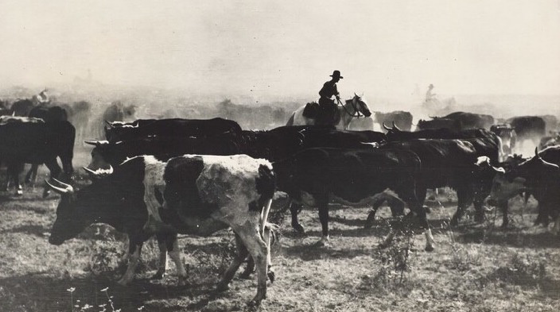
Larry McMurtry, Lonesome Dove.

An 800-plus-page western. A western? Cowboys? A cattle drive? I left central Alberta for a reason, dude. But many folks who know better than me loved it, so I gave it a shot. Holy shit is this book great. An out-and-out masterpiece. At times it felt like magic realism – did the bull actually fight that bear? Was the cook actually back there banging the same bell with the same crowbar? Did Blue Duck fly? The book’s Indigenous characters are barely fleshed out (although McMurtry does show sympathy for their plight) — but then this is really the story of the others, the damaged settlers moving against a nascent American backcloth, seeking and grasping for any purchase with little to guide or protect them. At its heart is an emotionally blocked friendship between two former Texas rangers, and the women who speak truth to them (and whom they largely fail to understand). Plus an impressive cast of secondary characters, all memorable creations. Did I mention it’s more than 800 pages and somehow feels too short?

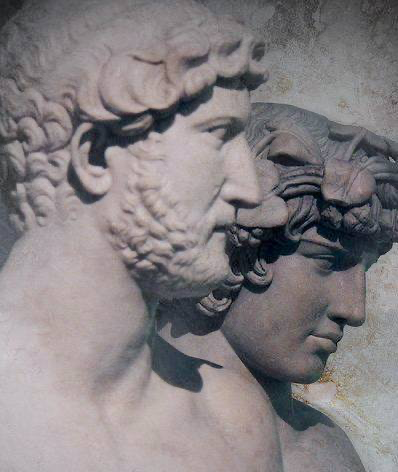
Marguerite Yourcenar, Memoirs of Hadrian (Trans. Grace Fick)

Another masterpiece. The best fictional evocation of the classical world I’ve ever read. Dreamlike and imagistic, with lessons on life and death to spare. I’m waiting to read more Yourcenar until the memory of this one’s brilliance fades a bit.

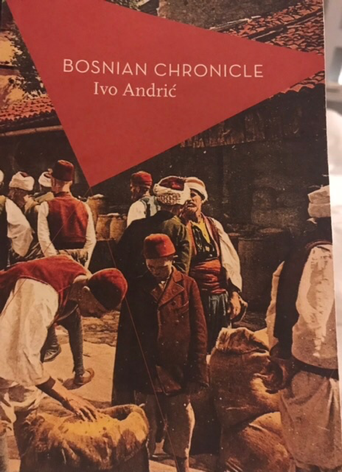
Ivo Andrić, Bosnian Chronicle (Trans. Celia Hawkesworth in collaboration with Bogdan Rakić)

A newish edition from Apollo Classics (Head of Zeus), this is a very long book, first published in 1945, about a French consul during the Napoleonic era living in a small Bosnian town on the extreme fringes of world events. Not much happens. I adored it.

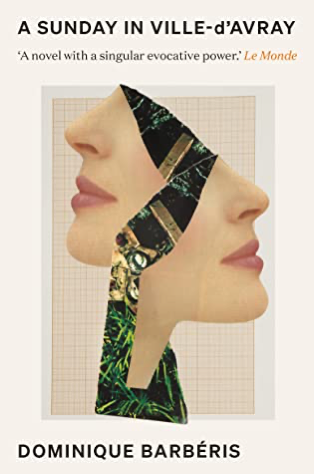
Dominique Barbéris, A Sunday in Ville-d’Avray (Trans. John Cullen)

This was great — a short, stylish account of two sisters, one recounting to the other a past entanglement with a strange man. Felt to me at times like watching a French film from the 1970s. Enigmatic, and atmospheric as all get-out.

Three books in the “how-did-I-not-know-about-these?” category:

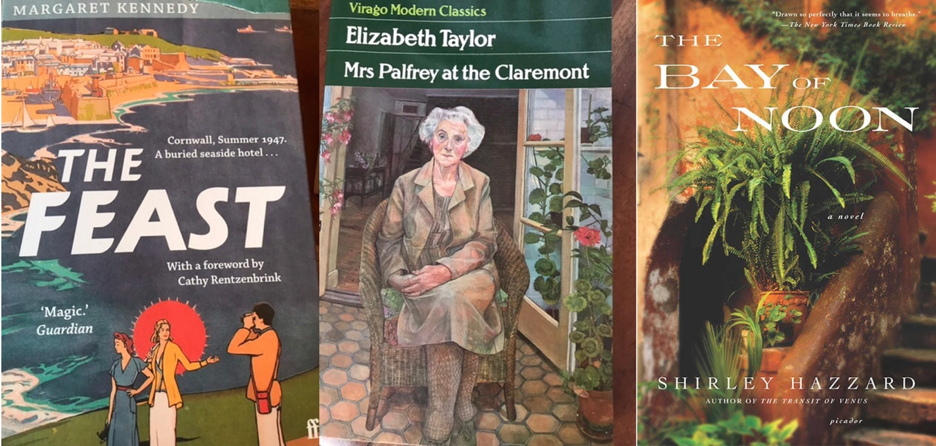
Margaret Kennedy, The Feast

A number of families cram into a seaside hotel in Cornwall for a week in the summer, their conflicts and idiosyncrasies build to a climax, then half of them are killed when a cliff falls on them. We know this part from the outset, though not who dies, so I’m not giving anything away. Apparently there’s a whole structure here about the 7 deadly sins, but I missed this while reading it, and it didn’t matter. Great fun. Made me want to read more Kennedy, and soon.

Elizabeth Taylor, Mrs. Palfrey at the Claremont

An older woman moves into a retirement hotel in London. The plot? Not much. But I found it utterly charming, even its descriptions of the depredations of old age, and very funny, too. Others, I’ve since learned, found it bleak. [Ed. – raises hand] Not me. Mrs. Palfrey is a plucky heroine, if a little self-deceiving (aren’t we all), and even the end, coming as it must, didn’t feel sad. I picked up a used Virago copy of this book on a whim, and then coincidentally read it the same week that it came out in a new NYRB classics edition. For once my finger was right on that pulse. More from Taylor in my near reading future.

Shirley Hazzard, The Bay of Noon

A young English woman in Naples in the 1950s falls in with a Neapolitan woman, Giaconda, and her Roman lover, Gianni. This was both evocative and restrained, with a powerful sense of the unspoken and unshown behind the minimal plot. Reminded me a bit of Antonioni, in a good way. Also made me long to revisit Naples (some strong compensatory travel-thrills in my readings this year!). My first Hazzard, won’t be my last.

Yasunari Kawabata, The Sound of the Mountain (Trans. Edward G. Seidensticker)

Junichiro Tanizaki, The Makioka Sisters (Trans. Edward G. Seidensticker)

Akimitsu Takagi, The Informer (Trans. Sadako Mizugushi)

Akimitsu Takagi, Honeymoon to Nowhere (Trans. Sadako Mizugushi)

Yuko Tsushima, Territory of Light (Trans. Geraldine Harcourt)

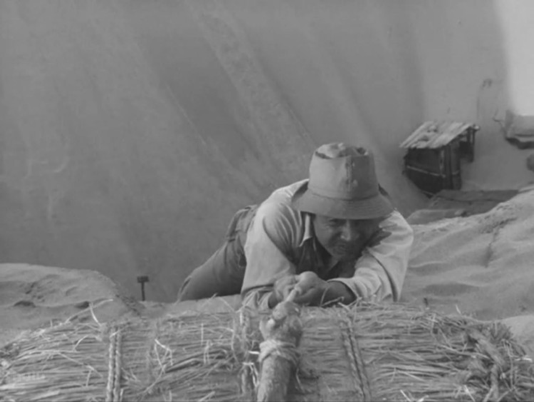
Kobo Abe, The Woman in the Dunes (Trans. E. Dale Saunders)

I enjoyed all the books translated from Japanese that I read this year, especially The Informer and Territory of Light. But it was Abe’s Woman in the Dunes that was the real revelation. A distressing, tense, fever-dream of a book, I’d put this existentialist fable of bizarre confinement, Sisyphean futility, and struggles of the will up against Camus any day of the week. I won’t be reading it again anytime soon, but I’m glad I did. Haven’t brought myself to watch the movie, but here’s an image from it anyway.

Raymond Chandler, The Big Sleep

Another existentialist hero, this time Philip Marlowe probing some family funny-business in sunny California. Noir perfection. I realized I’d previously conflated Chandler and Dashiell Hammett, whose hard-boiled shtick I could never really get past [Ed. – I am allowing this heresy on my blog, but I don’t like it], but this is glorious, witty stuff. The film, with Bogart and Bacall, is a deserved classic.

Muriel Spark, The Girls of Slender Means

My first Spark! I loved this small tale of young women living together and negotiating wartime, nascent loves, work, and rooftop escapes. A near-perfect short read.

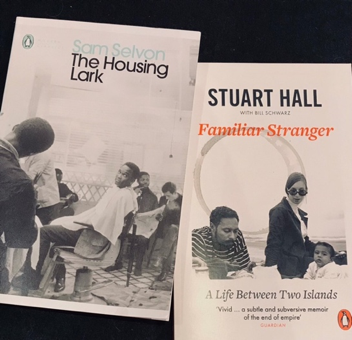
Sam Selvon, The Housing Lark

Stuart Hall, Familiar Stranger

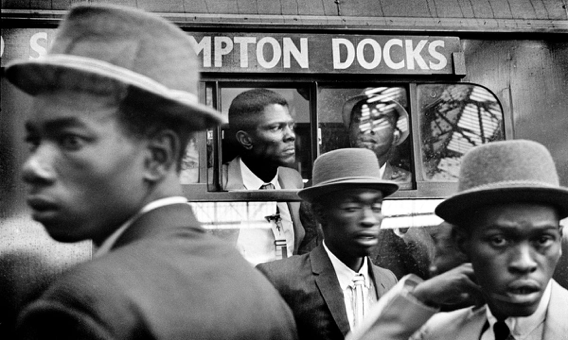
Two takes on the West Indian experience in 1950s – 60s England. The Housing Lark, by the criminally under-appreciated Sam Selvon, is a sort of sequel to his better-known The Lonely Londoners; if anything, I liked this one better. Hall’s autobiography takes him from Jamaica to Oxford to the founding of cultural studies and the New Left in the 1960s—on the one hand, a world apart from Selvon’s hustling hardscrabble immigrants, and on the other not so different, negotiating displacements and identities among the so-called Windrush generation. Suggest watching Steve McQueen’s remarkable Small Axe series alongside.

Graham Greene, The Quiet American

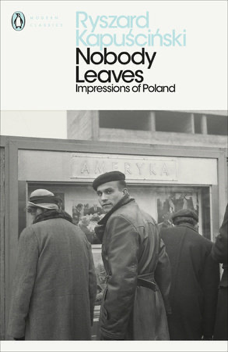
Ryszard Kapusćiński, Nobody Leaves: Impressions of Poland (Trans. William Brand)

Sergio Pitol, The Journey (Trans. George Henson)

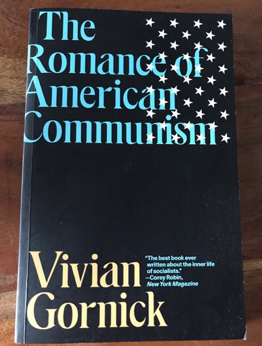
Vivian Gornick, The Romance of American Communism

Amor Towles, A Gentleman in Moscow

Purely by accident, I ended up reading a number of books this year highlighting historical communism and Cold War politics seen through individual lives. Graham Greene’s The Quiet American, a scathing indictment of Western intervention in Southeast Asia, with its shockingly amoral conclusion, was among the best books I read this year. Ryszard Kapusćiński’s Nobody Leaves, a collection of short journalistic pieces from his native Poland around 1960, is episodic, strange and beautiful, and generally short on hope. Sergio Pitol’s The Journey, has the Mexican writer traveling around literary circles in Moscow, Leningrad, and Tbilisi during two weeks in 1986, just as glasnost and perestroika were starting to peek through. It was a highly personable travelogue that makes me want to read more by him (I’ve already ordered Pitol’s The Love Parade, out in translation early this year). He writes a lot about Marina Tsvetaeva, which makes me think I should read her. In non-fiction, I was taken with Vivian Gornick’s The Romance of American Communism, recently republished by Verso. Originally from 1977, it’s an oral history of American communists from the 1920s through the 1950s and their breaks with the Party following the revelations of the 1950s. Gornick’s subjects are angry and wounded, prone to self-importance, self-deception, and self-critique, and her book is wonderful at conveying how people form passionate attachments to ideological movements, and what happens when that falls apart. Amor Towles’ A Gentleman in Moscow, a cream-puff fantasy of a hotel-bound aristocrat suffering minor inconveniences during the same decades of Soviet history, which I read at a cottage just after Gornick’s bracing book, felt too tidy and cute by half. I might have enjoyed it more at another time.

James Salter, Light Years

Probably my favourite book of 2021. A couple raises two kids in a country house not far from New York City. They have affairs, they divorce, their kids grow up, they meet artists, actors, go to parties, discuss the theatre, they remarry, get ill, die. It recalled the 1970s cinematic and literary middle-class dramas I was enthralled by as a child (this was what life was, or so I thought then). Now in my own middle age, I’m both less sanguine about this stuff than I used to be, and intuitively drawn to it. Nostalgia for that insular worldview? Dunno. Whatever it was, I found it perfectly, achingly beautiful, and sad. A book I know I’ll revisit. I also read Salter’s A Sport and a Pastime, which I liked but not nearly as much as this one.

In the last days of 2021, I read three quietly resonant books:

Paul Griffiths, The Tomb Guardians

I’m not sure how to classify this short book, which shifts constantly between two conversations: in the first, two figures discuss a series of three (real-life) paintings in a museum showing the sleeping guards charged with protecting Christ’s tomb; in the second, we hear the voices of the Roman guards themselves, having woken up to find one of their party missing and the stone from the tomb entrance moved. It’s clever and light, achieved with erudition and evident skill; as a professional art historian, I wish I’d written it myself.

Louise Glück, Winter Recipes from the Collective

Nobel winner of 2020. Quiet and studious poems. Felt snowy, and cold. Some folks are saying this book shows a diminution of Glück’s energies, which bodes well for her earlier work, I’d say. I’ve just bought her first four books of poems.

Aidan Higgins, Langrishe, Go Down

Another Apollo Classics reprint, first published in 1966. A woman on the cusp of middle age, living with her unmarried sisters in a declining Irish great house, has an ill-fated affair with a German scholar of no means. Just go read it already. One of my books of the year. There’s a film, too, with Jeremy Irons and Judi Dench.

One more, for Dorian:

Marian Engel, Bear. Technically a re-read, since I first read this when I was 18. But that was some time ago, and I was 18, so let’s call it a new book for 2021. Is it the great Canadian novel? Sure. [Ed. — Hmm… this is not the expression of explosive joy I’d hoped for, but I’ll take it.]

Some predictions for 2022:

– Nature-books: I’ve got a bunch of these on the shelf, and this is the year! Birds, mountains, wild swimming, I’m your man.

– More 20th-century reprints, mostly from UK writers: I’ve gathered a small heap of books from Virago Modern Classics, Persephone, Apollo Classics and others, and am eager to dive in.

– Finishing the Penguin Maigret books. I’ve got 10 left to read in this 75-volume set, and the last one has just arrived by post.

– Following a prompt from a Twitter mutual, I’ve signed on to read all the extant plays of classical Greece. Ambitious, but they’re short, right?