Hope Coulter’s Year in Reading, 2025

Regular readers will know that for the last several years I’ve solicited Year in Reading reflections from friends and trusted readers. As we’re well into February, I’ve scaled the project back considerably this time, but I’ve got some good stuff coming your way over the next few days. Today’s installment, her fifth, is by Hope Coulter, my friend and former colleague. Hope is a writer in Little Rock.

Robert Gober, Bag of Donuts, 1989

Like Dorian, I retired from Hendrix College last May. One of the joys of retirement has been more time to read. With more free hours in the day and no class prep I’ve been able to read gluttonously, leisurely-ly, reminding me of how I read as a child in our long low house on the bayou—stretched out for hours at a time with a book, changing position whenever a propping arm got tired. Once, I remember, I was performing the cliché of reading late into the night with a flashlight under the covers (I’m not sure where I even got this idea) when my father walked in and flipped on the light. “What in the world are you doing? We don’t mind if you stay up and read, but for heaven’s sake don’t strain your eyes.” [Ed. – Good Dad.] My body is bigger and creakier now, but the sense of abandon, of decadent pleasure in reading, is much the same.

In 2025 a third of the books I read happened to be memoirs, and of these, as I followed my nose and my algorithms, one-third were by chefs, restaurateurs, or gastronomes [Ed. – gastrognomes, you say???]. My favorites are as good a way as any to start off this list.

Best food-related memoirs:

  • Most Likely To Make You Hungry, Make You Laugh, and Make You Want To Cook: Stanley Tucci, Taste: My Life Through Food and What I Ate in One Year (and related thoughts) – Pure delight. I love this guy. He’s unpretentious, exuberant, and funny.
  • Most Likely To Make You Wince: Keith McNally, I Regret Almost Everything – Frank, well-written, painful and witty by turns. An inside scoop on the restaurant business.
  • Most Likely To Make You Drop Everything and Move to Southern France: Peter Mayle, A Year in Provence, Twenty-Five Years in Provence, Toujours Provence [Ed. – Blasts from the 90s past!]

Best non-foodie memoir:

  • Amy Liptrot, The Outrun – The narrator leaves her dissipated twenties in London and returns to Orkney, in far northern Scotland, to find her footing. Interesting setting, well written.

Best novels:

  • Kiran Desai, The Loneliness of Sonia and Sunny – For many years Desai’s previous book, The Inheritance of Loss (2006), has been my favorite novel; I’ve waited with much anticipation to see what she would do next. The wait was not short. But Loneliness, which was shortlisted for the Booker Prize, is so worth every bit of time Desai took to conceive and compose it. It’s a big, complicated book about art and identity and love and family and borders. Along with the big themes, she remains fantastic at rendering small moments: passing observations and exchanges so apt and droll you want to keep them at your fingertips.

In fact, this book has many of the same qualities that shone in Inheritance: sly humor, exasperating minor characters who unexpectedly endear themselves to you, and tensions between isolation and community, truth and cant, haves and have-nots. But over two decades those polarities have become more extreme and their effects more pernicious. Desai’s sensibility has grown more weary and embittered (hasn’t everyone’s?) [Ed. – yes], and to encompass all it sets out to, this new novel is necessarily larger, messier, more brooding and less ebullient.

  • Kevin Barry, The Heart in Winter – Irish love story meets American Western. [Ed. – Good description, good book.]
  • Niall Williams, This Is Happiness and The Time of the Child – Wonderful reads, with an Irish lilt to the prose that only deepens enjoyment. These are connected and I recommend starting with This Is Happiness.
  • Megha Majumdar, A Guardian and a Thief – A nail-biter set in the all-too-believable near future; the writing is strong and fresh. For instance: I happen to be aware that there are lots of saccharine quotations out there about hope (even by Dickinson!—“‘Hope’ is the thing with feathers…”—ugh). [Ed. – Surprising fighting words!] Majumdar’s take on hope is gloriously unsweet:

Hope for the future was no shy bloom but a blood-maddened creature, fanged and toothed, with its own knowledge of history’s hostilities and the cages of the present. Hope wasn’t soft or tender. It was mean. It snarled. It fought. It deceived. On this day, hope lived in the delivery of gold to a man who might be a scammer, and, perhaps, hope lived also in opening the doors to a thief.

Another great line:

He [the interloper] smelled of the soap Dadu [the protagonist’s father] had used, palming old sliver to new bar, decade after decade.

“Palming old sliver to new bar, decade after decade”—I know Dadu from that line, as well as if I smelled his soap scent. [Ed. – Indeed! And “palming,” which I only usually hear in reference to cards, makes it sound like he’s doing something a bit disreputable.]

Runners-up: Another near-sweep for the Irish!

John Boyne, Mutiny: A Novel of the Bounty [Ed. – Allowing this only because it’s you, Hope. We don’t like the Striped PJ man around here.]

Cólm Toibín, Nora Webster

Mary Costello, Academy Street

Weike Wang, Rental House

Most Unusual Best Novels:

  • Isabel Cañas, Vampires of El Norte – I thought I didn’t like vampire novels. Yawn. But this novel serves them up veiled in themes of colonialism and environmental exploitation, while also working well as a love story and as plain old horror. [Ed. – Horror one of the most vital genres right now!]
  • Samantha Harvey, Orbital – Great premise for a novel, and so many stunning descriptions—but too many plotlines are left flying at the end.

Best Classic That Stands Up to Time:

Willa Cather, Death Comes for the Archbishop – Bestowing superlatives in literature is kind of silly, ever more so as time goes by. Still, if I were forced to name the Greatest American Novelist, I would say Willa Cather. In this novel Father Jean Latour, a French-born priest, gets appointed to serve a vast area of New Mexico just after its annexation. His life in Santa Fe provides the central narrative, and on this armature Cather strings a number of side stories that she took in during her long visits to the area—some harrowing, some strange, stories of depravity or folly or pity, but all told with her characteristic quietness and exactitude. A lesser writer might have expanded one or two of these to fashion a more conventional main plot, say the story of the lost El Greco, or Father Latour’s lifelong dream of building the Santa Fe Cathedral. But Cather avoids imposing such a goal-driven form. The more organic structure that she chooses instead keeps our attention on the place and its inhabitants, emerging gradually into solidity. [Ed. – Such an enticing description!]

One of the book’s brilliant strokes is its prelude on a terrace in Rome, where over dinner three Cardinals and a Bishop are hashing out the jurisdiction of these territories so remote they might as well be on another planet. After this the novel returns to Europe only in brief flashes. Yet these bits of Old World context, in a novel about the relentless development of the American West, are somehow key to its power.
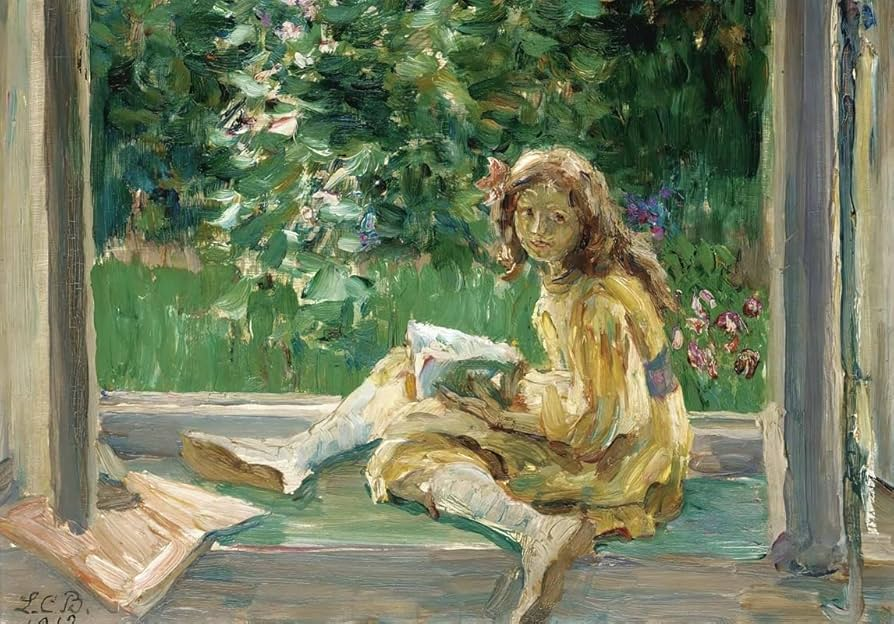
Louise Catherine Breslau, Young Girl Reading by a Window, 1912

Series That Never Disappoint:

Robert Galbraith,* Cormoran Strike series | new in 2025: The Hallmarked Man

Michael Connelly, Harry Bosch and Renée Ballard series | new series in 2025 set on Catalina Island: Nightshade

These series are my jam: character-driven investigator mysteries possessed of zest and depth. Authentic settings, dialogue that people would actually say, multiple unfolding plots.

*Yes, Galbraith is aka J. K. Rowling, and yes, she is toxic on the subject of trans rights. I’m shocked by how a writer with her insight and empathy into human character can be so hateful toward an entire subjugated group of people… yet I continue to love her books. Read Monsters: A Fan’s Dilemma by Claire Dederer if you judge me for this or if you too struggle with this conundrum. [Ed. – I don’t judge you, but I had to give up these books, which I very much enjoyed because she really seems a terrible person, and TERFs suck. I would like to read the Dederer, though.]

Best Potato Chip Fiction:

This is my husband’s term for books that may not be the highest order of literature, but they’re well done and so satisfying to read that you just keep ingesting them like potato chips that you can’t stop eating.

Lian Dolan, Abigail and Alexa Save the Wedding – I’ve gone on to read a few more of Dolan’s books, but this one is my favorite, with little gems of observation such as:

Alexa was one of those women who had aged in place, meaning that Abigail could still see the eighties undergrad and the focused career gal and the bold single mom in her sixty-something face. Some people disappeared into their later years’ appearance, no trace of their young days left, thanks to injectables and surgery. But not Alexa. She was all she had been.

Lisa Jewell, The Night She Disappeared, Don’t Let Him In, etc. [Ed. – I have been eyeing these…]

Best Nonfiction:

Lynne Olson, Madame Fourcade’s Secret War: The Daring Young Woman Who Led France’s Largest Spy Network Against Hitler

Elizabeth Letts, The Ride of Her Life: The True Story of a Woman, Her Horse, and Their Last-Chance Journey Across America

Liza Mundy, The Sisterhood: The Secret History of Women at the CIA

Jordan LaHaye Fontenot, Home of the Happy: Murder on a Cajun Prairie

Most Depressing Nonfiction:

Kirk Johnson, The Feather Thief: Beauty, Obsession, and the Natural History Heist of the Century – Just typing the title, I get depressed all over again. [Ed. – Well, you made me look this up and now I’m intrigued. We really need a moratorium on these nonfiction book subtitles, though.]

Nonfiction Most Guaranteed to Make You Grip the Arms of Your Chair and Be Relieved They’re Not the Gunwales of a Boat:

Hampton Sides, The Wide Wide Sea: Imperial Ambition, First Contact and the Fateful Final Voyage of Captain James Cook

Children’s Notables:

For a middle-grade novel I’m writing, I’ve been reading some classics of that genre. Here are three that I read or reread last year that wowed me.

William Pène duBois, The Twenty-one Balloons – I loved this inventive book as a kid, and turns out I still do.

Marguerite de Angeli, The Door in the Wall – How did I miss this one during my middle-grade years? Maybe I thought I didn’t like medieval settings: they’re so often gussied up with stale trappings of fantasy. But here the world-building feels solid and genuine. Good read.

Ann Petry, Harriet Tubman: Conductor on the Underground Railroad – Before reading this I knew only the broad outlines of Tubman’s life, and the fuller story blew me away. It’s billed as a young adult book, but nothing about it felt juvenile. Highly recommend. [Ed. – Fascinating! I did not know Petry wrote for children, too. I will pick this up.]
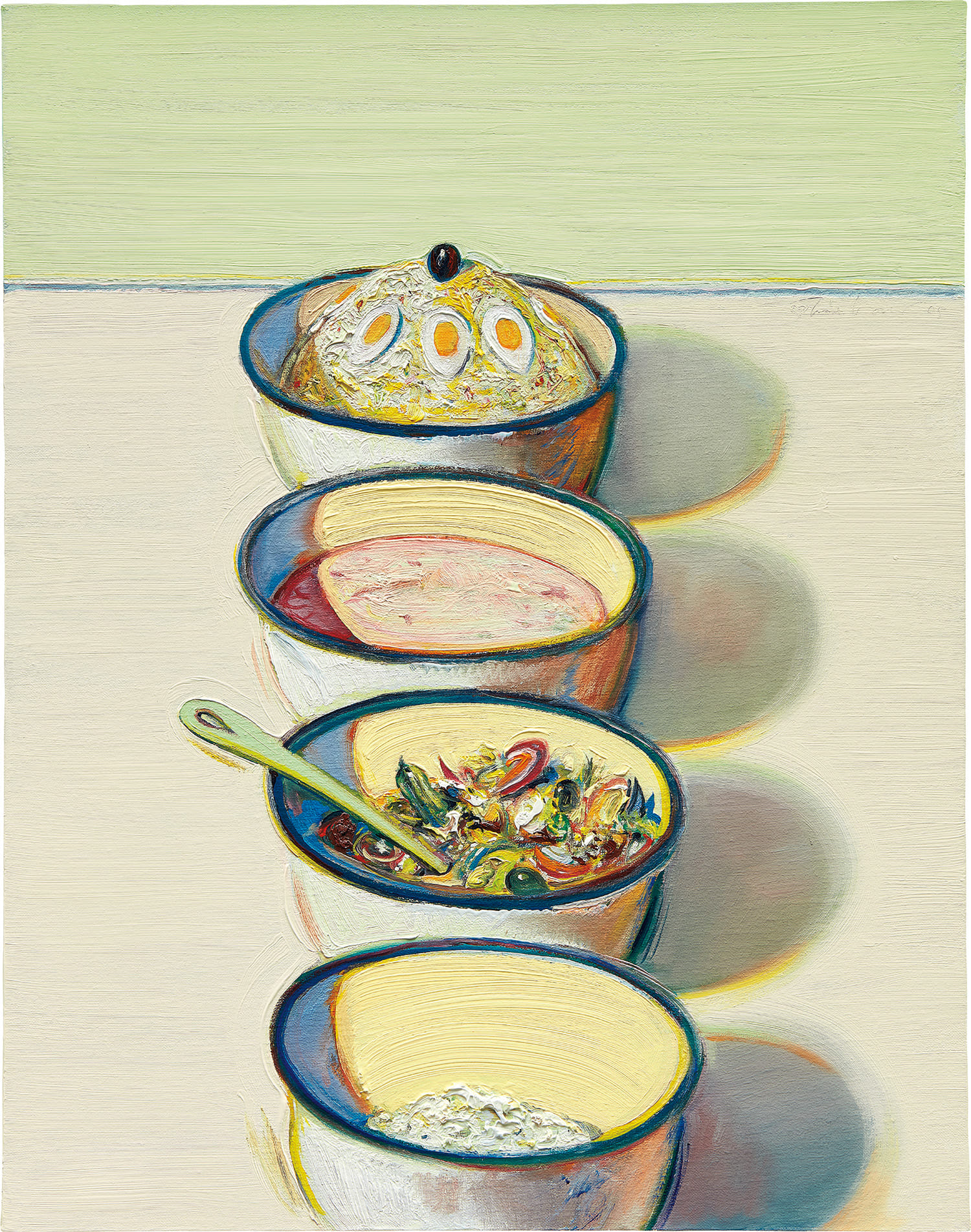
Wayne Thiebaud, Food Bowls, 2005

Thanks for reading; I welcome your comments on any of the above! And thank you, Dorian, for keeping this wonderful blog and for giving me a turn in your bully pulpit. [Ed. – Ha, nowhere near influential enough for that! Thanks for this piece, Hope!]
Bonnie Nickol’s Year in Reading, 2020

I’ll soon be writing up my reflections on my 2020 reading year. In the meantime, I’ve solicited guest posts from friends and fellow book lovers about their own literary highlights. I’m always looking for new contributors; let me know here or on Twitter (@ds228) if you have something you want to share.

The eighth post is by Bonnie Nickol, on behalf of her long-running Little Rock book club. An artist, political activist, and founder of the Single Parent Scholarship Fund of Pulaski County, AR, Bonnie was a Clinton delegate to the ’92 convention and served in the first Clinton administration. She is a wife, mother of two, and grandmother of 4.

Our 50+ years book club, the Julie Herman Tuesday Morning Book Club (JHTMBC) seems to have read it all. We would met on Tuesday mornings, once a month, but not in the summer. The school calendar defined the club’s year because we were “stay-at-home” mothers, all of us, during the 1970’s. Our husbands earned and we maintained the Southern-voiced norm: wives belonged at home.

With no Starbucks or other venues where we could gather, these very young women with our first babies at home rotated as hostesses to offset our sometimes uncomfortable isolation. It wasn’t a European coffee shop, but it provided what we needed: new friends who read, replenished intellectual needs. We solved many local, parenting and world problems. The club was our own salon.

We read it all, every theme ever explored in fiction and nonfiction through narratives of the past and present. What did we refuse to read for discussion? We “ran off” one member who urged us to read Classics! We told her that JHTMBC was not a university. We missed her brain, but refused her professorial standards.

For the past year we’ve met together, distanced, as covid forced these proud septuagenarians to Zoom. We had already switched our evenings of sharing the comforts of wine, cheese, cake and decaf to afternoons still light enriched, when driving after dark became a passenger’s nightmare.

Discussion leaders bring the group together with challenging ideas posed by (now) mostly unfamiliar authors; the more difficult challenge is choosing a book we’ve not read.

Three recent choices are reviewed below, one by Nan Selz, one by Marge Schueck, and one by myself.

Nan chose Night Boat to Tangier by Kevin Barry (2019):

This slim book about two old men waiting for someone in a ferry terminal manages to combine humor and melancholy. Barry’s language conveys a sense of place that, in a very few words, tells the reader just how each setting looks, smells, and feels, whether dingy ferry waiting room or dodgy waterfront bar. Barry’s characters are brought to life through their dialogue, written in Irish brogue, and their life stories which unwind as flashbacks throughout the book.

Barry’s talent is to combine opposites with ease. The book is set in both the present and the past. The prose is both lyrical and, at times, obscene. The plot includes themes of love and betrayal, innocence and guilt, brutality and tenderness, hope and despair. But it is the language which most enchants the reader, so much so that it is almost impossible to write about this book without a quote or two:

• Describing the ferry terminal itself, “Oh, and this is as awful a place as you could muster—you’d want the eyes sideways in your head.”  

• Describing the main characters, “There is old weather on their faces, on the hard lines of their jaws, on their chaotic mouths. But they retain—just about—a rakish air.”

If you love language, you are sure to love Night Boat to Tangier.

Marge chose The Art of Racing in the Rain by Garth Stein (2008):

Garth Stein has given us a gift. His The Art of Racing in the Rain will warm your heart and touch your soul. You will learn, you will laugh, and oh yes you will cry.

The narrator is a dog named Enzo who believes he will be reincarnated as a person… complete with opposable thumbs and a tongue that isn’t “a horribly ineffective tool for …making clever and complicated polysyllabic sounds that can be linked together to form sentences.” He is a loyal loving protector to the Swift family as they face heartbreaking challenges.

Denny Swift is a semi-professional race car driver trying to juggle his passion for the sport with his obligations to his family. His racing serves as an apt metaphor for life. He tells aspiring young racers “the car goes where the eyes go”, and through it all his eyes never look behind.

The book ends somewhat predictably in a beautiful scene that ties up all the loose ends in a neat little package. Just the way I like my endings! 

I chose Tender at the Bone: Growing Up at the Table by Ruth Reichl (1998):

During the early months of covid shutdowns, I saw a Zoom program featuring Ruth Reichl as she discussed Jewish cooking and recipes. I knew some of her professional background, but I was unaware of her humor and her struggles to survive a family that could be a psychiatric model of dysfunction.

Tender at the Bone, Reichl’s 7th book, which I expected to be nothing more than a collection of recipes bound together by vignettes of her life, is the autobiography of a lonely child living in a household ruled by her bipolar mother and ignored by her emotionally absent and complicit father.

Food was always an important factor in her life as she learned to guide dinner guests away from concoctions her mother served—dishes that often sent them to the hospital with food poisoning. Cooking became her strength, it taught her flexibility and a path to love as the housekeeper/cook brought Ruth into the kitchen to help prepare meals. Mrs. Peavey “proved her mettle the day she tripped coming through the kitchen door, dropping the beef Wellington two feet from where my mother stood waiting to serve it. ‘I’ll just go and get the other one, Mrs. Reichl’… “One minute later Mrs. Peavey reappeared, bearing a new beef Wellington…”

When Mrs. Peavey resigned, she left Ruth with three pieces of advice”: “The first is not to let other people tell you how to live your life.” She continued, “The second is that you have to look after yourself.” When Ruth asked for the third, Mrs Peavey reminded Ruth, “Don’t forget the extra pastry when you make beef Wellington.”

As a preteen, Ruth’s mother sent her to “Mars”—to boarding school in Paris where Reichl (who spoke no French) was miserable. “For as long as she lived my mother asked, at least once a year, ‘Aren’t you glad you speak French?…Total immersion is the only way to learn a language’…”

Beatrice, a derisive and dismissive schoolmate, soon became a friendly conspirator and invited Ruth for a weekend visit to the chateau that was home to these regal friends of Charles de Gaulle. Beatrice’s father was so delighted by Ruth’s unique love of French specialties, he began to spend time discussing gourmet foods with her though he had rarely had conversations with his daughter. Beatrice loved his newfound attention and with Ruth’s help baked him a lemon soufflé (recipe included). She admitted to Ruth she thought it was his favorite gift from her. Ruth “thought about her mother’s moods and poisonous messes” and returned to Paris for three more years.

Reichl’s pairings of recipes and stories detail her triumphs and her release from her mother’s illness. An adult friend says, “Nobody knows why some of us get better and others don’t.” Throughout her life cooking was Reichl’s strength, a way to bring her success, caring and warmth, close friendships and love. Reichl writes, “I thought of my mother. And then, suddenly, she seemed very far away.”

She was praised and admired as she moved from the little girl cooking for family and friends, growing to sous chef to chef, organic foodie to secret restaurant critic for the New York Times. Her writing pulled me into her life just as her descriptions of meals and the plated delicacies are so good the reader will read to the conclusion, starving for a taste and the smell of sweet aromas.

JHTMBC members are fewer now. This band of women—most of whom would otherwise not have met—miss the voices and reactions of those who have moved or died.

One loss we can’t bring back is Julie Herman; she and her young family moved within a year of her gathering the initial group. Even in today’s world of digital knowledge, we have never been able to locate her. Perhaps Julie started dozens more book clubs in other towns where other aging women are still reading and discussing and solving problems older than themselves. I like to think so, anyway.

Kevin Barry-Beatlebone (2015)

Do you hear whispers from back there, Cornelius?

Ah I would do. Yes.

You mean from an old life?

Back arse of time, he says, and gestures grandly with a sweep of imperious paw.

For a long time, like many people, I was obsessed with The Beatles. I don’t think I listened to anything else between the ages of 12-15 or so. Although I always knew which album was my favourite (Rubber Soul, natch), I wasn’t so sure about my favourite Beatle. Ringo was impossible, Paul sympathetic but in the end too sweet, George the one I eventually decided upon but only because it seemed a more recherché choice than the one who was from the beginning my actual favourite, John. He was the smartest, the funniest, the prickliest, the most sarcastic, the one who deadpanned his responses to the press: “How do you find America?” “Turn left at Greenland.” I loved him because he wasn’t easy to love.

Thinking back on it now, I wonder if the reason he would come to have a hold on me was that the announcement of his death was one of the first world-historical, if I can put it that way, events I remember. I was eight, and a friend of our family, the father of my best friend in my young childhood, the girl who taught me English, in fact, or so goes the family lore anyway, came to our house, presumably to pick her up but oddly I have no memory of her being there. Instead I remember him coming solemnly into our kitchen with his omnipresent cigarette and telling us Lennon had been shot and my mother giving a gasp and even—could this be right, it seems a bit melodramatic—crying a little.

I’m telling you all this because I’m wondering if any of it unconsciously prompted my decision to read Beatlebone, the new novel from Irish writer Kevin Barry. It’s about a visit Lennon took in 1978 to the small Irish island he had bought on a whim in the 60s. The island, Dorinish, is real. And Lennon really bought it, in 1967 for £1550. Lennon visited the island a handful of times before turning it over to a group of hippies who lived on it in the early 70s.

DorinishMore

The trip described in the novel is fictional, but the story is based on aspects of Lennon’s life from that time. Barry imagines that Lennon has slipped away from his new family and life in New York to visit the island and have a scream (Lennon & Yoko Ono had undergone primal therapy with its founder, Arthur Janov, in 1970) in the hopes of getting through a fallow creative period.

I still like the Beatles well enough, though I hardly ever listen to them anymore. It’s enough that they inspired so much of the pop music I came to love later in life. Maybe I’ll come back to them if my daughter discovers them for herself one day. I used to know a lot about them, as much as one could pre-internet. But I’m no Beatles expert and in general I’m turned off by intense fandom.

I think that made me an ideal reader of Beatlebone. The novel has a pleasingly oblique relationship to its protagonist. It’s sympathetic but not hagiographic. Barry’s Lennon seems plausible. I can imagine this Lennon as the real John Lennon, and for some reason that matters though I don’t know why. There’s something interesting about what Barry does that I can’t quite put my finger on. I was always shuttling back and forth between things I knew about Lennon and this character. On the one hand, this Lennon was simply the novel’s John and I took him on his own terms. But on the other I could never forget the historical John Lennon. I don’t do this with other historical novels, maybe because I don’t know anything about Henry VIII or Thomas Cromwell, say, other than what I know from Hilary Mantel.

Something about this book is licensed—though how I couldn’t say—by our sense of the historical John Lennon. Certainly the knowledge of his death hangs over the book, not least because Lennon feels himself, at 37, as old and maybe even a bit finished, although Barry fortunately does not have him imagining or foreshadowing his own death. Maybe the reason for the uncertainty I’m feeling but struggling with naming is that Barry’s Lennon is always so unsure about his own identity.

The novel is mostly composed in dialogue, with some interior monologue and almost no narrative exposition. Much of its success comes from this structure, since it avoids the clunky integration of facts that bogs down most historical fiction. John’s life as a Beatle is rarely referenced. A brief reference to the Cavern Club in Liverpool aside, John doesn’t flash back to some moment with the band in the studio or on tour. What matters is his present life—he’s become a New Yorker, a stay-at-home dad, a man unsure whether he has any music left in him—and the distant past: his childhood and adolescence in Liverpool, and, perhaps most importantly, the time before his birth when his parents first met.

In other words, Barry manages to keep the Beatles (almost) out of his book. And when they do appear it’s as a joke: at the end of his Irish sojourn, on a country road in County Mayo, John meets a 112-year-old woman. He’s introduced to her as Kenneth, the alias he’s been traveling under, but she sees through him:

Have you been on the television?

Maybe I have.

When you were younger, she says.

Well this is it.

I’d recognise the nose, she says. You’ve a bit of weight gone off you since?

I’ve gone macrobiotic now.

There were four of ye, she says.

There were.

The leader was a beautiful-looking boy, she says. The big eyes like saucers and the song about the blackbird.

As this passage suggests, the glory of this novel is its dialogue. I kept hearing bits of Beckett, which is perhaps just to say that I kept hearing Irishness. Indeed, the novel cares a lot about what the Situationists called psychogeography, the effect of geography on our emotions and behaviour. In the first scene, Lennon abandons his chauffeured car in the middle of the countryside and lies face down in the soft rich dirt before turning to watch the coming of dawn: “John lies saddled on the warm earth and he listens to its bones.”  Bones are important to the novel. Bones are a source of meaning; in fact, they are a synonym for source, for ancestry. But bones are also remnants, signs of death and loss. Lennon’s father was Irish and Barry argues that Lennon was preoccupied with his Irish roots. But what John keeps thinking about while actually in Ireland is the way it calls up his hometown across the Irish Sea. He tastes the foods of his childhood—things he’s given up now that he’s “gone macrobiotic”—and hears hints of Scouse in the Irish accent.

The novel’s deepest and weirdest belief is that there are certain places where people can slip through time and enter the past. Lennon finds himself not just imagining but actually attending the scene of his parents’ courtship. Most startling is an admission Barry himself makes. About three-quarters of the way through the book he breaks from the story, incorporating a section about his process of writing of the book, which was premised on his desire “to spring a story from its places… from Dorinish itself—if I could figure out how to get there—and to be guided as purely as possible by the feelings that are trapped within these places, and by the feelings trapped within.” Places are like psyches—intense feelings are locked within each.

After a description of a notorious “time slip” on Bold Street in Liverpool—apparently dozens of people have reported being transported back to the street as it was in the 1950s—Barrry describes his own otherwordly vision in the near-deserted villages along the Irish coast. He saw a coven of women dressed in black materialize from thin air and wade through the waves, the mirror of a vision he has John remember having with Yoko the first time they visited Dorinish together.

8189968855_0779243d93_o_d

I’m not sure this section is entirely successful: it has a whiff of the sub-Sebaldian, complete with studiously artless black and white photographs. But I do think the book’s commitment to irrational, out-of-body experiences is fascinating. One scene is representative of this tendency: on the way to Dorinish, John’s handler, Cornelius O’Grady, deposits him on Achill Island to wait out a storm. The island is deserted except for an ancient hotel named the Amethyst now inhabited only by a Svengali-like guru and an impressionable young couple who are careering through a perverse (aka satanic) version of something like Janov’s primal therapy. In the book’s most amazing scene the trio seeks to convince Lennon to take part in their ritual. They alternate between seduction and menace: the whole thing is hair-raisingly ominous, like something from some of the stranger sections of Lessing’s The Golden Notebook.

dorini2

The guru and his followers are a more compelling but dangerous version of the journalists who have got wind of Lennon’s presence and are hunting him down. To escape these predators, Lennon strikes out alone on the island and ends up in a cave where he has a vision of all the creatures whose bones he imagines are buried in the sand—“Elkbone Wolfbone Sealbone.” Suddenly he has a vision of a new album, Beatlebone, nine perfect songs that will put his musical past to rest. We later get a glimpse of the recording sessions for this imagined album: nothing good seems to be coming from them, which is an odd note for the novel to strike, given how much it otherwise upholds the value of visionary experience. What would it mean for the product of Lennon’s ultimate artistic vision to be nothing but dull screeching?

This bathos is of a piece with the self-deprecation and irony that characterizes so much of the novel.

Take this conversation between Cornelius and John. Cornelius is describing a period in his life when he was addicted to cough syrup:

Jesus Christ. What does six cough bottles down the hatch feel like?

Like an eiderdown wrapped around yourself. It feels like goose feathers. It feels like mother’s love. No matter how hard or cruel the world or the night might be you’re… like a baby… kind of… What’s the word I’m after, John?

Swaddled?

Is right. Against all the harshness of the world.

Were there hallucinations, Cornelius?

Were there fucken what. I had a firm belief—this went on for months unending that a particular gap in the hill on the road towards the Highwood was a kind of wink at me. In the night, as I drove through. As if the mountain was marking the passage of time for me in a sort of cheeky way.

The gap in the hill was a wink?

Just so. In the headlights as I drove though

Cornelius?

John?

Oh nothing.

John’s inability to tell Cornelius about the extraordinary things he’s been experiencing—the landscape similarly alive and seeming to signal to him, the revelations about his distant past, his conviction that he is on the way to artistic renewal—fits with the book’s appealing modesty. Irrational power is everywhere, but it’s nothing to make a fuss about. We see Lennon scorn the idea that coming to terms with the death of his mother and the abuse from his father will help him to live as an adult in the present. But we also see Lennon turn again and again, and at the very end of the novel, too, to his parents, especially his love for his mother. We see any number of mystic or non-rational occurrences, but we also see a casualness about them, even a dismissal of them.

In the end, Beatlebone convinces readers that John’s time in Ireland, though hardly idyllic, is genuinely restorative. It is for readers, at any rate. This has everything to do with Cornelius, one of the most compelling characters I’ve come across in a while. Sometimes the novel hints that Cornelius is a figment of Lennon’s imagination, another part of him, maybe a better part, something like the nurturing parent to his vulnerable inner child. But happily the hints stay that way. Mostly we’re to believe in his reality, even if he is larger than life. He’s funny:

Could you handle a shave yourself, maybe?

I think maybe I could.

I see you go reddish in the beard?

When it comes through, yeah. I’m a gingerbeard.

I’m sorry for your troubles, John.

And he’s poignant. Here he is describing his father’s death:

How did it happen, Cornelius?

Well. In the same way that an old dog gets to a certain age and a level of disregard for itself and it just takes off some night into the bushes. My father heard what was coming for him. And we didn’t find him after, in the way you wouldn’t find an old dog—you just wouldn’t—because my father, I have no doubt, put himself in the sea. It was all his life nearby and it would have been an idea always of a way out. He would not have been the type to string himself from the rafter of a barn. He was considerate. There was no show in the man.

There was no show in the man. Beatlebone gives us one of the twentieth century’s greatest showmen—great because he was so ambivalent about the show, seeming to disdain it. Barry’s John is at times as unshow-y as Cornelius’s father, with whom he is associated because he’s forced to wear the dead man’s suit when his other clothes are ruined. At other times he is the petulant star, spoiled, frightened, at an impasse in his life, resentful of the Kate Bush hit that’s always on the radio and wondering if The Muppet Show will ever come calling again.


I don’t know what to say about this novel, exactly. I’m not sure it will stay with me for the ages, but I was absolutely absorbed in it while reading. I will say, though, that something of its belief in psychogeography worked its magic on me. In the past days I’ve returned again and again to our old kitchen, with its brown stools and ochre tile, and me sitting there watching my mother cook dinner and Ronnie, my friend’s dad, coming in and saying, with a kind of grim paranoiac fatalism that seems now as much a part of the 70s as the kitchen’s drab hues, “They shot John. They shot John too.”