Scott Walters’s Year in Reading, 2024

Pleased to once again present reading reviews from some of my favourite readers. Today’s installment, his fourth, is by Scott Walters. Scott launched the much-lamented blog seraillon in 2010, and expects to return to it one of these days. He largely follows Primo Levi’s model of “occasional and erratic reading, reading out of curiosity, impulse or vice, and not by profession.” He lives with his partner in San Francisco.

Barring surprises, here ends the 2024 edition of the EMJ Year in Reading series: except, I hope, for my own. (Gotta write that…) Thanks to everyone who contributed–and all who read these engaging lists.

Balthus, The Passage of Commerce Saint-Andre (1954)

Thank you, Dorian, for inviting me again to participate in The Year in Reading. [Ed. – Pleasure all mine, Scott!] Mine meandered mostly pleasurably through some 60 books. I abandoned others, was surprised to have read fewer Italian works than in previous years, and experienced a number of unpremeditated pairings, reading two works each by a dozen authors plus more thematic linkages. I’ll get straight to 2024’s highlights:

The Woman in White, Wilkie Collins (1860)

I nearly lost my head when I interrupted my spouse’s reading of the final pages of The Woman in White, but her abrupt “Ssh!” made total sense as I plunged into the book myself the next day. Abstracted, the “detective-ish” book’s nutty plot—starting with its mysterious woman in white and moving to family secrets, confused identities, unlikely coincidences, shady interlopers, and convoluted inheritances—would hardly seem encouraging. But over 650 pages Collins never lets drop any of the knots of intrigue he has in the air, a master class in plotting with the ending so neatly and satisfyingly resolving the novel’s myriad conflicts that the book should have come tied up with a pretty bow. I found equally impressive his crafting of splendid characters, including the flamboyantly louche and unforgettable Count Fosco and Marian Holcombe, the novel’s moral center, surely one of the great characters in English literature. [Ed. – Now read No Name!]

[Paired with Collins’s The Moonstone].

The Purple Cloud, M. P. Shiel (1901)

If The Woman in White stands at the peak of the Victorian era, Shiel’s The Purple Cloud levels the period to the ground: an apocalyptic horror story, to be sure, with a body count beyond reckoning, but also an existential tale that takes Jules Verne’s brand of adventure in the direction of Lovecraft (and maybe even Kafka and Beckett). Into the tale of the sole-surviving member of a polar expedition returning to find worldwide catastrophe, Shiel mixes dazzling epic catalogues with itinerant wanderings—by dogsled, boat, rail, and on foot—that make Odysseus seem nearly an armchair tourist. A magnificently macabre tour of England unfolds from the coasts to the moors to the mines to the vacant house of Arthur Machen (to pay a literary debt) before the novel’s agonist traverses the infernal hellscape as far as Tokyo and San Francisco. Adding to the panorama of ghastliness is the misogynistic unpleasantness of the narrator himself, though having a murderer inherit such a lonely place is certainly a twist on the “last man” genre. Shiel lightens his grotesqueries by upscaling his inventiveness and gallows humor, even taking a few swipes at the Empire’s Victorian sensibilities. His idiosyncratic, nimble writing prompted me to mark down passages, though left me wondering whether the “purple” in his title may have referenced florid elements infecting his sheer writing bravura. Half-way through I wondered why the book didn’t regularly appear on English literature reading lists. Two-thirds of the way through, an abrupt turn sent the tone spiraling from Brueghel’s Triumph of Death into the schmalz of W. H. Hudson’s Green Mansions, underscoring a built-in problem of last man narratives: how to bring things to a close, what with destruction being so easy and rebuilding such a struggle. Shiel regained his footing towards the end but stumbled again on his way out the door. Maybe some goody-two-shoes editor had stuck their nose in. Still, The Purple Cloud’s grandiose conception and relentlessly ghastly anti-pleasures made it a singular reading experience—and fitting B-side to Collins.

Bel-Ami, Guy de Maupassant (1885)

At age 4, my French goddaughter presented me with a paper “cootie-catcher” featuring appealing green designs on three sides and a frightening mess of scribbled red and black on the fourth. I inquired. “This is a flower, and this is a tree, and this is grass, and this is a vampire.” [Ed. – Reasonable.] Now that she’s 21 I’ve come to expect this kind of thing regularly, but when she insisted that I read Guy de Maupassant’s Bel-Ami, I fell right into her trap. The story of a down-on-his-luck former soldier, Georges Duroy, whose life is transformed by a chance meeting with a war buddy who helps get him into journalism, is a superb depiction of the writing life; an existential examination of class, morality and gender relations; and one of the most sordid narratives I’ve come across. Duroy is a terrific antagonist, an arriviste with attractive qualities tinged by inexperience and raw ambition, not above prevarication and cruelty when it suits him. Maupassant manages the story so skillfully that I naively believed it to be heading towards a treatment of the subject of friendship between men and women, the source of Duroy’s “Bel-Ami” nickname—an ironic one, I was soon to realize, as what Maupassant does with Duroy makes Zola’s take on human debauchery look like a Sunday school picnic. [Ed. — !] The novel contains great set pieces, including a drawn-out death scene where a post-mortem odor drifts off the page like something out of D’Annunzio, and a party in a mansion on the Champs-Elysée that contrasts with the grim lives of Duroy’s rentier parents rotting away in Rennes. Maupassant levels the world of journalism too, its appetite for influencing public opinion, its writers seeking short-cuts to fame—a subject altogether too relevant today. Duroy’s talent, which emerges bit by bit, takes flight in social situations, where during one visit with a group of women he extemporizes on the writing of the French Academy. Maupassant, of course, was writing against the Academy grain, and few writers have woven a French of such sublime beauty from a tissue of such splendid decadence. [Ed. – Well, damn!]

[Paired with Manon Lescaut (1731), by the Abbé de Prevost].

Dark Back of Time, Javier Marías (1998) (Esther Allen, translator)

It would be unjust to pigeonhole Dark Back of Time –“a book of digressions”—as a campus novel, and equally unjust to separate it from its co-joined twin, All Souls (1992). But taken together as a campus novel, these two works, set at Oxford, slay all comers. Someone once quipped that the campus novel was about settling scores. Dark Back of Time seems aimed at undoing any barbs present in All Souls and even any notion of that book’s having been a roman à clef (this too, of course, may be a fiction). While the first part of Dark Back of Time engages weighty questions about fictional representation of real people, the joyousness of the novel’s explorations often had me in stitches, including a scene in which an academic negotiates with the narrator/author how he will be represented in the new novel, and another in which the narrator/author, timidly attempting to clarify for owners of an Oxford bookshop that what he’d written in All Souls was not about them, finds that the couple revel in their fame and petition to be included as themselves in a film version. It seems fitting in these books that Marías, Spain’s late greatest novelist, has evoked echoes of the most iconic of Spanish fictions, for, like the first and second books of Don Quixote, the two novels form an essential unit in which one could read only the first volume and miss out dramatically on what the second volume does with the first. (I’d love one day to see All Souls and Dark Back of Time boxed as a set; Cervantes would approve.) I don’t think it’s an exaggeration to suggest that these volumes, taken together, may be the finest contemporary literary work to address the question, “What is fiction?” Two other elements to recommend the book: The first is Marías’s inclusion of the fascinating story of Redonda, the “literary” nation of which Marías served as most recent and presumably final King (M. P. Shiel had been the first). [Ed. – Wait, that dude you just wrote about?? Is this real? Am I being punked??] The second is that Dark Back of Time contains some of Marías’s most exhilarating writing; I think immediately of a moving passage about the dawn crepuscule and streetlights that persist for a time into the day. Time having ever been one of Marías’s great preoccupations, I also winced at his narrator imagining life at age 85—a full 15 years past the premature end of Marías’s own. Unconscionably, The New York Times left Marías off of its recent list of the 100 Best Books of the 21st Century to date, but it is certain that the lamp of Marías’s work will live on to see its day.

[Paired with Marías’s short travel book, Venice: An Interior (2016)].

The Charwoman’s Shadow, Lord Dunsany (1926)

Fantasy is not among my favorite genres, but I’ve been fond of everything I’ve read by Edward Morton John Dax Plunkett, a.k.a. Lord Dunsany. Dunsany’s stories seem more like a new model of fairy tales, exploring interstices between reality and the imagination and dealing with moral issues without being moralizing. The Charwoman’s Shadow features a young Spaniard sent by his family to learn alchemy from a woodland magician, and exhibits Dunsany qualities in abundance: a deep gratitude for the richness of life, where nothing can be taken for granted; a genial wit and wordplay; a careful attention to nuance. The centerpiece of the novel is the value of one’s own shadow, the disappearance of which, through a Faustian bargain, produces unexpectedly dire consequences. Another Dunsany treasure is the lyrical quality of his writing, for example when he takes on that most magical of hours, l’heure bleue:

bright over the lingering twilight the first star appeared. It was the hour when Earth has most reverence, the hour when her mystery reaches out and touches the hearts of her children at such a time if at all one might guess her strange old story; such a time she might choose at which to show herself, in the splendour that decked her then, to passing comet or spirit, or whatever stranger would travel across the paths of the planets.

And then there is the book’s splendid ending, which I will not spoil other than to say that with no apparent thought of producing endless sequels like some contemporary writers of fantasy fiction, Dunsany gently places his chief protagonist off stage and sweeps into a realm of wistfulness drenched in the glow of a glorious sun setting at the height of Spain’s Golden Age.

[Paired with Dunsany’s The King of Elfland’s Daughter (1924)].

Fulgentius, César Aira (2017) (Christopher Andrews, translator)

At 163 pages, Aira’s Fulgentius straddles novella and novel, and not simply as matter of length. Aira’s intimate, vividly imagined tale of a Legate of the Roman Empire who also happens to be a playwright expands as it follows the aging Fulgentius and his 6,000 soldiers from Rome to reconquer Pannonia. Along the way, Fulgentius mounts performances of his sole work, a tragedy written when he was an adolescent, starring himself as tragic hero—and most important audience member. As Fulgentius has already written—or thinks he has already written—the tragic outcome of his own story, the plot tension is carried by a familiar Aira conceit around the entwining of fiction and reality. As a prime example one of Aira’s works that graft a fictional character onto history, Fulgentius offers a vivid sense of what such a march must have been like for the soldiers, the general, and the populations in their path. Deviating from the author’s more typical surrealist gymnastics, the language here takes on an unusually elegant lyrical register.

[Paired with Aira’s Alexandra Pizarnik (2001), an appreciation of the Argentine poet].

The Catherine Wheel, Jean Stafford (1952)

I found a copy of Jean Stafford’s The Catherine Wheel when I was 18. Had I read it then, I doubt I would have fully appreciated its adult nature—for it really is an adult book, dealing with adult things, things terrifying enough that I approached the novel’s final pages with a shudder of complete dread (completely vindicated). But in The Catherine Wheel Stafford also reckons with youth, entwining her two main characters, 38-year-old Katherine Congreve and her 12-year-old cousin Andrew Shipley. Devastated in love at an earlier age when Andrew’s father John married her sister Maeve, Katherine now occupies a position as the town’s most prominent unmarried curiosity, but also a magnet to John and Maeve’s children, left behind while the parents “summer” in Europe. Twin betrayals connected to this departure have set both cousins spinning: John’s surprise declaration of love for Katherine and determination to divorce Maeve while abroad, and the disappearance of Andrew’s playmate of previous summers, Victor, now entirely occupied with the post-war return of an older brother. Dually abandoned, the cousins shift focus to one another. Stafford thus sets up an unusual device in which youth attempts to divine the mysteries of adulthood while adulthood frets over the crises of youth, in a marriage story focused on impacts beyond the absent couple’s own strife. [Ed. – This feels like some Henry James-level melodrama!] A kind of third eye—that of the people of Hawthorne, who notice when Katherine’s light stays on into the wee hours—levies its own social pressure on the house’s inhabitants. Stafford’s densely poetic sentences frequently had me reading her aloud, relishing her words, marveling at the perfect limning of some little thing or creation of a resonance that rippled out towards subjects beyond the proximate ones. Though rooted in a realist, formalist literature that prioritized and exalted language, the novel still felt raw and new, bursting out of old molds, totally unsettling. Not a novel for the squeamish, but certainly one for any reader ready to appreciate some of the finest American writing of the period.

[Paired with Stafford’s The Mountain Lion (1947)].  

whose names are unknown, Sanora Babb (1936/2004)

Sanora Babb’s novel has been highlighted in recent articles recounting editor Bennett Cerf’s decision that two Dust Bowl novels in a single year would not stand. The other, of course, was The Grapes of Wrath, allegedly constructed in part on notes Babb had collected concerning hardscrabble farmers in her native Oklahoma, and which Cerf provided to Steinbeck. Though Babb published other well-received works, her Dust Bowl novel languished unpublished for nearly 70 years. whose names are unknown borrows its title from an eviction notice served on a family of Oklahoma farmers. What the novel may lack compared to Steinbeck’s elegant structure and majestic sweep, it makes up for in granularity of detail and visceral impact relating the farmers’ desperation and poverty, with particular attention to the lives of women, whose interactions give the work some of its strongest scenes. Babb’s direct, declarative sentences come across as hard as the land worked by her characters. She describes the knife-edge on which her people live, where even small luxuries—such as butter for the biscuits—must be used sparingly “so that it will last until the next churning.” Where Steinbeck set his novel on the back of hope for a better life in California, Babb spends a long time in Oklahoma before heading west, zeroing in on the encroachment of the Dust Bowl, poor farming practices colliding with a change in climate and the shifts within and without people as they try to wrestle with such environmental change. Babb’s powerful novel deserves at least to be taught alongside Steinbeck’s, or rather, as the debt is all his, the other way around. [Ed. – Pretty telling/damning that I’d never heard of it.]

Écoute, Boris Razon (2018)

It’s clear from which chapter of French journalist Boris Razon’s novel Écoute (“Listen”) Jacques Audiard plucked the seed for his film Emilia Perez, but Écoute differs almost entirely from the film. As the book’s title suggests, Razon focuses here on listening, various forms of which coalesce the book’s entwined stories and capture the complex, fraught texture of contemporary communications. Set mostly on a single block near Place d’Italie in Paris (with detours to Mexico City and Lisbon), and with the November 2015 terror attacks continuing to resonate, the novel touches on the surveillance state by encompassing listener, the listened-to, privacy, and identity (here’s where Emilia Perez came in, but so, to my surprise, did Fernando Pessoa). In conveying the rapid-fire chatter and laconic banality of so many electronic communications, Razon employs a good deal of verlan, texts and texting abbreviations, and emoticons, prompting one character to muse on the absence of a dictionary adequate to capture today’s modes of information sharing. Running beneath this surface noise is a current of desire to disappear from a world in which privacy has all but vanished. The stunning first chapter presents a scene of the Paris street that surely ranks among the richest in that city’s literature, an “audioscape” as experienced from the inside of a police surveillance van by an officer quietly being undone by his job of attempting to cull signal from the noise and by the uncanny valley between electronic input and what he perceives with his own senses. [Not yet available in English translation, though that may well change should Emilia Perez win the Oscar for best film].

Edward Hopper, Solitary Figure in a Theater (1903)

Oak Flat: A Fight for Sacred Land (2020) and Thunder and Lightning: Weather Past, Present and Future (2015), Lauren Redniss

2024 was the year I came late to Lauren Redniss’s party, pairing her powerful Oak Flat with her larger format Thunder and Lightning. The former explores the fight around the proposed Resolution mine on tribal lands in Arizona, while the latter treats weather phenomena both straightforwardly (i.e. Rain, Heat, Wind) and in more abstract terms (i.e. Chaos, Dominion, Profit, War). Using an anecdotal approach, Redniss displays in both books a knack for ferreting out the most interesting possible interviewees and unearthing fascinating hidden tales. But what makes the work of this MacArthur award winner stand out is its exploration of text and image. Using full page illustrations, Redniss skillfully advances her story through images of such impact that I found myself gasping at turning a page and being confronted with an image perfectly tuned to the tone she had set. The large format of Thunder and Lightning lends itself particularly well to her subject. In Fog, the text crawls along the bottom of pages of vast gray. Redniss’s deliberateness in matching image to text and letting the image carry the narrative feels like a new form of text/image interaction. In a section about cloud seeding, she describes a proposal to use weather balloons to heft a pipe with multiple nozzles to spray chemicals that could help cool the planet. I could not help see this as a metaphor for the way her illustrations lift her text in air. These images, easily mistaken for colored pencil washes, are in fact mostly acid etchings in black and white that Redniss has hand-colored (Thunder and Lightning includes a description of her processes). I read Redness not long after finishing James Elkins’s novel, Weak in Comparison to Dreams, another work that relies heavily on images, by a leading theorist of text/image interaction, no less, and now find myself dreaming of a Redniss/Elkins collaboration. Come on, you two. Make it so. [Ed. – Either way, I’m tracking down these Redniss books!]

Moonlight Elk, Christie Green (2024)

I know Christie Green but was wholly unprepared for her first book. Each time I put Moonlight Elk aside, I could not wait to get back out into it. That awkward prepositional formulation feels apt, as Moonlight Elk, a book framed around Green’s experiences in across New Mexico hunting wild game, largely for sustenance, takes one to wild spaces in an intensely intimate manner. Exploring the borders between interiority and exteriority, animal and human, life and death, the book’s dozen interlocking pieces, indexed to a hand-drawn map of the state, might well be the New Mexico state book of the year (if such a thing exists). With solid research behind her narrative, Green leverages her experience as hunter, mother, landscape architect, land use expert, designer, naturalist, activist, and writer to traverse territory of essay, short story, meditation, and what one might call an anthropology of relationship. Memoir might also come to mind, but resistant to definability, Moonlight Elk seems more like an exorcism, a courageous self-interrogation in quest of a “free range” existence that refutes facile answers, upends convention, moves into spaces predominantly occupied by men, and attempts to rid the cultural body of a toxic detachment from nature. Hunting—particularly as a woman alone—foregrounds the narrative, but Green is after larger game. She inhabits the lives of animals, their cycles and patterns, how they move, what they sense, how they see her. The mysterious, miraculous complexity of bodies, not least Green’s own, forms the beating heart of the book: details of muscular structure and bone, of blood and feathers and sex, the quickness of eyes, the sharp sense of smell. Her hunts force self-reckoning, as when she discovers a fetus moving within the abdomen of a cow elk she has shot, or when she ends the suffering of another cow that comes to her after being gruesomely wounded by poachers. Green, who grew up in Alaska, integrates into her experiences a wealth of issues impacting the American West, from private vs. public land and water use to tribal and border concerns (in the boot heel of New Mexico, a quail hunt collides with Border Patrol conducting their own kind of hunting). Only at the narrative’s end did I grasp the extent of the subjects Green had covered. More personally affecting, as she moves through forest, desert and chapparal, shadowed by cliffs and trees, illuminated by dreams and the changes of the moon, she offers, with keen animal sense and without escapism, an orthogonal, conscientious response to received ideas, convenient consumerism, and mediated experience. Hyper-alert, alive, intuitively creating her path, Green renders wilderness almost otherworldly. I emerged from Moonlight Elk seeing this world anew, as though a physical alteration had taken place. [Ed. – Sold! Might pair well with Joanna Pocock’s Surrender.]

Gallery of Clouds, Rachel Eisendrath (2024)

The title: irresistible. The cover too, a fresco of clouds at sunrise or sunset from the ceiling of the Rose Main Reading Room in the New York Public Library. And the opening especially, the author recounting a dream of carrying her manuscript through heaven and meeting: Virginia Woolf. Both ostensibly and in fact, the subject of Gallery of Clouds is Sir Philip Sidney’s 16th century, 900-page pastoral romance, Arcadia, about which I knew nothing and which overwhelms even Eisendrath, a Sidney scholar: “I find that my memory of the plot has already started to dim, to blur…I can no longer keep track of the basics…” I say “ostensibly” because Eisendrath uses the obstacle, Arcadia serving here as a nexus to send her fertile mind wandering down winding paths, from observations on the genre of Romance to the use of images, Shakespeare to Little Nemo, Poussin to Walter Benjamin, Montaigne to manicules (!), the marriage of hunting with desire to the cat dozing on Eisendrath’s bed.

But these seemingly inexhaustible spin-offs never seem gratuitous. Eisendrath subtly constructs an Arcadia of our own era, her black & white photos echoing the pastoral romance’s means of advancing its airy infinities through “images in words,” her “clouds” of thought (which she pointedly distinguishes from mere fragments) paralleling the episodic nature of the romance, her grounding her observations on Sidney in a relatable contemporary manner underscoring the genre as a response to grim realities. At the same time, Eisendrath engages proliferating modes in contemporary writing, such as the use of the fragmentary, the merging of the academic and the personal, the punctuation of text with images, the grappling, through a need to say, with an unraveling world. Though she is writing about a 16th century romance, her small, enthralling, sui generis book has volumes to say about how we read and write. And in Eisendrath’s few references to her own teaching, Gallery of Clouds, more than anything I have read in decades, has me wanting to be a student again.

The Waves, Virginia Woolf (1931)

Rereading The Waves 40+ years after I first read it and in the same copy I’d used then, my margin notes served to measure the distance between that young reader and this old one. I experienced pride regarding the young stranger’s underlining of particular lines; I noted too that he’d missed a lot. Passages of time of this sort span The Waves, entwined temporal arcs that longitudinally capture Woolf’s six characters through alternating interior soliloquies as they move from childhood to university [ed. – well, some of them get to go to university…] to the workplace to middle age and beyond, while brief impressionistic pieces preface each chapter and, over the course of the novel, trace the sun’s path across the sky during a single day at the shore. Here as in many of her works, Woolf, the great writer of immediacy, obsesses over capturing sensations, gestures, glances, discreet moments, the wave at the point of breaking, of ebbing. Rafts of glorious sentences ride Woolf’s exquisite phrasing, as she simultaneously questions the inadequacies of language, frustration with these limits reaching a crescendo as mortality nears for her characters, and a voice longs for:

some little language such as lovers use, broken words, inarticulate words, like the shuffling of feet on the pavement. I begin to seek some design more in accordance with those moments of humiliation and triumph that come now and then undeniably. Lying in a ditch on a stormy day, when it has been raining, then enormous clouds come marching over the sky, tattered clouds, wisps of cloud. What delights me then is the confusion, the height, the indifference and the fury. Great clouds always changing, and movement; something sulphurous and sinister, bowled up, helter-skelter; towering, trailing, broken off, lost, and I forgotten, minute, in a ditch. Of story, of design I do not see a trace then.

[Ed. – Is this Bernard? Sounds like Bernard.] Woolf described The Waves as a “playpoem,” but its approach to polyphony is unusual. In the first chapter, she goes inside the heads of her characters as young children while at the same time supplying them a vocabulary beyond their years, a device through which they speak both as themselves and as the writer, the latter’s presence made manifest when the children catch a glimpse through a window of a woman writing. Throughout the novel, her six characters’ voices float like spheres governed by gravity, now apart, now coalescing, as waves gather force and crash, exploding in spray and froth. But her characters also serve to question the nature of identity: clearly creations of the writer and facets of her circle (the roman à clef aspects interested me little), they are also beings in whom a “self” is merged inextricably with other selves. For all of its prose-poeminess, The Waves stands as a remarkable and grounded philosophical inquiry into what constitutes a self—and whether it even makes sense to speak of a “self.” [Ed. – Yes, the latter especially!]

In my first reading, I scarcely noticed the centrality to the novel of the death of Percival, a “seventh” character never given a voice. But in Paris shortly after finishing The Waves, I caught director Elise Vigneron’s theatrical adaptation of the novel, an extraordinary work employing both live actors and corresponding marionettes made of ice, such that as the play progressed, these figures melted, with much of the later action occurring in a resulting pool center stage. [Ed. — !] The physical presence of these characters and their doubles rendered Percival’s invisible presence powerful, a black center in Woolf’s “six-sided flower; made of six lives.” As with the shell-shocked Septimus Smith in Mrs. Dalloway, Percival represents a generation of young people damaged or lost to conflict and war. The cumulative effect of Woolf’s meditation on loss, whether through ordinary aging or via the injustice of an early death—and a palpable sense of darkness again descending upon Europe—left me overwhelmed by emotion at the story’s close.

What attracted me to Woolf at age 18 held firm: her sumptuous sentences; the tension between a love of people and aloof solitariness; the desperation of time passing fused with the fever to glean something lasting from the fleeting and ineffable. Also: recognition at last of Woolf’s lament for life lost at an early age, for the unshakable impact on those left behind, pushing The Waves into a work far greater than I’d registered the first time around. I’ve been thrilled, moved, and humbled by revisiting this extraordinary novel while the sun sinks toward a darkening horizon, so many years after I first read it, when the sun still mounted the sky. [Ed. – Beautifully put, Scott.]

[Paired with Woolf’s final novel, Between the Acts (1941)].

Felix Edouard Vallotton,The Sunny Street (1922)

Others works I could have included: D. H. Lawrence’s powerful Sons and Lovers [Ed. – Ph hell yeah]; Italian critic Cristina Campo’s The Unforgiveable;  the Strugatsky brothers’ The Snail on the Slope; Georges Simenon’s Arizona noir La Fond de la Bouteille; Shakespeare’s The Winter’s Tale; a pair of short books by Helen DeWitt (may she please complete her novel-in-progress set in Flin Flon, Manitoba) [Ed. – Wait what now]; Andrés Barba’s Two Small Hands and Andrés Neuman’s The Things We Don’t Do; poet Susan Nguyen’s second gen take on the American South in Dear Diaspora and other of her poems on-line; and, Most Unexpected Literary Object, the first volume of Ahmed Fāris Al-Shidyāq’s Leg Over Leg, a daring four-volume novel completed in 1885 with the modest ambition of catapulting the whole of Arabic language and literature into the modern age. In sum, a Year in Reading that elicited joy, snark, bon courage, resolve, humility, and defiance for challenging times ahead.

[Ed. – To which I can only summon both the raised fist and the thank you hand emojis: this is wonderful, Scott. May we draw on those good emotions in 2025!]

Scott Walters’s Year in Reading, 2023

Excited to once again present reading reviews from some of my favourite readers. Today’s installment, his third, is by Scott Walters. Scott launched a litblog, seraillon, in 2010, and expects to return to it one of these days. He largely follows Primo Levi’s model of “occasional and erratic reading, reading out of curiosity, impulse or vice, and not by profession.” He lives with his partner in San Francisco.

Barring a couple of possible late entries, here ends the 2023 edition of the EMJ Year in Reading series. Thanks to everyone who contributed–and all who read these engaging lists.

Édouard Boubat, Paris, 1949

Year in Reading 2023: 50 Books, Fat and Thin

Like several others who have already posted about 2023, I had a less than stellar reading year, finishing a little over half the number of books I did in 2022. On the other hand, several doubled as barbells for building up my muscles. On the third hand, some were slim. And on the fourth hand, some were slim pickings; I can’t recall ever reading so many works I didn’t especially like. I’m not sure to what to attribute that deflating phenomenon, but I hardly seem to be alone.

Best Quasi-Rereading

Michael Moore’s effervescent new translation marked my fourth time reading Alessandro Manzoni’s The Betrothed (1827/1842). As Moore explained at a reading I attended, he deliberately aimed his translation at an American audience lamentably unfamiliar with this 19th century masterpiece. An ingenious framing story cocoons this long tale of Renzo and Lucia, the affianced young couple whose wedding plans are dashed by the machinations of a lascivious warlord, forcing the couple to separate and flee into spiraling trials that challenge them (and several other characters) into becoming larger than themselves. Starting a beloved book in a new translation requires adjustment, but I was won over by Moore’s energetic, nimble, vivid and playful version, almost certainly the place to start for any American reader approaching this grand work for the first time. [Ed. – This book looks at me reproachfully from the shelf…]

Other Italian Explorations

Giovanni Boccaccio: The Decameron

G. W. McWilliams’ translation of Boccaccio’s 1353 classic accompanied me throughout the year as the perfect post-pandemic [Ed. – sic] companion. You know the framing story: five young women during the Florentine plague of 1348 abandon the city and invite along five male friends to an empty villa in the hills where, each day for ten days, each tells a story to entertain the others. The depiction of the plague in the book’s opening is terrific, and the 100 stories, splendidly diverse, are by turns tender, ribald, moving, pointed. So is the warm banter between the young people as they introduce their stories and encourage one another’s efforts, the whole serving as a kind of instruction manual on storytelling (and as a model for confronting calamity). Boccaccio has become a favorite; I also spent time this year with his Famous Women and Genealogy of the Pagan Gods, the latter especially highlighting Boccaccio’s talent as a great writer of prefaces. [Ed. – Ok, you sold me on this!]

Dominic Starnone: The House on the Via Gemita (2023)

The two short Starnone Neapolitan novels I’d read had impressed me, so I was excited to discover a fat new 500-page work also set in Naples. Starnone’s narrator recounts the history of his father, digging so thoroughly into strained father/son relationship that I can’t imagine The House on the Via Gemita not taking its place as a classic of the genre. To my surprise, the book also turned out to be an excellent novel about painting, in that the son must address both his father’s abusive personality and role as a peripheral figure in mid-century Italian art, a career layered on top of a day job as a railroad worker and the family responsibilities he largely leaves to others. Starnone gives us a brief history of postwar Italian art while exploring the qualities that make paintings great or mediocre and making personal an issue of our time: disentangling (or not) an artist from their art. I also noted the geographical precision employed by Starnone as a quality common to several contemporary Neapolitan novels; one can use a map to follow the narrative’s peregrinations around the city.

Maria Attanasio: Concetta et ses femmes

Concetta et ses femmes, written in 2021 when Attanasio was 80, sets out as a documentary rescue mission to obtain the story of Concetta la Ferla, organizer in the late 1960s, in Caltagirone, Sicily, of the first women’s branch of the Italian Communist Party (then the third largest in the world). Concetta’s grassroots project develops out of frustration with the municipality’s diversion of water to its wealthiest citizens, but runs into predictable obstacles in the form of chauvinistic attitudes in the city administration, in the Party, and at home. The story would be interesting enough simply as historical artifact. But Attanasio’s structuring of her novel, the first part narrated by Maria herself from the perspective of 20 years after the effort to preserve Concetta’s tale, and the second the tale itself in Concetta’s words, plays with questions of authorship and feminist solidarity, and emphasizes the continual nature of the struggle to gain legitimacy, to advance the advances of the past, to never go back.

Other Italian/Italy-related works included an Italian/French collection of short stories (Nouvelles italiennes contemporaines), with Tomas Landolfi, Massimo Bontempelli and especially Elisabetta Rasy’s contributions as standouts. Indian-American-now-Italian writer Jhumpa Lahiri’s Roman Stories (2023) revisits Alberto Moravia’s 1959 Roman Tales (Racconti Romani in the original Italian for both books), exchanging Moravia’s focus on Roman men in recognizable neighborhoods for immigrants, ex-pats, and tourists vaguely on the city’s periphery. Renato Serra’s Examination of Conscience of a Man of Letters (1915) presents a searing treatise on the relationship of literature and war, written three months before Serra perished in battle in World War I (read in French; while the essay has never gone out of print in Italy, it has not been translated into English). I devoured Janet Abramowicz’s monograph, Giorgio Morandi: The Art of Silence (1964), a deep appreciation of the Bolognese artist into whose family Abramowicz was essentially adopted. Despite this proximity, Abramowicz treats her former teacher judiciously and even unsparingly when it comes to Morandi’s blemishes, in particular his tacit involvement with fascism. German writer Esther Kinsky’s Rombo (2022), a polyphonic novel exploring the impact of a series of earthquakes on remote villages in the north of Italy, grew on me during my reading, with its Polaroid-like narrative approach in which the lives of the villagers gradually become more vivid and saturated. Finally, in Etruscan Places (posthumous publication 1932), D. H. Lawrence and a companion identified as “B” voyage through central Italy, exploring sites of the ancient Etruscan “12 cities.” Lawrence’s incisive, infectiously enthusiastic observations about Etruscan art and life turned me into a fan of this fascinating people whose culture was absorbed/obliterated by the Roman Empire. The narrative doubles as a travelogue through Mussolini’s Italy and, adding yet another layer, Lawrence’s views lay out an entire philosophy that has me determined to revisit his fiction this year. [Ed. – I support this plan!]

Stalingrad

I came away from Vasily Grossman’s Life and Fate convinced I’d encountered one of the essential literary documents of the 20th century’s experience of fascism. I did not know that the book was but a second volume in Grossman’s monumental effort to write the great World War II novel. The first, Stalingrad (1952), with still no definitive Russian edition, has only recently been translated into English by Robert and Elizabeth Chandler. As highly as I esteem Life and Fate, I believe Stalingrad may well be the superior novel [Ed. — !] in its immediacy and the sheer grandeur of its conception (but as the books were intended to form a whole, one need not set them against one another). Grossman, present at Stalingrad as a journalist, related some of his experiences in Life and Fate, but Stalingrad sets out to capture the whole story of the war’s most decisive battle, from August 23, 1942 to February 2, 1943. Grossman’s acute consciousness of his literary precursor, Leo Tolstoy, leads him to take his main character on two pilgrimages to Tolstoy’s house, Yasnya Polynka, and to muse on Tolstoy’s accomplishments: 

Krymov looked at the wounded who had fallen by the wayside, at their grim, tormented faces, and wondered if these men would ever enter the pages of books. This was not a sight for those who wanted to clothe the war in fine robes. He remembered a night-time conversation with an elderly soldier whose face he had been unable to see. They had been lying in a gully, with only a greatcoat to cover them. The writers of future books had better avoid listening to conversations like that. It was all very well for Tolstoy – he wrote his great and splendid books decades after 1812, when the pain felt in every heart had faded and only what was wise and bright was remembered.

With Life and Fate, Stalingrad now gives us one of the great documents of World War II – and one of the greatest works of fiction about war ever written.

An Essential Holocaust Novel

The Talmudic concept of the Lamed-Vov, the 36 righteous people on whom the continuity of the world depends, fascinated me when first I read about it. Only when I started André Schwarz-Bart’s 1956 Prix Goncourt-winning novel, The Last of the Just, did I realize that the Lamed-Vov were central to the book. Schwartz-Bart takes the reader though a thousand years of Lamed-Vov succession to arrive at Germany in the 1930s, where the narrative pace slows dramatically. His restrained, almost clinically factual language provides devastating testament as much as fiction. Some of its scenes are completely indelible, and Ernie Levy, Schwarz-Bart’s protagonist for this last half of the book, struck me one of the most remarkable characters I’ve encountered in a lifetime of reading. [Ed. – It feels like a professional failing that I have not read this book!]

José Revueltas: The Hole

A tiny but shockingly powerful novella, taut and tight with not a word out of place. [Ed. – Funny, that’s how people usually describe me!] The Mexican writer and activist Revueltas’s 1969 book, based on the author’s own 12-year experience as a political prisoner, resembles a Piranesi prison drawing in narrative form, an intensely concentrated exploration of incarceration. Everything in the narrative is compressed – time, space, hope, even the reader’s attention and the size of the book itself. An absolute masterpiece of prison literature.

Mariana Yampolsky, Estación Martell, 1988

Good King Xavier, Reino de Redonda

Spanish novelist Javier Marías died at age 70 on September 11, 2022. I encountered his work four times this past year, first in his final novel Tomás Nevinson (2022) which appeared last May in Margaret Jull Costa’s translation. I had come to anticipate each new Marías translation as nearly an annual tradition, so knowing that this his last novel made reading it deeply bittersweet. Tomás Nevinson follows up 2018’s Berta Isla, but also resurrects characters from Marías’s Your Face Tomorrow trilogy, most notably Bertram Tupra. Where Your Face Tomorrow engaged Spain’s experience of Franco and of the civil war, Tomás Nevinson takes as its starting point the Basque separatist terrorist attacks of the 1990s. As Nevinson is enlisted by Tupra to come out of retirement to track down a woman involved in the most heinous of these attacks, Marías uses the narrative to explore questions about our responsibility for seeking justice, how we deal with repentance and redemption, what justice seekers owe to their own loved ones, whether there may be some informal statute of limitations on bringing the guilty to account and how long justice should be sought – time being among the most prominent fixtures in Marías’s fiction. We are fortunate to have this novel; Marías’s time having run out seems completely unjust.

When I picked up Tomás Nevinson at Point Reyes Books, the literary mecca cultivated by Molly Parent and Stephen Sparks, Sparks asked if I’d read the new book about Redonda. I must have stared at him blankly, as, having not yet read Marías’s Oxford novels, I knew nothing. Thanks to Michael Hingston’s marvelously strange Try Not to Be Strange (2023), I now know quite a lot, including the fact that Marías had been, up until his untimely death, King Xavier I, monarch of this tiny nation, which, despite having no inhabitants, does have territory, a flag, its own currency and postage stamps, and a plethora of dukes and princesses, counts and ambassadors, and multitudes of other titles held by what seems a who’s-who of 20th century writers. This was by far my most fun book of the year, uncovering a great story, offering up a charming tale of obsession (including Hingston’s own), and digging a dizzying warren of rabbit holes for one to scurry down, which led to my filling quite a bit of empty shelf space with related works. [Ed. – Well, this all seems quite insane!]

One of those works, of course, was All Souls (1992), the Marías Oxford novel in which the author first mentions Redonda. I expect to have more to say about this book after I’ve read its sequel, Dark Back of Time, on deck for 2024.

Another addition, Cuentos únicos (1996), came from Reino de Redonda, Marías’s own Spanish-language imprint.This collection of 22 translated English language short stories selected by Marías presented a way to practice my poor Spanish and get to know some writers I didn’t know. Nugent Barker? Oswell Blakeston? Percival Landon? [Ed. – Are these imaginary???] My Spanish proved inadequate to the task, but I understood enough to have made the effort – to be continued this year – worthwhile.

The Ascent of Rum Doodle Mont Analogue

My next-to-most-fun book of the year, René Daumal’s Mont Analogue (1952), tells the story of Père Solgon’s organization of an expedition aboard the ship “Impossible” to find the rumored tallest peak on earth, mysteriously as yet undiscovered due to its isolation (guesstimated to be in the vast South Pacific) as well as certain tricks of light that keep it invisible except at a certain hour and from a certain approach. With a crew including such luminaries as an American painter of alpine scenes, one Judith Pancake, the voyage is half tongue-in-cheek, half mystical imponderables (Daumal had been a follower of Gurdjieff), half Jules Verne. Yes, I know that’s three halves, but that suggests the shape and character of this delightful novel, one of the rare “unfinished” works that actually ends mid-sent-….

(Note: for French readers: a lovely new hardcover illustrated edition of Mont Analogue comes with an introduction by musician Patti Smith).

Weak in Comparison to Dreams

I got to know art historian/theorist James Elkins’s work some 25 years ago while researching text and image for a conference paper. So it came as quite a shock to discover a 600-page novel by Elkins, especially as I’d recalled his having announced in an Amazon book review his intention to stop adding to an accretion of texts. Presumably Elkins only meant Amazon reviews, because Weak in Comparison to Dreams (2023) is a welcome contribution to contemporary literature and among the most unusual novels I’ve read in a long time.  In the book’s continuation of Elkins’s explorations of text/image interactions, I felt both that I was right back where I’d left off and in a whole new world. Incorporating scores of black and white images and increasingly nutty charts and graphs, the narrative follows its narrator, Samuel Emmer, a bacterial biologist for the city of Guelph, Ontario, on a series of visits to zoos around the world to evaluate mammalian behaviors and health protocols as Guelph plans its own zoo. [Ed. – The Guelph connection is… unexpected.] A dozen interchapters present Emmer’s dreams while on this mission, these too accompanied by images that suggest an intensifying fugue state. By turns sobering and hilarious, thematically touching on everything from animal welfare and incarceration to climate change and bureaucracy, from pseudo-science to contemporary experimental music, and playing in a space similar to that occupied by conceptual artist David Wilson’s Museum of Jurassic Technology, Elkins’s absorbing novel is… not at all what it seems. A 100-page final section entitled “Notes” delivers not so much “notes” as a surprising reframing of the first narrative, much in the way a caption might reframe an image. I can’t get the book out of my head, and shouldn’t, as Elkins has completed four other novels since 2008 that form a quintet of which Weak in Comparison to Dreams, though the first to be published, is volume three. I cannot wait to see what he does in the other four. [Ed. – How the hell do you find this stuff???]

The Queen of L.A. Noir

My familiarity with Dorothy Hughes’s In a Lonely Place (1947) had been limited to Nicholas Ray’s 1950 film starring Humphrey Bogart. Finally reading the novel left me incensed about the movie, a fairly egregious desecration of its source material. Fortunately, I felt no indignation in response to Hughes’s novel, which floored me as not just a masterpiece of Southern California noir, but perhaps the masterpiece of Southern California noir. I fell for it in the first pages, which captures the foggy, seeping chill of the California coast at night in a manner precise and true. She shies away from nothing in this penetrating psychological drama in which [Ed. – SPOILER INCOMING!] the narrator himself is the killer – presumably the quality that kept the studios from allowing Humphrey Bogart to be tarnished by such a role. Hughes covers the postwar L.A. noirscape exquisitely while managing to keep her narrator entirely human, a subtle literary feat that reads like one of Freud’s case studies. Raymond Chandler might be King of L.A. Noir, but if you asked me to pick a monarch, I’d go with Hughes on the basis of this novel alone.

Other mysteries included the marvelous Margaret Millar in Stranger in my Grave, a disappointing end to the Montalbano series in Andrea Camilleri’s Riccardino, and dismay as regards Mignon Eberhart, an author I’ve liked, whose Family Affair, in this year of too many books I did not like, marked the nadir.

Poetry

Aside from individual poems here and there, I read just three books of poetry. Reginald Dwayne Betts in Felon (2019) gives us a powerful collection of poems that go well beyond the experience of incarceration to address convict life beyond prison. I found Argentine poet Alexandra Piznarik’s Removing the Stone of Madness, Poems 1962-72 (Yvette Siegert, translator), relevatory. I did not know Piznarik, who, as the collection’s title suggests, fought a terrible battle with mental illness which she chronicled in short, sui generis poems as hard-edged and clean as crystals, powerful poem-objects one could almost hold in one’s hand. Finally, I loved Greg Hewitt’s intimate, resonant poems in Blindsight, structurally based on composer Olivier Messiaen’s prime-number system and which brought to mind Frank O’Hara’s personal poetic school of “Personism” (a mutual friend sent me Greg’s book).

Odds and Ends

The rest, an unorganized, mostly enjoyable mess, included Willa Cather, more Eve Babitz, Sándor Márai, Tatsuo Hori, Euripides, Chinua Achebe, Raphael Sánchez Ferlosio, more César Aira (an annual need), Daisy Hildyard and others. Larry McMurtry’s Lonesome Dove (1985) gave me exercise, as with Stalingrad in one hand, I built up my other bicep by hefting McMurtry’s 850-page narrative in late-night installments at approximately the same pace as the Texas border to northern Montana cattle drive the story depicts. I found it terrific fun, amplified by my subsequent reading of the story of a poor Texas legislator who made the mistake of trying to ban Texas’s national novel. No one should want to be that guy. A bit further south I ate up Charles Portis’s Gringos (1991), set in the Yucatan where rumpled ex-pat Americans are involved in archeological dealings and mis-dealings. Are all of Portis’s novels his best novel? I think so. I think so.  [Ed. – Well put!] Art historian Alexander Nemerov’s The Forest (2023), a collection of essays and corresponding plates, uses forests of the American frontier to cull idiosyncratic tales of 1830’s American art and culture, rescuing some fascinating figures from historical oblivion. I finally got around to reading Maggie Nelson, in Bluets (2009) and The Argonauts (2015) – respectively, musings on the color blue (with a towel snap at William Gass’s bare cheeks), and raw meditations on sex, gender and motherhood that I sent off to goddaughter pursuing gender studies. I’d been curious for some time about Michael McDowell six-volume Blackwater, and gorgeous and affordable new French paperback editions provided an opportunity to dive in. Blackwater 1: La Crue (1983) proved a Southern Gothic slow drip horror tale peeling away the veneer of Southern gentility. For the first time since high school, I revisited J. D. Salinger, in Raise High the Roof Beam, Carpenters (1955) and Seymour: An Introduction (1959). Salinger himself may not have aged well, but these two novels were far better than I expected them to be.  I found Tove Jansson’s The True Deceiver (1982) to be a stunningly good novella about truth, trust and deceit, not necessarily in that order, set in a fishing village on the Finnish coast. There seems to have been nothing Jansson couldn’t do right. While somewhat confined in a house in the mountains, I found appropriate companionship in Count Xavier de Maistre’s A Journey Round My Room (1795), a book born of boredom, a curious meditation on escaping it, created when, following a duel, de Maistre was put under house arrest for some six weeks. Alleviating boredom, Roy Lewis’s The Evolution Man, or How I Ate My Father (1960), though clearly dated, was still pretty damned funny as comedies about pre-history go. Finally, a couple of books with which I struggled still held enough of interest for me to get through them. Justin Torres’s Blackouts (2023) relies heavily on photographs, drawings, redacted text, dialogue as film script, and other novelties that I found a bit overcooked (in a way I did not with the Elkins novel). But the story Torres unearths of a 1942 study of homosexuality, and of the lesbian couple who helped drive the project and were betrayed by it, is remarkable. I had a tougher time with Gerald Reve’s The Evenings (1947) acclaimed by some as the great 20th century Dutch novel. A disaffected young man lives with his numbed parents in 1946 Amsterdam and battles his claustrophobic life with dark, acrid humor. I admired Reve’s allowing the war to drip into the narrative bit by bit, the horrors of the recent past seeping into normal life. But I couldn’t wait for the book to end.

Henri Cartier-Bresson, Naples, 1960

I’ll conclude with a dream. In a cluttered bookshop, I found a tattered but astounding volume amended with striking collages, vivid watercolor sketches, and dense margin notes. The (dream) author’s name seemed familiar, so upon waking I looked up James Gould Cozzens and plunged down a trail that led me to Dwight MacDonald’s 1958 review of Cozzens’ late novel, By Love Possessed.  I did not read Cozzens. I’m not sure I will ever read Cozzens. But I’m grateful to odd dreams for having pointed me to MacDonald’s review, which takes to task a generation of critics who, with log-rolling fealty and conformity to one another’s uncritical opinions, lavished praise on the novel. Eviscerating, illuminating, even necessary, his review models close textual analysis with an eye towards criticism’s larger role, relevant today when writer-critics blurb one another’s books and award prizes to mediocre works.  A pretty good way to end the reading year, and a better way to start off a new one which, I am happy to say, as far as books go, is off to a tremendous start. Thank you for reading. [Ed. –Thanks for writing, Scott! A delight as always.]

Isaac Zisman’s Year in Reading, 2022

Today’s reflection on a year in reading, poetic and stormy, is by Isaac Zisman. Isaac is a writer and editor based in Oakland, CA. Find him on all socials @octopus_grigori and at http://isaaczisman.com.

Ori Sherman, from The Creation (1986)

I confess to having a reticent memory. I keep few records. I should be more organized. Twenty-twenty-two was a year of reading—haven’t they all been? as well as I can recall—and yet I’m not sure it was a year of overmuch finishing. The year began in an overheated apartment in Manhattan. It could’ve been storming. Maybe lightning struck the tall building that everyone knows, everyone sees, the most witnessed building in history, perhaps, but whose name I here elide. A website I’ve never come across before says it was 55 degrees and raining at noon. It says nothing about thunder. I had Covid then, which meant I was on the couch under an old blanket. My partner prepared a small bite of caviar on toast the night before and I remember it only as texture.

I type in “books” into my phone’s camera roll and 534 images pop up. I add “2022” and the number drops to 136. Tapping “see all” brings them up in chronological order and so I can see I began the year with a small stack, my hand gripping the three books together above the sloping parquet of the apartment’s floor.

The first is I am writing you from afar: a novel graphic, by moyna pam dick, a gift from my friend Jared Fagen, a writer and the publisher of Black Sun Lit, the press who released the novel. My favorite page was one of four artful squiggles that appear to have been drawn with a weak Bic pen. Next in my hand is the Pevear and Volokhonsky translation of The Brothers Karamazov by Dostoevsky. I don’t think I made it past Father Zosima this go around. My copy of Crime and Punishment, ibid. trans. etc., sits next to it on the shelf now and I recall that in high school I thought it was a minor victory to take to the cover with a sharpie in order to change FYODOR DOSTOEVSKY into ODOR TOE. [Ed. – Big D would have been proud.] Thank god I left the spine clean. The third book is Janet Malcolm’s In the Freud Archives, in which a post-it note roughly lodged suggests I didn’t progress very far at all. [Ed. – Shame, it’s terrific!] I have the faint impression of a war between critics for mantle of Freud’s inheritance. I remember laughing at that.

Scrolling forward, my phone offers up mostly domestic scenes in which books appear. My partner eating soup at our little table next to the bookcase; the dog sprawled out beneath the same, his toys arranged on top of him in what was probably my idea of a joke; a giant pile of nachos at a friend’s apartment next to an edition of the Hokusai Manga, the astonishing book of figuration, expression, and Edo period garments by the painter of “The Great Wave Off Kanagawa.” In the background, the Los Angeles Rams square off against the Cincinnati Bengals, projected to nearly life size on the far wall. [Ed. – Ah, sportsball!]

On Feburary 2nd, I took a photo of single page of Ulysses (p. 489 in the Gabler edition, I discover, pulling down the book now from a high shelf). I’ve highlighted a name: “Isaac Butt.” [Ed. – Heh.]

Two weeks later I took a picture of String of Beginnings, the memoir of Michael Hamburger, translator of Paul Celan and basis of the character Michael Hamburger in Sebald’s The Rings of Saturn—for no representation can claim more than resemblance. I strikes me that I could steal the title for this little essay.

In March, friends online directed me to Guy Davenport—I’m sure you know these friends, perhaps you can count yourself among them. I picked up a copy of the guy davenport reader, primarily for the story “The Aeroplanes at Bescia,” a glorious assemblage of the fictional lives of Franz Kafka, the brothers Otto and Max Brod, and an atmospherically distant Ludwig Wittgenstein. For some reason, my hardback copy came wrapped in four identical dust jackets. I read around in Questioning Minds, Davenport’s lifetime of correspondence with the critic Hugh Kenner. My used edition of Apples and Pears, purchased later,contains a clipping—the author’s obituary in the Washington Post.

Late May found me in a strange version of a doctor’s office, a sort of wellness situation that goes beyond the purview of this text that I am writing now. The walls are adorned in a garish wallpaper and in my hand is a copy of the Zohar, though I can’t read Hebrew beyond sounding out the letters. I remember we spoke of being and becoming and that the doctor gave an impression of someone coming to poetry for the first time, his mind rigid with math and chemistry suddenly loosened at the core by the concept of metaphor. He liked to imagine beneficent angels, he told me.

On June 5th I bought another bookcase and took the stacks off the floor.

On June 10th I received a copy of Gordon Lish’s Peru from a seller on eBay. It smelled so rank I couldn’t bear to open it.

On June 16th I took a photo of an epigraph. “The first memory is of memory itself” –GIORGIO AGAMBEN. I have no idea to which book this quote attends.

In late June, we spent a week at a rental, a house on the New York State historic registry as it was once the home of Lincoln Barnett, a science journalist and editor for Life Magazine and the first to write a popular account of Einstein’s relativity for an American audience. It is possible that the great man, Einstein himself may have sat in this house, I thought as I leaned, head in hands at the old desk with its view of Lake Champlain and the sweet mildew smell of old books. Next to me sat my stack of Romanians—Mihail Sebastian, Dumitru Tsepeneag, Norman Manea, translations by Philip Ó Ceallaigh, Alistair Ian Blyth, Linda Coverdale. I composed half a chapter of my own book, adrift down a Dâmbovița of the mind.

By August I was reading Fosse again, this time Morning and Evening, trans. Damion Searls. I could not yet return to the Septology, also via Searls, the first volume of which had been my companion in the first weeks of the pandemic. If for Merve Emre reading Jon Fosse’s Septology was “the closest I have come to feeling the presence of God here on earth,” for me it was something different. The particular had exploded into the particulate. I have only been able to open it again now, but that is a reflection for next year. I am reminded, too, of the great Jewish mystic painter Ori Sherman and his series The Creation which depicts the seven days of Genesis. The last image is of the verdancy of the world, fecundity in potentia. God is at rest and emerging from the algal depths, from the swirling mass of green and blue signifying life and growth and wildness and all that is to come, ascends a radiant sphere. But it is neither the sun, nor the light of the world, nor of God, nor the gnostic light of secret knowledge. It is a crowned sphere inchoate, a virus. [Ed. — !]

Finding myself one of the few remaining residents at the end of a writing conference later that month, I laid claim to a stack of books abandoned by the side of a path. One of the novels was The Hundred Year House by Rebecca Makkai, who taught at the conference. At that moment, I saw her boarding a van to the airport and rushed over to greet her. I asked for an inscription, something I’ve rarely done. “To Isaac,” she obliged, “who stole this book!”

I returned to Lincoln Barnett’s house on the lake where I read Samantha Hunt’s mysterious essay collection, The Unwritten Book: An Investigation. Two days later, a cyclone descended, its epicenter the little spit of rock and soil on which the house perches above the lake. The windows blew in off their frames. Trees fell. Power lines draped across the road. The event lasted less than a minute, but we were trapped for days. We played scrabble and drank whisky and ate grilled hot dogs, the dented Weber, which the storm had flung across the yard and tipped to the edge of the small cliff at the far edge of the property, being our only method for cooking. I read Amit Chaudhuri’s Sojurn and dreamed of Berlin.

September was spent reading apartment listings. The Covid deals were gone. Rents had doubled, tripled. Our building had sold and was to become condos. We left Manhattan under a brilliant sky and headed back to California. In my backpack came a copy of Javier Marías’s A Heart So White, trans. Margaret Jull Costa, and as we drove toward the west, the smell of wildfire and dry grass, terrible and familiar, returned.

We arrived back in Oakland at the beginning of October, to the place where we’d lived before moving to New York, to the plague house of the first of the Covid years, and, before that, to nearly a decade of our lives. I returned to Bolaño and he carried me through the fall.

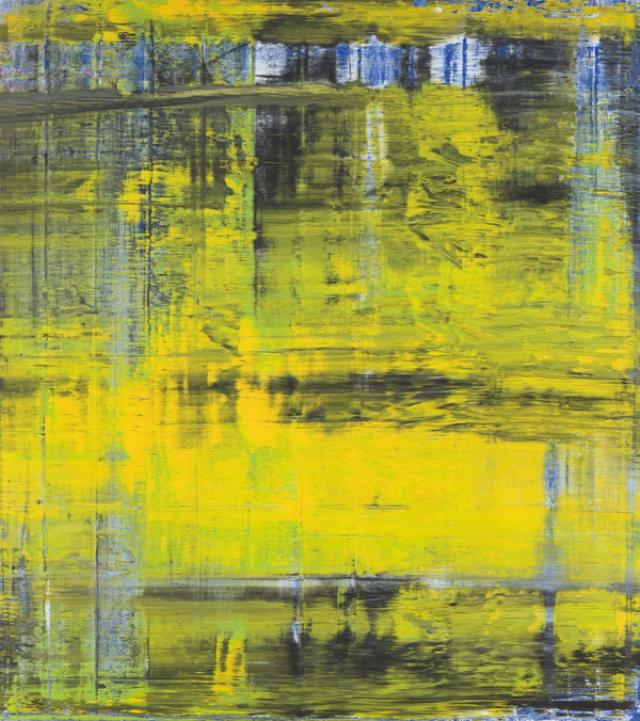
Gerhard Richter, Abstraktes Bild (1994)

There were other things read, I’m sure, though the question of when exactly eludes me. I know, for instance, that I loved Emily Hall’s The Longcut, Jessica Au’s Cold Enough for Snow, Sublunary Edition’s magisterial edition of Marguerite Young’s Collected Poems. That I reread swaths of Hans Magnus Enzenberger’s Tumult, trans. Mike Mitchell, after his passing. That I read a long-travelled copy of Grimmish by Michael Winkler, sat enthralled by Sergio Chejfec’s My Two Worlds, trans. Margaret B. Carson, inhaled December by Alexander Kluge and Gerhard Richter, translation by Martin Chalmers. That I read the fictions of friends, sworn to secrecy until their much deserving publication. That I read essays and poems, criticism, lists of albums, cookbooks, articles, manuals, comics, menus, books of photography, road signs. The work of my new, online companions—how good it feels to have such talented peers. [Ed. – heart emoji] I see the silvered spines of the New Directions Storybook editions on the shelf beside me, I see the bookmark wedged somewhere in the first third of Mircea Cărtărescu’s Solenoid, trans. Sean Cotter—the image of twine emerging from the narrator’s belly button producing a shudder once again. On my desk the piles begin to grow once more—the books I pulled off the shelf to remember, the two translations of Clarice Lispector’s The Hour of the Star, Giovanni Pontiero and Benjamin Moser, respectively, the copy of Annie Ernaux’s Happening, trans. Tanye Leslie, that I read breathless in a single sitting as December closed. And the Septology, arriving again to start anew. It was a messy year, but edifying. What emerges next, I’m not sure.