2018 Year in Reading

At first, I thought my 2018 reading was good but not great. But then I looked over my list and I kept remembering books that had left an impression. Maybe not a lot of books for all time, but plenty of high-quality stuff.

I read 126 books in 2019 (and abandoned a lot of others). Of these, 67 were by women and 59 by men; 99 were originally written in English and 27 in translation. 17 were audio books; 14 were re-reads.

Some highlights:

Kapka Kassabova, Border. A book I keep coming back to, and if it weren’t for a certain gargantuan novel (more below) this would be my book of the year. Border, as I wrote for #BulgarianLitMonth, is “about the periphery, places where resistance to centralized authority often succeeds, though usually at the cost of poverty and marginalization.” Kassabova’s journeys through Thrace (the intersection of Bulgaria, Greece, and Turkey) is filled with indelible portraits; it is the rare travelogue that is more about the people the writer meets than the writer herself.

Phillip Marsden, The Bronski House: A Return to the Borderlands. Back in June I described this book as “a story about home and exile amid the violence of the 20th century. It is a meditation on the idea of return. And it is a portrait of a sweet and moving friendship that crosses generations, sexes, and cultures.”

Jon McGregor, Reservoir 13. I think about this book all the time, even though I listened to the (gorgeous) audio book way back in March. A novel about the passing of time as marked by the rhythms of the natural world. I’m considering adding it to my Experimental British Fiction class for its brilliant use of passive voice (except the last thing that class needs is another book by a white guy).

Laura Lippman, Sunburn. Brilliant noir that subverts the genre’s misogyny. (I think it’s a response to Double Indemnity.) At one point I made a few notes for an essay, abandoned for now, about what life was like before the Internet, when serendipity seemed to structure what we knew, and many things were hard to know. This book is set in the 90s, not just for the backdrop of the Clinton impeachment hearings, which it uses to good effect, but because not knowing, or barely knowing, or needing to find someone who knows what you need to know is central to the plot.

Alfred Döblin, Berlin Alexanderplatz. Michael Hofman’s translation is a triumph (his afterword is fascinating); he makes Döblin’s collage of idioms and styles live for English-language readers. Not a book to love, for me at least, but certainly one to admire. Even more fun than writing about it was reading what Nat had to say.

Nick Drnaso, Sabrina & Liana Finck, Passing for Human. My two favourite comics in a year of good ones. (Honourable mention to Jason Lutes, for his satisfying conclusion to the Berlin trilogy). At first glance, these books have nothing in common, but they’re both dark and troubling, and they use the form in such interesting ways. I wrote about Sabrina here. You’ll hear more from me about Finck.

Helen Dunmore, Birdcage Walk. Even though this book felt a bit misshapen and truncated (it was her last and I’m sure her health was bad as she was completing it), it’s stayed with me much more than I expected. I wrote a bit about it here. I’ll read more Dunmore this year, starting with The Siege. If you have other favourites, let me know.

Lissa Evans, Old Baggage & Crooked Heart—One of this year’s many blogging regrets is that I never made time to write about these two novels. I read Old Baggage (2018) on the recommendation of various Twitter friends, and then tracked down Crooked Heart (2014) at my local library. This reverse order turned out just fine, as Baggage is a prequel to Crooked; knowing what has happened to get the child protagonist to the situation he’s in at the beginning of Crooked makes the earlier book even more poignant. If you’re allergic to poignancy, though, don’t worry. Evans is funny (in real life, too—follow her on Twitter) and anything but sanctimonious or sentimental. Which could have been a real risk: each of these books, set in England during the 1920s-40s, describes a boy’s relationship with two older women, ersatz parents. Even though each is in her own way a social misfit, the women have a lot to teach the child, whether it’s how to make a speech or how to pull a con. I loved both books, but preferred Baggage because the child plays second fiddle to the indelible Mattie Simpkin, a former Suffragette leader who, in her declining years, challenges herself to galvanize a generation of young women who are taking for granted the gains made by their elders. (As far as they’re concerned, Mattie and her ilk are just “old baggage.”) What happens, Evans asks, when the movement you’ve devoted your life to fades away? As great as Mattie is, she’s not even the best character: that would be her friend and sometime amanuensis, nicknamed The Flea, so kind, so loving, so long-suffering, so surprising. Old Baggage is a quick read, but it’s packed with things to think about and enjoy. You’ll have to get it from the UK but it’s worth it.

Jessie Greengrass, Sight. Smart novel/essay about the pleasures and pains of making the invisible visible.

Olivia Manning, The Levant Trilogy. Scott and I wrote about these wonderful books. Maybe not quite as amazing as their predecessors, The Balkan Trilogy, but there’s one scene in the first volume that is such a stunner.

Rachel Seiffert, A Boy in Winter. I hate almost all contemporary novels about the Holocaust. But Seiffert won me over, partly by emphasizing the Shoah by bullets (the murderous movement of the SS Einsatzgruppen across the Soviet Union in 1941-2), partly by focusing on victims, perpetrators, and bystanders alike, and complicating those seemingly separate categories, and partly by her thoughtfulness about the relationship between assimilation and survival. I even forgave the book for being written mostly in first person, a pet peeve of mine. (Long live the past perfect, I say.) I also read her first book, The Dark Room, also about the war years: also good, though not as light on its feet as Boy.

Brian Moore, The Mangan Inheritance. Seventies books are the best books.

Marlen Haushofer, The Wall, translated by Shaun Whiteside. This book is a wonder, so still and careful and joyous. It’s about a woman who survives some sort of apocalypse that leaves her trapped in a lovely, though also punishing alpine valley, with only various animals for companionship. I reveled in the details of the narrator’s survival and the suggestion that it might take a complete rupture for women to find their place in the world. John Self says the rest of Haushofer’s (small) body of work is good, too.

Émile Zola—Some of the year’s greatest reading moments came from the project Keith and I launched to make our way through the Rougon-Macquart cycle. We read three novels this year (at this rate, our kids are going to be in college before we’re done) and it was such a pleasure thinking about them with him. The Fortune of the Rougons was tough sledding, but The Belly of Paris and The Kill were great. I’m obsessed with Zola’s use of description, and how that tendency threatens to derail the aims of the naturalist project (if we in fact take those aims seriously; Tom cautioned me not to) and even the idea of narrative itself. We’re committed to continuing with Zola in 2019—maybe I can get my act in gear to read and write a little faster.

And my reading experience of the year: Jonathan Littel, The Kindly Ones, translated (heroically) by Charlotte Mandell.

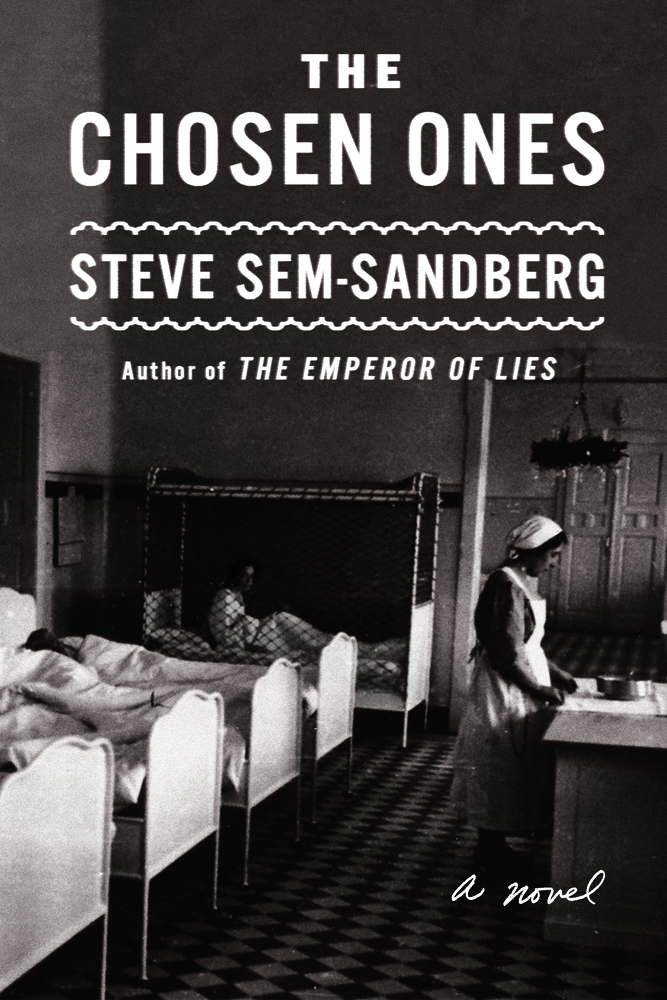
I’m sad I never made time to write about this, the longest (900+ pages) book I read in 2018. I read 20-50 pages each day in June, and as soon as I finished we left on our long Canada vacation and the moment for writing about it passed. But I have thoughts! This extraordinary novel of the Holocaust is narrated by Maximilian Aue, an SS officer who experiences most of the significant moments of the war and the Final Solution: he’s in Paris in the summer of 1940, and at Stalingrad two years later. He’s with the Einsatzgruppen as they extinguish Jewish life in the Ukraine (including a horrifying set piece describing the events at Babi Yar), he’s in the Caucasus, he’s in Vichy France, he’s in Pomerania as the Red Army overruns the Germans. It’s amazing how Littel makes Aue’s peregrinations seem plausible rather than a Forest Gump-like gimmick. Early on, I found the novel so grim and distasteful that I could only read 20 pages at a time—I asked Mandell, always so gracious on Twitter, how she could stand to translate it, and she told me it was hard, and even worse when she started to dreamed about it. Aue is not a nice man, but he’s smart and erudite and a compelling storyteller. He’s so much more reasonable, though I shudder to put it this way, in his extermination of Jews and other so-called undesirables than most of the men he works with, and he has the decency to make himself sick over what he’s done that occasionally we forget what the hell is really going on and even look on him kindly. Quite a trick how Littel pulls us towards accepting or at least understanding the intellectual underpinnings of fascism while never letting us forget what a failure it would be to really be seduced. There’s an utterly engrossing lengthy section in which Aue and various other officials discuss whether the Mountain Jews of the Caucuses (descendants of Persian Jews) are racially or “only” ritually Jewish; that is, whether they ought to be exterminated or not. The cold-bloodedness and ethnographic hairsplitting of the conversation offer a powerful example of how men can set notions of decency or morality aside.

The Kindly Ones is ultimately a flawed book: alongside the political/ideological explanations, Littel gives Aue another motivation for his actions—his incestuous love for his sister. (This is the strand that references the Orestia, the last volume of which gives the novel its name.) Littel never reconciles these political and personal strands, so that in the end all of his work at showing the all-too-human motivations for genocide is undone by the psychopathic aspects of this second strand. But the accomplishment here is tremendous. I don’t know if anyone less obsessed with the Holocaust than me could ever enjoy—well, let’s say value—such a book, but I was very taken with it, especially because the book wanted me to feel gross about feeling that way.

Some bests and worsts:

Best new (to me) series: Robert Galbraith (a.k.a J. K. Rowling)’s Cormoran Strike & Robin Ellacott books. A little bloated, but Galbraith knows how to tell a story. From the classic meet cute in the first pages of the first volume, Galbraith pushes my buttons and I don’t care. The plots are genuinely suspenseful, and the “will they/won’t they” storyline between the private detective and his temp-become-full-fledged assistant is catnip. I recommend the audio books.

Best Holocaust texts: Georges Didi-Huberman, Bark (beautiful essay on some photographs the author took on a visit to Auschwitz-Birkenau); Molly Applebaum, Buried Words: The Diary of Molly Applebaum (the story of how Applebaum survived the war is incredible, as is the cognitive dissonance between that text and her postwar memoir, also included in this volume); Nechama Tec, Dry Tears (I will be writing about this memoir soon).

Best book by Dorothy B. Hughes: I read four Hughes novels this year. The Expendable Man, her last, was my favourite, and I think it’s a genuinely great book because it implicates readers in its cultural criticism. I enjoyed the more famous In a Lonely Place, but I preferred the first half of the earlier The Blackbirder. Hughes isn’t a conventional suspense writer: plot isn’t her strength. What she’s brilliant at is describing how people deal with threats they know about but can’t escape. That skill is evident from the first page of The So Blue Marble, her first and mostly utterly preposterous novel. Even though Hughes’s protagonists aren’t always women, she writes from a position women know only too well: being victimized not by some unknown person, but by someone close to them—someone the rest of the world is slow to suspect. This accounts for the atmosphere of desperation and fear that characterizes her work. I’ll hunt down more Hughes in 2019.

Best essay about prison libraries hiding inside what pretends to be a crime novel: George Pelecanos’s The Man Who Came Uptown.

Best crime discovery (I): Anthony Horowitz, who I’ve in fact been enjoying for years as a longtime fan of (a.k.a. total suck for) Foyle’s War. The Word is Murder is pure genius: Horowitz puts himself in the story, uses the oldest odd-couple idea in the book, and still makes it work. Clever and fun. Afterwards, I read the earlier Magpie Murders, similarly clever and fun, though not quite as genius as Murder, which, I am delighted to see, looks like it will become a series.

Best crime discovery (II): Lou Berney, who lives just down Interstate 40 in Oklahoma City and isn’t afraid to write about it. The Long and Faraway Gone was good, but November Road is great, and I say that as someone allergic to anything to do with the Kennedy assassination.

Book I had to stay up all night to finish: Cherie Dimaline, The Marrow Thieves. Indigenous Canadian dystopian YA—will follow her career with interest.

Best thriller—Lionel Davidson’s Kolymsky Heights, by a mile. His first, The Night of Wenceslas, is weaker, but the guy can write a chase scene.

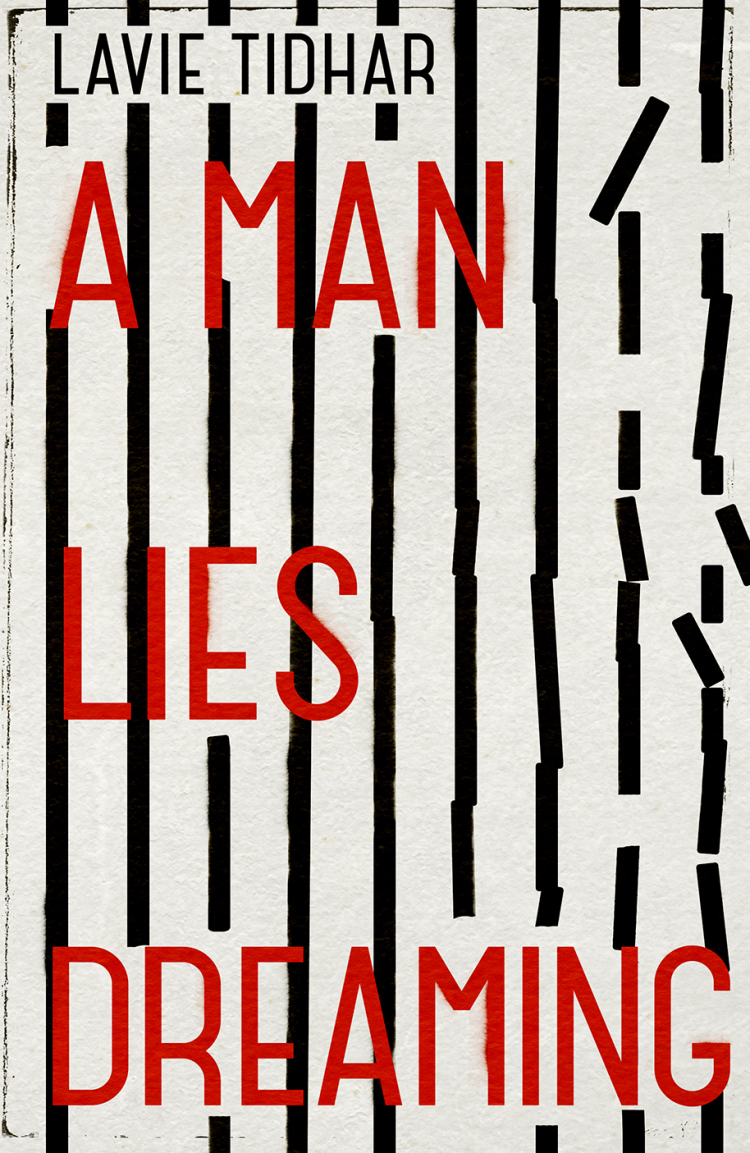
Best SF-alternate history-who knows what genre this is and who cares: Lavie Tidhar’s Unholy Land. Tidhar hasn’t always been to my taste, but he’s always worth thinking with, and here he delivers a compelling story that imagines a Jewish homeland in Africa. (Modelled of course on one of the many such plans in the late 19th and early 20th centuries.) A thoughtful book about borders, as sad as any book about that topic must be, and as such relevant to everyone.

Most vexing: P. G. Wodehouse, Thank you, Jeeves. It is delightful! But can it be delightful with a minstrelsy sub-plot?

Interesting, but I don’t quite get the fuss: Oyinkan Brathwaite, My Sister, the Serial Killer; Anna Kavan, Ice. I wrote about my struggle to teach the latter.

Books I liked at the time but have sunk without a trace: Sigrid Nunez’s The Friend is a good dog book and a book about a good dog. As I recall, it seems to be suggesting autofiction is intrinsically good at portraying grief, which is interesting. But although I enjoyed it a lot at the time, I never think of it now. I should be the target audience for Maybe Esther (Trans. Shelley Frisch), Katya Petrowskaya’s investigation into and speculation about the fate of her family in the Ukraine during WWII. And it really has its moments (there’s a great bit near the beginning about a ficus plant). But somehow it didn’t add up for me. I might like it a lot more on a re-read—do you ever feel that way about a book?

Disappointments: Claire Fuller, Bitter Orange (not terrible, and on the face of it the sort of thing I like best—Gothic country house, unreliable narrator—but underwhelming; maybe Our Endless Numbered Days was a one-off?); Ian Reid, Foe (fair bit of buzz about this quasi-SF, quasi-philosophical novel concerning humans and replicants, but I didn’t think it was as smart as it seemed to think it was).

Lousy: Leila Slimani, The Perfect Nanny (histrionic); Emma Viskic, Resurrection Bay (overwrought); Arnaldur Indridason, The Shadow Killer (losing his way, I fear).

Reliable pleasures: Tana French (Witch Elm deserves a better fate: it’s typically gorgeous and tricksy, but for the first time French concentrates on an individual rather than a relationship; I’ve read some grumbling about it, and I don’t get it); Jeanne Birdsall (Penderwicks 4eva!); John Harvey (the new book is his last and it is very sad); Ellis Peters (check out Levi Stahl’s lovely piece); Ian Rankin (came back to Rebus after many years away, and am catching up—sometimes the writing is bad, but he’s good at weaving subplots, and at knowing when a book is long enough); Phillip Kerr (making my way through the Bernie Guenther’s and they’re evocative, suspenseful, and damn funny: hard to pull off).

*

My big regret for 2018 is that I wrote almost nothing for publication. I was tired after a few very busy years. And I was scared to pitch new venues after some of the journals I’d been most associated with folded in 2017. I’m aiming to write more in 2019. Here on the blog, I would love to write more frequently and less longwindedly, but I’m coming to realize that over-long, close-reading analyses are what I do best (or what I do, anyway). I’m going to try something new, though, as a way to say a little something about more of the books I read: at the end of each month, I’ll write a round-up post, something like Elisa Gabbert’s magnificent year-end piece. I don’t have her lightness or ease, but I think it will be an exciting challenge.

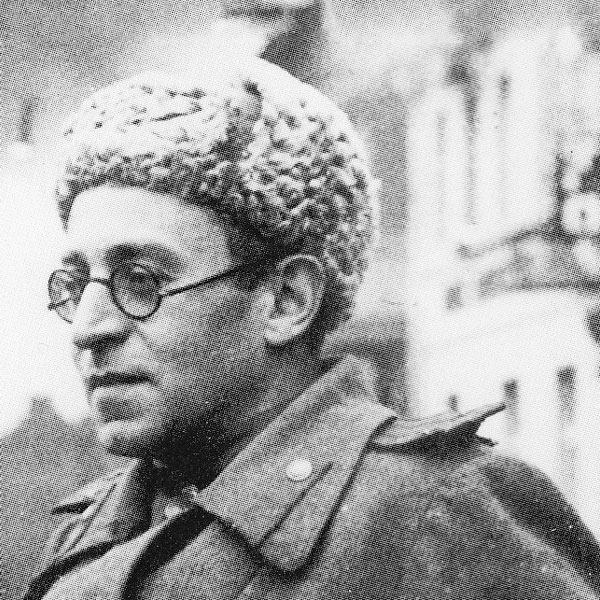
As always, I’ve loved reading and writing with friends this past year. For the first time I even included a post about a book I’ve never even read (thanks, Nat!). I’d love to have more contributions from other readers and writers. If you want to suggest something to read with me, just let me know. And if you just want a place to share your thoughts about a book, say the word. I do have one concrete suggestion: join me and others to read a long Danish novel about canals and Jews! And I know I will be avidly reading Vasily Grossman’s Stalingrad when it comes out this summer. And I will make it back to Anniversaries, I promise. Other than that, I’ll probably keep reading as waywardly and haphazardly as always. Although a hedgehog in personality, I am a fox when it comes to reading.

Thanks to everyone for reading and commenting in 2018—I hope you’ll stick around for more in 2019. After all, the blog is turning 5 next month! And if you want to see my reflections on the last few years, you can read about 2014, 2015, 2016 & 2017.

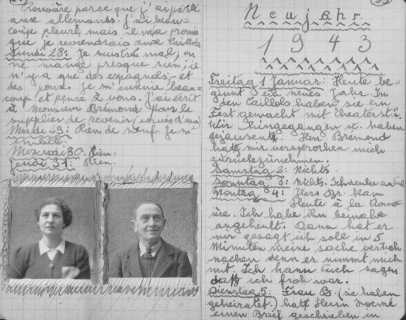
 

On Holocaust Diaries

I gave this paper as a talk the other day at the University of Arkansas at Fayetteville. The next day I taught three hour-long sessions using passages from three of the diaries I reference in the talk  to middle- and high-school students and their teachers. Both events were part of the 27th annual Arkansas Holocaust Education Conference. My thanks go to the conference organizer and Chair of the Arkansas Holocaust Education Committee, Grace Donoho, and, especially, Dr. Jennifer Hoyer of the German Department and Chair of the Jewish Studies Program at Fayetteville.

783904

I want to focus today on our fascination with Holocaust diaries, and I want to suggest that the reasons they typically fascinate us are not actually the reasons why they are so important.

We tend to privilege diaries, and especially Holocaust diaries, for their seemingly immediate access to experience. We are getting events as they happened and so are placed directly in the midst of a historical event to which we might otherwise not have access. So the thinking goes, anyway. Holocaust diaries can be considered Exhibit A in the category of testimonial literature that Elie Wiesel, writing in the late 1970s, deemed the genre of his generation, and that critics writing in the wake of Wiesel have described as the kind of writing most commensurate to the traumas of the 20th century.

In this context, let’s consider the following statement by survivor Primo Levi, who incidentally did not write a diary [other than the “retrospective” diary at the end of Survival in Auschwitz]:

We, the survivors, are not the true witnesses. … We survivors are not only an exiguous but also an anomalous minority: we are those who by their prevarications or abilities or good luck did not touch bottom. Those who did so, those who saw the Gorgon, have not returned to tell about it or have returned mute, but they are… the complete witnesses, the ones whose deposition would have a general significance. They are the rule, we are the exception.

Survivors, he adds, “speak in their stead, by proxy.”

The Final Solution was designed to be just that—final; there weren’t supposed to be any survivors. Survivors can thus be considered as a kind of noise or static, or, to change the metaphor, as the flaw that inheres in any system or machine. Exceptional, and interesting as such, but hardly representative. And because it is the case that many diarists did not survive the war—to use Levi’s language, those who did are the exception rather than the rule—these writers could be said to be what he calls “the complete witnesses” and therefore to offer us something even more valuable than survivor memoirs. But what interests me about Levi’s claim extends beyond the distinction between who lived and who died. To my mind, what Levi is really pointing to is something more fundamental about the very nature of experience, namely, that there is an inescapable surrogacy at the heart of experience.

I’m arguing, on the basis of reading Holocaust diaries, that all experience is characterized by indirection, by proxy-ness. To rephrase this in terms given to us by literary criticism, there is always a distinction between the “I” that narrates and the “I” that experiences.

Here, for example, is Hélène Berr, a 20-year-old student of literature at the Sorbonne, writing on June 24, 1942 about the traumatic events of the previous day, when her father, a prominent industrialist, had been arrested:

The first time I awoke and saw the morning light through the blinds, it occurred to me that this morning Papa would not have his usual breakfast, that he would not be coming to the breakfast table to get his toast and pour his cup of coffee. The thought was immensely painful.

That was only my first awakening, and gradually (I often drifted back to sleep) other thoughts came to me, making me realize what had happened. I am still waiting for the sound of keys jangling in his pocket, of him opening the shutters in his bedroom; I am still waiting for them [her parents] to get up, because he’s the one who turns on the gas. At those moments I can grasp it. At this moment of writing, I am not managing very well.

In her description of how she feels when expecting her father, she can grasp the fact of his arrest—via absence, via what’s not happening, and who isn’t there—but in the actual act of writing, she cannot grasp the situation at all. In other words, what the narrating I grasps is that it cannot really grasp what has happened to it.

Later, on October 10, 1943, taking up her diary after a year-long hiatus, Berr describes this split even more clearly:

Then there is the considerable repugnance I feel at thinking of myself as “someone who writes”, because for me, perhaps mistakenly, writing implies a split personality, probably a loss of spontaneity and abdication. [Not mistakenly!]

The split between narrating I and experiencing I allows us to see that even the testimony of direct witnesses to the Holocaust is indirect. The record of experience is at a remove from experience itself. That doesn’t mean these records are fictional or biased or untrustworthy. But it does mean that no one, not even the person doing the experiencing, has unmediated access to direct experience.

[Riff on James Young: the things diarists say are said from within the frame of their world-view: contrast Frank with Flinker—I absolutely agree but my point is more about experience itself.]

Moreover, even the very diaries themselves, irrespective of what is in them, are themselves examples of mediation, documents that stand in for the life of the person who wrote them, a person that is often no longer present, even alive once we are reading their entries.

86061

Published Holocaust diaries usually begin with an introduction explaining how the diary came down to us. Some of these stories are almost as well-known as the diaries themselves.

For example, many people know that Miep Gies, Otto Frank’s secretary, searched through the secret annex after the Gestapo raided it and retrieved Anne’s diary, which she kept in case any of the family returned from deportation.

Anne Frank had no way of knowing her writing would be preserved. Others were more deliberate about attempting to enact that preservation. Often, they relied on non-Jewish friends to keep their pages safe. Hélène Berr passed hers on to the family cook with instructions that she get them to Berr’s lover, who was fighting with the Free French. Victor Klemperer similarly gave his to a sympathetic friend.

Other stories are more haphazard, even dramatic. Dawid Serakowiak’s notebooks were found stacked on a stove, ready to be burned, when the Lodz ghetto was liberated. And consider the case of the diaries of Petr Ginz—a Czech teenager who wrote and illustrated adventure stories in the mode of Jules Verne, and whose entries are usually laconic descriptions of which of his friends are no longer at school, but who also wrote a heartbreakingly detailed description of the day he received his deportation notice, a description that focused on the delicate task of disassembling typewriters to clean their keys (this was his after-school job) (it’s a remarkable example of disassociation or of preserving one’s dignity, depending on how you look at it). Ginz’s diaries resurfaced when a man remembered some papers and drawings he had inexplicably kept after he bought an old house in Prague. He was reminded of the documents because of a news story about the explosion of the space shuttle Columbia. Among the crew was an Israeli astronaut who had taken with him a drawing of the moon by a teenager deported from Prague to Theresienstadt and then to Auschwitz—the same Petr Ginz.

There’s something avid in the way these stories are described by editors and readers alike. (I confess I share this sentiment.) I think that hunger, that fascination is worth thinking about, because it allows us to consider more fully the relationship between the diarist and the diary.

Diaries often seem to be direct replacements for the writers themselves. Perhaps even to be more important than the writer.

Think of Anne Frank naming her diary Kitty—turning it into an other, and, even more importantly, into an authority that legitimates her writing by being not only confidante but also judge.

Think of Chaim Kaplan, writing on August 2, 1942, amidst liquidation of Warsaw ghetto, in the last line of his last entry: “If my life ends—what will become of my diary?”

Think of Hélène Berr, writing in October 1943: “It makes me happy to think that if I am taken, Andrée [the family’s cook] will have kept these pages, which are a piece of me, the most precious part, because no other material thing matters to me anymore.”

Think of Molly Appelbaum, writing from near Tarnów, Poland, on March 1, 1942: “I look at each written page [of my diary] with respect. Why, these are the pages of my existence, my life.” (Even though her emphasis is on herself, the proof of the value of that life lies only in the diary.)

Think too of Artie Spiegelman, in the autobiographical comic Maus, listening to his father tell him about his separation from his wife, Artie’s mother, upon their arrival at Aushwitz-Biurkenau after months in hiding. Artie exclaims, “This is where Mom’s diaries will come in especially useful. They’ll give me some idea of what she went through when you were apart.” (But he finds out his father burned them, at which point he bursts out, accusingly, “God damn you, you murderer!”, as if the diary was in fact a person.) (It might be worth noting that these dairies were themselves reconstructions: they were lost in the war and she re-wrote them once settled in America.)

These are all instances in which the person seems subordinate to the diary.

Holocaust diarists are often convinced—usually rightly—that they will not survive. (The last line of Sierakowiak’s diary” “There is really no way out for this for us.”) But they want their diaries to survive. We might say that the narrating I triumphs over the experiencing I.

What does that mean, then, about the status of diaries as witnesses if the experience contained within them is never as direct as we assume?  Have we fetishized diaries at the expense of the actual lives involved?

The diarists themselves offer a response:

Klemperer famously writes, on May 27, 1942, “I shall go on writing. That is my heroism. I will bear witness, precise witness!”

Berr says something similar on October 10, 1943: “I have a duty to write because other people must know. Every hour of every day there is another painful realization that other folk do not know, do not even imagine, the suffering of other men, the evil that some of them inflict. And I am still trying to make the painful effort to tell the story. Because it is a duty, it is maybe the only one I can fulfill.”

And Samuel Golfard, in hiding in Eastern Galicia, begins his diary on January 23, 1943:

I am not composing these words for myself. They are intended for those who will survive and who might quickly forget what they had lived through not so long ago. Let these words refresh in their memory the moments of horror, the bloody scenes that took place before their eyes, the black night of savagery.

These statements are directed outwards, beyond the self. There’s even a sense that the writers don’t want to keep writing any more, or do so only at great cost or against all odds. Berr says as much: “I’m not even keeping this diary anymore, I’ve no willpower left, I’m just putting down the salient facts so as to remember them” (September 10, 1942). Sierakowiak doesn’t say it in so many words, but the terseness of his entries, coupled with his laments over his weakening concentration, failing health, and ebbing vitality, indirectly indicate to us how much the writing takes out of him.

On this way of thinking, the diary is an instrument, a tool of survival. Moreover, it is the often the only means of survival, and the only way it survives is by becoming separated and distanced from its writer. It is the very distinction between the writer’s experience and the diaries’ representation (their being a form of representation) that allows us to have access to these historical events at all.

Diaries, then, substitute for people who aren’t there any longer. [Even prey upon them? Cf Berr: I’m not even writing this diary anymore, but I have to.]

This is a melancholy, even dismal state of affairs. And inasmuch as we replace the reality of loss, suffering, and death—starvation, terror, dehumanization, typhus, tuberculosis, all the terrible traumas suffered by Frank and Berr and Sierakowiak and Klemperer, to name only a few—with the survival of the diaries themselves then it’s worse than that. To do so is to emphasize triumph where there is in reality only loss, a loss we’re literally papering over by fetishizing the miracle that the documents have come to us at all.

But this doesn’t have to be the only way to think about diaries as proxies for their authors. We can take the distance between diary and diarist not as a replacement of the latter by the former, but as a tribute the former pays to the latter.

Because if it weren’t for the mediated-ness of representation we wouldn’t have witnessing at all. The distance between person and diary is necessary. Sometimes that distance is physical (the two get separated: think of Frank’s pages scattered on the floor of the secret annex; think of Sierakowiak’s stacked on the stove, that narrow escape from the funeral pyre) but it is always structural (as I’ve been arguing, it’s constitutive of the form).

The separation of the diary from the diarist—sometimes a contingent fact of the vicissitudes of history but always an inescapable fact that is constitutive of the very act of writing—does two things at the same time: it keeps us from accessing direct experience but that very separation allows us to have any access to experience at all.

For Elie Wiesel, the legitimacy of the literature of testimony lies in its urgency:

We have all been witnesses and we all feel we have to bear testimony for the future. And that became an obsession, the single most powerful obsession that permeated all the lives, all the dreams, all the work of those people. One minute before they died they thought that was what they had to do.

The “we” in Wiesel’s first sentence refers to Holocaust survivors. But, like Levi, although less consciously, he distinguishes between those who survived and those who were murdered. Beginning with “we” Wiesel moves to “they” and “those people.” Holocaust diaries, I have hoped to show, show us in action what Wiesel can only unconsciously recognize, the fundamentally mediated quality of supposedly immediate or direct testimony.

“Yes, Here I Am”: Life and Fate’s Holocaust

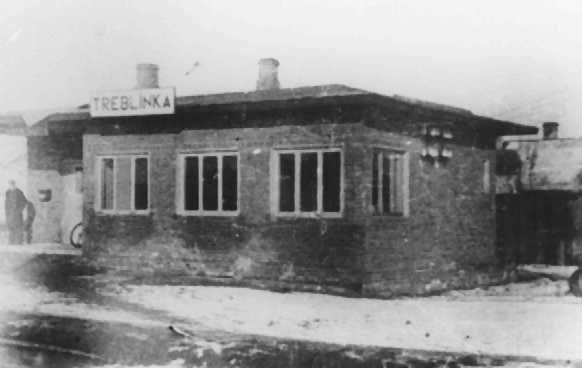
Among other things, Life and Fate is an important contribution to the literature of the Holocaust. The Holocaust touched Grossman personally. I’ve referred now a couple of times in these posts on the novel to his essay “The Hell of Treblinka.” Grossman was with the Red Army when it arrived at the former killing center, which the Germans had largely abandoned in 1943. His investigative journalism, including interviews with many of the local Poles, produced one of the earliest documents we have about the camps. But the Holocaust touched Grossman in a much more personal way. His mother was murdered in their hometown of Berdichev when the Germans invaded the Ukraine in the summer of 1941.

One of the novel’s most famous chapters contains the text of a letter from Anna Semyonovna, Viktor’s mother, to her son. Smuggled out just before the Berdichev ghetto is liquidated, the letter is a clear, careful, and enormously moving description of how quickly life turned upside down for the Jews of Ukraine in the summer of 1941. It is also Grossman’s homage to his mother; she was never able to send him anything comparable. Like his stand-in, Viktor, Grossman was plagued his whole life by guilt that he wasn’t able to get her to safety in Moscow before the German invasion.

The letter shows how fast life was overturned for the Jews of Berchidev. No sooner had the Germans arrived than many of the locals—even former friends and neighbours—feel emboldened to take over their apartments and steal their things. In a matter of days, the Germans announce the construction of a ghetto where all Jews are required to move. The ghetto is horrible—everyone hungry, sick, despairing. But it’s better than that brief period before. Anna concludes: “Now I’m no longer a beast deprived of rights—simply an unfortunate human being. And that’s easier to bear.”

Anna’s letter is filled with similar heartbreaking and pithy claims. “Nowhere is there so much hope as in the ghetto,” she writes. Anna describes herself seeing patients (she is an eye doctor) and saying “Now bathe your eye regularly with the lotion and it will be better in two or three weeks” when the signs are clear they will all be murdered soon:

The Jews who were sent to dig potatoes are digging deep ditches four versts from the town, near the airfield, on the road to Romanovka. Remember that name, Vitya—that’s where you’ll find the mass grave where your mother is buried.

She imagines herself becoming nothing but a faint memory, imagines some of her non-Jewish neighbours saying: “‘And there was a doctor who used to sit there, beneath that old pear-tree—I can’t remember her surname but once I went to her to have my eyes treated. After she finished world she use to bring out a wickerwork chair and sit there with a book.’ Yes, Vitya, that’s how it will be.”

I defy anyone to read this chapter with a dry eye.

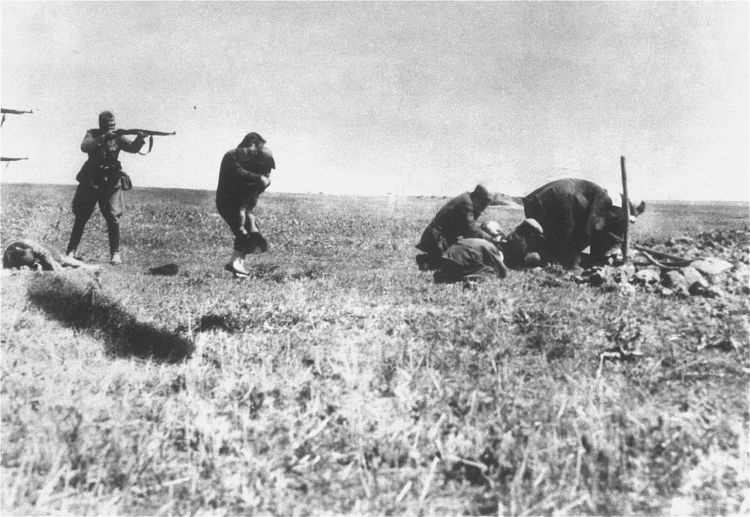
1280px-Jew_Killings_in_Ivangorod_(1942)

In addition to showing the complicity of the local population in the Nazi murder of Ukrainian Jews and daring to suggest that the crimes of Nazism and Stalinism were no so different, Grossman’s other big crime, as far as the Soviet authorities were concerned, was to assert that Jews suffered inordinately in the German invasion. That might seem obvious to us, but it was a brave, dangerous thing to say in the USSR in the 1950s. As translator Robert Chandler notes in his introduction, this was the time of the slogan “Do not divide the dead!” That is, all victims of fascism were supposed to be the same: all Soviets suffered together. Grossman challenges this orthodoxy in Life and Fate.

Indeed, one of the tragedies of the Holocaust in the Soviet Union is that many Jews there no longer or had never thought of themselves as Jewish. (This was true elsewhere in Europe too.) Viktor and his mother feel this way, as did Grossman himself. In a characteristically fine review of the novel, Adam Kirsch points out how Soviet modernity had transformed Jewish life, taking people out of the shtetls that persisted elsewhere in Eastern Europe (and in the USSR as well), bringing them to cities like Berdichev (prewar population 60,000, half of them Jewish), and allowing them access to all sorts of professions.

This transformation of Jewish life is evident in the novel. After being captured by the Germans outside Stalingrad, Sofya Levinton, an army doctor who is the other main Jewish character in the novel, is eventually deported to a concentration camp. In the cattle-car she studies her fellow prisoners and reflects on how the world of her childhood has changed:

The cattle-wagon was full of workers from different co-operatives, girls at teacher-training college, teachers from a school for trade unionists; there was a radio technician, an engineer who worked at a canned-food factory, a livestock expert, and a girl who worked as a vet. Previously, such professions had been unheard of in the shtetl.

As you can see from this example, the lists I discussed last time are present in the Holocaust sections of the book as well. Grossman uses them to show the enormous scope of Jewish persecution, as well as to remind readers that the Nazi-sponsored genocide affected Jews from across Europe and from all walks of life. In a powerful scene, Grossman depicts a meeting between (the fictional) SS Obersturmbannführer Liss and Adolf Eichmann, who reveals to him the plans for the Final Solution:

‘Can you give me some idea—just a rough estimate—of the number of Jews we’re talking about?’ …

Eichmann answered his question.

What?’ Liss gasped in astonishment. ‘Millions?’

Eichmann shrugged his shoulders.”

Riding in a limousine on the way to the meeting, Liss dreams of his future. Grossman interrupts his reverie with a kind of documentary overview of the coming destruction that is clearly not from Liss’s point of view:

Smolevichi [today in Belarus] is full of quiet little houses with gardens; grass grows on the pavements. In the slums of Berchidev there are dirty hens running around in the dust, their yellow legs marked with red and violet ink. In Kiev—on Vassilievskaya Avenue and in the Podol—there are tall buildings with dirty windows, staircases whose steps have been worn down by millions of children’s shoes and old men’s slippers.

In yards all over Odessa stand tall plane trees with peeling bark. Brightly-coloured clothes and linen are drying on the line. Pans of cherry jam are steaming on cookers. New-born babies with swarthy skin—skin that has yet to see the sun—are screaming in cradles.

On the six floors of a gaunt, narrow-shouldered building in Warsaw live seamstresses, book-binders, private tutors, cabaret-singers, students and watchmakers…

In Stalindorf [a Jewish agricultural colony in the Ukraine, established in 1924] people light fires in their huts in the evening. The wind blows from Perekop [on the isthmus between Ukraine and Crimea], smelling of salt and warm dust. Cows shake their heavy heads and moo…

In Budapest and Fastov [Ukraine], in Vienna, Melitopol [Ukraine] and Amsterdam, in detached houses with sparkling windows, in hovels swathed in factory smoke, lived people belonging to the Jewish nation.

The barbed wire of the camps, the clay of the anti-tank ditches and the walls of the gas ovens brought together millions of people of different ages, professions and languages, people with different material concerns and different spiritual belies. All of them—fanatical believers and fanatical atheists, workers and scroungers, doctors and tradesmen, sages and idiots, thieves, contemplatives, saints and idealists—were to be exterminated.

This passage is a good example of Grossman’s tendency to intersperse the narrative with little mini-essays or pieces of reportage (I gather Tolstoy does something similar with his writings on history in War & Peace). It’s also a clear statement of Jewish identity, really extraordinary given the ideological dreams and political realities of Soviet life.

Eventually, it becomes clear that Sofya not Victor is the novel’s main stand-in for the Jewish people. She is just as vivid, sympathetic, and moving a character as Viktor’s mother, Anna. Shortly after the passage I cited earlier about all the professions represented in the cattle-car, Sofya begins to think of herself as a member of a communal Jewish identity, addressing the others on the transport as Brider yidn (Fellow Jews). (Compare Anna: “But now, during these terrible days, my heart has become filled with a maternal tenderness towards the Jewish people. I never knew this love before.”)

Many pages later, when Sofya and the others are forced into the gas chamber, we’re given a passage that moves from individual Jewish bodies to the collective body of the Jewish people, from corporeal to historical continuity:

When a man has no clothes on, he draws closer to himself. ‘God, the hairs on my chest are thicker and wirier than ever—and what a lot of grey!’ ‘How ugly my fingernails look!’ There’s only one thing a naked man can say as he looks at himself: ‘Yes, here I am. This is me!’ He recognizes himself and identifies his ‘I’, an ‘I’ that remains always the same. A little boy crosses his skinny arms over his bony chest, looks at his frog-like body and says, ‘This is me’; fifty years later he looks at a plump, flabby chest, at the blue, knotted veins on his legs and says, ‘This is me’.

But Sofya Levinton noticed something else. I was as though the body of a whole people, previously covered over by layers of rags, was laid bare in these naked bodies of all ages: the skinny little boy with the big nose over whom an old woman had shaken her head and said, ‘Poor little Hassid!’; the fourteen-year old girl who was admired even here by hundreds of eyes; the feeble and deformed old men and women who aroused everyone’s pitying respect; men with strong backs covered in hair; women with large breasts and prominently veined legs. It was as though she felt, not just about herself, but about her whole people: ‘Yes, here I am.’ This was the naked body of a people: young and old, robust and feeble, with bright curly hair and with pale grey hair.

The scholar Marat Grinberg—more from him next time!—has observed that Sofya here references the hineni (Here I am!) of Abraham’s response to God in the story of the Akedah, that is, the binding of Isaac. It’s amazing to see the secular, atheist, Communist Grossman, who grew up without a traditional Jewish education, cite this central moment from what might be the most powerful and puzzling story in all of Torah. It’s even harder to know how to understand this choice. Is Grossman suggesting, via the biblical allusion, that even in the hell of the camps God will somehow look out for, even validate Jewish suffering? What could that possibly mean? These people are about to be murdered—unlike in “The Hell of Treblinka,” where Grossman also imagines a scene in the gas chamber but pulls away at the last moment, as if to say the moment of the death is beyond representation, here he actually depicts the death of Sofya and the rest:

Her heart, however, still had life in it: it contracted, ached and felt pity for all of you, both living and dead; Sofya Osipovna felt a wave of nausea. She pressed David [a little boy she cares for on the journey to death], now a doll, to herself; she became dead, a doll.

Is the “you” in this powerful passage meant to refer to Jews? To all human beings, even those who are on the other side of the doors, peeping through the porthole window? To us as readers?

Or is the reference to the hinenei supposed to be ironic? Is Grossman saying, despairingly, contemptuously: This is what has happened to the faith in the 20th century? I don’t think so. I think Grossman is wrestling with the relation between individual human life, which he values so much, as I’ve shown over and over in these posts, and group identity, which he wasn’t allowed to value except through the idea of Soviet or communist identity.

Although there’s a lot more to say about the role of the Holocaust in Grossman’s self-understanding and in the novel, I’ll finish by simply pointing out a few of the moving characters Grossman offers us.

There’s Rebekkah Bukhman, who strangles her baby when it begins crying in the hiding place from which she and her family are nonetheless wrenched during a house-to-house search in a ghetto. There’s Naum Rozenberg, an accountant forced to become a Brenner, one who burned the bodies of those shot by the SS Einsatzgruppen; Rozenberg has miraculously survived the liquidation of his unit only to be recaptured by the Germans and deported to Treblinka; he spends the train ride in a fugue state, calculating exactly how many bodies he was forced to burn. There’s an unnamed man, distinguished only by his raised collar, who suddenly shrugs his shoulders as the column of new arrivals is marched to the crematorium and “with a sudden nimble jump, as though he had spread his wings… punche[s] an SS guard in the face and knock[s] him to the ground.”

Grossman is too honest to simply ennoble the victims. Take a look at this passage, describing a husband and wife who are separated on the ramp and then by the so-called selection process. He is sent to work; she is sent to death. The passage starts out conventionally enough, just skirting piousness, but then takes a swerve that leaves false emotion far behind:

How can one convey the feelings of a man pressing his wife’s hand for the last time> How can one describe that last, quick look at a beloved face? Yes, and how can a man live with the merciless memory of how, during the silence of parting, he blinked for a moment to hide the crude joy he felt at having managed to save his life? How can he ever bury the memory if his wife handing him a packet containing her wedding ring, a rusk and some sugar-lumps? How can he continue to exist, seeing the glow in the sky flaring up with renewed strength? Now the hands he had kissed must be burning, now the eyes that had admired him, now the hair whose smell he could recognize in the darkness, now his children, his wife, his mother.

Yet he doesn’t blame the victims, either. That passage is like a punch to the gut because it acknowledges how the drive to live trumps every decent human emotion, even as it suggests how terrible it is that a person in that situation can, indeed must, become so callous. At the same time, though, the questions posed by the narrator aren’t just rhetorical. Grossman doesn’t let us forget that those of us who weren’t there struggle to understand. (Which isn’t the same as saying we can’t.) In an earlier passage, describing how the Nazis relied on their victims’ unwillingness to countenance what was happening to them “(A man cannot believe that he is about to be destroyed”), the narrator explains:

It is important to consider what a man must have suffered and endured in order to feel glad at the thought of his impending execution. It is especially important to consider this if one is inclined to moralize, to reproach the victims for their lack of resistance in conditions of which one has little conceptions.

In the vast and powerful literature of the Holocaust, few writers can convey more forcefully than Grossman the desire for life, which is as much physiological as metaphysical. In the gas chamber, the victims aren’t even animals—the way they squeeze into the room isn’t the way people move, not even the way “the lowest form of animal life moved”:

It was a movement without sense or purpose, with no trace of a living will being it. The stream of people flowed into the chamber; the people going in pushed the people already inside, the latter pushed their neighbours, and all these countless shoves and pushes with elbows, shoulders and stomachs gave rise to a form of movement identical in every respect to the streaming of molecules.

Yet even as, perversely, the air the victims desperately drive into their lungs only drives life out they remain human. The boy David, the one Sofya looks after, stands for them all. In the last minute, thinking of his summer with relatives in Ukraine, brutally interrupted by the Nazi invasion, David can’t let go of this life:

This world, where a chicken could run without its head, where there was milk in the morning and frogs he could get to dance by their front feet—this world still preoccupied him.

Next time, look for one last post on Life and Fate, a conversation with someone who really understands this book.

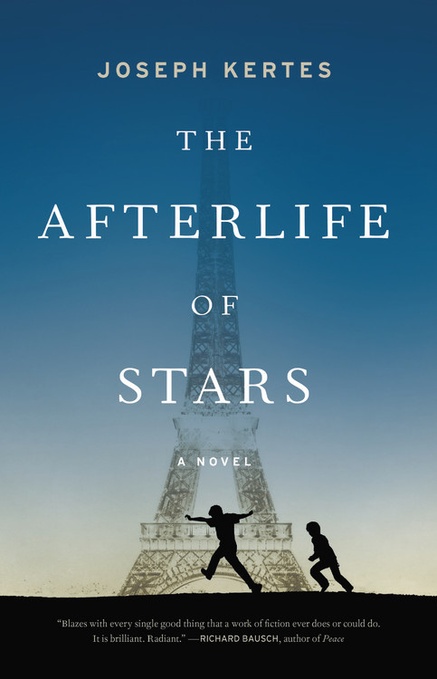
“Snow, Heavy at Times”: Joseph Kertes’s The Afterlife of Stars

Three years after its first Canadian publication, Joseph Kertes’s The Afterlife of Stars has appeared in the US. Was it worth the wait? I’m honestly not sure. Although I read it quickly, even avidly, I have mixed feelings. Sometimes it’s terrific. But sometimes it’s unconvincing and clunky.

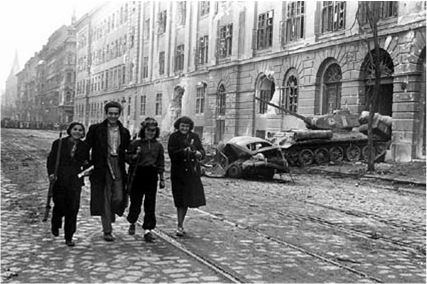
The novel begins in Budapest. The narrator, Robert Beck, turns 9.8 years old, as he puts it, on October 24, 1956. But that’s hardly the most important news of the day: the city is in upheaval. Students protesting the Communist government have been fired upon by the secret police; it won’t be long before Soviet tanks would be in the streets. The Becks—who we learn survived the last war in dramatic fashion—don’t wait to see how things turn out. Any hesitation they might have had about leaving is erased when Soviet officials arrive to requisition their apartment. They manage to get on one of the last trains leaving Budapest and walk across the border to Austria, where they are welcomed, if not with open arms, then at least with food and shelter. Robert and his older brother, Attila, treat it all as a bit of an adventure. But their father, in particular, wants nothing more to do with Europe. He arranges passage first to Paris, where his wife’s sister, a former opera star, lives in comfort, and then eventually to a new life in Canada.

43eff0030b7e4b9519dbab174c7b9475

As befits his name, Attila is a firebrand, equal parts annoying and entertaining, though I found him more the first than the second. The thirteen-year-old Attila knows more than Robert, though mostly what he knows is how, in the self-satisfied yet probing way of teenagers, to ask irritating questions, demanding to know everything from why sperm, so important, so exciting, so able “to make babies, humans, soldiers, beauties, love, courage, heroism” should be such a “drab pearly cream color” to why, if heaven is so wonderful, God and the angels should spend so much time looking down at the world.

Attila is a bit larger-than-life, supercilious, world weary before his time, mostly desperately uncertain. Robert is kinder, gentler, young and a bit naïve. Kertes chooses to narrate from within events: the older isn’t looking back on the events of his past and considering them with the knowledge of hindsight. This means the book eschews exposition: it helps to know something about the Hungarian Revolution. But it’s impressive how clearly we can follow what’s going on. We don’t need to know the full complexity of the crisis. We just need to know that this family, which has been persecuted before and barely survived, is determined to avoid getting into the same situation. The Becks, we gradually learn, are Jewish. And we see how much they have to fear when, on the bus to Paris, an older man spews anti-Semitic invective that leads to a fight.

Even before that Kertes has made clear how dangerous the situation in Hungary has become. Robert and Attila slip out of the apartment where the grownups are frantically packing and slink through the suddenly dangerous streets of Budapest. We feel the menace all the more because Robert isn’t really sure exactly what’s happening. The boys hoist themselves up onto the plinth of a toppled statue of Stalin and burrow into the shoes that are the only part left standing. They narrowly avoid being shot at. Minutes later, they get caught up in a group of protesters and again they are fired on. They duck into a side street and come across a movie theater. A man is standing calmly outside it:

He was dressed in a brown gabardine suit and wore a matching brown fedora. He was lighting a cigarette, turning away from the wind that brought us. … We caught up to the man just as he exhaled his first full puff of smoke, and a shot sounded, taking off his hat. For a stark and childish moment, I tried, in my own mind, to trace the path of the bullet through the man’s head as it knocked over everything in his path: his day, his night, his next puff of smoke, his dinner plate of veal paprkas, his smiling daughter holding up a glass to the light to see if it was cracked, his wife entering the dining room with the wine, wiping a damp hand on her apron.

This is just the sort of thing I meant when I said I didn’t know how to take the book. I’m not buying the last part of this passage. The childish tracing of the bullet through the man and his life, okay, fine, but that the boy would imagine the man’s daughter and his wife, I don’t buy it. Maybe this contradicts what I said before—maybe this is retrospective narration, though it isn’t cued as such. I think it’s just a bit of a slip, a sentimental litany of the small things in life that undoes what’s best about the passage, namely, how suddenly the man dies.

At first I thought this scene was going to be played for laughs, the way the scene with Stalin’s statue mostly is: it would be fitting to place the sort of gag that might appear in silent film—man lights cigarette, bullet takes his hat, man continues to smoke calmly—in front of a movie theater. But as we soon learn it’s the man’s head not his hat that’s shot. The boys speed into the theater, through “white doors now spattered with blood.” They stay for a Tarzan movie, not sure what else to do, part terrified and part interested in the show.

00bb5dcd2f3900f102d55262df4ec4fb

The Budapest scenes use this unstable tone to mimic the utter uncertainty of the situation. But the scenes in Paris work less well. Without the chaos of the revolution it’s hard to understand why the text veers from jaunty to somber, from laughs to horrors.

There are horrors in Paris, but they turn out to be in the past, specifically in the wartime experiences of the elder members of the Beck family (Robert wasn’t yet born, Attila was only a baby). Behind their aunt’s house, the brothers find a trunk filled with letters that explain how the boy’s uncle Paul, who worked for Raoul Wallenberg, saved the Becks from deportation, managing in the most dramatic and implausible way (though admittedly this was a time when implausible things happened regularly) to get them off the train that was taking them to the camps in the East. Wallenberg is the Swedish diplomat who in 1944 saved thousands of Jews by issuing certificates of protection; he disappeared late in the war under mysterious circumstances—he was last seen with Soviet officials in January 1945 who is thought took him back to Moscow.  More than likely he was executed at K G.B. headquarters.

Wallenberg is only a peripheral figure in the novel, and I’m really not sure what he’s doing in it. I’m similarly unsure what the book wants to say about the relation of the past to the present. The brothers’ investigation into the family’s past has none of the lightness and menace of the descriptions of the escape from Hungary. Instead it feels lumbering and clunky. It’s implausible how easily the boys find out what their elders have steadfastly refused to tell them, though I suppose it’s possible the novel could, through the ease of the way the past comes to light, be satirizing the very idea that traumatic memories can be understood.

But notwithstanding its title, which intimates that the past does indeed linger into and even distort or contaminate the present, The Afterlife of Stars fails to convince that it’s as in control of its depiction as that reading would require.

That lack of control is most evident in a scene towards the end of the book when the boys, implausibly on the trail of the Nazi who tortured their aunt, and in thrall to the Paris that they only know from Les Miserables, make their way through the sewers of Paris. The main function of the scene seems to be allows Kertes to offer an extensive description of the filth of Paris:

We had to pause to admire the dark river glubbing by, this wonder of the world. Lights down below lit up everything the city had expelled from the land above: leftover cabbage soup, even digested cabbage soup, fingernails and toenails, and earring, the nightly bathwater, a razor blade with a bit of face still stuck to it, cigar butts, the flow of a bad stomach, the flow of a good one, a gold wedding band, bones, knives, guns, vomit, dead goldfish, live mollies, hairs—blond, brunette, gray, auburn, true black, dyed black, dyed blond, dyed red—hairs by the millions and trillions, short hairs, long ones, curly ones, eyelashes….

The passage continues for almost another page. I do like that “glubbing,” though.

We could read this as a metaphor for repression—for all the things no one wants to acknowledge about the traumas of the past. And indeed the razor blade “with a bit of face still stuck to it” recalls the man shot outside the Budapest theatre. But my sense is that the text is interested in this underground world for its own sake. It seems to share the boys’ wonder at the place they’ve found their way into. Kertes likes lists, they seem to stand for him for an idea about the world’s plenitude—is the fulsomeness of these descriptions supposed to console his characters for their many losses?

These questions lead me back to the question of the book’s tone. Is it supposed to be a boys’ own adventure? Or a depiction of 20th century horrors? I guess it could be both: there’s nothing necessarily wrong with a book that’s hard to pin down. And certainly the adventure ends soon enough, with grave consequences for the Beck family. (At first I thought this was an accomplished YA novel, but although its style is straightforward and its protagonists young it’s awfully dark, even by the standards of today’s grim and apocalyptic YA fiction.)

But the book’s inability to choose a note and sustain it ultimately seems to me more a failure of execution than a commentary on the world the Beck brothers are forced to navigate.


23-1-formozov-1

My favourite passage—another list—is the only clearly retrospective one in the novel. It comes right at the end, when Robert, on board the ship to Canada, meets a boy who is eager to play his shortwave radio for him. Robert doesn’t understand what he’s listening to. The other boy, who has some English, explains:

“The man is saying snow—there’s lots of snow falling. It’s a weather forecast, and he’s naming the Ontario counties and towns. An early blast of winter—in November!”

“Snow,” I repeated, my new English word.

We listened. The radio man’s voice sounded soft and calm. I did not know the names then, but I have heard them many times since, lying alone in my room, listening to the feathery snow tick against the window as I wait for sleep: Essex, Kent, Lambton, Elgin, Middlesex: snow, high of twelve. Huron, Perth, Grey, Bruce, Waterloo, Wellington, Oxford, Brant: snow, heavy at times, high of eight. York, Durham, Bellville, Quinte, Northumberland: snow, mixed with freezing rain. Peterborough and the Kawarthas, Parry Sound, Muskoka: heavy snow, whiteout conditions through the night, and bitterly cold, high of minus twenty-two. Algonquin, Renfrew, Pembrooke, Barry’s Bay, periods of snow, clearning in the morning, high of eight. Ottawa, Prescott, Russell, Cornwall, Morrisburg: light snow, but very cold, high of minus seven. Wawa, the Sault, Cocrane, Timmins, Lake of the Woods: whiteout conditions, high of minus twenty.

It sounded as if the gentle radio announcer were calling each of his children to bed, by name, one by one.

I’m all over this passage. It feeds my homesickness and nostalgia; it promises to support my need to believe that Canada really is as good a place as it thinks it is. At a time when my adopted country wants to turn away those in need and repudiate the generosity that is its best characteristic, it’s nice to be reminded that my native land has been—and still is, though I worry for how much longer—a place welcoming to others.

It would be false and indeed stupid to think that Canada is a perfect place, a place with no problems other than the weather, but coming at the end of this novel, the weather forecast is indeed a kind of lullaby. No matter how bitter the cold or fearsome the whiteouts, this scenario feels like a relief after the events the Beck family has been through.

My pleasure in this passage was dimmed only by the references to Fahrenheit temperatures. Surely this was changed from the Canadian edition. Although I suppose it matters when the “many times since” of this passage is supposed to be. If it’s in the years shortly after Robert’s arrival in Canada—that is, if he’s still supposed to be a boy—then I guess it would make sense, since no one used Celsius before 1975. If it’s supposed to be much later, closer to our present time, if the narrator is now an old man, then it wouldn’t.

Anyway, that quibble doesn’t dim the book’s ending for me. Although I wasn’t totally sold on The Afterlife of Stars I liked it enough to get Kertes’s first novel, Gratitude, form the library. It’s about the Beck family’s wartime experiences, and I’m curious how the new book does or doesn’t complement it. Has anyone read it?


Holocaust Lit 2016 Week 10: Art Spiegelman’s Maus

In Holocaust Lit, we’ve devoted the past week and a bit to Art Spiegelman’s comic Maus. For me, Maus is one of the essential books of the 20th Century. There is no praise too high for it. Getting to meet Spiegelman a few years ago was a highlight of my life.

I’ve taught Maus so many times, in so many different contexts, that I no longer need to read it. (Even after almost 20 years of teaching, I can only say this of a handful of texts.) Yet I still look through it each day before class. Looking up a specific moment, I’ll find myself having read 20 pages without even knowing it, it’s that wonderful. But it’s quite nice to know a text that well, not least because it makes the day-to-day life of my semester a lot more manageable.

For those who aren’t familiar with it, Maus tells the story of Spiegelman’s father, Vladek. We learn of his experiences as a young businessman in pre-war Poland, his marriage to Spiegelman’s mother, Anja Zylberberg, and the devastation wrecked upon their lives by the war. When the Nazis invade Poland, Vladek and Anja go into hiding, after sending their young child Richieu to spend the war with a relative.

The boy doesn’t survive but, amazingly, both Vladek and Anja do, after having been betrayed in 1944 by smugglers who pretended they would get them to Hungary and then deported first to Auschwitz and then later, separately, to various other camps. Reunited in Poland after the war, the couple are able to get to Sweden and then eventually to the US, where Anja has a brother and sister-in-law who had been visiting the New York World’s Fair when the war broke out. Anja commits suicide in 1968, shortly after her brother’s death in a car accident, and after Art himself has suffered a nervous breakdown. Much of the text details Art’s efforts in the late 1970s and early 80s to learn more about his father’s wartime experiences.

The books—Maus is published in two volumes—thus range between the past (1930s & 40s) and the present (1970s & 80s). They are as much about the way Art gets his father’s story as they are about that story itself. And indeed over the course of its pages Maus becomes ever more aware of this process. The sophistication of its textual layering and its interest in the mediated quality of storytelling make this a crucial text for any class on Holocaust Literature.

The most immediately striking expression of that mediation is the book’s governing conceit: Jews are drawn as mice, Germans as cats, Poles as pigs, and other nationalities and groups as various other animals. Actually, this isn’t quite true: characters are drawn as people with animal heads, leading to much speculation about Spiegelman’s reclaiming Nazi portrayals of Jews as vermin and playing with the ban on visual representation in Jewish tradition.

Because Maus is so rich—and because students like it so much—I spend a lot of time on it. In the past I’ve devoted as many as six 50-minute classes to it. Over time I’ve settled on four as the optimal number. Here’s how I divided up the classes this year:

Day 1: Close reading of the opening two pages of volume 1, a story from Spiegelman’s childhood in which ten-year old Artie, having been left behind by his friends, seeks comfort from his father, who disproportionately and devastatingly replies, “Friends? Your friends? If you lock them together in a room with no food for a week… Then you could see what it is, friends!”

We spent a lot of time not only identifying and clarifying the relationships between past and present and the way that this relationship complicates our sense of what it means to survive and who even counts as having survived (we can read Artie, too, as a survivor, and we already see in this opening scene how our deeply-held but ultimately falsely pious and in fact pernicious belief that survivors must have been ennobled by their experience will be challenged). We also considered the grammar of comics, exploring the relationship of words and images that are crucial to the genre, learning about formal terms like panels and gutters (the white areas between panels that are the way comics express time).

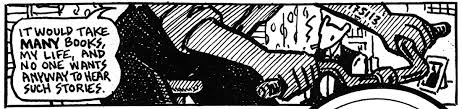
Day 2: We continued the formalist discussion of the first class by looking at Spieglman’s careful combining of words and images. We look at an early panel in which Artie, first suggesting to his father that he tell him his story, is framed, enclosed, perhaps even imprisoned between his father’s arms, the Auschwitz tattoo clearly visible on one, as Vladek dutifully follows his doctor’s orders to get some exercise by riding an exercise bike.

images-8

The care with which individual panels are constructed—Spigeleman once said in an interview that the main thing he learned from his father was how to pack a suitcase: his panels are similarly jammed with information—is mirrored by the attention to arranging those panels. Noting how important the page is as a way of structuring the book’s material, I had us compare two pages that are similarly composed, one showing Vladek and Anja on their way to a spa in Czechoslovakia in 1938, where they first see evidence of Nazi rule, and the other showing their arrival by van at the gates of Auschwitz.

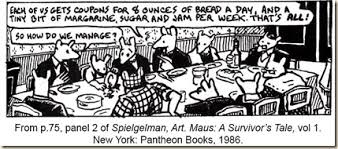
We considered Spiegelman’s style of representing and made a continuum ranging from realism to expressionism. As an example of the latter, we looked at a panel showing Vladek and Anja on the run, having been driven from yet another hiding place, running along a pathway whose branches form a swastika. Finally, we looked at a two-page spread halfway though the first volume where an almost subliminal story is told in the images that ends up reinforcing the one discussed in the narration and dialogue (Vladek is describing how food began to grow scarce in occupied Poland and how heavily the wealthy Zylberbergs had to rely on the black market; in the images, of a large family dinner that attempts to recreate pre-war life, Richieu overturns his bowl and is first punished and then consoled by various family members).

images-9

Day 3: Now, having read both volumes, we were ready to tackle the animal conceit, working through why Spiegelman chose to represent the different groups in the way he did. I asked the students to consider the limitations or questionable implications of the metaphor—if Germans are cats and Jews are mice does that mean it’s natural for Germans to hate Jews? But cats don’t’ hate mice: they just eat them. Is Spiegelman suggesting the Germans weren’t really responsible for their actions? Eventually I had them consider the subjective quality of the metaphor, that is, the idea that this is Vladek’s perspective, and not some objective claim about the merits or foibles of different groups of people. In the process I had us track how the metaphor changes as the book goes on. Tellingly volume 2 starts with Artie wondering how he should draw his wife, Francoise. As a frog, because she’s French? As a mouse, because she converted to Judaism? Does Speigelman’s conceit work with non-esentialist or fluid/hybrid notions of identity? After all, we do eventually see a mixed German-Jewish couple whose children are striped tabby mice.

More significantly, we see Spiegelman switch from animal heads to animal masks as he includes in his story the experience of making of the text. Earlier, he had used masks when characters tried to pass as something other than themselves (as Vladek does in the streets of occupied Poland, for example). But in a key section entitled “Time Flies” Spiegelman describes his creative block after the success of volume 1 and the death of his father. Here he and the other characters are clearly humans wearing what are clearly visible as animal masks. Referencing the work of the scholar Erin McGlothlin, I explained that our initial distinction between past and present needs to be complicated by the addition of what Spiegelman himself has called “the super-present,” a time even more recent, more present, than what has passed as the present so far in the narrative. In this way, the animal metaphor is ironized and destabilized, made to seem the relics of a past way of thinking about identity—though, tellingly, they are not abandoned altogether. After all, in Maus the past never lets go.

Day 4: I told the class I had three topics I wanted us to consider: (1) gender, especially the text’s presentation of women; (2) photographs; and (3) the last page of volume 2 and the idea of endings more generally.

I started by referring to a line quoted by the brilliant scholar Sara Horowitz in an influential essay on gender and Holocaust literature. Artie asks his father what his mother experienced when they were separated from each other upon arriving at Auschwitz. Vladek, anxious to keep Artie from finding out that he has burned Anja’s diaries after her death, tells Artie: “I can tell you… She went through the same what me: Terrible.” As Horowitz notes, Vladek here speaks for a larger tendency in Holocaust studies to efface gender or other indications of subjectivity in the victims. If the Nazis didn’t discriminate among their victims then why should we?

Yet men and women didn’t experience the Holocaust the same way, and the absence of Anja is a specter that haunts the book from its first pages. (I reminded the class that the first thing Artie says to his father when he asks him to tell his story is: “Start with Mom… tell me how you met.”) I had the class tell me what Anja was like. We soon concluded her character is quite complex. She is both mentally and physically frail, relying on Vladek to jolly, even bully her into health. Yet she is also strong: highly intelligent, beloved by her teachers, and politically active in ways that might surprise us given her family’s wealth. Vladek explains how he discovered shortly after their marriage that Anja had for some time been translating secret documents into German for a Communist group, a clandestine and illegal activity that she narrowly escaped being arrested for. Vladek was livid when he found out—“I always kept far away from Communist people”—and made his wife an ultimatum: “I told her ‘Anja, if you want me you have to go my way’… And she was a good girl, and of course she stopped all such things.”

Who knows how Anja felt about this and whether she really did give them up or whether the war intervened. The point, I suggested, is that Vladek seeks to make her life conform to his, just as he does retrospectively when he tells Artie that her experiences at Auschwitz were the same as is. Thus when Vladek later paints Anja as a saint, as the only woman of his life, we don’t quite believe him. Maybe his depiction of how much she relied on him is just another instance of his seemingly insatiable need to be in control, to be the consummate fixer, a trait that saved his life on more than one occasion in the camps.

Seeing how important it is for Vladek to control his portrayal of Anja, we might wonder if Artie does something similar. Yes, he arraigns his father as his mother’s murderer when he finds out what happened to the diaries, and he presents her as a softening influence on Vladek’s brutalizing parenting (she would let him get leave the table without finishing all of his food, as Vladek would insist). But earlier, in the wake of her suicide, he describes her as needy and smothering, in fact, as having murdered him.

Note, I added, how similar ambivalence characterizes the book’s portrayal of its other main female character, Mala, Valdek’s long-suffering second wife, herself a survivor. Mostly we see her berated and belittled by Vladek and it’s hard to know what keeps them together. Is it really, as Vladek repeats over and over, that she wants his money? Mala seems particularly hard done by in the book, and not just by Vladek. I pointed to a scene in which Artie, leaving his father winded after another long session on the exercise bike, comes across Mala in the kitchen. He mentions the round up in Sosnowiecz that Vladek has just been telling him about. Mala, who had experienced it as well, begins to tell the story of her family, including what sounds like an extraordinary feat of her own, in which she managed to smuggle her mother out of the ghetto. Artie doesn’t engage in any way with this fragment of what must be a remarkable tale. He jumps up to leave, having just remembered somewhere else where he might continue his vain search for Anja’s missing diaries.

I think this response is really surprising given how much Artie and Mala have in common. For example, both pale in Vladek’s affections in comparison to their dead precursors (Anja for Mala and Richieu for Artie), but this secondariness never amounts to any kind of solidarity or affection between them, at least not on Artie’s part. To recognize Mala might have required Artie to recognize the strange way in which he and his father attempt to control and even efface women by subordinating them to their various quests. After all, in their own ways, Artie and Vladek are equally controlling.

We could have kept talking about the text’s portrayal of gender for much longer, but I wanted to move us along and so was glad that someone mentioned the photo of Spiegelman and his mother, a holiday snap from 1958, that Spiegelman includes in volume I. I took the opportunity to segue to the topic of photographs, both actual and imagined. How many real photographs are reproduced in the book, I asked. Three. Who are they of? One’s of Artie and his mother, one’s of Vladek, and one’s of Richieu. Why are these photos included? It’s the family, someone replied. Yes, though a family photograph, that is, of all of them together, is naturally impossible. So the book performs a double movement: it reunites the family but in so doing only reminds us of the family’s fragmentation.

But why include the photos? Why reproduce them in the text? I got the predictable responses: photos are more realistic, they remind us that the events really happened, they show us what the people really looked like and remind us that they are people and not just mice. But were we ever in doubt of that? Don’t we identify with these figures so strongly, whether animals or humans or something in between? Why do we need to be reminded that these figures are really people? And why are we so convinced by the authenticity of photos? In this age of photoshop and snapchat and instagram, how can we forget how open to manipulation photos are?

Think of it this way, I said. What’s the photo with Vladek of? He’s posing in a concentration camp uniform that he found in a photo shop after the war, on his way home to Poland. Right: it’s the craziest photo—we don’t know why the photographer would have something like that and why anybody, not least someone like Vladek, would ever want to pose with it. So here the text challenges our beliefs in authenticity. The sign that Vladek was in the camps is a photo taken of him after the camps.

Besides, I added, we still haven’t figured out why Spigelman would include the photos rather than draw them. After all, he does that more than once. I quickly referenced a couple of examples from earlier in the book and then had us look at a sequence near the end of volume II in which Vladek brings out a box of old family photos for Artie to look through. The photos are mostly of Anja’s family, almost all of whom were murdered by the Nazis: “Anja’s parents, the grandparents, her big sister Tosha, little Bibi and our Richieu… All what is left, it’s the photos,” Vladek concludes, adding, when Artie asks about his own side of the family, “So only my little brother, Pinek, came out from the war alive… from the rest of the family, it’s nothing left, not even a snapshot.”

maus_p275

Why, I asked the class, would Spiegelman choose to draw these images, which are presumably based on real, extant photographs, rather than using the photos themselves? This was a real question. I’ve never been able to come to an answer about this question that satisfies me.

One student ventured that these people didn’t survive the war, thus they were consigned to the past, which Spiegelman indicated by drawings rather than photos. This was a nice theory, but as others quickly pointed out, not one that held up. After all, some of these people, like Vladek’s brother Pinek, who was hidden by peasants before making his way to Palestine, did survive. And others died in ways other than at the hands of the Nazis, like Anja’s brother Herman, hit by a car in Norristown, PA, or her brother Josef, a commercial artist who killed himself after an unhappy love affair.

We had reached a dead end in our conversation and I had no idea how to move us past it to consider the end of the book. There were ten minutes left in class: we had both too much and too little time. But then a student, one whose points are usually a little too obvious, saved the day by pointing out that the image of the pile of photos, seemingly having floated down from the sofa where Vladek and Artie are studying them and arrayed in great despairing drifts, went all the way to the edge of the page. We’d looked at some similar instances earlier in the week, and I’d suggested a connection between these images and the subtitle of Volume I: My Father Bleeds History. The images that couldn’t be constrained by a border—that bled to the edge of the page—suggested themselves as especially significant inasmuch as they pointed to the uncontainable nature of history, the inability of the past to stay safely in the past.

And then something really great happened. A pretty quiet student, smart but not always able to express himself clearly, said: It doesn’t matter when these people died or even if they are still alive. They are still victims of the war, of the things that happened during that Holocaust. That’s why the picture goes to the edge of the page. The war doesn’t stop.

I thought this was brilliant and I seized on it as a life raft. Exactly! I cried, repeating the student’s point so that others would be sure to have heard it. The war doesn’t stop. That’s exactly what we see happening on the last page. At this point we only had 5 minutes left and I often spend 20 minutes talking students through that last page. So all I could do was tell them what I most wanted to say about this ending.

maus2-p-136-last-page

As Spiegelman himself has pointed out, the end just keeps on ending. First we have Vladek’s description of his dramatic reunion with Anja, which, as we considered in our earlier discussion of his relation to women, we know to be self-serving and false: “More I don’t need to tell you. We were both very happy, and lived happy, happy ever after.” The repetition of “happy” belies the true state of affairs, which is that much unhappiness followed them after the war: Vladek’s reluctant move to the US (he wanted to stay in Sweden), Anja’s depression and eventual suicide, the estrangement between father and son; Vladek’s increasing ill health. I noted that the circle against which the couple embrace might remind us of the circle in the movie poster in Volume I of Rudolph Valentino, who the young Vladek was said to resemble. It might also remind us of the spotlight cast on the young couple as they dance at the spa in Czechoslovakia in the last happy days before the war. It might even remind us of the wheel of the exercise bicycle from which Vladek tells much of his story. The circle is a sign of futility and circularity as much as perfection, and, in its connection to image-making and Hollywood stars, it intimates the fabricated nature of Vladek’s conclusion.

This ending is immediately followed by another: Vladek’s wish to stop speaking, to stop creating the story. His fading powers, even the death that we know is not far off, is suggested by his confusion between his sons: “I’m tired from talking, Richieu, and it’s enough stories for now…” he tells Artie. Right below this row, even forcing its way into it, is yet another ending, an image of Vladek and Anja’s gravestone. The fact that the book ends three times, as it were, suggests that it can have no definitive end, an idea further supported by the image of the eternal flame on the gravestone. And what about Spiegelman’s own signature below that? The dates that accompany it are of course the dates of the creation of the work, but it’s hard not to think of them as the dates of his own life. After all, one of these endings includes his own erasure and replacement by the sibling he never knew, the one he had a weird ghostly rivalry with, as he tells Francoise at the beginning of Volume II.

Thus we ended this class much as we began the first one more than a week earlier, with an assertion of the ongoingness of events, the persistence of the past into the present. But our understanding of that claim was a lot more complex now than it had been then. I was really pleased with the work we’d done. In fact I continue to be amazed by this class. They’re still bringing it every single day. Usually, this late in the semester the conversation is being carried by a core group of actively engaged students while the rest follow limply along. But in this group almost everyone still talks every class period.

I really think they are the best group I’ve ever taught. I’m trying to enjoy every minute.

If you want to catch up you can read earlier posts about the course here, here, and here.

Holocaust Literature Week 2: Vasily Grossman’s “The Hell of Treblinka”

This semester I’m blogging about my class on Holocaust literature. Here is the first installment.

Vasily Grossman (1905-64), who we studied at the beginning of Week 2 of the course, is not nearly as well known in the canon of Holocaust literature as someone like last week’s author, Primo Levi (or some of the other writers we’ll study this semester, like Elie Wiesel and Tadeusz Borowski).

I can think of at least two reasons why. First, the reception of Holocaust literature in North America has been biased towards texts written in Western European languages. At least in part, this preference was a function of the inaccessibility of documents and archival material in Soviet-occupied Europe during the Cold War. Second, Grossman was not a survivor, per se, though his mother was murdered by the Nazis along with more than 20,000 other Jews in the family’s hometown of Berdichev in the Ukraine.

Grossman was born to an assimilated Jewish family. He did not have a Jewish education. It is unlikely he knew Yiddish. Berdichev, an important banking center, had one of Europe’s largest Jewish communities in the late 19th and early 20th centuries. This was a prosperous, cosmopolitan world quite unlike the shtetl world made famous in Sholem Aleichem’s work and depicted in the early parts of Wiesel’s Night.

Grossman studied to be an engineer, but turned to writing in the 1930s. When Hitler invaded the Soviet Union in the summer of 1941, Grossman was assigned to the Red Army newspaper. He became one of the most famous Soviet war correspondents, taking on many dangerous assignments, including a posting in Stalingrad. He accompanied the Red Army on its march westwards, where he reported on what has been called “the Shoah by bullets” (the death meted out by the Einsatzgruppen—mobile units or death squads—across Eastern Europe, especially the Ukraine. These firing squads murdered approximately tow million people in the years 1941-44, 1.3 million of them Jews, among them Grossman’s mother). Later, in 1944, he also reported on “the Shoah by gas.” He was with the Red Army when it arrived at the extermination camp Treblinka in August 1944.

Immediately he set about writing an essay called “The Hell of Treblinka.” Published in November 1944, it is one of the earliest accounts of the death camps. After the war, it was submitted as evidence by the prosecution during the Nuremberg trials. This extraordinary work is readily available—translated by Robert and Elizabeth Chandler together with Olga Mukovnikova—in an invaluable collection of Grossman’s essays, stories, and journalism called The Road (New York Review Books).

pic_related_091314_sm_-vasily-grossman

I began by asking the class to recall the question I’d given them at the end of the previous meeting as a way to guide their reading: What does Grossman value?

Hands shot up. I was relieved to see it, since, on the face of it at least, this is an easy question. Grossman is a passionate writer, not shy to render judgment and lay blame. And since that is what students want to do too, at least when it comes to the Holocaust, they take to him immediately. Of course, Grossman also gives us the tools to complicate what seem like straightforward categorizations.

Life, people, humanity, came the answers. Each student who spoke—and I reminded students that if they hadn’t yet said anything in class this was absolutely the day to chime in because soon, maybe already by the next class, their identity would be sealed: they would be a person who doesn’t talk in class—had to point to a specific passage to support their claim. “The most precious valuable in the world—human life.” “The epitaph history will write for [the victim] is: Here Lies a Human Being.” “Killing turned out to be supremely easy… This must be unflinchingly borne in mind by everyone who truly values honor, freedom, and the life of all nations, the life of humanity.”

These were all good examples. I pointed to another quintessentially Grossman-ian formulation: the victims, he says,

were caught up in a single flood, a flood that swallowed up reason, and splendid human science, and maidenly love, and childish wonder, and the coughing of the old, and the human heart.

The list of attributes and qualities here is typical; Grossman loves lists. (At one point in the essay he simply names, for almost ten lines, the belongings the new arrivals would have left scattered on the ground, commenting only, tartly, “It requires real skill to sort out, in the course of only a few minutes, all these thousands of objects.”) This particular list is a strange one. Ranging from physiology (the coughing) to emotion (love and wonder) to human accomplishment (reason and science), it seems to want to encompass everything that might go under the name the human condition in a single sentence.

Grossman absolutely believes in the idea of the human condition. This emphasis on common humanity is at least in part a political and ideological choice. In the course of this forty page essay, Grossman only mentions once that most of the victims were Jewish. That decision is a function of the Soviet insistence that only the suffering of Mother Russia rather than any individual group of people be commemorated. Grossman’s insistence on a kind of universal brotherhood of mankind is also evident in his insistence that the victims looked out for each other. Solidarity of this sort did exist in the camps, but so too did its opposite. Many of the course texts, I noted, will offer a quite different view of affairs.

Grossman was no doctrinaire Marxist—in the essay he even obliquely criticizes Stalinism; after the war he fell into disfavour and his great masterpieces Life and Fate and Everything Flows were written “for the desk drawer” and only survived because they were smuggled to the West in the Krushchev period. But he also insists in classic Marxist fashion that “what engenders a particular regime is the material and ideological relations existing among a country’s citizens… the nature of these relations is what should appall us.”

Yet Grossman never interprets Nazi Germany this way. Instead, as the students noted, he regularly describes them as demonic monsters, purveyors of “bestial madness.” They are refused any redeeming qualities; indeed, they aren’t even human: “The beast that triumphantly kills a man remains a beast.” What, I asked the class, is the effect of Grossman’s rhetoric? What is implied by this way of thinking and talking? (To offer compelling interpretations, students need to be able to draw out the implications of their observations, so I wanted them to practice drawing out the consequences of their ideas.) It’s like they’re not real people, someone said. Exactly, I responded. And why does that matter? Well, they were people, said another. Yes, I added, people like us.

It’s easy for us to imagine that these events have nothing to do with us. It allows us to approach the Holocaust as a kind of macabre spectator sport. But if we treat the Nazis as monsters, we effectively let ourselves off the hook. We don’t need to think of ourselves as in any way implicated in their way of viewing the world. In this way, Grossman risks devaluing the idea of humanity he values so much. In an oblique way, this risk is evident too in his treatment of what the historian Raul Hilberg would later call bystanders, in this case the local Poles who Grossman uses as mere neutral evidence for German actions. He doesn’t’ consider more complicated questions of implication or degrees of guilt, concepts that someone like Primo Levi would develop in his essay “The Grey Zone,” which we’ll read in a week or so.

35274

Whenever I teach “The Hell of Treblinka,” I work towards a close reading of a single passage. This time, I left it too late and we didn’t have the time to really do justice to it. But that’s okay. The work the class did in pointing to specific passages to support each claim, although time-consuming, was worth it. I want students to see that they can’t just go with their gut, can’t just offer a vague sense of what the text is saying (which often amounts to what they wish it were saying). They have to work with what’s there. Only then will their readings convince.

At any rate, here’s the passage that to my mind gets to the heart of Grossman’s enterprise. Having described the chaos new victims would have experienced on arrival—separated from loved ones and possessions, shaved and otherwise physically humiliated, herded along a path lined by high fences towards an imposing brick building—Grossman explains what would have happened next:

The door of the concrete chamber slammed shut […] Can we find within us the strength to imagine what the people in these chambers felt, what they experienced during their last minutes of life? All we know is that they cannot speak now… Covered by a last clammy mortal sweat, packed so tight that their bones cracked and their crushed rib cages were barely able to breathe, they stood pressed against one another; they stood as if they were a single human being. Someone, perhaps some wise old man, makes the effort to say, “Patience now—this is the end.” Someone shouts out some terrible curse. A holy curse—surely this curse must be fulfilled? With a superhuman effort a mother tries to make a little more space for her child: may her child’s dying breaths be eased, however infinitesimally, by a last act of maternal care. A young woman, her tongue going numb, asks, “Why am I being suffocated? Why can’t I love and have children?” Heads spin. Throats choke. What are the pictures now passing before people’s glassy dying eyes? Pictures of childhood? Of the happy days of peace? Of the last terrible journey? OF the mocking face of the SS man in that first square by the station: “Ah, so that’s why he was laughing…” Consciousness dims. It is the moment of the last agony… No, what happened in that chamber cannot be imagined. The dead bodies stand there, gradually turning cold. (Ellipses in original unless bracketed)

Here Grossman imagines the ground zero of the Holocaust, the centre of what the French political prisoner David Rousset, a survivor of Neuengamme and Buchenwald, called l’univers concentrationnaire. He takes us into the gas chamber. What happened there? Historians and forensic researchers can tell us a lot: we know that people were so desperate to escape that they clawed at the walls. We know from the evidence of the piles of corpses that those who were bigger and stronger climbed over those who were smaller and weaker to get the last bit of air. But the desire to enter into that scene—to turn it into a scene—is both taboo and inescapable in Holocaust literature.

Remember this passage, I told the students, when we read Maus: we’ll see how self-consciously Spiegelman points to the limits of eyewitness testimony. Remember this scene when we watch Schindler’s List: we’ll see how dubiously Spielberg flirts with exploiting our dark compulsion to enter into this space.

For now, I want us to see that when Grossman wonders whether we can “find the strength to imagine what the people in these chambers felt” he is asking a real question. This vivid passage aims to make us feel present—we see that most clearly in its use of physical and corporeal details: the clammy sweat, cracked bones, and crushed rib cages.

It even imagines how people might have acted and thought in those final moments. What kind of actions are these, I asked the students. They’re kind actions, caring. An old man shouts “Patience,” a mother seeks to make space for her child. The people evoked are vulnerable: that old man, that woman with her child, the young woman who wants to live. There’s even the intimation of revenge and resistance—someone, the only person here who isn’t described in any way, shouts out “a holy curse,” which he or she, as well perhaps as Grossman himself, insists, which is to say, hopes, must be fulfilled. These aren’t just victims; they are also resisters, not least in their staunch avowal of basic human dignity. They resist by maintaining solidarity with each other: “they stood as if they were a single human being.” Here we have Grossman’s credo in a phrase.

With only a minute or two left, I asked the class to tell me what happens in the passage between the sentence starting “Covered by a last clammy mortal sweat” and the one starting “Someone, perhaps some wise old man.” A moment’s silence: the students were tired but still game. They hadn’t packed up their stuff yet. But they knew there was an answer I was looking for and it made them wary.

Look at the verbs, I prompted. They shift from past tense to present, someone said, half-hesitantly, half-triumphantly. Yes, I said, pointing out examples: someone makes an effort; a mother tries to make more room for her child; heads spin; throats choke. What’s the effect of this shift? It’s like replacing statistics with stories, one student said. Yes, but that doesn’t explain this particular choice on Grossman’s part. What does the shift to present tense suggest? It makes it more intense, another said. Normally, I would have payed out this suggestion further, getting the student to expand on what she meant by intensity. But I was in a hurry, so I finished the thought. Right, it makes the scene immediate, vivid. In a way, it undoes what happened in the chamber, bringing the dead to life.

And yet, I concluded, these attempts at immediacy fail. The dead don’t live. Even if the passage returns to present in the final sentence (suggesting an ongoing duration—these bodies are in some way still standing there) the penultimate sentence, like the rest of the essay, is in past tense. In that sense, the key statement here is: “No, what happened in the that chamber cannot be imagined.” We are left only with a statement of absence: “All we know is that they cannot speak now.” Grossman has tried to do that for them, but ultimately refuses the possibility.

Grossman’s passionate desire to do justice to the victims and his equally ardent disgust for the perpetrators is matched by his modesty and reserve. He speaks for them only inasmuch as he rejects that speaking.

We’re returning to Primo Levi next class, I said, as the clock showed two minutes past the hour and the next group of students milled around outside the room. Think about Grossman’s humanism as you read Survival in Auschwitz. Will Levi’s humanism look like Grossman’s?

Class dismissed.

Holocaust Lit Fall 2016: Week 1

Last fall I blogged about my Short Fiction class. (You can read the first entry here.) I couldn’t keep it up all semester, and there’s no reason to think this year will be any different. But I’m going to try again, this time with the course I have taught the most, and that means the most me: English 248, The Holocaust in Literature, Theory, and Film.

So far this group (18 students) has impressed me with its energy and intelligence. We’re only in the second week, of course. But the beginning has been promising.

Today I thought I’d share with you the text we worked through on the second day of class, a short excerpt from The Reawakening, one of Primo Levi’s extraordinary memoirs of his experiences during the war.

Levi, a secular Jew from Turin who had trained as a chemist, was arrested in the Italian Alps in December of 1943 where he had joined a small band of partisans in the nascent Italian Resistance movement. Once it was discovered that he was a Jew, Levi was deported first to a transit camp called Fossoli and then to Auschwitz in February 1944. Thanks to his scientific background, Levi avoided the gas chamber and was sent to work in a sub-camp of Auschwitz, called Buna-Monowitz, where the Germans were trying to synthesize rubber. Through good fortune and the care of a Gentile Italian prisoner, who slipped him extra food when he could, Levi survived the bitter depredations of camp life. He was lucky to have been in the camp infirmary when the Germans abandoned it in January 1945 shortly before the Red Army arrived. In this way he avoided being sent on one of the so-called Death Marches, in which the Germans force-marched the remaining prisoners to other camps in Germany proper. Thousands of the malnourished and weakened prisoners died that way.

Primo Levi in his studio, Turin, 1981

Primo Levi in his studio, Turin, 1981

The passage we worked through begins with a description of the change in camp life after liberation:

Outside the windows, despite the steady snowfall, the mournful roads of the camp were no longer deserted, but teemed with a brisk, confused and noisy ferment, which seemed to be an end in itself. Cheerful or wrathful calls, shouts and songs rang out till late at night. All the same, my attention, and that of my neighbours in the near-by beds, rarely managed to escape from the obsessive presence, the mortal power of affirmation of the smallest and most harmless among us, of the most innocent, of a child, of Hurbinek.

Hurbinek was a nobody, a child of death, a child of Auschwitz. He looked about three years old, no one knew anything of him, he could not speak and he had no name; that curious name, Hurbinek, had been given to him by us, perhaps by one of the women who had interpreted with those syllables one of the inarticulate sounds that the baby let out now and again. He was paralysed from the waist down, with atrophied legs, as thin as sticks; but his eyes, lost in his triangular and wasted face, flashed terribly alive, full of demand, assertion, of the will to break loose, to shatter the tomb of his dumbness. The speech he lacked, which no one had bothered to teach him, the need of speech charged his stare with explosive urgency; it was a stare both savage and human, even mature, a judgment, which none of us could support, so heavy was it with force and anguish.

None of us, that is, except Henek; he was in the bunk next to me, a robust and hearty Hungarian boy of fifteen. Henek spent half his day beside Hurbinek’s pallet. He was maternal rather than paternal; had our precarious coexistence lasted more than a month, it is extremely probably that Hurbinek would have learned to speak from Henek; certainly better than from the Polish girls who, too tender and too vain, inebriated him with caresses and kisses, but shunned intimacy with him.

Henek, on the other hand, calm and stubborn, sat beside the little sphinx, immune to the distressing power he emanated; he brought him food to eat, adjusted his blankets, cleaned him with skillful hands, without repugnance; and he spoke to him, in Hungarian naturally, in a slow and patient voice. After a week, Henek announced seriously, but without a trace of selfconsciousness, that Hurbinek ‘could say a word.’ What word? He did not know, a difficult word, not Hungarian: something like ‘mass-klo,” ‘mastiklo.” During the night we listened carefully: it was true, from Hurbinek’s corner there occasionally came a sound, a word. It was not, admittedly, always exactly the same word, but it was certainly an articulated word; or better, several slightly different articulated words, experimental variations on a theme, on a root, perhaps on a name.

Hurbinek continued in his stubborn experiments for as long as he lived. In the following days everybody listened to him in silence, anxious to understand, and among us there were speakers of all the languages of Europe; but Hurbinek’s word remained secret. No, it was certainly not a message, it was not a revelation; perhaps it was his name, if it had ever fallen to his lot to be given a name; perhaps (according to one of our hypotheses) it meant ‘to eat,” or ‘bread’; or perhaps ‘meat’ in Bohemian, as one of us who knew that language maintained.

Hurbinek, who was three years old and perhaps had been born in Auschwitz and had never seen a tree; Hurbinek, who had fought like a man, to the last breath, to gain his entry into the world of men, from which a bestial power had excluded him; Hurbinek, the nameless, whose tiny forearm—even his—bore the tattoo of Auschwitz; Hurbinek died in the first days of March 1945, free but not redeemed. Nothing remains of him: he bears witness through these words of mine.

What is it about Hurbinek, I asked the class, that so gets to Levi and the others? What is the source of “the distressing power he emanate[s]”? It’s that he can’t speak but he wants to, said one student. It’s his need for language, said another. It’s because he’s judging them, said a third. So already we see the power of language and expression, as something fiercely desired but perhaps unattainable. Note what doesn’t surprise or horrify them: that a toddler is here in Auschwitz. The chasm between our expectations and the victims’ experiences is immense—we will encounter this again and again in the course.

Does Hurbinek freak everyone in the camp out, I asked. Not Henek. What’s different about Henek? He cares for him. Does any one else? The Polish girls, one student noted. But what does Levi say about the Polish girls? They don’t really care for him, answered one. They fuss over him, but they don’t like him, said another. He’s like a mascot to them, one concluded. Like a puppy or something. Right, I agreed. Levi distinguishes between false and true intimacy. Something about Hurbinek’s lack of language keeps almost everyone at a distance. Note that he sleeps on a pallet, like an animal. He has his own corner. He’s separate. And yet he isn’t an object of disgust or scorn. He fascinates the others. They follow his efforts to wield language with something like avidity.

How old is Hurbinek, I asked, switching gears. Three, a couple of people said at once. He looks three, one immediately added. That’s when I really first started having hopes for this class. Most readers don’t notice that Levi does something strange here: he begins with uncertainty—“he looked about three”—but ends with conviction: “Hurbinek, who was three years old.” I think this redescription is important—it’s a version in miniature of the speaking by proxy that Levi, in an essay we’ll read in a couple of weeks, will describe as central to the survivor experience. The survivor always testifies to an experience that isn’t the “true” or “ultimate” experience of the camp, which of course was to murder everyone in it. For now I noted that Levi’s descriptions of Hurbinek are unstable. He calls him a baby at one point. But his stare is also called “mature.” In an especially resonant phrase, Levi calls him “the little sphinx.”

Why? And what’s a sphinx? A couple of students cobbled together an accurate enough description of the Theban sphinx. Does anyone know the riddle he posed to travelers? The one only Oedipus could solve? “What goes on four legs in the morning, two at noon, and three in the evening?” Right—and the answer of course is a person, a human being.

In some ways, Hurbinek, who is paralyzed from the waist down, doesn’t fit the terms of the riddle at all. In that sense, he could be taken to be some kind of non-human other. But it’s clear that Levi values Hurbinek, even if he’s a little afraid of him. The literature of the Holocaust, I argued, is regularly preoccupied by what it means to be human. It will be important for us to see both victims and perpetrators as humans—it is as bad to demonize the latter as it is to demean the former. If we do so, we might falsely be able to convince ourselves that the events we’re studying have nothing to do with us, as we are neither angelic martyrs nor inhuman monsters.

The reference to the sphinx also tells something about Levi and his values. What can we tell about him based on his use of the term? He’s smart, he’s well read. Yes, and in a tradition that isn’t only or primarily Jewish. (We’ll say a lot more about Levi’s classical, humanist upbringing when we read his most famous memoir, Survival in Auschwitz starting in the second week of class.)

IMG_0444


Time was getting short and there were still a number of things I wanted to get through. I hurried us along. Let’s go back to Henek for a second, I said. Notice that Levi uses the same word to describe him that he does to talk about Hurbinek. Henek is “calm and stubborn”; Hurbinek continues “in his stubborn experiments.” Repetition is always significant in interpreting literature, I told the class. When we see the same images, the same metaphors, the same formulations or sentence structures, the same words, we should take note. Patterns are suggestive and meaningful.

By using the same word in reference to each figure, Levi cements the connection between them. But why this word? What does it suggest to us that they are stubborn? I can’t remember how they responded to this question. Not particularly helpfully, as I recall. But I was also going for something here, and so the question wasn’t particularly useful. Stubborn suggests persistence, I said, it suggests working away at something difficult. Anyone who writes about the Holocaust—and by extension anyone who reads about it—has to be stubborn. In fact, “stubborn experiments” could be a name for Holocaust literature itself, which is dogged in its attempt to describe what has been called indescribable. Holocaust literature is necessarily experimental literature. But the persistence connoted by the word “stubborn” promises attainment or completion or at least possibility. I want students to finish the course thinking that the Holocaust can in fact be represented.

I thus offer Hurbinek as a figure for the struggle to put traumatic experience into language. He does, after all, say a word. It’s not a message, it’s not a revelation. The word remains secret, though it’s open to, and in fact even demands, interpretation.

In the end, then, the real writer here, the one who wields language with extraordinary finesse, is not Hurbinek but Levi. In the last few minutes of class I turned our attention to the final phrase of the passage, one I’ve always found strange: “he bears witness through these words of mine.” Shouldn’t that be: I bear witness to him through these words of mine? Once again Levi points towards the necessarily proximate status of witnesses. The survivor is always a surrogate for those who didn’t survive.

The most significant way Levi can speak for Hurbinek—that is to say, be that surrogate—is to mimic in his own language the child’s struggle to express himself. I pointed students to the striking syntax of so many of Levi’s sentences:

All the same, my attention, and that of my neighbours in the near-by beds, rarely managed to escape from the obsessive presence, the mortal power of affirmation of the smallest and most harmless among us, of the most innocent, of a child, of Hurbinek.

Hurbinek was a nobody, a child of death, a child of Auschwitz.

Hurbinek, who was three years old and perhaps had been born in Auschwitz and had never seen a tree; Hurbinek, who had fought like a man, to the last breath, to gain his entry into the world of men, from which a bestial power had excluded him; Hurbinek, the nameless, whose tiny forearm—even his—bore the tattoo of Auschwitz; Hurbinek died in the first days of March 1945, free but not redeemed.

In each of these examples, I said, as the hour came to an end, Levi seems to do what he says Hurbinek did, when in his groping toward language he offered “several slightly different articulated words, experimental variations on a theme.” Levi seems compelled to re-describe Hurbinek. It’s never enough to say one thing about him (he was a nobody). He has to say three things about him (he was a child of death, a child of Auschwitz). Clusters of adjectival phrases and ramifying clauses cascade forward in these elongated and elegant sentences. We read of “the obsessive presence, the mortal power of affirmation” of Hurbinek, who is variously described as “the smallest and most harmless among us,” “the most innocent,” “a child,” “Hurbinek.”

Levi’s technique here might be a function of the way Hurbinek escapes definition. Which would return us to the suggestion we considered earlier that he is some kind of unknown being, some non- or a-human creature, a little sphinx indeed. But we could instead say that it is the best way for Levi to honour Hurbinek. In offering his own version of linguistic experimentation and variation he seeks to do justice to the child’s experience, and his ambivalent effect on his listeners. In this way, perhaps, Hurbinek does indeed bear witness through Levi’s words.


Pulp Friction: Lavie Tidhar’s A Man Lies Dreaming

Review of Lavie Tidhar’s A Man Lies Dreaming (2015)

a-man-lies2207

Is this book any good? It’s not often that I have to ask myself that question.

Its author, Lavie Tidhar, seems like an interesting guy. An Israeli who grew up on a kibbutz, moved to South Africa, and now lives in London, Tidhar has written—in English, as best I can tell—quite a few books, mostly science fiction and fantasy.

Like those earlier works, A Man Lies Dreaming, much fêted in the UK on its publication last year and newly arrived in the US from Melville House, is genre fiction. I was going to call it a pastiche of hard boiled detective fiction, except that pastiche often means derivative, and this book, even though in dialogue with and indeed filching styles and phrasings from all kinds of books, is anything but derivative. And if pastiche is problematic, then calling this book hard-boiled is even more so. A Man Lies Dreaming is instead an example of a genre that seems endlessly interesting to writers—alternate histories of WWII-era Europe. In this regard, Tidhar’s book reminded me of Jo Walton’s Farthing trilogy. Walton is another writer who is nominally a fantasy writer but mostly writes books that are hard to classify.

A big difference between Tidhar’s book and Walton’s, and indeed almost every book that revisits the struggle against fascism, is that in his the Germans haven’t won the war. Indeed, there hasn’t even been a war, at least not as we know it. In his world, the National Socialists came to power only briefly before being decisively defeated by communism, an event ominously called the Fall by fascists and their opponents alike. A Man Lies Dreaming is set in England in late 1939. The fascist leader, Oswald Mosley—whose real-life attempts to bring fascism to England were scuppered in the 1930s (and who is memorably pilloried in P. G. Wodehouse’s peerless The Code of the Woosters)—is about to be democratically elected. Former high-ranking Nazis, who have made their way to England and drifted into various illegal enterprises, abet Mosley’s rise to power.

british-fascist-leader-oswald-mosley-addressing-a-rally-in-hyde-park-picture-id3068451

Against this backdrop, Wolf, a down-at-heels private detective, is hired by a beautiful and rich young woman to find her sister. So far, so Hammett (or Chandler). Wolf is a bit different than Sam Spade or Philip Marlowe, though. He makes us uneasy already from his first sentence: “She had the face of an intelligent Jewess.” No matter that his client, Isabella Rubenstein, is an intelligent Jewess. What disturbs is the attribution of her Jewishness to her physiognomy, and the not-so-coded anti-Semitic suggestion that her intelligence will lead to some sort of scheming or malice. Indeed, on the next page Wolf bluntly asserts that he won’t work for Jews—though his poverty and her wealth, as well as, more complicatedly, his intensely ambivalent relationship to Jews, means that he takes the case.

Our uneasiness about Wolf is soon confirmed in, well, spades. He’s none other than Adolf Hitler, reduced, if that’s the right way to put it, to pounding London’s mean streets as a gumshoe. The novel doesn’t explicitly name Wolf as Hitler until it’s almost over, but it’s not exactly keeping it a secret, either. Everything we learn about Wolf’s earlier life matches on to Hitler’s, and in a historical note at the end of the book Tidhar reminds us that Hitler “used the nom de guerre of ‘Wolf’” in the 1920s.

In turning Hitler from a dictator to a PI, Tidhar makes things uncomfortable for his readers. As developed by Hammett, Chandler, Macdonald and others, the hard-boiled detective was already Exhibit A in readers’ willingness to sympathize with disreputable characters. (These days we so equate Hammett’s Spade with the charisma of Humphrey Bogart that we are quick to forget the novel’s introduction of him as looking “rather pleasantly like a blonde Satan.”) Of course, those novels always gave us an out because the society in which the PI made his way was so corrupt that any uncertainty we felt about the hero paled in comparison to his singular ability to do the right thing—or maybe he could be such a moral exemplar precisely because he was beyond the phony morality espoused by everyone around him.

But what happens when the knight in dark armor is Hitler?

Tidhar uses the irony of his conceit to trouble our relationship to his central character. Hitler’s famous abstemiousness (no alcohol, no cigarettes, no meat) contrasts nicely with the usual private eye vices. And characters are forever wondering at how Wolf could have come down so far in the world—that’s partly presented as a function of his purity (unlike other Nazi leaders like Göring and Goebbels or even famously sadistic functionaries like Ilse Koch or Josef Kramer, all of whom appear in the novel, Wolf is unwilling to turn his hatred into mere criminality) and, conversely, partly as a way of reinforcing the delusory quality of Hitler’s appeal. It’s as though no one in the novel can imagine how he managed to sway as many people as he did for as long as he did.

Perversely, then, we are sometimes led to side with Wolf, even feel bad for him. After all, like any good, dogged, hard-done-by PI he pursues his case no matter what obstacles are thrown in his way. He’s even falsely accused of being the serial killer who is murdering London’s prostitutes (like most noir fiction, A Man Lies Dreaming has too many busy sub-plots).

But he’s still Hitler. He’s despicable: violent, full of hate, and convinced of his own superiority. (I haven’t even mentioned his line in violent and debasing sex.) So when terrible things happen to him we’re left cheering. At least, that’s how I sometimes felt. At others I was more relieved than triumphant. And mostly I simply didn’t know how to feel. It’s common for the hardboiled PI to suffer a lot of physical abuse. Tidhar takes that convention and runs with it, most dramatically when Isabella’s father—immensely rich and influential, yet another anti-Semitic cliché except that he is hardly the effete weakling of Nazi propaganda—ambushes Wolf in his office. After beating him to a pulp, Rubeinstein and his henchmen circumcise him.

This vivid, visceral, and totally insane moment has significant ramifications. One of the subplots involves a secret Jewish resistance group that smuggles Jews out of an increasingly anti-Semitic England and on to safety in Palestine. Wolf gets his hands on one of the resister’s identity papers and, replacing the photo with one of his own, he becomes Moshe Wolfson. Late in the novel, a devoted and misguided admirer finally goads Wolf into admitting that he is in fact Hitler. The upshot is a furious spasm of violence that eventually leads Wolf to break down—or is it break through? Kicking the boy over and over until he is nothing but pulp, Wolf screams “I’m Hitler! I’m Hitler! I’m Hitler.” That avowal doesn’t last long, and the scene concludes:

He was no one. He was nothing.

“I’m…” he said. The theatre was quiet. The seats were empty and silent with disuse. There was no one to hear him, no one to respond. No one to acknowledge him, there was no one to march to his tune.

“I’m a Jew,” he said, and laughed; but like Wolf himself, the sound meant nothing.

What are we supposed to make of that? (You can see that whatever this novel has going for it, it isn’t subtle.) On a first reading, it would seem that Wolf’s identification as Jew is presented as totally spurious (“the sound meant nothing”). But then what about the novel’s denouement, when Wolf—now Wolfson—makes his way on to a ship leading to a new life in Palestine? Are we to cheer the little boy who cheerfully tells Wolf, “You ain’t nothing mister. You ain’t worth shit”? Or are we to laugh—or cry?—at Wolf’s taking on of that most sacred of Jewish cultural traditions, the Jewish joke? Consider this entry from his ship’s journal:

In the latrines an argument over who is a Jew, some suggestion not everyone on board may be kosher. “Easy way to tell,” I said. Pissing against the wall in a row, we all had a good laugh. I looked at my Jew dick in my hand almost in affection.

Should we be enraged with Wolf’s appropriation of the people and culture his real life counterpart tried to exterminate? I mean, even here Hitler is still a dick. “Almost in affection”: ugh, what a shit. Or should we conclude that Wolf aka Hitler is really now a Jew? I can’t decide whether this perverse use of the idea that the Jew is a universal figure for suffering is only Wolf’s (and therefore something we can dismiss as delusional) or in fact the novel’s (and therefore something we’re supposed to take seriously). When even Hitler can be a Jew the term has become so metaphorical as to be meaningless.

 *

I’ve been talking about the novel as though it’s written in first person, but that’s only partly true. There are two other narrative voices in addition to the first person excerpts from Wolf’s diaries. They might help us decide what the novel wants us to think about its premise. The first of those voices continues the story that Wolf tells, but in third person rather than first. It’s unclear to me why we need both, since the third person sections don’t cast new light on the first person ones. We’re given no reason why any given piece of information is narrated in first or in third person; this arbitrary and unnecessary distinction is the weakest part of the book.

The second voice is also told in third person but it’s connected to someone else altogether, a man named Shomer who is interned in Auschwitz. Shomer is a fictionalized version of the real-life Yiddish writer Nokhem Meyer Shaykevitch, who wrote hundreds of popular novels, plays, and stories under that pseudonym. (So it’s a fictional version of a real person who in fact used a fake name to write his fictions: got that?) The real Shomer died in New York in 1905 and so was spared the Nazis’ largely successful attempt to destroy his linguistic and cultural world. Shomer became famous, or perhaps infamous, as the foremost purveyor of shund, that is, trash or lowbrow literature. As Tidhar explains, Sholem Aleichem (the leading Yiddish writer of the late 19th century and best known today for the stories that Fiddler on the Roof is based on) attacked Shomer’s work as poorly constructed and morally dubious.

Shomer is obviously Tidhar’s stand-in, though his attempt at rescuing Shomer would have been more convincing had Shomer had a larger role in the story. Having said that, though, I must acknowledge that Shomer is interned in a concentration camp and Tidhar’s point, I think, is that Shomer is no longer a human being or on the verge of no longer being one. (It’s worth noting that Tidhar’s brief descriptions of life in Auschwitz, in particular of the Sonderkommando and the Canada Men, the Jews who were forced to work the crematoria and to separate newly arrived prisoners from their families and their possessions, is more sensitively managed than usual and much less pious and lugubrious than, say, Martin Amis’s in his recent The Zone of Interest.)

That Shomer represents Tidhar becomes clear halfway through the book in a scene describing an encounter between two prisoners who discuss how anyone could ever write about what is happening to them. It will be clear to many readers—and if it’s not Tidhar makes it explicit in his note—that one of the men is Primo Levi, who argues that “the novelist must employ a language as clear and precise as possible, a language without ornament.” The other, less well known to English-speaking audiences, simply calls himself Ka-Tzetnik, that is, “inmate.” Ka-Tzetnik, who would later case a sensation at the Eichmann trial, where he fainted during his testimony, and who later wrote a serious of lurid Holocaust novels, including House of Dolls, about the camp brothels, argues with Levi:

To write of this Holocaust is to shout and scream, to tear and spit, let words fall like bloodied rain on the page; not with cold detachment but with fire and pain, in the language of shund, the language of shit and piss and puke, of pulp, a language of torrid covers and lurid emotions, of fantasy: this is an alien planet. Levi. This is Planet Auschwitz.

tzetnik

The anachronism of this speech—no one at the time and in that place would have spoken of the Holocaust—is beside the point, because this isn’t really Ka-Tzetnik speaking, it’s Tidhar. For him, pulp or popular literature is an appropriate way to talk about the Nazi extermination of European Jewry. It might even be the best way. I don’t think Tidhar is arguing that Levi is wrong, rather that his approach only tells part of the story, maybe doesn’t grapple with the utter insanity of what the victims are experiencing. (I do think Tidhar’s Levi is a caricature, though—and Levi in fact wrote about how the Lagers would have generated a new language had they existed any longer than they did—but I also think Tidhar wouldn’t take that as a criticism, since I don’t think he sees anything wrong with caricature.) Even Wolf/Hitler gets in on the act. On the boat to Palestine, he reads Conrad’s The Secret Agent, laconically concluding, “Have read better, by worse.” Of course Hitler would have no taste. But Tidhar we need to take more serious. Still for me the question remains: what can shund do that serious or traditional or highbrow literature cannot?

The answer seems to be that it lets us escape. The man of the title, the one who lies dreaming, isn’t primarily Wolf/Hitler (whose dreams are other people’s nightmares). Rather, it’s Shomer, who finds some respite from his concentration camp existence by imagining the story we are reading:

And Shomer’s mind shies from the glare, conjures up a safe haven, a world of mean streets and buxom dames and flat-footed detectives, as is, if only he could open up a secret door, he could be transported there, and be free.

 *

I read this book because I can’t get enough of the period it’s about, even when the period is an imagined version of the real one. But I also read it because I thought it might be something I could teach at the end of my course Literature after Auschwitz, which examines representations of the effects of the Holocaust on those who came after it, those who had no direct experience of it but whose experiences have nevertheless been sharply affected by it. The first time I taught the course, I ended with Ellen Ullmann’s recent novel By Blood, a book I like a lot and that fit pretty well with what I was trying to do but which was a bit too long and too interested in so many other things to be the ideal last book on the syllabus. (Sometimes books don’t teach well for all kinds of reasons that have nothing to do with quality.) I read A Man Lies Dreaming with one eye to its possible placement on the syllabus.

And that’s where I come back to the question I asked at the beginning. Is this book any good? But do I mean, does this book have literary merit? (Tidhar would say that could be a dubious proposition, one inclined to value certain kinds of books over others.) Do I mean, does this book treat fascism and the Holocaust in an ethically sound way? (Here everything depends on how we’re meant to take the book’s portrayal of Hitler.) Or do I mean, would this book be good to teach?

Here I am led to wonder about the relationship of prurience to critique in this book. I think there are pleasures that are regressive and pleasures that are critical. (And maybe some that are just pleasures.) Regressive pleasures are still pleasures—just because, for example, Downton Abbey is selling us a fantasy that whitewashes a restrictive class structure by pretending to overturn or undermine it doesn’t mean it’s not also satisfying to watch—but in the absence of any self-consciousness about that regression they’re dangerous.

Now A Man Lies Dreaming is nothing if not self-conscious. And it has the honesty to admit, in that passage I quoted above about Shomer’s dreams of pulp fiction, that what it is describing is a fantasy—“as if, if only he could open up a secret door, he could be transported there, and be free.” The challenge of reading A Man Lies Dreaming lies in figuring out what it thinks fantasy can do. When is fantasy mere indulgence, a hopeless, ineffectual, and even pernicious because distracting response to a horrifying reality? And when is it a powerful counter-force to that otherwise seemingly overwhelming reality? What’s so great about reality, anyway?, Tidhar seems to be asking. In the end, he lets Shomer dream himself into Wolfson’s place, so that he gets to be the one who is welcomed to Palestine. Is this escape, or is this escapism?

What do you think? Should I teach this book?