Nat Leach’s Year in Reading, 2023

Excited to once again present reading reviews from some of my favourite readers. Today’s installment, his fifth, is by my longtime friend Nat Leach. Nat is a nineteenth-century scholar turned college administrator who has spent the last 6 years reading the books on his shelves in alphabetical order. He has recently doubled his social media presence by becoming mostly inactive on not one but two platforms, posting occasionally as @gnatleech on Twitter and @gnatleech.bsky.social on Blue Sky.

Berthe Morrisot, Hide and Seek, 1873

For reasons not worth going into, 2023 was actually a pretty rotten reading year for me. I read sporadically, finished only 20 books, and only progressed through one letter in my alphabetical reading project, finishing K, and making a brief start on L (so, after 6 years, I’m not even halfway through the alphabet; my 10-year plan, which was originally a 5-year plan, is looking like it will become a 15-year plan). [Ed. – Very Stalinist of you, Nat.] I wasn’t even able to write entries for each book as I went along, as I’ve done in the past, and was considering foregoing my annual post, but Dorian threatened to sue for breach of contract, so here we are. [Ed. – Look, a deal’s a deal. You want the glory, you gotta write the post.]

One meaningful reflection I was able to draw from my year’s reading is a better understanding of why I enjoy reading the way that I do, progressing alphabetically through my shelves rather than making conscious decisions about where my reading should take me. Thomas de Quincey, in a wonderful essay on “Sortilege and Astrology,” explains that he believes in astrology, but not in astrologers; there is indeed a pattern connecting all events in the world, but anyone who claims to know it is a charlatan. And yet, practices such as sortilege (the opening of a book at random and putting one’s finger on a passage as a means of divining the future) entail putting ourselves in the hands of this unknowable force of fate. [Ed. – Ah, finally I have a name for what my students do when I throw out a question in class.] My reading practice is then a kind of sortilege in which I trust that fate will put in my hands the right book at the right time. And very often, as I discovered this year, I’m able to trace out patterns and connections that I may not have been exposed to had I more rigorously organized my reading.

 I often found myself reading two books at the same time—books that offered unexpected congruences, and paths leading from one to the other. And thus, since I did not manage to write entries for individual books this year, I present my reading by category, which often means: by categories I would not always have chosen to adopt in advance, but discovered while reading.

Books Written in 1989 that Challenge Canonical Western Conventions of Storytelling: Thomas King – Medicine River and Maxine Hong Kingston – Tripmaster Monkey

A super-specific first category, but these are two very different books. For many years, my office was just around the corner from a poster with a quotation from Thomas King: “the truth about stories is that that’s all we are.” The narrative structure of Medicine River seems to be an illustration of that axiom. Each chapter cuts (in a way that feels very cinematic) between an action in the narrative present and one in the past. We thus gradually learn how the past of the protagonist, Will, shapes the person he’s become in the present. The book also suggests how this is true at a deeper cultural level, referring to significant events in Indigenous history such as the battle of Little Bighorn and the occupation of Wounded Knee, but for the most part the focus is personal and the tone is lightly comic, but also somewhat melancholic.

Kingston’s novel, on the other hand, is much more explicitly disruptive of literary expectations in its use of Chinese legends and stories to revise American literary and cultural norms. The novel’s protagonist is a Chinese-American hippie whose hybrid status is reflected in his name, Wittman Ah Sing (geddit?) and whose life in 1960s San Francisco is inflected with wild imaginings that superimpose figures of Chinese legend onto the American present, culminating with the performance of an extravagant play that ends with a chaotic collapse of the distinction between actor and audience. [Ed. — !] Like King’s novel, we see how stories create, and do not simply reflect, identities.

Kingston’s book segued nicely into the next book I read, Rudyard Kipling’s Kim. At one point, Kingston includes an extensive quotation from Kipling’s narrative of his visit to the United States. In that book, Kipling becomes a spokesperson for a racist past whose perspective persists in the present, a tendency that can certainly be seen in Kim, the story of a boy who gets caught up in the political intrigue of maintaining English power in the Indian sub-continent. It still works as an adventure story, though Kipling’s colonial perspective on India is consistent with the account of the Chinese inhabitants of San Francisco that Kingston critiques.

Holocaust Memoirs and Diaries: Gerda Weissman Klein – All But My Life, Victor Klemperer – I Will Bear Witness 1942-1945, Ruth Kluger – Still Alive

These were sitting next to each other on my alphabetically ordered shelves. I have much less experience with Holocaust texts than Dorian, so I will not pretend to any expertise here, but in the small teaching experience I have had, my approach has been to encourage students to notice differences—the atrocities of the Nazis took many forms, and were experienced differently based on a whole range of factors including location, age, gender et cet.—but also to notice significant similarities and patterns. [Ed. – Nat is too modest: I still use a terrific assignment he designed on the topic of Holocaust diarists.] Each of these texts describes some distinctive aspect of Nazi terror: Klein was part of one of the infamous “death marches,” which she describes more thoroughly than any account I had previously read [Ed. – absolutely agree], Klemperer describes the everyday psychological tortures endured by Jews living in Germany, as well as the horrors of the fire-bombing of Dresden, while Kluger’s account spans a range of locations and forms of violence from Vienna to Theresienstadt to Auschwitz. Looking for patterns, it is evident that each also benefits from a number of timely pieces of good fortune that contribute to their survival: for example, Klein was able to live through most of the war in the relatively protected confines of a weaving factory, Klemperer avoided deportation because his wife was Aryan, and the bombing of Dresden in fact provided him with an opportunity to remove the yellow star from his clothing and escape from the city, and Kluger benefited from timely advice to lie about her age at Auschwitz, and a well-timed decision to escape from a death march. A somewhat more curious parallel is that both Klemperer and Kluger fled to Bavaria, and both would have been in fairly close proximity when the war ended. [Ed. – Good point! A function of how the regime decided to compress this remaining pool of slave labour into a central, contiguous section of the Reich: the Sudetenland, x, y, and Bavaria.] In short, three very different books, with some similar lessons, including an awareness of the very narrow line between survival and destruction.

Classic postmodern novels from when it was still OK to use the word “postmodern”: Robert Kroetsch – The Words of My Roaring, Milan Kundera – The Unbearable Lightness of Being

Yeah, I know it’s cool to dump on the word “postmodern” in our enlightened 21st century, but I still find it a useful way to speak about texts that reflect on, and engage critically with, their own status as text. Both books use postmodern strategies to explore the construction of individual identity and that of a national past. Kroetsch’s book experiments with the genre of the folk tale, and is narrated by Johnny Backstrom, a political candidate in Alberta during the Depression who promises the voters—all farmers struggling with drought conditions—that it will rain. Kundera’s novel reflects more philosophically on the nature of chance and coincidence (coincidentally all the stuff I wrote about in my introduction) against the backdrop of Czechoslovakia in the Communist era. As with King and Kingston, these are books that think about how stories create identities.

Books set in the 1970’s (but written later): Hanif Kureishi- The Buddha of Suburbia and Rachel Kushner – The Flamethrowers

I was reading these at the same time, and all the ‘70s cultural references kept getting me confused as to which one I was reading. But the easy way to tell the difference was that one of these books harnesses that cultural anxiety/nostalgia in an interesting way, and the other… not so much. Kureishi’s book is great, exploring his familiar territory of cosmopolitan London and the racial and political tensions of the period. It moves deliberately from the idealism of the hippies to the backlash of punk, and ends with the election of “the new Prime Minister,” unnamed but obviously Thatcher, as represented in the striking images at the conclusion of the BBC miniseries. Things would never be the same again…

As for The Flamethrowers, if I were being charitable, I would say that the book wasn’t for me, as I simply didn’t find the subject matter interesting. If I were being uncharitable, I would say that the book cobbles together a whole bunch of supposedly “cool” images and events of the ‘70s just because they are cool, not because they serve any narrative logic. And the author’s Afterword kind of confirms that hypothesis in describing her process of starting with striking images.

Books set against the backdrop of 17th/18th century nationalist revolutions: Lady Caroline Lamb – Glenarvon and Giuseppe di Lampedusa – The Leopard

Again, a category that features one very good book, and one very bad book. Lamb’s novel was really written only as an attempt to avenge herself on Lord Byron, with whom she had a scandalous affair before he unceremoniously dumped her. The structure of the novel is bizarre, as the description of the affair between Glenarvon (Byron) and Calantha (Lamb) is sandwiched between a Gothic narrative that seems to make very little sense (the explanation provided at the end doesn’t seem to match with the beginning, but I have no desire to try to figure it all out). And, oh yeah, Glenarvon is made into an Irish patriot leader in the 1798 rebellion. For some reason. [Ed. – Very moody, the Irish. Just like Byron.]

The Leopard, on the other hand, is a fantastic book, often hailed as one of the great historical novels of the 20th century. What makes it great, I would argue, is that it represents a moment of critical historical change from a multivalent perspective that shows just how complex change is. Don Fabrizio is essentially the last in a long line of Sicilian nobility. His time is coming to an end, he knows that it is coming to an end, and he even recognizes that in some ways it is right that it is coming to an end. But we also see that good things are being lost along with the bad, and that a different form of badness is ascending. In short, Lampedusa shows historical change in all its ambivalence, as well as the conflicting emotions that it gives rise to. [Ed. – I gotta read this again: been far too long.]

Books read for Women in Translation month: Svenja Leiber- The Last Country and Clarice Lispector – Agua Viva

Well, in my case it was Women in Translation two and a half months, but that’s OK. I was hoping that the Leiber book would be the one to break me out of my slump of disliking 21st century novels, but it was not to be. It hooked me at first, but this is a book with an epic scope (the life of a musician through the vicissitudes of 20th century Germany) but an episodic structure, which I grew to find infuriating more than anything. The prose also felt very abstract—there were many moments when I honestly couldn’t tell whether a sentence was meant to be literal or metaphorical—but I’m not sure if this was a translation effect or inherent in the original. As for the Lispector, it was my first experience with her, and seemed to me an interesting cross between literary and theoretical prose; she reminded me of nobody more than Maurice Blanchot. Which, if you know me, is a compliment. [Ed. – He’s understating things. That’s like his highest compliment. Well, maybe if he’d said it reminded him of Levinas.]

Books read with the #NYRBWomen23 Group: Eleanor Perenyi – More Was Lost, Elizabeth Taylor – A View of the Harbour

I wish I’d had more time to participate in this wonderful series choreographed by @joiedevivre9 but these were the two that were on my shelves already (and hey, I’m going to get to “P” and “T” eventually, right?). Two very different books, Perenyi’s a non-fictional account of her life and marriage to a Hungarian nobleman before and during World War II, and Taylor’s an account of lives of quiet desperation in an English seaside town. Both excellent. [Ed. – So excellent]

A few classics: Honoré de Balzac – Le Père Goriot, Heinrich von Kleist – The Prince of Homburg, D. H. Lawrence – Sons and Lovers

Kleist’s play (like much of his work) is ahead of his time, a proto-Freudian reflection on dreams, reality, desire and death. This was a re-read for me, and confirmed its greatness.

OK, I haven’t actually finished the Lawrence yet (2 chapters left), but I figured mentioning it would score me points with Dorian. [Ed. – It does. You now have 7,967.] Lawrence’s prose is utterly compelling, and even though I find that most of the characters fall into the literary-critical category of “big idiots,” I am absolutely glued to the book. [Ed. – Ha! Accurate!] I’m also enamored of the fact that the book is set in the area of Derbyshire/Nottinghamshire that my grandparents used to live in, and I recognize many of the places mentioned from visits in my youth. When the characters go to Alfreton or Crich Tower, I internally cheer as if a rock band has just casually mentioned how great it is to be in <insert your city here>.

Saving the best for last, I started the Balzac shortly after joining Twitter some 6 years ago, and read it in French, which made it slow going for me. Appropriate then, that I finally finished it in 2023, the year of Twitter’s demise (or whatever you want to call the transformation it has undergone). In any case, this is such a wonderful book about the perils and temptations of society and money, and the challenges of maintaining a moral compass in the face of them. Apparently, I now have a whole lot of Balzac that I’m going to need to read. [Ed. – Hell yeah lfg!!!!!]

Felix Nussbaum, Shore at Rapallo, 1934

That’s about it. Will 2024 be a better year? Who knows how far I’ll get through the L shelf, and who knows how long it’ll take to get through that monstrously large stack of M’s (now is the time that joining those recent group reads of The Balkan Trilogy, The Levant Trilogy, Moby Dick, and The Man Without Qualities is really going to pay off!). But with Nella Larsen, Margaret Laurence and Ursula Le Guin among the next authors on my list, I am guaranteed some treats in the coming year. [Ed. – You sure are. Thanks as always, Nat.]

A Personal Anthology: 12 (More) Favourite Stories

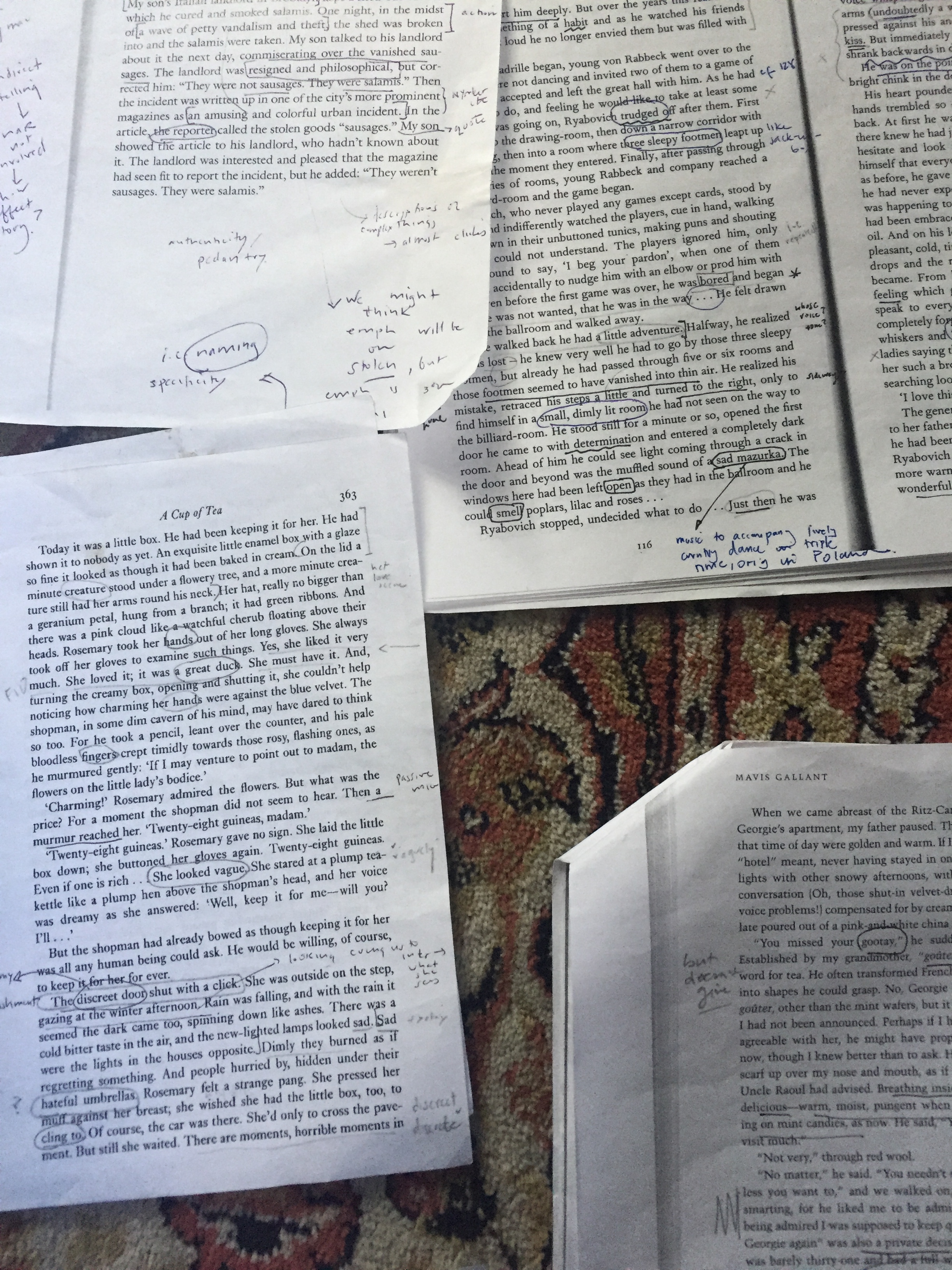
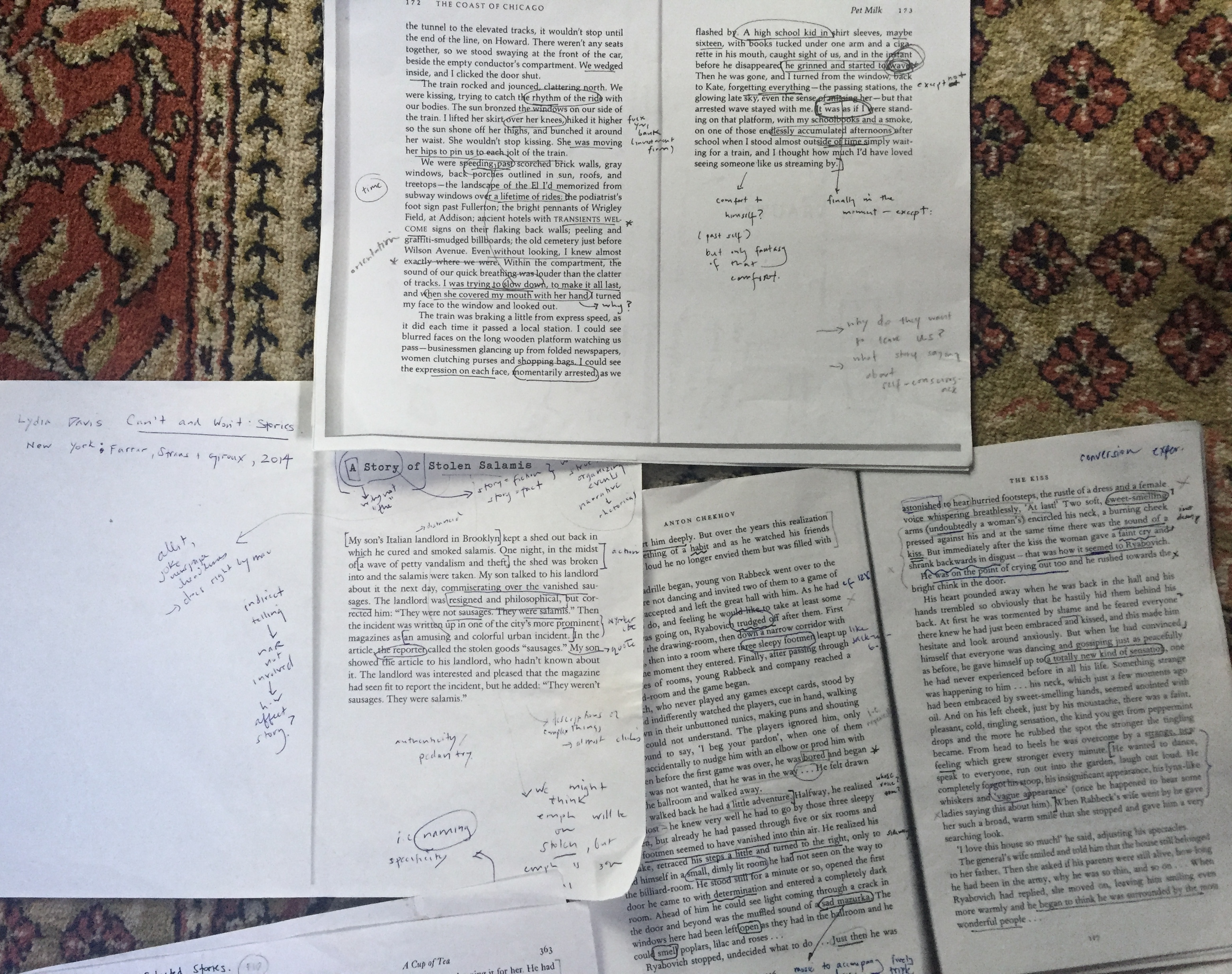
I recently added my thoughts on twelve favourite short stories to The Personal Anthology. I thank Jonathan Gibbs, the editor of this valuable project, for the invitation to contribute. (Do browse the archives—you’ll find all kinds of things worth reading.) I made my choices based on my experience teaching short fiction. In doing so, I had to leave off many worthy candidates. So even though nobody asked for it, here’s a baker’s dozen more wonderful stories.

QaaHL

“Nervous” by Robert Walser, translated by Christopher Middleton

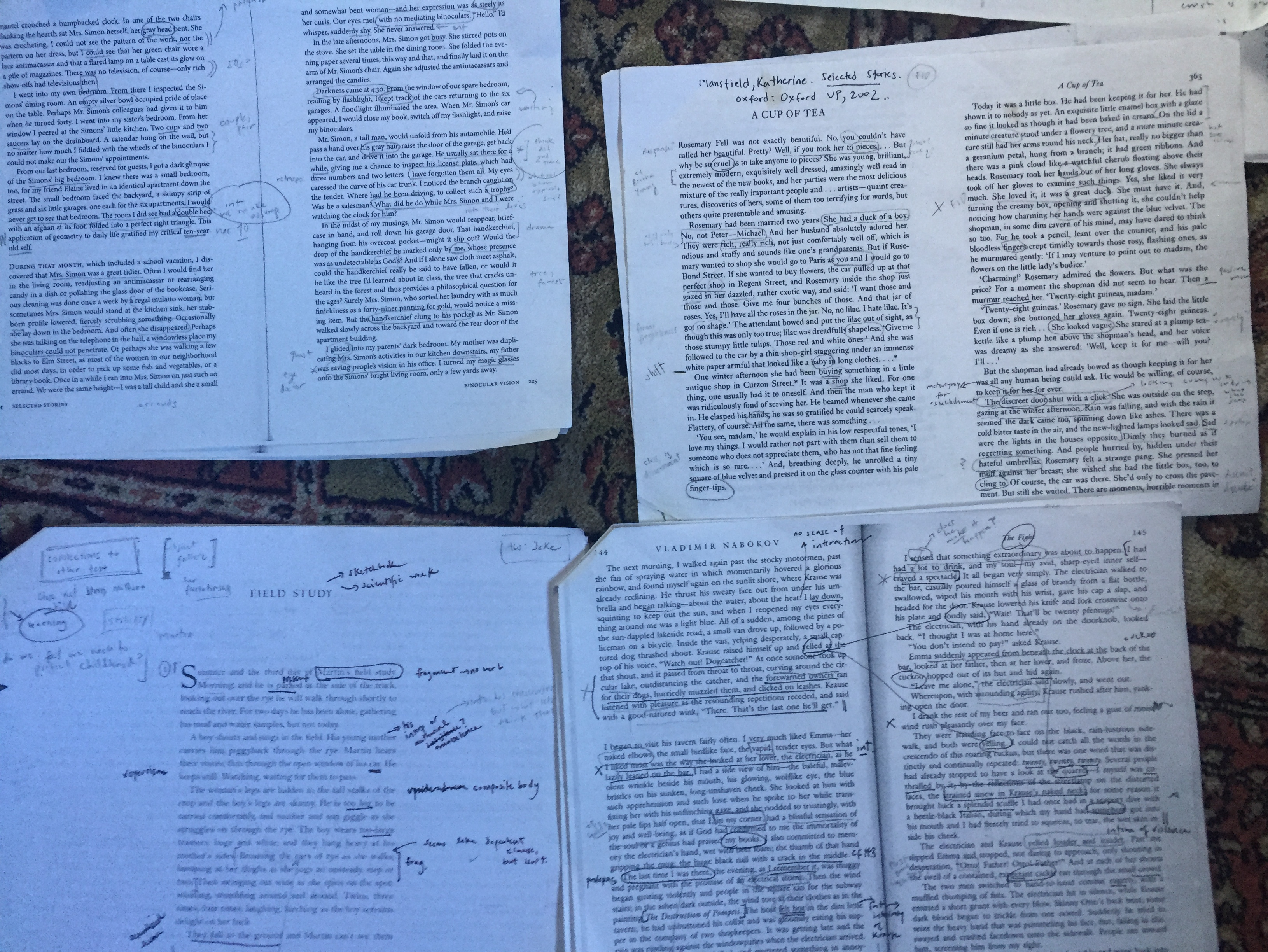
Walser’s little prose texts, scribbled on bits of paper, published in feuilletons across German-speaking Europe, are one of the glories of 20th century literature. Amazingly, they are finally getting their due in English. But thanks especially to the efforts of poet and translator Christopher Middleton, some of his work already appeared in English in the 1980s, including one of my favourites, “Nervous.” Walser’s writing is characterized by what I think of as a very Swiss mixture of sweetness and snark: its coziness soon goes off the rails. Here, in a text not coincidentally written in the middle of WWI, Walser is more anguished than gentle. But the reversals, hesitations, and self-cancellations of his prose are clearly evident.

I’ve often taught “Nervous” together with Jamaica Kincaid’s “Girl” (1983) another bravura exercise in narrative voice (in her case, in the imperative). Both texts undermine the coherence of the speaker, leading us to ask whether the very idea of identity is a fantasy of writing. Because both pieces are so short, they’re ideal for forcing students to linger over details. Students can even read them for the first time in class, which, in my experience, typically generates the best conversations.

First published in German in June 1916 in Neue Zürcher Zeitung. Published in English in Selected Stories Farrar, Straus & Giroux 1982. You can read an excerpt here and the German (with facing Dutch translation) here.

“The Demon Lover” by Elizabeth Bowen

It hurt to cut this from my original list, just as it hurt to cut it from my syllabus a few years ago. Students never loved it the way I do, and that disparity was getting me down. To be sure, it’s not straightforward. Bowen’s brilliant ghost story centers on Kathleen Drover, who has returned to London during the first Blitz to check on the house she and her children have left behind for shelter in the country. She finds a letter pushed under the door, a curt missive reminding her that the writer has not forgotten the troth she plighted, the promise she made. “Today is the day we said” it says, ominously. The letter takes her back to the Great War, and the man she fell in love with, the man she promised to marry, a cruel man, a man who returned to the front from leave and never returned. (The students have a hard time distinguishing between the two wars.) The letter sends Mrs. Drover into a panic, and she collects what she came to get as quickly as she can and runs away to hail a taxi. But you can’t outrun the past. This is a story of trauma, about physical and mental stains and strains. I can never shake the image of the weal on Kathleen’s hand when her fiancée presses it hard against the buttons of his uniform. One thing my students and I always agreed on, though: the editors of Bowen’s Collected Stories must have had a lot of fun when they made sure the story ended on p 666.

First published in The Demon Lover and Other Stories, Jonathan Cape, 1945. Available in The Collected Stories of Elizabeth Bowen, Ecco, 1989. Read the story here.

“The Bear Came over the Mountain” by Alice Munro

Maybe it’s because I’m Canadian, where we are All Munro All the Time—I remember reading “Boys and Girls” in middle school and having “the symbolism of the foxes” drilled into me—but I am lukewarm on our Nobelist. I mean, I recognize her greatness. But for me she’s so cold, and not just because that’s the emotional register of the largely Scottish and English WASPs that comprise a certain idea of “Old Canada,” fictional versions of which populate Munro’s stories. I find the stories themselves chilly, almost clinical in their attitudes to these figures. (No accident that so many of her editions have a reproduction of an Alex Colville painting on the cover.)

They do teach well, though. And this one in particular works for me. “The Bear Came over the Mountain” intertwines two couples: elegant Fiona, whose forgetfulness grows into dementia, and bien pensant Grant, who is not as nice as he thinks he is, on the one hand, and Aubrey, a former sweetheart of Fiona’s who she reconnects with in the facility Grant reluctantly moves her to, and Marian, Grant’s seemingly unsophisticated but in fact defiant and shrewd wife, on the other.

As the couples re-arrange, our suspicion grows that Fiona has orchestrated the events. The story asks: what is true, in the life of a couple and even in life itself? Epistemological uncertainty isn’t just something faced (with terror, stoicism, even grace) by the patients who lose their memories, but by readers as well.

First published in The New Yorker, December 27, 1999. Collected in Hateship, Friendship, Courtship, Loveship, Marriage McClelland & Stewart, 2001. You can read the story here.

“The Bad News” by Margaret Atwood

Atwood, by contrast, is another CanLit big shot whose work I do admire. (For whatever reason, her chilliness doesn’t bother me as much as Munro’s.) Although best known for her novels, Atwood’s written plenty of stories; the ones I’ve read are good. For a while I taught this story regularly, highlighting, in particular, its narrative structure and use of time. Like “The Bear Came over the Mountain,” “The Bad News” is about (the fear of) dementia. But I don’t think memory loss explains the story’s structure, which reminds me of a möbius strip. The narrator and her husband live in a dystopic near-future (if I were to read the story now, I’d probably just think it was set in the present) but part-way through the narrator remembers a trip they took to Glanum, the Roman ruins in the South of France. The memory sparks a fantasy that, at some point, becomes the present of the narrative itself. It ends with the couple, living in what to them is simply an outpost of Rome, nothing ancient at all, talking themselves out of worrying about the barbarian invasions (“They won’t be here for a long time. Not in our lifetime, perhaps. Glanum is in no danger, not yet”). We’re left wondering if the modern couple, similarly obsessed with but in denial about bad news, is perhaps a dream of the ancient one, rather than the other way ‘round. “We don’t like bad news, but we need it. We need to know about it in case it’s coming our way.”

First published in The Guardian, 2005. Collected in Moral Disorder and Other Stories, Nan A. Talese, 2006.

IMG_1632

“Indian Giver” by Max Apple

Probably the least famous writer on this list, which is a damn shame. Especially as he is probably the nicest (admittedly, the only one I’ve met, but man what a mensch). Apple is a worthy heir to Malamud (which, if you’ve read my original list, you’ll know is high praise). Seymour Rubin owns an automotive junkyard, but the only person who can work the baler that keeps the place going, a man named Alonso Johnson, has just converted to Islam and needs to pray on his lunch hour every Friday. Seymour, incensed at what he sputteringly calls “once a week anti-Semitism,” fires Alonso, which leads to his near ruin. (“Indian Giver” is a take on Malamud’s “The First Seven Years.”) Everyone begs Seynour to take Alonso back, especially Seymour’s son, Chuckie, who calls from the reservation in the South West where he is working with indigenous people. When a rival Jewish recycling firm offers to buy him out, Seymour has no choice but to go back to Alonso. Who, Apple’s story asks, is a Jew? And what does that mean? Are the identities we live by enabling or disabling? Funny, too!

First published in Story and collected in The Jew of Home Depot and Other Stories, Johns Hopkins, 2007.

“The Night Rhonda Ferguson was Killed” by Edward P. Jones

Now that I think of it, I briefly met Edward P. Jones at a reading from his novel The Known World. And he too was lovely, so soft-spoken and introverted, clearly a man uninterested in platitudes or bullshit. I warmed to him immediately. Though I’ve yet to read that book, I love his early stories, especially this one, which I use in teaching literary realism. This is a beautiful and very sad story about an angry, vulnerable teenage girl, Cassandra G. Lewis, whose best friend, the Rhonda Ferguson of the title, is about to sign with a record label. Rhonda almost never appears in the story—instead we follow Cassandra and some of her other friends as they spend a flirty, chaste, emotional, ordinary Friday evening that is upended by tragedy. By the time we learn of Rhonda’s death, so much has happened we’ve forgotten all about it, and we’re shocked despite the title. I love how one of the girls, a quiet soul Cassandra hardly knew before the fateful night, becomes the story’s central focus. And its last line is heartbreaking: “She sang on into the night for herself alone, pushing back everything she did not yet understand.”

Collected in Lost in the City, William Morrow, 1992.

“Tapka” by David Bezmozgis

A bittersweet, funny, but ultimately rather ominous story about a family of Latvian Jews who emigrate to Canada in the early 1980s as part of the exodus of Soviet Jews. (In this sense clearly autobiographical.) Mark Berman is in first grade at George Best Elementary School in his new home of Toronto. Together with his slightly older sister, he is tasked with walking a neighbour’s dog every day at lunch. Tapka is spoiled; her owners, also Russian emigres, though of a lower social class than the Bermans, have no children. Tapka is their everything. While the adults struggle through English classes by day, the children learn through osmosis (the narrator likens his brain to a catchment basin, with rivulets of language steadily accumulating into a pool). Pride of place goes to schoolyard insults, like “shithead” and “gaylord” (how it pains me to remember that we used to say things like that). The children love Tapka. But they also hate her, for inscrutable reasons that have to do with their powerlessness and general sense of being lost in a new place. So they start calling her the names they’ve learned, maybe felt the lash of; Mark feels the thrill and shame at having violated something. One thing leads to another, and the kids let the dog off the leash, whereupon it dashes into traffic and is hit by a car. Everything ends okay, except nothing will ever be okay again.

I also use this story to teach my American students the correct pronunciation of Toronto and what a washroom is. I think of it as a duty.

First published in The New Yorker in 2003. Collected in Natasha and Other Stories, Harper Collins, 2004.

IMG_1630

“The Knock at the Manor Gate” by Franz Kafka and translated by Willa and Edwin Muir

My favourite Kafka to teach is “A Hunger Artist” (though I confess I don’t love to teach Kafka—he is too hard, too much about the resistance to interpretation), but my favourite Kafka altogether might be this little text, which is perfectly Kafkan, but, more importantly, for me, comes unbidden to me every time we chant the v’ahavta in synagogue. That’s the prayer in which we name the ways we shall love G-d. Tell them to your children, think of them when you wake and when you sleep. And, finally, “bind them as a sign on your hand and let them serve as a symbol on your forehead; inscribe them on the doorposts of your house and on your gates.” Kafka would have known this prayer (it comes just after the sh’ma, Judaism’s affirmation of monotheism); every week I wonder if he had it in mind in writing this enigmatic work.

First published posthumously in Beim Bau der Chinesischen Mauer in 1931. Collected in English in The Complete Stories of Franz Kafka, edited by Nahum Glatzer, Schocken, 1971. You can read the story here.

“The Use of Force” by William Carlos Williams

Although only four pages long, this story is so rich, it’s easy to spend an hour talking about it and still have plenty to say. Based on Williams’s own experience as a doctor in Rutherford, NJ, it tells the story of a doctor summoned by a poor, terrified couple who suspect their daughter has diphtheria. To confirm his diagnosis—which will lead only to quarantine, there being nothing else the man can do: the story is from the 1930s; there are no antibiotics—the doctor needs her to open her mouth. Which the girl refuses to do. The result is a battle not just of wits but of strength. The title doesn’t just describe the doctor’s actions; it also poses a question: what is the use of force? What purpose does it serve? Can we diagnose a condition without causing harm? And if we think about the similarities between diagnosis and interpretation, we might extrapolate to ask, can we read a text without doing violence to it?

First published in 1933 in Blast and collected in Life Along the Passaic River, New Directions, 1938 and The Doctor Stories, New Directions, 1984. You can read the story here.

“A Family Supper” by Kazuo Ishiguro

Rohan Maitzen tipped me on to this story, one of only a few by Ishiguro. Although it would be terrific for any lesson on unreliable narrators, I always teach “A Family Supper” on the second day of the semester to help students begin the semester-long process of learning to support claims with textual evidence. For the central question demanded by this story of a young man who returns after the death of his mother to his home in Japan from a new life in America is whether his father has poisoned their supper of fish soup. (The first thing we learn is that the mother died from eating improperly prepared fugu.) Students always have strong opinions, but they’re not always sure why they think what they think. Ishiguro has a fine way with dread and unease. In addition to everything else, this is good ghost story.

First published in Firebird 2 in 1982. Collected in Malcolm’s Bradbury’s anthology The Penguin Book of Modern British Short Stories, Penguin, 1989. You can read the story here.

“Drown” by Junot Díaz

The narrator’s former best friend Beto is back in town, but the narrator doesn’t want to see him. We learn that Beto once gave him a blow job, which the narrator both liked and hated. “Drown” is a story of repression, confused masculinity, and growing up in a society that has no expectations for you (note the imperative of the title). My students and I often linger on this early passage, where we can already see the rivalrous relationship between the boys. Along with the rest of the kids in the neighbourhood, the boys have climbed the fence at the local pool:

I sit near the sign that runs the pool during the day. No Horse-Play, No Running, No Defecating, No Urinating, No Expectorating. At the bottom someone has scrawled in No Whites, No Fat Cbiks and someone else has provided the missing c. I laugh. Beto hadn’t known what expectorating meant though he was the one leaving for college. I told him, spitting a greener by the side of the pool.

At night the pool runs by other rules: the difference between no expectorating and a greener by the poolside. Nighttime pool has vitality, but what is that worth compared to the power of daytime rules?

First published in The New Yorker, January 29, 1996 and collected in Drown, Riverhead, 1996. Read the story here.

“The Marquise of O” by Heinrich von Kleist, translated by David Luke and Nigel Reeves

A crazy, long story about a woman, the Marquise of the title, who becomes pregnant after being raped during the Napoleonic wars. The scholar Mary Jacobus has a nice essay about how everyone sees the Marquise as an empty O just waiting to be filled (literally or figuratively). The story’s told with Kleist’s characteristic indirection, which means students have a hard time with it—it doesn’t help that the central event is elided in a dash—but they often get into rousing discussions of contemporary slut-shaming that makes them see things haven’t changed as much as they like to think. For me the big question is: can we read the Marquise as having any control over her circumstances? Does she have any agency?

First published in German in Phöbus in 1808. Available in English in The Marquise of O and Other Stories, Penguin 1978.

“Bartleby, the Scrivener: A Story of Wall-Street” by Herman Melville

What is there to say? A stone-cold masterpiece. “I would prefer not to” doesn’t mean no. It’s much more destabilizing (or insidious, depending on how much you side with the narrator). A wonderful story about men at work.

First published in Putnam’s Monthly Magazine in November and December 1853. Collected in The Piazza Tales, 1856. Read the story here.

IMG_1629

Now you tell me: what would be on your list?