My Year in Reading, 2024

If you’re reading this, you are faithful indeed. And I am grateful. Long silence here, I know. As my adopted country tumbles into authoritarianism, things have also been changing, though more positively, chez EMJ.

Igor Razdrogin, Book Bazar (1975)

My wife, daughter, and I are moving to St Louis in a month’s time! We’ve spent quite a bit of time there these past few years, and we like it a lot. We’ll have a little more space in our new home (which, combined with some collective efforts to tame my unruly library, might mean that our house will at least briefly not be overflowing with books), and, best of all, we’ll be living in a walkable neighbourhood with sidewalks, which is something we’ve been missing these past 18 years in Little Rock.

The other big transition concerns my career. I’m leaving my job at Hendrix, of course, but I’m also leaving academia in general. People keep asking how I’m feeling about this and I keep saying: Terrific! I was pretty burned out and starting to get a little Old Man Yells at Clouds about All the Changes that affected the classroom experience: the pervasiveness of AI and LLMs (something no one, as far as I know, ever asked for), and, more distressingly, the difficulty even the best-prepared students are having reading sustained works of literature, by which I mean, an entire book, no matter how straightforward the prose. This isn’t about their intelligence, or even their phones. It’s about the strictures placed on secondary school teachers. As instruction moves ever more toward preparing for testing centered on multiple choice reading comprehension questions about utterly decontextualized chunks of texts, teachers aren’t assigning much reading, which means students simply don’t have much practice at it.

(I also have a pet theory that for all its flaws Harry Potter (to be clear: it sucks) helped Millennials think of reading as both exciting and habitual, and Gen Z hasn’t had anything like that. The Harry Potter to Jane Austen to English Major pipeline kept our department afloat for a lot of years. These days, students dislike both Rowling and Austen…)

I still love many things about teaching, and it’s possible I’ll miss it so much that I’ll return to it in some fashion. (I’m never getting another job like this one, though. Those don’t exist anymore.) But for now, I feel relief, and curiosity—along with a lot of trepidation—about the chance to try something new. For now, it feels a bit unreal. Because the academic year is cyclical—summer is always a time of collapse and, if lucky, regeneration—I don’t yet feel as a though I’ve made much of a change. Talk to me in the fall, or next spring, or five years from now.

Luckily—and this is another reason for the silence around here—I’ve been working as a consultant for the Educator Programs arm of the William Levine Family Institute of Holocaust Education at the United States Holocaust Memorial Museum in DC. The people I work with are absolutely fabulous: smart, funny, kind, devoted to their work without having delusions of grandeur about it. It’s eye-opening—and fun—to work as part of a team, after decades of the isolation of academic life. I’ve helped them create resources for K – 12 English Language Arts classrooms, and have taken great satisfaction in the work.

I’ll need full-time work sooner rather than later, though, so if you have any ideas or leads, hit me up! Like, what are some jobs people do? What do y’all do all day? I need advice!

What I’m saying is, I had a lot going on these last months. But I did manage to keep reading. Maybe not as much as usual, but whenever I could make time. I get that it’s ridiculous to offer a 2024 reflection halfway through 2025, but FWIW here are the things that stuck with me last year.

Eight standouts

Francis Spufford, Cahokia Jazz (2023)

So much to love in this novel about an alternate 1920s in which a sizeable indigenous population thrives in a nation called Deseret centered on the bustling city of Cahokia. Spufford weaves his world-building throughout a procedural, in which our hero, a cop who moonlights as a jazz pianist, investigates a murder with vast political implications, to the point of threatening Deseret’s independence.

Cahokia Jazz is the most referenced title in the Year in 2024 Reading pieces I posted earlier this year, which means either that everybody loves this book, or that people like me love this book. Anyway, given my upcoming move to Missouri, it won’t surprise you to hear that the scene that most sticks in my mind is when Barrow pursues a lead in a village at the end of the Cahokia streetcar line, a fly-swept place he can’t wait to leave. Its name? St Louis…

I look forward to visiting the ruins of the actual Cahokia, once the biggest city north of Mexico City.

Katrina Carrasco, The Best Bad Things (2019)

Fabulous and underrated crime novel set in 1880s Port Townsend, where the most valuable commodity passing through the busy port is opium smuggled in from north of the border. Alma Rosales, who once worked for the now-shuttered Woman’s Bureau of the Pinkerton Detective Agency, has left San Francisco for Washington Territory to work for the seductive, brilliant, coolly calculating Delphine Beaumond, who runs most of the drug smuggling on the west coast.

When product goes missing, Delphine puts Alma on the case. Alma goes undercover as a dockworker—not a problem, because Alma is also Jack Camp, a slight yet wiry man who can hold their liquor and likes ladies and men equally. Did I mention that Alma and Delphine are lovers? Or that Jack starts a torrid affair with the man they’re investigating? Or that they’re also still working as a Pinkerton agent—in a desperate attempt to get their old job back?

Cue double-, triple-, even quadruple-crossing; witty repartee; and some pretty hot sex. Most crime novels are let down by their endings, but this one… let me tell you, friends, I literally gasped. A brilliant debut. I want everyone to read it.

Émile Zola, La Bête Humaine (1890, translated by Roger Pearson) and The Assommoir (1877) Trans Brian Nelson (2021)

Even by Zola’s lofty standards, these two are bangers. Push comes to shove, I guess I’d choose Bête over Assommoir, just because I love the crime story trappings, but the latter might be the more impressive accomplishment, especially if you could read it in French to see what Zola does with the argot of his lumpenprotelariat characters. They’re equally—which is to say, tremendously—depressing, but also viciously alive. Zola’s naturalist doom is regularly leavened by his prose, which zips from one brilliant set-piece to another. I’m talking about stuff like the bruising fight between two laundresses in front of an audience of delighted, shouting onlookers in the opening scene of The Assommoir, or the berserk vision of a driverless train, filled with drunk soldiers in full war frenzy heading to their doom at the hands of the Prussians, in the last pages of La Bête Humaine. Feels like a good time to study Zola’s fascinated descriptions of all things irrational.

Hernán Diaz, In the Distance (2017)

Quasi-Western in which the protagonist—a hulking, nearly mute Swede named Håkan whose only goal is to find the brother he was separated from on the voyage to the New World, and whose body and psyche seem to be able to take any amount of suffering—travels east, south, and north as much as west. This is a brainy book: Diaz riffs on Frankenstein, and probably a lot of other stuff I missed. But its allegories are always concrete. In this novel of a man stubbornly going against the westward direction of Manifest Destiny, I most remember the section in which, after suffering a terrible loss, Håkan literally burrows into the ground, eventually building a maze-like underground shelter where he lives in ambivalent isolation for years.

I read Diaz’s Trust last year too: also great. Probably not telling you anything you don’t know. But if like me you are late to Diaz, move him up your list. Smart guy and beautiful writer.

Leah Hagar Cohen, To & Fro (2024)

Last year I served as a judge for the US Republic of Consciousness Prize, which honors literature published by small presses. Yes, I tossed aside some duds and waded through many competent but unexceptional novels, but I also discovered some terrific stuff I wouldn’t have otherwise read. My favourite was this delightful and thoughtful literary experiment, a novel written in two halves that can be read in either order. You can start with “To” and flip the book over halfway through to read “Fro,” or do the reverse. You could call this a Jewish Alice in Wonderland (I love how deeply and unapologetically Jewish the book is: it takes such pleasure in asking questions), but that wouldn’t give you the sense of how the book is both realist and fantastic, a genre-bender that sometimes reads like a middle-grade book and sometimes like a historical “what if” novel, if those were written by someone whose lodestar was Maimonides. Magic!

Thanks to Lori Feathers, the genius behind this award, and to my fellow judges, who always brought it. Serving on this panel was time well spent.

Elizabeth Bowen, The House in Paris (1935)

A book of arrivals and departures, whether longed-for, dreaded, or uncertain. It feels both constricted and expansive: a neat trick. Bowen often gets called Jamesian. That is true not in style but only in a shared preoccupation with cruelty. Hard to say which fictional universe is meaner. Another thing I liked about The House in Paris is that it offers further evidence for my theory that British modernism is just another name for Gothic literature about children.  

Martin MacInnes, In Ascension (2023)

Here we have two sisters. One becomes a scientist who explores the depths of the ocean floor and the vastness of space (she develops nutrition-dense and fast-growing algae for interstellar travel); the other sets aside her career as an international lawyer to find out what happened to the first. I can’t remember everything that happened in the book, but I do remember being enthralled from start to finish. (This is another long book that never felt slow.) The final scene, set in the remotest place on earth, Ascension Island, foregrounds another kind of foreign place: our memories. “A family”, MacInnes writes, showcasing his epigrammatic mode, “is a group of strangers with a destructive desire for common nostalgia.” MacInnes’s big question, asked as much of a sibling relationship as of humanity’s ability to inhabit the stars, is whether the only way to get beyond the destructiveness of the human species is to destroy the individual self Beejay Silcox, one of my favourite critics, gets it right when she calls the book “a primer to marvel.”

Sally Michel Avery, Father and Daughter, 1963

Thoughts on the rest

Ones I keep thinking about: Manjula Martin’s The Last Fire Season (2024): I still haven’t prepped a go-bag—how foolish is that? Catherine Leroux’s The Future (2020, translated by Susan Ouriou): What if the French had never lost Detroit? What if climate change and resultant socioeconomic crises meant that most of the trappings of a functioning state had fallen away? And what if bands of roving children built hardscrabble lives in overgrown parks? Peter Heller’s The Last Ranger (2023): Conventional but satisfying novel about a ranger in Yellowstone, filled with scenes in which the hero drinks early morning coffee on the porch of his cabin: Heller knows the landscape and describes it beautifully. (Given what the chuckleheads at DOGE did, this title resonates differently now…) Jill Ciment’s Consent (2024): Revelatory memoir in which the author reassesses her decades-long marriage to her now deceased husband, with whom she took a painting class when she was 17 and he was 47. Can the relationship really have been good given that they met when she was a child?

Best study of xenophobia, told in an atmosphere of creeping dread: Georges Simenon’s The Little Man from Archangel (1956, translated by Sian Reynolds).

A Russian Jew, brought to rural France as a child, French in every way, has his life turned upside down because of a casual remark. Chilling. Best Simenon I’ve read.

Best study of deprogramming: Emily Tesh, Some Desperate Glory (2023).

Maybe useful these days.

Best case of “it’s not you, it’s me”: Nisi Shawl’s Everfair (2016)

Steampunk set in an alternate late 19th century in which the Fabians buy tracts of land from King Leopold to protect refugees fleeting the horrors of Belgium’s rule in the Congo. At first, this new nation—Everfair—prospers. European benefactors and missionaries work with Africans to create trade networks based on clean airship technology. They develop intelligence networks to navigate the region’s politics. They promote or at least allow social experiments concerning family structure, marriage, and sexual politics. But the internal tensions become too much, and the utopia falls apart. Even as I’m writing this I’m thinking, Honestly this sounds pretty good, maybe I’ve misjudged the book. And at the level of idea it’s intriguing. The execution, though: that’s the problem. The prose is leaden, the relation between action and exposition awkward. Maybe the book actually needed to be longer? A strange thing to say since I felt like it was never going to end. This book is a darling to many (Jo Walton loves it, for example). Probably just the wrong time for me. Can’t imagine giving it another try, though.

Best (and most) coffee: Mark Haber’s Lesser Ruins (2024).

Things are not going well for the narrator of this Bernhardian novel, ever since his wife died and he lost his job. That’s a tough spot. And he tries to do the right thing, sometimes. He reaches out to his son, whose passion for house music means he will dilate on the perfect set list for as long as his father will hold the phone near his ear. Like so many of us (me, anyway), he struggles to surmount the gap between idea and execution, endlessly trying to write something good. You’d think we might like the guy. But… He’s a terrible snob. He lambastes his students, neglecting his work to the point of installing an espresso machine under the desk in classroom. (That an instructor at a community college would have a dedicated classroom is the book’s only false note.) His unfinished, maybe unfinshable, book on Montaigne is probably not really going to be all that. So he ain’t easy to like.

All of this is beside the point, though, because this novel is about the way sentences can mimic the swerves and circles of a mind endlessly thinking. One of the things our narrator thinks about most is coffee. He drinks a lot of coffee. Long sections concern the various roasts, the preparation, the anticipation, the enjoyment. I’m not a coffee snob on his level, but I found nothing to ironize or criticize in the man’s love for the perfectly pulled shot. Lesser Ruins is great for other reasons, too (it’s Haber’s best IMO), but if you like coffee at all, you gotta read this.

Most ingenious conceit: Kenneth Fearing’s The Big Clock (1946)

A drudge at a magazine publisher modelled on Time-Life is tasked with finding—for purposes of eliminating—a witness to a crime. Only thing is, he is that witness…

Dark and boozy. This is the good stuff.

Best crime fiction: Carrasco, obviously. Also obviously, the latest Tana French. (At least I can say I was alive while Tana French was writing novels that will be read in a hundred years…) The latest Garry Disher, Sanctuary (2023), is a satisfying standalone about theft and friendship. I read a couple of Gary Phillips’s books about a Black Korean-war vet turned crime-scene photographer: good stuff. (I learned a lot about Watts.) Start with One-Shot Harry (2022). Years ago I devoured Scandinavian crime novels: seemed like the most exciting thing in the genre. Bloom’s been off that rose for a while, but Cristoffer Carlsson’s Blaze Me a Sun (2021, translated by Rachel Wilson-Broyles) took me back. Marcie R. Rendon’s Where They Last Saw Her (2024) is her first book set in the present, and much as I love the Cash Blackbear series, probably her best. How nice to read a book about an indigenous woman who has a good man in her life. I regularly think about the scenes of women jogging through the snowy Minnesota woods.

Best sff: In addition to MacInnes and Tesh, I most enjoyed Ann Leckie’s Ancillary Justice (2013), Shelley Parker-Chan’s She Who Became the Sun (2021), and various works by Guy Gavriel Kay, who continues to be a source of reliable pleasure, even if no one would call his books cutting edge. (So humane, though! I need that right now.) Alas, I am not yet a dedicated enough sff reader to have figured out how to overcome the “stalling out in a series because I didn’t get to the next one right away and then forgetting what happened” problem.

Best poetry: Louise Glück’s The Wild Iris (1992). Ok, the only poetry collection I read, but I liked it enough to assign it this past semester and the students loved it. Teaching it made me both appreciate it more and notice its limitations (it hoes rather a narrow furrow). I ought to read some of her later stuff: I bet it’s even better.

Best book of the kind I could imagine myself writing and yet am mostly allergic to reading: A tie between Jakuta Alikavazovic’s Like a Sky Inside (published 2021 and translated by Daniel Levin Becker) and Chris Bachelder & Jennifer Habel’s Dayswork (2023).

The whole quasi-essay, quasi-memoir with novelistic elements thrown in for good measure—mostly that stuff leaves me cold. But these two won my heart. Alikavozovic describes a night she spent in the Louvre, a place that she often visited with her father, a ne’er-do-well from the former Yugoslavia. After each excursion, her father would ask, How would you go about stealing the Mona Lisa? This question, and the reflections on her father’s life of petty crime and her own experience growing up in a culture and language that he never perfected, lies at the heart of this beautiful little book.

Bachelder and Habel have done something remarkable: written a book together, about themselves as a couple, that feels written in a single voice. The text centers on the Habel character’s fascination with Herman Melville: it’s about his life, and their lives, and what it means to write a life, with copious references to the man they call The Biographer, Herschel Parker, who seems to have been really something. And by that I mean kind of a dogged genius, but also a pain in the ass.

Best literary fiction:

Laurie Colwin’s Shine On, Bright and Dangerous Object (1975) is sad and delightful, filled with loving anger. A splendid beginning to a marvelous though much too short career. William Maxwell’s So Long, See You Tomorrow (1980) is famous for good reason. Audacious structure and play with time, heartbreaking story, even a section told from the point of view of a dog. Joan Chase’s During the Reign of the Queen of Persia (1983) deserves its resurrection thanks to the good people at NYRB. Another story of childhood in the American Heartland, at once bucolic and traumatic.

You can see I am deep into the “my favourite artworks are the ones created while I was a child and too young to experience at the time” years. I read new things too, though, and the best of these was Kaliane Bradley’s The Ministry of Time (2024), which I finished in a cabin at the Grand Canyon during a thunderstorm that had the rain pounding on the metal roof. The book is as memorable as the setting of my reading: an experiment in time travel, in which a 19th century Arctic explorer is brought to a near-future UK and given to a handler from the titular government agency whose background happens to be Cambodian. In addition to its speculative elements, and a terrific love story, the novel considers differing cultural responses to trauma. More Bradley soon, please!  

Henri Matisse, Woman Reading in a Violet Dress, 1898

Short story collection: Only read one, but it was a good one. I liked all the stories in Jamel Brinkley’s Witness (2023), but “At Barstow Station” is an all-timer. Even a class full of students who did not care much for reading agreed.

Most unexpected page-turner: Karl Ove Knausgaard’s The Morning Star (2020, translated by Martin Aitken) blends his signature interest in mundane middle-class life with some weird shit (a blazing star that no one can explain, a ritual murder, shenanigans at a mental institution). I raced through it and bee-lined for the bookstore to but the next one (in an expensive and gigantic hardcover edition), only to ignore it for the rest of the year. Honestly, the hardcover might be the problem. Most of the time I’m a “give me the paperback” guy. Anyway, will read the others in this series.

Most fun: The audiobook of Jesse Q. Sutanto’s Vera Wong’s Unsolicited Advice for Murderers (2023), read with obvious affection by Eunice Wong, made me laugh aloud. As I feared, the strains of keeping the conceit going already show in the second book, which I listened to a couple of months ago. But I’ll stick with Vera a while longer; she’s a treat.

Best sequel: Waubgeshig Rice’s Moon of the Turning Leaves (2023) is a big advance over its predecessor, Moon of the Crusted Snow. A rare case of a longer book being better. It’s ten years since the mysterious event down south that sent the grid down. The small indigenous community at the heart of the first book has been thriving, but its inhabitants realize they have reached the limit of the resources in their immediate area. After painful debate, they send a search party to find out if anyone else is out there—specifically, anyone indigenous. Exciting, well-drawn, and smart about the cost of giving up part of your identity to gain the benefits of joining something. (a community, a culture) larger.

Grimmest ending: Edith Wharton’s Summer (1917), really a hell of a book. Even if you haven’t read Wharton before you know things aren’t going to end well. But I at least did not anticipate them to end quite that dispiritingly. Thanks to Shawn Mooney and the rest of the Wharton gang for the invitation to read.

Hurts so good: Elliott Chaze, Black Wings Has My Angel (1953)

Liked at the time, but has now faded from memory:

Jean Giono’s Fragments of a Paradise (1944/48 and newly translated by Paul Éprile); Suzumi Suzuki’s Gifted (2022, translated by Allison Markham Powell); Ariane Koch’s Overstaying (2021, translated by Damion Searls);and Jón Kalman Stefansson’s Your Absence is Darkness (2020, translated by Philip Roughton). Don’t get me wrong: these are all good books (especially the Giono). I don’t regret reading any of them. Just not top-notch, for me.

Meh:

These did nothing for me, and even left me a little grumpy. Ari Richter’s Never Again Will I Visit Auschwitz: A Graphic Family Memoir of Trauma & Inheritance (2024): you’d think I’d be the perfect reader for this, but honestly I did not think this book was very smart. Dorothy West’s The Wedding (1995): I get it, she was old when she wrote this. Plus, the existence of a Black elite on Martha’s Vineyard was news to me: interesting stuff. But this felt wispy, and not in that good Belle and Sebastian way. Two crime novels by Arnaldur Indridason: sometimes you just want to turn pages and remember your Iceland vacation but at the same time you know you’ll never get these hours back.

Most ambivalent toward:

Tried to explain why I felt this way about Lily Tuck’s The Rest is Memory in The Washington Post.

It wouldn’t be an end-of-year list from me without some thoughts on Holocaust-related books, which I’ve divided into categories:

History: Dan Stone’s The Holocaust: An Unfinished History (2023). All due respect to Doris Bergen, this is the best single-volume history of the event I know, and it’s pretty short too. I went long on it for On the Seawall. Honorable mentions: Linda Kinstler’s Come to this Court and Cry: How the Holocaust Ends (2022), and Rebecca Donner’s All the Frequent Troubles of Our Days (2021). The latter admittedly not a Holocaust book, but rather a resistance to the Third Reich book. Pretty damn good tho.

Memoir: József Debreczeni’s Cold Crematorium: Reporting from the Land of Auschwitz (1950, translated by Paul Olchváry). If I could legislate that people had to read one Holocaust book, I’d choose this one. Indelible. You think the Holocaust was bad? You don’t know from. Honorable mention: Michael Frank’s One Hundred Saturdays: Stella Levi and the Search for a Lost World (2022), which I wrote about in 2023 but read again for a book group last fall. If anything, it was even better the second time. To read about Stella is to love her.

YA: Elana K. Arnold’s The Blood Years (2023). Gonna do what I can to see that this one gets more traction.

Comic: Emil Ferris’s My Favorite Thing is Monsters [Vol 1] (2017). What an accomplishment! Your heart will hurt but you won’t be able to stop turning the pages. Ten-year-old Karen Reyes lives in Chicago in the late 1960s. She adores her brother, who is sometimes a gentle artistic soul but sometimes a man pushed to violence by racism and poverty, almost as much as she loves monsters. (She draws herself as a werewolf.) She’s fallen in love with her best friend, Missy, who now shuns her at school while being drawn to her in private. Her mother is diagnosed with cancer, leaving the family’s fortunes ever more precarious. When Karen’s upstairs neighbour, Anka Silverberg, a married Holocaust survivor with whom her brother had been having an affair, is found dead under mysterious circumstances, Karen takes it upon herself to investigate. She stumbles on some cassette tapes, in which the woman tells her life story, a lurid and painful one: Anka was brought up in a brothel by her abusive mother, a sex worker, and then sold into a child prostitution ring from which she is “rescued” by a client who later abandons her when she gets too old for him. After the fall of the Weimar Republic and the rise to power of the Nazis, Anka is persecuted for her Jewishness and eventually deported to the camps. How she survived, how she made her way to America, and what led to her death—these questions are presumably answered in volume 2, which was released last fall. Volume 1 is 400 pages, with plenty of tiny lettering. It would be an effort to read it even without its distressing subject matter. But it’s damn good and deserves more attention than it’s got. Ferris uses dense cross-hatching to give her images texture: I don’t how else to say it other than the images seem tense. Amazingly the book is drawn almost entirely with Bic ballpoints. The whole story of its creation, which took six years, is remarkable, starting with Ferris’s partial paralysis after contracting West Nile disease.

Holocaust-adjacent text: Svetlana Alexievich”s Last Witnesses: An Oral History of the Children of World War II (1985, translated by Richard Peaver and Larissa Volokhonsky) impressed me with the pathos of its subject matter (children, many orphaned either permanently or temporarily when Germany invaded the USSR in 1941) and the success of its method (her now well-known quasi-anthropological style, in which witnesses speak for themselves, with seemingly little input or shaping from Alexievich herself, other than the ordering and structuring, not to mention the selecting of excerpts from what are presumably much longer testimonies: which is to say, thoroughly shaped…)

Book I Never Expected to Spend This Much Time With:

Lois Lowry’s Number the Stars (1989), the classic middle-grade novel about the (anomalous) experience of Danish Jews during the Holocaust. I created a lot of materials about this book for teachers. Yes, it has certain limitations, but I’m honestly impressed by how much richness I’ve found in this text. It seems to be fading a bit from the classroom—but not anymore, if I can help it!

Edouard Vuillard, Madame Losse Hessel in Vuillard’s Studio (1915)

There you have it. I don’t know what my life is going to look like going forward—but I hope at least in the short term to have more time for this poor little blog. Thanks as always for reading! I would love to hear your thoughts on anything I wrote about here.

Matt Keeley’s Year in Reading, 2024

Friends, I am here to apologize to Matt Keeley, who wrote this great piece for me many months ago and has waited patiently (or maybe fumed silently) for me to publish it. I have no good excuse: I got busy and forgot. Terrible. Anyway, this really is a case of better late than never.

Matt is a freelance writer living in Boston.

Ilse Bing, East River with Boat, New York (1936)

Being a reader and working with books can, oddly enough, feel like mutually exclusive propositions. I spent most of 2024 underemployed, but what work I had before starting a new full-time job in October was mainly book-related. I copyedited and wrote pitches for a Dutch literary agency; I did brief manuscript reports for a literary scouting firm; I did occasional reviews for Reactor, The Washington Post, and The Boston Globe. I spent so much time on “professional” reading, including dozens of titles that I would normally have no interest in, that my personal reading suffered.

E.L. Doctorow’s Ragtime was not the book I expected it to be: one somehow doesn’t expect a book this strange to sell a million copies, end up on movie screens, and inspire a Broadway musical. This is an almost essayistic historical novel, with an intrusive and opinionated narrator, major characters who go titled (Father, Mother, Younger Brother) but unnamed, and plot lines that don’t tangle so much as split. Henry Ford and JP Morgan discuss reincarnation in front a stolen Egyptian mummy; Emma Goldman befriends a notorious “kept woman;” in the epilogue, we learn that one character gets killed in the Mexican Civil War, that another sinks with the Lusitania, and that a third creates the Little Rascals franchise. It’s a deeply weird book. [Ed. – Colour me intrigued…]

The movie, incidentally, is quite good, with James Cagney’s final performance, an uncredited appearance by a young Samuel L. Jackson, and Norman Mailer as an ill-fated libidinous architect. I wonder how many New York literati of the 1980s especially enjoyed watching his death scene? [Ed. – Probably still satisfying today.]

Ruth Scurr’s John Aubrey: My Own Life is an unusual biography that repurposes the words of the great antiquarian and his contemporaries to create a sort of hypothetical autobiography. There’s much that remains unknown about Aubrey’s life, and Scurr would rather leave open a gap than speculate. That means, for example, that we get more about the stones of Avebury than we do about Aubrey’s romantic life, more tossed-off preference than deeply felt emotion. This is an eccentric book about an eccentric man; most readers won’t much like it, but a few, like me, will love it. [Ed. – In the immortal slogan of Halifax’s Alexander Keith’s brewery: “Those who like it, like it a lot.”]

Gone: The Last Days of The New Yorker is Renata Adler’s score-settling memoir about the departure of William Shawn, the arrival of Robert Gottlieb, and the eventual appearance of Tina Brown. At one point, Adler compares Adam Gopnik to Anthony Powell’s Widmerpool. If you recognize the names in the last few sentences, you’ll likely enjoy this book, even if you don’t entirely trust it. Otherwise, you’d best avoid.

Rejection by Tony Tulathimutte is the dirtiest book I’ve read in ages. [Ed. — !] It seemed to come out of nowhere: I’d never heard of book or author until an editor asked me to review it. I invoked Philip Roth in my review, and I stand by that comparison:

Its heights, or depths, of exuberant filth reminded me of Philip Roth in Portnoy’s Complaint or Sabbath’s Theater. Like Roth, Tulathimutte knows desire can be as ludicrous as it is urgent; like Roth, he likes a good dirty joke.

Other highlights of 2024’s reading include:

  • Peter Straub’s Koko, a serial killer story with fine writing, memorable characters, and all too much exoticizing of the mysterious Orient [Ed. – It’s so mysterious tho]
  • Six of Georges Simenon’s Maigret novels — I really need to get back to the romans durs soon, but there’s something comforting about Maigret even when the plots are, in fact, quite harrowing
  • Amit Chaudhuri’s A Strange and Sublime Address, his first novel, as elegantly written and absorbingly plotless as later books like Friend of My Youth and Sojourn [Ed. – Read this last year as well: good stuff]
  • Paolo Bacigalupi’s Navola, the sequel to which cannot come soon enough. (Dorian — There’s a strong Guy Gavriel Kay influence here. I think you’d like) [Ed. – I appreciated this tip enough to check it out of the library—it indeed looks quite my thing—but not, apparently, enough to read it yet…]
  • M.T. Anderson’s Nicked, a fantastical medieval heist novel and queer romance [Ed. – Octavian Nothing was fantastic.]
  • Adam Roberts’s Lake of Darkness, a science fiction novel about Satan, post-scarcity, and what happens when you let AI do all your thinking
  • Howard Norman’s My Darling Detective, a thoroughly charming tale hampered only by the author’s difficulties with continuity and his editor’s failing to notice the innumerable discrepancies and inconsistencies. Read for the vibes, not the details. [Ed. – Yikes!]

Two that got away

One sad effect of all my book work was that I struggled to finish long and complicated books. I got maybe eighty pages into Oakley Hall’s classic Western Warlock before I gave up. The prose so fine, the type so small, the pages so numerous: I enjoyed and admired the book, but it took two weeks to traverse less than a hundred pages. [Ed. – Ha! Nicely put! It’s not easy, that one. Took me a while to fall under its spell.] I felt myself losing the thread, and put the book back on the shelf for a less fraught day.

Something similar happened with Iris Murdoch’s The Black Prince, which I’ve had on my shelves since 2007. In a burst of optimism, I’d bought three Murdoch paperbacks when I was a college student studying abroad in Dublin. I quickly read A Severed Head and hated it, and so The Sea, the Sea and The Black Prince sat unread for more than a decade. I knew, however, the problem was more with Matt than with Murdoch, so every year I vainly promised myself I’d give Murdoch another shot. When I finally took the plunge last June, I was thrilled to find that The Black Prince was smart, funny, and satirical, bursting with memorable images and sparkling with ideas. Except, once again, I found myself losing the thread and regretfully set the book aside.

I ended up reading The Bell, another Murdoch, in January of 2025. Perhaps I’ll get through The Black Prince later this year? [Ed. – Because it took me so damn long to get this up, maybe he has!]

John Constable, Cloud Study

Last year’s books, this year

Finally, there are a few 2024 books that I bought and fully intended to read, but haven’t quite gotten around to. First is Percival Everett’s James, a novel which sold a million copies and made nearly as many end-of-year lists. I’ve enjoyed Everett’s past novels and I’m sure I’ll tear through this one when I get around to it. Incidentally: I wonder when Everett’s next book will be? He usually seems to write about a book a year; I wonder if they’re holding off publication until James sales begin to taper off?

Next is Cahokia Jazz by Francis Spufford. I pitched it for review, but the pitch was declined. [Ed. – Boo!] I’m reading it now and am impressed: It’s simultaneously a murder mystery, a literary novel, and an alternate history. Spufford dedicates the book to “Prof. Kroeber’s daughter;” I wonder if Prof. Kroeber makes an appearance in the book. The period is right, Kroeber was an anthropologist interested in Native Americans, and there are lots of Native American characters in the book. [Ed. – SO good!]

Last is Ed Park’s Same Bed Different Dreams, which looks to be a polyphonic metafictional conspiratorial genre bender. I’ll probably turn to this once I finish Cahokia Jazz. [Ed. – Also good, with plenty of hockey. Thanks, Matt! Sorry again for dropping the ball!]

What I Read, May 2024

What a terrific month! Yes, the first ten days were busy: bringing the semester to a close; dealing with the fallout of the lousy previous months; celebrating with our graduates. But then the pace shifted entirely. Amazing how much better I feel when I exercise regularly, eat better, sleep well, and sit on the back deck with a fantasy novel for an hour just because.

It occurred to me recently that in my moaning about last month I forgot something amazing. The eclipse! Little Rock in the totality for something like two and a half minutes, and the experience was as incredible as everyone said it would be. How lucky to simply walk down the block to an open space for an incredible view of the thing. How amazing that people in our neighbourhood (who normally never have anything to say to each other) were out and about, portable lawn chairs and to go cups in hand. Strong school’s out for summer vibes. 10/10, absolutely recommend.

Here are the books I read:

Franz Marc, Two Women on the Hillside, 1906

Arnaldur Indridason, The Darkness Knows (2017) Trans. Victoria Cribb (2021)

In wintery Iceland, retired cop Konrad is pulled into an ongoing investigation that to his surprise helps him learn more about the mysterious death of his father.

Arnaldur Indridason, The Girl by the Bridge (2018) Trans. Philip Roughton (2023)

In summery Iceland, retired cop Konrad is pulled into an ongoing investigation that to his surprise helps him learn more about the mysterious death of his father.

Look, sometimes you need to read something as undemanding as possible.

Guy Gavriel Kay, Lord of Emperors (2000)

Longer and even more satisfying sequel to Sailing to Sarantium, which I read a few months ago. This will sound weird, but I get the same feeling reading Kay as I do watching David Simon shows: intense investment on my part in the characters, sighs of bittersweet pleasure when things come to a close. Like its predecessor, Lord of Emperors is modelled on Byzantium under Justinian and Theodora. The mosaicist hero of the first volume—summoned to Sarantium to tile a version of the Hagia Sophia—is joined in this book by a doctor from lands to the east. Political upheaval leads to changing religious and artistic standards; the eventual fall of the Empire is hinted at. (Kay develops this unthinkable outcome in his more recent books.) There’s an exciting chariot race, too.

Christine Lai, Landscapes (2023)

Matt Keeley calls this the Sebaldian country house novel you didn’t know you needed. Which is a good description. Set in England in the near-future in an isolated house among desiccated fields and dead woods, Landscapes centers on an art historian who is first brought to the house by one of a pair of wealthy brothers only to flee from his violence into the arms of the other. Lai’s world-building won’t win any awards—it’s clearly not what she’s most interested in, though her description of literal zones of climate-controlled safety around city centers and other wealthy enclaves feels all-too plausible—and her characterization is uneven. (The only vivid character is the empty, preening, vain cruel brother.) But the book had me thinking anew about the role of art in an era of climate catastrophe and the Benjaminian claim that every document of culture is also a document of barbarism.

Megan Abbott, Beware the Woman (2023)

My first Abbott, unaccountably. But not my last.

Thriller with a side of body horror about a pregnant woman who accompanies her husband to his family’s summer place in Michigan’s upper peninsula for the first time. Plenty of Gothic accoutrements: kindly father, a former doctor still grieving his wife’s death decades ago, who might not be what he seems; mysterious housekeeper; isolated home. Abbott excels at creating menace, unease, and doubt. A story about what men will do to control women’s bodies: very much of our time.

Perfect reading for the first hot Sunday of the summer.

Émile Zola, La Bête Humaine (1890) Trans. Roger Pearson (1996)

“Too many trains, too many murders,” an early critic wrote, preposterously, of this terrific late novel in Zola’s Rougon-Macquart cycle. As if a book could have too much of either!

Although I still have plenty of Zola ahead of me—I’ve read about half of the RMs now—I’m willing to say that this is the most Zola-esque Zola of all. The train system, with its switches, branches, tunnels, wheelhouses, and miles of track, is the perfect metaphor for the books’ obsession with the interconnected systems and institutions of Second Empire France, especially because it affords new expressions of crime, sexual desire, and violence.

Reading La Bête Humaine, I was reminded of the opening of Peter Brooks’s argument that sight is the realist sense par excellence; of the many descriptive set pieces in this novel, Zola’s favourites seem to be the ones depicting the railyards of the Gare St Lazare as seen from the balcony of an apartment building inhabited by railway workers. In the opening scene a railyard supervisor named Roubaud awaits the return of his wife, Séverine, in a borrowed apartment in that building. She’s been shopping while he’s been getting a dressing down from his superior, a pickle he escapes thanks to the influence of a man named Grandmorin, a former judge who is on the board of the railway and has taken Roubaud on as a protégé because of his fondness for/guilt toward Séverine, whom he knew as a child. What promises to be a cozy tête-à-tête between newlyweds turns ugly, when a change remark by Séverine’s reveals that the judge had sexually abused her for years. Roubaud sees red and after nearly throttling his wife immediately plots to kill the judge, forcing Séverine to send the man a note asking him to meet her in a private car on the evening train to Rouen. This violence unfolds against a backdrop of gaiety and hilarity rising from the apartment below, where two sisters run a non-stop party of singing, dancing, and drinking.

Over the course of four-hundred increasingly intense pages—filled with one sensational, over-the-top scene after another—Zola builds to an indelible ending in which the strains of violence, misogyny, wounded male pride, hilarity, and excess that are already present in the beginning return in reconfigured form: a runaway train, its driver and fireman thrown off after a terrible fight, filled with drunken, bawling recruits headed to the front of what will be the disastrous Franco-Prussian War, hurtles unchecked and to certain disaster under a full head of steam.

I couldn’t get enough of the novel’s proto-Freudian and phrenological-criminological-eugenicist ways of thinking about human behavior. The other main character—the connection to the Rougon-Mcquart family—is the train driver Jacques Lantier (whose mother and brothers appear in The Assommoir, The Masterpiece, and Germinal, respectively), who literally sees red when he is aroused by a woman, wanting only to dismember her. (A long time ago I saw the Renoir film—though I remembered almost nothing; it must be so different from the book—and I could only picture Lantier as Jean Gabin, which is unfortunate because he’s much more like Peter Lorre.) And lest I make it sound like this is a book about men, that’s only partly true. In addition to Séverine, there are two other terrific female characters. The one who broke my heart was Flore, an operator at an isolated railway crossing, and whose unrequited love for her cousin Lantier leads to a disastrous outcome.

I could say a lot more about this book. Check out our conversation at One Bright Book to hear more. And speaking of more, I feel compelled to read more Rougon-Maquart before long. Summer of Zola, anyone?

Karl Ove Knausgaard, The Morning Star (2020) Trans. Martin Aitken (2021)

The reason I so seldom follow through on reading plans like the one I just suggested is that I just cannot stop from being distracted by unexpected things that come my way. I’d been paying even more attention than usual to Brandon Taylor’s reading because he’s been championing Zola lately. So when he tweeted repeatedly about this latest series from Knausgaard, I thought maybe I should investigate. I hadn’t paid any attention to this, other than to vaguely note Jeez, that Norwegian guy has another set of books. If I expected anything it was that the books would be autofiction in the vein of My Struggle. (I read the first two of those with great pleasure a long time ago and then… just didn’t keep up: now I want to close that loop, too.) But The Morning Star is a proper novel, in the sense that it is composed of long sections narrated by different first-person narrators, most of whom link up in sometimes unexpected ways. The action takes place in a hot summer in and around Bergen, in something like 2016. There is plenty of the deep ordinariness of middle-class Norwegian life that I found compelling in My Struggle (cabins to close for the season, impromptu dinner parties to arrange, elderly parents to look after, marriages to keep on life-support). But there’s also a lot of weird stuff: a priest conducts a funeral for a man who turns out to look identical to the one who asked her an impertinent question in the airport the night before; a creature, whether human or not is unclear, roams the forest, possibly in connection to the disappearance of a man from a mental institution and a shocking satanic cult murder; and, most powerfully of all, a dazzlingly bright star suddenly appears in the sky.

The novel seems to be about the relation between the mundane and the extraordinary: I say seems because for me Knausgaard incites a delicious reading fugue state, where undistinguished sentences roll on into compelling blocks of text and the pages keep turning as if by themselves. As soon as I reached the end of its 600+ pages I ordered the 800+-page sequel…

Berthe Morisot, In England (Eugène Manet on the Isle of Wight), 1875

Honestly I enjoyed all these books, even those Indridasons. See anything you fancy here?

What I Read, March 2024

March 2024 was a big month in our family: my daughter became a bat mitzvah on the 29th of Adar I. She worked hard for months beforehand to prepare, and even though the process wasn’t always easy, she did great. Like, better than great. Services were moving, lunch was a whirlwind (no time to eat much but we had delicious leftovers for days), and the party at our beloved local indie bookstore was a blast. (Including a Haftorah Smackdown, where guests who had ben bnai mitzvahed were encouraged to show off how much of their portion they could remember.) Celebrating with friends and family—including one of my oldest friends, who came all the way down from Ottawa, how about that??—was incredible. Suffice it to say, Marianne and I were kvelling big time. We were also very tired. For a couple of weeks afterward, the energy level in this house was low. Like, come home from work, lie down on the couch, wake up two hours later with a crease down your cheek kind of low. All the reading took place around the edges.

Henri Matisse, The Ballet Dancer, Harmony in Grey (1927)

Ann Leckie, Ancillary Justice (2013)

First volume in the already canonical space opera set in the Radch Empire (expansionist, like all empires). Breq is an ancillary, a human body that acts as an extension of the hive mind AI that controls the empire, or a bit of the consciousness of a starship (these amount to the same thing, I think: it’s confusing), and the only survivor of a starship destroyed twenty years earlier. The Wikipedia entry helpfully explains the plot; I found the reading experience pleasurably disorienting. Basically, the action moves between the present, in which Breq seeks revenge for the destruction of her ship, and the past, in which the treacherous circumstances of that destruction become clear.

James told me to read the next one right away so I didn’t forget everything, but I didn’t. Uh oh.

David Downing, Union Station (2024)

Downing knows his readers can’t get enough of his John Russell books, even though he wrote his way to the end of WWII. He first solved the problem by writing a prequel. Now he’s taken a page from Philip Kerr and continued the adventures of journalist and former reluctant spy Russell and his actress wife Effie Koenen into the postwar period. Union Station finds the couple in Los Angeles, where Effie is making a go in an American sitcom while Russell grits his teeth and interviews movie stars. One day he realizes he’s being tailed and life gets more interesting. (Downing has great fun taking Russell on routes all over the metropolis.) But who’s after him? The Soviets, reneging on the deal that released him from their services? The Americans, suspicious of his thinly-disguised hostility to McCarthyism? As in all spy novels, the answer can only be found by returning to Berlin. (The occasion is the third annual Berlin Film Festival, where Effie is honoured with a retrospective.) A bittersweet return for both husband and wife: a new war has spring up on what aren’t even the ashes of the old.

The John Russell books are often great and never less than serviceable. This isn’t the best of the bunch, but if Downing keeps writing them I’ll keep reading.

Tana French, The Hunter (2024)

As a helpless Tan French simp I had the release date for her latest circled on my calendar months ago. The Hunter came out the week of the bat mitzvah—perfect timing: I demolished it on my spring break the week after. A sequel to The Searcher, which I wrote about at length here, it offers more of that French good stuff. Pitch-perfect command of voice, slow burn, delicious uncertainty about who is playing what game and whether they know that others think they’re on to them. (Lotta pronouns there, I admit.) Honestly, the book could have been longer: the last 75 pages or so were too hurried for my taste. French is good with dogs. Gamboling across the fields after a scent, huffing the occasional dramatic sigh while lolling on the wood floor, barking at a strange car juddering down the drive. Gimme more!

Dan Stone, The Holocaust: An Unfinished History (2023)

I reviewed this for On the Seawall. What a terrific, impressive book. If you only have the appetite for one history of the Holocaust, this is the one. I especially loved how Stone shows the Holocaust to be an ongoing phenomenon, the meaning of which continues to be contested in the most unlikely ways.

Tessa Hadley, After the Funeral and Other Stories (2023)

Push comes to shove I prefer Hadley’s novels to her stories, but I like her stories a lot too. (I once wrote about one of my favourite early ones.) I read these in a rush, one after the other, which is a terrible way to read a collection. I’d read a couple before, in The New Yorker. They were still good on a second reading. Not quite Alice Munro-levels of shifting-narrative-times-to-narrate-striking-events-in-otherwise-ordinary-middle-class-lives, but close.

Louise Glück, The Wild Iris (1992)

Another book I wouldn’t have read were it not for One Bright Book. Huge thanks to Rebecca for choosing this terrific collection of poems addressed to and spoken by flowers and gardens and times of day. Listen to the pod for the details of our reactions, but I’ll just reiterate here that what delighted me most in these poems is their syntax. Glück’s punctuation is an arresting joy.

Turns out I’ll be teaching our intro to the English major course next year, and I’m thinking hard about assigning these.

Guy Gavriel Kay, Sailing to Sarantium (1998)

Kay is the homme moyen sensuel of fantasy writers, which makes him catnip to me.

Henri Matisse, Olga Merson (1911)

That’s it for now. See anything you like here?

My Year in Reading, 2023

I wouldn’t say I had a great reading year. I was on my phone too much, I was being anguished or avoiding being anguished about the myriad injustices of the world, which I knew too much and could do too little about. I travelled—maybe not too much but an awful lot, for me—which was often energizing and enjoyable, but also got in the way of reading.

I felt, in other words, that I had frittered away my one wild and precious reading life. I bottomed out in the middle of the year, regularly tossing aside books unfinished after having spent more time with them than they deserved or that I could find patience for. A querulous reading year, you could say.

And yet some things stood out. Links to previous posts, if I managed to write about it.

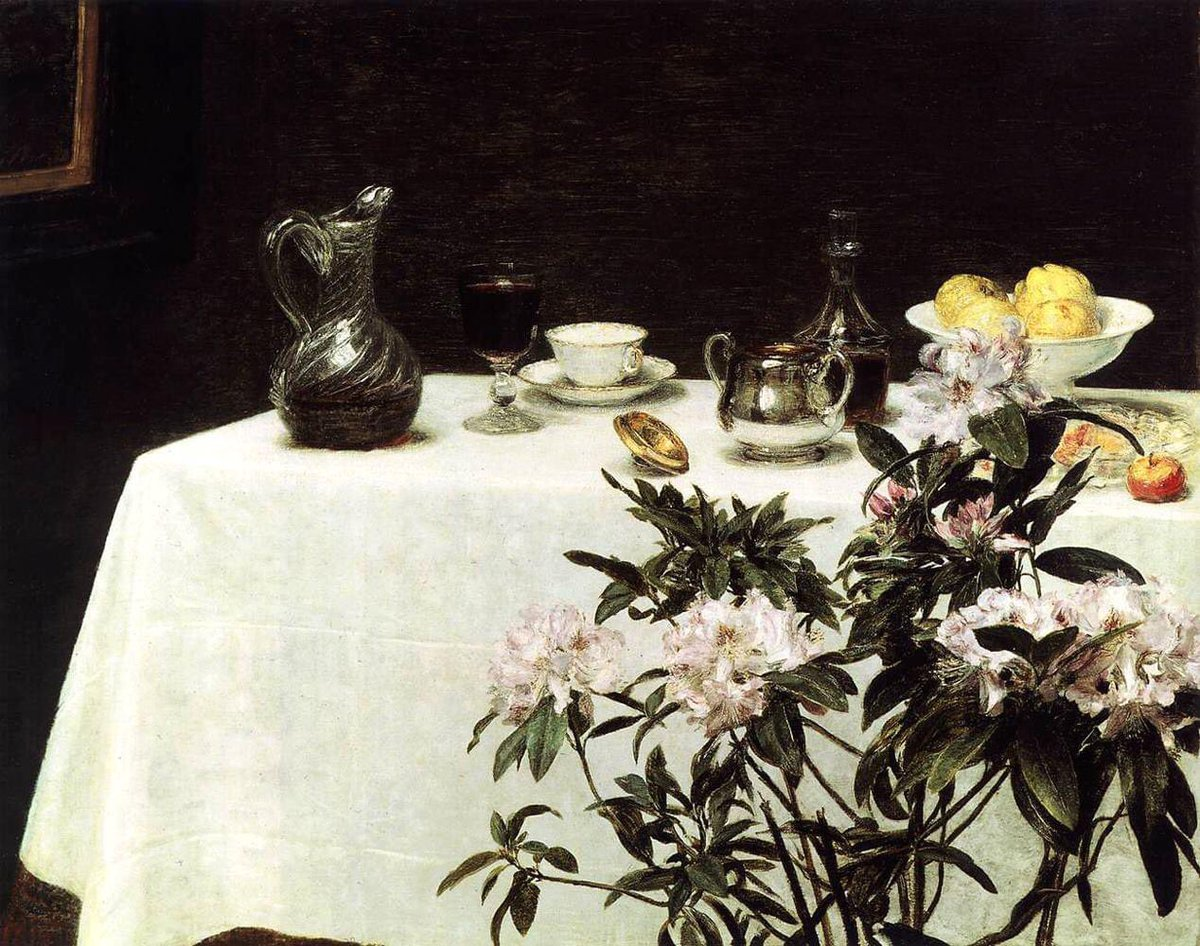
Henri Fantin-Latour, Le coin de la table (1872)

Dwyer Murphy, The Stolen Coast

A rare heist novel where the heist, though satisfying, isn’t the main attraction. I loved this stylish, smart, funny tale of a man who has put his Ivy League law degree to use in taking over the family business: giving new identities to guys on the run and getting them the hell over the border. A great book of off-season resort towns.

Simon Jimenez, The Vanished Birds

I’m still getting my bearing in contemporary sff so take these comments for what they’re worth, but it seems rare to me that a book takes as many swerves as this one: the narrative moves back and forward in time and all over the place, from a near-future nearly uninhabitable earth to a galaxy far-away in space and time. You get invested in a storyline and then it ends but sometimes it comes back. But even more than the structure I loved this book for its emotional seriousness: its many relationships are doomed to fail because of their constitutive circumstances. For example: a man ages fifteen years between each meeting with his beloved, while she, thanks to intricacies of stellar time travel, has only aged a few months. The emotions might be bigger than the ideas, but I was totally okay with that.

Two novels by Katherena Vermette

One of the greatest working Canadian writers. This year, fresh off the thrill of teaching The Break to smart, appreciative students, I read The Strangers and The Circle, a bleak and beautiful trilogy of indigenous life in the aftermath of the cultural trauma of the residential school system.

Four novels by Kent Haruf

It should tell you something that in early April, one of the worst times in the academic year, I read four novels by Kent Haruf in just over a week. I loved Plainsong the most but enjoyed Eventide, Benediction, and Ours Souls at Night almost as much. Easy reading, sure: plain syntax rising to gentle arias, nothing fancy, maybe a little sentimental. But these books are so warm and kind. Each is set in Holt, Colorado, out on the eastern plains, where the mountains are a smudge on the western horizon and it’s sometimes hot and sometimes cold but always dry. The people are ranchers and school teachers and social workers and hardware store owners and ne’er-do-wells and retirees. Everyone is white and no one thinks that’s worth noticing. The time is hard to pin down. Sometimes I thought the 70s or early 80s but we’re probably talking the 90s. Things were different before the internet. The characters’ lives are modest and they seem fine with that. They go about their business, do their work, make good choices and bad ones. People look out for each other, but they judge each other, too. Little kids get lost biking, but they come home again. It’s not all roses, though. High school boys bully girls into having sex, over in that abandoned house just down from where the math teacher lives. People get sick, go hungry, lose jobs. Some characters get what the preacher will call a good death, some die unreconciled to their kin, some without warning, too soon. Life just keeps happening, you know?

Some readers will call this hokum, but I ate it up. Haruf won my heart. I thought him especially good on second chances and unexpected turns of fate. Of all the stories that weave through these loosely connected novels, the best concerns two brothers, old bachelors, ranchers, who agree to take in a pregnant teenage girl and who, to everyone’s surprise, not least their own, form a new family with her. That scene where they take into the next town over to get things for the baby and insist on buying the best crib in the store? Magic.

Garth Greenwell, Cleanness

Smart, sexy, stylish books about how we relate to bodies privately and publically, and whether we can recast the narratives that have shaped aka deformed our understanding of what it is to live in those bodies. Greenwell’s Substack is worth subscribing too; he makes me curious about whatever he’s curious about. Can’t wait for the essay collection he’s writing.

Emeric Pressburger, The Glass Pearls

Yep, that Pressburger. Closer to Michael Powell’s Peeping Tom than any of the (indelible) films they made together. Karl Braun, a German émigré, arrives at a boarding house in Pimlico on a summer morning in 1965. A piano tuner who never misses a concert, a cultured man, a fine suitor for the English girl he meets through work. I’m not spoiling anything to say that Karl isn’t just quiet: he’s haunted—and hunted. For Karl Braun is really Otto Reitmüller, a former Nazi doctor who performed terrible experiments, a past he does not regret even as he mourns the death of his wife and child in the Hamburg air raids. Now the noose is tightening and Otto/Karl goes on the run… Suspenseful stuff; most interesting in this play with our sympathies. Not that we cheer for the man. But his present raises our blood pressure as much as his past.

Toni Morrison, A Mercy

A short book that covers as much ground as an epic; a historical novel that feels true to the differences of the past but that is clearly about the present; a classic modernist Morrison text, where the first page tells you everything that’s going to happen except that it makes no sense at the time and the rest of the reading experience clarifies, expands, revises. Such beauty and mystery in so few pages.

Roy Jacobsen’s Barrøy series (Translated by Don Bartlett and Don Shaw)

Cheating a bit since I read the first one in December 2022. I’m a huge fan of these novels about a family and the remote Norwegian island they call home from 1900 to 1950. I like books where people do things with their hands, maybe because I can’t do much with mine. The characters bring sheep into the upper field, fish with nets and line, salt cod, keep the stove burning all through the year, row through a storm, carry an unconscious man through sleet. It’s all a little nostalgic, a little sentimental, but not too much. Just how I like it.

Two Books by Walter Kempowski (Translated, respectively, by Michael Lipkin and Anthea Bell)

Fresh on my mind so it’s possible I’ve overvalued them but I don’t think so. All for Nothing, especially, is something special.

George Eliot, Middlemarch

Last read in college—under the expert tutelage of Rohan Maitzen, this can only be called one of the highlights of my undergraduate experience. This time I listened to Juliet Stevenson’s recording, which perfectly filled a semester’s commuting. True, Arkansas traffic is not the ideal venue for some of Eliot’s more complex formulations, but Stevenson (as much a genius as everyone says, she do the police in different voices, etc.) clarifies the novel’s elegant syntax and famous images. The book’s the same, but I’m not; a whole new experience this time around. Much funnier, especially its early sections. (Celia is a triumph.) More filled with surprising events: that whole Laure episode (a Wilkie Collins novel in miniature), it was as if I’d never read it. And more heartbreaking: in 1997, I hated Rosamond, and I admit I still felt for Lydgate this time around, but I had so much sympathy for her, a character I’d only been able to see as grasping and venal. Speaking of sympathy, one of the glories of English literature lies in watching Dorothea as she matures from excitable near-prig to wiser and sadder philanthropist. Amidst all this change, though, some things stayed the same. Mary Garth still won my heart; the suspense at the reading of Featherstone’s will gripped me just as much.

It’s good to read Middlemarch in college. It’s better to re-read Middlemarch in middle age. It’s best to read Middlemarch early and often.

Konstantin Paustovsky, The Story of a Life (translated by Douglas Smith)

Six-volume autobiography of Soviet writer and war correspondent Paustovsky, a Moscow-born, Ukrainian-raised enthusiast of the Revolution who somehow made it through Stalinism to become a feted figure of the 1960s. The new edition from NYRB Classics contains the first three volumes. I only read the first two, not because I didn’t enjoy them (I loved them) but because I set the book down to read something else and the next thing I knew it was a year later. Paustovsky had something of a charmed life. His childhood was largely downwardly mobile, and he lived through so much terror and upheaval. And yet he always seems to have landed on his feet. Maybe as a result—of maybe as a cause—he looks at the world with appreciation. He can sketch a memorable character in a few lines. He writes as well about ephemera (lilacs in bloom) as about terror (I won’t soon forget his time as an orderly on an undersupplied hospital train in WWI). He can do old-world extravagance (the opening scene is about a desperate carriage ride across a river raging in spate to the otherwise inaccessible island where his grandfather lies dying) and the brittle glamour of the modern (for a while he drives a tram in Moscow). Trevor Barrett, of Mookse & Gripes fame, said it best: Paustovsky is good company. I really ought to read that third book.

Félix Vallotton, Still Life with Flowers, 1925

A few other categories:

Didn’t quite make the top, but such pleasurable reading experiences: Adania Shibli, Minor Detail; Paulette Jiles, Chenneville; Abdulrazek Gurnah, By the Sea; Jamil Jan Kochai, The Haunting of Hajji Hotak and Other Stories (teaching “Return to Sender” was a revelation: fascinating how even students who had seemed immune to literature shook themselves awake for this one).

Read with dread and mounting desperation, don’t get me wrong it’s a banger, but couldn’t in good conscience call it a pleasure to read: Ann Petry, The Street. Barry Jenkins adaptation when?

Maybe not standouts, but totally enjoyable: Margaret Drabble, The Millstone; K Patrick, Mrs. S; Yiyun Li, The Vagrants; Elif Batuman, Either/Or

Best dip into the Can-con vaults: Margaret Laurence, The Stone Angel. Got more about of this now than I did in high school, lemme tell you.

Best book by a friend: James Morrison, Gibbons or One Bloody Thing After Another: Not damning by faint praise. It’s terrific!

Book the excellence of which is confirmed by having taught it: Bryan Washington, Lot. Maybe the great Houston book. I get that novels sell but I wish he’d write more stories.

Grim, do not recommend: Larry McMurtry, Horseman, Pass By; Girogio Bassani, The Heron

Not for me: Jenny Offill, Weather; Annie Ernaux, Happening; Yiyun Li, The Book of Goose

Planned on loving it, but couldn’t quite get there: Julia Armfield, Our Wives Under the Sea. Sold as metaphysical body horror, this novel about a woman who goes to pieces when her wife returns from an undersea voyage gone catastrophically wrong as a kind of sea creature didn’t give me enough of the metaphysics or the horror. I figured it would be perfect for my course Bodies in Trouble but I couldn’t find my way to assigning it. Possibly a mistake: teaching it might have revealed the things I’d missed. Gonna trust my instincts on this one, tho.

The year in crime (or adjacent) fiction:

Disappointments: new ones from Garry Disher, Walter Mosley, and S. A. Cosby (this last was decent, but not IMO the triumph so many others deemed it; he’s a force, but I prefer his earlier stuff).

Standouts: Celia Dale, A Helping Hand: evil and delightful, can’t wait to read more Dale; Lawrence Osborne, On Java Road: moody, underappreciated; Christine Mangan, The Continental Affair: moody, underappreciated; Allison Montclair, The Right Sort of Man: fun; Joseph Hansen: wonderful to have the Dave Brandsetter books back in print, hope to get to more in 2024; Richard Osman: as charming, funny, and moving as everyone says.

Maigrets: Of the six I read this year, I liked Maigret and the Tramp best. Unexpectedly humane.

Giants: Two Japanese crime novels towered above the rest this year. I didn’t write about volume 2 of Kaoru Takamura’s Lady Joker (translated by Marie Iida and Allison Markin Powell) but maybe my thoughts on volume 1 will give you a sense. Do you need a 1000+ page book in which a strip of tape on a telephone poll plays a key role? Yes, yes you do. (Also, it has one of the most satisfying endings of any crime novel I’ve ever read.) More on Hideo Yokoyama’s Six Four (translated by Jonathan Lloyd-Davies) here. Do you need an 800+ page book in which phone booths play a key role? Yes, yes you do.

The year in horror:

Victor LaValle, Lone Woman: horror Western with a Black female lead and not-so-metaphorical demon, enjoyable if a bit forgettable; Jessica Johns, Bad Cree: standout Indigenous tale, also with demons; Leigh Bardugo, Hell Bent: serious middle-volume-of-trilogy syndrome. Many demons, tho.

The year in sff:

In addition to Simon Jimenez, I liked Ann Leckie’s Translation State, Nick Harkaway’s Titanium Noir, and, above all, the three novels by Guy Gavriel Kay I read this summer, which gave me so much joy and which I still think about all the time.

The year in poetry:

Well, I read some, so that’s already a change. Only two collections, but both great: Wisława Szymborska’s Map: Collected and Last Poems (Translated by Clare Cavanaugh and Stanislaw Baranczak), filled with joy and sadness and wit, these poems made a big impression, and Ilya Kaminsky’s Deaf Republic (fortunate to have met him, a mensch; even more fortunate to have heard his indelible performance).

The year in German books: I read two, liked them both. Helga Schubert, Vom Aufstehen: Ein Leben in Geschichten (On Getting Up: A Life in Stories), vignettes by an octogenarian former East German psychotherapist who had fallen into oblivion until this book hit a nerve, most impressive for the depiction of her relationship to her mother, which reminded me of the one shared by Ruth Kluger in her memoir; Dana Vowinckel, Gewässer im Ziplock (Liquids go in a Ziplock Bag): buzzy novel from a young Jewish writer that flits between Berlin, Jerusalem, and Chicago. The American scenes failed to convince me, and the whole thing now feels like an artefact from another time, given November 7 and its aftermath. I gulped it down on the plan ride home, though. Could imagine it getting translated.

Everyone loved it; what’s wrong with me? (literary fiction edition):

Made it about 200 pages into Elsa Morante’s 800-page Lies and Sorcery, newly translated by Jenny McPhee. Some of those pages I read raptly. Others I pushed through exhaustedly. And then I just… stopped. The publisher says it’s a book “in the grand tradition of Stendhal, Tolstoy, and Proust,” and I love those writers. (Well, I’ve yet to read Stendahl, but based on my feelings for the other two I’m sure I’ll love him too.) Seemed like my social media feeds were filled with people losing it over this book. Increasingly, I see that—for me, no universal judgment here—such arias of praise do more harm than good; I experience them as exhortations, even demands that just make me feel bad or inadequate. Increasingly, too, I realize how little mental energy I have for even mildly demanding books during the semester. (A problem, since that’s ¾ of the year…) I might love this book in other circumstances —I plan to find out.

Everyone loved it; what’s wrong with me? (genre edition):

Billed as True Grit set on Mars in alternate version of the 1930s, Nathan Ballingrud’s The Strange indeed features a young female protagonist on a quest to avenge the destruction of her family, but Ballingrud is no Portis when it comes to voice. True, I was in the deepest, grumpiest depths of my slough of despondent reading when I gave this a try, so I wasn’t doing it any favours. But that’s a nope from me.

Other failures:

Mine, not the books. Once again, I read the first hundred or so pages of Anniversaries. It’s terrific. Why can’t I stick with it? I read even more hundreds of pages of Joseph and His Brothers, as part of a wonderful group of smart readers, most of whom made it to the end of Thomas Mann’s 1500-page tetralogy. I loved the beginning: fascinating to see Mann’s take on the stories of Genesis; interesting to speculate on why Mann would write about this subject at that time. (For me, Mann is in dialogue with Freud’s Moses and Monotheism, another oblique response to fascism through stories from Torah.) My friends tell me it got a lot more boring shortly after I left off (the end of volume 2), but that’s not why I gave up. Turns out, I don’t do well if I’m supposed to read something in regular, little bits. I need to tear into books—and I wasn’t willing to make the time for this chunkster. Sorry, guys.

Odds & Ends:

A few albums that stood out: Roy Brooks, Understanding (reissued in 2022, but I’m not over it: this quintet, man, unfuckingbelievable); Taylor Swift, Midnights (I love her, haters go away); Sitkovetsky Trio, Beethoven’s Piano Trios [volume 2] (a late addition, but pretty much listened to it nonstop in December and now January).

After a decade hiatus, I started watching movies again. Might do more of that this year!

I was lucky enough to travel to Germany in late spring with a wonderful set of students. While there, I met so many people from German Book Twitter who have become important to me, including the group chat that got me through covid and beyond. (Anja and Jules, y’all are the best.) All these folks were lovely and generous, but I want to give special thanks to Till Raether and his (extremely tolerant) family, who took me in and showed me around Hamburg. (Great town!) Have you ever met someone you hardly know only to realize they are in fact a soulmate? That’s Till for me. What a mensch. Cross fingers his books make it into English soon. In the meantime, follow him on the socials!

Reading plans for 2024? None! I need fewer plans. I can’t read that way, turns out, and maybe I’ll avoid disappointment by committing less. Gonna be plenty of other disappointments this year, I figure. No need to add any self-inflicted ones. At the end of last year, I joined a bunch of groups and readalongs, because I want to hang with all the cool kids, but I can already see I need to extricate myself from most of them. One good thing I did for myself in 2023, though, was to stop counting how many books I read. I was paying too much attention to that number. Fewer statistics in 2024!

Piet Mondrian, Oranges and Decorated Plate, 1900

Finally, to everyone who’s read the blog, left a comment or a like, and generally supported my little enterprise (which turns 10 in a week or two…), my heartfelt. I do not know many readers in real life. You all are a lifeline.

What I Read, August 2023

We went east through southern Alberta and Saskatchewan, where the drought is bad, all the sloughs empty and cracked, the occasional cattle herds dazed under unrelenting sun. Farther south they’d had more rain; we crawled for an hour or so through a pelting storm near the South Dakota Iowa line. Towns that depress you from the highway reveal unexpected delights when you stop for a minute. The perfectly preserved 50s downtown of Swift Current. A hipster café in Fargo on market day. The sophistication of Omaha. (Love that town.) And then we were back home, where it hasn’t rained in weeks and the wet bulb readings have been frightening. The trees shed leaves by the minute. We probably lost the plum. I hope the cherry makes it.

Nothing for it but to stay inside and read.

Agnes Martin, Buds ca. 1959

Helen Dunmore, A Spell of Winter (1995)

This Gothic WWI-era novel about a girl and her brother raised in a crumbling manor house by their grandfather after their mother absconds and their father goes mad won the inaugural Orange Prize. As the siblings grow to adulthood, they live in dreamy/nightmarish seclusion, seeing only a governess they hate and eventually get rid of and the housemaid, a young Irish woman whose perspicacity fails only at one crucial moment. Some pretty heavy-duty and salaciously over-the-top things (I said it was Gothic, right?) make for gripping reading, but in the end, I don’t know that it amounts to much. It hasn’t stayed with me the way Dunmore’s Birdcage Walk and The Siege have; it’s not as brilliant as, say, Andrew Miller’s Now We Shall Be Entirely Free. But it’s plenty enjoyable, especially on a hot day when all you want to do is read about drafty English houses.

Elizabeth Jane Howard, Something in Disguise (1969)

Novel about a misguided second marriage and the couple’s adult children who mostly fail to find their way through life. I cannot improve on Jacqui’s deft summary of its busy events: do take a look. Like her, I was unpersuaded by the book, though to be fair the title drops what in retrospect should seem a glaring clue that things aren’t as they first seem. It’s impossible to say anything about this book without spoiling things, so look away friends if that sort of thing bothers you. I was certainly shocked by the ending—props to any reader who isn’t—and admired (but didn’t appreciate) the sudden swerve not just to the macabre but something closer to sadism. Quite the trick to turn a novel of manners into something like Cammell and Roeg’s Performance. Normally that kind of uncanny reversal would be just my thing. But Howard doesn’t play fair. Maybe if I read the book again I’d see the breadcrumbs, but on a first reading, anyway, I felt she’d pulled a bait and switch. Impressively so, maybe, but I still felt duped.

I gather the team at Backlisted likes the book a lot; if anyone can convince me to think better of the book it’s them. (Breaking news: apparently Jacqui reread it and liked it much more…) But for now the jury is out for me on this writer. I enjoyed the first Cazalet, but abandoned the second. Maybe Howard, despite being a midcentury British novelist named Elizabeth, isn’t for me.

Guy Gavriel Kay, The Children of Earth and Sky (2016)

The book that spawned the two prequels I loved so much last month. It won’t surprise you when I tell you I loved it too. Did I mention these books have maps? Goddamn I love maps.

Jessica Johns, Bad Cree (2023)

Mackenzie left her home in northern Alberta a couple of years ago after the sudden death of her beloved sister. She’s made a quiet life in Vancouver: a steady if soul-destroying job at Whole Foods, a close friend who looks out for her, the anonymity of the city after her small-town childhood. But lately she’s been having dreams. Bad dreams. And the boundaries between waking and dreaming are getting harder to parse. Why are all these crows outside her window all the time? Maybe because she woke up one morning with the severed head of a bird in her bed. There’s nothing for it: she’ll have to beg for time off and fly home to come to terms with everything there she ran away from.

The set-up for Johns’s debut novel is actually the weakest part. I almost it down about thirty pages in—despite its extreme events nothing about the book felt urgent. But when Mackenzie comes home the book gets going. I loved its depiction of the northern Alberta bush, the town where a trip to the Seven Eleven is a big deal, the lake where her family picnics, the silent oil rigs, abandoned when crude fell below $100 / barrel. Johns’s depiction of Mackenzie’s extended family is terrific: bring on the cups of tea, the card games, the pots of mac and cheese, the good dogs sighing under the table, I can’t get enough of that shit. And the story’s horror elements—Mackenzie is possessed by a windigo—make so much sense as an allegory for the depredations and violence of a resource extraction economy.

Pair with Kate Beaton’s Ducks, the white settler version of this story, or simply enjoy on its own.

K. Patrick, Mrs. S (2023)

As a dogsbody at a girls’ boarding school in England in the 90s, the narrator of K. Patrick’s smart and sensual debut novel does whatever she’s told. One of her jobs is to supervise prep, the two hours after dinner when the girls work on their homework. Sitting in a classroom, the day’s Latin lesson still on the board, she muses with her customary acuity on the relationship between bodies and language:

On the chalkboard behind, an exercise in a grammar of belonging, he or she or we or they, the types of bodies changing the next word. It looks difficult. Pointless.

That mingling of the staccato and the sinuous is characteristic of the narrator. She is known only as Miss, just as other characters are referred to by their function: the Housemistress, the Art Teacher, the Vicar. Only the headmaster and his wife have names, but even they are known only in abbreviation (Mr. and Mrs. S.), as if they’d stepped from one of Freud’s case studies. The narrator is unimportant to the life of the school—Miss is there only for a year, fresh from the Australian Outback—which means she goes everywhere, sees everything, is seen by no one, bolstered by the freedom of her insignificance.

Patrick pulls off a difficult trick: her narrator is often inarticulate to others, scrubbed and raw, at sea in this foreign place, yet also as nuanced in her observations and interpretations as a character from Henry James.

Maybe it’s this juxtaposition between empty surface and full interior that proves attractive to the woman who gives the book its title. Over the course of a dry, burning summer, the narrator sets herself to seducing Mrs. S. It won’t spoil much to say that she does; it spoils more to say that she does so not in the way Mrs. S does, governed as the older woman is by a love of transgression she is allowed thanks to her privilege, nor in the way of her friend, the Housemistress, a butch lesbian whose bravado must be kept closeted to keep the job she both needs and loves. The narrator instead is a queer Bartleby, though her preferring not to does not extend to her sex life, which is lusciously depicted. (The book is hot.) (Also, Bartleby was already queer.)

Patrick’s strategy of embedding dialogue within the interior monologue without attribution forces us to slow down, to go backward in the light of new information to re-read earlier sentences, to play a detective game: who speaks to whom? As Frances put it in our conversation about the novel on One Bright Book, Mrs. S is fascinated by scripts: what it means to follow one, what it means to live without one.

An impressive debut that can go in the pantheon of great summertime novels (Bear, The Go-Between, A Month in the Country).

Garry Disher, Day’s End (2022)

Regular readers will know that I’m a huge Hirsch fan, my favourite procedural series of the moment. But despite featuring some of the books’ regular pleasures—Hirsch himself of course, his morning walks around his south-central Australian town, and the long drives along fearsome backroads to check in on his far-flung community members—Disher tries to do too much here. True, this is the most effective use of life during covid I’ve seen in a crime novel (the cops actually put on masks!), and believe me I am alive to the dangers of authoritarianism, extremism, and illiberalism that our time is giving rise to, but the last third of the novel is too schematic. It’s a lot to show in just a couple hundred pages how online bullying, drug dealing, and alt-right militarism combine, to say nothing of how some ordinary people, a little bored and frightened and underemployed could be seduced by the new fascism. I’m a Disher fan for life but if you don’t know him yet don’t start here.

Ann Leckie, Translation State (2023)

Having done a little reading around I now realize that Leckie’s latest sf novel is set in a universe she has already detailed in earlier books. Possibly I would have had an even richer experience had I read them first. But I still thought this was terrific. It won me over even though it switches among three narrators (a structure that usually gets on my nerves).

Leckie’s universe is a place of many genders. As this smart review puts it:

Leckie uses both sie/hir/hirs and e/em/eir as pronouns for nonbinary genders in this setting, in contrast to they/them pronouns, which designate agendered or genderless identities.

We meet Enae (sie/hir) after the death of her grandmaman, a fearsome character who made Enae’s life difficult, not least when it is posthumously revealed that the old woman had sold her estate and title to an upstart years ago to save herself from financial ruin. Enae no longer has a home; sie does, however, have a new purpose. The person who displaced hir is required by the terms of the sale to provide for Enae, which she does by sending hir on what she imagines will be a fruitless investigation: to find someone who went missing 200 years ago. But Enae has more guts and abilities than anyone credits hir for; sie finds the offspring of the missing person, a man named Reet who grew up with three adopted parents (two of whom use female pronouns and one nonbinary), a likeable misfit who spends much of his time watching a serial called Pirate Exiles of the Death Moon, which helps him damp down an alarming desire to bite people. Reet, it turns out, is what’s called a Presger Translator, a version of the alien Presger bred to interact with humans. (The backdrop of the book is the re-negotiation of a longstanding peace treaty between humans and the Presger.) When Reet’s background is revealed, he falls prey to political machinations, the gist of which is that he is expected to “match” (biologically and psychologically meld with) another Presger Translator, Qven (they/them), who is recovering from an assault and struggling with their desire, encouraged by Reet, to self-dentify as human. As part of this process, they begin using e/em/eir pronouns: as the LARB essay notes, pronouns are a big deal in this book, misgendering being a form of violence. The plot hinges on whether Reet (who has never known any other life) and Qven will be granted their wish to be accepted as human, with grave consequences for the political situation of Leckie’s universe, and clear analogues to our own cultural moment, where a vicious backlash against trans and nonbinary people teeters on the edge of full-scale murderousness.

My sense is that Leckie is in line with a lot of the coolest stuff going on in sff these days (though she might be a bit brainier than some), but this sure isn’t the kind of thing the genre has historically been associated with. I hope readers who don’t read a lot of sff will give it a try. It’s also quite funny, I don’t think I made that clear!

I listened to the audiobook narrated by British actress Adjoah Andoh (Lady Danbury in Bridgerton), and if the book interests you at all, I recommend her rendition highly. Her accents, ranging from Scottish to gorgeous West African, are a delight.

Yiyun Li, The Vagrants (2009)

Li’s absorbing, despairing novel of post-Maoist China gripped me from the start. The setting is a provincial city hundreds of miles from Beijing, where the Democracy Wall Movement briefly promises change of the sort Li’s characters cannot imagine, caught up as they are in navigating the broken social structures left to them by the Maoist Revolution: families at odds with each other, domestic violence, hunger, fear. The Vagrants of the title are its central characters, more or less loosely connected, in large part because they live in an especially impoverished neighbourhood in the (fictional) city of Muddy River. Many of them are children, perhaps because Li, born in 1972, grew up in the China of the period, and perhaps because children are the ones least able to exert their own agency (under the tyranny of their parents and the indoctrination of their schools) but also the most free from strictures, in the way of a kid who can take the long way home from school without anyone asking where they’ve been.

We meet the schoolboy Tong, who loses his dog, his only companion, and inadvertently ruins his feckless but innocent father’s life. And twelve-year-old Nini, disabled from birth, perhaps because her mother was beaten by an apparatchik while pregnant (that very true believer is the woman who, having fallen from favour, has been condemned and whose execution is the occasion of the public holiday with which the book opens), Nini’s bleak life of toil and punishment seems to change when a privileged young man named Bashi takes an interest in her that is equal parts prurient, exploitative, and touching. The adult characters include Kai, a radio broadcaster who joins an underground movement at enormous cost to everyone around her, and the former teacher Gu, whose daughter is the condemned woman , and who retreats in pain and shame into memories of pre-revolutionary life even as his second wife, his former student, is radicalized by her child’s fate. Wonderful characters all, portrayed with the clarity of Chekov.

I don’t hear Li’s early work talked about much: based on the two of her more recent books I’ve read she now writes in a different vein, less realist, more first-person fabulist a la Lydia Davis or Sigrid Nunez. But when it was published The Vagrants got some thoughtful reviews. True, the framing of Pico Iyer’s New York Times review, for example, is preposterous in its vapid hymn to multiculturalism—” All the world’s stories are America’s stories now, and this is the current glory of our literature”: did we believe that stuff even then?—but he offers some impressive readings of the novel, noting how Li equates the moral failings of the nation with the violation of Gu Shan’s body, which is cut apart for reasons of punishment, graft, and perversion (vocal cords severed before execution so she cannot shout out, kidneys given to an aging military leader, breasts and genitals hacked out by the man hired to bury her). And I’m interested, if not fully convinced, by Iyer’s suggestion that The Vagrants is less a novel than a “counter-document of sorts, a private, unsanctioned portrait of those interiors (in every sense) that are always left out of the grand official picture.” I mean, yes, that’s true, but I don’t see why Iyer’s imagined genre of the “counter-document” would be at odds with the novel.

Anyway, the older I get the more I want fiction to teach me about times and places I don’t know, and The Vagrants succeeded brilliantly on this front. (I’d love to hear if readers who know more about 20th-century China than I do—all of you probably—feel similarly.) Even more than its historical realism, though, I appreciated its evenhandedness about the possibility of solidarity or connection under an oppressive regime. The bonds between society’s vagrants, the refuse left behind by the unrelenting violence of ideology, are built on the sandy foundation of fear but their buildings stand nonetheless. Li has what I take to be the novelist’s quintessential ability to ironize but not demonize. There’s no one to like in this book, but everyone to feel for.

Georges Simenon, The Judge’s House (1942) Trans. Howard Curtis (2015)

Maigret has been exiled to the Vendée because he pissed off his superiors in some unexplained fashion and now he’s bored. The smell of his colleague’s Brillantine is making him crazy and just how many mussels can he eat? (Quite a few, actually.) But then some local busy-bodies, husband and wife, come to him with a story about a dead body in the upper room of the manor house of the local grandee, a former judge, a room the married couple can see from a tree in their garden, a tree they just happened to be climbing.

Sure enough, there’s a body; Maigret catches the judge trying to dispose of it under cover of stormy night. The man claims to have no idea who it is, which preposterous right? turns out to be true. A complicated plot involving the judge’s adult children, his daughter’s lover, the judge’s own criminal past, and his ex-wife ensues. Maigret unravels it all, of course, and presumably gets back to Paris (I can’t even remember). Not my favourite Maigret, but it has its moments. Be warned, though, it’s at least a 6/10 on the misogyny scale.

Agnes Martin, Friendship, 1963

Fun reading month! See anything you like here?

What I Read, July 2023

How good to escape summer in the South! How good for the soul to be back in the mountains! How good for the body to be somewhere with paths and trails and sidewalks! About halfway through July I realized I’d been in a reading slump for a long time, most of the year really. I’d been reading, but from compulsion not joy. Books were like ash in my mouth. What I needed was to do the opposite of what I’d been doing—slow down the reading, do some other things, occupy my body more than my mind. And then a chance encounter gave me my reading mojo back.

Peter Whyte, Mount Rundle from Vermilion Lakes, n.d.

Hideo Yokoyama, Six Four (2012) Trans. Jonathan Lloyd-Davies (2017)

The second terrific long novel about the failure of Japanese political and social institutions disguised as a procedural I’ve read in the past year. For a while I thought Yokoyama was more despairing, even more cynical than Takamura in Lady Joker about the possibility that institutions like the press, the police, and the political system could be reformed. But by the end of the Six Four I’d changed my mind. In the end, I think Takamura’s is the more coruscating and thorough-going treatment. But Six Four is the more conventionally suspenseful book.

Named after the last year of the Shōwa era (1989), when, in the first days of January, coincidentally the last of Hirohito’s life, a seven-year-old girl is kidnapped and murdered when the ransom drop goes haywire. Fourteen years later the case remains unsolved. Mikami, one of the detectives on the original team and the novel’s protagonist, has become his department’s press officer. As a result of some truly complicated inter-organizational machinations, he reinvestigates the case in secret. These efforts take on extra resonance because his own (much older) daughter has disappeared. Among other things, this is a novel about shame: national, cultural, and personal, the latter exhibited in Mikami’s painful near-inability to open up to his wife, a former cop. (One of the indirect lessons of this book, even more than in Lady Joker is to not be a woman in Japan.) If you like intricate and satisfying plots and/or the minutiae of bureaucratic politics, you’ll love this chunky boi.

I read it under a canopy in a friend’s backyard in Salt Lake City, and that was very nice.

Margaret Drabble, The Millstone (1965)

When I chose The Millstone from among three or four orange-spined Penguin Drabbles at a used bookstore I wasn’t thinking of the scene in which a toddler eats several pages of her mother’s novelist roommate’s typescript, which Ursula LeGuin quotes to memorable effect in one of the essays I’d read the month before. Nor was I thinking ahead to the decision I’d have to make a week later about what book to schlep with me on the ten-mile-hike to Shadow Lake Lodge for a glorious hiking vacation, though it turned out that this slender book—made possible by some truly excruciatingly tiny type—was perfect.

No, what I was thinking at the time was that I’d been meaning to read Drabble for a while and the Nic Roeg-Don’t Look Now-psychosexual-horror vibe of the cover was calling to my 1970s soul. No sooner had I returned to cell range from the mountains than I learned that Backlisted had just released an episode on this very book. So the whole thing was clearly Bashert. (This was not my favourite episode of the podcast, to be honest, even though my secret celebrity crush Lucy Scholes is a guest, but I did appreciate the panel’s thoughts on how important the NHS is to the novel—not an angle I’d have considered.)

Besides, how could I not have bought a book that starts with a line of positively Brooknerian perfection:

My career has always been marked by a strange mixture of confidence and cowardice: almost, one might say, made by it.

I do love me a nice hedge—that “strange mixture,” that “almost,” the circumlocutionary “one might say.” Funnily enough, the character making this statement is anything but cowardly or unconfident in her professional life, where she moves through an academic career with unflagging industry. Her personal life, though, is another story. There she is hapless and diffident—but also, in the end, in her way, satisfyingly triumphant. As Rosamund Stacey tells us on the final page, she has “lost the taste for half-knowledge.” Gone is the woman who carries on uninspiring and unconsummated relationships with two men at the same time, neither of whom she likes as more than a friend, if that, and who, with seemingly the worst luck in the world, falls pregnant after an absurd one-night stand with a gay man. Gone too is the woman whose hapless attempt at a bathtub abortion is foiled when some friends descend on her flat, drink most of the gin she’d bought for the deed, and then traipse off to a Fellini film. That woman is replaced by one who decides to have the child, who navigates a patronizing and patriarchal medical system, and who falls deeply in love with her baby, all the while balancing mothering and working. She’s no super-woman: she has the luxury of a flat left her by parents who are pursuing mildly Fabian-inspired good works abroad, a lodger (the writer whose pages get eaten and who is a pretty good sport about it: how differently Doris Lessing would have written that scene!) to help make ends meet, and, when the baby gets badly ill, a specialist who takes a special interest in the case thanks to family connections. But Rosamund stands up for herself and finds all the affection she needs from her child; we aren’t meant to think she is deluded or lacking.

A pleasant surprise—more Drabble is in my future.

Guy Gavriel Kay, A Brightness Long Ago (2019)

Guy Gavriel Kay has flitted along the edges of my reading life. Back in the 80s I had a copy of his first fantasy novel but I couldn’t make much headway: it was too sophisticated for the boy who was deeply into Dragonlance and Piers Anthony and David Eddings. (Pretty sure these were all in fact terrible books.) Later as a bookseller I worked with people who counted Kay a friend and raved about each new book. But I was disavowing fantasy then and even though I respected my friends as readers I felt the need to define myself by other kinds of books. I was older then, though; I’m younger than that now. I’ve been coming back to sff lately, convinced it’s the most vital genre of the moment. Plus I remember Levi Stahl repping this book and that’s usually all the recommendation I need.

So when I saw A Brightness Long Ago on the shelf of a Calgary bookstore I knew now was the time. What I didn’t know was how much joy I’d take from it; how much pleasure of the “leave me alone I’m reading I just gotta finish these last 200 pages” variety I’d set myself up for.

If you tuned out when you heard the word “fantasy” maybe I can get you back by admitting that I don’t actually understand why Kay’s books are categorized this way. To me they feel more like historical fiction, only the history is of an invented world, albeit one similar to the early modern period in Europe and the Near East. Specifically, the events of Brightness are modelled on the Italian Wars of the 15the century. (I think I read Kay say somewhere, or maybe someone saying it about him, I can’t remember now, that Dorothy Dunnett is a model. As I’ve yet to read Dunnett I can’t say.) Anyway, Kay has two great strengths: complex world building that reveals itself gradually and organically, and dramatic set-pieces that carry you away. Together they make him compelling conceptually and exciting narratively. Plus, his general mode seems to be rueful—in full awareness of the sadness of mortal life. And boy am I a sucker for rue. From the first scene—an assassination that I can only describe by the cliché “fiendishly clever”—I was enchanted. And feeling all the feels: sorrow, fear, exhilaration, and genuine surprise. (Good ending.)

Turns out this book (and the one that followed it, which of course I immediately read) is a prequel to his previous novel, but that didn’t make any difference.

Guy Gavriel Kay, All the Seas of the World (2022)

Features the same world and some of the same characters as A Brightness Long Ago. Also, pirates!

Sarah Shun-Lien Bynum, Ms. Hempel Chronicles (2008)

Many of Ms. Hempel’s students were performing in the show that evening, but to her own secret disappointment, she would not be appearing.

The opening sentence of Shun-Lien Bynum’s collection of linked stories tugged at me when I picked it off the half-price shelf at the bookstore in Canmore, AB. (Check it out, very cute!). I identify with that feeling of wanting to be seen (even as I also fear it), so that was part of the appeal. But what really drew me in was that second comma. Technically speaking unnecessary, right? To me, the effect is to create a greater sense of privacy (one of course open to readers), as if Ms. Hempel’s desires are kept from everyone but herself. A comma of self-knowledge. And these tales of a young middle-school teacher’s experiences in and around the classroom do contain a matter-of-fact wisdom. In this regard, Shun-Lien Bynum’s stories reminded me a little of Laurie Colwin’s descriptions of young New Yorkers in love, but I’m having a hard time articulating why: I mean more than the shared setting, more the way big events—breaking up with a fiancée, say—happen almost without comment while minor ones prompt lengthy reflection.

I’ll admit I wasn’t always equally engaged by Ms. Hempel’s travails. (The first and last pieces are the strongest.) But I loved the book’s depiction of teaching, of the mixture of pleasure and pain and gentle dismissal that teachers feel toward their students. Shun-Lien Bynum gets it. Ms. Hempel’s students are never cute or worldly wise or bleak ciphers symbolizing anomie. She cares for them in a free-floating, genuine, but distanced way that felt right to me; all the more striking for her, and for readers, when years later a chance encounter gives her a vertiginous glimpse into what that relationship had felt like from the other side.

The book’s all heart, without being cheaply heartfelt. Take this passage, again from the first page, a description of Adelaide Burr, “an avid appreciator of dance,” whose excitement about her upcoming performance in the school talent show burns in her so wildly she has to corner her teacher to tell her about it:

[Adelaide’s] first book report had celebrated in a collage (dismembered limbs; blue glitter) the life and contributions of Martha Graham, and her second, a dramatic monologue, was based on a bestseller written by a ballerina who had suffered through several disastrous affairs and then developed a serious cocaine habit. Adelaide seemed excited by the lurid possibilities. “Just imagine!” she said to Ms. Hempel, and clapped her hands rapturously against her thighs, as though her shorts had caught fire. The bodies of Ms. Hempel’s students often did that: fly off in strange directions, seemingly of their own accord. Now Adelaide told her that she had choreographed a solo piece to Beethoven’s Moonlight Sonata. Balancing precariously, she said, on a kitchen footstool, she had peeled the glow-in-the-dark stars off the ceiling above her bed. “I have incorporated them into my dance,” she said mysteriously.

Isn’t that great? That parenthesis! Gotta be a nod to Lolita, right? Except from the point of view of someone who actually cares for children.

I read The Ms. Hempel Chronicles fast, on my mother’s back deck, but I suspect that the book would repay re-reading. I might teach it someday.

Catharine Robb Whyte, Bow Peak, Bow Lake, ca. 1945

A small but not slim reading month if you know what I mean. I was glad to have read all of these books. And I owe Guy Gavriel Kay for making me fall back in love with the whole enterprise. More anon!