Nat Leach’s Year in Reading, 2025

Regular readers will know that for the last several years I’ve solicited Year in Reading reflections from friends and trusted readers. As we’re well into February, I’ve scaled the project back considerably this time, but I’ve got some good stuff coming your way over the next few days. Today’s installment, his seventh, is by my longtime friend Nat Leach. Nat is a nineteenth-century scholar turned college administrator who has spent the last 8 years reading the books on his shelves in alphabetical order. He lives in Ontario.
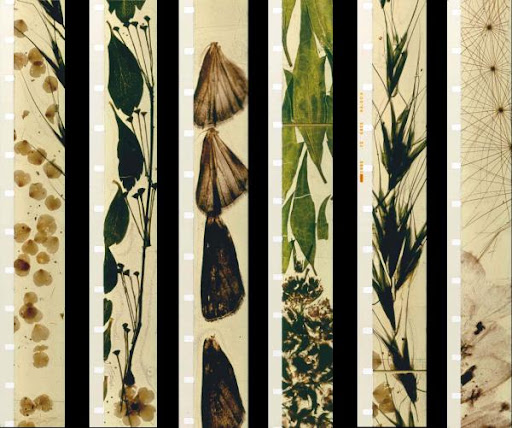
Stills from “Mothlight” (Dir, Stan Brakhage, 1963)

Looking back on my “year in review” posts, it occurs to me that I seem to have reached a reading plateau over the past few years: I’m reading more than I was able to some years ago, but still less than I wish I could. [Ed. – But don’t we always read less than we wish we could???] In the end, though, looking at the list below, I am grateful for what I have been able to read, and for this opportunity to write about my rather eclectic reading program.

In total, I read 35 books last year, though as always, this includes some works of philosophy, theory and criticism that I have been working on gradually for some time. In fact, I read only 10 novels, including finishing two that I already wrote about last year, although I did read more short stories and plays than in recent years.

As for my alphabetical reading project (last year was Year 8 if anyone is still counting), I spent pretty much the whole year working on “M” and didn’t quite get through it. But since “M” is a pretty massive literary letter, I am fairly satisfied with that progress, which means that, alphabetically at least, I am just about at the halfway mark of my project. [Ed. – Amazing!]

I notice that many of the reflections below contain memories and associations with my student days; this is perhaps natural, given that the intent of my project is to clear my TBR shelves of the books that have been there for a long time. I am in many cases finally reading those books I wanted to read during the first half of my life, and hopefully in that way achieving some kind of closure on that chapter before moving ahead to the next project (which, not coincidentally, I have already started to plan). [Ed. – Teaser!]

But before I get ahead of myself, here is what I read in 2025:

Marias, Javier – “Bad Nature” (1996) Trans. Esther Allen

I had never read Marias before, but stumbled across this story in an old edition of Granta that I was reading. It is a somewhat bizarre counter-factual narrative about a translator who worked for Elvis while he was shooting a movie in Mexico. [Ed. — !] I read it as a fable about translation itself; the translator strives very hard to render Elvis’s words accurately, but, in a dangerous context, finds himself facing the consequences of those words because the listeners hear only him saying them, and thus, they become his utterances, and no longer Elvis’s. This seems an apt emblem of the plight of translators in general, foregrounding the impossibility of complete transparency in rendering one language through another. Appropriate, of course, that I read it in translation.

Marlowe, Christopher – The Jew of Malta (1589)

It was perhaps a strange choice to read this terribly antisemitic Elizabethan play, but, as it was the only Marlowe play I hadn’t read, the completist in me felt the need to read it. It’s interesting mostly in contrast with Shakespeare’s The Merchant of Venice; while Shakespeare cultivates at least some level of sympathy for Shylock, Marlowe’s Barabas is a combination of an antisemitic stereotype and a Machiavellian schemer-villain common to Elizabethan revenge tragedy. Despite this, Marlowe interestingly makes clear that Barabas’s villainy is largely triggered by egregious injustices done to him by the Governor of Malta. Short on cash for the required tribute to pay off the Turkish empire not to invade the island, the Governor requires all Jews to pay half their wealth in tax. Those who refuse will have all their property confiscated. In fact, there is really nobody in the play who comes off particularly well (for example, there is a great deal of satire involving Catholic priests), but Barabas is clearly presented as the worst. [Ed. – Boo! Dislike!]

Marquez, Gabriel Garcia – One Hundred Years of Solitude (1967) Trans. Gregory Rabassa

I’m not sure whether Dorian remembers, but when we were both humble MA students, we had to sit a rather ridiculous “Graduate Record Examination” in literature as part of our applications to PhD programs. [Ed. – He sure does.] One of the few things I remember about this was that it included a section where we had to match up famous opening lines with the books from which they came. Most of the answers could be deduced from context fairly easily (the one about mines in Derbyshire was obviously Sons and Lovers, just as Colonel Aureliano Buendia remembering his father taking him to see ice had to be One Hundred Years of Solitude) but it did seem concerning to me that I hadn’t actually read any of these books, which apparently a well-read graduate student should know. [Ed. – Or know how to pretend they know.] This led me to buy all the books included in this question, although the fact that I am still working on finishing them gives the lie to the “well-read” part. [Ed. – See previous interjection.] Anyway, this is another one off that list, and is by turns great fun, horribly tragic, and totally exhausting (trying to remember all of the familial relations between the characters). And this exhaustion is, I think, part of the point of Marquez’s magic realist style, which contrasts linear history with a cyclical vision of human nature and development. The fictional setting of Macondo goes through a historical pattern that echoes that of many South and Central American countries: colonization, revolution, civil war, Imperialist/capitalist exploitation, etc. Against this backdrop, the Buendia family changes along with the country, even as it continually repeats and revises the past (a process most clearly demonstrated by the countless family members named Aureliano and Jose Arcadio throughout the many generations covered by the book). History changes and progresses, and at the same time, folds back on itself. [Ed. – I would like to read this book again. It’s been 35 years.]

Marquis, Don – archy and mehitabel (1927)

I still remember the day when my Grade 12 English class was assigned a poetry project, and our teacher pulled out a stack of photocopies of American poems (with no context) and asked us to select one. I immediately gravitated towards one called “The Lesson of the Moth.” Written in all lower-case letters with no punctuation, it describes the speaker’s encounter with a moth trying to fly into an electric light. The speaker asks why moths have this self-destructive urge and is told that it is because they crave beauty and excitement: “it is better to be happy for a moment and be burned up with beauty than to live a long time and be bored all the while.” The speaker disagrees with this view, saying that he would “rather have half the beauty and twice the longevity” but also rather ruefully concludes “i wish there was something i wanted as badly as he wanted to fry himself.” This poem resonated strongly with my teenaged self, and only later did I discover that the context is that the speaker is archy, a cockroach who types poems on Don Marquis’ typewriter after hours (hence the lack of upper-case letters or punctuation: archy can’t hold down the shift key). [Ed. — !!!] The poems typically revolve around archy’s interactions with other insects and animals, particularly mehitabel the cat, an aging feline who believes she is the reincarnation of Cleopatra. I realize now that this poem may not be quite as profound as my 17-year-old self found it, but I still love it, and I still have a soft spot for archy. I am also glad that I found a three-in-one volume that also includes archys life of mehitabel and archy does his part, so I still have more of him to look forward to. I also note that it is sad that the creation of archy would not have been possible in this computer age—unless we are to believe that a cockroach could turn on a computer and open Word. But that would be just plain silly, right?

Massinger, Philip – A New Way to Pay Old Debts (1625) and The Roman Actor (1626)

It must have been tough writing drama in the wake of some guy named Shakespeare. However well-crafted these plays may be, they invariably suffer by comparison. A New Way to Pay Old Debts is a comedy in which the avaricious Sir Giles Overreach [Ed. – Very subtle, the naming] is tricked by a would-be victim of his greed. It’s enjoyable, but a reader of Shakespeare’s plays can’t help but find the scheme by which the protagonists succeed to be quite simplistic. The Roman Actor is a tragedy of somewhat less merit, which begins with the conceit also explored in “The Mouse-Trap” scene from Hamlet, namely, that drama can be a surreptitious means to cultivate an awareness of guilt or wrongdoing in its audience. It doesn’t do a whole lot with this idea, though, and the play ends with fairly conventional devices depicting romantic jealousy and the downfall of a tyrant. And, frankly (spoiler alert!) [Ed. – No worries, Nat, you’ve read this for all of us, no one is gonna have anything spoiled], when the title character dies even before the final act, it’s hard to avoid the impression that the plot has not been fully thought through.

Maugham, Somerset – The Razor’s Edge (1944)

This book has the dubious distinction of being the book in this project that had been on my TBR pile for the longest time, having been first recommended to me by a friend in high school. [Ed. – That’s when I read it, and I think it’s the perfect time for it.] Fittingly, perhaps, it is a book that I think would land very differently for readers of different ages [Ed. – Aha!]; had I read this when I was younger, I certainly would have sympathized with Larry Darrell, a young man in search of greater meaning in his life than is being offered to him by capitalism and the American Dream. In my older age, though, I identified more with the perspective of Maugham’s narrator, a version of himself who provides a more critical view of Larry and his extended social set, including the compulsive socialite Elliot Templeman, and Larry’s erstwhile fiancée, Isabel Bradley, who has rejected him to retain her social position but still seems to harbour some regret. All in all, I enjoyed the book, although I can’t help but wonder whether the teenager who was so struck by “The Lesson of the Moth” might have found this book’s lessons much more profound than I did upon this reading.

Maupassant, Guy de – “L’Ermite” and “Mademoiselle Perle” (1886)

I have not read a whole lot of Maupassant, although back when I used to teach a course on the short story, I always included one by him. They tend to follow a similar pattern: the narrator/main character notices a seemingly mundane object or event, becomes curious about it, and upon further exploration, finds that it reveals an unexpected depth of insight into human nature, usually by way of a highly brutal or at least sorrowful experience. These stories fit that pattern very well. In “L’Ermite,” a traveller comes across an incredibly remote house on the southern coast of France, and decides to find out what could possibly possess someone to want to live there; he finds out more than he bargained for about the sordid past of the house’s owner. In “Mademoiselle Perle,” a chance incident at a celebration with family friends leads the narrator to uncover a tale of frustrated love. Both stories powerfully depict the normally hidden depths of human emotion that are caused to come to the surface as a result of these events.

Having read the novella/long short story (my bête noire is trying to tell the difference between these categories!) La Petite Roque (which is also fantastic and devastating, by the way), I am now making my way through the other stories in that volume, and am at about the halfway point in the book. [Ed. – More love for Maupassant, I say!]

Mauriac, Francois – Le Désert de l’Amour (1925)

I certainly got my French language reading in this year. This is another one that had been on my shelf for many years, having picked it up at Dorian’s recommendation when I was in grad school, and another one that probably would have landed very differently had I read it when I was younger, as the generational conflict between father and son (both suffering from feelings of unrequited love for the same woman) lies at the heart of this book. [Ed. – I did indeed read this at one point, but so long ago that I have no memory of it at all.] Mauriac reflects on questions of the continuity of the self, and on how people change – and do not change – over time. Despite being written in 1925, the book feels very cinematic, opening in a bar in present day Paris, filling in character histories through extended flashbacks, before concluding back in the present. In this way, we see the impact that the past has had on the development of Raymond Courrèges, whom we see both as a jaded thirty-five-year-old man (in the narrative present) and an irritable and awkward teenager (in the flashbacks), as we learn of the events that caused the latter to grow into the former. [Ed. – Feel like you are delicately, very Canadian-ly, saying “This book is no good.”]

McCarthy, Cormac – The Orchard Keeper (1965)

After that Grade 12 English class (in which we read exclusively American literature), I pretty much stayed away from American literature throughout the rest of my student days. Partly, this was because the only choice I had in my undergraduate program was between Canadian and American literature, and I chose Canadian every time. [Ed. – Imma tariff the fuck out of this post.] Partly, it stemmed from a perception that American literature was filled with toxic masculinity and grotesque celebrations of self-reliance (at least the texts that were being taught at that time often seemed to fit this description). As a result, I am aware that there are some significant gaps in my knowledge of American literature, and Cormac McCarthy was one of these. Although I did buy a three-novels-in-one volume of his work when I was in grad school, I still harboured a vague suspicion that he was not for me. I was surprised, then, by how quickly this book grabbed me. It has an almost dreamlike feel with its elaborate descriptive prose and with the nebulous quality created by its sparse use of proper nouns; most sections of the book are initially presented from the perspective of a “he” and readers have to figure out from the context which character is being referred to, often not getting the solid grounding of a proper noun until a few pages later. The effect of this is to blur the main characters whose lives are interwoven in this book – a bootlegger, a young boy and an old man, all living in rural Tennessee in the 1930s – and challenge the boundaries of identity that separate them. However, also like a dream, many loose ends remain, and I’m not entirely sure that it adds up to much in the end. Appreciating that this is McCarthy’s first novel, though, I look forward to exploring his later work; I still have Suttree and Blood Meridian in that three-novels-in-one volume.

Meredith, George – The Ordeal of Richard Feverel (1859)

In my final semester as an undergraduate, my friends and I, as a study break (or a study strategy, I’m not really sure), compiled a list of “Big Idiots in English Literature.” [Ed. – Strong David Lodge vibes!] At first designed for the Angel Clares and Othellos of the literary world, it soon became quite a voluminous list, as we determined that almost every character in every literary work we had studied over the course of four years had done something to merit inclusion. I mention this only to be clear that when I say that this book features some of the biggest literary idiots I have ever seen, I know whereof I speak. [Ed. – lol!] The plot in a nutshell: Sir Austin Feverel, a big idiot whose wife has run off with a poet, determines to educate his son, Richard, according to a system of his own devising in order to preserve him from the corrupting influence of women. This system of education in turn causes Richard to grow up into a big idiot who gets himself into a great deal of trouble, and runs away with practically the first girl he meets. Along the way, he is aided and abetted by a number of other big idiots, and he also ends up being a big idiot to his wife, who, despite being a version of the Victorian “angel in the house” commits some idiocies of her own.

I should be clear that this is in no way a criticism of the book; the presence of big idiots does not compromise its literary value, but man, does it make the book painful to read at times. Meredith doesn’t get talked about as much as many of his Victorian contemporaries, perhaps because of his more modern perspective, perhaps because his big idiots are not so thoroughly and cathartically tragic in the way that, say, Hardy’s are. Having said that, the painfulness level of this book is pretty close to Hardy at his best, even if it is leavened with a wry cynicism that perhaps more anticipates Oscar Wilde. In the end, it’s one of those books that I enjoyed reading, but really enjoyed finishing (just to get away from the big idiots). [Ed. – I will never read this, but if I ever did it would be because of this review.]
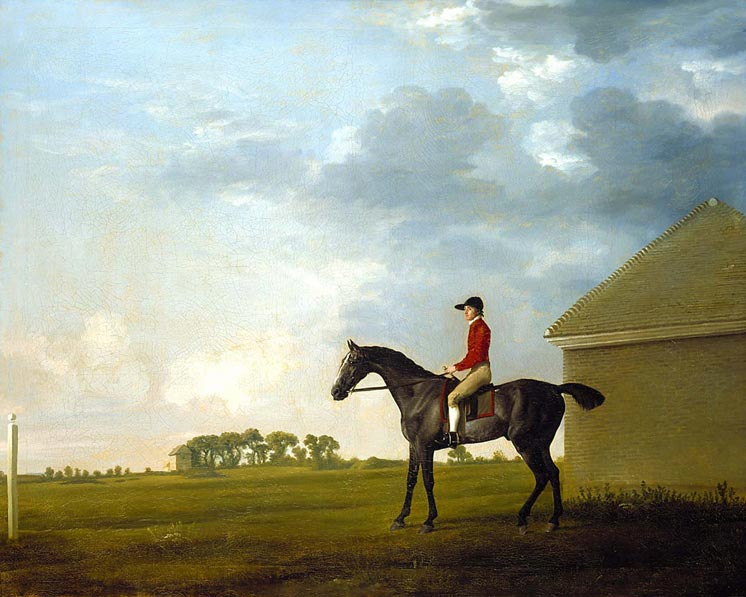
George Stubbs, Gimcrack with John Pratt up on Newmarket Heath, ca. 1765

Miller, Andrew – Now We Shall Be Entirely Free (2018)

This is the book that divided me the most this year, and raised questions about my own reading expectations. On the one hand, I always looked forward to reading the next chapter of this book, and its narrative drive – about the pursuit of an English officer accused of atrocities in the Napoleonic wars – thoroughly gripped me. One night, I binge-read the last 50 pages of the book, which is something I have not done in a long time. On the other hand, many things kept irritating me about the book’s representation of its historical period. At first, it was little things that just didn’t seem to fit the setting of the book in 1809. I began to feel the need to research some of these perceived anachronisms, even as I wondered if they were only bothering me because, as a scholar of Romantic literature, I have spent a lot of time reading about this period, and am perhaps over-sensitive to these details. For example, one of the soldiers swears a great deal – fair enough, I’m sure people swore much more in the 19th century than they do in a Jane Austen novel – but the language used is consistently modern (e.g. “wankers,” which I have now learned only took on its modern meaning in the mid-twentieth century, and “the fuck?” for “what the fuck?” which I certainly had never heard used prior to the 21st century). [Ed. – I feel sure we said “the fuck” in the 90s. Have I misremembered this???] But my most pedantic objection is the fact that the characters discuss the poetry of John Clare. In 1809, Clare would have been only 16 years old, and he did not publish his first book of poetry until 1820. There are also casual references to the future, which seemed to serve no purpose other than winking knowingly at the reader; for example, at one point, a character makes an offhand observation about how this new idea they call “police” might really catch on in the future.

But while I plead guilty to pedantry, I realized that these anachronistic details were not really what was bothering me. Rather, I came to recognize that the source of my frustration was that the characters feel thoroughly modern in their thoughts and actions despite the period setting. The protagonist, an English gentleman who purchased a commission as an officer in the British army, is not in the least rooted in the ideology of that class, and virtually all the characters exhibit attitudes that are much more modern than any that would have been around in 1809 – for example, most of the characters’ attitudes towards sexuality are not simply liberal, but unthinkable for their class and time period.

All of this led me to ask questions, the first and foremost being “does any of this matter?” Should it really affect my enjoyment of the novel if it is not entirely historically accurate? For one thing, I can readily imagine that if Miller had written a draft that rendered 1809 with impeccable period detail – and I should mention, by the way, that he does seem to have done a great deal of research, as evidenced, for example, by a description of the conditions of child labour in the period that tallies very closely with contemporary accounts – his editors would likely have compelled him to revise it extensively anyway, given that most modern readers would not be able to follow many period details of language and custom.

So, perhaps what my objections amount to is the fact that the book belies its appearance as a “historical novel”; to my mind, it does not reflect on the period in which it is set in any meaningful way. Which leads to the next questions: “if it’s not a historical novel, is it something else?” and “could that something else be considered good and enjoyable in its own way?” There is indeed a lot to like about the book, especially, for me, its thrilling climax. So, in the end, I guess I would say that I liked it, but felt like it could have been something more than it was, while also acknowledging that this could be an unfair expectation on my part. [Ed. – Ok this fascinates me, as a huge fan of the book who now feels the need to revise his opinion. The inaccuracies are unfortunate, definitely, but your questions about what this book is in fact doing are what really hit home. It does seem a book marked by a modern idea of trauma, that’s for sure.]

Mitchell, W.O. – Roses Are Difficult Here (1990)

I must admit that I only picked up this book because of a reference to it in a Tragically Hip song (“Impossibilium”) but given my fondness for all things CanLit, I expected I would enjoy this novel about a small town in the Alberta foothills in the 1950’s that is turned upside down by the arrival of a sociologist conducting a study. And this book does have plenty of that Canadian small-town charm and humour, but, like Now We Shall Be Entirely Free, Roses Are Difficult Here was another book that kind of gnawed at me. In this case, the novel feels like it is based in a kind of anti-woke panic avant la lettre. [Ed. – That tracks with the little I know of Mitchell’s personality FWIW.] The sociologist is villainized for suggesting modern ideas, such as the implication that the town maybe ought to be less racist towards the nearby Indigenous community, and that the feeling of unity in which all the town’s inhabitants take pride is actually based on its exclusion of outsiders, such as the half-Indigenous garbage collector, Rory Napoleon. Having said that, the scene in which Rory stampedes his goats through the town in retribution for his treatment at the hands of the townsfolk is definitely the highlight of the book. But aside from giving Rory a chance to air his grievances at a town meeting, the book clearly sides with the townsfolk, and, written in 1990, it seems nostalgic for a past where nobody complained about casual racism and sexism. [Ed. – Strong white guy vibes.]

And since I have already demonstrated my penchant for pedantry, I might as well lean into it: Mitchell begins a chapter set in the autumn of 1957 using the following passage full of historical detail:

The Russians had just shocked the world with the announcement of their successful satellite… The previous June, the Liberal government had been defeated by the conservatives after fifteen unbroken years in power; Canada had lost the world hockey championship to Sweden; the Milwaukee Braves had taken the World Series…

I concede Sputnik and the Braves, but Sweden did not defeat Canada in hockey even though they did win the championship – Canada and the U.S. boycotted the event being held in the U.S.S.R. that year in protest of the Soviet occupation of Hungary. And the Liberals had been in power since 1935 prior to the 1957 election, which actually makes it more like 22 consecutive years. OK, thank you, I just had to get that out. [Ed. – I’m glad you did! And that “Does no one edit these books???” was already a thing in 1990. Also, that sample paragraph is terrible!]

Modiano, Patrick – The Search Warrant (1997) Trans. Joanna Kilmartin

There seems to be an unwritten rule that every Holocaust-themed book translated into English must have its title altered unrecognizably from the original. Usually, the impulse is towards a title that moralizes or sensationalizes the narrative, but in this case it’s just baffling. Originally published as Dora Bruder, this book does not include a literal search warrant, although it is admittedly concerned with other kinds of official documentation used to give a legal veneer to otherwise unjustifiable deportations. And on the other hand, the title could only with difficulty be twisted to refer by analogy to Modiano’s own search for evidence of the titular 15-year-old Jewish girl who ran away from home during the Nazi occupation of Paris and was later deported to Auschwitz. In any case, the book is a fascinating exploration of memory and the way the traces of the past persist into the present, as Modiano weaves in his own experiences of Paris with what he has been able to learn about Dora’s experiences, and, more importantly, with what is not known, and will never be known about them. [Ed. – Modiano is not my guy, but you might be happy to know that at some point—maybe after the Nobel win?—the publisher reissued it under its original title.]

Piñero, Claudia – Elena Knows (2007)

Every year, I scale back my ambitions for Women in Translation month in August, and this year, I finally came up with a plan that I could complete before the end of August: one relatively short book (spoiler alert: it was so good, I couldn’t put it down and ended up finishing it within two weeks). I’d first heard about this book on, I believe, the first ever podcast of One Bright Book (those folks are great, huh?) and was sold on it. [Ed. – Now that you mention it, they are kind of great.] Nor did it disappoint; while the premise may not exactly sound like a page-turner (woman with Parkinson’s resolves to investigate her daughter’s murder), it is in fact a brilliant and devastating book. It’s a premise that compels readers to pause and take notice of mundane activities that most of us take for granted, increasingly drawing us into Elena’s perspective as she tries to find answers. I won’t risk spoilers by saying any more, but this is quite possibly the best book I read this year, and as someone who has a track record for not getting on with books written in this century, that is high praise indeed. [Ed. – This is one of those books that I like more and more as I think about it. You’ve made me want to re-read it!]

Barbara Hepworth, Kneeling Figure (1932)

Looking ahead to 2026

What’s next for me? Well, after M comes N, then O (both mercifully light letters, by the way)… but, as I mentioned last year, this reading project was really front-loaded in the first half of the alphabet, so even though I have almost reached the alphabetical mid-point of my project, I am actually over 2/3 of the way through. In fact, were it not for two very significant undertakings at the end of the “P” shelf (hint: Proust and Pynchon), I might be tempted to consider myself nearly home and dry. With about 75 books remaining, optimistically, I might imagine finishing this project within 2-3 years (keeping in mind that this was conceived as a 5-year project, and it won’t be finished in 10, so any optimism is pretty clearly misplaced).

But as I said at the top, I’ve already started to think about my next utterly ridiculous reading project, and, in fact, probably spent far too much of my valuable reading time this year planning it out and acquiring the necessary books. [Ed. – Nat, that is important and necessary work, especially the acquiring books part.] It may require a bit too much space to explain my plan fully here, but it will involve 250 novels, and I may still need some recommendations to fill out this number, so perhaps if Dorian hasn’t yet had enough of my nonsense, he will let me write another guest post about it later in the year. [Ed. – He 100% will.] In the meantime, Brian Moore and Toni Morrison are the only authors standing in the way of my getting to the second half of the alphabet. [Ed. – Ooh such good authors! Thanks for another wonderful piece, Nat!]

Scott Walters’s Year in Reading, 2024

Pleased to once again present reading reviews from some of my favourite readers. Today’s installment, his fourth, is by Scott Walters. Scott launched the much-lamented blog seraillon in 2010, and expects to return to it one of these days. He largely follows Primo Levi’s model of “occasional and erratic reading, reading out of curiosity, impulse or vice, and not by profession.” He lives with his partner in San Francisco.

Barring surprises, here ends the 2024 edition of the EMJ Year in Reading series: except, I hope, for my own. (Gotta write that…) Thanks to everyone who contributed–and all who read these engaging lists.

Balthus, The Passage of Commerce Saint-Andre (1954)

Thank you, Dorian, for inviting me again to participate in The Year in Reading. [Ed. – Pleasure all mine, Scott!] Mine meandered mostly pleasurably through some 60 books. I abandoned others, was surprised to have read fewer Italian works than in previous years, and experienced a number of unpremeditated pairings, reading two works each by a dozen authors plus more thematic linkages. I’ll get straight to 2024’s highlights:

The Woman in White, Wilkie Collins (1860)

I nearly lost my head when I interrupted my spouse’s reading of the final pages of The Woman in White, but her abrupt “Ssh!” made total sense as I plunged into the book myself the next day. Abstracted, the “detective-ish” book’s nutty plot—starting with its mysterious woman in white and moving to family secrets, confused identities, unlikely coincidences, shady interlopers, and convoluted inheritances—would hardly seem encouraging. But over 650 pages Collins never lets drop any of the knots of intrigue he has in the air, a master class in plotting with the ending so neatly and satisfyingly resolving the novel’s myriad conflicts that the book should have come tied up with a pretty bow. I found equally impressive his crafting of splendid characters, including the flamboyantly louche and unforgettable Count Fosco and Marian Holcombe, the novel’s moral center, surely one of the great characters in English literature. [Ed. – Now read No Name!]

[Paired with Collins’s The Moonstone].

The Purple Cloud, M. P. Shiel (1901)

If The Woman in White stands at the peak of the Victorian era, Shiel’s The Purple Cloud levels the period to the ground: an apocalyptic horror story, to be sure, with a body count beyond reckoning, but also an existential tale that takes Jules Verne’s brand of adventure in the direction of Lovecraft (and maybe even Kafka and Beckett). Into the tale of the sole-surviving member of a polar expedition returning to find worldwide catastrophe, Shiel mixes dazzling epic catalogues with itinerant wanderings—by dogsled, boat, rail, and on foot—that make Odysseus seem nearly an armchair tourist. A magnificently macabre tour of England unfolds from the coasts to the moors to the mines to the vacant house of Arthur Machen (to pay a literary debt) before the novel’s agonist traverses the infernal hellscape as far as Tokyo and San Francisco. Adding to the panorama of ghastliness is the misogynistic unpleasantness of the narrator himself, though having a murderer inherit such a lonely place is certainly a twist on the “last man” genre. Shiel lightens his grotesqueries by upscaling his inventiveness and gallows humor, even taking a few swipes at the Empire’s Victorian sensibilities. His idiosyncratic, nimble writing prompted me to mark down passages, though left me wondering whether the “purple” in his title may have referenced florid elements infecting his sheer writing bravura. Half-way through I wondered why the book didn’t regularly appear on English literature reading lists. Two-thirds of the way through, an abrupt turn sent the tone spiraling from Brueghel’s Triumph of Death into the schmalz of W. H. Hudson’s Green Mansions, underscoring a built-in problem of last man narratives: how to bring things to a close, what with destruction being so easy and rebuilding such a struggle. Shiel regained his footing towards the end but stumbled again on his way out the door. Maybe some goody-two-shoes editor had stuck their nose in. Still, The Purple Cloud’s grandiose conception and relentlessly ghastly anti-pleasures made it a singular reading experience—and fitting B-side to Collins.

Bel-Ami, Guy de Maupassant (1885)

At age 4, my French goddaughter presented me with a paper “cootie-catcher” featuring appealing green designs on three sides and a frightening mess of scribbled red and black on the fourth. I inquired. “This is a flower, and this is a tree, and this is grass, and this is a vampire.” [Ed. – Reasonable.] Now that she’s 21 I’ve come to expect this kind of thing regularly, but when she insisted that I read Guy de Maupassant’s Bel-Ami, I fell right into her trap. The story of a down-on-his-luck former soldier, Georges Duroy, whose life is transformed by a chance meeting with a war buddy who helps get him into journalism, is a superb depiction of the writing life; an existential examination of class, morality and gender relations; and one of the most sordid narratives I’ve come across. Duroy is a terrific antagonist, an arriviste with attractive qualities tinged by inexperience and raw ambition, not above prevarication and cruelty when it suits him. Maupassant manages the story so skillfully that I naively believed it to be heading towards a treatment of the subject of friendship between men and women, the source of Duroy’s “Bel-Ami” nickname—an ironic one, I was soon to realize, as what Maupassant does with Duroy makes Zola’s take on human debauchery look like a Sunday school picnic. [Ed. — !] The novel contains great set pieces, including a drawn-out death scene where a post-mortem odor drifts off the page like something out of D’Annunzio, and a party in a mansion on the Champs-Elysée that contrasts with the grim lives of Duroy’s rentier parents rotting away in Rennes. Maupassant levels the world of journalism too, its appetite for influencing public opinion, its writers seeking short-cuts to fame—a subject altogether too relevant today. Duroy’s talent, which emerges bit by bit, takes flight in social situations, where during one visit with a group of women he extemporizes on the writing of the French Academy. Maupassant, of course, was writing against the Academy grain, and few writers have woven a French of such sublime beauty from a tissue of such splendid decadence. [Ed. – Well, damn!]

[Paired with Manon Lescaut (1731), by the Abbé de Prevost].

Dark Back of Time, Javier Marías (1998) (Esther Allen, translator)

It would be unjust to pigeonhole Dark Back of Time –“a book of digressions”—as a campus novel, and equally unjust to separate it from its co-joined twin, All Souls (1992). But taken together as a campus novel, these two works, set at Oxford, slay all comers. Someone once quipped that the campus novel was about settling scores. Dark Back of Time seems aimed at undoing any barbs present in All Souls and even any notion of that book’s having been a roman à clef (this too, of course, may be a fiction). While the first part of Dark Back of Time engages weighty questions about fictional representation of real people, the joyousness of the novel’s explorations often had me in stitches, including a scene in which an academic negotiates with the narrator/author how he will be represented in the new novel, and another in which the narrator/author, timidly attempting to clarify for owners of an Oxford bookshop that what he’d written in All Souls was not about them, finds that the couple revel in their fame and petition to be included as themselves in a film version. It seems fitting in these books that Marías, Spain’s late greatest novelist, has evoked echoes of the most iconic of Spanish fictions, for, like the first and second books of Don Quixote, the two novels form an essential unit in which one could read only the first volume and miss out dramatically on what the second volume does with the first. (I’d love one day to see All Souls and Dark Back of Time boxed as a set; Cervantes would approve.) I don’t think it’s an exaggeration to suggest that these volumes, taken together, may be the finest contemporary literary work to address the question, “What is fiction?” Two other elements to recommend the book: The first is Marías’s inclusion of the fascinating story of Redonda, the “literary” nation of which Marías served as most recent and presumably final King (M. P. Shiel had been the first). [Ed. – Wait, that dude you just wrote about?? Is this real? Am I being punked??] The second is that Dark Back of Time contains some of Marías’s most exhilarating writing; I think immediately of a moving passage about the dawn crepuscule and streetlights that persist for a time into the day. Time having ever been one of Marías’s great preoccupations, I also winced at his narrator imagining life at age 85—a full 15 years past the premature end of Marías’s own. Unconscionably, The New York Times left Marías off of its recent list of the 100 Best Books of the 21st Century to date, but it is certain that the lamp of Marías’s work will live on to see its day.

[Paired with Marías’s short travel book, Venice: An Interior (2016)].

The Charwoman’s Shadow, Lord Dunsany (1926)

Fantasy is not among my favorite genres, but I’ve been fond of everything I’ve read by Edward Morton John Dax Plunkett, a.k.a. Lord Dunsany. Dunsany’s stories seem more like a new model of fairy tales, exploring interstices between reality and the imagination and dealing with moral issues without being moralizing. The Charwoman’s Shadow features a young Spaniard sent by his family to learn alchemy from a woodland magician, and exhibits Dunsany qualities in abundance: a deep gratitude for the richness of life, where nothing can be taken for granted; a genial wit and wordplay; a careful attention to nuance. The centerpiece of the novel is the value of one’s own shadow, the disappearance of which, through a Faustian bargain, produces unexpectedly dire consequences. Another Dunsany treasure is the lyrical quality of his writing, for example when he takes on that most magical of hours, l’heure bleue:

bright over the lingering twilight the first star appeared. It was the hour when Earth has most reverence, the hour when her mystery reaches out and touches the hearts of her children at such a time if at all one might guess her strange old story; such a time she might choose at which to show herself, in the splendour that decked her then, to passing comet or spirit, or whatever stranger would travel across the paths of the planets.

And then there is the book’s splendid ending, which I will not spoil other than to say that with no apparent thought of producing endless sequels like some contemporary writers of fantasy fiction, Dunsany gently places his chief protagonist off stage and sweeps into a realm of wistfulness drenched in the glow of a glorious sun setting at the height of Spain’s Golden Age.

[Paired with Dunsany’s The King of Elfland’s Daughter (1924)].

Fulgentius, César Aira (2017) (Christopher Andrews, translator)

At 163 pages, Aira’s Fulgentius straddles novella and novel, and not simply as matter of length. Aira’s intimate, vividly imagined tale of a Legate of the Roman Empire who also happens to be a playwright expands as it follows the aging Fulgentius and his 6,000 soldiers from Rome to reconquer Pannonia. Along the way, Fulgentius mounts performances of his sole work, a tragedy written when he was an adolescent, starring himself as tragic hero—and most important audience member. As Fulgentius has already written—or thinks he has already written—the tragic outcome of his own story, the plot tension is carried by a familiar Aira conceit around the entwining of fiction and reality. As a prime example one of Aira’s works that graft a fictional character onto history, Fulgentius offers a vivid sense of what such a march must have been like for the soldiers, the general, and the populations in their path. Deviating from the author’s more typical surrealist gymnastics, the language here takes on an unusually elegant lyrical register.

[Paired with Aira’s Alexandra Pizarnik (2001), an appreciation of the Argentine poet].

The Catherine Wheel, Jean Stafford (1952)

I found a copy of Jean Stafford’s The Catherine Wheel when I was 18. Had I read it then, I doubt I would have fully appreciated its adult nature—for it really is an adult book, dealing with adult things, things terrifying enough that I approached the novel’s final pages with a shudder of complete dread (completely vindicated). But in The Catherine Wheel Stafford also reckons with youth, entwining her two main characters, 38-year-old Katherine Congreve and her 12-year-old cousin Andrew Shipley. Devastated in love at an earlier age when Andrew’s father John married her sister Maeve, Katherine now occupies a position as the town’s most prominent unmarried curiosity, but also a magnet to John and Maeve’s children, left behind while the parents “summer” in Europe. Twin betrayals connected to this departure have set both cousins spinning: John’s surprise declaration of love for Katherine and determination to divorce Maeve while abroad, and the disappearance of Andrew’s playmate of previous summers, Victor, now entirely occupied with the post-war return of an older brother. Dually abandoned, the cousins shift focus to one another. Stafford thus sets up an unusual device in which youth attempts to divine the mysteries of adulthood while adulthood frets over the crises of youth, in a marriage story focused on impacts beyond the absent couple’s own strife. [Ed. – This feels like some Henry James-level melodrama!] A kind of third eye—that of the people of Hawthorne, who notice when Katherine’s light stays on into the wee hours—levies its own social pressure on the house’s inhabitants. Stafford’s densely poetic sentences frequently had me reading her aloud, relishing her words, marveling at the perfect limning of some little thing or creation of a resonance that rippled out towards subjects beyond the proximate ones. Though rooted in a realist, formalist literature that prioritized and exalted language, the novel still felt raw and new, bursting out of old molds, totally unsettling. Not a novel for the squeamish, but certainly one for any reader ready to appreciate some of the finest American writing of the period.

[Paired with Stafford’s The Mountain Lion (1947)].  

whose names are unknown, Sanora Babb (1936/2004)

Sanora Babb’s novel has been highlighted in recent articles recounting editor Bennett Cerf’s decision that two Dust Bowl novels in a single year would not stand. The other, of course, was The Grapes of Wrath, allegedly constructed in part on notes Babb had collected concerning hardscrabble farmers in her native Oklahoma, and which Cerf provided to Steinbeck. Though Babb published other well-received works, her Dust Bowl novel languished unpublished for nearly 70 years. whose names are unknown borrows its title from an eviction notice served on a family of Oklahoma farmers. What the novel may lack compared to Steinbeck’s elegant structure and majestic sweep, it makes up for in granularity of detail and visceral impact relating the farmers’ desperation and poverty, with particular attention to the lives of women, whose interactions give the work some of its strongest scenes. Babb’s direct, declarative sentences come across as hard as the land worked by her characters. She describes the knife-edge on which her people live, where even small luxuries—such as butter for the biscuits—must be used sparingly “so that it will last until the next churning.” Where Steinbeck set his novel on the back of hope for a better life in California, Babb spends a long time in Oklahoma before heading west, zeroing in on the encroachment of the Dust Bowl, poor farming practices colliding with a change in climate and the shifts within and without people as they try to wrestle with such environmental change. Babb’s powerful novel deserves at least to be taught alongside Steinbeck’s, or rather, as the debt is all his, the other way around. [Ed. – Pretty telling/damning that I’d never heard of it.]

Écoute, Boris Razon (2018)

It’s clear from which chapter of French journalist Boris Razon’s novel Écoute (“Listen”) Jacques Audiard plucked the seed for his film Emilia Perez, but Écoute differs almost entirely from the film. As the book’s title suggests, Razon focuses here on listening, various forms of which coalesce the book’s entwined stories and capture the complex, fraught texture of contemporary communications. Set mostly on a single block near Place d’Italie in Paris (with detours to Mexico City and Lisbon), and with the November 2015 terror attacks continuing to resonate, the novel touches on the surveillance state by encompassing listener, the listened-to, privacy, and identity (here’s where Emilia Perez came in, but so, to my surprise, did Fernando Pessoa). In conveying the rapid-fire chatter and laconic banality of so many electronic communications, Razon employs a good deal of verlan, texts and texting abbreviations, and emoticons, prompting one character to muse on the absence of a dictionary adequate to capture today’s modes of information sharing. Running beneath this surface noise is a current of desire to disappear from a world in which privacy has all but vanished. The stunning first chapter presents a scene of the Paris street that surely ranks among the richest in that city’s literature, an “audioscape” as experienced from the inside of a police surveillance van by an officer quietly being undone by his job of attempting to cull signal from the noise and by the uncanny valley between electronic input and what he perceives with his own senses. [Not yet available in English translation, though that may well change should Emilia Perez win the Oscar for best film].

Edward Hopper, Solitary Figure in a Theater (1903)

Oak Flat: A Fight for Sacred Land (2020) and Thunder and Lightning: Weather Past, Present and Future (2015), Lauren Redniss

2024 was the year I came late to Lauren Redniss’s party, pairing her powerful Oak Flat with her larger format Thunder and Lightning. The former explores the fight around the proposed Resolution mine on tribal lands in Arizona, while the latter treats weather phenomena both straightforwardly (i.e. Rain, Heat, Wind) and in more abstract terms (i.e. Chaos, Dominion, Profit, War). Using an anecdotal approach, Redniss displays in both books a knack for ferreting out the most interesting possible interviewees and unearthing fascinating hidden tales. But what makes the work of this MacArthur award winner stand out is its exploration of text and image. Using full page illustrations, Redniss skillfully advances her story through images of such impact that I found myself gasping at turning a page and being confronted with an image perfectly tuned to the tone she had set. The large format of Thunder and Lightning lends itself particularly well to her subject. In Fog, the text crawls along the bottom of pages of vast gray. Redniss’s deliberateness in matching image to text and letting the image carry the narrative feels like a new form of text/image interaction. In a section about cloud seeding, she describes a proposal to use weather balloons to heft a pipe with multiple nozzles to spray chemicals that could help cool the planet. I could not help see this as a metaphor for the way her illustrations lift her text in air. These images, easily mistaken for colored pencil washes, are in fact mostly acid etchings in black and white that Redniss has hand-colored (Thunder and Lightning includes a description of her processes). I read Redness not long after finishing James Elkins’s novel, Weak in Comparison to Dreams, another work that relies heavily on images, by a leading theorist of text/image interaction, no less, and now find myself dreaming of a Redniss/Elkins collaboration. Come on, you two. Make it so. [Ed. – Either way, I’m tracking down these Redniss books!]

Moonlight Elk, Christie Green (2024)

I know Christie Green but was wholly unprepared for her first book. Each time I put Moonlight Elk aside, I could not wait to get back out into it. That awkward prepositional formulation feels apt, as Moonlight Elk, a book framed around Green’s experiences in across New Mexico hunting wild game, largely for sustenance, takes one to wild spaces in an intensely intimate manner. Exploring the borders between interiority and exteriority, animal and human, life and death, the book’s dozen interlocking pieces, indexed to a hand-drawn map of the state, might well be the New Mexico state book of the year (if such a thing exists). With solid research behind her narrative, Green leverages her experience as hunter, mother, landscape architect, land use expert, designer, naturalist, activist, and writer to traverse territory of essay, short story, meditation, and what one might call an anthropology of relationship. Memoir might also come to mind, but resistant to definability, Moonlight Elk seems more like an exorcism, a courageous self-interrogation in quest of a “free range” existence that refutes facile answers, upends convention, moves into spaces predominantly occupied by men, and attempts to rid the cultural body of a toxic detachment from nature. Hunting—particularly as a woman alone—foregrounds the narrative, but Green is after larger game. She inhabits the lives of animals, their cycles and patterns, how they move, what they sense, how they see her. The mysterious, miraculous complexity of bodies, not least Green’s own, forms the beating heart of the book: details of muscular structure and bone, of blood and feathers and sex, the quickness of eyes, the sharp sense of smell. Her hunts force self-reckoning, as when she discovers a fetus moving within the abdomen of a cow elk she has shot, or when she ends the suffering of another cow that comes to her after being gruesomely wounded by poachers. Green, who grew up in Alaska, integrates into her experiences a wealth of issues impacting the American West, from private vs. public land and water use to tribal and border concerns (in the boot heel of New Mexico, a quail hunt collides with Border Patrol conducting their own kind of hunting). Only at the narrative’s end did I grasp the extent of the subjects Green had covered. More personally affecting, as she moves through forest, desert and chapparal, shadowed by cliffs and trees, illuminated by dreams and the changes of the moon, she offers, with keen animal sense and without escapism, an orthogonal, conscientious response to received ideas, convenient consumerism, and mediated experience. Hyper-alert, alive, intuitively creating her path, Green renders wilderness almost otherworldly. I emerged from Moonlight Elk seeing this world anew, as though a physical alteration had taken place. [Ed. – Sold! Might pair well with Joanna Pocock’s Surrender.]

Gallery of Clouds, Rachel Eisendrath (2024)

The title: irresistible. The cover too, a fresco of clouds at sunrise or sunset from the ceiling of the Rose Main Reading Room in the New York Public Library. And the opening especially, the author recounting a dream of carrying her manuscript through heaven and meeting: Virginia Woolf. Both ostensibly and in fact, the subject of Gallery of Clouds is Sir Philip Sidney’s 16th century, 900-page pastoral romance, Arcadia, about which I knew nothing and which overwhelms even Eisendrath, a Sidney scholar: “I find that my memory of the plot has already started to dim, to blur…I can no longer keep track of the basics…” I say “ostensibly” because Eisendrath uses the obstacle, Arcadia serving here as a nexus to send her fertile mind wandering down winding paths, from observations on the genre of Romance to the use of images, Shakespeare to Little Nemo, Poussin to Walter Benjamin, Montaigne to manicules (!), the marriage of hunting with desire to the cat dozing on Eisendrath’s bed.

But these seemingly inexhaustible spin-offs never seem gratuitous. Eisendrath subtly constructs an Arcadia of our own era, her black & white photos echoing the pastoral romance’s means of advancing its airy infinities through “images in words,” her “clouds” of thought (which she pointedly distinguishes from mere fragments) paralleling the episodic nature of the romance, her grounding her observations on Sidney in a relatable contemporary manner underscoring the genre as a response to grim realities. At the same time, Eisendrath engages proliferating modes in contemporary writing, such as the use of the fragmentary, the merging of the academic and the personal, the punctuation of text with images, the grappling, through a need to say, with an unraveling world. Though she is writing about a 16th century romance, her small, enthralling, sui generis book has volumes to say about how we read and write. And in Eisendrath’s few references to her own teaching, Gallery of Clouds, more than anything I have read in decades, has me wanting to be a student again.

The Waves, Virginia Woolf (1931)

Rereading The Waves 40+ years after I first read it and in the same copy I’d used then, my margin notes served to measure the distance between that young reader and this old one. I experienced pride regarding the young stranger’s underlining of particular lines; I noted too that he’d missed a lot. Passages of time of this sort span The Waves, entwined temporal arcs that longitudinally capture Woolf’s six characters through alternating interior soliloquies as they move from childhood to university [ed. – well, some of them get to go to university…] to the workplace to middle age and beyond, while brief impressionistic pieces preface each chapter and, over the course of the novel, trace the sun’s path across the sky during a single day at the shore. Here as in many of her works, Woolf, the great writer of immediacy, obsesses over capturing sensations, gestures, glances, discreet moments, the wave at the point of breaking, of ebbing. Rafts of glorious sentences ride Woolf’s exquisite phrasing, as she simultaneously questions the inadequacies of language, frustration with these limits reaching a crescendo as mortality nears for her characters, and a voice longs for:

some little language such as lovers use, broken words, inarticulate words, like the shuffling of feet on the pavement. I begin to seek some design more in accordance with those moments of humiliation and triumph that come now and then undeniably. Lying in a ditch on a stormy day, when it has been raining, then enormous clouds come marching over the sky, tattered clouds, wisps of cloud. What delights me then is the confusion, the height, the indifference and the fury. Great clouds always changing, and movement; something sulphurous and sinister, bowled up, helter-skelter; towering, trailing, broken off, lost, and I forgotten, minute, in a ditch. Of story, of design I do not see a trace then.

[Ed. – Is this Bernard? Sounds like Bernard.] Woolf described The Waves as a “playpoem,” but its approach to polyphony is unusual. In the first chapter, she goes inside the heads of her characters as young children while at the same time supplying them a vocabulary beyond their years, a device through which they speak both as themselves and as the writer, the latter’s presence made manifest when the children catch a glimpse through a window of a woman writing. Throughout the novel, her six characters’ voices float like spheres governed by gravity, now apart, now coalescing, as waves gather force and crash, exploding in spray and froth. But her characters also serve to question the nature of identity: clearly creations of the writer and facets of her circle (the roman à clef aspects interested me little), they are also beings in whom a “self” is merged inextricably with other selves. For all of its prose-poeminess, The Waves stands as a remarkable and grounded philosophical inquiry into what constitutes a self—and whether it even makes sense to speak of a “self.” [Ed. – Yes, the latter especially!]

In my first reading, I scarcely noticed the centrality to the novel of the death of Percival, a “seventh” character never given a voice. But in Paris shortly after finishing The Waves, I caught director Elise Vigneron’s theatrical adaptation of the novel, an extraordinary work employing both live actors and corresponding marionettes made of ice, such that as the play progressed, these figures melted, with much of the later action occurring in a resulting pool center stage. [Ed. — !] The physical presence of these characters and their doubles rendered Percival’s invisible presence powerful, a black center in Woolf’s “six-sided flower; made of six lives.” As with the shell-shocked Septimus Smith in Mrs. Dalloway, Percival represents a generation of young people damaged or lost to conflict and war. The cumulative effect of Woolf’s meditation on loss, whether through ordinary aging or via the injustice of an early death—and a palpable sense of darkness again descending upon Europe—left me overwhelmed by emotion at the story’s close.

What attracted me to Woolf at age 18 held firm: her sumptuous sentences; the tension between a love of people and aloof solitariness; the desperation of time passing fused with the fever to glean something lasting from the fleeting and ineffable. Also: recognition at last of Woolf’s lament for life lost at an early age, for the unshakable impact on those left behind, pushing The Waves into a work far greater than I’d registered the first time around. I’ve been thrilled, moved, and humbled by revisiting this extraordinary novel while the sun sinks toward a darkening horizon, so many years after I first read it, when the sun still mounted the sky. [Ed. – Beautifully put, Scott.]

[Paired with Woolf’s final novel, Between the Acts (1941)].

Felix Edouard Vallotton,The Sunny Street (1922)

Others works I could have included: D. H. Lawrence’s powerful Sons and Lovers [Ed. – Ph hell yeah]; Italian critic Cristina Campo’s The Unforgiveable;  the Strugatsky brothers’ The Snail on the Slope; Georges Simenon’s Arizona noir La Fond de la Bouteille; Shakespeare’s The Winter’s Tale; a pair of short books by Helen DeWitt (may she please complete her novel-in-progress set in Flin Flon, Manitoba) [Ed. – Wait what now]; Andrés Barba’s Two Small Hands and Andrés Neuman’s The Things We Don’t Do; poet Susan Nguyen’s second gen take on the American South in Dear Diaspora and other of her poems on-line; and, Most Unexpected Literary Object, the first volume of Ahmed Fāris Al-Shidyāq’s Leg Over Leg, a daring four-volume novel completed in 1885 with the modest ambition of catapulting the whole of Arabic language and literature into the modern age. In sum, a Year in Reading that elicited joy, snark, bon courage, resolve, humility, and defiance for challenging times ahead.

[Ed. – To which I can only summon both the raised fist and the thank you hand emojis: this is wonderful, Scott. May we draw on those good emotions in 2025!]