James Morrison’s Year in Reading, 2025

Regular readers will know that for the last several years I’ve solicited Year in Reading reflections from friends and trusted readers. As we’re well into February, I’ve scaled the project back considerably this time, but quality takes quantity every time… Today’s installment, his fifth, is by James Morrison, reader extraordinaire. James lives and works in Adelaide, on unceded Kaurna territory.
Charlie Stone, Behemoth from ‘The Master & Margarita’ (1999)

Working out which books to write about for these discussions is always fraught—there are easily another twenty great books I could have raved about, but neither you nor I are made of infinite time. I’ve tried to narrow things down to a few broad categories, but even then a few books would not be restrained by such, so they’re tacked on at the end.

In a couple of other people’s year-end reading round-ups on Bluesky, they talked not about what they’d read, but why they’d read it—what had prompted them to buy or pick up the books they ended up reading. It was strangely interesting, at least to a big horrible nerd like me, so I’m including that here for my own choices. Feel free to pass over it with glazed eyes. [Ed. – No way! I think people love that stuff. I know I do.]

RAMUZ

My most compelling new-to-me writer discovery of the year was Swiss novelist Charles Ferdinand Ramuz (1878–1947). The three of his books that I read all have the same basic premise—Something Horrible Happening in the High Alps—but go off in very different directions. Great Fear on the Mountain (translated by Bill Johnston) was what got me hooked first: a historical novel where a group of men set off to take the village’s flock up through a mountain pass to find feed, and then everything goes to hell. It has all the rhythms of an 1980s horror movie, but is beautifully written and was first published in 1926. Derborence [When the Devils Came Down] (translated by Laura Spinney) features an avalanche and its spooky survivor, while Into the Sun (translated by Olivia Baes and Emma Ramadan) is an impressionistic, atmospheric early climate change novel. As the Earth slowly falls into the sun, the snows melt, the mountain lakes boil, and society collapses into violence and despair.

Why: Nathaniel Rich’s splendid overview of Ramuz’s work in the NYRB.

BIG FAT EPICS

For some reason 2025 became a year in which I started, and sometimes finished, a number of big fat epics. [Ed. — Always big and fat, the epics.] Look at me, aren’t I tough?

Miklós Bánffy, The Transylvanian Trilogy/The Writing on the Wall (translated by Katalin Banffy-Jelen and Patrick Thursfield): I had actually read this massive Hungarian modern classic before, some quarter-century ago, but remembered very little other than it was hugely enjoyable. If anything it was even better this time around, now that I am older and theoretically wiser. Aristocratic Hungarians in Transylvania scheme and gamble and party and fuck, fighting for their rights as a minority in the Habsburg Empire while simultaneously being unable (for the most part) to see how they are simultaneously repressing and neglecting the Transylvanians whose land they rule. And all the politicking and manoeuvring takes place as the Great War draws closer, ready to sweep their whole world away. It’s like a vastly more incident-packed counterpoint, set at the other end of the Empire, to one of my other favourite books, Musil’s The Man Without Qualities. [Ed. – James and I as always on the same wavelength…]

Why: Over recent years I’ve been going back to a number of books I remember as brilliant, to see if they actually are. For the most part, fortunately, they have been.

Solvej Balle, On the Calculation of Volume (translated by Barbara J. Haveland, Sophia Hersi Smith and Jennifer Russell): Happy to say I fell for the hype and read the three books of this septology so far available in English. It’s a closely observed and beautifully written variation on the “Groundhog Day” premise of being stuck reliving the same day endlessly, but adding more and more wrinkles and complexities as the looping time passes. Fortunately this seems to be doing extremely well in English, so there’s every chance that, assuming Balle finishes the series, we’ll get to see all of it in translation. If she doesn’t, you’ll see me frothing blood in a tempest of rage.

Why: Though not original, the premise is fascinating, and I fell for the hype.

Dorothy Richardson, Pilgrimage: I read the first four books of this 13-volume modernist masterpiece, and while each book individually was excellent, the cumulative effect of this subtle, witty and awkward fictionalised autobiography is even more impressive. I hope to read the rest of this massive thing in 2026.

Why: I’ve wanted to read this for decades, but Virago’s treatment of their Modern Classics heritage being what it is, it’s never been possible to get all four volumes of the collected edition. Fortunately, Brad Bigelow of Neglected Books published his own edition, and I finally got my disgusting paws on it.

Len Deighton, the Bernard Sampson series: In terms of pure, sardonic, exciting and bleak reading pleasure, it’s hard to go past this trilogy of trilogies about the much put-upon spy Sampson, his extremely complicated wife, and his infuriating superiors. I still have the last three books to go, so that’s another treat in store for 2026, assuming any of us live. [Ed. – James. A little less truth-telling, please. As to these books, I’ve only read the first three so far, but they are terrific.]

Why: I’d only ever read a couple of Deightons in the past, and they were excellent, so why it took me until now to realise just how good he is and just how pleasingly extensive his back catalogue is must stand as a testament to my general dimwittedness.

C. J. Cherryh, The Morgaine Saga: Extremely futuristic science-fiction masquerading as swords-and-magic fantasy, this trilogy of novels (there’s a fourth, published much later, which I have yet to get) is so richly imagined, and so cleverly paced and written, that it makes you despair about how crap most of its genre competition remains. Outcast prince, magical witch queen, brutal politics, war, extremely difficult moral choices, aliens; the whole shebang.

Why: Every now and then I get the urge to read some fantasy to recapture the kick it used to carry when I was a teenager. Sadly I am no longer a teenager with a teenager’s standards, and almost every time I give up on whatever overpraised nonsense I’ve been tricked into reading. This was one of the rare exceptions.

Homer, The Odyssey (translated by Emily Wilson): Only a single (big fat) book this time, but one I haven’t read in 20 years, and the newish Wilson translation was calling to me. And it’s great! I’d forgotten just how oddly structured the book is (the famously interminable journey home of the hero taking up a relatively small part of the story), and how mental some of the developments. And apparently, she’s going to retranslate it and publish a whole new version? [Ed. – Seriously???] Seems like sheer madness to me, but I guess that’s what working in academia does to someone. [Ed. — Laughs bitterly]

KILL ALL NAZIS

Why: All the worst people seemed to be enraged by Wilson’s translation, and her gender, so I could not resist. [Ed. – Yeah, those guys suck.]
Charlotte Mano, From the Mythologies series (2021)

All Nazis must fuck off and die. Here are some books about what they were like, and how they were dealt with, first time round…

Marie Chaix, The Laurels of Lake Constance (translated by Harry Mathews): Astonishingly good in English, and the French original is apparently even better? How can this be? An autobiographical novel from the point of view of the daughter of an enthusiastic French Nazi and traitor before and during WW2. Unsensationalised, elliptical, and marvellous.

Why: It looked both pretty and interesting in the bookshop, and that’s all I needed to see.

Uwe Wittstock, Marseille 1940: The Flight of Literature (translated by Daniel Bowles): A day-by-day, sometimes hour-by-hour, account of the lives, desperation, plots and betrayals of the huge array of German and Austrian writers and artists who fled the Nazis to France, only to have France fall soon afterwards. Lucid and utterly fascinating.

Why: Wittstock’s previous book, February 1933: The Winter of Literature, did the same thing for the month the Nazis came to power, so there was no way I was not going to read this follow-up when it appeared.

Grete Weil, Last Trolley from Beethovenstraat (translated by John Barrett): An obsession with a lost friend taken by the Gestapo in Amsterdam spills into the post-war life of a man now living in Germany. He marries the man’s sister in a confused, guilt-fuelled attempt to try to bring him back to life. Complications ensue, as you might expect. Rich and compact, and highly recommended. [Ed. – More on Weil here…]

Why: If I see a book in the Verba Mundi series, I buy it. It’s an eclectic but extremely well-selected library of translated literature from all over the world.

Lorenza Mazzetti, The Sky is Falling (translated by Livia Franchini): Another fictionalised memoir, about a pair of sisters sent to stay with Jewish relatives in Tuscany—relatives then slaughtered by the Germans in 1944 (Mazzetti always believed they were killed for the Nazi-perceived crime of being related to Albert Einstein). The beautifully observed child’s viewpoint contrasts with the horrors of the confused world she inhabits, and the book’s brevity gives it the intense kick of all the best novellas. [Ed. – Fascinating! Ordering now…]

Why: This was the first book released by a new feminist publisher, Another Gaze Editions, whose output focuses on the work of women filmmakers like Mazzetti. It’s a hell of a promising way to kick things off.

Niaz Uddin, Airplane Home in Hillsboro, Oregon'(2017?)

HOPELESS FUTURES

Jane Rawson, Human/Nature: Rawson is a fine and unusual Australian novelist whose first book was a manual on climate change survival. In this non-fiction return she takes a simultaneously despairing and bleakly funny look at the horrible state of things, what it all means, and where it’s all leading. None of it’s good, but at least it’s wonderfully written. We still have good prose, if nothing else.

Why: I love the author and would buy anything she wrote.

Jack Womack, Random Acts of Senseless Violence: Somehow I missed this in 1993 when it first came out, more fool me. In the convincing form of a young girl’s diary over several months in (then) near-future New York as everything falls apart under gun-wielding late-stage capitalism, it’s amazing how much this gets right, yet it’s also a strangely analogue vision of the future. It also posits a series of successful US presidential assassinations, and sadly the real world seems unable to provide any of those.

Why: It’s now an established science-fiction classic and I needed to read it.

Bradley Somer, Extinction: A ranger tries to protect the last living bear in North America from poachers. Gripping and downbeat and all-too believable. [Ed. – Why are these all so depressing???? *re-reads section heading* Oh.]

Why: Impulse remainder purchase that panned out extremely well.
Nicolas-Edmé Restif de la Bretonne, ‘The Serpent-People’ from ‘Découverte Australe par un Homme Volant, ou Le Dédale Français’ (1781)

PARENTS AND OUR MYRIAD FAILURES

Krystelle Bamford, Idle Grounds: Astonishingly good debut in the collective first person, told by a group of unmonitored children at a family party as they get bored, muck around, encounter something wrong in the garden, and go searching for one of their number who vanishes. Spooky, funny, original stuff. I couldn’t recommend this book more highly, to be honest.

Why: The cover of the UK edition, with a picture of roped-together monochrome children lost in a field of fluorescent green, was enough to convince me. [Ed. – I wish more people talked about how book covers influence their buying.]

Violette Leduc, Asphyxia (translated by Derek Coltman): A well-named book if ever there was one, this dense little novella details the suffocated life of a young girl with an unloving mother in rural pre-War France. But, flinty matriarchs aside, it’s also a richly drawn world of natural wonders and discoveries.

Why: I only discovered Leduc in the last few years, and she was such an extraordinary writer. This was published as part of a very small collection of French classics by female writers by Gallic Books.

Adrian Nathan West, My Father’s Diet:  A wonderful book that takes some well-known signifiers of modern American fiction (hollowed-out suburbs, emptying malls, masculinity in crisis, etc etc) and does new and strange things with them. A depressed son learns his father has, out of nowhere, become an obsessive bodybuilder, determined to win the Body You Choose competition. The characters are never caricatures, and it’s extremely funny despite the quiet desperation of it all.

Why: One of the many excellent books put out by And Other Stories, and this is from before they went for their current ugly typographic covers. [Ed. – James! I love those covers!]

GRAPHIC NOVELS

Lee Lai, Stone Fruit and Cannon: Australian (but now based in Canada) artist Lai’s two graphic novels are both minor masterpieces, and genuinely full novels in complexity and subtlety. Sad and perceptive dissections of failing relationships, parenthood, faltering elders, exploitative friendship, and being part of the Chinese diaspora.

Why: This review in Meanjin, an 85-year-old Australian literary magazine currently being put to death by the witless timid bureaucrats who cower in terror of angry letters from the Zionist lobby and who are ruining pretty much all the arts in Australia at the moment.

Emily Carroll, A Guest in the House: A seriously Gothic tale of madness, downtrodden femininity and hapless stepmotherhood, drawn with Carroll’s usual visual flair and attention to detail.

Why: I’ve raved about Carroll before, and love all her work. Somehow, to my annoyance, I didn’t even know this book, published in 2023, existed until I saw a copy a couple of months ago. My spies failed me. [Ed. – Maybe they were busy failing to assassinate US Presidents.]

VOYAGER 2 – Europa (1979)

UNCATEGORIS[ED/ABLE]

Mariette Navarro, Ultramarine (translated by Eve Hill-Agnus): Wonderfully unsettling novel about a woman captaining a cargo ship with a male crew. In the middle of the Atlantic they stop for everyone to have an illicit swim—and when everyone climbs back on board there’s one extra person.

Why: The Deep Vellum edition (already a recommendation) has a great cover with a vast cube of ocean on it, and I am only weak flesh.

Li Qingzhao, The Magpie at Night (translated by Wendy Chen): A beautiful collection of the complete surviving poetry by one of China’s greats, from the Twelfth Century. I mean, get a load of her perfect description of a lazy, drunken evening, from ‘As in a Dream’:

Remember that day

spent on the stream,

watching the sunset glaze

the pavilion.

So drunk, we could not find

our way back.

It was late when we had enough.

We turned the boat around

and were caught, accidentally, in the deep

tangle of lotus roots.

Rowing through, rowing through –

startling, from the banks,

herons.

Why: Having only read a couple of her poems in anthologies, it was a pleasure to find her complete works available in English.

J.M. Coetzee & Mariana Dimópulos, Speaking in Tongues: If you’re at all interested in translated literature, and in the process of translation itself, this is a very rewarding book. Two novelists and literary translators discuss what translation is, what it does, how it works, and a peculiar but intriguing project they undertook (and which was foiled by commercially minded publishers) to make the translated Spanish text of one of Coetzee’s novellas the “original” version of the book.

Why: If the topic is this interesting and the two writers involved this good, what sort of a fool would I be to not read it, I ask you?

[Ed. — A fool indeed. As is anyone who reads this and doesn’t head to their local bookstore or library ASAP on the hunt for some of these recs. Thanks, James!]
What I Read, November 2021

Ah, November, we hardly knew ye. Wait—November?! What about October? Well spotted, eagle-eyed reader—I know you and many others have been refreshing this page daily in the hopes of getting your EMJ fix. Sorry to disappoint. Trust me, I feel bad about it. A two-year streak of monthly reading reviews broken, just like that. Still hope to catch up, but what can I say, October was a cluster. November was better, which is surprising since it’s usually one of the worst months of the academic calendar. This semester has been one of my lightest ever, though, a blessing since it’s allowed me to keep the rest of my life ticking along, just barely. I had a lot going on. My mother visited, the first time we’d seen each other in two years. There was Thanksgiving to celebrate. And leaves piled up steadily on our tree-lined corner lot, those things don’t rake themselves. But I read some stuff too.

Camille Pissarro, The Path at Basincourt, 1884

Sarah Hall, Burntcoat (2021)

Preordered this even though the idea of “pandemic novels” doesn’t appeal because I’m a Hall fan. Burntcoat is narrated by Edith Harkness, a sculptor—the resonant title is the name of her studio—who, after studying the Japanese art of shou sugi ban (charred or burned wood) has become one of the UK’s premier landscape artists. Some short flashbacks describe an apprenticeship in Japan, but these moments are underdeveloped, serving more as a metaphor—the technique is counterintuitive, “damaging wood to protect it”—than as detailed reality. There are many damaged people in the novel, mostly those infected by a virulent disease, much worse than a coronavirus, that either kills quickly or lies dormant for years after infection. But the most important damaged person in the novel, certainly one who has been protected by that harm, is Edith’s mother, a writer felled by a brain disease that transforms her personality and, for a time, makes her unable to speak or write. She recovers from the trauma to become an outsider artist, whose experimental works are underappreciated until after her death. Before that she had taken her young daughter, Edith, to live in the Cumbrian fells. As always, Hall is great with northern landscapes, but where Burntcoat really shines is in her other area of descriptive specialty. Hall writes great (cishet) sex scenes—exciting, never cringe-y, hot. Quite a feat. The sex in this novel is between Edith and her lover Halit, a migrant from Turkey who works as a chef in a middle eastern restaurant. Their relationship has no sooner begun, though, than the pandemic hits and Halit gets sick. Burntcoat is about making and healing, about losing and grieving, about the depredations and losses of time’s passing that can also become transformations and developments. It’s a good if not great novel, a bit suggestive, sometimes more a sketch of something than the thing itself. Curious how it will fit in her body of work twenty years on.

Nastassja Martin, In the Eye of the Wild (2019) Trans. Sophie R. Lewis (2021)

In 2015, Martin, a French anthropologist with deep knowledge of the indigenous people of Kamchatka, was mauled by a bear while conducting field work. After initial treatment in Russia, she is flown back to France, and suffers from further, supposedly superior, operations and treatments, one of which almost kills her. She suffers, physically and emotionally. Eventually she decides she must return to Siberia, to learn, as the jacket copy of the newly released English-language translation has it, “what it means to have become, as the Even people call it, medka, a person who is half human, half bear.”

From the time Magda first told me about this book, I’ve been psyched to read it, devoted fan that I am of another book about a woman and a bear. (In that one, incidentally, the main character, a librarian cataloguing the books in a great house in northern Ontario, learns that Kamchatkans use the sharpened shoulder blade of a bear as a scythe.) Nathan Goldman brings the two books together in his terrific essay on In the Eye of the Wild. Even more valuably, he points out the central tension in Martin’s memoir/essay: on the one hand, she resists attempts to explain or understand her experience, whether the lens be therapeutic, medical, or cultural (one of Martin’s Evenk friends, for example says the bear left her, the friend, a gift by keeping Martin alive); on the other, she writes in a language of abstraction that feels quintessentially French, especially that of post-Hegelian (i.e. post-Kojève) philosophy: structuralism, poststructuralism, deconstruction, etc., language that values nothing more than explanation and understanding, even if only to resist those very concepts. Take this passage for example:

To be the human who sees the bear (or to be the bear who sees the human) is to embody reversibility: it is to describe a face-to-face encounter in which a necessarily radical alterity is actually revealed as the greatest proximity.

Let’s just say I recognize several tics of my own writing in this sentence. (And, yes, Nathan quotes the same line, but I swear I marked it in my copy before reading his piece!) I was trained as a theorist in the 90s, and I still have a lot of time for its insights, if not always its language (though I’m mindful of what Barthes said: between jargon and platitude, take jargon every time). All of which is to say I think I’d have loved In the Eye of the Wild even more had I been able to read it twenty years ago. The whole books isn’t as abstract as that quote, but it’s pretty abstract. I kept waiting for a description of the attack—the encounter as she styles it—but it never happens, not even indirectly, Grizzly Man style.

Some of Martin’s resistance to explanation stems from her experience on the land: “In the heart of these frozen woods, you don’t ‘find’ answers: first you learn to suspend your reasoning and allow yourself to be caught up in the rhythms of an existence entirely organized around staying alive in a forest in winter.” Some of it comes from her anthropological training. Elaborating on her friend’s idea that the bear gave her a gift of Martin’s survival, Martin writes:

I know that this encounter was planned. I had marked out the path that would lead me into the bear’s mouth, to his kiss, long ago. I think: who knows, perhaps he had too.

That “kiss,” I dunno. Maybe I’m just irredeemably Canadian, and want my bear kisses to be literal, or, like Lou, the librarian in Bear, to realize that however necessary the fantasy has been, when bears get kissed things have gone too far. Kiss feels a little dramatic to me. (Lacan: the word kills the thing. Kills it?) I’ve been presenting In the Eye of the Wild and Bear as opposites, and in their representational strategies and general MO they are. But they agree, fundamentally, that, as Martin puts it, “a bear and a woman is too big an event.” The challenges posed by the female-ursine conjunction aren’t the same in each text—which after all were written in different circumstances and in different genres—but both Engel and Martin consider what it means to be a self, and whether one sealed off from the world is worth anything at all.

Dervla McTiernan, The Good Turn (2020)

The third book in Australian McTiernan’s Irish-based Cormac Reilly detective series is skillfully done—less engrossing as the first but absolutely engaging. (I spent a happy Saturday on the couch with it.) Yet the police procedural is a genre in crisis—books about heroic inspectors and their harried, money-conscious superiors just don’t cut it any more for readers faced with the violence and racism of the police-incarceration complex. McTiernan isn’t immune to this crisis. She circumvents it by placing the two investigations at the forefront of the book against the backdrop of a larger narrative arc concerning police corruption. But then a wise and trustworthy superintendent of police has to step in last minute to save the day, which keeps intact the myth of rogue agents within a sound system.

Charles Portis, The Dog of the South (1979)

Ray Midge leaves Little Rock, Arkansas for Mexico, on the trail of his wife, Norma, and her ex-husband, with whom she has taken up again. Before she split, Norma palmed Ray’s credit card. Using the receipts, he tracks the pair south of the border all the way to Belize, which at the time had only recently changed its name from British Honduras. (I’d no idea.) Along the way Ray meets Dr. Reo Symes, a hard-luck case/charlatan whose medical license has been revoked for fraud and who has since poured his energies into grandiose dreams of developing an island in the Mississippi owned by mother. All he needs is for her to give him the deed. To this end, he’s on his way to Belize, where the woman runs a Christian charity, but the old school bus he commandeered somewhere along the way has broken down, and Ray is his only hope for completing the journey. Classic odd couple stuff: unlike the disreputable and excitable conman Symes, Ray is a pedant with strong opinions about Civil War strategy and plenty of observations about human behaviour (“Most children are close with their money”); the men squabble about most everything, including, hilariously, who invented the clamp—a guy from Louisiana or the Sumerians? Finally they fetch up in Belize, where a lot of dramatic things happen quite suddenly before events trail off meekly, in the way of many foolhardy adventures.

The Dog of the South is not a long book, but maybe because the quest itself never feels urgent (we get little sense of Norma until the end, except that she is both long-suffering and careless—the Midges are anything but a match made in heaven) the book drags at times. The first third is comic gold, though, real laugh-out-loud stuff, including some loving disparagement of Little Rock. Plus, Portis’s way with bit characters is unbeatable. My favourite was Melba, a friend of Symes’s mother who helps run the orphanage. A real hoot, that Melba. An insufferable Canadian hippie in Mexico runs a close second.

I listened to the audio book narrated by Edward Lewis (which is different from the version on Audible, FYI), and his intonations and pacing were perfect. Really hits that strange note between smart aleck and stick-up-the-ass that characterizes Ray. I only wish Lewis’s accent were more Arkansan. He avoids generic Southern (it feels specific, though I can’t pin-point it) but that weird Arkansan combination of flatness and drawl escapes him.

Andrea Camilleri, The Cook of the Halcyon (2019) Trans. Stephen Sartarelli (2021)

Preposterous.

Grete Weil, Aftershocks (1992) Trans. John S. Barrett (2008)

Grete Weil née Dispeker was born to a privileged bourgeois intellectual household near Munich in 1906. Her father was a well-known lawyer, her elder brother a hero of the Great War; the family believed profoundly, tenaciously, unrequitedly in German-Jewish togetherness. As a Young Person, Grete palled around with Erika and Klaus Mann, Thomas Mann’s children, and climbed a lot of mountains. In 1932 she married the dramaturg Erich Weil; he was arrested shortly after the Nazi takeover and fled to Holland on his release to found a branch of his father’s chemical company. Grete followed in 1935: the couple settled in Amsterdam, where Grete opened a photography studio. Their circle included fellow émigrés Max Beckmann and Bruno Walter. After Holland was occupied, the Weils tried but failed to get to England. They turned their efforts to Cuba. The night before Edgar was to pick up their visas, he was arrested in a roundup and deported to KZ Mauthausen, where he was murdered in September 1941.

Weil was forced to give up her business—she lent her photography skills to the underground, helping to forge documents—and took a job in the Dutch Jewish Council, which helped her evade deportation. When her notice finally came, in summer 1943, she and her mother, who had been with all this time. went into hiding. For almost a year and half they lived on a mattress in a small space behind a bookshelf in a friend’s apartment. There Weil took up writing again—it had been one of the passions of her childhood. After the war, she felt comfortable neither in Holland nor in England, where her brother had settled. To the consternation of Klaus Mann, who tried to talk her out of it, she returned to Germany in 1946. She received her husband’s family’s pharmaceutical company as restitution (one of the only instances I know of in which that process actually did anyone any good) and devoted herself to writing, including opera libretti and translations from the English (including John Hawkes). She published various novels, collections of short prose, and memoirs in the years before her death in 1999.

Before coming across this book, I’d never heard of Weil, which surprises me, given my research and teaching interests, plus the fact that Godine published three of her books in the early 2000s. Aftershocks is the third, a collection of stories and memoiristic pieces about the long afterlife of the Shoah. I was not always gripped by the book, Weil does not seem the most graceful writer (that may be down to Barrett, the translator, not sure), but I admired her unwillingness to ingratiate herself with her audience. In this she reminded me of Ruth Kluger, a writer I also did not fall in love with straight away but who has since become a lodestar. I plan to keep reading Weil, not to mention (the ultimate test) teaching her, so look for a more informed opinion in several years.

Like Kluger, Weil was willing to think the Holocaust together with American state-sponsored racism. In a text called “The House in the Desert,” the narrator, a figure much like Weil herself, arrives in Los Angeles to visit an aunt and uncle who, having settled in America, are determined to laud the place as the land of milk and honey. Walking through the city—her first mistake—she thinks that if she were Black she would rather live in the desert. Even if the chances of getting away “if things really got bad” were slim, they would be better than in LA itself; the desert would be an easier place to run from. For she is an expert in running away. Even though the war’s been over for years she isn’t likely to ever forget:

As if you could simply put aside a habit that had gotten into your very fiber. Once a body’s picked up momentum, it doesn’t just stop suddenly. It doesn’t matter that there are no more Gestapo agents asking for your papers, that no trucks are driving through the streets to pick up people [her husband’s fate]; that no one’s ringing your doorbell at night, that the concentration camps have been turned into museums where cut-off hair and knocked-out teeth are displayed in glass cases, that there’s no reason to run away any more. The running away goes on. Running away from the name. when Auschwitz wasn’t yet a name, you didn’t need to run away, but who’s going to take the name back? Who’s going to tell me it’s not my hair, my teeth. They meant it for me.

She proceeds to eviscerate the white people, her relatives among them, who inform her, with useless regret, that “it’s not possible to solve the race problem from one day to the next.” Weil is nothing if not clearsighted, speculating, in a final text, almost an afterword, which is clearly about her own experiences, that “maybe I’ve remained alive simply because I didn’t witness enough. I witnessed the persecution, but not the deportations, really, let alone the horrors of the concentration camps.”  

I’ve got another of Weil’s books here, and I’m on the lookout for her (as-yet-untranslated) autobiography.

Wallace Stegner, Crossing to Safety (1987)

Two couples arrive in 1930s Madison where the men, an aspiring poet from money and a newly-minted scholar from nowhere, have landed jobs at the university; the women meet and the four become lifelong friends. The framing action takes place in the 70s, when they gather in Vermont, as they regularly did for many years, to say farewell to one of their number, who is dying, furiously, of cancer, though that hasn’t stopped her from orchestrating their time together the way she always has. The narrator, Larry Morgan, the scholar, though he has left that behind and become a novelist, moves between the present and the past, unfolding the story of the couples’ lives together.

I read Crossing to Safety because Paul spoke of it so enticingly on The Mookse and Gripes podcast. I’m afraid I didn’t love it as much as he does (though I love how much he loves it) but I did appreciate a lot of things about it. The book really is about both couples, the women as important as the men (though I wanted more about Larry’s wife, Sally). Each marriage matters on its own, of course—maybe the most moving thing in the novel is the disconnect between what the poet’s wife wants for her husband and what he wants for himself, compounded by his deeply held wish not to disappoint anyone, her most importantly—but it’s really a novel about friendship: between two men, two women, and between two couples. As Larry notes (he talks to us, his readers, regularly), you’d expect a situation like this to get derailed by sexual desire: by someone falling in love with someone else, maybe an affair, a great smash of hurt and regret. But that’s not what happens: the book is much quieter, though there are plenty of things to grieve amid the joy they take in each other’s company. Stegner is good on the rituals of comfortable WASP American life. He’s even better on the natural world: though he is known as a writer of the West, he must have spent a lot of time in Vermont; he clearly loved the place. And he can do a fine dramatic set-piece: a difficult birth; a boat-ride in the Wisconsin winter that almost ends in tragedy; a last family bonfire, with delightedly screeching children sheering in packs through the summer night.

Why then, after offering such praise, do I say I didn’t love the novel? (I read it over a weekend, after all: it definitely kept my interest.) Not sure, but it might have something to do with the WASPs I mentioned earlier. Despite its insistence on maintaining connection and husbanding memory—the title comes from a Frost poem in which the speaker exults in protecting the things that “while the Customs slept/I have crossed to Safety with”—the novel felt remote. The characters tend to be arch and gay with each other—in this world, to be heartfelt is to be vulnerable, and being vulnerable for these characters is never good. I think it’s the complacent assumption of how life is supposed to work for (certain kinds of) Americans that grated on me, though this isn’t a Boomer novel, the characters are a generation older. And I definitely did not love the depiction of Jewishness (part and parcel of its chilliness IMO). There’s a disturbing scene early on where a striving Jewish husband and wife embarrass themselves at a faculty party—reflecting on how he and the others treated Marvin Ehrlich, Larry says, “Maybe we were all anti-Semitic in some sneaky residual way, but I don’t think so.” Well I do! Especially when he adds, “I think we simply felt that the Ehrlichs didn’t permit themselves to be part of the company.” I don’t see the novel putting much distance between itself and Larry here. Later there’s a Jewish son-in-law, a kind economist (natch) who stutters, literally tripping over himself to ingratiate himself into the family. Not crazy about any of that.

This was the second Stegner that left me ambivalent: he might just not be my guy. Haven’t tried Angle of Repose yet, though, which I gather is the masterpiece, so if I do go back to the Stegner well, that’ll be the one.

Garry Disher, Bitter Wash Road (2013)

Constable Paul Hirschhausen, known to all as Hirsch, has been demoted and sent to the middle of nowhere, three-hours’ drive from Adelaide, because he blew the whistle on some corrupt cops. No one likes him for having done this, himself included. Now he’s enduring the petty hazing of his new colleagues and keeping an eye on a mysterious person who is trying to frame him as bent. Then there’s a crime to solve, a murder made to look like a hit-and-run. That’s on top of the regular work he does: stopping desperate farmers from beating their wives and children, checking in on invalids, keeping the town quiet on football nights. Hirsch is a pleasingly ambivalent figure (he gets nicer toward the end: disappointing); Disher’s prose better than serviceable, with plenty of great Australianisms. He’s no Peter Temple, but who is? Recommended.

Natasha Brown, Assembly (2021)

The writer Olivia Sudjic bizarrely describes this debut novel as Mrs. Dalloway mixed with Citizen. The Rankine, yes, definitely (the poet is cited in the novel’s end notes—yes, you read that right). But the Woolf? Makes no sense. The action does not take place over a single day, various characters do not intersect by passing one another, the narration is not even in close third person (with the exception of a short initial section). Who cares about blurbs, I know, but my reaction to this description was like my reaction to the novel itself: I don’t get it. Bits of Assembly are really good: the descriptions of aggressions, some micro, some decidedly not, faced by people of colour will make you wince; the narrator’s boyfriend, able to be dedicated to a meaningful life thanks to great wealth, inherited wealth, wealth that comes in part from England’s colonization of places like Jamaica, which to the consternation even of immigrants the narrator is not from, knows only from family stories, is perfectly delineated: that foppish, well-meaning, smart-but-mustn’t-be-too-obviously-smart, knows-his-way-about-a-wine list insouciance that characterizes many English men of a certain class. The narrator, though, who works hard in finance, doing things with data, making a lot of money, more money than her boyfriend, he likes to joke—she is harder to pin down. She’s just been promoted, an event she has to share with another member of the firm, a white man, who is spiteful about it, muttering about “diversity.” Not even he can tarnish the good news completely, though, and she allows herself a moment to take a break from the endless climb up the ladder, a brief respite from the fear of having nothing beneath her. But only for a moment: even when she receives some lifechanging news, she can’t stop doing and worrying and putting her head down. Most immediately, there’s a party to attend, it’s not hers, though, she isn’t Clarissa, it’s a party being given by a Clarissa, her boyfriend’s parents, who are grudgingly tolerant in a way, I suppose, not dissimilar to the Peter Walshes and the Richard Dalloways.

Assembly is fine, interesting enough, but too short to make a real impression, not nearly as formally innovative as critics are making out.

Susanna Clarke, Piranesi (2020)

Most everybody loves this book, and most everybody is right. Or, I am like most everybody. My experience matches Rohan’s almost exactly: failed at reading Jonathan Norrell and Mr. Strange, donated it to the library sale, gave the new book a whirl, was captivated by it and convinced I should try her doorstopper again. As to Piranesi, I won’t say much about the plot, for that would ruin it, but I will say how much I loved the descriptions of the world inhabited by the narrator—called by The Other, the only other person he knows, Piranesi, a name he has adopted for himself, even though he is convinced it is not really his—a lonely place of sea and stone and shrieking seabirds that felt joyful and sustaining rather than bleak and damp (though it’s those things too).

In its unraveling of unraveled minds, Piranesi reminded me of Beckett’s Molloy but the better, if at first glance stranger, comparison might be to J. G. Ballard’s wonderful little story “The Autobiography of J.G.B.” (which you can read here if you can get the damn New Yorker site to work). Ballard’s text and Clarke’s novel are happy Robinson Crusoe stories, in which solitude is pleasurable and plenitude rules the day. Piranesi’s plenitude takes the form not of the physical things that wash ashore, as in Defoe, but of experiential connection: he speaks to his world and his world speaks to him. In the end, this communing is, indirectly, what does eventually bring loss into the story.

I’m not explaining this well, you really have to read the book for yourself. Piranesi lends itself to allegorizing, but it warns readers against doing so. It challenges the separation of human and world enacted by science qua knowing without romanticizing the numinous. It describes the life of those, like its author, who are shut off from the world (Clarke suffers from a chronic illness), yet who have gained something from that experience even if it doesn’t mitigate what they have lost. Mostly, though, it tells the story of a man who is alone but not lonely, a distinction it preserves even when the man’s life is, once again, turned inside-out.

Georges Simenon, My Friend Maigret (1949) Trans. Shaun Whiteside (2016)

Getting the hang of these Maigrets. The crime hardly matters, the outcome certainly doesn’t. Mostly Maigret just vibes. My Friend Maigret is pleasingly meta about this state of affairs. Maigret is tasked with showing an English colleague how he solves crimes, which incites some embarrassment on his part—he doesn’t actually want to conduct any interviews, or do any deducting, he just wants to hang out on the island in the Mediterranean he has escaped rainy and cold springtime Paris for on the flimsiest of rationales. For a while he does what he thinks the Scotland Yard inspector would want him to. But he quickly realizes that guy just wants to swim and drink and vibe too. It’s all very entertaining, and I am thankful to John Wilson for recommending it to me as an especially good installment in the series.

Charles Cumming, The Moroccan Girl (aka The Man Between) (2018)

Cumming takes on Eric Ambler’s favourite gambit—ordinary guy tumbles into espionage—and gives it a twist: his ordinary guy, C. K. (Kit) Carradine, is a successful spy novelist who is recruited to run an errand for the Service. All he has to do is pass an envelope to a woman while he attends a literary festival in Marrakesh. Of course, Kit gets more than he bargained for, and proves himself, in his naïve way, good at spying. Cumming has fun with the differences between espionage in fiction and in fact. At its best. The Moroccan Girl is pleasantly dizzying and self-referential while still offering the thrills and other pleasures of the genre. I’ve noted before that Cumming is great with tradecraft; I love how exciting his action scenes are without being flashy. (Every car chase takes place in a taxi.) Without being heavy-handed about it, Cumming makes us think about what we do when we read spy stories: Kit is never sure if what’s happening to him is ordinary or suspicious, whether an event is coincidental or conspiratorial. He’s an endless reader of events, just as spy novels ask us to be. Unfortunately, not everything succeeds in this stand-alone (though Cumming leaves himself the chance to write more if he chooses: this would be a mistake). The woman Cumming meets—and of course falls in love in, though at least that’s discreetly and non-cringingly handled—has been involved in an anarchist leftist Occupy-type group called Resurrection, which leads to a number of tedious scenes in which characters debate whether violence is ever necessary. In the end, the novel is ploddingly middle-of-the-road liberal, aghast at “excesses.”

Kiku Hughes, Displacement (2020)

YA comic about a teenager, Kiku, who travels back in time, finding herself interned in a camp in Utah. One of the other prisoners is her grandmother. Before this Kiku had known almost nothing about what her relatives had gone through—which means readers learn a lot, too: I now know where the expression “no-no boy/girl” comes from, for example. In the book’s most interesting development, Kiku tells her mother about her experience, expecting to be disbelieved, only to learn that the same thing happened to her. The mother calls them “displacements,” and thinks of them as a way to correct the shame and silence experienced by Japanese Americans in the decades after the war, responses displaced into the dive to become “a model minority.” (The book is good at explaining intergenerational trauma.) The comic is beautiful, evocatively illustrated—a cloud of cigarette smoke as enervated as the man who’s breathed it out; Kiku’s mother, eyes glued to the television as Trump stampedes to the Republican nomination, a study in disdain, all crossed arms and silent judgment. I must admit that even as I devoured Displacement I did say to myself, well this is all well and good but it’s no Kindred, only to be chagrined when I read Hughes’s hymn to Butler in her acknowledgements. Anyway, worth reading, even if you’re no longer a young adult.

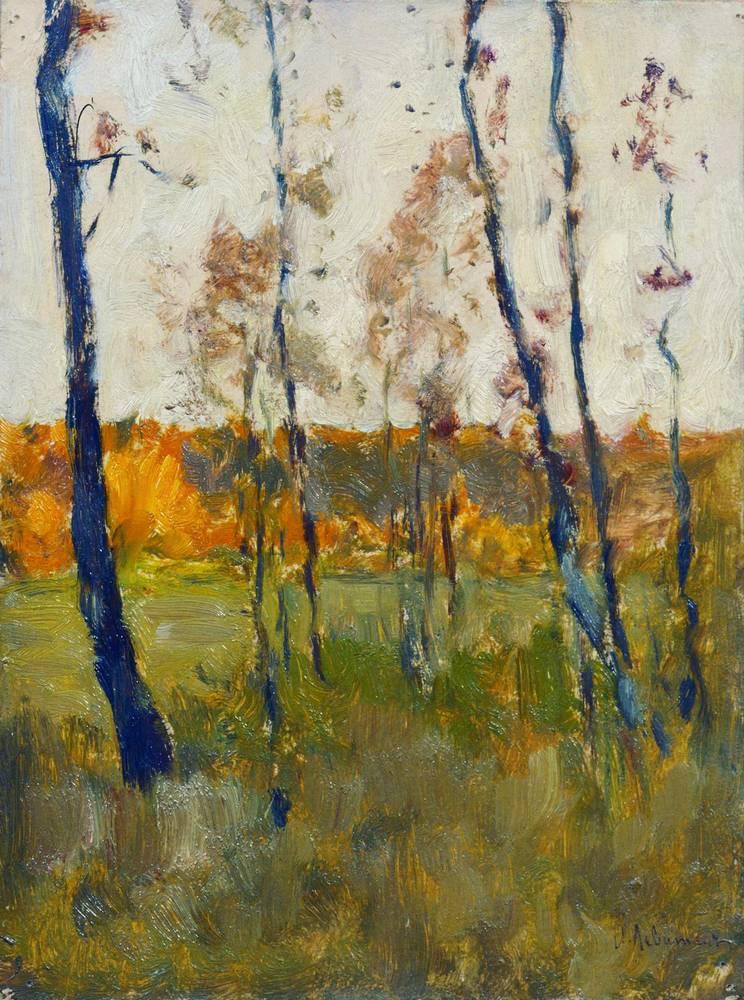
Isaac Levitan, Autumn, 1899

Some perfectly good things this month, but not many standouts. Piranesi was the winner, I’d say. Here’s hoping for a more memorable December. I have several exciting things lined up, including some group reads. How about you? Did your November reading make an impression?