What I Read, June 2024

Dropping this as something to keep you busy—and maybe even entertained—while I carve out the time to write my Year in Review piece. I won’t be catching up on the last half of the year—in fact, not sure I’m going to continue with the monthly pieces, might be time to try something new—but I’d already written most of this one and it seemed a shame to let it go to waste.

Joaquin Sorolla, San Sebastian Landscape (1911)

Shelley Parker-Chan, She Who Became the Sun (2021)

Fantasy novel set in 14th Century China (with the smallest bit of magic) about a young girl who fulfills the destiny foretold for her brother, who dies, along with the rest of her family and everyone else in her village, from a harrowingly described famine. Zhu Chomngba drags herself, starving and mute with fear, to the nearest monastery, where she is taken in because she has disguised herself as a boy, a deception she never disabuses anyone of, going to great lengths to keep the secret. Her bunkmate, and best friend, learns the truth, leading to an unexpectedly progressive outcome. The meat of the book concerns Zhu’s long, slow rise to power, as she consolidates the Han and prepares to do battle against the Mongols. I liked the idea of this book more than the actual reading experience. By the end, I was keen to learn what happens next, but I was also relieved to have finished the book. (It’s long.) Jury’s out whether I’ll read the sequel.  

William Maxwell, So Long, See You Tomorrow (1980)

Seems like everybody knows this book, but if you don’t, do yourself a favor and read it. But make sure you’re in a good head space first. So Long, See You Tomorrow, a novella about things people can’t bear, isn’t easy. A woman can’t bear to tell her son her estranged husband has ordered her to forbid the boy from visiting the farmstead where he, the former husband, is quietly cracking up, and, even more heartbreakingly, the boy’s dog is tearing itself apart in grief. Years later, another man, the story’s narrator, sits in a New York City analyst’s office and means to say that he “couldn’t bear” his mother’s decades-ago untimely death, but says, instead, he “can’t bear it,” a realization that sends him out of the office and into the streets, for only in the streets of NYC can one cry freely.

As these examples might suggest, the book consists of two strands. Interestingly, they intersect only glancingly. In one the first-person narrator, who seems an awful lot like Maxwell—today, the book might be marketed as autofiction—describes his mother’s death in the little town of Lincoln, Illinois in the 1918 flu pandemic. (The story that took up the whole of They Came Like Swallows is here compressed into a handful of anguished pages.) When the boy’s father remarries the couple decide to build a new house. The work-site, the house framed but without walls, and as such a metaphor for the book’s fascination with unfinished, maybe unfinishable structures, becomes the boy’s refuge after school. He bring his friend Cletus, and as the boys play amid the unfinished space, the narrator believes he “had found a way to get around the way things were.” But nothing gets around the way things are: that’s why life is so unbearable.

Cletus, whose experiences comprise the book’s other strand, also has much to mourn. His family, tenant farmers scrapping a life together, has fallen apart. He now lives in town with his mother, who has left her husband to be with the husband of the couple’s best friends, who work the next farm over. Cletus soon has even more to deal with: his father shoots his wife’s lover, his former best friend. (Not a spoiler: the novella opens with the rifle shot.) The boys drift apart. The narrator next sees Cletus years later in a high school hallway. The narrator sees Cletus, sees that Cletus sees him seeing—and ignores him. This unkindness haunts him all his life, getting tangled with the earlier loss of his mother. The book’s premise is that the narrator, now an old man in New York, the kind of person who visits MOMA regularly, where he is much taken with a Giacometti sculpture that reminds me of his father’s half-built house, a man, as I said earlier, like William Maxwell, excavates, through a mixture of research and imaginative reconstruction, what happened on those farms between those people.

Death, adultery, murder, cruelty: these are the things that can’t be borne in So Long, See You Tomorrow. Which makes the book sound lurid when in fact it’s heartbreakingly restrained. Or, more accurately, a strange blend of the two. The writer Antonya Nelson gets it exactly right:

I don’t know how William Maxwell manages to balance those two stories, one plotted like a melodrama, replete with murder and mayhem, and the other a quiet meditation that hinges on the tiniest non-gesture of passing strangers many years in the past. It’s a combination that oughtn’t work. And yet it does.

Even a three-page swerve into the mind of the abandoned dog works. Which it absolutely should not. Anyway, like I said, read it. It’ll tear your heart out, but in a good way.

I read a lot of Maxwell in my mid-twenties (somehow never this one, though). Now that I am old enough I want to revisit them all. And that’s just the novels. I haven’t even cracked the stories yet.

Manjula Martin, The Last Fire Season: A Personal and Pyronatural History (2024)

Manjula Martin lives in Sonoma County. She is not a winemaker (although she drives past the fields full of seasonal workers, most of them Latino/Latina, working through the night to pick the grapes at the time when they are at their most succulent). Nor is she especially wealthy (though she and her partner have jobs that pay enough and make a difference (union organizing, writing), plus the proceeds from an apartment she sold in San Francisco).

They live in a redwood cottage in the WUI, the wildland-urban interface, as do so many in the paradise of northern California. A paradise threatened by fire. As it always was. But now more than ever. The relentless impingement of human habitation into the forest, plus a century’s worth of misguided fire prevention strategy, plus climate change means the wildfire season is ever longer and ever more dangerous.

Martin’s memoir begins in July 2020, when terrible lightning storms set off hundreds of fires that burned hundreds of thousands of acres. It ends in November, with the delayed end of the season, though with the tendency of fires to smolder underground through the increasingly dry winters, every season is now fire season. In between, she, like everyone in California, learns to prepare a go bag, to speak knowledgeably about AQI levels, and, like many, to evacuate for a time when the fire comes within a couple of miles of the house.

She breaks up her descriptions of those months of the fire by looking back to her childhood growing up on a commune with hippie parents who left that life to become a master gardener and a professor in nearby Santa Cruz and forward to the actions she has taken since to prepare to live with fire.

Martin is an expert at living with hard things; she suffers chronic pain from the operations required to free her from a broken IUD. As a woman who cannot and never wanted to bear children, Martin resists the tendency to think of nature in terms of fecundity and rebirth, even as she finds herself unwillingly returning to that language. Martin impressively blends the experience of living in a damaged body with that of living on a damaged planet.

Martin learns the key distinction between good fire and bad fire. Without the former we have no hope of combatting the latter, though we may have left things too late. She argues that there is no natural world outside its encounter with the human (just as there is no definition of the human that isn’t dependent on our reliance on nature, especially plants). Our fantasy of pristine or untouched nature is just the flip side of our rapacious consumption of natural resources. Thus she returns again and again to her garden, which not only distracts her from her pain but teaches her about the power of pruning, grafting, and weeding. “An intervention,” she writes, “was not inherently good or bad; it was part of a dialogue. The tending of a natural body required constant attention: the giving and receiving of nurture and discipline. Extraction and tourism were types of attention. So was gardening. It mattered how the relationship was structured, not just that there was one.”

At her best, Martin rejects easy thinking. The tendency to just get through to the end of the next fire season, for example, is strong, but Martin rejects this as blindness. We need, she argues, to think of ourselves as in a relationship with the world, to refuse to separate human from non-human life.

The Last Fire Season annoyed me sometimes: it’s too long, and its author is pretty self-righteous. I’m sympathetic to her politics and indeed her world view, but even I had to roll my eyes at her holier-than-thou attitudes. But even though I strongly suspect Martin and I would hate each other, I learned a lot from her book (not least the wonderful word “duff”), and I bet I’ll think about it for a long time to come.

Caleb Carr, The Alienist (1994)

In the Sherwood branch of the Central Arkansas Library System’s copy of Carr’s The Alienist, someone has written alongside a passage referring to the draft riots of 1863, “Oh Please! Too much B.S.” Telling that out of this entire 400+ page novel, only the passage describing the backstory of its sole African American character is singled out for such contempt. Who knows when some anonymous member of my community expressed this frustration. It looks like the book hasn’t been checked out for a while—but it also looks like it was checked out a lot, back in the day. And of course, The Alienst was a huge hit. I remember selling more than a few copies of it in my bookseller days. For whatever reason, I never thought of reading it then. But Carr’s recent death, and the story of his life as revealed in the Times obit, piqued my interest. And I knew the book has its fans. When I wondered on Bluesky about reading it, Anne Trubek said she’d spent years chasing the high of her first encounter with the book. How could I not see what the fuss was about?

In New York in 1898 someone is killing young boys. Not just killing them: maiming them horribly and leaving them on grisly display. These boys are orphans and runaways. They work in brothels, servicing a particular clientele: men who like boys dressed up as women. In the first chapter, the narrator, John Schuyler Moore, a crime reporter for the Times is summoned to the latest corpse by his former Harvard classmate, Laślo Kreisler. Kreisler is the alienist of the title, as psychologists were then known: they cared for or studied people “alienated” from society and their own, “true” natures. Under the guise of then police commissioner Theodore Roosevelt (another old pal), whose attempt to clean the force of corruption (same as it ever was…) threatens to founder if the killer isn’t caught, the pair methodically stalk the fiendish killer. They are joined by the first female police officer in NY, two Jewish cops ostracized for their identity and their passion for scientific methods of detection, and some devoted former cast-offs from Kreisler’s life’s work helping orphans. The band gets together, they make painstaking progress, but they’re always behind the killer. As the death toll rises, and nefarious elements seek to use the killings to foment reactionary unrest in the city, the case becomes a race against time…

The short verdict: it’s good! Not, in my opinion, great. But worth reading. I got a Name of the Rose vibe from it: a smart non-crime writer writing an investigation in a historical period they have researched to bits.

The long verdict: maybe what Carr was doing—spotlighting together historically marginalized figures and using historical figures like Jabob Riis and Teddy Roosevelt as more than just bit players—was more unusual at the time than now. Maybe the book is in that awkward in-between stage: a bit dated, not yet so old that it feels like a glimpse into another world.

What does feel of its time—the 1990s, not the 1890s—is the passionate defense of children, and the abhorrence of the violence (physical, psychological, sexual) done to them by adults. Based on what I read about him, this element seems to come pretty closely from Carr’s own life, with the desperate, authentic, slightly incoherent quality of not-fully-worked-through experience. In this, The Alienist reminded me of some otherwise completely different books, the crime novels of Andrew Vachss, all of which centered on the sexual abuse of children. Anyone remember those? Vintage published them in the 90s, they were kind of a thing, but I never see them anymore. Wonder what happened to him.

Ignore that anonymous Arkansas reader: no BS here. There’s plenty of fiction being written today that will look, if we are lucky, a little creaky in 30 years in its efforts to include marginalized experience. Worth a little awkwardness to kick open some doors.

Laurie Colwin, Shine On, Bright and Dangerous Object (1975)

Colwin’s first novel, which I think I maybe found a bit slight on my initial deep-dive thirty years ago and which I haven’t read since, but which impressed me greatly as a middle-aged reader. Crazy to think Colwin was only about 30 herself when she wrote it.

A Jewish woman marries into an old WASP family. He husband, a charismatic ne’er-do-well, dies in a sailing accident. In the grieving process, she must come to terms not only with her loss but her recognition of how little her husband had ever been able to know about himself. In the process, she becomes close to her husband’s brother, as serious as her husband was carefree. I won’t tell you what happens, but Colwin does something so interesting at the end: her book takes an unexpected swerve that makes everything so much more complex. Man, it sucks she died so young.

Francis Spufford, Cahokia Jazz (2023)

God, what a book! I’ll say more about it in my Year in Reading piece.

Elisa Gabbert, Any Person is the Only Self (2024)

Essays on mostly bookish topics written by the poet Elisa Gabbert. I was happy to start in on the first one, because I remembered it from its first appearance in the New York Times: a lovely piece on the “recently returned” shelf at the Denver Public Library, where no algorithm or even individual taste holds sway. Gabbert has revised the piece so that it has a wider focus, and I actually missed the minor-key aspect of the original. But I swallowed these pieces one after another, unable to give them the time they, like all good essays, deserve. I ought to revisit them from time to time. Here’s what stuck with me, though: the to-me breathtaking abruptness of their endings. Gabbert does this thing where she meanders in classic essayistic fashion, and then simply declares herself done. I experienced this as an attack on my sense that the ending of an essay should call back to its earlier moments, allowing readers to see in a new light something they’ve have already been told. But they really are more ways to do things than you’d think.

Jamel Brinkley, Witness (2023)

Strong collection of stories of unhappiness. I still think about “Blessed Deliverance,” about a group of friends coming up in a gentrifying neighbourhood (one sign of which is that some white folks set up a bunny rescue) who drift apart as they enter high school. And I was blown away by “Barstow Station,” the story of a UPS driver whose adult relationships founder because he’s too busy preserving himself from the memory of something bad that happened when he was a teenager. I immediately decided to teach it this fall—along with this lovely close reading by my secret boyfriend Garth Greenwell. (Secret to him, not all of you.) In the months since first writing this, I did indeed teach the story, and even though most days in that class were hard slogging, the story was a hit. Or at least what counted for one in one of the least curious groups of students I’ve ever taught.

Colin Walsh, Kala (2023)

Debut Irish crime novel that seems to have made basically no impact in the US market. Friends who were teenagers when one of their gang disappeared are brought back together when the body is found. As the crime is investigated, these now-adults learn how much they’ve lost over the years. I’m grateful to the friend who sent me a copy: I read Kala with pleasure over a summer weekend. Walsh reminds me a lot of Tana French: they’re both Irish, obviously, and dab hands at dialogue. Above all, Walsh concentrates as much on character as his more famous (and, let’s be real, talented) confederate.

Linda Kinstler, Come to this Court and Cry: How the Holocaust Ends (2022)

In her brilliant first book, Linda Kinstler asks this vexing question: what counts as proof that the Holocaust happened? She begins in Argentina in 1965 and the Mossad’s assassination of Herbert Cukurs, the Latvian Lindbergh (in politics and aviation alike), known during the Holocaust as the “butcher of Riga.” Next to the body, the killers left this text from a closing speech at the Nuremberg Trials: “Mankind itself… comes to this Court and cries: ‘These are our laws—let them prevail!” A strange choice, at least for anyone uncomfortable with the idea of taking the law into one’s own hands.

From this historical event—prompted by unwillingness on Israel’s part to have a sequel to the Eichmann trial and fear that the statute of limitations for perpetrators was about the expire in Germany—Kinstler’s text becomes at once more theoretical and personal. Theoretical because her main interest is in parsing the difference between law, history, and story, and how the evidentiary claims for the latter two are different than those affecting the first. And personal because in the background of Cukurs’s story—a member of the Arājs Kommando, Latvian auxiliaries who competed with the Germans for cruelty and zeal in murdering their Jewish former neighbors—was one Boris Kinstler, the author’s grandfather, who disappeared or died in mysterious circumstances in the late 1940s and may have been a KGB spy and thus acting as a mole within the fascist-aligned organization.

Central to Kinstler’s argument is a historical situation that was new to me. In 1958 a German jurist named Erwin Schüle, the lead prosecutor on a trial of perpetrators who had been stationed in Lithuania, made a consequential decision. Initially faced with only a single defendant—a man named Fischer-Schweder who had white-washed his SS record and, perversely, even ran a displaced persons camp after the war—Schüle ran up against the problem that German law required him to prove that defendants had initiated murder (in this case, mass shootings), rather than doing them on the orders of others. Witness testimony was inconclusive. So Schüle ordered his detectives to expand their investigation to uncover what he called “the crime complex” of the area on the German-Lithuanian border where Fischer-Schweder had served. As Kinstler explains, by crime complex Schüle meant “the entire constellation of actors and actions that allowed mass executions to take place.” In so doing, the prosecution charged nine more men. All ten were convicted.

The idea of the “crime complex” considered Holocaust crimes as structural rather than individual:

it treated entire swathes of the Nazi administration as criminal organizations and presumed the complicity of everyone involved, including secretaries and radio operators and cooks. It required investigators to begin with a place, or a name, or a date, and comb through vast amounts of information to fill in the blanks: who had been killed, and how, and by whom?  How many ‘Aktions’ were there, and on whose orders? How many Nazi personnel had been involved? Were they still alive and in Germany? If they were able to answer all these questions with certainty, then they could initiate criminal proceedings.

Perhaps because of its status as both victim and perpetrator, Latvia never pursued the “crime complex” idea. Which, Kinstler argues, made it hard for the country to come to terms with its responsibility in the miserable fate of its Jewish population. And then, more recently, to refuse to take up a case against (the memory of) Cukurs, despite the pleas of the remnants of its Jewish community. For in these same years, Cukurs has again become a folk hero in Latvia, a devoted patriot, a fighter of the Soviets, a victim of Israeli aggression, who not only didn’t kill Jews but helped several members of that community, even rescuing one young woman and taking her to safety in South America after the war. (Kinstler meets the woman’s daughter to learn more, though mostly what she learns is that the woman’s mother never talked about her wartime experiences, leaving her and Kinstler companions in confusion.) Kinstler tells us about a musical that, like something out of Mel Brooks, white-washed Cukurs’s reputation; she even reads a spy novel (recommended to her by the local prosecutor) in which her own grandfather figures as a Soviet spy and thus a traitor to the Latvian people.

Historically, it’s clear that Cukurs both saved a handful of people and was present at many deportations, requisitions, beatings, and mass shootings, notoriously in the Rumbula massacre, in which 25,000 Jews were murdered on two days in late November and early December 1941 in a forest near Riga. Eyewitnesses report him taking part in such events. But no one alive can testify to it.

In this sense, Come to this Court and Cry is a fascinating expansion of what Dan Stone argues in his new history, regarding the reactionary backlash that has shaped the latest iteration of Holocaust memory wars. At the annual Holocaust remembrance events, local politicians downplay the Arājs Kommando’s responsibility, saying that no simple conclusion can be made regarding its activities. Too hard to acknowledge complicity.

As Kinstler concludes, in the 21st century, to expand the reach of justice in reopening cases from the era of WWII is a double-edged sword: “a crime that can still be tried can also still be pardoned.” Her book explores how “remembering went from being an injunction to a knotted, nearly impossible question.”

And what about Boris Kinstler, the author’s grandfather? Was he a spy? At the end of her book, which I recommend unreservedly, Kinstler tells us about the report she requested from the Russian government. Did they have a file on her grandfather? A one-page letter returns: no information or materials pertaining to Boris Kinstler exists in the archive. No answers there either. Kinstler’s subtitle, she tells us, is a warning, not a prediction. The fight against the Holocaust’s misuses never ends; as the forces who propagate those varied distortions grow in number and power, it seems a fight less likely than ever that we will win.

Helen Garner, This House of Grief (2014)

September 4, 2005 was Father’s Day in Australia. A man named Robert Farquharson was driving his three children home to their mother, who had initiated divorce proceedings against him earlier that year. Father and sons had spent the day watching the football, visiting family, making a KFC run for dinner, even doing a little shopping. Night had fallen; Farquharson was on the highway, five minutes from home. He headed up a railway overpass, then down the other side. Suddenly, his car veered off the road and plunged into a reservoir. Farquharson survived; the boys drowned.

Garner’s work of narrative nonfiction tells the story of the aftermath of this terrible event. Although he was charged by the Crown with three counts of murder, his soon-to-be ex-wife supported him, saying he could not have set out to kill his beloved children. But Farquharson’s behaviour after the crash was odd, to say the least. Splashing out of the water into the spring evening, soaking wet, he flagged down a car and ordered its drivers to take him to his ex-wife’s house. Only there did he mention the children were still in the water. And only then were the authorities informed. When Farquharson and the boys’ mother were taken back to the site, by her new lover, Farquharson stood silently, asking only for a cigarette. It was the new man in Cindy’s life who went into the water to try to rescue the boys. That first night, when police questioned him, he insisted he hadn’t done anything wrong, asking only, over and over again, what would happen to him.

Who acts that way? Well, anyone maybe.

What is the right way to respond to a terrible situation? Is some grief more acceptable than others? Could Farquharson’s confused story—that he had blacked out during a violent coughing fit—have been true? Is cough syncope a thing? Some experts said no. Others said yes. What about the physical evidence, tire tracks and the like? According to the police, the signs pointed to voluntary movements on the slope, inconsistent with an out of control car. Farquharson, they allege, steered the car into the water. But they messed up some of the evidence, and failed to account for the road’s camber. What about the explosive testimony of one of Farquharson’s mates, who said he’d had a conversation with the man a few months before the event, outside the local fish and chippie on a Friday night: Farquharson was not just low and helpless, as others had testified he had been, but angry and vengeful. He said he was going to kill the boys, and he would do it on a day everyone would remember, Father’s Day. Did Farquharson really say such a thing? Why didn’t the mate come forward at the time?

Was this an accident or an act of vengeance? Garner followed the trial for months, attending court every day, and her book records the efforts of the Australian legal system to come to terms with this baffling case. She gets friendly with the other regulars—reporters, gawkers, court officials—and one day runs into the defense counsel, to whom she says, “Only one man knows what happened, and he’s not saying.” This seemingly benign statement of perplexity incenses the lawyer (he threatens to ban from the courtroom): the whole point, he thunders, is that Farquharson doesn’t know what happened. What is knowing? What is an act? Can we entangle our conscious decisions from our unconscious drives? These are the big questions Garner probes in this riveting book.

Garner doesn’t like Farquharson—her take seems to be that the only thing more impossible than his having killed the boys is the possibility that he didn’t—and her descriptions of the man are pitiless, though, I wouldn’t say, unfair. In one especially merciless moment, she calls him a “small stump of a man, with his low brow and puffy eyes, his slumped spine and man-boobs, his silent-movie grimaces and spasms of tears, his big clean ironed handkerchief.” It doesn’t help, from her perspective, nor, I suspect, from that of either the law or public opinion, that Farquharson is profoundly inarticulate. He responds with baffled indignation to his plight; he turns to sentimental clichés and watered-down therapy-speak. Behind the story of the crime is an argument about a certain kind of Australian masculinity and its helpless, toxic loneliness. As a North American reader, I no doubt don’t understand the full context but Farquharson is legible beyond his corner of Victoria.

I’ll let you look up the outcome for yourself: if you like Janet Malcolm (name-checked here in one of the epigraphs) you’ll enjoy This House of Grief. I read with avidity, but I also never quite get on with true crime. Throughout, Garner projects herself on to the jury, imagining her own responses (boredom, confusion, indignation, you name it) reflected in their posture and expression. By the end, I felt like Garner was trying to reason out her own compulsion. It can’t be good for you, attending to a sensational trial this closely when you don’t have to. I found her final pages, where she mediates on her grief for children she never knew—ending in a sanctimonious aria: “They are ours to mourn. They belong to all of us now”—mawkish and unconvincing.

Read this, sure, but read her fiction first.

Dorothy West, The Wedding (1995)

Set in 1953 in a black enclave on Martha’s Vineyard called The Oval, West’s novel—only her second, written over decades in collaboration with her editor, Jacqui Kennedy Onassis, and published when the author was 88—is set on the day leading up the wedding of the youngest daughter of the community’s richest and most prestigious family. This economy of space and time is contrasted with flashbacks that go back four generations on both sides of the family. Over and over, these family stories show whites and blacks mixing, often intimately. The characters, obsessed with color, police racial distinctions that can’t hold. Seemingly impermeable ways of living and thinking prove to be all too permeable. Most interesting to me as a (remembered) record of the last moments of legally segregated America—a world Henry Louis Gates, Jr. wrote about in his underappreciated memoir Colored People. Had I read it on my own, I would probably have forgotten it soon after reading. But I read it for One Bright Book, and Frances and Rebecca helped me think about it more carefully. They didn’t quite convince me the novel is as smart about class as it is about race, but they made me see it as more carefully composed then I’d thought. Give the episode a listen and see if you are enticed.
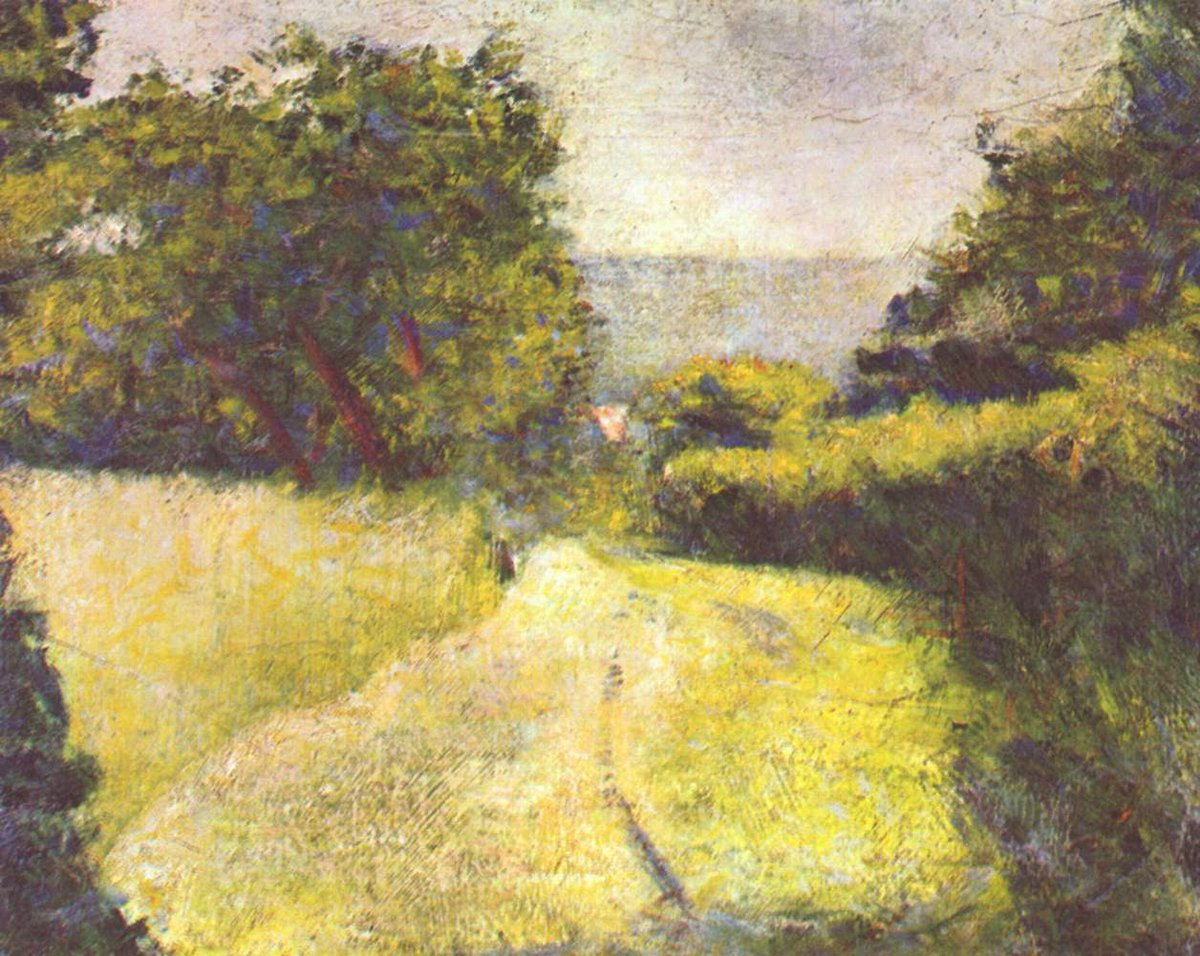
Georges Seurat, The Hollow Way (1882)

Tell me—have you read any of these? If I could only recommend one, it would be the Spufford. And then the Colwin. And don’t sleep on Brinkley. But a good month all round. Doesn’t last summer seem a lifetime ago?
My Year in Reading, 2023

I wouldn’t say I had a great reading year. I was on my phone too much, I was being anguished or avoiding being anguished about the myriad injustices of the world, which I knew too much and could do too little about. I travelled—maybe not too much but an awful lot, for me—which was often energizing and enjoyable, but also got in the way of reading.

I felt, in other words, that I had frittered away my one wild and precious reading life. I bottomed out in the middle of the year, regularly tossing aside books unfinished after having spent more time with them than they deserved or that I could find patience for. A querulous reading year, you could say.

And yet some things stood out. Links to previous posts, if I managed to write about it.

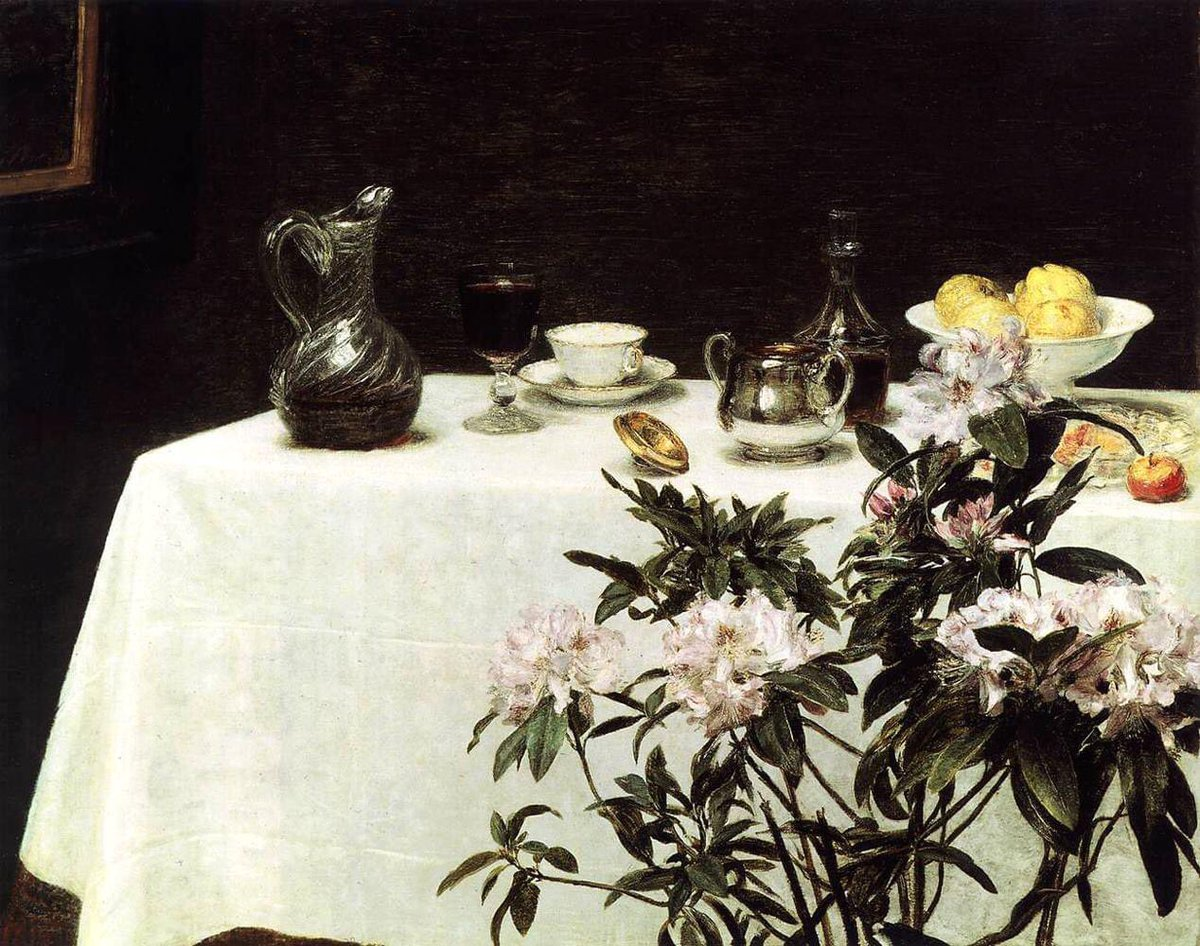
Henri Fantin-Latour, Le coin de la table (1872)

Dwyer Murphy, The Stolen Coast

A rare heist novel where the heist, though satisfying, isn’t the main attraction. I loved this stylish, smart, funny tale of a man who has put his Ivy League law degree to use in taking over the family business: giving new identities to guys on the run and getting them the hell over the border. A great book of off-season resort towns.

Simon Jimenez, The Vanished Birds

I’m still getting my bearing in contemporary sff so take these comments for what they’re worth, but it seems rare to me that a book takes as many swerves as this one: the narrative moves back and forward in time and all over the place, from a near-future nearly uninhabitable earth to a galaxy far-away in space and time. You get invested in a storyline and then it ends but sometimes it comes back. But even more than the structure I loved this book for its emotional seriousness: its many relationships are doomed to fail because of their constitutive circumstances. For example: a man ages fifteen years between each meeting with his beloved, while she, thanks to intricacies of stellar time travel, has only aged a few months. The emotions might be bigger than the ideas, but I was totally okay with that.

Two novels by Katherena Vermette

One of the greatest working Canadian writers. This year, fresh off the thrill of teaching The Break to smart, appreciative students, I read The Strangers and The Circle, a bleak and beautiful trilogy of indigenous life in the aftermath of the cultural trauma of the residential school system.

Four novels by Kent Haruf

It should tell you something that in early April, one of the worst times in the academic year, I read four novels by Kent Haruf in just over a week. I loved Plainsong the most but enjoyed Eventide, Benediction, and Ours Souls at Night almost as much. Easy reading, sure: plain syntax rising to gentle arias, nothing fancy, maybe a little sentimental. But these books are so warm and kind. Each is set in Holt, Colorado, out on the eastern plains, where the mountains are a smudge on the western horizon and it’s sometimes hot and sometimes cold but always dry. The people are ranchers and school teachers and social workers and hardware store owners and ne’er-do-wells and retirees. Everyone is white and no one thinks that’s worth noticing. The time is hard to pin down. Sometimes I thought the 70s or early 80s but we’re probably talking the 90s. Things were different before the internet. The characters’ lives are modest and they seem fine with that. They go about their business, do their work, make good choices and bad ones. People look out for each other, but they judge each other, too. Little kids get lost biking, but they come home again. It’s not all roses, though. High school boys bully girls into having sex, over in that abandoned house just down from where the math teacher lives. People get sick, go hungry, lose jobs. Some characters get what the preacher will call a good death, some die unreconciled to their kin, some without warning, too soon. Life just keeps happening, you know?

Some readers will call this hokum, but I ate it up. Haruf won my heart. I thought him especially good on second chances and unexpected turns of fate. Of all the stories that weave through these loosely connected novels, the best concerns two brothers, old bachelors, ranchers, who agree to take in a pregnant teenage girl and who, to everyone’s surprise, not least their own, form a new family with her. That scene where they take into the next town over to get things for the baby and insist on buying the best crib in the store? Magic.

Garth Greenwell, Cleanness

Smart, sexy, stylish books about how we relate to bodies privately and publically, and whether we can recast the narratives that have shaped aka deformed our understanding of what it is to live in those bodies. Greenwell’s Substack is worth subscribing too; he makes me curious about whatever he’s curious about. Can’t wait for the essay collection he’s writing.

Emeric Pressburger, The Glass Pearls

Yep, that Pressburger. Closer to Michael Powell’s Peeping Tom than any of the (indelible) films they made together. Karl Braun, a German émigré, arrives at a boarding house in Pimlico on a summer morning in 1965. A piano tuner who never misses a concert, a cultured man, a fine suitor for the English girl he meets through work. I’m not spoiling anything to say that Karl isn’t just quiet: he’s haunted—and hunted. For Karl Braun is really Otto Reitmüller, a former Nazi doctor who performed terrible experiments, a past he does not regret even as he mourns the death of his wife and child in the Hamburg air raids. Now the noose is tightening and Otto/Karl goes on the run… Suspenseful stuff; most interesting in this play with our sympathies. Not that we cheer for the man. But his present raises our blood pressure as much as his past.

Toni Morrison, A Mercy

A short book that covers as much ground as an epic; a historical novel that feels true to the differences of the past but that is clearly about the present; a classic modernist Morrison text, where the first page tells you everything that’s going to happen except that it makes no sense at the time and the rest of the reading experience clarifies, expands, revises. Such beauty and mystery in so few pages.

Roy Jacobsen’s Barrøy series (Translated by Don Bartlett and Don Shaw)

Cheating a bit since I read the first one in December 2022. I’m a huge fan of these novels about a family and the remote Norwegian island they call home from 1900 to 1950. I like books where people do things with their hands, maybe because I can’t do much with mine. The characters bring sheep into the upper field, fish with nets and line, salt cod, keep the stove burning all through the year, row through a storm, carry an unconscious man through sleet. It’s all a little nostalgic, a little sentimental, but not too much. Just how I like it.

Two Books by Walter Kempowski (Translated, respectively, by Michael Lipkin and Anthea Bell)

Fresh on my mind so it’s possible I’ve overvalued them but I don’t think so. All for Nothing, especially, is something special.

George Eliot, Middlemarch

Last read in college—under the expert tutelage of Rohan Maitzen, this can only be called one of the highlights of my undergraduate experience. This time I listened to Juliet Stevenson’s recording, which perfectly filled a semester’s commuting. True, Arkansas traffic is not the ideal venue for some of Eliot’s more complex formulations, but Stevenson (as much a genius as everyone says, she do the police in different voices, etc.) clarifies the novel’s elegant syntax and famous images. The book’s the same, but I’m not; a whole new experience this time around. Much funnier, especially its early sections. (Celia is a triumph.) More filled with surprising events: that whole Laure episode (a Wilkie Collins novel in miniature), it was as if I’d never read it. And more heartbreaking: in 1997, I hated Rosamond, and I admit I still felt for Lydgate this time around, but I had so much sympathy for her, a character I’d only been able to see as grasping and venal. Speaking of sympathy, one of the glories of English literature lies in watching Dorothea as she matures from excitable near-prig to wiser and sadder philanthropist. Amidst all this change, though, some things stayed the same. Mary Garth still won my heart; the suspense at the reading of Featherstone’s will gripped me just as much.

It’s good to read Middlemarch in college. It’s better to re-read Middlemarch in middle age. It’s best to read Middlemarch early and often.

Konstantin Paustovsky, The Story of a Life (translated by Douglas Smith)

Six-volume autobiography of Soviet writer and war correspondent Paustovsky, a Moscow-born, Ukrainian-raised enthusiast of the Revolution who somehow made it through Stalinism to become a feted figure of the 1960s. The new edition from NYRB Classics contains the first three volumes. I only read the first two, not because I didn’t enjoy them (I loved them) but because I set the book down to read something else and the next thing I knew it was a year later. Paustovsky had something of a charmed life. His childhood was largely downwardly mobile, and he lived through so much terror and upheaval. And yet he always seems to have landed on his feet. Maybe as a result—of maybe as a cause—he looks at the world with appreciation. He can sketch a memorable character in a few lines. He writes as well about ephemera (lilacs in bloom) as about terror (I won’t soon forget his time as an orderly on an undersupplied hospital train in WWI). He can do old-world extravagance (the opening scene is about a desperate carriage ride across a river raging in spate to the otherwise inaccessible island where his grandfather lies dying) and the brittle glamour of the modern (for a while he drives a tram in Moscow). Trevor Barrett, of Mookse & Gripes fame, said it best: Paustovsky is good company. I really ought to read that third book.

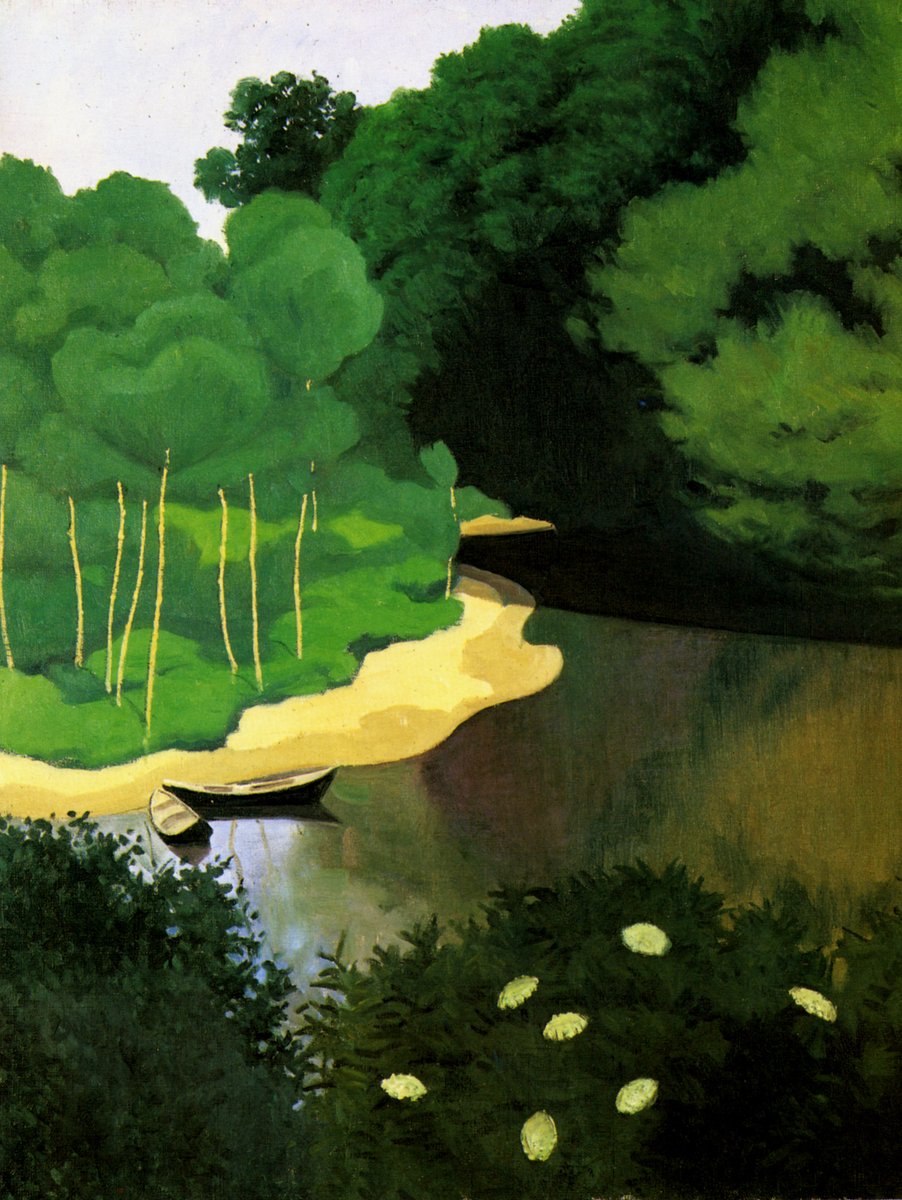
Félix Vallotton, Still Life with Flowers, 1925

A few other categories:

Didn’t quite make the top, but such pleasurable reading experiences: Adania Shibli, Minor Detail; Paulette Jiles, Chenneville; Abdulrazek Gurnah, By the Sea; Jamil Jan Kochai, The Haunting of Hajji Hotak and Other Stories (teaching “Return to Sender” was a revelation: fascinating how even students who had seemed immune to literature shook themselves awake for this one).

Read with dread and mounting desperation, don’t get me wrong it’s a banger, but couldn’t in good conscience call it a pleasure to read: Ann Petry, The Street. Barry Jenkins adaptation when?

Maybe not standouts, but totally enjoyable: Margaret Drabble, The Millstone; K Patrick, Mrs. S; Yiyun Li, The Vagrants; Elif Batuman, Either/Or

Best dip into the Can-con vaults: Margaret Laurence, The Stone Angel. Got more about of this now than I did in high school, lemme tell you.

Best book by a friend: James Morrison, Gibbons or One Bloody Thing After Another: Not damning by faint praise. It’s terrific!

Book the excellence of which is confirmed by having taught it: Bryan Washington, Lot. Maybe the great Houston book. I get that novels sell but I wish he’d write more stories.

Grim, do not recommend: Larry McMurtry, Horseman, Pass By; Girogio Bassani, The Heron

Not for me: Jenny Offill, Weather; Annie Ernaux, Happening; Yiyun Li, The Book of Goose

Planned on loving it, but couldn’t quite get there: Julia Armfield, Our Wives Under the Sea. Sold as metaphysical body horror, this novel about a woman who goes to pieces when her wife returns from an undersea voyage gone catastrophically wrong as a kind of sea creature didn’t give me enough of the metaphysics or the horror. I figured it would be perfect for my course Bodies in Trouble but I couldn’t find my way to assigning it. Possibly a mistake: teaching it might have revealed the things I’d missed. Gonna trust my instincts on this one, tho.

The year in crime (or adjacent) fiction:

Disappointments: new ones from Garry Disher, Walter Mosley, and S. A. Cosby (this last was decent, but not IMO the triumph so many others deemed it; he’s a force, but I prefer his earlier stuff).

Standouts: Celia Dale, A Helping Hand: evil and delightful, can’t wait to read more Dale; Lawrence Osborne, On Java Road: moody, underappreciated; Christine Mangan, The Continental Affair: moody, underappreciated; Allison Montclair, The Right Sort of Man: fun; Joseph Hansen: wonderful to have the Dave Brandsetter books back in print, hope to get to more in 2024; Richard Osman: as charming, funny, and moving as everyone says.

Maigrets: Of the six I read this year, I liked Maigret and the Tramp best. Unexpectedly humane.

Giants: Two Japanese crime novels towered above the rest this year. I didn’t write about volume 2 of Kaoru Takamura’s Lady Joker (translated by Marie Iida and Allison Markin Powell) but maybe my thoughts on volume 1 will give you a sense. Do you need a 1000+ page book in which a strip of tape on a telephone poll plays a key role? Yes, yes you do. (Also, it has one of the most satisfying endings of any crime novel I’ve ever read.) More on Hideo Yokoyama’s Six Four (translated by Jonathan Lloyd-Davies) here. Do you need an 800+ page book in which phone booths play a key role? Yes, yes you do.

The year in horror:

Victor LaValle, Lone Woman: horror Western with a Black female lead and not-so-metaphorical demon, enjoyable if a bit forgettable; Jessica Johns, Bad Cree: standout Indigenous tale, also with demons; Leigh Bardugo, Hell Bent: serious middle-volume-of-trilogy syndrome. Many demons, tho.

The year in sff:

In addition to Simon Jimenez, I liked Ann Leckie’s Translation State, Nick Harkaway’s Titanium Noir, and, above all, the three novels by Guy Gavriel Kay I read this summer, which gave me so much joy and which I still think about all the time.

The year in poetry:

Well, I read some, so that’s already a change. Only two collections, but both great: Wisława Szymborska’s Map: Collected and Last Poems (Translated by Clare Cavanaugh and Stanislaw Baranczak), filled with joy and sadness and wit, these poems made a big impression, and Ilya Kaminsky’s Deaf Republic (fortunate to have met him, a mensch; even more fortunate to have heard his indelible performance).

The year in German books: I read two, liked them both. Helga Schubert, Vom Aufstehen: Ein Leben in Geschichten (On Getting Up: A Life in Stories), vignettes by an octogenarian former East German psychotherapist who had fallen into oblivion until this book hit a nerve, most impressive for the depiction of her relationship to her mother, which reminded me of the one shared by Ruth Kluger in her memoir; Dana Vowinckel, Gewässer im Ziplock (Liquids go in a Ziplock Bag): buzzy novel from a young Jewish writer that flits between Berlin, Jerusalem, and Chicago. The American scenes failed to convince me, and the whole thing now feels like an artefact from another time, given November 7 and its aftermath. I gulped it down on the plan ride home, though. Could imagine it getting translated.

Everyone loved it; what’s wrong with me? (literary fiction edition):

Made it about 200 pages into Elsa Morante’s 800-page Lies and Sorcery, newly translated by Jenny McPhee. Some of those pages I read raptly. Others I pushed through exhaustedly. And then I just… stopped. The publisher says it’s a book “in the grand tradition of Stendhal, Tolstoy, and Proust,” and I love those writers. (Well, I’ve yet to read Stendahl, but based on my feelings for the other two I’m sure I’ll love him too.) Seemed like my social media feeds were filled with people losing it over this book. Increasingly, I see that—for me, no universal judgment here—such arias of praise do more harm than good; I experience them as exhortations, even demands that just make me feel bad or inadequate. Increasingly, too, I realize how little mental energy I have for even mildly demanding books during the semester. (A problem, since that’s ¾ of the year…) I might love this book in other circumstances —I plan to find out.

Everyone loved it; what’s wrong with me? (genre edition):

Billed as True Grit set on Mars in alternate version of the 1930s, Nathan Ballingrud’s The Strange indeed features a young female protagonist on a quest to avenge the destruction of her family, but Ballingrud is no Portis when it comes to voice. True, I was in the deepest, grumpiest depths of my slough of despondent reading when I gave this a try, so I wasn’t doing it any favours. But that’s a nope from me.

Other failures:

Mine, not the books. Once again, I read the first hundred or so pages of Anniversaries. It’s terrific. Why can’t I stick with it? I read even more hundreds of pages of Joseph and His Brothers, as part of a wonderful group of smart readers, most of whom made it to the end of Thomas Mann’s 1500-page tetralogy. I loved the beginning: fascinating to see Mann’s take on the stories of Genesis; interesting to speculate on why Mann would write about this subject at that time. (For me, Mann is in dialogue with Freud’s Moses and Monotheism, another oblique response to fascism through stories from Torah.) My friends tell me it got a lot more boring shortly after I left off (the end of volume 2), but that’s not why I gave up. Turns out, I don’t do well if I’m supposed to read something in regular, little bits. I need to tear into books—and I wasn’t willing to make the time for this chunkster. Sorry, guys.

Odds & Ends:

A few albums that stood out: Roy Brooks, Understanding (reissued in 2022, but I’m not over it: this quintet, man, unfuckingbelievable); Taylor Swift, Midnights (I love her, haters go away); Sitkovetsky Trio, Beethoven’s Piano Trios [volume 2] (a late addition, but pretty much listened to it nonstop in December and now January).

After a decade hiatus, I started watching movies again. Might do more of that this year!

I was lucky enough to travel to Germany in late spring with a wonderful set of students. While there, I met so many people from German Book Twitter who have become important to me, including the group chat that got me through covid and beyond. (Anja and Jules, y’all are the best.) All these folks were lovely and generous, but I want to give special thanks to Till Raether and his (extremely tolerant) family, who took me in and showed me around Hamburg. (Great town!) Have you ever met someone you hardly know only to realize they are in fact a soulmate? That’s Till for me. What a mensch. Cross fingers his books make it into English soon. In the meantime, follow him on the socials!

Reading plans for 2024? None! I need fewer plans. I can’t read that way, turns out, and maybe I’ll avoid disappointment by committing less. Gonna be plenty of other disappointments this year, I figure. No need to add any self-inflicted ones. At the end of last year, I joined a bunch of groups and readalongs, because I want to hang with all the cool kids, but I can already see I need to extricate myself from most of them. One good thing I did for myself in 2023, though, was to stop counting how many books I read. I was paying too much attention to that number. Fewer statistics in 2024!

Piet Mondrian, Oranges and Decorated Plate, 1900

Finally, to everyone who’s read the blog, left a comment or a like, and generally supported my little enterprise (which turns 10 in a week or two…), my heartfelt. I do not know many readers in real life. You all are a lifeline.

What I Read, September 2023

Don’t ask me what happened in September, it was a long time ago. I’m amazed I’m even writing this post.

Alex Katz, Lake Light (1992)

Dwyer Murphy, The Stolen Coast (2023)

I liked Murphy’s debut, An Honest Living. But I liked the follow-up even more. So much so that I’d have to call this my most enjoyable reading experience of the year. Murphy seems to know stuff: how to use the law to do things that aren’t really kosher, how to order in a dive bar, how to post in a pickup game. Jack, our narrator, has a pedigreed law degree, but he lives in his hometown, an appealingly ramshackle Massachusetts coastal town that is for sure not the Cape. He works with his father in the family business: helping people shed their identities and giving them new ones so they can start over. People on the run from criminal outfits, companies they’ve stolen intellectual property from, pasts that got too hot. I loved this premise and wanted even more of it.

Here’s Jack reflecting on how you can’t start totally from scratch in creating a new identity—everyone’s been damaged and that’s important:

You want to preserve a little trace of that damage. From parents, boyfriends, husbands, estranged siblings, jilted nobodies, pissed-off bosses who put a credit check on you ten years back for no good reason except you were leaving with two weeks’ notice. A past is a string of resentments and grievances. Grudges that never amounted to anything but were felt for a time. I paid a kid in Iceland to handle the digital traces. It might have been a pack of kids for all I knew. Healthy wind-kissed boys in front of computers, Viking aggression moving through their blood and no lands left to pillage, but they wanted money to walk around with and this was the work they had chosen.

That old-fashioned reference to “walking around money” turns those wind-kissed boys into something from the Rat Pack. Love it.

The quote gives you get a sense of Jack’s voice (Murphy keeps on like he started, he’s gonna be our next Portis.) And he’s not the only great character, either. Jack’s father is a delight, a man who knows how to eat, and chat up the ladies, and perform spycraft: he may be suffering from an incurable illness, though, and maybe things are going to change in Jack’s life.

When an old flame/best friend/absolute pistol, herself a lawyer working at the edge of the law, comes home for the summer, things definitely change. Jack gets involved in an elaborate heist, the machinations of which are pure pleasure. Speaking of pleasure, the main appeal of the book is Dwyer’s prose, which snaps with epigrams (“sincerity unmans me”) and jokes that don’t try too hard:

I went inside for a while and sat at the bar. It was a long block of wood nailed into legs and looked like something you might build in your basement and then forget about for several years.

I read this book over Labour Day weekend and that was a nice thing I did for myself.

Yiyun Li, The Book of Goose (2022)

After getting along with Li’s first novel, I turned to her most recent. I disliked it! Rohan’s take mirrors mine. I really didn’t understand why this novel had to be set in France. On the one hand, Frenchness seems to matter to it a lot. On the other hand, not at all. Feels like Emperor’s New Clothes to me.

Christine Mangan, The Continental Affair (2023)

If “atmospheric” as a term of literary praise means “set in European locales, especially those off the beaten track,” then this is a highly atmospheric novel.

In other words, we get Paris, yes, but we get more of Belgrade. Still more unexpected are Grenada and the peripherally European spaces of Istanbul and Algiers. But Mangan’s latest is more Hitchcock than Bourne. The best literary comp might be Highsmith.

A woman enters a train compartment otherwise occupied only by a ruggedly handsome man. They exchange pleasantries, watch the countryside of 1960s Europe flash by from the windows of the dining car, and warily seek to move past each other’s defenses. Part meet cute, part slow burn. But they’re acting. They know each other already. In fact, the man has been following the woman across the continent, tasked with retrieving some stolen money—something he could have done ten times over already, but can’t find it in him to do.

Brainy thrillers with nice locales are catnip to me, even though Mangan freights her characters a little heavily: they share a dramatic past neither can let go of. But she nails the ending, and even if The Continental Affair is a mere diversion—the title is so generic it’s like a parody—it’s adeptly done. Can’t wait for Cate Blanchett to star in the inevitable adaptation. Get this for the dad in your life who fancies himself a man of taste: he won’t be able to resist.

Simon Jimenez, The Vanished Birds (2020)

I can’t remember who put me on to this remarkable space opera. Adam Roberts? (Google search drew a blank.) I do remember where I bought it: a little shop in Missoula a couple of years ago. (Not the Shakespeare one. The other one.) I don’t remember what made me take it off the shelf. (I went back and forth between the audio and the paper book. Good narrator.)

I can say that The Vanished Birds will be on my end of year list. It’s that moving, that smart, that surprising.

It’s a long, complicated book. (Though not a patch on his most recent, The Spear Cuts Through Water, which I had to give up listening to, it was just too hard for my commute, but that book too astonishes right from its kickass dedication, “This one’s for me.”) My summary won’t do it justice. But here goes. In a galaxy owned by a single company, a spaceship arrives every five years on a small “resource planet” to take the accumulated harvest to the galaxy’s central planet. At the festival celebrating the ship’s arrival, the captain, Nia, hooks up with a local. They meet each time she returns, but the thing is that, thanks to time manipulation technology, what’s five years to him is only 15 months to her. She barely changes while he leaps forward in age.

But this poignant story is only the beginning of Jimenez’s tale. One year, in between spaceship arrivals, an unknown ship crashes into the fields. The man who loves Nia takes in the only survivor, a mute young boy, before passing him on to her on her next visit (the last one the now elderly man will live to see). Nia names the boy Ahro. It takes years before he speaks, but his musical abilities suggest there’s something special about him. That quality is recognized by Fumiko Nakajima, the lead designer/engineer/physicist of the company that runs the galaxy. Thanks to cryogenic technology, Fumiko is thousands of years old; Jimenez diverts us to her story, which begins on a near-future earth that she escapes just before it collapses due to climate change, but not without leaving behind her lover, a woman determined to see the place through to its end. Fumiko suspects that Ahro has a talent that could undo her past mistakes—but she knows the company that owns everything, even her, would subject him to vivisectionist experiments if it knew what the boy is capable of. She hires Nia on a mission to keep the boy, now a young man, on the fringes of the galaxy, away from company patrols. In the process, Nia becomes his parent. When Ahro is captured despite her efforts, only she can save him…

That’s a lot, right? The Vanished Birds is a novel of found family, colonialism, ecological change, time the revelator. Big stuff. It’s bold and beautiful (the prose is a cut above) and too carefully constructed to be called sprawling. I think about it a lot, several months after having read it, not least the section set on a planet that has bought by the company and stripped of its people, populated now by dozens of feral dogs and one last man, left behind to man the radio tower. I shed a tear at the end, I tell ya.

Garth Greenwell, Cleanness (2020)

I first read Cleanness in March—I never wrote up that month, and I probably never will. I’m glad of the chance to say something here, because I love this book. I already thought it was great the first time, but having had the chance to teach it, I’m convinced it’s brilliant. Like “we will read this in a hundred years” brilliant.

A companion piece to his wonderful debut, What Belongs to You, Cleanness is also narrated by an American teaching in Bulgaria. But the new novel is richer, its power coming from the montage of its seemingly disparate, almost stand-alone sections. To my mind, it is also better in that its references to the narrator’s childhood are cut to the bone. The handful of references hit that much harder than the extended section in the previous book.

I read Cleanness as a novel about different ways bodies can come together. Readers are most often drawn to the scenes of anonymous BDSM sex, but several chapters feature the narrator’s more placid relationship with another foreigner, a student from the Azores. Others describe a writing retreat, two describe encounters with current and former students in which the narrator wrestles with what it means to be a gay role model in a country where LGBTQ life is harshly penalized. A particularly fascinating chapter describes a series of spontaneous street protests that convulse Sofia, and the narrator’s admiration and fear of the unpredictable power of masses of bodies in public space. Even when we try to reduce ourselves to pure flesh, Greenwell implies, we can’t escape identity. But identity isn’t fixed; the roles we’ve been given are just that, roles. They can change, we can push against them even when their forms are ossified and seemingly inescapable. (That’s what politics is for.) This idea comes across most clearly in a chapter called “The Little Saint,” whose titular character, a bottom who lets men bareback him, gently explains to the narrator that the violence he begs the narrator to unleash upon him, which brings the narrator to tears, since the sounds of the whipping he lays on the young man seem to have turned him into a version of his father, who was never shy with his belt, the violence that is demanded by one person of another, can never be the same as violence enacted in hate or rage.

The book ends with a beautiful scene involving an elderly dog who wanders the campus of the international school where the narrator teaches. The narrator, drunk and alone, having narrowly avoided making a mess of some important things, takes the dog into his rooms even though it’s strictly forbidden to bring her inside because she’s meant to have fleas. He makes up a bed for her and then lies down next to her. An indelible scene. Here I take Greenwell to be saying that we can’t take the cleanness granted by the Little Saint and wished for by the protestors who want to sweep a corrupt government out of power too seriously. Cleanness but not too much: it’s good to lie down with beings, human or not, that others think of as dirty.

Seriously, this book is something else. Greenwell has such intelligence and such beautiful prose. Thrilling.

Sadly, most of my students did not feel the same way, though some of them were big enough to admit that they were kink shaming. No matter, Imma teach it again!

Georges Simenon, Cécile is Dead (1942) Trans. Anthea Bell (2015)

Day after day Cécile Pardon waits for Maigret at police headquarters, unwilling to see anyone but the great man, and when she does she has nothing more definitive to report than a suspicion that someone has been in the apartment she shares with an elderly aunt. When he sees her in the waiting room (the lads call it “the aquarium”) on a day when he’s just not feeling it, he slips out the back. She’s gone when he gets back to the office. But then the aunt is reported dead, and Cécile is nowhere to be found. (You can guess the rest; the title is not a metaphor.) Plottier than the average Maigret, this early-ish installment is further enlivened by the presence of an American detective who comes to see how the big man does his thing. (Simenon liked this idea: there’s one where someone from Scotland Yard does the same thing.)

The investigation centers on the apartment building where Cécile lived with her aunt. You could read Cécile is Dead, with its depiction of the space and the people who inhabit it, as a slantwise homage to Zola’s Pot Luck.

Annie Ernaux, Happening (2000) Trans. Tanya Leslie (2001)

Having taught Happening this semester in a class called Bodies in Trouble, I was interested to go back and read what I had to say about it three years ago. I see that I was damning with faint praise already then; spending a lot more time with the book didn’t make me care for it more. As for my students, they seemed to like it well enough. Understandably they couldn’t help but read it in terms of their post Dobbs American life; more surprisingly, they were mostly worked up by what they perceived as Ernaux’s class striving: they saw her as both a victim of and complicit in the denigration of working class lives. Their end of semester feedback revealed that they could take it or leave it as a course text. Good to hear, since I’d already decided not to repeat the experiment. I get that Ernaux is doing a thing; I just don’t care much for the thing. And her prose, as shaped by her various no doubt able translators (here Tanya Leslie), does not lend itself to the kind of close reading that is my pedagogical bread-and-butter. Whatever, Ernaux will get along just fine without my reservations.

Joseph Hansen, Troublemaker (1975)

I thought I wrote about the first novel in the Dave Brandstetter series, Fade Out, when I read it a couple of years ago but now I can’t find it in the perhaps-not-reliable index of this blog. In this, the third book (they’re all being reissued but the store didn’t have the second one in stock), the owner of a local gay bar is found naked and dead. A local hustler is found next to him. An open and shut case. Not to insurance agent Brandstetter. Surprise, surprise, he’s right, and soon he’s neck-deep in a twisty plot that once again makes the 70s seem both shitty and terrific.

These books are great above and beyond any talk of “pioneering representation” (tho that matters), it’s great that they’re back in print, it sucks that my local library does not have them.

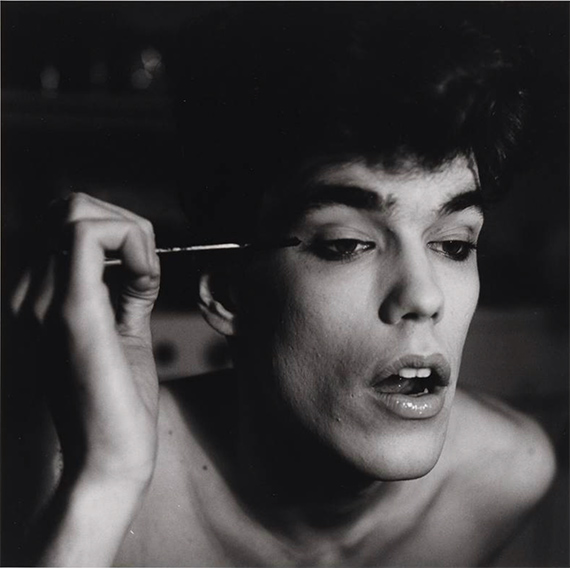
David Brintzenhofe Applying Makeup (II) (1982)

There you have it, friends. Have at me, Ernaux lovers, The Book of Goose partisans, and anyone who thinks all the books I liked are overrated…

May 2019 in Review

In contrast to last month, May was a good reading month. No surprise: April is the worst month of the year for my schedule; May is one of the best. Plus, I had a lovely few days at my in-laws’ farm, where there’s nothing for me—a person who avoids bush-hogging (it’s a thing, look it up) as if his life depended on it—to do but sit on the porch swing and read.

D6ogWr6W0AES07o

David Downing, Diary of a Man on Leave (2019) The new standalone from Downing is about a German-born Soviet spy who is sent back to Germany in 1938 to see if any of the members of the now-suppressed Communist party can be enticed into sabotage or resistance work. As is often the case with Downing, the historical background is more compelling than the writing or the story. But I also didn’t give this book my best. I bet I would have enjoyed it more if I’d read it in a couple of sittings, instead of in dribs and drabs over the last week of the semester.

Miriam Toews, Women Talking (2018) Lots of people have already written about this excellent novel, including Parul Seghal in this very nice essay about #Metoo in fiction. It’s based on a true story: in a Mennonite community in Bolivia, women of all ages were regularly drugged with animal anesthetic and raped by men they lived among and knew well. In Toews’s novel, the men of the community have gone to the city to bail out the culprits. The women have two days to decide what to do: stay, leave, or fight. The novel consists of their debates, as recorded by August, a man who in his younger years left the community (his parents were expelled) and has now returned. August is an educated man, a man useless at farming, and, as such, in the eyes of the women as well as his own, not really a man at all.

I loved this smart, slippery novel, and I suspect I would get a lot more out of it on a second reading. I don’t think I’ve come close to plumbing its depths. I’ll simply note for now that the use of the male transcriber (the women are illiterate) is brilliant—it lets us see how even an ostensibly “good,” that is, sympathetic man, is complicit in patriarchy. When August describes the underside of a woman’s arm as “very smooth and white, like the keel of a new canoe,” my first response was to admire this simple but effective simile. My second was to wonder over the nature of the comparison. Is it neutral? (And what would that even mean?) Appreciative? Objectifying? Can there be appreciation without objectification? Relatedly, can there be forgiveness without complicity? What is forgiveness even for? By evoking these sorts of questions, Women Talking reminded me of Virginia Woolf’s Three Guineas, another rhetorically complex investigation into social structures, gender politics, and the uses and abuses of violence.

I’ve a longstanding aversion to Canadian literature that I perceive to be worthy but dull (i.e. most mainstream English-language Canadian fiction of the past thirty years). I’d never read Toews before because I thought she fit that bill. On the basis of this book, anyway, I was totally wrong, and I look forward to looking into her backlist. Anyone have preferences?

Katherine Marsh, The Night Tourist (2007) This one is special to me because my daughter and I read it together (mostly me to her, but sometimes her to me), and it’s a pretty sophisticated book, probably best suited for middle readers or even teenagers. It reworks the Orpheus myth (and as such gave my daughter her first consistent exposure to Greek myth—another milestone). Jack Perdu is a teenager who experiences mysterious visions that eventually lead him to experience a whole New York underworld full of ghosts. These recently and not-so-recently dead people must come to terms with their past before they can, in the language of the novel, “move on” to Elysium. Befriended by a girl named Euri, Jack learns why he, a mortal, can see ghosts and at what cost. In so doing, he uncovers the truth about his mother’s death, about which his father has always been so tight-lipped. And he reenacts his own version of the Orpheus story. Along the way he travels through all kinds of unusual New York landmarks—it’s a good city novel—and meets all kinds of people, like the poet Dylan Thomas and the psychoanalyst and early translator of Freud Abraham Brill. In other words, The Night Tourist was as much fun for me to read as for my daughter. I’m grateful to a colleague who teaches Classics and Children’s literature for turning me on to this book.

John Warner, Why They Can’t Write: Killing the Five-Paragraph Essay and Other Necessities (2018) Catnip to me, since I spend much of my professional life decrying the five-paragraph essay, teaching students why it’s boring and awful, and supporting them through the realization that a skill they had to master in order to get to college now means nothing at all.

Warner, who is clear that his teaching discoveries have been possible because he hasn’t had a full-time, secure academic position (which is to say, he is the most common kind of academic there is today), is funny without being cutesy. He’s clear and thoughtful. And best of all, he’s inspiring. I’ll be changing my teaching this Fall based on his suggestions. His practical advice is great—and his sample exercises even better. I could have done without some of the sections demolishing what has passed as educational reform in the last decades—mostly because I already agree with Warner, but also because these sections feel a bit padded—but on the whole this is a book anyone who writes or, especially, teaches others to write should take a look at. It opens with a great bit on the reactions Warner gets when people learn about his job (It’s the phones! It’s that they’re snowflakes!). Warner says, it’s not the phones, and it’s not the snowflakes: it’s that students are doing exactly what we’ve trained them to do.

Andrew Taylor, The Anatomy of Ghosts (2010) My last audiobook of the semester was a good one. I’ve read some of Taylor’s historical fiction before (always crime-ish, sometimes Gothic, a bit pastiche-y), and although some are better than others, he’s always good light reading. This is a story of secrets and corruption in 18th century Cambridge. Some appealing characters, some dastardly ones, some nice twists. Good stuff.

Ben Aaronovitch, Whispers Under Ground (2012) I really liked Midnight Riot, the first book in Aaronovitch’s urban fantasy Rivers of London series. In the first book, PC Peter Grant learns to his surprise that he has an affinity for the supernatural and is assigned to a unit of the Met dealing with all things inexplicable to reason. (I especially like the personification of the various rivers and streams in and under London that gives the series its name.) A while ago, I read the second book, and it was ok. Now I took a flier on the third, and I’m realizing that I like crime a lot more than fantasy. There’s always a climactic bit in these books with some kind of monster or supernatural creature that I find tedious. So maybe these books aren’t really my thing. They’re funny, though. Maybe I’ll pick up the fourth in a year or so.

Nathan Englander, kaddish.com (2019) Englander is the heir to Bernard Malamud, which is some of the highest praise I can offer. My appreciation for his (admittedly a bit uneven) work only grew when I got to host him for a few days several years ago. The man’s a prince.

I liked kaddish.com a lot, but this review in The Nation made me doubt my response. (I respect Nathan Goldman’s taste.) I agree with Goldman that the book (which is really a novella—a form that, happily, seems to be making a comeback: thinking of Moss’s Ghost Wall for example) is more expanded short story than fully-fledged novel. But I don’t think it’s padded or slight or overworked. I appreciated how it used the kind of temporal shifts more common to a story than a novel. There’s a big, and to my mind fascinating, shift about 30 pages in: some readers characterize it as undeserved or ill-explained, but I think it’s important for making sense of the book, which is about persistence or, better, the inexpungable, whether that takes the form of pop up windows or Torah study.

What’s this book about? The eponymous website, of course, which promises to exploit a Talmudic loophole in order for users to hire someone to say kaddish (the prayers for the dead) for a deceased loved one for the year prescribed by Jewish law. Englander’s protagonist, who has taken advantage of this service, spends most of the book trying to meet the shadowy and perhaps unreal person who took on that burden. Like so much of Englander’s work, kaddish.com simultaneously challenges and appreciates Jewish tradition. (Again like Malamud.) It also asks to be read in tandem with his last book, the similarly short The Dinner at the Center of the World: both are about Israel around the turn of the century; the first political, the second religious.

James Sturm, Off Season (2019) Melancholy comic, which I wrote about here.

Judith Kerr, When Hitler Stole Pink Rabbit (1971) I’d been thinking about how I first learned about the Holocaust, and I remembered this book, which—along with Anne Holm’s I Am David (does anyone read that anymore? I should track it down)—was one of the first places I got even a hint about the fate of Europe’s Jews under Nazism. (How old was I? 10 maybe?) Re-reading When Hitler Stole Pink Rabbit was a revelation. For one thing, I realized it’s not really about the Holocaust: it’s indirectly about the Nazi persecution of Jews, and directly about exile.

Anna, the protagonist, clearly modelled on Kerr herself, is nine when Hitler takes power. Her father is a well-known writer critical of National Socialism. (As was Kerr’s father, Alfred Kerr, nicknamed the Kulturpapst (cultural Pope) of Weimar Germany.) Just before the fateful elections in January 1933, Anna’s father is tipped off that he should leave the country, as he is likely to be arrested should the Nazis win. What he hopes will be a short vacation turns into a life-long exile, in which he is joined by his family, first in Switzerland, then Paris, and finally London.

Kerr writes piercingly of what it means to have no home other than one’s immediate family (“If you haven’t got a home, you’ve got to be with your people”—lucky for her, and her character, that she could). Being a refugee is hard, the book suggests, but it also has its benefits. (Maybe this is the difference between exiles and refugees. Only the former can look on their experiences so philosophically.)

There’s an especially moving subplot about a family friend, a naturalist and a Luftmensch who laughs off the idea that he should leave Germany. (One of his grandparents was Jewish.) When Uncle Julius is forced out of his job and can only find work as a sweeper in a factory, his only pleasure is his daily visit to the Berlin zoo, where, Anna’s father notes sadly, the monkeys recognize him not just for the peanuts he brings but also for his gentleness. If only the people were as perceptive. When the zoo is decreed off-limits to Jews, Julius swallows a bottle of sleeping pills.

Yet despite such stories, the book is very funny. The family’s pluck is heartening, and their dry wit a pleasurable, if necessarily limited, fuck you to fascism. (The title comes from Anna’s decision to leave behind her favourite stuffed animal, a pink rabbit, with all the rest of the family’s possessions, in favour of a new toy that she later recognizes she doesn’t love at all. The family’s things are sent “into storage,” but of course, none of it is ever seen again.) Reading Kerr’s delightful book, I sometimes laughed out loud, which I really didn’t expect.

Kerr wrote two more books about the family’s experiences, taking up Anna’s story after her arrival in England. These are out of print, but I’ve tracked them down in various local libraries. Just a few days after finishing Rabbit, I learned of Kerr’s death at the age of 95. (Judging from the stories circulating on Twitter, she was a delight.) I’ll be reading the rest of the trilogy soon: maybe an essay will come of it.

Chia-Chia Lin, The Unpassing (2019) Contemporary American literary fiction is not my thing, but I like Garth Greenwell, and he’s been saying good things about this book. So I plucked it from the library’s New Book shelf. I almost quit on the first page:

During an uneventful part of my childhood, my mother walked into the room with a plate of loose washed grapes. She collapsed. Grapes thudded dully on the carpet. One rolled under the couch. The plate lay overturned, and my mother’s body was beside it, limbs splayed.

This is just the sort of in medias res, flatly written, and ominously portentous sort of thing I associate with American literary fiction. So annoying. (At least it’s in past tense. Why does everyone feel they have to write in present tense?)

Anyway, I persevered, and I’m glad I did. It turns out the mother is testing her kids, checking to see whether they would call for an ambulance. (They didn’t.) This gives you some idea of the fraught family dynamic at the heart of Lin’s debut novel, which is narrated by a sensitive child, alert to some of the nuances of what’s going on around him, but blind to others, which we glimpse by reading against his limited perspective.

Not a particularly unusual scenario for a literary novel. But who the child is and where he tells his story from is more unusual. Gavin, ten years old in 1986, is the middle child in an immigrant family. His parents are from Taiwan; he grows up in Alaska. His father is a wastewater engineer, but whether from bad luck or incompetence, he makes a mistake and a child dies from a poisoned well. (The motif of poisoning returns at the end of the book, with a reference to the Exxon Valdez disaster/fiasco.) The child who dies barely figures in the book—though the event has consequences for the narrator’s family, which spirals into severe poverty—but that fate echoes in another, significant way: Gavin’s younger sister dies of meningitis, and we see how each member of the family struggles with the repercussions of that terrible event. It’s all made worse in that no one in the family is able or willing to talk about their feelings.

Even though the book’s not especially long I thought it could have been shorter: I think it would have been better as a novella. Especially as Lin is better with set pieces than sustained narration. Two in particular stand out: one in which Gavin and his mother encounter a beached whale (it’s not as crassly symbolic as it sounds), and another in which the family’s youngest child goes missing during a violent storm. (That scene is so suspenseful I could feel my hands clutching the pages.)

As a child of immigrants, I’m captivated by stories of children forced to become the interpreters of a new land for their elders. I was surprised, and interested, to find that racism isn’t central to the story. Gavin’s family is different from most everyone around them, no question, and those differences embarrass and confuse the children, but the white Alaskans in the novel—admittedly few in number: the family is isolated, more by choice than geography—are more puzzled than hostile when they encounter the narrator and his siblings and parents. But then there’s the title, with its ungainly nonce noun, which I can’t quite figure out. Does “unpassing” suggest their inability to fit in? What isn’t being passed? I couldn’t make much of it.

It’s neither here nor there, but I was also surprised by the affinities between Lin’s novel and David Vann’s Legend of a Suicide (2008). Moral of the story: try not to grow up with emotionally distant parents in Alaska.

Daphne Du Maurier, The House on the Strand (1969) A great time travel novel! Richard Young is invited to stay at a house on the Cornish coast owned by his friend Magnus Lane, a scientist who has secretly invented a concoction that takes whoever swallows it back to the fourteenth century. Richard, who agrees to test it, experiences a different moment in the lives of the local gentry on each trip. As befits a novel from the 60s, Du Maurier explicitly plays up the analogy between time travel and drugtaking, not least because the professor’s tincture turns out to be addictive. Richard’s visits to the past are momentary, and he cannot intervene in events. But even mere observation is risky.

I happened to read The House on the Strand as I was writing about Sarah Moss’s recent novel Ghost Wall, which concerns an anthropology study course, in which participants try to live as the Celts of Northumberland did in the years before the Roman invasion of Britain. Both novels investigate the power—and danger—of the desire to inhabit the past. Although Du Maurier’s narrator is more generous in his relationship to the past than most of Moss’s characters, he experiences the fantasy of direct connection to the past just as intensely as they do: “Imagination was not enough, I craved the living experience which had been denied me.”

The drug means Du Maurier’s narrator can experience what Moss’s characters cannot. Yet the opportunity comes at great cost. Madness results when the boundary between past and present dissolves. Which is really not that different from what we see in Moss’s novel. Moreover, both writers are equally convinced that the desire to control and dominate the past, rather than just to know it, is particularly male. The most disagreeable thing about The House on the Strand is the way Richard bullies his wife. (I think Du Maurier is critiquing this behavior, but I’m actually not sure. I find her gender politics hard to figure out.)

Anyway, you can read The House on the Strand without reading Ghost Wall. It’s a great book, a highlight in the Du Maurier canon, in my opinion, one I am steadily exploring with great pleasure (six books so far, and not a dud among them).

I read this for Ali’s #DDMreadingweek, which was a big success: I wish I’d been in time to write about it. But she promises to run it again next year, which gives me the excuse to read more Du Maurier!

Henrik Pantoppidan, Lucky Per (1898 – 1904, rev. 1918) Trans. Naomi Lebowitz (2010) I made a big deal about asking everyone to read this, and some of you even did. What I haven’t done is written anything about the experience yet. Will rectify this week.

Esther Freud, Peerless Flats (1993) I’ve long been a fan of Freud’s first novel, Hideous Kinky, which I gather is closely based on her own childhood experiences in Morocco, where she and her sister were taken by her clever, free-spirited, feckless, Hippie (choose your modifier) mother. But I’ve never read any of her others, even though I’ve collected most of them. I’ve long had the idea to catch up with them, and I think this is the summer for it.

Peerless Flats (you’ve got to admit, she has a way with titles) is, by all accounts, another fairly autobiographical novel, though this time with an older protagonist. In 1979, Lisa is sixteen and newly arrived in London where she’s just started an acting course. She lives with her mother (a version of the mother in Hideous) and much younger (and hilariously anarchic) brother. She’s also trying to keep tabs on her half-sister, who is into punk and drugs and lousy men; Lisa is the sensible one in the family, with all the travails that entails.

Two passages I liked a lot:

In the first, Lisa is in a pub, waiting for an older man she’s not sure she’s in love with. She’s ordered a drink she doesn’t want because she’s convinced ordering a soft drink would be a tip-off that she’s underage. She thinks about how late it’s getting:

Lisa began to worry about her mother. She imagined her waiting up. Listening for every tread on the stairs. She knew from experience that the more she worried about her mother, the less anxious her mother seemed when she did finally appear. But it didn’t stop her. Maybe this was what people meant by sensible.

In the second, she starts a new term to find that Brecht has replaced Stanislavsky on the syllabus:

Lisa felt completely thrown. For her the whole point of acting was the license it gave you to become another person, protected by a stage set and someone else’s words. … ‘What kind of actress are you going to be, Brechtian or Stanislavskian?’ [her friend] Janey asked Lisa in the canteen.

Lisa wasn’t sure. Really she just wanted to be Julie Christie in Doctor Zhivago and wear a fur hat and a tailored coat with buttons down the front.

Right?!?

It seems to me that Freud is the link between a writer like Barbara Comyns and one like Nina Stibbe. All are exemplars of a British tradition of female experience—predominantly realist in expression, but where the Gothic is never far away—in which stoicism is leavened by humour, and competent haplessness is, maybe not a value, but a totally okay way to be. Anita Brookner might fit somewhere here too.

Yuko Tsushima, Territory of Light (1979) Trans. Geraldine Harcourt (2018) Evocative 1970s Japanese novella about a woman who separates from her husband and lives with her small daughter. As the title hints, the book is as much about patterns and sensations as about emotions: or, rather, the latter are mostly evoked through the former. (The particular territory of light is a fourth-floor apartment, but it’s surely also the psyche.) My sense is that single mothers were unusual in Japan at the time, and the narrator deals with a certain amount of animus and hardship. But the book is really about resilience, about making a life which is sometimes exhilarating and sometimes imprisoning. (I especially loved a bit where the mother loses it on her tantrum-y child in a park and wants nothing more than to leave her behind.) Territory of Light was initially published in a newspaper in twelve monthly installments. No doubt that’s why there’s the chapters repeat themselves a bit, but I liked this: it captured that crushing sense of getting though daily life that characterizes life with small children, even as the change in seasons makes the book more fluid than stagnant. The only thing I wondered at was the portrayal of the daughter, who seemed not so much precocious (thank God, that’s the worst) but developmentally older than I expected. She said and did things I don’t associate with three-year-olds. Regardless, Tsushima is an impressive writer, and it’s great to see her in English: I’ve got Child of Fortune and will read that soon.

Helen Dunmore, The Siege (2001) Last year, I read the late Helen Dunmore’s last novel, Birdcage Walk. I liked it a lot, and I think about it often. I liked The Siege even better, mostly because it is set in the period of my intellectual interests/obsessions (the 1930s and 40s in Europe). The title refers to the terrible siege of Leningrad by the Nazis, especially its horrifying first months during the winter of 1941-2.

Dunmore sometimes reminds me of Penelope Fitzgerald in her use of unusual and vivid details to evoke the foreignness of the past. In the end, she’s a less surprising writer than Fitzgerald (I mean, who isn’t?), but still a very good one. Especially memorable here is her depiction of what prolonged hunger does to bodies, both metaphorical (the body politic, which bends and often breaks) and, most interestingly, literal.

Hearts palpitate after the simplest actions (climbing a flight of stairs, to say nothing of chopping a hole in the frozen Neva or dragging a pailful of its water back to an apartment). Legs swell. Teeth fall out. Short-term memory fades. Breath stinks. Sexual desire evaporates. I’d need to think more about whether the book ignores important political and historical distinctions by emphasizing the body (not in itself an ahistorical concept, but presented here as such), but that focus is certainly powerful.

The Siege isn’t a short book. And aside from some important chapters at the beginning set during the summer of 41, when Germany invaded the USSR, it concentrates on the months between September 1941 and April 1942. That level of detail is impressive—and sometimes hard to take. We watch a family’s precious supplies dwindle (we ache when the very last teaspoon of honey is meted out to a little boy; we wonder how many times tea can be made from the same dried nettles) and we wring our hands in anticipation—in a way I have often considered with my students of Holocaust literature—of an end we know, with the benefit of hindsight, is coming. Just hold out a little longer, I silently urged the characters, even as I worried because there were so many more years of the siege to go. How could they survive?  Dunmore’s decision to elide the rest of the war and leap to its end in the final chapters worked for me. Only a different kind of book—and probably not a novel—could cover the whole event in such detail. Plus, although life remained terribly hard for Leningraders, it was never as bad as that first winter, since the authorities were eventually able to fly supplies in—plus every available inch of the city was turned into a vegetable garden.

More Dunmore is in my future, no question. Maybe I’ll start with her sort-of sequel to The Siege, The Betrayal. Anyone have any other suggestions?

D686ZKqW0AcEEDk

Judith Kerr’s story of exile & Dunmore’s depiction of the siege of Leningrad aside, I deliberately took a break from all things fascism/Holocaust-related this month. In June, though, I’ll be returning to my regular fare. In particular, I’ll be reading and writing about Primo Levi, as a way to commemorate his centenary. More on that in a separate post soon.