What I Read, August 2023

We went east through southern Alberta and Saskatchewan, where the drought is bad, all the sloughs empty and cracked, the occasional cattle herds dazed under unrelenting sun. Farther south they’d had more rain; we crawled for an hour or so through a pelting storm near the South Dakota Iowa line. Towns that depress you from the highway reveal unexpected delights when you stop for a minute. The perfectly preserved 50s downtown of Swift Current. A hipster café in Fargo on market day. The sophistication of Omaha. (Love that town.) And then we were back home, where it hasn’t rained in weeks and the wet bulb readings have been frightening. The trees shed leaves by the minute. We probably lost the plum. I hope the cherry makes it.

Nothing for it but to stay inside and read.
Agnes Martin, Buds ca. 1959

Helen Dunmore, A Spell of Winter (1995)

This Gothic WWI-era novel about a girl and her brother raised in a crumbling manor house by their grandfather after their mother absconds and their father goes mad won the inaugural Orange Prize. As the siblings grow to adulthood, they live in dreamy/nightmarish seclusion, seeing only a governess they hate and eventually get rid of and the housemaid, a young Irish woman whose perspicacity fails only at one crucial moment. Some pretty heavy-duty and salaciously over-the-top things (I said it was Gothic, right?) make for gripping reading, but in the end, I don’t know that it amounts to much. It hasn’t stayed with me the way Dunmore’s Birdcage Walk and The Siege have; it’s not as brilliant as, say, Andrew Miller’s Now We Shall Be Entirely Free. But it’s plenty enjoyable, especially on a hot day when all you want to do is read about drafty English houses.

Elizabeth Jane Howard, Something in Disguise (1969)

Novel about a misguided second marriage and the couple’s adult children who mostly fail to find their way through life. I cannot improve on Jacqui’s deft summary of its busy events: do take a look. Like her, I was unpersuaded by the book, though to be fair the title drops what in retrospect should seem a glaring clue that things aren’t as they first seem. It’s impossible to say anything about this book without spoiling things, so look away friends if that sort of thing bothers you. I was certainly shocked by the ending—props to any reader who isn’t—and admired (but didn’t appreciate) the sudden swerve not just to the macabre but something closer to sadism. Quite the trick to turn a novel of manners into something like Cammell and Roeg’s Performance. Normally that kind of uncanny reversal would be just my thing. But Howard doesn’t play fair. Maybe if I read the book again I’d see the breadcrumbs, but on a first reading, anyway, I felt she’d pulled a bait and switch. Impressively so, maybe, but I still felt duped.

I gather the team at Backlisted likes the book a lot; if anyone can convince me to think better of the book it’s them. (Breaking news: apparently Jacqui reread it and liked it much more…) But for now the jury is out for me on this writer. I enjoyed the first Cazalet, but abandoned the second. Maybe Howard, despite being a midcentury British novelist named Elizabeth, isn’t for me.

Guy Gavriel Kay, The Children of Earth and Sky (2016)

The book that spawned the two prequels I loved so much last month. It won’t surprise you when I tell you I loved it too. Did I mention these books have maps? Goddamn I love maps.

Jessica Johns, Bad Cree (2023)

Mackenzie left her home in northern Alberta a couple of years ago after the sudden death of her beloved sister. She’s made a quiet life in Vancouver: a steady if soul-destroying job at Whole Foods, a close friend who looks out for her, the anonymity of the city after her small-town childhood. But lately she’s been having dreams. Bad dreams. And the boundaries between waking and dreaming are getting harder to parse. Why are all these crows outside her window all the time? Maybe because she woke up one morning with the severed head of a bird in her bed. There’s nothing for it: she’ll have to beg for time off and fly home to come to terms with everything there she ran away from.

The set-up for Johns’s debut novel is actually the weakest part. I almost it down about thirty pages in—despite its extreme events nothing about the book felt urgent. But when Mackenzie comes home the book gets going. I loved its depiction of the northern Alberta bush, the town where a trip to the Seven Eleven is a big deal, the lake where her family picnics, the silent oil rigs, abandoned when crude fell below $100 / barrel. Johns’s depiction of Mackenzie’s extended family is terrific: bring on the cups of tea, the card games, the pots of mac and cheese, the good dogs sighing under the table, I can’t get enough of that shit. And the story’s horror elements—Mackenzie is possessed by a windigo—make so much sense as an allegory for the depredations and violence of a resource extraction economy.

Pair with Kate Beaton’s Ducks, the white settler version of this story, or simply enjoy on its own.

K. Patrick, Mrs. S (2023)

As a dogsbody at a girls’ boarding school in England in the 90s, the narrator of K. Patrick’s smart and sensual debut novel does whatever she’s told. One of her jobs is to supervise prep, the two hours after dinner when the girls work on their homework. Sitting in a classroom, the day’s Latin lesson still on the board, she muses with her customary acuity on the relationship between bodies and language:

On the chalkboard behind, an exercise in a grammar of belonging, he or she or we or they, the types of bodies changing the next word. It looks difficult. Pointless.

That mingling of the staccato and the sinuous is characteristic of the narrator. She is known only as Miss, just as other characters are referred to by their function: the Housemistress, the Art Teacher, the Vicar. Only the headmaster and his wife have names, but even they are known only in abbreviation (Mr. and Mrs. S.), as if they’d stepped from one of Freud’s case studies. The narrator is unimportant to the life of the school—Miss is there only for a year, fresh from the Australian Outback—which means she goes everywhere, sees everything, is seen by no one, bolstered by the freedom of her insignificance.

Patrick pulls off a difficult trick: her narrator is often inarticulate to others, scrubbed and raw, at sea in this foreign place, yet also as nuanced in her observations and interpretations as a character from Henry James.

Maybe it’s this juxtaposition between empty surface and full interior that proves attractive to the woman who gives the book its title. Over the course of a dry, burning summer, the narrator sets herself to seducing Mrs. S. It won’t spoil much to say that she does; it spoils more to say that she does so not in the way Mrs. S does, governed as the older woman is by a love of transgression she is allowed thanks to her privilege, nor in the way of her friend, the Housemistress, a butch lesbian whose bravado must be kept closeted to keep the job she both needs and loves. The narrator instead is a queer Bartleby, though her preferring not to does not extend to her sex life, which is lusciously depicted. (The book is hot.) (Also, Bartleby was already queer.)

Patrick’s strategy of embedding dialogue within the interior monologue without attribution forces us to slow down, to go backward in the light of new information to re-read earlier sentences, to play a detective game: who speaks to whom? As Frances put it in our conversation about the novel on One Bright Book, Mrs. S is fascinated by scripts: what it means to follow one, what it means to live without one.

An impressive debut that can go in the pantheon of great summertime novels (Bear, The Go-Between, A Month in the Country).

Garry Disher, Day’s End (2022)

Regular readers will know that I’m a huge Hirsch fan, my favourite procedural series of the moment. But despite featuring some of the books’ regular pleasures—Hirsch himself of course, his morning walks around his south-central Australian town, and the long drives along fearsome backroads to check in on his far-flung community members—Disher tries to do too much here. True, this is the most effective use of life during covid I’ve seen in a crime novel (the cops actually put on masks!), and believe me I am alive to the dangers of authoritarianism, extremism, and illiberalism that our time is giving rise to, but the last third of the novel is too schematic. It’s a lot to show in just a couple hundred pages how online bullying, drug dealing, and alt-right militarism combine, to say nothing of how some ordinary people, a little bored and frightened and underemployed could be seduced by the new fascism. I’m a Disher fan for life but if you don’t know him yet don’t start here.

Ann Leckie, Translation State (2023)

Having done a little reading around I now realize that Leckie’s latest sf novel is set in a universe she has already detailed in earlier books. Possibly I would have had an even richer experience had I read them first. But I still thought this was terrific. It won me over even though it switches among three narrators (a structure that usually gets on my nerves).

Leckie’s universe is a place of many genders. As this smart review puts it:

Leckie uses both sie/hir/hirs and e/em/eir as pronouns for nonbinary genders in this setting, in contrast to they/them pronouns, which designate agendered or genderless identities.

We meet Enae (sie/hir) after the death of her grandmaman, a fearsome character who made Enae’s life difficult, not least when it is posthumously revealed that the old woman had sold her estate and title to an upstart years ago to save herself from financial ruin. Enae no longer has a home; sie does, however, have a new purpose. The person who displaced hir is required by the terms of the sale to provide for Enae, which she does by sending hir on what she imagines will be a fruitless investigation: to find someone who went missing 200 years ago. But Enae has more guts and abilities than anyone credits hir for; sie finds the offspring of the missing person, a man named Reet who grew up with three adopted parents (two of whom use female pronouns and one nonbinary), a likeable misfit who spends much of his time watching a serial called Pirate Exiles of the Death Moon, which helps him damp down an alarming desire to bite people. Reet, it turns out, is what’s called a Presger Translator, a version of the alien Presger bred to interact with humans. (The backdrop of the book is the re-negotiation of a longstanding peace treaty between humans and the Presger.) When Reet’s background is revealed, he falls prey to political machinations, the gist of which is that he is expected to “match” (biologically and psychologically meld with) another Presger Translator, Qven (they/them), who is recovering from an assault and struggling with their desire, encouraged by Reet, to self-dentify as human. As part of this process, they begin using e/em/eir pronouns: as the LARB essay notes, pronouns are a big deal in this book, misgendering being a form of violence. The plot hinges on whether Reet (who has never known any other life) and Qven will be granted their wish to be accepted as human, with grave consequences for the political situation of Leckie’s universe, and clear analogues to our own cultural moment, where a vicious backlash against trans and nonbinary people teeters on the edge of full-scale murderousness.

My sense is that Leckie is in line with a lot of the coolest stuff going on in sff these days (though she might be a bit brainier than some), but this sure isn’t the kind of thing the genre has historically been associated with. I hope readers who don’t read a lot of sff will give it a try. It’s also quite funny, I don’t think I made that clear!

I listened to the audiobook narrated by British actress Adjoah Andoh (Lady Danbury in Bridgerton), and if the book interests you at all, I recommend her rendition highly. Her accents, ranging from Scottish to gorgeous West African, are a delight.

Yiyun Li, The Vagrants (2009)

Li’s absorbing, despairing novel of post-Maoist China gripped me from the start. The setting is a provincial city hundreds of miles from Beijing, where the Democracy Wall Movement briefly promises change of the sort Li’s characters cannot imagine, caught up as they are in navigating the broken social structures left to them by the Maoist Revolution: families at odds with each other, domestic violence, hunger, fear. The Vagrants of the title are its central characters, more or less loosely connected, in large part because they live in an especially impoverished neighbourhood in the (fictional) city of Muddy River. Many of them are children, perhaps because Li, born in 1972, grew up in the China of the period, and perhaps because children are the ones least able to exert their own agency (under the tyranny of their parents and the indoctrination of their schools) but also the most free from strictures, in the way of a kid who can take the long way home from school without anyone asking where they’ve been.

We meet the schoolboy Tong, who loses his dog, his only companion, and inadvertently ruins his feckless but innocent father’s life. And twelve-year-old Nini, disabled from birth, perhaps because her mother was beaten by an apparatchik while pregnant (that very true believer is the woman who, having fallen from favour, has been condemned and whose execution is the occasion of the public holiday with which the book opens), Nini’s bleak life of toil and punishment seems to change when a privileged young man named Bashi takes an interest in her that is equal parts prurient, exploitative, and touching. The adult characters include Kai, a radio broadcaster who joins an underground movement at enormous cost to everyone around her, and the former teacher Gu, whose daughter is the condemned woman , and who retreats in pain and shame into memories of pre-revolutionary life even as his second wife, his former student, is radicalized by her child’s fate. Wonderful characters all, portrayed with the clarity of Chekov.

I don’t hear Li’s early work talked about much: based on the two of her more recent books I’ve read she now writes in a different vein, less realist, more first-person fabulist a la Lydia Davis or Sigrid Nunez. But when it was published The Vagrants got some thoughtful reviews. True, the framing of Pico Iyer’s New York Times review, for example, is preposterous in its vapid hymn to multiculturalism—” All the world’s stories are America’s stories now, and this is the current glory of our literature”: did we believe that stuff even then?—but he offers some impressive readings of the novel, noting how Li equates the moral failings of the nation with the violation of Gu Shan’s body, which is cut apart for reasons of punishment, graft, and perversion (vocal cords severed before execution so she cannot shout out, kidneys given to an aging military leader, breasts and genitals hacked out by the man hired to bury her). And I’m interested, if not fully convinced, by Iyer’s suggestion that The Vagrants is less a novel than a “counter-document of sorts, a private, unsanctioned portrait of those interiors (in every sense) that are always left out of the grand official picture.” I mean, yes, that’s true, but I don’t see why Iyer’s imagined genre of the “counter-document” would be at odds with the novel.

Anyway, the older I get the more I want fiction to teach me about times and places I don’t know, and The Vagrants succeeded brilliantly on this front. (I’d love to hear if readers who know more about 20th-century China than I do—all of you probably—feel similarly.) Even more than its historical realism, though, I appreciated its evenhandedness about the possibility of solidarity or connection under an oppressive regime. The bonds between society’s vagrants, the refuse left behind by the unrelenting violence of ideology, are built on the sandy foundation of fear but their buildings stand nonetheless. Li has what I take to be the novelist’s quintessential ability to ironize but not demonize. There’s no one to like in this book, but everyone to feel for.

Georges Simenon, The Judge’s House (1942) Trans. Howard Curtis (2015)

Maigret has been exiled to the Vendée because he pissed off his superiors in some unexplained fashion and now he’s bored. The smell of his colleague’s Brillantine is making him crazy and just how many mussels can he eat? (Quite a few, actually.) But then some local busy-bodies, husband and wife, come to him with a story about a dead body in the upper room of the manor house of the local grandee, a former judge, a room the married couple can see from a tree in their garden, a tree they just happened to be climbing.

Sure enough, there’s a body; Maigret catches the judge trying to dispose of it under cover of stormy night. The man claims to have no idea who it is, which preposterous right? turns out to be true. A complicated plot involving the judge’s adult children, his daughter’s lover, the judge’s own criminal past, and his ex-wife ensues. Maigret unravels it all, of course, and presumably gets back to Paris (I can’t even remember). Not my favourite Maigret, but it has its moments. Be warned, though, it’s at least a 6/10 on the misogyny scale.

Agnes Martin, Friendship, 1963

Fun reading month! See anything you like here?

James Morrison’s Year in Reading, 2022

I still hope to write up my reflections on my 2022 reading year. (Though look how well that worked last year…) In the meantime, I’ve solicited guest posts from friends and fellow book lovers about their own literary highlights. First up is James Morrison, an Australian reader and editor (sadly, not of books) who tweets at @unwise_trousers and blogs (increasingly infrequently) at http://causticcovercritic.blogspot.com. His novel Gibbons, Or One Bloody Thing After Another will be published later this year by Orbis Tertius Press

Look for more reflections from a wonderful assortment of readers in the days to come. And remember, you can always add your thoughts to the comments.

Woman committing suicide by jumping off of a bridge – George Cruikshank [1848]

First, a bit of throat-clearing. When I started to try to work out what my favourite books that I had read in 2022 were, I had a list 84 books long, out of nearly 300 read. This is obviously insane, possibly even psychopathic, so I have winnowed it down a bit. Secondly, I have now learned that two of my favourite books were also on Barack Obama’s list, which means after this I presumably need to become a boring centrist and do some war crimes. In any case, I’ve tried to force things into various fairly elastic categories in order to give this article the illusion of clarity.

[Audience: Get on with it!]

THE BIG BASTARDS

I finally joined the people-who-have-read-James-Joyce’s-Ulysses club this year, something which was ridiculously overdue. And what can I usefully say about this astonishing, hilarious, brilliant, occasionally tedious (hello, ‘Oxen of the Sun’) and quietly heartbreaking book? “It’s great!” I could tell you, unhelpfully, but you already knew that. It’s also one of the most amazing evocations of being embodied, of living a human fleshy existence with all its joys and ills and excrescences, that has ever been written. I also read Terence Killeen’s Ulysses Unbound, and found it to be a hugely welcoming, informative, and wise companion.

Another massive tome was Jon Fosse’s Septology (translated by Damion Searls), which the publishers and many reviews will tell you is really seven short novels, which is, in turn, a lie (though one which makes tackling such a big book seem much more approachable). It’s more accurately described as seven periods of minutely annotated consciousness, from waking to prayerful drowsiness, full of repetitions and art and small acts of kindness and weirdly commingling parallel universes and a (frankly bonkers) girlfriend. I didn’t find it to be the transformative work of art that many others did, but I did enjoy it tremendously.

The third giant was Osebol: Voices from a Swedish Village, by Marit Kapla (translated by Peter Graves), a polyphonic oral history in prose-poem form of a dying Swedish village, drawn from interviews with every inhabitant. It’s a book that takes a simple idea that somehow has never been had before, and applies it perfectly.

GINZBURG & CO.

More than any other writer, Natalia Ginzburg was the one I kept returning to this year. She is just phenomenal, and I devoured a bunch of her shorter books like popcorn. The Road to the City (translated by Frances Frenaye), Voices in the Evening (translated by DM Low), Valentino and Sagittarius (both translated by Avril Bardoni) are all near-as-damnit perfect novellas, mostly about Italy during or just after World War II, full of frustrating families, political activism and romantic fuck-ups. 

Two other writers I read multiple books by were Maylis de Kerangal and Gwendoline Riley. De Kerangal’s Birth of a Bridge is something like an Arthur Hailey blockbuster condensed to 300 pages and written by a genius [Ed. – sold!]: an exploration of all the people and organisations and objects involved in the construction of a massive bridge project, while Eastbound is a compact novella about a fraught encounter between a Russian fleeing conscription and a French tourist on the Trans-Siberian Railway. Both these books were translated by Jessica Moore. Riley’s most recent novels, First Love and My Phantoms, are perfect, hilarious [Ed. – uh that is uh weird, James] examinations of the awfulness of families and relationships.

Self Portrait on Statue, Gouges – Polly Penrose [2020]

MY BODY BETRAYED ME

Anna Deforest’s A History of the Present Illness is a startling novel about grief and the terrible things that can happen to a human body, told from the point of view of a student doctor. Szilvia Molnar’s The Nursery (due this coming March) is a fine addition to the ‘new mothers who may be losing their minds’ library. What Are You Going Through by Sigrid Nunez is a brilliant, telegraphic novel about helping and failing to help a dying friend have a good death. Imogen Binnie’s Nevada is a simultaneously hilarious and dispiriting book about gender dysphoria and about being a well-meaning but really terrible wise elder trying to help someone else deal with their trans-ness. Abi Palmer’s Sanatorium is a fascinating diary/essay about her experiences dealing with physical rehab in both a Budapest thermal bath and a crappy inflatable pool in London

And then there’s Naben Ruthnum’s Helpmeet. If Edith Wharton had started one of her excellent wintry ghost stories, but then been overcome by the body-horror vibes of a time-travelling David Cronenberg without losing any of her prose style or piercing insights, this is the novella she might have written. [Ed. – Hell to the yeah!] Strange but true.

IMAGINED WORLDS, FUCKED-UP PHYSICS

Writing a high-concept science-fiction airport thriller is not something you expect a President of the Oulipo group to do, but that’s exactly what we have in The Anomaly by Hervé Le Tellier (translated by Adriana Hunter). And it’s really good! A passenger jet survives a storm and lands safely. Then, months later, the exact same jet (and all its passengers) lands safely again, introducing hundreds of duplicate people to the world. The weirdness spirals from there, but Le Tellier plays it dead straight.

Simon (or S. J.) Morden is a British science-fiction writer quietly producing a fascinating body of work. His newest novel, The Flight of the Aphrodite, is an excellent dark tale of an exploratory ship crew going to pieces in the face of the possibility of First Contact, and an older book, Bright Morning Star, is a moving novel about an autonomous alien AI drone landing in the middle of a Ukraine forest as Russians invade [Ed. — !].

I was predisposed to ignore the work of ‘qntm’ because, let’s face it, that pseudonym is extremely irritating. Annoyingly, I have to report that There Is No Antimemetics Division is kind of brilliant: a group of specialists are charged with stopping malignant alien antimemes, which are ideas and concepts and things which by their very nature cannot be communicated or remembered.

Julia Armfield’s Our Wives Under the Sea is a scary, absorbing story of loving someone who is going through a very horrible change after suffering an accident on an exploratory deep-sea dive. Humidly, damply intense. And finally, there’s Audrey Schulman’s The Dolphin House, which is fiction about science being done, rather than science-fiction, and both completely convincing and compelling.

THE TUMOUR AT THE HEART OF HUMAN HISTORY

The Investigation: Oratorio in Eleven Cantos by Peter Weiss (translated by Alexander Gross) is a play based on the testimony Weiss observed at the Frankfurt Auschwitz trials in the mid-1960s. Riveting and horrifying and an excellent one-book summary should you ever need to rustle up evidence for use in damning the entire human race. Ernst Weiss’s The Eyewitness (translated by Ella R. W. McKee) is a posthumous novel about a psychiatrist called in to treat a young Austrian ex-soldier, initials A.H., which seems to have been based on Hitler’s actual psychiatric reports, which Weiss had brief access to.

James Kestrel’s Five Decembers is, despite its pulpy cover, an unexpected and thoughtful crime novel about regret and missed opportunities, through the prism of the attacks by and on Japan during World War Two. Clouds Over Paris by Felix Hartlaub (translated by Simon Beattie) is perhaps the most self-effacing diary ever, as well as being beautifully written. Hartlaub was a reluctant and mildly embarrassed Nazi stationed in newly Occupied Paris. He was still a Nazi, though, despite the prose quality, so let’s shed no tears over his death and disappearance in 1945.

Lacertilia [Lizards] – Ernst Haeckel [1904]

[Audience: He does fucking go on, doesn’t he?]

GRAPHIC!

The fact that several of the best graphic novels I read this year were about adolescents having much more interesting times than I ever did should not be taken as an indicator that I am having a mid-life crisis or am extremely boring. [Ed. – Ah good that you said that, because I was thinking _exactly* that…] Skim by Gillian and Mariko Tamaki is about a Japanese-Canadian Goth failing to fit in at a Catholic School. Giulia Sagramola’s Summer Fires (translated by Brahm Revel) is about a group of teenagers connected to a pair of fractious sisters in a Spanish summer where the landscape keeps bursting into flames. And Andi Watson and Simon Gane’s Sunburn perfectly captures being old enough to be involved in adult’s relationship game-playing, but not old enough to know what the hell you’re doing.

Sara Del Giudice’s Behind the Curtain (translated by M.B. Valente) is a gorgeously rendered story, all pale colours and intricate fabric textures, about Jewish sisters in Paris as the Nazis take over, with a nasty kick in the guts at the end. And last of all there’s Ducks by Kate Beaton, her big, funny and moving memoir of working in the Canadian oil sands, with all the awful sexual pressure and violence that involved.

From ‘A.C.2020’ – Mirko Ilic [2020]

POEMS THAT MOSTLY DON’T RHYME

Verse novels, baby, that’s where it’s at with the cool kids these days! If you want to fit in at the top table, why not read Sickle by Ruth Lillegraven (translated by May-Brit Akerholt), a tiny family saga about inheritance, books and change set in nineteenth-century Norway. Or for something far more depressing [Ed. – pretty rich, given this list so far], let me recommend Greg McLaren’s Camping Underground, in which a former undercover political provocateur gives her fragmented testimony about the terrible things that have reduced a future Australia into a scavenger-economy wasteland. It has some really good jokes!

Lisa Robertson’s The Baudelaire Fractal is a prose-poem-novel-something about a woman who wakes up one day to find she’s the author of Baudelaire’s collected works. Body Braille by Beth Gylys is a beautiful collection about how bloody hard it is to live in a body, with sections for each of the senses.

And then there’s The Lascaux Notebooks, ostensibly by Jean-Luc Champerret and translated by Philip Terry, which claim to be a series of translations of Lascaux cave paintings into poetry. It’s mad and clever and fun and I fell for it for much longer than I should have.

TINY WEE HUNGARIANS [Ed. – That’s nice, isn’t it? They don’t get much, the wee Hungarians.]

The three best books from the literary wonderland that is Hungary that I read this year were all tiny. Agota Kristof’s The Illiterate (translated by Nina Bogin) is a compressed, bleak and reliably brilliant memoir of moving from Hungary to France and trying to learn a new and unrelated language. The Manhattan Project (translated by John Batki) is a slender but oversized thing of beauty, full of photos by Ornan Rotem, in which László Krasznahorkai meanders through the work and worlds of Melville, Lowry, and Lebbeus Woods. And In a Bucolic Land by Szilárd Borbély (translated by Ottilie Mulzet) is a brilliant and autobiographical posthumous collection of poems describing the author’s childhood as part of a despised family, being raised by parents who would later be violently murdered. 

MEDIUMN-SIZED JAPANESE

The book I was looking forward to most in 2022 was Woman Running in the Mountains by Yūko Tsushima (translated by Geraldine Harcourt), which takes the Tsushima constants (young single Japanese mother, awful mother, vanished father, deadbeat ex) and yet again spins them into gold. Her ability to get infinite artistic variety from the same initial ingredients remains amazing.

Mieko Kawakami continues her series of novels about Japanese misfits with All the Lovers in the Night (translated by Sam Bett and David Boyd), which manages the rare feat of making the story of a withdrawn person with an uneventful life absolutely compelling.

[Audience: Sweet fancy Moses, shut up!]

(REACHING DESPERATELY) UM, BOOKS WITH PLANES ON THE COVER [Ed. – Oh come on!]

Gertrude Trevelyan is one of those nearly lost writers I had never read before, but on the basis of Two Thousand Million Man-Power I am now seeking out the rest of her work: this novel is told in an experimental/modernist-yet-highly-readable voice, swooping from the frenetic global to the low-key personal, sometimes multiple times a sentence, with vertiginous ease. And Elleston Trevor’s Squadron Airborne is a quietly impressive and downbeat novel about the RAF in WW2, a spiritual forerunner to the work of the still-alive but still-neglected Derek Robinson. No Churchillian Imperialistic bullshit to be found here.

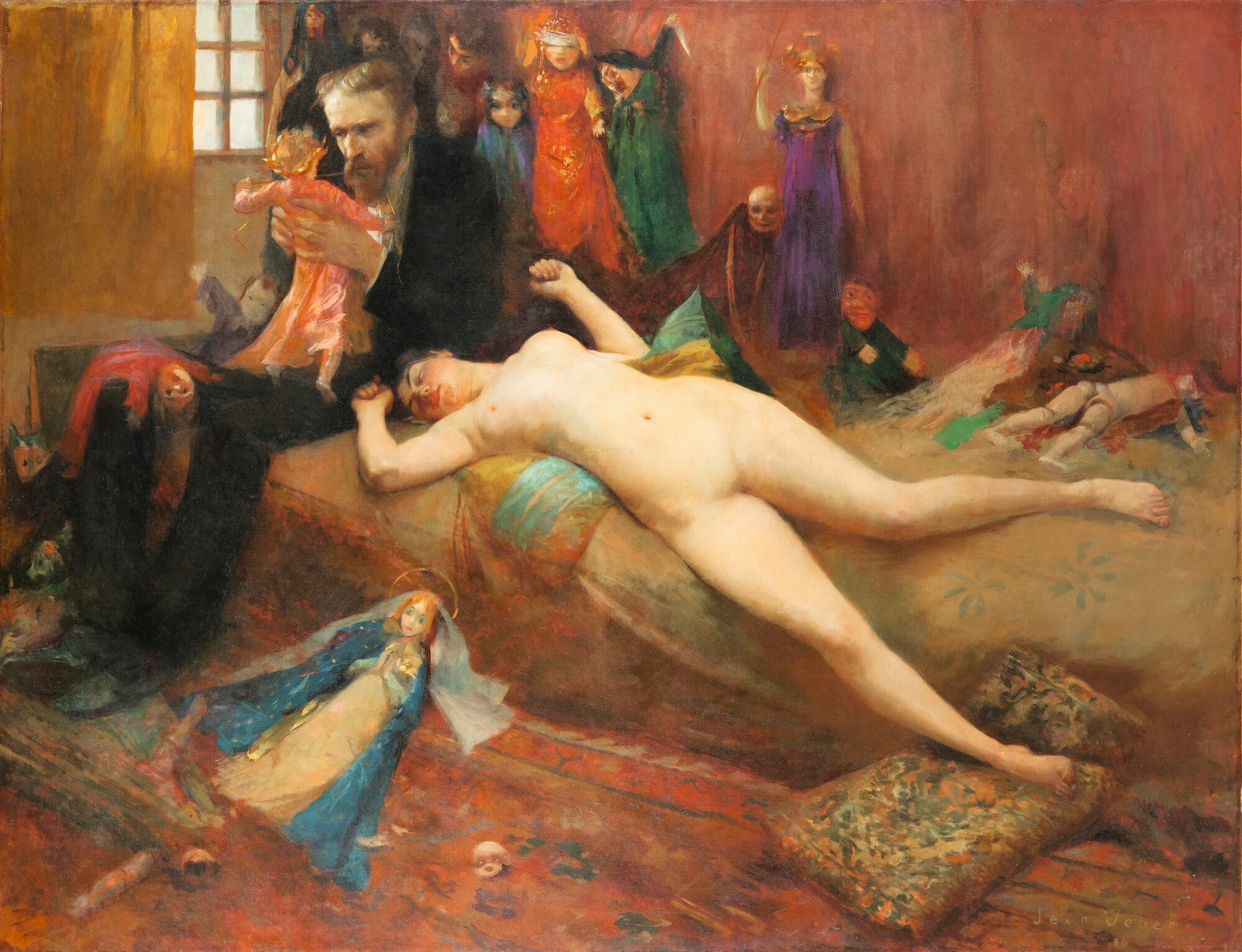
The Doll Man – Jean Veber [1896]

WON’T FIT INTO ANY ARBITRARY CATEGORY WITH EACH OTHER [Ed. – At least that’s honest.]

Squarely in the Olivia Manning/Elizabeth Jane Howard sweet spot is the Good Daughters trilogy by Mary Hocking (Good Daughters, Indifferent Heroes, Welcome Strangers), following three sisters from the 1930s to the years after WW2. They’re basically Platonic ideal books for people like me who reflexively buy the old green-spined Virago Modern Classics on sight.

The Friendly Young Ladies by Mary Renault was delightful: a wonderful 1930s summery sexy atmosphere, beautifully written, and nobody was punished by the plot for being gay. (In fact, someone wrecked their life by not being gay enough.) [Ed. — *nodding sagely * seen it happen many a time.]

Keith Ridgway’s A Shock is brilliant and sui generis; a sporadically sinister set of linked stories in multiple styles—a worthy follow-up to his Hawthorn & Child, though shooting out in completely different directions.

Awake by Harald Voetmann (translated by Johanne Sorgenfri Ottosen) is fragmented, which I have seen some people complain about, saying it doesn’t add up to a story. I guess that’s true, but I really didn’t care. A novel about Pliny the Elder, his nephew, and his slave, it’s great on the sentence level, and so interesting. And deeply, deeply horrible.

Hagar Olsson’s Chitambo (translated by Sarah Death) deserves to be much better known: a modernist Finnish masterpiece about a young girl whose life is wrecked by a father who is at first her ally in an imaginative world, and who then loses interest in her as he moves on to other, madder utopian schemes.

[Audience: GET HIM OFF! GET HIM OFF!]

The Trouble with Happiness is a collection of short stories by Tove Ditlevsen (translated by Michael Favala Goldman), and is as good as you’d hope from the author of the Copenhagen Trilogy. The Devastation of Silence by João Reis (translated by Adrian Minckley) is an exemplary example of one of my favourite genres of novel—the mildly unhinged monologue from a monomaniacal narrator, in this case a Portuguese POW in a German camp in WW1. Helen DeWitt’s The English Understand Wool is a really funny novella of subverted expectations. And Ed Yong’s An Immense World is a brilliantly and subtly written survey of the latest science in animal perception, including senses that humans cannot even begin to rival. OK, OK, I’m going, what is that thing, a crook, you do know they don’t actually use them to haul people off the stage anym–

[Ed. — Don’t tell James, but I could have read even more from him!]

Martin Schneider’s Year in Reading, 2021

Today’s reflection on a year in reading is by Martin Schneider, a freelance copyeditor (of books!) who lives in Cleveland, tweets at @wovenstrap, and used to write for Dangerous Minds. He’s part-Austrian and can occasionally can be found in that country.

Look for more reflections from a wonderful assortment of readers every day this week and next. Remember, you can always add your thoughts to the mix. Just let me know, either in the comments or on Twitter (@ds228).

Charles E. Martin

The global pandemic has been very good for my reading life.

I’ve read novels my entire adult life but the raw totals in any given year might not have been very high, maybe 30 per year. When COVID-19 arrived, I had an empty work patch in my freelance schedule and I responded by attempting to read one novel per day for 30 days (!) as a way of distracting myself from the fact that I might have a hard time finding freelance work. I made it to Day 19 but some work came in, thank god, and I didn’t get to Day 30. That stretch sparked a period of high novel consumption: I read 72 novels in 2020 and 70 novels in 2021. Those are very high totals for me.

I’m grateful for the particular cluster on Twitter that orbits around Caustic Cover Critic and Damian Kelleher and of course Dorian for improving my general experience on Twitter as well as giving me inspiration for new books and a community of like-minded people, etc. I should also say a word about the Backlisted podcast as additional inspiration (obviously that also overlaps with Twitter in some ways). I appreciate the monthly bookstack photographs and other visual ephemera that Book Twitter is always providing me with.

I’m a volume whore, by which I mean I favor reading short novels so that the raw book count stays as high as possible and I don’t get stuck for a month reading Moby-Dick or whatever. [Ed. — Ah, but what a month it would be!] 275 pages already begins to seem a high total to me, my sweet spot is about 191. ABC, always be churning. [Ed. – Hahaha!]

It goes without saying that 2021 was a very good reading year for me, cycling through 70 books in a calendar year is pretty close to an ideal way for me to spend my free time.

OK, here are about 20 books I wanted to say something about, listed in chronological order except where books are joined.

Michaela Roessner, Vanishing Point

The first read of the year for me, and one of the year’s finest. Vanishing Point is hard to track down but this exemplar of heady, sinuous ’80s sci-fi is worthwhile for those who like that kind of thing. The setup has much in common with Tom Perrotta’s The Leftovers — it also came first — which most likely is what drew me to seek it out. I don’t want to divulge too much about it, but I greatly enjoyed this intelligent, immersive book, and I think about it often.

Josephine Tey, The Franchise Affair

I’ve never been much enamored of The Daughter of Time, which has always seemed implausible and overbaked. This left me unprepared for the astonishing authorial control of The Franchise Affair. I think you’d be hard-pressed to find a better representation of midcentury England than this book; the sheer exuberance of the jolly/obliging/diffident/snappish voices — literally, speaking voices — is tough to top. What’s the cricket equivalent of “a home run”? [Ed. – Knocked it out of the oval here, my friend: such a good book.]

Gilbert Adair, Love and Death on Long Island

Quite simply, my #1 read of 2021. I adore thinking about this book. Every page is a treat. I would urge those who like their fiction subtle and incisive to consume this immediately. Adair’s performance — and it is definitely a performance — feels thoroughly under-heralded. I had seen bits of the movie years ago and had always found the central predicament original and delicious and rich. Who can fail to relate to the sorrows/joys of being a bookish hideaway in a world that produces, almost unthinkingly, Hotpants College II?? [Ed. – Admittedly, not a patch on Hotpants I.] The ways Giles and Ronnie fail to comprehend each other are a wellspring of comedy that will never stop nourishing me. I never reread books but will likely return to this “jewel-like” 1930s-type book set in the age of the vulgar teenage sex farce (rented from the local video shop, natch); those 1980s details are decisively additive, at least for me. I sorely crave books like this but alas, strong comps are surely thin on the ground…… [Ed. – Ooh, a challenge: do your best, Team. Whatcha got for Martin?]

Colson Whitehead, The Underground Railroad

I am a fan of Whitehead’s, but I was disappointed by The Underground Railroad. It seems unusually weak for a Pulitzer winner (then again, there is The Goldfinch, oof). I appreciated the comparative tour of antebellum contexts, but the failure to develop the literalized choo-choos nagged at me. Does that metaphor explain anything to anybody? I can’t see how. It’s such a great idea but also a massive missed opportunity. This is the rare case of a book that needs another 200 pages, I think. I also worry that Whitehead has bought into the hype surrounding him. Give me another John Henry Days, man — please!

C.S. Forester, The African Queen

In 2020 I read The Good Shepherd and found it utterly compelling. Then dang if the same thing didn’t happen all over again with The African Queen. I am a little leery of the Hornblower books — I prefer the 20th century, thanks — but Forester’s way of imparting information really does it for me.

Patricia Lockwood, No One Is Talking About This

Jonathan Lethem, The Arrest

No One Is Talking About This is a relatively celebrated recent novel that I cluster together with the works of Jenny Offill and Rachel Khong, and not in a positive way. I think of all of these books as jammed with clever, postmodern witticisms/jokes that you could rearrange in any order and it wouldn’t make much difference to the narrative. That’s a little unfair to No One Is Talking About This, which Lockwood does take pains to instill with an Act I/Act II structure, but I still found it a complete failure in terms of ordinary novel-building. Meanwhile, Lethem is not much in fashion lately, especially after The Feral Detective, which did not work. I suspect there was scant interest in his stab at Post-Apocalypse, but I still found The Arrest as intelligent, engaging, and sharp as much of his stuff — I admire Chronic City particularly. His books don’t always hang together, but on the paragraph and thematic levels, Lethem seems to me the equal of anyone out there right now and, as such, under-appreciated.

Arthur Getz

Margaret Drabble, The Millstone

Oh, boy. I was more than a little surprised how conventional and bourgeois (and therefore tiresome) I found this book, which in 1965 represented such a brave “new” perspective — or did it? From the perspective of 2021 it reads as so much more aligned to Drabble’s (presumably) hated predecessors than to us. To the reader of today, I submit, so many of Rosamund’s choices are unintelligible, particularly that of concealing the existence of her child from her parents. Rosamund’s whole setup (enormous apartment, rent-free) is so contrived and refuses to serve as the societal basis for anything (as I think was intended or at least was regarded). Jerusalem the Golden, a humble tale of growth about a woman from humble origins I read and esteemed decades ago, seems the antithesis of this. Drabble really leans into her privilege here, thus undoing the point. Next! [Ed. – *popcorn gif *]

Quentin Tarantino, Once Upon a Time in Hollywood

The last few years I have found myself increasingly disenchanted with the MFA-influenced “well-crafted” masterpieces that dominate (say) the Tournament of Books. The writing is frequently too tidy and pristine and there’s too much overlap/groupthink in the authors. In my mind, these books are not composed by individuals; too many of the nasty, idiosyncratic details have been sanded off. An antidote to this is Once Upon a Time in Hollywood, far from a great book but I found its termite-ish perambulations entirely refreshing and (am I crazy for believing this?) an explicit callback to the shaggy-dog ways of Dickens. I do suspect that Tarantino thought of this “novelization” (a favorite form of his) as an attack on all the bloodless hifalutin volumes that get adopted by reading groups. I’m ready to sign on to this agenda; modern fiction could surely stand to ingest the unkempt, untoward essence of this book.

Elena Ferrante, The Lost Daughter

I admire the guts it took to be so unflinching about the unvirtuous aspects of shirked motherhood. The Lost Daughter dares you to dislike its protagonist, which I did not — or not very much; Ferrante works in the class signifiers to make her readers side with her heroine over the swinish, unreaderly family that intrudes on her interlude — and then forces those same readers to think about that. It’s encouraging that a writer of Ferrante’s gifts has found such widespread success.

Susanna Clarke, Piranesi

Everybody’s favorite recent puzzle box, it seems. The first half of this book constituted one of the reading high points of the year for me. Nothing wrong with the second half, to be sure, but you just can’t top the sheer blazing WTF “where is this going?” quality of this book’s setup. [Ed. – Yeah, can’t argue with that.] As with Love and Death on Long Island, I desperately want to find books with this vibe, but I doubt that any are out there (I did think of David Mitchell’s Slade House, however).

Joseph Hansen, Fadeout

One of my top reads of 2021. I learn from the internet that Hansen was a pioneer of the gay detective novel. This book introduced Dave Brandstetter, Hansen’s recurring hero of a dozen or so mysteries. The gay angle functions as the lever that furnishes Hansen’s situation/solution with complexity, but it wasn’t just that; Hansen also had the ability and the interest to write textured, complex thrillers. That’s the kind of shit I live for! This was published in 1970, but I thought it stood up dazzlingly well today.

Eugene Mihaesco

Percival Everett, Cutting Lisa

This somehow pairs with The Lost Daughter in the author seeking out, nay, embracing unpleasantness to spectacular effect. This was on my shortlist of reading experiences for the year, a strikingly original work that forthrightly countenanced negativity while resisting the impulse to pin everything on a villain. Every character has corners; every situation is layered. My first Everett, Cutting Lisa has a chewiness I associate with the finest output of the 80s, and I can’t wait to read more by him.

William Maxwell, So Long, See You Tomorrow

Katherine Anne Porter, Noon Wine

So Long, See You Tomorrow is one of those “writerly” novellas that hit me entirely the wrong way. Maxwell was a smalltown escapee who later found tenure at The New Yorker and thereby invested himself of the power to imbue these “simple midwestern people” (yuck) with meaning. If ever a narrative should have dispensed with the pretentious framing device of the events filtered through the memories of a child, it’s this one. I guess I can see why people admire this book, but for me it was just a succession of false notes. [Ed. – Ooh, fighting words!] Noon Wine reveals the falsity of Maxwell’s methods; another short novel — Porter, it seems, detested the term novella — but in this case authentically empathetic towards its figures, in contrast to Maxwell’s self-serving projections/lies. Noon Wine has the guts to put real people on the page — and real stakes.

William Lindsay Gresham, Nightmare Alley

One of the much-mentioned texts of 2021, due to the Guillermo del Toro adaptation that landed late in the year. Later on, I found it significant that Gresham is not celebrated for any other work. This book is certainly adept and not devoid of virtues, but I found it labored and tiresome, every point underlined in every paragraph, nothing allowed to breathe, as a real novelist would do it. I resorted to a new strategy: just grind through 10 pages per day until done, just to get it behind me (while starting a different novel, I seldom double dip). I should go back and finish Geek Love as an antidote (not that Dunn let things breathe, either).

Louise Erdrich, The Sentence

Simply put, I cannot think of another novel as generous-minded as this.

Other books I enjoyed:

Powers of Attorney by Louis Auchincloss

Asylum by Patrick McGrath

Mrs. Caliban by Rachel Ingalls

Trustee from the Toolroom by Nevil Shute

The Mosquito Coast by Paul Theroux

Figures in a Landscape by Barry England

The Small Back Room by Nigel Balchin

The Blessing by Nancy Mitford

A Favourite of the Gods by Sybille Bedford

Excellent Women by Barbara Pym

After Leaving Mr. Mackenzie by Jean Rhys

Voyage in the Dark by Jean Rhys

The Easter Parade by Richard Yates

Two Serious Ladies by Jane Bowles

The Country Girls by Edna O’Brien

The Last Policeman by Ben H. Winters

Rose Under Glass by Elizabeth Berridge

The Quiet American by Graham Greene

On the Beach by Nevil Shute

An Unsuitable Job for a Woman by P.D. James

The Power of the Dog by Thomas Savage

Black Wings Has My Angel by Elliott Chaze

Amigo, Amigo by Francis Clifford

Something in Disguise by Elizabeth Jane Howard

Five Decembers by James Kestrel

A Disorder Peculiar to the Country by Ken Kalfus

NancyKay Shapiro’s Year in Reading, 2021

Today’s reflection on her year in reading, her second annual contribution, is by NancyKay Shapiro (@NancyKayShapiro). NancyKay lives in New York, and reads a whole shit-ton.

Look for more reflections from a wonderful assortment of readers every day this week and into next. It’s a stellar lineup. Remember, you can always add your thoughts to the mix. Just let me know, either in the comments or on Twitter (@ds228).

Edward Hopper, New York Corner (Corner Saloon), 1913

The notorious year, the second of the Big Pandemic here in New York City, was, for me, the year I really settled into the idea of being retired from my freelance ad biz career (which I’d declared at the beginning of ’20 in a wishful fingers-crossed kind of way), found other things to do than work, got my elderly mom vaccinated twice, myself vaccinated three times, counted lots of blessings, lost said elderly mom at age 89 (not to Covid), and busied myself then grieving and dealing with her estate.

I read or listened to 84 books. Looking back over the list, I find that very little has stuck with me with especial vividness, probably because there was a flatness to my emotional life for most of the year, and then, when Mom passed in early September, the whole emotional tenor changed, and everything leading up to the day of her death seemed like a decade rather than a handful of days and weeks ago.

So, having said that, let’s see which books I want to recommend from those 84.

The first book I read in 2021 was The Last Samurai by Helen DeWitt, which I only picked up because of Book Twitter, and which I hated and kept telling Dorian I was going to chuck, because it seemed to be about an overly academically precocious child and an overly clever but useless-at-life mother. I thought I saw where it was going and that was to an ever-more annoying place. I would have chucked it if not for his encouragement, and I only appreciated it when I got to the last fourth or so of the text and could see what the whole thing was amounting to. [Ed. – Let this be a lesson to you all.] In the end I was glad I’d read it, breaking a habit I have of not persevering with books that, a hundred pages in, aren’t giving me much reading pleasure. The pleasure was retroactive.

Rob Sheffield, the music critic, wrote a book called Dreaming The Beatles: A Love Story of One Band and The Whole World. I’m a lifelong fan, but hadn’t thought about them much in recent years; this book delighted me because it wasn’t so much a band bio as a story of how the Beatles are perceived, and adored, across time, by their admirers. Lots of fun, gave me some new perspectives on these old favorites that sent me back to the music; a sprightly winter time read.

Quenching my desire to read dark books about grim and squalid Northern British things was Alma Cogan, a novel by Gordon Burn, in which he writes a fictional autobiography of Cogan, a singer popular in England in the 50s and early 60s, whose career was steamrollered by rock’n’roll, and who died young. In this novel she doesn’t die young, and she spills all the tea. Great and ghastly.

No One Is Talking About This by Patricia Lockwood really lit me up when I was reading it. It had an air of sui generis-icity about it that was exciting; its emotional roller-coaster effects were earned. Lockwood is very clever in the good ways of being clever, and this novel, which starts out being about online-ness, ends up being about emotions of great tenderness and subtlety. Full of surprise. A must. Just read it without reading anything about it first.

Over the summer I got into the way of wanting short stories by Anton Chekhov and William Trevor, and read great gobs of them, in the form of The Portable Chekhov and Trevor’s Collected Stories. I feel, looking back, as if I sat through hundreds of hand-wringing playlets, each story totally absorbing, a world in itself in a way that even the best novels are not, because you’re not reading them in a single sitting.

Also over the summer I had an urge to reread John O’Hara, and revisited Butterfield 8, Appointment in Samara, and 10 North Frederick. O’Hara’s merciless dissection of the manners and mores of upper-class Americans in the late 19th and 20th century is a genre unto itself for me. I can’t get enough of his snobs and tragically unself-aware nobs, all floating in cold martinis.

A wonderful discovery was the Chinese writer Eileen Chang, whose books are reprinted by the wonderful New York Review Books. I read Little Reunions for a class at the Center For Fiction, then went on to Love In A Fallen City. She writes about romance and family life in Hong Kong and Shanghai in the mid 20th century, with the political restrictions of these places hidden beneath the carefully articulated actions and thoughts of her heroines.

At the end of 2021 I listened to the audio of a new biography of poet Sylvia Plath, Red Comet: The Short Life and Blazing Art of Sylvia Plath by Heather Clark, an exhaustive but never exhausting account of the accomplishments and anxieties of Plath’s amazing life, which lasted just 30 years. I’m always fascinated by the lives of writers. Plath was, though a genius, also exemplary of all the things society puts in the way of young women—the pressures to be pretty, nice, quiet, maternal, agreeable, nurturing. This bio impressed me afresh with her struggle to be both a great artist and a successful woman, by the standards of mid-century America and Britain.

Finally, my least-liked—really, flat-out disliked, book of 2021: The Wind-Up Bird Chronicle by Haruki Murakami. The first novel by him I’ve read, and it’ll be the last. I only finished it because I’d been taught by The Last Samurai that things might turn around in the final third, but in this case, not so much. I know a few people who adore him and this book, but I can’t see it. [Ed. – I did not recommend this book, just FYI.]

Edward Hopper, Blackwell’s Island, 1928

Other stand-out books I read:

  1. Mayflies by Andrew O’Hagan
  2. Piranesi by Susannah Clarke
  3. Broken Greek: A Story of Chip Shops and Pop Songs by Pete Paphides
  4. Odd Girl Out by Elizabeth Jane Howard
  5. Harlem Shuffle by Colson Whitehead
  6. Alec by William DiCanzio
  7. How To Hide An Empire by Daniel Immerwahr
  8. Bosnian Chronicle by Ivo Andric
  9. Life of a Klansman: A Family History In White Supremacy by Edward Ball
  10. Box Hill by Adam Mars-Jones

Every book I’ve read since 2008: https://bit.ly/3njPjah

What I Read, August 2021

I know, I know, this thing is late. Here it is, almost October and me still going on about August. Had a lot going on, though. Back to full-time work after a year’s sabbatical (the Sunday night of all Sunday nights, let me tell you). Plus my wife moved temporarily to St. Louis to complete an MSW degree. So August was split between setting her up in her place there—St. Louis is so great!—and starting the new academic year, for me and our daughter (last year of elementary, how did that happen?). I fit reading in where I could—I go nuts if I don’t—but it wasn’t the top priority. Here’s how that shook down.

Childe Hassam, Clouds (also known as Rain Clouds over Oregon Desert), 1908

Dolores Hitchens, Sleep with Slander (1960)

When I wrote last month about the first Jim Sader PI novel, which I liked a lot, I alluded to its sequel, in my opinion a genuine masterpiece that anyone with even a passing interest in PI novels should read. In sleep with Slander, Sader is hired to find a kidnapped child. The boy’s grandfather has received an anonymous letter explaining that the child has been taken from the people the grandfather put him with (his daughter had the child out of wedlock) and is now being abused. Things get complicated fast, as Sader runs up against one closed door after another. Unlike in some detective stories, where the complexity becomes an end in its own right (Chandler, say, even Hammett), here the plot never obscures the hurt at the heart of the matter. The book feels urgent, even more so than in Ross Macdonald, whose Archer novels Sleep with Slander shares a preoccupation with, specifically, the way families pass along their hatreds. Hitchens contributes her share to the California rhapsodies sung by generations of crime writers—when Sader turns his car from the ocean at Laguna Beach and up into a canyon “the sea wind followed, funneling through the narrow cleft in the coastal hills”; here as elsewhere Sader is more pursued than pursuer, mocked even by the elements: “he heard it whistle against the window” (it’s like he’s being cat-called by the environment)—but Hitchens really shines with her deft character portraits, even in the most minor characters. I was especially struck by a real estate man whose habit of silently beating out hymns on his empty desk strikes a plaintive note of discord with the dreams of happiness his profession traffics in. Leaving the man after a revealing interview, Sader sees him, silent, alone, “sitting with fingers poised, ready to strike an opening chord on the rim of the desk.”

Hitchens never wrote another Sader novel, though given the melancholy perfection of the ending of Sleep with Slander it’s really no surprise.

Elizabeth Jane Howard, The Light Years (1990)

Howard’s novels about the Cazalet family have been on my radar for a while, enthused over by readers I trust. I was surprised to find they were published in the 90s; I’d vaguely assumed they were from the 50s. And they are a bit old fashioned, sort of soapy, though not, I’d say melodramatic. (Not that there’s anything wrong with melodrama!) The Cazalets have made their money importing wood from the colonies. In 1937, when The Light Years begins, the business is run by the two eldest sons, Hugh (a good soul, wounded both physically and emotionally in the Great War) and Edward (jolly, lover of the good things in life, bit of a cad), even though their father, known to all by a typically ridiculous upper-class British nickname, The Brig, remains nominally in charge. In practice, though, he spends his time at their seat in Sussex, where his increasing blindness don’t stop him from advancing many improvement schemes in the neighbourhood, which require a lot of work from everyone else, especially his unmarried (and possibly gay, though she seems unsure about that) daughter, Rachel. (His wife, the family matriarch, known as the Duchy, is both steely and vague—I could read a whole book about her but she floats around the edges of this one.) Hugh and Edward’s younger brother, Rupert, a schoolteacher and artist, is being pressured to join the firm. Zoë, Rupert’s young second wife—his first having died (I think in childbirth, but maybe I made that up and I’m too lazy to look it up)—is young, beautiful, rather out of her depth, though Howard deepens her portrait satisfyingly. She feels shut out by Sybil and Villy, Hugh and Edward’s wives, who are close, though not enough for Sybil to share her ambivalence at getting pregnant again or Villy to admit her fears (barely expressed even to herself) about her husband’s affairs, and her thwarted ambitions (she was once a ballet dancer).

As good as Howard is with these adults—and she’s very good—she really shines with the children, who range in age from about 5 – 15: Hugh and Sybil’s two, Polly and Simon; Edward and Villy’s three, Louise, Teddy, and Lydia; and Rupert’s two, Clary and Neville. (I won’t even get into their cousins, Villy’s sister’s children, but they’re important, too.) Each is wonderful, though I think I like Polly and Clary best. (Clary, the would-be writer, might be Howard’s younger self. She’s funny, too. When her aunt, tucking her into bed one night, asks if she’s warm enough, the girl looks surprised: “I don’t know. How do I feel?”)

Each summer, the clan gathers in Sussex; The Light Years describes the events of two summers, 1937 and 1938, the latter governed by the specter of war, relieved at the last moment by the events of Munich. The novel is leisurely, engrossing, delightful if you like an unflashy but pleasing style and incisive psychological insight. As a co-dependent, I’m particularly compelled by Hugh and Sybil’s marriage—a good one, but spoiled a little by each partner’s desire to please each the other so much that they end up doing things neither really likes, in the mistaken belief that they’re doing a kindness to their partner:

This duel of consideration for one another that they had conducted for the last sixteen years involved shifting the truth about between them or withholding it altogether and was called good manners or affection, supposed to smooth the humdrum or prickly path of everyday married life. Its tyranny was apparent to neither.

“This duel of consideration”! Ouch!

Anyway, I’m currently stuck into volume 2 and anticipating a fruitful autumn of Cazalets.

Naomi Hirahara, Clark and Division (2021)

Frustrating crime novel: fascinating premise, mediocre execution. In 1944, the narrator, Aki, and her parents arrive in Chicago after being interned in the Manzanar War Relocation Camp. There they plan to reunite with the family’s elder daughter, Rose, who, having been deemed a loyal Nisei, had been released the year before. But Rose fails to meet the train; soon they learn she is dead, hit by a subway train at the station that gives the book its name. The official verdict is suicide; Aki is convinced it was murder. As her parents retreat into grief, Aki sets out to find the truth of her sister’s death, following in Rose’s footsteps whenever possible, but also creating a new life for herself, with a job (at the Newberry Library) and love interest.

I wanted to like Clark and Division more than I did. I appreciated the history lesson and the attention to characters who don’t usually appear in crime fiction. But the plot is creaky and the writing wooden. The book reads like mediocre YA, filled with leaden lines and obvious questions: “Pages had been ripped out [of Rose’s diary] and I couldn’t help but wonder if they had held some secrets to why my sister was now dead”; “Was I, in fact, hurting my sister’s legacy by being consumed by it?” Yeah, yeah, we get it.

Gwendoline Riley, My Phantoms (2021)

Total banger. Ostensibly a story about a woman’s terrible parents—blustering, bullying father; needy, demanding mother—but actually about the woman’s own terribleness, her contempt and lack of interest in others, her mother especially. The way Riley uses the woman’s narration against herself (she reveals herself as unpleasant only slowly) is, as the kids say, chef’s kiss.

Mick Herron, London Rules (2018)

For a thing I wrote about the Slough House series, I read two Herron novels this month. I quite liked this one, maybe because I was paying more attention to Herron’s style, trying to get a handle on how he does what he does.

Esther Freud, I Couldn’t Love You More (2021)

Huge fan of Freud, starting with her brilliant debut, Hideous Kinky, which you should read immediately. (Terrific example of a non-treacly first-person child narrator—its protagonist is only five.) She hasn’t published a novel in quite a while, so when I heard about this one I ordered it from the UK so I could have a hardcover.

I spent a pleasant weekend with it, enjoying the feeling of being in Freud’s quiet, assured hands. The new novel is a bit different from the earlier ones, which fall into two camps: stories of children at the hands of hapless, almost but not quite neglectful adults (versions of her own childhood, perhaps), and stories of early 20th century Europe and its connections via exile, war, and displacement to England (versions of her family’s history: Sigmund Freud was her great-grandfather; the painter Lucien Freud her father—though as I read around a little online to write this blurb, I learned that the new book imagines what might have happened to her mother, Bernardine Coverley, born in Brixton to Irish Catholic parents, had her own teenage pregnancy led to unhappier results).

I Couldn’t Love You More shares with the latter books an interest in the aftereffects of the past on the present; the setting is Ireland and the UK between the late 1930s and the 90s. The story moves between three generations of women: Aoife, who, sitting at the bedside of her dying husband, remembers their life together; Rosaleen, who leaves Ireland for London in the 60s and gets involved with sculptor; Kate, who, stuck in 90s London with a small child and an alcoholic husband, sets out to uncover the identity of her birth mother, a journey that takes her to Ireland and the remains of the Magdalene Asylum system.

As I said, I liked the book plenty as I was reading it. But now, a month later, I realize I don’t remember much about that. Not that it’s bad—but certainly much less vivid than her others. The Kate storyline works best—Freud is brilliant with children, and the chaos and drudgery of living with them—but I’d rank this as minor work. Not the place to start if you’ve not read Freud before. I will say, though, that the title is pretty great: its double meaning (I love you as much as it is possible to love someone; I loved you no more than I was able) captures the painful ambivalence of all the story’s relationships.

Judith Hermann, Summerhouse, Later (1998) Trans. Margot Bettauer Dembo (2001)

I really flaked out when it came to Women in Translation month. Plucking Hermann off the shelf was my nod to that fine event; sadly, I chose poorly. When my wife and I spent a fair bit of time in Germany at the beginning of the century, Hermann was talked about as a big deal, a hip, young writer who was invigorating German literature with her Carver-esque prose and her descriptions of life after die Wende. Reading it twenty-five years after publication, I didn’t understand the fuss. It’s too dated to appeal to the current moment and not dated enough to become interesting again. The stories about Wessis taking over the East interested me the most, but that socio-political material is well in the background; the focus is on lives and listless love affairs of young, vaguely arty types. If I want that, I’ll dig out my Doris Dörrie collections. Anyone remember her?

John Darnielle, Universal Harvester (2017)

Darnielle fronts The Mountain Goats, and I’ve wondered whether his book deals came from that fame as opposed to his talent. But a trusted former student raves about him, so I finally gave him a chance. Thank God I did! Universal Harvester wowed me with its combination of menace and warmth. A young man working in a video store in small-town Iowa in the late 90s—among other things, the novel sings a low-key hymn to that time before the internet changed everything—gets complaints from customers: something is on the cassette they watched, like another bit of a movie, something weird. They can’t or won’t say more, act disturbed and uneasy. The man watches the movies—and becomes disturbed and uneasy himself. Someone has spliced footage—some innocuous (an empty barn), some frightening (a hooded figure tied to a chair)—into the disposable Hollywood products of the 80s and 90s. Reluctantly, the man is drawn into an investigation of sorts, propelled by two women (one owns the store, one is a customer). He gets involved with neither, just one way Darnielle subverts expectations. Another, more striking, is by breaking the storyline off to tell the story of a woman in 1960s eastern Iowa who joins a cult and the effect her decision has on her husband and daughter. A third storyline, closer in time to the present-say, links the two earlier ones.

Raving about the book on Twitter I learned, to my delight, how many of my mutuals love this book. Someone who was prompted to read it based on our praise later tweeted something like: “Not what I expected. Thought it would be Videodrome, but it turned out to have a lot more heart.” Perfect description. As much as I like Cronenberg—Long live the new flesh!—I agree that it is Darnielle’s kindness—modest, never sappy—mixed with his rueful self-awareness of the pleasures and limitations of midwestern politeness that really made the book work for me. Darnielle knows the Midwest; his descriptions chimed with what my wife has told me about her own childhood in Missouri.

Now that I have to commute again, I’m back to listening to audio books. (Alas, during the pandemic the local library system stopped buying CDs, which I totally get, but my car is old and not Bluetooth-enabled. So I’ll be making my way through their older stuff, hopefully before they get around to deaccessioning them all…) Darnielle reads Universal Harvester himself and he is wonderful (I mean, he is also a performer, singer, and musician so I shouldn’t be surprised). I loved his voice so much, he seems so kind and gentle. I just want to be his friend! He includes some cool music—which I assume he composed—between sections, too. I’m sure the book is wonderful on its own, but experiencing it in audio form made me love it even more.

Mick Herron, Joe Country (2019)

The Slow Horses briefly leave London for Wales, which to them is as exotic as Siberia. Ends with quite the cliff-hanger.

Tommy Orange, There There (2018)

Much-fêted novel by a young indigenous writer about twelve characters converging on a powwow in Oakland, CA. Each section is told from one of their viewpoints. In addition to this dozen first-person narrators, Orange includes a prologue and interlude told in first-person plural. I liked these two sections best, actually: their essayistic and choral mode suits Orange, who’s better at letting his intelligence and cultural references loose directly than at creating a character with a similar academic background to his own. (For those who’ve read the book: Dene Oxendene is the least interesting character, IMO.) Oakland is famously the place where there’s no there there; Orange gives Oxendene an admittedly good riff on how misunderstood this passage of Gertrude Stein’s is, and how the loss invoked by the phrase is also the story of Native Americans. Orange evokes the city with love mixed with anger at its gentrification. I agree with the many readers who’ve said that it’s bracing to read a book about urban Natives. As with Esther Freud’s latest, though, I enjoyed Orange’s novel more in the reading than in the reflection. Unlike, say, The Break, Katherena Vermette’s novel of indigenous Winnipeg (which similarly splits its narrative between a set of connected characters), a book I seldom go a week without thinking about, I’ve barely thought about There There since finishing it.

Georges Seurat, Alfalfa, St. Denis, 1885-86

Maybe I’d have remembered these books more if I’d been in a better head-space, but a person can’t always be at the top of their game. Besides, between the Hitchens, the Howard, the Riley, and the Darnielle it was still a pretty good reading month. I can tell you already, September will bring more of the reading-around-the-edges same… How about you? Was your August a good month?