My Year in Reading, 2024

If you’re reading this, you are faithful indeed. And I am grateful. Long silence here, I know. As my adopted country tumbles into authoritarianism, things have also been changing, though more positively, chez EMJ.

Igor Razdrogin, Book Bazar (1975)

My wife, daughter, and I are moving to St Louis in a month’s time! We’ve spent quite a bit of time there these past few years, and we like it a lot. We’ll have a little more space in our new home (which, combined with some collective efforts to tame my unruly library, might mean that our house will at least briefly not be overflowing with books), and, best of all, we’ll be living in a walkable neighbourhood with sidewalks, which is something we’ve been missing these past 18 years in Little Rock.

The other big transition concerns my career. I’m leaving my job at Hendrix, of course, but I’m also leaving academia in general. People keep asking how I’m feeling about this and I keep saying: Terrific! I was pretty burned out and starting to get a little Old Man Yells at Clouds about All the Changes that affected the classroom experience: the pervasiveness of AI and LLMs (something no one, as far as I know, ever asked for), and, more distressingly, the difficulty even the best-prepared students are having reading sustained works of literature, by which I mean, an entire book, no matter how straightforward the prose. This isn’t about their intelligence, or even their phones. It’s about the strictures placed on secondary school teachers. As instruction moves ever more toward preparing for testing centered on multiple choice reading comprehension questions about utterly decontextualized chunks of texts, teachers aren’t assigning much reading, which means students simply don’t have much practice at it.

(I also have a pet theory that for all its flaws Harry Potter (to be clear: it sucks) helped Millennials think of reading as both exciting and habitual, and Gen Z hasn’t had anything like that. The Harry Potter to Jane Austen to English Major pipeline kept our department afloat for a lot of years. These days, students dislike both Rowling and Austen…)

I still love many things about teaching, and it’s possible I’ll miss it so much that I’ll return to it in some fashion. (I’m never getting another job like this one, though. Those don’t exist anymore.) But for now, I feel relief, and curiosity—along with a lot of trepidation—about the chance to try something new. For now, it feels a bit unreal. Because the academic year is cyclical—summer is always a time of collapse and, if lucky, regeneration—I don’t yet feel as a though I’ve made much of a change. Talk to me in the fall, or next spring, or five years from now.

Luckily—and this is another reason for the silence around here—I’ve been working as a consultant for the Educator Programs arm of the William Levine Family Institute of Holocaust Education at the United States Holocaust Memorial Museum in DC. The people I work with are absolutely fabulous: smart, funny, kind, devoted to their work without having delusions of grandeur about it. It’s eye-opening—and fun—to work as part of a team, after decades of the isolation of academic life. I’ve helped them create resources for K – 12 English Language Arts classrooms, and have taken great satisfaction in the work.

I’ll need full-time work sooner rather than later, though, so if you have any ideas or leads, hit me up! Like, what are some jobs people do? What do y’all do all day? I need advice!

What I’m saying is, I had a lot going on these last months. But I did manage to keep reading. Maybe not as much as usual, but whenever I could make time. I get that it’s ridiculous to offer a 2024 reflection halfway through 2025, but FWIW here are the things that stuck with me last year.

Eight standouts

Francis Spufford, Cahokia Jazz (2023)

So much to love in this novel about an alternate 1920s in which a sizeable indigenous population thrives in a nation called Deseret centered on the bustling city of Cahokia. Spufford weaves his world-building throughout a procedural, in which our hero, a cop who moonlights as a jazz pianist, investigates a murder with vast political implications, to the point of threatening Deseret’s independence.

Cahokia Jazz is the most referenced title in the Year in 2024 Reading pieces I posted earlier this year, which means either that everybody loves this book, or that people like me love this book. Anyway, given my upcoming move to Missouri, it won’t surprise you to hear that the scene that most sticks in my mind is when Barrow pursues a lead in a village at the end of the Cahokia streetcar line, a fly-swept place he can’t wait to leave. Its name? St Louis…

I look forward to visiting the ruins of the actual Cahokia, once the biggest city north of Mexico City.

Katrina Carrasco, The Best Bad Things (2019)

Fabulous and underrated crime novel set in 1880s Port Townsend, where the most valuable commodity passing through the busy port is opium smuggled in from north of the border. Alma Rosales, who once worked for the now-shuttered Woman’s Bureau of the Pinkerton Detective Agency, has left San Francisco for Washington Territory to work for the seductive, brilliant, coolly calculating Delphine Beaumond, who runs most of the drug smuggling on the west coast.

When product goes missing, Delphine puts Alma on the case. Alma goes undercover as a dockworker—not a problem, because Alma is also Jack Camp, a slight yet wiry man who can hold their liquor and likes ladies and men equally. Did I mention that Alma and Delphine are lovers? Or that Jack starts a torrid affair with the man they’re investigating? Or that they’re also still working as a Pinkerton agent—in a desperate attempt to get their old job back?

Cue double-, triple-, even quadruple-crossing; witty repartee; and some pretty hot sex. Most crime novels are let down by their endings, but this one… let me tell you, friends, I literally gasped. A brilliant debut. I want everyone to read it.

Émile Zola, La Bête Humaine (1890, translated by Roger Pearson) and The Assommoir (1877) Trans Brian Nelson (2021)

Even by Zola’s lofty standards, these two are bangers. Push comes to shove, I guess I’d choose Bête over Assommoir, just because I love the crime story trappings, but the latter might be the more impressive accomplishment, especially if you could read it in French to see what Zola does with the argot of his lumpenprotelariat characters. They’re equally—which is to say, tremendously—depressing, but also viciously alive. Zola’s naturalist doom is regularly leavened by his prose, which zips from one brilliant set-piece to another. I’m talking about stuff like the bruising fight between two laundresses in front of an audience of delighted, shouting onlookers in the opening scene of The Assommoir, or the berserk vision of a driverless train, filled with drunk soldiers in full war frenzy heading to their doom at the hands of the Prussians, in the last pages of La Bête Humaine. Feels like a good time to study Zola’s fascinated descriptions of all things irrational.

Hernán Diaz, In the Distance (2017)

Quasi-Western in which the protagonist—a hulking, nearly mute Swede named Håkan whose only goal is to find the brother he was separated from on the voyage to the New World, and whose body and psyche seem to be able to take any amount of suffering—travels east, south, and north as much as west. This is a brainy book: Diaz riffs on Frankenstein, and probably a lot of other stuff I missed. But its allegories are always concrete. In this novel of a man stubbornly going against the westward direction of Manifest Destiny, I most remember the section in which, after suffering a terrible loss, Håkan literally burrows into the ground, eventually building a maze-like underground shelter where he lives in ambivalent isolation for years.

I read Diaz’s Trust last year too: also great. Probably not telling you anything you don’t know. But if like me you are late to Diaz, move him up your list. Smart guy and beautiful writer.

Leah Hagar Cohen, To & Fro (2024)

Last year I served as a judge for the US Republic of Consciousness Prize, which honors literature published by small presses. Yes, I tossed aside some duds and waded through many competent but unexceptional novels, but I also discovered some terrific stuff I wouldn’t have otherwise read. My favourite was this delightful and thoughtful literary experiment, a novel written in two halves that can be read in either order. You can start with “To” and flip the book over halfway through to read “Fro,” or do the reverse. You could call this a Jewish Alice in Wonderland (I love how deeply and unapologetically Jewish the book is: it takes such pleasure in asking questions), but that wouldn’t give you the sense of how the book is both realist and fantastic, a genre-bender that sometimes reads like a middle-grade book and sometimes like a historical “what if” novel, if those were written by someone whose lodestar was Maimonides. Magic!

Thanks to Lori Feathers, the genius behind this award, and to my fellow judges, who always brought it. Serving on this panel was time well spent.

Elizabeth Bowen, The House in Paris (1935)

A book of arrivals and departures, whether longed-for, dreaded, or uncertain. It feels both constricted and expansive: a neat trick. Bowen often gets called Jamesian. That is true not in style but only in a shared preoccupation with cruelty. Hard to say which fictional universe is meaner. Another thing I liked about The House in Paris is that it offers further evidence for my theory that British modernism is just another name for Gothic literature about children.  

Martin MacInnes, In Ascension (2023)

Here we have two sisters. One becomes a scientist who explores the depths of the ocean floor and the vastness of space (she develops nutrition-dense and fast-growing algae for interstellar travel); the other sets aside her career as an international lawyer to find out what happened to the first. I can’t remember everything that happened in the book, but I do remember being enthralled from start to finish. (This is another long book that never felt slow.) The final scene, set in the remotest place on earth, Ascension Island, foregrounds another kind of foreign place: our memories. “A family”, MacInnes writes, showcasing his epigrammatic mode, “is a group of strangers with a destructive desire for common nostalgia.” MacInnes’s big question, asked as much of a sibling relationship as of humanity’s ability to inhabit the stars, is whether the only way to get beyond the destructiveness of the human species is to destroy the individual self Beejay Silcox, one of my favourite critics, gets it right when she calls the book “a primer to marvel.”

Sally Michel Avery, Father and Daughter, 1963

Thoughts on the rest

Ones I keep thinking about: Manjula Martin’s The Last Fire Season (2024): I still haven’t prepped a go-bag—how foolish is that? Catherine Leroux’s The Future (2020, translated by Susan Ouriou): What if the French had never lost Detroit? What if climate change and resultant socioeconomic crises meant that most of the trappings of a functioning state had fallen away? And what if bands of roving children built hardscrabble lives in overgrown parks? Peter Heller’s The Last Ranger (2023): Conventional but satisfying novel about a ranger in Yellowstone, filled with scenes in which the hero drinks early morning coffee on the porch of his cabin: Heller knows the landscape and describes it beautifully. (Given what the chuckleheads at DOGE did, this title resonates differently now…) Jill Ciment’s Consent (2024): Revelatory memoir in which the author reassesses her decades-long marriage to her now deceased husband, with whom she took a painting class when she was 17 and he was 47. Can the relationship really have been good given that they met when she was a child?

Best study of xenophobia, told in an atmosphere of creeping dread: Georges Simenon’s The Little Man from Archangel (1956, translated by Sian Reynolds).

A Russian Jew, brought to rural France as a child, French in every way, has his life turned upside down because of a casual remark. Chilling. Best Simenon I’ve read.

Best study of deprogramming: Emily Tesh, Some Desperate Glory (2023).

Maybe useful these days.

Best case of “it’s not you, it’s me”: Nisi Shawl’s Everfair (2016)

Steampunk set in an alternate late 19th century in which the Fabians buy tracts of land from King Leopold to protect refugees fleeting the horrors of Belgium’s rule in the Congo. At first, this new nation—Everfair—prospers. European benefactors and missionaries work with Africans to create trade networks based on clean airship technology. They develop intelligence networks to navigate the region’s politics. They promote or at least allow social experiments concerning family structure, marriage, and sexual politics. But the internal tensions become too much, and the utopia falls apart. Even as I’m writing this I’m thinking, Honestly this sounds pretty good, maybe I’ve misjudged the book. And at the level of idea it’s intriguing. The execution, though: that’s the problem. The prose is leaden, the relation between action and exposition awkward. Maybe the book actually needed to be longer? A strange thing to say since I felt like it was never going to end. This book is a darling to many (Jo Walton loves it, for example). Probably just the wrong time for me. Can’t imagine giving it another try, though.

Best (and most) coffee: Mark Haber’s Lesser Ruins (2024).

Things are not going well for the narrator of this Bernhardian novel, ever since his wife died and he lost his job. That’s a tough spot. And he tries to do the right thing, sometimes. He reaches out to his son, whose passion for house music means he will dilate on the perfect set list for as long as his father will hold the phone near his ear. Like so many of us (me, anyway), he struggles to surmount the gap between idea and execution, endlessly trying to write something good. You’d think we might like the guy. But… He’s a terrible snob. He lambastes his students, neglecting his work to the point of installing an espresso machine under the desk in classroom. (That an instructor at a community college would have a dedicated classroom is the book’s only false note.) His unfinished, maybe unfinshable, book on Montaigne is probably not really going to be all that. So he ain’t easy to like.

All of this is beside the point, though, because this novel is about the way sentences can mimic the swerves and circles of a mind endlessly thinking. One of the things our narrator thinks about most is coffee. He drinks a lot of coffee. Long sections concern the various roasts, the preparation, the anticipation, the enjoyment. I’m not a coffee snob on his level, but I found nothing to ironize or criticize in the man’s love for the perfectly pulled shot. Lesser Ruins is great for other reasons, too (it’s Haber’s best IMO), but if you like coffee at all, you gotta read this.

Most ingenious conceit: Kenneth Fearing’s The Big Clock (1946)

A drudge at a magazine publisher modelled on Time-Life is tasked with finding—for purposes of eliminating—a witness to a crime. Only thing is, he is that witness…

Dark and boozy. This is the good stuff.

Best crime fiction: Carrasco, obviously. Also obviously, the latest Tana French. (At least I can say I was alive while Tana French was writing novels that will be read in a hundred years…) The latest Garry Disher, Sanctuary (2023), is a satisfying standalone about theft and friendship. I read a couple of Gary Phillips’s books about a Black Korean-war vet turned crime-scene photographer: good stuff. (I learned a lot about Watts.) Start with One-Shot Harry (2022). Years ago I devoured Scandinavian crime novels: seemed like the most exciting thing in the genre. Bloom’s been off that rose for a while, but Cristoffer Carlsson’s Blaze Me a Sun (2021, translated by Rachel Wilson-Broyles) took me back. Marcie R. Rendon’s Where They Last Saw Her (2024) is her first book set in the present, and much as I love the Cash Blackbear series, probably her best. How nice to read a book about an indigenous woman who has a good man in her life. I regularly think about the scenes of women jogging through the snowy Minnesota woods.

Best sff: In addition to MacInnes and Tesh, I most enjoyed Ann Leckie’s Ancillary Justice (2013), Shelley Parker-Chan’s She Who Became the Sun (2021), and various works by Guy Gavriel Kay, who continues to be a source of reliable pleasure, even if no one would call his books cutting edge. (So humane, though! I need that right now.) Alas, I am not yet a dedicated enough sff reader to have figured out how to overcome the “stalling out in a series because I didn’t get to the next one right away and then forgetting what happened” problem.

Best poetry: Louise Glück’s The Wild Iris (1992). Ok, the only poetry collection I read, but I liked it enough to assign it this past semester and the students loved it. Teaching it made me both appreciate it more and notice its limitations (it hoes rather a narrow furrow). I ought to read some of her later stuff: I bet it’s even better.

Best book of the kind I could imagine myself writing and yet am mostly allergic to reading: A tie between Jakuta Alikavazovic’s Like a Sky Inside (published 2021 and translated by Daniel Levin Becker) and Chris Bachelder & Jennifer Habel’s Dayswork (2023).

The whole quasi-essay, quasi-memoir with novelistic elements thrown in for good measure—mostly that stuff leaves me cold. But these two won my heart. Alikavozovic describes a night she spent in the Louvre, a place that she often visited with her father, a ne’er-do-well from the former Yugoslavia. After each excursion, her father would ask, How would you go about stealing the Mona Lisa? This question, and the reflections on her father’s life of petty crime and her own experience growing up in a culture and language that he never perfected, lies at the heart of this beautiful little book.

Bachelder and Habel have done something remarkable: written a book together, about themselves as a couple, that feels written in a single voice. The text centers on the Habel character’s fascination with Herman Melville: it’s about his life, and their lives, and what it means to write a life, with copious references to the man they call The Biographer, Herschel Parker, who seems to have been really something. And by that I mean kind of a dogged genius, but also a pain in the ass.

Best literary fiction:

Laurie Colwin’s Shine On, Bright and Dangerous Object (1975) is sad and delightful, filled with loving anger. A splendid beginning to a marvelous though much too short career. William Maxwell’s So Long, See You Tomorrow (1980) is famous for good reason. Audacious structure and play with time, heartbreaking story, even a section told from the point of view of a dog. Joan Chase’s During the Reign of the Queen of Persia (1983) deserves its resurrection thanks to the good people at NYRB. Another story of childhood in the American Heartland, at once bucolic and traumatic.

You can see I am deep into the “my favourite artworks are the ones created while I was a child and too young to experience at the time” years. I read new things too, though, and the best of these was Kaliane Bradley’s The Ministry of Time (2024), which I finished in a cabin at the Grand Canyon during a thunderstorm that had the rain pounding on the metal roof. The book is as memorable as the setting of my reading: an experiment in time travel, in which a 19th century Arctic explorer is brought to a near-future UK and given to a handler from the titular government agency whose background happens to be Cambodian. In addition to its speculative elements, and a terrific love story, the novel considers differing cultural responses to trauma. More Bradley soon, please!  

Henri Matisse, Woman Reading in a Violet Dress, 1898

Short story collection: Only read one, but it was a good one. I liked all the stories in Jamel Brinkley’s Witness (2023), but “At Barstow Station” is an all-timer. Even a class full of students who did not care much for reading agreed.

Most unexpected page-turner: Karl Ove Knausgaard’s The Morning Star (2020, translated by Martin Aitken) blends his signature interest in mundane middle-class life with some weird shit (a blazing star that no one can explain, a ritual murder, shenanigans at a mental institution). I raced through it and bee-lined for the bookstore to but the next one (in an expensive and gigantic hardcover edition), only to ignore it for the rest of the year. Honestly, the hardcover might be the problem. Most of the time I’m a “give me the paperback” guy. Anyway, will read the others in this series.

Most fun: The audiobook of Jesse Q. Sutanto’s Vera Wong’s Unsolicited Advice for Murderers (2023), read with obvious affection by Eunice Wong, made me laugh aloud. As I feared, the strains of keeping the conceit going already show in the second book, which I listened to a couple of months ago. But I’ll stick with Vera a while longer; she’s a treat.

Best sequel: Waubgeshig Rice’s Moon of the Turning Leaves (2023) is a big advance over its predecessor, Moon of the Crusted Snow. A rare case of a longer book being better. It’s ten years since the mysterious event down south that sent the grid down. The small indigenous community at the heart of the first book has been thriving, but its inhabitants realize they have reached the limit of the resources in their immediate area. After painful debate, they send a search party to find out if anyone else is out there—specifically, anyone indigenous. Exciting, well-drawn, and smart about the cost of giving up part of your identity to gain the benefits of joining something. (a community, a culture) larger.

Grimmest ending: Edith Wharton’s Summer (1917), really a hell of a book. Even if you haven’t read Wharton before you know things aren’t going to end well. But I at least did not anticipate them to end quite that dispiritingly. Thanks to Shawn Mooney and the rest of the Wharton gang for the invitation to read.

Hurts so good: Elliott Chaze, Black Wings Has My Angel (1953)

Liked at the time, but has now faded from memory:

Jean Giono’s Fragments of a Paradise (1944/48 and newly translated by Paul Éprile); Suzumi Suzuki’s Gifted (2022, translated by Allison Markham Powell); Ariane Koch’s Overstaying (2021, translated by Damion Searls);and Jón Kalman Stefansson’s Your Absence is Darkness (2020, translated by Philip Roughton). Don’t get me wrong: these are all good books (especially the Giono). I don’t regret reading any of them. Just not top-notch, for me.

Meh:

These did nothing for me, and even left me a little grumpy. Ari Richter’s Never Again Will I Visit Auschwitz: A Graphic Family Memoir of Trauma & Inheritance (2024): you’d think I’d be the perfect reader for this, but honestly I did not think this book was very smart. Dorothy West’s The Wedding (1995): I get it, she was old when she wrote this. Plus, the existence of a Black elite on Martha’s Vineyard was news to me: interesting stuff. But this felt wispy, and not in that good Belle and Sebastian way. Two crime novels by Arnaldur Indridason: sometimes you just want to turn pages and remember your Iceland vacation but at the same time you know you’ll never get these hours back.

Most ambivalent toward:

Tried to explain why I felt this way about Lily Tuck’s The Rest is Memory in The Washington Post.

It wouldn’t be an end-of-year list from me without some thoughts on Holocaust-related books, which I’ve divided into categories:

History: Dan Stone’s The Holocaust: An Unfinished History (2023). All due respect to Doris Bergen, this is the best single-volume history of the event I know, and it’s pretty short too. I went long on it for On the Seawall. Honorable mentions: Linda Kinstler’s Come to this Court and Cry: How the Holocaust Ends (2022), and Rebecca Donner’s All the Frequent Troubles of Our Days (2021). The latter admittedly not a Holocaust book, but rather a resistance to the Third Reich book. Pretty damn good tho.

Memoir: József Debreczeni’s Cold Crematorium: Reporting from the Land of Auschwitz (1950, translated by Paul Olchváry). If I could legislate that people had to read one Holocaust book, I’d choose this one. Indelible. You think the Holocaust was bad? You don’t know from. Honorable mention: Michael Frank’s One Hundred Saturdays: Stella Levi and the Search for a Lost World (2022), which I wrote about in 2023 but read again for a book group last fall. If anything, it was even better the second time. To read about Stella is to love her.

YA: Elana K. Arnold’s The Blood Years (2023). Gonna do what I can to see that this one gets more traction.

Comic: Emil Ferris’s My Favorite Thing is Monsters [Vol 1] (2017). What an accomplishment! Your heart will hurt but you won’t be able to stop turning the pages. Ten-year-old Karen Reyes lives in Chicago in the late 1960s. She adores her brother, who is sometimes a gentle artistic soul but sometimes a man pushed to violence by racism and poverty, almost as much as she loves monsters. (She draws herself as a werewolf.) She’s fallen in love with her best friend, Missy, who now shuns her at school while being drawn to her in private. Her mother is diagnosed with cancer, leaving the family’s fortunes ever more precarious. When Karen’s upstairs neighbour, Anka Silverberg, a married Holocaust survivor with whom her brother had been having an affair, is found dead under mysterious circumstances, Karen takes it upon herself to investigate. She stumbles on some cassette tapes, in which the woman tells her life story, a lurid and painful one: Anka was brought up in a brothel by her abusive mother, a sex worker, and then sold into a child prostitution ring from which she is “rescued” by a client who later abandons her when she gets too old for him. After the fall of the Weimar Republic and the rise to power of the Nazis, Anka is persecuted for her Jewishness and eventually deported to the camps. How she survived, how she made her way to America, and what led to her death—these questions are presumably answered in volume 2, which was released last fall. Volume 1 is 400 pages, with plenty of tiny lettering. It would be an effort to read it even without its distressing subject matter. But it’s damn good and deserves more attention than it’s got. Ferris uses dense cross-hatching to give her images texture: I don’t how else to say it other than the images seem tense. Amazingly the book is drawn almost entirely with Bic ballpoints. The whole story of its creation, which took six years, is remarkable, starting with Ferris’s partial paralysis after contracting West Nile disease.

Holocaust-adjacent text: Svetlana Alexievich”s Last Witnesses: An Oral History of the Children of World War II (1985, translated by Richard Peaver and Larissa Volokhonsky) impressed me with the pathos of its subject matter (children, many orphaned either permanently or temporarily when Germany invaded the USSR in 1941) and the success of its method (her now well-known quasi-anthropological style, in which witnesses speak for themselves, with seemingly little input or shaping from Alexievich herself, other than the ordering and structuring, not to mention the selecting of excerpts from what are presumably much longer testimonies: which is to say, thoroughly shaped…)

Book I Never Expected to Spend This Much Time With:

Lois Lowry’s Number the Stars (1989), the classic middle-grade novel about the (anomalous) experience of Danish Jews during the Holocaust. I created a lot of materials about this book for teachers. Yes, it has certain limitations, but I’m honestly impressed by how much richness I’ve found in this text. It seems to be fading a bit from the classroom—but not anymore, if I can help it!

Edouard Vuillard, Madame Losse Hessel in Vuillard’s Studio (1915)

There you have it. I don’t know what my life is going to look like going forward—but I hope at least in the short term to have more time for this poor little blog. Thanks as always for reading! I would love to hear your thoughts on anything I wrote about here.
What I Read, April 2024

April sucked shit. I’d had it with everything: the semester grind, how hard it’s become to teach these last few years, and a lot of my colleagues, especially the administrators of my place of employment. I didn’t sleep enough, saw the height of the Arkansas spring blooms only through windows, and drank too much coffee. Gotta make some changes in my life.

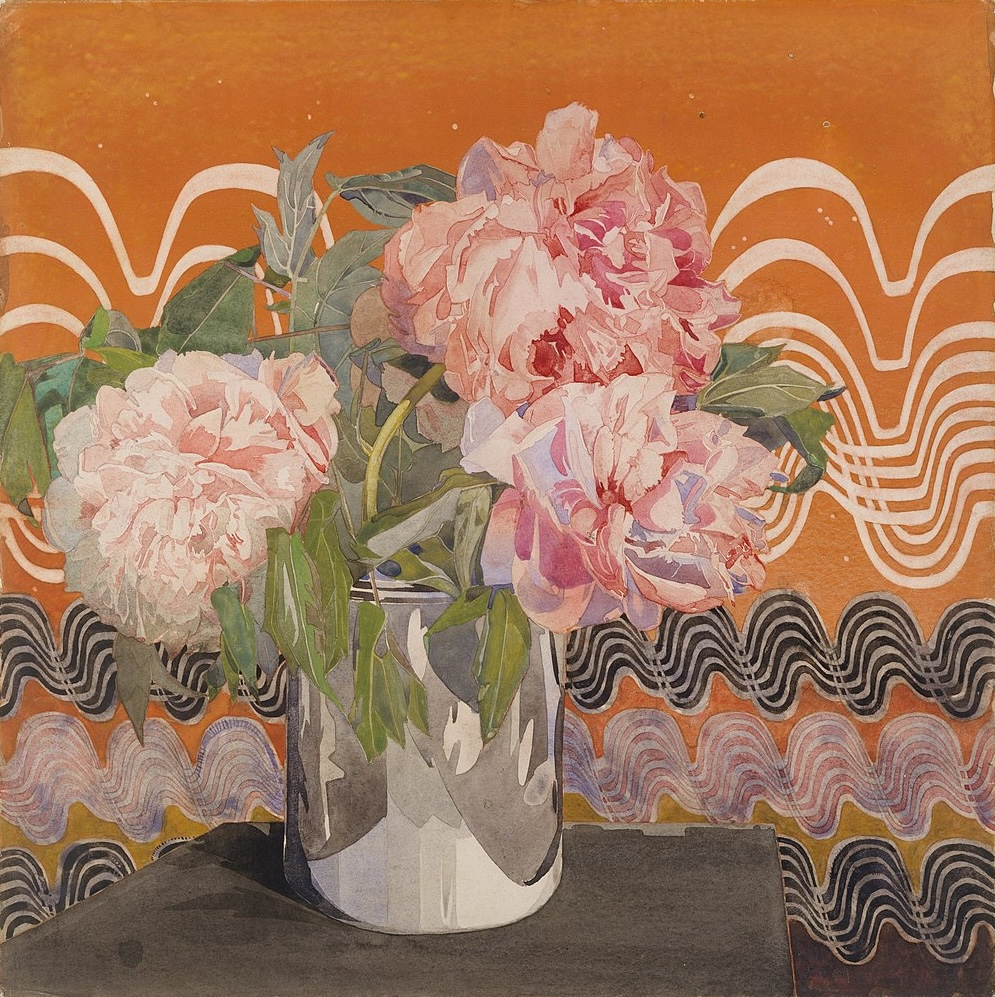
Charles Rennie Mackintosh, Peonies, ca. 1920

Edith Wharton, Summer (1917)

Wharton continues to be one of my happiest discoveries of the last few years. (A personal discovery: I know everybody else already knows her.) Shawn Mooney, host of the Shawn Breathes Books YouTube channel, asked a few of his many bookish friends to read this novella from the middle of Wharton’s career. What a terrific book! Charity Royall, the adopted daughter of a lawyer and his now-late wife, might be in the upper echelon of her New England village’s society, but that doesn’t mean much. She’s bored to death. When a young architect comes up from New York to summer with a relative—to sketch the local country houses, ostensibly, but mostly to loaf—Charity is smitten by the glimpse of another world he offers. And by him, too: the book is impressively sexually frank for its time. Before long, Charity and Lucius have made a love-nest out of an abandoned house halfway up a nearby mountain. When Charity gets pregnant, a lot of troubling and surprising things happen in a short time. I won’t spoil the ending, but oof what a gut punch. Recommended!

Folks who have read this novel (others, look away): do you think Royall might be Charity’s father? Am I crazy to think so??? The circumstances around Charity’s coming to the Royalls seem… murky.

Andrey Kurkov, The Silver Bone (2020) Trans. Boris Dralyuk (2024)

Kurkov, whose delightful Death and the Penguin I laboriously read in German way back in the day and whose subsequent many, many books I have failed to keep up with, has written the first of a series set in Kyiv in 1919. The Great War might be over, but peace is nowhere to be found in Ukraine. Various factions vie for control: unaffiliated war lords, the Bolsheviks, the Whites, and the embattled Ukrainian People’s Republic, one of the first nations in Eastern Europe to deem Jews a protected minority, which didn’t stop it from countenancing a wave of pogroms under its brief rule. (I’m slowly making my way through Jeffrey Veidlinger’s history of these events, In the Midst of Civilized Europe, which is retrospectively clearing up a lot of the context.)

On the novel’s first pages, Kurkov’s protagonist, Samson Kolechko, a would-be engineer, loses his ear in an attack by Cossacks. (His father, alas, is murdered.) Samson, an upside-down low-rent version of his biblical namesake, manages to keep the ear, which turns out to have fantastical powers, allowing him to hear things he otherwise couldn’t. This comes in handy when the two Red Army soldiers who have usurped his apartment plot to kill him. He goes to police to turn them in and in a pleasingly preposterous turn of events is taken on as a detective himself. Along the way, he relies on the help of a young woman employed by the newly-established department of statistics. Kurkov vividly evokes the danger, scarcity, and uncertainty of Kyiv in this period: atmosphere is the book’s strong suit.

As for the crime element, well, let’s say it’s on the shambolic side. Perhaps more generously: it’s about what it means to investigate crime in a place where the political situation is changing so fast that the law threatens to be even more nakedly a fig leaf for power than usual.

In Boris Dralyuk, Kurkov has found a translator who gets his goofy side—and, I suspect, has even improved the book a little. He tells me the second Samson novel will be out in English next year. Count me in.

József Debreczeni, Cold Crematorium: Reporting from the Land of Auschwitz (1950) Trans. Paul Olchváry (2023)

Extraordinary. I do read a fair few Holocaust memoirs, and even though I’m interested to see how similar they are, how much they trade in the same tropes, I’m usually caught short in horrified wonder by at least one scene or detail. Cold Crematorium—now translated into English for the first time, more than 70 years after its publication in communist Yugoslavia—gave me that feeling from start to finish.

Debreczeni, the penname of József Bruner, was born in Budapest but moved to the Vojvodina, the largely Hungarian-speaking part of what is now Serbia, after WWI, where he worked as a journalist and newspaper editor. Like most Hungarian Jews he was deported to Auschwitz in 1944. Having survived the initial selection, he volunteered to be transported further west in Silesia to a camp that was then under construction. Falkenberg, as the Germans named it, was part of the vast Gross-Rosen camp system. Conditions in that archipelago of suffering were so bad that far fewer victims survived its array of satellite camps than did Auschwitz; it is much less well known today than its role in the Holocaust would demand. (Menachem Kaiser’s excellent third-generation memoir Plunder also considers this lacunae.) From there he was sent to the work camp at Fürstenberg, and finally to Dörnhau, the “hospital” ward of which was known to inmates as the cold crematorium because so many died within its frigid walls. He was liberated in May 1945, barely alive. After a lengthy recuperation, he returned to Belgrade, where he lived and worked until his death in 1978.

Indulge me as I share some of this remarkable book with you. It is the most visceral, corporeal description of the Holocaust that I know:

Here’s a passage from Fürstenberg, where Debreczeni labored, under dire conditions, to build an underground tunnel system (the so-called Project Riese, the eventual purpose of which remains a source of debate among historians):

Dysentery takes hold me of me yet again. Swelling spreads frighteningly over my entire body. Over the course of these days I am lugging sacks of cement to the mixers, and I become hopelessly dirty. The cement dust swirling nonstop in the air forms a thick layer of sediment upon my clean-shaved head. It collects on my gums and seeps into my nose, my eyes, my ears. Not even Sani Róth [former mobster who takes Debreczeni under his wing] can get his hands on soap. I hang my rags on the nail above me. The pants and tunic are literally moving from the thousands of squirming lice. Destroying them is hopeless to begin with, so lately we haven’t even been trying.

Here’s one from the “hospital” unit at Dörnhau, where Debreczeni spent eight miserable months:

The November cold pours in through the broken windows, and yet the stench is unbearable all the same. A suffocating stink oozes from the walls. Rising between the rows of bunks, several centimeters high, is an odious yellow slurry of dung. Naked skeletons are sloshing through the putrid river.

At one point, that slurry was knee height (for the few who could still walk). I will never get that detail out of my mind. This is the kind of thing I mean when I say Cold Crematorium makes other Holocaust memoirs seem tame.

And here’s another one from Dörnhau, about a man named Miklós Nagy, who scrabbled to the position of chief functionary of the medics who “treated” the patients, some with good will and others with pure cynicism, in an environment completely lacking medical supplies that was also, as we have seen, utterly unhygienic.  

I once saw this lightweight man jump up and down on a patient’s chest like a rubber ball, stomping on him with bloodshot eyes until he was worn out. The victim’s crime: he’d tried conniving his way to a second helping of soup.

Remember, Nagy was a prisoner of the Nazis, too. The pitiless depiction of camp functionaries is just one of the things that makes this book such a valuable testimonial document.

I am seriously thinking about assigning this book instead of Primo Levi in my intro Holocaust Lit course. (Shouldn’t be one or the other, but syllabi are zero-sum games…) If you think you have the fortitude, I urge you to read this book.

Joan Chase, During the Reign of the Queen of Persia (1983)

I chose this novel by the hitherto unknown-to-me Joan Chase for the April episode of One Bright Book simply because it was reissued by NYRB in 2014 and I’ve had it on my shelf ever since. (I’m trying to use the podcast to get to some of the hundreds of unread books around here…) Reading it was a happy surprise: it’s excellent, although, in my opinion, awfully sad. Somehow Chase tells the well-worn story of a vanished childhood—shot through with depictions of women’s limited lives in this time and place—in a way that feels new.

During the Reign of the Queen of Persia tells the story of three generations of the Krauss family, who mostly live on a farm near an unnamed county seat in northern Ohio probably modelled on Wooster, where Chase was born. The family is made up almost entirely of women: its matriarch, Lil, known as Gram (the titular Queen, so named as a joke about her similarity to a family pony who loves to run wild), has five daughters, two of whom have two daughters each. These girls, all born within two years of each other, and now in their mid to late teens, think of themselves as a collective: their responses to the vicissitudes that life throws the family’s way make up the core of the novel’s events.

Listen to the episode for more about this terrific book. For now, I’ll just say that if you’re intrigued by a first-person plural narrator that never feels gimmicky, and you like domestic fiction that also dabbles in the Gothic, you’re going to love this.

Amy Pease, Northwoods (2024)

(Not to be confused with Daniel Mason’s North Woods; that must have annoyed Pease and her publisher…)

Set in Shaky Lake, WI (which the internet suggests is a real place???), Pease’s debut crime novel concerns a former fish and wildlife investigator, Eli North, who returns from Afghanistan with PTSD and is taken on as a charity case by his mother, the local sheriff. Eli is at the end of his rope: drinking too much, losing contact with his son (his wife threw him out of the house), scared and ashamed most of the time. When a teenage boy is found dead and the girl he’s been seeing disappears, Eli fights for the right to take on the case and maybe regain his footing. The most interesting thing about this book is that Pease has chosen to put the exasperated, anguished, loving relation between Eli and his mother at its center. How things work out between them is ultimately more compelling than the whodunit.

All told, Northwoods is totally satisfactory debut; I’ll keep an eye on Pease. I listened to the audio, and I was excited each day to catch the next installment, sometimes even forsaking my hockey podcasts. So that tells you something.

Willard Metcalf, May Pastoral, 1907

All I can say is: IT’S SUMMER BITCHES. A fuller reading slate returns in May.

Melanie Nicholls’s Year in Readng, 2022

Today’s reflection on a year in reading is by Melanie (Mel) Nicholls. Mel is a bookseller at Barnes and Noble from Georgia. You can follow her on Twitter @nichollsm86 where she often tweets about…books!

Rineke Dijkstra, Self portrait, Marnixbad, Amsterdam, 1991

I was pleased when Dorian asked to do a write up of my 2022 reading, as I enjoyed reading the entries from last year. My reading in 2022 was mainly fiction in translation and short stories. When choosing what to read I mostly pick up books I think I’ll enjoy. And this past year I definitely succeeded! Here are some of the standouts.

January started strong with two books that are new favorites. The haunting Ganbare! Workshops on Dying is by Katarzyna Boni (tr. Mark Ordon). Boni reports on the March 11, 2011 earthquake and tsunami in the Tōhoku region of Japan and its aftermath. She offers accounts of the effects on survivors such as learning to scuba dive to help find bodies, a gripping account of the Fukushima nuclear disaster, and stories of other devastating earthquakes in Japan’s history. A heartbreaking and timely work. I followed this with the NYRB Classics edition of Edith Wharton’s ghost stories, unsettling and eerily quiet hauntings. A book I could read every year. The novel Written on the Body by Jeanette Winterson and the stories in Cars on Fire by Mónica Ramón Ríos (tr. Robin Myers), continued my excellent streak of reading for the first month of the year. 

In February I began the readalong of Dorothy Richardson’s thirteen book sequence Pilgrimage. I really started to click with Miriam’s journey with book three and my top reading goal in 2023 is to finish the sequence. Other highlights include the classic Passing by Nella Larsen [Ed. – GOAT!] and the absolute gem Byobu by Ida Vitale (tr. Sean Manning), two books I’m sure I’ll find new meaning in each time I read them. 

In March I read another top book of 2022, Blood Feast: The Complete Short Stories of Malika Moustadraf. These stories about gender and class in society are expertly translated by Alice Guthrie. The outstanding translator’s notes make this a book I hope to study more and highly recommend. April was another strong month with the beautiful novel When I Sing, Mountains Dance by Irene Solà (tr. Mara Faye Lethem) and the terrific History of a Disappearance: The Forgotten Story of a Polish Town by Filip Springer (tr. Sean Gasper Bye). I ended this month with the masterpiece Woman Running in the Mountains by Yūko Tsushima (tr. Geraldine Harcourt) which I often think of with Lolly Willowes by Sylvia Townsend Warner. Both novels portray a woman’s yearning for freedom and Dorian’s podcast One Bright Pod has superb episodes for both books. [Ed. – Thank you! Of course, Frances and Rebecca are the really important members of the team.]

May and June were the months of absolute banger short books: 

Yesterday by Juan Emar (tr. Megan McDowell)

They by Kay Dick

Cold Enough for Snow by Jessica Au

Spear by Nicola Griffith [Ed. – Curious to check this one out.]

An Ideal Presence by Eduardo Berti (tr. Daniel Levin Becker)

Permafrost by Eva Baltasar (tr. Julia Sanches)

Violets by Kyung-Sook Shin (tr. Anton Hur)

Pollak’s Arm by Hans von Trotha (tr. Elisabeth Lauffer)

The Employees: A Workplace Novel of the 22nd Century by Olga Ravn. (tr. Martin Aitken)

July’s standout is A Month in the Country by J.L. Carr, a perfect novel. [Ed. – Absolutely agree.] August is one I look forward to every year because it is Women in Translation month. I continued this year with four writers whose translated work I am slowly making my way through: Annie Ernaux, Yoko Tawada, Natalia Ginzburg, and Banana Yoshimoto. Another highlight was the collection Panics by Barbara Molinard (tr. Emma Ramada). Molinard was a close friend of Marguerite Duras and would destroy most of her writing. [Ed. – Thanks, uh, “friend”…] These bizarre and grotesque stories are a must read. Two books translated from Croatian, Call Me Esteban by Lejla Kalamujic (tr. Jennifer Zoble) and Divine Child by Tatjana Gromača (tr. Will Firth) from the new small press of translated fiction Sandorf Passage, were also excellent. 

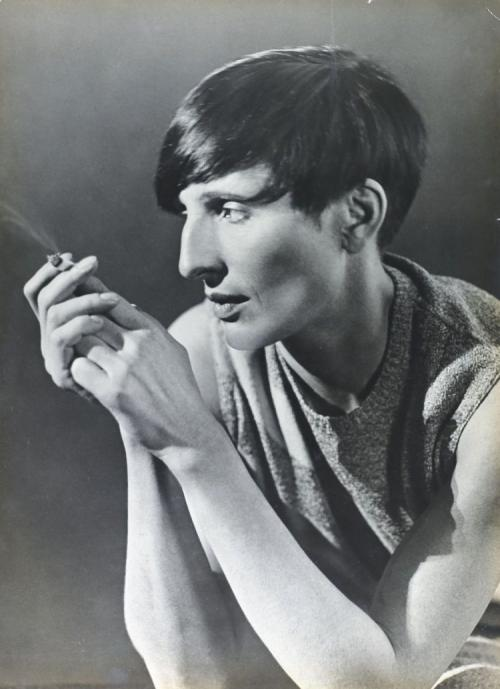
Gerty Simon, Renée Sintenis ca. 1929 – 32

The last few months of the year offered standouts in nonfiction. I love Elaine Castillo’s debut novel America is Not the Heart and she delivers again with the essays in How to Read Now. This book, along with A Ghost in the Throat by Doireann Ní Ghríofa, This Little Art by Kate Briggs, The Missing Pieces by Henri Lefebvre (tr. David L. Sweet), and Voice of the Fish by Lars Horn, left me with a new appreciation for reading, translation, writing, and art. All are books I will come back to often. Other wonders at the end of the year include some short-but-mighty translated novellas: Space Invaders by Nona Fernández (tr. Natasha Wilmer), Baron Bagge by Alexander Lernet-Holenia (trs. Richard and Clara Winston), A Woman’s Battles and Transformation by Édouard Louis (trs. Tash Aw) and Rogomelec by Leonor Fini (trs. William Kulik and Serena Shanken Skwersky). I’ll close with Nettleblack by Nat Reeves, a playful novel of queer awakening among strange crimes in a Victorian rural town.The most fun I had reading in a while, just a joy to read. [Ed. – Sounds great!] My reading has changed over the last couple of years as I have discovered more translated fiction, small press, and Book Twitter. I am excited to see where my 2023 reading will take me and to share the wonders. [Ed. – You’re welcome back next year, Mel!]

Anne Cohen’s Year in Reading, 2021

Today’s reflection on a year in reading is by Anne Cohen (@aecnyc). Anne is a lifelong reader (preferably stretched out on couch or bed), retired lawyer, and former reporter. She lives in New York City with part of her family and two dogs and is firmly convinced that Book Twitter saved her from homicidal behavior in 2021.

Look for more reflections from a wonderful assortment of readers every day this week. Remember, you can always add your thoughts to the mix. Just let me know, either in the comments or on Twitter (@ds228).

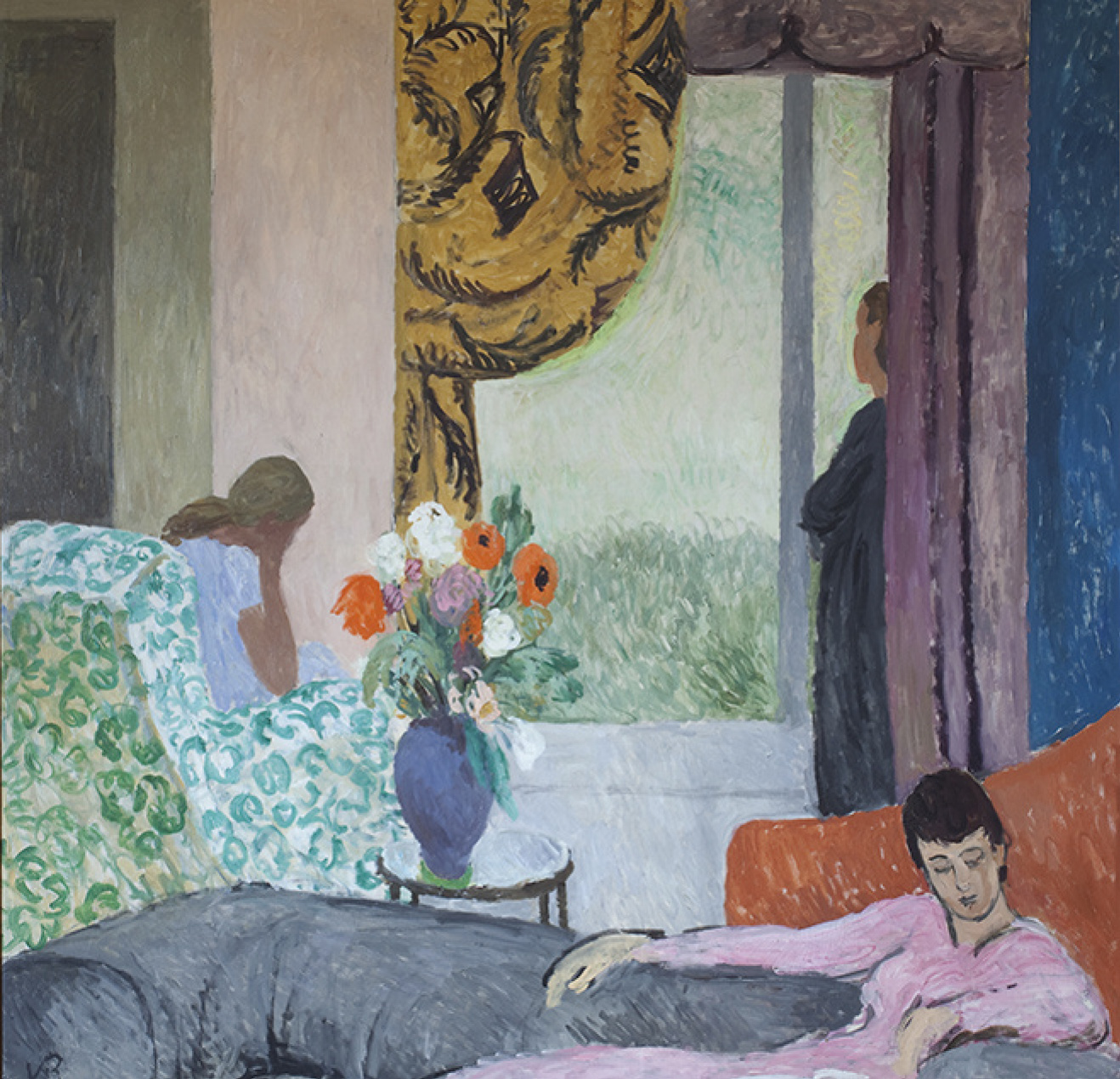
Vanessa Bell, In the Other Room (late 1930s)

Most beautifully-written book: Transit of Venus by Shirley Hazzard was the most exquisitely-written novel I read in 2021 but also one of the most frustrating. It was as if the plot and the characters were unworthy of the prose. 

Am trying avoid spoilers, but the coyness of the last page infuriated me and even drove me to the internet for clarification.  “WTF” endings don’t bother me; reader and narrator of The Sense of an Ending share the same information and deluded memories and are equally gobsmacked at the conclusion, and Kate Atkinson, whose A God in Ruins had a similarly tricksy ending, is a master of showing but not telling. Although the language was gorgeous, the last paragraph of Transit felt cheap.

(You still should read it.)

Second most beautifully-written book: Daddy’s Gone A’Hunting written by Penelope Mortimer and published in 1958 was also the most frightening book I read this year. Daddy is the story of Ruth, an upper-middle-class woman in her late 30’s trying to navigate the potential termination of her college-age daughter’s pregnancy (whose pre-marital conception was the impetus for Ruth’s own marriage).

The scary part was not just the ordinary shivers of recognition present in most good novels about families. Perhaps it is a function of my age and gender—Daddy and I were both born in the middle of the baby boom—but I was horrified by the sight of Ruth, already feeling old at 38!, being shamed as she searched for a physician who might be willing to terminate the pregnancy on behalf of her clueless and nasty daughter. 

This year, I also read Mortimer’s biography of the Queen Mother, which is not scary, and her first volume of memoirs, About Time, which has as a central character her impious cleric father. (Maybe read it as a double feature with Priestdaddy.)  I recently located a copy of her second volume, About Time Too, and it’s on my TBR stack.

Other wonderful fiction: Cathedral, by Ben Hopkins, hasn’t gotten as much attention as it deserves.  I can’t get into The Constant Nymph, but Margaret Kennedy’s The Feast was enormous fun, beautifully written, and (spoiler alert) the right people survive; I also enjoyed her contemporaneous account of the early days of World War II, Where Stands a Winged Sentry, a country companion of sorts to a similar book about London read last year, Chelsea Concerto, by Frances FlavellDaisy and The Six made me laugh when I was sick.

Lolly Willowes entranced me [Ed. – Paging Frances Evangelista!], as did both Scenes From Childhood, Sylvia Townsend Warner’s memoir and her collected letters. (Have not yet finished The Corner that Held Them or Summer Will Show.)

Also read and liked Cassandra at the Wedding by Dorothy Baker, The Tortoise and the Hare by Elizabeth Jenkins, A Month in the Country, by J.L. Carr and several pieces of fiction by Tove Jansson. I was thrilled by parts of Gerard Reve’s The Evenings and wondered when other sections would end, which may have been the sensation the author intended.   

Molly Keane’s Good Behaviour offered an instructive counterpoint to Transit: annoying characters, obsessive conduct, and an ending that made me want to go back to the beginning, but without feeling as if I’d been snookered along the way.

Not fiction but an elegant presentation of how an interesting woman’s actual life was commandeered by fiction and biography: The True History of the First Mrs. Meredith by Diane Johnson.

Biggest project of the year: Diaries and letters have always fascinated me and taken up significant space shelf. Their proportion in my reading diet has increased over the last 22 months, as I’m comforted by the notion that their authors didn’t know what was going to happen to them any more than we do now. [Ed. – Nicely put!]

Someone who was often wrong about the future was Henry “Chips” Channon, an American-born writer, pal of the rich, royal and merely titled from his late teens onward, member of the British Parliament, and from 1938 to 1941 a senior cabinet aide in the Foreign Office. The first two volumes (total 2000+ pages) of his unexpurgated diaries were published in 2021 and edited brilliantly by Simon Hefner, whose dazzling footnotes include some tart asides and everyone’s courtesy titles.

“Chips” knew everyone, and everyone appears in the diaries. He was a wrong-headed bigot, a sniveling acolyte of Neville Chamberlain, a toady to almost anyone with a royal title, and a nasty, insecure, self-important snob, who occasionally recognized his reputation as a well-connected lightweight. 

What makes the diaries worth £35 each plus postage to the States is the astonishing range of Channon’s access and the detail of his descriptions— his failing marriage to a rich and titled woman, who left him for a horse dealer; events, including his dinner for Edward VIII, and Mrs. Simpson a month before the abdication; his crushes on a series of other well-connected men and his schemes to marry them off to “suitable” women; changes in society during the war, including his mother-in-law (“the richest woman in England”) doing without a cook; and the perfidy of his enemies of the moment. [Ed. – Ok, that sounds really good.]

My fascination with these books is more than historical. As someone who annually orders but doesn’t always use a big Smythson daybook, I’m reluctantly moved by dogged if not heroic maintenance of a diary for decades and even more by the willingness to write down so much of one’s deepest and often foolish feelings in real time. 

A year for letters: Love From Nancy: The Letters of Nancy Mitford; The Letters of Nancy Mitford and Evelyn Waugh; Letters from Tove [Jansson]; Letters of Sylvia Townsend Warner; Letters of E.B. White; and A Whole World: Letters From James Merrill.

Not surprisingly, there were many connections among Channon, Mitford and Waugh, who lived in a small world they thought was the whole.  

But other connections were less expected—the Merrill letters were terrific, and not just because his frequently-mentioned mother and daughter Connecticut neighbors were novelist Grace Zaring Stone and Eleanor Stone Perenyi, author of both More Was Lost [Ed. – A long-time EMJ favourite!] and Green Thoughts: A Writer in The Garden, which I’d consulted only days before about dahlias.

The best connection came when I was alternating books—Hermione Lee’s biography of Willa Cather and the E. B. White letters—and suddenly realized the same “character” appeared in both: Cather’s good friend Elizabeth Sargent was also White’s sister-in-law Elsie, older sister of New Yorker editor and garden writer Katherine White. [Ed. — !]

Mysteries: Spine for spine, I probably read mysteries more than other category and can inhale a whole series of 10-15 books in a week. (Hey, I’m retired and read fast.) [Ed. – Goals!] This year, in addition to rereading half a dozen of Simenon’s Maigret books and the first few chapters of Busman’s Honeymoon, and adding to my list of books by E. C. R. Lorac, John Rhode, and Patricia Wentworth, I was introduced to Jane Haddam’s Gregor Demarkian, Craig Rice’s John Malone and pals, Delano Ames’s Jane and Dagobert Brown, and Elizabeth Daly’s Henry Gamadge.

Of these my favorite was probably the last, not for the quality of the story or the story-telling, but for the flavor of New York City in the early 1940s and the depiction of people for whom the world had changed since the turn of the century. Part of my attraction to mysteries, and especially those of the “Golden Age,” is the way they incidentally reflect the details of their time, whether clothes, food, manners, or relationships.  

Vanessa Bell, Composition, ca. 1914

Audiobooks: I’m not snobbish about the idea of audiobooks but I’m picky about both the sound of the voice generally and the rightness of it for a specific work. These are obviously very subjective criteria; most people were probably thrilled by Patti Smith’s reading of Just Kids but I ripped off my headphones during the foreword. 

I read quickly, sometimes too quickly (see possible explanation for my reaction to Transit of Venus), and so have been fascinated by my reaction to hearing books I’ve previously read. Listening to The Age of Innocence made me much more aware of Wharton’s humor and devastating nuance.  

Some books—like The Thursday Murder Club—can be aural candy, perfect for walking the dogs; this is not a put down, at least from me. It’s also when I listen to the Backlisted podcast, whose fingerprints are all over this list. 

What I Didn’t/Haven’t Finished: There are mystery tropes I can’t abide (especially the protagonist as suspect), and if one of those sneaks by my “blurb” filter, I’ll let it go. [Ed. – Almost as bad as “investigator’s loved one in danger”…]  

Books not finished in 2021 but still open are Hamnet (and I loved I AM I AM I AM), as well as Klara and the Sun, Our Spoons Came From Woolworth’s, Shuggie Bain, and Mrs. Palfrey at the Claremont. I couldn’t get into Adam Thorpe’s 1921, which broke my heart, because his work is so varied and usually so very good. 

Best reading experience: Not the “best” book or the most interesting or important—but an almost out-of-body moment late one night propped up in bed with the five-book Percy Jackson series, which I’m reading along with an 11-year-old friend. 

The apartment was quiet. Maybe it was Percy’s adolescent demi-god angst, but for a sudden moment, I was in my childhood bedroom, trying not to wake up my sister and hearing my father’s voice at the door, telling me to go to sleep.  Sam died almost 25 years ago, and it was nice to have him back for that instant.

What I read, June 2021

In June I realized my sabbatical is in fact coming to an end. (Technically, it ended last week, but I have a few weeks’ grace until the school years grinds into gear.) Soon I will be back among people all the time; this knowledge made me anxious. The weight I gained over the pandemic made me depressed. The discoveries at two of the many former Residential Schools in Canada shocked but did not surprise me. (Similar mass graves will be found at others in the coming months, I have no doubt.) The extreme heat and firestorms in the West, including my home province terrified me; ironically, the weather in Arkansas was cooler than usual. (This too a function of climate of change, of course.) Everything seemed ominous. I was working hard, too, mostly on an essay I’m excited to share with you all in August. My daughter and I started taking one of the dogs for a walk each morning: that was a good thing. As to reading, the month started strong, then tailed off. Here’s what I finished.

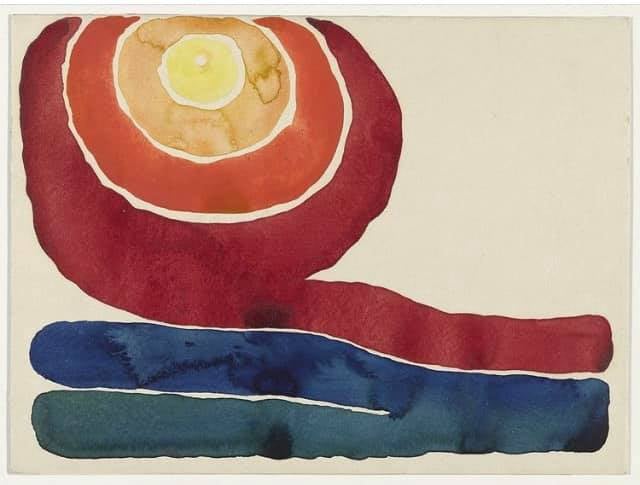
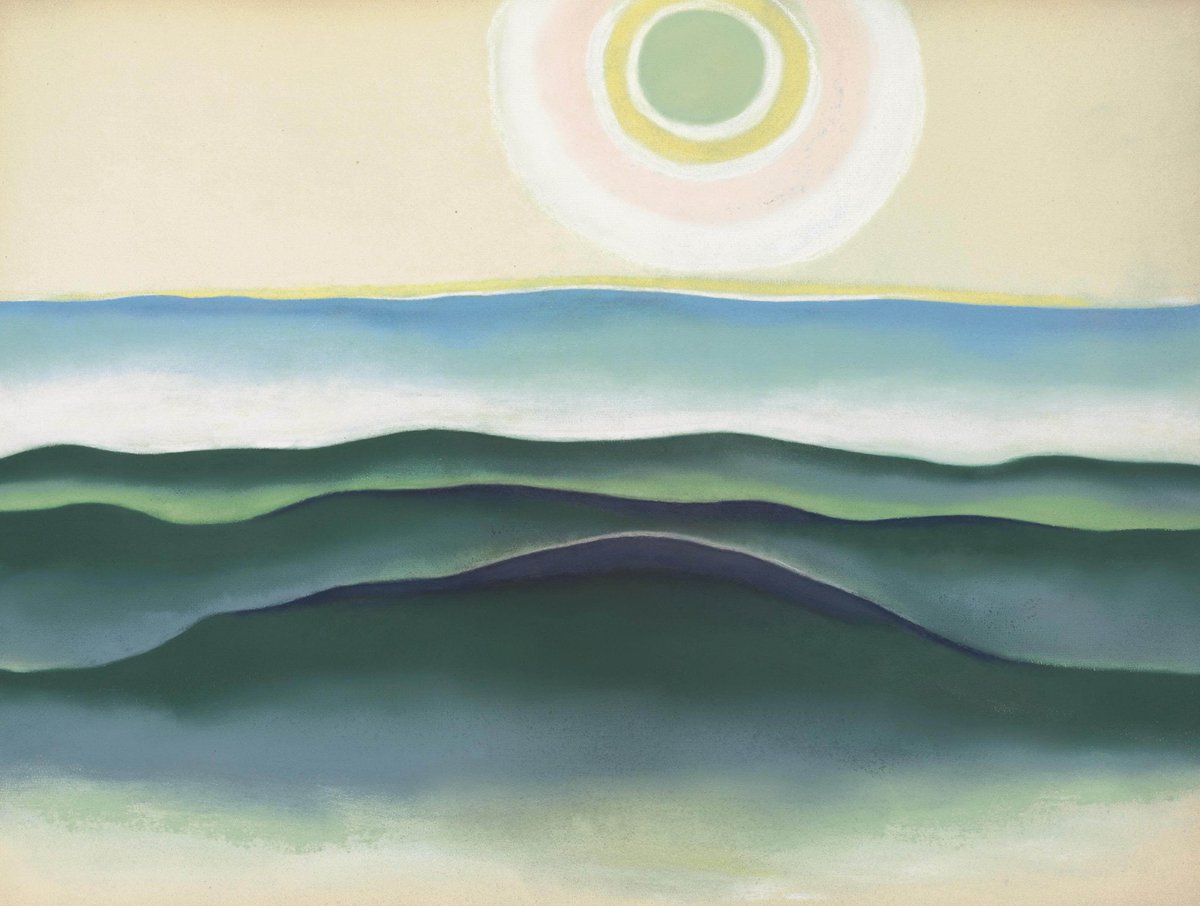
Georgia O’Keefe, Evening Star III, 1917

Madeleine Watts, The Inland Sea (2020)

Strong debut novel about a young woman, fresh out of university, who takes a job as an emergency dispatcher, eliciting from panicked callers where in Australia they are and which service to connect them to. Filled with wonderful place names and terrible events, The Inland Sea is a novel of emergencies: fires and petty crimes and surfing accidents, but also the narrator’s depression and despair, the violent settler colonialism of Australia’s past and present, and above all the changing climate. A wildfire from the early 90s, which the narrator’s family had to flee, is a primal moment the novel returns to again and again, presenting it as a harbinger of the terrible changes to come. The title refers to the 19th century settler belief that the continent’s rivers must have had a common source; the mythical inland sea stands in for all hubristic fantasies that aim to make reality fit ideology. (Patrick White, especially his novel Voss, about a megalomaniac explorer, is referenced repeatedly: the shittiest of the narrator’s shitty exes is writing a thesis about him.)

The Inland Sea captures the rage and despair that I’ve seen in younger people these past years, faced as they are with an increasingly uncertain future, and that I am myself enveloped in more every day. (It’s the same future; they just have, or should have, more of it.) Here the narrator reflects on her mother—whom she loves and is close to but can’t tell anything important to:

This was what my mother had never understood. The things she never would have done—moving out of the city, dropping out of the university system and into paid-by-the-hour work, reckless sex and drinking—they were not things I did because I didn’t know any better. I just didn’t think there was any point in trying to shelter myself. If working on the phones had taught me anything, it was that emergency could not be avoided. Emergency would come for you no matter what you did.

In this moment the dispatch center comes close to mere symbol. Fortunately it’s usually described more fully, though I wouldn’t have minded learning even more about it. (I loved the details, like the mid-morning lull when older women, mostly widows, call in with invariably false stories of burglaries or strange men in the back garden.)

The Inland Sea reminded me of some other recent novels—like Conversations with Friends, with its description of endometriosis—that present women’s bodies as a site of violence and harm, even when the women who live in those bodies try to take charge of them: here, a procedure to implant an IUD goes badly. As the narrator concludes, “My body could not be made to behave. It disdained all methods of prevention and protection.” Danger everywhere.

Last thought: I only know Australia from books, which means I know nothing, but I’ve always thought Melbourne was the cool place and Sydney beautiful but tedious, but Watts makes Sydney seem, not appealing, really, it’s mostly a terrifying landscape of drunk men lurching after women, but something other than the “world city” of the opera house and Bondi beach. The final image, of the narrator swimming in Gordon’s Bay, looking back at the “scum of waste… weeds and straws and band Aids and bottles” washed up after yet another 100-year storm, reminded me of the ambivalent swimming scene at the end of Cusk’s Kudos.

Doris Lessing would have liked this book.

Anakana Schofield, Bina (2019)

Bina—“Bye-na not Bee-na,” consider yourself warned—is 74. Who know how long she had left: she has a lot to say even if it’s not what you want to hear (“I’m here to warn you, not reassure you”), so she’s not going to waste any time. Empathy has been her undoing (interesting, given how empathetic this book is): it led her to invite a Bad Man into her home, who abused her and took advantage or her and whose return she daily fears; it got her involved in a secret organization that helps people end their lives which in turn led to her arrest. We let people into our lives, Bina says, it’s what we do. The trouble is getting them back out. Bina reminded me of Beckett’s Molloy, not just because it’s set in Ireland (though Schofield now lives in Canada) but because of its fascination with both the rhythms of spoken language and the frailty of the human body (there’s a relationship there I’m not able to articulate just now—or maybe I’m just following Bina’s quite Beckettian demand that “the explanation-hungry get over themselves”).

Bina is a fabulous character: self-aware (“I was a great woman for delivering the verdicts to others that I could neither conjure or conquer for myself”), wise (“I have noticed that it’s the decent people who are buried/While it’s the parasites and demolishers who endure”), scathing (“There are those reading and thinking, isn’t she daft, why didn’t she walk or why didn’t she do this or that. Well I am not worried about you, because maybe you’ve had the good fortune to be trained different and would not scupper yourself this way. And it’s it as well for you.”), and funny (women have to get up and pee at night because they are “widdling the confused strain of anger gathered up there all day”—why men have to pee at night is a mystery, “perhaps it’s God’s subtle way of tormenting them. He goes straight for the pipe does our Saviour”).

Schofield is a terrific writer (men like Eddy, the Bad Man, are “bullies in woolens”): I loved this book and can’t wait to read her others.

Bryan Washington, Lot (2019)

Many of the stories in this debut collection center feature versions of the same family: black father (sometimes absconded, sometimes just about to), Latina mother, daredevil older brother, sister looking to get the hell out, and at the center, the young gay narrator. Restaurant kitchens, johns, animals in the bayous—this isn’t the Houston of Rice, the Menil Collection, or even Minute Maid Park. That world is present only at the edges of the frame, mostly through the specter of gentrification. No surprise that a book called Lot is interested in real estate (not to mention one’s lot in life, having a lot to deal with and a lot to live for, and maybe even Lot of Genesis, who looked upon and fled Sodom). Much as I would miss Malamud’s The Magic Barrel, I’m thinking of replacing it with Lot as the centerpiece collection the next time I teach my course on the short story. My students—a good number of whom are from Houston, though rarely the parts described in the book—would like it, I suspect, and I’ll be able to decide if it’s as good as my first reading suggests.

Edith Wharton, The Age of Innocence (1920)

Fantastic. Read this in college, probably a year after the movie came out (I believe it was the first film I saw as a college student), and, I realize now, completely missed the point. Not only did the story seem slight, worse, I identified with Newland Archer, the ironic yet self-satisfied scion of a wealthy New York family in the 1860s whose imminent marriage to athletic, kind, incurious May is threatened by the return of her disgraced cousin, Ellen, on the run from a bad marriage to a Polish nobleman, with whom he falls in love. Wharton’s irony—her brilliant control of the narrative voice—passed me right by. I can’t think of a better advertisement for re-reading than my experience returning to this novel—though I now wonder how many other books I’ve misunderstood over the years.

Newland is such a carefully constructed character, his world-view so dominant, his criticisms of a world he loves and is much more enmeshed in than he ever realizes so easy to side with, that it is easy to miss that this is in fact a novel of two women, neither of whose interiority we ever access directly. Both May and Ellen are so much more interesting than Newland realizes. Ellen, in particular, fascinates as a figure who has suffered greatly from men, including from Archer, who is nowhere near as nice to her as he thinks he is, but who gains hard-won freedom—not least from us, the intrusive readers. (The bit players are wonderful too, from the titanic Mrs. Mingott to the ladies’ man Beaufort to the subdued Janey, Archer’s sister—I would have liked more of her.)

The novel is filled with rituals, rites, tutelary deities, and the like, the whole language of the ascendant anthropology of the 1920s. This motif is connected to Archer’s interest in the moeurs of New York society, which he studies as another scholar might the curious customs of some primitive tribe. He mostly has Ellen to thank for this—when he first visits her bohemian downtown apartment (unfashionable neighbourhood, artistic tchotchkes, and all), he decides the advice he wants to give her on how to behave in society is as useless in her bohemian world as warning someone bargaining in a Samarkand market about New York winters. Ellen, he thinks, has helped him see his native city clearly: “Viewed thus, as through the wrong end of a telescope, it looked disconcertingly small and distant; but then from Samarkand it would.” Archer fancies himself having transcended his world—now seeing it as curious as anywhere else—but you look foolish holding a telescope the wrong way ‘round, and Archer doesn’t have it in him to pursue the idea to its logical consequences. Maybe his privilege—his ability to imagine himself being rescued by Ellen from what no doubt feels genuinely and excruciatingly like a spiritual wasteland—isn’t as natural as he believes.

But before we get too comfortable at our own perspicaciousness in seeing through Archer, we might wonder at what we want from this novel. I read the new Penguin Classics edition (the cover of which was roundly pooh-poohed on Twitter, though I don’t mind it myself), and you should too, because the introduction by Sarah Blackwood is outstanding. (There’s also a Foreword by Elif Batuman—her name is on the cover—which is fine but nothing special.) Blackwood deftly summarizes the result of Wharton’s narrative decisions:

In keeping us in Archer’s perspective, Wharton allows us to experience the limited and impoverished viewpoint of a selfish young man, even as we are drawn to him and his desires, even as we relate to how deeply and ineffectually he wants.

[That’s what I missed as an undergraduate. I identified with his tragic position without seeing the harm it incited.]

Thus I read passages like this, in which Archer reflects on his mother and sister, as sympathetic:

Mother and daughter adored each other and revered their son and brother; and Archer loved them with a tenderness made compunctious [a word to warm the fussy heart of the lawyer in Melville’s “Bartleby, the Scrivener] and uncritical by the sense of their exaggerated admiration, and by his secret satisfaction in it. After all, he thought it a good thing for a man to have his authority respected in his own house, even if his sense of humour sometimes made him question the force of his mandate.

That it is anything but natural for him to have been granted such a mandate—and what it means for the organization of the world that he does—never intrudes on even his rueful thoughtfulness.

Blackwood continues by offering a startling and brilliant reading of what she rightly calls the novel’s “innovative’ ending:

By one metric, the fully realized novel [as opposed to drafts in which Wharton had Newland and Ellen get together, only to realize they had nothing in common] is a tragic story of two people trying to surmount the obstacles to their love. But in another… the published novel does have a happy ending. The Age of Innocence is one of the only stories Wharton ever wrote where everyone does, indeed, ‘get what [they] want.’ May gets to achieve the sentimental, sacrificial maternal and wifely status she desired. Newland gets to feel like an outsider while remaining an insider; he experiences no shortage of people to enlighten over the years. [Archer, Blackwood notes, is a preeminent mansplainer.] And Ellen? Well, Ellen gets to live a life that evades even our own prying eyes.

In this way, she finds a way to evade both the cruelty of impermanence—at the not-yet-fashionable Metropolitan Museum she regrets the way daily objects and implements, once so important to the people who made and used them, fade into obscurity until they are exhibited in a vitrine labelled “Use unknown”—and the cruelty of “the meanwhile,” of life as it is lived before time’s transience has done its work, a cruelty Archer fails to understand.

If you’re past your own age of innocence—though how can we ever know that we have reached this stage?—I urge you to read or reread this American masterpiece.

Mick Herron, Real Tigers (2016)

More adventures for the Slow Horses. Totally enjoyable. Not as good as the first, but better than the second. Since I love Standish the most, I both appreciated and was alarmed by the plot. Odd the way Herron frames these books with extended descriptions of Slough House from the perspective of a ghost or spirit stalking its floors, which I fancifully want to believe he has borrowed from the “Time Passes” section of To the Lighthouse.

Mick Herron, Spook Street (2017)

I mean, it’s a spy novel, but even so this one is a little preposterous. Still has its moments, but the bait-and-switch it pulls midway through annoyed me.

Judy Batalion, The Light of Days: The Untold Story of Women Resistance Fighters in Hitler’s Ghettos (2021)

Fascinating & detailed narrative history about female resistance fighters in Polish and Lithuanian ghettos. Smuggling information, living under false papers, shooting Nazis, stitching up partisans: these young women did exciting, dangerous, and important work. I have reservations about the book’s tone, structure, and narrativizing tendencies, but Light of Days is a valuable, accessible book that is well-sourced. So useful to have this experience brought to non-Yiddish speakers. Writing about it for another outlet, so more soon.

Jessica J. Lee, Two Trees Make a Forest (2020)

Memoir/nature writing by a Canadian writer of Taiwanese and British ancestry who now lives in Berlin (with all the other writers). The book tries to do a lot: relate walks and bike rides all over Taiwan, narrate the history of her mother’s family and their journey from mainland China to Canada via Taiwan, probe the family’s silences and antagonisms. All while giving us a potted history of the discovery of the island’s flora and fauna by mostly European scientist explorers. The weaving of these various strands isn’t always seamless. But each concerns the task of naming, defining, or fixing. Which explains Lee’s interest in mapmaking, language differences, and histories of classification. In each case these gaps—her difficulty, as a child in southern Ontario, in communicating with her Chinese Taiwanese grandparents, for example—prove to be both generative and debilitating, connecting even as they separate. That paradox leads to Lee’s final comparison, spurred by a trek through the Shanlinxi forest and its enormous cedars, of people to trees, connected through subterranean roots that make of these separate entities a forest. Language itself carries this affinity within it, Lee argues, noting that Carl Linneaus’s name is rendered in Chinese by characters meaning “someone related to the forest” or “someone who endures the forest” (the latter suggestion especially fraught and intriguing). To model human interrelatedness on the nonhuman natural world, Lee suggests, isn’t fanciful; it’s an expression of the truth of our own insignificance: “our fleeting human worlds are so easily swallowed up by nature, our fate fastened to its course. What we believe to be culture is only ever a fragment of natural world that we have sectioned off, enclosed, pearl-like, for posterity.”

I did not like Two Trees unreservedly—the writing is uneven: sometimes genuinely affecting, sometimes straining for lyricism—but I learned a lot. I recommend Nicie’s reflections on her own ambivalence.

Jeong You-Jeong, Seven Years of Darkness (2011) Trans. Kim Chi-Young (2020)

Compelling sort-of crime novel from Korea, a bit Gothic, a bit horror. Reminded me of Les Revenants (The Returned), that French show about ghosts—not least because both show and novel feature villages flooded by the construction of hydroelectric dams. If I knew more about Korean history I might suggest that Seven Years of Darkness is an allegory of the country’s rapid modernization. There’s that dam, of course, but also all kinds of sophisticated surveillance technologies A novel, then, about both 20th and 21st century technologies. Good stuff; I’ll definitely be reading more Jeong.

Sujata Massey, The Satapur Moonstone (2019)

Second in the Perveen Mistry books about a female solicitor in 1920s India. This time Perveen travels to a Himalayan princely state (once again to interview women in purdah). That world is interesting and compellingly presented. Perveen gains a possible love interest; that worked for me too. Massey is a plodding writer, though; suspense is not her forte. The third book has just been published but I’m not sure I’ll keep reading.

Hannah Arendt, The Human Condition (1958)

I enjoyed my online class with Samantha Rose Hill on The Origins of Totalitarianism so much that I signed up for one on Arendt’s follow-up, The Human Condition. Much shorter, but much more philosophical, harder to read. Sam is a great teacher, though, and the class was filled with smart people from literally all around the world. (Zoom doesn’t always suck.) Arendt and I don’t always see eye-to-eye, but the scope of her thinking and its anti-transcendence are inspiring.

We live, so Arendt, between the no-longer and the not-yet: there is no ideal society because there is no teleology to our lives or this universe. We have to rethink the human condition all the time based on experience, on what is. In her concern with what is, Arendt might seem like a materialist; she might seem, in other words, to be influenced by Marx. And indeed, the book began as a study of Marx, but became something else, especially as Arendt offers a (pretty idiosyncratic and, I am told, weak) reading of Marx. Marx believed labour to be the essence of human experience, Arendt argues, but he also wanted to liberate us from labour (and its alienation). Which would mean there would be no more human essence. Marx, Arendt continues, failed to distinguish between labour and work. Labour is necessary, but limited and limiting. It consumes itself because its task is consumption. Labour is endless, even circular: we need to feed and clothe ourselves, take care of our children and elders, etc. Almost all of the ways we spend our time and earn our living today are forms of labour. (Even the things we do in our spare time—our hobbies, which Arendt is hilariously scornful about—are just disguised labour.) Work, by contrast, is fabrication, it makes something that is durable, that is made of (some element of) the earth but exceeds the earth by the process of shaping and making. Work has dignity, though it barely exists anymore (says Arendt in the late 1950s), some scientists and, mostly, artists are the only ones lucky enough to work in this way.

In the process, Arendt, using Augustine’s concept of the love of the world, overturns the dualism present since Aristotle between the life of contemplation and the life of action. Philosophy has always valued the former and denigrated the second. Arendt flips this around. Because only in action can politics come into being. (Politics is when people come together to bring about a new beginning—always risky, always unstable, something like revolution; it is not the administration of the results of that action: that’s the political, bureaucracy, an all-around bad scene.) To love the world is to look at it for what it is, to face reality, to see all the good and evil in it. The Human Condition is a secular theodicy, a vindication of the world. We should not want to get outside ourselves—Arendt references Kafka’s parable of the man who found an Archimedean point but only because he was able to use it only against himself as a warning against the idea of transcendence—which explains why she is so fixated on the Sputnik rocket: it’s an image of science’s failed attempt to find that impossible place outside the world, impossible because what science has done with its Archimedean discovery is to use it against the human, to turn away from our experience in the world. We live in a world without much freedom (the world of consuming, of language deadened into cliché, of administrative rationality) but the possibility of freedom is always there. Things can always be different than they are. We know this because of what Arendt ominously/grandiosely calls “natality,” by which she simply means that we are born and we die. Every time someone is born something utterly new has come into the world. It is this principle of change—which is politics properly considered—that we must live by.

My summary surely misunderstands Arendt in some ways—please correct me. But it’s stirring stuff. I recommend Arendt, especially if you have someone to help you through it. I couldn’t help, however, but find her emphasis on the human overbearing and misguided in the time of the Anthropocene. I’m not sure the earth can take the world Arendt wants us to build. I so wish she were alive to help us think our current moment. But she’d probably tell me that’s for us to do…

Georgia O’Keefe, Sun Water Maine, 1922

Lots to recommend here, I hope you’ll find something you like the sound of and that you’ll share your favourites of the month. Above all, (re) read The Age of Innocence: it’s really something.