James Morrison’s Year in Reading, 2025

Regular readers will know that for the last several years I’ve solicited Year in Reading reflections from friends and trusted readers. As we’re well into February, I’ve scaled the project back considerably this time, but quality takes quantity every time… Today’s installment, his fifth, is by James Morrison, reader extraordinaire. James lives and works in Adelaide, on unceded Kaurna territory.
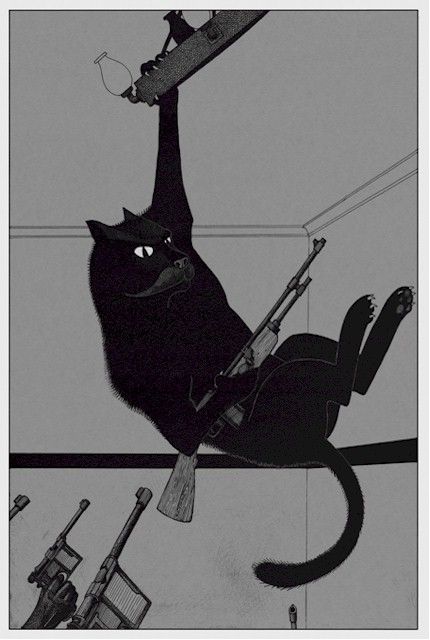
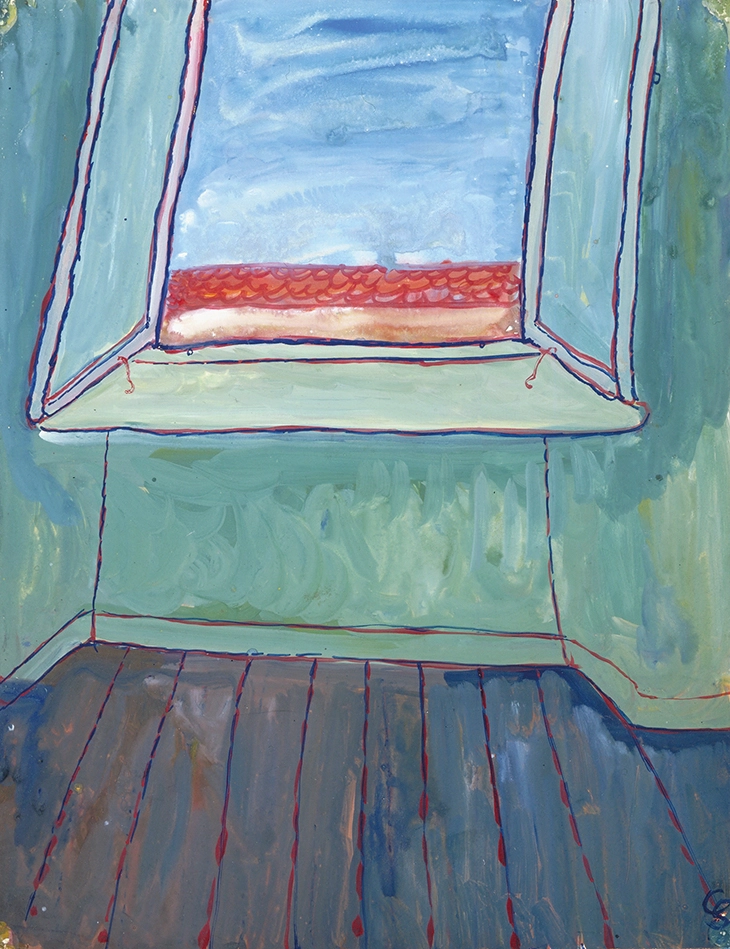
Charlie Stone, Behemoth from ‘The Master & Margarita’ (1999)

Working out which books to write about for these discussions is always fraught—there are easily another twenty great books I could have raved about, but neither you nor I are made of infinite time. I’ve tried to narrow things down to a few broad categories, but even then a few books would not be restrained by such, so they’re tacked on at the end.

In a couple of other people’s year-end reading round-ups on Bluesky, they talked not about what they’d read, but why they’d read it—what had prompted them to buy or pick up the books they ended up reading. It was strangely interesting, at least to a big horrible nerd like me, so I’m including that here for my own choices. Feel free to pass over it with glazed eyes. [Ed. – No way! I think people love that stuff. I know I do.]

RAMUZ

My most compelling new-to-me writer discovery of the year was Swiss novelist Charles Ferdinand Ramuz (1878–1947). The three of his books that I read all have the same basic premise—Something Horrible Happening in the High Alps—but go off in very different directions. Great Fear on the Mountain (translated by Bill Johnston) was what got me hooked first: a historical novel where a group of men set off to take the village’s flock up through a mountain pass to find feed, and then everything goes to hell. It has all the rhythms of an 1980s horror movie, but is beautifully written and was first published in 1926. Derborence [When the Devils Came Down] (translated by Laura Spinney) features an avalanche and its spooky survivor, while Into the Sun (translated by Olivia Baes and Emma Ramadan) is an impressionistic, atmospheric early climate change novel. As the Earth slowly falls into the sun, the snows melt, the mountain lakes boil, and society collapses into violence and despair.

Why: Nathaniel Rich’s splendid overview of Ramuz’s work in the NYRB.

BIG FAT EPICS

For some reason 2025 became a year in which I started, and sometimes finished, a number of big fat epics. [Ed. — Always big and fat, the epics.] Look at me, aren’t I tough?

Miklós Bánffy, The Transylvanian Trilogy/The Writing on the Wall (translated by Katalin Banffy-Jelen and Patrick Thursfield): I had actually read this massive Hungarian modern classic before, some quarter-century ago, but remembered very little other than it was hugely enjoyable. If anything it was even better this time around, now that I am older and theoretically wiser. Aristocratic Hungarians in Transylvania scheme and gamble and party and fuck, fighting for their rights as a minority in the Habsburg Empire while simultaneously being unable (for the most part) to see how they are simultaneously repressing and neglecting the Transylvanians whose land they rule. And all the politicking and manoeuvring takes place as the Great War draws closer, ready to sweep their whole world away. It’s like a vastly more incident-packed counterpoint, set at the other end of the Empire, to one of my other favourite books, Musil’s The Man Without Qualities. [Ed. – James and I as always on the same wavelength…]

Why: Over recent years I’ve been going back to a number of books I remember as brilliant, to see if they actually are. For the most part, fortunately, they have been.

Solvej Balle, On the Calculation of Volume (translated by Barbara J. Haveland, Sophia Hersi Smith and Jennifer Russell): Happy to say I fell for the hype and read the three books of this septology so far available in English. It’s a closely observed and beautifully written variation on the “Groundhog Day” premise of being stuck reliving the same day endlessly, but adding more and more wrinkles and complexities as the looping time passes. Fortunately this seems to be doing extremely well in English, so there’s every chance that, assuming Balle finishes the series, we’ll get to see all of it in translation. If she doesn’t, you’ll see me frothing blood in a tempest of rage.

Why: Though not original, the premise is fascinating, and I fell for the hype.

Dorothy Richardson, Pilgrimage: I read the first four books of this 13-volume modernist masterpiece, and while each book individually was excellent, the cumulative effect of this subtle, witty and awkward fictionalised autobiography is even more impressive. I hope to read the rest of this massive thing in 2026.

Why: I’ve wanted to read this for decades, but Virago’s treatment of their Modern Classics heritage being what it is, it’s never been possible to get all four volumes of the collected edition. Fortunately, Brad Bigelow of Neglected Books published his own edition, and I finally got my disgusting paws on it.

Len Deighton, the Bernard Sampson series: In terms of pure, sardonic, exciting and bleak reading pleasure, it’s hard to go past this trilogy of trilogies about the much put-upon spy Sampson, his extremely complicated wife, and his infuriating superiors. I still have the last three books to go, so that’s another treat in store for 2026, assuming any of us live. [Ed. – James. A little less truth-telling, please. As to these books, I’ve only read the first three so far, but they are terrific.]

Why: I’d only ever read a couple of Deightons in the past, and they were excellent, so why it took me until now to realise just how good he is and just how pleasingly extensive his back catalogue is must stand as a testament to my general dimwittedness.

C. J. Cherryh, The Morgaine Saga: Extremely futuristic science-fiction masquerading as swords-and-magic fantasy, this trilogy of novels (there’s a fourth, published much later, which I have yet to get) is so richly imagined, and so cleverly paced and written, that it makes you despair about how crap most of its genre competition remains. Outcast prince, magical witch queen, brutal politics, war, extremely difficult moral choices, aliens; the whole shebang.

Why: Every now and then I get the urge to read some fantasy to recapture the kick it used to carry when I was a teenager. Sadly I am no longer a teenager with a teenager’s standards, and almost every time I give up on whatever overpraised nonsense I’ve been tricked into reading. This was one of the rare exceptions.

Homer, The Odyssey (translated by Emily Wilson): Only a single (big fat) book this time, but one I haven’t read in 20 years, and the newish Wilson translation was calling to me. And it’s great! I’d forgotten just how oddly structured the book is (the famously interminable journey home of the hero taking up a relatively small part of the story), and how mental some of the developments. And apparently, she’s going to retranslate it and publish a whole new version? [Ed. – Seriously???] Seems like sheer madness to me, but I guess that’s what working in academia does to someone. [Ed. — Laughs bitterly]

KILL ALL NAZIS

Why: All the worst people seemed to be enraged by Wilson’s translation, and her gender, so I could not resist. [Ed. – Yeah, those guys suck.]
Charlotte Mano, From the Mythologies series (2021)

All Nazis must fuck off and die. Here are some books about what they were like, and how they were dealt with, first time round…

Marie Chaix, The Laurels of Lake Constance (translated by Harry Mathews): Astonishingly good in English, and the French original is apparently even better? How can this be? An autobiographical novel from the point of view of the daughter of an enthusiastic French Nazi and traitor before and during WW2. Unsensationalised, elliptical, and marvellous.

Why: It looked both pretty and interesting in the bookshop, and that’s all I needed to see.

Uwe Wittstock, Marseille 1940: The Flight of Literature (translated by Daniel Bowles): A day-by-day, sometimes hour-by-hour, account of the lives, desperation, plots and betrayals of the huge array of German and Austrian writers and artists who fled the Nazis to France, only to have France fall soon afterwards. Lucid and utterly fascinating.

Why: Wittstock’s previous book, February 1933: The Winter of Literature, did the same thing for the month the Nazis came to power, so there was no way I was not going to read this follow-up when it appeared.

Grete Weil, Last Trolley from Beethovenstraat (translated by John Barrett): An obsession with a lost friend taken by the Gestapo in Amsterdam spills into the post-war life of a man now living in Germany. He marries the man’s sister in a confused, guilt-fuelled attempt to try to bring him back to life. Complications ensue, as you might expect. Rich and compact, and highly recommended. [Ed. – More on Weil here…]

Why: If I see a book in the Verba Mundi series, I buy it. It’s an eclectic but extremely well-selected library of translated literature from all over the world.

Lorenza Mazzetti, The Sky is Falling (translated by Livia Franchini): Another fictionalised memoir, about a pair of sisters sent to stay with Jewish relatives in Tuscany—relatives then slaughtered by the Germans in 1944 (Mazzetti always believed they were killed for the Nazi-perceived crime of being related to Albert Einstein). The beautifully observed child’s viewpoint contrasts with the horrors of the confused world she inhabits, and the book’s brevity gives it the intense kick of all the best novellas. [Ed. – Fascinating! Ordering now…]

Why: This was the first book released by a new feminist publisher, Another Gaze Editions, whose output focuses on the work of women filmmakers like Mazzetti. It’s a hell of a promising way to kick things off.

Niaz Uddin, Airplane Home in Hillsboro, Oregon'(2017?)

HOPELESS FUTURES

Jane Rawson, Human/Nature: Rawson is a fine and unusual Australian novelist whose first book was a manual on climate change survival. In this non-fiction return she takes a simultaneously despairing and bleakly funny look at the horrible state of things, what it all means, and where it’s all leading. None of it’s good, but at least it’s wonderfully written. We still have good prose, if nothing else.

Why: I love the author and would buy anything she wrote.

Jack Womack, Random Acts of Senseless Violence: Somehow I missed this in 1993 when it first came out, more fool me. In the convincing form of a young girl’s diary over several months in (then) near-future New York as everything falls apart under gun-wielding late-stage capitalism, it’s amazing how much this gets right, yet it’s also a strangely analogue vision of the future. It also posits a series of successful US presidential assassinations, and sadly the real world seems unable to provide any of those.

Why: It’s now an established science-fiction classic and I needed to read it.

Bradley Somer, Extinction: A ranger tries to protect the last living bear in North America from poachers. Gripping and downbeat and all-too believable. [Ed. – Why are these all so depressing???? *re-reads section heading* Oh.]

Why: Impulse remainder purchase that panned out extremely well.
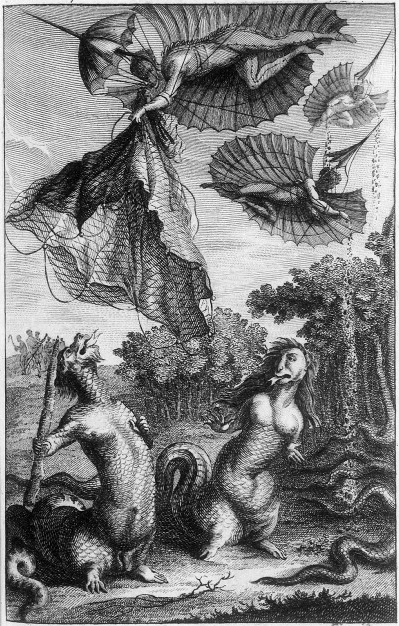
Nicolas-Edmé Restif de la Bretonne, ‘The Serpent-People’ from ‘Découverte Australe par un Homme Volant, ou Le Dédale Français’ (1781)

PARENTS AND OUR MYRIAD FAILURES

Krystelle Bamford, Idle Grounds: Astonishingly good debut in the collective first person, told by a group of unmonitored children at a family party as they get bored, muck around, encounter something wrong in the garden, and go searching for one of their number who vanishes. Spooky, funny, original stuff. I couldn’t recommend this book more highly, to be honest.

Why: The cover of the UK edition, with a picture of roped-together monochrome children lost in a field of fluorescent green, was enough to convince me. [Ed. – I wish more people talked about how book covers influence their buying.]

Violette Leduc, Asphyxia (translated by Derek Coltman): A well-named book if ever there was one, this dense little novella details the suffocated life of a young girl with an unloving mother in rural pre-War France. But, flinty matriarchs aside, it’s also a richly drawn world of natural wonders and discoveries.

Why: I only discovered Leduc in the last few years, and she was such an extraordinary writer. This was published as part of a very small collection of French classics by female writers by Gallic Books.

Adrian Nathan West, My Father’s Diet:  A wonderful book that takes some well-known signifiers of modern American fiction (hollowed-out suburbs, emptying malls, masculinity in crisis, etc etc) and does new and strange things with them. A depressed son learns his father has, out of nowhere, become an obsessive bodybuilder, determined to win the Body You Choose competition. The characters are never caricatures, and it’s extremely funny despite the quiet desperation of it all.

Why: One of the many excellent books put out by And Other Stories, and this is from before they went for their current ugly typographic covers. [Ed. – James! I love those covers!]

GRAPHIC NOVELS

Lee Lai, Stone Fruit and Cannon: Australian (but now based in Canada) artist Lai’s two graphic novels are both minor masterpieces, and genuinely full novels in complexity and subtlety. Sad and perceptive dissections of failing relationships, parenthood, faltering elders, exploitative friendship, and being part of the Chinese diaspora.

Why: This review in Meanjin, an 85-year-old Australian literary magazine currently being put to death by the witless timid bureaucrats who cower in terror of angry letters from the Zionist lobby and who are ruining pretty much all the arts in Australia at the moment.

Emily Carroll, A Guest in the House: A seriously Gothic tale of madness, downtrodden femininity and hapless stepmotherhood, drawn with Carroll’s usual visual flair and attention to detail.

Why: I’ve raved about Carroll before, and love all her work. Somehow, to my annoyance, I didn’t even know this book, published in 2023, existed until I saw a copy a couple of months ago. My spies failed me. [Ed. – Maybe they were busy failing to assassinate US Presidents.]
VOYAGER 2 – Europa (1979)

UNCATEGORIS[ED/ABLE]

Mariette Navarro, Ultramarine (translated by Eve Hill-Agnus): Wonderfully unsettling novel about a woman captaining a cargo ship with a male crew. In the middle of the Atlantic they stop for everyone to have an illicit swim—and when everyone climbs back on board there’s one extra person.

Why: The Deep Vellum edition (already a recommendation) has a great cover with a vast cube of ocean on it, and I am only weak flesh.

Li Qingzhao, The Magpie at Night (translated by Wendy Chen): A beautiful collection of the complete surviving poetry by one of China’s greats, from the Twelfth Century. I mean, get a load of her perfect description of a lazy, drunken evening, from ‘As in a Dream’:

Remember that day

spent on the stream,

watching the sunset glaze

the pavilion.

So drunk, we could not find

our way back.

It was late when we had enough.

We turned the boat around

and were caught, accidentally, in the deep

tangle of lotus roots.

Rowing through, rowing through –

startling, from the banks,

herons.

Why: Having only read a couple of her poems in anthologies, it was a pleasure to find her complete works available in English.

J.M. Coetzee & Mariana Dimópulos, Speaking in Tongues: If you’re at all interested in translated literature, and in the process of translation itself, this is a very rewarding book. Two novelists and literary translators discuss what translation is, what it does, how it works, and a peculiar but intriguing project they undertook (and which was foiled by commercially minded publishers) to make the translated Spanish text of one of Coetzee’s novellas the “original” version of the book.

Why: If the topic is this interesting and the two writers involved this good, what sort of a fool would I be to not read it, I ask you?

[Ed. — A fool indeed. As is anyone who reads this and doesn’t head to their local bookstore or library ASAP on the hunt for some of these recs. Thanks, James!]

Melanie Nicholls’s Year in Readng, 2022

Today’s reflection on a year in reading is by Melanie (Mel) Nicholls. Mel is a bookseller at Barnes and Noble from Georgia. You can follow her on Twitter @nichollsm86 where she often tweets about…books!

Rineke Dijkstra, Self portrait, Marnixbad, Amsterdam, 1991

I was pleased when Dorian asked to do a write up of my 2022 reading, as I enjoyed reading the entries from last year. My reading in 2022 was mainly fiction in translation and short stories. When choosing what to read I mostly pick up books I think I’ll enjoy. And this past year I definitely succeeded! Here are some of the standouts.

January started strong with two books that are new favorites. The haunting Ganbare! Workshops on Dying is by Katarzyna Boni (tr. Mark Ordon). Boni reports on the March 11, 2011 earthquake and tsunami in the Tōhoku region of Japan and its aftermath. She offers accounts of the effects on survivors such as learning to scuba dive to help find bodies, a gripping account of the Fukushima nuclear disaster, and stories of other devastating earthquakes in Japan’s history. A heartbreaking and timely work. I followed this with the NYRB Classics edition of Edith Wharton’s ghost stories, unsettling and eerily quiet hauntings. A book I could read every year. The novel Written on the Body by Jeanette Winterson and the stories in Cars on Fire by Mónica Ramón Ríos (tr. Robin Myers), continued my excellent streak of reading for the first month of the year. 

In February I began the readalong of Dorothy Richardson’s thirteen book sequence Pilgrimage. I really started to click with Miriam’s journey with book three and my top reading goal in 2023 is to finish the sequence. Other highlights include the classic Passing by Nella Larsen [Ed. – GOAT!] and the absolute gem Byobu by Ida Vitale (tr. Sean Manning), two books I’m sure I’ll find new meaning in each time I read them. 

In March I read another top book of 2022, Blood Feast: The Complete Short Stories of Malika Moustadraf. These stories about gender and class in society are expertly translated by Alice Guthrie. The outstanding translator’s notes make this a book I hope to study more and highly recommend. April was another strong month with the beautiful novel When I Sing, Mountains Dance by Irene Solà (tr. Mara Faye Lethem) and the terrific History of a Disappearance: The Forgotten Story of a Polish Town by Filip Springer (tr. Sean Gasper Bye). I ended this month with the masterpiece Woman Running in the Mountains by Yūko Tsushima (tr. Geraldine Harcourt) which I often think of with Lolly Willowes by Sylvia Townsend Warner. Both novels portray a woman’s yearning for freedom and Dorian’s podcast One Bright Pod has superb episodes for both books. [Ed. – Thank you! Of course, Frances and Rebecca are the really important members of the team.]

May and June were the months of absolute banger short books: 

Yesterday by Juan Emar (tr. Megan McDowell)

They by Kay Dick

Cold Enough for Snow by Jessica Au

Spear by Nicola Griffith [Ed. – Curious to check this one out.]

An Ideal Presence by Eduardo Berti (tr. Daniel Levin Becker)

Permafrost by Eva Baltasar (tr. Julia Sanches)

Violets by Kyung-Sook Shin (tr. Anton Hur)

Pollak’s Arm by Hans von Trotha (tr. Elisabeth Lauffer)

The Employees: A Workplace Novel of the 22nd Century by Olga Ravn. (tr. Martin Aitken)

July’s standout is A Month in the Country by J.L. Carr, a perfect novel. [Ed. – Absolutely agree.] August is one I look forward to every year because it is Women in Translation month. I continued this year with four writers whose translated work I am slowly making my way through: Annie Ernaux, Yoko Tawada, Natalia Ginzburg, and Banana Yoshimoto. Another highlight was the collection Panics by Barbara Molinard (tr. Emma Ramada). Molinard was a close friend of Marguerite Duras and would destroy most of her writing. [Ed. – Thanks, uh, “friend”…] These bizarre and grotesque stories are a must read. Two books translated from Croatian, Call Me Esteban by Lejla Kalamujic (tr. Jennifer Zoble) and Divine Child by Tatjana Gromača (tr. Will Firth) from the new small press of translated fiction Sandorf Passage, were also excellent. 

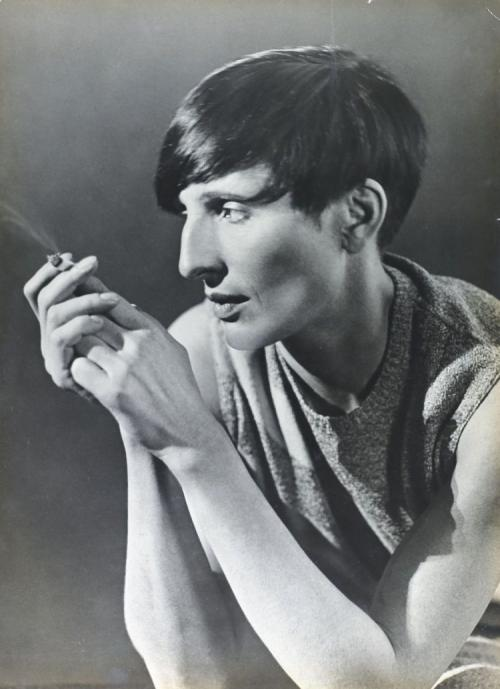
Gerty Simon, Renée Sintenis ca. 1929 – 32

The last few months of the year offered standouts in nonfiction. I love Elaine Castillo’s debut novel America is Not the Heart and she delivers again with the essays in How to Read Now. This book, along with A Ghost in the Throat by Doireann Ní Ghríofa, This Little Art by Kate Briggs, The Missing Pieces by Henri Lefebvre (tr. David L. Sweet), and Voice of the Fish by Lars Horn, left me with a new appreciation for reading, translation, writing, and art. All are books I will come back to often. Other wonders at the end of the year include some short-but-mighty translated novellas: Space Invaders by Nona Fernández (tr. Natasha Wilmer), Baron Bagge by Alexander Lernet-Holenia (trs. Richard and Clara Winston), A Woman’s Battles and Transformation by Édouard Louis (trs. Tash Aw) and Rogomelec by Leonor Fini (trs. William Kulik and Serena Shanken Skwersky). I’ll close with Nettleblack by Nat Reeves, a playful novel of queer awakening among strange crimes in a Victorian rural town.The most fun I had reading in a while, just a joy to read. [Ed. – Sounds great!] My reading has changed over the last couple of years as I have discovered more translated fiction, small press, and Book Twitter. I am excited to see where my 2023 reading will take me and to share the wonders. [Ed. – You’re welcome back next year, Mel!]

Brad Bigelow’s Year in Reading, 2022

Today’s reflection on a year in reading is by Brad Bigelow. Brad writes http://NeglectedBooks.com and edits the Recovered Books series for Boiler House Press.

Charlotte Salomon, No. 134 from Life? Or Theater? (1941 – 42)

When I finished college forty-some years ago, I started writing down every book I read in a little spiral notebook. I kept up this habit for over twenty years and then stopped for some forgotten reason. Since starting The Neglected Books Page, most of my reading has been of long-forgotten books and most of these I’ve recorded by writing about them on the site. But as time goes on, I’m falling ever further behind in this writing. And to make matters worse for the purposes of this piece, I keep no record of my non-neglected reading. So, this is a fairly unreliable review of my reading in 2022, but I hope it’s worth your time nonetheless.

(It’s a good thing I never went into marketing.) [Ed. – No kidding!]

Among my neglected reads, easily the most memorable was Charlotte Salomon’s Life or Theater? Although Salomon told her life through paintings, it operates at an unforgettable level of intensity. There are at least three narratives winding through the hundreds of paintings in this book: the psychological breakdown of her family; her own troubled emotional development; and the trauma of Germany, and of German Jews in particular, with the rise of Nazism and Hitler. As I wrote back in April, “the book is presented as an art book – large and very heavy with its hundreds of pages of full-color images. But I think this does the book as a book some disservice. For it can also be seen as a graphic novel.” And I think it would benefit from being repackaged as a graphic novel, since today’s readers are now so accustomed not just to the language of graphic novels but to the very idea of considering them as literature. [Ed. – Absolutely. Her drawings look like they come from a graphic novel, too, as your post with its generous illustrations suggests.]

Easily the most enjoyable was Madeleine Masson’s memoir, I Never Kissed Paris Goodbye.Though we know from its opening line—“It was a beautiful day in June 1940”—that this story will have a sad ending, most of Masson’s account of Paris in the 1930s is as frothy and delightful as a glass of champagne. It’s full of the infidelity, excess, and manic energy of Jean Renoir’s classic film The Rules of the Game, and highly recommended to anyone who loves that film. [Ed. – You’re trying to tell me there are people who don’t love that film? Nonsense! This book sounds excellent, BTW.]

My deepest archaeological dig of the year was locating a copy of Carola Ernst’s Silhouettes crèpusclaires, and then dusting off my French to read it, based on nothing more than a brief reference in a magazine from 1921. This modest account of the journey Ernst took in the Fall of 1914 to return a French officer blinded in an early battle of the First World War to his family is a touching portrait of a world in the midst of a radical transformation. The pair are able to travel via Belgium, Germany, Switzerland, and France thanks more than anything to a spirit of chivalry that had not yet been destroyed in the industrial machinery of the war.

Another highlight was the chance to spend several weeks with some of the many volumes of poetry penned by Raymond Souster, the bard of Toronto. Souster’s longevity and disciplined dedication to his art enabled him to amass an account of one city’s life that may be unparalleled in the 20th century. Souster lived and wrote to the age of 91, worked in the same bank for over 40 years, was married to the same woman for over 60 years, and, as their only child, cared for his parents until they died in their late nineties. Though Souster claims he never wrote any great work (“I’m not sure I’m ready for epics/there are far too many little songs/the rest have left unsung”), the body of his work is sort of an epic in itself. [Ed. – Fascinating! I’ve even lived in Toronto and have never heard of Souster.] Someone needs to go through the thousands of pages of Souster’s poetry and distill it into an autobiography along the lines of what Ruth Limmer did with Louise Bogan’s work in Journey Around My Room.  

Finally, I must mention Nina Warner Hooke’s Biff and Netta trilogy: Striplings (1934); Close of Play (1936); and Own Wilderness (1938). These novels follow a half-brother and sister, Biff and Netta, from their early to mid-teens, as their already unconventional and decaying family collapses completely. The first volume received tremendous critical praise and was most commonly compared to the work of P. G. Wodehouse. Warner Hooke said she had no plans for further books at first, but when you finish the trilogy, its narrative arc seems almost predestined. She could no more leave off her story than you could get off a rollercoaster after the first drop. It is deeply strange, not solely because of its theme of incest, and deserves much closer examination than I was able to give it in my post. At 900-some pages, it’s far too long to expect anyone to ever reissue it unless some editor finds the courage to do some substantial posthumous abridgement, but it’s a work that I continue to process months after finishing it.

I tend to rely on audiobooks for my non-neglected reading. For years, I had a daily commute of over an hour each way and I racked up thousands of hours of listening, which enabled me to catch up on many classics I’d skipped. Now, my commute is just a staircase [Ed. – Bliss!], but I still get in an hour or so of listening each day. One of my projects was to go back through the works of Thornton Wilder, who is arguably both recognized and neglected. Aside from “Our Town”, most folks have only a vague notion of what he did, and even the once-ubiquitous The Bridge of San Luis Rey is not a familiar title. Wilder is the only writer to have received a Pulitzer in two genres, fiction and drama, has several volumes in the Library of America, and most of his work never falls out of print for long. I wrote about The Eighth Day, his most ambitious—and, to be honest, most flawed—novel years ago, and loved Heaven’s My Destination and Theophilus North when I first read them. This year, I went back and listened to all his novels in chronological order (an exercise I highly recommend for novelists who particularly interest you), starting with The Cabala.

The experience was both a revelation and a disappointment. I found several of the books suffered from an earnestness that became particularly apparent when considered back-to-back. On the other hand, I was astonished at the innovation of The Ides of March, his novel of Caesar’s last months. It’s a collage of fictional letters, excerpts from actual Latin texts, and even graffiti from the streets of Rome in the first century BC. Why is this book not acclaimed as a milestone in the fictional form? [Ed. – Sounds like time for a reissue?]

Aside from Wilder, most of my listening has been focused on Russian history and literature. I’ve long been fascinated by Russia, even though I’ve deliberately avoided my few opportunities to visit there. There’s something about the darkness of so much of the Russian experience that seems to reassure me that my own life really isn’t all that bad. This might be one of the reasons that I read so many books about Stalin when I was working for the two worst bosses I’ve had to suffer. I listened to two historical surveys by Orlando Figes: A People’s Tragedy, about the Russian Revolution, which occasionally bogged down in the minutiae of political infighting, and Natasha’s Dance, which I would recommend to anyone looking for a historical context to much of the Russian art, literature, and music of the last 200+ years. There were also several biographies—Alex Christofi’s Dostoevsky in Love, Alexandra Popoff’s book on Vasily Grossman, Donald Rayfield’s Chekhov—all richly illuminating. But by far the most enjoyable and impressive listen was Nabokov’s The Gift, which managed to weave so many of the threads from these other books together and remind me yet again of the fact that Nabokov worked at a level miles above so many of the 20th century’s greats.

Of the more recently-published books I’ve read, few really stand out. I found a number of the more acclaimed ones forgettable and will skip over them. Although I’ve read that it’s not the place to start, I loved Annie Ernaux’s The Years, in part because it described a world very familiar to me after 18 years of living in Belgium and working closely with many French men and women. And Gwendolyn Riley’s My Phantoms could have described some of our neighbors on the little street in Norwich where my wife and I lived for two years. [Ed. – Yikes!] I wish I could say that the books I’ve read by American writers were half as evocative, but I guess I’m still getting used to a country that’s so different from the one we left just before 9-11.

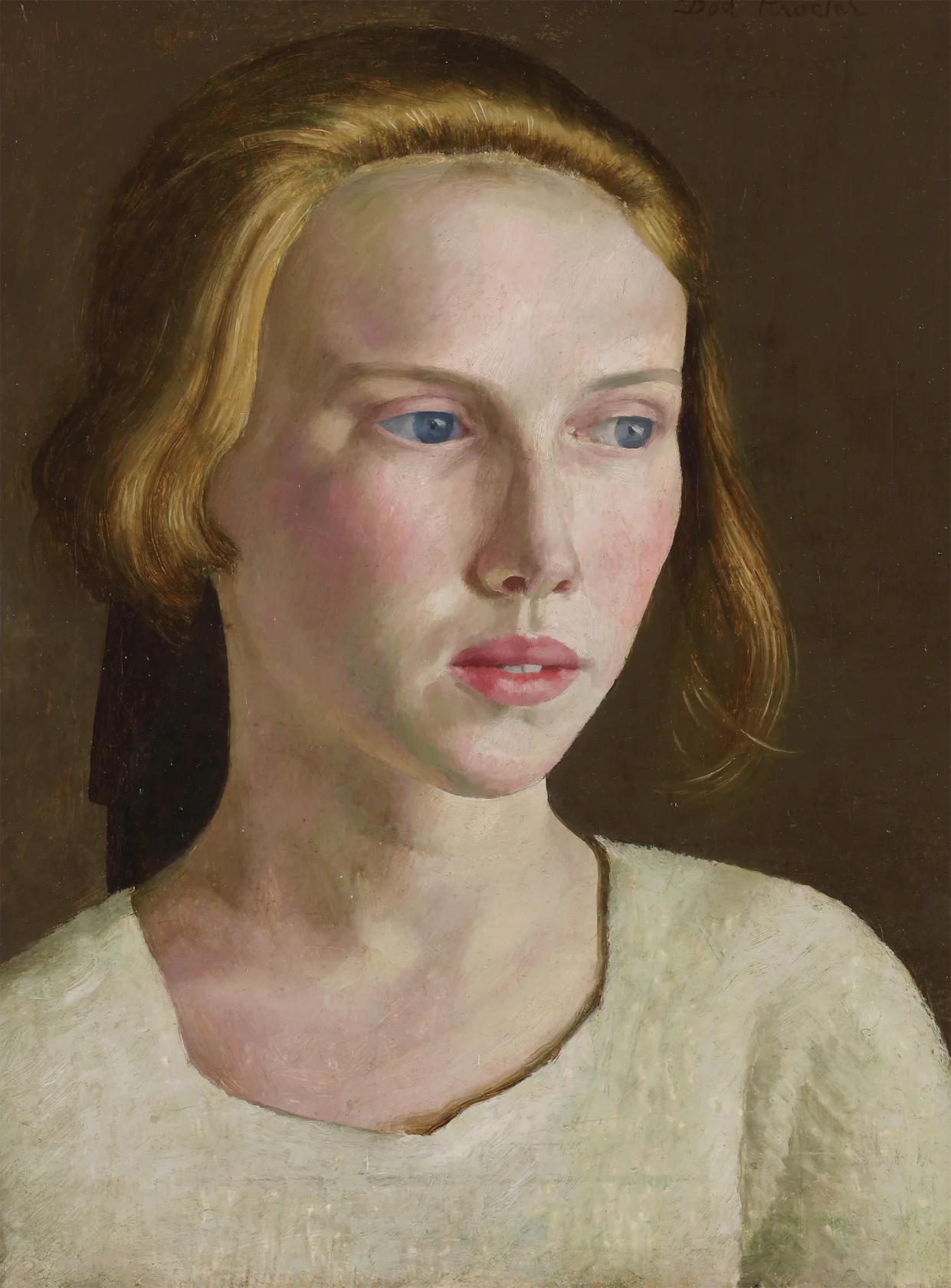
Dod Procter, Lydia, ca. 1926

And it would be remiss of me not to mention the brightest highlight of 2022, which was the #PilgrimageTogether reading group. Starting in January, a group of us worked our way through the thirteen “chapter-volumes” of Dorothy Richardson’s masterpiece, Pilgrimage, aided by a wonderful cast of Richardson scholars who agreed to take part in our monthly discussions. I first read Pilgrimage in 2016 as part of a two-year project of reading only the work of neglected women writers (complemented by two years of only listening to audiobooks by women) and ever since have been an evangelist on its behalf. Not to denigrate Proust, but I find it astonishing that thousands of people read Remembrance of Things Past each year while Pilgrimage, which speaks directly to so many aspects of life that are still part of our everyday world today, is barely known and even less read. Like others in the group, I found Pilgrimage both so challenging and so rewarding that other books seem somehow diminished in comparison. It’s a novel I know I’ll be returning to again — and, I hope, with another group of readers. [Ed. – This is good to hear, since I regret not joining in. It would be great if you could time it with my next sabbatical, thanks.] Until then, I encourage folks to take up Pilgrimage and spend some months with Dorothy Richardson’s insistently individualistic Miriam Henderson, aided by the Reading Pilgrimage website. [Ed. – Thanks for the post, Brad, and congratulations on that site. What a resource!]

Nicie Panetta’s Year in Reading, 2021

Today‘s reflection on a year in reading is by Nicie Panetta (@nicie_panetta). Nicie lives north of Boston with her husband, their frisky orange cat, and her lazy but lovable paint pony. She used to have some empty space on her bookshelves. That is no longer the case.

Look for more reflections from a wonderful assortment of readers every day this week. Remember, you can always add your thoughts to the mix. Just let me know, either in the comments or on Twitter (@ds228).

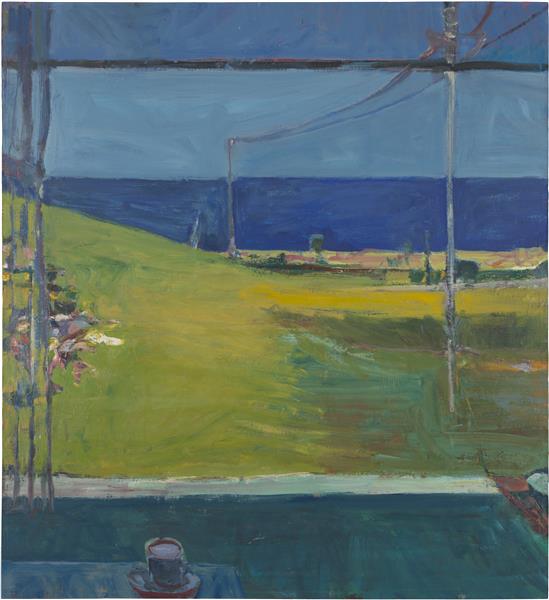
Richard Diebenkorn, Ocean from a Window, 1959

The Anthropocene

Almost a year ago, I started a weekly newsletter called Frugal Chariot. I write about books that I believe have something special to say about the troubled role of humans in the non-human world. I guess you could say that the fate of the earth and all that dwell within its embrace is my subject, but that books written by humans are my vehicle. “How frugal is the Chariot/ that bears a Human soul.” Thank you, Dorian for a chance to reflect here on my reading as a whole in 2021. [Ed – The pleasure is all mine!]

From the standpoint of literary merit and depth of meaning, my favorite book on the Anthropocene, which I haven’t yet written about for the newsletter, is Arctic Dreams by Barry Lopez. I ardently recommend it for the magisterial precision of his writing, for the prophetic nature of his insights, and for the great fighting heart that you can feel beating within the rather strict container of his style and tone. I did write about Lopez’s Horizon here.

From the standpoint of environmental news you can use, I would press into your hands Silent Earth: Averting the Insect Apocalypse by Dave Goulson. The author, a leading entomologist, explains carefully and without histrionics why bugs are vitally important to all life on earth, and what we do know and don’t yet know about the extent and causes of insect population declines. He also has practical suggestions for individuals and for industry and government. This is an indispensable guide for the general reader to the way that the climate and biodiversity interrelate, and it’s also full of delight and discovery.

A quick request, if I may. I would be very grateful for any suggestions that EMJ readers might have for nature, place, and climate writing (does not have to be in book form) from underrepresented geographies, marginalized communities, and Indigenous writers. [Ed. – Cherie Dimaline, The Marrow Thieves and Waubgeshig’s Moon of Crusted Snow: two novels by Indigenous Canadians, dystopian clifi that foreground indigenous ways of knowing.] I am concerned that there are not enough voices from outside the Anglosphere and outside the OECD countries getting heard. My DMs are open and my email is nicie.panetta@gmail.com. Thanks in advance.

The Thing Is . . .

Because I am starting work on a climate-related place writing project [Ed. – Ooh, tease!], I have devoted much attention over the past year to treatments of the non-human, across my reading. The books that resonated most deeply for me often had a commitment to the thing-ness of things, to quiddity, to description. What follows are just a few examples of writings that I felt were exceptional on this score. Many if not most of these books came from recommendations provided by Learned Book Folks (LBFs) on Twitter, and I am so grateful. 

Two Writers’ Memoirs

Last year I read nearly forty memoirs. [Ed. — !] Deborah Levy’s Autobiographical Trilogy truly knocked my socks off. How could I never have heard of this writer! Thank you to Rebecca Hussey, for sending her my way. In the first volume, Levy makes highly effective use of narrative shear: a simple question from a stranger causes the floor of the present to buckle and give way to the past. In the two subsequent volumes, she uses totems of the everyday to represent the new phase of her life that begins after the end of her long marriage: a shed for writing, a heater for the shed, an electric bike to get around, a green pair of shoes for walking in Paris. 

It’s the basics: food, shelter, clothing, transportation. These objects, as they appear and reappear, create a syncopated rhythm that feels so true to the way we pass through time. Levy writes well about many things, including the closeness and strangeness of friendship, the commitments of motherhood (including the commitment to let go), the practicalities of being a writer, and most of all, what it is to be awake to life. Utterly captivating is this voyage on the inland sea of her mind: 

To walk towards danger, to strike on something that might just open its mouth and roar and tip the writer over the edge was part of the adventure of language.

Another writer’s memoir that is much less well known is Blue Remembered Hills by Rosemary Sutcliff, the author of classics of historical fiction for children (including The Eagle of the Ninth). [Ed. – Just taking a moment here to remember how much that book meant to me.] Her account of growing up as an only child with chronic illness and disability is both sharp and glowing. Sutcliff’s portrait of her intense relationship with her mother is one of the best I’ve read, and the village communities of her childhood are brilliantly evoked. Heartbreak finds her, and she finds her way to a writing life. Aces. [Ed. – Sold to the man with too many books already!]

A Poet’s Playlist

Reading poetry has been a central preoccupation of my adult life. Because of my current interests and commitments, I am actually reading less poetry than I have in the past. But I did just finish Rita Dove’s Playlist for the Apocalypse, her first collection in over a decade. The book is made up of distinct groupings of poems, including an ars poetica with the poet as spring cricket, a group about American history that serves as the text for a new song cycle, A Standing Witness, and eight very flashy “angry odes.” Here’s a poem from the final, quietly personal section, Dove’s translation of perhaps the most famous German poem:

Wayfarer’s Night Song

Above the mountaintops

all is still.

Among the treetops

you can feel

barely a breath—

birds in the forest, stripped of song.

Just wait: before long

you, too, shall rest.

Johann Wolfgang von Goethe, 1776

The World Wars

A surprise. After toting things up, literature in translation accounted for nearly 40% of the books I read in 2021. I think this was due to a combustion reaction between my obsession with the period that encompasses the two world wars and the constant stream of relevant book ideas from the LBFs. [Ed. – Vowing to make this acronym take off.] Those years set the courses of my parents’ lives. My parents were born in the 1920s and died when I was young. Reading about this era keeps me in touch with them. Each of these books changed me in some small or larger way.

In poetry, I read a lot of Rilke thanks to an epistolary seminar offered by Mark Wunderlich (look for his forthcoming book on Rilke). I keep returning to Rilke’s work, in which the non-human vibrates without cease, and the moment of the poem zaps into the eternal. Prosodic whiz Don Paterson dresses the Orpheus sonnets in a new formal fabric in Orpheus: A Version of Rilke.

Enthroned one: in the ancient understanding,

You were no more than a cup with a plain rim.

But for us you are the full-blown, infinite bloom,

The wholly indefatigable thing

From “Rose” 

My parents loved the word “indefatigable.” They were activists, and it was a mark of highest esteem if they used it to characterize someone. It’s a good word to keep in your pocket. See also, “staunch.”

In fiction, Visitation by Jenny Erpenbeck (translated by Susan Bernofsky) tells the story of the strange life and dumpster-filling death of a German lake house near Berlin, across the entire twentieth century. Erpenbeck is very good with lists of ordinary stuff (building materials, bath towels, regulations), inventories that are transformed into incantantions of frightening power. As we grapple with our direction as a species, stories with non-human protagonists and with plots that extend beyond the human lifespan have much to offer. Visitation is a notable example. There is also a brilliant novel about a medieval convent in East Anglia, but I read that in 2020. [Ed. – The editor cannot help but feel attacked by this reference to That Book He is Unable to Finish. YMMV.]

Natalia Ginzburg’s essays about her family’s tragic experiences in Fascist and postwar Italy, The Little Virtues (translated by Dick Davis) was also a revelation of style for me. Her tonal restraint and the apparent simplicity of her sentences make the heavy chords truly plangent when she strikes them. “And perhaps even for learning to walk in worn-out shoes, it is as well to have dry, warm feet when we are children.” 

Salt Water by Josep Pla (translated by Peter Bush) is a travelogue of his adventures on the Spanish and French coasts in the early 20th century. This book features shipwrights, bandits, taverns, sardines, and bracing quaffs that mingle caffeine with alcohol. The book, written under house arrest and a censorship regime, might be an instruction manual for those writing in a time of rising authoritarianism. There is something to be said for going rogue, or at least knowing a few rogues. Pla says it.

Most of all, the discovery of Joseph Roth thanks to the crew at the Backlisted podcast truly made my reading year. Many EMJ readers (and certainly the editor) know his work far better than I do. [Ed. – The editor is overestimated.] But What I Saw (translated by Michael Hofman), The Hotel Years (ditto), and On the End of the World (translated by Will Stone) have set a high-water mark for me as to what is possible from a journalist writing in a short form to deadline. Roth was a Galician Jew who made it to Vienna for university, served in the Austrian army in WWI, and then moved to Berlin to write for newspapers. He also wrote fiction, including Job and The Radetsky March.

What I Saw, which collects his feuilletons about Weimar Berlin, is a book not so much of vignettes, but of micro-sagas. He makes fun of skyscrapers (“We will make ourselves comfortable among the clouds . . . They will hear the clatter of typewriters and the ringing of telephones”), visits Berlin’s refugees (“Their garments were a weird and wonderful hodgepodge of uniforms. In their eyes I saw millennial sorrow”), makes regular forays to the demimonde (“Albert’s Cellar has regulars of such fixed habits that they even have their mail sent there”), and charts the collapse of the Republic with rising alarm and grief (“It is not true that a murder is just a murder”). His farewell column of 1933, written fresh from his flight into exile in Paris, is almost unbearable reading. So many observers were blind to what Roth saw, or failed to report what they saw. All the books I have mentioned here make the case for the necessity of style, and how style gives writing access to power. Roth’s work is exemplary in this regard. I read in awe, and salute his legacy:

Month on month, week on week, day by day, hour by hour, it becomes ever more impossible to give expression to the inexpressible nature of this world. The circle of lies that the miscreants draw around their crimes paralyses the word and the writers who employ it. Yet a common obligation makes you persist to the last moment: that is to say to the last drop of ink . . .

Earbuds 

I’m gradually working my way through Juliet Stevenson’s catalog (N.B. she reads the Levy trilogy brilliantly), and she never fails to bring clarity and spirit to a text. Other major delights have been Thandiwe Newton reading Jane Eyre (I’m excited for her War and Peace), Doc Brown reading Zadie Smith’s Grand Union (underrated, I aver), Chiwetel Ljiofor’s performance of Piranesi, and Prunella Scales’ reading of The Railway Children by E. Nesbit.

Campus Duds

I read two campus novels that were cruel about women. Lucky Jim (despite one of the great hangover scenes in 20th-century literature) was chalk on a blackboard with its hatchet job on Monica Jones. Pictures of an Institution is also extravagantly mean about Mary McCarthy, who, to be fair, probably gave as good as she got. But who needs it? I’m with Pnin all day long. [Ed. – Amen!] Haven’t read Stoner yet. [Ed. – Don’t do it.]

Unclassifiable Wisdom

Alice Oswald’s Oxford Poetry Lectures on YouTube have been landmark events for me. Water, a pebble, Ainu epics: whatever the topic, she is riveting, incisively lyrical, somehow in touch with worlds beyond our ken. 

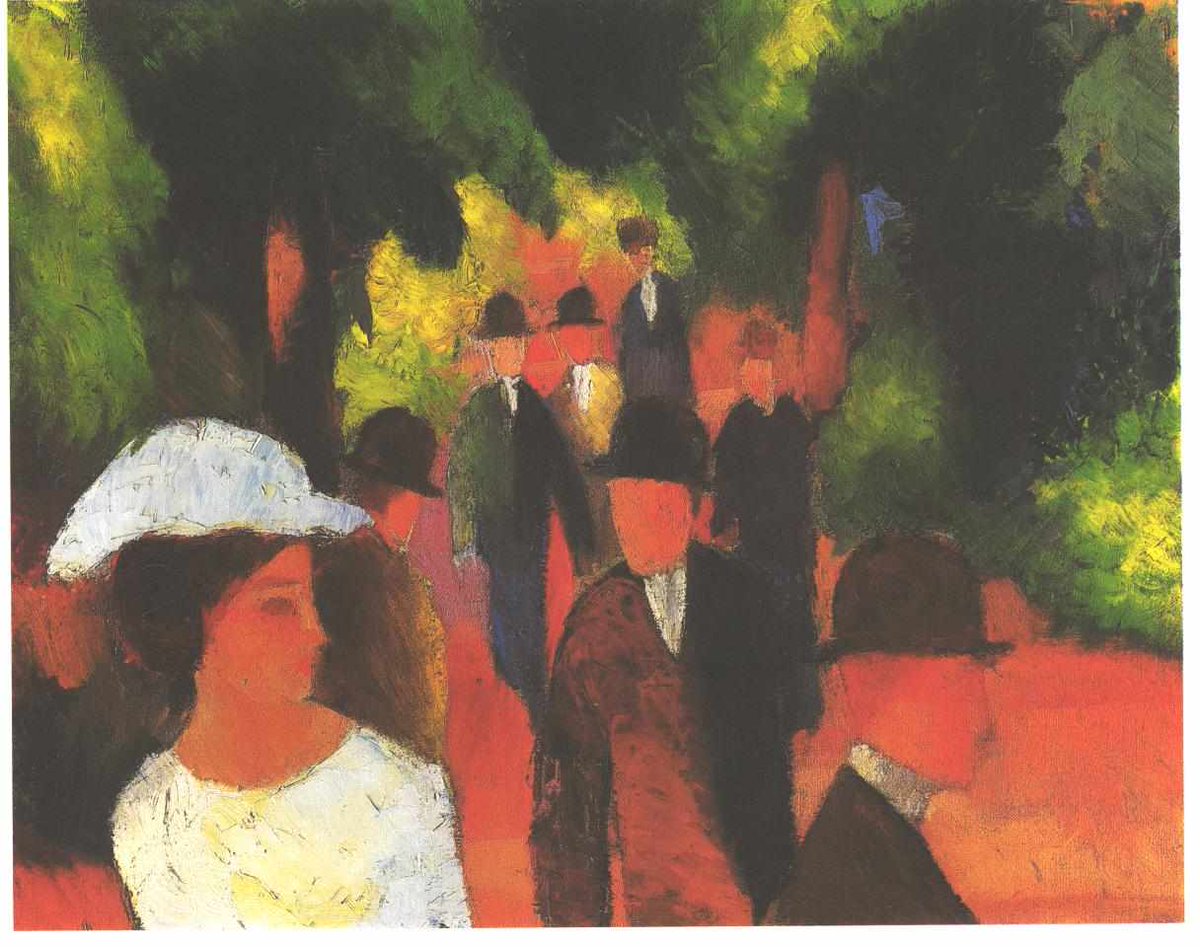
August Macke, Promenade II, 1913

2022

This year I will be paying special attention to structure, so if you have books that you think are brilliantly structured, please do be in touch.

In addition to reading for Frugal Chariot, and I have the following projects on deck:

  • Re-reads of The Iliad, The Odyssey and a few other classical texts
  • Fiction of Joseph Roth and the forthcoming biography by Keiron Pim [Ed. — Can’t wait for that one.]
  • Dorothy Richardson’s Pilgrimage (I have to admit that I’m not wowed by Pointed Roofs so far, but I am giving it a fair hearing)
  • The Love Songs of W. E. B. Du Bois
  • Lonesome Dove (you rave, I read!) [Ed. – Thumbs up emoji]
  • Moby Dick with #APSTogether
  • Louise Erdrich
  • Teju Cole
  • More poetry! 

I wish you all wonderful years of reading in 2022, and look forward to ongoing fellowship. May we be wholly indefatigable!