Nat Leach’s Year in Reading, 2025

Regular readers will know that for the last several years I’ve solicited Year in Reading reflections from friends and trusted readers. As we’re well into February, I’ve scaled the project back considerably this time, but I’ve got some good stuff coming your way over the next few days. Today’s installment, his seventh, is by my longtime friend Nat Leach. Nat is a nineteenth-century scholar turned college administrator who has spent the last 8 years reading the books on his shelves in alphabetical order. He lives in Ontario.
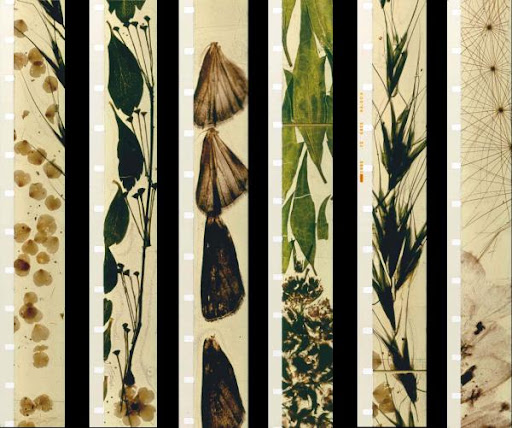
Stills from “Mothlight” (Dir, Stan Brakhage, 1963)

Looking back on my “year in review” posts, it occurs to me that I seem to have reached a reading plateau over the past few years: I’m reading more than I was able to some years ago, but still less than I wish I could. [Ed. – But don’t we always read less than we wish we could???] In the end, though, looking at the list below, I am grateful for what I have been able to read, and for this opportunity to write about my rather eclectic reading program.

In total, I read 35 books last year, though as always, this includes some works of philosophy, theory and criticism that I have been working on gradually for some time. In fact, I read only 10 novels, including finishing two that I already wrote about last year, although I did read more short stories and plays than in recent years.

As for my alphabetical reading project (last year was Year 8 if anyone is still counting), I spent pretty much the whole year working on “M” and didn’t quite get through it. But since “M” is a pretty massive literary letter, I am fairly satisfied with that progress, which means that, alphabetically at least, I am just about at the halfway mark of my project. [Ed. – Amazing!]

I notice that many of the reflections below contain memories and associations with my student days; this is perhaps natural, given that the intent of my project is to clear my TBR shelves of the books that have been there for a long time. I am in many cases finally reading those books I wanted to read during the first half of my life, and hopefully in that way achieving some kind of closure on that chapter before moving ahead to the next project (which, not coincidentally, I have already started to plan). [Ed. – Teaser!]

But before I get ahead of myself, here is what I read in 2025:

Marias, Javier – “Bad Nature” (1996) Trans. Esther Allen

I had never read Marias before, but stumbled across this story in an old edition of Granta that I was reading. It is a somewhat bizarre counter-factual narrative about a translator who worked for Elvis while he was shooting a movie in Mexico. [Ed. — !] I read it as a fable about translation itself; the translator strives very hard to render Elvis’s words accurately, but, in a dangerous context, finds himself facing the consequences of those words because the listeners hear only him saying them, and thus, they become his utterances, and no longer Elvis’s. This seems an apt emblem of the plight of translators in general, foregrounding the impossibility of complete transparency in rendering one language through another. Appropriate, of course, that I read it in translation.

Marlowe, Christopher – The Jew of Malta (1589)

It was perhaps a strange choice to read this terribly antisemitic Elizabethan play, but, as it was the only Marlowe play I hadn’t read, the completist in me felt the need to read it. It’s interesting mostly in contrast with Shakespeare’s The Merchant of Venice; while Shakespeare cultivates at least some level of sympathy for Shylock, Marlowe’s Barabas is a combination of an antisemitic stereotype and a Machiavellian schemer-villain common to Elizabethan revenge tragedy. Despite this, Marlowe interestingly makes clear that Barabas’s villainy is largely triggered by egregious injustices done to him by the Governor of Malta. Short on cash for the required tribute to pay off the Turkish empire not to invade the island, the Governor requires all Jews to pay half their wealth in tax. Those who refuse will have all their property confiscated. In fact, there is really nobody in the play who comes off particularly well (for example, there is a great deal of satire involving Catholic priests), but Barabas is clearly presented as the worst. [Ed. – Boo! Dislike!]

Marquez, Gabriel Garcia – One Hundred Years of Solitude (1967) Trans. Gregory Rabassa

I’m not sure whether Dorian remembers, but when we were both humble MA students, we had to sit a rather ridiculous “Graduate Record Examination” in literature as part of our applications to PhD programs. [Ed. – He sure does.] One of the few things I remember about this was that it included a section where we had to match up famous opening lines with the books from which they came. Most of the answers could be deduced from context fairly easily (the one about mines in Derbyshire was obviously Sons and Lovers, just as Colonel Aureliano Buendia remembering his father taking him to see ice had to be One Hundred Years of Solitude) but it did seem concerning to me that I hadn’t actually read any of these books, which apparently a well-read graduate student should know. [Ed. – Or know how to pretend they know.] This led me to buy all the books included in this question, although the fact that I am still working on finishing them gives the lie to the “well-read” part. [Ed. – See previous interjection.] Anyway, this is another one off that list, and is by turns great fun, horribly tragic, and totally exhausting (trying to remember all of the familial relations between the characters). And this exhaustion is, I think, part of the point of Marquez’s magic realist style, which contrasts linear history with a cyclical vision of human nature and development. The fictional setting of Macondo goes through a historical pattern that echoes that of many South and Central American countries: colonization, revolution, civil war, Imperialist/capitalist exploitation, etc. Against this backdrop, the Buendia family changes along with the country, even as it continually repeats and revises the past (a process most clearly demonstrated by the countless family members named Aureliano and Jose Arcadio throughout the many generations covered by the book). History changes and progresses, and at the same time, folds back on itself. [Ed. – I would like to read this book again. It’s been 35 years.]

Marquis, Don – archy and mehitabel (1927)

I still remember the day when my Grade 12 English class was assigned a poetry project, and our teacher pulled out a stack of photocopies of American poems (with no context) and asked us to select one. I immediately gravitated towards one called “The Lesson of the Moth.” Written in all lower-case letters with no punctuation, it describes the speaker’s encounter with a moth trying to fly into an electric light. The speaker asks why moths have this self-destructive urge and is told that it is because they crave beauty and excitement: “it is better to be happy for a moment and be burned up with beauty than to live a long time and be bored all the while.” The speaker disagrees with this view, saying that he would “rather have half the beauty and twice the longevity” but also rather ruefully concludes “i wish there was something i wanted as badly as he wanted to fry himself.” This poem resonated strongly with my teenaged self, and only later did I discover that the context is that the speaker is archy, a cockroach who types poems on Don Marquis’ typewriter after hours (hence the lack of upper-case letters or punctuation: archy can’t hold down the shift key). [Ed. — !!!] The poems typically revolve around archy’s interactions with other insects and animals, particularly mehitabel the cat, an aging feline who believes she is the reincarnation of Cleopatra. I realize now that this poem may not be quite as profound as my 17-year-old self found it, but I still love it, and I still have a soft spot for archy. I am also glad that I found a three-in-one volume that also includes archys life of mehitabel and archy does his part, so I still have more of him to look forward to. I also note that it is sad that the creation of archy would not have been possible in this computer age—unless we are to believe that a cockroach could turn on a computer and open Word. But that would be just plain silly, right?

Massinger, Philip – A New Way to Pay Old Debts (1625) and The Roman Actor (1626)

It must have been tough writing drama in the wake of some guy named Shakespeare. However well-crafted these plays may be, they invariably suffer by comparison. A New Way to Pay Old Debts is a comedy in which the avaricious Sir Giles Overreach [Ed. – Very subtle, the naming] is tricked by a would-be victim of his greed. It’s enjoyable, but a reader of Shakespeare’s plays can’t help but find the scheme by which the protagonists succeed to be quite simplistic. The Roman Actor is a tragedy of somewhat less merit, which begins with the conceit also explored in “The Mouse-Trap” scene from Hamlet, namely, that drama can be a surreptitious means to cultivate an awareness of guilt or wrongdoing in its audience. It doesn’t do a whole lot with this idea, though, and the play ends with fairly conventional devices depicting romantic jealousy and the downfall of a tyrant. And, frankly (spoiler alert!) [Ed. – No worries, Nat, you’ve read this for all of us, no one is gonna have anything spoiled], when the title character dies even before the final act, it’s hard to avoid the impression that the plot has not been fully thought through.

Maugham, Somerset – The Razor’s Edge (1944)

This book has the dubious distinction of being the book in this project that had been on my TBR pile for the longest time, having been first recommended to me by a friend in high school. [Ed. – That’s when I read it, and I think it’s the perfect time for it.] Fittingly, perhaps, it is a book that I think would land very differently for readers of different ages [Ed. – Aha!]; had I read this when I was younger, I certainly would have sympathized with Larry Darrell, a young man in search of greater meaning in his life than is being offered to him by capitalism and the American Dream. In my older age, though, I identified more with the perspective of Maugham’s narrator, a version of himself who provides a more critical view of Larry and his extended social set, including the compulsive socialite Elliot Templeman, and Larry’s erstwhile fiancée, Isabel Bradley, who has rejected him to retain her social position but still seems to harbour some regret. All in all, I enjoyed the book, although I can’t help but wonder whether the teenager who was so struck by “The Lesson of the Moth” might have found this book’s lessons much more profound than I did upon this reading.

Maupassant, Guy de – “L’Ermite” and “Mademoiselle Perle” (1886)

I have not read a whole lot of Maupassant, although back when I used to teach a course on the short story, I always included one by him. They tend to follow a similar pattern: the narrator/main character notices a seemingly mundane object or event, becomes curious about it, and upon further exploration, finds that it reveals an unexpected depth of insight into human nature, usually by way of a highly brutal or at least sorrowful experience. These stories fit that pattern very well. In “L’Ermite,” a traveller comes across an incredibly remote house on the southern coast of France, and decides to find out what could possibly possess someone to want to live there; he finds out more than he bargained for about the sordid past of the house’s owner. In “Mademoiselle Perle,” a chance incident at a celebration with family friends leads the narrator to uncover a tale of frustrated love. Both stories powerfully depict the normally hidden depths of human emotion that are caused to come to the surface as a result of these events.

Having read the novella/long short story (my bête noire is trying to tell the difference between these categories!) La Petite Roque (which is also fantastic and devastating, by the way), I am now making my way through the other stories in that volume, and am at about the halfway point in the book. [Ed. – More love for Maupassant, I say!]

Mauriac, Francois – Le Désert de l’Amour (1925)

I certainly got my French language reading in this year. This is another one that had been on my shelf for many years, having picked it up at Dorian’s recommendation when I was in grad school, and another one that probably would have landed very differently had I read it when I was younger, as the generational conflict between father and son (both suffering from feelings of unrequited love for the same woman) lies at the heart of this book. [Ed. – I did indeed read this at one point, but so long ago that I have no memory of it at all.] Mauriac reflects on questions of the continuity of the self, and on how people change – and do not change – over time. Despite being written in 1925, the book feels very cinematic, opening in a bar in present day Paris, filling in character histories through extended flashbacks, before concluding back in the present. In this way, we see the impact that the past has had on the development of Raymond Courrèges, whom we see both as a jaded thirty-five-year-old man (in the narrative present) and an irritable and awkward teenager (in the flashbacks), as we learn of the events that caused the latter to grow into the former. [Ed. – Feel like you are delicately, very Canadian-ly, saying “This book is no good.”]

McCarthy, Cormac – The Orchard Keeper (1965)

After that Grade 12 English class (in which we read exclusively American literature), I pretty much stayed away from American literature throughout the rest of my student days. Partly, this was because the only choice I had in my undergraduate program was between Canadian and American literature, and I chose Canadian every time. [Ed. – Imma tariff the fuck out of this post.] Partly, it stemmed from a perception that American literature was filled with toxic masculinity and grotesque celebrations of self-reliance (at least the texts that were being taught at that time often seemed to fit this description). As a result, I am aware that there are some significant gaps in my knowledge of American literature, and Cormac McCarthy was one of these. Although I did buy a three-novels-in-one volume of his work when I was in grad school, I still harboured a vague suspicion that he was not for me. I was surprised, then, by how quickly this book grabbed me. It has an almost dreamlike feel with its elaborate descriptive prose and with the nebulous quality created by its sparse use of proper nouns; most sections of the book are initially presented from the perspective of a “he” and readers have to figure out from the context which character is being referred to, often not getting the solid grounding of a proper noun until a few pages later. The effect of this is to blur the main characters whose lives are interwoven in this book – a bootlegger, a young boy and an old man, all living in rural Tennessee in the 1930s – and challenge the boundaries of identity that separate them. However, also like a dream, many loose ends remain, and I’m not entirely sure that it adds up to much in the end. Appreciating that this is McCarthy’s first novel, though, I look forward to exploring his later work; I still have Suttree and Blood Meridian in that three-novels-in-one volume.

Meredith, George – The Ordeal of Richard Feverel (1859)

In my final semester as an undergraduate, my friends and I, as a study break (or a study strategy, I’m not really sure), compiled a list of “Big Idiots in English Literature.” [Ed. – Strong David Lodge vibes!] At first designed for the Angel Clares and Othellos of the literary world, it soon became quite a voluminous list, as we determined that almost every character in every literary work we had studied over the course of four years had done something to merit inclusion. I mention this only to be clear that when I say that this book features some of the biggest literary idiots I have ever seen, I know whereof I speak. [Ed. – lol!] The plot in a nutshell: Sir Austin Feverel, a big idiot whose wife has run off with a poet, determines to educate his son, Richard, according to a system of his own devising in order to preserve him from the corrupting influence of women. This system of education in turn causes Richard to grow up into a big idiot who gets himself into a great deal of trouble, and runs away with practically the first girl he meets. Along the way, he is aided and abetted by a number of other big idiots, and he also ends up being a big idiot to his wife, who, despite being a version of the Victorian “angel in the house” commits some idiocies of her own.

I should be clear that this is in no way a criticism of the book; the presence of big idiots does not compromise its literary value, but man, does it make the book painful to read at times. Meredith doesn’t get talked about as much as many of his Victorian contemporaries, perhaps because of his more modern perspective, perhaps because his big idiots are not so thoroughly and cathartically tragic in the way that, say, Hardy’s are. Having said that, the painfulness level of this book is pretty close to Hardy at his best, even if it is leavened with a wry cynicism that perhaps more anticipates Oscar Wilde. In the end, it’s one of those books that I enjoyed reading, but really enjoyed finishing (just to get away from the big idiots). [Ed. – I will never read this, but if I ever did it would be because of this review.]
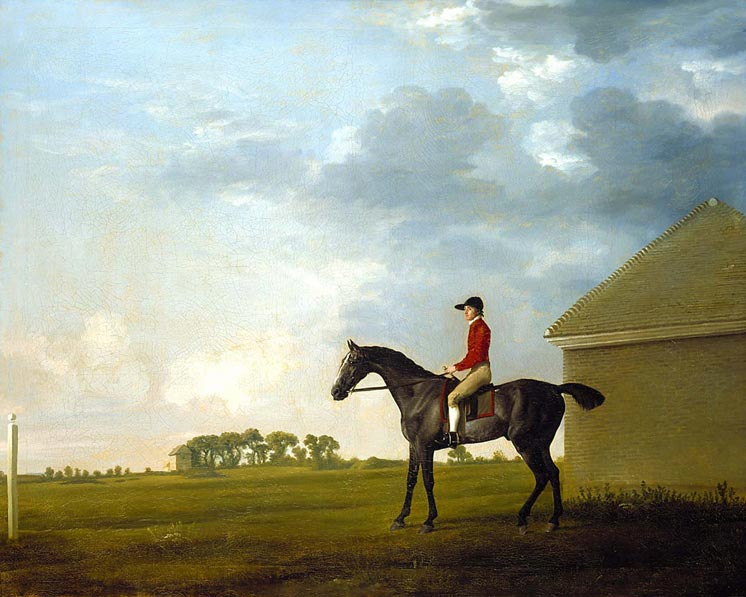
George Stubbs, Gimcrack with John Pratt up on Newmarket Heath, ca. 1765

Miller, Andrew – Now We Shall Be Entirely Free (2018)

This is the book that divided me the most this year, and raised questions about my own reading expectations. On the one hand, I always looked forward to reading the next chapter of this book, and its narrative drive – about the pursuit of an English officer accused of atrocities in the Napoleonic wars – thoroughly gripped me. One night, I binge-read the last 50 pages of the book, which is something I have not done in a long time. On the other hand, many things kept irritating me about the book’s representation of its historical period. At first, it was little things that just didn’t seem to fit the setting of the book in 1809. I began to feel the need to research some of these perceived anachronisms, even as I wondered if they were only bothering me because, as a scholar of Romantic literature, I have spent a lot of time reading about this period, and am perhaps over-sensitive to these details. For example, one of the soldiers swears a great deal – fair enough, I’m sure people swore much more in the 19th century than they do in a Jane Austen novel – but the language used is consistently modern (e.g. “wankers,” which I have now learned only took on its modern meaning in the mid-twentieth century, and “the fuck?” for “what the fuck?” which I certainly had never heard used prior to the 21st century). [Ed. – I feel sure we said “the fuck” in the 90s. Have I misremembered this???] But my most pedantic objection is the fact that the characters discuss the poetry of John Clare. In 1809, Clare would have been only 16 years old, and he did not publish his first book of poetry until 1820. There are also casual references to the future, which seemed to serve no purpose other than winking knowingly at the reader; for example, at one point, a character makes an offhand observation about how this new idea they call “police” might really catch on in the future.

But while I plead guilty to pedantry, I realized that these anachronistic details were not really what was bothering me. Rather, I came to recognize that the source of my frustration was that the characters feel thoroughly modern in their thoughts and actions despite the period setting. The protagonist, an English gentleman who purchased a commission as an officer in the British army, is not in the least rooted in the ideology of that class, and virtually all the characters exhibit attitudes that are much more modern than any that would have been around in 1809 – for example, most of the characters’ attitudes towards sexuality are not simply liberal, but unthinkable for their class and time period.

All of this led me to ask questions, the first and foremost being “does any of this matter?” Should it really affect my enjoyment of the novel if it is not entirely historically accurate? For one thing, I can readily imagine that if Miller had written a draft that rendered 1809 with impeccable period detail – and I should mention, by the way, that he does seem to have done a great deal of research, as evidenced, for example, by a description of the conditions of child labour in the period that tallies very closely with contemporary accounts – his editors would likely have compelled him to revise it extensively anyway, given that most modern readers would not be able to follow many period details of language and custom.

So, perhaps what my objections amount to is the fact that the book belies its appearance as a “historical novel”; to my mind, it does not reflect on the period in which it is set in any meaningful way. Which leads to the next questions: “if it’s not a historical novel, is it something else?” and “could that something else be considered good and enjoyable in its own way?” There is indeed a lot to like about the book, especially, for me, its thrilling climax. So, in the end, I guess I would say that I liked it, but felt like it could have been something more than it was, while also acknowledging that this could be an unfair expectation on my part. [Ed. – Ok this fascinates me, as a huge fan of the book who now feels the need to revise his opinion. The inaccuracies are unfortunate, definitely, but your questions about what this book is in fact doing are what really hit home. It does seem a book marked by a modern idea of trauma, that’s for sure.]

Mitchell, W.O. – Roses Are Difficult Here (1990)

I must admit that I only picked up this book because of a reference to it in a Tragically Hip song (“Impossibilium”) but given my fondness for all things CanLit, I expected I would enjoy this novel about a small town in the Alberta foothills in the 1950’s that is turned upside down by the arrival of a sociologist conducting a study. And this book does have plenty of that Canadian small-town charm and humour, but, like Now We Shall Be Entirely Free, Roses Are Difficult Here was another book that kind of gnawed at me. In this case, the novel feels like it is based in a kind of anti-woke panic avant la lettre. [Ed. – That tracks with the little I know of Mitchell’s personality FWIW.] The sociologist is villainized for suggesting modern ideas, such as the implication that the town maybe ought to be less racist towards the nearby Indigenous community, and that the feeling of unity in which all the town’s inhabitants take pride is actually based on its exclusion of outsiders, such as the half-Indigenous garbage collector, Rory Napoleon. Having said that, the scene in which Rory stampedes his goats through the town in retribution for his treatment at the hands of the townsfolk is definitely the highlight of the book. But aside from giving Rory a chance to air his grievances at a town meeting, the book clearly sides with the townsfolk, and, written in 1990, it seems nostalgic for a past where nobody complained about casual racism and sexism. [Ed. – Strong white guy vibes.]

And since I have already demonstrated my penchant for pedantry, I might as well lean into it: Mitchell begins a chapter set in the autumn of 1957 using the following passage full of historical detail:

The Russians had just shocked the world with the announcement of their successful satellite… The previous June, the Liberal government had been defeated by the conservatives after fifteen unbroken years in power; Canada had lost the world hockey championship to Sweden; the Milwaukee Braves had taken the World Series…

I concede Sputnik and the Braves, but Sweden did not defeat Canada in hockey even though they did win the championship – Canada and the U.S. boycotted the event being held in the U.S.S.R. that year in protest of the Soviet occupation of Hungary. And the Liberals had been in power since 1935 prior to the 1957 election, which actually makes it more like 22 consecutive years. OK, thank you, I just had to get that out. [Ed. – I’m glad you did! And that “Does no one edit these books???” was already a thing in 1990. Also, that sample paragraph is terrible!]

Modiano, Patrick – The Search Warrant (1997) Trans. Joanna Kilmartin

There seems to be an unwritten rule that every Holocaust-themed book translated into English must have its title altered unrecognizably from the original. Usually, the impulse is towards a title that moralizes or sensationalizes the narrative, but in this case it’s just baffling. Originally published as Dora Bruder, this book does not include a literal search warrant, although it is admittedly concerned with other kinds of official documentation used to give a legal veneer to otherwise unjustifiable deportations. And on the other hand, the title could only with difficulty be twisted to refer by analogy to Modiano’s own search for evidence of the titular 15-year-old Jewish girl who ran away from home during the Nazi occupation of Paris and was later deported to Auschwitz. In any case, the book is a fascinating exploration of memory and the way the traces of the past persist into the present, as Modiano weaves in his own experiences of Paris with what he has been able to learn about Dora’s experiences, and, more importantly, with what is not known, and will never be known about them. [Ed. – Modiano is not my guy, but you might be happy to know that at some point—maybe after the Nobel win?—the publisher reissued it under its original title.]

Piñero, Claudia – Elena Knows (2007)

Every year, I scale back my ambitions for Women in Translation month in August, and this year, I finally came up with a plan that I could complete before the end of August: one relatively short book (spoiler alert: it was so good, I couldn’t put it down and ended up finishing it within two weeks). I’d first heard about this book on, I believe, the first ever podcast of One Bright Book (those folks are great, huh?) and was sold on it. [Ed. – Now that you mention it, they are kind of great.] Nor did it disappoint; while the premise may not exactly sound like a page-turner (woman with Parkinson’s resolves to investigate her daughter’s murder), it is in fact a brilliant and devastating book. It’s a premise that compels readers to pause and take notice of mundane activities that most of us take for granted, increasingly drawing us into Elena’s perspective as she tries to find answers. I won’t risk spoilers by saying any more, but this is quite possibly the best book I read this year, and as someone who has a track record for not getting on with books written in this century, that is high praise indeed. [Ed. – This is one of those books that I like more and more as I think about it. You’ve made me want to re-read it!]

Barbara Hepworth, Kneeling Figure (1932)

Looking ahead to 2026

What’s next for me? Well, after M comes N, then O (both mercifully light letters, by the way)… but, as I mentioned last year, this reading project was really front-loaded in the first half of the alphabet, so even though I have almost reached the alphabetical mid-point of my project, I am actually over 2/3 of the way through. In fact, were it not for two very significant undertakings at the end of the “P” shelf (hint: Proust and Pynchon), I might be tempted to consider myself nearly home and dry. With about 75 books remaining, optimistically, I might imagine finishing this project within 2-3 years (keeping in mind that this was conceived as a 5-year project, and it won’t be finished in 10, so any optimism is pretty clearly misplaced).

But as I said at the top, I’ve already started to think about my next utterly ridiculous reading project, and, in fact, probably spent far too much of my valuable reading time this year planning it out and acquiring the necessary books. [Ed. – Nat, that is important and necessary work, especially the acquiring books part.] It may require a bit too much space to explain my plan fully here, but it will involve 250 novels, and I may still need some recommendations to fill out this number, so perhaps if Dorian hasn’t yet had enough of my nonsense, he will let me write another guest post about it later in the year. [Ed. – He 100% will.] In the meantime, Brian Moore and Toni Morrison are the only authors standing in the way of my getting to the second half of the alphabet. [Ed. – Ooh such good authors! Thanks for another wonderful piece, Nat!]

Keith Bresnahan’s Year in Reading, 2024

Pleased to once again present reading reviews from some of my favourite readers. Today’s installment, his third, is by my longtime friend Keith Bresnahan. He is a self-described harrumphing scrivener who lives and works in Toronto.

Roger Deakins, The Rail to Grants, New Mexico (2014)

2024 was a difficult year, marked by personal loss. In July, an old friend from graduate school, a brilliant and feisty scholar of the Horn of Africa, succumbed to the cancer that she had been living with on and off for the past decade. And then in October, another death. My oldest and closest friend, with whom I’d been friends since kindergarten, died of an aggressive cancer he’d been diagnosed with only 11 months earlier. I’d managed to get down to Atlanta, where he’d recently taken on a new academic position, a few times to see him—the last just weeks before his passing—but it still felt inadequate, and very sad.

Throughout all this, I was working on writing my own book, on architectural destruction and emotion in late-nineteenth century France. Despite spending the last half of the year on sabbatical from teaching, I didn’t manage to finish it, which was also difficult. But: I’m still here, and the work continues amid the usual teaching and service. I’m casting an envious eye on those colleagues leaving academia for greener or at least other pastures. But for now, this is where I’m at.

Apart from the reading I did for my own book project, which was substantial, my extracurricular reading this year was not insignificant: 65 books, if my list is correct.

I read a lot of mysteries, by French, Irish, English, Japanese authors. I read a lot of Georges Simenon, though not the Inspector Maigret series. (I read the last of these—75 novels and three short-story collections—a few years back. Would that there were more.) Unusually for me, I read quite a few Canadian authors, and a couple American ones, and one Sicilian. A bunch of French graphic novels/comics. And I finished my reading, begun many years ago, of Zola’s 20-voume Rougon-Macquart saga.

Here are the ones that stayed with me:

In the first days of 2024 (feels like a lifetime ago), I read Geoffrey Household’s Rogue Male, which was as great as everyone says. An Englishman, having attempted to assassinate an unnamed European dictator (Hitler, quite obviously) is now being pursued by agents across the continent. It’s a white-knuckle ride that in its second act switches pace to a two-person détente, in which our hero slowly plays out becoming-animal (the ‘rogue male’) in a kind of homemade burrow. Super-weird, I loved it. My only complaint is with the book’s end, which reveals a deeply personal rationale for the assassination attempt, practically undoing the whole perversely-unmotivated-action-begets-tragic-outcomes schema of all that had come before. Still, highly recommended.

Seicho Matsumoto, Point Zero. I had read his mystery A Quiet Place a couple years back and loved it. [Ed. – Agreed, so good.] Point Zero, like that one, is translated by Louise Heal Kawai for Bitter Lemon Press. As I progressed in the book, I started wondering: had I read this before? It all had a vaguely familiar ring. It turns out I had not; but I had watched Yoshitarō Nomura’s excellent 1961 film adaptation, Zero Focus. It’s an excellent, propulsive tale of a woman whose new husband has gone missing, and her search to find the truth. I figured out (or remembered?) who ‘did it’ about 2/3 of the way through, but it hardly mattered. Great, though A Quiet Place still has the edge for me. More Matsumoto in English, please!! [Ed. – I gather there’s a ton of him. Sort of like Simenon.]

Other Japanese books I read this year: Seishi Yokomizo, The Devil’s Flute Murders and The Little Sparrow Murders (fine, if workmanlike, mysteries); Jun’ichirō Tanizaki, Naomi (a striking tale of manic obsession and cuckoldry, but the main characters aggravated me to no end).

I also read Yoel Hoffmann’s edited anthology Japanese Death Poems, which I received as a tongue-in-cheek birthday gift (although they knew I’d also love it). It’s what it sounds like: a collection of short poems, mostly haiku, written over centuries by monks and poets and ordinary folks on the verge of death, or in anticipation of dying. Fascinating stuff. I read it in the fall, in the midst of grief. Good to meditate on, and dip in and out of.

Also in the mystery vein, I continued to work my way through Magdalen Nabb’s Marshal Guarnaccia books, set in Florence. I like every one of these I’ve read, and this year I went back to the beginning, to read (new to me) the first in the series, Death of an Englishman. Excellent and atmospheric, and I loved that Guarnaccia has the flu and only shows up at the very end for this first book in his own saga. [Ed. – Intriguing!]

My last read of the year was also a mystery (they really do seem to fit the winter holidays in a way I can’t explain): John Banville’s The Lock-Up. This is a late book in his Quirke series (originally published under the pseudonym ‘Benjamin Black’), but the first I’ve read. For whatever reason, I’ve never got on with Banville’s literary fiction (I know, shame on me). [Ed. – I dunno, I’m not sure he’s all that, actually.] But this hit the spot. Quirke, a weary alcoholic pathologist, investigates the murder of a young Jewish woman in 1950s Dublin. All sorts of side-narratives here: former Nazis escaping justice with the help of the Church, arms dealings in Israel, romantic entanglements, struggles with work colleagues. Yes, aspects of it are clichéd and feel dated, despite being published in 2023. What can I say? I liked it enough to immediately reserve four other books in the series at my local library branch, so watch this space for more in my 2025 round-up.

George Simenon: since finishing the Maigrets, I’ve been slowly working through some of his other output: these 300-odd standalone books are often gathered under the rubric of ‘romans durs’ (‘hard novels’). They’re hard looks at human nature, alright, though not always violent or murderous. I read 19 of these this year, including a bunch of the ones he wrote while living in the USA in the 1950s, and set there (for whatever reason these have never struck me with the same truth as his French-set novels). Some leitmotifs: voyeurism, small-town prejudice, frustrated men, philandering men, sensual women, penny-pinching women, family squabbles, and men who suddenly realize that their wives resemble their mothers. Nothing if not Freudian, this guy.

My favourites: The Krull House; The Venice Train; Account Unsettled; Striptease; The Little Saint; The Man with the Little Dog; The Little Man from Arcangel. For me, this last one was the best: A Russian-Jewish bookseller and philatelist, assimilated to France since arriving there as a young boy and living in a small town’s market district, marries a promiscuous younger woman from the town. She leaves one evening and does not return, and suspicion slowly falls on him. It’s a masterful study in the vicious closedness and rumor-mill of a community against a person they had superficially but never deeply accepted, driving to an inevitably sad conclusion. I’d put this up against any literary study of othering and alienation, any day of the week. [Ed. – 100: this one will be on my year in review list, too.]

I also read Pedigree, Simenon’s memoir of his life from birth to age 15 in Belgium (Liège, to be precise), focused mostly on his mother and her family. The basic elements of his other books seem to pretty much have their origins here, except the murders. A note about his mother, whom he felt never sufficiently loved him: from the 1930s to the early 1970s Simenon wrote fiction with compulsive mania, averaging 10-15 books a year. Then his mother died, and he never wrote another novel. Did I already mention Freud?

My Can-Lit year:

I like Canadian literature as much as the next guy, provided the next guy likes it but doesn’t make a habit of it. [Ed. – Handshake emoji.] But, I was a visiting fellow at Massey College at the University of Toronto this past year, where the spirit of Robertson Davies flows through the corridors, and where I had some interesting discussions of Canadian literature with my fellow fellows — including David Chariandy, whose very fine reflection on race and parenthood in Canada, I’ve Been Meaning to Tell You, I also read this year. All of which prompted me to pick up some books:

Helen Humphreys, Coventry: I really enjoyed this short novel set during the burning of Coventry Cathedral in November 1940, with intersecting stories of two women. Canadian author, if not Canadian content. Also a bit of a cheat, since I read it for another academic project on ruins. But everything counts!

Robertson Davies, The Deptford Trilogy. One of the landmarks of Can-Lit. I’d read Fifth Business (the first novel in the series) decades ago, but never the other two, The Manticore and World of Wonders. I read them all in quick succession in the depths of a Toronto winter. Fifth Business, set in small-town Ontario and then Toronto (with a side-swerve to WWI Europe) is seriously great. I would read it again right now. The Manticore: was I surprised that the next book in the series sees our hero undertaking Jungian analysis in Switzerland? Yes. Did I like it? Also yes, but decidedly less than the first book. The third, World of Wonders, picks up threads from the other two, and set in the world of circuses and magic. There is thus a lot here about stagecraft, circus life, and stage magicians, all of which are things that repel me, frankly. [Ed. – We are the same person, Keith.] So, not my bag. But still, a satisfying enough conclusion.

Marian Engel, The Tattooed Woman. Well, we know how we feel about a certain book by Engel, don’t we? [Ed. – We feel grrrrreat about it.] Bear has been featured here on occasion, including the last time I did one of these year-in-reviews. Here we have her last published work (from 1985), a collection of short stories featuring women at middle age, dealing with children and partners and aging. A mixed bag, with some standouts. Not a patch on Bear, but worth a look. [Ed. – Totally agree with this assessment.]

Helen Weinzweig, Basic Black with Pearls. Thanks to the folks at NYRB Classics for bringing this 1980 book back into print. [Ed. – Also available from the good folks at Anansi Press.] An unexpected treat. A woman, estranged from her husband and family, wanders through Toronto, maybe looking for her mysterious lover, who may be a spy (and who also may not exist) and then maybe goes home where another woman maybe now lives in her place. A psychological novel in the best sense. As a local, I loved the street-level view of my city. However, I feel compelled to add an editorial note: you can’t get to Dundas from Queen going south on McCaul, lady.

Following this, I read an earlier Weinzweig, her first: Passing Ceremony. An episodic, fragmentary exercise in which varied voices unfold in non-linear fashion a wedding and its reception. Everyone seems to have a past and beef with the bride, while the gay groom in it for the social beard pines for a lost love. Fine, but I liked it less.

Brian Moore, Catholics. A fine short novel of faith and orders and the world, set in a remote Irish abbey in the wake of Vatican II. The Abbot, no zealot, has in fact has lost his faith, serving as mere manager of a group of working monks. The interactions between him and the young American priest sent from Rome to compel him to conform to the changed rituals are excellent. It compelled me, let me tell you. And it didn’t stay a minute past its welcome. It was one of the last books I discussed with my very Catholic friend—himself a great reader—in his dying months. Again, there’s no mention of Canada in the book, though this was (Irish) Moore’s adopted country, so I’ll count it here.

Zola:

As I’ve mentioned, this was the year I finished in Zola’s monumental Rougon-Macquart series, following two branches of this family through the whole of Second Empire France (1852-1870; the novels themselves were written 1871–1893). The books themselves vary, but I would recommend these to anyone. One of the great reading experiences of my life. Look forward to revisiting it in, oh, 30 years or so. You in, Dorian? [Ed. – Your faith in my longevity is touching, Keith. I still need to finish my first go-round. But, yes, if I’m still here and able in my 80s, you got it.]

Here are the ones I read this year, in the order in which I read them.

Money. Took me a while to finish this: kept putting it down and then coming back to it. The rise and fall of a speculative bank in 1860s Paris and those who are brought up and laid low by it. Beneath it all, Zola’s usual interest in ambition, passion, crisis, and heredity.

Earth. More disagreeable people. Really disagreeable. Maybe the worst people in the whole series. Zola’s great novel of peasant life. The earth is the great character here (the title gives it away), but it’s often obscured by the endless wretched goings-on of these stingy and promiscuous bastards. Wears its King Lear heavily on its sleeve. There’s no redemption here, and I was glad to be done with its characters, but it’s undeniably impressive.

The Dream. An abrupt shift from Earth. [Ed. – Yeah, dreams and earth do not seem to go together, lately.] A childless couple engaged in the family business of embroidery in a northern cathedral town take in an abandoned young girl, eventually adopting her; she is prone to religious passions and flights of fantasy, which eventually coalesce in her idealized love for the rich son of a local lord (and bishop!). The religious background and hagiographic details, as well as the highly detailed particulars of embroidery (hey, you were the one who picked up a naturalist novel) made for an interesting contrast with all the recent scheming bastards. (R-M connection: Angélique, the girl, is the illegitimate daughter of Sidonie Rougon of La Curée, in a plot point not developed except to assert the link to the rest of the series). Brandon Taylor, in his much-discussed recent take on Les Rougon-Macquart, wrote that this was his least favourite, the one on which he got stuck. Not me.

That would be:

The Bright Side of Life. This took me forever, despite being relatively short. My least favorite R-M novel. Technically speaking, there’s nothing wrong with it! All the components of the series are there: the family drama, the scheming and obsession with money, the kind-hearted soul exploited by unscrupulous others, the hint of martyrdom, and the scientific explorations of the age. Lazare’s constant flitting from one new artistic or scientific enterprise to another made me think of Bouvard et Pécuchet. Pauline’s passivity drove me crazy. But overall, this tale of family and striving and love on the Normandy coast left me without a sense of life, bright or dark, that vitality that’s usually there in Zola even in the descriptions of weather or mechanical objects. (R-M connection: Pauline is the orphaned daughter of Lisa Quenu, née Macquart, in Belly of Paris—ironically maybe my favourite of all these books).

Germinal. The last of my years-long reading of the Rougon-Macquart. Did I save the best for last? Almost. I still prefer the Parisian masterpieces Belly of Paris and L’Assommoir, and even Au Bonheur des Dames, but for epic tragic scope you can’t match this tale of cruel life in a northern French mining town. Zola depicts the crushing poverty and squalid forms of barely-human life (there’s a lot of comparing people to animals here), of an uprising and strike and the inevitable(?) ‘retour à la normale’—albeit one that ends with a germ of revolutionary hope, rising from the soil, of a future world in which the workers have their day. Still waiting on that one. Anyway, it speeds the reader along with propulsive force, in which sense it reminded me more of La Bête humaine than its more obvious counterpart, Earth. Zola is at his best here. Déprimant, bien sûr; mais quelle grandeur!

I also read Zola’s standalone Therese Raquin. Enough with the miserableness, Émile! Just unrelenting, goddamn. It’s great, of course, but I would recommend reading it on a day when you can immediately go for a picnic in the sun and pet some kittens and eat a bag of marshmallows. [Ed. – Unrelenting is the word. Grim.]

Other things:

Kent Haruf, Benediction. My first Haruf. An elderly man in a small town dies from cancer. A moving read, especially in this year.

Frank Tuohy, The Ice Saints. Thank the gods for the Head of Apollo imprint: so many great forgotten books in this now-defunct series. In this one, a young English woman, Rose, visits communist Poland in 1964 to see her sister, her sister’s Polish husband, and their teenage son. Lots of sadness and disillusionment to go around, and some nice reflections on the outsider’s pitying gaze and well-meaning help being not without illusions of its own. Rose is not particularly likeable, but neither is anyone else. Highly recommended. [Ed. – Entirely new to me! I’m intrigued.]

Walker Percy, The Moviegoer. Folks online seem preoccupied with the fact that it, and not Catch-22, won the National Book Award in 1961. But I’ve never read Catch-22, and I have now read this, and I liked it a lot. [Ed. – Plus we know by now that the folks online don’t know shit.] A recommendation of my friend when I visited him in Atlanta last summer, I didn’t get around to reading it until after he’d died, but I thought of him the whole time I was in it. I read the Library of America edition, and I am a sucker for that series’ size, typesetting, and lovely thin pages, so perhaps I was already well-disposed to like it. [Ed. – I confess, that font size stresses me out.] At the same time, I was surprised by it. A man who does not feel a great deal of attachment to much, but is on some kind of secret undisclosed ‘quest’ that gives his life meaning, spends a week or so around Mardi Gras flirting with (and maybe sleeping with) women, arguing with his aunt, worrying over (and definitely sleeping with) his cousin-on-the-verge-of-a-breakdown, and spending time with his much younger step-siblings. There’s sex, death, driving, movies watched. And not much else, except that somewhere in there is also the whole of life. It reminded me strangely of memories of reading J.D. Salinger, but also less precious and more mature. Fragments of this one have returned to me often since finishing it.

Claire Keegan, Small Things Like These. An exceptional short read, but you all know that by now.

Henri Alain-Fournier, Le Grand Meaulnes. Finally got around to reading this, which I consumed in a single short burst. A magical fairy-tale of old France, caught just before the old ways gave way to automobiles and telephones. It’s all faintly ridiculous, but somehow also great?

Peter Matthiessen, Nine Headed Dragon River. I’ve had an on-again, mostly off-again, relationship to Zen Buddhism over the years, trying and failing to establish a regular meditation practice, but feeling a real connection to the culture and writings it has produced. I really enjoyed this memoir of the author’s engagements (and struggles) with Zen Buddhism in America, Nepal, and Japan from the late 1960s to the mid-1980s. Ymmv, but it spoke directly to some long-dormant yearnings in me.

Marguerite Duras, The Vice-Consul. A strange, enigmatic, hallucinatory book about foreigners in India. Who knows what is true? What happened in Lahore with the Vice-Consul? The whole thing here is about others’ stories being told by others, telling their own false stories, lies and fabulations replacing whatever might be conceived of as a ‘truth’ — ultimately inaccessible if it exists at all. Annoying, also somehow memorable? [Ed. – Sounds annoying, truth be told.]

Fran Ross, Oreo. First published in 1974 and recently rediscovered. Lots of clever wordplay in this recreation of Theseus’s journey through the eyes of a young Black Jewish woman. If Ulysses were a hip trip through 1970s Philly and NYC instead of 1904 Dublin, it might be something like this.

I read a bunch of French comics/bandes dessinées this year, both in translation and not. Among these, I recommend Riad Sattouf, Esther’s Notebooks. Folks might recall my love for his autobiographical series The Arab of the Future. Here, he follows a young girl, the daughter of his friends, through the vicissitudes of elementary and junior-high school. I laughed out loud, a lot, at a time when I especially needed it. Also recommended are Julie Delporte, This Woman’s Work and Portrait of a Body, autobiographical graphic memoirs of trauma, friendship, sexuality, Tove Jansson, Chantal Ackerman, and much besides. Her pencil-crayon drawings, both lush and hesitant, perfectly match the tone.

Maybe the best book I read this year, though, was a bonafide classic: Giuseppe Tomasi di Lampedusa, The Leopard. Holy shit. As good as everyone says. Better. Every word in this book is covered in a layer of dust. It evokes the overwhelming stillness of a class (the Sicilian aristocracy) in decline, while the world moves around them. The central characters here are as immobile as a daguerreotype or Walter Benjamin’s nineteenth-century inhabitants sunk into their own velvet compass-cases. Deserving of all the praise.

Edward Hopper, Yonkers (1916)

There were lots of other books I read this year: some fine, others bad, others I started but did not finish, that didn’t make this list. One can’t say everything.

Plans for next year: I’ve got an ambitious lineup of French literary classics to boost my woeful education: Flaubert, Stendhal, Hugo, Proust. I’d also like to read more works by 20th-century women writers: luckily, I’ve got a dozen or so Virago editions sitting on the shelf here. Others: Banine’s Parisian Days, Litvinoff’s The Lost Europeans, all those Charco Press books I bought years ago. Those Banville mysteries. More Simenon, probably. And whatever else provides intelligent fodder and distraction as our world continues its shockingly precipitous slide into fascism. [Ed. – We read, we resist, we read as resistance. Thank you, Keith!]

Victoria Stewart’s Year in Reading, 2021

Today‘s reflection on a year in reading is by Victoria Stewart (@verbivorial). Victoria is a university lecturer in English literature, with special interests in Holocaust writing and interwar detective fiction (she’s like me, only more successful), but this post focuses on some of what she read for pleasure in 2021.

Look for more reflections from a wonderful assortment of readers every day this week. Remember, you can always add your thoughts to the mix. Just let me know, either in the comments or on Twitter (@ds228).

Rachel Whiteread, Line Up, 2007-2008

Reading Maria Stepanova’s The Memory of Memory,translated by Sasha Dugdale, I wasn’t sure whether to be gratified or not to recognise myself as this ‘type of person’:

Notebooks are an essential daily activity for a certain type of person, loose-woven mesh on which they hang their clinging faith in reality and its continuing nature. Such texts have only one reader in mind, but this reader is utterly implicated. Break open a notebook at any point and be reminded of your own reality, because a notebook is a series of proofs that life had continuity and history and (this is most important) that any point in your own past is still within your reach.

In any case, my ‘reading notebook’ came in useful, or finally justified its existence, when Dorian kindly invited me to write this post. Looking through the list of what I read in 2021, I see that what might broadly be called ‘autofiction’ figured quite heavily. I’ve always been drawn to realist fiction, and the idea of writing a novel that could be mistaken for a factual text is one logical extension of that, I suppose. Whether The Memory of Memory, an exploration of Russian/Soviet family history, steps over the line from fiction into essay maybe only Stepanova herself can tell, though for me it demanded the kind of attention that I associate with reading nonfiction.

I started 2021 by re-reading Emmanual Carrère’s The Adversary, translated by Linda Coverdale, an account of an act of criminal deception that formed the basis for the 2002 film of the same name [Ed. – I believe it also inspired Laurent Cantet’s excellent Time Out (L’Emploi du Temps), 2001], but which, like many classic true-crime texts, weaves the story of the author’s ‘investigation’ into their account of the crime. I must have first read this soon after it was published in the early 2000s, and only belatedly realised that Carrère was the author of Limonov, translated by John Lambert, an experiment in biography that’s also intertwined with autofictional elements. I read for the first time Carrère’s nasty, brutish and short Class Trip, translated by Linda Coverdale, which, told from a child’s perspective, forms a sort of distorted mirror image of The Adversary. My Life as a Russian Novel, another Coverdale translation, is probably the one I’d be least inclined to return to. [Ed. – Of course that’s the one I own…] The story of Carrère’s quest to find out about his grandfather, who was (probably) executed at the end of the Second World War as a collaborator, gets submerged under other strands that, to me, were less engaging.

I’d resisted reading both Tove Ditlevsen’s trilogy, Childhood, Youth, Dependency, translated by Michael Favala Goldman, and Vigdis Hjorth’s Will and Testament, translated by Charlotte Barslund, as I’m not generally keen on texts dealing with traumatic childhoods or addiction, but I was glad that recommendations from other readers persuaded me to get over that resistance. The first two volumes of Ditlevsen have a black humour that I hadn’t expected, though I found Dependency much tougher, and Hjorth’s reflections on family dynamics and being a grown-up child struck a chord:

Sybille Bedford writes somewhere that when you’re young you don’t feel that you’re a part of the whole, of the fundamental premise for humanity, that when you’re young you try out lots of things because life is just a rehearsal, an exercise to be put right when the curtain finally goes up. And then one day you realise that the curtain was up all along. That it was the actual performance.

During the pandemic lockdown, which went on for an extended period in the part of the UK where I was living in 2020-21, I probably did more re-reading than I had previously: more time at home led me to scan the bookshelves and, in some cases, acknowledge that I could remember very little about volumes had been sitting on my shelves since being bought and read maybe twenty years ago. Sometimes that re-reading turned up forgotten gems (like Elke Schmitter’s creepy Mrs Sartoris, translated by Carol Brown Janeway). On other occasions, I didn’t get past the first page, and the local charity shops got the benefit when they eventually re-opened. I’m not sure what prompted me to start re-reading Alan Hollinghurst’s novels in 2021, but I’m glad I did. I went more or less in order of publication, and I particularly enjoyed the leaps in time that structure his later novels, especially The Stranger’s Child and The Sparsholt Affair, the brief disorientation that comes from figuring out how the protagonists in the current section relate to those of the previous one.

Another author I binged on, though I think with one or two exceptions I was reading his novels for the first time, was Brian Moore, whose centenary fell in 2021. [Ed. – So good!] Born in Belfast, Moore relocated first to Canada and then to the USA as an adult. I enjoyed the awful embarrassment of school-teacher Dev’s attempt at courtship in the Belfast-set The Feast of Lupercal. That novel was published in 1958, prior to the launch of the IRA campaign which forms the backdrop for Lies of Silence. Though the politics are much more explicit here, as in Lupercal matters of political choice can’t be separated from apparently more personal ethical and moral decisions. The Doctor’s Wife, about a married woman’s relationship with a younger man, has aged less well, andMoore’s non-fiction novel The Revolution Script didn’t quite work for me, though it did bring into focus a moment in Canadian history of which I knew very little, the ‘October Crisis’. [Ed. – That was a big deal, all right. Curious about this now.]

Several other novels I read this year also took the tropes of the thriller and gave them an interesting twist. Chris Power’s A Lonely Man places Robert, its Berlin-based author protagonist, in a moral dilemma after he becomes entangled with Jonathan, a ghostwriter. Ben, the narrator of Kevin Power’s White City (the two Powers aren’t related) has a voice that one reviewer found reminiscent of Martin Amis’s early work. Perhaps they were thinking of Ben’s reflections on abandoning his PhD on James Joyce:

Now I regarded my old underlined Penguin Popular Classics copy of A Portrait as a kind of embarrassing ex-girlfriend to whom I was still attracted but with whom things had not really worked out. [Ed. – Hmm…]

But the payoff is serious, and the switch in tone subtle. I heard about Katie Kitamura’s A Separation via reviews of her most recent novel Intimacies. Like Chris Power’s novel, A Separation uses a disappearance to open up to view a disintegrating relationship. The action of Kitamura’s novel takes place on a Greek island; Alison Moore’s The Retreat has an invented island off the coast of England as the setting for what becomes a nightmarish artists’ retreat, its interlocking narratives connecting in ways that reveal the whole narrative to be as carefully constructed as a piece of origami.

I don’t generally read much science fiction or speculative fiction, but Isabel Wohl’s Cold New Climate, goes stealthily in that direction. Lydia is shocked when, after what she intended as a temporary break from her older lover, she returns to find he is ending their relationship. Her reaction seems designed to be self-destructive and to inflict the maximum amount of pain on those around her, but the ending confronts the reader with destruction of a different kind. [Ed. – Anyone know if this is getting US release?] Rosa Rankin-Gee’s Dreamland was an all-too believable dystopia that conveyed the urgency of its political concerns without ever becoming shrill. M. John Harrison’s The Sunken Land begins to Rise Again intertwines the stories of former lovers Shaw and Victoria, moving between Shaw’s life in London and Victoria’s relocation to a house she’s inherited in Shropshire. Victoria’s new neighbours are not quite what they seem, and the watery theme manifests itself in ways that veer between the fairy tale and the horror story.

Where non-fiction is concerned, it was mainly artists’ biographies that caught my eye in 2021, maybe because visiting exhibitions was more challenging than usual. Andy Friend’s biography of John Nash was so beautifully illustrated it almost made up for not being able to get to the exhibition at Compton Verney in Warwickshire that prompted it. Friend’s handling of the death of Nash’s son was especially sensitive. I was lucky enough to see a small exhibition of John Craxton’s work at the Fitzwilliam in Cambridge in 2013, and Ian Collins’s biography was another gorgeous volume, benefitting from the author’s personal connection with the long-lived Craxton. And Jenny Uglow’s Sybil and Cyril was a dual biography of the unusual artistic partnership between Sybil Andrews and Cyril Power that gave a new slant on mid-twentieth century commercial art: among much else, they designed a number of posters for the London Underground.

Rachel Whiteread, Wall (Door) 2017

Next up, I’m waiting for an excuse to treat myself to Alex Danchev’s biography of Rene Magritte, and Tessa Hadley’s new novel Free Love is high on my list for 2022. [Ed. – Just finished it this morning, and it is terrific.]

Five Years Later

I posted my first review here at Eiger, Mönch & Jungfrau five years ago last week. A satisfying milestone, especially as more people visited last year than ever before. And surely not all of them are trying to plan a trip to Switzerland…

In preparing these comments, I looked back at last year’s anniversary post. Most of the things I said there remain true. Most of all I still wish I wrote more regularly. But I’m doing better about not beating myself up about it. And overall I’m feeling more optimistic about lit blogs in general. I know there was that recent piece about how book blogs are dead, and I know some smart bloggers wrote rebuttals. I’m grateful to my comrades for doing so, but I confess I didn’t read either the original take or the responses. Maybe some people think blogs are over, but that’s not the way it feels to me. There are still plenty of people out there, ploughing their various fields, and giving me all kinds of new things to think about and titles to hunt down. (I’ve said it before, but I swear to God the first thing I’m going to do this summer is add a blog roll.) Without exception, the people I’ve come to know through the online lit community have been smart, funny, warm, and generous. And best of all, they are real readers. Although I’ve been lucky enough to meet a few in person, most I know only in the spectral way of the internet. And yet I do feel I know them. At a time in my life when I don’t interact with many readers on a daily basis (which might surprise you, given that I’m an academic, but there you have it), I really cherish that community.

As for the coming year on the blog, I suspect it will be much like the last: a series of too occasional, too long meditations on stuff I’ve been reading. I plan to add a few things. For example, I’m writing monthly round-up posts. I’ve pledged to host a group reading of a long nineteenth-century Danish novel in May (please join!). And when the semester ends I will try, as I did last year, to write a few essayistic pieces.

Until I re-read the plans I made last year, I’d forgotten I suggested coordinating a celebration of Primo Levi’s centenary. (I’m puzzled that no one seems to be talking about this milestone.) Having committed to the Big Danish Novel in what is prime reading and writing time (just when the semester ends) I’m not sure when this going to happen, but I think it’s important to commemorate this wonderful writer, so I will devise some kind of plan, however modest. Let me know if you have suggestions. In fact, if you would like to help me (primarily by keeping me accountable) I would be ecstatic. Levi’s hardly forgotten, but his oeuvre is more varied than you might think. Plus, as a writer of witness, and as a person who found the worlds of science and literature mutually enlivening rather than entirely separate, he remains as relevant as ever.

And then there’s Uwe Johnson’s Anniversaries, which I have sadly neglected after such a strong start. I hope to get back to it. But I know the siren-song of another giant NYRB release will be calling my name come summer.

If I can get my act together, the long-suffering Keith and I will continue our slow tour through Zola’s Rougon-Macquart cycle. I’ve loved sharing Keith’s writing, as I have Nat’s. Reading Olivia Manning with Scott was typically satisfying. If you’re looking for a (very modest) platform for your bookish writing, let me know. I’d love to have more contributors here, either regularly or as a one-off.

Before I close, let me list a few highlights from the past year:

Heartfelt thanks to everyone who stopped by the site this year. Your interest and support mean so much.

Onwards! That book mountain isn’t going to climb itself.

2018 Year in Reading

At first, I thought my 2018 reading was good but not great. But then I looked over my list and I kept remembering books that had left an impression. Maybe not a lot of books for all time, but plenty of high-quality stuff.

I read 126 books in 2019 (and abandoned a lot of others). Of these, 67 were by women and 59 by men; 99 were originally written in English and 27 in translation. 17 were audio books; 14 were re-reads.

Some highlights:

Kapka Kassabova, Border. A book I keep coming back to, and if it weren’t for a certain gargantuan novel (more below) this would be my book of the year. Border, as I wrote for #BulgarianLitMonth, is “about the periphery, places where resistance to centralized authority often succeeds, though usually at the cost of poverty and marginalization.” Kassabova’s journeys through Thrace (the intersection of Bulgaria, Greece, and Turkey) is filled with indelible portraits; it is the rare travelogue that is more about the people the writer meets than the writer herself.

Phillip Marsden, The Bronski House: A Return to the Borderlands. Back in June I described this book as “a story about home and exile amid the violence of the 20th century. It is a meditation on the idea of return. And it is a portrait of a sweet and moving friendship that crosses generations, sexes, and cultures.”

Jon McGregor, Reservoir 13. I think about this book all the time, even though I listened to the (gorgeous) audio book way back in March. A novel about the passing of time as marked by the rhythms of the natural world. I’m considering adding it to my Experimental British Fiction class for its brilliant use of passive voice (except the last thing that class needs is another book by a white guy).

Laura Lippman, Sunburn. Brilliant noir that subverts the genre’s misogyny. (I think it’s a response to Double Indemnity.) At one point I made a few notes for an essay, abandoned for now, about what life was like before the Internet, when serendipity seemed to structure what we knew, and many things were hard to know. This book is set in the 90s, not just for the backdrop of the Clinton impeachment hearings, which it uses to good effect, but because not knowing, or barely knowing, or needing to find someone who knows what you need to know is central to the plot.

Alfred Döblin, Berlin Alexanderplatz. Michael Hofman’s translation is a triumph (his afterword is fascinating); he makes Döblin’s collage of idioms and styles live for English-language readers. Not a book to love, for me at least, but certainly one to admire. Even more fun than writing about it was reading what Nat had to say.

Nick Drnaso, Sabrina & Liana Finck, Passing for Human. My two favourite comics in a year of good ones. (Honourable mention to Jason Lutes, for his satisfying conclusion to the Berlin trilogy). At first glance, these books have nothing in common, but they’re both dark and troubling, and they use the form in such interesting ways. I wrote about Sabrina here. You’ll hear more from me about Finck.

Helen Dunmore, Birdcage Walk. Even though this book felt a bit misshapen and truncated (it was her last and I’m sure her health was bad as she was completing it), it’s stayed with me much more than I expected. I wrote a bit about it here. I’ll read more Dunmore this year, starting with The Siege. If you have other favourites, let me know.

Lissa Evans, Old Baggage & Crooked Heart—One of this year’s many blogging regrets is that I never made time to write about these two novels. I read Old Baggage (2018) on the recommendation of various Twitter friends, and then tracked down Crooked Heart (2014) at my local library. This reverse order turned out just fine, as Baggage is a prequel to Crooked; knowing what has happened to get the child protagonist to the situation he’s in at the beginning of Crooked makes the earlier book even more poignant. If you’re allergic to poignancy, though, don’t worry. Evans is funny (in real life, too—follow her on Twitter) and anything but sanctimonious or sentimental. Which could have been a real risk: each of these books, set in England during the 1920s-40s, describes a boy’s relationship with two older women, ersatz parents. Even though each is in her own way a social misfit, the women have a lot to teach the child, whether it’s how to make a speech or how to pull a con. I loved both books, but preferred Baggage because the child plays second fiddle to the indelible Mattie Simpkin, a former Suffragette leader who, in her declining years, challenges herself to galvanize a generation of young women who are taking for granted the gains made by their elders. (As far as they’re concerned, Mattie and her ilk are just “old baggage.”) What happens, Evans asks, when the movement you’ve devoted your life to fades away? As great as Mattie is, she’s not even the best character: that would be her friend and sometime amanuensis, nicknamed The Flea, so kind, so loving, so long-suffering, so surprising. Old Baggage is a quick read, but it’s packed with things to think about and enjoy. You’ll have to get it from the UK but it’s worth it.

Jessie Greengrass, Sight. Smart novel/essay about the pleasures and pains of making the invisible visible.

Olivia Manning, The Levant Trilogy. Scott and I wrote about these wonderful books. Maybe not quite as amazing as their predecessors, The Balkan Trilogy, but there’s one scene in the first volume that is such a stunner.

Rachel Seiffert, A Boy in Winter. I hate almost all contemporary novels about the Holocaust. But Seiffert won me over, partly by emphasizing the Shoah by bullets (the murderous movement of the SS Einsatzgruppen across the Soviet Union in 1941-2), partly by focusing on victims, perpetrators, and bystanders alike, and complicating those seemingly separate categories, and partly by her thoughtfulness about the relationship between assimilation and survival. I even forgave the book for being written mostly in first person, a pet peeve of mine. (Long live the past perfect, I say.) I also read her first book, The Dark Room, also about the war years: also good, though not as light on its feet as Boy.

Brian Moore, The Mangan Inheritance. Seventies books are the best books.

Marlen Haushofer, The Wall, translated by Shaun Whiteside. This book is a wonder, so still and careful and joyous. It’s about a woman who survives some sort of apocalypse that leaves her trapped in a lovely, though also punishing alpine valley, with only various animals for companionship. I reveled in the details of the narrator’s survival and the suggestion that it might take a complete rupture for women to find their place in the world. John Self says the rest of Haushofer’s (small) body of work is good, too.

Émile Zola—Some of the year’s greatest reading moments came from the project Keith and I launched to make our way through the Rougon-Macquart cycle. We read three novels this year (at this rate, our kids are going to be in college before we’re done) and it was such a pleasure thinking about them with him. The Fortune of the Rougons was tough sledding, but The Belly of Paris and The Kill were great. I’m obsessed with Zola’s use of description, and how that tendency threatens to derail the aims of the naturalist project (if we in fact take those aims seriously; Tom cautioned me not to) and even the idea of narrative itself. We’re committed to continuing with Zola in 2019—maybe I can get my act in gear to read and write a little faster.

And my reading experience of the year: Jonathan Littel, The Kindly Ones, translated (heroically) by Charlotte Mandell.

I’m sad I never made time to write about this, the longest (900+ pages) book I read in 2018. I read 20-50 pages each day in June, and as soon as I finished we left on our long Canada vacation and the moment for writing about it passed. But I have thoughts! This extraordinary novel of the Holocaust is narrated by Maximilian Aue, an SS officer who experiences most of the significant moments of the war and the Final Solution: he’s in Paris in the summer of 1940, and at Stalingrad two years later. He’s with the Einsatzgruppen as they extinguish Jewish life in the Ukraine (including a horrifying set piece describing the events at Babi Yar), he’s in the Caucasus, he’s in Vichy France, he’s in Pomerania as the Red Army overruns the Germans. It’s amazing how Littel makes Aue’s peregrinations seem plausible rather than a Forest Gump-like gimmick. Early on, I found the novel so grim and distasteful that I could only read 20 pages at a time—I asked Mandell, always so gracious on Twitter, how she could stand to translate it, and she told me it was hard, and even worse when she started to dreamed about it. Aue is not a nice man, but he’s smart and erudite and a compelling storyteller. He’s so much more reasonable, though I shudder to put it this way, in his extermination of Jews and other so-called undesirables than most of the men he works with, and he has the decency to make himself sick over what he’s done that occasionally we forget what the hell is really going on and even look on him kindly. Quite a trick how Littel pulls us towards accepting or at least understanding the intellectual underpinnings of fascism while never letting us forget what a failure it would be to really be seduced. There’s an utterly engrossing lengthy section in which Aue and various other officials discuss whether the Mountain Jews of the Caucuses (descendants of Persian Jews) are racially or “only” ritually Jewish; that is, whether they ought to be exterminated or not. The cold-bloodedness and ethnographic hairsplitting of the conversation offer a powerful example of how men can set notions of decency or morality aside.

The Kindly Ones is ultimately a flawed book: alongside the political/ideological explanations, Littel gives Aue another motivation for his actions—his incestuous love for his sister. (This is the strand that references the Orestia, the last volume of which gives the novel its name.) Littel never reconciles these political and personal strands, so that in the end all of his work at showing the all-too-human motivations for genocide is undone by the psychopathic aspects of this second strand. But the accomplishment here is tremendous. I don’t know if anyone less obsessed with the Holocaust than me could ever enjoy—well, let’s say value—such a book, but I was very taken with it, especially because the book wanted me to feel gross about feeling that way.

Some bests and worsts:

Best new (to me) series: Robert Galbraith (a.k.a J. K. Rowling)’s Cormoran Strike & Robin Ellacott books. A little bloated, but Galbraith knows how to tell a story. From the classic meet cute in the first pages of the first volume, Galbraith pushes my buttons and I don’t care. The plots are genuinely suspenseful, and the “will they/won’t they” storyline between the private detective and his temp-become-full-fledged assistant is catnip. I recommend the audio books.

Best Holocaust texts: Georges Didi-Huberman, Bark (beautiful essay on some photographs the author took on a visit to Auschwitz-Birkenau); Molly Applebaum, Buried Words: The Diary of Molly Applebaum (the story of how Applebaum survived the war is incredible, as is the cognitive dissonance between that text and her postwar memoir, also included in this volume); Nechama Tec, Dry Tears (I will be writing about this memoir soon).

Best book by Dorothy B. Hughes: I read four Hughes novels this year. The Expendable Man, her last, was my favourite, and I think it’s a genuinely great book because it implicates readers in its cultural criticism. I enjoyed the more famous In a Lonely Place, but I preferred the first half of the earlier The Blackbirder. Hughes isn’t a conventional suspense writer: plot isn’t her strength. What she’s brilliant at is describing how people deal with threats they know about but can’t escape. That skill is evident from the first page of The So Blue Marble, her first and mostly utterly preposterous novel. Even though Hughes’s protagonists aren’t always women, she writes from a position women know only too well: being victimized not by some unknown person, but by someone close to them—someone the rest of the world is slow to suspect. This accounts for the atmosphere of desperation and fear that characterizes her work. I’ll hunt down more Hughes in 2019.

Best essay about prison libraries hiding inside what pretends to be a crime novel: George Pelecanos’s The Man Who Came Uptown.

Best crime discovery (I): Anthony Horowitz, who I’ve in fact been enjoying for years as a longtime fan of (a.k.a. total suck for) Foyle’s War. The Word is Murder is pure genius: Horowitz puts himself in the story, uses the oldest odd-couple idea in the book, and still makes it work. Clever and fun. Afterwards, I read the earlier Magpie Murders, similarly clever and fun, though not quite as genius as Murder, which, I am delighted to see, looks like it will become a series.

Best crime discovery (II): Lou Berney, who lives just down Interstate 40 in Oklahoma City and isn’t afraid to write about it. The Long and Faraway Gone was good, but November Road is great, and I say that as someone allergic to anything to do with the Kennedy assassination.

Book I had to stay up all night to finish: Cherie Dimaline, The Marrow Thieves. Indigenous Canadian dystopian YA—will follow her career with interest.

Best thriller—Lionel Davidson’s Kolymsky Heights, by a mile. His first, The Night of Wenceslas, is weaker, but the guy can write a chase scene.

Best SF-alternate history-who knows what genre this is and who cares: Lavie Tidhar’s Unholy Land. Tidhar hasn’t always been to my taste, but he’s always worth thinking with, and here he delivers a compelling story that imagines a Jewish homeland in Africa. (Modelled of course on one of the many such plans in the late 19th and early 20th centuries.) A thoughtful book about borders, as sad as any book about that topic must be, and as such relevant to everyone.

Most vexing: P. G. Wodehouse, Thank you, Jeeves. It is delightful! But can it be delightful with a minstrelsy sub-plot?

Interesting, but I don’t quite get the fuss: Oyinkan Brathwaite, My Sister, the Serial Killer; Anna Kavan, Ice. I wrote about my struggle to teach the latter.

Books I liked at the time but have sunk without a trace: Sigrid Nunez’s The Friend is a good dog book and a book about a good dog. As I recall, it seems to be suggesting autofiction is intrinsically good at portraying grief, which is interesting. But although I enjoyed it a lot at the time, I never think of it now. I should be the target audience for Maybe Esther (Trans. Shelley Frisch), Katya Petrowskaya’s investigation into and speculation about the fate of her family in the Ukraine during WWII. And it really has its moments (there’s a great bit near the beginning about a ficus plant). But somehow it didn’t add up for me. I might like it a lot more on a re-read—do you ever feel that way about a book?

Disappointments: Claire Fuller, Bitter Orange (not terrible, and on the face of it the sort of thing I like best—Gothic country house, unreliable narrator—but underwhelming; maybe Our Endless Numbered Days was a one-off?); Ian Reid, Foe (fair bit of buzz about this quasi-SF, quasi-philosophical novel concerning humans and replicants, but I didn’t think it was as smart as it seemed to think it was).

Lousy: Leila Slimani, The Perfect Nanny (histrionic); Emma Viskic, Resurrection Bay (overwrought); Arnaldur Indridason, The Shadow Killer (losing his way, I fear).

Reliable pleasures: Tana French (Witch Elm deserves a better fate: it’s typically gorgeous and tricksy, but for the first time French concentrates on an individual rather than a relationship; I’ve read some grumbling about it, and I don’t get it); Jeanne Birdsall (Penderwicks 4eva!); John Harvey (the new book is his last and it is very sad); Ellis Peters (check out Levi Stahl’s lovely piece); Ian Rankin (came back to Rebus after many years away, and am catching up—sometimes the writing is bad, but he’s good at weaving subplots, and at knowing when a book is long enough); Phillip Kerr (making my way through the Bernie Guenther’s and they’re evocative, suspenseful, and damn funny: hard to pull off).

*

My big regret for 2018 is that I wrote almost nothing for publication. I was tired after a few very busy years. And I was scared to pitch new venues after some of the journals I’d been most associated with folded in 2017. I’m aiming to write more in 2019. Here on the blog, I would love to write more frequently and less longwindedly, but I’m coming to realize that over-long, close-reading analyses are what I do best (or what I do, anyway). I’m going to try something new, though, as a way to say a little something about more of the books I read: at the end of each month, I’ll write a round-up post, something like Elisa Gabbert’s magnificent year-end piece. I don’t have her lightness or ease, but I think it will be an exciting challenge.

As always, I’ve loved reading and writing with friends this past year. For the first time I even included a post about a book I’ve never even read (thanks, Nat!). I’d love to have more contributions from other readers and writers. If you want to suggest something to read with me, just let me know. And if you just want a place to share your thoughts about a book, say the word. I do have one concrete suggestion: join me and others to read a long Danish novel about canals and Jews! And I know I will be avidly reading Vasily Grossman’s Stalingrad when it comes out this summer. And I will make it back to Anniversaries, I promise. Other than that, I’ll probably keep reading as waywardly and haphazardly as always. Although a hedgehog in personality, I am a fox when it comes to reading.

Thanks to everyone for reading and commenting in 2018—I hope you’ll stick around for more in 2019. After all, the blog is turning 5 next month! And if you want to see my reflections on the last few years, you can read about 2014, 2015, 2016 & 2017.


“A Canadian Loser”: Brian Moore’s The Mangan Inheritance

Now as he came closer the man reached up to the collar of his slicker and opened it, letting it fall back to reveal his windburned face, which was partly hidden by a few weeks’ growth of beard. But even with the beard, even in the shadow cast by the low-brimmed hat, Mangan saw it clear. It was his face.

Now that’s some Daphne Du Maurier or Patricia Highsmith-level doubling right there. But this passage isn’t from either of those wonderful writers. Instead it’s from another underappreciated 20th century writer who, like those precursors, works primarily in the realist vein but flirts with its representational others: the fantastic, the Gothic and, especially, the uncanny. Brian Moore was born in Northern Ireland, came to Canada in the late 1940s, and eventually settled in California. He wrote 20 novels and, if The Mangan Inheritance (1979) is any indication, I have a lot of satisfying reading ahead of me.

13_valerie_anex_ghost_estates-17

The character who sees his own face in another man’s is James Mangan, a former poet, a former journalist, and the former husband of a famous actress. This encounter is in some respects the climax of the novel. It’s precipitated by a moment early in the text, in which Mangan, rummaging through some old family papers while visiting his father, finds a daguerreotype of a man who looks just like him. The image, dated 1849, has the initials J. M. penciled on the back. Mangan believes he is looking at the (actual, I was surprised to learn) 19th century poéte maudit James Clarence Mangan, and, moreover, that the man is his direct ancestor, even though most biographies claim he died childless.

Having suddenly come into a large fortune, and freed of all responsibilities, Mangan travels overseas in order to confirm his suspicion. It is January, and Ireland is cold and rainy and poor. Many of the people he meets are suspicious, even hostile. But he feels ever more alive on the trip, especially when he meets some previously unknown cousins. And always he carries the daguerreotype, carefully wrapped in plastic, in the inside pocket of his coat, for every time he looks at it he feels an electric spark. Some kind of force makes itself felt, convincing him he is connected to his lookalike.

Various misadventures on the wild coasts of southwestern Ireland lead him to the encounter described in that passage, which turns out to be with an uncle everyone thinks is dead. Which means there are three identical men. What connection binds them? Has a creative force, a virtuosic artistic talent, been mysteriously passed among them?

220px-TheManganInheritance

One of the things I like best about the book is how far Mangan and the novel have travelled to reach this point. The book begins with Mangan in his apartment in New York. The door bell rings. It’s the super, come to fix a leaking faucet. “You have bathroom trouble?” he asks. This trouble is easily fixed, but before long Mangan has plenty of other, less remediable troubles. (Impossible not to read that word without thinking of Ireland’s Troubles, not to mention the wonderful J. G. Farrell novel, also from the 1970s, of the same name.) In the end, the man Mangan discovers, the man who shares his face, has bathroom troubles of his own, albeit of a more disturbing, irreparable, and corporeal sort.

But the swerve away from the domestic (the simple business of replacing a washer) is characteristic of the book’s trajectory, which is to break away from all that seems familiar. (This seems to be a real preoccupation of 1970s English-language fiction: I’m thinking of some of my favourite novels: The Summer before the Dark, Desperate Characters, Bear. Make of that what you will.) The book keeps moving, ever onward, from New York to Montreal to the snowy Laurentians and on to Ireland, and, once there, from small towns to a shuttered and ominous Big House to a windswept headland and a man in a tumbled down Norman keep. Only in the last handful of pages is there a return of any sort, and even then it is only geographic. Mangan goes back to Montreal, his home town, but to greatly changed circumstances that will require him to live a different life, if he is willing to do so.

Mangan’s isolation is as much emotional as geographic. Just as he is led further and further off the beaten track so too do his connections to other people fray. His initial exultation at meeting his extended family doesn’t last; before long, Mangan finds himself increasingly adrift. The more he learns about the men who share his face, the less he wants to be like and with them.

That uneasiness appears in a scene in which Mangan, blundering in the dark through a house that once belonged to the family but has been sold to a foreigner, comes across a mirror. He’s led to an uncomfortable thought:

He stared in terror at the face: a narrow old mirror framed in a gold-scrolled leaf and in it, glaring at him, ghostly pale, eyes glittering with the steely hysteria of an insane person, the features frighteningly bruised, lip swollen, missing front tooth: himself. And in that moment he knew why the house resisted him. I am the ghost that haunts it. (Moore’s italics)

How about that first sentence? That second colon, unusual where we might expect a comma to complete the itself incomplete (since the verb is elided) clause “and in it himself,” has the effect of suggesting that he himself is essentially this bruised and swollen figure. (He’s been jumped in a bar—and in so doing becomes ever more like the 19th century poet, not only in his dissolute-ness but also in his physique: the daguerreotype shows him missing the same tooth.)

And how about that final sentence? I am the ghost that haunts it. Creepy! Yet here is where Moore diverges from writers like Du Maurier or Highsmith. Whereas those writers would ask us to take the haunting seriously, as a way to make a point about identity, say, Moore ends up rejecting it. Or, rather, his ghosts are more mundane, if no less scarring. The Mangan family isn’t the repository of creative vitality, the flip side of which would be demonic grandiosity. More upsettingly, the family is ordinary in its cruelty. Some dramatic and sordid things have happened to its members, but they result from common, though terrible, bad behaviour.

All of which is to say that the terror Mangan experiences in front of the mirror is as misguided as the exultation he feels later when, in a sample of the lovely description of landscapes that Moore almost offhandedly weaves into the text, he makes his way to the encounter that he thinks will change his life:

On the other side of the wall was a footpath, a narrow, little-used track in the long rush grasses, leading back up the headland to a white, two-story farmhouse overlooking the sea. It seemed to be about half a mile away, and as he settled down to the uphill walk, the intermittent rain through which he had driven all morning was hurried off by strong, gusty winds coming in from the sea. High cumulus clouds sailed over the blue dome of the sky. Below, to his left, the sea fielded a platoon of angry whitecaps to race on top of its blue-marine depths. The bare green headland, the white house, the azure sky, all of it reminded him of a painting harshly etched, lonely as a Hopper landscape. He felt alive with expectation, as though, like someone in an old tale, he at last approached the sacred place to meet the oracle who knew all secrets. He put his hand in his pocket and touched the daguerreotype as though it were a charm.

When he passes the farmhouse and toils to another slope to his final destination and encounters a man who looks just like him, as described in the passage I quoted at the beginning of this post, he feels “elated as though he had stumbled on a treasure.” But the vision of “a man amid his books in a ruined Norman tower, living liked a hermit writing his verse” quickly sours.

Indeed, the promise of his own artistic rejuvenation, passed from the 19the century poet through the hermit and his verses reverses itself: rather than passing down genius perhaps his doubles can offer him only sordidness. Mangan speculates that “his double, like some scabrous sufferer from a dread disease, signaled that his listener was also infected.”


valerie-anex-1340810897-4894

In the end, this speculation is a fanciful as the one that led him there. No genius throbs in the Mangan blood, but neither does there lurk degeneracy. The Mangan Inheritance is ironic in its title, and indeed its disposition. It rejects genetics as an explanatory force. The inheritance of anything more than mere physical appearance proves to be a myth. There were and are no poetic geniuses in the family, but that’s okay since genius has been used to whitewash abuse. The book has no time for the idea of inherited traits. Nothing is passed down; rather, things are passed onward. Mere circulation matters more to the novel than any idea of fate or destiny. After all, the most important inheritance, the only one that has any actual force, is the one that comes to Mangan from his ex-wife. And that one, the Abbot Inheritance, wasn’t even earned by her, despite her fame.

Transmission in The Mangan Inheritance takes the form of capital, not genes: and capital doesn’t care who it belongs to or what right they think they have to it, what belief systems they’ve created to legitimize it. It just wants to be spent, like a virus blindly seeking out a new host. (A salutary lesson for our own era, which is as obsessed with genes as with capital, and, with every advertisement for genetics testing, binds them more tightly and ruinously together.)

bf6b5e0

James Clarence Mangan, looking suitably diabolical

The only thing I didn’t like about the book is its depiction of Kathleen, Mangan’s young, beautiful, and damaged cousin, with whom he quickly becomes obsessed. She is consistently objectified, and even though the book makes it clear that this is Mangan’s vision, and that he is taking advantage of her (even as it allows us the possibility that she might be doing the same to him), and that this is just one of many things that have gone wrong in the family—not because there’s some mysterious taint in their blood but because they behave badly to each other—I couldn’t get passed the feeling that the book also enjoyed the objectification. This is the only way in which the book felt dated.

But in general Moore’s use of description is compelling. I wouldn’t call it a lyrical book, but there are lots of lovely bits, whether arresting word choices (surprised by a visit from his ex-wife, Mangan feels “his heart hit”—the intransitive use of the verb is evocative in its amorphousness, capturing how lost he feels), memorable phrases (castigating himself for losing his wife to a rival, Mangan tells himself, “And if she ditches you, it’s because you’re a loser. A Canadian loser.” (Is there any other kind?)), meta-reflections on the nature of the narrative masquerading as reflections of the main character (“To sit here in the car while the priest administered extreme unction to a dying Irish woman seemed a dream which like all true dreams moved at its own mysterious pace, without logic, toward a purpose he did not understand”), and evocative descriptions. Here, for example, is Montreal in winter: “Mangan… saw the steaming exhausts of other cars, the high dirty slabs of shoveled snow, the cleared lanes of traffic racing in the smoking Arctic air: a landscape of death.” Yep, been there.

764

Like so many 20th century writers, Moore is stranger than he first appears. In this sense, his use of Gothic tropes is a ruse. For Freud, the uncanny, by virtue of its connotation in German of domesticity and coziness (das Unheimliche), is only truly evident when the familiar reveals itself as strange. Only the things we think we know can really spook us. That’s why there’s nothing as uncanny as a house. And The Mangan Inheritance has a haunted house, not to mention a ruined keep (as I was reading I kept thinking of the contemporary Irish version of this space, the housing estates left half-finished in the Crash of 2008, so brilliantly depicted by the Swiss-Irish photographer Valérie Anex). But the real uncanniness of the book lies in its prose. Take for example, the passage I cited at the beginning:

Now as he came closer the man reached up to the collar of his slicker and opened it, letting it fall back to reveal his windburned face, which was partly hidden by a few weeks’ growth of beard. But even with the beard, even in the shadow cast by the low-brimmed hat, Mangan saw it clear. It was his face.

I’m stuck on that “clear.” Yes, it’s not so strange to use an adjective in place of an adverb, especially to mimic speech. But although Moore’s dialogue is pitch-perfect, his narration hasn’t seemed interested in aping speech, and, anyway, Mangan is a pretty formal guy, who’s made his living wielding language, so it seems out of place as a representation of his speech/thought pattern. Instead I think Moore wants us to think not of seeing something (a face) clearly, but of seeing something clear. To see something clear might be to see it off, to pass beyond it. Fanciful, maybe, but this book is all about keeping things moving, and rejecting the past when it is taken as a hypostasized fantasy.

*

It’s thanks to Jacqui that I read this book. Her review of The Lonely Passion of Judith Hearne generated so much praise for Moore that I was inspired to finally get to him. Hearne sounded a bit relentless, but I also had Mangan on the shelf. I’ve now started Hearne (40 pp in and I can tell there’s going to be heartbreak, though not quite at Jean Rhys level, I hope) and checked out several other Moores from the library. Everyone agrees that the variety of his substantial output is one of his strengths. If I even find one or two more I like as much as Mangan I’ll be pleased. Do you have a favourite Moore? Or a suggested reading order? I’d love to hear about it.