On Miaow

Here is my introduction to Episode 38 of the podcast I co-host with Rebecca Hussey and Frances Evangelista, One Bright Book.

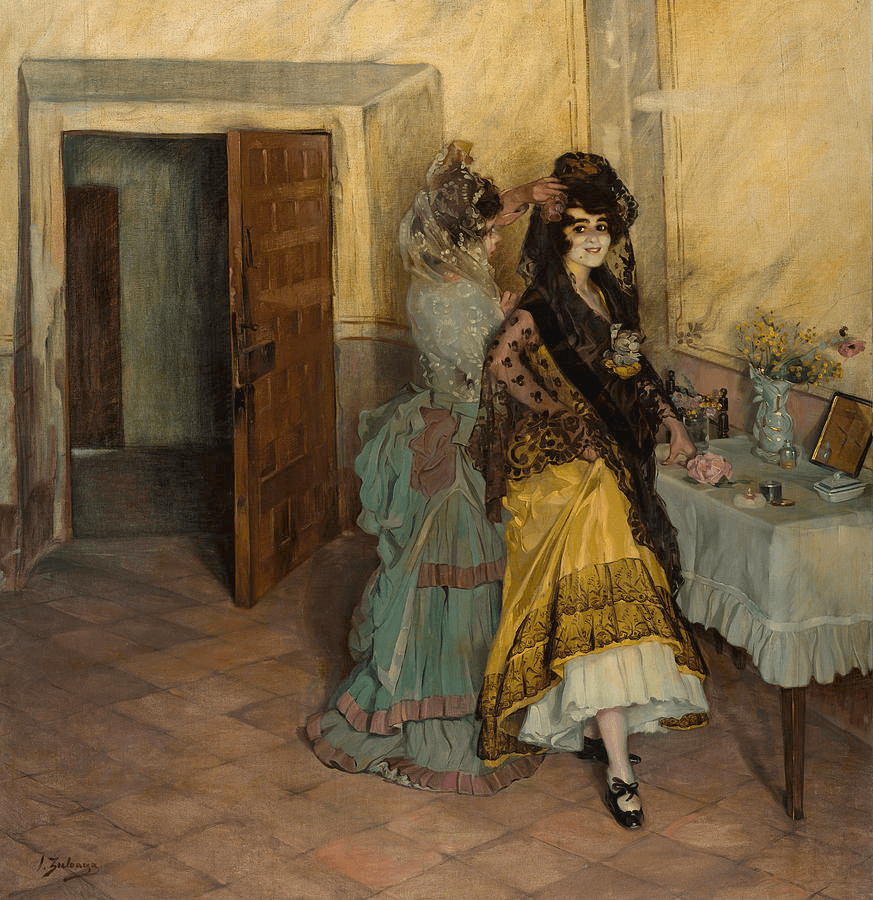
Ignacio Zuloaga y Zabaleta, Preparation for a Bullfight (1903)

Our book today is Miaow, written in 1888 by the great Spanish 19th-century realist Benito Pérez Galdós and recently published by NYRB Classics in a lively new translation by Margaret Jull Costa.

Galdós, whose long and productive life lasted from 1843 – 1920, was born in the Canary Islands, which perhaps gave him an outsider’s perspective on the Madrid society he scrutinized in more than 80 novels.

Miaow has a cast of, well, maybe not thousands but a lot of characters. Ramón Villaamil has served the state his whole life, but he’s lost his job in the tax office due to changing political fortunes just two months short of qualifying for his pension. He solicits possible patrons and haunts his old office, not just to get a job but also to escape his household, where he lives in an uneasy truce with his wife, Doña Pura, their adult daughter, Abelarda, and his sister-in-law Milagros. Completing the ménage is Luis, the son of a second daughter who died young. Luis’s father is a man named Victor, a bad penny who has never been in the picture, indeed whose name is never spoken in the home. The novel kicks into gear when Victor turns up and inveigles his way into the household, eventually sowing great unhappiness. (Victor is a breathtakingly bad guy—I hope we’ll talk about this.)

These are all interesting characters—so why isn’t the book named after any of them? That would be the usual 19th-century thing. (Jane Eyre, Daniel Deronda, Eline Vere, Anna Karenina,l etc., etc.) Why does it have such an odd title? Who or what does “miaow” refer to, anyway? Well, lots of things. It’s the nickname given by the local wags to the women of the Villaamil household, after their supposedly feline features. I think it’s important, though, that the book isn’t called The Miaows. For the title also extends to Ramón, the paterfamilias—not because of how he looks but of what he believes. MIAOW is an acronym for his mantra that Spain can only be saved by Morality, Income Tax, Additional Import Tariffs, Overhaul of the National Debt, and Work. So already “miaow” references both physiognomy and economy. But there’s more. In addition to being a noun, miaow is also a verb, a sound, an onomatopoeia, and a sarcastic, acidic, or bitchy commentary, as when we call someone out for being catty: Mee-ow! It’s this last meaning I thought of most as I considered the harsh disdain so often expressed by the characters toward each other and the gentle satire of the narrative voice toward all of them.

Once we see that “miaow” is something like a mood or attitude or state of mind, we’re able to recognize how unusually Galdós uses characterization. In my description of the book a minute ago, I made it sound like a family story. But it’s not, quite. The critic Fredric Jameson, who really loved Galdós and thought his unfamiliarity in the English-reading world a real travesty, says that Galdós offers “a deterioration of protagonicity,” an admittedly unlovely phrase that he glosses as “the movement of the putative heroes and heroines to the background, whose foreground is increasingly dominated by minor or secondary characters.” As a Marxist, Jameson attributes this not just to Galdós’s predilection or “genius” but to his position as a person living in late 19th century Spain and its strangely non-modern political landscape following the failed “Glorious Revolution” of 1867 (they deposed the monarchy and then brought it back, sort of). To depict the social reality of his society, Galdós had to “strike[ ] an uneasy compromise between the atomized individualism of more fully bourgeois societies with their nuclear families, and the more archaic traces of the older feudal class and castes.” To me, this explains why Galdós feels like an uncanny version or simulacrum of canonical realists like Balzac or Zola, with whom Galdós shares an interest in recurring characters and the desire to explore an entire society. Miaow reminded me of Père Goriot or La Bête Humaine. But also not. Jameson notes that Galdós’s novels are not organized around families, even extended families, but rather around households, an ambiguous term that includes servants, neighbours, and other families who circulate in and out of the story. (In Miaow, Doña Pura is always hosting friends, acquaintances, people who may or may not respect or like; Ramón is always trying to hide from them.) The household thus includes the Mendizábals, a couple who live downstairs and take pity on the much-neglected Luis; the Cabreras, the sister and brother-in-law of that cad Victor, who want to adopt Luis; as well as a whole series of characters at Don Ramón’s former office, some of whom are, to me at least, hard to keep track of, but to whom the novel devotes so much attention, in their various sympathy to or ridicule of Don Ramón, that it doesn’t make sense to just call them “minor.”

All of which is to say that Miaow, though not especially long (it’s like 300 pages) is very busy. To that end I was struck by a word that appears in the first sentence and reappears near the end. Here’s how the novel begins: “At four o’clock in the afternoon, the kids from the school on Plazuela del Limón erupted out of the classroom, making the very devil of a racket.” 250 pages later, a disconsolate, embittered Don Ramón observes a flood of civil servants clattering out of the workplaces at the tax office on payday: “The stairs were almost overwhelmed by this human torrent, which made a tremendous racket as it flowed on down, the sound of heavy footsteps mingling with all the cheerful, sparkling, payday chatter.”

The repetition of racket reminds us that bureaucrats are just overgrown schoolboys. Here we see Galdós’s satirical side. (And by the way, surely the opening scene of the schoolchildren, who, as they pile into the streets, tease little Luis with the nickname of his aunts and grandmother, miaow, miaow, miaow, refers to the opening of Madame Bovary, where a different set of schoolboys taunt a nice enough if also hapless pupil.) But more importantly the repetition of racket speaks to its modus operandi., maybe what we’d now call its vibe. This book too makes a tremendous racket, in the best possible way, with clever dogs, opera singers, officious bureaucrats, raw army recruits, shopkeepers, and a score of others contributing their two cents. Mee-ow indeed.

Have any of you read this book? Or anything else by Galdós? What do you think?

Nat Leach’s Year in Reading, 2023

Excited to once again present reading reviews from some of my favourite readers. Today’s installment, his fifth, is by my longtime friend Nat Leach. Nat is a nineteenth-century scholar turned college administrator who has spent the last 6 years reading the books on his shelves in alphabetical order. He has recently doubled his social media presence by becoming mostly inactive on not one but two platforms, posting occasionally as @gnatleech on Twitter and @gnatleech.bsky.social on Blue Sky.

Berthe Morrisot, Hide and Seek, 1873

For reasons not worth going into, 2023 was actually a pretty rotten reading year for me. I read sporadically, finished only 20 books, and only progressed through one letter in my alphabetical reading project, finishing K, and making a brief start on L (so, after 6 years, I’m not even halfway through the alphabet; my 10-year plan, which was originally a 5-year plan, is looking like it will become a 15-year plan). [Ed. – Very Stalinist of you, Nat.] I wasn’t even able to write entries for each book as I went along, as I’ve done in the past, and was considering foregoing my annual post, but Dorian threatened to sue for breach of contract, so here we are. [Ed. – Look, a deal’s a deal. You want the glory, you gotta write the post.]

One meaningful reflection I was able to draw from my year’s reading is a better understanding of why I enjoy reading the way that I do, progressing alphabetically through my shelves rather than making conscious decisions about where my reading should take me. Thomas de Quincey, in a wonderful essay on “Sortilege and Astrology,” explains that he believes in astrology, but not in astrologers; there is indeed a pattern connecting all events in the world, but anyone who claims to know it is a charlatan. And yet, practices such as sortilege (the opening of a book at random and putting one’s finger on a passage as a means of divining the future) entail putting ourselves in the hands of this unknowable force of fate. [Ed. – Ah, finally I have a name for what my students do when I throw out a question in class.] My reading practice is then a kind of sortilege in which I trust that fate will put in my hands the right book at the right time. And very often, as I discovered this year, I’m able to trace out patterns and connections that I may not have been exposed to had I more rigorously organized my reading.

 I often found myself reading two books at the same time—books that offered unexpected congruences, and paths leading from one to the other. And thus, since I did not manage to write entries for individual books this year, I present my reading by category, which often means: by categories I would not always have chosen to adopt in advance, but discovered while reading.

Books Written in 1989 that Challenge Canonical Western Conventions of Storytelling: Thomas King – Medicine River and Maxine Hong Kingston – Tripmaster Monkey

A super-specific first category, but these are two very different books. For many years, my office was just around the corner from a poster with a quotation from Thomas King: “the truth about stories is that that’s all we are.” The narrative structure of Medicine River seems to be an illustration of that axiom. Each chapter cuts (in a way that feels very cinematic) between an action in the narrative present and one in the past. We thus gradually learn how the past of the protagonist, Will, shapes the person he’s become in the present. The book also suggests how this is true at a deeper cultural level, referring to significant events in Indigenous history such as the battle of Little Bighorn and the occupation of Wounded Knee, but for the most part the focus is personal and the tone is lightly comic, but also somewhat melancholic.

Kingston’s novel, on the other hand, is much more explicitly disruptive of literary expectations in its use of Chinese legends and stories to revise American literary and cultural norms. The novel’s protagonist is a Chinese-American hippie whose hybrid status is reflected in his name, Wittman Ah Sing (geddit?) and whose life in 1960s San Francisco is inflected with wild imaginings that superimpose figures of Chinese legend onto the American present, culminating with the performance of an extravagant play that ends with a chaotic collapse of the distinction between actor and audience. [Ed. — !] Like King’s novel, we see how stories create, and do not simply reflect, identities.

Kingston’s book segued nicely into the next book I read, Rudyard Kipling’s Kim. At one point, Kingston includes an extensive quotation from Kipling’s narrative of his visit to the United States. In that book, Kipling becomes a spokesperson for a racist past whose perspective persists in the present, a tendency that can certainly be seen in Kim, the story of a boy who gets caught up in the political intrigue of maintaining English power in the Indian sub-continent. It still works as an adventure story, though Kipling’s colonial perspective on India is consistent with the account of the Chinese inhabitants of San Francisco that Kingston critiques.

Holocaust Memoirs and Diaries: Gerda Weissman Klein – All But My Life, Victor Klemperer – I Will Bear Witness 1942-1945, Ruth Kluger – Still Alive

These were sitting next to each other on my alphabetically ordered shelves. I have much less experience with Holocaust texts than Dorian, so I will not pretend to any expertise here, but in the small teaching experience I have had, my approach has been to encourage students to notice differences—the atrocities of the Nazis took many forms, and were experienced differently based on a whole range of factors including location, age, gender et cet.—but also to notice significant similarities and patterns. [Ed. – Nat is too modest: I still use a terrific assignment he designed on the topic of Holocaust diarists.] Each of these texts describes some distinctive aspect of Nazi terror: Klein was part of one of the infamous “death marches,” which she describes more thoroughly than any account I had previously read [Ed. – absolutely agree], Klemperer describes the everyday psychological tortures endured by Jews living in Germany, as well as the horrors of the fire-bombing of Dresden, while Kluger’s account spans a range of locations and forms of violence from Vienna to Theresienstadt to Auschwitz. Looking for patterns, it is evident that each also benefits from a number of timely pieces of good fortune that contribute to their survival: for example, Klein was able to live through most of the war in the relatively protected confines of a weaving factory, Klemperer avoided deportation because his wife was Aryan, and the bombing of Dresden in fact provided him with an opportunity to remove the yellow star from his clothing and escape from the city, and Kluger benefited from timely advice to lie about her age at Auschwitz, and a well-timed decision to escape from a death march. A somewhat more curious parallel is that both Klemperer and Kluger fled to Bavaria, and both would have been in fairly close proximity when the war ended. [Ed. – Good point! A function of how the regime decided to compress this remaining pool of slave labour into a central, contiguous section of the Reich: the Sudetenland, x, y, and Bavaria.] In short, three very different books, with some similar lessons, including an awareness of the very narrow line between survival and destruction.

Classic postmodern novels from when it was still OK to use the word “postmodern”: Robert Kroetsch – The Words of My Roaring, Milan Kundera – The Unbearable Lightness of Being

Yeah, I know it’s cool to dump on the word “postmodern” in our enlightened 21st century, but I still find it a useful way to speak about texts that reflect on, and engage critically with, their own status as text. Both books use postmodern strategies to explore the construction of individual identity and that of a national past. Kroetsch’s book experiments with the genre of the folk tale, and is narrated by Johnny Backstrom, a political candidate in Alberta during the Depression who promises the voters—all farmers struggling with drought conditions—that it will rain. Kundera’s novel reflects more philosophically on the nature of chance and coincidence (coincidentally all the stuff I wrote about in my introduction) against the backdrop of Czechoslovakia in the Communist era. As with King and Kingston, these are books that think about how stories create identities.

Books set in the 1970’s (but written later): Hanif Kureishi- The Buddha of Suburbia and Rachel Kushner – The Flamethrowers

I was reading these at the same time, and all the ‘70s cultural references kept getting me confused as to which one I was reading. But the easy way to tell the difference was that one of these books harnesses that cultural anxiety/nostalgia in an interesting way, and the other… not so much. Kureishi’s book is great, exploring his familiar territory of cosmopolitan London and the racial and political tensions of the period. It moves deliberately from the idealism of the hippies to the backlash of punk, and ends with the election of “the new Prime Minister,” unnamed but obviously Thatcher, as represented in the striking images at the conclusion of the BBC miniseries. Things would never be the same again…

As for The Flamethrowers, if I were being charitable, I would say that the book wasn’t for me, as I simply didn’t find the subject matter interesting. If I were being uncharitable, I would say that the book cobbles together a whole bunch of supposedly “cool” images and events of the ‘70s just because they are cool, not because they serve any narrative logic. And the author’s Afterword kind of confirms that hypothesis in describing her process of starting with striking images.

Books set against the backdrop of 17th/18th century nationalist revolutions: Lady Caroline Lamb – Glenarvon and Giuseppe di Lampedusa – The Leopard

Again, a category that features one very good book, and one very bad book. Lamb’s novel was really written only as an attempt to avenge herself on Lord Byron, with whom she had a scandalous affair before he unceremoniously dumped her. The structure of the novel is bizarre, as the description of the affair between Glenarvon (Byron) and Calantha (Lamb) is sandwiched between a Gothic narrative that seems to make very little sense (the explanation provided at the end doesn’t seem to match with the beginning, but I have no desire to try to figure it all out). And, oh yeah, Glenarvon is made into an Irish patriot leader in the 1798 rebellion. For some reason. [Ed. – Very moody, the Irish. Just like Byron.]

The Leopard, on the other hand, is a fantastic book, often hailed as one of the great historical novels of the 20th century. What makes it great, I would argue, is that it represents a moment of critical historical change from a multivalent perspective that shows just how complex change is. Don Fabrizio is essentially the last in a long line of Sicilian nobility. His time is coming to an end, he knows that it is coming to an end, and he even recognizes that in some ways it is right that it is coming to an end. But we also see that good things are being lost along with the bad, and that a different form of badness is ascending. In short, Lampedusa shows historical change in all its ambivalence, as well as the conflicting emotions that it gives rise to. [Ed. – I gotta read this again: been far too long.]

Books read for Women in Translation month: Svenja Leiber- The Last Country and Clarice Lispector – Agua Viva

Well, in my case it was Women in Translation two and a half months, but that’s OK. I was hoping that the Leiber book would be the one to break me out of my slump of disliking 21st century novels, but it was not to be. It hooked me at first, but this is a book with an epic scope (the life of a musician through the vicissitudes of 20th century Germany) but an episodic structure, which I grew to find infuriating more than anything. The prose also felt very abstract—there were many moments when I honestly couldn’t tell whether a sentence was meant to be literal or metaphorical—but I’m not sure if this was a translation effect or inherent in the original. As for the Lispector, it was my first experience with her, and seemed to me an interesting cross between literary and theoretical prose; she reminded me of nobody more than Maurice Blanchot. Which, if you know me, is a compliment. [Ed. – He’s understating things. That’s like his highest compliment. Well, maybe if he’d said it reminded him of Levinas.]

Books read with the #NYRBWomen23 Group: Eleanor Perenyi – More Was Lost, Elizabeth Taylor – A View of the Harbour

I wish I’d had more time to participate in this wonderful series choreographed by @joiedevivre9 but these were the two that were on my shelves already (and hey, I’m going to get to “P” and “T” eventually, right?). Two very different books, Perenyi’s a non-fictional account of her life and marriage to a Hungarian nobleman before and during World War II, and Taylor’s an account of lives of quiet desperation in an English seaside town. Both excellent. [Ed. – So excellent]

A few classics: Honoré de Balzac – Le Père Goriot, Heinrich von Kleist – The Prince of Homburg, D. H. Lawrence – Sons and Lovers

Kleist’s play (like much of his work) is ahead of his time, a proto-Freudian reflection on dreams, reality, desire and death. This was a re-read for me, and confirmed its greatness.

OK, I haven’t actually finished the Lawrence yet (2 chapters left), but I figured mentioning it would score me points with Dorian. [Ed. – It does. You now have 7,967.] Lawrence’s prose is utterly compelling, and even though I find that most of the characters fall into the literary-critical category of “big idiots,” I am absolutely glued to the book. [Ed. – Ha! Accurate!] I’m also enamored of the fact that the book is set in the area of Derbyshire/Nottinghamshire that my grandparents used to live in, and I recognize many of the places mentioned from visits in my youth. When the characters go to Alfreton or Crich Tower, I internally cheer as if a rock band has just casually mentioned how great it is to be in <insert your city here>.

Saving the best for last, I started the Balzac shortly after joining Twitter some 6 years ago, and read it in French, which made it slow going for me. Appropriate then, that I finally finished it in 2023, the year of Twitter’s demise (or whatever you want to call the transformation it has undergone). In any case, this is such a wonderful book about the perils and temptations of society and money, and the challenges of maintaining a moral compass in the face of them. Apparently, I now have a whole lot of Balzac that I’m going to need to read. [Ed. – Hell yeah lfg!!!!!]

Felix Nussbaum, Shore at Rapallo, 1934

That’s about it. Will 2024 be a better year? Who knows how far I’ll get through the L shelf, and who knows how long it’ll take to get through that monstrously large stack of M’s (now is the time that joining those recent group reads of The Balkan Trilogy, The Levant Trilogy, Moby Dick, and The Man Without Qualities is really going to pay off!). But with Nella Larsen, Margaret Laurence and Ursula Le Guin among the next authors on my list, I am guaranteed some treats in the coming year. [Ed. – You sure are. Thanks as always, Nat.]

“Good at Wrecking Things”: Virginie Despentes’s Vernon Subutex

Virginie Despentes is a novelist, filmmaker, rock journalist, and former sex worker. She is best known for her book Baise-moi (1983; translated as Rape Me), a revenge fantasy inspired by the rape and abuse she suffered as a young woman. And if her awesome author photo is anything to go by, she’s still rocking that punk sensibility.

methode-times-prod-web-bin-9e2279a4-9029-11e8-8c1a-b63727488402

As a long-standing square, terrified of drugs and able to appreciate punk only as an idea (so noisy!), I’d never even considered reading Despentes. But then I started hearing about this trilogy she’d written about a man in midlife, who falls victim to the precarity of neo-liberalism and finds himself pushed to the margins of society. But even after reading an enticing review in the TLS, I still figured these were books I was more likely to read about than read myself. But then Frances and Eric raved about them; Eric even offered to pass along his copies. The die was cast.

So it was that I recently spent a week or so happily immersed in the first two volumes of the Vernon Subutex trilogy. (Volume 3 hasn’t yet appeared in English.) Vernon—“the guy with the name like an orthopaedic mattress, Subutex,” as the grown daughter of one of his former customers acidly but aptly puts it—ran a record store named Revolver for twenty five years. But then came downloading, and rising rents, and he had to close. For a few years he eked out a living selling off the rest of his stock on Ebay. But on the first page of the first volume, he’s about to be evicted, the last of his remaining possessions taken as collateral. He’s hardly eaten in days, even quit buying coffee and cigarettes. He’s 49 years old and without any plan for what comes next. Without even his noticing it—Vernon is not shrewd; in that TLS review, Chris Kraus calls him an “affable loser,” which is near enough I guess, though it makes him seem sweeter and more hapless than he is—his friends have left him behind: moved away, started families, schemed desperately to cling to economic stability (unless of course they married into money). Or they’ve left him permanently: cancer, car accident, overdoses, the losses mount up.

Of those deaths, the most consequential is Alexandre Bleach’s. Alex, a mixed-race kid who found his way into Revolver one day and learned about bands like Stiff Little Fingers and Bad Brains under Vernon’s tutelage, made it big. (Along the way he passed through a punk phase: his former bandmates are some of the first people Vernon turns to once he finds himself on the streets.) But Alex never much liked being a star, though he has enough self-knowledge to know how irritating it is to complain when you get everything you’re supposed to want. Alex would periodically hole up in Vernon’s apartment, listening to music, getting high, and hiding from the responsibilities of fame; as a recompense for having this bolt-hole, Alex would pay Vernon’s rent.

But now Alex is dead, and Vernon immediately wonders where the rent money’s going to come from. Yet like the characters of so many 19th-century novels—subject matter aside, Vernon Subutex is quite old-fashioned (and I don’t mean that as a slight)—Alex is never so alive as when he’s died. One of his last acts was to record a manifesto/testament, a combination of stoned philosophizing and vituperative score-settling. Vernon, predictably, slept through the whole thing, but the tapes are some of the only things he takes with him onto the streets because he’s convinced he’ll be able to sell them.

The series is plotty and I’ll try not to go into too much detail and reveal too many secrets, other than to say that the tapes, which Vernon deposits with a friend from whom they are promptly stolen, link the trilogy’s large set of characters. For the bombshell hidden in all that rambling is that Alex has told the truth about the death of his former girlfriend, a porn star named Vodka Satana (yeah, it doesn’t work for me either), at the hands of a movie mogul named Laurent Dopalet (part Harvey Weinstein, part Dominique Strauss-Kahn). Dopalet hires a woman known as the Hyena to find the tapes, but she joins forces with another former porn star and friend of Vodka Satana’s to forge an alliance with Vernon’s friends. (The Hyena’s job is to boost and attack directors, actresses, and other media personalities, “to plaster the internet with love notes, photos, passionate declarations and real-life accounts about how lovely and approachable they are,” or, conversely, “to stop some young starlet from making it too quickly.” Fascinating stuff, and I wish Despentes had done more with it.)
05_GB_M_2005_01_20

Even more than plot, the Vernon Subutex series cares about character. This is both good and bad. Vernon’s friends, in particular, are a mixed blessing. On the one hand, they are the focus of much of the book’s energy and social critique. For example, there’s Xavier Fardin, a screenwriter with only one hit to his name who has been living for years off his wife’s family money and his peculiar fame as an avowed conservative in the leftist Parisian art world, basically a shit but a fairly decent one, especially in his love for an old and practically hairless poodle, not to mention his willingness to stand up to alt-right thugs (he’s beaten badly defending Vernon and another homeless person). Even more interesting is Patrice, a punk musician who cut ties with the industry and is now a mailman. Patrice lives alone because of his inability to stop himself from physically and emotionally abusing his ex-wife and girlfriends. (Despentes writes great male characters—the various gradations of male douchebaggery and assholery seems to be her real subject.)

On the other, the friends are a problem, because they complicate what’s really great about the books: their depiction of Vernon’s journey to homelessness. Despentes shows how easy it is to drift to the margins of society, how quickly one can be reduced to something less than human. Without being clumsy or preachy, Despentes shows a world many of her readers don’t know. Along with Vernon, we learn the rules and strategies of begging (which are the best pitches—outside bakeries, because people pay cash and leave with change—what is the etiquette about finding a new one, when to look at people’s feet and when in their faces). We experience with him the constraints of public space (realizing that the world is made up of park benches with bars down the middle of them and shop fronts with spikes, designed to stop people sleeping and sitting). We also see the camaraderie, even freedom that prevails among the homeless (one woman has a theory about how much the system needs people like her; without her example, she avers, most people wouldn’t keep going to work). But we also see how violent and dangerous it is to be on the streets: you are tired, cold, sick most of the time; your body changes on you, becomes unrecognizable, from your smell to your painful uncut toenails, not to mention the ineradicable grime that colours your skin.

Like Zola in his day, Despentes critiques the depredations of a gilded age. Unlike Zola, however, she isn’t also fascinated by the extravagance and excesses of the one percent. The Vernon Subutex books are great novels of the failures of neo-liberalism. One of my favourite sections concerns Patrice’s reflections on what he’s learned being a postman:

It’s hard fucking work. He is sorry he has always been so down on postmen. First off, it’s hard not to steal stuff. But the main problem is all the walking. And it’s an obstacle course, working out where people mount their letter boxes … If it were left to him, he would have regulations in place like a shot—the fuckers already get their mail delivered for free, the least they can do is have standard-size letter boxes situated in the same places. Make things move faster. People take public services for granted—they’ve been spoiled. People need to make sure they have the letter-box in the right place, that there are no vicious dogs barring the way, they need to realize how lucky they are to have a postman come by every morning.

Which leads him into a screed against deregulation:

The old-timers are devastated to see what the postal service has come to. It’s like everything else. They’re witnessing the systematic dismantling of everything that worked, and to top it all they get told how a mail distribution system should work by wankers straight out of business school who have never seen a sorting office in their lives. Nothing is ever fast enough for them. The skeleton staff is too expensive. Tearing down a system that already works is quicker. And they’re happy with the results: they are good at wrecking things, these bastards.

(Substitute higher education for the mail distribution system and this works just as well—for lots of other things too, no doubt, public utilities, health care, anything important that isn’t amenable to profit.) Patrice, as I’ve noted, is no saint. He’s quite repulsive, actually—but he’s also appealing. Despentes forces us to sit with that contradiction. We can even see in his own fulminations against the people he serves that he’s been infected by the neo-liberal language of efficiency (“make things move faster”).

As these passages suggest, the Subutex books, despite the presence of alt-right bullies, porn stars, popular music and movies, and plenty of drugs and alcohol, owe more to Honoré de Balzac than to J. G. Ballard. But there is some Ballard in these books. Nothing like the fascinating sexual and consumer excesses of Crash, but moments when the books’ social critique is decoupled from realism and, as in Ballard, connected to something more fantastic and oneiric.

This tendency is most apparent when Vernon becomes something like a shaman, the still, doped-out center of a network of people who reconnect through his tribulations—and his way with a playlist. Vernon’s friends track him down, and offer him money, couches to crash on, help of various kinds: he refuses all offers and finds a place for himself in an encampment on a disused railway line near the Buttes Chaumont. (Readers who know Paris better than I do will probably get even more from this book.) Vernon no longer cares about rejoining society. He only cares for music. He becomes a DJ at regular events, raves of a sort, first at a bar and then in abandoned industrial sites across France, where hundreds of people come to lose themselves in his sets.

Vernon hasn’t been on the streets for long before he starts experiencing fevered visions: sometimes he feels himself to be growing wings, soaring through the air. Sometimes he feels himself, “a hobo perched on a hill, in Paris,” to be an amalgam of all those who suffer from ordinary life, from “the drug mule pissing myself in fear ten metres from customs” to “the nurse made deaf by the cries of the patients and by dint of powerlessness” to “the cow in the abattoir.”

RICHTER-jumbo

I don’t know what to make of this. At least character agrees with me: “how does a guy who’s likable enough but a bit short of change when it comes to charisma turn himself into the messiah of the Buttes-Chaumont? The guy is homeless, stinks of sweat and wears trailer trash boots, but everyone treats him like he’s baby Jesus if he’d skipped the bit with the cross, he’s surrounded by dozens of Magi who bring him gifts every day.”

For the most part, though, the book asks us to take Vernon’s reincarnation as a guru at face value. But how is all this shamanistic stuff supposed to be a critique of neo-liberalism? Is Despentes arguing for the power of fantasy to counter alienation and inequality? Or is she depicting nothing more than ineffective resistance to those states? At times the books seem to manifest the inchoate rage of the gilet jaunes, but then the belief in the power of music and dance mitigates that sense of injustice. In the end, Vernon Subutex seems to hold fast to the radical potential of the 1960s and 70s, even as it is alive to the irony that its middle-aged characters, through the world they built, have done so much to undermine these ways of being.

Maybe the books’ most interesting social criticism concerns the idea of friendship. Although the books are peopled by dozens of characters (volume 2 even starts with a list), all of whom are connected in some way, they contain almost no marriages. Nor are there many sexual relationships (even though the male characters are always moaning about how women won’t sleep with them anymore, that is, when they’re not commenting on their lack of sex drive: “his libido has long since been running on empty”). If these books have utopian tendencies, they’re quite chaste. Or quite pornographic—in the sense that sex has retreated to a realm of private, managed fantasy. Which makes the insistence on friendship all the more striking.

tumblr_lzg3dnb2vH1r2k9k0

I’ve quoted a few bits of the books already. Enough for you to know that the individual sentences are not particularly interesting. Despentes is not a stylish writer. In its rapid cutting between different characters it seems written for tv (and apparently a series is coming, maybe already out in France). But I wouldn’t say these are badly written or structured books. They have a hurried, helter-skelter charm, which their translator Frank Wynne (presumably following the original, I’m not sure) evokes with commas rather than semi-colons, dashes, periods, or other more formal methods of linking and separating clauses. The books are easy to read and soothing to plunge into, even when the subject matter is enraging or disquieting.

At times, Despentes dabbles in aphorism. (She is French, after all.) “Past the age of forty, everyone is like a bombed-out city.” “He recognizes the fervent foolishness of people who feel the need to put the same expressions in every sentence.” “But heredity is a patient spider” (this from a man horrified to find himself becoming like the father he hated).

Sometimes aphorism connects with social critique. Alex compares life under capitalism to “the battered wives you see on documentaries: we are so gripped with terror, we have forgotten the basic rules of survival.” A woman who played in the band with Patrice and Xavier reflects on how poorly they’ve aged: “Women survive prison better than men because, throughout history, they have been accustomed to being locked up spied on hobbled punished and deprived of their freedom. Not that it’s in their blood, but it’s part of their heritage. The same thing can be said about social success: women don’t suffer as much when they don’t succeed.”

Thinking about the books’ tendencies toward pronouncements (“women don’t suffer as much when they don’t succeed”), I was reminded of a much earlier French text about how to live, one with a similarly naïve hero: Voltaire’s Candide. Admittedly, I haven’t read it in 30 years, and that was in high school French class, so I probably didn’t understand it even then, but the way Despentes depicts the raves organized by Vernon and his friends, I couldn’t help but think of Pangloss’s insistence that we cultivate our own gardens.

Of course, Voltaire ironizes the imperative as much as he avows it. And maybe Despentes is similarly ambivalent. Nothing stuck with me in these books as much as  the last line in volume 2. We’re at one of the parties, Vernon is spinning his tunes (Bootsy Collins, a favourite). He’s watching the dancers (“shapes peel away and form fleeting groups”); he’s thinking about those who aren’t there, especially Alex (“he makes contact with those who are absent”), it’s all very mystical (“whorls of moonlight open up between people”). And then this: “He is making them all dance.” On the one hand, this is a mere description, of something nice no less. But on the other, it’s a more sinister observation, even a prophecy. Does Vernon have a plan we don’t know about? Is there more to him than affable helplessness? Are the love, drugs, and music that seem to resist neoliberalism’s cruel optimism in fact nefarious?

I trust all will be revealed in volume 3.
2015 Year in Reading

2015 was a good year in reading. Better than 2014, though nowhere near the annus mirabilis of 2013 (pre-blog, alas). I read 80+ books. Here are the ones that most stayed with me:

IMG_0288

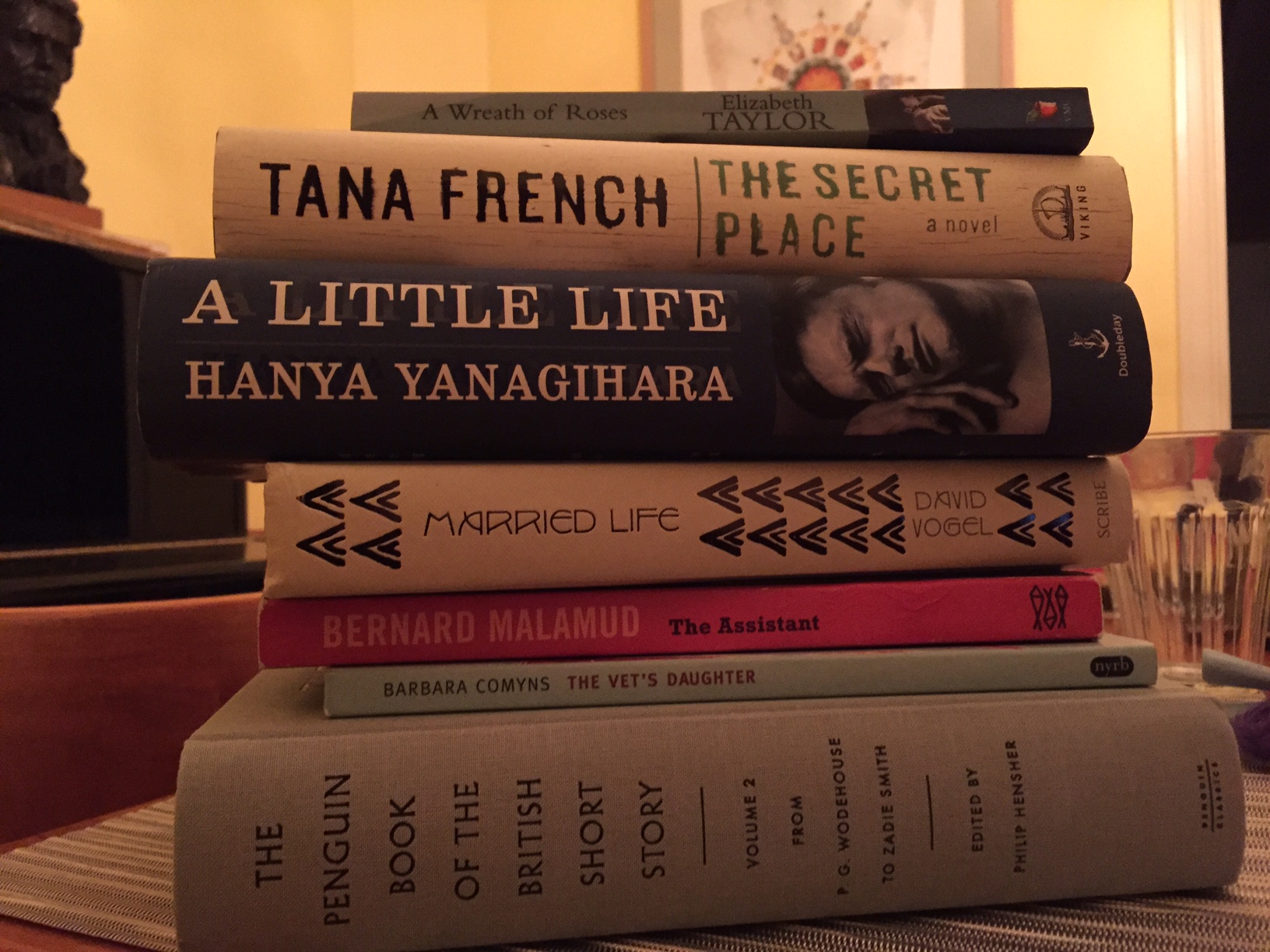
A Little Life—Hanya Yanigahara

The reading event of the year for me. Everyone has an opinion about it, and they’re mostly strong opinions. I understand the main objections—it’s too long, it’s indulgent, it gets off on abusing its main character and even maybe its readers, its prose is sometimes clunky, even embarrassing—but I don’t feel them. These days I struggle to keep my attention away from my phone, social media, hockey scores, you name it. Sometimes I worry I don’t have the reading stamina I used to. In this regard, A Little Life was a gift: an intense, immersive reading experience that captivated me not just for the week of the reading but throughout the whole year. I wrote about it here.

Married Life—David Vogel

Written in Hebrew and published in Vienna in 1930, this is an extraordinary book that expands our sense of what European modernism was all about.

If I read Hebrew, I would write Vogel’s biography. Born in the Pale of Settlement, Vogel made his way via Vilnius and a brief stint as a yeshiva student to Vienna just in time to be interned as a Russian citizen during WWI. After the war he loafed, nearly penniless, in Vienna’s cafes, finding a little translation work and writing his first poems and novellas. He immigrated briefly to Palestine in the late 20s but Zionism never held much appeal for him and he returned to Europe, eventually finding his way to Paris in the early 30s. Tragically he was interned in the next war, this time as an Austrian citizen, and was deported via the infamous transit camp at Drancy to Auschwitz where he was murdered in 1944.

In Married Life the poor but promising writer Rudolph Gurweil meets the impoverished and rapacious aristocrat Thea von Takov and falls immediately under her spell even though he’s not sure he likes her very much. The two marry after only kowing each other for a few weeks and things go badly from the start. Thea converts to Judaism to marry Gurweil but among other things she’s a terrible anti-Semite. The novel is a drawn-out depiction of a disastrous marriage, but it’s also a glorious depiction of shabby Jewish Vienna.

I started a review and got sidetracked. I’d really like to finish it. If it got this book even one more reader it would be worth it.

Heartfelt thanks to heroic translator Dalya Bilu and to Australian-based Scribe for publishing this masterpiece, not least in such a gorgeous edition.

The Vet’s Daughter—Barbara Comyns

Wonderful, heartbreaking novel about a young woman who levitates. I wrote about it at length here and my appreciation only increased when I taught it this fall. Happily, my students loved it too; I received several excellent papers about it. I’m about to write more about Comyns myself. More on that soon, I hope.

The Heat of the Day—Elizabeth Bowen

The same students who enjoyed Comyns did magnificently with this marvelous novel of the Blitz and its aftermath. The course is on Experimental 20th-Century British Fiction, and I hadn’t taught Bowen for a while (six years, in fact), after my previous attempt at teaching her failed spectacularly. I finally worked up the courage to try Heat again, and am so glad I did. It helped, of course, that this was a particularly strong group of students. It was really fun helping them work through Bowen’s famously thorny sentences. To the North might still be my favourite Bowen, but this novel about lying to one’s self and to others is one of her best. I often grumble about how teaching gets in the way of reading. But sometimes the chance to return to the same set of books is a joy. As Roland Barthes once said, those who don’t re-read are doomed to read the same text over and over again.

Bernard Malamud

Another one from the teaching files, at least in part. I taught an introductory level course on short fiction this fall. (For a while I blogged about it regularly—the first installment is here, if you’re interested—but eventually I capitulated to the semester’s demands and gave up.) The touchstone text was Malamud’s first collection, The Magic Barrel. I’d taught these marvelous stories before but it had been a while and found I liked them even more this time.

I’ve always loved their enigmatic qualities, and had long been curious whether his novels were like that too. So I read The Assistant over Thanksgiving (I started a post on that too which I also failed to complete). It tells the story of Morris Bober’s struggle to eke out a living from his small grocery store in a poor part of New York, a struggle that only deepens when he takes on a drifter as a de facto assistant. It is also one of the most depressing books I’ve ever read, with a scene that genuinely shocked me. Malamud’s stories are hardly heartwarming, but they have a lightness missing from this novel. Absolutely worth reading, though.

Various short stories

The Penguin Book of the British Short Story—Philip Hensher, Ed.

As I said, I taught a lot of short stories this fall, and in the process I remembered how much I love the form. Edith Pearlman, Katherine Mansfield, and D. H. Lawrence were particular favourites. I also want to tip my hat to this wonderful two-volume edition of short stories edited by Philip Hensher. I’ve got volume 2 (they’re only available in the UK and a bit pricey but the production values are amazing) and I’ve only read a handful of the stories. But the roster is exciting; not just the usual suspects. Hensher plowed through a ton of late-19th and early-20th century magazines and has found some amazing stuff. I especially like one by “Malachi” (Marjorie) Whitaker, called “Courage”: it’s going straight on to the Spring syllabus. Hensher’s introduction makes a fascinating case for why Britain produced such good short fiction in the years 1890-1940 and why economic and structural conditions make it unlikely for the form to flourish in the same way again (which isn’t the same as saying there are no good instances of the form today: volume 2 goes from P. G. Wodehouse to Zadie Smith). Please Penguin, bring this out in the US.

The Book of Aron—Jim Shepard
A Brief Stop on the Road from Auschwitz—Göran Rosenberg

Holocaust literature is central to my teaching, and so also to my reading. These two books impressed me this year, the first a novel of the Warsaw Ghetto that I wrote about at Open Letters Monthly and the second a second-generation memoir that I reviewed at Words without Borders.

Death of a Man—Kay Boyle

Thanks to Tyler Malone of The Scofield I learned a lot about Kay Boyle this year. The best thing I read by her was a heartbreaking early story about failed pedagogy called “Life Being the Best” (read it!), but the book I spent the most time with was this 1936 novel about an American heiress who falls in with fascist sympathizers in pre-Anschluss Austria. I can’t say I liked the book all that much, but I was utterly fascinated by it and I enjoyed wrestling with its slippery politics. You can read my essay, along with many other wonderful pieces, here.

A Wreath of Roses and Blaming—Elizabeth Taylor

These are two of the best books I read this year, but they’re wrapped up in guilt for me because I promised someone a piece about them and never delivered. (Not yet, anyway…. I still want to, though!) I’ve loved everything I’ve read by Taylor, but these are the best of the bunch. Blaming (1976), her last book, is about what happens to a middle-aged woman after the unexpected death of her husband. It manages to be both rueful and acerbic. A Wreath of Roses (1949) is a masterpiece and if it were in print in the US I would have taught it this semester for sure. Less histrionic than Bowen’s Heat of the Day but similarly a novel of what the war did to England, it’s also a story of female friendship that earns its epigraph from Woolf’s The Waves. Genuinely haunting: I read it in June and still think about it regularly.

The Secret Place—Tana French

French doesn’t need me to sing her praises. Everyone already knows she’s the best crime writer today. Some thought this latest book—for some unaccountable reason I held off reading it for almost a year—in the Dublin Murder Squad series a falling off, but I adored it. I especially loved the echoes of Josephine Tey’s Miss Pym Disposes. French is such a genius because she writes super suspenseful books that are ultimately about something quite different: they are fascinated to the point of obsession with the idea of friendship—interestingly, romance or sex features hardly at all—especially how friendship intersects with the partnership between detectives. Yet again French proves she writes vulnerable men better than anyone.

 *

Other good things: Vivian Gornick’s The Odd Woman and the City is a brilliant essay-memoir and I would have written more about it here but it’s late and I’m tired (the Open Letters piece is good, though); The Hare with Amber Eyes (again, everyone already knows it’s amazing—I most liked a surprising Arkansas connection!); Emma (enjoyed re-reading this and wrote about the experience here and here); bits of Balzac (the last 100 pp of Pere Goriot, which practically had me in tears; the scene in Eugenie Grandet when Eugenie wakes at night to see her father and his servant taking his gold downstairs: hallucinatory); Wilkie Collins (I liked both The Dead Secret and The Law and the Lady). Also, good light reading: Ben Aaronovitch’s Rivers of London (urban fantasy—smart and funny: read the first two this year and mean to finish the series in 2016); Hans Olav Lahlum’s K2 books (engaging Norwegian homage to Golden Age crimes, locked room mysteries and the like); Ellis Peter’s Cadfael books (read the first: surely the beginning of a beautiful friendship).

 *

Reading is a passionately solitary experience, but also a joyously communal one. That’s true (mostly) in my classroom and, increasingly, on social media and the Internet more generally. Sometimes I find the constant stream of books to read that come through my Twitter feed a little daunting, but mostly I’m thrilled to know that so much reading is going on, so vigorously and passionately.

Thanks to everyone who read this blog in 2015, especially those who encouraged me and prompted me to think harder or differently about the books. It is wonderfully strange for me to speak so much with people I haven’t for the most part even met about something so important to me.

Thanks too to those who published me this year, especially the wonderful people at Open Letters Monthly. Here’s to more writing next year, and of course to more reading.

Short Fiction 2015 Week 2: Balzac, Chekhov, Kipling

I’m still uncertain what kind of a group I’m dealing with. A smaller one than last week, at any rate. Two students dropped—one had been a strong contributor to discussion and we’ll miss her—and now we’re reaching the point where the class won’t work if everyone doesn’t pitch in. It doesn’t help that there are almost no humanities students in the class. That can bring its own rewards, but it doesn’t help my department’s goal of using classes like this one as a way to generate majors. And although the students have been willing to work with me so far, I sense that they simply aren’t sold yet on the value of close textual analysis. I worry that if even a few of them decide to check out, our conversations will become strained and artificial.

What a shame that would be: the material is so interesting! I would say that of course, but I really don’t see how anyone could fail to be intrigued by the stories we studied this week: Balzac’s “Sarrasine” (1830), “Kipling’s “Mrs. Bathurst” (1904), and Chekhov’s “The Kiss” (1887). They happen to be the three oldest stories on the syllabus, as well as some of the longest. No doubt those things contributed to some of the students’ difficulties. But in general we persevered.

I wanted us to consider in particular these questions: What sorts of things should happen in a story, and how should they be told? To this end I introduced the distinction made by the Russian Formalists in the first decades of the twentieth century between fabula and syuzhet, or story and plot. Although readers sometimes use these terms as synonyms, narratologists make a useful distinction between them. Story is the chronological order of events; plot is the arrangement of those events into the order we experience them in our reading of the text.

In preparing for class I came across this example, which I put on the board. (I love the room we’re in because it still has a chalkboard.) What, I asked, is the difference between these narratives?

Tim got up in the morning. There wasn’t any cereal left, so he went out to get some. On his way to the store, he was hit by a car and died.

Tim couldn’t believe he was dying because of cereal. He should never have left the house.

Students were readily able to note to difference between a chronological ordering of material and an achronological one that begins with the end and will presumably flash back to earlier events in order to explain the cryptic sentence “Tim couldn’t believe he was dying because of cereal.” It took a little prodding, however, for them to say that the second of these admittedly not especially elegant examples is more interesting than the first—specifically, it is more suspenseful. I observed that some genres, crime fiction in particular, manipulate story more than others, largely in the service of suspense.

My main points were these: all narratives have plots, however minimal, and so all narratives manipulate the presentation of events. Story is what readers are continually creating, often unconsciously, from their experience of plot. Story is therefore a necessary fiction, an effect of plot. It’s not something that pre-exists plot.

I hope they got this counter-intuitive idea, but I don’t know (yet). I noticed that the students were happiest—and liveliest—when they were learning this vocabulary and applying it to the course texts. They liked it, in other words, when I was lecturing. But I’m not a particularly good lecturer, and I don’t do much of it in this course or any other. What I really do—what I really want them to learn—is how to pay close attention to literary texts; how to develop interpretations of the whole based on scrupulous attention to its parts.

doinel-balzac

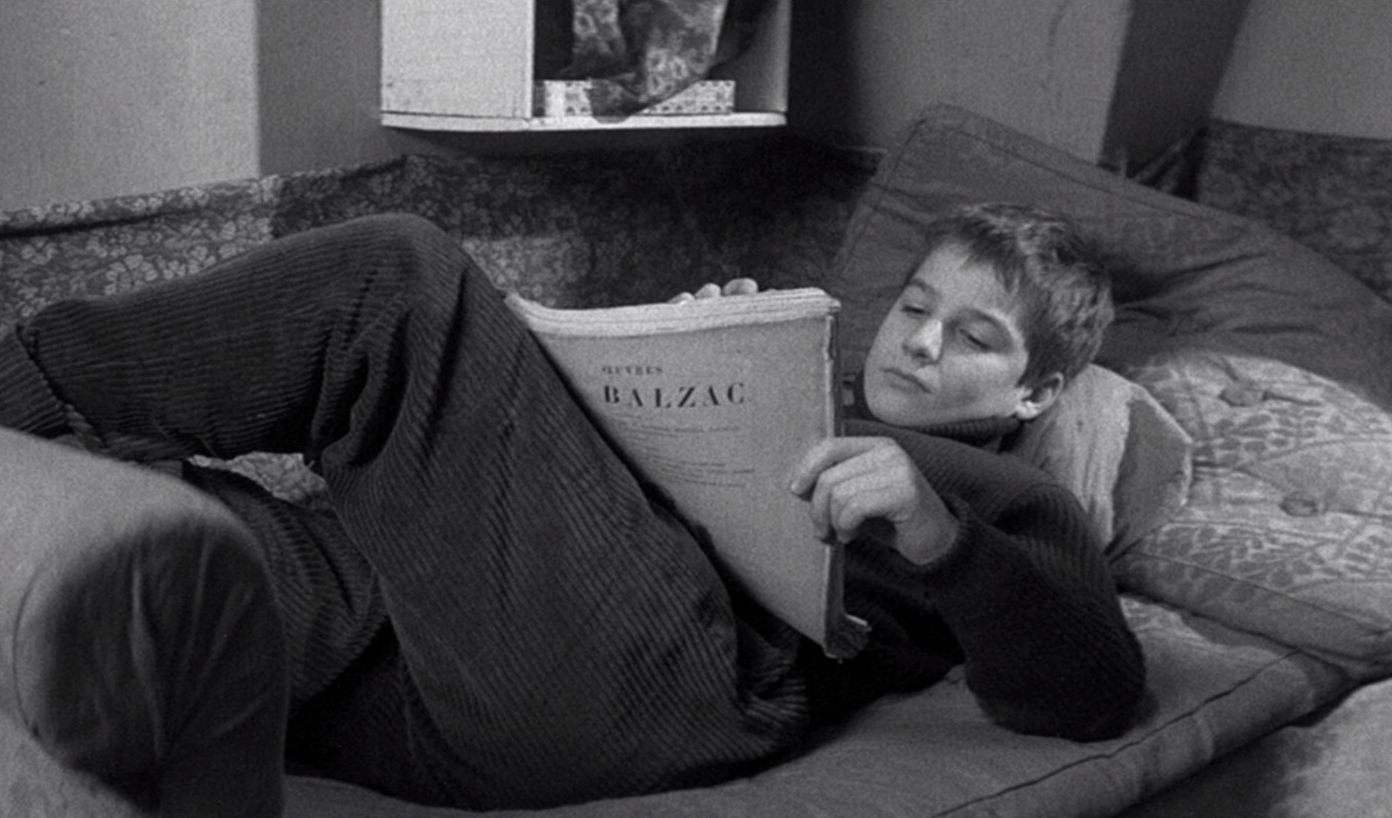
I can’t talk about these stories without spoiling some of their surprises, so consider yourself warned. Each is wonderful, but this time around the one that really struck me was “Sarrasine.” I’ve only ever taught it in the context of Roland Barthes’s powerful reading of it in his brilliant book about realist fiction, S/Z. My take on the story is heavily indebted to Barthes, but I found it freeing to teach the story on its own terms. I think using Jordan Stump’s translation from this lovely new edition of Balzac stories helped too. It feels fresher and lighter than the one by Richard Howard I’m familiar with.

I had the students bring a one-page summary of the story to class, partly as a diagnostic exercise (so I could see what their writing was like) and partly to get them to practice accurate and concise description. I wanted to know what they chose to emphasize. (Interestingly, they almost all ignored the ending.) Here’s my crack at it:

“Sarrasine” begins at an opulent ball at the home of the mysterious de Lanty family. The narrator has brought a (married) woman to the party, Madame de Rochfide, whom he hopes to seduce. Like the rest of Parisian society, the young woman is both attracted and repelled by an old man who regularly appears at the de Lantys’ parties. Who is he and why is the family so solicitous but also so frightened of him? The narrator knows and agrees to explain all to his lover when they meet in her boudoir the following evening. There he launches into the story of one Earnest-Jean Sarrasine, a sculptor who rose from obscurity in provincial France to fame in Paris, leading him to win a prize to study in Rome. Sarrasine’s genius combines a fiery, unruly nature with a profound lack of worldliness. That naivety is apparent when, arriving in the Eternal City, he attends the opera and falls immediately in love with a singer known only as La Zambinella. La Zambinella rebuffs the sculptor’s professions of love, saying that if Sarrasine really knew her he would be horrified—a diagnosis that proves to be true when she turns out not to be a woman. Her unearthly voice is the result of castration. An enraged Sarrrasine is on the point of killing the poor creature, to use a word the text repeats several times, when he is himself murdered by ruffians hired by the singer’s protector, one of Rome’s most powerful Cardinals. The old man—the uncle of Madame de Lanty—is none other than La Zambinella; his musical career generated the fortune that has fueled the family’s rise to respectability. But when the mystery is revealed it casts a shadow, a kind of taint on its eager audience. Madame de Rochfide is so repelled by the story that she breaks off her relation with the narrator (and in classic Balzac fashion, threatens to retire from this monstrous world to a convent).

“Sarrasine” is a great story. And it’s great for teaching narrative structure, both because it’s filled with so many mysteries and because it’s so brilliantly manipulative in making us care about them. In other words, it’s very suspenseful, and we feel the suspense all the more powerfully because characters in the story do too, and they’re always cuing us to experience events in a certain way.

I began our discussion of the story by asking the class to identify the story’s key mysteries. They quickly said: Where does the de Lantys’ money come from? Who is the old man? Who is the subject of the portrait of Adonis that hangs in the de Lanty mansion? Who is La Zambinella? Will the narrator get together with Madame de Rochfide?

These all turn out to be versions of the same question. Even the last one hinges on the revelation of the others. I pointed out some of the ways the story answers these questions early on without really answering them. These pieces of incomplete information fit with the story’s depiction of concealment and revelation. Plots work by oscillating between revealing and concealing; Balzac is a master of literalizing these narrative metaphors. The story is full of secret passages, cloistered window-ledges, disguises, etc.

Here’s an example of the kind of half-answer I’m talking about. Already on the fourth page the narrator reveals “The beauty, the fortune, the wit, the grace and intelligence of these two children [the de Lantys’ son and daughter] came to them solely from their mother” (my emphasis). As Barthes points out, the sentence’s parataxis—the presentation of information serially, without any kind of subordination or hierarchy—sweeps us along, so that it’s almost impossible to notice that we’ve already been given the answer to one of the story’s burning questions. But the answer is only a partial answer, an answer we can’t yet fully understand. The de Lanty fortune comes from the maternal side. But we don’t yet know what that means.

The story’s clever plotting, especially the extended flashback to the time when the enigmatic old man was the diva La Zambinella, contributes to its sense of mystery. Where things get really interesting is when that mystery is resolved. At the end of the story, all our questions are answered, but the resolution isn’t satisfying, at least not to the character that has been our stand-in, Madame de Rochfide. (She is the one, like us, who hungers to know the truth behind the mysterious appearances.) Barthes famously described the story’s final scene as a metaphorical instance of castration, an echo of the literal castration that befalls the singer. Here, for example, is the narrator explaining the connection between the old man, La Zambinella, and the de Lanty fortune:

“Perhaps now you can understand Madame de Lanty’s interest in concealing the source of a fortune that comes from—”

“Enough!” she interrupted, with a commanding gesture.

We sat for a moment in the deepest silence.

The event at the heart of the story—Zambinella’s castration, that is, his becoming Zambinella—is so terrifying, even, it would seem, disgusting, that it cannot be spoken, and even the incomplete revelation of its truth is enough to kill desire in anyone who hears of it. (I mean both narrative desire and sexual desire.) The exchange the narrator and his lover have agreed upon—a story for sex—isn’t consummated. In this sense “Sarrasine” offers an allegory of the impossibility of any story to conclude satisfactorily—no solution is ever as satisfying as its enigma.

In other words, one of the things Balzac’s story is about is that what is hidden can never be fully revealed. To satisfy narrative desire is always to incite a kind of death. And that’s especially true in a story like this one, where a key connection between the story of the sculptor and the castrato and the story of the narrator and his lover is the former’s desire to shape the other to their own ends. What Madame de Rochfide says bitterly to the narrator—“Oh! You’re remaking me to suit your own tastes. A strange sort of tyranny that is! You want me to be something other than me”—could just as easily be said by La Zambinella to Sarrasine.

IMG_0206

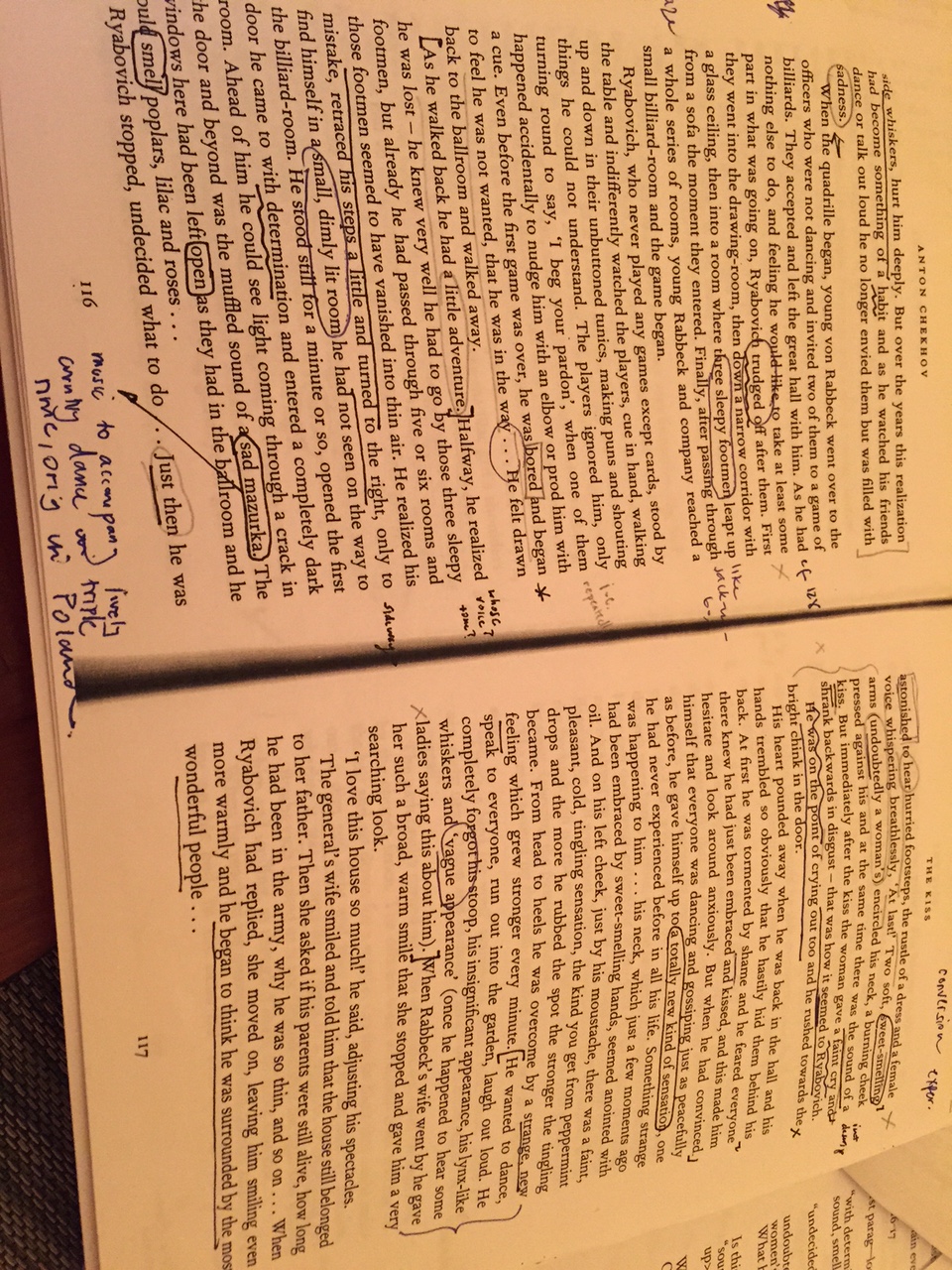
The same sort of solipsistic control is evident in more melancholic form in Chekhov’s “The Kiss.” A general who like fat women assumes his men must as well. A habitual cynic assumes his colleague must be lying. And an introvert assumes that others must share his disparagement of himself. In contrast to Balzac, and also to Kipling, with their dramatic, even melodramatic events, Chekhov operates in a more muted register. I don’t know if he invented the modern conception that short fiction centers on small epiphanies, but he’s certainly an important figure in the development and eventual triumph of that mode.

I began our discussion of the story by asking students to name the central event of the story. They immediately referred to the scene in which the protagonist Ryabovich, lost at a house party, wanders into a darkened room where he is embraced by a woman who has mistaken him for her lover. But a student immediately added that the real event seems to be the man’s reaction to the embrace. Thus the titular kiss becomes an allegory for our tendency to imagine that a story pre-exists its telling—its plot—when in reality it is only ever constructed from our ways of telling it. Here’s the passage we spent a lot of time on:

Ryabovich stopped, uncertain what to do… Just then he was astonished to hear hurried footsteps, the rustle of a dress and a female voice whispering breathlessly, ‘At last!’ Two soft, sweet-smelling arms (undoubtedly a woman’s) encircled his neck, a burning cheek pressed against his and at the same time there was the sound of a kiss. But immediately after the kiss the woman gave a faint cry and shrank backwards in disgust—that was how it seemed to Ryabovich.

It took a little prodding but eventually I was able to get students to see that this is really a very strange description. The loss of sight in the darkened room means that other senses are heightened—here we referenced a number of other passages that describe sounds and smells—but how trustworthy are those senses, or how are they being interpreted? Why does the text add that parenthetical “undoubtedly a woman’s”? Hasn’t the reference to a female voice made that clear? (Though “Sarrasine” ought to have made us suspicious about such essentialism.) I can’t trust that “undoubtedly”—I immediately hear the doubt hiding within the word. It’s not that I think the person was actually a man. It’s that the whole scenario seems so insubstantial. As one student pointed out, it’s only Ryabovich who is convinced the woman shrinks in disgust. (And because he decides never to return to the house, we never find out if he’s right.)

Further uncertainty comes from that strange phrasing, “there was the sound of a kiss.” Sound isn’t usually the first way we experience a kiss. Why then does Chekhov describe it this way? Again the effect is to render the whole event uncertain. But that very uncertainty is what enables Ryabovich to speculate extravagantly about it, to construct an ideal woman composed of all the most appealing parts of the different women at the party (he imagines the shoulders of one, the smile of another, etc).

We didn’t have time to consider the different registers of experience in the story—the way the habitual actions of the artillery battalion to which the protagonist belongs are succinctly described but derided by the text as boring, whereas the singular action of the kiss, if we can even talk about it in such terms, is developed at length to the point of distortion. But we did linger over the end of the story, over Ryabovich’s decision not to return with the others to the house where the kiss occurred, a decision that comes after he stands overlooking a river. The current that purls faintly and passes inexorably along leads Ryabovich to feel a sense of futility. Yet the story’s final irony is that in taking, at long last, a decisive action—in not returning to the house where, in a different kind of story, he would have re-encountered the woman from the darkened room—he resolutely chooses irresolution. But doing so allows him to maintain the power of fantasy, thereby asserting the inevitable quality of reconstruction that attends all the important moments of our lives. Yet in a way I still don’t fully understand the recognition of this inevitability is combined with a really ominous sense that things will go badly for poor Ryabovich. When the others go off to the party, he lies on his bed “in defiance of fate—as though he wanted to bring its wrath down on his own head.”

rudyard-kipling

Speaking of ominous fate, what about “Mrs. Bathurst”? This post is already too long, so I won’t say much about it here other than that it is in fact the most enigmatic of these puzzling tales. In fact, it’s really hard to know what happens in it, and we spent much of the class period trying to sort that out. Like “Sarrasine” and “The Kiss,” “Mrs. Bathurst” is also a story about storytelling. Four men gather in a railway car near Cape Town to tell the story of a man who deserted from the Navy. But what exactly happens to him, and what led him to desert? A quick online search suggests that commentators can’t agree on the answers. I think the students found it hard—it worked less well than the last time I taught it—and it’s true that to make any sense of it at the most basic level we have to make much of enigmatic and offhand phrasing, as when the deserter tells the story-teller: “remember that I am not a murderer, because my lawful wife died in childbirth six weeks after I came out [i.e. away from England].” Why “lawful wife”? Isn’t that redundant? Well, maybe not if you have a second wife, an unlawful one. Not, in other words, if you’re a bigamist. Look here for an extraordinarily detailed, if sometimes pedantic to the point of obtuseness, analysis of much of the existing criticism of the story, where this suggestion among others is made. (The whole site has the layout and monomaniacal tone that so characterized the Internet in its early days.) Kipling doesn’t even attempt the resolution of narrative enigmas that proved so problematic in Balzac. He’s probably the least well respected of the three writers today, but in this sense at least he feels the most radical. We’ll return to the topic of uncertain or unknowable events when we read an early story by Nabokov next week.

Eugénie Grandet–Honoré de Balzac

It will tell you something about me that the Balzac I know best is his story “Sarrasine” (1830), a text mostly ignored by readers for a century until, so the story goes, Roland Barthes came across an offhand reference to it by Georges Bataille that intrigued him enough to devote an entire seminar to the little story, the result of which was his extraordinary narratological study S/Z.

“Sarrasine” is amazing and holds up to many readings. But one story out of the thousands of pages Balzac wrote, well, it’s not much to base a judgment on, is it? (Technically I read Père Goriot a long time ago, too, but I can’t tell you anything about it except that it’s about a boarding house. It’s about a boarding house, right?) But now as part of the Slaves of Golconda group I’ve read Eugénie Grandet (1833) and I’m planning to immerse myself in Balzac as soon as reasonably possible. The guy was clearly a genius.

To come to Balzac through Barthes and post-structuralism is now so old-fashioned as to be almost quaint. The news that Princeton has bought the library of Jacques Derrida, though it warms my heart, makes me certain that the theory that was meat and drink to me is rapidly becoming antiquated. As Alexander Trocchi once said of the canonization of Dada, even “the turds of anti-art were framed and hung alongside “The School of Athens.”

Although Barthes offered his reading of Balzac as a critique of the ideological dominance of literary realism—specifically, its way of pretending that what it is doing is merely transforming things into words when in fact every thing, in this case every referent, is already produced through the combination of a number of interpretive codes—Barthes would be the first to acknowledge what time has made increasingly clear: S/Z is a paean to that realism, and especially to Balzac. Barthes described the realist writer as a painter whose main tool was not his canvas but the frame he placed around it, which Barthes employs as a figure for the condition of representability itself. To show anything it must first be selected, chosen, made. The trick played by realism—the ideological sleight of hand that bothered Barthes in the early 70s—was to pretend that the frame didn’t exist and that the canvas was simply a swathe of the real. But that didn’t mean, as critics of post-structuralism liked to say, that the art of the canvas was second-rate or disingenuous or bad. After all, S/Z is as much love letter as critique.

It’s entirely possible, though, that what Barthes said about literary realism might really only be about Balzac. Maybe the circulation of codes—by which Barthes meant both pre-established conventions for depicting and thinking about the world, and the way texts are in fact citing other texts when they claim to be showing life—isn’t the way realism works. Maybe it’s just how Balzac works. That’s the thought that came to me when I read, in Eugénie Grandet’s stilted and awkward opening pages, this description of Monsieur Grandet, the heroine’s father, a miserly cooper whose speculations first in the wine trade and later in the financial markets make him rich: “Financially speaking, Monsieur Grandet had the qualities both of a tiger and a boa-constrictor.” A tingle ran down my spine. Hadn’t I read about tigers and boa constrictors before? I pulled my copy of “Sarrasine” off the shelf where I duly found this description of a woman entranced by an old man she does not yet know is a castrato: “She was under the spell of that timorous curiosity which leads women to seek out dangerous emotions, to go to see chained tigers, to look at boa constructors.”

No doubt someone has written a book on the history of circuses and the Paris zoo (which, a quick Wikipedia search tells me, was founded in 1793) or any of the other ways in which such exotic animals might have made their way to 19th century France. If anyone knows about that stuff, please let me know, but honestly I’m only halfheartedly interested in that sort of background. What I’m genuinely interested in is how this repeated imagery tells us something about Balzac’s method and the preoccupations of this book. It’s not that Balzac copies himself—Barthes says copies are at the heart of Balzac’s work: what they are about and how they are made—but that in citing himself, in returning even to tropes that aren’t at all central to the subject matter of his writing, Balzac incorporates a process of circulation that is central to that subject matter.

Balzac delights in expressing and examining received wisdom; Barthes called this doxa and Franco Moretti called it Balzac’s “loquacious wisdom.” One of Balzac’s favourite formulations (present dozens of times in “Sarrasine,” admittedly less frequently in Eugenie) is “one of those”: “Prompted by one of those ideas which arise in a young girl’s heart…”; “It was one of those looks in which there is almost as much coquetry as deep feeling.” The implication is that readers will know what the narrator is talking about (ah, one of those ideas, one of those looks). The narrator becomes a kind of cataloguer of the world, able to show us what we might have missed but what, prompted by his description, we recognize as present in the world. But again the point isn’t that literature simply reflects the world beyond it but that it summons that world into being. The circulation of tropes, whether the “repetition” of known truths (“one of those”) or the self-citation of metaphors and images (tigers and boa constrictors) contributes to the way Balzac’s texts elide their own construction. How otherwise could such fanciful and melodramatic tales have come to seem so natural? The seemingly haphazard quality of the prose and the structure—this isn’t Flaubert—similarly contribute to the “natural” or “found” quality of the work: here is a slice of life.

As I said above, circulation isn’t just present in the form of the text. It’s also important in its content. The circulation of tropes that realist representation depends on is like the circulation of capital. And Eugénie Grandet is, at least superficially, about a miser (though the fact the miser is Eugénie’s father and that the book is not named for him suggests we might need to rethink that assertion). Grandet amasses his fortune first through trade (often by deviously undercutting his fellow vintners) but later through investment and speculation, where money is made from money. Rohan wrote about how unconcerned the novel seems to detail the source of Grandet’s money, how uninterested in detailing the labour that goes into making it. But from the perspective of capitalism, the more alienated capital is from labour the more powerful its ideological purchase.

That said, there are important counterweights in the novel to the idea of effortless speculation. Grandet loves gold, even picking gold threads out of a dress. He hoards copper coins in his study, so many that when he takes them out of the house, under cover of night, he needs a servant to help him carry the cauldron on a yoke around his neck. (The scene where Eugénie, half asleep and in the fever of new love, chances upon her father in this act is a masterful phantasmagoria.) In this sense wealth is highly material—and so too are the vividly evoked deprivations Grandet’s household endures as a result of the father’s miserliness, like the sugar cubes Grandet finds time in his busy schedule to cut up. Indeed, the miser challenges the idea of capitalist circulation, because he wants to hoard his money rather than keep it moving about. So although the novel depicts the increase of the Grandet fortune as implacable and inevitable, it also positions the miser as not just the capitalist par excellence, but also, more challengingly, as the limit of that economic system.

I struggled with how to understand the relation between money and heredity in this book. For heredity—by which I mean the passing on of emotional traits and values rather than of physical characteristics—seems to be something that also persists implacably. The novel tells the story of a family, but mostly it focuses on just the father and his daughter. What the daughter takes from the father is important to understanding the book’s remarkable ending. (Balzac might not be too great with beginnings, at least as evidenced by this book, but he sure knows what to do with an ending.)

The back cover of the Oxford edition I read—which comes with a really excellent, smart but not pedantic introduction by Christopher Prendergast, you should check it out if you’re at all interested in this book—asks “Who is going to marry Eugénie Grandet?” “This is the question,” the copy adds, “that fills the minds of the inhabitants of Saumur,” the town in the Loire where the book is set. Amateur Reader has pointed out that this is not really the question of the book. I submit that if there were something like a guiding question for the book it would be something like: “How should we understand Eugénie’s fate?”

I love the book’s way of wrong-footing us, of presenting scenarios we’ve seen before and then upending them. When Eugénie’s glamorous and spoiled Parisian cousin Charles comes to visit, and when the girl is instantly smitten with him to the point of giving him her heart, and, just as importantly in this novel, paying off his debts, we think we know what to expect. Surely this rakish dandy will do her wrong; surely he will be her ruin. When Charles learns, shortly after his arrival in Saumur, of his father’s suicide after the shame of becoming a bankrupt and accepts that his only hope of recovering any position in Parisian society is to seek his fortune in the Indies, we are sure he will abandon to Eugénie. And in this case we are right, just as we are also right that Eugénie will hold fast to his memory. Charles, who whatever his flaws was always rather sweet, becomes hardened in his seven years overseas—not least because he soon realizes that the real money is in selling people not goods. Embroiled in the slave trade—in “unremitting contact with selfish interests”—he becomes hardened and cynical: “his feeling for others contracted and withered away.” Balzac immediately adds that after all Charles is a Grandet: “The blood of the Grandets fulfilled its destiny. Charles became hard and ruthless in the pursuit of gain.” That ruthlessness extends to his personal life. On the ship home, Charles meets a titled, well-positioned family that has been much reduced materially. Although he doesn’t much care for Mademoiselle d’Aubrion—and Balzac does his best to make sure we don’t either, describing her as “thin and spare, with a supercilious mouth, dominated by a blunt, over-long nose, which was normally yellowish but became quite red after meals, a kind of vegetable phenomenon that is more unpleasant in a pale, bored face than in any other”: nothing by halves for our Balzac—Charles marries her anyway, because her family’s connections will open Parisian society to him. So important to him is this idea of securing a brilliant position that even when he learns that Eugénie has repaid his father’s creditors, with interest, he only pauses momentarily to lament the loss of a fortune the size of which he hadn’t suspected—what he really cares about, Eugénie can’t give him.

I suspect Charles isn’t the only Charles in Balzac’s works, and I bet some of them get their own novels. But in this novel his trajectory must remain only a sketch because its main interest is in Eugénie. Her honour has not been besmirched; she hasn’t become a fallen woman. She and Charles share only two kisses before his departure; he does not force himself upon her or leave her ruined. Nor does she simply renounce the world after her disappointment. She doesn’t become a nun, exactly—this isn’t The Princesse de Cleves. It’s true that her first reaction to the news of Charles’s dismissal of her after seven years is to calmly state that now she can only “suffer and die.” She even tells her priest that she wishes to leave the world and live in seclusion. But she doesn’t. She learns Charles’s marriage will not come off until his father’s creditors are appeased and arranges to pay all the outstanding bills. We don’t know why she does this. From self-abnegation? From a desire for revenge? To make Charles dependent on her? None of these are right. What we do know is that when she decides to take this action, a friend of the family tells her, “ ‘As you said that, your voice was just like your late father’s.’” This a moment after the text has told us: “she decided that, in future, she would assume an impassive expression as her father had always done.”

So the heredity that concerns the book pertains as much to Eugénie as to her Charles. For she too is a Grandet. And she becomes increasingly like her father. She is immured neither in a convent nor in the walled garden where she once sat with Charles, but she is imprisoned in a life of emotional nullity. Although enormously rich, she doesn’t hoard her wealth; indeed, she gives generously to charity and the Church. But the hardness that attached itself to Charles also begins to manifest itself in her. She isn’t cynical, but she does, the narrator tells us, respond to others “ironically,” a word it would never have used to describe her earlier.

It is in this spirit of emotional asperity that she agrees to marry a lawyer from Saumur, the now middle-aged son of one of two families that had been vying for Eugénie’s hand—and her fortune—since even before the arrival of Charles. But she marries Monsieur de Bonfons only on the condition that he expect nothing more than friendship from her. (And that friendship seems quite icy.) She doesn’t pine for Charles, she doesn’t preserve the memory of their courtship in Havishamian aspic. She simply turns that part of herself off. When Bonfons dies only a few years later, she becomes even richer, even more isolated, even more forbidding. The irony of the Grandet family is complete: the one who cares nothing for gold is showered with it. She uses it to do good in secret. But despite this charity, and despite her beauty, which, the narrator tells us, persists even as she approaches forty, despite her poise, she isn’t the same as she was as a girl:

She has all the nobility of grief, the saintliness of one whose soul is unsullied by contact with the outside world. But she has also the rigid outlook of an old maid and the narrow vision that comes from the restricted life of a provincial town. In spite of her income of eight hundred thousand livres, she lives as poor Eugénie Grandet used to live. She lights her fire only on the days when her father used to allow the fire to be lit in the living-room, and puts it out according to the rules in force when she was young. She always dresses as her mother did. The house at Saumur, sunless, devoid of warmth, gloomy, and always in the shade, reflects her life.

I’m interested in the way the book here reverses its understanding of the distinction between Paris and the provinces (Paris = flashy, vain, superficial; provinces = solid, demure, profound). There’s enough criticism of Eugénie in this passage to complicate the saintly resignation that would otherwise have reduced her to caricature. To be sure, if the book really believes in the ideas of emotional inheritance it so often references, then she couldn’t have ended up any other way, and so it would be meaningless to speak of criticism. And on the book’s final page, the narrator both backpedals on some of the things it says here—claiming that “the greatness of her soul lessens the effect of the narrowness of her upbringing”—and finds fault with the situation itself. Whether the tragedy is really that “a woman who, made to be a magnificent wife and mother, has neither husband nor children nor family” (a surprising thing to say, given the book’s interest in heredity, which would seems to make nonsense of the possibility raised here that Eugenie was made to be something her family could not have given her), the book does leave us feeling the hopelessness of her situation.

But Eugénie Grandet is melancholic not tragic. From the first sentence, in which the houses in certain provincial towns arouse melancholy as much in the stranger who comes across them as in the people who live in them, melancholy is referenced throughout the book, the best way to describe the strange uncertainty of the narrator’s description of the widowed Madame de Bonfons. Melancholy is the way the book gives its protagonist a fate more complicated, if not necessarily more pleasant to experience, than those typically granted to heroines of the period. I find myself thinking about her a lot, and, as Barthes once did, look forward to delving further into the vast and surprising work of her creator.