Hope Coulter’s Year in Reading, 2025

Regular readers will know that for the last several years I’ve solicited Year in Reading reflections from friends and trusted readers. As we’re well into February, I’ve scaled the project back considerably this time, but I’ve got some good stuff coming your way over the next few days. Today’s installment, her fifth, is by Hope Coulter, my friend and former colleague. Hope is a writer in Little Rock.
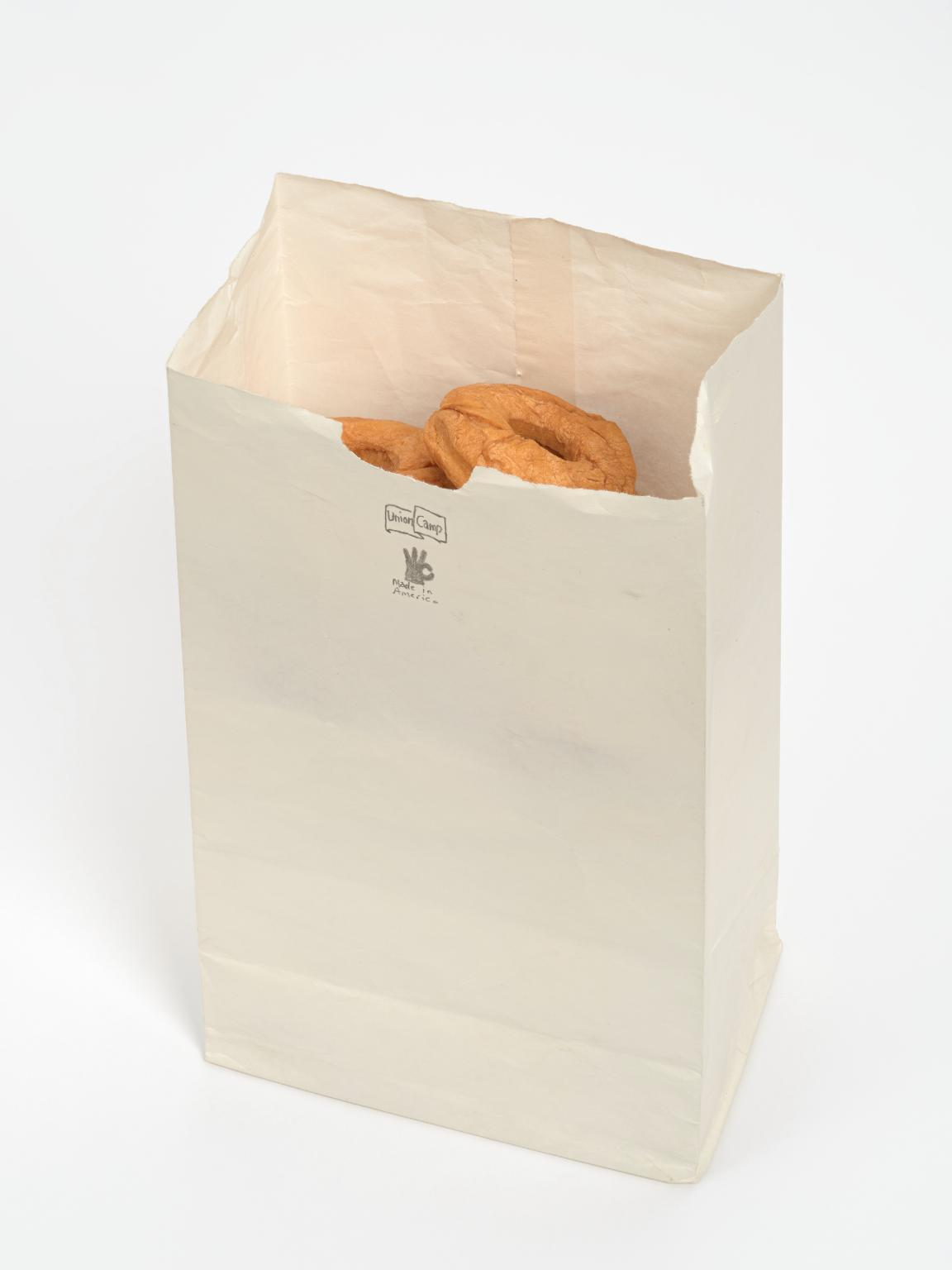
Robert Gober, Bag of Donuts, 1989

Like Dorian, I retired from Hendrix College last May. One of the joys of retirement has been more time to read. With more free hours in the day and no class prep I’ve been able to read gluttonously, leisurely-ly, reminding me of how I read as a child in our long low house on the bayou—stretched out for hours at a time with a book, changing position whenever a propping arm got tired. Once, I remember, I was performing the cliché of reading late into the night with a flashlight under the covers (I’m not sure where I even got this idea) when my father walked in and flipped on the light. “What in the world are you doing? We don’t mind if you stay up and read, but for heaven’s sake don’t strain your eyes.” [Ed. – Good Dad.] My body is bigger and creakier now, but the sense of abandon, of decadent pleasure in reading, is much the same.

In 2025 a third of the books I read happened to be memoirs, and of these, as I followed my nose and my algorithms, one-third were by chefs, restaurateurs, or gastronomes [Ed. – gastrognomes, you say???]. My favorites are as good a way as any to start off this list.

Best food-related memoirs:

  • Most Likely To Make You Hungry, Make You Laugh, and Make You Want To Cook: Stanley Tucci, Taste: My Life Through Food and What I Ate in One Year (and related thoughts) – Pure delight. I love this guy. He’s unpretentious, exuberant, and funny.
  • Most Likely To Make You Wince: Keith McNally, I Regret Almost Everything – Frank, well-written, painful and witty by turns. An inside scoop on the restaurant business.
  • Most Likely To Make You Drop Everything and Move to Southern France: Peter Mayle, A Year in Provence, Twenty-Five Years in Provence, Toujours Provence [Ed. – Blasts from the 90s past!]

Best non-foodie memoir:

  • Amy Liptrot, The Outrun – The narrator leaves her dissipated twenties in London and returns to Orkney, in far northern Scotland, to find her footing. Interesting setting, well written.

Best novels:

  • Kiran Desai, The Loneliness of Sonia and Sunny – For many years Desai’s previous book, The Inheritance of Loss (2006), has been my favorite novel; I’ve waited with much anticipation to see what she would do next. The wait was not short. But Loneliness, which was shortlisted for the Booker Prize, is so worth every bit of time Desai took to conceive and compose it. It’s a big, complicated book about art and identity and love and family and borders. Along with the big themes, she remains fantastic at rendering small moments: passing observations and exchanges so apt and droll you want to keep them at your fingertips.

In fact, this book has many of the same qualities that shone in Inheritance: sly humor, exasperating minor characters who unexpectedly endear themselves to you, and tensions between isolation and community, truth and cant, haves and have-nots. But over two decades those polarities have become more extreme and their effects more pernicious. Desai’s sensibility has grown more weary and embittered (hasn’t everyone’s?) [Ed. – yes], and to encompass all it sets out to, this new novel is necessarily larger, messier, more brooding and less ebullient.

  • Kevin Barry, The Heart in Winter – Irish love story meets American Western. [Ed. – Good description, good book.]
  • Niall Williams, This Is Happiness and The Time of the Child – Wonderful reads, with an Irish lilt to the prose that only deepens enjoyment. These are connected and I recommend starting with This Is Happiness.
  • Megha Majumdar, A Guardian and a Thief – A nail-biter set in the all-too-believable near future; the writing is strong and fresh. For instance: I happen to be aware that there are lots of saccharine quotations out there about hope (even by Dickinson!—“‘Hope’ is the thing with feathers…”—ugh). [Ed. – Surprising fighting words!] Majumdar’s take on hope is gloriously unsweet:

Hope for the future was no shy bloom but a blood-maddened creature, fanged and toothed, with its own knowledge of history’s hostilities and the cages of the present. Hope wasn’t soft or tender. It was mean. It snarled. It fought. It deceived. On this day, hope lived in the delivery of gold to a man who might be a scammer, and, perhaps, hope lived also in opening the doors to a thief.

Another great line:

He [the interloper] smelled of the soap Dadu [the protagonist’s father] had used, palming old sliver to new bar, decade after decade.

“Palming old sliver to new bar, decade after decade”—I know Dadu from that line, as well as if I smelled his soap scent. [Ed. – Indeed! And “palming,” which I only usually hear in reference to cards, makes it sound like he’s doing something a bit disreputable.]

Runners-up: Another near-sweep for the Irish!

John Boyne, Mutiny: A Novel of the Bounty [Ed. – Allowing this only because it’s you, Hope. We don’t like the Striped PJ man around here.]

Cólm Toibín, Nora Webster

Mary Costello, Academy Street

Weike Wang, Rental House

Most Unusual Best Novels:

  • Isabel Cañas, Vampires of El Norte – I thought I didn’t like vampire novels. Yawn. But this novel serves them up veiled in themes of colonialism and environmental exploitation, while also working well as a love story and as plain old horror. [Ed. – Horror one of the most vital genres right now!]
  • Samantha Harvey, Orbital – Great premise for a novel, and so many stunning descriptions—but too many plotlines are left flying at the end.

Best Classic That Stands Up to Time:

Willa Cather, Death Comes for the Archbishop – Bestowing superlatives in literature is kind of silly, ever more so as time goes by. Still, if I were forced to name the Greatest American Novelist, I would say Willa Cather. In this novel Father Jean Latour, a French-born priest, gets appointed to serve a vast area of New Mexico just after its annexation. His life in Santa Fe provides the central narrative, and on this armature Cather strings a number of side stories that she took in during her long visits to the area—some harrowing, some strange, stories of depravity or folly or pity, but all told with her characteristic quietness and exactitude. A lesser writer might have expanded one or two of these to fashion a more conventional main plot, say the story of the lost El Greco, or Father Latour’s lifelong dream of building the Santa Fe Cathedral. But Cather avoids imposing such a goal-driven form. The more organic structure that she chooses instead keeps our attention on the place and its inhabitants, emerging gradually into solidity. [Ed. – Such an enticing description!]

One of the book’s brilliant strokes is its prelude on a terrace in Rome, where over dinner three Cardinals and a Bishop are hashing out the jurisdiction of these territories so remote they might as well be on another planet. After this the novel returns to Europe only in brief flashes. Yet these bits of Old World context, in a novel about the relentless development of the American West, are somehow key to its power.
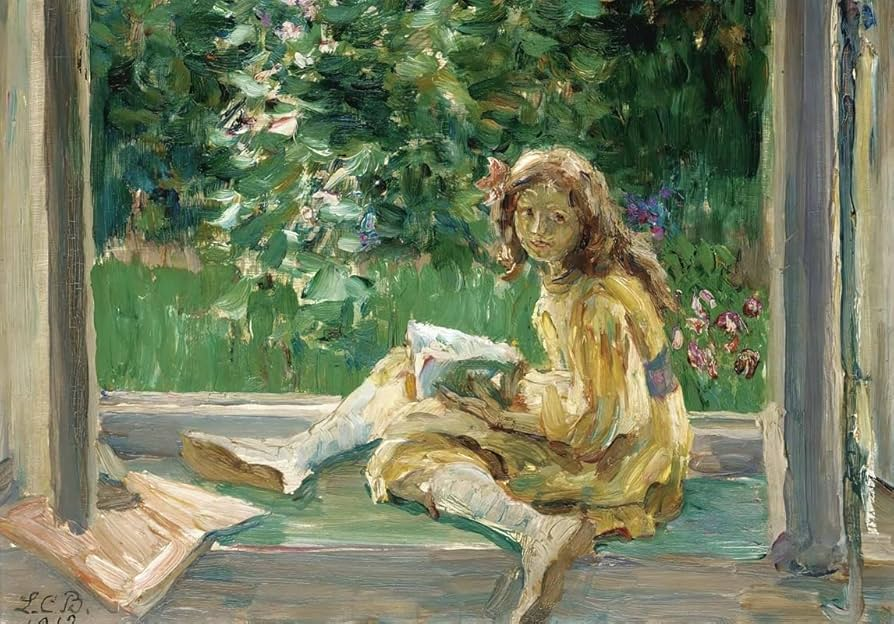
Louise Catherine Breslau, Young Girl Reading by a Window, 1912

Series That Never Disappoint:

Robert Galbraith,* Cormoran Strike series | new in 2025: The Hallmarked Man

Michael Connelly, Harry Bosch and Renée Ballard series | new series in 2025 set on Catalina Island: Nightshade

These series are my jam: character-driven investigator mysteries possessed of zest and depth. Authentic settings, dialogue that people would actually say, multiple unfolding plots.

*Yes, Galbraith is aka J. K. Rowling, and yes, she is toxic on the subject of trans rights. I’m shocked by how a writer with her insight and empathy into human character can be so hateful toward an entire subjugated group of people… yet I continue to love her books. Read Monsters: A Fan’s Dilemma by Claire Dederer if you judge me for this or if you too struggle with this conundrum. [Ed. – I don’t judge you, but I had to give up these books, which I very much enjoyed because she really seems a terrible person, and TERFs suck. I would like to read the Dederer, though.]

Best Potato Chip Fiction:

This is my husband’s term for books that may not be the highest order of literature, but they’re well done and so satisfying to read that you just keep ingesting them like potato chips that you can’t stop eating.

Lian Dolan, Abigail and Alexa Save the Wedding – I’ve gone on to read a few more of Dolan’s books, but this one is my favorite, with little gems of observation such as:

Alexa was one of those women who had aged in place, meaning that Abigail could still see the eighties undergrad and the focused career gal and the bold single mom in her sixty-something face. Some people disappeared into their later years’ appearance, no trace of their young days left, thanks to injectables and surgery. But not Alexa. She was all she had been.

Lisa Jewell, The Night She Disappeared, Don’t Let Him In, etc. [Ed. – I have been eyeing these…]

Best Nonfiction:

Lynne Olson, Madame Fourcade’s Secret War: The Daring Young Woman Who Led France’s Largest Spy Network Against Hitler

Elizabeth Letts, The Ride of Her Life: The True Story of a Woman, Her Horse, and Their Last-Chance Journey Across America

Liza Mundy, The Sisterhood: The Secret History of Women at the CIA

Jordan LaHaye Fontenot, Home of the Happy: Murder on a Cajun Prairie

Most Depressing Nonfiction:

Kirk Johnson, The Feather Thief: Beauty, Obsession, and the Natural History Heist of the Century – Just typing the title, I get depressed all over again. [Ed. – Well, you made me look this up and now I’m intrigued. We really need a moratorium on these nonfiction book subtitles, though.]

Nonfiction Most Guaranteed to Make You Grip the Arms of Your Chair and Be Relieved They’re Not the Gunwales of a Boat:

Hampton Sides, The Wide Wide Sea: Imperial Ambition, First Contact and the Fateful Final Voyage of Captain James Cook

Children’s Notables:

For a middle-grade novel I’m writing, I’ve been reading some classics of that genre. Here are three that I read or reread last year that wowed me.

William Pène duBois, The Twenty-one Balloons – I loved this inventive book as a kid, and turns out I still do.

Marguerite de Angeli, The Door in the Wall – How did I miss this one during my middle-grade years? Maybe I thought I didn’t like medieval settings: they’re so often gussied up with stale trappings of fantasy. But here the world-building feels solid and genuine. Good read.

Ann Petry, Harriet Tubman: Conductor on the Underground Railroad – Before reading this I knew only the broad outlines of Tubman’s life, and the fuller story blew me away. It’s billed as a young adult book, but nothing about it felt juvenile. Highly recommend. [Ed. – Fascinating! I did not know Petry wrote for children, too. I will pick this up.]
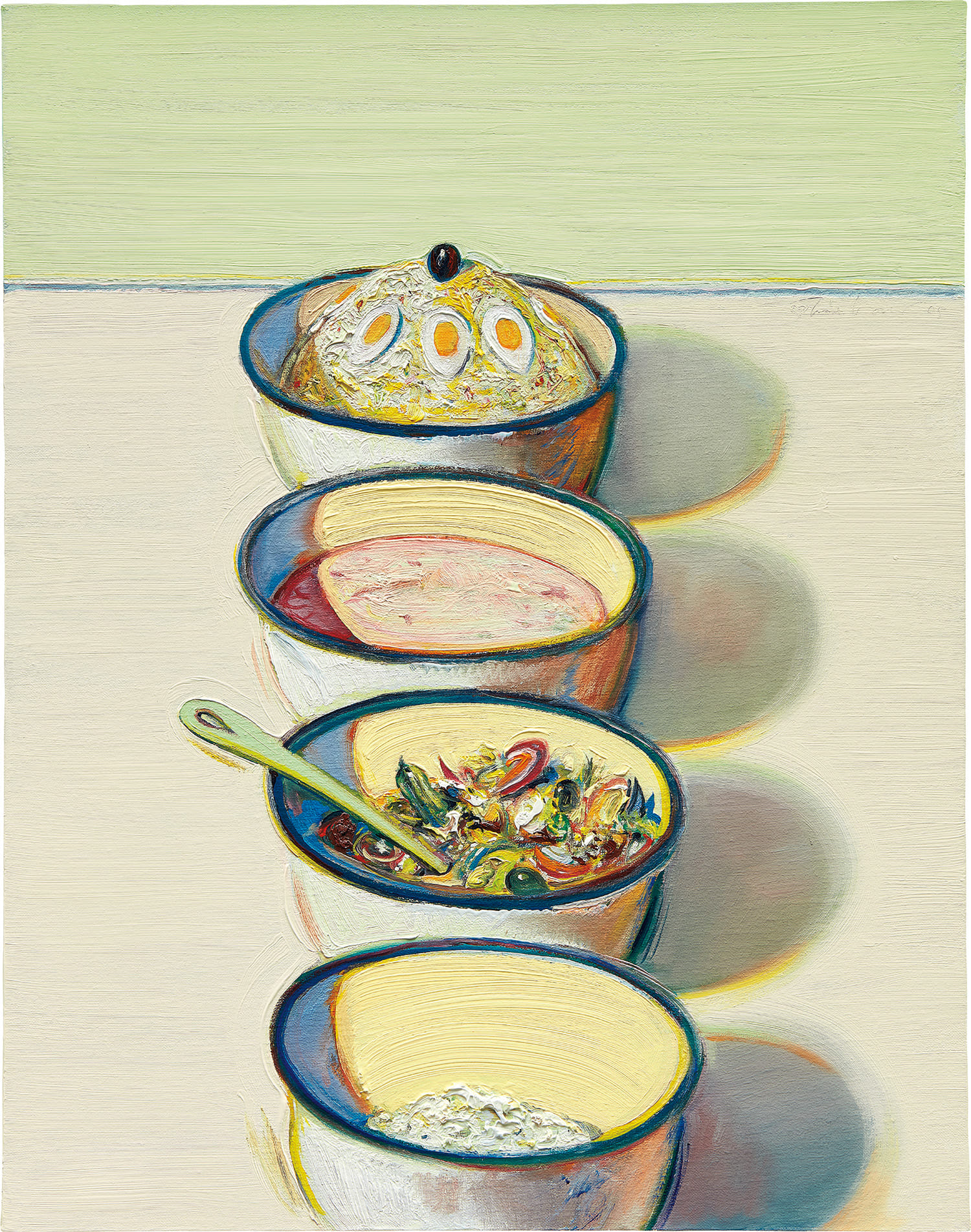
Wayne Thiebaud, Food Bowls, 2005

Thanks for reading; I welcome your comments on any of the above! And thank you, Dorian, for keeping this wonderful blog and for giving me a turn in your bully pulpit. [Ed. – Ha, nowhere near influential enough for that! Thanks for this piece, Hope!]

“Nothing but Land”: Willa Cather’s My Ántonia

znxuVkJ

How I’ve lived 45 years without reading Willa Cather I do not know. But now that I’ve read My Ántonia (1918)—some impulse made me slip it into my suitcase just before leaving for vacation last month—I plan to make up for lost time. Because if this book is anything to go by, Cather is the real deal. As much as I’m chagrined to have taken so long to read her, I’m excited that there’s quite a lot of her to read.

(The other night I read the first 30 pages of O Pioneers!—clearly, she was a genius right from the start. If you have a favourite, let me know in the comments.)

Two things about My Ántonia really struck me: its descriptions of the Nebraskan prairie in the late 19th century, and its unusual narrative structure.

The book is narrated by a man named Jim who shares Cather’s biography; like Cather, Jim leaves his home in Virginia at age nine or ten (unlike Cather, he is orphaned) and goes to live with relatives in Nebraska, back when the land was barely plowed and not at all fenced in. My Ántonia is filled with evocative descriptions of the landscape, in its beauty and menace.

Consider this famous passage, from the end of the first chapter. Jim has arrived in the middle of the night at the station in Black Hawk, Nebraska, where he’s met by his grandfather’s hired man. He’s tucked into a kind of bed in the straw of a farm wagon and sets out on the long journey to his grandparents’ homestead:

Cautiously I slipped from under the buffalo hide, got up on my knees and peered over the side of the wagon. There seemed to be nothing to see; no fences, no creeks or trees, no hills or fields. If there was a road, I could not make it out in the faint starlight. There was nothing but land: not a country at all, but the material out of which countries are made. No, there was nothing but land—slightly undulating, I knew, because often our wheels ground against the brake as we went down into a hollow and lurched up again on the other side. I had the feeling that the world was left behind, that we had got over the edge of it, and were outside man’s jurisdiction. I had never before looked up at the sky when there was not a familiar mountain ridge against it. But this was the compete dome of heaven, all there was of it. I did not believe that my dead father and mother were watching me from up there; they would still be looking for me at the sheep-fold down by the creek, or along the white road that led to the mountain pastures. I had left even their spirits behind me. The wagon jolted on, carrying me I knew not wither. I don’t think I was homesick. If we never arrived anywhere, it did not matter. Between that earth and that sky I felt erased, blotted out. I did not say my prayers that night: here, I felt, what would be would be.

This is such a careful melding of physical and emotional geography, the featureless but evocative and powerful landscape mirroring, even inciting, a kind of acceptance of fate and loss. There’s something artless about the prose here, helped by the child’s perspective, though Cather doesn’t stay entirely within this point of view: that brilliant description of the prairie—“not a country at all, but the material out of which countries are made”—seems to come from a more mature perspective. But the vivid descriptions of the landscape here and elsewhere in the book (terrible blizzards, glorious sunsets, lazy summer days by the river) aren’t simply offered for their own sake. Instead they are central to the book’s narration. Writing about a place in which indistinction or lack or differentiation is one of the dominant features seems to have allowed Cather to think in interesting ways about what it means to structure a story. Could she write a novel that didn’t follow the usual landmarks of fiction?

maxresdefault

In the introduction to the Penguin edition I read, editor John J. Murphy cites what I expect is a famous passage in Cather studies. Reflecting on her life, Cather describes how she took the advice of the famous New England writer Sarah Orne Jewett, who, when they met in1908, urged her to write about Nebraska:

From the first chapter, I decided not to “write” at all—simple to give myself up to the pleasure of recapturing in memory people and places I had believed forgotten. This was what my friend Sarah Orne Jewett had advised me to do. She said to me that if my life had lain in a part of the world that was without a literature, and I couldn’t tell it truthfully in the form I most admired, I’d have to make a kind of writing that would tell it, no matter what I lost in the process.

Reading these lines after having finished the book, I thought they helped explain the uncertainty My Ántonia had incited in me. What kind of a book is this, I kept asking myself. I loved it from the start—it seemed like a more sophisticated and less politically troubling version of the Laura Ingalls Wilder books I’d adored as a child—but once I reached the halfway point I became increasingly puzzled. Why was the book telling me what it was telling me?

Jim’s ostensible purpose is to tell the story of the oldest daughter of the other family that had disembarked at Black Hawk with him that night, the Shimerdas, immigrants from Bohemia. From the start Jim is smitten with Ántonia, who has a kind of vivacity, a life force, for lack of a better term, that almost singlehandedly allows her family to survive the difficult and dangerous first years in a new country.

But as the book continues, Jim becomes more important to the story; as a man he has opportunities the many women in the novel (the characters it actually cares about) don’t. (Although this is a novel filled with powerful female characters.) Jim grows up, becomes enmeshed in the social life of the town his family moves too when he is a teenager, and eventually, as Cather did, makes his way to Lincoln to attend university. As Jim’s experience takes center stage, I thought the book might become a kind of second-rate Bildungsroman. I say second-rate because Jim isn’t a particularly interesting character. For a time he is involved with another eldest daughter of an immigrant family, a woman named Lena who Jim and Ántonia had known from childhood. For a time I thought maybe the book was going to become about her. (She’s quite fascinating.) But when that didn’t happen, I couldn’t figure out where Cather was trying to go. There didn’t seem to be any forward momentum, and the vivid descriptions of survival on the prairie that had so captivated me faded as the characters gained greater economic and cultural security.

At about this time I was lucky enough to have lunch with Joe from Roughghosts. Over pancakes and eggs, I started complaining about Jim. Why did Cather need him as a narrator? If Ántonia couldn’t tell her own story—and her inarticulateness, which is never understood by the book as a failure, suggests she couldn’t—why didn’t Cather make someone even more like herself the narrator? Specifically, why didn’t she use a female narrator?

Joe gently pointed out that I was missing the point—through Jim’s relation to Ántonia, Cather, who loved women all her life, possibly unrequitedly, I don’t know enough about her to say for sure, had found a way to queer her tale. Jim allows her to tell the book’s real story—about her own love for women, especially women like Anna Sadilek, the model for Ántonia—in a way that is at once more socially acceptable but also ultimately more interesting. Jim never gets together with Ántonia, never gets together with Lena, who for a time seems like a more or less satisfactory replacement for Ántonia (though, as I said, who is plenty interesting in her own right and exceeds our or at least my expectations for her). In other words, My Ántonia entirely avoids compulsory heterosexual romance. Well, almost. In the last chapters we return to Ántonia, who has, after a terrible experience, found a lovely, gentle man, married him, and produced a whole brood of children who the grown up Jim, now an unhappy Eastern sophisticate, spends his summers visiting, even becoming something like a sibling to them.

But this heterosexuality is almost invisible. (It is the privilege of heterosexuality to be invisible in the sense of being normalized, that is, accepted as the default state of things, but what I mean here is that it is invisible in and unimportant to the workings of the plot.) Ántonia’s remarkable fecundity is divorced from sexuality—her magnificent brood seems to have sprung directly from her own vivacity. I was struck by this description from the scene in which Jim first re-encounters Ántonia:

Ántonia and I went up the stairs first, and the children waited. We were standing outside talking, when they all came running up the steps together, big and little, tow heads and gold heads and brown, and flashing little naked legs; a veritable explosion of life out of the dark cave into the sunlight. It made me dizzy for a moment.

If sexuality is anywhere here it is in the bodies of the children (“flashing little naked legs”), but I don’t think we’re to imagine that Jim desires them—as I said, if anything he desires to be them, and in fact does so, I would argue, at the end of the book. Indeed, sexuality is almost always bad in this book—a sub-plot involving an attempted seduction, leading to a murder suicide brings this fact home.

What is valued instead is something like friendship or admiration, ostensibly between men and women but actually, it seems, between women and women. Yet even as I say that, I don’t think it’s correct. The book doesn’t just use Jim as a way to disguise Cather’s love for women. The book’s weirder than that. It’s about intense emotional currents, strong affections that don’t have any name. Friendship is the best we have but it’s a pretty paltry term for the relationship between Jim and Ántonia, who mean so much to each other but who spend most of the book living such different lives. And yet the book never presents their relationship as a missed opportunity. It’s not that they were meant for each other and should really have got together. After all, Ántonia seems perfectly content, inasmuch as that matters, with her husband. The more I think about the book the more strange, intense relationships it seems to contain: a lot could be said about Peter and Pavel, two Russians who flee to America after a terrible (and incredibly exciting, as well as stylistically distinctive—folkloric rather than realist) incident in which a wedding party is chased and mostly devoured by wolves. What’s going on with those guys?

I suppose this interpretation, if I can grace these thoughts with that term, would need to take into account the book’s title. What’s implied by the possessive? (My Ántonia.) We tend to think of ownership as being connected to domination. Certainly Jim has a lot more conventional societal clout (money, education, status) than Ántonia. But is she really his? She doesn’t seem to need him, or to be subservient to him. How does the non-normativity I’m arguing for include the possessiveness of the title?

Writing this post has made me want to read the book again, this time with pencil in hand in a more determined effort to understand its various parts. (I was on vacation when I read it, after all.) But I stand by my sense that the book’s depiction of landscape is connected to its interest in non-normative relationships, which leads it to take up a seemingly haphazard, even careless, and ultimately fascinating narrative form. I loved My Ántonia for the way it kept wrong-footing me and entertaining me as it did so.