Friends, I am here to apologize to Matt Keeley, who wrote this great piece for me many months ago and has waited patiently (or maybe fumed silently) for me to publish it. I have no good excuse: I got busy and forgot. Terrible. Anyway, this really is a case of better late than never.
Matt is a freelance writer living in Boston.
Ilse Bing, East River with Boat, New York (1936)
Being a reader and working with books can, oddly enough, feel like mutually exclusive propositions. I spent most of 2024 underemployed, but what work I had before starting a new full-time job in October was mainly book-related. I copyedited and wrote pitches for a Dutch literary agency; I did brief manuscript reports for a literary scouting firm; I did occasional reviews for Reactor, The Washington Post, and The Boston Globe. I spent so much time on “professional” reading, including dozens of titles that I would normally have no interest in, that my personal reading suffered.
E.L. Doctorow’s Ragtime was not the book I expected it to be: one somehow doesn’t expect a book this strange to sell a million copies, end up on movie screens, and inspire a Broadway musical. This is an almost essayistic historical novel, with an intrusive and opinionated narrator, major characters who go titled (Father, Mother, Younger Brother) but unnamed, and plot lines that don’t tangle so much as split. Henry Ford and JP Morgan discuss reincarnation in front a stolen Egyptian mummy; Emma Goldman befriends a notorious “kept woman;” in the epilogue, we learn that one character gets killed in the Mexican Civil War, that another sinks with the Lusitania, and that a third creates the Little Rascals franchise. It’s a deeply weird book. [Ed. – Colour me intrigued…]
The movie, incidentally, is quite good, with James Cagney’s final performance, an uncredited appearance by a young Samuel L. Jackson, and Norman Mailer as an ill-fated libidinous architect. I wonder how many New York literati of the 1980s especially enjoyed watching his death scene? [Ed. – Probably still satisfying today.]
Ruth Scurr’s John Aubrey: My Own Life is an unusual biography that repurposes the words of the great antiquarian and his contemporaries to create a sort of hypothetical autobiography. There’s much that remains unknown about Aubrey’s life, and Scurr would rather leave open a gap than speculate. That means, for example, that we get more about the stones of Avebury than we do about Aubrey’s romantic life, more tossed-off preference than deeply felt emotion. This is an eccentric book about an eccentric man; most readers won’t much like it, but a few, like me, will love it. [Ed. – In the immortal slogan of Halifax’s Alexander Keith’s brewery: “Those who like it, like it a lot.”]
Gone: The Last Days of The New Yorker is Renata Adler’s score-settling memoir about the departure of William Shawn, the arrival of Robert Gottlieb, and the eventual appearance of Tina Brown. At one point, Adler compares Adam Gopnik to Anthony Powell’s Widmerpool. If you recognize the names in the last few sentences, you’ll likely enjoy this book, even if you don’t entirely trust it. Otherwise, you’d best avoid.
Rejection by Tony Tulathimutte is the dirtiest book I’ve read in ages. [Ed. — !] It seemed to come out of nowhere: I’d never heard of book or author until an editor asked me to review it. I invoked Philip Roth in my review, and I stand by that comparison:
Its heights, or depths, of exuberant filth reminded me of Philip Roth in Portnoy’s Complaint or Sabbath’s Theater. Like Roth, Tulathimutte knows desire can be as ludicrous as it is urgent; like Roth, he likes a good dirty joke.
Other highlights of 2024’s reading include:
Peter Straub’s Koko, a serial killer story with fine writing, memorable characters, and all too much exoticizing of the mysterious Orient [Ed. – It’s so mysterious tho]
Six of Georges Simenon’s Maigret novels — I really need to get back to the romans durs soon, but there’s something comforting about Maigret even when the plots are, in fact, quite harrowing
Amit Chaudhuri’s A Strange and Sublime Address, his first novel, as elegantly written and absorbingly plotless as later books like Friend of My Youth and Sojourn [Ed. – Read this last year as well: good stuff]
Paolo Bacigalupi’s Navola, the sequel to which cannot come soon enough. (Dorian — There’s a strong Guy Gavriel Kay influence here. I think you’d like) [Ed. – I appreciated this tip enough to check it out of the library—it indeed looks quite my thing—but not, apparently, enough to read it yet…]
M.T. Anderson’s Nicked, a fantastical medieval heist novel and queer romance [Ed. – Octavian Nothing was fantastic.]
Adam Roberts’s Lake of Darkness, a science fiction novel about Satan, post-scarcity, and what happens when you let AI do all your thinking
Howard Norman’s My Darling Detective, a thoroughly charming tale hampered only by the author’s difficulties with continuity and his editor’s failing to notice the innumerable discrepancies and inconsistencies. Read for the vibes, not the details. [Ed. – Yikes!]
Two that got away
One sad effect of all my book work was that I struggled to finish long and complicated books. I got maybe eighty pages into Oakley Hall’s classic Western Warlock before I gave up. The prose so fine, the type so small, the pages so numerous: I enjoyed and admired the book, but it took two weeks to traverse less than a hundred pages. [Ed. – Ha! Nicely put! It’s not easy, that one. Took me a while to fall under its spell.] I felt myself losing the thread, and put the book back on the shelf for a less fraught day.
Something similar happened with Iris Murdoch’s The Black Prince, which I’ve had on my shelves since 2007. In a burst of optimism, I’d bought three Murdoch paperbacks when I was a college student studying abroad in Dublin. I quickly read A Severed Head and hated it, and so The Sea, the Sea and The Black Prince sat unread for more than a decade. I knew, however, the problem was more with Matt than with Murdoch, so every year I vainly promised myself I’d give Murdoch another shot. When I finally took the plunge last June, I was thrilled to find that The Black Prince was smart, funny, and satirical, bursting with memorable images and sparkling with ideas. Except, once again, I found myself losing the thread and regretfully set the book aside.
I ended up reading The Bell, another Murdoch, in January of 2025. Perhaps I’ll get through The Black Prince later this year? [Ed. – Because it took me so damn long to get this up, maybe he has!]
John Constable, Cloud Study
Last year’s books, this year
Finally, there are a few 2024 books that I bought and fully intended to read, but haven’t quite gotten around to. First is Percival Everett’s James, a novel which sold a million copies and made nearly as many end-of-year lists. I’ve enjoyed Everett’s past novels and I’m sure I’ll tear through this one when I get around to it. Incidentally: I wonder when Everett’s next book will be? He usually seems to write about a book a year; I wonder if they’re holding off publication until James sales begin to taper off?
Next is Cahokia Jazz by Francis Spufford. I pitched it for review, but the pitch was declined. [Ed. – Boo!] I’m reading it now and am impressed: It’s simultaneously a murder mystery, a literary novel, and an alternate history. Spufford dedicates the book to “Prof. Kroeber’s daughter;” I wonder if Prof. Kroeber makes an appearance in the book. The period is right, Kroeber was an anthropologist interested in Native Americans, and there are lots of Native American characters in the book. [Ed. – SO good!]
Last is Ed Park’s Same Bed Different Dreams, which looks to be a polyphonic metafictional conspiratorial genre bender. I’ll probably turn to this once I finish Cahokia Jazz. [Ed. – Also good, with plenty of hockey. Thanks, Matt! Sorry again for dropping the ball!]
Chava Rosenfarb was born in Lodz in 1923 to parents enmeshed in the life of the Bund, a political and social justice movement that flourished in interwar Poland. In contrast to Zionists, Bundists believed that Europe could and should remain central to the future of Jewish life. Economically, they embraced socialism. (Bundism thrived in the highly Jewish, highly urbanized cities of Poland, especially Lodz, a center of textile manufacturing regularly compared to Manchester.) Linguistically, they championed Yiddish over Polish or the Hebrew that Zionists, aimed to resurrect. Spiritually, they turned Judaism’s emphasis on reparation (the messiah will not arrive until we have perfected the world) to social justice ends in their own community.
Like every other Jew her age in Poland, Rosenfarb’s education was interrupted when Germany invaded in September 1939. A few months later, she was interned with her family in Lodz’s sealed ghetto. Amazingly, she, her sister, and her parents remained together until the final liquidation of the ghetto in the late summer of 1944. Along with some friends, the family had prepared a hidden space in their apartment building; more than 20 people crammed into it in those final days. Although they escaped notice for more than three days, their luck eventually ran out and they were deported to Auschwitz. Rosenfarb’s father was separated from them at the ramp: they never saw him again; she would later learn that he died in an allied bombing raid in Germany in the last days of the war. The Rosenfarb women were sent to Sasel, a work site in a Hamburg suburb, where they rebuilt roads for several hard and cold months. Early in 1945 they were deported again, this time to Bergen-Belsen, where Rosenfarb, sick from the typhus infestation that swept that notoriously chaotic place (all camps were disaster zones in the last weeks of the war: the situation in Belsen was perhaps the most terrible of all), clung to life, more dead than alive, when the camp was liberated in April.
Remarkable experiences as a DP and an illegal alien in Belgium followed; by 1950 the Rosenfarbs, along with a man Chava had known in Lodz, reencountered in the ruins of postwar Germany, and later married, secured visas to Canada. (That man, Henry Morgenthaler would later champion the cause of legal abortion in Canada, becoming, in my 1980s childhood, a figure equally reviled and admired. My mind exploded when I learned this connection.) The refugees settled in Montreal, where Rosenfarb would spend most of the rest of her life. In this new world, along with caring for her mother and raising her children, Rosenfarb continued the writing she had begun in the Lodz ghetto. After poems came novels and short stories, her efforts culminating in her three-volume fictional chronicle of the Lodz Ghettto, The Tree of Life (1972, translated into English by her daughter, Goldie Morgenthaler).
I learned all this and more in a wonderful course offered by the Yiddish Book Center, spurred by the publication of her collected short stories (excellent, especially the dramatic “Edgia’s Revenge,” which I immediately added to my syllabus). The Center offers courses and talks regularly; check them out if you have any interest in all things Yiddish.
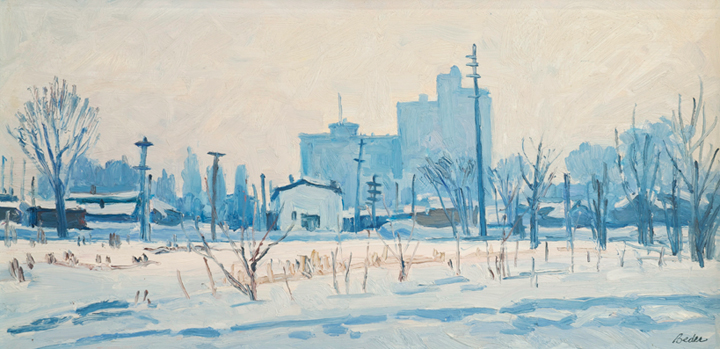
Jack Beder, Winter Morning, 1972
Rebecca Donner, All the Frequent Troubles of Our Days (2021)
Mildred Harnack née Fish grew up in Milwaukee to an intermittently employed father and a mother who was a stenographer. In the 1920s she attended the University of Wisconsin, where she met Arvid Harnack, an economist and jurist from Germany who could, unlike any man she had met before, match her as much in the seminar room as on the dance floor. By 1929 the young couple—they had married three years earlier—was living together in Berlin. Mildred would return home only a handful more times. Berlin was exciting, even for a poor couple like the Harnacks. All kinds of change seemed possible. But the rise of the Nazi party threatened all that. Mildred was fired from her position teaching American literature in 1932 because of her opposition to the party, even though it would not come to power until the following year. Needing to find work, Mildred took a job teaching working class students at night school. She loved her students, believed in their ability to transform their lives, and eventually recruited some of them as central figures in a resistance movement that she and her husband began building in the early years of the regime. The circle, as she called it, met to share ideas, often over book discussions, and distributed leaflets denouncing Nazi policies. It was loosely aligned with other resistance movements, including the one that included the pastor Dietrich Bonhoeffer, a cousin of Arvid’s, and the one led by Harro Schulze-Boysen and Libertas Haas-Heye, which eventually led Arvid to pass on military secrets he gained from his work in the Reich Ministry of Economics. Rebecca Donner, who happens to be Mildred’s great-great-nice, tells the story with flair and sympathy.
I found it fascinating to compare Donner’s book to Norman Ohler’s Bohemians, in which Mildred is a bit player. Donner has much less sympathy with Haas-Heye than Ohler does—which makes sense since Haas-Heye ratted Harnack and the others in the so-called Red Chapel group out. It seems she was duped by a supposedly sympathetic secretary in the jail where she was held in custody—but duped rather easily, Donner implies.
Earlier in the 1930s, Mildred befriended Martha Dodd, daughter of the US ambassador. When Dodd was replaced, she became close to the wife of the new First Secretary, whose son, nine-year-old Don Heath, Jr., acted as a courier, carrying clips of paper in his backpack from his English lessons with Mildred (whom he adored) to his father. Typically, those messages consisted only of a time and place where Mildred or Arvid could meet with Heath to pass on information in person.
This work was dangerous, of course, and it some sense it was only a matter of time before she and Arvid were found out. Had the group’s Soviet handler not been so clumsy, they may have escaped detection. When they realized their cover had been blown in September 1942, the couple tried to get to Sweden, but they were arrested in East Prussia the day before they were to set sail. Mildred’s initial six-year prison sentence was overturned by Hitler himself. A new trial sentenced her to death; she was executed by guillotine in February 1943.
As its title implies, nothing is comforting about the subject matter of All the Frequent Troubles of Our Days. It’s a sad book. In her final days Harnack was miserable: eaten by lice, beaten by guards, almost unable to speak to the fellow prisoners who admired her. But grief and despair shadowed her long before her arrest; I was moved by the cost of Harnack’s convictions. Her commitment—compounded by her inability to say anything, lest it further endanger her—destroyed her relationships with almost everyone, especially her American family. By the end, Harnack has the remarkable but unenviable distance from the world of someone like Simone Weil. Donner admires her great-great-aunt, and makes us admire her, too. But she has the guts to admit that principled resistance to injustice can lead to the calcification of so much that is human. How painful to see the erosion of that Wisconsin college girl, wide-eyed and full of the desire to teach and to learn, in love with a man and the world. How loving and patient of Donner to have resurrected her.
[An aside: Donner relies heavily on William Shirer’s diaries. That surprised me: he seems so old-fashioned. Who reads The Rise and Fall of the Nazis anymore? But Donner knows what she’s doing: based these excerpts, he was a hell of a writer.]
Emily Tesh, Some Desperate Glory (2023)
The always reliable Adam Roberts tipped me on to this in his annual sff recap in The Guardian. Then Ian Mond praised it too. The Venn diagram of their tastes is close to being a circle, but everything in it is top-notch. Roberts calls Some Desperate Glory “a blend of space opera and military SF that refreshes both modes,” which sounds exactly right to me, even if I still don’t quite know what those terms mean.
Kyr has come of age on Gaea Station, the last redoubt of humanity after earth is destroyed by alien species who have decided that humans are irredeemably violent. (I mean, not wrong.) Her seventeen years have been marked by submission, dedication, and toughness, to others but above all to one’s self. Food is fuel; rest mandated so the machinery of the body and the station can keep going; families are split apart, the children, bred to emphasize traits necessary for survival, are raised in same-sex age cohorts after they leave the nursey.
Gaea, it becomes clear, is Sparta.
And Kyr loves it.
Along with her twin brother, she is the best of the best: fast, strong, smart, zealous, loyal to the cause. Yes, her “siblings” hate her—she’s always ratting them out and pushing them to exhausted, shameful tears—but such toughness is needed for humanity to enact its revenge. As the date of her cohort’s graduation approaches, Kyr can’t wait for her assignment. She knows she’ll be named to the warrior caste. And then she’ll be able to throw off her only black mark: a family history of treachery. Ten years earlier, her older sister fled the station with her infant child, probably for a planet where the aliens let humans live on sufferance, symbolically neutered, as pathetic as lap dogs. When Kyr’s assignment comes back all wrong—her shock compounded by the news that her brother has been selected for an even more prestigious, albeit suicidal mission—she hatches a plot to follow him. The journey will eventually revise her entire sense of the universe.
I admired Tesh’s accomplishment here: she lets us to read against Kyr (we know she’s more than insufferable: the perfect fascist, really) even as we can understand her zeal for her embattled mission. (I say “we” but a quick glance at Goodreads—I remembered why I never do that—shows me that Tesh’s skill with POV is lost on some readers…) In a brief afterword, Tesh lists some of the works she consulted in writing Some Desperate Glory: books on North Korea, Paxton’s classic study of fascism, and Lawrence’s Wright expose of the handful of people who have escaped scientology. All of which allows her to pull off her greatest trick: like Kyr, readers too are deprogrammed, the “facts” of the novel’s world cast into new light as we proceed. An unpredictable quest story follows, with plenty of plot twists and heart-in-mouth moments. (I was on the verge of tears by the end.) Queer love stories, found families, alternate realities: all the things contemporary sff is known for come into play. Good stuff.
Walter Kempowski, Marrow and Bone (1992) Trans. Charlotte Collins (2018)
Marrow and Bone might be the least terrific of the three Kempowskis I’ve now read, but it’s still very good. (Don’t start here, though.) Jonathan Fabrizius is a freelance writer who, thanks to a small stipend from an uncle, lives in charming modesty in 1980s Hamburg, sharing one of those impossible German apartments (carved up willy-nilly from a grander space, bathrooms in the hall, no kitchen to speak of) with a girlfriend who has given up on him. Out of the blue, an invitation comes from, of all things, the organizers of a road rally across the former East Prussia: they want Jonathan to write about the sights attendees might enjoy as they follow the racers from east to west. Jonathan accepts with alacrity: he needs the money, but he also has ties to the region. His companions are a former racecar driver and a representative of the event organizers. Like all picaresques, Marrow and Bone shambles from one incident to another, most of which at first seem consequential, even dire, but prove to be irritants at worst, spurs to further discoveries at best. (When their car and luggage is stolen, for example, the company immediately sends another car, and the protagonists later find the luggage abandoned by the side of the road.) Jonathan, a bit of a schlemiel, need never worry about the consequences of his failures: in one moving scene, he promises to mail form the West some anxiety medication to the mother of a suffering young woman. Tragically, absurdly, he loses the address: he feels bad there’s no way to reach them, but he’s content to throw up his hands.
It’s clear that Kempowski is diagnosing the post-communist situation in this tale of the last days of divided Germany. How so and to what end are harder to say. Maybe that comes from the newness of the events (published only three years after the fall of the wall). Or maybe from Kempowski’s haziness, which can be hard to disentangle from Jonathan’s. Importantly, though, Kempowski does not think it would have been better had the Germans not lost East Prussia. He acknowledges that Poles have had opportunities and made a go of things—even if those things are sometimes muddled in the ordinary way of the world—that they might not have had under German hegemony. But he also laments a lost world—especially the mix of cultures that East Prussia, like all borderlands, once had. He’s similarly gentle with the 1980s leftist intellectual milieu to which Jonathan belongs. He pokes fun at their belief in the power of petitions and protests, but admires their conviction.
I guess I am writing myself into the position that it is not easy to tell what is mild (and therefore, possibly, generous) in the book and what is fuzzy (and therefore, possibly, lazy).
Oliver Burkeman, Four Thousand Weeks: Time Management for Mortals (2021)
If we’re lucky and live into our seventies, we spend about four thousand weeks in this life. To my numerically-hazy mind that seems lot, but it’s not. And when you’re in your 50s, you can’t help but conclude that you have hardly any weeks left at all. Burkeman’s self-help book for people who cringe at the idea of self-help gently asks us to recognize the fact that we all want to deny, the inescapable reality quantified in his title. Burkeman, a self-professed failed productivity expert, exhorts us to make those weeks count—but not by being more productive. (Some of the most amusing parts of the book concern the various productivity regimes to which he has pled fealty. As he wryly notes, work tends to beget work. Answering email is shit!) The point isn’t that we should spend our time only doing what we want—none of us have that freedom, especially those of us who aren’t independently wealthy. Rather, it’s simply that we should be intentional about our time. But what a huge “simply” that is! It means recognizing our mortality—something that I, for one, have had no interest in doing.
A short, well-written, often funny, and always accessible book (Burkeman makes even Heidegger intelligible), Four Thousand Weeks has kept its hold on me in the weeks since I read it. He demolishes the belief so many of us have that our real life will begin at some indefinite future time: as soon as I do x or figure out y, I’ll finally do z (clean the closets, commit to a relationship, write that book), when in fact our lives are nothing but the cluttered, half-hearted, scattered series of moments that we wrongly think of as garbage time before real meaning will arrive. He argues that our impatience, our “it would be funny if it weren’t so sad” drive to hurry through life, is really a sign of how strongly we deny our mortality. We feel time is wasted because we are reluctant to embrace discomfort and resistance. We don’t have to like traffic jams, checkout lines, or toddler games. But until we learn to experience them as time we will find them even more painful than they are.
Some of you might remember Emma Townsend from Twitter (I miss her). I raised an eye at her when she raved about Four Thousand Weeks; she gently encouraged me not to be so hasty. It took me a while to try the book for myself, but I’m so glad I did. Sorry for doubting you, Emma.
Rebecca West, Harriet Hume (1929)
A witchy book; I must confess, I am not much for witchy things.
West’s strange fantasia of a (non)-relationship over several decades is the subject of Episode 22 of One Bright Book—worth your time, in my opinion, especially if you want to hear smart readers wrestle with a book they don’t quite know what to make of. Fascinating for the contrast between West’s mode here and that of her gigantic Balkan travelogue, Black Lamb and Grey Falcon, which I spent some time with each day this month.
László Moholy-Nagy, 7 A.M. (New Year’s Morning) ca. 1930
I still have a few Rosenfarb stories to read, so I’ll save further comment on the collection for later other than to say how wonderful it is that these are now available in English. If I had more time—and, you know, didn’t spend my days teaching—I’d take classes like this one all the time.
Excited to once again present reading reviews from some of my favourite readers. Kicking things off is the one and only James Morrison, back for his thirdinstallment. James lives and works in Adelaide, Australia, on unceded Kaurna Country. For many years he has written about book design as the Caustic Cover Critic. He has too many books. He’s online at @Unwise_Trousers (Twitter) or @causticcovercritic.bsky.social (Bluesky). His first novel, Gibbons, or One Bloody Thing After Another, was published in 2023 by Orbis Tertius Press.
‘Tonight too / does my woman’s pitch-black hair / trail upon the floor / where she sleeps without me?’ Masayuki Miyata
[We push through the crowded train station and step up into the carriage, compulsively checking you have your ticket several times in the process. You find a seat and open your mouth to speak, but I suddenly launch into a monologue.]
So, yes, it was a tremendously crappy year, both personally and globally, but at least I got some books read. Indeed, that’s pretty much all I did. I scythed through 296 books, and only a few of them were terrible, so that’s some sort of achievement right there. Right? Right??? [Ed. – Holy shit yes.]
DENSE SLICES OF TIME
Two of the most fascinating non-fiction books I read this year both took the same approach—densely researched group portraits of the lives of interconnected writers and artists over the period of a month or so—applied to two very different eras. Alethea Hayter’s A Sultry Month (1965) covers the world of literary London in June 1846, from Robert Browning and Elizabeth Barrett planning their elopement to Jane and Thomas Carlyle driving each other round the bend, all joined together by the last acts of now-forgotten artist Benjamin Robert Haydon as he prepares his suicide. Uwe Wittstock’s February 1933: The Winter of Literature, translated by Daniel Bowles (2021/23), uses the same close focus on the writers, filmmakers, dancers and actors of Germany in the first month of Hitler’s power, from Joseph Roth wisely fleeing, via Thomas Mann being unbelievably naïve, to Gottfried Benn enthusiastically Nazifying himself. It’s chilling and depressing in equal measures, what with [points helplessly at everything]. [Ed. – *nods glumly *]
As a pendant to the Wittstock, Lion Feuchtwanger’s The Oppermanns (1933), translated by James Cleugh, is hard to beat, detailing the rise of the Nazis through the story of a successful Jewish Berlin family. Written when the events it details were still ongoing, and with much worse to come, it is a perceptive and still timely book. [Ed. – Amen]
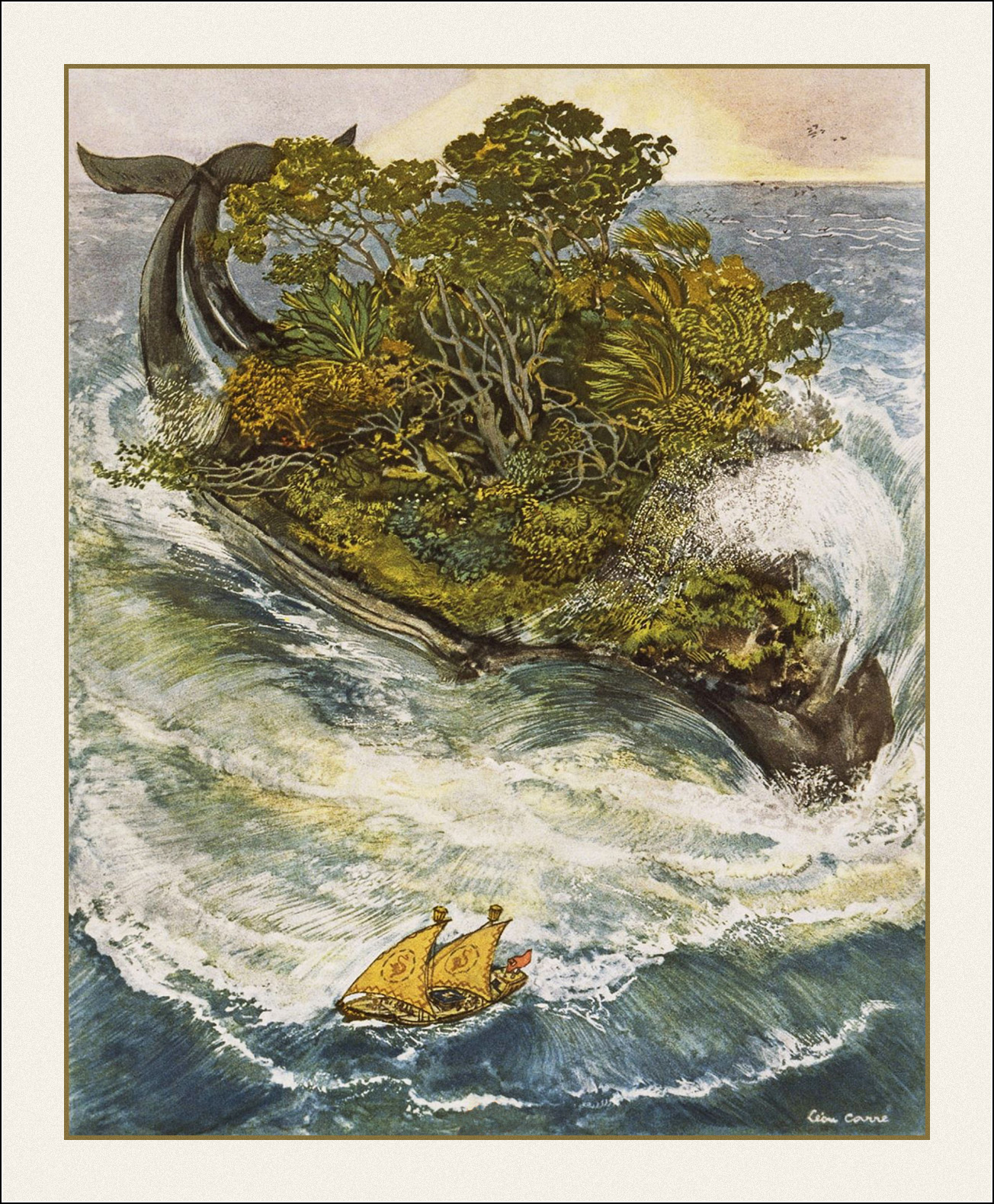
From ‘The adventures of Sindbad’ Leon Carre
AUSTRALIANS
It’s wonderful to have been one of the many readers who finally got hold of the books of Jen Craig this year, and fell in love with them. Intensely, almost claustrophobically, looping narratives of communication breakdowns, troublesome families, injuries, art, eating disorders, and the irritation of being named Jenny Craig when that’s the name of the country’s most famous dieting pyramid scheme. The experience of reading each book—Since the Accident (2013) and Panthers and the Museum of Fire (2015)—is something like peering closely at the back of an incredibly detailed tapestry, trying to guess at the structure, and then with the last few pages suddenly flipping it over to discover a masterpiece. I also read her third novel, Wall (2023), but that was earlier this month so just imagine me saying something similar in 12 months about that.
Susan McCreery’s All the Unloved (2023) is a wonderful novella about the inhabitants of a block of flats in 1990s beachside Sydney, centred on a teenaged girl’s coming of age. Amanda Lohrey’s Vertigo (2009) is another small gem, the story of a traumatised couple fleeing to a new home on the rural coast, and ending in bushfire and terror, told in an engagingly odd way. The two most recent collections of Greg Egan’s short stories, Instantiation (2020) and Sleep and the Soul (2023), demonstrate with impressive depth just why he is widely regarded as one of the world’s best science-fiction writers, especially at this length—story after story will use an amazing idea that a lesser writer would spend a 1200p trilogy on, and then move on to something else even more mind-boggling in just a couple of dozen pages.
Adam Ouston’s Waypoints (2022) is a splendid example of one of my favourite genres of book—an obsessive monologue by an unreliable narrator, in this case somewhat pinned to reality through the disappearance of airliner MH370 in 2014 and Harry Houdini’s attempts to be the first person to fly an airplane over Australia in 1910. Finally, Tommi Parrish’s newest graphic novel, Men I Trust (2023), is a drably beautiful exploration of parasitic friendship, and I really am trying to get over the fact that they mistakenly include a Walmart in an Australian setting. [Ed. – Oh I just picked this up—had no idea it was Australian!]
[The conductor passes down the corridor, bellowing in a monotone. “This train is about to depart, all visitors please leave! Ticketholders only!” A small, relieved smile passes over your face as I step down from the carriage onto the platform, still talking.]
HUNGARIANS
Anyone who has read one of my year-in-readings before knows how I go on about the Hungarians. And here I am doing it again. The best Hungarian literature I read this year was Magda Szabó’s The Fawn (1959/2023), translated by Len Rix, the story of the career and personal life of increasingly enraged actress through Hungary’s tumultuous mid-twentieth Century. Spadework for a Palace by László Krasznahorkai (2018/2022), translated by John Batki, is another tremendous example of the obsessive monologue/unreliable narrator mentioned above. And Ágota Kristóf’s Yesterday (1995/2019), translated by David Watson, was sadly the last book of hers I had left unread: an illegitimate small-town child flees his past by moving to the city, but the reappearance of his now-married childhood love throws everything into chaos.
‘Hare 2’ Jan Pypers
OUTER SPACE, INNER SPACE
Samantha Harvey’s Orbital was just my cup of tea, a quiet and thoughtful 24-hour slice of the lives of six people at work, where said work is in the International Space Station in its final days. In Ascension by Martin MacInnes goes further afield, from the ocean depths to the Oort Cloud, in search of First Contact, strange dreams, and the dawn of life. I loved it, but not unreservedly—there were occasional weird glitches, like MacInnes’s childlike idea that as you travel through the Solar System you pass the planets one by one in a neat line, the way they are drawn in a kids’ encyclopaedia. [Ed. – Wait, that’s not what they’re like???]
The This (2022) by the always interesting, and ludicrously underrated, Adam Roberts, is a hugely entertaining extrapolation from the near into the far future, taking us from the Next Big Thing in social media to humanity as a hive mind. And an end-of-year treat was the new collection Selected Nonfiction 1962-2007 (2023) by J. G. Ballard, a chunky and tremendously entertaining mix of reviews, articles, memoirs, lists and rants.
[The train begins to move, very slowly at first. I’m standing at your carriage window, still talking, and I begin to walk along the platform, keeping pace with the train. You glance at your fellow passengers, blushing.] [Ed. – Ugh shit like this is sooo embarrassing… What a weirdo right I don’t even know that guy!]
ENDS
There were lots of excellent cataclysms in this year’s reading. How I’d taken this long to read David Markson’s Wittgenstein’s Mistress is both mysterious and an indictment on me, but this beautiful book from the point of view of possibly the last woman on Earth is full of gorgeous writing and vivid images. [Ed. – Is she thrilled to be free of bros at long last?] I absolutely loved it. I also loved Oana Aristide’s Under the Blue, a particularly well-done plague-and-after novel, so I was very sad to get in a fight and end up blocking the author online because of her being an anti-trans bigot. Why are authors all so unpleasant?
Pink Slime (2020/2023) is an Uruguayan novel of toxic miasma and slow societal collapse by Fernanda Trías, translated by Heather Cleary, another weird case of a book being written pre-COVID that foreshadows and refracts the weirdness we all then went through. Rebecca Campbell’s Arboreality (2022) is a Canadian novel in stories that takes us further and further into our future of rising waters and collapsing ecosystems, offering no cheap false hope but still providing a glimpse of something worth being alive for. [Ed. – I keep hearing about this book. Gotta check that out.]
And turning from global to personal cataclysm, there was Lorrie Moore’s I Am Homeless If This Is Not My Home (2023), where one of the two main characters is very, very dead. But readers of Anagrams will know well that a character doesn’t have to exist for them to be vividly, hilariously rendered by Moore.
STORIES
There were so many resurrections and collections of great short story writers this year. Among the best were Rattlebone (1994) by Maxine Clair and Lover Man (1959) by Alston Anderson, both beautifully observed interconnected collections about Black American communities. No Love Lost (2023) collects the incredible novellas of Rachel Ingalls, and if there’s a richer, stranger book than this out there, send it to me now!
Jean Stafford’s Children Are Bored on Sunday (1945) is as brilliant as the title promises. [Ed. – Great fucking title.] I also read her novel The Mountain Lion (1947), and fucking hell could she write. Weird misfit children, unhappy loves, badly behaved artists. Have at it!
Tessa Yang’s The Runaway Restaurant (2022) and Madeline Cash’s Earth Angel (2023) were two of the best new story collections I came across this year. Both are peculiar and fizzing with ideas, completely happy to depart reality for the depths of weirdness at the drop of a hat, and very moving—imagine George Saunders if he was actually as good as everyone thinks he is. [Ed. – Heh, you’re not wrong, James…]
And then there was The Collected Works of Jo Ann Beard (2023), which was an absolute revelation. Stories, autofiction, memoir, reportage, not of it conventional, all of it astonishing in its quality and death-haunted eccentric brilliance.
[The train accelerates. You try to pretend the man running along at the window, now bellowing, has nothing to do with you. Not paying attention to where I’m going, I run full-tilt into a metal bin with a resounding clang.] [Ed. — *snort *]
‘Nature Takes Over’ Thomas Strogalski
RANDOM OTHERS
Some books you just can’t shoehorn awkwardly into a category, and there are still too many good ones left to mention. In brief:
Elspeth Barker’s O Caledonia (1991) pairs perfectly with The Mountain Lion, a black comedy about a strange and unloved daughter.
James Hannaham’s Didn’t Nobody Give a Shit What Happened to Carlotta (2022) is a delicious exercise in capturing a voice, in which a trans woman gets out of prison and tries to reconnect with her family and normal life.
Szilvia Molnar’s The Nursery (2023) is an unnerving and convincing novel of fear-of-everything from the point-of-view of a new mother.
Nigel Balchin’s Simple Life (1935) starts off like a mild comedy mocking get-back-to-the-land types, but quickly turns into a fascinating and alarming study of a fraught ménage à trois in a cottage in the middle of nowhere.
And finally, the complete Diaries of Franz Kafka, translated by Ross Benjamin (2023): a monolith of a book, a treasure trove, a heartbreaking testament.
From ‘L’Ange’ Patrick Bokanowski
[You glance back, caught between relief and embarrassment, as I leap to my feet and charge like a maniac after the repeating train, still yelling. Then I reach the end of the platform and plunge into the shrubbery, vanishing from sight. You exhale, and pull out your book to start reading in blessed peace.] [Ed. – Not true, I’d do almost anything to spend a train ride talking books with you, James!]






 Eiger, Mönch & Jungfrau