The Dead Secret–Wilkie Collins (1857)

My (very slow) journey through the complete works of Wilkie Collins continued this weekend with The Dead Secret (1857). This was Collins’s fourth published novel, the one right before he hit the big time with The Woman in White. It’s really quite good, absolutely enjoyable if a bit soppy at times and a little baggy. But there are a number of wonderful characters and some genuinely creepy and atmospheric scenes.

In his preface to the one-volume edition of 1861, Collins describes the phrase of his title as if it were a familiar idiom (he mentions it couldn’t be translated into French). I’d never heard the phrase “a dead secret” before, but apparently it means an “absolute secret, not to be revealed under any circumstances.” In this sense, Collins’s title is ironic, since the secret the story revolves around is supposed to be revealed in the first chapter—and it sort of is, though not conclusively enough for readers, or at least this one, to be sure what it is—but the person who is supposed to reveal it chooses not to.

As I observed recently in regards to The Law and the Lady, Collins here too anticipates Freud’s belief that “no mortal can keep a secret. If his lips are silent, he chatters with his fingertips.” Collins is fascinated by the idea that whatever is buried will eventually come to light. The Dead Secret begins with the maid Sarah Leeson attending the deathbed of her mistress, Mrs. Treverton, in a remote and falling down Cornish mansion called Porthgenna. Mrs. Treverton writes a letter to husband revealing a secret only she and her maid have known about until now, and just before she breathes her last she is on the point of making Sarah swear that she will pass the letter to Captain Treverton. Instead Sarah—whose hair is shockingly gray even though she is still a young woman, a sign of some terrible thing in her past—hides the letter in a locked room in the disused wing of the house and runs away from the Captain and his five-year-old daughter.

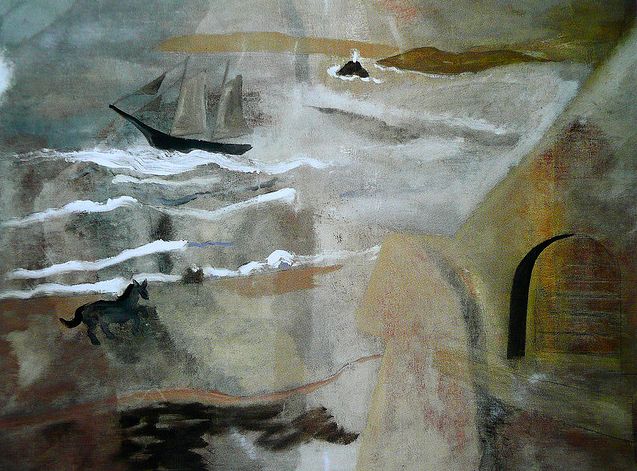
Ben Nicholson--Wrong Century, Right Place

We pick up events fifteen years later when that little girl, Rosamond Treverton, marries a young man, Leonard Frankland. Frankland is blind, blindness being a motif, I gather, that reappears in later works, and of course fittingly literalizes the figurative state of most of Collins’s characters. Collins uses Leonard’s blindness as a way to mediate the telling of the story even in the midst of the action. In this sense it seems an even more sophisticated version of his preference for shifts from third or first person narration to epistolary, or amongst various narrators or between various interpolated texts. These shifts emphasize the telling of the story over the events that are told. So for example Rosamond must describe everything she is doing to Leonard, especially once they find themselves caught up in trying to find the mysterious letter in a place Leonard has never been. This has the effect of slowing down the action while also ratcheting up the suspense, even in instances where there shouldn’t be any. We know where the letter is hidden, after all.

Although the mystery—which concerns them more than anyone—couldn’t be solved without them, Rosamond and Leonard are the book’s least interesting characters. The most interesting is Sarah—certainly she gets the most extraordinary scenes. She’s not really the heroine—the book’s attention is too diffuse, too decentralized among so many characters to have a heroine, and besides it’s unclear for the longest time whether or not we’re even supposed to like her: she’s continually rubbing other characters the wrong way—but she is at the heart of its enigma. Collins loves disguises, and in the scenes that most stuck with me Sarah hides her identity without actually lying about who she is. In the first, under the name Mrs. Jazeph, she becomes the nurse to Rosamond when the latter’s journey back to Cornwall is interrupted by the early arrival of her first child. The nurse, who has been nervous and flighty all evening, keeping herself at an unnatural distance which makes her charge increasingly uneasy, finally approaches Rosamond—but now she comes too close:

[T]he nurse was stopping midway between the part of the room from which she had advanced , and the bedside. There was nothing wild or angry in her look. The agitation which her face expressed, was the agitation of perplexity and alarm. She stood rapidly clasping an unclasping her hands, the image of bewilderment and distress—stood so for nearly a minute—then came forward a few steps more, and said inquiringly, in a whisper: —

‘Not asleep? Not quite asleep, yet?’

Rosamond tried to speak in answer, but the quick beating of her heart seemed to rise up to her very lips, and to stifle the words on them.

The nurse came on, still with the same perplexity and distress in her face, to within a foot of the bedside—knelt down by the pillow, and looked earnestly at Rosamond—shuddered a little, and glanced all around her, as if to make sure the room was empty—bent forward—hesitated—bent nearer, and whispered into her ear these words: —

‘When you go to Porthgenna, keep out of the Myrtle Room!

The hot breath of the woman, as she spoke, beat on Rosamond’s cheek, and seemed to fly in one fever-throb through every vein of her body.

The creepiest part of this passage is the qualifying clause “as she spoke,” which seems initially redundant—did we think the breath came from anywhere else?—but which in the end focuses our attention on the almost animalistic quality of Sarah. Similarly disquieting is the ambiguous pronoun at the end, which makes it hard to distinguish Sarah from Rosamond. (Shrewd readers will guess already that this suggestion of symbiosis is fitting.)

The scene could easily have been risible—and depending on your appetite for sensation fiction maybe it is—if it weren’t so true to the proto-Freudian theory of the unconscious (later Sarah will marvel that she said the last thing she wanted to say, or at least the last thing she thought she wanted to say) and so well executed.

Similarly dramatic is the second scene with Sarah that impressed itself on me. Sarah and her uncle Joseph (more about him in a second) rush to Porthgenna in advance of Rosamond and Leonard and brazen their way into the house, but Sarah is unable to retrieve the secret letter because she is overwhelmed on the threshold of the nfamous Myrtle Room by guilt and anxiety and maybe a genuine ghost. I’m too pressed for time to cite the passage: suffice it to say Sarah confuses the flapping of loose wallpaper with the admonitions of her late mistress and collapses in a dead swoon. Collins shows his genius in making us feel anxious and upset even though we know the (ostensible) cause of the disturbing noises. You can see Collins figuring out how to unsettle readers, and two years later he’ll write a masterpiece in which the kind of scenes I’m talking about here, which here are scattered across the book, will be much more prominent.

But The Dead Secret isn’t just apprentice work. I was disappointed by Ira Nadel’s introduction to the Oxford edition (unusual for that estimable line). Nadel meanders through the novel’s motifs, content simply to point out similar instances in other books by Collins. He never tries to interpret this book on its own merits. I was especially let down because the blurb tells me Nadel is the author of a book called Joyce and the Jews. And my pet theory about this book is that Sarah’s uncle, Joseph Buschmann, is in fact Jewish. Collins never says so, and he never resorts to the typology of this and other periods (hooked nose, swarthy, lecherous, usurious, etc) that would telegraph to readers, even unconsciously, a character’s Jewishness. We do know that Joseph is German, though he proudly asserts that he is also a citizen of England. We know he loves music—his prized possession is a music box given to his elder brother by Mozart himself: this automaton is just part and parcel of the book’s fascination with the uncanny, the Gothic, etc. We know he’s not quite five feet tall. He’s endearing in his insistent guilelessness, and kind and loving to Sarah despite all her troubles. Basically he’s a total mensch and I really wanted him to be Jewish not just because he was my favourite but because he is so determinedly not characterized by negative stereotypes. But being musical and short and kind and a little schmaltzy isn’t enough to make someone Jewish—though it’s a pretty good start.

Can anyone who’s read this book help me out here, and support this fancy of mine?

Either way, The Dead Secret doesn’t deserve to be one. A great book for your vacation reading.

Listen to Britain: A God in Ruins–Kate Atkinson (2015)

In A God in Ruins Kate Atkinson returns to some of the characters she wrote about in Life after Life (2013). That novel focused on Ursula Todd, who died many deaths navigating the perils of the twentieth century. I had reservations about the book, but I liked the way it valued sibling relationships over romantic ones. When I heard that Atkinson would be revisiting the Todd family, focusing this time on a younger brother, Teddy, I found myself looking forward to the book with an enthusiasm that surprised me. Recently I spent a weekend with it, engrossed happily enough, but already the book is fading for me, and I’m doubtful it will linger for me the way its successor did.

The great event in Teddy’s life, as for so many fictional characters and, who knows, maybe even real people, was WWII. He served as a bomber pilot, leading risky raids in his rickety Halifax bomber over Germany. Bombers were at constant risk—from anti-aircraft fire, from German fighter pilots, from the dangers of flying itself (taking off and landing were as dangerous as flying over Berlin). Teddy, bored stiff by his prewar job in a bank, comes alive in the air force. He loves the camaraderie, the white-knuckle combination of luck and skill needed to fly a plane, and most of all the terrible danger. Teddy is shot down twice: the first over the Channel, forcing a harrowing water landing and several terrifying days adrift in a life raft, and the second over enemy territory, which leads to his internment in a German POW camp (interestingly, the latter is only alluded to, not shown).

After the war, Teddy works at various provincial newspapers, marries his childhood sweetheart (who had at least as interesting a war as he did, as a code breaker at Bletchley Park), becomes an avid gardener, suffers the loss of his wife to brain cancer, and raises an increasingly difficult daughter with whom he is never quite reconciled but whose children he becomes close to. He has a good life, though maybe not a good death—at the end he is a centenarian who has lingered in a kind of half-life in a depressing nursing home. Atkinson never says so, but I think we’re to wonder if it hadn’t been better for him to die in the war. Teddy’s grandson overcomes a rough childhood to become a Buddhist-inspired guru of sorts. Perhaps this development is the novel’s way of insisting we must accept whatever happens to us, a New Age version of the English stiff upper lip. And yet even though the book is at pains not to glorify war, I think it can’t help but being in thrall to that time in British life.

671596

The novel’s interest in the relationship of past to present isn’t only historical or political. It’s also narratological. The TLS review suggested that, unlike Life after Life, A God in Ruins is concerned with character rather than narrative structure. I don’t think that’s right. But I don’t think its narrative experiments are always successful. For example, the book is filled with flash-forwards that reveal almost as an aside the inevitably terrible fate of a minor character. Take the case of Julia, a peer’s daughter serving in the women’s auxiliary with whom Teddy has a brief but intense affair. Teddy arrives at their rendezvous to find only a scribbled note thanking him for everything. The narrator continues:

Not long afterwards Julia was posted to an Army ordinance base and was one of seventeen people who were killed when a bomb dump accidentally exploded. Teddy was already in the POW camp by then and didn’t find out about the incident until years later when he read about her father’s death in his own newspaper (‘Peer in sex scandal falls to death’).

Other writers have used this technique to marvelous effect, notably Proust, and, more pertinently to Atkinson’s literary lineage, Virginia Woolf in Jacob’s Room and Muriel Spark in The Prime of Miss Jean Brodie. Atkinson’s glimpses into the future are much more heavy-handed than these other writers. After the paragraph quoted above, we are returned to the present in the most obvious way possible: “But all that was in the future.” Admittedly, the narration here is attached to Teddy’s consciousness, and he’s offered to us as a bit pedantic and dutiful, though all the more loveable for that conscientiousness. Which means that leaden transition could be Teddy’s own. But on other occasions the narrative asides are more obviously the narrator’s, even when expressed by a character. Ursula has a friend in the Air Ministry whose sole function is to provide the novel with war statistics, especially about the long odds that a bomber pilot would survive the war. The joke’s on her, as we learn during one of Teddy’s sorties. His rear-gunner has just seen a spectacular sunset:

As a rear-gunner, Kenny was the least likely of all of them to live to see a sunset in peacetime. Only a one-in-four chance of staying alive until then, Ursula’s girl said. In the end, of course, it was the girl from the Air Ministry who was living without a future, killed by the Aldwych V-1 rocket in June of ’44. She had been on the roof of Adastral House, where the Air Ministry was housed, sunbathing whilst eating her lunchtime sandwiches. (What were the odds against that, Teddy wondered?)

Serves her right for daring to disparage the fortunes of the protagonists of this book! That parenthesis is clumsy—it makes no sense either logically or narratively. When is Teddy thinking this? Certainly not in the plane over the North Sea. (He doesn’t yet know she’ll die this way.) At some later time? But there’s been no acknowledgement that we’ve left that moment in the skies, except perhaps that “of course” which might be taken as an indication of retrospective tsk-tsking: the irony of that girl with her grim statistics being the one who kicked off… and in such unproductive, hedonistic fashion (sunbathing!). Keep calm and carry on, indeed.

These narrative infelicities aside, though, the scenes in the bombers are terrific: vivid and exciting, filled with enough historical and cultural details that we understand what risks those young men ran and what they were asked to accomplish. But when Atkinson gets philosophic about the results of the bombing war—specifically, the firestorms that incinerated German cities, deliberately targeting civilians—her heavy hand returns. The culmination is a scene between Teddy and Ursula at a wartime concert of Beethoven’s Ninth where she asks him how he can justify bombing those civilians. Against the obstreperous backdrop of the Ode to Joy, the siblings discuss man’s inhumanity to man:

‘Alle Menschen werden Brüder,’ Ursual said. ‘Do you think it’s possible? One day? That all men could be brothers one day? People—by which I largely mean men—have been killing each other since time began. Since Cain threw a rock at Abel’s head or whatever it was he did to him.’

‘I don’t think the Bible’s that specific,’ Teddy said.

‘We have terrifically tribal instincts,’ Ursula said. ‘We’re all primitives underneath, that’s why we had to invent God, to be the voice of our conscience, or we would be killing each other left, right and center.’

In a scene we don’t see, Ursula returns to her rooms to continue reading Freud’s Totem and Taboo… Look, D. H. Lawrence is my favourite writer—I don’t mind a philosophical debate/disquisition in the middle of a novel. But this one is so pat: it considers whether German civilians are really civilians, whether they’re not also the enemy, culpable by association; it adds that awkward parenthetical about male aggression. The implied argument of A God in Ruins is that everything in Britain went downhill after the war, that nothing afterwards could ever do justice to its excitement and moral urgency. Indeed, war is exciting. As Freud put it in “Thoughts for the Time on War and Death,” written six months after the start of WWI, nothing quickens our appreciation for life than the imminent risk that it will be taken away. My sense is that in including set-pieces like this one between the Todd siblings Atkinson wants to question or qualify her own thesis about the terrible beauty of war. But its hastiness and triteness works against that aim. The moment feels dutiful, the prose especially lax. Only when Teddy is in the air does it come to life. In the end, then, the book feels like a hymn to the Greatest Generation, as evidenced by the number of times characters wonder how the cosseted and ineffectual postwar generations would cope in extremis, as if everyday life at any time didn’t offer up all sorts of emotionally rich, vital, and meaningful situations every day.

In the end, then, I hold two things against A God in Ruins. First, its self-congratulation about the seriousness of the enterprise of documenting twentieth century history, which comes across most fully in those heavy-handed exchanges between Ursula and Teddy about the possibility of a just war, a self-congratulation that folds into a conservative narrative about Britain’s decline. Second, the flatness of Atkinson’s prose, which holds no surprises, offers no resistance to easy digestion. It’s so inoffensive, so unlike the English fiction of the period it’s fascinated by (Bowen, Green, Lehmann, Taylor, etc). I can’t tell what’s more dispiriting: the vision of Atkinson writing a novel dedicated to each of the Todd siblings (even the eldest, the insufferable prig Maurice, might eventually get redeemed), or the vision of myself despite everything reading them all.

The Law and the Lady–Wilkie Collins (1875)

The critical consensus is that Collins’s great period is 1860-68, when he produced the four masterpieces Woman in White, No Name, Armadale, and The Moonstone. A couple of summers ago I devoured the first three, and loved them all, especially No Name, which I think about often. I was fortunate enough to have read the fourth in college under the expert guidance of Rohan, but I think it’s time to read it again.

At any rate, for once, the critical consensus seems to be right, at least judging from this later work. The Law and the Lady is very good but not quite top-shelf Collins. It hasn’t the seat-of-your-pants excitement of his best work, but it’s perfectly enjoyable and spry enough to keep readers guessing. Plus if you’ve any interest in Freud, you will enjoy the novel’s uncanny prefiguring of the theory of the unconscious.

The book opens with Valeria Brinton having just become Valeria Woodville—except that in a slip of the pen (paging Dr. Freud…) she signs her maiden name. The mistake isn’t just an indication of Valeria’s independent mindedness, although that will be amply demonstrated in the book’s events. It’s also an unconscious recognition that something isn’t right about the name she’s taking on.

It isn’t long before Valeria learns that her husband’s name isn’t Woodville. Her husband implores her not to look into the matter further. But that’s just what she does. Could we possibly be interested in a book about any woman who wouldn’t have? Before long she learns that her husband, whose real name is Macallan, was tried in Scotland for poisoning his wife. The Scottish part matters because Scots’ law apparently still to this today allows a verdict of Not Proven, which is somewhere between acquittal and guilt. The accused is free to go, but not free of suspicion or innuendo. Insisting that no one, not even his wife, could believe entirely in his innocence, Macallan leaves for the Continent. Yet Valeria is undaunted by this dereliction and sets out to prove Macallan wrong by proving him blameless

Valeria’s first step is to read the trial proceedings. Collins first published his works in serial form, and like other writers of the period, most notably his friend Dickens, he was a genius with suspenseful chapter endings. Here for example is Valeria launching her career as detective:

I drew down the blind, and lit the candles. In the quiet night—alone and unaided—I took my first step on the toilsome and terrible journey that lay before me. From the title-page to the end, without stopping to rest, and without missing a word, I read the Trial of my husband for the murder of his wife.

After a paragraph like that, who’s not going to turn the page/buy the next installment/watch the next episode? Indeed, Valeria’s description of her reading experience—at once breathless and assiduous—is a good description of our own. But although she might have taken her first step unaided, she gets a lot of help the rest of the way. A friend of her husband’s, Major Fitz-David, an aging ladies’ man, introduces her to some of the people who testified at the trial. Her late father’s law clerk, Mr. Benjamin, together with a Mr. Playfair, the lawyer who represented Eustace at trial, support her inquiries and eventually uncover the crucial piece of evidence. And even her new mother-in-law, who at first refuses to speak to her, begrudgingly comes to her side, even though she insists to the end that Valeria must not tell Eustace what she has found.

It is true, though, that Valeria is the force that keeps the investigation going, even when it seems to flag and even when she has to leave England to nurse Eustace back to health. He lies unconscious for weeks after having been wounded in Spain (for the life of me I can’t remember why he went there or what the fighting was about—I can’t seem to find it by flipping though the book, either). His actions exemplify his character: he’s supposed to be gallant but he’s always making a mess of things—indeed, we learn that the same ambivalent mixture of righteousness and weakness characterized his relationship with his first wife, Sarah, whom he married because he felt sorry for her. (We’re supposed to think her nasty and shrewish, but it’s hard not to feel sympathy for her. Collins could have done a lot more with Valeria’s feelings about her predecessor—the way Du Maurier did so successfully in Rebecca.) The vacillation and general pain-in-the-assedness of Eustace’s character is a weakness in a novel that depends on Valeria’s profound belief in him. Any time Valeria seems to question her motives—to wonder what it means that she’s undertaking all this effort and risk for someone who has treated her so badly, or to acknowledge that what really thrills her is the investigation itself more so than the eventual exoneration of her husband—she pulls back. I don’t see much evidence that Collins wants us to do anything but take her at her word.

At times, the book gets distracted from its protagonist and her husband. In those other books by Collins I admired his unusual narrative structures—his shifts in points of view or in media (from third person narration to letters, for example) all within a single book. That play with structure doesn’t work as well here. The trial, for example, is presented to us indirectly, through the report Valeria finds. But the book chooses to summarize it rather than transcribing it as a “found text”, presumably because that would be more interesting than a lengthy legal document, but the result is just the opposite: all the momentum the book had built up gets killed and it takes a while to recover. Similarly, a lot of the detective work is done by Playfair and Benjamin, but we hear about it through their letters to her instead of seeing it first hand.

But the real distraction doesn’t lie in the narration—it comes from the introduction of the character Misserimus Dexter, an old friend of Eustace’s and a house guest at the time of Sarah’s death. Dexter is supposed to be a menacing yet magnetic character of the kind that appears elsewhere in Collins—Count Fosco of The Woman in White might be the best example. But where Fosco genuinely is magnetic Dexter is more irritating. We hear a lot about his eccentricity, his genius, his mania. He lives in an isolated half-lavish, half-dilapidated mansion with a cousin who herself is a grotesque figure, a lumpen simpleton who is nonetheless devoted to him and, come to think of it, in this regard acts as a mirror for Valeria’s relation to Eustace. Dexter is a dandy, an elegant and beautiful man despite what the novel calls his “deformity”: he is a paraplegic who is mostly confined to a wheelchair except in some dramatic moments that Collins clearly relishes when he slips its chains and propels himself along by only the force of his arms. Valeria coaxes from Dexter his memory of the events around Sarah’s death—yet in doing so brings him closer and closer to madness until, having mentioned a letter written by Sarah on the day she died, a letter that promises to clear up the circumstances behind her death, he lapses completely into insanity.

The last part of the book concerns the search for this letter, which, we learn, is a suicide note from Sarah to Eustace that fully exonerates him. (That isn’t much of a spoiler, since we’re led to believe from pretty early on that Eustace didn’t do it. But this is a spoiler: Sarah kills herself by taking arsenic she had had Eustace purchase because she is convinced that in small doses it could remedy the kind of skin conditions that disfigure her—and she does so because Dexter, who had loved her before her marriage and is still furious that she rejected his proposal, shows her Eustace’s diary, in which he laments having married her and complains of her incessant wheedling and general poor character.) The letter leads us to the best part of the book: its fascination with the permanence of objects, especially those we think to be junk.

That fascination is already evident when Valeria first visits Dexter at what her mother-in-law satirically calls his palace:

We had got out of the carriage, and we were standing on a rough half-made gravel path. Right and left of me, in the dim light, I saw the half-completed foundations of new houses in their first stage of existence. Boards and bricks were scattered about us. At places, gaunt scaffolding-poles rose like the branchless trees of the brick-desert. Behind us, on the other side of the high road, stretched another plot of waste ground, as yet not built on. Over the surface of this second desert, the ghastly white figures of vagrant ducks gleamed at intervals in the mystic light. In front of us, at a distance of two hundred yards or so, as well as I could calculate, rose a black mass which gradually resolved itself, as my eyes became accustomed to the twilight, into a long, low, and ancient house, with a hedge of evergreens and a pitch-black paling in front of it. The footman led way towards the paling, through the boards and the bricks, the oyster-shells and the broken crockery, that strewed the ground.

I’m intrigued by the bathos of this would-be Gothic scene (the ancient house amidst abandoned construction sites: it’s unclear whether the new will even have the vigor needed to replace the old). It reminds me of something from Dickens, maybe Our Mutual Friend, probably because of all the waste, the oyster-shells and broken crockery (where’s that come from?). Waste is central to the resolution of the plot. Before being called to her husband’s bedside in Spain, Valeria visits his former country house, the place where Sarah died. Wandering the “wilderness of weeds” that is the garden of the shut-up house, something catches her eye:

Beyond the far end of the garden, divided from it by a low paling of wood [Collins will never say “fence” when he can say “paling”—though admittedly it has that fitting resonance of shock and suspense—turning pale, etc—though maybe I’m doing him an injustice and “fence” is just an Americanism], there stretched a piece of waste ground, sheltered on three sides by trees. In one lost corner of the ground, an object, common enough elsewhere, attracted my attention here. The object was a dust-heap. The great size of it, and the curious situation in which it was placed, roused a moment’s languid curiosity in me. I stopped, and looked at the dust and ashes, at the broken crockery and the old iron. Here, there was a torn hat; and there, some fragments of rotten old boots; and, scattered around, a small attendant litter of waste paper and frowsy rags.

Litter here of course means trash, but the word can also refer to a vehicle, and in The Law and the Lady this trash becomes the vehicle for Eustace’s exoneration and Valeria’s triumph. Biggest spoiler alert of all: the torn pieces of Sarah’s letter are exhumed from this pile and pieced together forensically. There’s nothing frowsy about this waste after all!

Here’s where the novel got spooky for me. For these descriptions of waste, on top of or beside which life goes on, and which never fully decay, reminded me uncannily of Freud’s descriptions of the unconscious. Already in “The Aetiology of Hysteria” from 1896 Freud compared the analyst to an explorer who excavates a ruined site and is able to uncover from its remains whole vanished way of life. He never wavered from the image of the unconscious as a wellspring to be excavated (lest its unhealthy manifestations—its symptoms—continue to debilitate the patient) but towards the end of his career he modified the image. In the great Civilization and its Discontents (which could be the motto for Gothic and Sensation fiction) from 1930, for example, he returns to the image of the mind as a ruined city, even the Eternal City, Rome, yet admits that the image doesn’t quite work because unlike in Rome, where the present day covers up the past, so that only hints of its past strata are apparent, in the mind nothing ever goes away. If we wanted to think of the unconscious as a city, we would need to conceive of every era of its history as coexisting so that we would, for example, need to imagine new buildings superimposed over the old ones they replaced.

In The Law and the Lady the future is only possible because the past persists. But what would that mean for a crime novel? Can we speak of solving a crime when any resolution comes from the fact that nothing is ever settled? What else from the past might surface to trouble this marriage that seems now to have been saved? Interestingly, Eustace elects not to learn what his first wife wrote in the letter, preferring only to know that it is enough to absolve him of blame. The novel’s resolution is thus appropriately qualified, and Collins gives us a powerful image of that uncertainty in the envelope containing Sarah’s letter, which Eustace elects to save for his soon-to-be-born child. That’s a potentially explosive inheritance, maybe not quite the bombshell that Pinkie leaves his progeny at the end of Greene’s Brighton Rock (which I read as a modernist Gothic/Sensation novel), but pretty strong stuff nonetheless.

It must be significant, too, that this all takes place in Scotland, one of those Gaelic Gothic dark undersides to English modernity—right after the passage I quoted in which the dust-heap makes its first appearance, Playfair ruefully says to Valeria that something like that wouldn’t be tolerated in the grounds of an English house—though of course the passage describing Dexter’s wasteland “palace” suggests he’s not entirely right.

At any rate, it’s that ending that makes me think The Law and the Lady is more than merely competent and engaging. The whole time I wanted Collins to leave us in doubt as to Eustace’s innocence, the way Du Maurier or Patricia Highsmith would have. Making Valeria protect a murderer would just be more interesting, though perhaps more sadistic. But in the end there’s enough unsettling about The Law and the Lady to make it a fitting depiction of the past’s similarly unsettling refusal to go away.

Spring Can Really Hang You Up the Most

The Penderwicks in Spring—Jeanne Birdsall (2015)

I yelped with delight when I learned that the latest Penderwicks book was out.

22693814

The Penderwicks in Spring is the fourth book in a delightful middle reader series about the adventures of the Penderwick children and their friends and family. It’s a satisfying addition to the series, maybe the best since the first, The Penderwicks: A Summer Tale of Four Sisters, Two Rabbits, and a Very Interesting Boy (2005). You could read it on its own, but I wouldn’t. One of the many pleasures of these books is watching what happens to the children as they age. More than most children’s series, the Penderwicks books, which jump ahead a year or two between each volume, are about the passing of time. Which means they are also about change and death.

In the great tradition of children’s literature, the lives of the Penderwick children have been shaped by the death of a parent, in this case, their mother, who died of cancer just after the birth of the youngest Penderwick, Batty. Batty is four in the first book, and unlike her sisters Rosalind (12), Skye (11), and Jane (10), she has no memories of her mother. What she has instead is the warmth of her family, starting with the girls’ father, an absentminded professor of Botany who manages to be just this side of cliché. Each of the Penderwick sisters has a role/incipient métier: Rosalind, as eldest and by temperament (though who can sort these things out?), is the caretaker; Skye is sporty, a bit sarcastic and difficult; Jane is dreamy, a writer and observer. And Batty is delightful, especially in her fierce attachment to the beloved family dog, Hound.

By the time of the latest book, Batty is in fifth grade and her role expands to more than just comic relief. She’s at the center of The Penderwicks in Spring, and she’s about to learn, as the old song has it, that spring can really hang you up the most. Batty has become musical, devoted to the piano and abruptly, in the new book, discovering that she has a fine voice too, which she puts to good work on a whole bunch of the Tin Pan Alley songs that with impressive (and precocious) taste she adores.

The book begins with Batty determinedly stomping on a patch of lingering snow in the backyard of the Penderwicks’ Massachusetts home because, she explains, spring can’t begin until the snow’s all melted. But this spring will prove particularly hard. Rosalind is at college (with an obnoxious new boyfriend) and Skye and Jane are lost to their high school world of friends who trawl through the Penderwicks’ kitchen with impressive ferocity. More worrisomely, a beloved neighbour has been deployed to Iraq. And (spoiler alert) Hound has died. Birdsall describes Batty’s grief and misplaced feelings of guilt and responsibility that she didn’t do enough to save him utterly convincingly. (Fear not: the possibility of a new dog arises by the end of the book—the book is often dark, but it’s not a downer). Most piercingly of all, Batty overhears Skye saying something hateful about her and her relation to their mother, something that sends Batty into deep despair, a depression lifted only when Skye’s words are revealed as a terrible misunderstanding. Lessons are learned, but lightly, and the lessons are pretty sophisticated (paternalistic adult protection can really hurt children), so the book never feels preachy.

And like its companions in the series, The Penderwicks in Spring is funny: there’s an exchange student who Jane insists on talking to in French even though she doesn’t actually know it; the aforementioned obnoxious boyfriend who bores small boys with his knowledge of Buñel films; and Batty’s pistol of a baby sister, two-year-old Lydia, always ready with a zinger—sometimes even in Spanish, which she’s learned a few words of at her preschool, as in this exchange when Batty, seeking pocket money for singing lessons, asks her elderly neighbours whether they have any odd jobs for her. To Batty’s surprise, they eagerly ask her to walk their dog:

“I didn’t think you had a dog, Mrs. Ayvazian,” [Batty] said, hoping this was all a misunderstanding.

“Duchess, dear, say hello to Batty and Lydia.” Mrs. Ayvazian lowered her voice, as if the invisible dog could hear her. “She arrived only last week. My brother moved to Florida and thought she would be better of here with us. I think she misses him something awful.”

“Well, she should miss him. He spoiled her rotten.” Mr. Ayvazian didn’t lower his voice. Since there was still no dog in sight, Batty didn’t know whether this was a good or bad sign.

Could it be the Ayvazians were losing their minds? This happened sometimes to old people, Batty had heard, although usually it made them do things like misplace keys, not hallucinate dogs. She was trying to figure out a polite way of getting Lydia safely out of the house when she heard a grunt coming from behind a blue armchair.

Then, slowly, while Batty and Lydia stared in amazement, an oddly shaped brown animal—like an overstuffed hot dog with teeny legs—dragged itself out into the open.

Gato,” said Lydia uncertainly.

That “uncertainly” is pitch perfect, like everything else about these books.

Batty soon trims the overweight dachshund Duchess down. Here and elsewhere in the book we see Batty take on new responsibilities—not least because she’s no longer the youngest Penderwick: she has a step-brother (Ben, seven) in addition to her little sister Lydia (in love with Ben, to his horror) from her father’s second marriage, cleverly orchestrated by the children in an earlier book. Batty will always be Batty, but she is also becoming Elizabeth—her given name, and, she concludes, a fine one for a singer.

Birdsall knew from the beginning she would write five books about the Penderwicks. I’m eager to read the last one, to see how everything turns out, but I’m already saddened by the thought that—like everything else we value—the series will come to an end.

The way I came to these books in the first place—at that time I didn’t yet have a child and even now she’s still too young for them—is a triumph of the virtues of independent bookselling, and since I try to value that world without being sentimental about it let me praise the good people at Talking Leaves Books in Buffalo, NY. I was in town for a conference and spent a lovely afternoon browsing what was then at any rate an impressive store. The second book in the series must have just come out in hardback, and they had a whole display of the first one in paperback right by the cash. I picked up a copy and the clerk immediately said, solemnly, “You need to read that.” She was right. I’ve followed the series faithfully ever since, and I really hope that before too long my daughter will be as smitten with them as I am.

Hey, Jude

A Little Life—Hanya Yanagihara (2015)

The first time I lived amongst people who loved to read was after I graduated from high school. Through circumstances too long to get into here I managed to get a job in the shipping department of a bookstore in Switzerland. I loved listening to the other booksellers talk about what they were reading. One of the things I learned is that a community of readers only arises from solitude. I remember one of my co-workers telling me about a book she was so absorbed in—it was by that titan of Swiss literature, Ken Follett—she didn’t want to do anything else but read. “We had friends over for dinner,” she told me ruefully, “and the whole time I just wanted them to leave so I could get back to my book.” No one had ever expressed this sentiment to me so baldly and of course I was so young with so few obligations that I could pretty much do whatever I wanted when it came to reading or anything else for that matter, yet even so I recognized with a throb of immediate familiarity that feeling of impatience with the rest of the world, that desire to return to another world, the one of the book in which I was so immersed.

Even then I knew this sort of immersion was rare, most reading experiences, even good ones, being more quotidian, more desultory, more broken into by the exigencies of the day, but I couldn’t guess how rare it would become, as my time became less my own and my attention span seemed to shrivel. (Lately I find myself setting aside whatever I’m reading to check my email, again, or twitter, again, or the hockey score, again.)

How wonderful then—how marvelous a tonic at the end of a difficult semester—to have spent the better part of the last week lost in Hanya Yanagihara’s A Little Life. I sped through its 700+ pages in satisfying 100-150 page chunks, and when I wasn’t reading it I was thinking about it, anticipating when I could get back to it, wondering not so much what would happen next as what its characters were doing, as if they were living beings going about their business. It’s not so much that I confused them with real people, but rather they had for me a kind of autonomous life more interesting to me than that of the people in my real life.

I can imagine someone calling A Little Life old-fashioned: with its emphasis on character, shifting third person narration, and clearly observed East Coast locations it could be seen as a literary analogue to the art of one of its characters, JB, a “classicist” figurative painter who feels himself to be fighting a rearguard action against performance and other non-figurative arts. But A Little Life isn’t defensive, and I’m not sure it’s old-fashioned. Admittedly, it doesn’t feel especially of its moment, the way books by, say, Ben Lerner or Teju Cole or Karl Ove Knausgaard do. (This means it is unlikely to date as badly as they surely will.) What struck me in reading A Little Life was how little it reminded me of anything else I’d read, which might be because its artistic touchstones are visual: painting, photography, film, architecture. Every so often I’d think of Proust, both for the book’s anatomizing of the vicissitudes of relationships—their shifts, both sudden and gradual, their reversals, their persistence, the way they loom out from the practicalities of everyday life even when they occupy less of our attention than those mundane matters—and for the uncertainty about when its events happen and even about the age of its characters, although the book becomes much clearer about that as it goes along.

But old-fashioned or of the moment or Proustian or something else entirely, A Little Life certainly is a melodramatic and sentimental book, filled with dramatic events. The words the characters most often say to each other are “I’m sorry” and the thing they do more than anything else is cry, or defiantly not cry, or wish they could cry. I can’t talk about this book without talking about some of these events, so if spoilers bother you as much as they do me (though the book isn’t particularly driven by plot) then you might want to stop here.


A Little Life follows four young men from the time they meet in college into early middle age. Even though one of them thinks only two are really ambitious, filled with what he calls “that grim, trudging determination… that gave them that slightly faraway look in their eyes that always made him think a fraction of them was already living in some imagined future,” in fact each becomes successful in his chosen field. JB, spoiled, petulant, irrepressible, becomes a painter. Malcolm, unsure, self-doubting, refined, rich, becomes an architect. Willem, kind, even-keeled, sensitive, a bit plodding or, at least, keen to think of himself that way, becomes an actor, even, to the surprise of everyone, a very famous one. And finally Jude, the center of the book, brilliant, secretive, haunted, filled with self-loathing, emotionally damaged, becomes a feared litigator.

JB and Malcolm are more or less wealthy New Yorkers (Malcolm more, JB less). Malcolm feels guilty about the advantages given to him by his very wealthy, very cultured, mixed-race family, while JB is cosseted by the many women in his extended Haitian family. Willem’s parents emigrated from Norway to be ranchers in Wyoming; at college he feels himself to be “a sort of unofficial poor-white-rural-dweller-oddity affirmative-action representative.” And Jude—no one knows where he comes from, how he made it to college in Boston. All he’ll say is that his parents died when he was small and that he was injured in a car accident which is why he limps and struggles to climb stairs and is sometimes laid out with mysterious, debilitating pain. His injuries lead him to Andy, a medical student who becomes his doctor, almost his personal physician, the only person who knows even part of what happened to Jude in his past.

Eventually, we learn Jude’s back-story. Abandoned by his parents when he was only an infant, he grows up in a monastery. This is no idyll. The monks educate the boy, who is an excellent pupil, but they also punish and abuse him, abuse that takes on even more sinister and sexual form when the one person who seems to care for him, the gentle gardener Brother Luke, spirits him away from the monastery and into a fugitive life on the run, through innumerable motel rooms and always in disguise, a life paid for by Luke’s prostituting the boy out to hundreds of men. As if this weren’t terrible enough, he compounds that abuse by also forcing the boy to have sex with him as a sign of what he insists is their love for each other. The physical, mental and sexual abuse continues at the orphanage Jude is sent to after Luke is finally caught. Managing to escape the orphanage, Jude manages to make his way half-way across the country, hitching rides with truckers who, more often than not, rape him as well. Eventually he is found, delirious with fever from a venereal disease, he is found by a psychiatrist, the sinister Dr. Traylor, who locks him in his basement, and waits until a round of antibiotics has run its course before abusing the boy himself. Traylor eventually “frees” Jude but only to hurt him one final horrible time: he runs over him in his car. Jude is found and taken to hospital, where the now fifteen-year-old meets the first good person in his life, his therapist Anna, but in keeping with the book’s punishing attitude, she dies of cancer, though not before helping him apply to college.

Writing this out, I almost want to laugh, it’s so over the top. But the book doesn’t play it for laughs. (A Little Life has many virtues, but humour is not one of them.) There’s a scene where Jude, on the run with Luke, sees some boys playing little league ball, their mothers waiting for the with slices of orange, and knows his life will never be like that, never be normal—it could be a kind of rewriting of Lolita from the child’s perspective, a version of that famous scene in which Humbert Humbert , with grotesque self-satisfaction but also real pathos, hears some children singing and knows Lolita’s voice will never be among their concord. But although A Little Life doles out Jude’s past in extended flashbacks, what it really cares about is the long aftermath of that terrible time. What kind of an adult could a person with no childhood be? In this way, the book always steers just shy of sadism. It punishes Jude, and it punishes us for our investment in Jude—an investment it works hard to create by making him such a complex and fascinating character—but it doesn’t manipulate just for the sake of manipulation. Its manipulation serves a number of ends—for example, by asking us whether knowing everything about someone is to condone or accept them.

The novel enacts this dilemma as part of its investigation of friendship. Arriving at college, Jude is immediately befriended by JB, Malcolm, and Willem, much to his amazement, and joy, and terror (he thinks he doesn’t deserve it, is sure the others have made a mistake about him). The bond between the four—some of which has to do with supporting each other in their desire to make it, and some of which has to do with forming a circle of protection around whatever horrors Jude has experienced: horrors that they know are present even though they don’t know what they are—continues throughout their adult lives.

For all its fascination with success and fame as particular forms of accomplishment, A Little Life is ultimately more interested in something less tangible, something that success and fame tend to work against—long lasting emotional connections between individuals. This is a novel of male friendship. Women barely factor into it: there are hardly any in the book and their perspective is never shared by the narration. Is it because Yanagihara is a woman that this decision never feels demeaning or exclusionary? Of the various implausible or fantastical elements to the novel, the one that feels most energizing to me is its ability to present its intense focus on the intimate and emotional lives of four men without any of the “bromance” anxiety about homosexuality that seems to govern so many representations of male friendship today (all that Hangover stuff). And that’s not just because some of the characters are gay. Rather it’s because the book is so queer, in the sense Eve Sedgwick gave us when she reminded us to remember that people are different and have different desires and that the straight/gay binary, which only normalized heterosexuality, couldn’t account for these seemingly simple yet enormously consequential facts. Of the central characters, JB is openly, we might almost say straightforwardly, gay. Malcolm, after some youthful hand-wringing, comes out as straight. But Jude has had sexual desire beaten out of him by the horrors of his childhood, although on the rare occasions in his adult life when he, unwillingly, has sex it is with men. And Willem prefers to sleep with women except that the person he really loves, and really desires, is Jude. The life Willem and Jude try to make together becomes the center of the book: this queer relationship, which cannot be contained by our habitual use of the term friendship, which is sexual but not, which is a gift to both men yet fraught with risk, given Jude’s past, is something that the book shows us at great length because it can’t name it and anyway naming it would reduce it. In this light, the opening page, in which Jude and Willem, fresh out of college and newly arrived in New York, try to rent an apartment that has only one closet, a closet that they realize they don’t even need, since they don’t have anything, in retrospect seems like a joke about limiting ideas of sexuality and identity.

I said earlier that I had a hard time deciding whether the book was conventional or unconventional in its structure. Now I see that this uncertainty comes from its challenge to conventional modes of intimacy that it nonetheless maintains (It is at once correct and false to say that Jude and Willem are friends. The novel wants to keep friendship as its central concept, but it also wants to expand and revise that concept. The closest analogue to what I mean in rhetoric is catachresis, a semantic “misuse” that bends or deforms a term from its habitual use.) Yanagihara mimics this catachresis in the structure of her novel. We begin by shuttling back and forth between the perspectives of the four main characters, as it develops a portrait of the group. But by and by JB and Malcolm fall by the wayside; they’re still in the book, but events aren’t narrated from their perspective any longer. Instead, Willem and, especially, Jude, and then Willem & Jude are at the center of things. I noted earlier that the book is in third person, but there are a couple of sections narrated in first person. I’m pretty sure these are limited to the perspective of Harold, a professor of Jude’s in law school who becomes so close to Jude that he and his wife eventually formally adopt Jude. (This allows Yanagihara to do for the child-parent relationship what she does at greater length with friendship: i.e. to renovate and expand it: Harold is Jude’s father, but he isn’t his father in any conventional sort—what, she asks, is the emotional tie between these two men?) Harder to figure out are shifts to present tense: I think these are used at times of particular emotional intensity, but I’m not sure—maybe someone can help me figure that out. Yanagihara’s style is neither showy nor unvarnished, nothing particularly daunting or knotted about the syntax yet with a perspicuity of word choice that befits these educated, accomplished, thoughtful characters. Every once in a while, the prose becomes more poetic, more metaphoric, but always anchored in something more plainspoken. Here, for example, is Willem thinking about his parents’ response to the death of his handicapped brother, Henning:

He wanted to scream at his parents, to hit them, to elicit from them something—some melting into grief, some loss of composure, some recognition that something large had happened, that in Henning’s death they had lost something vital and necessary to their lives. He didn’t care if they really felt this way or not: he just needed them to say it, he needed to feel that something lay beneath their impenetrable calm, that somewhere within them ran a thin stream of quick, cool water, teeming with delicate lives, minnows and grasses and tiny white flowers, all tender and easily wounded and so vulnerable you couldn’t see them without aching for them.

However unusual the images in this little aria—images we can just about believe are Willem’s: it’s only in the last clauses about the subterranean stream of water that we sense any distance between character and narrator—their subject matter, of emotion, is typical. We see here that same sense of difficulty in naming—that italicized something, those anaphoric phrases gesturing towards some evanescent thing that is tied to the more easily named forms of life in the extended metaphor by the concept of delicacy and value: things that are fragile and hurt are things we must open ourselves up to.

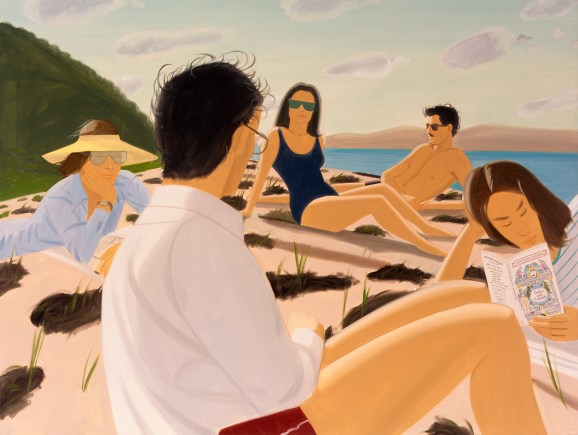
The book’s stylistic and formal choices, then, have everything to do with its interest in revising without fully destroying conventional forms of emotional connection or relationship. That same dynamic is at work in a philosophical and psychological register in the book’s interest in the relation between form and formlessness. It makes sense that so many of the book’s characters are creators—even Jude responds to the structure of the law, which he comes to as a way to become materially secure in a way he never was in his childhood after leaving behind his first love, mathematics. In the courtroom he is commanding and decisive, even cruel. Harold despairs of Jude’s decision to abandon his work with the public prosecutor in favour of corporate law, but the callousness or self-interested qualities he sees in Jude’s defenses of corporate malfeasance extends far beyond the law. Creation is always destructive, we see, not least of trust and human relationship, most famously in JB’s choice to paint only his friends, especially Jude, especially in moments of what to Jude is intolerable vulnerability. I think of JB’s paintings like Alex Katz’s, only without any women:
katz_round-hill

Alex Katz, “Round Hill” (1977)

In Katz’s “Round Hill” we see solitude, even vacancy in the middle of intimacy or closeness. There’s always something that threatens to destroy whatever connections we make with others. Even more paradoxically, sometimes the destructive element is the only thing that gives our lives shape, a painful contradiction we see most clearly in Jude’s self-harm, his need to cut. Perhaps this tension between form and formlessness explains why A Little Life is so long. The passing of time is essential to the making of a life. Friendships, emotional connections more generally, need repetitions and rituals in order to cohere, yet even then they are subject to so many changes, reversals, vicissitudes. Maybe that’s why there are so many parties in this book, so many birthdays, so many premieres, so many holidays—sometimes I think this book is about Thanksgiving—in its pages: the coursing of affect and sympathy between individuals is so fluid, so quicksilver, that we need these artificial touchstones if we want to have any hope of holding on to it, to turning these friable, fragile, evanescent emotions into a life, even a little one.

In this regard, the title of A Little Life can be taken as a modest claim about its accomplishments, an ironic contrast to its epic scope. A little life might be all any of us have, all any of us can aspire towards. Yet the term isn’t only (however modestly) aspirational. It also refers to falsity, artificiality, the worst aspects of performance. As far as I can tell, the only time that the titular phrase is actually used in the text is when Brother Luke instructs Jude how to act with the johns: he needs to act as though he likes it, he needs to “show a little life.” This life that we live in our vulnerable human bodies is previous because finite. But what the double meaning of the title suggests is that if life is a value it’s not because it’s synonymous with authenticity. Life is a force that manifests itself in pre-established forms: in this sense we are all actors filling a role (thus the characters’ insistence on “making it” takes the form of successfully inhabiting recognizable forms of being, not least certain careers or vocations). Acting can be enabling, as Willem’s career demonstrates. But it can also be punitive, a source of deprivation, as Jude’s enforced life as a rent boy suggests. Yet although established roles are powerful and hard to dislodge they aren’t definitively fixed. They’re open to being changed, and they are at their most powerful when they can’t yet be named, or when they deform or revise an established name (like “friendship”).

But what about those aspects of our experience that seem to force us into certain beliefs, actions, or identities? A Little Life is at its most interesting when it pits its theory of self or societal invention against the debilitating and stultifying effects of abuse and trauma. Can a damaged person change his sense of himself in relation to other people? I’ve been arguing that the novel believes that people can change each other, largely by changing the way they live and act together. But that claim has to be qualified by its investigation of people who cannot or will not change because their traumatic experiences make it almost impossible for them to do so. What, the novel asks, is the relation between physical and mental health? What does it mean to be psychologically deviant or abnormal? How can we respect the value of a person’s symptoms—the meaning, we might even say the sustenance, they give him—while still acknowledging how harmful they can be? If we love someone who is hurt or damaged, are we responsible for curing him, or making sure someone else cures him (and what would curing even mean in this context)? Or does our responsibility consist in letting him be who he is? But what if he’s someone who damages himself? How can we express love for people who hurt us? What kind of a relationship can we have with them? Does sex need to enter into every loving relationship? How can we renovate or expand our impoverished ideas about relationships? In what way is friendship a model for those new ways of being? Are there some experiences so powerful that they preclude the possibility of changing who we are?

Many of these questions were already posed a century ago by psychoanalysis, and this is yet another way in which the novel is importantly modern. Yet psychotherapy in general is given pretty short shrift in the book: Jude is terrified of it (which could be taken as an implicit acknowledgement of its power), and Willem comes to tire of it, even as he and Harold and Andy and everybody in Jude’s life urges Jude to unburden himself to a professional. Jude refuses, and it’s hard not to connect this to the fact that of the many men who harm Jude in his childhood, the worst is the psychiatrist Dr. Traylor. The characters’ opinions aren’t the same as the book’s, of course, but maybe this skepticism of the methodology that has set the very terms of the book’s premise—that the psyche of a person wounded in childhood, whether he remains wounded or not, is not just a meaningful concept but also a source of endless fascination—has to do with the desire of psychotherapy to answer these questions rather than to ask them. The book’s uncertainty about therapy is even more striking in light of its validation of traditional anatomical/physiological medicine, as incarnated in Andy’s over-the-top, devoted ministrations to Jude. No matter how inexorable the decline in Jude’s physical condition, no matter how much abuse his body suffers, thanks to these medical ministrations Jude always recovers, even when that means, as it does eventually, that his legs must be amputated.

But the novel’s understanding of the relationship between mind and body is more complicated than these opposing depictions of medical care would suggest. Jude fears that the body reflects the mind—his damaged body is a sign of his damaged mind. But that damage comes in two kinds—the harm done to him by others and the harm he does to himself, especially cutting. In the latter case, the body trumps the mind: physical pain takes him away from his problems, makes him serene and gives him the feeling of control. But in other ways the body seems to have no relation to the mind—for all his belief that he is hideous, and despite the mass of scar tissue on his back and arms, Jude is strikingly handsome. In this regard, the relation of body to mind fits with the disjunction we repeatedly find in the book between how others perceive a character and how the character perceives himself: Jude can never shake his conviction that he is fundamentally soiled and unworthy of love.

Whatever the book wants to tell us about bodies and minds is connected to the intense emotion that the book is not just depicting but also making us feel. A Little Life is relentless in its description of the terrible things that happen to Jude. It exploits our responses to them, but it doesn’t simply titillate us, or revel in the horror. But it does want us to be emotionally bruised by the things it tells us about. More than most books it elicits extreme emotional responses from us: we take joy in their success, fear with them that this success won’t last, get angry at them when their self-defeating tendencies make them unable to accept the love and attention they are offered, and feel fury when they are hurt, visceral pain and anguish at the suffering their bodies endure, and hurt when we see how quickly life and love can be taken away. The quickening of our emotional response has larger social-political ends, similar to the way the melodrama of Uncle Tom’s Cabin sought to further abolitionism, or the films of Douglas Sirk to explore the prison of women’s lives in 50s America. In Yanagihara’s case that end, I think, is the redescription or renovation of friendship as the most meaningful kind of emotional tie.


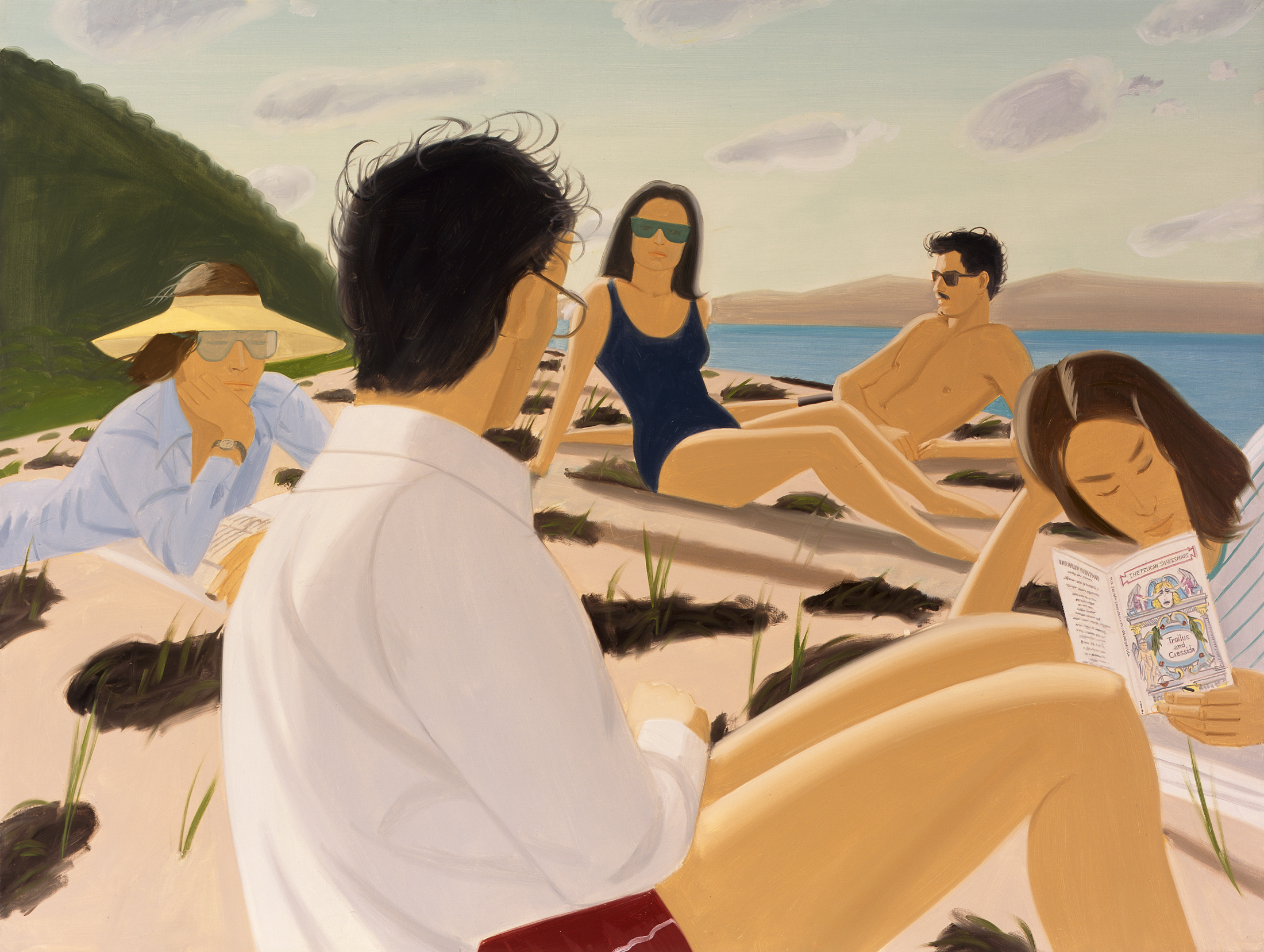
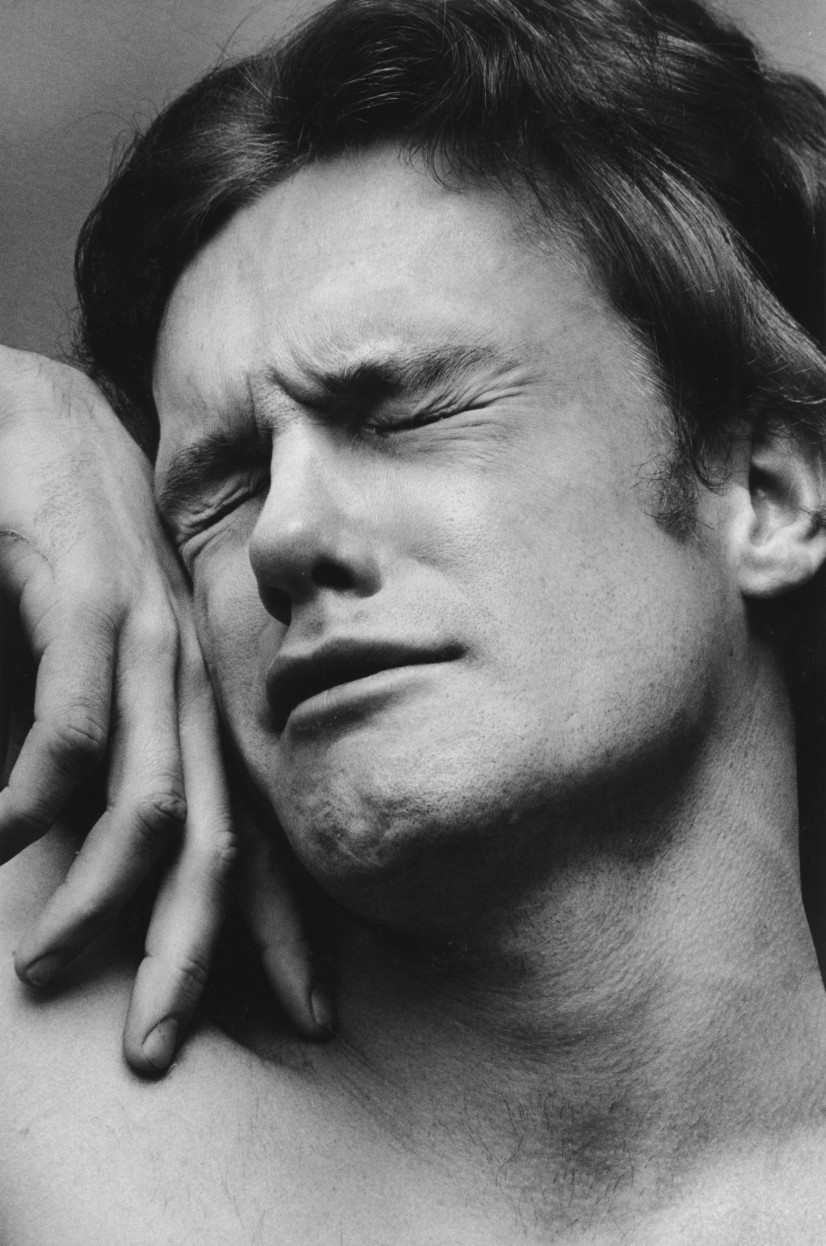
Extremes of emotion that suggest the possibility of new kinds of relationships the instantiation of which never overcomes the possibility of their failure, indeed, the failure of any relationship, the possibility of an isolation that might be enabling but which could also be terrifying—this convoluted knot of affective promise and threat seems encapsulated to me in the image on the cover of Yanagihara’s book, a Peter Hujar photo of a man with his eyes screwed shut and a hand (his own?—hard to say, though if so the posture is awkward, unnatural) touching the side of his face.

Peter Hujar, "Orgasmic Man" (1987)

Peter Hujar, “Orgasmic Man” (1987)

Although he looks anguished to me, the jacket copy tells me the photo is called “Orgasmic Man.” Of course Barthes and others made plenty of hay about the estranging, even destructive qualities of bliss, so it’s not as if those terms are necessarily contradictory. My uncertainty about this image, my changing sense of what it might mean in light of its title has an analogue in the design of the cover. In the right light, a holographic double of the title and author’s name shimmers into life, as if in recognition of the subterranean life that courses beneath the surface of even those who are closest to us. The power of A Little Life is to be able to expose that duality so movingly, to make us immersed in the lives of these characters, to do what literature does, to let us live in a world that is not our world. Of course there are risks in that displacement. Thinking back to my Swiss co-worker, who wanted her guests gone so she could get back to her book, I see now that the greatest paradox of A Little Life is that to be immersed in this enormous, exhilarating book about what it means to relate to others is to risk being distanced, even alienated from the others in our own lives, the ones we love in whatever hesitantly articulable ways we love them.
Eugénie Grandet–Honoré de Balzac

It will tell you something about me that the Balzac I know best is his story “Sarrasine” (1830), a text mostly ignored by readers for a century until, so the story goes, Roland Barthes came across an offhand reference to it by Georges Bataille that intrigued him enough to devote an entire seminar to the little story, the result of which was his extraordinary narratological study S/Z.

“Sarrasine” is amazing and holds up to many readings. But one story out of the thousands of pages Balzac wrote, well, it’s not much to base a judgment on, is it? (Technically I read Père Goriot a long time ago, too, but I can’t tell you anything about it except that it’s about a boarding house. It’s about a boarding house, right?) But now as part of the Slaves of Golconda group I’ve read Eugénie Grandet (1833) and I’m planning to immerse myself in Balzac as soon as reasonably possible. The guy was clearly a genius.

To come to Balzac through Barthes and post-structuralism is now so old-fashioned as to be almost quaint. The news that Princeton has bought the library of Jacques Derrida, though it warms my heart, makes me certain that the theory that was meat and drink to me is rapidly becoming antiquated. As Alexander Trocchi once said of the canonization of Dada, even “the turds of anti-art were framed and hung alongside “The School of Athens.”

Although Barthes offered his reading of Balzac as a critique of the ideological dominance of literary realism—specifically, its way of pretending that what it is doing is merely transforming things into words when in fact every thing, in this case every referent, is already produced through the combination of a number of interpretive codes—Barthes would be the first to acknowledge what time has made increasingly clear: S/Z is a paean to that realism, and especially to Balzac. Barthes described the realist writer as a painter whose main tool was not his canvas but the frame he placed around it, which Barthes employs as a figure for the condition of representability itself. To show anything it must first be selected, chosen, made. The trick played by realism—the ideological sleight of hand that bothered Barthes in the early 70s—was to pretend that the frame didn’t exist and that the canvas was simply a swathe of the real. But that didn’t mean, as critics of post-structuralism liked to say, that the art of the canvas was second-rate or disingenuous or bad. After all, S/Z is as much love letter as critique.

It’s entirely possible, though, that what Barthes said about literary realism might really only be about Balzac. Maybe the circulation of codes—by which Barthes meant both pre-established conventions for depicting and thinking about the world, and the way texts are in fact citing other texts when they claim to be showing life—isn’t the way realism works. Maybe it’s just how Balzac works. That’s the thought that came to me when I read, in Eugénie Grandet’s stilted and awkward opening pages, this description of Monsieur Grandet, the heroine’s father, a miserly cooper whose speculations first in the wine trade and later in the financial markets make him rich: “Financially speaking, Monsieur Grandet had the qualities both of a tiger and a boa-constrictor.” A tingle ran down my spine. Hadn’t I read about tigers and boa constrictors before? I pulled my copy of “Sarrasine” off the shelf where I duly found this description of a woman entranced by an old man she does not yet know is a castrato: “She was under the spell of that timorous curiosity which leads women to seek out dangerous emotions, to go to see chained tigers, to look at boa constructors.”

No doubt someone has written a book on the history of circuses and the Paris zoo (which, a quick Wikipedia search tells me, was founded in 1793) or any of the other ways in which such exotic animals might have made their way to 19th century France. If anyone knows about that stuff, please let me know, but honestly I’m only halfheartedly interested in that sort of background. What I’m genuinely interested in is how this repeated imagery tells us something about Balzac’s method and the preoccupations of this book. It’s not that Balzac copies himself—Barthes says copies are at the heart of Balzac’s work: what they are about and how they are made—but that in citing himself, in returning even to tropes that aren’t at all central to the subject matter of his writing, Balzac incorporates a process of circulation that is central to that subject matter.

Balzac delights in expressing and examining received wisdom; Barthes called this doxa and Franco Moretti called it Balzac’s “loquacious wisdom.” One of Balzac’s favourite formulations (present dozens of times in “Sarrasine,” admittedly less frequently in Eugenie) is “one of those”: “Prompted by one of those ideas which arise in a young girl’s heart…”; “It was one of those looks in which there is almost as much coquetry as deep feeling.” The implication is that readers will know what the narrator is talking about (ah, one of those ideas, one of those looks). The narrator becomes a kind of cataloguer of the world, able to show us what we might have missed but what, prompted by his description, we recognize as present in the world. But again the point isn’t that literature simply reflects the world beyond it but that it summons that world into being. The circulation of tropes, whether the “repetition” of known truths (“one of those”) or the self-citation of metaphors and images (tigers and boa constrictors) contributes to the way Balzac’s texts elide their own construction. How otherwise could such fanciful and melodramatic tales have come to seem so natural? The seemingly haphazard quality of the prose and the structure—this isn’t Flaubert—similarly contribute to the “natural” or “found” quality of the work: here is a slice of life.

As I said above, circulation isn’t just present in the form of the text. It’s also important in its content. The circulation of tropes that realist representation depends on is like the circulation of capital. And Eugénie Grandet is, at least superficially, about a miser (though the fact the miser is Eugénie’s father and that the book is not named for him suggests we might need to rethink that assertion). Grandet amasses his fortune first through trade (often by deviously undercutting his fellow vintners) but later through investment and speculation, where money is made from money. Rohan wrote about how unconcerned the novel seems to detail the source of Grandet’s money, how uninterested in detailing the labour that goes into making it. But from the perspective of capitalism, the more alienated capital is from labour the more powerful its ideological purchase.

That said, there are important counterweights in the novel to the idea of effortless speculation. Grandet loves gold, even picking gold threads out of a dress. He hoards copper coins in his study, so many that when he takes them out of the house, under cover of night, he needs a servant to help him carry the cauldron on a yoke around his neck. (The scene where Eugénie, half asleep and in the fever of new love, chances upon her father in this act is a masterful phantasmagoria.) In this sense wealth is highly material—and so too are the vividly evoked deprivations Grandet’s household endures as a result of the father’s miserliness, like the sugar cubes Grandet finds time in his busy schedule to cut up. Indeed, the miser challenges the idea of capitalist circulation, because he wants to hoard his money rather than keep it moving about. So although the novel depicts the increase of the Grandet fortune as implacable and inevitable, it also positions the miser as not just the capitalist par excellence, but also, more challengingly, as the limit of that economic system.

I struggled with how to understand the relation between money and heredity in this book. For heredity—by which I mean the passing on of emotional traits and values rather than of physical characteristics—seems to be something that also persists implacably. The novel tells the story of a family, but mostly it focuses on just the father and his daughter. What the daughter takes from the father is important to understanding the book’s remarkable ending. (Balzac might not be too great with beginnings, at least as evidenced by this book, but he sure knows what to do with an ending.)

The back cover of the Oxford edition I read—which comes with a really excellent, smart but not pedantic introduction by Christopher Prendergast, you should check it out if you’re at all interested in this book—asks “Who is going to marry Eugénie Grandet?” “This is the question,” the copy adds, “that fills the minds of the inhabitants of Saumur,” the town in the Loire where the book is set. Amateur Reader has pointed out that this is not really the question of the book. I submit that if there were something like a guiding question for the book it would be something like: “How should we understand Eugénie’s fate?”

I love the book’s way of wrong-footing us, of presenting scenarios we’ve seen before and then upending them. When Eugénie’s glamorous and spoiled Parisian cousin Charles comes to visit, and when the girl is instantly smitten with him to the point of giving him her heart, and, just as importantly in this novel, paying off his debts, we think we know what to expect. Surely this rakish dandy will do her wrong; surely he will be her ruin. When Charles learns, shortly after his arrival in Saumur, of his father’s suicide after the shame of becoming a bankrupt and accepts that his only hope of recovering any position in Parisian society is to seek his fortune in the Indies, we are sure he will abandon to Eugénie. And in this case we are right, just as we are also right that Eugénie will hold fast to his memory. Charles, who whatever his flaws was always rather sweet, becomes hardened in his seven years overseas—not least because he soon realizes that the real money is in selling people not goods. Embroiled in the slave trade—in “unremitting contact with selfish interests”—he becomes hardened and cynical: “his feeling for others contracted and withered away.” Balzac immediately adds that after all Charles is a Grandet: “The blood of the Grandets fulfilled its destiny. Charles became hard and ruthless in the pursuit of gain.” That ruthlessness extends to his personal life. On the ship home, Charles meets a titled, well-positioned family that has been much reduced materially. Although he doesn’t much care for Mademoiselle d’Aubrion—and Balzac does his best to make sure we don’t either, describing her as “thin and spare, with a supercilious mouth, dominated by a blunt, over-long nose, which was normally yellowish but became quite red after meals, a kind of vegetable phenomenon that is more unpleasant in a pale, bored face than in any other”: nothing by halves for our Balzac—Charles marries her anyway, because her family’s connections will open Parisian society to him. So important to him is this idea of securing a brilliant position that even when he learns that Eugénie has repaid his father’s creditors, with interest, he only pauses momentarily to lament the loss of a fortune the size of which he hadn’t suspected—what he really cares about, Eugénie can’t give him.

I suspect Charles isn’t the only Charles in Balzac’s works, and I bet some of them get their own novels. But in this novel his trajectory must remain only a sketch because its main interest is in Eugénie. Her honour has not been besmirched; she hasn’t become a fallen woman. She and Charles share only two kisses before his departure; he does not force himself upon her or leave her ruined. Nor does she simply renounce the world after her disappointment. She doesn’t become a nun, exactly—this isn’t The Princesse de Cleves. It’s true that her first reaction to the news of Charles’s dismissal of her after seven years is to calmly state that now she can only “suffer and die.” She even tells her priest that she wishes to leave the world and live in seclusion. But she doesn’t. She learns Charles’s marriage will not come off until his father’s creditors are appeased and arranges to pay all the outstanding bills. We don’t know why she does this. From self-abnegation? From a desire for revenge? To make Charles dependent on her? None of these are right. What we do know is that when she decides to take this action, a friend of the family tells her, “ ‘As you said that, your voice was just like your late father’s.’” This a moment after the text has told us: “she decided that, in future, she would assume an impassive expression as her father had always done.”

So the heredity that concerns the book pertains as much to Eugénie as to her Charles. For she too is a Grandet. And she becomes increasingly like her father. She is immured neither in a convent nor in the walled garden where she once sat with Charles, but she is imprisoned in a life of emotional nullity. Although enormously rich, she doesn’t hoard her wealth; indeed, she gives generously to charity and the Church. But the hardness that attached itself to Charles also begins to manifest itself in her. She isn’t cynical, but she does, the narrator tells us, respond to others “ironically,” a word it would never have used to describe her earlier.

It is in this spirit of emotional asperity that she agrees to marry a lawyer from Saumur, the now middle-aged son of one of two families that had been vying for Eugénie’s hand—and her fortune—since even before the arrival of Charles. But she marries Monsieur de Bonfons only on the condition that he expect nothing more than friendship from her. (And that friendship seems quite icy.) She doesn’t pine for Charles, she doesn’t preserve the memory of their courtship in Havishamian aspic. She simply turns that part of herself off. When Bonfons dies only a few years later, she becomes even richer, even more isolated, even more forbidding. The irony of the Grandet family is complete: the one who cares nothing for gold is showered with it. She uses it to do good in secret. But despite this charity, and despite her beauty, which, the narrator tells us, persists even as she approaches forty, despite her poise, she isn’t the same as she was as a girl:

She has all the nobility of grief, the saintliness of one whose soul is unsullied by contact with the outside world. But she has also the rigid outlook of an old maid and the narrow vision that comes from the restricted life of a provincial town. In spite of her income of eight hundred thousand livres, she lives as poor Eugénie Grandet used to live. She lights her fire only on the days when her father used to allow the fire to be lit in the living-room, and puts it out according to the rules in force when she was young. She always dresses as her mother did. The house at Saumur, sunless, devoid of warmth, gloomy, and always in the shade, reflects her life.

I’m interested in the way the book here reverses its understanding of the distinction between Paris and the provinces (Paris = flashy, vain, superficial; provinces = solid, demure, profound). There’s enough criticism of Eugénie in this passage to complicate the saintly resignation that would otherwise have reduced her to caricature. To be sure, if the book really believes in the ideas of emotional inheritance it so often references, then she couldn’t have ended up any other way, and so it would be meaningless to speak of criticism. And on the book’s final page, the narrator both backpedals on some of the things it says here—claiming that “the greatness of her soul lessens the effect of the narrowness of her upbringing”—and finds fault with the situation itself. Whether the tragedy is really that “a woman who, made to be a magnificent wife and mother, has neither husband nor children nor family” (a surprising thing to say, given the book’s interest in heredity, which would seems to make nonsense of the possibility raised here that Eugenie was made to be something her family could not have given her), the book does leave us feeling the hopelessness of her situation.

But Eugénie Grandet is melancholic not tragic. From the first sentence, in which the houses in certain provincial towns arouse melancholy as much in the stranger who comes across them as in the people who live in them, melancholy is referenced throughout the book, the best way to describe the strange uncertainty of the narrator’s description of the widowed Madame de Bonfons. Melancholy is the way the book gives its protagonist a fate more complicated, if not necessarily more pleasant to experience, than those typically granted to heroines of the period. I find myself thinking about her a lot, and, as Barthes once did, look forward to delving further into the vast and surprising work of her creator.

Words to Live By

But perhaps the moral value of the disciplines we call the humanities actually lies in the care and self-consciousness with which the desire to understand is regulated, in finding ways to cajole it away from egoism and self-inflation so that idealism and learning, thinking and knowing, can co-operate.

It isn’t easy. When I write a commentary on a text I’m aware that I know things that have the potential to generate a toxic cloud of dullness which could obscure the poem I am supposed to be explicating. I know stuff about the practice of sonnet writing in 1609, stuff about the history of words, stuff about the history of gender and sexuality. When I set that down in the form of a commentary on Shakespeare’s sonnets I also know that explication can be the most excruciating form of bardicide. Holding back on philological learning in order not to drown out the little voice inside which keeps on saying ‘the reason you are doing this is because this poem is fascinating beyond anything you could begin to create,’ and letting readers see why it might be worth knowing more in order to understand better is what I think I am doing. … [A]cademics manifest in unusually public ways the general tendency of desire to turn into something else in the course of its realisation. The caricature philologist could be regarded as a person in whom the desire to understand has suffered its final metamorphosis: the means used to pursue the end have entirely obliterated the end itself. We take the risk of becoming that person whenever we interpret more than casually. We owe it to ourselves to back off from time to time, and remind ourselves of our own ends.

—Colin Burrow, “Are You a Spenserian?”

Happy Birthday, EMJ!

WordPress tells me that a year ago yesterday I started this blog. I wish Eiger, Mönch & Jungfrau nothing but the best in the coming year, including, just maybe, a more frequent posting schedule.

Keeping this blog has meant a lot to me and given me some sorely needed confidence about my writing. It’s helped me be freer and looser in my writing, and allowed me to contribute, albeit in a small way, to a larger ongoing conversation online about books that I value a lot and am pleased to be part of. And it’s made me think more carefully and clearly about the things I’m reading. What I tell my students is really true—you can’t know what you think about something until you write about it.

I’ve a couple of blogging goals this year: to write more posts and to keep them shorter, and to try different kinds of writing, more in the vein of the personal essay. I’ve been striving here to write pieces that combine criticism with personal reflection, pieces that bring my own reading experience or history into the discussion of the books I write about. So I think the writing has already been personal. But I want to try to write essays that are inspired by, even grounded in, things I’ve read, but that aren’t so much reviews per se.

It matters a lot to me that others are reading these posts. I know from my stats that there aren’t that many of those others, but numbers aren’t everything, and the encouraging feedback I’ve received has meant so much to me.

To my readers, then, thank you for your interest & support.

I take requests, too. Maybe not about which books to write about—I always want recommendations, but I usually follow my own reading inclinations and it can take a long time before I get to them, which is why you should never lend me a book—but about the kinds of pieces you’d like to see here. Do let me know, if you’ve a mind.

That’s all for now. More mountains to climb. The bedside pile is particularly north face-ish just now.

A Year in Reading, 2014

Late on this, I know, but here are a few thoughts on my 2014 Year in Reading.

Thanks largely to my sabbatical I read a lot last year (96 books). Included in that list were many books that I liked, some that I liked a lot. But I’m left with the impression that it was a more muted year than the previous one. The spread between the best and the worst wasn’t as big. But I didn’t read as many indelible books, especially compared to 2013. Rebecca West, Olivia Manning, the last volume of Proust. Hilary Mantel—hard to compete with those.

But I read a number of good things. And although you wouldn’t know it from this list I made an effort to read more nonfiction this year. I especially liked Wright’s Thirteen Days in September, Shavit’s My Promised Land, and Bernard Wasserstein’s The Ambiguity of Virtue: Gertrude van Tijn and the Fate of the Dutch Jews, which I wrote about here.

David Bezmozgis—The Free World & The Betrayers

These were my books of the year, and I regret not making the time to write about them.

Part of the reason I didn’t is that Adam Kirsch has already said everything that needs to be said about them. He argues that Bezmozgis is a striking outlier in the current wave of literature being produced by the children of the Soviet Jews allowed to emigrate in the 1970s and 80s. Like Bezmozgis, many of these writers were born in the USSR but came to the US—or, in Bezmozgis’s case, Canada—as young children. But unlike them he is at least as interested in what the émigrés left behind in the old world as what they found in the new. The Free World is a beautiful, funny, and smart novel about one extended family’s experience leaving Latvia for the West. The title refers, of course, to America and its promises. But it also refers to the aimless freedom of Rome and its environs, where the family, along with dozens of other Soviet Jews, await visas to their final destination. As Kirsch points out, Bezmozgis doesn’t concentrate on the experiences of a child, that is, of someone close to the age he would been when he left the USSR. (He already did that in his first book, the wonderful linked story collection Natasha.) Instead, he focuses on his parents’ and grandparents’ generation, and the conflict between them as they negotiate a strange new world. Most impressive is Bezmozgis’s sympathetic portrait of Samuil Krasnansky, a true Communist and Soviet patriot to the end. As Kirsch says, Bezmozgis reminds us of a whole category of people and way of life that many readers would prefer to forget: “the generation of Jewish Communists who ardently believed that the Soviet Union was forging a path to Jewish and human liberation.”

Samuil’s past is told so vividly that we can’t help but contrast it to the more petty and aimless story of his sons, trying to provide, in however quasi-legal or illegal fashion, for their families in this Italian interregnum. Yet Bezmozgis isn’t nostalgic: his point isn’t that the past is better but that it has a value that shouldn’t be forgotten even when it has been apparently inevitably superseded.

At one point in The Free World a character recalls an absurd detail from the Sharansky trial. What is background material in the first novel–a sign of the larger political moment Bezmozgis is interested in–takes center stage in the second. Natan Sharansky is the obvious model for Baruch Kotler in The Betrayers. Sharansky—the most famous of the refuseniks–spent more than a decade in Soviet prison camps on trumped up charges while his wife campaigned publically and continuously for his release. When this was finally granted, in 1986, he moved to Israel and became an influential politician. Kotler’s life maps on to Sharansky’s in almost every detail, except that Sharkansky’s personal life remained above reproach, unlike Kotler’s. At the beginning of The Betrayers, he has arrived in Yalta, his boyhood home, with the young woman with whom he is having a suddenly very public affair. By a coincidence so bald and overt that the novel spends a lot of time thinking about its baldness and overtness, he ends up staying in the only room available in the city in high season, in the home of the man who all those years ago denounced him to the KGB. (As you can see, pretty much everyone in the book could be described by the title.) Tankilevich, the informer, is presented as sympathetically as Kotler, and the hardship of Jewish life in Crimea (only exacerbated by the events that happened between the time the book was written and published) is movingly presented. Kotler’s principled response to an imagined Israeli pullout from the West Bank, especially in relation to his reservist son’s very different, yet equally principled take, is also fascinating. My only wish is that the book had more time for its female characters. But the novel seeks to understand everyone, which is one of the reasons it complicates its talky, schematic structure. My sense from casual online browsing is that many find this structure a liability. But for me it shows again that Bezmozgis is the smartest and most surprising young (North) American Jewish writer today.

Josephine Tey—The Franchise Affair

This was one of the first books I read last year and it stayed with me to the end. Strange and unsettling, The Franchise Affair is about an unambitious lawyer in the English countryside who finds himself defending a mother and daughter against accusations that they kidnapped and abused a fifteen-year-old girl. The suspense of whether the couple is guilty is handled superbly, but what makes the book really interesting is its grim suggestion that aggression and vindictiveness lurk inside everybody, just waiting to come out. This philosophy really messes with our reading experience: just who are we supposed to sympathize with? As in all of Tey’s books, the expected romance founders, but her dispatching of the idea here is even more determined than usual. That failure is offered as yet another example of people’s inability to read each other. See Rohan Maitzen’s intelligent review for more about this terrific book.

Caleb Crain—Necessary Errors

Necessary Errors will always have a soft spot in my heart because it’s the first book I blogged about. But I also love it because it’s so smart and rueful and moving. A much better than average novels of innocents abroad. I can’t wait to see what Crain will write next.

Roz Chast—Can’t We Talk about Something More Pleasant?

Everybody says this about this book, but it’s true: reading it, you will both laugh out loud and feel very, very sad. Of course I’ve always loved Chast’s cartoons—what self-respecting neurotic person doesn’t? But this memoir of her parents’ very old age had a depth and power that surprised me. Made me think about all the conversations neither my parents nor I want to have.

Three Books by Tove Jansson

2014 was Tove Jansson’s centennial and the least I could do was read some of her books. I dispatched The Summer Book, The True Deceiver and Fair Play in the space of a week: they’re wonderful and wonderfully short. They pack a big punch, too. I want to read them again; I’ve a hunch they’ll only get better. (Surely there’s some class I can shoehorn them into?) I wanted to write about them, to force myself to articulate what makes them so great. But I never did. It didn’t help that the week I read them was the week before the semester started. Something else stopped me, too, though. I think it was my sense that they are more complicated than they seem and that delving into them would be a real project. For now, I’ll just say a few obvious things: they are marvelous books about Northern weather and the way it makes you feel—how summer up north makes you feel indomitable and reckless, coated in endless light, how winter makes you feel shriveled and curt, menacing in a different way; they are marvelous books about taking a break from ordinary life; they are marvelous books about friendship, how hard it is to attain and how much it can mean when you do; and above all they are marvelous books about artistic/intellectual work. In this regard, Fair Play is the pick of the litter, even though it was the one I liked least for most of my reading experience it. (An excursion to America seemed particularly infelicitous.) But the ending is so moving and lovely, you forgive everything and realize you’d been wrong in finding parts of it lame and clunky, on the contrary everything was just right.

Penelope Fitzgerald—The Bookshop

Another book I wanted to write more about and didn’t. Early Fitzgerald, but classic, the story simple to the point of nonexistent. A middle-aged woman decides to open a bookshop in a windy, damp Norfolk town in the late 1950s. It doesn’t work out. The Bookshop is devastating, mostly because Fitzgerald calmly underplays everything. We feel so sad at the end because the world didn’t end. Thinking about it now, I see surprising similarities to The Franchise Affair: both novels have a dark vision of English provincialism. Fitzgerald is funnier than Tey, though. Fitzgerald is always funny, in a desperate, almost daft English way. At long last, a book about books that doesn’t think books will save the world.

Sarah Kofman—Rue Ordener, Rue Labat

Last summer I wrote about re-reading this in preparation for a new course. I was surprised how my students took to the book—their energy and insights made me appreciate it even more. Professional bias, I know, but I still think teaching a book is the best test of its value.

Karl Ove Knausgaard—My Struggle (Books1 &2)

I don’t care what Stevereads says. This book, whether novel or memoir or whatever it is, is fascinating. Will it stand the test of time? Who knows? Not much does. But it stayed with me all of the past year, especially the first volume, especially those indelible scenes in which the narrator & his brother muck the filth out of their alcoholic father’s house.

Nathan Englander

This was a special part of my 2014 reading, because I got to hang out with the author for a few days this fall, and he’s totally hilarious and a total mensch. I like For the Relief of Unbearable Urges best as a collection, but think there are individual stories the stories in What We Talk About When We Talk about Anne Frank that are stronger (“Free Fruit for Young Widows” is amazing). The Ministry of Special Cases felt like an inspired misfire, but I gather the next novel will be set in Israel and I can’t wait.

Peter Higgins—Wolfhound Century & Truth and Fear

Another winning recommendation from Jenny Davidson. These were my favourite light reading this year. Is this steampunk? I think so. It’s an alternate history of 20th century Russia, it’s crime fiction and fantasy, it’s a totally compelling and carefully imagined world that owes so much to so many wonderful books. Look, for example, at this totally cool and endearing list of “books that shuffled and groaned and whispered on the shelves while Wolfhound Century was being written.” The sequel was just as wonderful and I await the third impatiently.

The Vet’s Daughter–Barbara Comyns

Barbara Comyns’s strange little book The Vet’s Daughter (1959) is narrated by Alice Rowlands, a seventeen-year-old girl who temporarily escapes the desperate circumstances of her home life when she takes a position as companion to an old woman, the mother of one her father’s colleagues. This woman, a Mrs. Peebles, is so sunk into depression or anxiety or ennui or something that she earns Alice’s description of her as “so sadly vague and harmless.”

Mrs. Peebles has survived a house fire, the death of her husband, and even a suicide attempt. A man delivering bread to the house discovered her “limply hanging in the green barn among the apples, and he had the presence of mind to cut her down with a pair of sheers and untie the dreadful rope around her neck.” This passage puts me in mind of the suicide Mr. Valpy, whose death in Virginia Woolf’s autobiographical fragment “A Sketch of the Past” gets fused in the mind of the young Virginia with the image of an apple tree in the garden. More pertinently, it offers a fine sense of Comyns’s calm way with horrible things. Some of that measured quality attaches to the narrator too, though equally characteristic is the gallows sprightliness evident in the sentence that comes right after the description of that macabre discovery: “Sometimes, when I looked at her there appeared to be a sinister brown stain round her neck, and I couldn’t help wondering if her eyes had always been so prominent.” This is funny, but not arch or knowing; mostly it’s discomfiting. Alice’s sentiments here seem almost naïve, but she is neither guileless nor foolish, even though she is almost always at the mercy of others.

Of all the unsettling, even startling things that happen to Alice in The Vet’s Daughter, why is it that the detail I remember most is so benign? Alice’s time with Mrs. Peebles comes to an abrupt end when the old woman—distraught that the couple who have kept house for her, a nasty pair straight out of a Roald Dahl story, have absconded with the silverware—is found drowned, presumably having finally succeeded in killing herself.

A kind policeman questions Alice and, as she has nowhere else to go, takes her in for the night. His house—unlike all the other filthy, dilapidated houses in the book—is “red-bricked and very clean.” (I picture it like the policeman’s house in Wes Anderson’s Moonrise Kingdom, all bachelor ship-shape.) And there’s an unexpected grace note: “Homing pigeons that had failed to return were in a box beside the fire, waiting to be claimed.”

Maybe the reason this image stays with me so strongly is that it’s one of the few homey, domestic, and even hopeful moments in the book. True, these birds are failures, homing pigeons that never made it home. In their dispossession they are rather like Alice. But they seem to have ended up well. Imprisoned, perhaps, or packaged at least, yes, but well looked after, all cozy beside the fire. And surely someone will want them: they are waiting to be claimed, after all. It’s unclear anyone wants Alice, for anything other than abusive or mercenary reasons, except perhaps Mrs. Peebles’s son Henry, Alice’s father’s colleague, the man who arranged for her to look after his mother and who cares a great deal for her even though she can’t bring herself to return the feeling. (In the end, he proves unable or unwilling to save Alice.) The pigeons in their box remind us of so many unhappy animals in the book, especially those in Alice’s father’s care—a term we can only use ironically, since he sells the ones he doesn’t like to a vivisectionist. That’s to say nothing of the ones he has used to furnish his house: a rug from a Great Dane’s skin, a monkey’s skull that sits on the mantelpiece, “a horse’s hoof without a horse joined to it” to prop open the door to his study. The house is full of piteous and frantic mewling and screeching and barking—as well as, before long, the tortured cries of Alice’s mother, who dies from a painful, undiagnosed illness.

Whatever their fate, then, the pigeons don’t suffer as these other animals do. Maybe I held on to the image’s intimation of a happier future—the moment someone finally claims the birds—as a corrective to my uneasy suspicion that Alice has had something to do with Mrs. Peeples’s death. And I don’t just mean that in the childish sense of the omnipotence of thoughts: Mrs. Peeples disappears on an afternoon when Alice has fled the house, unable to take the woman’s presence any more (“She became repulsive to me, like some old brown flower”) and the girl feels guilty for having felt that way. I mean it more literally: in the possibility that Alice has done her companion in.

That suspicion might be a way to understand the strange paragraphs—suddenly and unusually narrated in present tense—that describe Alice’s search for Mrs. Peeples. Here’s the first one:

Clank, clank my feet on the stairs; clank, clank on the landing. All the doors are open. One of Mrs. Peeples’s black shoes is caught in the ironwork and abandoned. Through the open doors are rooms with open windows, and it is like a zoo with the animals let loose and escaped. No one is there. “Mrs. Peeples, where are you?” Where are you? Not upstairs or below, or in the garden where you never went. Where are you? For a long time I look for her, even in the green shed, but she isn’t there hanging from the roof with the rope cutting into her brown neck.

The garden where you never went. It’s as if Alice knows she is already dead. The odd syntax of the final sentence, which paints the picture of the death it claims to disavow, doesn’t make the scene any less creepy. And why is Alice saying to herself (“Where are you?”) what she has already said out loud? In the end, I don’t think Alice has really killed Mrs. Peeples. Instead it’s as though she’s in a fugue state here, which is a pretty good description of the whole atmosphere of this strange little novel.

*

So who is this Barbara Comyns and where did she come from? The US edition includes a short introduction by Comyns, reprinted from a British reprint from the 1980s. (It is the fate of writers like Comyns always to be reprinted, always to be rediscovered.) Comyns gives us a rather helter-skelter autobiography. We learn of a violent father who went through the family fortune, an invalid mother who suddenly, unaccountably went deaf, a series of unlikely governesses. Her childhood seems to have been both privileged and hardscrabble. Later came art school and two marriages and a whole series of odd jobs, in advertising and in real estate, as an artist’s model and a refurbisher of cars. Throughout she kept writing, though with only middling success, it seems.

It’s heartening anyone published her at all, so odd is her prose (at least based on this book). I remember once in graduate school, having recently discovered Henry Green, another unusual English writer of the mid twentieth century, telling one of my advisors that I wanted to include him in my dissertation. She was generally speaking encouraging of my project (as well as unusually well read for an academic). But talking with her made me nervous and prone to prattle on. I remember saying to her, rather grandiosely, that Green wasn’t like anyone else, it was as if he’d dropped to earth from the moon, to which she tartly responded that no one dropped from the moon, that he wasn’t so unusual as all that, that he had his context like anyone else. I think now that this is true. And reading Comyns I was reminded of a number of other wonderful, more or less minor British writers from about the same time.

There’s something of Jean Rhys in Comyns’s portrayal of the hopelessness felt by young women (though Alice, and perhaps even her deaf friend Lucy, who flits intriguingly along the margins of the novel, is more resourceful than Rhys’s protagonists). I caught echoes of Richard Hughes’s hallucinatory portrayal of childhood in A High Wind in Jamaica (1929) and of Rebecca West’s matter-of-fact inclusion of supernatural elements in her amazing The Fountain Overflows (1957). (It’s probably no accident that these last two titles, like The Vet’s Daughter, are published by NYRB Classics.) Sometimes Comyns reminded me of Penelope Fitzgerald, in the obliquity of both her narrative structure and her own biography. (Fitzgerald kept herself and her family afloat by taking all sorts of odd jobs, too.) I even caught an anticipatory hint of early Ian McEwan—The Vet’s Daughter is like a less macabre Cement Garden (1978). And those are just the writers I know: I’ve a hunch, that Comyns might be like Ivy Compton-Burnett and Muriel Spark, though I haven’t actually read them yet.

So Comyns might not be sui generis. But I don’t think I was entirely wrong in thinking (wishing?) that Henry Green, or Barbara Comyns, or any similar writer, the ones that slink through the supposedly dull and genteel world of twentieth century British fiction like feral cats, is an alien, weird figure. However romantic or idealized, that way of thinking might keep us alive to the wonder of such writers. And in literary historical terms it can help us see that realism only ostensibly triumphed in the fiction of the period. In reality, a perverse, fantastic, Gothic strain runs throughout it. I’m thinking, in addition to those I’ve already mentioned, of writers as seemingly different as Elizabeth Bowen, Doris Lessing, and Daphne du Maurier. (Importantly, I suspect, the weirdness that disrupts these novels almost always manifests itself in depictions of children.)

In The Vet’s Daughter the clearest example of this strangeness—the oddest, most unsettling thing in this odd, unsettling book—is Alice’s sudden ability to levitate, or, as she prefers to call it, to float. One night Alice finds herself rising out of her bed and she knows she isn’t dreaming because she hits her head on a sconce that is still cracked in the morning. She is as surprised by this turn of events as we are. But the novel takes it in stride. It quickly becomes clear that we aren’t to take the floating as a hallucination on her part or a metaphor on the novel’s (her way of rising above the unhappy events of her life, say). Alice’s ability is both ordinary (when she cautiously asks Mrs. Peeples if she has ever heard of anything like it the woman says she believes it used to be quite common) and extraordinary (it fills everyone who sees it with horror, even disgust). I like that the novel doesn’t try to explain it away, or use it as a way to redeem or transform Alice’s mostly grim and unhappy life. Indeed, it’s not long before someone—her father, the very man who hatefully said he hoped he would never see her again—tries to profit from Alice’s ability. He arranges a public demonstration, doubtless the first step on a tour that, Alice sees all too clearly, will make her into a freak show exhibit.

In a marvelously ambivalent ending, though, these plans are foiled. Alice’s appearance in the air above Clapham Common causes a riot in which three people, including Alice herself, are killed. The first person narration comes abruptly to an end, her fate given to us through a newspaper report. The bitter irony of the book’s end fits with its way of ruthlessly undermining anything nice or good that happens to Alice: a boy she falls for, who teaches her to skate, throws her over; Henry, Mrs. Peebles’s kind son, doesn’t come when she calls him in her hour of greatest need.

Perhaps surprisingly, given what I’ve said, The Vet’s Daughter isn’t unrelievedly bleak, but it’s hardly easy going. You can see why I needed to hold on to those pigeons, and to think of them as rescued. But the book whetted my interest in Comyns’s other books, even though I’ll need to take a deep breath first.

Writing about this book made me like it more. (Always a good sign.) I read it along with the good folks at Slaves of Golconda. I’m curious to see what they made of it, and hope you will too.