The Best Days of Our Life: Sentimental Education

I’ve written before about how my wife and a friend of ours from the days when we were all starting out as academics and in our first, temporary jobs after graduate school decided to read Proust together. We tackled one volume each summer for seven years, switching between his city and ours once our careers and life-paths took us in different directions.

We finished Proust and decided to stay with French literature: two years ago we read Madame Bovary. Last year we didn’t read anything; instead we went to our friend’s wedding. But we were back at it last week. Our book this year was Flaubert’s other well-known book, Sentimental Education (1869). We had a hard time with it and although our friend thinks we should try Bouvard and Pecuchet next year I think he’s going to be outvoted. I’m plumping for Stendahl but neither of the others seems much interested. We’ll probably end up with either Balzac or Zola. Vote your choice in the comments!

I don’t think I would have made it though Sentimental Education without the reading group. Certainly I wouldn’t have appreciated it as much on my own. Each of us experienced the same phenomenon: we didn’t much like reading the book, but we sure enjoyed talking about it. Nonetheless, I’ve concluded that Flaubert is a writer I admire but do not like. He’s like Joyce for me. They’re both so, I don’t know, airless. I need my books a little shaggier. That’s why I wrote a dissertation on Lawrence, I guess.
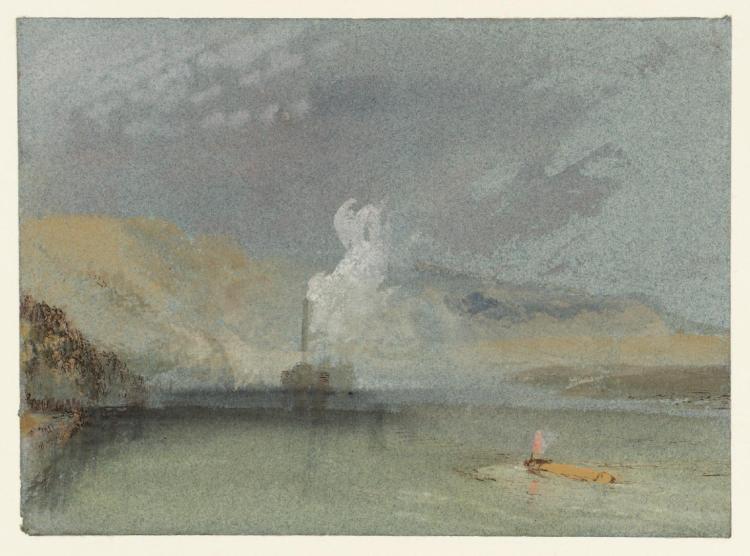
A Steamer and Shallow Waters in the Seine, Normandy c.1832 by Joseph Mallord William Turner 1775-1851

A Steamer and Shallow Waters in the Seine, Normandy c.1832 Joseph Mallord William Turner

Anyway, here are some observations on the novel, taken from the notes I scribbled during our conversations:

We did understand, by the way, that not liking the book was pretty much the point. It’s a book about having high expectations for life and one’s self and being disappointed in them. But the trick is that those expectations aren’t foiled because of bad luck or history or poverty or illness. Rather they’re foiled from inability—including the inability to recognize one’s lack of ability. Sentimental Education is about being mediocre. The narrator readily lets us see how mediocre the characters are, which makes the novel Olympian and rather disdainful.

The hero, if you can put it that way, is Frédéric Moreau, a young man from the provinces who flunks out of law school but is able to live in relatively grand style anyway because he inherits a lot of money from an uncle. In fact, at the beginning of the book he’s returning from a trip to visit the uncle, his mother having sent him there in hopes of currying the man’s favour. Frédéric returns from Le Havre to Nogent-sur-Seine via Paris, where he switches to a steam ship because he’s sulky about having to go home for the summer and it will take him longer to get there by boat than by any other route. So he begins taking a petty revenge against his mother. This is a fine introduction to a novel filled with mean-spirited and selfish actions.

The boat trip results in more than a small-minded psychological victory, though. Onboard Frédéric meets Jacques Arnoux, an art dealer and impresario and eventual porcelain manufacturer with whom he will be intertwined for the rest of the book. More importantly, he meets Arnoux’s wife, with whom he is immediately besotted. Much of the novel is about the relationship they never quite consummate.

But it’s not really a love story. Yes, Frédéric falls immediately for Madame Arnoux, swooning for her, to the point that he ignores her lack of interest and regularly misrepresents her words and deeds as coded expressions of her own desire for him (though eventually they do become something like lovers). But Sentimental Education is no Anna Karenina. It’s not even Madame Bovary. For one thing, Madame Arnoux isn’t the only woman in Frédéric’s life. There’s Rosanette, one of Arnoux’s mistresses, with whom Frédéric takes up; the two even have a child together. There’s Louise, the daughter of the Frédéric’s neighbour in Nogent-sur-Seine. And finally there’s Madame Dambreuse, the wife and eventual widow of a banker, who Frédéric meets through Louise’s father, who is Dambreuse’s business manager. Got all that? Sentimental Education is a book obsessed with crowds, but it doesn’t have that many characters. In addition to the ones I’ve mentioned, there are a number of young men Frédéric knows from his time as a student, including his schoolboy friend Deslauriers, who is a lot poorer than Frédéric. The two treat each other fairly badly, considering they’re such good friends.

Anyway, I was saying it’s not really a love story. Flaubert defined it as the only kind of love story suitable for his generation: “It’s a book about love, about passion; but passion such as can exist nowadays—that is to say, inactive.”

This idea of passivity or inactivity—remember, the big event in Frédéric’s life is his inheriting a small fortune from his uncle—affects more than just romance. Sentimental Education is famously also a novel about politics, even about revolution. The last part of the book is set against the Revolution of 1848, when the Orleans monarchy was overthrown in favour of the short-lived Second Republic. Many of the book’s characters are active in these turbulent political events, though Frédéric mostly avoids them (he literally leaves town during the most dramatic and violent weeks). And with the exception of one character, a shopkeeper called Dussardier who Frédéric and his circle befriend on a lark, and who is a committed Republican, so committed that he dies for the cause, no one partakes of these events out of a sense of duty or obligation or passion. According to the introduction to the new Oxford World’s Classics edition, translated by Helen Constantine, Flaubert did not know Marx’s The Eighteenth Brumaire of Louis Bonaparte (1852) in which he famously said that history repeats itself, once as tragedy and once as farce, but Sentimental Education could have been written with that dictum in mind.

The reason the 1848 revolution was a pale imitation of 1789, at least on the evidence in this novel, is that it was self-interested. Self-interest matters a lot in this novel; if it’s about anything, it’s about how people use each other. Characters regularly claim to care for things—movements, causes, other people—but prove not to. This isn’t just a function of their fickleness or moral laxity: it’s a function of the world they live in. No one feels secure enough in their place in society that they don’t feel the need to use others to get ahead. Even Madame Arnoux, who in general is gentle and definitely put upon by her rakish/obnoxious husband, isn’t above using Frédéric’s infatuation with her to help her family out financially. (Again, Dussardier, the shopkeeper, is the only exception, but he’s such a minor character and he meets such a sad end that we can’t make an example of him.)

Flaubert could have made much of this cutthroat world in which everyone is out to get everyone else, or, in which a lot of cynical people are out to get each other and whatever innocents are around—but then he’d have been Henry James, and Flaubert is after something more dispiriting than the actually quite lurid and melodramatic James. (Madame Dambreuse is the most Jamesian character—there’s a great moment when she and Frédéric attend an auction of the Arnoux’s personal effects—they’ve fallen into financial ruin—and when she sees how distressed Frédéric is by the sale of so many objects he had become so familiar with, having attached them to his love for Madame Arnoux, not least a small jewellery box, she insists on outbidding everyone for it and giving it to him, just to show him who’s boss.)

The dispiriting part isn’t just that everyone uses everyone else. It’s also that they’re not always that good at it. Frédéric in particular is a hard character to get a handle on, because he’s so narcissistic, always preening in mirrors and admiring his outfits, always ready to do whatever it takes to keep up his image, yet at the same time he’s regularly taken advantage of. He’s not very clever, but he’s also not naïve. His self-reflections, when they occur, never lead anywhere. They don’t make him act any differently. We’re in the odd position of neither liking him much nor of feeling bad for him when he’s been fleeced. Who could like a guy who, walking through a crowded street, thinks things like:

He felt sick at the sight of their vulgar faces, the idiotic remarks, the foolish satisfaction on their sweaty foreheads! However, the knowledge that he was worth more than these people lessened the fatigue he felt contemplating them.

Here as elsewhere, Flaubert uses free indirect discourse—the description of a character’s thoughts in apparently omniscient voice—to devastating effect. The more we know Frédéric the less we like him. The mingling of narratorial and character’s voice is often so subtle it takes us a while to figure out who is being judged. Early on in the novel, when Frédéric is still poor and convinced he’ll stay that way, he convinces himself that poverty could work to his advantage:

A soul like Madame Arnoux’s would surely be moved by that sight [of the poverty that would no doubt bring out his genius] and she would take pity on him. So this catastrophe was a stroke of luck after all. Like the earthquakes in which treasures are uncovered, it had revealed to him the secret riches of his character.

Flaubert uses metaphor so sparingly that when we get one we are apt to hold onto it gratefully. At last, a poetic moment! But when we think about what’s being said here we see something more disheartening than high-flown, beautiful rhetoric. Who thinks of an earthquake as something that reveals buried treasure? Who ignores its destructiveness? Maybe someone who doesn’t in fact have any secret riches or rich interior life.

Flaubert loves bathos: any time he verges on the lyrical, he’s sure to follow it with a prosaic detail. A long description of arriving in Paris at dusk works itself up to an unusually delicate effusiveness—“the entire greeny stretch of the Seine tore itself into silvery shards of silk against the pillars of the bridge”—only to be immediately followed by: “He went to have dinner for forty-three sous in a restaurant in the Rue de la Harpe.” Or consider this momentary idyll amidst the bustle of the city:

Leaning on the plush windowsill, [Frédéric and Deslauriers] smoked cheroots. The sun was shining, the air was mild, swarms of birds flew down into the garden; statues of bronze and marble washed by the rain glistened. Aproned maids sat chatting on chairs. And you could hear children laughing, along with the continuous murmur of the fountain.

Nice, right? I love Paris in the springtime. But how does Frédéric respond?

Under the influence of the wine circulating in his veins, half asleep, bemused and with the light full in his face, he felt nothing but an immense sense of well-being, a dull voluptuousness, like a plant saturated in warmth and wet.

He responds stupidly, complacently, dully, like a plant. Notwithstanding some lyric pages in the countryside near Fontainbleu late in the novel, this isn’t a book that loves the country. Flaubert was not a writer who knew the name of every flower or tree. In this world-view, it’s not a good thing to be like a plant saturated in warmth and wet. (That’s about as much sex as Frédéric gets, by the way.)

After all, plants don’t do much. One of the most fascinating things about Sentimental Education for me was watching Flaubert try to escape from his own trap. Hardly anything happens in this novel. It’s not dramatic. In fact, it’s against the very idea that life is dramatic, structured like a story with obstacles to be overcome and climaxes to be attained. It ironizes the story of the young man on the make who comes to the capital form the provinces and takes the town by storm. It ironizes Balzac, in other words. There aren’t any set pieces in this novel. A scene at the horse races could have been highly dramatic. It could have shown Frédéric as a hero, or advanced one of his affairs. It could have been the horse race from Anna Karenina. But it’s not.

The second race was not very entertaining, nor the third, apart from a man being carried off on a stretcher [good joke there: all of J. G. Ballard in a nutshell]. The fourth, in which eight horses battle it out for the Prix de la Ville, was more engaging.

A paragraph about this race follows. It’s interesting enough, I guess. But then this:

A dispute held up the last race. The crowd, bored, broke up. Groups of men were chatting below the stands. The talk was rather loose. Some society ladies left, shocked by the proximity of the kept women.

And that’s it. Except traffic. What follows is a pretty lengthy description of how long it took everyone to get home, since all the carriages were leaving at once. Always, always, Flaubert ironizes and debunks. But what is he left with? What kind of a novel repudiates all the things that make up novels? That’s the corner Flaubert paints himself into, the aridity I complained about at the beginning.

Very rarely does Flaubert indulge in pathos. One such moment comes near the end of the book. Frédéric and Rosanette’s child falls seriously ill. Frédéric, who hasn’t had much to do with it, tries to downplay the illness; Rosanette is frightened. The child falls unresponsive; Rosanette calls Frédéric to her side. But it’s too late:

The child was dead. She took him up, shook him, hugged him, calling him the sweetest names, covered him in kisses and sobs, walked round and round, distraught, tore out her hair, uttered little cries; and collapsed on the couch where she remained open-mouthed [in Madame Bovary the motif of open mouths signals imbecility and vacuity], with floods of tears issuing from her staring eyes. Then she was overcome with lethargy and all became calm in the apartment. The furniture was turned upside down. Two or three napkins lay around. Six o’clock struck. The night light went out.

I find those napkins heartbreaking, a forlorn symbol of the aftermath of sudden, terrible emotion. But my reading partners thought this made me a chump (they’re more Flaubertian than I am, I guess), noting, perhaps rightly, that the emotion (all Rosanette’s) peters out rather quickly—that phrase “all became calm” suggests the event might not in fact matter so much. It doesn’t to Frédéric, who thinks only of himself: “It seemed to him that this death was but a beginning, and that an even greater misfortune was about to befall him.” (It doesn’t). Even Rosanette is hard to sympathize with: she wants them to embalm the child, a wish both grandiose and ignorant. As the narrator says with typical acerbity, “There were many reasons against it, the most cogent of which was that it was not feasible in the case of such a young child.” What I’m saying is, if you want pathos in your literature, as I’ve come to realize I do, then Flaubert is not your guy.
260px-Frankfurt_Am_Main-Carl_Morgenstern-Prospekt_von_Frankfurt_von_der_neuen_Brueckenmuehle_aus_gesehen-1828

I’ll end the way the novel does. Years pass. Frédéric gets older, but not wiser. France gets another monarch. Frédéric reconciles with Deslauriers: the latter had tried to revenge himself on his richer friend because of the lousy way Frédéric had always treated him—he marries Louise, who Frédéric had been on the point of deciding was the girl he should have loved, but (no surprise) the joke cuts more than one way: Louise quickly leaves Deslaurier for another man, so that even speaking of the falling out between the two as a breach that has to be reconciled is actually putting events too strongly. Anyway, the two friends, or whatever the hell they are, they’re not even really frenemies, meet up again and reminisce about an adventure from their school days. One Sunday in the summer of 1837 they slipped off to the local brothel. On the way they picked enormous bouquets of flowers from Madame Moreau’s garden, in the hopes of impressing the prostitutes. But when they arrive at the house things don’t go according to plan:

Frédéric presented his [bouquet], like a lover to his betrothed. But the heat, the fear of the unknown, a kind of remorse, and even the pleasure of seeing at a glance so many women at his disposal, affected him so powerfully that he went deathly pale and stood still, tongue-tied. They all laughed, delighted at his embarrassment. Thinking they were making fun of him, he fled. And as it was Frédéric who had the money, Deslauriers was obliged to follow him.

The last line is typical Flaubert, an extra little sting of bathetic deflation. It also summarizes Frédéric and Deslauriers’s relationship, in which money always gets in the way. (It’s like every other relationship in the book.) The scene is also emblematic of Frédéric’s inability to act: here he is, on the threshold of his desire, and he can’t pull the trigger. Worst of all, perhaps, we see how his narcissism and self-regard cause him to misread the situation. He thinks he’s being laughed at when in fact they’re laughing with him, or they would be if he let them.

Sentimental Education is about the hash we make of our lives when we’re so absorbed in ourselves that we miss the opportunity for community or fellow feeling with others. Think how differently things would have gone if he’d laughed along with them. But Flaubert isn’t writing a morality tale. Things can’t be other than the way they are. That’s what makes the whole enterprise so dispiriting. Telling the story to each other, Deslaurier and Frédéric conclude: “Those were the best days of our lives!” And you know what, they probably were. Isn’t that depressing. Almost as depressing as the complacency that besets so many of us—Flaubert would say, all of us—when we look back on our lives and think that regardless of all the vicissitudes life has thrown our way things have worked out for the best.

Any story we tell of our own lives—the very idea that our lives have a story—is bound to be narcissistic. Flaubert brilliantly arraigns the navel gazing of the Bildungsroman. But maybe a little narcissism isn’t so bad. Better than an irony that scorches everything in its path, anyway.
 

“No Aspirations”: Jezebel’s Daughter

I’m always berating myself for writing such long posts: just one of many ways I can second-guess myself. But I may have hit on a solution: all I need to do is write about something I read so long ago I can hardly remember it.

The book in question is Jezebel’s Daughter (1880), a rather creaky but pleasurable enough novel from Wilkie Collins’s last decade. Longtime readers will know I’m a Collins fan. I read the famous ones pre-blog, but wrote about two of his less well-known books last year. This one kept me amused on a longish flight earlier this year.

9780198703211


Jezebel’s Daughter is narrated by the now-elderly David Glenney, who reflects on some sensational events from his youth in the 1820s, some sixty years before the time of his telling. In this sense, it is much more conventional than the works of Collins’s prime, Woman in White, say, or the brilliant, underappreciated No Name.

Glenney works in the firm of Wagner, Keller, and Engelman. No idea what this firm does—maybe we’re told and I’ve forgotten, but I actually think Collins can’t be bothered to tell us. I’ve a vague idea they’re a bank. At any rate, they’ve offices in London and Frankfurt. The book begins with the death of Wagner; in his will he has appointed his widow, David’s aunt, as his sole successor. Mrs. Wagner has a shrewd head for business, but her real distinguishing characteristic is her love of socially progressive causes. She immediately hires women to work in the office—and demands the same happen in the much more conservative Frankfurt office. And she rescues a foundling, named Nicholas Grimm but called Jack Straw by the other characters, from a madhouse that she and her late husband had worked hard to reform. Straw becomes a kind of pet or devoted servant to her and affirms his benefactor’s conviction that all anyone needs is to feel useful and loved.

Glenney is sent from London to Frankfurt on a kind of exchange program. Keller, one of the German partners, has sent his son, Fritz, to London to get him away from a girl. Minna is sweet but insipid, of no real interest to anyone in this novel. The editor of this edition puts matters in the best possible light when he says that unlike in many of Collins’s earlier books, where spirited young women are at the center of the action, Jezebel’s Daughter concentrates on two mature women. That means the title is a misnomer: what matters in this book isn’t the daughter, but the mother, the Jezebel of the title, one Madame Fontaine, whose husband, an experimental chemist, bequeathed several vials of deadly and recherché poisons along with their antidotes to his not especially grieving widow.

But it’s not that Madame Fontaine is looking for a man for herself. All her attention is directed toward her daughter. She’s so desperate to marry her daughter into the Keller family that she insinuates herself into the firm by charming—and eventually humiliating—the good-natured bachelor partner, Engelman. Having gained access to Keller’s household, Madame Fontaine poisons him with one of her late husband’s concoctions, carefully measuring the dosage so that he hovers on the brink of death. Then she nurses him back to health (using the antidote), eventually becoming his housekeeper. Keller, grateful to the woman who in fact almost killed him, consents to the marriage between Fritz and Minna. The wedding date falls just before a large debt owed by Madame Fontaine falls due, which is important because Keller abhors debt and would stop the marriage if he found anything so disreputable in his future daughter-in-law’s family.

At the last minute, though, the wedding has to be postponed. The debt comes due; Madame Fontaine is desperate and she steals the money from Mrs. Wagner, who at some point in all this has arrived in Frankfurt—for the wedding, I think, but also because she is determined to force Keller to hire women in the office. The supposedly mad Jack Straw—who has suffered greatly at the hands of the Fontaine family, in a complicated and fairly preposterous back story I won’t go into here—discovers the theft and when Mrs. Wagner confronts Madame Fontaine she does the only thing a woman in her terrible position would do: she poisons the other woman. This all leads to the climactic scene in the Frankfurt mortuary, the Dead House, in which Mrs. Wagner is revived from the dead and replaced by Madame Fontaine who accidentally poisons herself.

Cue the happy ending. Minna is blonde and sweet enough that no one really minds that her mother is an attempted murderer. The wedding goes on as planned, Jack Straw remains devoted to his benefactor, and has the satisfaction of having proved himself more competent than most of the so-called sane characters, and Mrs. Wagner recovers enough to push through her egalitarian vision of the workplace.

260px-Frankfurt_Am_Main-Carl_Morgenstern-Prospekt_von_Frankfurt_von_der_neuen_Brueckenmuehle_aus_gesehen-1828

Yes, I gave a few things away here, but unusually for Collins the book isn’t that suspenseful. And that’s a pity, because suspense is what Collins does best. It’s pretty clear what Madame Fontaine is up to. A different novel would have kept us unsure about whether she had actually poisoned Keller. So why should anyone read this book? Its interest is in the pairing of the two widows, both of them smart and determined, and more interesting than any of the men in the book. Because Mrs. Wagner’s drive is channeled in socially productive ways, we’re meant to sympathize with her rather than with her continental (read louche, untrustworthy) opposite number. But Mrs. Wagner is a bit too decent to hold too much of our interest (though she’s never saccharine, I will give Collins that—quite unlike any of the good female characters in Dickens, say.) At the same time, Madame Fontaine isn’t quite compelling enough to be a study in glamorous evil, the lurid reference to Jezebel in the title notwithstanding. Indeed, at its best the novel suggests she’s simply a mother who will do anything to see her daughter made happy. It seems as though Collins is suggesting that in the absence of the reforms desired by Mrs. Wagner a woman could be forced to the excesses of Madame Fontaine. Unlike someone like The Woman in White’s Count Fosco, who does evil for the hell of it, Madame Fontaine does evil for her daughter. She’s as exhausted as I expect today’s Tiger Moms are.

In the end, the only really engaging and sympathetic character is Engelman, the old bachelor. Here’s how Glenney introduces him:

Mr. Engelman, short and fat, devoted to the office during the hours of business, had never read a book in his life, and had no aspirations beyond the limits of his garden and his pipes. “In my leisure moments,” he used to say, “give me my flowers, my pipe, and my peace of mind—and I ask no more.”

The redundancy of the last sentence—it pretty much repeats the previous one—gives you a sense of Glenney’s prose. (He’s just prosy and complaisant enough that I’m willing to believe Collins is aiming for dullness here, rather than just being dull.) Sadly, Engelman’s peace of mind is ruined when Madame Fontaine ensnares him. The kindhearted Engelman is ready to throw over his tidy, careful, indolent bachelor life for the captivating widow but when he realizes she is only using him as part of a greater plan he withdraws to his hometown and dies of apoplexy aka shame. He’s a more tragic version of Joseph Buschmann from The Dead Secret. At least he had the wisdom not to fall in love. Does love ever work out in Collins? It’s enough to make me wonder if there isn’t something ominous (rather than, say, sickly sweet) in the tears which, filling Glenney’s eyes at the end of the book, oblige him to break off in his description of Minna and Fritz’s wedding. Wishful thinking on my part, no doubt, but even in a minor work Collins always leaves us a little uncertain.

Minor Collins, no doubt, but props to Oxford to putting this out in a decent, affordable, well-edited edition.

“A Long Continuity”: Eleanor Perényi’s More Was Lost

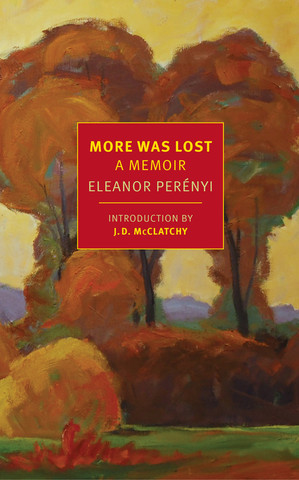
In 1937, the nineteen-year-old Eleanor Stone, daughter of a career naval officer and a novelist, was invited to a dinner party at the American legation in Budapest. There she met an Oxford-educated, communist-sympathizing Hungarian nobleman, Baron Zsigmon (Zsiga) Perényi. He called on her the next day and they spent the rest of her week in Budapest together. On her last evening, they went out to dinner. Here’s how the now Eleanor Perényi would describe it a decade later in her wonderful memoir More Was Lost:

We sat and drank Tokay for a long time. I felt surprisingly miserable.

At last he said, “It’s a pity we are both so poor.”

“Why do you say that?”

“Because otherwise we could perhaps marry.”

I looked into my wineglass.

“Yes, we could,”

There was another pause which seemed to me interminable. Then he said, “Do you think you could marry me anyway?”

“I think I could decidedly.”

So we were engaged.

This could come from a Lubitsch movie, and indeed both Eleanor and Zsiga have qualities recognizable from the pictures of that time—her pluck, his debonair decency (he always introduces bad news, and there’s quite a lot of it in this book, by saying, “Fancy, darling…”).

But even if this passage reads like a more reticent version of the “meet cute” scenes so beloved of 1930s Hollywood, there’s nothing cute about this book. Zsiga gives up his job in Budapest so that the two of them can return to and manage his ancestral home of Szöllös. Sounds romantic, but there are several problems with this idea. Eleanor especially has no idea how to run an estate. They don’t have any money. And worst of all the estate isn’t even in Hungary anymore. It was part of the territory given to the Czechs after WWI: Zsiga needs a passport and permission from the authorities to be there at all.

More_Was_Lost_large

The young couple isn’t dissuaded by these difficulties—but they don’t ignore them either. Eleanor in particular sees things for what they are. She is hardly the stereotypical naïve American abroad. It might seem as though she has fallen into a fairytale, but she’s a careful, thoroughly unsentimental observer of her situation. Consider for example her description of the estate at Szöllös:

The property was at the exact geographical end of the Danubian plane, and at the beginning of the Carpathians. Our farm was on the plain, and on a mountain that was the first spur of the Carpathians we had a large forest, and a vineyard. The farm was managed by a tenant. He paid us an outrageously low rent, but the forest and the vineyard brought in some money too. An old tutor managed them. He did what he could, but it was a thankless job, and he was tired of it. The place was not in good condition.

Hardly rosy. And here she is meditating on the new circumstances of her life:

 A young couple are supposed to be lucky if they can build their own home. It may be so. For me, the theory did not work that way. My favorite idea as a child was what happened in French fairy stories. You were lost in a forest, and suddenly you came on a castle, which in some way had been left for you to wander in. Sometimes, of course, there were sleeping princes, but in one special one there were cats dressed like Louis XIV, who waited on you. Sometimes it was empty, but it always belonged to you without any effort on your part. Maybe it’s incorrigible laziness, but I like things to be ready-made. And when I went into my new home, I had just the feeling of the child’s story. It was all there waiting for me. This house was the result of the imaginations of other people. If a chair stood in a certain corner it was because of reasons in the life of someone who had liked it that way. I would change it, of course, but what I added would only be part of a long continuity, and so it would have both a particular and a general value. If we had built it, it would certainly have been more comfortable, and perhaps even more beautiful, but I doubt it, and I should have missed this pleasure of stepping into a complete world. And there would have been no thrill of discovery. As it was, I ran from room to room, examining everything. I liked it all.

I admire how Perényi moves so assuredly from analysis into narration in that last sentence. I appreciate the self-assurance that’s gone into that off-handed but firm remark about putting her stamp on the place, “I would change it, of course.” And I love that she has the largeness of spirit to feel enriched rather than threatened by that sense of “long continuity.” She’s also a bit strange: is that bit about the cats dressed as Louis XIV a reference to a real tale? Either way, it’s wonderful that what she wants isn’t a prince but someone (or something) to wait on her. But what could make a worse servant than a cat? Even Perényi’s fantasies are unusual. That’s fitting though, for the period she’s living through, when dreams most often turned to nightmares. More Was Lost presents itself as slight, even whimsical, but as this passage clearly reveals, it’s anything but.

Perényi can be tart (the Czech trains, she tells us, were always dirty, “but I know enough not to associate clean trains with political freedom”). She can be reticent, which might seem counter intuitive in a memoir but which only makes us feel more strongly how personal this story is (writing of the restaurant in a rural train station, she says, “I had a special reason for liking this restaurant. We had been there often, and once, sitting at a corner table drinking coffee between trains, Zsiga had said the nicest thing he ever said to me. It doesn’t matter what it was.”) But mostly she can appreciate things, for in this world of continuity paradoxically nothing lasts. Everything has been overturned by the last war—Szöllös was looted three times—and will be overturned still further by the next.

542854b2c0b3929072bc5b704d7907b7

In the first half of the book Eleanor and Zsiga bring the estate back to life. Perényi was a wonderful gardener—much later in life she wrote a book about gardening that I gather is considered to be her masterpiece, though I can’t imagine how it could better this book—and we hear a lot about how she took the 10 acres of jardin anglais in hand. More pertinently, the gardener’s need to take the long view, her sense of time passing according to seasons rather than days or months, structures the first half of the book. Perényi referrs to passing seasons, uses phrases like “over time” and “eventually,” and generally marks time quite vaguely: “Once we had a sudden influx of visitors”; “In the summer the ripe eating grapes were packed outside the winehouse in the vineyard.” In this way, the narrative of the young American who learns to be a Baroness is continually eclipsed by a bigger story, which isn’t really a story at all, but rather a scenario or situation, about a house and the way of life supported by it. As much as I loved this section, I was kept off-balance—I kept wondering what year it was—and I fretted over the war that my knowledge of history and Perényi’s gentle foreshadowing told me was coming.

The war comes, of course. But first we follow Perényi as she gets the house into shape, learns passable Hungarian, navigates the Church, manages servants, pays calls on the local families, and, most charmingly, is invited for opulent house parties at the much more expansive estate of Zsiga’s cousin across the border in Hungary. (Count Laci is one of those larger than life characters it’s so delightful to delight in.) You can just imagine the terrible movie to be made from this book: plucky American gal becomes a Baroness, overcomes obstacles, wins the hearts of the locals, and lives happily ever after.

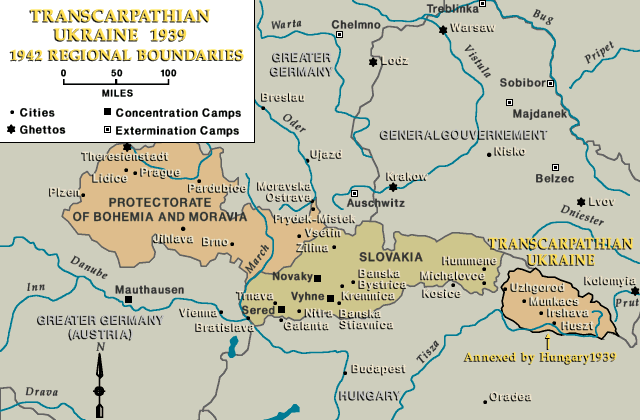
But More Was Lost never falls prey to cliché. Nor, alas, does it have a happy ending. The second half of the book is narrated more straightforwardly: story swallows up situation. Events begin with Britain and France’s refusal to support the Czechs when Hitler demands the Sudetenland. In the ensuing shakeup, Hungary gained back most of its lost territory, but not the land around Szöllös. That became part of a new and short-lived Ruthenian separatist state called Carpatho-Ukrainia which was quickly defeated by the Hungarians. (After the war, Szöllös became part of the Ukranian province of the Soviet Union—the estate was turned first into a museum and then into a school administration office, its furnishings and moldings stripped.) Hungary was an initially tacit and eventually (after 1940) official ally of the Germans. When Zsiga got his call up notice in 1939 he already knew it was likely he would have to fight in support of the Germans. For an avowed anti-fascist, this was intolerable. But Hungary was his country, and he loved it. What to do? In the midst of everything, Eleanor gets pregnant. Life continues somewhat normally for a few more months, and Eleanor enjoys one more spring on the estate. But when Germany invades Belgium in May 1940, it becomes clear that Sziga would have to fight. He urges her to return to America while she still can, and after some anguished uncertainty she does.

Perényi is convinced the absence will be relatively short and that she and Zsiga and the baby will be reunited after the war, but that’s not the way things turn out:

 When you leave a place you are never going to see again, you are supposed to have some sort of premonition. I have been mildly clairvoyant in my life, but not this time. I left as if I expected to be back the following week, straightening one of the little cherubs on each side of the clock, reminding Laci to throw out last month’s New Yorkers on the table by the porcelain stove, leaving the lid of the rosewood piano open… a hasty glance around the garden over which I had worked so hard… I didn’t pay any farewell calls. I didn’t go to take a last look at my trees in the orchard. I walked out with only one bag, got into the carriage to be driven to the station by Sandor as usual, and never looked back.

 *

I’m a sucker for stories of decaying, tragic Mitteleuropa; I’m really the ideal audience for this book. I could read about lavish hunting parties all day long, and I was fascinated by Perényi’s sympathetic portrayal of the local Jewish population. (Already in the 30s when Hungary introduced a looser version of the Nuremberg Laws, Eleanor and Zsiga helped a neighbouring Jewish landowner keep his property; later in the war Zsiga hid Jews on the estate and smuggled seed grain to help feed others in a nearby ghetto; some quick internet research tells me that it’s only about 40 miles from the estate to Sighet, the town from which a young Elie Wiesel was deported to Auschwitz.)

cze69070

But what I really love about this book, what sticks with me most, is Perényi herself. You can see again, in that passage of leavetaking, her matter of factness, her unwillingness to sentimentalize even this moment of great loss. And that’s only fitting because however much she loved Szöllös she loved Zsiga more, and—spoiler alert!—she loses him too, even though he survived the war. When he finally writes to her in the summer of 1945 she hasn’t heard from him in three and a half years. In that time of silence she worries less over whether he’s alive than what he might have been up to during the war. “He had always had a pessimism born of privation and failure,” she writes. Would he have supported the fascism he so detested because he felt the need to fight for Hungary? Would he have joined the Communist resistance even though his father detested Communism? She concludes, rather remarkably, I think:

I didn’t altogether trust him. I said to myself that he would never willingly have collaborated with the Germans, but on the other hand he might simply have failed to take any stand at all. Yes, I decided that that was probably what he had done. And I said too that I didn’t blame him for it, because the choice he faced was almost an impossible one to make…. But my motives were not all so high-minded, fair, or explainable. It was also true that by assuming he had chosen the safer curse, or no course at all, I spared myself the pan of worrying about him.

We already saw in the passage about fairy stories that Perényi is never as artless as we might expect her to be. I have to stop myself from calling this book “charming.” It’s almost charming—it’s almost a fairy story—but the sentiments in this passage aren’t charming. They’re heart-rending, not least because they’re a little cold, much harder on Perényi herself than on her husband or anyone else.

In the introduction to this reissue we learn what we don’t in the book itself: a year after its publication in 1946, Zsiga came to New York and lived with Perényi and their child for several months. But it didn’t work out. They couldn’t overcome the past, the differences in their lives. He didn’t want to live in the US and she didn’t want to go back to Europe. He died in 1965, shortly after his second wife. Heartbreakingly, it is said he always kept his copy of the book with him. Perényi herself never talked about what happened between them. She kept his name, though. But maybe that’s just what people did then. Amazingly, everyone in the book survives the war. But they don’t live happily ever after, at least not the way they thought they would.

More Was Lost is another example of what New York Review Books does best: bring you books you didn’t know how much you needed. How lovely that More Was Lost is lost no more.

“Teeming with Life”: Jean Giono’s Hill

Scott from Seraillon & I have organized a group reading of Hill. I’ll update this post with links as I learn of them. You can read what Grant from 1streading’s Blog, Teresa from Shelf Life, Frances from Nonsuch Books, and Dolce Belezza have to say about it.

*

When I sat down to write about Jean Giono’s Hill (1929), I did what I usually do: I re-read the opening pages to get my head back into it. Then I did something I almost never do: I kept on reading until I’d read the whole book again. It helps that Hill, in this lovely new edition from New York Review Books, is only 112-pages long. But I bet if it had been three times as long I would have kept turning the pages, as hypnotized as the characters are by the story one of them tells to explain the events they’ve suffered through:

They were listening, with their eyes wide open, their jaws slack, their lips drooping, their pupils dilated, their hands frozen, overwhelmed by the vision of the avenging spirits of the vegetal world.

The “they” in this passage are the men of a tiny hamlet called the Bastides, halfway up the side of the Mount Lure in the Alpes-de-Haute-Provence. Too tiny to even be called a village, the Bastides is a remnant, a leftover, an almost-abandoned former market town in which only four houses are still inhabited. Twelve people live here, plus an unlucky thirteenth, a gentle stranger, a simpleton the others call Gagou, after the only syllables he is able to make. There’s Gondran le Mérédic, who married Marguerite Ricard and farms the land that belonged to her father, Janet. There’s Aphois Arbaud and his wife, Babette, who have two small children. There’s César Maurras, who lives with his mother and a servant. And there’s Alexandre Jaume, whose wife committed suicide a few years back. He lives with his grown daughter, Ulalie.

Only on my second reading did I begin to get a handle on these characters. That’s telling: Hill isn’t a novel of character. In fact, it’s hardly a novel of human beings. Instead it’s a novel about the relationship between humans and the non-human world. As its title suggests, Hill is about the earth; in its world-view, geological formations are as alive as non-human animals or plants.

With that thought in mind, let’s return to that passage I quoted above. The men are “overwhelmed by the vision of the avenging spirits of the vegetal world.” They’ve been listening to Jaume as he tries to explain a series of frightening things they’ve experienced. But even though Jaume has a privileged place in the village—he reads, he’s the one the others turn to when they need their world explained to them—he isn’t held in the same esteem by the novel as a whole. We shouldn’t confuse Jaume’s explanation with the truth. No doubt the vegetal world of this book is animated. And no doubt the villagers have been right to be afraid of what’s happened to them. But whether the world is out to get them is less clear.

So what’s gone wrong for the people of Bastides? In his excellent introduction to this edition, the philosopher David Abram suggests it all starts when Gondran, working in his olive orchard, sees a lizard. He’s filled with a spasm of irritation. The text adds—and its narration is interestingly hard to get a handle on: often in present tense, sometimes in past, often in third person, but sometimes referencing a first person narrator, often omniscient but sometimes attached to a character’s perspective—“Man wants to be the master-beast, the one who kills.” Gondran smashes the lizard with his shovel. He’s first ashamed and then uneasy. A sound fills the air:

The wind comes rushing.

The trees confer in low voices.

(Giono likes one-sentence paragraphs.) Gondran gets back to his work, but as he does

 it occurs to him for the first time that there’s a kind of blood rising inside bark, just like his own blood; that a fierce will to live makes the tree branches twist and propels these sprays of grasses into the sky.

Here’s an example of what I said before: the book believes in something we might call a generalized sentience, a life force that manifests itself through everything on earth, not least the earth itself. A passage like this one seems to support Jaume’s later suggestion that the earth is taking revenge for the things people have done to it. Shortly after that day in the field, the villagers suffer a series of inexplicable events. First the village’s spring runs dry, forcing the villagers to carry water from an abandoned village far away. They set up a rotation but the effort irritates them and sets them against each other. Then one of Arbaud’s children get sick and no one in the village, not even Jaume with his medical book, can make her better. The fever that rocks the little girl’s body is echoed in the final catastrophe: a terrible forest fire sweeps across the region and threatens to destroy the village.

The villagers certainly think of these events as connected, and the novel doesn’t give us any reason to doubt that. But as to why they’re happening, well, that’s harder to say. Maybe it wasn’t the murder of a lizard. Maybe it all started when old Janet, Gondran’s father-in-law, is incapacitated by something like a stroke, leaving him bed-ridden in his daughter’s kitchen, able to do nothing other than swallow, move his fingers, and talk, talk, talk. Or maybe it started with the return of a black cat to the village, a cat the others are convinced is tied to unlucky events in the past. Or maybe it has to do with the connection between the old man and the cat. Janet, who seems to have some kind of supernatural power (as a younger man he was famous for dowsing), or the very least who sees in ways the others cannot, sometimes seems the know the source of the trouble, maybe even to have brought it on himself. Right after his stroke he says something to Gondran that could apply to any of the villagers: “When you come right down to it, you’re incapable of looking at a tree and seeing anything but a tree.” It sounds like a curse.

maxresdefault

You’ll notice I’m using a lot of qualifiers in describing these events. That’s because the book refuses to explain them. In fact it doesn’t even know exactly how to define them. Fittingly, Giono’s preferred pronoun is “it”, his favourite noun is some version of “thing”: “Then all at once, it started”; “It all took shape—a whole world being born out of his words”; “Whatever it is, it’s brought a cold sweat to their brows”; “There’s still this thing lingering in Jaume’s brain”; “This kind of thing, it always starts with someone who sees farther than the rest”; “It runs out of him in a stream and it’s not so funny.” Those are just a few examples.

But even though the characters are the ones who either directly (in speech) or indirectly (through the narrative voice) use these inherently vague terms, they aren’t satisfied with vagueness. And neither are readers. Needing an explanation, the villagers convince themselves that Janet must be the source of their trouble. They decide to kill him, sure that this is the only way they can get back to the good relationship they had with the hill. As their spokesman Jaume puts it:

“It’s Janet who made this happen, with his head full of ideas.

“Things were going well before all of this. It had never said or done anything to harm us. It was a good hill. It knew pleasant songs. It hummed like a big wasp. It let us have our way with it. We never dug too deep. One or two blows of a spade, what harm could that do? We walked across it without fear. When it spoke to us, it was like a spring. It spoke to us though its cool springs and its pine trees.

“He must have messed with it.”

The villagers’ scapegoating of Janet is disturbing. And yet as readers we’re complicit in the same thinking. We too want to know why the things that have happened have happened. The novel is sharply critical of this kind of knowing, which symbolizes a disposition towards the world that the philosopher Martin Heidegger, a contemporary of Giono’s, called “standing reserve.” When we see the world as a standing reserve, we see it only for our purposes, only for the ends we could put it to. We look at a river and we only see the hydroelectric power it could provide, for example.

But whereas Heidegger’s philosophy is fundamentally nostalgic—which might explain why he was seduced by fascism—Giono’s novel is harder to pin down, and all the better for that uncertainty. Once in a while it suggests an age-old peasant wisdom in which people live in harmony with the land. But it also argues that this so-called harmony is always exploitative. And yet as readers we are asked to sympathize with the people who perpetrate that exploitation. Is there any way of living on the land that isn’t living off it, in the way a parasite lives off its host?

Thus the ambivalence of the novel’s end is so fitting. At the last minute, the villagers don’t need to murder Janet because he dies, naturally as it were. And as soon as he does, the village’s spring starts running again. The fire has been beaten back. The little girl “looks like she’s doing better.” It’s a relief to have misfortune and acrimony between the villagers and their environment replaced by harmony and the hope of better things to come. This vision of plenitude is best symbolized by the newly plashing spring, which “sings a long lament that conjures up cold stones and shadows. The water trough quivers, teeming with life.”

Cold stones and shadows are lovely things, especially on hot Provencal days. But why a “long lament”? Here Giono qualifies the idyll he’s just given us. After all, there has been a scapegoat: the interloper Gagou succumbs (rather ecstatically, it must be said) to the fire. And on the book’s last page, the villagers shoot a wild boar and stretch its skin to dry on a tree. We might remember the murder of the lizard and worry what atrocities might arise from this new killing, especially when we read the novel’s last lines:

 Now it’s night. The light has just faded from the last window. A large star keeps watch over Lure.

From the skin, which turns in the night wind and drones like a drum, tears of dark blood weep in the grass.

It’s egotistical to think the nonhuman world would respond in human terms (vengeance, say) to human actions. But Hill conjures up such non-human emotional sentience on almost every page. Yet it doesn’t pit the non-human world against the human in a vision of environmental apocalypse that would only flatter human depredation (we must be special to have caused—even deserved—such harm). Nor does it aim for some consoling vision of harmony between the human and the natural.

That’s a lot of contradictions, I know. What’s amazing is how vividly Giono animates them in such a short book.

Here’s the final contradiction, one it would take a post much longer even than this one to tease out: if language is fundamentally human, something (maybe the main thing) that distinguishes the human from the non-human, would it even be possible for language to depict the non-human world in a way that wasn’t anthropomorphic or romantic? I think Giono accomplishes this feat. He’s very good at using language to represent things that seem inherently non-linguistic. In this he reminds me of another early twentieth century writer skeptical of knowledge and compelled to see a life force in all living beings, D. H. Lawrence. Both are visionary writers who value the non-human environment without apologizing for the humans who are inescapably but not necessarily harmoniously intertwined with it.

burtynsky043

Like many people, I’ve been preoccupied by and aghast at the fire that swept through Fort McMurray in my home province of Alberta and might burn for as long as a year. Since Fort McMurray is the center of the tar sands industry, a horrifying industrial sublime well captured by the photographer Edward Burtynsky, it’s tempting to see the fire as climatological blowback, the nightmarish effects of climate change coming back to strike one of the centers of the industry largely responsible for creating it. I’ve thought such things myself. But tell it to the people who have lost everything. It’s a lot easier to talk about karma from the safety of somewhere distant. Yet I’m also repelled by the “Alberta Strong!” chauvinism that insists “we” will return and rebuild. The Horse River fire is much more devastating than the one in Hill, but, more than anything I’ve read in the media so far, Jean Giono’s almost ninety-year-old novel helps me to think through our relationship to what we so casually call nature.

*

I never know what to say about translations, especially when I haven’t compared them to the original. I know it’s bad form to ignore a book’s having been translated, but to me it’s just as unhelpful merely to assert how well it’s been done (a “sprightly new translation,” “ably translated by…” and so forth). So my apologies to translator Paul Eprile. I don’t know what to say, other than thank you. The translation seems powerful and lucid, as forceful as the original must be. I’m hoping Scott will have more to say about Eprile’s work, since I know he read both the original and the translation. All I can say is how excited I am to learn that Eprile will be bringing another Giono title into English. It can’t come soon enough.

Pulp Friction: Lavie Tidhar’s A Man Lies Dreaming

Review of Lavie Tidhar’s A Man Lies Dreaming (2015)

a-man-lies2207

Is this book any good? It’s not often that I have to ask myself that question.

Its author, Lavie Tidhar, seems like an interesting guy. An Israeli who grew up on a kibbutz, moved to South Africa, and now lives in London, Tidhar has written—in English, as best I can tell—quite a few books, mostly science fiction and fantasy.

Like those earlier works, A Man Lies Dreaming, much fêted in the UK on its publication last year and newly arrived in the US from Melville House, is genre fiction. I was going to call it a pastiche of hard boiled detective fiction, except that pastiche often means derivative, and this book, even though in dialogue with and indeed filching styles and phrasings from all kinds of books, is anything but derivative. And if pastiche is problematic, then calling this book hard-boiled is even more so. A Man Lies Dreaming is instead an example of a genre that seems endlessly interesting to writers—alternate histories of WWII-era Europe. In this regard, Tidhar’s book reminded me of Jo Walton’s Farthing trilogy. Walton is another writer who is nominally a fantasy writer but mostly writes books that are hard to classify.

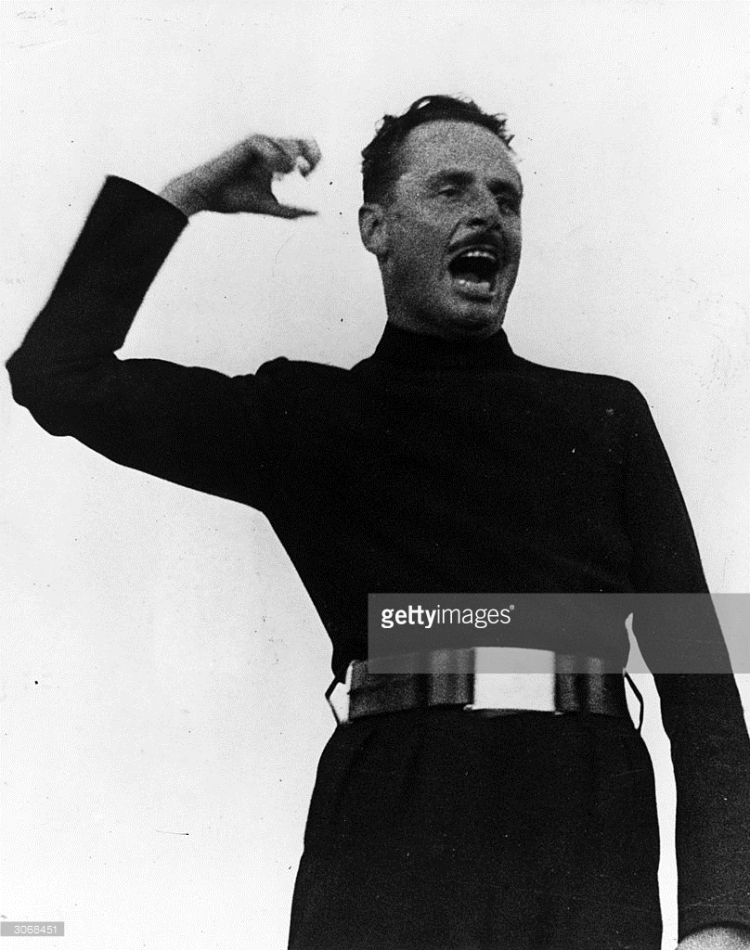
A big difference between Tidhar’s book and Walton’s, and indeed almost every book that revisits the struggle against fascism, is that in his the Germans haven’t won the war. Indeed, there hasn’t even been a war, at least not as we know it. In his world, the National Socialists came to power only briefly before being decisively defeated by communism, an event ominously called the Fall by fascists and their opponents alike. A Man Lies Dreaming is set in England in late 1939. The fascist leader, Oswald Mosley—whose real-life attempts to bring fascism to England were scuppered in the 1930s (and who is memorably pilloried in P. G. Wodehouse’s peerless The Code of the Woosters)—is about to be democratically elected. Former high-ranking Nazis, who have made their way to England and drifted into various illegal enterprises, abet Mosley’s rise to power.

british-fascist-leader-oswald-mosley-addressing-a-rally-in-hyde-park-picture-id3068451

Against this backdrop, Wolf, a down-at-heels private detective, is hired by a beautiful and rich young woman to find her sister. So far, so Hammett (or Chandler). Wolf is a bit different than Sam Spade or Philip Marlowe, though. He makes us uneasy already from his first sentence: “She had the face of an intelligent Jewess.” No matter that his client, Isabella Rubenstein, is an intelligent Jewess. What disturbs is the attribution of her Jewishness to her physiognomy, and the not-so-coded anti-Semitic suggestion that her intelligence will lead to some sort of scheming or malice. Indeed, on the next page Wolf bluntly asserts that he won’t work for Jews—though his poverty and her wealth, as well as, more complicatedly, his intensely ambivalent relationship to Jews, means that he takes the case.

Our uneasiness about Wolf is soon confirmed in, well, spades. He’s none other than Adolf Hitler, reduced, if that’s the right way to put it, to pounding London’s mean streets as a gumshoe. The novel doesn’t explicitly name Wolf as Hitler until it’s almost over, but it’s not exactly keeping it a secret, either. Everything we learn about Wolf’s earlier life matches on to Hitler’s, and in a historical note at the end of the book Tidhar reminds us that Hitler “used the nom de guerre of ‘Wolf’” in the 1920s.

In turning Hitler from a dictator to a PI, Tidhar makes things uncomfortable for his readers. As developed by Hammett, Chandler, Macdonald and others, the hard-boiled detective was already Exhibit A in readers’ willingness to sympathize with disreputable characters. (These days we so equate Hammett’s Spade with the charisma of Humphrey Bogart that we are quick to forget the novel’s introduction of him as looking “rather pleasantly like a blonde Satan.”) Of course, those novels always gave us an out because the society in which the PI made his way was so corrupt that any uncertainty we felt about the hero paled in comparison to his singular ability to do the right thing—or maybe he could be such a moral exemplar precisely because he was beyond the phony morality espoused by everyone around him.

But what happens when the knight in dark armor is Hitler?

Tidhar uses the irony of his conceit to trouble our relationship to his central character. Hitler’s famous abstemiousness (no alcohol, no cigarettes, no meat) contrasts nicely with the usual private eye vices. And characters are forever wondering at how Wolf could have come down so far in the world—that’s partly presented as a function of his purity (unlike other Nazi leaders like Göring and Goebbels or even famously sadistic functionaries like Ilse Koch or Josef Kramer, all of whom appear in the novel, Wolf is unwilling to turn his hatred into mere criminality) and, conversely, partly as a way of reinforcing the delusory quality of Hitler’s appeal. It’s as though no one in the novel can imagine how he managed to sway as many people as he did for as long as he did.

Perversely, then, we are sometimes led to side with Wolf, even feel bad for him. After all, like any good, dogged, hard-done-by PI he pursues his case no matter what obstacles are thrown in his way. He’s even falsely accused of being the serial killer who is murdering London’s prostitutes (like most noir fiction, A Man Lies Dreaming has too many busy sub-plots).

But he’s still Hitler. He’s despicable: violent, full of hate, and convinced of his own superiority. (I haven’t even mentioned his line in violent and debasing sex.) So when terrible things happen to him we’re left cheering. At least, that’s how I sometimes felt. At others I was more relieved than triumphant. And mostly I simply didn’t know how to feel. It’s common for the hardboiled PI to suffer a lot of physical abuse. Tidhar takes that convention and runs with it, most dramatically when Isabella’s father—immensely rich and influential, yet another anti-Semitic cliché except that he is hardly the effete weakling of Nazi propaganda—ambushes Wolf in his office. After beating him to a pulp, Rubeinstein and his henchmen circumcise him.

This vivid, visceral, and totally insane moment has significant ramifications. One of the subplots involves a secret Jewish resistance group that smuggles Jews out of an increasingly anti-Semitic England and on to safety in Palestine. Wolf gets his hands on one of the resister’s identity papers and, replacing the photo with one of his own, he becomes Moshe Wolfson. Late in the novel, a devoted and misguided admirer finally goads Wolf into admitting that he is in fact Hitler. The upshot is a furious spasm of violence that eventually leads Wolf to break down—or is it break through? Kicking the boy over and over until he is nothing but pulp, Wolf screams “I’m Hitler! I’m Hitler! I’m Hitler.” That avowal doesn’t last long, and the scene concludes:

He was no one. He was nothing.

“I’m…” he said. The theatre was quiet. The seats were empty and silent with disuse. There was no one to hear him, no one to respond. No one to acknowledge him, there was no one to march to his tune.

“I’m a Jew,” he said, and laughed; but like Wolf himself, the sound meant nothing.

What are we supposed to make of that? (You can see that whatever this novel has going for it, it isn’t subtle.) On a first reading, it would seem that Wolf’s identification as Jew is presented as totally spurious (“the sound meant nothing”). But then what about the novel’s denouement, when Wolf—now Wolfson—makes his way on to a ship leading to a new life in Palestine? Are we to cheer the little boy who cheerfully tells Wolf, “You ain’t nothing mister. You ain’t worth shit”? Or are we to laugh—or cry?—at Wolf’s taking on of that most sacred of Jewish cultural traditions, the Jewish joke? Consider this entry from his ship’s journal:

In the latrines an argument over who is a Jew, some suggestion not everyone on board may be kosher. “Easy way to tell,” I said. Pissing against the wall in a row, we all had a good laugh. I looked at my Jew dick in my hand almost in affection.

Should we be enraged with Wolf’s appropriation of the people and culture his real life counterpart tried to exterminate? I mean, even here Hitler is still a dick. “Almost in affection”: ugh, what a shit. Or should we conclude that Wolf aka Hitler is really now a Jew? I can’t decide whether this perverse use of the idea that the Jew is a universal figure for suffering is only Wolf’s (and therefore something we can dismiss as delusional) or in fact the novel’s (and therefore something we’re supposed to take seriously). When even Hitler can be a Jew the term has become so metaphorical as to be meaningless.

 *

I’ve been talking about the novel as though it’s written in first person, but that’s only partly true. There are two other narrative voices in addition to the first person excerpts from Wolf’s diaries. They might help us decide what the novel wants us to think about its premise. The first of those voices continues the story that Wolf tells, but in third person rather than first. It’s unclear to me why we need both, since the third person sections don’t cast new light on the first person ones. We’re given no reason why any given piece of information is narrated in first or in third person; this arbitrary and unnecessary distinction is the weakest part of the book.

The second voice is also told in third person but it’s connected to someone else altogether, a man named Shomer who is interned in Auschwitz. Shomer is a fictionalized version of the real-life Yiddish writer Nokhem Meyer Shaykevitch, who wrote hundreds of popular novels, plays, and stories under that pseudonym. (So it’s a fictional version of a real person who in fact used a fake name to write his fictions: got that?) The real Shomer died in New York in 1905 and so was spared the Nazis’ largely successful attempt to destroy his linguistic and cultural world. Shomer became famous, or perhaps infamous, as the foremost purveyor of shund, that is, trash or lowbrow literature. As Tidhar explains, Sholem Aleichem (the leading Yiddish writer of the late 19th century and best known today for the stories that Fiddler on the Roof is based on) attacked Shomer’s work as poorly constructed and morally dubious.

Shomer is obviously Tidhar’s stand-in, though his attempt at rescuing Shomer would have been more convincing had Shomer had a larger role in the story. Having said that, though, I must acknowledge that Shomer is interned in a concentration camp and Tidhar’s point, I think, is that Shomer is no longer a human being or on the verge of no longer being one. (It’s worth noting that Tidhar’s brief descriptions of life in Auschwitz, in particular of the Sonderkommando and the Canada Men, the Jews who were forced to work the crematoria and to separate newly arrived prisoners from their families and their possessions, is more sensitively managed than usual and much less pious and lugubrious than, say, Martin Amis’s in his recent The Zone of Interest.)

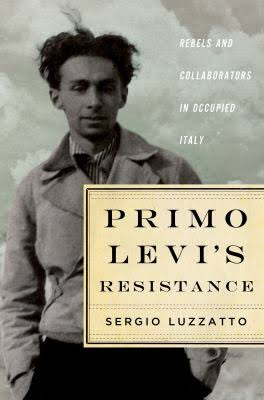
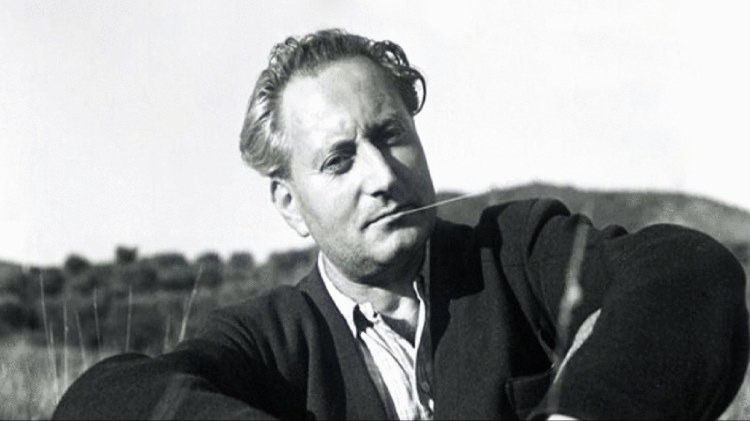
That Shomer represents Tidhar becomes clear halfway through the book in a scene describing an encounter between two prisoners who discuss how anyone could ever write about what is happening to them. It will be clear to many readers—and if it’s not Tidhar makes it explicit in his note—that one of the men is Primo Levi, who argues that “the novelist must employ a language as clear and precise as possible, a language without ornament.” The other, less well known to English-speaking audiences, simply calls himself Ka-Tzetnik, that is, “inmate.” Ka-Tzetnik, who would later case a sensation at the Eichmann trial, where he fainted during his testimony, and who later wrote a serious of lurid Holocaust novels, including House of Dolls, about the camp brothels, argues with Levi:

To write of this Holocaust is to shout and scream, to tear and spit, let words fall like bloodied rain on the page; not with cold detachment but with fire and pain, in the language of shund, the language of shit and piss and puke, of pulp, a language of torrid covers and lurid emotions, of fantasy: this is an alien planet. Levi. This is Planet Auschwitz.

tzetnik

The anachronism of this speech—no one at the time and in that place would have spoken of the Holocaust—is beside the point, because this isn’t really Ka-Tzetnik speaking, it’s Tidhar. For him, pulp or popular literature is an appropriate way to talk about the Nazi extermination of European Jewry. It might even be the best way. I don’t think Tidhar is arguing that Levi is wrong, rather that his approach only tells part of the story, maybe doesn’t grapple with the utter insanity of what the victims are experiencing. (I do think Tidhar’s Levi is a caricature, though—and Levi in fact wrote about how the Lagers would have generated a new language had they existed any longer than they did—but I also think Tidhar wouldn’t take that as a criticism, since I don’t think he sees anything wrong with caricature.) Even Wolf/Hitler gets in on the act. On the boat to Palestine, he reads Conrad’s The Secret Agent, laconically concluding, “Have read better, by worse.” Of course Hitler would have no taste. But Tidhar we need to take more serious. Still for me the question remains: what can shund do that serious or traditional or highbrow literature cannot?

The answer seems to be that it lets us escape. The man of the title, the one who lies dreaming, isn’t primarily Wolf/Hitler (whose dreams are other people’s nightmares). Rather, it’s Shomer, who finds some respite from his concentration camp existence by imagining the story we are reading:

And Shomer’s mind shies from the glare, conjures up a safe haven, a world of mean streets and buxom dames and flat-footed detectives, as is, if only he could open up a secret door, he could be transported there, and be free.

 *

I read this book because I can’t get enough of the period it’s about, even when the period is an imagined version of the real one. But I also read it because I thought it might be something I could teach at the end of my course Literature after Auschwitz, which examines representations of the effects of the Holocaust on those who came after it, those who had no direct experience of it but whose experiences have nevertheless been sharply affected by it. The first time I taught the course, I ended with Ellen Ullmann’s recent novel By Blood, a book I like a lot and that fit pretty well with what I was trying to do but which was a bit too long and too interested in so many other things to be the ideal last book on the syllabus. (Sometimes books don’t teach well for all kinds of reasons that have nothing to do with quality.) I read A Man Lies Dreaming with one eye to its possible placement on the syllabus.

And that’s where I come back to the question I asked at the beginning. Is this book any good? But do I mean, does this book have literary merit? (Tidhar would say that could be a dubious proposition, one inclined to value certain kinds of books over others.) Do I mean, does this book treat fascism and the Holocaust in an ethically sound way? (Here everything depends on how we’re meant to take the book’s portrayal of Hitler.) Or do I mean, would this book be good to teach?

Here I am led to wonder about the relationship of prurience to critique in this book. I think there are pleasures that are regressive and pleasures that are critical. (And maybe some that are just pleasures.) Regressive pleasures are still pleasures—just because, for example, Downton Abbey is selling us a fantasy that whitewashes a restrictive class structure by pretending to overturn or undermine it doesn’t mean it’s not also satisfying to watch—but in the absence of any self-consciousness about that regression they’re dangerous.

Now A Man Lies Dreaming is nothing if not self-conscious. And it has the honesty to admit, in that passage I quoted above about Shomer’s dreams of pulp fiction, that what it is describing is a fantasy—“as if, if only he could open up a secret door, he could be transported there, and be free.” The challenge of reading A Man Lies Dreaming lies in figuring out what it thinks fantasy can do. When is fantasy mere indulgence, a hopeless, ineffectual, and even pernicious because distracting response to a horrifying reality? And when is it a powerful counter-force to that otherwise seemingly overwhelming reality? What’s so great about reality, anyway?, Tidhar seems to be asking. In the end, he lets Shomer dream himself into Wolfson’s place, so that he gets to be the one who is welcomed to Palestine. Is this escape, or is this escapism?

What do you think? Should I teach this book?


Jean Giono Readalong

14_Hill_1024x1024

Later this month, Scott of seraillon (I hope you read his blog regularly: it’s excellent) and I will be reading of Jean Giono’s first novel, Hill, published in 1929 and recently reissued in the indispensable NYRB Classics series. We hope you will join us!

Here’s what the publishers have to say about Hill:

Deep in Provence, a century ago, four stone houses perch on a hillside. Wildness presses in from all sides. Beyond a patchwork of fields, a mass of green threatens to overwhelm the village. The animal world—a miming cat, a malevolent boar—displays a mind of its own.

The four houses have a dozen residents—and then there is Gagou, a mute drifter. Janet, the eldest of the men, is bedridden; he feels snakes writhing in his fingers and speaks in tongues. Even so, all is well until the village fountain suddenly stops running. From this point on, humans and the natural world are locked in a life-and-death struggle. All the elements—fire, water, earth, and air—come into play.

From an early age, Jean Giono roamed the hills of his native Provence. He absorbed oral traditions and, at the same time, devoured the Greek and Roman classics. Hill, his first novel and the first winner of the Prix Brentano, comes fully back to life in Paul Eprile’s poetic translation.

The idea for the group reading came out of a series of exchanges we had about my review of Robert Seethaler’s A Whole Life. In his defense of Seethaler, Scott said he was “reminded too of some of Jean Giono’s pastoral novels, which also have a third person narrator whose reliability one is scarcely conscious of needing to question, the narration almost seeming an organic aspect of the landscape.” That got me intrigued: I wanted to know more about this narrative voice, and since I had just learned of the reissue it all seemed fated to be.

So even though I know nothing about Giono–beyond the wonderful National Film Board of Canada animated film of The Man Who Planted Trees that was a staple of my childhood (directed by Frederic Back, it’s indelibly narrated by the aptly named Christopher Plummer–those tones!)–the good news is that Scott knows a lot. So between us we have a  perfectly average amount of knowledge to share.

Please consider joining us–and let us know if you decide to do so! We’ll be posting about the book in the last week of May and look forward to working through it together with you all.

Added 8/19/16: You can find my thoughts on Hill here, BTW.


A Pure Soul: Robert Seethaler’s A Whole Life (2014)

I’m always urging my students to be governed by the principle of interpretive charity. I want them to take the text for what it is, not what it could or ought to be. I want them to be able to explain what makes the works they’re studying what they are. I exhort them not to smooth away the strangeness of the books we read. And although I believe our emotional responses to books matter a lot, I also think our primary task isn’t to grade them, to give them a thumbs up or thumbs down.

Usually I follow this advice here at the blog. Today I’m going to ignore it.

I can’t remember now where I first heard about Robert Seethaler’s Ein ganzes Leben, translated by Charlotte Collins as A Whole Life. Probably on Twitter, where else do I hear anything these days? As an Albertan of Swiss heritage, mountains run deep in my blood, so a novel about a man who with one important exception spends his entire life in a remote valley in the Austrian Alps seemed like just my thing.

So obviously I snapped up the book when I came across it on a recent trip to Canada—it will be published in the US later this year—and I read it in a couple of sittings this weekend. (It’s really a novella, not even 150 pp in this generously spaced edition.) Although the ominous words “The International Bestseller” on the front cover put me on my guard, I started the book, as I do almost every book, prepared to like it.

That didn’t last long.

A Whole Life is an example of my least favourite genre: worthy middlebrow pap. I can only imagine Thomas Bernhard, probably the greatest Austrian writer since the war, author of plenty of books set in the Alps, fulminating against it, though he’d probably decide it wasn’t even worth his time. It’s possible this book will soon disappear into the oblivion it deserves. But I can imagine it becoming a “surprise hit,” “the most talked-about book of the season,” “a darling of book clubs everywhere.” I’m the sort of person who burns with rage in anticipation of things that might not happen. I’m ready for people to tell me how moving and beautiful and life affirming they found A Whole Life, how I simply have to read it. I’m ready for the book to be an undeserved success. Hey, haters gonna hate.

s-l300

A Whole Life is about Andreas Egger, who arrives as a small child at the beginning of the 20th century in the unnamed alpine valley that becomes his home. The boy is unceremoniously deposited with a small-minded, vicious farmer named Hubert Kranzstocker. Egger is the child of one of Kranzstocker’s sisters-in-law, whose dissolute life in the city (which is to say, her life in the city) has led ineluctably to her death by consumption. Egger never really becomes part of his adopted family, he’s more hired hand than anything, which is lucky for Kranzstocker, whose other children aren’t very good at farm work and have besides a worry tendency to be felled by childhood diseases. Egger, by contrast, is strong, so strong that he survives the beatings Kranzstocker metes out to him, even when Kranzstocker goes too far and breaks the boy’s leg, an injury that leaves him crippled.

Seethaler has no time for lingering—the point of his book seems to be that everything passes if you’re stoic enough—and so before long we’re following the adult Egger as he builds a small home for himself high up the mountain on a bit of grass too rocky to pasture any animals on. In short order he tentatively courts the new serving girl at the inn, marries her, and takes on more permanent work with Bittermann & Sons, a construction and blasting company recently arrived in the valley to build its first cable car.

We’re in the early 1930s now and the most interesting parts of the book are the descriptions of Egger and his mates at their dangerous work of modernization. Unfortunately, Seethaler isn’t really interested in cable cars as anything more than a symbol, so these descriptions are far too cursory. Nothing here to match, for example, Philip Roth’s description of the glove-making factory in American Pastoral. You won’t learn how to build a cable car from this book.

After a terrible accident destroys his brief domestic happiness, Egger has nothing but his work to console and occupy him. His wife’s death sends him into a kind of fugue state that might be one way of explaining why we never hear any reference to events in the world beyond the valley until one evening Egger enters his boarding house to find his landlady crying before a silent wireless set, which is strange because “at this hour [it] was usually blasting out brass-band music or Adolf Hitler’s furious tirades.” War has been declared; Egger tries to join up (we’ve no idea why) but is rejected because of his leg.

But three years later even crippled men are being conscripted. Egger is sent to the Caucasus because of his expertise in mountain engineering. There he’s ordered to man a remote outpost where he never fires a shot, and which he leaves once his supplies are no longer replenished weekly, an ominous sign he rightly interprets as  an indication that things are not going well for his side. On the way back to the front, he’s captured by Soviet forces and spends several years as a POW.

Egger isn’t able to return home until 1951, but the years pass so briskly it doesn’t seem that much of a hardship. Here for example is Seethaler describing how nothing changes for Egger and his fellow prisoners once the war ends:

The work remained the same, the millet soup was thinner than ever, and the flies still circled unperturbed around the beams of the latrine.

A page and a half later we’re given this meager summary—laconic to the point of bathos—of these years: “It was almost another six years before Egger’s time in Russia came to an end.” His time in Russia: as if it were fated or preordained. Everything in this book is described in the same clipped, blasé manner. It’s just one damn thing after another.

Returning home, Egger finds things only a little changed. The mayor doesn’t display swastikas anymore, but he’s still the mayor. Franzstocker is still around, but older and frailer and he dies before long. Bittermann & Sons has gone belly up, but Egger makes do on a war pension until he stumbles into a new career guiding tourists, a new breed of people called into being by those cable cars (and postwar affluence). Egger has always loved the mountains, feels better when he’s on his feet all day, despite his limp. Sometimes the tourists are annoying or irritating, spoiled or sententious or smart alecky, but mostly they’re grateful for the beauty he shows him and besides we never have much sense of what Egger thinks other than that he apparently doesn’t think that much, not that he’s stupid, just not reflective.

Wankbahn_poster

Egger keeps getting older. He misses his late wife, almost gets involved with an older female teacher but can’t. (Her response to his spurning of her advances is the only moment of true emotion in this book. Too bad she disappears after only five pages.) Television is the latest thing, but it doesn’t do much for Egger. He remembers only two moments: one (sadly undeveloped, and not quite strange enough to be really interesting) showing Grace Kelly getting off a plane, the other the moon landing.

Egger gets too old to guide anymore and retreats to a little hut high above the village. One night in February, sitting by candlelight at his little table, thinking about the coming snowmelt, Egger is

overcome by a feeling of warmth at the thought of his leg, that piece of rotten wood that had carried him through the world for so long [a puzzling image, since his leg is not actually a prosthetic]. At the same time he was no longer sure whether he was still thinking this, or was already dreaming. He heard a sound, very close to his ear: a gentle whisper, as if someone were speaking to a little child. “I suppose it is late,” he heard himself say, and it was as if his own words hovered in the air in front of him for a few moments before bursting in the light of the little moon in the window. He felt a bright pain in his chest, and watched as his body sank slowly forwards and his head came to rest with his cheek on the tabletop. He heard his own heart. And he listened to the silence when it stopped beating. Patiently he waited for the next heartbeat. And when none came, he let go and died.

A good death for a good man. That “patiently” says it all, characterizes everything Seethaler wants to say about Egger. Not that he’s passive or a spectator in his life. (All the language of observing the self in this passage, all that out of body stuff, is actually quite unusual in the book, though again I don’t think Seethaler does anything much with it.) Egger’s end isn’t the book’s, though. Seethaler gives us a little coda, a story from a few months earlier, when Egger suddenly decides to take the bus to the town at the bottom of the valley. Here too nothing happens: he’s a bit disoriented, unsure what he’s done or why he’s come. After wandering aimlessly around the square for a minute, he is helped by the driver back on to the bus that takes him home and it’s not until he’s in the thinner air again that he recovers. Arriving home, he heads not for his hut but for the trails. He’s filled with a blurred nameless memory, probably of the opening scene, which describes a failed wintertime rescue of a different old man, one we are invited to see that Egger has become, an old man who deliberately lost himself in the snow rather than suffer any more. Egger responds to this “fleeting recollection of something very long ago, little more than a blurred image”: “ ‘Not just yet,’ he said, quietly.” And in this way the story of a good, unassuming life gets prolonged beyond its end. A quietly triumphant conclusion to this quiet book.

IMG_0318

Yet that very restraint seems to me nothing but self-satisfied bullshit. Take the book’s attitude towards history. I appreciate that it’s not constructed with the certainty of hindsight: this isn’t one of those historical novels where characters are always running into people or experiencing events that we’ve decided were significant. After all, what later generations decide to call history usually passes us by in the moment. So I’m willing to believe fascism passed Egger by. Well, I’m not, really–the almost total ellison of fascism is more than a little convenient. But what really gets me is the complete flattening away of history, the absence of any sense that what makes a life meaningful or what counts as suffering is historically inflected if not constructed. This absence makes the book so flat as to seem not even autistic, but catatonic. I can’t even tell if we’re meant to understand Egger as an average person, a representative man of the century. I think he’s supposed to be more than that, a kind of model we might aspire to if only we could make our own lives as simple as his. But it’s hard to know for sure because Egger is a total blank, not even interesting enough to be a cipher.

Seethaler’s narrative decisions are largely responsible for making Egger such a nonentity. We’re so seldom inside his head—so much so that I was drawn up short by this passage:

The weeks and months after the opening ceremony at the top station [the successful completion of the first cable car] were the happiest of Andreas Egger’s life. [The unnecessary use of his full name signals that what comes next might be free indirect discourse: we might be getting access to his interior life.] He saw himself as a small but not unimportant cog [that litotes doesn’t fit with his way of thinking and speaking—plus, a cog, get it? Just like he used in building the cable car!] in a gigantic machine called Progress, and sometimes, before falling asleep, he would picture himself sitting in the belly of this machine as it ploughed inexorably through forests and mountains, contributing, with the heat and sweat of his brow, to its ongoing advance. He had taken the words with the heat and sweat of his brow from a tattered magazine Marie has found under one of the benches in the inn, and from which she would sometimes read to him in the evenings.

That clumsy reference to “the heat and sweat of his brow,” that obstreperous explanation of how he came to use these words: this is the first time we’ve been led to believe that Egger himself is lending anything to the narration of the story. It feels unearned and unnecessary, a piece of authorial clumsiness that reminds me of the much later description of the day the schoolteacher rejected by Egger leaves the village:

One cold morning, before sunrise, she climbed aboard the post bus with two suitcases, sat down in the back seat, closed her eyes, and, as the driver later reported, didn’t open them again once throughout the journey.

Seethaler is so keen to make a point about the woman’s utter defeat—the possibility that those close eyes could indicate resistance never enters into the picture—that he’s willing to offer this implausible description: no one driving a bus down a mountain road would be looking at his passenger the whole time. The sentiment is uttered only for us; Seethaler doesn’t even try to make it organic to the story.

A Whole Life studiously rejects reflection—the closest we get is the dime-store existentialism of Egger’s sudden outburst to a tourist he’s had to rescue from near death, “Each one of us limps alone!” One night Egger awakes suddenly to find his window “clouded by hundreds of moths”: “For a moment Egger thought their appearance must be a sign, but he didn’t know what it was supposed to mean, so he closed his eyes and tried to go back to sleep.” I don’t think the book is poking even gentle fun at him here. It’s not that he’s dim, not that he’s missing out on some significant, even portentous moment. There’s really nothing to make of that evanescence.

In so steadily agreeing with Egger’s even-keeled banality, the book ends up presenting him as an exemplar of a life well lived. Early in his days on the cable car, Egger falls in with a would-be philosopher named Mattl. Mattl dies an absurd death—he falls asleep in a bath tub and catches pneumonia—and the foreman, who hardly knows him “cobble[s] together” a short funeral address, “which talked about the hard work on the mountain and Mattl’s pure soul.” The foreman is being disparaged here, but Seethaler ends up presenting exactly what he’s ironized, giving us a story of hard work on the mountains and Egger’s pure soul.

To paraphrase that peerless old New Yorker cartoon, I say A Whole Life is nothing but unearned redemption and I say the hell with it.


Tall Lady, Eating Sandwiches: The Pickwick Papers (Installment 1)

Behold the Stars has organized a readalong of The Pickwick Papers, timed to the publication of its first installment in March 1836. Readalongs and the academic schedule don’t mesh well, but the idea here is to read the book as it was first published, that is, according to its original publishing schedule. It means taking a year and a half to read the book, but I figure even I can manage the 50 pages or so each month.

So I’m giving it a try.

I’m hardly an expert in Dickens, having only read Great Expectations, Bleak House, Nicholas Nickleby and, long ago, so long ago I remember nothing but that 19th century Madoff Mr. Merdle, Little Dorritt. Oh, and the first third of Our Mutual Friend three times. (Story for another day.) Something about Pickwick always put me off. I had the impression it wasn’t really a novel, or that it was more like something from the 18th rather than the 19th-century. I thought it would be hard.

But I read the first two chapters—the opening installment—over the weekend. They’re wonderful! If the other 700 pages are anything like them, this has got to be one of the greatest English books.

We begin with the proceedings of the Pickwick Club from May 12, 1827, where Samuel Pickwick, Esq., has just triumphed with his presentation of a brilliant paper on the origins of the Hampstead ponds, along with some observations on the creature he calls tittlebats and others persist in calling sticklebacks. So that the Club might continue to promote similar contributions to the study of science, the membership approves the creation of a Corresponding Society, a traveling subset of club members who will report back on their findings and adventures. I assume the rest of the novel will comprise those exploits.

At the head of this group, of course, is Pickwick himself—who I can’t help but picture as Sydney Greenstreet in The Maltese Falcon, even though I don’t think there’s any suggestion that he’s fat. The one who is fat is Tracy Tupman, ardent yet hapless lover of women everywhere. Joining them are the dreamy poet Augustus Snodgrass and the impetuous sportsman Nathaniel Winkle.

Things get off to a rousing start when the Club makes its first journey, to Rochester in Kent. Mishaps ensue even before they make it to the coaching inn: the cabbie takes exception when Pickwick records in his ever-present notebook the answers to the questions he’s posed to him, mistaking Pickwick’s dedication to increasing the store of human knowledge for the assiduity of an informer looking to find the cabbie in violation of the newly regulated hackney carriage business.

London+cab+c+1823+curtain+drawn-001

The cabbie, a nervous type, eventually challenges Pickwick and friends to a fight; a melee develops, from which our heroes are rescued only by a man known (so far, anyway) as the stranger, a man who, we learn in due course, is also, it turns out, traveling to Rochester. The stranger—I hope we learn his name, because I sure want him to stick around—has a richly elliptical way of speaking that is pure joy to read. Here he is reflecting, if that is the right word, on recent events at the coach-yard, which has a notoriously low archway:

Terrible place–dangerous work–other day–five children–mother–tall lady, eating sandwiches–forgot the arch–crash–knock–children look round–mother’s head off–sandwich in her hand–no mouth to put it in–head of a family off–shocking, shocking.

“Tall lady, eating sandwiches.” Perfect! The stranger, who might be a reprobate, or more likely simply blithely unconcerned by consequences, one of those people the world can’t seem to touch—maybe he’s a much more intelligent Skimpole?—joins the Club members for dinner once they arrive in Rochester.

A ball is about to begin in the room above the dining room and Tupman can’t stop thinking about the ladies who will soon be arriving. The wine flows freely, the stranger passing the bottle around at every opportunity. Eventually everyone but Tupman and the stranger fall into a stupour. The stranger admits that he too would like to go to the ball, but alas he has nothing to wear. (His belongings have been sent ahead of him; he is leaving England for some inscrutable reason, or maybe for a clearly stated reason that I can’t remember.) Tupman has a brainwave. Winkle has a new evening suit, made especially for members of the club, complete with a button bearing Pickwick’s visage and the letters P.C. to either side.

The suit fits the stranger just fine and the two have an excellent time, especially when the stranger cuts in on a little fat bald man, a Doctor Slammer, who has designs on a rich widow. As the stranger puts it: “Lots of money–old girl–pompous doctor–not a bad idea–good fun.” The stranger makes a fool of the brilliantly named Slammer, but Slammer gets his revenge when the next morning he sends a Second to the inn to challenge the man who insulted him. Of course, the stranger has disappeared and the Second, who doesn’t know the name of the man he wants, is able only to describe his unusual outfit. Said outfit is duly discovered in Winkle’s room, rather the worse for wear, as is Winkle, who can’t remember going to a ball or insulting anyone, but can only look at the state of the suit and assume the accusations are true.

In a state of pitiable terror, Winkle acquiesces to the Second and prepares to fight a duel, which his own second, Snodgrass, feels confident about, given Winkle’s renown as a sportsman. Turns out, although Snodgrass never learns it, that Winkle doesn’t even know how to load a gun and the duel, which threatens to be very grim indeed, turns to comedy when, at the last minute, Slammer realizes that his opponent isn’t the man he wants. The men part amicably, with “cordial farewells,” even arranging to have dinner later. Perhaps the next chapter will include Slammer. Who cares if it doesn’t: Pickwick and the others are more than enough to go on.

Duel-19thcentury-crop

I’m sure I’m not saying anything new here, but reading Pickwick I suddenly realized: this is where P. G. Wodehouse comes from. (Wodehouse comes from other things too, of course: Jerome K. Jerome, Edwardian music halls, etc, etc.) There’s that same sense of a world that looks so much like our own but in which nothing bad can ever happen. Mishaps? Of course, there are plenty of those: mistaken identities, swindles, misunderstandings. But they all get resolved, and everything ends with a nice bit of supper. Of course, I could prove to be wrong about all of this. But the ironic narrative voice seems so Wodehousian (or, I suppose, Wodehouse so Dickensian, or, better, Pickwickian). Consider this sentence, for example. The stranger has just idly insulted Tupman, calling him a second-rate Bacchus:

Whether Mr Tupman was somewhat indignant at the peremptory tone in which he was desired to pass the wine which the stranger passed so quickly away; or whether he felt properly scandalized, at an influential member of the Pickwick club being ignominiously compared to a discounted Bacchus, is a fact not yet ascertained.

“An influential member of the Pickwick club,” “is a fact not yet ascertained”—the jokes are all the funnier for the gentleness of the expression here. We can see too that the novel is going to be interested in facts–what counts as one and what are they good for?


When Behold the Stars announced this readalong, Amateur Reader said it would be hard for participants to limit their reading only to the assigned chapters. Too true!

Let’s see if I have the willpower to stick to schedule.

“Even Stranger”: Two Serious Ladies

 Mr. and Mrs. Copperfield had gone over to Panama City for two days. The first day after lunch Mr. Copperfield proposed a walk towards the outskirts of the city. It was the first thing he always did when he arrived in a new place. Mrs. Copperfield hated to know what was around her, because it always turned out to be even stranger than she had feared.

Coming to Jane Bowles’s only novel, Two Serious Ladies, I didn’t fear it would be strange. But I certainly found it to be strange. I don’t think Bowles intended this passage, which for me centers on that comparative adjective “even stranger,” as a description of her novel, any more than Mrs. Copperfield is an advertisement for ignorance. It doesn’t take us long, after all, to see that Mr, Copperfield, like all the men in this novel, is caught up in his own brutish self-righteousness. His spirit of adventure is a lot less interesting than he thinks it is. It’s not that the novel is advocating being afraid, only that it admits that for women, even wealthy and eccentric women like the ladies of the title, there’s quite a lot to be afraid of, mostly men and their violence and neediness. Mrs. Copperfield, in other words, is much shrewder than almost anyone gives her credit for.

The Serious Ladies of the title are Christina Goering—impossible, in a novel published in 1943, not to hear an ominous echo of fanaticism in that name—and Frieda Copperfield. They know each other slightly, and near the beginning of the novel even meet at a party in New York. Mrs. Copperfield is about to leave on the trip to Panama referenced in the passage I’ve quoted above. Miss Goering has just taken on a female companion, a Miss Gamelon, who she will eventually be quite mean to. Goering and Copperfield run into each other again at the end of the book, but one of the things I liked about it is that it doesn’t spend much time making parallels between them, beginning with its narrative structure, which quite favours Goering’s story over Copperfield’s. I found that a pity, since I much preferred Mrs. Copperfield to Miss Goering, but I appreciated the (at least apparent but actually I think quite sincere) casualness, even haphazardness of the book’s structure.

I confess I’ve never actually understood what a picaresque novel (technically a solecism, I suppose—a picaresque isn’t a novel, it’s another literary form altogether, right?) but I think the term applies here. It really was never clear to me why characters did the things they did, this despite but perhaps ultimately in keeping with Miss Goering’s claim that something she is about to do “is against my code, but then, I have never even begun to use my code, although I judge everything by it.” There’s the sense here of a moral imperative, however inchoate, a desire to push established ways of behaving to a limit. Taken out of context, Goering’s comment about the code she never uses but judges everything by sounds a little arch, like something from Wilde. But the book isn’t arch at all. In fact, I’m not quite sure how to get a handle on its tone., and in the end that might be the thing that bothers me the most about it.

Miss Goering takes up with one man after another, each worse to her than the last, and leaves the city for increasingly precarious and transitory living situations. Mrs. Copperfield abandons her husband to live in a Panamanian brothel, befriending its alcoholic owner, Mrs. Quill, and one of the prostitutes who live there, Pacifica. In the loveliest scene in the book, Pacifica takes Mrs. Copperfield to an isolated beach where she tries to teach the terrified older woman how to swim. It’s an idyll of sorts in a book that doesn’t hold much truck with anything that gentle, though it’s also a sad scene, foreshadowing the falling out between the two women by the end of the book.

2013-8-44front


Two Serious Ladies quite bedeviled me. I’ve written before about the risks of thinking of books as sui generis. What that often means is that we haven’t valued their context highly enough. But even though neglected Anglophone women writers of the 20th Century are my bread and butter, as it were, nothing I knew helped me to categorize Bowles’s novel. So many of the writers I love—Jean Rhys, Barbara Comyns, Rebecca West, Penelope Fitzgerald—would seem to be close kin to Bowles. But I didn’t find that to be the case. Maybe it matters that Bowles was American and the others weren’t. I did compare her fleetingly to Kay Boyle, but the comparison is mostly to Bowles’s credit. She seems both more viscerally clear about the dangers of authoritarianism than Boyle (it took her a while to come around) and less obviously in thrall to an aesthetic of high modernist seriousness. As I think about it now, Bowles strikes me as much less invested in a tradition of literary realism than those other writers, even though they all, in their different ways, contested it, mostly by having recourse to the Gothic tradition that has always been the doppelganger of English-language realism. Bowles is doing something else, but I can’t figure out what. It matters a lot, I think, that unlike the women in Rhys and Comyns’s novels, especially, money insulates them from the patriarchy’s harshest depredations. Goering and Copperfield can be more overtly in control over their own lives than the protagonists of those other writers’ books. But just because they’re financially independent doesn’t mean they know who they are.

*

The longer I blog—and WordPress tells me it is exactly two years ago today, in fact—the more I’m convinced that I only really care to write about things I really like. And so I’m a bit hamstrung by Two Serious Ladies. If I hadn’t agreed to participate in Dolce Bellezza’s readalong I probably wouldn’t have written about it. And even then I don’t know if I would have had I not read Seraillon’s wonderful & intelligent piece.

It’s always a pleasure to read criticism where the subject clearly resonates with the critic. Although Scott’s post confirmed for me that Two Serious Ladies didn’t speak to me in that way, it also opened up the possibility that I might change my mind. Frankly, it’s unlikely I’ll read this book again anytime soon, but because of the carefulness of his reading I can imagine wanting to do so. All of which is to say, read his post, and those of the others taking part in the group. If you’re like me, you’ll be amazed and grateful that thanks to the glorious strangeness of the Internet you can always find someone out there who has understood something more richly than you have.