Holocaust Lit 2016 Week 10: Art Spiegelman’s Maus

In Holocaust Lit, we’ve devoted the past week and a bit to Art Spiegelman’s comic Maus. For me, Maus is one of the essential books of the 20th Century. There is no praise too high for it. Getting to meet Spiegelman a few years ago was a highlight of my life.

I’ve taught Maus so many times, in so many different contexts, that I no longer need to read it. (Even after almost 20 years of teaching, I can only say this of a handful of texts.) Yet I still look through it each day before class. Looking up a specific moment, I’ll find myself having read 20 pages without even knowing it, it’s that wonderful. But it’s quite nice to know a text that well, not least because it makes the day-to-day life of my semester a lot more manageable.

For those who aren’t familiar with it, Maus tells the story of Spiegelman’s father, Vladek. We learn of his experiences as a young businessman in pre-war Poland, his marriage to Spiegelman’s mother, Anja Zylberberg, and the devastation wrecked upon their lives by the war. When the Nazis invade Poland, Vladek and Anja go into hiding, after sending their young child Richieu to spend the war with a relative.

The boy doesn’t survive but, amazingly, both Vladek and Anja do, after having been betrayed in 1944 by smugglers who pretended they would get them to Hungary and then deported first to Auschwitz and then later, separately, to various other camps. Reunited in Poland after the war, the couple are able to get to Sweden and then eventually to the US, where Anja has a brother and sister-in-law who had been visiting the New York World’s Fair when the war broke out. Anja commits suicide in 1968, shortly after her brother’s death in a car accident, and after Art himself has suffered a nervous breakdown. Much of the text details Art’s efforts in the late 1970s and early 80s to learn more about his father’s wartime experiences.

The books—Maus is published in two volumes—thus range between the past (1930s & 40s) and the present (1970s & 80s). They are as much about the way Art gets his father’s story as they are about that story itself. And indeed over the course of its pages Maus becomes ever more aware of this process. The sophistication of its textual layering and its interest in the mediated quality of storytelling make this a crucial text for any class on Holocaust Literature.

The most immediately striking expression of that mediation is the book’s governing conceit: Jews are drawn as mice, Germans as cats, Poles as pigs, and other nationalities and groups as various other animals. Actually, this isn’t quite true: characters are drawn as people with animal heads, leading to much speculation about Spiegelman’s reclaiming Nazi portrayals of Jews as vermin and playing with the ban on visual representation in Jewish tradition.

Because Maus is so rich—and because students like it so much—I spend a lot of time on it. In the past I’ve devoted as many as six 50-minute classes to it. Over time I’ve settled on four as the optimal number. Here’s how I divided up the classes this year:

Day 1: Close reading of the opening two pages of volume 1, a story from Spiegelman’s childhood in which ten-year old Artie, having been left behind by his friends, seeks comfort from his father, who disproportionately and devastatingly replies, “Friends? Your friends? If you lock them together in a room with no food for a week… Then you could see what it is, friends!”

We spent a lot of time not only identifying and clarifying the relationships between past and present and the way that this relationship complicates our sense of what it means to survive and who even counts as having survived (we can read Artie, too, as a survivor, and we already see in this opening scene how our deeply-held but ultimately falsely pious and in fact pernicious belief that survivors must have been ennobled by their experience will be challenged). We also considered the grammar of comics, exploring the relationship of words and images that are crucial to the genre, learning about formal terms like panels and gutters (the white areas between panels that are the way comics express time).

Day 2: We continued the formalist discussion of the first class by looking at Spieglman’s careful combining of words and images. We look at an early panel in which Artie, first suggesting to his father that he tell him his story, is framed, enclosed, perhaps even imprisoned between his father’s arms, the Auschwitz tattoo clearly visible on one, as Vladek dutifully follows his doctor’s orders to get some exercise by riding an exercise bike.
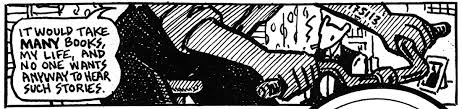
images-8

The care with which individual panels are constructed—Spigeleman once said in an interview that the main thing he learned from his father was how to pack a suitcase: his panels are similarly jammed with information—is mirrored by the attention to arranging those panels. Noting how important the page is as a way of structuring the book’s material, I had us compare two pages that are similarly composed, one showing Vladek and Anja on their way to a spa in Czechoslovakia in 1938, where they first see evidence of Nazi rule, and the other showing their arrival by van at the gates of Auschwitz.

We considered Spiegelman’s style of representing and made a continuum ranging from realism to expressionism. As an example of the latter, we looked at a panel showing Vladek and Anja on the run, having been driven from yet another hiding place, running along a pathway whose branches form a swastika. Finally, we looked at a two-page spread halfway though the first volume where an almost subliminal story is told in the images that ends up reinforcing the one discussed in the narration and dialogue (Vladek is describing how food began to grow scarce in occupied Poland and how heavily the wealthy Zylberbergs had to rely on the black market; in the images, of a large family dinner that attempts to recreate pre-war life, Richieu overturns his bowl and is first punished and then consoled by various family members).
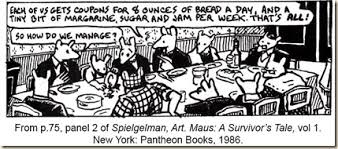
images-9

Day 3: Now, having read both volumes, we were ready to tackle the animal conceit, working through why Spiegelman chose to represent the different groups in the way he did. I asked the students to consider the limitations or questionable implications of the metaphor—if Germans are cats and Jews are mice does that mean it’s natural for Germans to hate Jews? But cats don’t’ hate mice: they just eat them. Is Spiegelman suggesting the Germans weren’t really responsible for their actions? Eventually I had them consider the subjective quality of the metaphor, that is, the idea that this is Vladek’s perspective, and not some objective claim about the merits or foibles of different groups of people. In the process I had us track how the metaphor changes as the book goes on. Tellingly volume 2 starts with Artie wondering how he should draw his wife, Francoise. As a frog, because she’s French? As a mouse, because she converted to Judaism? Does Speigelman’s conceit work with non-esentialist or fluid/hybrid notions of identity? After all, we do eventually see a mixed German-Jewish couple whose children are striped tabby mice.

More significantly, we see Spiegelman switch from animal heads to animal masks as he includes in his story the experience of making of the text. Earlier, he had used masks when characters tried to pass as something other than themselves (as Vladek does in the streets of occupied Poland, for example). But in a key section entitled “Time Flies” Spiegelman describes his creative block after the success of volume 1 and the death of his father. Here he and the other characters are clearly humans wearing what are clearly visible as animal masks. Referencing the work of the scholar Erin McGlothlin, I explained that our initial distinction between past and present needs to be complicated by the addition of what Spiegelman himself has called “the super-present,” a time even more recent, more present, than what has passed as the present so far in the narrative. In this way, the animal metaphor is ironized and destabilized, made to seem the relics of a past way of thinking about identity—though, tellingly, they are not abandoned altogether. After all, in Maus the past never lets go.

Day 4: I told the class I had three topics I wanted us to consider: (1) gender, especially the text’s presentation of women; (2) photographs; and (3) the last page of volume 2 and the idea of endings more generally.

I started by referring to a line quoted by the brilliant scholar Sara Horowitz in an influential essay on gender and Holocaust literature. Artie asks his father what his mother experienced when they were separated from each other upon arriving at Auschwitz. Vladek, anxious to keep Artie from finding out that he has burned Anja’s diaries after her death, tells Artie: “I can tell you… She went through the same what me: Terrible.” As Horowitz notes, Vladek here speaks for a larger tendency in Holocaust studies to efface gender or other indications of subjectivity in the victims. If the Nazis didn’t discriminate among their victims then why should we?

Yet men and women didn’t experience the Holocaust the same way, and the absence of Anja is a specter that haunts the book from its first pages. (I reminded the class that the first thing Artie says to his father when he asks him to tell his story is: “Start with Mom… tell me how you met.”) I had the class tell me what Anja was like. We soon concluded her character is quite complex. She is both mentally and physically frail, relying on Vladek to jolly, even bully her into health. Yet she is also strong: highly intelligent, beloved by her teachers, and politically active in ways that might surprise us given her family’s wealth. Vladek explains how he discovered shortly after their marriage that Anja had for some time been translating secret documents into German for a Communist group, a clandestine and illegal activity that she narrowly escaped being arrested for. Vladek was livid when he found out—“I always kept far away from Communist people”—and made his wife an ultimatum: “I told her ‘Anja, if you want me you have to go my way’… And she was a good girl, and of course she stopped all such things.”

Who knows how Anja felt about this and whether she really did give them up or whether the war intervened. The point, I suggested, is that Vladek seeks to make her life conform to his, just as he does retrospectively when he tells Artie that her experiences at Auschwitz were the same as is. Thus when Vladek later paints Anja as a saint, as the only woman of his life, we don’t quite believe him. Maybe his depiction of how much she relied on him is just another instance of his seemingly insatiable need to be in control, to be the consummate fixer, a trait that saved his life on more than one occasion in the camps.

Seeing how important it is for Vladek to control his portrayal of Anja, we might wonder if Artie does something similar. Yes, he arraigns his father as his mother’s murderer when he finds out what happened to the diaries, and he presents her as a softening influence on Vladek’s brutalizing parenting (she would let him get leave the table without finishing all of his food, as Vladek would insist). But earlier, in the wake of her suicide, he describes her as needy and smothering, in fact, as having murdered him.

Note, I added, how similar ambivalence characterizes the book’s portrayal of its other main female character, Mala, Valdek’s long-suffering second wife, herself a survivor. Mostly we see her berated and belittled by Vladek and it’s hard to know what keeps them together. Is it really, as Vladek repeats over and over, that she wants his money? Mala seems particularly hard done by in the book, and not just by Vladek. I pointed to a scene in which Artie, leaving his father winded after another long session on the exercise bike, comes across Mala in the kitchen. He mentions the round up in Sosnowiecz that Vladek has just been telling him about. Mala, who had experienced it as well, begins to tell the story of her family, including what sounds like an extraordinary feat of her own, in which she managed to smuggle her mother out of the ghetto. Artie doesn’t engage in any way with this fragment of what must be a remarkable tale. He jumps up to leave, having just remembered somewhere else where he might continue his vain search for Anja’s missing diaries.

I think this response is really surprising given how much Artie and Mala have in common. For example, both pale in Vladek’s affections in comparison to their dead precursors (Anja for Mala and Richieu for Artie), but this secondariness never amounts to any kind of solidarity or affection between them, at least not on Artie’s part. To recognize Mala might have required Artie to recognize the strange way in which he and his father attempt to control and even efface women by subordinating them to their various quests. After all, in their own ways, Artie and Vladek are equally controlling.

We could have kept talking about the text’s portrayal of gender for much longer, but I wanted to move us along and so was glad that someone mentioned the photo of Spiegelman and his mother, a holiday snap from 1958, that Spiegelman includes in volume I. I took the opportunity to segue to the topic of photographs, both actual and imagined. How many real photographs are reproduced in the book, I asked. Three. Who are they of? One’s of Artie and his mother, one’s of Vladek, and one’s of Richieu. Why are these photos included? It’s the family, someone replied. Yes, though a family photograph, that is, of all of them together, is naturally impossible. So the book performs a double movement: it reunites the family but in so doing only reminds us of the family’s fragmentation.

But why include the photos? Why reproduce them in the text? I got the predictable responses: photos are more realistic, they remind us that the events really happened, they show us what the people really looked like and remind us that they are people and not just mice. But were we ever in doubt of that? Don’t we identify with these figures so strongly, whether animals or humans or something in between? Why do we need to be reminded that these figures are really people? And why are we so convinced by the authenticity of photos? In this age of photoshop and snapchat and instagram, how can we forget how open to manipulation photos are?

Think of it this way, I said. What’s the photo with Vladek of? He’s posing in a concentration camp uniform that he found in a photo shop after the war, on his way home to Poland. Right: it’s the craziest photo—we don’t know why the photographer would have something like that and why anybody, not least someone like Vladek, would ever want to pose with it. So here the text challenges our beliefs in authenticity. The sign that Vladek was in the camps is a photo taken of him after the camps.

Besides, I added, we still haven’t figured out why Spigelman would include the photos rather than draw them. After all, he does that more than once. I quickly referenced a couple of examples from earlier in the book and then had us look at a sequence near the end of volume II in which Vladek brings out a box of old family photos for Artie to look through. The photos are mostly of Anja’s family, almost all of whom were murdered by the Nazis: “Anja’s parents, the grandparents, her big sister Tosha, little Bibi and our Richieu… All what is left, it’s the photos,” Vladek concludes, adding, when Artie asks about his own side of the family, “So only my little brother, Pinek, came out from the war alive… from the rest of the family, it’s nothing left, not even a snapshot.”

maus_p275

Why, I asked the class, would Spiegelman choose to draw these images, which are presumably based on real, extant photographs, rather than using the photos themselves? This was a real question. I’ve never been able to come to an answer about this question that satisfies me.

One student ventured that these people didn’t survive the war, thus they were consigned to the past, which Spiegelman indicated by drawings rather than photos. This was a nice theory, but as others quickly pointed out, not one that held up. After all, some of these people, like Vladek’s brother Pinek, who was hidden by peasants before making his way to Palestine, did survive. And others died in ways other than at the hands of the Nazis, like Anja’s brother Herman, hit by a car in Norristown, PA, or her brother Josef, a commercial artist who killed himself after an unhappy love affair.

We had reached a dead end in our conversation and I had no idea how to move us past it to consider the end of the book. There were ten minutes left in class: we had both too much and too little time. But then a student, one whose points are usually a little too obvious, saved the day by pointing out that the image of the pile of photos, seemingly having floated down from the sofa where Vladek and Artie are studying them and arrayed in great despairing drifts, went all the way to the edge of the page. We’d looked at some similar instances earlier in the week, and I’d suggested a connection between these images and the subtitle of Volume I: My Father Bleeds History. The images that couldn’t be constrained by a border—that bled to the edge of the page—suggested themselves as especially significant inasmuch as they pointed to the uncontainable nature of history, the inability of the past to stay safely in the past.

And then something really great happened. A pretty quiet student, smart but not always able to express himself clearly, said: It doesn’t matter when these people died or even if they are still alive. They are still victims of the war, of the things that happened during that Holocaust. That’s why the picture goes to the edge of the page. The war doesn’t stop.

I thought this was brilliant and I seized on it as a life raft. Exactly! I cried, repeating the student’s point so that others would be sure to have heard it. The war doesn’t stop. That’s exactly what we see happening on the last page. At this point we only had 5 minutes left and I often spend 20 minutes talking students through that last page. So all I could do was tell them what I most wanted to say about this ending.

maus2-p-136-last-page

As Spiegelman himself has pointed out, the end just keeps on ending. First we have Vladek’s description of his dramatic reunion with Anja, which, as we considered in our earlier discussion of his relation to women, we know to be self-serving and false: “More I don’t need to tell you. We were both very happy, and lived happy, happy ever after.” The repetition of “happy” belies the true state of affairs, which is that much unhappiness followed them after the war: Vladek’s reluctant move to the US (he wanted to stay in Sweden), Anja’s depression and eventual suicide, the estrangement between father and son; Vladek’s increasing ill health. I noted that the circle against which the couple embrace might remind us of the circle in the movie poster in Volume I of Rudolph Valentino, who the young Vladek was said to resemble. It might also remind us of the spotlight cast on the young couple as they dance at the spa in Czechoslovakia in the last happy days before the war. It might even remind us of the wheel of the exercise bicycle from which Vladek tells much of his story. The circle is a sign of futility and circularity as much as perfection, and, in its connection to image-making and Hollywood stars, it intimates the fabricated nature of Vladek’s conclusion.

This ending is immediately followed by another: Vladek’s wish to stop speaking, to stop creating the story. His fading powers, even the death that we know is not far off, is suggested by his confusion between his sons: “I’m tired from talking, Richieu, and it’s enough stories for now…” he tells Artie. Right below this row, even forcing its way into it, is yet another ending, an image of Vladek and Anja’s gravestone. The fact that the book ends three times, as it were, suggests that it can have no definitive end, an idea further supported by the image of the eternal flame on the gravestone. And what about Spiegelman’s own signature below that? The dates that accompany it are of course the dates of the creation of the work, but it’s hard not to think of them as the dates of his own life. After all, one of these endings includes his own erasure and replacement by the sibling he never knew, the one he had a weird ghostly rivalry with, as he tells Francoise at the beginning of Volume II.

Thus we ended this class much as we began the first one more than a week earlier, with an assertion of the ongoingness of events, the persistence of the past into the present. But our understanding of that claim was a lot more complex now than it had been then. I was really pleased with the work we’d done. In fact I continue to be amazed by this class. They’re still bringing it every single day. Usually, this late in the semester the conversation is being carried by a core group of actively engaged students while the rest follow limply along. But in this group almost everyone still talks every class period.

I really think they are the best group I’ve ever taught. I’m trying to enjoy every minute.

If you want to catch up you can read earlier posts about the course here, here, and here.
Holocaust Lit Fall 2016: Week 6 Imre Kertesz’s Fatelessness

This fall, I’m blogging about my course on Holocaust Literature. You can catch up on the first two installments here.

We’re already through six weeks of the semester, and if you’re keeping track at home you know I’ve missed three weeks. I hope to get to those later, but don’t hold your breath. It’s hard to keep up, and even harder to reconstruct. The headlong pace of the semester sweeps all before it, but I’m delighted to say that I’m having so much fun teaching this group. They are the best class I’ve taught in years. After six weeks, almost all students still participate regularly in discussion, and most of the ones I suggested come meet with me after less-than-distinguished early papers actually did so. Unheard of!

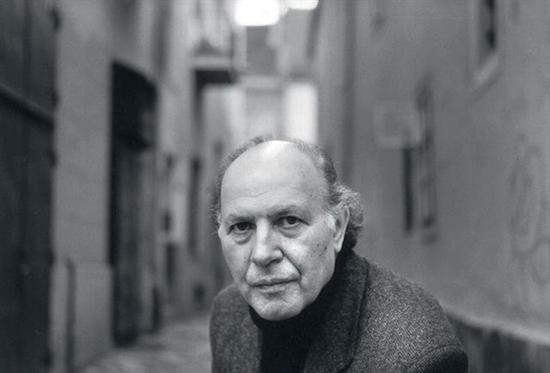
This week we faced our toughest challenge yet: Imre Kertesz’s novel Fatelessness (1975). Kertesz, who won the Nobel Prize for Literature in 2002, insists the novel is not especially autobiographical, though its protagonist, György Köves, shares some of Kertesz’s wartime experiences. Like Kertesz, György grows up in Budapest to divorced parents, is deported to Auschwitz in 1944 at the age of 14, and is later transferred to Buchenwald.

Fatelessness is a hard book. It’s not only a lot longer but also far more conceptually complex than anything we’ve read so far. (Which is saying something, since Primo Levi, in particular, is no slouch when it comes to intellectual sophistication.) I teach the newish translation by Tim Wilkinson; it seems to me admirable though by no means easy or always elegant, which I suspect is true of the original too. There’s an earlier English translation by Christina and Katharina Wilson, which goes by the slightly but significantly different name Fateless. I’ve not read it, so can’t compare them. If anyone has, I’d love how the translations match up. I’d especially like to hear from anyone who has read Kertesz in his native Hungarian.

It’s been several years since I taught Fatelessness. Students tended to resist it, and although I could tell it was remarkable, I didn’t have a good handle on it myself. The ending in particular is hard to make sense of. I took it off the syllabus for a couple of years, but I never found anything that satisfied me more and the book kept calling to me, so back on it went. Third time’s the charm, I guess. I’m still not entirely clear on what Kertesz wants to say, exactly, in the last chapter, but I feel more confident with it than before and this group of students tackled the book cheerfully and with good will, which made me like the book even more.

So it was a good week in the classroom. (Really, the book deserves even more than a week, but sometimes less is more.) Here I’ll concentrate on the first day’s discussion and allude occasionally to some of the things we covered during the rest of the week.

kertesz-imre_1376810388_crop_550x373-1

We began, as I like to do, at the beginning. I read the opening paragraph:

I didn’t go to school today. Or rather, I did go, but only to ask my class teacher’s permission to take the day off. I also handed him the letter in which, referring to “family reasons,” my father requested that I be excused. He asked what the “family reason” might be. I told him my father had been called up for labor service; after that he didn’t raise a further peep against it.

What’s the tone here, I asked the class, and how can you tell? It’s straightforward. What does that mean? Is “straightforward” a tone? It’s simple, you can tell already he’s young. How can you tell? Well, he is supposed to be in school. Right. But can you tell by his way of speaking? His sentences are simple—they’re not complicated and they almost all start with “I.” That’s mostly true, here, about the syntax, though that third sentence is a bit more complex. And we’ll see that his sentences are actually often rather hard to parse, clotted as they are with seemingly unnecessary qualifications and hesitations, the most apparent of which is the term “naturally.” But let’s stick with your other observation—the sentences almost all start with “I.” Does that suggest anything about him?

Maybe he only cares about himself, came the tentative reply. Is he selfish elsewhere? Maybe not selfish, but he doesn’t know how to deal with other people. For example? Well, later he’s embarrassed about all the emotion around his father leaving. And he always seems to be astonished by other people’s reactions. We considered a couple of examples from the first third of the book. Then I brought us back to the opening paragraph. Are there other things you notice about his way of speaking or the kinds of words he uses? He says, “peep.” That’s a young word. A young word? I teased. Like, we just invented it? The student blushed, became more precise. A word a young person would use. Immature. Right, this instance of slang seems important. It suggests something about this person. Neither Levi nor Wiesel would have said “peep.”

What else can we tell about him based on his way of speaking? Think especially about the first and second sentences. What’s the relation between them? After a minute we concluded that the second sentence reverses the first, or, rather, qualifies it. Qualification of this sort is everywhere in the book. It’s the most obvious characteristic of György’s narration. (Later we looked at a famous, grotesque example. György gets inflamed wounds on his hips—phlegmons—that burst and become infected with the lice that are everywhere in the camp. Contemplating the voraciousness of the parasites he comments: “In the end, I realized that, to some extent, and taking everything into account, I could see it their way.” Three qualifying phrases in one simple sentence—typical of his way of speaking.) What kind of person might he be then, given these incessant qualifications and hesitations? Here I was pushing a particular line, and the students could sense it. That always make them clam up—they get scared of giving the wrong answer. Someone ventured: he wants to get things right?

Interesting. Yes, accuracy matters to him. He can’t cut any corners, someone said, he has to tell it exactly. He likes rules, I added. Can we think of any examples? He worries about being with his father on the day of his deportation because that’s the day of the week he’s supposed to be with his mother, according to the court ruling in his parents’ divorce. And he worries about the star on his jacket, someone added. Oh yeah, remind us about that. It’s on page 5—he’s walking and decides not to take his coat off in case his star gets covered up: “It was a clear, balmy morning, considering it was still just early spring. I was about to unbutton myself but then had second thoughts: it was possible that, light as the head breeze was, my coat lapel might flap back and cover up my yellow star, which would not have been in conformity with the regulations.”

The stakes of following rules are high for someone like György, I said. But he’s also shallow, someone said. How so? He doesn’t want a home made star. He thinks those are embarrassing. Yeah, he’s really immature, someone else piled on. But he’s only 14, another student said. He doesn’t know anything other than the rules the Nazis made for him. (Here I gave a brief clarification about the relation of the Hungarian and German governments during the war, but the student’s point still stood.)

So thinking about this rule following and then going back to the opening paragraph, we can see that there is something both fussy and oddly accepting about György’s attitude to his experiences. Fussy is the word I always come back to for György’s style, with its endless qualifications and circumlocutions.

All of this had taken a while, so I also didn’t mention the two uses of euphemism in the opening paragraph—one quoted (“family reasons”), the other not (“labor service”). But they are significant because of a tendency we remarked on later—the way György accepts, even takes on and unthinkingly uses, the language of his oppressors.

Over the course of the week, we saw that tendency ever more clearly and worried a lot over what it suggested. Is it a sign of how thoroughly he’s been duped, how unable he is to escape from the ideology that vilifies him? Or is a sign of something more nefarious—is he a traitor to his people? (A people he has little to do with—an early scene shows how assimilated the family is, serving pork at the father’s farewell supper, stumbling through prayers in a language almost none of them speak. György falls in with the other Jewish kids in his building, but only because they have all been singled out as Jewish, something that never meant anything to them before.) Is György an idiot? Totally clueless? Self-hating?

I reminded students of the extraordinary, ten-page long description of György’s arrival at Auschwitz, where, among other things, young György admires the SS officers spotless uniforms and observes with interest but also revulsion the prisoners who unload them from the train: “It was quite a shock, for after all, this was the first time in my life that I had seen, up close at any rate, real convicts, in the striped duds of criminals, and with shaven skulls in round caps. Dude, I shouted, shamelessly mugging for the students, that’s you!

The best way to understand György in moments like these, I suggested, is to think about the novel’s unusual use of time. When is György telling his story? A hard question, met with silence. As they’re happening to him, someone finally ventured. Is it in present tense? The student had to admit it wasn’t. So not quite as it’s happening, but you are basically right, I said. It’s very close to the events, from some imaginary, impossible to pinpoint position that is after the events but not much after.

Compare this, I said, to the texts we’ve read before. Borowski also used a first person narrator in “This Way for the Gas, Ladies and Gentlemen,” but he told the story in present tense. Even more characteristic is the first person voice of Wiesel’s Night and Levi’s Survival in Auschwitz (these are the missing three weeks’ worth of blog posts). Remember that Levi and Wiesel regularly used retrospection. They narrated from well after the events. We noted how Levi liked to move from narrative to essayistic mode (typically noted by a shift from “I” to “we”), as he stepped back to consider, for example, how the Germans’ thoroughgoing utilitarianism was at work in the “selection” process. We noted how Wiesel regularly castigated the Jews of his hometown of Sighet for not seeing what was about to befall them. These attitudes can only be offered in retrospect, through a hindsight that, in Wiesel’s case in particular, is pretty dubious. (Hindsight 20/20, etc.) Kertesz’s novel, by contrast, is never retrospective. It sticks so closely to its events, because it believes that is the most honest way to represent them, especially for its young protagonist, who lacks any context to make sense of what’s happening to him and his world.

At the end of our last class on the novel, I would wrap up the week’s discussion by reading an excerpt from Kertesz’s Nobel Prize address in which he takes up this method:

But the hero of my novel does not live his own time in the concentration camps, for neither his time nor his language, not even his own person, is really his. He doesn’t remember; he exists. So he has to languish, poor boy, in the dreary trap of linearity, and cannot shake off the painful details. Instead of a spectacular series of great and tragic moments, he has to live through everything, which is oppressive and offers little variety, like life itself.

But the method led to remarkable insights. Linearity demanded that each situation that arose be completely filled out. It did not allow me, say, to skip cavalierly over twenty minutes of time, if only because those twenty minutes were there before me, like a gaping, terrifying black hole, like a mass grave.

What Kertesz here calls linearity is linked to a scene at the end of the novel that we considered, in which György returns to Budapest at the end of the war and is asked by a reporter to share his stories with the world. The reporter seems to have his heart in the right place: he wants to avoid platitudes, he wants to mobilize citizens’ attention to what happened, he wants to fight the apathy the world threatens to sink into even though the war has only just ended. (He’s a lot more sympathetic than the family who has taken over György’s father’s apartment, and refuses to let him in or even to acknowledge his existence.) But he also sees György as a symbol of the times rather than as an individual, and he presses him to describe what it was like in “the hell of the camps.” György responds firmly that he is “not acquainted with hell and couldn’t even imagine what that was like.”

Here we see the outcome or even payoff of the extreme literalism that characterizes György’s way of expressing himself from the beginning of the book. He refuses to speak grandiosely of atrocities, not out of some kind of perverse admiration for the camps, but because he never experienced anything grandiose, only boredom and pain and hunger and even pleasure, the pleasure of still being alive, a sensation that never abandons him even when he is reduced to the most minimal sentience. The reporter give György a slip of paper with his address and urges him to come see him but György lets it drop into the street as soon as the men take their leave of each other. Why does he do that I asked one student, a really smart kid who saves everything for his writing and is unaccountably quiet in class. He hadn’t been expecting the question and struggled a little and then said, simply, I don’t know, I was wondering that too. How did it make you feel, I asked. Upset. Frustrated. That seemed to me a completely understandable response and many students agreed. Despite the novel’s first-person narration, we’re much closer to the reporter than to György, who we have a hard time identifying with. But then another student piped up to say that she was glad György dropped the paper, because the reporter just wanted to exploit him. (Indeed. And that should make us think hard about what our relation to the works we’ve been studying might be. What do we want from them?) I agreed, even if the exploitation was more metaphysical than financial (the reporter admits that neither of them is likely to make much money from any articles they would write together.)

Our insistence that survivors return to tell the world about the atrocities they suffered through is a version of the retrospection that Kertesz contests. What Kertesz wants instead is to present the experience of the survivor from within, which is to say, from the position of someone who is merely surviving, not yet a survivor. Some of the power of Fatelessness comes from the dramatic irony that arises when we compare our knowledge of historical events with György’s—we know what it means to have been “selected,” whereas Györy can only, disquietingly, exult in the clear physical superiority of those in the group he’s been sent to when the people in his transport are separated out. But most of its power comes when we allow ourselves to think about what that disquiet implies: an utter refusal to make of the events something other than what someone going through them might have experienced.

Fatelessness is the only novel I know of that attempts to portray the experience of what was known in camp slang as the Musselmänner, the Muslims, those who were unable through bad luck or poor constitutions or mere inability to find a way to finagle, through some kind of position or job, a few scraps more to eat than the allotted rations and who quickly wasted away. These figures are present throughout Holocaust literature, sometimes as objects of fear, sometimes of contempt, sometimes, as in Levi, as the representatives of the truth of the entire genocidal project, a truth no survivor can be said to share. Here we see one reason why Kertesz needed to write a novel rather than a memoir. By definition, we have no testimony from within that experience, since no one survived it. But Kertesz makes it palpable and plausible how one could be reduced to this state, and how within this zero-degree of human sentience there could still exist, however minutely, the desire for life. It is in this sense that György, transferred to Buchenwald, nothing but a sack of skin and bones who can no longer walk and is left for dead on the ramp until through the most contingent action—he happens to blink just as he is about to be carted to the charnel house and is instead taken to the camp infirmary, it is suggested because the prisoners sorting the living from the dead are so amused at the sight of one so obviously far gone attempting to announce his connection to the living—only in this sense can we understand what otherwise seems only ironic or deluded, György’s breathtaking statement. “I would like to live a little bit longer in this beautiful concentration camp.” In the same vein, György, who survives by being taken on as a kind of pet prisoner in a hospital unit manly for non-Jewish prisoners, for reasons that are obscure to us because they are unclear to him, can also think, back in Budapest, fondly on the camp: “I was seized by a sharp, painful, futile longing for it: nostalgia, homesickness.” This feeling too must somehow be accepted as part of what Kertesz woudl doubtless shudder to call “the Holocaust experience.”

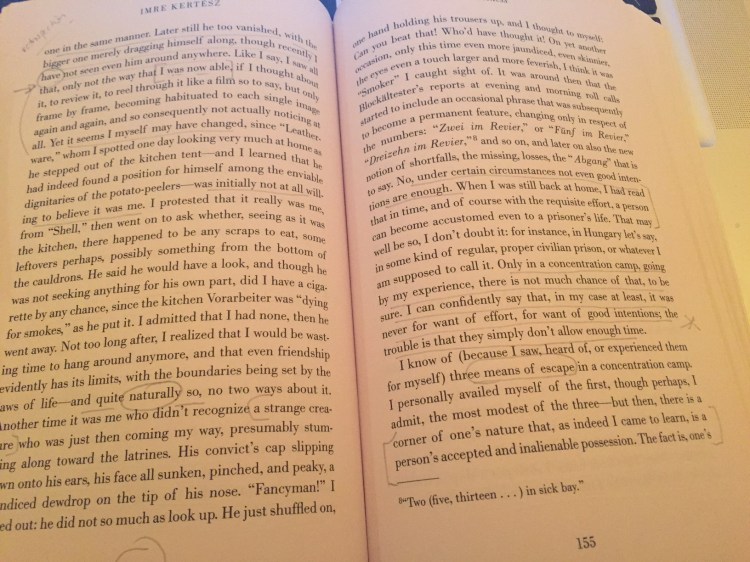
img_0453

There’s so much more to say about Kertesz’s remarkable—and still too little appreciated—novel. But I’ve already said a lot. Suffice it to say that the class did terrifically well with this demanding novel. Next week, after a break for Rosh Hoshanah, we’ll spend several days working on the first long essay. I’m crossing my fingers that when we return to the course texts, this group will continue to keep on bringing it the way they have so far.


Teaching Rhys

jeanrhysreadingweek-banner

I’ve taught Jean Rhys regularly for more than ten years: the quietly devastating story “Learning to be a Mother,” perfect for showing students how much you can say about something that seems at first glance so slight; the heartbreaking Good Morning, Midnight, with its hair-raising and endlessly discussable ending; and, most of all, my true Rhys-love, the marvelous Voyage in the Dark. I’ve lost track of how many times I’ve taught this book, the third of Rhys’s five novels, but I know it’s never failed me yet. Even students who hate it get passionately caught up in our conversations. There’s a lot to talk about because Rhys’s fiction is such a challenge to how we talk about fiction.

Most of the things I have to say about Rhys come from the person who first introduced me to her, Molly Hite, now retired but when I knew her a professor of English at Cornell. The best courses I took in graduate school were the two I took with Molly. Anyone who’s been to graduate school knows that this could be faint praise, but Molly cared as much about her teaching as about the books she taught. And she cared about those a lot. Molly pressed Voyage on me the semester I was studying for my comprehensive exams. We were talking about an essay I wanted to write about representations of children in modernist literature. Molly said I had to add Voyage to my list. It’s about a girl who is eighteen, but none of the men she meets believe her when she says that, because, as one points out, women always say they’re either eighteen or twenty-two. This is just one instance in which Anna Morgan, the figure at the center of the novel, finds her lived reality butting up against dismissive patriarchal expectations.

Voyage isn’t obviously about childhood, but it turns out to be a smart way to think about the book. After all, Anna ends up pregnant, plagued by nightmares about the monstrous child within her that she desperately wants to abort, possibly at the cost of her own young life. After just the first few pages I saw how wonderful the book is. Molly was perhaps the only professor I knew in graduate school who really seemed to love reading, and I thrilled to that infectiousness. But I was also a little scared of Molly. Nothing unusual there, I was scared of most of my professors, but I felt it more strongly with her, probably because I cared about her opinion more than I did other professors’.

In my line of work, I often meet people who had very close, even nurturing relationships with their dissertation advisors. That was not my experience. Not that they were bad or hostile relationships. Just not close. But Molly was as close as I came to having a mentor. She cared the most about my writing, pushed me the hardest, and shaped my approach to reading most strongly. What she said to me about an essay I wrote on D. H. Lawrence’s The Fox has stayed with me: “You have to let the story be as weird as it is.” I say it to my students every semester, but these are words for every reader to live by.

img_0447

Although I didn’t know it at the time, this sentiment is expressed in Molly’s terrific essay on Jean Rhys, “Writing in the Margins” (published in The Other Side of the Story in 1989). Molly was modest enough not to tell me she’d written about Rhys, and in fact I can’t even remember when I read the article, not until I left grad school for my first job I think.

In an incisive critique of existing Rhys criticism, Molly says:

Both mainstream and feminist critics who admire Rhys’s fiction in effect try to settle her, accommodating her to [dominant cultural] presuppositions either by interpreting her as an alien and inferior sort of person who serves as an object of study (in the process sacrificing authorial empathy), or by interpreting her as Rhys’s own unexamined self-projection (in the process sacrificing authorial control).

The reason critics and ordinary readers alike feel the need to “settle” or domesticate Rhys’s fiction has everything to do with her particular, and to my mind highly experimental, conception of character. Molly says a lot of smart memorable things in this essay—you should totally read it, it’s quite accessible—but what sticks with me the most is her argument that our ideas of what fictional characters are supposed to be like are governed by an idea of voluntarism that simply doesn’t apply to protagonists like Anna Morgan.

By voluntarism, Molly means something like an unshakeable belief in willpower. The idea that characters—at least active, important, main characters, the kind E. M. Forster described in his engaging Aspects of the Novel as “round”—should change. They should make decisions, take charge of their actions, act on their wishes, shape the world around them. Rhys’s characters aren’t like that. But neither are they static, or minor, or clichéd or any of the things Forster says about what he calls “flat” characters.

What happens when a novel centers on someone who is unable to change or take charge or her circumstances? And not because of some kind of personality defect (she’s weak or stupid or passive) but because of who she is (a woman, young, poor, from a far-away place that most of the people who live in the country she’s moved to have never heard of and even when they have can’t take seriously: Anna, like Rhys, is from the Caribbean island of Dominica).

One of the first things I ask students about Anna is: what should we call her? Here I’m riffing off an anecdote Molly offers in the essay: a male student “remarked wonderingly that he wasn’t sure why we were taking a floozy so seriously.” I don’t think any of my students even know what a floozy is. But they have other names. Is Anna a pushover? A weakling? A depressive? A gold-digger? A space-cadet? An idiot? A heartless bitch? I’ve heard all these things. Most often, I hear some version of the half-plaintive, half-aggressive question: Why doesn’t she get her act together? As I tell those students, it’s quite revealing how Anna can upset us. The mostly privileged students I teach are deeply attached to the idea that those who work hard will succeed.

Ultimately, these conversations always turn on the question of whether Anna is a victim. As Molly puts it: “Rhys’s protagonists are victims who are fully aware of their victimization.” She adds:

Their awareness does not make them any less victimized, it serves only to make them self-conscious in their roles and thus alienated from the society that wants to identify them completely with these roles. Worst of all, because their situation as both marginalized and wholly conscious is impossible in the terms proposed by the dominant culture, the statements in which they express their awareness cannot have any acknowledged context.

They can speak in ways that are expected of them—but if they do they are dismissed. Or they can not speak at all. No wonder they are so unhappy.

images-7

Yet Rhys’s characters are anything but inarticulate. The abiding interest of her novels lies in the presence of a distinctive consciousness that is pretty much unintelligible to the society in which she lives but possibly, if we’re willing to expand our expectations of literary character, intelligible to us. Especially in Rhys’s first person novels, this conundrum is expressed through narrative voice. I could talk for a long time about the many wonderful qualities of Voyage in the Dark—it’s a desert island book for me—but I don’t want to go on too long. Let me just give a few examples:

She can be funny and shrewd, as in this moment when the older man she falls in love with, a man who keeps her and later abandons her, leaves her some money:

I took the money from under my pillow and put it into my handbag. I was accustomed to it already. It was as if I had always had it. Money ought to be everybody’s. It ought to be like water. You can tell that because you get accustomed to it so quickly.

She is a fascinated observer of others—though what that observation is used for is harder to figure. Here she’s writing about how much she liked one of the women who worked in her father’s household in the Caribbean:

The thing about Francine was that when I was with her I was happy, She was small and plump and blacker than most of the people out there, and she had a pretty face. What I liked was watching her eat mangoes. Her teeth would bite into the mango and her lips fasten on either side of it, and while she sucked you saw that she was perfectly happy. When she had finished she always smacked her lips twice, very loud—louder than you could believe possible. It was a ritual.

Is this ritual positive? A kind of repetition compulsion? Does the passage express female desire, or, on the contrary a way of curbing it?

Notice how in both passages Anna uses “you.” This is characteristic, but oddly enough it doesn’t always make us feel closer to her, as when she says:

 I didn’t say anything. I put my face nearer the glass. Like when you’re a kid and you put your face very near to the glass and make faces at yourself.

You might do this, and you might not. The attempt to universalize—or at least widen—the behaviour actually ends up seeming estranging, though it doesn’t mitigate the pathos of this attempted challenge to the overwhelming power of female appearance. (A constant anxiety in the novel is that when women age, men will replace them with someone younger.)

Some similar examples:

Being afraid is cold like ice, and it’s like when you can’t breathe.

After a while I crossed everything out and began again, writing very quickly, like you do when you write

I felt emptied out and peaceful—like when you’ve had a toothache and it stops for a bit, and you know quite well it’s going to start again but just for a bit it’s stopped.

Or, finally, this description of depression:

But I stopped going out; I stopped wanting to go out. That happens very easily. It’s as if you had always done that—lived in a few rooms and gone from one to the other. … You feel peaceful but when you try to think it’s as if you’re face to face with a high, dark wall. Really, al you want is night, and to lie in the dark and pull the sheet over your head and sleep, and before you know where you are it is night—that’s one good thing. You pull the sheet over your head and think, “He got sick of me,” and “Never, not ever, never.” And then you go to sleep. You sleep very quickly when you are like that and you don’t dream either. It’s as if you were dead.

Rhys’s prose is at once affectless, even artless, and affecting. It’s carefully shaped; I’m struck by how the repetition of “you” distances at least as much as it draws us closer.

It’s always hard to know what to make of Rhys’s tone, once again, I’d say, because of the way the characters are at once powerless without being stupid or unaware. On the contrary they are highly aware, but that awareness only lets them see more clearly the prison they live in. As in this example, when Anna daydreams about being back at home and feeling that everything that’s happened to her—abandoned by her lover, without any money or prospects, and now pregnant on top of it all—is just a dream:

She’ll smile and put the tray down and I’ll say Francine I’ve had such an awful dream—it was only a dream she’ll say—and on the tray the blue cup and saucer and the silver teapot so I’d know for certain it had started again my lovely life—like a five-finger exercise played very slowly on the piano like a garden with a high wall round it—and every now and again thinking I only dreamt it it never happened…

How could we read that “lovely life” as anything but ironic, especially as it’s likened to a doubled metaphor of control and imprisonment—the piano exercise, the walled garden? And yet it’s more lovely than her current life, which has the ominousness of a dream she cannot escape.

Although I don’t think Molly was appreciated by her colleagues or the profession as much as she should have been, I don’t want to suggest that she and Rhys were the same. Yet I’ve a hunch that they had a few traits in common—at once brash and shy, both seem to me to be people the world hasn’t always know what to do with. (I’m writing as though Molly were dead! That’s so weird; I’m sorry. As best I can tell, she’s enjoying retirement in the Pacific Northwest.) But it does seem fitting that I can never read Rhys without thinking of Molly. Both were fiercely committed to the idea that books are always more off-putting, more ready to wrong-foot us, than we think, especially if we come to them with ready-made ideas of how they should work and what they should mean.

When Molly leant me her copy of Voyage in the Dark in the fall of 2001, Rhys wasn’t read that often. Most people knew her only as the author of Wide Saragasso Sea. I never studied her in a class. Fifteen years later, Rhys feels firmly canonical. Even more than her critical or academic acceptance, I take heart in the way non-specialist readers have embraced her, as evidenced by ReadingRhys week. I suspect that wherever she is, whatever she’s doing, beachcombing near Seattle maybe, Molly approves too.

Holocaust Literature Week 2: Vasily Grossman’s “The Hell of Treblinka”

This semester I’m blogging about my class on Holocaust literature. Here is the first installment.

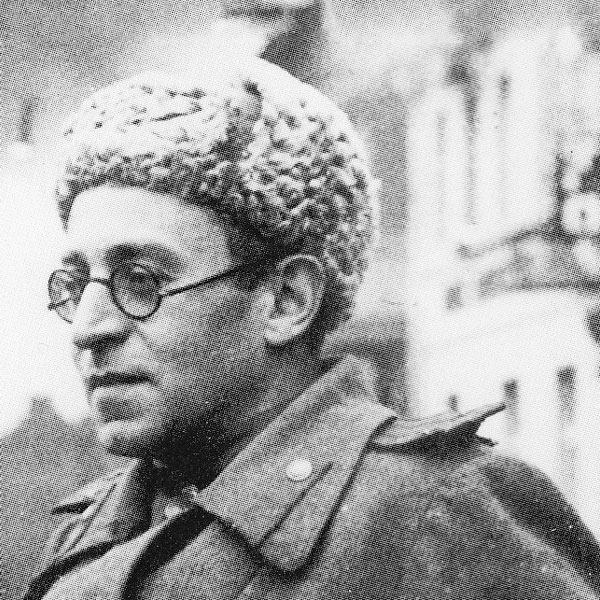
Vasily Grossman (1905-64), who we studied at the beginning of Week 2 of the course, is not nearly as well known in the canon of Holocaust literature as someone like last week’s author, Primo Levi (or some of the other writers we’ll study this semester, like Elie Wiesel and Tadeusz Borowski).

I can think of at least two reasons why. First, the reception of Holocaust literature in North America has been biased towards texts written in Western European languages. At least in part, this preference was a function of the inaccessibility of documents and archival material in Soviet-occupied Europe during the Cold War. Second, Grossman was not a survivor, per se, though his mother was murdered by the Nazis along with more than 20,000 other Jews in the family’s hometown of Berdichev in the Ukraine.

Grossman was born to an assimilated Jewish family. He did not have a Jewish education. It is unlikely he knew Yiddish. Berdichev, an important banking center, had one of Europe’s largest Jewish communities in the late 19th and early 20th centuries. This was a prosperous, cosmopolitan world quite unlike the shtetl world made famous in Sholem Aleichem’s work and depicted in the early parts of Wiesel’s Night.

Grossman studied to be an engineer, but turned to writing in the 1930s. When Hitler invaded the Soviet Union in the summer of 1941, Grossman was assigned to the Red Army newspaper. He became one of the most famous Soviet war correspondents, taking on many dangerous assignments, including a posting in Stalingrad. He accompanied the Red Army on its march westwards, where he reported on what has been called “the Shoah by bullets” (the death meted out by the Einsatzgruppen—mobile units or death squads—across Eastern Europe, especially the Ukraine. These firing squads murdered approximately tow million people in the years 1941-44, 1.3 million of them Jews, among them Grossman’s mother). Later, in 1944, he also reported on “the Shoah by gas.” He was with the Red Army when it arrived at the extermination camp Treblinka in August 1944.

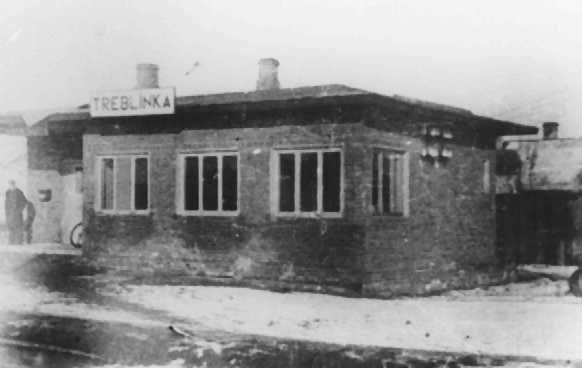
Immediately he set about writing an essay called “The Hell of Treblinka.” Published in November 1944, it is one of the earliest accounts of the death camps. After the war, it was submitted as evidence by the prosecution during the Nuremberg trials. This extraordinary work is readily available—translated by Robert and Elizabeth Chandler together with Olga Mukovnikova—in an invaluable collection of Grossman’s essays, stories, and journalism called The Road (New York Review Books).

pic_related_091314_sm_-vasily-grossman

I began by asking the class to recall the question I’d given them at the end of the previous meeting as a way to guide their reading: What does Grossman value?

Hands shot up. I was relieved to see it, since, on the face of it at least, this is an easy question. Grossman is a passionate writer, not shy to render judgment and lay blame. And since that is what students want to do too, at least when it comes to the Holocaust, they take to him immediately. Of course, Grossman also gives us the tools to complicate what seem like straightforward categorizations.

Life, people, humanity, came the answers. Each student who spoke—and I reminded students that if they hadn’t yet said anything in class this was absolutely the day to chime in because soon, maybe already by the next class, their identity would be sealed: they would be a person who doesn’t talk in class—had to point to a specific passage to support their claim. “The most precious valuable in the world—human life.” “The epitaph history will write for [the victim] is: Here Lies a Human Being.” “Killing turned out to be supremely easy… This must be unflinchingly borne in mind by everyone who truly values honor, freedom, and the life of all nations, the life of humanity.”

These were all good examples. I pointed to another quintessentially Grossman-ian formulation: the victims, he says,

were caught up in a single flood, a flood that swallowed up reason, and splendid human science, and maidenly love, and childish wonder, and the coughing of the old, and the human heart.

The list of attributes and qualities here is typical; Grossman loves lists. (At one point in the essay he simply names, for almost ten lines, the belongings the new arrivals would have left scattered on the ground, commenting only, tartly, “It requires real skill to sort out, in the course of only a few minutes, all these thousands of objects.”) This particular list is a strange one. Ranging from physiology (the coughing) to emotion (love and wonder) to human accomplishment (reason and science), it seems to want to encompass everything that might go under the name the human condition in a single sentence.

Grossman absolutely believes in the idea of the human condition. This emphasis on common humanity is at least in part a political and ideological choice. In the course of this forty page essay, Grossman only mentions once that most of the victims were Jewish. That decision is a function of the Soviet insistence that only the suffering of Mother Russia rather than any individual group of people be commemorated. Grossman’s insistence on a kind of universal brotherhood of mankind is also evident in his insistence that the victims looked out for each other. Solidarity of this sort did exist in the camps, but so too did its opposite. Many of the course texts, I noted, will offer a quite different view of affairs.

Grossman was no doctrinaire Marxist—in the essay he even obliquely criticizes Stalinism; after the war he fell into disfavour and his great masterpieces Life and Fate and Everything Flows were written “for the desk drawer” and only survived because they were smuggled to the West in the Krushchev period. But he also insists in classic Marxist fashion that “what engenders a particular regime is the material and ideological relations existing among a country’s citizens… the nature of these relations is what should appall us.”

Yet Grossman never interprets Nazi Germany this way. Instead, as the students noted, he regularly describes them as demonic monsters, purveyors of “bestial madness.” They are refused any redeeming qualities; indeed, they aren’t even human: “The beast that triumphantly kills a man remains a beast.” What, I asked the class, is the effect of Grossman’s rhetoric? What is implied by this way of thinking and talking? (To offer compelling interpretations, students need to be able to draw out the implications of their observations, so I wanted them to practice drawing out the consequences of their ideas.) It’s like they’re not real people, someone said. Exactly, I responded. And why does that matter? Well, they were people, said another. Yes, I added, people like us.

It’s easy for us to imagine that these events have nothing to do with us. It allows us to approach the Holocaust as a kind of macabre spectator sport. But if we treat the Nazis as monsters, we effectively let ourselves off the hook. We don’t need to think of ourselves as in any way implicated in their way of viewing the world. In this way, Grossman risks devaluing the idea of humanity he values so much. In an oblique way, this risk is evident too in his treatment of what the historian Raul Hilberg would later call bystanders, in this case the local Poles who Grossman uses as mere neutral evidence for German actions. He doesn’t’ consider more complicated questions of implication or degrees of guilt, concepts that someone like Primo Levi would develop in his essay “The Grey Zone,” which we’ll read in a week or so.

35274

Whenever I teach “The Hell of Treblinka,” I work towards a close reading of a single passage. This time, I left it too late and we didn’t have the time to really do justice to it. But that’s okay. The work the class did in pointing to specific passages to support each claim, although time-consuming, was worth it. I want students to see that they can’t just go with their gut, can’t just offer a vague sense of what the text is saying (which often amounts to what they wish it were saying). They have to work with what’s there. Only then will their readings convince.

At any rate, here’s the passage that to my mind gets to the heart of Grossman’s enterprise. Having described the chaos new victims would have experienced on arrival—separated from loved ones and possessions, shaved and otherwise physically humiliated, herded along a path lined by high fences towards an imposing brick building—Grossman explains what would have happened next:

The door of the concrete chamber slammed shut […] Can we find within us the strength to imagine what the people in these chambers felt, what they experienced during their last minutes of life? All we know is that they cannot speak now… Covered by a last clammy mortal sweat, packed so tight that their bones cracked and their crushed rib cages were barely able to breathe, they stood pressed against one another; they stood as if they were a single human being. Someone, perhaps some wise old man, makes the effort to say, “Patience now—this is the end.” Someone shouts out some terrible curse. A holy curse—surely this curse must be fulfilled? With a superhuman effort a mother tries to make a little more space for her child: may her child’s dying breaths be eased, however infinitesimally, by a last act of maternal care. A young woman, her tongue going numb, asks, “Why am I being suffocated? Why can’t I love and have children?” Heads spin. Throats choke. What are the pictures now passing before people’s glassy dying eyes? Pictures of childhood? Of the happy days of peace? Of the last terrible journey? OF the mocking face of the SS man in that first square by the station: “Ah, so that’s why he was laughing…” Consciousness dims. It is the moment of the last agony… No, what happened in that chamber cannot be imagined. The dead bodies stand there, gradually turning cold. (Ellipses in original unless bracketed)

Here Grossman imagines the ground zero of the Holocaust, the centre of what the French political prisoner David Rousset, a survivor of Neuengamme and Buchenwald, called l’univers concentrationnaire. He takes us into the gas chamber. What happened there? Historians and forensic researchers can tell us a lot: we know that people were so desperate to escape that they clawed at the walls. We know from the evidence of the piles of corpses that those who were bigger and stronger climbed over those who were smaller and weaker to get the last bit of air. But the desire to enter into that scene—to turn it into a scene—is both taboo and inescapable in Holocaust literature.

Remember this passage, I told the students, when we read Maus: we’ll see how self-consciously Spiegelman points to the limits of eyewitness testimony. Remember this scene when we watch Schindler’s List: we’ll see how dubiously Spielberg flirts with exploiting our dark compulsion to enter into this space.

For now, I want us to see that when Grossman wonders whether we can “find the strength to imagine what the people in these chambers felt” he is asking a real question. This vivid passage aims to make us feel present—we see that most clearly in its use of physical and corporeal details: the clammy sweat, cracked bones, and crushed rib cages.

It even imagines how people might have acted and thought in those final moments. What kind of actions are these, I asked the students. They’re kind actions, caring. An old man shouts “Patience,” a mother seeks to make space for her child. The people evoked are vulnerable: that old man, that woman with her child, the young woman who wants to live. There’s even the intimation of revenge and resistance—someone, the only person here who isn’t described in any way, shouts out “a holy curse,” which he or she, as well perhaps as Grossman himself, insists, which is to say, hopes, must be fulfilled. These aren’t just victims; they are also resisters, not least in their staunch avowal of basic human dignity. They resist by maintaining solidarity with each other: “they stood as if they were a single human being.” Here we have Grossman’s credo in a phrase.

With only a minute or two left, I asked the class to tell me what happens in the passage between the sentence starting “Covered by a last clammy mortal sweat” and the one starting “Someone, perhaps some wise old man.” A moment’s silence: the students were tired but still game. They hadn’t packed up their stuff yet. But they knew there was an answer I was looking for and it made them wary.

Look at the verbs, I prompted. They shift from past tense to present, someone said, half-hesitantly, half-triumphantly. Yes, I said, pointing out examples: someone makes an effort; a mother tries to make more room for her child; heads spin; throats choke. What’s the effect of this shift? It’s like replacing statistics with stories, one student said. Yes, but that doesn’t explain this particular choice on Grossman’s part. What does the shift to present tense suggest? It makes it more intense, another said. Normally, I would have payed out this suggestion further, getting the student to expand on what she meant by intensity. But I was in a hurry, so I finished the thought. Right, it makes the scene immediate, vivid. In a way, it undoes what happened in the chamber, bringing the dead to life.

And yet, I concluded, these attempts at immediacy fail. The dead don’t live. Even if the passage returns to present in the final sentence (suggesting an ongoing duration—these bodies are in some way still standing there) the penultimate sentence, like the rest of the essay, is in past tense. In that sense, the key statement here is: “No, what happened in the that chamber cannot be imagined.” We are left only with a statement of absence: “All we know is that they cannot speak now.” Grossman has tried to do that for them, but ultimately refuses the possibility.

Grossman’s passionate desire to do justice to the victims and his equally ardent disgust for the perpetrators is matched by his modesty and reserve. He speaks for them only inasmuch as he rejects that speaking.

We’re returning to Primo Levi next class, I said, as the clock showed two minutes past the hour and the next group of students milled around outside the room. Think about Grossman’s humanism as you read Survival in Auschwitz. Will Levi’s humanism look like Grossman’s?

Class dismissed.

Holocaust Lit Fall 2016: Week 1

Last fall I blogged about my Short Fiction class. (You can read the first entry here.) I couldn’t keep it up all semester, and there’s no reason to think this year will be any different. But I’m going to try again, this time with the course I have taught the most, and that means the most me: English 248, The Holocaust in Literature, Theory, and Film.

So far this group (18 students) has impressed me with its energy and intelligence. We’re only in the second week, of course. But the beginning has been promising.

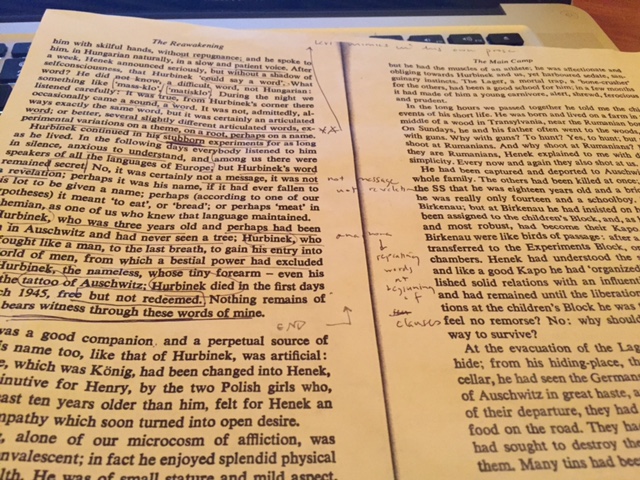
Today I thought I’d share with you the text we worked through on the second day of class, a short excerpt from The Reawakening, one of Primo Levi’s extraordinary memoirs of his experiences during the war.

Levi, a secular Jew from Turin who had trained as a chemist, was arrested in the Italian Alps in December of 1943 where he had joined a small band of partisans in the nascent Italian Resistance movement. Once it was discovered that he was a Jew, Levi was deported first to a transit camp called Fossoli and then to Auschwitz in February 1944. Thanks to his scientific background, Levi avoided the gas chamber and was sent to work in a sub-camp of Auschwitz, called Buna-Monowitz, where the Germans were trying to synthesize rubber. Through good fortune and the care of a Gentile Italian prisoner, who slipped him extra food when he could, Levi survived the bitter depredations of camp life. He was lucky to have been in the camp infirmary when the Germans abandoned it in January 1945 shortly before the Red Army arrived. In this way he avoided being sent on one of the so-called Death Marches, in which the Germans force-marched the remaining prisoners to other camps in Germany proper. Thousands of the malnourished and weakened prisoners died that way.

Primo Levi in his studio, Turin, 1981

Primo Levi in his studio, Turin, 1981

The passage we worked through begins with a description of the change in camp life after liberation:

Outside the windows, despite the steady snowfall, the mournful roads of the camp were no longer deserted, but teemed with a brisk, confused and noisy ferment, which seemed to be an end in itself. Cheerful or wrathful calls, shouts and songs rang out till late at night. All the same, my attention, and that of my neighbours in the near-by beds, rarely managed to escape from the obsessive presence, the mortal power of affirmation of the smallest and most harmless among us, of the most innocent, of a child, of Hurbinek.

Hurbinek was a nobody, a child of death, a child of Auschwitz. He looked about three years old, no one knew anything of him, he could not speak and he had no name; that curious name, Hurbinek, had been given to him by us, perhaps by one of the women who had interpreted with those syllables one of the inarticulate sounds that the baby let out now and again. He was paralysed from the waist down, with atrophied legs, as thin as sticks; but his eyes, lost in his triangular and wasted face, flashed terribly alive, full of demand, assertion, of the will to break loose, to shatter the tomb of his dumbness. The speech he lacked, which no one had bothered to teach him, the need of speech charged his stare with explosive urgency; it was a stare both savage and human, even mature, a judgment, which none of us could support, so heavy was it with force and anguish.

None of us, that is, except Henek; he was in the bunk next to me, a robust and hearty Hungarian boy of fifteen. Henek spent half his day beside Hurbinek’s pallet. He was maternal rather than paternal; had our precarious coexistence lasted more than a month, it is extremely probably that Hurbinek would have learned to speak from Henek; certainly better than from the Polish girls who, too tender and too vain, inebriated him with caresses and kisses, but shunned intimacy with him.

Henek, on the other hand, calm and stubborn, sat beside the little sphinx, immune to the distressing power he emanated; he brought him food to eat, adjusted his blankets, cleaned him with skillful hands, without repugnance; and he spoke to him, in Hungarian naturally, in a slow and patient voice. After a week, Henek announced seriously, but without a trace of selfconsciousness, that Hurbinek ‘could say a word.’ What word? He did not know, a difficult word, not Hungarian: something like ‘mass-klo,” ‘mastiklo.” During the night we listened carefully: it was true, from Hurbinek’s corner there occasionally came a sound, a word. It was not, admittedly, always exactly the same word, but it was certainly an articulated word; or better, several slightly different articulated words, experimental variations on a theme, on a root, perhaps on a name.

Hurbinek continued in his stubborn experiments for as long as he lived. In the following days everybody listened to him in silence, anxious to understand, and among us there were speakers of all the languages of Europe; but Hurbinek’s word remained secret. No, it was certainly not a message, it was not a revelation; perhaps it was his name, if it had ever fallen to his lot to be given a name; perhaps (according to one of our hypotheses) it meant ‘to eat,” or ‘bread’; or perhaps ‘meat’ in Bohemian, as one of us who knew that language maintained.

Hurbinek, who was three years old and perhaps had been born in Auschwitz and had never seen a tree; Hurbinek, who had fought like a man, to the last breath, to gain his entry into the world of men, from which a bestial power had excluded him; Hurbinek, the nameless, whose tiny forearm—even his—bore the tattoo of Auschwitz; Hurbinek died in the first days of March 1945, free but not redeemed. Nothing remains of him: he bears witness through these words of mine.

What is it about Hurbinek, I asked the class, that so gets to Levi and the others? What is the source of “the distressing power he emanate[s]”? It’s that he can’t speak but he wants to, said one student. It’s his need for language, said another. It’s because he’s judging them, said a third. So already we see the power of language and expression, as something fiercely desired but perhaps unattainable. Note what doesn’t surprise or horrify them: that a toddler is here in Auschwitz. The chasm between our expectations and the victims’ experiences is immense—we will encounter this again and again in the course.

Does Hurbinek freak everyone in the camp out, I asked. Not Henek. What’s different about Henek? He cares for him. Does any one else? The Polish girls, one student noted. But what does Levi say about the Polish girls? They don’t really care for him, answered one. They fuss over him, but they don’t like him, said another. He’s like a mascot to them, one concluded. Like a puppy or something. Right, I agreed. Levi distinguishes between false and true intimacy. Something about Hurbinek’s lack of language keeps almost everyone at a distance. Note that he sleeps on a pallet, like an animal. He has his own corner. He’s separate. And yet he isn’t an object of disgust or scorn. He fascinates the others. They follow his efforts to wield language with something like avidity.

How old is Hurbinek, I asked, switching gears. Three, a couple of people said at once. He looks three, one immediately added. That’s when I really first started having hopes for this class. Most readers don’t notice that Levi does something strange here: he begins with uncertainty—“he looked about three”—but ends with conviction: “Hurbinek, who was three years old.” I think this redescription is important—it’s a version in miniature of the speaking by proxy that Levi, in an essay we’ll read in a couple of weeks, will describe as central to the survivor experience. The survivor always testifies to an experience that isn’t the “true” or “ultimate” experience of the camp, which of course was to murder everyone in it. For now I noted that Levi’s descriptions of Hurbinek are unstable. He calls him a baby at one point. But his stare is also called “mature.” In an especially resonant phrase, Levi calls him “the little sphinx.”

Why? And what’s a sphinx? A couple of students cobbled together an accurate enough description of the Theban sphinx. Does anyone know the riddle he posed to travelers? The one only Oedipus could solve? “What goes on four legs in the morning, two at noon, and three in the evening?” Right—and the answer of course is a person, a human being.

In some ways, Hurbinek, who is paralyzed from the waist down, doesn’t fit the terms of the riddle at all. In that sense, he could be taken to be some kind of non-human other. But it’s clear that Levi values Hurbinek, even if he’s a little afraid of him. The literature of the Holocaust, I argued, is regularly preoccupied by what it means to be human. It will be important for us to see both victims and perpetrators as humans—it is as bad to demonize the latter as it is to demean the former. If we do so, we might falsely be able to convince ourselves that the events we’re studying have nothing to do with us, as we are neither angelic martyrs nor inhuman monsters.

The reference to the sphinx also tells something about Levi and his values. What can we tell about him based on his use of the term? He’s smart, he’s well read. Yes, and in a tradition that isn’t only or primarily Jewish. (We’ll say a lot more about Levi’s classical, humanist upbringing when we read his most famous memoir, Survival in Auschwitz starting in the second week of class.)

IMG_0444


Time was getting short and there were still a number of things I wanted to get through. I hurried us along. Let’s go back to Henek for a second, I said. Notice that Levi uses the same word to describe him that he does to talk about Hurbinek. Henek is “calm and stubborn”; Hurbinek continues “in his stubborn experiments.” Repetition is always significant in interpreting literature, I told the class. When we see the same images, the same metaphors, the same formulations or sentence structures, the same words, we should take note. Patterns are suggestive and meaningful.

By using the same word in reference to each figure, Levi cements the connection between them. But why this word? What does it suggest to us that they are stubborn? I can’t remember how they responded to this question. Not particularly helpfully, as I recall. But I was also going for something here, and so the question wasn’t particularly useful. Stubborn suggests persistence, I said, it suggests working away at something difficult. Anyone who writes about the Holocaust—and by extension anyone who reads about it—has to be stubborn. In fact, “stubborn experiments” could be a name for Holocaust literature itself, which is dogged in its attempt to describe what has been called indescribable. Holocaust literature is necessarily experimental literature. But the persistence connoted by the word “stubborn” promises attainment or completion or at least possibility. I want students to finish the course thinking that the Holocaust can in fact be represented.

I thus offer Hurbinek as a figure for the struggle to put traumatic experience into language. He does, after all, say a word. It’s not a message, it’s not a revelation. The word remains secret, though it’s open to, and in fact even demands, interpretation.

In the end, then, the real writer here, the one who wields language with extraordinary finesse, is not Hurbinek but Levi. In the last few minutes of class I turned our attention to the final phrase of the passage, one I’ve always found strange: “he bears witness through these words of mine.” Shouldn’t that be: I bear witness to him through these words of mine? Once again Levi points towards the necessarily proximate status of witnesses. The survivor is always a surrogate for those who didn’t survive.

The most significant way Levi can speak for Hurbinek—that is to say, be that surrogate—is to mimic in his own language the child’s struggle to express himself. I pointed students to the striking syntax of so many of Levi’s sentences:

All the same, my attention, and that of my neighbours in the near-by beds, rarely managed to escape from the obsessive presence, the mortal power of affirmation of the smallest and most harmless among us, of the most innocent, of a child, of Hurbinek.

Hurbinek was a nobody, a child of death, a child of Auschwitz.

Hurbinek, who was three years old and perhaps had been born in Auschwitz and had never seen a tree; Hurbinek, who had fought like a man, to the last breath, to gain his entry into the world of men, from which a bestial power had excluded him; Hurbinek, the nameless, whose tiny forearm—even his—bore the tattoo of Auschwitz; Hurbinek died in the first days of March 1945, free but not redeemed.

In each of these examples, I said, as the hour came to an end, Levi seems to do what he says Hurbinek did, when in his groping toward language he offered “several slightly different articulated words, experimental variations on a theme.” Levi seems compelled to re-describe Hurbinek. It’s never enough to say one thing about him (he was a nobody). He has to say three things about him (he was a child of death, a child of Auschwitz). Clusters of adjectival phrases and ramifying clauses cascade forward in these elongated and elegant sentences. We read of “the obsessive presence, the mortal power of affirmation” of Hurbinek, who is variously described as “the smallest and most harmless among us,” “the most innocent,” “a child,” “Hurbinek.”

Levi’s technique here might be a function of the way Hurbinek escapes definition. Which would return us to the suggestion we considered earlier that he is some kind of unknown being, some non- or a-human creature, a little sphinx indeed. But we could instead say that it is the best way for Levi to honour Hurbinek. In offering his own version of linguistic experimentation and variation he seeks to do justice to the child’s experience, and his ambivalent effect on his listeners. In this way, perhaps, Hurbinek does indeed bear witness through Levi’s words.


Magical Thinking: L. P. Hartley’s The Go-Between

I reckon I’ve had The Go-Between on my shelves for more than 20 years. Jacqui’s enthusiastic and thoughtful review finally spurred me to read it. (That plus I’ve taken a doubtless-brief-but-nonetheless-well-intentioned pledge to read books I already own rather than buy new ones.)

I can’t imagine matching Jacqui’s summary of the novel, so I direct you there for more details. I’ll just give a brief synopsis here. Leo Colston is a man in his middle sixties who, when the novel begins, finds a trunk full of old papers, including his diary from the year 1900.

As he remembers the dramatic events of that year—events we’re told have marked him forever, somehow left him unfit to participate in life—he tells us about his school days where he was first bullied and then later respected based on a strange incident I’ll say more about in a minute. When the school is suddenly closed for the year because of a measles outbreak, the almost-thirteen-year-old Leo is invited by his friend Marcus Maudsley to spend the summer at his family’s estate in Norfolk. The Maudsleys are richer than Leo and his widowed mother and he feels ill at ease and awkward in their home, not least because he has no proper summer clothes and the weather turns hotter than anyone can remember. Maudsley’s sister Marian (I think she’s about 19 or so) takes pity on Leo, buys him a new summer suit, and then, either as a result of a premeditated plan or, more likely, a readiness to seize the situation, for she knows Leo is ready to do anything for her, entices him into carrying secret letters to Ted Burgess, the hunky tenant farmer. Readers know long before Leo does that Marian and Ted are lovers; Leo is shocked when he finds out, not only because of the class difference, but also because she is engaged to be married to Viscount Trimingham, a fatally decent man who has been badly wounded in the Boer War.

(If the book sounds a bit melodramatic when I summarize it this way, I think I’m doing it justice.)

Anyway, Leo doesn’t want to be the lovers’ go-between anymore but Marian has ways of convincing him, ways just slightly more pleasant than those used by her rather demonic mother, the lady of the house, Mrs. Maudsley, who forces the presumably unwitting Leo to reveal the affair. Things end pretty badly, though most of the drama happens off-stage. What’s really bad, it seems, is the hold the whole situation has had on Leo, as we see in a coda in which the now elderly Leo continues to be manipulated by a very old Marian all these years later.

IMG_0435

I read an old Penguin 20th Century Classics edition of the book, but in the US the book is published by New York Review Classics. Their edition has an excellent introduction by the Irish novelist and critic Colm Tóibín. Tóibín offers some background on Hartley, whose solicitor father made a fortune in the brick trade, moving the family up from the middle class. Hartley seems to have felt uncomfortable in the new world in which he moved (Harrow and then Oxford). Rather than rebelling against it, Hartley sought to become more a part of the establishment, trading the Methodism of his childhood for the Church of England, for example. In this regard, he seems rather like his protagonist Leo. Although it wasn’t much of a secret that Hartley was gay, there seems to have been something of the closet about him, a desire to blend in, but more to efface than to protect his difference.

Hartley doesn’t seem to have been much liked by the literary world. In 1923 Virginia Woolf recorded meeting “a dull fat man named Hartley” while visiting the socialite and patron of the arts Ottoline Morrell. One of the Sitwells called him “Bore Hartley.” I confess these descriptions make me more not less sympathetic to him, though Tóibín reports him as becoming increasingly conservative as he aged and always quarrelsome with servants (who certainly appear in a dim light in The Go-Between). I wonder, has anyone written his biography?

Tóibín’s most interesting point is that the novel isn’t really about either the foreignness or the persistence of the past—lots of people who have never read this novel know its first line: “The past is a foreign country: they do things differently there”—but rather about Leo’s self-division. He dislikes, even condemns Marian and Ted, yet he’s helplessly drawn towards them. Hartley professed to be surprised and dismayed when readers sympathized with the lovers. If that’s true, it’s a remarkable lack of insight that proves writers aren’t always good readers of their own work. Tóibín interestingly links Hartley to writers like D. H. Lawrence and E. M. Forster (all these sets of initials, aren’t their real names good enough for them?), other writers of the period who extolled the value of the senses in hide-bound English society.

I’m not really buying this comparison, because I don’t think Forster and Lawrence have much in common. Hartley is like Forester, I grant, in that both are writers who are at best ambivalent about the power of sensuality. Lawrence, by contrast, had no ambivalence there. Where the Hartley – Forster comparison comes up short, in my opinion, is in their differing use of narrative voice. Forester never wrote in first person, as far as I know; he certainly wasn’t compelled to trace the modulations of a distinctive first-person narrative voice the way Hartley does here. Forster’s concern with the unreliability of perception attaches itself to skepticism about third-person omniscience.

No, the writer Hartley really reminded me of is Kazuo Ishiguro. Now that I think of it, I rarely hear critics placing Ishiguro in any kind of literary tradition or continuum. (Not that I know the Ishiguro criticism particularly well; correct me if I’m wrong.) If anything he’s discussed as part of that flowering of new English writing in the 1980s, the Granta writers, the young Turks who are now the old guard of English literature (Rushdie, Amis, Graham Swift, Jeanette Winterson, McEwan, etc). Hartley seems like an important model and precursor for Ishiguro, although I think Ishiguro is more sophisticated in his use of unreliability, more unreliably unreliable if I could put it that way, and a better writer all around. But I’ve only read one novel by Hartley, and most of Ishiguro’s, so I ought to read more of the former to be sure. Looking around my shelves, I find I’ve got six other Hartley novels lying around—he’s apparently one of those writers I’m highly invested in even though I hardly know anything about them—so I certainly could find out.

5149117717_af98c99ebf

I just want to say two other things about The Go-Between:

I couldn’t decide how clueless Leo is supposed to be. Or, rather, I couldn’t quite decide whether the events of that summer are supposed to be told by Leo at the time or by Leo in retrospect. Sometimes we are clearly dealing with a child’s voice:

She was silent and I felt for the first time that she was unhappy. This was a revelation to me. I knew that grown-up people were unhappy—when a relation died, for instance, or went bankrupt. At such times they were sure to be unhappy: they had no option: it was the rule, like mourning after a death, like a black margin around the writer paper. (My mother still used it for my father.) They were unhappy to order. But that they should be unhappy in the way that I was sometimes, because something in my private life, to which perhaps I couldn’t give a name, had gone wrong—that hadn’t occurred to me.

Here we’re in that Jamesian world of innocence ruined, though James famously set himself tougher challenges than writing about a teenager, as when he sought to narrate from a child’s perception though not in a child’s language in his novel about a five-year-old buffeted by a nasty divorce, the magisterial What Maisie Knew. Plus, the parenthetical sentence could only be narrated within the present of the narrated events.

But at other times it’s harder to pin down the voice. Here the narrator has accompanied the family and the other house guests to church:

Again Lord Trimingham was the last to leave. I thought Marian would wait for him, but she didn’t, so I did. Most of my shyness with him had worn off, and I was disposed to think that everything I did or said became me. But I did not want to broach at once the subject that was uppermost in my mind.

I was disposed to think that everything I did or said became me. By this point in the novel, Leo has had two great successes. He’s made a splendid catch in an important cricket match and then sung two songs to great success at the party afterwards. And he’s meditated a lot on how extraordinary the attention made him feel, and how uncomfortable too. But that complex and complexly phrased sentiment, of being disposed to think one’s words and actions become one, with its quality of self-deprecation and irony that undermines the ostensible meaning of the words—that seems an attitude that only the older Leo, looking back on himself, would be in a position to note. And yet the story really only works if the older Leo is kept in abeyance. If retrospection governed the narrative too completely there would be no suspense, and our sense of how children and adults can work at cross-purposes, in which ignorance tragically shades into malevolence, would be much reduced.

One way to read the end of the book is that it shows Leo never really learns anything, but that would challenge even further the sense that the older man can make sense of his younger self. Perhaps it is just this uncertainty—that the older man thinks he knows more than the younger, yet proves to be just as or maybe even more clueless—is what Hartley wants to get at in a passage like the one I’ve cited. That would be pretty sophisticated; I suppose I wasn’t convinced that novel is quite that sophisticated, but maybe I’m under-selling it. (And it’s an awfully good book, don’t get me wrong.)

So that’s one thing. The other is about the supernatural. Young Leo, we learn, is fascinated by the zodiac and by the idea that events can be determined by spells. The way he moves from being bullied to being respected at school is that he puts a curse on two boys who have been tormenting him; soon afterwards they fall off the roof during a nighttime escapade and hurt themselves badly. When word of the spell gets around—I can’t remember if Leo puts it out himself or if it’s found out in some other way—Leo’s stock rises dramatically and he is soon being asked by his classmates to create imprecations and spells to order. Towards the end of the book he again has recourse to magic and again succeeds, though less clearly than the first time.

What is this material doing in this book? My sense is that the general way this book gets talked about (hot summer, lost innocence, boy becoming man, elegy for forgotten way of life) ignores this supernatural material. But it’s pretty important to the book; we hear a lot about it, especially in the first quarter or so. These weren’t the most evocative bits of the book, by any means (that would be the languorous descriptions of the heat, and the landscape, and the rituals of English life that someone like Ishiguro would later so profitably explore as strange performances). They seemed awkward, kind of clunky, something that belonged more in a Roald Dahl story, or some minor Greene work, than in the kind of book this seemed to want to be.

This lack of fit interested me, and I wonder if anyone has any ideas about it. One thought I had was that the spells are meant ironically, a way to emphasize how little control Leo (like all children) has over the world, and even to disparage him in our eyes, since he thinks he has control when he doesn’t. But I’m unconvinced because the book rather seems to believe in the spells. In that case, their efficacy would suggest Leo knows more than he thinks, if not more than he lets on. (This would be a peculiarly unconscious certainty.) But does Leo’s magic run out when he exchanges school for the adult world? Or are we to take him as more responsible for his actions towards Marian and Ted than it at first seems? Are Leo’s spells magical thinking—or are they really magic? I’m not sure the book knows how to answer that question. And that uncertainty makes me like it all the more.


Friedrich Glauser & Patrick Leigh Fermor, Together at Last

Last month two short pieces of mine went live.

glauser01

In the most recent issue of The Scofield, dedicated to the Swiss writer Max Frisch, I recommend his compatriot, the wonderful crime writer Friedrich Glauser, as someone to check out once you’ve made your way through Frisch. Glauser had a pretty intense life and he wrote some terrific crime novels.

OB-UR231_mag101_G_20120920222643

And in last month’s Open Letters Monthly, I wrote about my favourite travel books, the trilogy Patrick Leigh Fermor wrote describing his travels across Europe on foot in the early 1930s. I’m in good company here: there are lots of great suggestions for you to consider. If you’ve got favourite travel writing, I’d love to hear about it.

The two never met, as far as I know, but I bet they’d have got alone like gangbusters.

How I Spent My Summer Holidays

Every year it’s the same. I leave for vacation in Canada with ambitious reading plans, usually involving a fat Penguin classic. I take the book with me and find myself unable to read a word once I arrive. Instead I’m helplessly drawn to books I’ve left behind at my mother’s house or books I buy, mysteries mostly. It’s as though I need weeks of nothing but light reading to allow my readerly self to recuperate for another year. (As someone who has spent almost his whole life in a classroom, the new year always starts for me in September–or, since coming to Arkansas, cruelly, August.)

This year’s abandoned classic was Leopold Alas’s La Regenta. I read the first 60 pp on the plane and was impressed. Not easy stuff, by any means, but interesting, and often quite funny, particularly impressive since at least at first it’s all about priests. I was glad to have read Sentimental Education so recently as I could see Flaubert was an important inspiration for (the brilliantly named) Alas.

But then I got to Calgary, and the mountains beckoned and La Regenta sat on the shelf, untouched, for the next three weeks. I felt especially bad about this failure because Tom from Wuthering Expectations had organized a readalong. This is now the second time I’ve funked one of his group readings (there was that Hamsun I abandoned ¾ of the way through a few years ago) and since he is one of the bloggers I most respect I really wanted to participate. You can check out the posts, with typically interesting comments, over at the site, though I confess I’ve only skimmed them, partly to avoid spoilers and partly because I feel so badly about giving up.

macdonald9

So what did I read on my vacation, you ask?

Well, a few things:

Wallace Stegner, The Spectator Bird (1976)

41cORvXOqyL._SX324_BO1,204,203,200_

Rohan had written about this shortly before I left and when I looked up at the shelf of books that I’ve still got to get out of my mother’s house some day, there it was. Bashert, right? I must have bought my copy in my bookselling days in the early 90s. Over 20 years it had been sitting there, just waiting for me to get to it. American literary fiction isn’t really my thing, but the 70s are long enough ago that this book almost felt like literature in translation. Rohan’s review is as smart and thoughtful as you’d expect; read it to get a better sense of the book. She liked it better than I did. Although I appreciated its astringent, unsentimental portrayal of aging, I tired of its protagonist’s jaundiced take on contemporary life. I wasn’t convinced the novel itself was distancing itself from the character’s embitterment, so the whole thing started to feel querulous and brittle. And I really wanted more about his wife, who seems much the most interesting character.

Eva Dolan, Tell No Tales (2015)

51ixtM2HS3L._SY346_

Why doesn’t this superior police procedural about a hate crimes unit in Peterborough have a US publisher? It didn’t seem to matter that I came into the series late (this one is the second; I gather there are three so far.) And the story—about a far-right party loosely or not so loosely modeled on UKIP and featuring violence to immigrants–felt even more relevant this summer than it must have last year. Dolan’s not breaking any new ground, but this is satisfying stuff. I’ll read more but I’d rather not have to import from the UK.

Michael Frayn, The Russian Interpreter (1966)

51Pf6kTOQML._AC_US160_

Years ago I read Spies and really liked it. And like all sentient human beings, I love Noises Off. So when I came across a whole series of early Frayn novels in the bookstore—recently reissued by Faber in the UK and Canada; I think some interesting small publisher has them in the US, but I can’t remember where I saw that—I grabbed the one that seemed most appealing. Given my fascination with all things Russian, and with the vicissitudes of European 20th Century history, The Russian Interpreter was the obvious choice. I liked the book for its pleasing combination of English reserve and Russian lugubriousness. Set in Moscow in the late 50s, it tells the story of an English graduate student of Russian history, Paul Manning, who gets involved with a visiting English businessman named Procter-Gould. Procter-Gould has no Russian, so Manning starts interpreting for him, not least in his love affair with Manning’s own girlfriend. No one is quite what they seem, and it all gets a little byzantine. It’s totally unfair, but I couldn’t fall in love with this book because I wanted it to be Penelope Fitzgerald’s The Beginning of Spring, another novel by an English author set in Moscow, though this time in 1913, and one of the very best English novels of the 20th century.

Frayn is no Fitzgerald, but who is? And The Russian Interpreter has a great opening:

Manning’s old friend Proctor-Gould was in Moscow and anxious to get in touch with him. Or so Manning was informed. He looked forward to the meeting. He had few friends in Moscow, none of them old friends, and no friends at all, old or new, in Moscow or anywhere else, called Proctor-Gould.

Ragnar Jónasson, Night Blind (2015) Trans. Quentin Bates (2016)

41URil18fAL._AC_US160_

Arnaldur Indridason needn’t worry about being deposed as King of Icelandic crime any time soon. I read Jónasson’s first book earlier this year and liked it enough to buy this sequel. The writing here is less clunky, but the plotting is weaker, and I really missed the intense evocation of bad weather that characterized the first book. I like Iceland a lot but can’t see myself continuing with this series.

Louise Welsh, A Lovely Way to Burn (2014) & Death is a Welcome Guest (2015)

51HREwURdNL._AC_US160_

These were the discoveries of my trip. I’d read Welsh’s debut ten or fifteen years ago or whenever it was and liked it a lot. I read her next book and liked it less. And then I forgot about her. She’s written quite a lot in the meantime, it appears. These are the first two of The Plague Trilogy (the third isn’t out yet, worse luck) and I don’t know why they haven’t got more press, at least here in the US. You can read Grant’s useful review here. (Added 8/5/16: I just came across Max’s review too.)

As a hypochondriac of longstanding, I’m enthralled and terrified by stories of pandemics. So I am definitely the right person for these books, which is about an illness called the Sweats that quickly wipes out most of the world. Each book has a different protagonist; the last page of the second volume suggests they will meet up in the third. I found these books in the crime section and it’s true that each has a suspicious death at its center. But I didn’t find that stuff nearly as interesting as Welsh’s depiction of apocalypse. Rather unusually, the second volume is even better than the first—the first sometimes felt a bit like Ballard-lite, though with much less interesting prose—since it considers what kinds of communities could be built after a catastrophe and how hard it might be to do so. The best thing about these books is that they are real just-one-more-chapter-and-then-I’ll-sleep-oh-well-it’s-almost-finished-might-as-well-just-read-the-rest page-turners. Volume three, please!

Gerard Woodward, Vanishing (2014)

51J+xl1Ru-L._SY346_

Another book I found in the crime section that really doesn’t belong there. (And I say that as someone who loves crime fiction.) Woodward seems like a writer I need to pay more attention to. I really liked the first half of this (rather long: 500 pp) book. Interwar England is my meat and drink and I appreciated how adroitly Woodward taught me things, especially about the old Heathrow, the farming community in Middlesex that was requisitioned and destroyed by the British government during the war to build the military airfield that became the airport we know today. I was especially fascinated by the story of how sludge cake—basically the refuse from the sewers of London—were first used to fertillize the crops in this area. Teaching readers stuff about the world is something realist fiction does best, but it’s not easy to do without dumping information on readers in a heavy-handed way.

But before long Vanishing grew more and more complex. Too complex. It tells the story of Kenneth Brill, from his boyhood in Heathrow to his student days at the Slade School of Art to his time in a camouflage unit in Egypt in the war. The retrospective material is brought out at his trial in a military court, where he has been bought up under suspicion of treason. (He claims to have been painting the landscape of his childhood before it is destroyed; the military claims he is encoding secrets about the airfield into his paintings to pass on to the enemy.). The camouflage stuff is interesting, but I started to be reminded of a novel like Giles Foden’s Turbulence, which taught me things about weather prediction during WWII that I could have learned more concisely and compellingly in an essay. Camouflage does give Woodward a metaphor to work with as he also examines Brill’s queer sexuality and the appeal of fascism in the England of the period. But I don’t know exactly what he wants to say about all these things and in the end I didn’t quite care enough to really think it through. There’s really a whole lot going on here, I haven’t even mentioned all the subplots, and I found the story’s narrative structure, its use of unstable, unreliable first person not quite well handled enough to sustain my interest. (It’s no Ishiguro.) But Woodward is definitely a talent and I mean to try some of his other books when I’ve time. For more check out this interestingly ambivalent review by John Self at Asylum.

OLYMPUS DIGITAL CAMERA

OLYMPUS DIGITAL CAMERA

So I didn’t get on with my classic, but I read some good things (and more importantly went on a lot of great hikes). Now I’m back in Arkansas, sweltering in the heat, and trying to stay on top of a lot of deadlines before the new semester begins in just three weeks…

What about you? What did you read on your summer holidays?


“Something about Eline”: Louis Couperus’s Eline Vere

Eline Vere (1889) is the best book I’ve read this year, would undoubtedly be one of the best books in almost any year. It’s the first novel by Dutch novelist Louis Couperus (1863-1923). I fancy myself pretty well read in European literature since 1800, I mean, nothing like some people, but more than many. But I had never heard of this book, though I gather it is a great classic of Dutch literature, until I read about it on this terrific list. (As it happens I have those books by Prus, Eça de Queirós, and Der Nister in hand and somehow need to make time for them.) If you like sweeping books about a richly appointed bourgeois world, with a generous but unobtrusive narrator, and just enough asperity to balance a tendency to effusiveness, you’re going to love this book.

It captivated me over a long weekend at one of my very favourite reading places of all, my in-laws’ farm in rural Missouri, where there is a really excellent porch swing and all manner of birds and animals to look at when you’re tired and need to raise your eyes from the page.

elinevere

The scene is The Hague in the late-nineteenth century. The characters belong to the interrelated wealthy families who run the place, or who have enough money that they don’t need to work. They’re not that rich, though, the possibility that the money is going to run out is a worry for many of them, as is the sense, as befits this buttoned-down Protestant milieu, that the men, at least, ought to work regardless of financial need, out of a moral duty to lead society.

The book’s question, then, is: what makes a meaningful life? And in the great 19th century realist tradition, that question is much more difficult and fascinating for women. What do they live for, if not work? Marriage and family are two obvious answers, satisfying for some of the female characters. But not for all, certainly not for the protagonist, Eline.

Eline Vere gets compared to Madame Bovary, Anna Karenina, and Effi Briest. The reason is obvious: all are novels centered on eponymous heroines who are drawn to men who aren’t their husbands as a way to overcome their boredom and uncertain place in society. I’ve not read Effi Briest—I can already hear Tom telling me I have to rectify that oversight, and I mean to—but I didn’t find Eline Vere as much like those books as blurb writers would have us believe.

For Eline’s dissatisfaction doesn’t find a sexual outlet. She’s not even married, so adultery doesn’t even come into it. In some sense, the book is a long search for the right man for Eline. It seems, halfway through, that she’s found him, an eminently suitable, kind, dutiful, all-around stand-up guy named Otto van Erlevoort. They get engaged, despite his family’s initial reservations—Eline somehow seems so different from them. Otto’s sister never overcomes these reservations: “I know she’s beautiful and charming, but there’s something about her that, well, that I find unsympathetic… She doesn’t have a heart, all she has is egotism, stone-cold egotism.” Later, the sister’s sister-in-law adds similar misgivings: “There’s something about Eline that makes me think she might not fit in very well with the rest of the family. She adapts herself, certainly, but I’m not sure she does so with all her heart.” Note the motif of the heart, or, rather, heartlessness. Having a heart seems here to mean caring for others. But it also seems to mean playing a part, going along with appearances, fitting in with others. The heart is a sign of both authenticity and falsity. Small wonder, then, that the book opens at a party in which the youngsters of the Dutch beau monde organize extravagant dramatic tableau. Eline, who at age 23 is or could be part of that set, is notably absent. (It’s a classic dramatic set-up: as various characters ask each other where Eline is, we get more and more intrigued about her.)

So sure was I that Eline’s travails had to play out in a love affair that I spent the first half of the book wondering who she would fall in love with, and in what way that love would be inappropriate or scandalous. The first candidate is an opera singer who takes The Hague by storm and who Eline is obsessed with for a while, secretly buying pictures of him and stalking him in the park where he takes a walk most days. But she never even speaks to him and before long throws over the infatuation as silly. Then I thought the trouble might be with her brother-in-law, Henk, who obviously adores her and who she seems to like a lot too. (After the death of her mother, Eline lives with her sister, the much more pragmatic Betsy, and Henk and their children.) But Henk is like the faithful Newfoundland dog he’s compared to early on and really only wants everyone he knows, especially his wife and her sister, to get along, so that he can be left in peace to go riding and shooting. He’s a tenderly imagined version of Charles Bovary, though rather more competent. Then Otto comes along and Eline gets engaged to him and it all seems so promising.

8a750fef990bd622802bb36771605b9c

There’s an absolutely wonderful set piece—Couperus is almost as good as Tolstoy when it comes to set pieces—at the Van Erlevoorts’ summer home, De Horze, complete with lovely meals and long days with seemingly endlessly lengthening shadows on the evening lawn and children rushing around underfoot and inventing games. I’m absolutely a sucker for this stuff, and Couperus lays it on thick. But he does so only to insist that idyll can’t last. At almost the exact halfway point of the book, at the end of the De Horze chapter, at the end of the summer, we find this meditation on self-sabotage and the loss of happiness:

[Eline] opened the window and looked outside. The rain had stopped and the air was fragrant with moist foliage. The sky was clear, wiped clean of leaden clouds but for some lingering streaks, from which rose a brilliant crescent moon. The far-flung fields lay muffled in silence; a lone windmill held aloft a dark motionless sail, starkly defined against the pale sheen of the evening sky. The ditches glittered like strips of metal, and a scented freshness emanated like a gentle sigh from the slumbering landscape. Eline leant out of the window, hugging her bare arms. She felt as if that soft sigh of freshness had sweetened all her thoughts with the fragrance of wild flowers, banishing the stale, sickly smell of her former state of mind. It was like inhaling the heady perfume of musk and opopanax, and she felt very young, younger than she had ever felt before, and oh!—of this she was certain—never had she been in love as she was now, never! Her Otto! Thinking of him she felt no need whatsoever to conjure up some idealised image of him; she thought of him as he was, manly and strong in his good-natured simplicity, with one single thought governing his mind: the thought of her. His love was so rich, so full, so all-encompassing. And hers was growing by the day, she believed … no it couldn’t grow any further, that would be impossible! No further wishes, no concerns about the future; it would unfold of its own accord, a perspective tinged with a golden glow! Nothing but the stillness of that lake into which her soul had glided, nothing but the peace and love of that blue ecstasy! Nothing but that … She could not imagine what more a human being could wish for.

Only, there was one tiny blemish in all that clear expanse of blue, an inkling of fear that change might yet come! It was so very long since she had prayed, and she was unsure how to go about it, whether she should say the words aloud or just think them. Indeed, she no longer knew whether she believed in God, she no longer knew what she believed, but now, at this moment, she dearly wished to pray that it might remain as it was now, that nothing would ever change—oh, for that gentle happiness, that tranquility of mind, that blue to remain with her for ever!

“Never again as it was, please God; make everything stay the same as it is now! I’ll die if anything changes!” she whispered under her breath, and as she folded her hands in prayer, a teardrop quivered on her lashes. But it was a tear of joy, and in her joy that tiny fear drowned like a drop in the ocean.

But of course it doesn’t. The fear grows to unmanageable proportions. You can see from this passage that Couperus stays close to Eline perspective, and so that the conventionality or melodramatic extravagance of some of the prose (“nothing but the peace and love of that blue ecstasy”) is the character’s. (He also moves us from character to character—we aren’t constrained to Eline’s perspective, which allows us to see, for example, how frustrating Eline can be at times, especially in the only strand of the story that includes characters from a different social strata, a young couple and their children named the Ferelijns, who have settled in Java and only returned to Holland temporarily due to the husband’s ill health. Eline, who went to school with the wife, veers between sensitivity and obliviousness about their quite precarious financial situation.)

Eline’s life unravels because she can’t imagine herself to be happy, because part of her doesn’t want to be happy, and because she can’t wholeheartedly accept what the rest of the characters call happiness. Eline is a confusing but compelling mixture of fatalism, congenital, even hereditary dissatisfaction, and self-awareness. The hereditary part—Couperus is like a less-militant Zola at times—comes to the fore when Eline and Betsy’s cousin, Vincent—decadent, a bit louche, a debtor (the worst thing you can be in this social world), a dabbler in Nietzsche—comes to visit.

Betsy hates him; Eline adores him; she almost falls in love with him, but their relationship is weirder than that, and besides the genuinely egotistical and probably gay Vincent doesn’t care about her. (Vincent is saved by a rich American friend, a man named St Clare, an enigmatic figure who has wandered in from a James novel. To make things even more complicated he almost has a thing with Eline.) Something about Vincent makes Eline unable to love Otto, or, rather, confirms for her that a life with Otto isn’t possible. Betsy exults when she can finally kick Vincent out of the house; Eline publicly berates her for her unkindness. This rupture leads to an extraordinary scene–another one of those set pieces–in which Eline leaves Betsy’s home in the middle of the night, in the midst of an enormous and terrifying storm. It’s cheesy in my telling but absolutely riveting in Couperus’s.

The book Eline Vere did remind me of is Buddenbrooks, though I haven’t read it in about 25 years, so I may be overstating the similarities. They share a Northern European, Protestant, bourgeois setting and a belief in hereditary decline. What Mann’s novel has that Couperus’s doesn’t is a belief in art as a kind of safety valve. Yes, the generations become more effete as they move away from business, but at least they gain in sensitivity and artistic refinement.

Eline too is drawn to art. She is a passable pianist and her voice is quite good, but she never keeps up with her lessons, and besides as her health gets worse her doctors forbid her from practicing. First love fails Eline, then art. Without those things, what can a woman of this time turn to?

isaac_israels_girl_reading_on_a_sofa_d5827283h

Eline did for a time love Otto; I don’t think we’re supposed to believe otherwise. But as the book goes on it seems that Eline doesn’t really love anyone—not because she’s as selfish as others think she is, but because she doesn’t want to, or, at least, know how to. She increasingly finds herself unworthy, and she has an extraordinary way of evading or upending any situation that others create to make her happy, often by making herself so unpleasant that she drives people away. The end offers one of the more subtle portraits of madness in 19th century literature (and that’s saying something, there’s madness all over the place there).

We see Eline unable to sleep, increasingly delirious, and we follow the restless zigzag of her thoughts: first desperately trying to hold on a love she can no longer feel, then despairing over her inability to force herself to keep loving Otto, and finally raging over her situation, “because she was being assailed by thoughts she did not wish to think at all, and because she felt herself too weak to turn around and fight those invisible forces.”

Couperus doesn’t judge his characters—he’s no Flaubert—valuing this closely-knit society with its demonic fascination with duty even as he shows it to be narrow and conventional and totally unable to know what to do with Eline. But he makes Eline off-putting enough that we can’t totally sympathize with her, even though we ultimately must pity what today we might call the manic-depressive demons that surge through her.

I’m not sure how well I’ve conveyed this book to you. What I most want you to know is that it’s stranger than it seems. Its gilded, cozy, and upright surfaces—if you’re at all susceptible to gemütlichkeit you’ll love this book—contain unsettling depths. But the depths aren’t appealing enough to allow us to dismiss the surfaces as mere conventionality. Above all, I hope I’ve made this book intriguing enough that you’ll want to read it and talk about it with me.

 *

Thanks must go to Archipelago Books for their lovely edition, with its generous margins, thick paper, clear font, the whole pleasing heft and size of the book itself. No doubt I would have appreciated some parts of the story even more had the book come with notes or introduction. Definitely a list of characters or family tree would have been helpful. But in the end I enjoyed the book all the more because I just had to plunge in and make my own way through it. (Actually, there’s an afterword by someone named Paul Binding and as I recall it’s quite good, more appreciative than academic.) Yes, sometimes I had a hard time keeping the characters straight, but Eline Vere gave me what I too seldom get when reading these days and what I long for more than anything else: a deep sense of immersion, a wish to be alone with the book and to keep the pages turning. The novel’s 500 pages, but twice as long would have been just fine with me. Ina Rilke’s translation seems excellent. I mean it as a tribute to her when I say that I often found myself thinking, Well, I can read German, surely Dutch isn’t that different, I bet I could read this book in the original! Rilke’s supple English—neither fussy nor anachronistic, neither old-fashioned nor contemporary—made me believe in such a fantasy. I’m keen to read more of her translations from the Dutch. And I’m even keener to read more Couperus. A few of his books are available but as best I can tell his masterpiece Old People and Things That Pass (1918) is not. Archipelago, or other brave publishers, I beg you: please, please, please, more Couperus.