Reeking of Crime: Émile Zola’s The Fortune of the Rougons

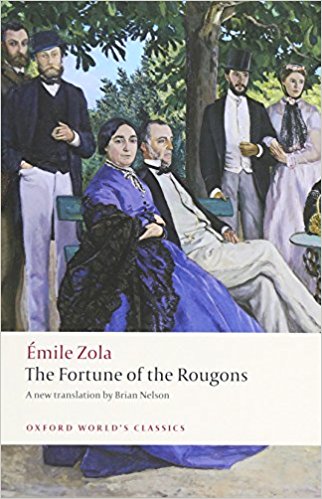
Several weeks ago now, flush from the success of reading Belly of Paris, Keith and I read the first volume in Zola’s Rougon-Macquart series, The Fortune of the Rougons (1871), in Brian Nelson’s recent translation. I promised Keith I would write something about the novel, which he could respond to if he wanted. And ever since I’ve been avoiding doing it.

I didn’t dislike Fortune, but I didn’t love it either. Books that leave me ambivalent are the hardest to write about. In fact, the only thing I loved unreservedly about the first novel of Zola’s vast cycle was the family tree at the beginning of the excellent Oxford World’s Classics edition. I appreciated it as a practical feature (an invaluable guide to the novel’s many characters). But I loved it as a spur to daydreaming about future reading. All of those names had at least one, sometimes more novels attached to them! How amazing was that?

Dreaming of the future was, as it so often is, easier than responding to the present. Fortune left me stymied. No part of it grabbed hold of me the way those incredible descriptions of Les Halles did in Belly (or of the department store in Au Bonheur des Dames, which I read many years ago, but still think about regularly, and look forward to revisiting). Worse, the more I procrastinated, the less I remembered about the book. (Its plot is complicated, requiring readers to know something about the origins of the Second Empire with the coup of Louis-Napoléon in 1851. This is an excellent plot summary.) To write this post came to seem ever more daunting.
518jGU77qqL._SX320_BO1,204,203,200_

Then I read one of those interesting pieces at Five Books, this one about the political novel, as chosen by the novelist Joshua Cohen. (His selections are interesting and unexpected.) Cohen makes a helpful distinction:

What I am interested in, when it comes to the politics of the novel, is the revival of that old debate, realism v. naturalism, which I always took to mean the distinction between writing about the-ways-in-which-a-character-experiences-something and writing about the-ways-in-which-a-character-has-been-conditioned-to-experience-something. I find the tension between those two approaches enlivening.

That certainly spoke to the way that I’d been taught to think about naturalism (though I’d never seen its difference from realism explained so clearly before). More to the point, it made me wonder about Fortune. Is it even naturalist? Crazy question, right? After all, Zola introduces not just the novel but also the entire Rougon-Macquart cycle with these now famous paragraphs:

My aim is the explain how a family, a small group of human beings, behaves in a given society after blossoming forth and giving birth to ten or twenty individuals who, though they may seem at first glance totally dissimilar from each other, are, as analysis shows, linked together in the most profound ways. Heredity, like gravity, has its laws.

By solving the dual problem of temperament and environment, I shall attempt to discover and trace the thread that leads mathematically from one person to another. When I am in possession of every thread, and hold in my hands an entire social group, I shall describe the behaviour of this group as it plays its part in an historical period; I shall show it in action, with all its varied energies; and I shall analyse the aims and ambitions of its individual members along with the general tendency of the whole.

(An aside: the confidence, not to say bald ambition, of late 19th century writers is breathtaking and in its way quite appealing. Zola’s unabashed statement of the writer-thinker as scientist reminds me of certain tendencies in Freud.)

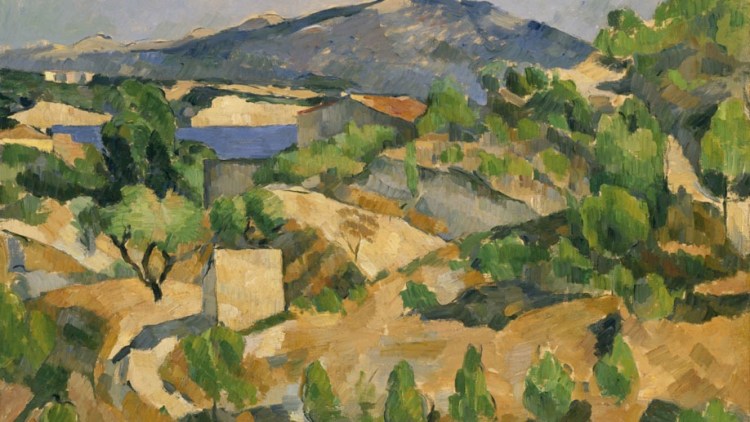
The Rougon-Macquardts descend from a woman named Adélaide Fouque. Eve, not Adam, or perhaps more accurately Sara, not Abraham, is the progenitor of this people. (Unclear that this makes the family a matriarchy, though.) Adélaide married a man named Rougon; they had a son named Pierre. But suddenly Rougon died. And not long after that, to the scandal of everyone in Plassans (a fictional town in the Var department of Provence, but apparently modeled on the Aix-en-Provence of Zola’s own upbringing), Adélaide took a lover, one Macquart, a poacher, smuggler, alcoholic, and general ne’er-do-well. With Macquart, Adélaide had two more children, Ursule and Antoine.

This family history takes up much of the first third of the novel. By the time of its present-day events—that is, the coup of 1851—Ursule has died. One of her sons, Silvère, is taken in by Adélaide. Silvère, an idealistic young man, spurred to Reublicanism by some half-digested readings of Rousseau, plays an important part in the novel, but in the end he is less important than his uncles, who are engaged in a power struggle between legitimate and illegitimate sons. Pierre Rougon, incensed at the idea of having to share his patrimony with his half-sibling, schemes to deny Antoine not just his share of the inheritance but also any material success from the societal upheaval brought about by the coup.

This scheming is rather convoluted and pretty ironic, inasmuch as much of it works out only by accident, and the parts that come about by design are the brainchild of Pierre’s formidable wife, Félicité. (It’s fascinating to see how this character, introduced as petty and grasping, develops into a formidable and ruthless figure. I wanted more of her.) But regardless of where it comes from and how effective it is, the scheming is still scheming. That is, it’s the result of characters conspiring to do things. And in that sense, it seems contrary to the conditioning vaunted by naturalism.

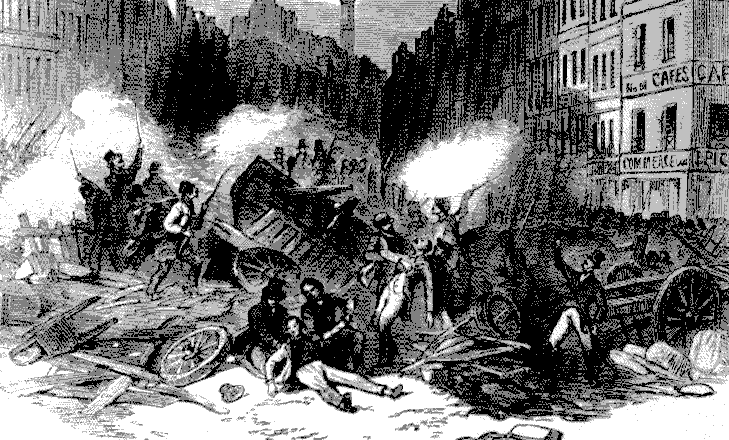
Because Plassans is so far from Paris, it takes a long time for people to know what’s happening to the government, and to shape their responses accordingly. History, if only in the farcical version proposed by Marx in his famous depiction of Louis-Napoléon’s coup, might be the ultimate driver of events, but Zola never shows us those events directly. We only get rumours and reports, especially from the Rougon’s eldest son, Eugène, who, having trained as a lawyer, lit out for the capital years before and, long having seemed to his family almost totally unaccomplished, now reveals himself as a key mover and shaker in the plot to bring Bonaparte to power. Although we don’t ever see any of that orchestration directly, his reports to his parents about when and how they should act in order to get on the Bonapartist bandwagon early enough to set themselves up for the plum political appointment that is all they want out of life present Eugène as a shadowy mastermind, and his parents, especially his mother, as the initially suspicious but ultimately shocked and grateful beneficiaries of that knowledge.
barics2

Why am I going on about this? Because even if Eugène is telling them what to do, Pierre and Félicité still make a lot of decisions, admittedly often in response to events beyond their control. This sort of political action doesn’t seem like the “heredity is destiny” stuff Zola is on about in his preface. To be sure, the novel has its share of such material. The girl Miette, who together with her lover Silvère dies for the failed Republican cause, feels herself to be “living under a curse” because of the actions of her father, a murderer. Similarly, the original Macquart is described as the product of his lifestyle: he has “the furtive, melancholic look of a man of tramp-like instincts, gone to the bad because of wine and the life of an outcast.” Eugène, the Parisian politician, is said to look just like his father but to have the temperament of his mother: “By one of those alleged quirks of nature, of which science is now beginning to discover the laws, if Eugène’s physical resemblance to Pierre was total, Félicité seemed to have provided him with his brains.” But such moments are asserted by the narrator rather than expressed through the text. Most of the novel is instead made up of what Cohen calls realism: ways in which the characters experience something.

There’s nothing wrong with the novel’s surprising realist tendencies, and besides I doubt it’s possible definitely to separate realism from naturalism. But I was a little disappointed by how little the novel emphasized determinism. On reflection, I think that’s not because I think determinism explains the world but because what I like most in Zola is when the naturalist stuff—the ways in which characters are conditioned to experience things—comes out indirectly in the text rather than being baldly asserted by it, as if they were mere instructions for an experiment set by the writer.

Mostly what I missed here in comparison to other Zola novels I’ve read is the weird, fantastical stuff, like those extended descriptions of fruits and vegetables in Belly that seem to wriggle free from their creator’s intentions.

Happily, there are a few such moments here. In his admirable introduction, the translator Nelson gives one: an almost Gothic little scene suggesting Pierre and Félicité will never escape the bloodthirstiness of their actions, no matter how rich it’s made them. Here they are, having consoled each other before bed that their troubles will soon be over and fallen into the sleep of the sanctimonious, watched over only by the reflection of the night lamp:

They kissed each other again and fell asleep. The patch of light on the ceiling now seemed to be assuming the shape of a terrified eye, staring unblinking at the pale slumbering couple, who now reeked of crime under their sheets, and were dreaming that they could see blood raining down in big drops and turning into gold coins as they landed on the floor.

Only the narrator sees the “terrified” eye; the couple sees only the perverse transubstantiation of bloody deeds into filthy lucre. It tells you everything you need to know about them that this vision comes to them in dreams rather than nightmares.

A less sanguinary, more coolly ironic detail is the mirror in the city hall, which is shot to pieces by accident but becomes a synecdoche for the blood-thirstiness of the revolutionaries that the good burghers of Plassans must put down at all costs.

Or how about this description of a creep named Vuillet, a bookseller and newspaper publisher, who for purely pigheaded reasons takes the opposing line to Rougon (but is eventually brought to heel by Félicité). In the tumult of the hour, when it is unclear whether the Republicans will take the town, Vuillet sneaks into the post office and gorges himself on secrets:

Never had Vuillet felt so happy. Since he had been able to slip his little fingers into the mailbag he had tasted the most exquisite pleasures, the pleasures of a prurient priest about to relish the confessions of his penitents. [He’s like someone logging on to Facebook.] All the sly indiscretions, all the vague chatter of sacristies resounded in his ears. He poked his long, pale nose into the letters, gazed amorously at the addresses with his suspicious eyes, felt the envelopes just as young abbes feel the souls of young virgins. He experienced endless enjoyment, he was titillated by endless temptations. The thousand secrets of Plassans lay there. … Vuillet was one of those terribly bitter, cold-blooded gossips who know everything, worm out everything, but never repeat what they know except to deal somebody a mortal blow. He had often longed to plunge his arms into the public letter-box. Since the previous evening the little postmaster’s office had become a big confessional full of shadows and religious mystery, in which he nearly fainted in rapture as he sniffed the letters which exhaled vague longings and trembling confessions.

You can see from the description of Vuillet as molester and the Rougons as murderous profiteers that Zola has no affection for the counter-revolutionaries. But he’s ambivalent about the Republicans, too. Here he is describing their naivety at thinking the rest of the country shares in their ideals:

Intoxicated by their belief in the general insurrection of which they had dreamed, they fancied that France was following their example; they imagined that, on the other side of the Viorne, in that vast ocean of diffuse light, there were endless columns of men rushing like themselves to the defense of the Republic. In their naivety and self-delusion, so characteristic of crowds, their simple minds imagined that victory would be easy.

The only people Zola seems to have any affection for are the young lovers Miette and Silvère; when he makes fun of them it is in a teasing, affectionate, kind-hearted way. Here he is describing their nightly parting in a walled-off patch of waste ground called the Aire Saint-Mittre:

Of all the sounds that reached them only one made them feel uneasy, that of the clocks striking slowly in the darkness. At times, when the hour struck they pretended not to hear, at other moments they stopped short as if in protest. But they could not go on forever giving themselves ten minutes grace, and so the time came when they were at last obliged to say goodnight. They would have played and chattered away until dawn, arm in arm, in order to enjoy that strange feeling of breathless excitement that never failed to surprise them. Then Miette reluctantly climbed up on the wall again. But that was not the end, for they would linger over their leave-taking for a good quarter of an hour. When the girl had climbed up on the wall she remained there with her elbows on the coping and her feet supported by the branches of the mulberry tree which she used as a ladder. Silvère, standing on the tombstone, was able to take her hands again, and continue their whispered conversation. They repeated “See you tomorrow!” a dozen times, and yet still found something more to say.

No matter how sweet this young love, it seems ominous that the site of these assignations—so interestingly described in the first chapter (the best in the book)—is a former graveyard. (There’s a ghoulish description of the way, thirty years before, the bodies were dug up and transported, slowly and in full view of the townspeople, with “fragments of bone and handfuls of black soil” scattered at every jolt of the carts to their resting place in the new cemetery.) At such moments, the novel makes us feel the taint or curse that elsewhere it simply asserts.
cezanne-1-tt-width-918-height-517-fill-1-crop-0-bgcolor-ffffff

Maybe the reason the novel is ultimately always more critical than affectionate is that to be otherwise would get in the way of the attitude it values most of all: dispassionate diagnosis. Pierre and Félicité’s second son, after Eugène, is Pascal, who becomes a doctor. During the insurrection, Pascal treats the wounded, no matter what side they are on. In the aftermath of the fray he runs into his cousin Silvère, whipped up into revolutionary fever:

Pascal listened with a smile, and watched the youth’s features and vigorous facial expressions with great interest, as if he were studying a patient or analyzing a passion, to ascertain what might lie behind this fever of excitement.

The climax of this dispassionateness comes when Pascal observes his dying and now mad grandmother, the family matriarch/progenitor, though here reduced, in his observations, to something like an insect or plant or tree, something to be studied, at any rate:

Pascal looked intently at the madwoman, then at his father and uncle; his professional instincts were getting the better of him; he studied the mother and the sons, with the fascination of a naturalist observing the metamorphosis of an insect. He pondered over the growth of the family, with its different branches springing from one parent stock, whose sap carried the same seeds to the furthest twigs, which bent in different directions according to the ambient sunshine or shade. For a moment he thought he could see, in a flash, the future of the Rougon-Macquart family, a pack of wild, satiated appetites in the midst of a blaze of gold and blood.

Here character merges with author (this passage could have come from Zola’s preface). Zola is less contemptuous than his near-contemporary Flaubert, but I wouldn’t call him warm. I’m curious to read the book about Pascal, to see whether Zola will eventually deign to admire someone unreservedly, and what such admiration would look like, but I gather that’s the last one of the series, so it looks like I’ll be waiting a while.

In sum: If you’re new to Zola, I wouldn’t recommend starting with this book. Maybe I should have waited even longer to read it, got a few more of the series under my belt, but I can already tell there’s no perfect place to start with the Rougon-Macquart cycle. You just have to plunge into it, with the understanding that you’ll miss some things at first but knowing that you’ll be able to revisit bits of it in the light of the discoveries to come. Next stop: The Kill.

 

On Teaching Anna Kavan’s Ice

Like all teachers, I’m always tinkering with my syllabi. Sometimes I’ll add texts I haven’t taught before. More rarely I’ll do something even more outrageous (exciting, foolish: choose your adjective): I’ll assign something I’ve never even read.

Before you get too excited (is he crazy? What a charlatan!), know that when I say I’ve never read it I’m not saying I’ve simply plucked the book off a shelf at random. It’s possible to know quite a bit about books we haven’t read—maybe we’ve glanced at them, paged through them, read snippets and summaries of. But I still couldn’t say in any meaningful sense of the term that I’ve read the book.

(Why do such a thing? Setting aside laziness or chronic over-commitment—academic summers are pretty full and it’s not easy to get to everything you mean to read—the main reason is to mimic students’ experience: it’s never a bad idea to remember what it’s like at the other side of the seminar table. (Answer: hard and stressful.) Teaching something for the first time, although always kind of a cluster, can be exciting and an excellent way to reckon with a book in a pretty intense way.)

This past semester I taught one book I’d never read before: Anna Kavan’s Ice, first published in 1967 and recently reissued by Penguin Classics. I assigned it in Experimental 20th Century British Fiction, a class I’ve taught many times (this was probably its sixth or seventh iteration). As I said, I don’t pull this trick of teaching something brand new too often, but whenever I do I choose something I am pretty sure I am going to like. Well, there’s a first time for everything. I did not like Ice. But my struggles teaching it taught me some things, especially about I value in a book, and, not unrelatedly, about what kind of book is easiest for me to teach.

9780143131991

First a few words about the course. My idea is that in Britain in the last century, at least, the idea of experimental literature is best understood in terms of Freud’s definition of the uncanny. Writing in the wake of his experience with shell-socked soldiers in WWI and on the cusp of the dramatic revision of his thinking that was first developed in Beyond the Pleasure Principle (1920), the essay “The Uncanny” (1919) is part of Freud’s increasing fascination with unpleasant and traumatic experiences. In that sense it fits in with the trajectory of his thinking. In another respect, though, it is quite unusual: it is Freud’s most sustained act of literary criticism.

Reading E. T. A. Hoffmann’s Romantic/Gothic story “The Sandman” (1817), Freud comes to understand the uncanny—in German, das Unheimliche—as “that species of the frightening that goes back to what was once well known and had long been familiar.” The inextricable relationship between comfort and discomfort inheres in the very etymology of the word: unheimlich contains within it Heimlich, which, Freud notes, means both cozy/comforting and secret/stealthy. Only that which we think we know can truly disturb us. What most has the power to terrify us—to freak us out, even, as in the case of the Hoffmann story, to drive us insane—is the revelation that something or someone close to us is not what we take them to be. The strangest things don’t, at first glance, look that strange. But when we look at them more closely we see how strange they are. And that is unsettling.

I think this idea of strangeness helps us understand 20th Century British literature, which, especially in its post-war manifestations, is often taken to be conventional, formally unadventurous and pedestrian in its subject matter. (The exciting, experimental stuff is thought to be happening elsewhere: France, America, anywhere but at home.) But this is a misreading. After all, the “experimental” only makes sense in relation to the “conventional.” The strangest textual effects, the riskiest narrative strategies, the most disquieting subject matter—these indicators of the experimental might be all the more pronounced when they appear in seemingly straightforward guise.

Having taught the course many times, I have a few fixed points on the itinerary. I start with D. H. Lawrence’s Women in Love (1920) and end with J. G. Ballard’s Crash (1973). (Yes, mine is a short century—I’ve added more recent texts into the mix before, but this arc seems to work best.) I always teach Virginia Woolf’s The Waves. And Beckett’s Molloy (I know, not British). And either Henry Green’s Loving or Elizabeth Bowen’s The Heat of the Day. (It was Green this year, and I think I’ve really finally figured out how to teach him: went very well.) The past couple of times I’ve taught Barbara Comyns’s The Vet’s Daughter and often I include Jean Rhys’s Voyage in the Dark, as I did this year. Doris Lessing is usually in there too, though this year I took a break. That’s what opened up the slot for Kavan.

I knew Ballard admired Kavan, and I thought Ice might work nicely with Crash. But I’m not sure we made much of the pairing. Both are about violence, and oblique about how they understand that violence. But the books didn’t have as much in common as I’d suspected.

Ice is set in some ill-defined apocalyptic landscape. (Some say it is modeled on New Zealand, where Kavan spent part of WWII. But it feels like nowhere.) The narrator is a former soldier and explorer. Now he is “home,” driving through an isolated landscape in an ice storm to visit the girl he had once planned to marry and her husband, a painter. In some complicated fashion that is probably metaphorical, the girl is abducted by a sinister figure known only as the Warden, with whom the narrator is also infatuated, though he professes to despise him. It is even possible that the Warden is just another aspect of himself—after all, the narrator admits on the second page, “Reality had always been something of an unknown quantity to me.”

The book is an extended chase scene (if you can imagine a chase in which the setting is inconclusive and the mechanisms of the chase unexplained—it is not, in other words, an exciting chase scene): the narrator searches for the girl, who doesn’t want to be found by him (until, perhaps, at the end, though the narrator’s description of their final reunion is so self-serving I’m unconvinced), and no wonder, since most of his fantasies about her involve her violation. (The Warden is equally violent towards her; more so, since his fantasies actually seem to be realized. It is hard to tell for sure.) At the same time, the planet is threatened by an encroaching ice age; the breakdown of civilization engenders further violence. Although climate change as we know it today couldn’t have been on Kavan’s radar, the way the narrator talks about the coming apocalypse mirrors some of the rhetoric you might hear today: “The ultimate achievement of mankind would be, not just self-destruction, but the destruction of all life; the transformation of the living world into a dead planet.”

*

Ice is short: straightforward prose, less than 200 pages. So I allocated only two class periods for our conversation. I was scrambling to prepare for our first meeting: it was three-quarters of the way through the semester, pressures mounting on every side, plus I was having trouble staying motivated to teach this group. Lots of smart students, but reticent, and, what’s worse, afraid. They worried a lot about saying the right thing, I could tell, and that sort of attitude is terrible in a discussion-based class. I’d tried all semester to loosen the atmosphere, but nothing had worked and by this point I’d mostly given up. Worse, their tenseness had affected me, which made me a less effective teacher. I didn’t particularly enjoy meeting with them, even though all the interactions I had with students one-on-one were absolutely fine.

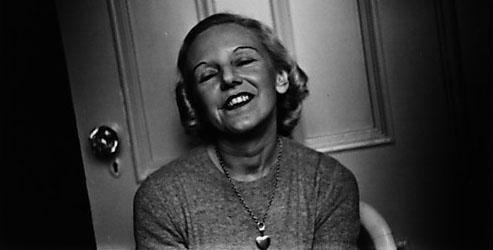
So the situation was not ripe for success. And I was down to the last minute preparing for that first class. We had the first third or so of the novel to consider. I was wary of both my own uncertainty about the book and mindful that the first day on any novel is usually a bit halting. So I offered a few remarks on Kavan’s remarkable life—most of which I pilfered from this fine New Yorker profile, along with the information that her life-long heroin habit began when she was introduced to it by a tennis pro on the French Riviera, who thought it would be good for her serve!—and then passed around a handout with questions I’d prepared. I split the class into groups and assigned each a question. (I thought about including them, but decided that was overkill. Leave a comment if you want me to send them to you.)

The exercise worked okay: we got at some of the novel’s concerns, but I found it hard to get students to point to specific passages in their answers. It’s always hard to get students to do this—they’re always happier with generalities. But the problem seemed more intransigent this time. The reason, I realized, concerned the nature of the book itself. Ice doesn’t lend itself to close reading. The style is flat, with little texture, grain, weirdness. Even the narrator, so problematic, seemed less complex than I’d hoped. Certainly, he is untrustworthy, but he isn’t seductive in the way of Nabokov or Ishiguro’s narrators, for example. Class discussion felt aimless: we didn’t know what to do with this book.

ccn0e2qviam6ufz1

As I was preparing for the next class I realized I was bored. I resented Ice, hated having to read it. I found my attention even more fragmented than usual: my thoughts wandered away from the page; I was checking Twitter and hockey scores even more than usual. The last hundred pages were killing me. Now, it is true that sometimes I am resentful of having to re-read books for teaching because doing so takes me away from reading other things, things I’ve never read before, but I’m never bored or resentful. I leave that to the students! I like the books assign. Most of them I even love. So what was going on? And why was I the only one (outside my classroom, I mean) who seemed to feel that way?

I’d decided to assign Ice in the first place on the basis of conversations with readers I trust, all of whom were enthusiastic about the book. And as I prepared to teach, I read what Grant and Max and John Self and others had written about the book (I think Jacqui likes it too but I can’t find her review). They all loved it. But I just couldn’t see what they saw.

Finally, I had an insight that offered, I hoped, a way to think more productively about my resistance. I was reading a passage in which the narrator, who has, for reasons too obscure to go into here, joined a group of mercenaries ultimately in the pay of his nemesis the Warden, decides he needs to meet him face to face. But his immediate superior, the only person in the unit with even occasional direct dealings with the Warden, refuses, fearing that his own privilege will thereby be undermined. So the narrator comes up with a scheme:

For days we had been attacking a strongly defended building said to contain secret papers. He [the leader of the narrator’s unit] would not ask for reinforcements, determined to get the credit for taking the place unaided. By a simple trick, I enabled him to capture the building and send the documents to headquarters, for which I was highly praised.

My mind snagged on that “by a simple trick.” Quite possibly we are to take that as another sign of the narrator’s unpleasant character—look how boastful he—but in that case wouldn’t he want to tell us all about the trick so that we could see just how clever he is? It seems more likely that this is an example of everything Ice isn’t interested in. I imagined the kind of novel that would make much of that offhanded phrase. In that novel, a thriller, say, the mechanics of the trick would matter a lot. But Ice doesn’t care about plot, or plausibility, or cause and effect (its logic, if it can be said to have one, is dreamlike). It also doesn’t care about character, at least not as an expression of a complicated psychology or interiority.

So what does it care about?

I still don’t know the answer to that, which is why my attempt to teach it failed. Pressed, though, I would say it cares about the repetition and re-arrangement of certain images and motifs. But if so, its interest in repetition is totally different than Lawrence’s. We’d spent a long time at the beginning of the semester looking at how Lawrence repeats himself—the most noticeable, and, to his critics, most annoying aspect of his style. But in Lawrence, repetition always leads to difference. When he repeats himself, he seldom uses exactly the same word; he offers slight variations (adjectives become adverbs, for example). When repetition leads to difference, the prose becomes propulsive, befitting his fascination with change. Kavan’s repetition didn’t inhere in her style (she doesn’t repeat the same words); it inheres in her structure (the girl is trapped in one way, then another, then still another).

Thinking about that difference helped me—if not my students—clarify my own values. I care way more about experiments at the sentence-level rather than at the book-level. The flatness of Kavan’s prose offered me no handholds. If, to return to the passage that snagged my attention, the prose could be likened to a strongly defended building, it is one whose slippery surfaces repel me. I cannot grapple with them. The prose offers me no traction, nothing to grab hold of by resisting. At the sentence level, it’s just not weird enough. The book’s weird as hell, don’t get me wrong, but at any given moment it feels so ordinary. In this sense, Ice is the opposite of the books we’d been reading all semester, perhaps exemplified by Loving and The Vet’s Daughter, books that seem straightforward at first glance, but get stranger and stranger the more we look at them, specifically because of their deceptive style. With these texts, we think we know what we are getting (“ordinary” realism—keeping in mind that realism actually ordinary at all, that’s just the straw position it’s held for many 20th century writers and readers) but once we get into them we find ourselves in a stranger place than we’d expected.

Having had us look at that phrase “by a simple trick,” and having broached the question of what Kavan’s novel values, I asked the class: Is this novel boring? The students were reluctant to answer, sensing some kind of trap, but I wasn’t having them on. I told them I found it very boring. But what was boring about it? Was boredom a flaw or a tactic?

One way to recuperate this boredom, I suggested, might be to read Ice as a novel about the violence men perpetrate on women. Such violence is boring. Not unimportant. Nor excusable. Something that ought to be combated (though I don’t think the book has any ideas about how to do so, or if it even can be). It is boring because, no matter how many forms violence takes, no matter what lurid and dismal fantasies give rise to it, it is always the same. In other words, in boring us the book is performing the boredom of misogyny and patriarchy.

Does this reading work? I’m not sure. I am sure, though, that the novel refuses to glamourize violence. On the contrary, it shows that part of violence’s power comes from its resolutely static nature.

In this regard, Ice is quite different from Crash, a novel which also presents violence in an affectless manner but which is also thrilled by it. (It is also so much richer in its prose). Ballard’s world-view—though also quite mad—is less stultifying than Kavan’s, because in Crash violence is equal opportunity (it’s not only men who enact it), and, more importantly, not the point. The point is that violence combined with sex begets fantasies that are transformative and therefore generative, even if in ways that make us uncomfortable. (It’s a book about people who get off on car crashes; it’s about people fascinated by the way bodies can be transfigured through violent collisions with machines. It’s insane, but you should read it.)

717xdHIekSL

On the course feedback form I asked students whether they thought I should teach Ice again. I’ll be curious to see their answers. My guess is they’ll say no, because none of them chose to write about it for their final papers. And I’m pretty much ready never to read it again. And yet it’s almost always rough the first time one teaches anything. I bet I’d do a better job next time. But I don’t think I’m interested enough to try. Teaching Ice turned out to be a failed experiment. Of course, those are the ones you learn the most from.

On Counterpoint in the Classroom

It often happens that I ask students to work together in pairs or small groups for a few minutes during class. We usually do “think-pair-share”: students write on a prompt for a few minutes, they debrief with a partner, and then, once the class as a whole has reconvened, they share what they learned from talking with their partner. I have the pairs work together for two or three minutes, sometimes five, depending on how engaged they seem.

Sometimes I prepare a series of more involved questions about the day’s text, divide the class into five or six groups, and assign each of them a question, telling them that they will share their response with the group as a whole. In this case they spend longer together, at least five minutes, maybe ten.

This time, when the students are busily working together, is what I want to talk about today.

I find such moments equally satisfying and unsettling. They have a particular texture that, I suspect, is very different for me than for the students. What is happening at such moments? When they are bent over their writing or chatting with a classmate, what am I doing? Am I teaching?

I remember once walking down the hallway of one of the busiest buildings on campus. It was the middle of a class period, and as I passed six or seven classrooms I heard over and over the voices of professors. Some of these classes were lectures, some were discussions, some, no doubt, a hybrid. But regardless of type I didn’t hear a lot of students talking. I’m always conscious that I too am the person who talks the most in my classes. There are good reasons for this (I know more than my students do about most of the things I teach). I’d say I talk more now than I did when I started, for reasons that are both good (I’m more confident; I’ve perfected a spiel that works) and bad (I’ve gotten lazier; it’s easier to talk than to engage in other ways). But my ideal is still a class in which students talk at least as much and preferably more than I do. (I still remember a session on Virginia Woolf many years ago when I only spoke a single sentence for the first hour of class. It was amazing.)

Small-group work has many benefits. It allows people who are shy about speaking in front of the whole class to contribute to class conversation. It helps the ones who need a little time to formulate an answer and who otherwise might be drowned out by students who find it easy to give immediate answers to my questions. And it integrates writing with talking—important because for most people writing is the best way to improve thinking.

When students talk with each other, they wake up, they feed off the changed atmosphere, they gulp down the oxygen that comes into the room. At least, they do when things are going well. Like most teachers, I’ll use impromptu small group work if the atmosphere is particularly leaden (if it’s a particularly rainy or gloomy day I’ll usually come prepared with a small group exercise). Sometimes it doesn’t shake things up. Who knows why. Could be the time of the semester, the day of the week, the weather outside and inside, the intransigence or shyness or fearfulness of a particular group dynamic.

But mostly it works. Things always start quietly; students are shy about breaking the silence. They begin by murmuring, but as they warm to the task they get louder. Soon there is a pleasant hubbub, almost a roar. That’s what I love best. I can feel the class loosening up. There’s more laughter, a kind of ease comes into the room.

I’m not an idiot: I know students aren’t always talking about the thing I asked them to talk about. (Though knowing I might ask them to summarize the conversation usually keeps them honest.) That’s not even the worst thing in the world. If I hear a few groups talking about their weekends or a chemistry exam they just took then I know—though the presence of longer pauses has usually already clued me in—that it’s time to bring them back together as a class. If one group finishes their task too quickly, I’ll go over and check in, ask someone to tell me what they’ve been talking about, prod them to think further, maybe give them another question to think about.

But mostly I stay out of their conversations. Instead I walk, and I listen. Unless I’m teaching a seminar where we can all fit around a table, I always move around the room a lot. Partly because I am nervous and fidgety, but also because I think it keeps them engaged, a little off-balance, in a good way. When I’m asking questions and expanding on their responses—in other words, when I’ve conducting the discussions that make up 90% of my class time—I want to be close to the students: looking in their faces to see what’s happening (are they getting what I’m saying, do they seem confused or bored?) and bringing my presence to different parts of the room. But when they’re doing group work I want to be out of their way. So I’ll wander the perimeter of the room, maybe looking at what’s hanging on the walls (maps of foreign countries, posters listing tutoring times, cheap reproductions of art works hung by God knows who God knows when) or, better still, out the window, if I can. I’ll cast myself outside the space of the classroom, watching the trees rustle in the wind or people hurrying or sauntering along the campus’s walkways or the groundskeepers with their inevitable leaf-blowers. Part of me will be out there, in that space where I don’t have to perform, where no one needs to have something to say about the day’s text. But part of me will be inside the room, roaming.

But this walking is much less important than listening. I’ve always liked to eavesdrop—as a kid I rode the bus a lot, especially when I got to be a teenager, since I took the city bus to school and to work; that’s where I honed my skills of listening in on people’s lives—and these small group sessions are a chance for me to get a (more or less unfiltered) sense of what students are thinking. As I’m wandering the room I’m getting bits and pieces of conversations; I’ll listen for ideas that are repeated from group to group, or for passages that particular groups seize upon. When I can I’ll reference these ideas in our discussions, whether overtly (“I noticed many of you were drawn to the scene at the swimming pool”) or covertly, as a way to structure the rest of the day’s conversation. Eavesdropping is a good way for me to get a handle on misconceptions or just generally take the temperature of the class’s familiarity with the day’s text (if people haven’t read it the small group conversation will be halting; it’s always a tell when students are desperately scanning the pages in the hopes of figuring out what the hell the thing’s about).

As the voices of the students rise and fall, as I make my way around the room, casting an eye outside it and an ear within it, I’ll find myself feeling calmer, even soothed. I’m getting a little break: for a few minutes I don’t have to be the one doing the heavy lifting of making something (a meaningful conversation) out of a room-full of people with their books. I don’t have to worry about time. (When class is going well, time flies by; when it’s not, it’s an enemy, a leaden lump I am forced to try to mould.) And I’m always heartened by the surge of the students’ voices: it makes me feel that something is being achieved in this room—paradoxically, it’s when the class splits up that I am mostly likely to feel the group working together—to feel that it is, in fact, a group, rather than a bunch of individuals who happen to occupy the same space at the same time.

At such times I often recall a scene from the Canadian director François Girard’s film 32 Short Films about Glenn Gould (1993). Canadians of a certain disposition and generation probably know it, but I’m not sure it ever got much traction anywhere else. The film mixes documentary footage and interviews with people who knew Gould and adds re-enactments of important moments in his life. In these, Colm Feore plays Gould, presenting him as gentle and sweet and wise but also strange and demanding and prey to various compulsions, panics, and paranoias. (Much, it seems, like the real Gould.) It’s a good film, and worth your time, regardless of how much you know or care about Gould.

One of the vignettes is called Truck Stop:

As he waits for his eggs and orange juice, Gould, in sun glasses, black beret and wool overcoat, dials into the various conversations around him: a man tells a story about picking up a hitchhiker, a story that seems as though it will be salacious and dispiriting but swerves into a different register altogether; a waitress breaks off her affair with a regular, a long-distance trucker; two men talk sports (the woefulness of the Leafs a topic of almost perennial relevance). We see Gould marking time on his fingers, as if the conversations were a composition by Bach. Girard overlays the different conversations–we’re hearing all the stories at once–but, because he brings up first one and then another, we concentrate on different bits of the general hubbub at different times. This diner fugue is book-ended by Petula Clark’s “Downtown,” which plays on the radio both in Gould’s car and in the restaurant: a more simple musical form, but no less appealing, and important, for that.

Wandering my classroom, I fancy myself as Gould, dialing into first this snippet and then that, but weaving them together into a pedagogical counterpoint that offers an image of what I hope the class a whole will be: a set of independent voices that are nonetheless harmonically interdependent. (Am I understanding “counterpoint” correctly? Help me, musical people.)

At the best of these moments, I feel more than satisfied. I feel exultant. But I’m also uncertain, beset by questions. What exactly am I doing just now? Am I teaching or have I abdicated my responsibilities? Shouldn’t I be taking control and running the show? Similarly, I wonder about Gould’s relationship to the diner’s patrons. He’s with the people but he’d not of them. We get a sense of that distance when the waitress, excitedly, a little flushed, asks “Mr. Gould” if he wants his usual. Is Gould slumming? What is his role here, anyway? Is he composer? Performer? Conductor? Maker of found art? Is he responding to what he finds? Or is he, out of his genius, making something out of nothing, music out of noise? Do the conversations mean anything without his assessing ear?

I’m always worried I’ll let the group exercise go on too long. My worry is in part pedagogical: I don’t want the energy to peter out; I don’t want students to lose focus. But in part it’s more obscure, more personal: am I doing my job if I’m not taking a more active role? Of course, I set the task, I arranged the groups, I’m keeping an ear out for who is staying on task, and I’m the one who will turn this moment into what with luck will be a productive conversation about the text. So I’m doing a lot. Am I being an artist of sorts—is that the best way to describe a good teacher? Or am I imposing order and structure and form on something that might, admittedly, be more chaotic but maybe more valuable, more organic without me? Worse, am I using these exercises as a kind of distraction, whether for myself or for the students or for us all? After all, Clark’s “Downtown,” which is just as important to Girard’s scene as the inaudible Bach that underlies it, is a song about distraction, presented not only as a way to help us get outside ourselves but also, more troublingly, as a way to let us hide from ourselves. “You can forget all your troubles, forget all your cares,” sings Clark on the tinny radio. Is that a good thing or not?

Sometimes in these moments that now don’t seem quite as peaceful, these moments when I’m watching and listening and the students are working, I’ll fixate on the close-up of Gould’s fingers and I’ll feel my own twitching. What are those fingers doing? What kinds of cares are they forgetting?

On the Opening Scene of Birth (2004)

Before we see anything, we hear a man’s voice: “Okay, let me say this.” He sighs, then repeats himself. It turns out he is answering a question at a talk he has been giving. We don’t hear the question, but it must have been about reincarnation. He thinks about what would happen if his wife died—though he doesn’t say this, what he actually says is more revealing: he imagines having “lost” her: this movie will ask whether anything or anyone can ever be lost. The man imagines an outlandish scenario in which a bird comes to tell him, “’Sean, it’s me Anna, I’m back.’” In that case, what could he say? He’d believe the bird, or he’d want to. He’d be stuck with the bird, he adds, a little superciliously. (He’s cocky, this guy.) A ripple of laughter alerts us to the presence of the audience. But other than that, other than this extraordinary or preposterous imaginary situation, no, he’s a man of science, he doesn’t believe that mumbo jumbo. That will have to be the last question, he adds. He has to go for a run before he heads home.

It’s hard to imagine anyone ending a lecture this way, but we need the information because the screen, which has been blank, offering only the name of the production company, cuts to the film’s first image, a long shot of a figure, dressed in black and shown from behind, running through a snowy landscape. We put the image together with what we just heard: the runner must be the man we heard speaking. We might have figured that out anyway, but it doesn’t matter if the transition is abrupt, even clunky. This film is about how hard it to make a transition. It’s about implausibilities, too. What happens, it asks, when we take implausible scenarios seriously?

The opening speech is connected to the image of the running man in another way, too. As soon as the man mentions Anna, music rises softly in the background. Flutes, delicate, repetitive, are soon joined by strings and some kind of bell. (I’m reminded of Mahler’s 4th.) After that opening bit of dialogue, the only sound in this opening scene is this music, which swells and fades and swells again, mesmerizing us. (It’s a shame I can’t talk intelligently about music; it’s so important to this film.)

The man is running along a snow-covered road or path, with trees and fields lined with rickety fences put up to stop the drifts. Eventually we see some other people and a road with cars, but only in the background. The man is alone in this magical winter space, which might be a function of the time of day or perhaps more likely a symptom of the privilege enjoyed by the film’s main characters. Anyone who has been there will know: this is Central Park.

It can’t be too cold; the snow on the path is pretty slushy. It’s covered in footprints, though interestingly the man doesn’t seem to leave any. The temperature is probably just a few degrees below zero. Perfect for running, especially if you’re dressed for it, which the man is, though come to think of it his outfit is a bit weird. Who dresses all in back to go for a run? Is he a thief? There’s something ominous about him, an impression furthered by our inability to see his face.

This beautiful, almost stately tracking shot has so far been a single long take. The film critic André Bazin said that long takes give us the sense that we are seeing the world entire, complete, as it is. Whatever is outside the frame exists in continuity with whatever is inside it. All of a sudden we get a demonstration of this principle. In what might be my favourite moment in a film I love to pieces, four dogs run into the image and cross the path ahead of the runner before disappearing offscreen as quickly as they appeared. The runner doesn’t slow down, the dogs don’t return. They aren’t accompanied by anyone. Where do they come from, these dogs? Where are they going? I love this moment because it is an intrusion that doesn’t intrude. It has nothing to do with the story we are about to watch other than that it is a bit of magic, a spell to use a word one of the film’s characters will later use. The dogs are living out a different story than the one we are pursuing, maybe a happier one, since their effortless, satisfying lope contrasts with the more effortful—I was going to say “dogged”—exertions of the man.

He’s running fast, though, making good time through the snow. We can’t catch up with him and as he begins to run down a gentle slope the strings become more prominent in the soundtrack, taking up a waltz tune that will reappear throughout the film. The music is elegant, sophisticated, swoony—but accompanied by enough ominous themes to keep us wondering just how to understand what we are seeing, especially when the brass instruments introduce the sort of hunting themes you’d hear in Brahms or Mahler just as the man runs into the darkness of an underpass.

We almost lost sight of him but then he reappears on the other side and at that moment we have our first cut, to another shot of the park, but somewhere other than the path we’ve been following. The man isn’t in the frame, but we have something else to look at: a word, written in curlicued, somehow old-fashioned script, is superimposed over an image of snowy trees. Finally we learn the title of the film, Birth. (The direction is by Jonathan Glazer, the music by Alexandre Desplat, the cinematography by Harris Savides.) Then, a surprise: the music that has been so important to our sense of the film abruptly stops—well, almost anyway. A triangle keeps the time and, as the title fades, the music rises again. Just then we see the man entering the screen, still running. He disappears behind a rise and the camera tracks backwards slowly, moving us, as we can tell from the curve of an archway that fills the top part of the frame, into another underpass. As we move into that darkness—once we’ve seen the film we might think of it as a kind of womb, or maybe as the passageway from which Orpheus loses Euridice—the score becomes more urgent and unsettling, dominated by loud kettledrums. The man, running if possible even faster, comes back into the frame and runs towards us into the darkness.

And now something terrible happens. The man slows, lurches, leans forward with his hands braced on his knees. And then he keels over, first on all fours and then on his side. Another edit, this time a dissolve to a close-up of the man. We see his face for the first time, but the darkness and his hoodie shroud his features. The man does not move. The music stops. Another cut. Now we are on the other side of the underpass, looking at the silent landscape of the park. There’s still no one around, no one to help the man, only us to witness his fall, though even that opportunity or obligation has been taken from us. It is snowing lightly, wet snow, fall or springtime snow. The camera tracks slowly away from the underpass with its body. The soundtrack, as if out of respect, is silent. Then, quietly, quietly, the music starts up again. We cut to something that is hard to make out. The image is quivering, almost out of focus. But soon we recognize it as a newborn baby, a water birth, being lifted out of the water in someone’s arms. The screen is filled with the baby’s mouth, gaping in what is presumably a howl, and its chest, bursting with a first breath.

This is the Prologue to Birth. Before long we will be asked to wonder whether the baby we have just seen is the reincarnation of the man who died in the park. The film is about magical thinking, and surely one of the reasons I love it so much is that I am so susceptible—or receptive, depending on your inclination—to magical thinking. To this day, I think about this movie every morning on my run, convinced, as I am, that one day, perhaps today, I will similarly collapse.

On Roger Lewinter’s An Approach

5oogO6WmH9mTX58X5LuAjs1JabcC7yGLDi7gDguv2NrnaBsPpcXN3l2Td0utPStLrGg3DncAkhuonMzZxYMBog0FsOyqmA=s750

The original project was to write a story in a single sentence without a period. The first draft was completed in ten days in 1989, but finding this first version “too simplistic, discursive, linear,” Lewinter sought to break out of what he saw as the constraining matrices of language in order “to have access to a state situated in another space-time, where everything can appear simultaneously.” Formally, this entailed a “disarticulation” of the sentence by means of interpolated clauses set off with dashes. … Lewinter’s functional innovation—the asymmetrically spaced dash—“allows the horizontal prose ‘sentence’ to be excavated vertically,” and ultimately diagonally, restoring to language its “other dimensions: even the space of the word.”

Last year I wrote a review essay of two works by the French writer Roger Lewinter. Not long ago, the translator of these books, Rachel Careau, told me about a new translation that had just been published at BOMB Magazine.

As much as I liked The Attraction of Things and Story of Love in Solitude—and I liked them a lot—I like this new piece even more. An Approach consists of four iterations, numbered one through four, of a single sentence—if it even is a sentence: there is no full stop—that readers must decide how to read. (We can follow the same number all the way through, or jump between them.) As in the works published last year, An Approach references literary translation (Lewinter has made his living as a translator from German to French), filial devotion, an encounter with a difficult lover, and the banalities of life in a city like Geneva, where Lewinter has long lived. But the text isn’t about those things: rather, it’s about nearly encountering them, brushing past them. For me, Lewinter’s texts are literary cruisings.

Careau offers an even better explanation of what ’s Lewinter is after in his literary experiments in her short introduction, which I have excerpted above.

You can read An Approach here.

English language readers should be grateful to Careau for her beautiful translations of these enigmatic and fascinating works. I gather more Lewinter might be forthcoming in English translation. I very much hope so.

A Note on David Downing’s Spy Novels

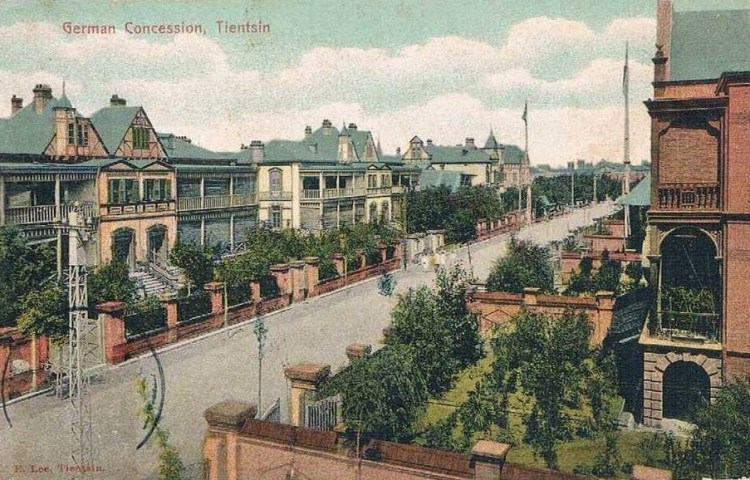
David Downing writes pretty good historical spy thrillers. The Dark Clouds Shining concludes the Jack McColl series, set at the edges of WWI and in its aftermath, particularly Russia in the years after the Revolution. Downing takes readers to some unusual places—the Western Front is barely mentioned. Instead, his hero McColl finds himself in the Kiautschou Bay concession (home of the Tsingtao brewery), the Dublin of the Easter Uprising, the border between Finland and Russia, and Tashkent and Samrkand in the early 1920s, where Soviet and Uzbeki cultures abut uneasily. Downing is great at subordinating his historical material to his story. We learn a lot, and quite effortlessly, too.

515MDNi7PVL._SX331_BO1,204,203,200_

Unlike a lot of books set during WWI, especially those involving Britain, the emphasis here isn’t on the betrayal of innocent lives by those who want to cling to power, but rather the new ways of life that arise from the war: a world that begins to imagine decolonization, gender equality, and the liberation and equality promised by socialism and communism. Of course the books also emphasize the failures of these promises, in part by the excesses of the liberatory movements themselves and in part by reactionary forces in the not-quite-former Great Powers.

McColl finds himself working for a country and, especially, an ideology he no longer believes in; his on-again off-again girlfriend, an Irish American journalist—finds herself caught up in the exhilaration of the Russian revolution and then quickly in the disappointing, even murderous reality of what the revolution quickly becomes.

Unable to resolve its socio-political conundrums, The Dark Clouds Shining saves its tidying-up for the relationship between the two leads: a satisfying but also much less ambitious ending. But then again I’m not sure thrillers are ever able to tackle the big questions they circle around, constrained as they are to emphasize individual character rather than societal, structural, or communal concerns.

German_Concession,_Tientsin

If you haven’t read Downing before, I recommend starting with his six-book John Russell series, set before, during, and after WWII and named after the train stations of Berlin (and Prague). Downing feels more in command of that material than he does in the new series, and Russell is more fully realized than McColl (although there’s not really that much to choose between them: they are good guys who sometimes have to make hard decisions and who treat women well—a fact the novels are a little too self-satisfied about). One of the best parts of the earlier series is that Russell’s one-time girlfriend and eventual wife, Effie, grows from a bit part to a central character. In the McColl series, Caitlin is even more important—the last few books are split equally between her and Jack, and she is at the center of their most interesting scenes.

Recently I wrote about two masters of the spy genre. Downing isn’t at their level. But he’s pretty good: absolutely reliable light reading, and there’s nothing wrong with that.


Through the Looking-Glass: Lisa Halliday’s Asymmetry

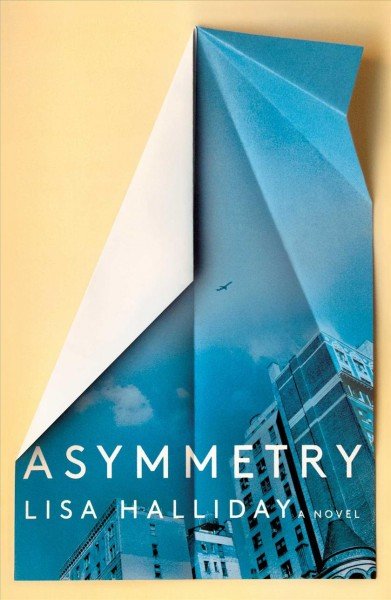
Asymmetry is Lisa Halliday’s debut novel and she is clearly a writer to watch.

The novel begins with a meet cute. Alice is a recent college graduate who works in publishing in New York. She is reading in the park when a man, much older, sits down beside her with an ice cream cone from the Mister Softee truck. Alice knows immediately who he is: Ezra Blazer, Pulitzer-but-not-yet-Nobel-prize winning writer of a series of famous and influential books. (Blazer is clearly modeled on Philip Roth, with whom Halliday was at one time apparently involved. The most preposterous thing in the book is that people whose lives his books have changed keep recognizing him; surely that doesn’t happen even to Roth.)

DP102500

Blazer tells her a middlingly funny joke and invites her over. In no time at all they are having just-a-little-bit-disappointing sex (gingerly because of his back), and watching baseball (it is 2004 and Alice is a Red Sox fan, much to Ezra’s disgust). Alice is something between personal assistant and girlfriend, running by Zabar’s to get Ezra’s favourite brand of preserves. He gives her things, some little (a sheet of stamps with the portraits of the Tin Pan Alley songwriters he introduces her to, various CDs, a wallet), some not (he pays off her student loans). He invents a persona for her (complete with fake business cards), passing her off as Samantha Bargeman, his research assistant, so that she can join him at his summer place. He gives her books to read.

It’s a May-December romance. Well, not really. She is part caretaker, part lover. He is on the verge of failing health, all colonoscopies and forgetfulness. It’s a bit tender and a bit not. It’s a Pygmalion story. Alice is lucky. Alice is put upon. Alice is being used. Alice is some kind of man’s fantasy:

Sweetheart,” he said. “I can’t wear a condom. Nobody can.”

“Okay.”

“So what are we going to do about diseases?”

“Well, I trust you, if you—“

“You shouldn’t trust anyone. What if you become pregnant?”

“Oh don’t worry about that. I’d have an abortion.”

Before too long, in other words, readers are likely to feel disquieted, indignant, uncomfortable, or worse about the relationship. Ezra is kind of funny and kind of wise but he’s also kind of insufferable. In the hospital after being beset by chest pains, Ezra watches spellbound as a couple across the cubicle lay hands on each other and pray to Jesus: “he could never get enough of humanity, so long as it slept in another room.”

This tart observation is Alice’s—the first third of the book is focalized through her. Clearly, Alice isn’t just a push-over. In fact, the book is more complicated and stranger than I’ve made it out to be. Take the opening. I said Alice was sitting on a park bench, reading. Here’s how it actually begins:

Alice was beginning to get very tired of all this sitting by herself with nothing to do: every so often she tried again to read the book in her lap, but it was made up almost exclusively of long paragraphs, and no quotation marks whatsoever, and what is the point of a book, thought Alice, that does not have any quotation marks.

That opening clause carries the suggestion that Alice is restless, ready for something to happen. Is she waiting for someone like Ezra? Has she conjured him? The preciousness of Alice’s impatience with literary pretension sounds like something from a beloved, twee, almost certainly English children’s book. If Alice’s name weren’t clue enough, the epigraph to the first section—revealingly entitled “Folly—is from Martin Gardner’s The Annotated Alice. (Her last name is Dodge, too, pretty close to Dodgson.) From the beginning, Halliday is taking us down a rabbit hole. But it takes a long time to figure out just how intricate are its twists.

I can’t talk about the book anymore without revealing some secrets. They aren’t crime-fiction-whodunit secrets, but they explain what makes the book unusual and interesting. Don’t say you weren’t warned.

When Ezra plumps down beside her, she is wondering—“somewhat foolishly, for she was not very good at finishing things”—“whether one day she might even write a book herself.” And Alice does.

But we don’t know that until the end of the book, in a short section that is a transcript of Blazer’s appearance on the BBC radio program Desert Island Discs. Asked whether he has ever suffered from depression, Blazer starts riffing on how nations and economies can suffer depression, finding his way into a screed about the complacency of American power. Then he says:

A young friend of mine has written a rather surprising little novel about this, in its way. About the extent to which we’re able to penetrate the looking-glass [WHAT DID I SAY ABOUT ALICE?] and imagine a life, indeed a consciousness, that goes some way to reduce the blind spots in our own. It’s a novel that on the surface would seem to have nothing to do with its author, but in fact is as kind of veiled portrait of someone determined to transcend her provenance, her privilege, her naiveté.

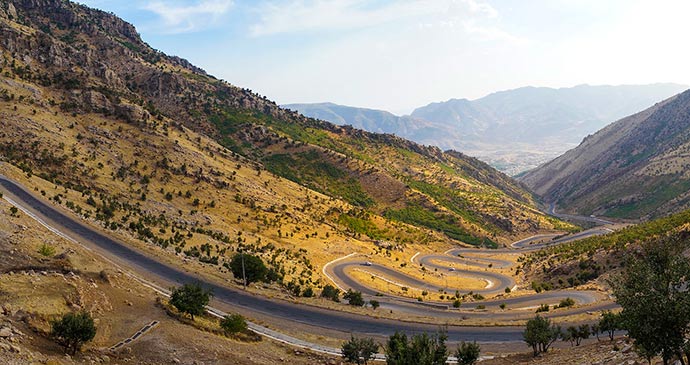
This information is slipped into a section that serves to amplify whatever reservations we have may had about Ezra. With increasing desperation and lack of self-consciousness he attempts to seduce the radio host, and his chutzpah sheds itself of the last vestiges of any charm. But readers of the book—as opposed to listeners to the program—will seize on the information, because it explains the second part of the book, titled “Madness”, which seems to have nothing to do with what’s come before and what comes after. “Madness” tells the story of Amar Jafaari, an Iraqi American, an economist, who is held by immigration officials at Heathrow on his way to visit his brother, a doctor, in Kurdistan. Amar reflects on his childhood visits to family in Iraq, in the schism in the family caused by his brother’s decision to return to Iraq, and his despairing feelings, shared by everyone in his extended family, of how much worse and less safe American intervention has made life. Halliday works brilliantly on our latent prejudices. The authorities refuse to allow Amar to enter the UK, and we keep wondering, despite all the evidence to the contrary, whether they know something we don’t. Could this intelligent, polite, and thoughtful young man be a threat? Is he part of some kind of terror plot?

kurdistan_iraq_EL

The answer is no (though that doesn’t stop British officials have detaining him in airport immigration limbo until he can get on a flight to Turkey), but the point is that we’ve wondered. The epistemological uncertainty of this moment is encapsulated in a bizarre scene in which Amar is forced to undergo a medical examination even though there is nothing wrong with him. Everything in the immigration scenes feels threatening, deadening boredom adding to rising indignation. Even more amazing than these scenes in the airport are those set in Iraq and Kurdistan, in which Halliday shows the increasing despair of Iraqis, the way they begin to take precautions like never taking the same route home or to work; to this she adds the surreal parallel life of foreign reporters and NGO officials, where drunken pool parties manifest the heartbreak and cynicism that comes from reporting on others’ suffering.

Amar’s section—which resonates with Alice’s in all kinds of small ways: remember that exchange between Ezra and Alice about what would happen if she got pregnant? Well, Amar remembers accompanying a college friend to get an abortion—feels vivid, relevant, and plain old interesting. I feel like I know Ezra’s history (he explains it to the BBC radio host). And I feel like I know Alice’s world, and can imagine it intersecting with Ezra’s. But I don’t know much of anything about Amar’s (though I understand, in a much milder, safer, and more privileged way, Amar’s frightening and frustrating experiences with immigration officials).

Because Ezra and Alice’s worlds were familiar to me, I was able to note something a little destabilizing in Halliday’s portrayals of them—the way we were meant to see how Alice wasn’t only undermined or oppressed by Ezra, for example. But I don’t have a comparable seismograph for reading Amar’s story. Which is part of the point. My readiness to find Amar’s story not exotic—Halliday is too sophisticated for that—but fascinating because foreign is built into the novel. Maybe I find Amar’s story so fascinating and plausible because it fits with little snippets of things I’ve heard on NPR or read in the New York Times. Maybe I’m just congratulating myself on encountering foreignness, on expanding my readerly horizons.

Literature is good at introducing us to foreign worlds. But I think what Halliday is doing here is asking us to think about what we mean when we say that. In that sense, her book can be taken as an intelligent contribution to the anxious debate about cultural appropriation: as Ezra puts it, it suggests we can “penetrate the looking-glass and imagine a life, indeed a consciousness, that goes some way to reduce the blind spots in our own.” (The specific looking-glass here is the one-way mirror Amar knows is there in the immigration holding area but which he cannot see.) Ezra goes on to add that this portrait of the other, no matter how convincing and flattering to our liberal sensibilities, is really a disguised portrait of the self, such that any encounter with otherness might be deemed impossible.

That’s a compelling reading, but Ezra is shown to be such a fraud, or at least, such a pain in the ass, that I don’t think we should take it at face value. I think Halliday believes we can learn something from the stories of others as long as we don’t start congratulating ourselves for it, as long as we don’t forget that what we are seeing as the other might just be a version of what we’ve been told to see (which isn’t quite the same as seeing only ourselves).

In this way we come to see the justness of Halliday’s title. She isn’t just referencing the odd, unbalanced, only tangentially connected structure of her narrative. Asymmetry inheres not just in art but also in life. The relationship between the west and the rest, and between those who have and those who don’t is anything but balanced. The connection between art and life arises, for this novel, in the idea of storytelling. Whose story gets to be told? Whose stories are finished and whose are left hanging?

9781501166761_custom-0de1113e01dcf036ee285262e983e116feb82574-s400-c85

The other asymmetrical relationship important to the book is the one between men and women. If anything is clear in this slippery book it is its indictment of white male privilege. Ezra isn’t as charming as thinks: his avuncularity is a mask for a pretty ruthless narcissism that requires that he fascinate women all out of proportion to the quality of his character. Halliday deftly makes us turn against Ezra.

But even as I admired her skill here—she never casts aspersions on his work, for example; too many people are doing that these days with Roth—I was troubled by her example of insufferable male privilege. Ezra doesn’t just happen to be Jewish; his Jewishness is at times part of what the book finds irritating about him. It’s true that a disproportionate number of the most prominent abusers who have come to light in the past year or so are Jewish. And in my opinion Jewish men need to have a reckoning about their masculinity and how it’s tied to some dangerous ideas about authority. But I don’t think this book is enabling that conversation. I don’t think it’s interesting enough about Jewishness, except to tie it in a careless way to Ezra’s (and by extension, through his friends and acquaintances and the cultural institutions they are shown to have built, to his generation’s) carelessness and entitlement.

That aspect of the novel disturbed me. But I liked how it kept evading my grasp. When we say a book is slippery we often mean it is confusing or that it is cutely self-referential. But this slipperiness is as thorough going as it is thought provoking. I’ll read her next book with interest.


My Life in Books

Hope Coulter, my colleague in the English Department at Hendrix and Director of the Hendrix-Murphy Foundation Programs in Language in Literature, invited me to give a talk in a new series of lunchtime conversations called My Life in Books. Here’s an only slighted revised version of what I presented today. People seemed to like the talk; we had a good discussion afterward. I wrote this pretty quickly, as you’ll be able to tell; it’s a little rough. I’d to revise it further, and I welcome your suggestions.

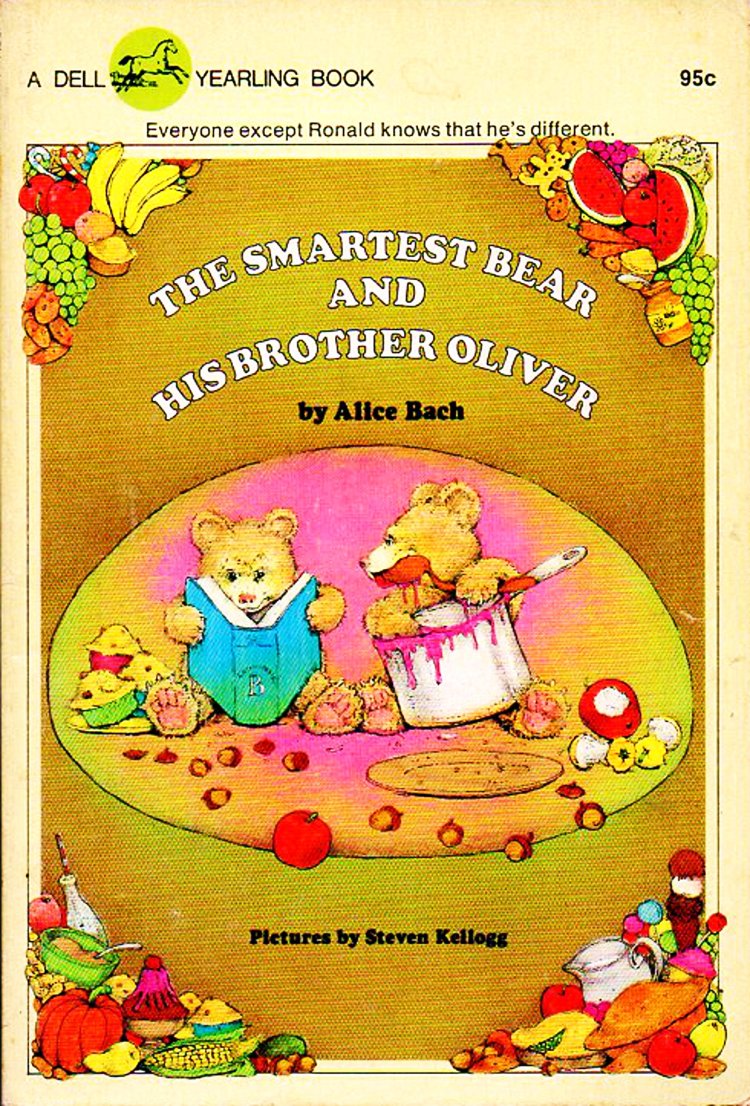
Somewhere in my house I have a thin little book I’ve carried around with me for many years. I don’t remember when I got this book, probably I was around 8 or 9. The name of this book is The Smartest Bear in the World and His Brother Oliver. It’s by Alice Bach, who it turns out—I only learned this yesterday, never having been in the slightest curious about the author before—has had a long and distinguished career as a feminist biblical scholar, in addition to having written twenty children’s books.

91h+ahS15EL

Of those many books, this one dates from 1975 and my copy—which I wanted to bring today but could not find despite having ransacked the house—included wonderful, shaggy illustrations by Steven Kellogg.

The gist is this: Ronald is very smart bear. He has a set of encyclopedias that he is reading from A-Z because he wants to learn everything. But he has a problem: it’s fall, winter is coming, it will soon be time for bears to hibernate and his family just wants him to eat all the time. Ronald isn’t that interested in eating—it’s fine, but it keeps him from reading. He’s not like his brother Oliver—Oliver loves eating. (There are these wonderful pictures of the bears tucking into giant stacks of pancakes smothered in syrup.)

It’s hard to learn everything when you have to sleep for almost half the year. So Ronald makes a plan. This year he will only pretend to go to sleep with his family. Once the others fall asleep he will stay up all winter, and have many glorious months of uninterrupted reading time. He imagines he’ll be reading about zebras when his family wakes up in the spring.

You can probably see where things are heading. Ronald’s plan is foiled—he can’t help himself; he’s a bear, after all—and when the rest of his family tuck themselves under heaping piles of down-filled comforters he gets sleepy too. But everything turns out fine—he learns that he doesn’t have to do everything at once, that the encyclopedia will be waiting for him come spring, and that his brother Oliver—his sticky, always-eating-young-chef-in-the-making brother Oliver, who is so much more like a normal bear than Ronald—isn’t so bad.

In other words: moderation in all things and tolerance for people who are different from us, even people who don’t like to read.

To which I say: what a terrible message!

By no means is this the greatest kids book ever written, nor was it the book I loved most as a child. But I did read it over and over again, stopping occasionally as I did so to glance up at my own set of encyclopedias, mostly unread. And it has stayed with me as an adult, maybe because I’ve refused to take its lesson.

To this day there is a part of me—a not insignificant part of me—that believes I could read the encyclopedia from front to back. And believes, even more grandiosely, that I could read everything. Even that I should read everything.

You can guess how well that’s going.

Maybe for some people reading is a pastime. They like it, they don’t like it, whatever: it might be important to them but it causes them no anxiety or neuroses at all. This is hard for me to get my head around. I don’t mean to say that I find no pleasure in reading; I find a lot. But I also find a burden, an endless task connected to some totally unhelpful ideas of mastery. At its best the idea that you’ll read everything is motivated by insatiable curiosity. At its worst, though, it’s motivated by narcissism and egomania. No hibernation for me!

*

When I first heard the title Professor Coulter gave to this series—My Life in Books—I immediately thought: but that’s redundant! My life, books, these are the same thing—totally synonymous. I can’t imagine my life without books.

But of course it’s important that life and books aren’t quite the same. It’s impossible for me to imagine being able to live life—and to make sense of life—without books, but the point is that books have to be different from life. We need fake things to understand real things. (Even non-fiction is “fake” in this sense—not that it tells lies but that it represents—every book has to frame the truth it tells, and that framing is the distance between art and life.)

But I don’t just experience the book-life distinction as a theoretical matter. For me it’s also psychological, even embodied. As a pretty highly introverted person—a person for whom being around others takes more energy than it gives (it is not an easy thing for such a person to be a college professor, by the way)—I need time away from the world. I need to fill up my emotional tank, which runs dry pretty quickly.

So in addition to being objects to conquer, books have always served a second important function in my life: they’re a way to hide from the world. “Leave me alone, I’m reading,” as the title of book critic Maureen Corrigan’s memoir has it. Often, when I am having, or even on the brink of having, a difficult or intense conversation with someone, I can feel myself needing a book. If one is nearby I’ll pick it up, hold it, steal a few glances at it. We sometimes speak of books as demanding—“Ulysses is a demanding book”—but even the most demanding book has never demanded anything of me the way other people do.

Reflecting on these roles books have played in my life—as a way to define myself, as a challenge to set myself, as a tool to help me manage a world that often seems so clamorous—I wonder if I’m able to have a healthy, neutral, or, best of all, purely joyful, relationship to books. Is my relationship to books—one of the two most important relationships in my life—a good one? Is it good for me?

I think being a professional reader—and someone who teaches others to read—is both a wonderful and a terrible choice for me to have made. (If it’s even a choice: fate might be a better word.)

As I sit with this ambivalence, I’m led to think again about The Smartest Bear in the World and his Brother Oliver. Maybe its lesson isn’t so bad after all. Ronald learns that his passion doesn’t need to be his neurosis. I’m working on that too, but maybe my lesson is actually different from Ronald’s. My lesson might be about hungering for books—about needing (and wanting) to devour them. And about accepting that need. My lesson might be that I am just as much Oliver as I am Ronald. Maybe part of me is a gourmand of books not just the professor of books. I’m working, not on being the smartest bear in the world—that sounds pretty terrible, actually—but on learning to eat, and then sleep. I’m learning to hibernate.

Two Superior Spy Thrillers

Does anyone remember the movie Crank from 2006? Jason Stratham plays a hit man injected with a poison that will kill him if his heart rate drops. What follows is 90 minutes of preposterous enjoyment, and a master class in narrative efficiency. There is no goal; there is only go. The movie barely has a beginning, and who knows what the end is (it’s telling that I can’t remember, because even more than most narratives this ending must undo all that’s come before). Instead it’s all middle, just one set piece after another of ingenious contrivances designed to keep the character’s—and the viewer’s—heart pounding.

I thought of Crank when reading Lionel Davidson’s terrific thriller Kolymsky Heights (1994). Davidson’s novel is more sophisticated, but like the now mostly forgotten movie it reducing narrative to its essentials. What’s really amazing is that Kolymsky does so over almost 500 pages, not a single one of which is wasted. The book gets its hooks into you from the beginning and doesn’t let go. That’s true even when it does something unorthodox, like taking until page 60 to introduce us to the hero.

And what an interesting hero he is. Jean-Baptiste Porteur is known as Johnny Porter. He is a Gitskan Indian from the Skeena River area of Northern British Columbia. (How timely and exciting to have an Indigenous protagonist., one whose indigeneity is central to his success—and not because he’s “in tune with the land” or some such nonsense but because he can speak so many languages.) Porter is a linguistic genius, having as a child already mastered several Native languages from the region, including Tsimshean, “a language so unique that linguists had been unable to relate it to any other on earth.” Later he is sent to a mission school (the horrors of which are glossed over—I’d like to think a book written today wouldn’t do so), where he learns English and French. Porter begins studying at two prestigious Canadian universities—studies interrupted by a sojourn in Russia—before completing his degree and winning a Rhodes scholarship.

Porter is back in Canada pursuing legal claims against the Canadian government when he is approached by an Englishman named Lazenby, who has received a coded message from a research station in Siberia that no one in the West knows the purpose of. Lazenby, who is the character we follow for the first 60 pages, reaches out to a former student now working for British secret services and the CIA; agents from these institutions are the ones who tap Porter as the only person able to get into Siberia, penetrate the defenses of the research station, and return. Lazenby flies to Northern British Columbia, makes his case to Porter, and exits the novel. Porter, phlegmatic, bemused, and interested despite himself, meets with the CIA and takes the case.

What follows is a gloriously ingenious journey via Japan and a Korean ship through the Northwest Passage into the heart of Siberia. Porter disguises himself as a member of the Chukchee people (he speaks the language, as well as related ones such as Evenk), going by the name of Kolya Khodyan. He gets a job at a transport company in the Green Cape along the Kolyma River (where earlier in the century many of the Gulags had been located) and patiently waits for his chance to sneak into the top-secret research facility. (This involves befriending the local Medical Officer, with whom he enters a relationship much more touching, plausible, and non-exploitative than the ones you usually find in spy novels.) The best parts of the novel detail the winter transportation routes across Siberia, mostly along frozen rivers in jeep-like vehicles called bobiks. (Kolymsky Heights has good maps and if you’re anything like me you will refer to them over and over.)

Golden Kupol

I pretty much loved everything about Kolymsky Heights. Particularly intriguing is the absence of any references that would allow us to date the events. The events of 1991 are never mentioned, though I suppose they are indirectly alluded to in the increasing national/ethnic self-consciousness of the indigenous peoples of the north (though this is always accompanied by contempt/casual racism by whites, a fact Porter uses to his benefit, in that people are always underestimating him because they think he is “just” a Chukchee or an Evenk). I take the book to be set around the time of its writing, that is, in an interim period in which the Cold War is taken by many to be over but Russia remains an enemy, though of what kind it isn’t quite clear.

That uncertainty might explain why the mystery at the ostensible heart of the book—what is the going on at that underground research station?—isn’t the usual Cold War fare. The Russians don’t have a terrible new weapon that threatens humanity, for example. This mystery is much more intellectual, even ontological, concerning what it means to be a human being. (A question which, frankly, was answered in a more profound manner in the labour camps strewn across the whole area in which this book is set and which were just being closed at the time of its publication.) All mysteries have an easier time building up suspense than resolving it, and if there is any weakness to this novel it’s with the scenario Porter uncovers at the research station. I had a hard time really caring about the Big Reveal. But I cared a lot about how Porter was going to break into that place and then get out again. Porter’s escape through the blizzards of the Siberian winter is one of the most exciting things I’ve ever read.

A vivid evocation of a particular time and place is one of the things that links Kolymsky Heights to a thriller I read a few weeks later: Joseph Hone’s The Private Sector (1971). But that’s about the only thing these books have in common. If Kolymsky Heights reminded me of Crank, The Private Sector is, oh, I don’t know, Antonioni maybe. The Private Sector is not particularly suspenseful (though the last thirty pages or so really pick up the pace; it turns out this is the first in a four-book series and you can tell Hone is playing the long game). Nor is its presentation of events always clear. Hone is fond of shifts in perspective and time that are at times so oblique that I had read a few pages before I noticed what had happened. And the story itself is much more complicated than in Kolymsky Heights. In Davidson’s book, we know what the hero is trying to do; the suspense lies in seeing whether he will be able to, and how, exactly he will accomplish it. In Hone’s, not even the protagonist (no heroes here) is sure what he’s meant to do. This is the world of triple agents and double crossings familiar to me from the little amount of John le Carré I’ve read.

But whereas most spy fiction takes the transience of its characters for granted—having nothing to say about it beyond fetishizing the freedom of its invariably male protagonists from the clutter of bourgeois life—Hone makes this situation into an existential dilemma for his characters, all of whom have hybrid identities that complicate their work for British intelligence. Marlow, the central figure, is born in Ireland but grows up in England. He meets Henry Edwards—who first recruits him into intelligence work and whom he is now, many years later, assigned to track down—at a private school in post-Suez Cairo, where both are teachers. Edwards has grown up in Egypt, as has Bridget, the woman whom by the time of the narrative present he has become involved with and who happens to be Marlow’s ex-wife. It’s all very complicated and it doesn’t make it easier that all the male characters have first-name surnames. (Their control back in London is named Williams.)

What Kolymsky Heights does for the cold, The Private Sector does for heat and humidity in pre-air conditioning Cairo. Hone vividly describes how the heat sends everyone underground, holing up by day and timidly venturing forth at night. I was reminded of Olivia Manning’s descriptions of Egypt in the first volume of the Levant Trilogy, which I read a few years back and unaccountably didn’t finish. (If you haven’t read The Balkan Trilogy yet, stop reading this post and do so immediately. These two books are fantastic, but they’re no Balkan Trilogy.)

Egypt+Cairo+La+Place+Tahrir

All of which is to say that Nassar’s Egypt in May 1967, rushing into a war with Israel that, in Hone’s telling at least, it has no real interest in, is more than just an exotic locale. It is home to most of the characters even though almost none of them think of it that way. They think of themselves as from England, a place most of them have spent very little time in. Though less overtly uninterested in the locals than many novels set in expatriate or colonial/Pieds-Noir communities—an Egyptian colonel, in particular, is an important and appealing character—The Private Sector is still almost entirely about Westerners. That’s certainly a limitation, but I found its depiction of colonials living on in the wake of decolonization fascinating.

Here, for example, is Marlow describing Henry Edwards’s particular tribe, those Englishmen who had grown up in Egypt, would never be Egyptian, yet are highly attuned to it:

[T]hey were natural seismographs alive to its [Cairo’s] smallest tremors. They had not always been happy there; so much the more were they bound to it: they had lived a real life in the city, had given nothing false to it, in every minute passed there. Their dreams of elsewhere, of rain, of ploughed fields, sloes in the hedgerow or London Transport, were as unreal as mine would have been for sun and coral, and clear blue water. The known years spent in a landscape never tie us to it, the marked calendar from which we can stand back and reflect or think of change; we are bound to a place by the unconscious minutes and seconds lost there, which is not measurable time or experience, and from which there is no release.

You can see what I mean when I say Hone isn’t exactly easy going. His narrator is always stepping back from the action to offer these sorts of reflections. With its sophisticated syntax and complex ideas, this passage is typical. Our dreams, Hone suggests, are always of elsewhere. For him dreams are conscious things, meditations that fill our days even as we ignore our surroundings. But it turns out we’re not really ignoring them. We might think we know where we’re from—after all, we do live “real” lives, we do give ourselves over to the place where we live, it’s not that we are living in bad faith all the time—but we’re tied to the place of our history by something deeper than what we can know. We can’t even measure these experiences, but nor can we get rid of them. Most of time, this passage tells us, we live in clichés (sloes in the hedgerow or coral in a clear sea) when what really matters is happening to us unannounced.

I don’t cite this passage in order to say that Hone transcends the thriller genre, because I don’t think genres need to be transcended. They exert a hold on us for a reason. (If we’re going to wish them away we should do so in the spirit of true freedom and gleeful destruction, as Tom does, rather than as a covert way to uphold literary fiction as the standard for all writing.) Better to say that Hone’s book is both a very good spy story—though for pure excitement it’s got nothing on Davidson’s—and a thoughtful meditation on belonging. Although Marlow is thinking in this passage about belonging to nations or cities—about England and Egypt, London and Cairo—in the end the book pursues the idea most intensely in terms of the intelligence community. What allegiances do we owe to institutions that pursue their work by breaking allegiances—that is, by spying? Given its—to me, completely unexpected—ending, it’s clear Hone will have more to say about this question in the rest of the series.

*

Maybe the best thing about these wonderful books is the serendipitous way I came across them. I found Kolymsky Heights the old-fashioned way: browsing in a good bookstore, in this case Bridge Street Books in Washington, D.C. I’d never heard of Davidson, but I knew I was on to a good thing when, a day or two later, I had the good fortune to finally meet face to face with Eric Passaglia at an evening with several bloggers and book lovers organized by the inimitable Frances. (Eric has no blog, sadly, but you should follow him on Twitter.) Eric sang Davidson’s in a way that made me wonder yet again how it was I had never run across him before. The book Eric had with him that night was by Joseph Hone (I can’t remember if it was The Private Sector or one of the later ones) and he described him so appealingly that I tracked the book down at the library as soon as I returned home. Serendipity, then, and the reassurance that comes from a trusted source’s recommendation (which is what independent bookstores at their best can do): that’s how I came across these two books. I’m here to pass on the love. If you have even the least interest in spy thrillers, you should read Davidson and Hone without delay.

Emergency Thinking: Richard Lloyd Parry’s Ghosts of the Tsunami

Richard Lloyd Parry’s Ghosts of the Tsunami: Death and Life in Japan’s Disaster Zone is a sober and moving account of what happened in the Tõhuku region of the northeastern part of Honshu during the tsunami of 2011.

Parry is a British journalist who has long been based in Japan. He’s written at least one other book, a true crime story that’s meant to be very good. Here he expertly contextualizes his material for non-Japanese readers while keeping his telling economical in his telling.

japan-tsunami

At the center of the book is an investigation of what happened at Okawa Elementary School, where a failure to follow evacuation protocols led to the deaths of 74 children and 10 teachers.

Parry details what went wrong at the school and turns a pitiless eye on the generally fairly ineffectual attempts of the surviving school officials to deny their responsibility. But he is most interested in the psychological costs of the disaster, and he is most interesting when he refuses to consider any aspect of the event as redemptive.

As he puts it in one of the book’s most memorable passages:

It is true that people can be “brought together” by catastrophe, and it is human to look to this as a consolation. But the balance of disaster is never positive. New human bonds were made after the tsunami, old ones became stronger; there were countless remarkable displays of selflessness and self-sacrifice. These we remember and celebrate. We turn away from what is also commonplace: the destruction of friendship and trust; neighbors at odds; the enmity of friends and relatives. A tsunami does to human connectedness the same thing that it does to roads, bridges, and homes. And in Okawa, and everywhere in the tsunami zone, people fell to quarrelling and reproaches, and felt the bitterness of injustice and envy, and fell out of love.

Parry is never ghoulish about the societal and interpersonal destruction levied by the disaster. If anything, he is rather matter of fact. But he makes us feel the loss strongly—think about his double use of “falling” in that last sentence. Parry returns to a handful of individuals and families, people he met and got to know in his repeated trips to the region. So when he describes the breakdown of love and trust between and even within individuals we don’t just have to take him at his word; instead we see it happening.

I was first drawn to the book by an engaging review in the TLS. The article made much of the material that gives the book its title, namely, the extraordinary phenomenon of people who, in the weeks and months after the event, felt themselves to be possessed by the ghosts of people who had died, spirits not yet at rest. In Japanese culture, Parry explains, “when people die violently or prematurely, in anger or anguish, they are at risk of becoming gaki, ‘hungry ghosts’, who wander between worlds, propagating curses and mischief.” Parry meets a Buddhist priest named Reverend Kaneda, who lives in a town thirty miles inland, near the tsunami zone but far enough away from it to have been spared. People began to come to Kaneda, reporting to him, in some mixture of embarrassment or horror, things they could not remember doing: shouting and snarling at loved ones, even telling them they must die. They described seeing bedraggled, mud-soaked, flickering people that others could not see. Kaneda prays with them, talks with them, engages with the people or personalities possessing them as a therapist might. He reasons and urges and cajoles and soothes: the ghosts, mollified, disappear.

It’s compelling stuff. But it only takes up the last part of the book. What Parry is more interested in, I think, and what really stuck with me, is the way disasters can be prepared for. When those preparations are good and when people follow the routines that have been prescribed for them, outcomes are, if not good, then at least less bad. Many schools were in the tsunami zone. Only at Okawa did so many children die.

In this regard, Parry’s book reminded me of a strange but fascinating and, to my mind, underappreciated book I read several years ago. Elaine Scarry’s Thinking in an Emergency argues that thinking and habit can go together, indeed, that the best way to prepare for an emergency is to think beforehand so that when disaster strikes habit can take its course, the way those who know CPR are drilled extensively so that they are able to react without thinking and without hesitation in the moment of crisis.

Parry reveals that in Tõhuku, and at Okawa in particular, these protocols—of which there are many in Japan: earthquakes and tsunamis are regular occurrences and the Japanese have thought deeply about the best way to respond to them—were ignored. In the terrible twenty or thirty minutes between the alerts and the arrival of the tsunami, the teachers at the school, for whatever reason, didn’t follow the plan. Even when some of the children asked why they weren’t moving to higher ground—we know this because a few bolted up the hillside behind the school and managed to escape the wave—they went instead the other direction, towards the onrushing wave.

The failure to observe protocol, to follow the procedures everyone had practiced so many times before is by no means unique to Japan. (On the contrary, as I’ve said, the country is admirable in disaster readiness—it is one of the societies, as Scarry notes in her book, which inspired her idea that we need to practice our responses to emergencies so that when they strike habit takes over.) But Parry considers a particularly Japanese aspect to the story: the reluctance of those in authority to admit to the mistakes they made, which led some of the parents of the victims to take those officials to court, a highly unusual move in a country where the good faith of governments and local authorities is rarely challenged.

9780374710934_FC

Parry never comes out and says so, but there must be some sort of connection between the parents’ refusal of the historical Japanese effacement of the individual in the face of the collective (don’t rock the boat, don’t challenge the authorities) and the more dramatic effacement of their very personalities experienced by the survivors possessed by ghosts. In both cases, violent, angry, we might say unseemly emotions are expressed, though of course with the difference that whereas at least in Parry’s telling the parents suing the school district are heroes for breaking a cultural code of silence, the possessed come to Reverend Kaneda because they long to be released from the violent spirits inhabiting them. In the first case, the idea is to be liberated from effacement; in the second effacement is a burden to be undone at any cost.

The idea of effacement carries over into Parry’s style. There is something pleasingly old-fashioned about his way of telling. Although he begins the book by describing how, far away in Tokyo, he experienced the earthquake that led to the tsunami as a minor irritation, and although he is often present in the story, returning to Tõhuku again and again in the years that follow the disaster, getting to know the people who feature in his narrative quite well, he doesn’t make a big deal of himself. I can imagine a lot of other writers making a lot more of their own response to the events.

The book itself is similarly modest. Although it suggests some serious and thought-provoking questions—what does it means for a society to respond to disaster? What is the relation between psychological and physical damages—Ghosts of the Tsunami resists making grand claims, and in fact ends rather abruptly after the section on Kaneda. In keeping with his rejection of an uplifting narrative, Parry, in telling Kaneda’s story, emphasizes not the man’s accomplishments but rather the toll the work took on him—he eventually had to give it up after it brought him to the verge of a breakdown.

Given Parry’s refusal of redemption, it feels wrong to call the book a triumph. But it’s certainly good at what it does. Parry writes carefully, precisely, and very movingly. In so doing, he indirectly attains larger, more general or theoretical significance. By focusing on a small piece of an almost unimaginable event, Parry allows us to think about disaster and trauma more generally. Grief, Parry writes, “doesn’t resolve anything, any more than a blow to the head or a devastating illness.” To say that Parry’s book doesn’t come to specific resolutions is to say nothing less than that it does justice to its subject.