On Kathryn Bigelow’s A House of Dynamite

At the beginning of A House of Dynamite, Kathryn Bigelow’s new film, now in theaters and on Netflix, an intercontinental ballistic missile shows up on the radar screens of a tracking station in Alaska. Is it a test? A malfunction? If, as it soon becomes clear, it’s real, who launched it? These questions are picked up by the team at the White House that monitors threats to the country. Soon the military command, the Department of Defense, FEMA, and other agencies are involved. They have less than twenty minutes to shoot the missile down before the ten million people in and around Chicago are incinerated. When the ground-based interceptors fail, a decision falls to the President (Idris Elba, known to the audience only as a voice until the last third of the film). Should he order a retaliatory strike (and if so, against whom)? Perhaps unsurprisingly, given its love of expertise, the film presents the President as a mediocrity doing his best but outmatched by the enormity of the situation.
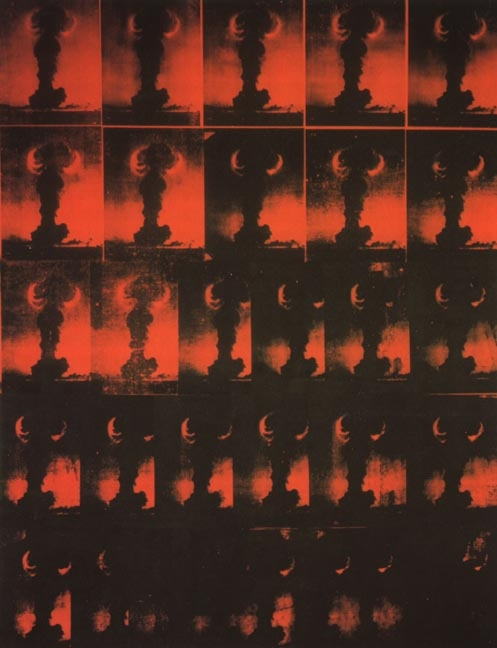
Andy Warhol, Atomic Bomb (1965)

The movie drives hard and fast. It’s suspenseful and frightening. But its real interest is in something seemingly much less exciting: expertise. On one level, A House of Dynamite is a paean to experts, people with specialized knowledge that guides informed yet decisive action. In the current moment our American oligarchic and fascistic kleptocracy, the days of the experts often seems to be over, a victim of a long-running war against education, perpetrated by privileged people who have benefitted from it. How thrilling, then, to see Captain Olivia Walker (Rebecca Ferguson), Deputy National Security Advisor Jake Bearington (Gabriel Basso), or even General Anthony Brady (Tracy Letts, he of recent Criterion Closet fame: “take your dissonance like a man) assert the value of reasoned protocol. Following procedure never seemed so exciting.

On another level, though, the film shows nothing but the failure of expertise. Characters struggle to communicate with each other, often in the most banal ways: someone important is out of the office; phone calls break up; conflicting video conferencing systems can’t be patched together. And they fail to see eye-to-eye. As their confidence in the country’s preparedness fades with every minute, they argue over the merits of a counterstrike. Will it stop further attacks? Or bring about the end of the world?

How does the film’s form relate to this content? To what extent is it an example of expertise? It’s certainly professional. A House of Dynamite moves quickly, even neatly, shifting between locations and institutions without ever leaving the audience confused. This clarity is the more impressive in that Bigelow has split the film into three chapters. Each tells the same story, but highlights different characters. There are a lot of off-screen voices in this film—people on conference calls, crackling out of microphones. We get the pleasure of putting faces to those names as we revisit earlier scenes from different perspectives.

Despite its looping, non-linear telling—a counterpoint to the relentless ticking of the clocks down to zero and annihilation—A House of Dynamite is efficient to a fault, offering minimum requisite humanizing beats to its characters. These moments often involve children. Captain Walker takes her son’s plastic dinosaur to work after he solemnly presents it to her on her way out the door; later she winces when slipping on her heels after passing through security outside her office before pausing, stork-like, to dig out the offending figurine which has must have fallen into a shoe when both were in her bag. A fighter pilot stationed in the Pacific stuffs the teddy bear he’s bought for his kid into his locker, only to fail to notice that it slides to the floor when his attention is distracted by the alarm that indicates a sudden mission. This tendency to use children as signifiers of the personal reaches its height when the Secretary of Defense (Jared Harris) kills himself after realizing that he will be unable to save his daughter, who lives in Chicago.

These decisions are mawkish (though the man’s last call with his daughter is affecting: he understandably sees no reason to tell her she is likely to die within minutes). But that’s not the problem. The problem is how calculating the film is in humanizing its characters, how minimal and cliché its sense of what the human means. I found this especially disheartening in a movie that claims to abhor the destruction of human life.

In terms of its form, well, there’s professional, and then there’s polished. In trying to depict what stands to be lost in the event of the unthinkable, A House of Dynamite is as instrumental as the failed way of thinking that reduces weighty decisions to options in an if-then chart. Hard to imagine a less shaggy movie. (No “few small beers” here.) I was left wishing for some loose ends.

That might seem crazy given that probably soon-to-be notorious open ending. We never learn what the President decides to do. Or if Chicago is obliterated (though it sure seems likely). Or We if the repeated claim that “sometimes these weapons malfunction or don’t detonate” is wishful thinking. Sitting in the theater, I felt a brief flare of frustration. But how is a film like this supposed to end? After all, it argues that building a house full of dynamite and then deciding to keep living in it is insane. To that end, the missile must remain anonymous, its source forever unknown. The Russians deny it. The Chinese deny it. The North Koreans are unreachable. Ana Park (Greta Lee), the expert on that country, lays out a convincing scenario in which the North Koreans might be motivated to launch a suicide attack. But nobody knows. The film argues that it doesn’t matter. The possibility of unmotivated mass destruction is simply built into a world with nuclear weapons.

This choice on the film’s part, however, means that politics is off the table. Despite a good scene in which the Deputy National Security Advisor has a tense, heartfelt, but ultimately inconclusive phone call with a Russian counterpart, geopolitical maneuvering or negotiating are rendered inoperative by the bomb’s anonymity. The attempt to game out—in less than twenty minutes—possible consequences of preemptively launching a return strike, or of choosing not to, turns into abstraction, a kind of amplified trolley problem that the film doesn’t have the chops or stomach to develop. (Clearly, though, the tough-minded hawk, sitting in a bunker somewhere in the South Pacific, isn’t to be trusted. He puts eight sugars in his enormous travel mug of coffee.) I’m not sure what Bigelow had in mind by putting the North Korea expert, who fields calls from frightened officials on her day off, at a reenactment of the Battle of Gettysburg with her pre-teen son. Is the idea that the Civil War was as senseless as a nuclear attack? Or, on the contrary, that however terrible that war, it was at least a fight with dignity, valor, etc.? Or that any terrible event will eventually be subsumed into nostalgia and/or the politics of commemoration?

I said before that this is a frightening movie. It induces feelings of panic, helplessness, sorrow, and rage. And that, more than any mourning of the utopia of expertise, makes A House of Dynamite a movie for America in 2025.

But only in the worst, paralyzing way. Admittedly, paralysis constitutes much of what I at least experience most often these days. But that’s not the only way we can respond just now. And not the one that we need to emphasize if we are going to change the mess we’re in rather than just experience it. What would this film be like if it valued thinking more than the compartmentalization of calm professionalism and abject terror?

What if Bigelow or her writer Noah Oppenheim had read Elaine Scarry’s Thinking in an Emergency (2011)? There Scarry argues that America has dangerously normalized the idea of emergency as exception, and therefore as something that requires citizens to set aside democratic participation for unchecked executive action. She offers examples from around the world where careful but decentralized emergency preparedness results in mutual aid among citizens, not force from the State.
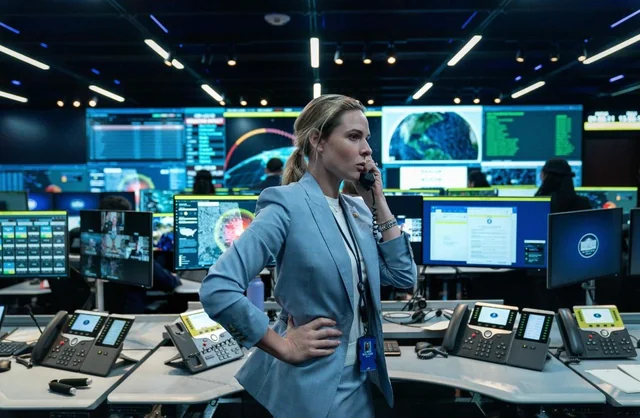
Still from A House of Dynamite (2025). Lotta phones, lotta screens.

The protocols devised in the US to respond to nuclear attack—the nuclear codes; the handbook with its menu of increasingly drastic responses; the double-checking of identities; the sequestering of the chain of command, hell, the very idea of a chain of command—are designed to protect a few when the many die a terrible death. The film’s last scene shows buses of officials designated as indispensable arriving at a bunker in the Pennsylvania countryside. (It’s clear that what matters is position, not person: thus the inclusion in the film of a FEMA employee based in Chicago (Moses Ingram), responsible for disaster response; the woman has only been in the job a short time; her colleagues are actively hostile when they realize that she, not they, will be sent to supposed safety.) We get no sense of what will happen to those individuals should that bomb in fact land. The protocols of response to a nuclear attack, like the film that shows them to us, is governed by ruthlessness. The only challenge to that brute instrumentality—and the only thing that could count as a loose end in the movie—is that Park, the North Korea expert, stumbles off the bus with her son. It’s a hint of human possibility in this fascinating but inhuman film..
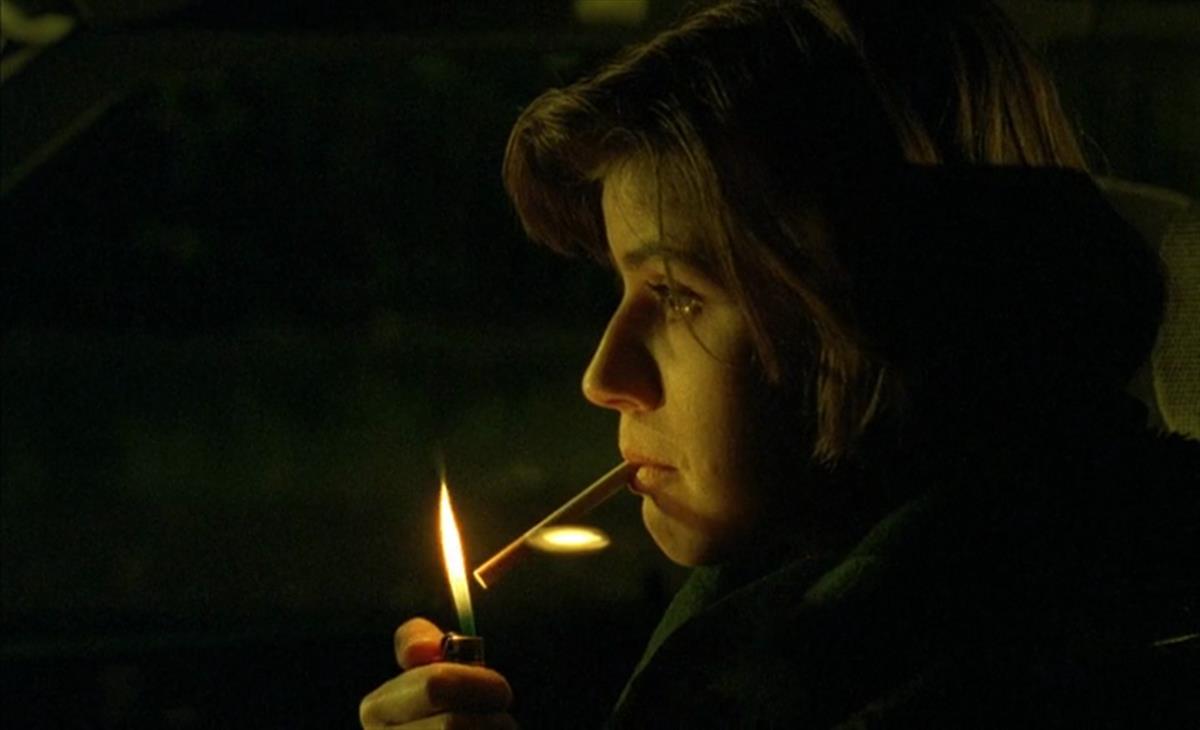
On Being Absorbed & The Double Life of Véronique

What do we see when we’re not looking? We say we are “lost in a trance.” Could we in fact be finding our way? In a series of interlocking scenes from the middle of his 1991 film The Double Life of Véronique, Krzysztof Kieślowski repeatedly shows one of his two conjoined heroines lost in thought: at a puppet show held for the entertainment of the children at the school where she teaches; in her classroom, as she gazes out the window while her students play a new piece of music; in her car, at a traffic light, where she absent-mindedly puts a cigarette in her mouth the wrong way round.

At each moment, her reverie is connected to the same man, a puppeteer who masterminds the show she and her students are so taken by. In the auditorium she stares at his reflection, seeing him pulling the strings. In the classroom, she looks out distractedly at his van in the courtyard of the school. In the car, she eventually sees him pulled up next to her at the light. In the last case, he interrupts her absorption, honking at her as she is about to light the cigarette before motioning to her with a twist of the wrist that she needs to turn it around.

He has saved the day, it seems; the lesson is that you need to turn things around, look at them, not differently, but the right way; you need to be brought out of your absorption. But what if the man is not the hero but the villain? What if he has destroyed something? What if the scarf that in an earlier scene trails along behind the woman as she walks through the corridor of the cardiology unit in the hospital, test results clasped to her chest—suggesting a different reason for absorption than romantic infatuation—is a sign not of absent-mindedness, even carelessness, but of strength, elegance?

Several weeks ago, I sat in on a workshop for some of the students at the school where I teach who hope to apply for distinguished scholarships, like the Fulbright or Rhodes. The facilitator–who was teaching essayistic writing without naming it as such–showed part of The Double Life of Véronique and gave the students ten minutes or so to write about it. Because I loved this movie when I was in college, I decided to take up the prompt, too, and recently found what I wrote when I was cleaning off my desktop. I thought it was interesting enough to post here, in the hopes that those of you who know the movie better than I do–or who have thoughts about being absorbed–can tell me what to write next.

On the Opening Scene of Birth (2004)

Before we see anything, we hear a man’s voice: “Okay, let me say this.” He sighs, then repeats himself. It turns out he is answering a question at a talk he has been giving. We don’t hear the question, but it must have been about reincarnation. He thinks about what would happen if his wife died—though he doesn’t say this, what he actually says is more revealing: he imagines having “lost” her: this movie will ask whether anything or anyone can ever be lost. The man imagines an outlandish scenario in which a bird comes to tell him, “’Sean, it’s me Anna, I’m back.’” In that case, what could he say? He’d believe the bird, or he’d want to. He’d be stuck with the bird, he adds, a little superciliously. (He’s cocky, this guy.) A ripple of laughter alerts us to the presence of the audience. But other than that, other than this extraordinary or preposterous imaginary situation, no, he’s a man of science, he doesn’t believe that mumbo jumbo. That will have to be the last question, he adds. He has to go for a run before he heads home.

It’s hard to imagine anyone ending a lecture this way, but we need the information because the screen, which has been blank, offering only the name of the production company, cuts to the film’s first image, a long shot of a figure, dressed in black and shown from behind, running through a snowy landscape. We put the image together with what we just heard: the runner must be the man we heard speaking. We might have figured that out anyway, but it doesn’t matter if the transition is abrupt, even clunky. This film is about how hard it to make a transition. It’s about implausibilities, too. What happens, it asks, when we take implausible scenarios seriously?

The opening speech is connected to the image of the running man in another way, too. As soon as the man mentions Anna, music rises softly in the background. Flutes, delicate, repetitive, are soon joined by strings and some kind of bell. (I’m reminded of Mahler’s 4th.) After that opening bit of dialogue, the only sound in this opening scene is this music, which swells and fades and swells again, mesmerizing us. (It’s a shame I can’t talk intelligently about music; it’s so important to this film.)

The man is running along a snow-covered road or path, with trees and fields lined with rickety fences put up to stop the drifts. Eventually we see some other people and a road with cars, but only in the background. The man is alone in this magical winter space, which might be a function of the time of day or perhaps more likely a symptom of the privilege enjoyed by the film’s main characters. Anyone who has been there will know: this is Central Park.

It can’t be too cold; the snow on the path is pretty slushy. It’s covered in footprints, though interestingly the man doesn’t seem to leave any. The temperature is probably just a few degrees below zero. Perfect for running, especially if you’re dressed for it, which the man is, though come to think of it his outfit is a bit weird. Who dresses all in back to go for a run? Is he a thief? There’s something ominous about him, an impression furthered by our inability to see his face.

This beautiful, almost stately tracking shot has so far been a single long take. The film critic André Bazin said that long takes give us the sense that we are seeing the world entire, complete, as it is. Whatever is outside the frame exists in continuity with whatever is inside it. All of a sudden we get a demonstration of this principle. In what might be my favourite moment in a film I love to pieces, four dogs run into the image and cross the path ahead of the runner before disappearing offscreen as quickly as they appeared. The runner doesn’t slow down, the dogs don’t return. They aren’t accompanied by anyone. Where do they come from, these dogs? Where are they going? I love this moment because it is an intrusion that doesn’t intrude. It has nothing to do with the story we are about to watch other than that it is a bit of magic, a spell to use a word one of the film’s characters will later use. The dogs are living out a different story than the one we are pursuing, maybe a happier one, since their effortless, satisfying lope contrasts with the more effortful—I was going to say “dogged”—exertions of the man.

He’s running fast, though, making good time through the snow. We can’t catch up with him and as he begins to run down a gentle slope the strings become more prominent in the soundtrack, taking up a waltz tune that will reappear throughout the film. The music is elegant, sophisticated, swoony—but accompanied by enough ominous themes to keep us wondering just how to understand what we are seeing, especially when the brass instruments introduce the sort of hunting themes you’d hear in Brahms or Mahler just as the man runs into the darkness of an underpass.

We almost lost sight of him but then he reappears on the other side and at that moment we have our first cut, to another shot of the park, but somewhere other than the path we’ve been following. The man isn’t in the frame, but we have something else to look at: a word, written in curlicued, somehow old-fashioned script, is superimposed over an image of snowy trees. Finally we learn the title of the film, Birth. (The direction is by Jonathan Glazer, the music by Alexandre Desplat, the cinematography by Harris Savides.) Then, a surprise: the music that has been so important to our sense of the film abruptly stops—well, almost anyway. A triangle keeps the time and, as the title fades, the music rises again. Just then we see the man entering the screen, still running. He disappears behind a rise and the camera tracks backwards slowly, moving us, as we can tell from the curve of an archway that fills the top part of the frame, into another underpass. As we move into that darkness—once we’ve seen the film we might think of it as a kind of womb, or maybe as the passageway from which Orpheus loses Euridice—the score becomes more urgent and unsettling, dominated by loud kettledrums. The man, running if possible even faster, comes back into the frame and runs towards us into the darkness.

And now something terrible happens. The man slows, lurches, leans forward with his hands braced on his knees. And then he keels over, first on all fours and then on his side. Another edit, this time a dissolve to a close-up of the man. We see his face for the first time, but the darkness and his hoodie shroud his features. The man does not move. The music stops. Another cut. Now we are on the other side of the underpass, looking at the silent landscape of the park. There’s still no one around, no one to help the man, only us to witness his fall, though even that opportunity or obligation has been taken from us. It is snowing lightly, wet snow, fall or springtime snow. The camera tracks slowly away from the underpass with its body. The soundtrack, as if out of respect, is silent. Then, quietly, quietly, the music starts up again. We cut to something that is hard to make out. The image is quivering, almost out of focus. But soon we recognize it as a newborn baby, a water birth, being lifted out of the water in someone’s arms. The screen is filled with the baby’s mouth, gaping in what is presumably a howl, and its chest, bursting with a first breath.

This is the Prologue to Birth. Before long we will be asked to wonder whether the baby we have just seen is the reincarnation of the man who died in the park. The film is about magical thinking, and surely one of the reasons I love it so much is that I am so susceptible—or receptive, depending on your inclination—to magical thinking. To this day, I think about this movie every morning on my run, convinced, as I am, that one day, perhaps today, I will similarly collapse.