Today’s reflection on a year in reading, her second for the blog, is by Anne Cohen (@aecnyc). Anne is a lifelong reader (preferably stretched out on couch or bed), retired lawyer, and former reporter. She lives in New York City with part of her family and two dogs, and continues to believe that the existence of Book Twitter saves her from homicidal and other anti-social behavior.
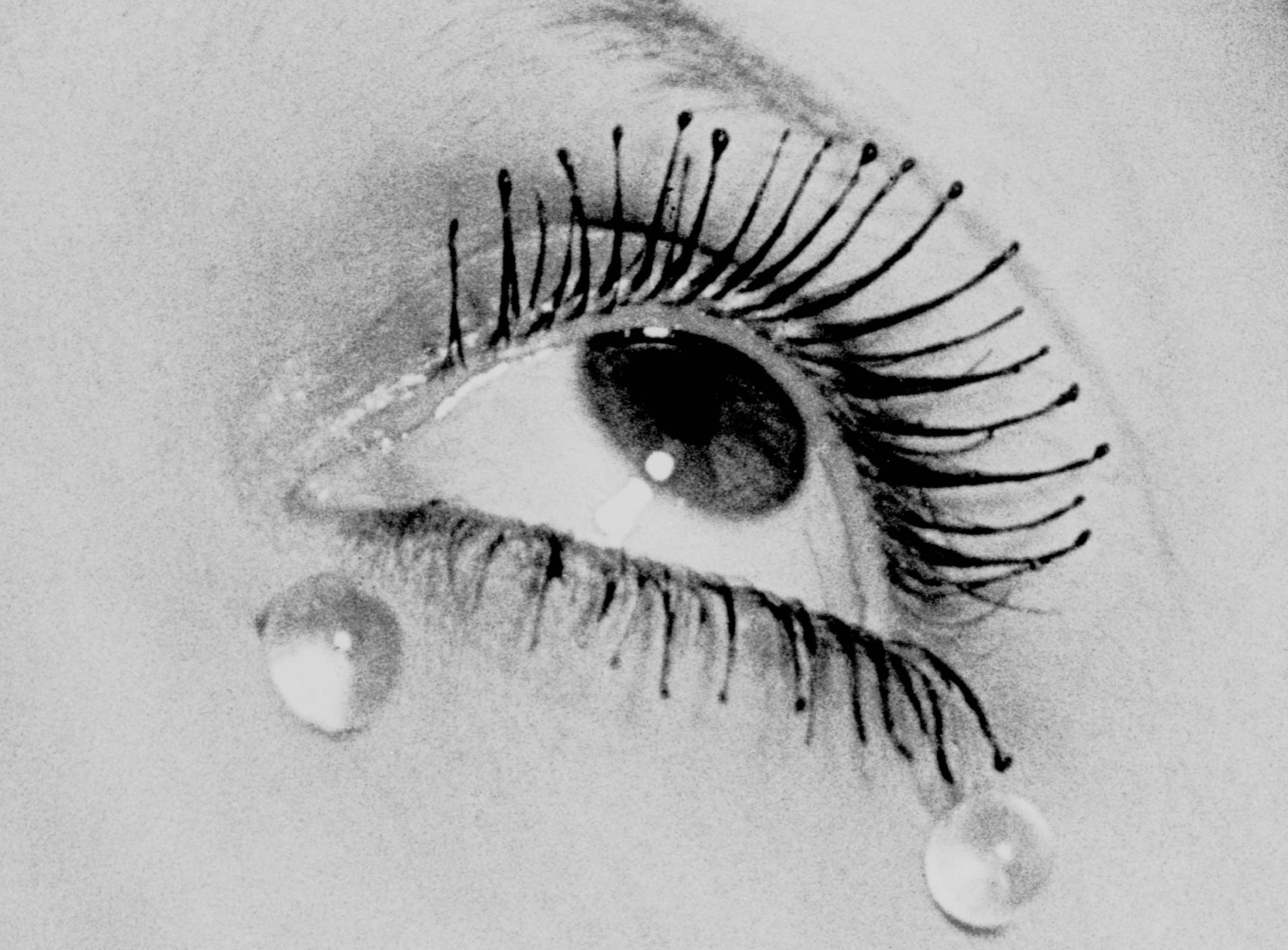
Man Ray, Glass Tears, 1932
I first got my glasses in the second grade, at almost the beginning of my reading life, and for the next 60 years, couldn’t function without them. A year ago, after repeatedly misreading price tags and after having lost several years of ophthalmologist appointments to the pandemic, I had cataract surgery in March and April, followed by several months of significant light sensitivity.
So when I looked back at my reading, I shouldn’t have been surprised (but was) that 2022 was a year of audiobooks.
These included the Anthony Trollope Barsetshire books (except Framley Parsonage, yet to be started), as well as Can You Forgive Her? and The Eustace Diamonds from the Palliser series, all read by Timothy West; Olivia Manning’s Balkan Trilogy, read by Harriet Walter; Elizabeth Gaskell, Cranford; Anne Tyler, French Braid; Amy Bloom, In Love; Fintan O’Toole, We Don’t Know Ourselves; Ferdinand Mount, Kiss Myself Goodbye; and Richard Osman, The Bullet That Missed.
Barsetshire and Palliser. Loving the Trollope was perhaps the biggest surprise of my year (or second biggest, after the realization, right after the first cataract was removed, that the trim around my bathroom mirror was actually white and not a yellowy cream). I had slogged partway through Phineas Finn for a book group several years ago and was bored stiff and, worse, annoyed.
My experience of the Barsetshire novels was entirely different, and I would often find myself grabbing print versions when I couldn’t wait to get to the rest of a chapter (and even when I already knew what happened, I still wanted to find out now how Trollope got his characters there).
I had not expected the novels to be so wryly funny and spot on, even in apparently throwaway descriptions of barely-named characters, especially but not only members of the gentry and Parliament:
Sir Cosmo had a little party [i.e., a following] of his own in the House, consisting of four or five other respectable country gentlemen, who troubled themselves little with thinking, and who mostly had bald heads. [Ed. – The hair keeps the head warm enough to think, you see.]
Nor did I expect the characters to be so richly drawn, with even the least sympathetic of them humanly presented.
“It cannot be said that she was a bad woman, though she had in her time done an indescribable amount of evil,” Trollope writes of Mrs. Proudie, the bishop’s wife. Bad things happen in Trollope but not so much outright evil, and so his word choice here—not misfortune, or unhappiness, or even disaster—is meaningful.
But even as Trollope demonstrates this woman has been an engine of ruin in the lives of others, he also shows Mrs. Proudie’s realization that her own life is among the debris: “At the bottom of her heart she knew that she had been a bad wife. And yet she had meant to be a pattern wife! She had meant to be a good Christion; but she had so exercised her Christianity that not a soul in the world loved her, or would endure her presence if it could be avoided!”
The unapologetic havoc Mrs. Proudie causes may make her an outlier in Barsetshire, but at least so far as I’ve read all the novels are about characters coming to grips with their limitations—whether of birth (ancestry, gender, class, nationality, education, family dynamics); money (having, getting, losing, and the manner of doing either); and personal characteristics (intelligence, pride, diffidence, physical and mental health).
While I’m looking forward to finishing The Prime Minister and onward, I still find both Phineas Finn and Phineas Redux tedious and unfinishable, maybe because the books focus so completely on a single character, without the switches within a skein of stories that, for example, makes The Rev. Josiah Crawley’s continual self-abnegation in The Last Chronicle of Barset less tedious.
The Balkan and Levant Trilogies. Olivia Manning’s account of a young married-but-hardly-know-themselves-let-alone-each-other couple during World War II supposedly mirrors much of her own life, which makes one wonder about her marriage. [Ed. – She married Guy, no question.] Harriet Walter’s reading of the first trilogy (alas, she hasn’t recorded the second) is remarkable; thinking back, I had to remind myself that she voiced all the characters, who are richly drawn and deeply flawed. I enjoyed both trilogies, despite a deep desire to smack most of the characters upside the head; I even missed Prince Yakimov. [Ed. – Yaki! One of the great characters in 20th Century British literature!]
Other audiobooks. I’m a big Amy Bloom fan, especially her short stories, which I’ve always thought of as small jewels. In Love recounts her mid-life marriage to Brian Ameche, a terrific guy who develops early onset Alzheimer’s, and his determination to end his life while he’s still competent to make the decision to do so. Two points I keep turning back to—that Brian Ameche died at Dignitas in Switzerland on January 30, 2020, just before the world shut down, and that a relatively early Bloom short story is about a woman whose married lover has Parkinson’s and wants her to promise to help him die when the time comes. Bloom reads In Love herself, and it’s funny and angry and heartbreaking.
We Don’t Know Ourselves, although non-fiction, is great story-telling. Using his own life as a hook, O’Toole goes year-by-year through recent Irish history, starting in 1958. Highly recommend.
Cranford was non-superficial fun (and led me to order Mrs. Gaskell’s letters, which I’ve not yet started); French Braid was fine if not memorable; and The Thursday Murder Club books are made for audiobook (in a good way).
Some other novels. Miriam Toews, All My Puny Sorrows (another potential trip to Dignitas, but blackly funny all the same); Barbara Comyns, Who Was Changed and Who was Dead and The Vet’s Daughter; Margery Sharp, Harlequin House (always entertaining but I don’t remember a single detail); Georgette Heyer, The Grand Sophy; Rivka Galchen, Atmospheric Conditions; Herve Le Tellier, The Anomaly; Haldor Laxness, Fish Can Sing; Nina Stibbe, One Day I Shall Astonish the World (don’t bother—sorry Dorian) [Ed. – No worries]; Gwendoline Riley, My Phantoms (well-written but sterile and mean—sorry again, DS) [Ed. – Definitely mean. Not sterile, IMO, but I get where you’re coming from]; Willa Cather, The Lost Lady; and Kate Atkinson, Shrines of Gaiety (lacks the gut punch how-did-I-miss-that moment of her best, but her “not best” beats out the best of a lot of others).
And speaking of gut punches, the best single novel of my year was probably Beyond Black by Hilary Mantel, about an overweight psychic named Alison and her relationships with others, especially her non-psychic assistant, Collette, and nasty spirit guide, Morris. (Thank you again, Backlisted.)
There’s a lot going on here, as in much of Mantel’s work, about memory and the interplay of the living and the dead. Especially interesting were Alison’s musings about the connection of her physical size and her psychic work and whether they might echo the novelist’s sense of how her own body. “I try my best with the diets, she said to herself; but I have to house so many people. My flesh is so capacious; I am a settlement, a place of safety, a bombproof shelter.” Alison’s size is also a form of self-protection against Morris and his ilk. “What the doctors fail to realize is you need some beef, you need some heft, you need some solid substance to put up against the demons.”
This is one I’ll read again.
Mysteries. I’m always taken aback at how many mysteries I’ve read in a given year. (A lot.)
As I was finishing this, Dorian and his One Bright Book podcast colleagues were talking about how hard it sometimes can be to settle into a new novel; to become used to the rhythm of that specific universe. For me, a pleasure of mysteries, and mystery series in particular, is the absence of some of that acclimatization. [Ed. – Nicely put! Helps me see why genre fiction can be so comforting.] Mysteries are like sonnets—the typicality or transparency of their framework makes it fun to see how well a writer sets up character and plot; the bad or lazy writing can be howlingly obvious and the clever more enjoyable. [Ed. – Absolutely!]
This year, I read bunch of books by: Francis Vivian (Inspector Knollis); E. C. R. Lorac (always a treat); Margo Bennett; Brian Flynn (Anthony Bathhurst); John Dickson Carr (Gideon Fell—meh, am not a locked room person); Martin Walker (Bruno Courrèges, sadly not improving with age); Anthony Horowitz (Magpie Murders, not nearly as well-told as TV series); Christopher Bush (Ludovic Travers); Derek Miller (Sheldon Horowitz); and Rosalie Knecht (Vera Kelly). [Dorian, there’s one more, with a name a can’t remember about a gay guy in Scotland] [Ed. – Ann Cleves’s The Long Call?] [Ed. — We figured it out! Louise Welsh’s The Cutting Room!]
Two very different series stood out for me, both written from the 1930s through the 50’s: Nicholas Blake (pen name for Cecil Day-Lewis, former British Poet Laureate), featuring Oxford-educated Nigel Strangeways, and Stuart Palmer’s series featuring middle-aged school teacher “spinster” Hildegarde Withers, working with NYPD homicide Inspector Oscar Piper. The Blake books are arguably “better” written, but the Withers are more fun, and she gains in wisdom as the books progress.
Four Lost Ladies, published in 1949, could have been a standard bad-guy-preys-on-vulnerable women, but Palmer (in Hildegarde’s voice) imbues the story with a deeper meaning, about women who “haven’t importance enough to be missed, they haven’t any close friends or near relatives, so nothing is ever done about it.” Everything starts with a former neighbor from whom Hildegarde did not receive an annual Christmas card:
Miss Withers began absently to fold and refold her napkin. “Oscar, do you happen to know just how many lonely, middle-aged, unattached women disappear right here in this city every year?”
She let that one go by. “More than three thousand, according to recent estimates by the YWCA and the Travelers Aid Society.” …
He put a breadstick in his mouth. . . .”Relax, Hildegarde. … [W]e don’t get three thousand unidentified female stiffs in the city morgues in the course of a year—no, nor a tenth that number. Almost all the ones we do get are victims of accident, disease, or suicide. No, you’re barking up the wrong tree again. Those women you’re so worried about, they probably just got bored with the big city and went home. Or else they wanted to skip out on a husband or boy-friend, or beat some bills.”
Hildegarde, no big spoiler alert necessary, of course is right. (Check out the movies made about Hildegarde and Oscar, which unfortunately don’t include Four Last Ladies; available on Internet Archive.)
Diaries, letters and memoirs. Sylvia Townsend Warner diaries and correspondence with David Garnett; James Lees-Milnes early diaries; Paul Theroux, Kingdom by The Sea; Natalia Ginzburg, Family Lexicon; and Dervla Murphy, Full Tilt, Wheels Within Wheels, and A Place Apart: Northern Ireland in 1970’s; and the first two volumes of Diary of A Wimpy Kid, which helped prepare me for my 50th high school reunion. [Ed. — !]
Diaries of Chips Channon. Last year, I wrote about the first two volumes of the interminable but somehow addictive Diaries of Chips Channon, a snobbish, American-born, royalty-and-luxury loving, anti-almost-everyone-else Member of Parliament, who was close to power in the late 1930s and early 1940s.
In addition to an antisemitism barely tempered by knowledge of the Holocaust (to say nothing of people of color, whom he doesn’t even begin to notice), the Channon diaries are filled with hateful invective towards ‘my enemies,’ who seem to be legion.
The third and last volume was released this year, and Chips is largely unchanged, except for more frankly (but still obliquely) writing about his sex life; homosexual activity was illegal in Britain until a decade after Channon’s death, and the diaries suggest a mixture of discretion and bravado in his public conduct.
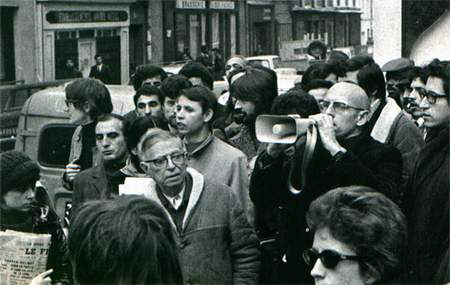
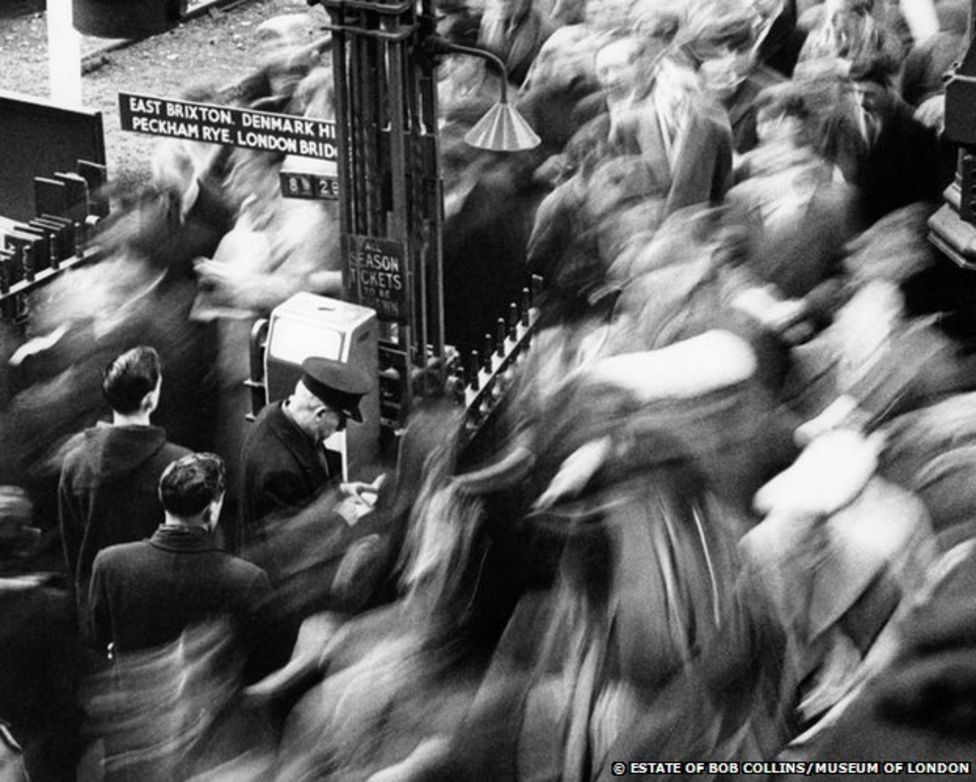
Bob Collins, The Morning Rush Hour, Victoria Station, 1960
Nella Last’s War and The Diaries of Nella Last. Channon wrote for a posterity he assumed would be interested in the placement and menus at his dinner parties, the trinkets he gave to and received from royalty, and his conviction that Neville Chamberlain was right.
Nella Last, on the other hand, was a housewife from the northwest of England; her diary was created in response to a request for volunteers from Mass-Observation, the groundbreaking social research project which sought information about the lives of ‘ordinary’ Britons. She could not have known her submissions to M-O would have a life beyond the study’s archive.
Reading the two in tandem was disorienting. It’s hard to believe—except for a few references by Channon to scarcity of turkeys and competent household staff and an occasional trip by train rather than in his Rolls—that he and Nella Last lived through and wrote about the same war and post-conflict austerity.
Her journals are filled with descriptions of eking out a supply of eggs or cream and the most useful cuts of whatever meat was available, of making rag dolls to sell at the Women’s Voluntary Service shop to raise Red Cross funds or to donate to local hospitals, of being unable for years of fuel rationing to make simple Sunday drives to a nearby lake.
Beyond their historical value, the diaries record someone once plagued by depression and self-doubt (“the rather retiring woman who had such headaches and used to lie down so many afternoons”) blossoming with her wartime volunteer work and with the incentive to record not just her observations of the world around her but of the changes in herself and her relationships. “After all these peaceful years, I discover I’ve a militant suffragette streak in me” and “[I] peel off the layers of ‘patience,’ ‘tact,’ ‘cheerfulness and sweetness’ that smother me like layers of unwanted clothes.”
Nella’s tolerance for almost anything but hypocrites and bullies was particularly welcome after Channon’s spitefulness. She refused to shun unwed mothers, and while she’s not thrilled to see ‘conchies’ (conscientious objectors) on work teams who come to her volunteer canteen, she recognizes their humanity. Despite a single reference to “the ‘Jewish’ stamp’” of dresses gotten off-coupon while clothes were rationed, she describes her religion as “a mixture of wishful thinking and nature worship and a stern belief that God is Jewish” [Ed. — !] and is “astonished at the mistrust and real hatred of Jews, in quite ordinary men on the street.”
Nella was also aware of, and abashed by, what she recognized as her own biases. The local medical community includes several Africans, and she is surprised but pleased to see “chummy” interaction among the nurses of different backgrounds, “as if colour and race were one.” But after a pleasant chat on the street with one of the African nurses, who knows Nella from her hospital volunteer work, “my little happy feeling seemed to sour” at the sight of the white wife and biracial children of the local African eye doctor:
“Whatever the views I hold of ‘some day, one colour, one creed,’ the sight of half-caste children seems to strike at something deep down in me. I say I’ve no ‘colour bar,’ but wonder if I’ve a very deep rooted one. I could work with coloured people, enjoy their society, attend their wants in canteen, fully admit them to positions of trust and service, but know, finally, I’d have died before I could have married one, or borne coloured children. So perhaps I have a colour bar.” [Ed. – Oof, impressive attempt at self-knowledge; also, gross.]
I hope—wherever she is—that she’s not appalled at being read so intently; I would have liked the chance to know her better. [Ed. – A woman worth knowing. Just like you, Anne. Thanks!]
Today’s reflection on a year in reading is by Melanie (Mel) Nicholls. Mel is a bookseller at Barnes and Noble from Georgia. You can follow her on Twitter @nichollsm86 where she often tweets about…books!
I was pleased when Dorian asked to do a write up of my 2022 reading, as I enjoyed reading the entries from last year. My reading in 2022 was mainly fiction in translation and short stories. When choosing what to read I mostly pick up books I think I’ll enjoy. And this past year I definitely succeeded! Here are some of the standouts.
January started strong with two books that are new favorites. The haunting Ganbare! Workshops on Dying is by Katarzyna Boni (tr. Mark Ordon). Boni reports on the March 11, 2011 earthquake and tsunami in the Tōhoku region of Japan and its aftermath. She offers accounts of the effects on survivors such as learning to scuba dive to help find bodies, a gripping account of the Fukushima nuclear disaster, and stories of other devastating earthquakes in Japan’s history. A heartbreaking and timely work. I followed this with the NYRB Classics edition of Edith Wharton’s ghost stories, unsettling and eerily quiet hauntings. A book I could read every year. The novel Written on the Body by Jeanette Winterson and the stories in Cars on Fire by Mónica Ramón Ríos (tr. Robin Myers), continued my excellent streak of reading for the first month of the year.
In February I began the readalong of Dorothy Richardson’s thirteen book sequence Pilgrimage. I really started to click with Miriam’s journey with book three and my top reading goal in 2023 is to finish the sequence. Other highlights include the classic Passing by Nella Larsen [Ed. – GOAT!] and the absolute gem Byobu by Ida Vitale (tr. Sean Manning), two books I’m sure I’ll find new meaning in each time I read them.
In March I read another top book of 2022, Blood Feast: The Complete Short Stories of Malika Moustadraf. These stories about gender and class in society are expertly translated by Alice Guthrie. The outstanding translator’s notes make this a book I hope to study more and highly recommend. April was another strong month with the beautiful novel When I Sing, Mountains Dance by Irene Solà (tr. Mara Faye Lethem) and the terrific History of a Disappearance: The Forgotten Story of a Polish Town by Filip Springer (tr. Sean Gasper Bye). I ended this month with the masterpiece Woman Running in the Mountains by Yūko Tsushima (tr. Geraldine Harcourt) which I often think of with Lolly Willowes by Sylvia Townsend Warner. Both novels portray a woman’s yearning for freedom and Dorian’s podcast One Bright Pod has superb episodes for both books. [Ed. – Thank you! Of course, Frances and Rebecca are the really important members of the team.]
May and June were the months of absolute banger short books:
Yesterday by Juan Emar (tr. Megan McDowell)
They by Kay Dick
Cold Enough for Snow by Jessica Au
Spear by Nicola Griffith [Ed. – Curious to check this one out.]
An Ideal Presence by Eduardo Berti (tr. Daniel Levin Becker)
Permafrost by Eva Baltasar (tr. Julia Sanches)
Violets by Kyung-Sook Shin (tr. Anton Hur)
Pollak’s Arm by Hans von Trotha (tr. Elisabeth Lauffer)
The Employees: A Workplace Novel of the 22nd Century by Olga Ravn. (tr. Martin Aitken)
July’s standout is A Month in the Country by J.L. Carr, a perfect novel. [Ed. – Absolutely agree.] August is one I look forward to every year because it is Women in Translation month. I continued this year with four writers whose translated work I am slowly making my way through: Annie Ernaux, Yoko Tawada, Natalia Ginzburg, and Banana Yoshimoto. Another highlight was the collection Panics by Barbara Molinard (tr. Emma Ramada). Molinard was a close friend of Marguerite Duras and would destroy most of her writing. [Ed. – Thanks, uh, “friend”…] These bizarre and grotesque stories are a must read. Two books translated from Croatian, Call Me Esteban by Lejla Kalamujic (tr. Jennifer Zoble) and Divine Child by Tatjana Gromača (tr. Will Firth) from the new small press of translated fiction Sandorf Passage, were also excellent.
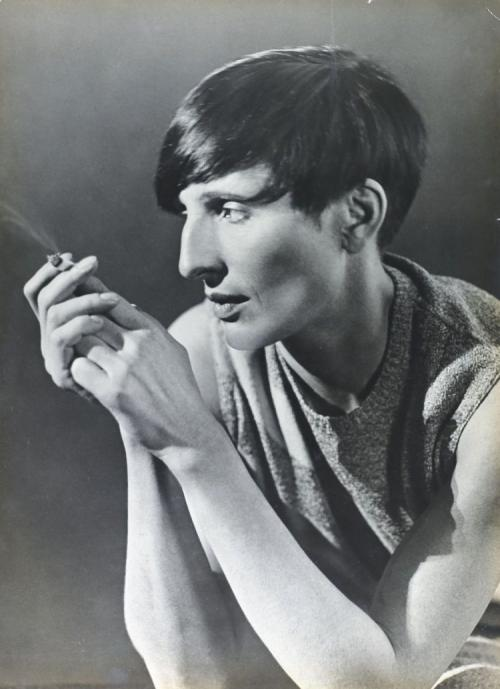
Gerty Simon, Renée Sintenis ca. 1929 – 32
The last few months of the year offered standouts in nonfiction. I love Elaine Castillo’s debut novel America is Not the Heart and she delivers again with the essays in How to Read Now. This book, along with A Ghost in the Throat by Doireann Ní Ghríofa, This Little Art by Kate Briggs, The Missing Pieces by Henri Lefebvre (tr. David L. Sweet), and Voice of the Fish by Lars Horn, left me with a new appreciation for reading, translation, writing, and art. All are books I will come back to often. Other wonders at the end of the year include some short-but-mighty translated novellas: Space Invaders by Nona Fernández (tr. Natasha Wilmer), Baron Bagge by Alexander Lernet-Holenia (trs. Richard and Clara Winston), A Woman’s Battles and Transformation by Édouard Louis (trs. Tash Aw) and Rogomelec by Leonor Fini (trs. William Kulik and Serena Shanken Skwersky). I’ll close with Nettleblack by Nat Reeves, a playful novel of queer awakening among strange crimes in a Victorian rural town.The most fun I had reading in a while, just a joy to read. [Ed. – Sounds great!] My reading has changed over the last couple of years as I have discovered more translated fiction, small press, and Book Twitter. I am excited to see where my 2023 reading will take me and to share the wonders. [Ed. – You’re welcome back next year, Mel!]
Today’s reflection on a year in reading is by Brad Bigelow. Brad writes http://NeglectedBooks.com and edits the Recovered Books series for Boiler House Press.
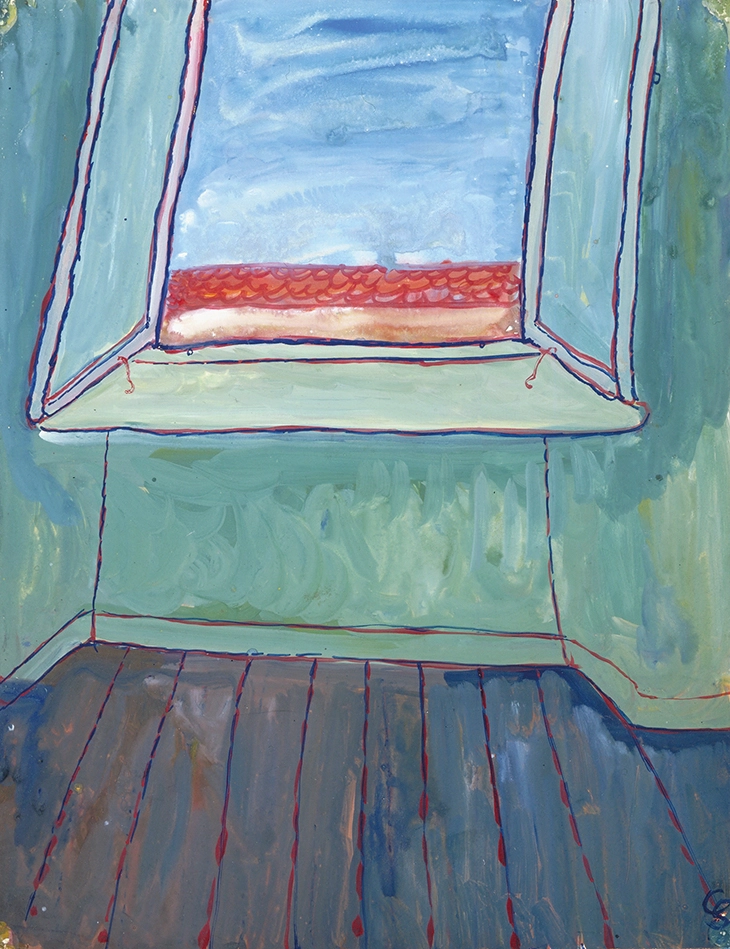
Charlotte Salomon, No. 134 from Life? Or Theater? (1941 – 42)
When I finished college forty-some years ago, I started writing down every book I read in a little spiral notebook. I kept up this habit for over twenty years and then stopped for some forgotten reason. Since starting The Neglected Books Page, most of my reading has been of long-forgotten books and most of these I’ve recorded by writing about them on the site. But as time goes on, I’m falling ever further behind in this writing. And to make matters worse for the purposes of this piece, I keep no record of my non-neglected reading. So, this is a fairly unreliable review of my reading in 2022, but I hope it’s worth your time nonetheless.
(It’s a good thing I never went into marketing.) [Ed. – No kidding!]
Among my neglected reads, easily the most memorable was Charlotte Salomon’s Life or Theater? Although Salomon told her life through paintings, it operates at an unforgettable level of intensity. There are at least three narratives winding through the hundreds of paintings in this book: the psychological breakdown of her family; her own troubled emotional development; and the trauma of Germany, and of German Jews in particular, with the rise of Nazism and Hitler. As I wrote back in April, “the book is presented as an art book – large and very heavy with its hundreds of pages of full-color images. But I think this does the book as a book some disservice. For it can also be seen as a graphic novel.” And I think it would benefit from being repackaged as a graphic novel, since today’s readers are now so accustomed not just to the language of graphic novels but to the very idea of considering them as literature. [Ed. – Absolutely. Her drawings look like they come from a graphic novel, too, as your post with its generous illustrations suggests.]
Easily the most enjoyable was Madeleine Masson’s memoir, I Never Kissed Paris Goodbye.Though we know from its opening line—“It was a beautiful day in June 1940”—that this story will have a sad ending, most of Masson’s account of Paris in the 1930s is as frothy and delightful as a glass of champagne. It’s full of the infidelity, excess, and manic energy of Jean Renoir’s classic film The Rules of the Game, and highly recommended to anyone who loves that film. [Ed. – You’re trying to tell me there are people who don’t love that film? Nonsense! This book sounds excellent, BTW.]
My deepest archaeological dig of the year was locating a copy of Carola Ernst’s Silhouettes crèpusclaires, and then dusting off my French to read it, based on nothing more than a brief reference in a magazine from 1921. This modest account of the journey Ernst took in the Fall of 1914 to return a French officer blinded in an early battle of the First World War to his family is a touching portrait of a world in the midst of a radical transformation. The pair are able to travel via Belgium, Germany, Switzerland, and France thanks more than anything to a spirit of chivalry that had not yet been destroyed in the industrial machinery of the war.
Another highlight was the chance to spend several weeks with some of the many volumes of poetry penned by Raymond Souster, the bard of Toronto. Souster’s longevity and disciplined dedication to his art enabled him to amass an account of one city’s life that may be unparalleled in the 20th century. Souster lived and wrote to the age of 91, worked in the same bank for over 40 years, was married to the same woman for over 60 years, and, as their only child, cared for his parents until they died in their late nineties. Though Souster claims he never wrote any great work (“I’m not sure I’m ready for epics/there are far too many little songs/the rest have left unsung”), the body of his work is sort of an epic in itself. [Ed. – Fascinating! I’ve even lived in Toronto and have never heard of Souster.] Someone needs to go through the thousands of pages of Souster’s poetry and distill it into an autobiography along the lines of what Ruth Limmer did with Louise Bogan’s work in Journey Around My Room.
Finally, I must mention Nina Warner Hooke’s Biff and Netta trilogy: Striplings (1934); Close of Play (1936); and Own Wilderness (1938). These novels follow a half-brother and sister, Biff and Netta, from their early to mid-teens, as their already unconventional and decaying family collapses completely. The first volume received tremendous critical praise and was most commonly compared to the work of P. G. Wodehouse. Warner Hooke said she had no plans for further books at first, but when you finish the trilogy, its narrative arc seems almost predestined. She could no more leave off her story than you could get off a rollercoaster after the first drop. It is deeply strange, not solely because of its theme of incest, and deserves much closer examination than I was able to give it in my post. At 900-some pages, it’s far too long to expect anyone to ever reissue it unless some editor finds the courage to do some substantial posthumous abridgement, but it’s a work that I continue to process months after finishing it.
I tend to rely on audiobooks for my non-neglected reading. For years, I had a daily commute of over an hour each way and I racked up thousands of hours of listening, which enabled me to catch up on many classics I’d skipped. Now, my commute is just a staircase [Ed. – Bliss!], but I still get in an hour or so of listening each day. One of my projects was to go back through the works of Thornton Wilder, who is arguably both recognized and neglected. Aside from “Our Town”, most folks have only a vague notion of what he did, and even the once-ubiquitous The Bridge of San Luis Rey is not a familiar title. Wilder is the only writer to have received a Pulitzer in two genres, fiction and drama, has several volumes in the Library of America, and most of his work never falls out of print for long. I wrote about The Eighth Day, his most ambitious—and, to be honest, most flawed—novel years ago, and loved Heaven’s My Destination and Theophilus North when I first read them. This year, I went back and listened to all his novels in chronological order (an exercise I highly recommend for novelists who particularly interest you), starting with The Cabala.
The experience was both a revelation and a disappointment. I found several of the books suffered from an earnestness that became particularly apparent when considered back-to-back. On the other hand, I was astonished at the innovation of The Ides of March, his novel of Caesar’s last months. It’s a collage of fictional letters, excerpts from actual Latin texts, and even graffiti from the streets of Rome in the first century BC. Why is this book not acclaimed as a milestone in the fictional form? [Ed. – Sounds like time for a reissue?]
Aside from Wilder, most of my listening has been focused on Russian history and literature. I’ve long been fascinated by Russia, even though I’ve deliberately avoided my few opportunities to visit there. There’s something about the darkness of so much of the Russian experience that seems to reassure me that my own life really isn’t all that bad. This might be one of the reasons that I read so many books about Stalin when I was working for the two worst bosses I’ve had to suffer. I listened to two historical surveys by Orlando Figes: A People’s Tragedy, about the Russian Revolution, which occasionally bogged down in the minutiae of political infighting, and Natasha’s Dance, which I would recommend to anyone looking for a historical context to much of the Russian art, literature, and music of the last 200+ years. There were also several biographies—Alex Christofi’s Dostoevsky in Love, Alexandra Popoff’s book on Vasily Grossman, Donald Rayfield’s Chekhov—all richly illuminating. But by far the most enjoyable and impressive listen was Nabokov’s The Gift, which managed to weave so many of the threads from these other books together and remind me yet again of the fact that Nabokov worked at a level miles above so many of the 20th century’s greats.
Of the more recently-published books I’ve read, few really stand out. I found a number of the more acclaimed ones forgettable and will skip over them. Although I’ve read that it’s not the place to start, I loved Annie Ernaux’s The Years, in part because it described a world very familiar to me after 18 years of living in Belgium and working closely with many French men and women. And Gwendolyn Riley’s My Phantoms could have described some of our neighbors on the little street in Norwich where my wife and I lived for two years. [Ed. – Yikes!] I wish I could say that the books I’ve read by American writers were half as evocative, but I guess I’m still getting used to a country that’s so different from the one we left just before 9-11.
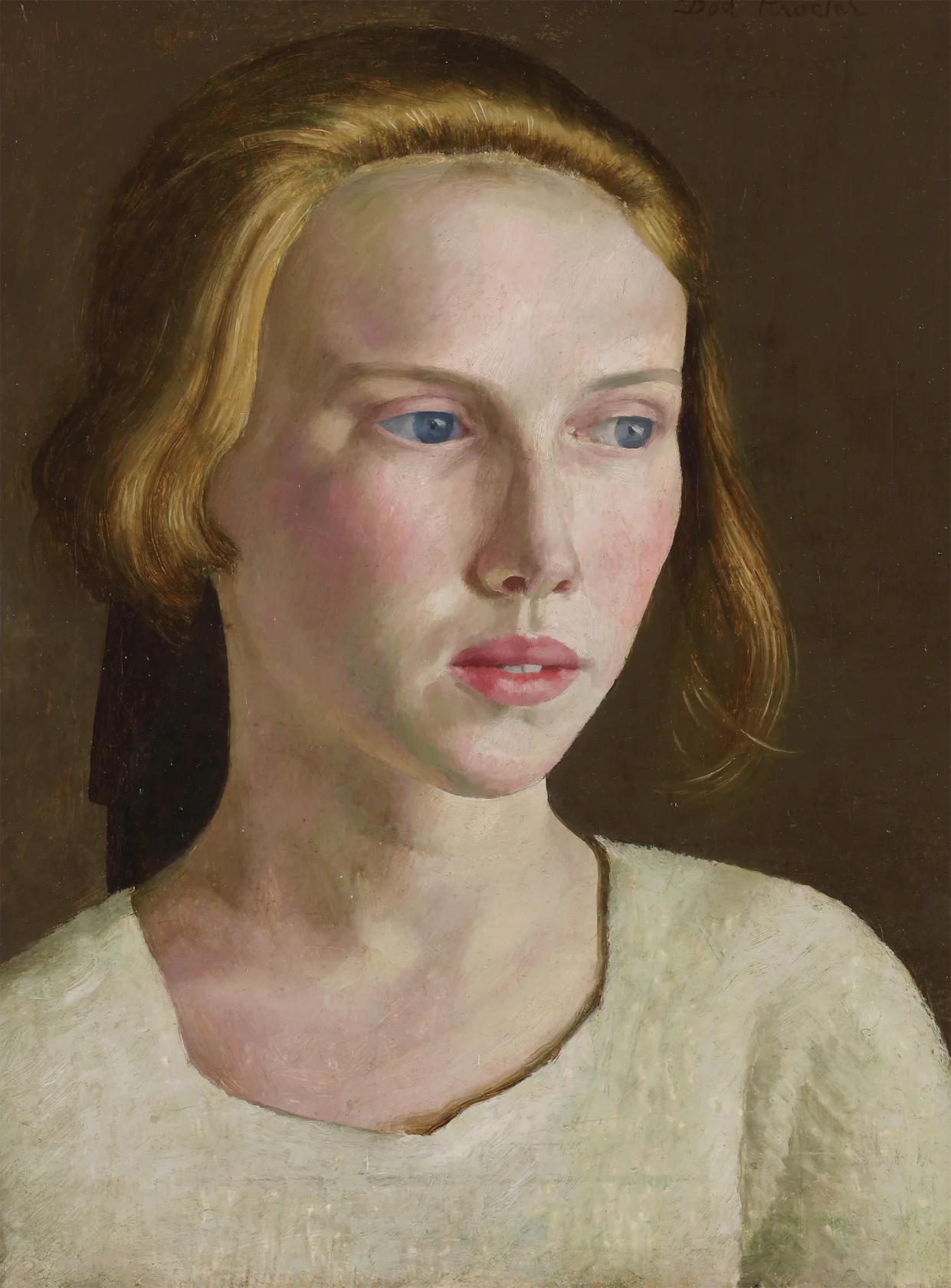
Dod Procter, Lydia, ca. 1926
And it would be remiss of me not to mention the brightest highlight of 2022, which was the #PilgrimageTogether reading group. Starting in January, a group of us worked our way through the thirteen “chapter-volumes” of Dorothy Richardson’s masterpiece, Pilgrimage, aided by a wonderful cast of Richardson scholars who agreed to take part in our monthly discussions. I first read Pilgrimage in 2016 as part of a two-year project of reading only the work of neglected women writers (complemented by two years of only listening to audiobooks by women) and ever since have been an evangelist on its behalf. Not to denigrate Proust, but I find it astonishing that thousands of people read Remembrance of Things Past each year while Pilgrimage, which speaks directly to so many aspects of life that are still part of our everyday world today, is barely known and even less read. Like others in the group, I found Pilgrimage both so challenging and so rewarding that other books seem somehow diminished in comparison. It’s a novel I know I’ll be returning to again — and, I hope, with another group of readers. [Ed. – This is good to hear, since I regret not joining in. It would be great if you could time it with my next sabbatical, thanks.] Until then, I encourage folks to take up Pilgrimage and spend some months with Dorothy Richardson’s insistently individualistic Miriam Henderson, aided by the Reading Pilgrimage website. [Ed. – Thanks for the post, Brad, and congratulations on that site. What a resource!]
Thought I might read some longer books this year. And in fact I have three on the go, all promising. (Which means I’m not making much progress on any of them: more on all that later, maybe.) But I clearly need the feeling of accomplishment that comes from finishing something, because I reached for shorter things on the side.
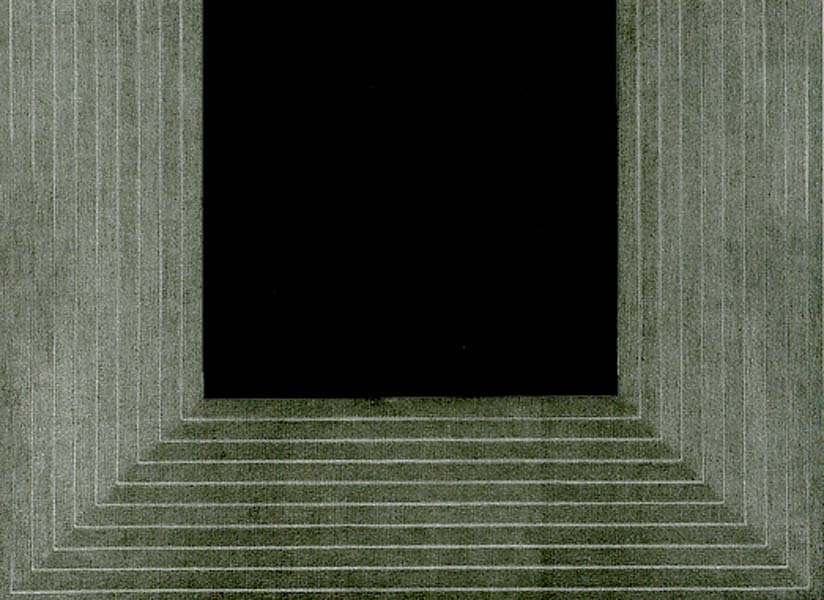
Frank Stella, Lace City, 1962
Stephen Spotswood, Secrets Typed in Blood (2022)
The most recent Pentecost & Parker novel might be the best. A serial killer is plagiarizing crimes from a pulp magazine and staging them in real life. Friction arises between the duo as Parker chafes at an undercover assignment as a pencil-skirted secretary in an advertising agency that is the only lead they have on their long-time adversary. Plus Parker has gotten in deep with the writer of the pulp stories. As Sarah Weinman put it—the NYT crime column has improved greatly since she took over—this delightful series is as much about the present as the 40s. A couple of lines from Pentecost hit home especially hard:
“Once you start picking and choosing what is relevant in a life, you edge closer too picking and choosing which lives are relevant.”
“The world often defines women by the worst thing that’s ever happened to us. … It won’t let us be otherwise.”
Eduardo Halfon, The Polish Boxer (2008) Trans. Daniel Hahn, Ollie Brock, Lisa Dillman, Thomas Bunstead & Anne McLean (2012)
Here’s one that’s been sitting on my shelf for a long time. I’d heard it was a third-generation Holocaust story by a Guatemalan writer, which of course piqued me. That’s not quite what I got, but also not not what I got… The book is about a Guatemalan writer named Eduardo Halfon, frustrated with his students but devoted enough to one who made an impression on him that he tracks him back to his indigenous village when he drops out; enamoured with his girlfriend, who seems equally enamoured with him; captivate by a Serbian pianist who layers Thelonious Monk into his Rachmaninov, and who sends Halfon mysterious postcards practically begging him, Halfon, to search him out, which he does, among the Roma community in Belgrade. And yeah there’s a story about a Polish boxer, told to Halfon by his grandfather, an Auschwitz survivor, who owes his survivor to whispered advice, which the old man no longer remembers, from the eponymous boxer, though, in a late twist, this story may have been entirely made up.
A meandering book that for a while seems aimless but gains coherency: I liked it. And I think the story of the grandfather continues in later books, so maybe I’ll get my wish in the end. But I won’t mind even if I don’t.
Ludwig Bemelmans, Hotel Splendide (1941)
A splendid bauble.
Ludwig Bemelmans was just a teenager when he immigrated to New York from his native Austria, where he had already worked in a hotel in the Tirol owned by his uncle. He got on at a luxury hotel in Manhattan, which in this delightful memoir of sorts, he calls The Splendide—a good choice given that everyone who works there seems to be European. At first, he’s busboy to a waiter named Mespoulets, “probably the worst waiter in the world,” whose three tables aren’t even in the main dining room. Instead they form “a kind of penal colony” to which the maître d’ exiles undesirable customers (cranks, lingerers, bad tippers, that sort of thing). Guests seated at Mespoulet’s tables rarely return. For one thing, service is slow. But that’s just the start of it:
When the food finally came, it was cold and often not what had been ordered. While Mespoulets explained what the unordered food was, telling in detail how it was made and what the ingredients were, and offered hollow excuses, he dribbled mayonnaise, soup, or mint sauce over the guests, upset the coffee, and sometimes even managed to break a plate or two. I helped him as best I could.
What a joy, that last line! I imagine the similarly clumsy Bemelmans just making everything worse. Po-faced but sly, Bemelmans reminded me at times of Robert Walser. In the end, though, he’s both lighter and more attuned to the realities of a career in service than his Swiss literary forbearer. Hotel Splendide is episodic—imagine the New Yorker’s Talk of the Town if it weren’t WASPy and pleased with itself—but there is something of a larger arc, which consists of the author’s climb up the hotel ladder. (He is in fact far more competent than Mespoulets.) Yet for all his success—he eventually gets a good deal on a fast car, and is even able to return to his home town for a visit in style—Bemelans is seldom at the center of events; like the artist he wanted to be—and eventually was, to even greater success; this is the Bemelmans of Madeleine fame, after all, and his spidery drawings grace this text as well, he prefers to observe the foibles of others, whether clients (some jovial, some sympathetic, some downright mean) or fellow employees, all of whom get worked off their feet.
Moving stuff, serious stuff, but best of all funny stuff. I liked this bit, where a guest, an analyst, is enthralled by a medium, nicknamed the Professor, who is regularly hired by the hotel to entertain banquets and other large gatherings. The analyst tracks the medium down after the show, keen to find out what makes the man tick. What, for example, is he thinking about right now?
‘Horses.’
‘Horses? A lot of horses or just one horse, a particular horse?’
‘A horse, a very particular horse.’
‘You’re fond of horses?’
‘No. I hate horses—that is, I dislike them.’
‘Have you had trouble with a horse?’
‘No.’
‘Where is this horse you are thinking about?’
‘The horse is nowhere. This isn’t a real horse. This horse is in a dream.’
‘Oh,’ said Dr Munkaczi, and then, ‘Go on.’
‘I dream of this horse—’
‘You dream of this horse frequently?’
‘Yes. Every night, almost I dream of this horse, and I am very tired the next day.’
‘Ah,’ said Dr Munkaczi, ‘zoologica erotica’
Can’t you just see the doctor’s satisfaction, the confirmation of his monomania?
Do yourself a favour and track Hotel Spendide down. It’s out in perfect new livery from Pushkin Press.
Shola von Reinhold, Lote (2020)
Stunning novel about black queer modernism, reinvention, escaping one’s origins and what it would mean for a book to be trans not just in content but also in style. We talked about Lote on the most recent One Bright Book episode, and had a hell of a discussion. Check it out.
Jamil Jan Kochai, The Haunting of Hajji Hotak and Other Stories (2022)
Stories set in Afghanistan and the Afghani American community concerning the back-and-forth between these worlds. Not for me the masterpiece it is for Wyatt Mason, but unquestionably impressive. The clever stories seem to get the most attention—one told in second person about an Afghani American teen playing a video game that puts him in the position of American servicemen in his father’s homeland, and another structured as a resumé, with the character’s jobs and duties from shepherd in Logar province to company-winning lawn technician in California (until a car wreck leaves him in pain and unemployable). But as good as these are (neither cute nor clever) the ones that tread the line between realism and fantasy impressed me most. The title story, say, in which someone or something (maybe a CIA or NSA operative, but I prefer to think of the narrator as a different kind of spook) falls in love with an Afghani family in exile he has been assigned to haunt. Or “Return to Sender,” an aching tale in which something terrible happens to a married couple, both doctors, who learn that not even their American passports can protect them in Kabul. That’s the one I’ve decided to assign in my class on the short story this semester. Here I felt most strongly the influence not just of someone like Jhumpa Lahiri but the writer she has cited as one of her most important influences: Bernard Malamud.
Lawrence Osborne, On Java Road (2022)
Blotto after the first week of the semester, I needed something that would go down smooth, and neither tax nor insult me. This was just the ticket. Java Road is where English journalist Adrian Gyle lives in Hong Kong. It’s also the site of regular clashes between police and protesters resisting Beijing’s eefforts to crush the place. The novel’s take on current events is refracted through a triangle of sorts between Gyle; his school friend Jimmy Tang, part of one of the island’s richest families; and Tang’s latest love interest, a university student turned full-time protester. Narrated by the outsider Gyle—in full Gatsby mode, complete with knowing allusions—the novel concerns the disintegration of a middle-aged male friendship. Anthony Domestico, from whom I learned about this book in his year-end piece in Commonweal, has it right: more than suspense, more than place, this book has atmosphere: “an introduction to, rather than a clarification of, the frightening haziness of the world.” Recommended for sad middle-aged men (are there any other kinds?), but maybe others too.
Warning: oh my god there’s a lot of drinking in this book. My drinking-less-in-2023 liver throbbed, but in sympathy or envy I couldn’t tell.
Elif Batuman, Either/Or (2022)
Maybe not as funny as The Idiot but still pretty funny:
Of course, you couldn’t have a party without alcohol; I understood that now. I understood the reason. The reason was that people were intolerable. But wasn’t there any way around that? Juho was talking about different research into alcoholism that people were doing in Finland. Why was nobody researching the more direct issue of how to make people less intolerable?
Or this:
All through my childhood, everyone had been yelling, “You’ll hurt your back!” and wrenching suitcases out of each other’s hands, in an effort personally to be the one who hurt their back.
But smart too:
A daunting thought… how would I eventually root out from my mind all the beliefs that I hated?
Either/Or is deeper than the previous novel, more regularly pulling off its signature balance of the naïve and the thoughtful. Batuman has a schtick, but it’s a schtick I like.
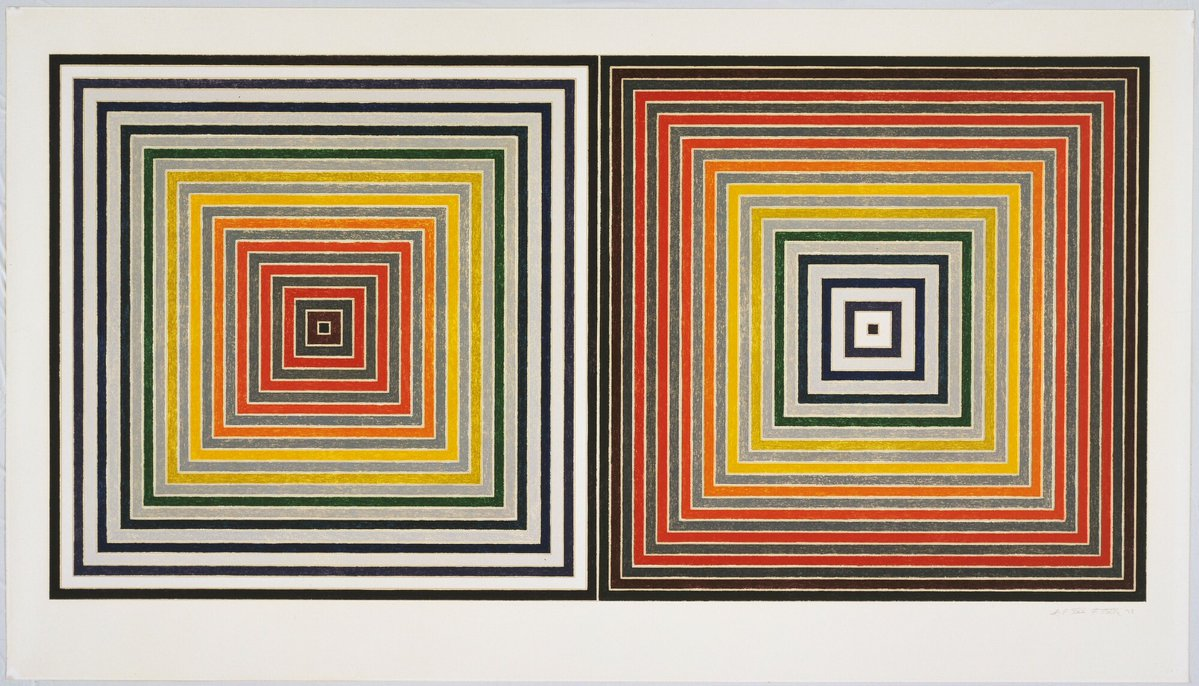
Frank Stella, Double Gray Scramble, 1973
In sum: plenty of good light reading. (A consummation not to be underestimated.) But only Lote and maybe The Polish Boxer are likely to be in my memory a few months from now. How about you all? How was your reading January?
Today’s reflection on a year in reading, his second for the blog, is by Bryce Sears (@BryceSears5). Bryce, one of the nicest people on Book Twitter (which is saying something), is an avid reader and writer who lives in Oakland.
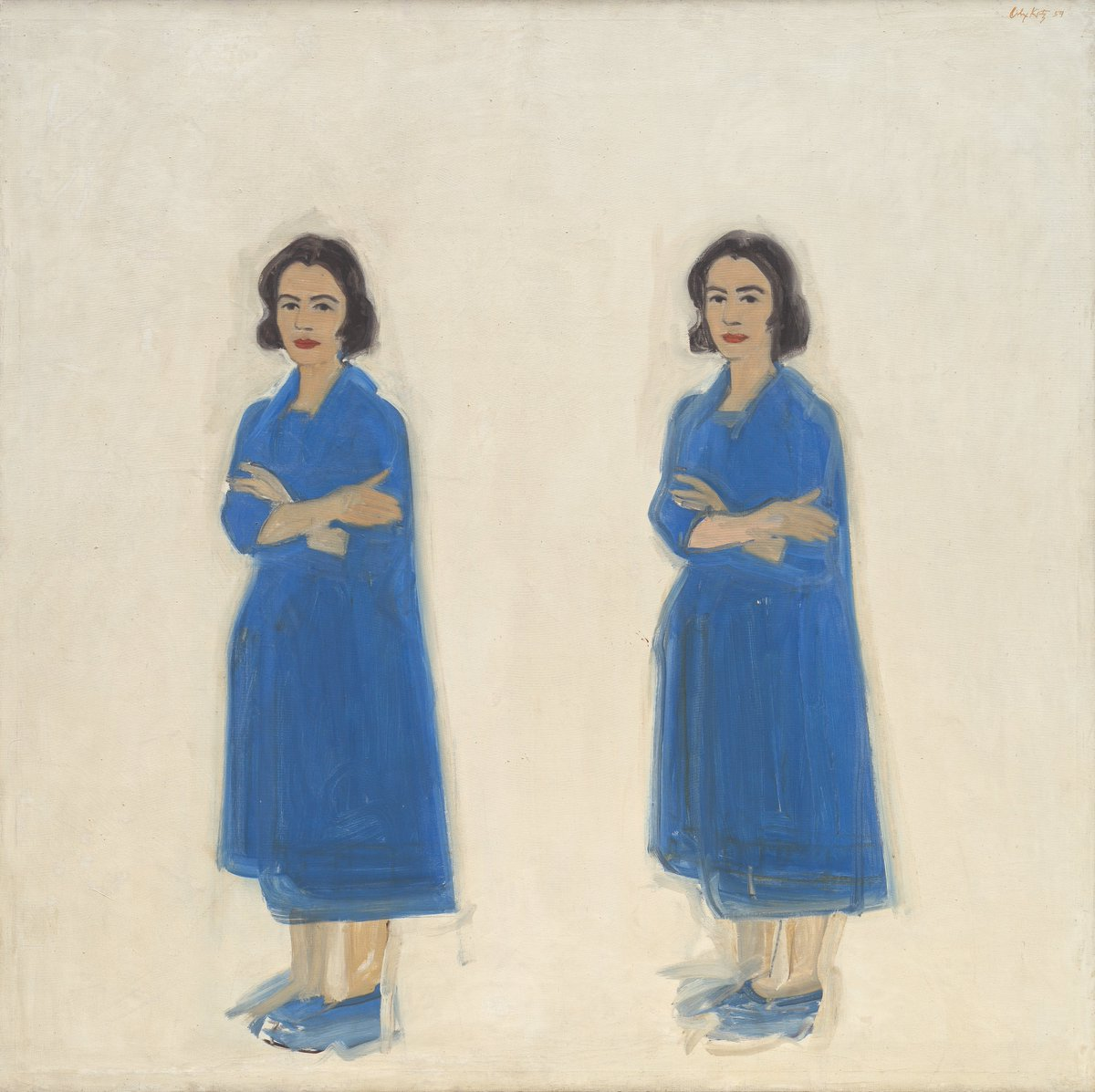
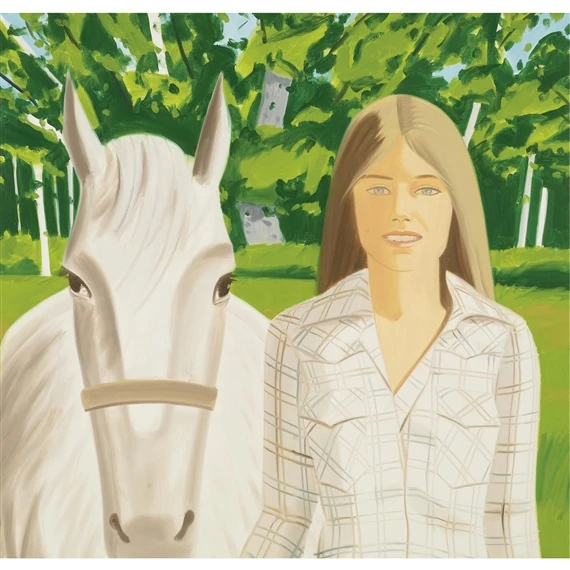
Alex Katz, Ada Ada (1959)
It looks like I read about a book a week in 2022. Notable also that about four books in every five or so I read last year were by women. I favored women writers by about the same margin the year before last, too. I’m not sure why I’ve been reading mostly women. I haven’t planned to do so – not as a habit. Like anyone else, I’m just following my own interests in reading. Years ago, I spent a lot more time reading men, perhaps favoring them by as lopsided a ratio. Months of reading Nabokov, Bellow, Naipaul, Coetzee. So, maybe I’m bringing things back into balance? I wonder too, as I think about reading Fosse and Knausgaard in 2023, if I might be going back to reading more men. We’ll see. It has been exciting reading more women. I think that, not being the primary beneficiaries of a patriarchy, the women I’ve been reading have tended to see the world as more dangerous than did the men I used to read more of.
The Book of Goose, and some other works by Yiyun Li
Yiyun Li and Shirley Jackson top the list of writers I read the most of last year. I had previously read only a little of both. With Li, I had read her second story collection, Gold Boy, Emerald Girl. Then, last year, I read the first collection, A Thousand Years of Good Prayers. [Ed. – I feel like those early collections don’t get enough love these days.] With that, I had a feeling something had clicked for me with her writing. I read her third novel, Where Reasons End, as well as her collection of memoir essays, Dear Friend, from My Life I Write to You in Your Life. These are both pretty somber books. Li has spoken in interviews about her own attempts to commit suicide and she wrote, in Dear Friend, about these attempts. In 2017 her son, at 16, took his own life. She writes, in Where Reasons End, a work of fiction, about a mother’s grieving following the suicide of her son. Toward the end of last year, I read The Book of Goose, Li’s most recent novel and my favorite of hers. More recently, finishing in January of 2023 (I’d like to call this part of a “long 2022”), I read The Vagrants, her first novel, which is very good and very bleak.
I realize this may all make Li sound like a writer of mostly bleak stories. And her work is often quite somber, at least in these books I’ve read. But it isn’t always. The Vagrants, which deals, among other things, with the oppression of free speech in China, struck me as bleak mostly for political reasons. Dear Friend has chapters about suicide, as mentioned, but is mostly about reading (Maxim Gorky, Elizabeth Bowen, Ivan Turgenev, Thomas McGahern, William Trevor, Marianne Moore, among others). The stories are terrific and varied. The Book of Goose is dark and delightful.
I like how Li describes the human predicament. She doesn’t go in much for metaphor. She uses short sentences and short paragraphs. She has written about reading Tolstoy, and her writing can remind me of his in moments when humanity seems to shine out of her paragraphs. I had that sense while reading The Vagrants, especially, but also while reading The Book of Goose. The latter has the feel of a fable. I wouldn’t describe it as a funny book. But it did, like The Vagrants, strike me as having deep wells of humor. Consider its narrator, 13-year-old Agnès, thinking here about her friend Fabienne, and questioning her own belief in god:
Fabienne loved making nonsense about god. She claimed she believed in god, though what she meant, I thought, was that she believed in a god that was always available for her to mock. I did not know if I believed in god – my father was an atheist and my mother was the opposite of an atheist. If I had been closer to one or the other, it would be easier for me to choose. But I was close only to Fabienne. Perturbatrice of god, she called herself, and said I was one, too, because I was always on her side. In that sense we were not atheists. You had to believe that god existed so you could make mischief and upend his plans.
What I love here, especially, is that “If I had…” bit. Yes, it is a little bleak how casually Li has her narrator put her religious belief up for grabs. It is as if Li is saying, Yes, that is how we build our identities. But isn’t that mostly true? And isn’t it funny that we are like that?
We Have Always Lived in the Castle, and some other works by Shirley Jackson
I can’t believe I waited so long to read Shirley Jackson. [Ed. – You’re ahead of me! I know, it’s a scandal.] But here, at last, I’ve made a start. My summer last year was the summer of Shirley Jackson. It wasn’t planned, not (again) as a habit. On a whim, I read We Have Always Lived in the Castle, Jackson’s last novel. I had always assumed it was a kind of haunted house story, like The Haunting of Hill House. Somehow – very likely from the Backlisted podcast, as Castle is the subject of their 52nd episode – I wised up. A house figures prominently in Castle, as in much of Jackson’s work. But Castle is about siblinghood and mass hysteria, not to mention the anxieties of adolescence. It has Gothic elements. It resembles a haunted house story. But it isn’t supernatural. Not in the least. Just a tale about the remnants of your average family getting by after one of them has murdered the others with some arsenic in the fruit salad.
If you haven’t read Castle, don’t wait. I wish I hadn’t. I followed it with a binge. I reread The Lottery, which I hadn’t read in decades. It’s still a knockout. I read The Haunting of Hill House, then The Road Through the Wall, then Hangsaman.Haunting struck me as a little dull, perhaps because its approach has been used so often elsewhere since its publication. I should have read it when I was younger. I liked Road a lot, but Hangsaman came closest for me to the thrill of Castle, which is still my favorite Jackson. I read Dark Tales, another story collection (“The Summer People” is a stunner in that one). I read The Sundial, too, in which Jackson turns her knack for foreboding tension into comedic gold. (Pitch-black comedic gold, if that makes sense.) Another Do as I Say Not as I Did? Don’t sleep on The Sundial.
Somewhere along the way, I read A Rather Haunted Life, the Ruth Franklin biography. It is a sad thing about our time with Jackson, who died in 1965 at age 49, only a few years after Castle was published. Her most popular book in her lifetime – her biggest seller by some margin – wasn’t Castle, or any of the world-famous books mentioned above. It was a book called Life Among the Savages, the best, I gather, of the comical chronicles of everyday family life Jackson wrote for the women’s magazines of her day (another collection of these chronicles is called Raising Demons). I’m not here to speak ill of comical family chronicles. I have copies of both of these books and look forward to reading them. Still, new to her work as I am, aware I’m only the latest of many to have this thought, I can’t help but wish we’d gotten more time with Jackson. I can’t help but wish she had seen her reputation rise based on the books we celebrate her for now, or other books she might have written. Had she lived even into her 80s, she would have been alive and presumably writing in the 1990s. Crazy-making, thinking of what she might have come up with in those years.
The Dominant Animal and Kick the Latch, by Kathryn Scanlan
I read two books by Kathryn Scanlan last year. Earlier in the year, after loving a story of hers (called “As the Dick Would Have It”) in Southwest Review [Ed. – Ok that is a a good title], I picked up The Dominant Animal, a collection of very short stories. I read it quickly and liked it a lot. I’d recommend it anyone who doesn’t need a story to convey a meaning of some sort that is especially clear. Some of the stories in this collection were published, I believe, in Noon, the journal Diane Williams founded. Probably everyone knows this, but Williams is famous for writing very short stories. People write of her stories that they skirt meaning in interesting ways. I find her stories interesting. Her narrators often strike me as shocking, even horrifying. Most of them I find comical. I experience the people in her stories speaking and behaving in ways I think, at first, people never speak or behave in real life. Then, sometimes, I start to think people do sometimes talk and act like that. In any case, even as I think now that Scanlan is portraying characters in a somewhat more realistic way than I read Williams as doing, or intending to do, my read of The Dominant Animal at the time (a somewhat shallow read, I hope I’m making clear, though I hope it may help readers new to her work) was along these lines – that Scanlan was doing a similar sort of thing to what Williams is doing.
Kick the Latch, which I read in September, is a quite different sort of book from The Dominant Animal. It is a kind of novel. A single, first person narrative of the life of a horse trainer named Sonia, a woman Scanlan interviewed whose voice (I’m quoting here from the afterward and the French flaps) she transcribed and amplified and “used to write the book, which is a work of fiction.” In some ways, the book reads like a memoir written by Sonia. It would feel very much like a memoir, I think, if it had included more details that identify her, like her last name. As it is, Sonia can feel at times like an everywoman. That isn’t a bad thing, to my thinking. The book is terrific. Moving, at times harrowing, odd, above all interesting. Scanlan has a wonderfully taught prose style. Producing a book in this way raises ethical questions. I can imagine someone trying this technique – producing a novel based on interviews with a working-class person who doesn’t want credit as a cowriter – in a way I’d consider exploitative. The hosts of the Literary Friction podcast interviewed Scanlan and wondered, as a kind of thought experiment, how our reaction to the book might change if Sonia were suing Scanlan over some kind of misrepresentation. That would change things for me, certainly. So, I count myself lucky nothing of the sort seems to be happening. The book is so good. Just thinking of it again now, I want to reread it. All the while I was reading it, I wished my grandparents – my grandparents! – were alive so that I might convince them to read it. If you knew them you’d get the emphasis. They were open-minded about literature, but weren’t great readers. My grandmother was a big Danielle Steel fan. But they were Texans who retired to a horse-racing life in New Mexico. They could sound at times like Sonia does in Kick the Latch. And the storytelling in the book is so naturally done. My grandparents would have loved it. I bet you would too. [Ed. – Been hearing a lot about this, but this has sold me! Thanks, Bryce.]
In Memory of Memory, by Maria Stepanova (tr. Sasha Dugdale)
I’m a sucker for the “meditation on” label in book marketing. Give me Fernando Pessoa journaling for five hundred pages about nostalgia, and his daily life at the office. Give me Claudio Magris, traveling the Danube, letting its scenery take his thinking where it will. Give me Nathalie Léger, on a three-book quest to understand herself through the lives of other artists. If the feeling of a mind letting itself wander a bit aimlessly thrills you too, you may love In Memory of Memory as I did. The book is a kind of tribute Stepanova is writing to her family. The digressive nature of this tribute may make it difficult to track what exactly is happening to her family. I could find myself losing threads. Still, I didn’t mind. The digressions are wonderful. They’re most of the book. The family history, in some sense, is a frame to support them. Stepanova writes about Sebald and Joseph Cornell, Tsvetaeva, Walter Benjamin, Francesca Woodman, among other writers and artists. She writes about history. Her family had better luck than many other Jewish families did in Russia during the 19th and 20th centuries. [Ed. – Low bar…] In Memory of Memory isn’t about the worst human suffering of those years. It’s about some people who escaped it. This is a source of some tension for Stepanova. She writes with some regret that she had no heroes in her family, that they all “appeared to live utterly apart from grinding mills of the era.” In this sense, the book strikes me a tribute to ordinary people, too, as well as to art and literature.
AlexKatz, Jean Standing (1976)
How can I only have read a book a week last year and I’m still running out of space for this piece? (Because I’m longwinded, that’s how.) [Ed. – Haha I’ll see you and raise you…]
I don’t want to miss saying that I read and loved J.A. Baker’s The Peregrine last year, too – a somber book of perfect sentences. You won’t read it without planning to reread it. It is that good.
I loved Leonora Carrington’s The Hearing Trumpet, one of the funniest books I read last year. Did you know she was friends with Jodorowsky? I didn’t until a few months ago, when someone said so on Twitter (so it must be true). I want to read everything by her now. I want to learn all about her life, too.
I loved Elif Batuman’s The Possessed. Another book that had me laughing. It was one a very few non-fiction books I read last year. I loved Jenny Erpenbeck’s Visitation (tr. Susan Bernofsky), and Magda Szabó’s The Door (tr. Len Rix). I hope to read a lot more of both writers. I read, spread out over most of the year, the seasonal quartet of Ali Smith. I want to read more of her work. And Sleepless Nights – I can’t not mention Sleepless Nights! My first Elizabeth Hardwick. I see a lot more of her work in my future. [Ed. – Thanks, Bryce. So many writers, right???]
Today’s reflection on a year in reading, poetic and stormy, is by Isaac Zisman. Isaac is a writer and editor based in Oakland, CA. Find him on all socials @octopus_grigori and at http://isaaczisman.com.
Ori Sherman, from The Creation (1986)
I confess to having a reticent memory. I keep few records. I should be more organized. Twenty-twenty-two was a year of reading—haven’t they all been? as well as I can recall—and yet I’m not sure it was a year of overmuch finishing. The year began in an overheated apartment in Manhattan. It could’ve been storming. Maybe lightning struck the tall building that everyone knows, everyone sees, the most witnessed building in history, perhaps, but whose name I here elide. A website I’ve never come across before says it was 55 degrees and raining at noon. It says nothing about thunder. I had Covid then, which meant I was on the couch under an old blanket. My partner prepared a small bite of caviar on toast the night before and I remember it only as texture.
I type in “books” into my phone’s camera roll and 534 images pop up. I add “2022” and the number drops to 136. Tapping “see all” brings them up in chronological order and so I can see I began the year with a small stack, my hand gripping the three books together above the sloping parquet of the apartment’s floor.
The first is I am writing you from afar: a novel graphic, by moyna pam dick, a gift from my friend Jared Fagen, a writer and the publisher of Black Sun Lit, the press who released the novel. My favorite page was one of four artful squiggles that appear to have been drawn with a weak Bic pen. Next in my hand is the Pevear and Volokhonsky translation of The Brothers Karamazov by Dostoevsky. I don’t think I made it past Father Zosima this go around. My copy of Crime and Punishment, ibid. trans. etc., sits next to it on the shelf now and I recall that in high school I thought it was a minor victory to take to the cover with a sharpie in order to change FYODOR DOSTOEVSKY into ODOR TOE. [Ed. – Big D would have been proud.] Thank god I left the spine clean. The third book is Janet Malcolm’s In the Freud Archives, in which a post-it note roughly lodged suggests I didn’t progress very far at all. [Ed. – Shame, it’s terrific!] I have the faint impression of a war between critics for mantle of Freud’s inheritance. I remember laughing at that.
Scrolling forward, my phone offers up mostly domestic scenes in which books appear. My partner eating soup at our little table next to the bookcase; the dog sprawled out beneath the same, his toys arranged on top of him in what was probably my idea of a joke; a giant pile of nachos at a friend’s apartment next to an edition of the Hokusai Manga, the astonishing book of figuration, expression, and Edo period garments by the painter of “The Great Wave Off Kanagawa.” In the background, the Los Angeles Rams square off against the Cincinnati Bengals, projected to nearly life size on the far wall. [Ed. – Ah, sportsball!]
On Feburary 2nd, I took a photo of single page of Ulysses (p. 489 in the Gabler edition, I discover, pulling down the book now from a high shelf). I’ve highlighted a name: “Isaac Butt.” [Ed. – Heh.]
Two weeks later I took a picture of String of Beginnings, the memoir of Michael Hamburger, translator of Paul Celan and basis of the character Michael Hamburger in Sebald’s The Rings of Saturn—for no representation can claim more than resemblance. I strikes me that I could steal the title for this little essay.
In March, friends online directed me to Guy Davenport—I’m sure you know these friends, perhaps you can count yourself among them. I picked up a copy of the guy davenport reader, primarily for the story “The Aeroplanes at Bescia,” a glorious assemblage of the fictional lives of Franz Kafka, the brothers Otto and Max Brod, and an atmospherically distant Ludwig Wittgenstein. For some reason, my hardback copy came wrapped in four identical dust jackets. I read around in Questioning Minds, Davenport’s lifetime of correspondence with the critic Hugh Kenner. My used edition of Apples and Pears, purchased later,contains a clipping—the author’s obituary in the Washington Post.
Late May found me in a strange version of a doctor’s office, a sort of wellness situation that goes beyond the purview of this text that I am writing now. The walls are adorned in a garish wallpaper and in my hand is a copy of the Zohar, though I can’t read Hebrew beyond sounding out the letters. I remember we spoke of being and becoming and that the doctor gave an impression of someone coming to poetry for the first time, his mind rigid with math and chemistry suddenly loosened at the core by the concept of metaphor. He liked to imagine beneficent angels, he told me.
On June 5th I bought another bookcase and took the stacks off the floor.
On June 10th I received a copy of Gordon Lish’s Peru from a seller on eBay. It smelled so rank I couldn’t bear to open it.
On June 16th I took a photo of an epigraph. “The first memory is of memory itself” –GIORGIO AGAMBEN. I have no idea to which book this quote attends.
In late June, we spent a week at a rental, a house on the New York State historic registry as it was once the home of Lincoln Barnett, a science journalist and editor for Life Magazine and the first to write a popular account of Einstein’s relativity for an American audience. It is possible that the great man, Einstein himself may have sat in this house, I thought as I leaned, head in hands at the old desk with its view of Lake Champlain and the sweet mildew smell of old books. Next to me sat my stack of Romanians—Mihail Sebastian, Dumitru Tsepeneag, Norman Manea, translations by Philip Ó Ceallaigh, Alistair Ian Blyth, Linda Coverdale. I composed half a chapter of my own book, adrift down a Dâmbovița of the mind.
By August I was reading Fosse again, this time Morning and Evening, trans. Damion Searls. I could not yet return to the Septology, also via Searls, the first volume of which had been my companion in the first weeks of the pandemic. If for Merve Emre reading Jon Fosse’s Septology was “the closest I have come to feeling the presence of God here on earth,” for me it was something different. The particular had exploded into the particulate. I have only been able to open it again now, but that is a reflection for next year. I am reminded, too, of the great Jewish mystic painter Ori Sherman and his series The Creation which depicts the seven days of Genesis. The last image is of the verdancy of the world, fecundity in potentia. God is at rest and emerging from the algal depths, from the swirling mass of green and blue signifying life and growth and wildness and all that is to come, ascends a radiant sphere. But it is neither the sun, nor the light of the world, nor of God, nor the gnostic light of secret knowledge. It is a crowned sphere inchoate, a virus. [Ed. — !]
Finding myself one of the few remaining residents at the end of a writing conference later that month, I laid claim to a stack of books abandoned by the side of a path. One of the novels was The Hundred YearHouse by Rebecca Makkai, who taught at the conference. At that moment, I saw her boarding a van to the airport and rushed over to greet her. I asked for an inscription, something I’ve rarely done. “To Isaac,” she obliged, “who stole this book!”
I returned to Lincoln Barnett’s house on the lake where I read Samantha Hunt’s mysterious essay collection, The Unwritten Book: An Investigation. Two days later, a cyclone descended, its epicenter the little spit of rock and soil on which the house perches above the lake. The windows blew in off their frames. Trees fell. Power lines draped across the road. The event lasted less than a minute, but we were trapped for days. We played scrabble and drank whisky and ate grilled hot dogs, the dented Weber, which the storm had flung across the yard and tipped to the edge of the small cliff at the far edge of the property, being our only method for cooking. I read Amit Chaudhuri’s Sojurn and dreamed of Berlin.
September was spent reading apartment listings. The Covid deals were gone. Rents had doubled, tripled. Our building had sold and was to become condos. We left Manhattan under a brilliant sky and headed back to California. In my backpack came a copy of Javier Marías’s A Heart So White, trans. Margaret Jull Costa, and as we drove toward the west, the smell of wildfire and dry grass, terrible and familiar, returned.
We arrived back in Oakland at the beginning of October, to the place where we’d lived before moving to New York, to the plague house of the first of the Covid years, and, before that, to nearly a decade of our lives. I returned to Bolaño and he carried me through the fall.
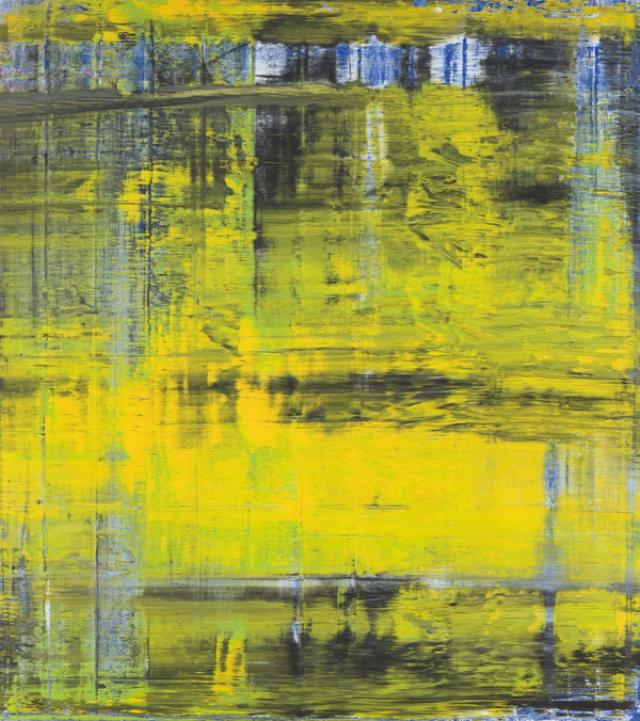
Gerhard Richter, Abstraktes Bild (1994)
There were other things read, I’m sure, though the question of when exactly eludes me. I know, for instance, that I loved Emily Hall’s The Longcut, Jessica Au’s Cold Enough for Snow, Sublunary Edition’s magisterial edition of Marguerite Young’s Collected Poems. That I reread swaths of Hans Magnus Enzenberger’s Tumult, trans. Mike Mitchell, after his passing. That I read a long-travelled copy of Grimmish by Michael Winkler, sat enthralled by Sergio Chejfec’s My Two Worlds, trans. Margaret B. Carson, inhaled December by Alexander Kluge and Gerhard Richter, translation by Martin Chalmers. That I read the fictions of friends, sworn to secrecy until their much deserving publication. That I read essays and poems, criticism, lists of albums, cookbooks, articles, manuals, comics, menus, books of photography, road signs. The work of my new, online companions—how good it feels to have such talented peers. [Ed. – heart emoji] I see the silvered spines of the New Directions Storybook editions on the shelf beside me, I see the bookmark wedged somewhere in the first third of Mircea Cărtărescu’s Solenoid, trans. Sean Cotter—the image of twine emerging from the narrator’s belly button producing a shudder once again. On my desk the piles begin to grow once more—the books I pulled off the shelf to remember, the two translations of Clarice Lispector’s The Hour of the Star, Giovanni Pontiero and Benjamin Moser, respectively, the copy of Annie Ernaux’s Happening, trans. Tanye Leslie, that I read breathless in a single sitting as December closed. And the Septology, arriving again to start anew. It was a messy year, but edifying. What emerges next, I’m not sure.
Today’s reflection on a year in reading, her third, is by Hope Coulter(@hopester99), whom I’m lucky to call a colleague. A fiction writer and poet, Hope directs the Hendrix-Murphy Foundation at Hendrix College.
David Hockney, Nathan Swimming Los Angeles, 1982
2022 turned out to be a good reading year. I got a wider shot at e-book availability by joining a second public library in the adjacent city. [Ed. – “city.”] Then, by pecking through recommendation lists and hopping from screen to screen, I was able to keep my library hold shelves reassuringly filled—staving off that dire malady known as Running Out of Something Good To Read. [Ed. – Extremely bad. Jenny Davidson writes about some psychological studies done on this phenomenon in Reading Style.] Along the way I ran across some new obsessions.
Starting with nonfiction, I enjoyed and was moved by Suleika Jaouad’s Between Two Kingdoms: A Memoir of a Life Interrupted. It’s a cancer narrative that stands out on account of Jaouad’s youth, frankness, and writing chops, as well as the fact that the second half becomes a road-trip book. Jaouad discovered her cancer right after graduating from Princeton. In the flash of an eye the promising, carefree prospect of her twenties became a hellish ordeal. She’s still fighting cancer, and I wish her all the best for recovery. This book is a gift.
Thinking of memoirs by feisty young women, Crying in H-Mart, by Michelle Zauner got a lot of attention this year. For me it was an okay read, but not as memorable as Jaouad’s book. On the other hand, I recommend Lynne Cox’s Swimming to Antarctica: Tales of a Long-Distance Swimmer not for any particular magic in the telling but for the extraordinary nature of Cox herself—her athletic prowess, her ability to connect with people around the world, the cheerful way she greets challenges of all kinds.
Another thoroughly satisfying memoir was Marcus Samuelsson’s Yes, Chef, ghostwritten by Veronica Chambers. Samuelsson is the Ethiopian-born, Swedish-raised culinary phenom who co-founded the Red Rooster restaurant in Harlem. His account of his Scandinavian upbringing; his rise through some of the most demanding restaurant kitchens in Europe, under despotic chefs; and his lifelong love affair with food and culture make this a book to relish on many levels. [Ed. – I see what you did there!]
George Saunders’s A Swim in the Pond in the Rain: In Which Four Russians Give a Master Class on Writing, Reading, and Life is a terrific read for anyone who wants to dive deep into the craft minutiae of great short fiction. What questions does a story ask, and how do they pull us along? Is it what’s left in or what’s left out that makes a masterpiece? Of the analyses Saunders offers, his take on three of Chekhov’s stories were my favorite. On the other hand, if you’re not minutely interested in the technical and creative decisions behind a narrative—the tied-off loops on the back of the tapestry—you might as well just read the stories themelves.
Last but not least in nonfiction, fans of Skyfaring: A Journey with a Pilot by Mark Vanhoenacker, won’t want to miss his latest, Imagine a City: A Pilot’s Journey across an Urban World.Imagine a City includes lots of the lyrical, novel description that makes Skyfaring wonderful, this time swirled into memoir and a flâneur’s takes on cities around the world. By the nature of his work as a long-distance commercial pilot, Vanhoenacker often finds himself with two days to spend near any metropolitan destination that he flies. He bides the mandatory rests in exploration and writing. This book not only features slices of such urban-scapes, but recurring takes on the author’s growing-up in Pittsfield, Massachusetts: the town, his family, his coming-out, and the globe-spinning reveries that led to his vocation.
Now to fiction. One novel that blew me away this year was Julie Otsuka’s The Swimmers. As someone who loves pools and water I was initially attracted to the title and cover (I know, I know, like buying wine for the label; I confess). [Ed. – I strongly support buying books for their covers.] Then when I started to read, I fell hard for the voice. Exactly who is speaking with such quiet authority, unspooling list after list about the lap swimmers with such close, cool knowledge? A crack appears in the bottom of their pool, and it’s like Jane Alison’s Nine Island meets Tim O’Brien’s The Things They Carried… The novel suddenly widens into a more familiar and pain-steeped story that I won’t spoil; sprint [Ed. – missed metaphor opportunity!] to your nearest book source and see for yourself.
My enthusiasm for The Swimmers sent me to Otsuka’s earlier novels, When the Emperor Was Divine and Buddha in the Attic, which in different ways chronicle the experiences of Japanese American immigrants. They’re well worth the read, though to me not consummate in their artistry like The Swimmers.
Way different stylistically from The Swimmers was a book at least as magnificent: Anna Burns’s Milkman, the densest and strangest novel I read last year. A student in my Irish short stories tutorial recommended it, and I’m so glad she did: this book made me understand as never before what it was like to live in the middle of the Troubles, no, to live the Troubles, to contain their gaslighting and violence in one’s marrow. The narrator has one of those unforgettable voices—drenched in idiom, funny, idiosyncratic—that at first seems impossible to understand. There are few paragraph changes, and few characters are called by actual names. All these might put you off, might seem like obstructions to grasping the story… and yet. Somehow it galvanizes a world as you read, a world that tumbles around you and into you, changing you.
Another surprise and pleasure was Mrs. Palfrey at the Claremont, by Elizabeth Taylor, first published in 1971.It opens on a rainy Sunday in January (is there anything more depressing?) in a London lodging hotel just affordable and respectable enough for old folks not yet decrepit or destitute. You might judge this an unpromising start—till you find yourself immersed, riveted by Mrs. Palfrey and her fortunes: the aches, yearnings, miscues, and irritations of ordinary human life, rendered with nothing less than mastery.
Also of seventies vintage was Marian Engel’sBear (1976), which Dorian has touted for years. I loved it: the boreal setting, the understated tone, a fusion of real with surreal that’s so seamless I question “surreal” even as I type it. The book is alluring and disconcerting at once—shoving me into uncomfortable encounters with my own relationships to sex, animals, and self—and resists interpretation at every turn. In fact, it’s highly entertaining to browse through reader takes on this book anywhere from Amazon to scholarly platforms. What is this thing: feminist text, postcolonial critique, an ursine-Canadian Lady Chatterley’s Lover, or a portrait of a “phallic mother”? Don’t miss Dorian’s delightful conversation with Shawn and James on Shawn the Book Maniac, which includes a clip from an interview with Engel herself. Mind you, as the interviewer admonishes, “This is no kinky, porno Pooh-Bear!” so prepare yourself for . . . something else thereof. [Ed. – Music to my ears, natch. But really 70s books are the best books…]
Thanks again to Dorian I reread Lonesome Dove, by Larry McMurtry, and was relieved to find that it still has its magic: it had been so long (or my memory so bad) that the plot twists surprised me all over again. This big novel is good for what ails you, a bracing tonic, just like the big skies and open roads out West. [Ed. – So glad it held up! Every time I see it on my shelf I brighten up a little.]
Jonathan Evison’s Lawn Boy is about Mike Muñoz, a southern California guy who can’t seem to catch the brass ring. His voice is canny, believable, often funny, and a little hoarse with pain, and there’s never a false note or a missed beat narrating his adventures through emotional and economic labyrinths. This is a fresh take on the American dream, as broken down for disillusioned 21st century folks, and it deserves to endure. Highly recommend.
Mercy Street by Jennifer Haigh is a gritty novel that revolves around a Boston abortion clinic where the protagonist works and various other characters who intersect there. I read it before the mid-year overturn of Roe, but it’s at least as relevant now: it remains on my mind for its multidimensional treatment of people on different sides of the abortion issue. Creepy, scary, and all too credible, in the case of a couple of anti-abortionist characters; but as I said, granting a multidimensionality that at least seeks to understand the sources of the venom that animates them. As Mohsin Hamid says, one thing literature does is “recomplicate what has been oversimplified,” and a novelist’s nuance is too often missing from the violent discord around this issue.
Elizabeth Strout’s Lucy by the Sea brings her Oh William! characters forward through the first year of the coronavirus pandemic—moving those inveterate New Yorkers up to Maine. Anyone who has liked Strout’s earlier novels won’t be disappointed.
Speaking of disappointments, even though Emily St. John Mandel’s Sea of Tranquillity made a lot of people’s best-of lists last year, for me it was pretty forgettable—way less gripping than Station Eleven, the post-pandemic novel she wrote a few years before Covid struck. I was likewise underwhelmed by The Flight of Gemma Hardy, Margot Livesy’s attempt at a modern retelling of Jane Eyre. I did finish it, but it annoyingly lacked a couple of key plot underpinnings as well as some of the major elements that make Bronte’s novel so great.
Edward Ruscha, Pool # 9, 1968
Last, and monumentally, I come to a series that dominated the last half of my reading year—and which I’m still devouring as we move into 2023: Michael Connelly’s Harry Bosch novels, which chronicle the LAPD detective’s cases across more than twenty years in L.A. Formerly a reporter, including a last stint on the crime beat at the Los Angeles Times, Connelly is steeped in knowledge of the criminal legal system, LAPD culture, and police-reporter relations—not to mention southern California history and culture in general. So the books take place against a backdrop studded not only with physical landmarks but landmark events, O.J. to Rodney King to Robert Blake to COVID. Oh, and there’s also the iconic food of the greater L.A. area—specific BLTs and tacos and martinis that may have you keeping notes for the next time you make it out to the Golden State with an appetite.
In Heironymous (yes, named after the painter by his mother) Bosch, Connelly has created a laconic, jazz-listening, relationship-tending-to-screw-up hero in the best noir tradition: a SoCal Don Quixote perpetually battling the forces of darkness on his quest to put the bad guys (and women) behind bars. Fortunately, uh, but only for us as readers I mean, in the sweep of the sprawling metropolis there’s no shortage of evil out there for him to take on—from its crumbling bungalows to its gated MCM mansions, from seaside to outlying deserts, and sometimes within the halls of justice and press rooms and inter-warring police precinct headquarters themselves. The writing is spot-on: tough, perfectly paced, with lots of plot and action, of course, and salted just right with description and character. I’ve consumed these books the way I used to read beloved series as a kid, binge-reading with abandon, and now I see with dread that I’m closing in on the end of even the prolific Connelly’s output. [Ed. – Ah, that feeling! It’s really a thing, isn’t it?] He’s written several spinoff books involving sometime partners of Bosch, and a shorter series about a criminal defense lawyer who works from the back seat of his Lincoln, and those are good as well—but alas, they too are finite.
For what it’s worth, I read the series completely out of order, and it wasn’t a problem. When I did make my way back to the first couple of Bosch books, I found them a little stilted and trying too hard on the tough-guy front, in contrast to the grace and understatement of the later ones. In a way, though, the fact that the writing wasn’t impeccable was heartening: it showed that not even Connelly came to fiction-writing already with his skill set complete, but built his command over time. [Ed. — Glad to hear this, because I was underwhelmed by the first when I read it many years ago. Maybe I’ll grab one from later in the series.]
No, I haven’t watched the TV version of the Bosch books, and I doubt that I will; my mind’s-eye picture of the characters is too strong for me to want to sully it with a screen version, even though the author did consult on set. But next time I’m in L.A. I do plan to drive Mulholland Drive, and I’ll be looking for #7203, the modest cantilevered house with the deck on the back, where Bosch gazes down on the lights of the city in pensive moments. I have more to say on this topic, but excuse me, I’d rather go read now. We’re about to find out where the bodies are buried.
Today’s post is from Benita Berthmann (@moodboardultra). Benita studies literature in Marburg, Germany, where she is a full time book enthusiast, part time smoker and occasional existentialist.
Balthus, The Game of Patience, 1954
Once again, Dorian was gracious enough to allow me to write about My Year in Reading 2022, thank you, Dorian, nothing I love more than talking about books!
First of all, the hard facts: In the past year, I’ve managed to read 158 books, which is a bit less than the year before, but in terms of pages, I’ve gone up a bit, having read a whopping 51,308 pages over the course of 365 days. [Ed. – JFC, B!] I’m glad I was able to spend that much time on my favorite hobby and thankful for always being able to find distraction, solace, amusement and everything else I need in books. That is a great gift, methinks. [Ed. – Amen.]
Enough of the boring statistics, which I track via TheStorygraph by the way, on to the more interesting stuff. It is impossible to talk about all the books I’ve read, so I’ve selected a handful of extraordinary texts to talk about.
Dorian and Magda, you are chiefly responsible for this one: BEAR by Marian Engel, which, apart from being a story about loneliness, nature, and Canadian history, features a female archivist having intercourse with, you might have guessed it, a bear. No, that’s not a metaphor. Consequently, Magda (@theruraljuror) coined the hashtag #bärensexbuch on German twitter which means, literally, book about having sex with a bear. God bless German compound words. [Ed. – I only wish English had a handy noun for this important concept.] Apart from our protagonist having sex with a bear, I enjoyed the atmosphere that I’d deem far more important than the plot. It is calm, yet unhinged, something is lurking in the dark, but for now, we’re lingering on a remote island, pleasantly detached from normalcy. Thank you, D and M, for being so adamant about BEAR, it was the perfect read for a hot and hazy afternoon in late July. [Ed. – I love to hear it.]
In 2022, I have also discovered an author that is right on track to become a new favorite of mine: Haruki Murakami. Yeah, I know, totally basic of me, but from the very first page of KILLING COMMENDATORE (German translation by Ursula Gräfe, English by Philipp Gabriel and Ted Goosen), I was hooked. The story about an unnamed painter trying to figure out what to do with his life after having been left by his wife has everything I love: magical realism, mystery and suspense, obscurity, art and culture. The title refers to a painting that plays a major role in the novel and I physically couldn’t stop reading until I knew what would happen. A novel to fall in love with reading and the magic of storytelling if there ever was one.
At university, I took part in a seminar dealing with literature that has been subject to judicial conflict. One of the books we talked about was ESRA by Maxim Biller, which deals with the relationship and subsequent breakup of Adam, a Jewish writer, and Esra, a German-Turkish actress, troubled and traumatized. None of the characters are particularly likeable, nor is the story itself innovative. [Ed. – Really selling this…] What makes the novel interesting, though, is that one can easily draw parallels between Maxim Biller and his alter ego Adam, not least because of the court case following a lawsuit filed by the woman who was clearly the model for Esra and her mother, both of whom claimed that Biller had violated their privacy rights. In the seminar, we talked about to what degree literature can take inspiration from real life, how German courts have decided these questions, and how they came to their decisions, the discrepancy between scholars of literature and of law and, of course, the question whether it was the lawsuit itself that drew attention to an otherwise rather mediocre novel, whether it is – Streisand effect – at least partly the plaintiffs’ fault that they found themselves subject to public scrutiny. To this day, the novel remains forbidden in Germany, a decision made by the highest German court, and it is nearly impossible to get one’s hand on a copy – except if you’re reading it “for scientific reasons” as we did in class. Unfortunately, I am not allowed to pass on the text, sorry, folks. [Ed. – Fascinating!]
One of the authors I revere most is Simone de Beauvoir, ever since I read The Mandarins almost five years ago. This year, I finally managed to read the second part of her autobiography, THE PRIME OF LIFE (German translation by Rolf Soellner, English by Peter Green). The story begins right where the previous volume, Memoirs of a Dutiful Daughter, left us: It’s the late 1920s, de Beauvoir studies philosophy, hangs out with Sartre, they become the founders of existentialism and important public figures in France after having made their respective debuts as writers. They survive the war; the book ends in 1944. I loved reading about the extraordinary life of an absolute fucking legend, an intelligent woman; her philosophy and clever wit allowed my thoughts to flourish while reading and I felt incredibly enriched afterwards. Not just from an intellectual perspective, either. Fun and the absurd aren’t neglected either. For example, the book involves an incident where Beauvoir and Sartre encounter a woman smoking a cigarette with her vagina during their travels. [Ed. – But how is that…] Oh, how I long to be THAT cool. [Ed. – Still struggling with this one, B.] In 2023, I really need to read the two remaining volumes of her autobiography.
Balthus, from the series Mitsou, 1919
Even though I’m too lazy to write about them in detail, a couple of books and authors that deserve at least an honorable mention:
First and foremost, Thomas Bernhard, my most-read author 2022, and also my favorite rage-mode Austrian. [Ed. – Hell yeah!] If you need the healing powers of incandescent rage, Bernhard is your man. I’d especially recommend the drama HELDENPLATZ (English translation by Gitta Honneger) that talks about the Austrian Nazi past kept secret.
ON EARTH WE’RE BRIEFLY GORGEOUS by Ocean Vuong. Has queer prose ever been more thoughtful, more touching, more well-written? I doubt it.
LAPVONA by Ottessa Moshfeg wins the prize for the most disgusting book in 2022. Not much else to say except steer clear of it if gore, organs and cannibalism upset your stomach.
EMPIRE OF PAIN: THE SECRET HISTORY OF THE SACKLER DYNASTY. I am pretty sure that Patrick Radden Keefe is the best contemporary non-fiction writer there is.
Marlene Streeruwitz, an Austrian feminist writer. When will her work finally be translated? Looks like I need to take care of that. [Ed. – Yes you do! That would be a real service.]
The PERCY JACKSON series by Rick Riordan, he is sort of an unproblematic JKR.
Last but not least, Julia Kristeva’s REVOLUTION IN POETIC LANGUAGE (English translation by Margaret Waller, German by Reinhold Werner) deserves the final spot on my list, even though I have not fully finished it in 2022, just because she made me lose my mind. [Ed. – Do Powers of Horror next!]
For 2023, I hope we will all make enough time for reading and find new favorites. Never stop reading. Let’s hope Dorian continues this series for many more years to come so that we have an excuse to create never ending TBR stacks. [Ed. I don’t think anyone reading this needs my say-so to create a giant TBR… Thank you, Benita!]
still hope to write up my reflections on my 2022 reading year. (Though look how well that worked last year…) In the meantime, I’ve solicited guest posts from friends and fellow book lovers about their own literary highlights. Today’s post is from Nat Leach, who used to be a specialist in 19th century literature, but now writes exclusively for this blog (exactly once a year). [Ed. – Exclusive content, y’all!] He lives and works in Peterborough, Ontario, and tweets sporadically about literature and film @GnatLeech
Look for more reflections from a wonderful assortment of readers in the days to come. And remember, you can always add your thoughts to the comments.
Charley Harper, Red-tailed Hawk
Regular readers of my yearly round-ups (if any such there be) [Ed. – hell yeah!] will recall that shortly after joining Twitter, my new year’s resolution in 2018 was to complete all the partially-read books on my shelves by proceeding through them in alphabetical order. At the time, I thought of this as a five-year plan, but exactly five years later, I find myself only about halfway through, as the plan has expanded to include a good many newly purchased books as well, though my original alphabetical progression continues. So my five-year plan is now a ten-year plan, but the main thing is that I’m still reading a lot of good books, and making headway through those books that have been staring reproachfully at me from the shelves for many long years. For those keeping score at home, I have now completed 158 of the 289 books currently on my list (but of course, the list keeps growing).
Despite the arbitrariness of my system, each year gives me something to reflect on regarding my reading tendencies. In this case, my most significant reflection is simply that, when it comes to reading, I am who I thought I was: a reader of classics and obscure older texts who frequently struggles to get on with more contemporary fiction. My most inspiring reading experiences of the year were re-reads of The Iliad, The Odyssey and Moby-Dick, while, under the influence of the many good people of Book Twitter, I experimented with more contemporary fiction that I usually do, with mixed results. There were a couple of big winners (Ishiguro’s Never Let Me Go and Kertész’s Fatelessness) but I found that many other highly-recommended late-twentieth/early-twenty-first century books just didn’t do much for me. So, it’s not exactly a revelation, and I’m not complaining; after all, it’s not entirely a bad thing to have one’s choice of lane confirmed, and it’s probably too late to change myself anyway. Even so, I don’t see myself shying away from contemporary literature altogether; I do value my Twitter interactions, as there are many wonderful authors I probably wouldn’t have found on my own, although I may now take a closer look before plunging into anything written within the last 50 years or so. [Ed. – Honestly, this seems wise…]
In terms of the bigger picture of my project, after two years of spending an entire year on a single letter (who knew that G and H would be so much work?), this year, I finished off H, flew through I and J (mercifully short shelves!) and got started on K. Here are synopses of what I read:
Hines, Barry – A Kestrel for a Knave (1968)
I picked up this book after watching Ken Loach’s film adaptation, Kes, for the fourth or fifth time and wondering why I had never read the source novel. I discovered, unsurprisingly, that the book is equally great, and that the film is quite a faithful adaptation. Both tell the story of Billy, a working-class Yorkshire youth with an abusive brother, an absentee father, and a neglectful mother, who captures and trains a young bird of prey. The one significant difference I would note between the novel and the film is that the protagonist has slightly more agency, resourcefulness, and expertise in the book than in the film. Loach’s intention seems to be to show that Billy’s victimization by the social structure—embodied especially in the bullying he suffers at school, both from other students and the teachers—is essentially an inescapable result of his class position, while Hines shows some very brief glimmers of hope for challenging the oppressions of the system. The book’s ending, which includes a somewhat surprising (given the gritty realism of the rest of the book) fantasy sequence, also differentiates it from the film.
Holcroft, Thomas – Hugh Trevor (1794-97)
I went on a bit about Holcroft last year, when I read his Anna St. Ives. Hugh Trevor is another didactic novel clearly intended to illustrate Holcroft’s theories about human perfectibility. The book is a bildungsroman that draws in parts on Holcroft’s own life and career, including his experience as a playwright and his imprisonment on charges of sedition. The protagonist goes through a series of adventures, incidentally touching on just about all the careers thought appropriate for a gentlemen at that time (the church, law, politics—only the military is missing, rejected from the start as too barbaric), each of which is exposed as corrupt. Trevor learns the necessity of controlling his passions and exerting his reason. One of the great scenes in the novel is a riff on the Gothic, as Trevor and his companion, wandering in a stormy night, believe themselves to have stumbled on a den of murderous bandits, only to discover they are very mistaken. Enjoyable for the most part, although Holcroft’s invention seems to fail him at times, as Trevor is coincidentally in the right place at the right time to come to the rescue of the heroine on three separate, but very similar occasions involving runaway horses and imperiled carriages.
Holtby, Winifred – Anderby Wold (1923)
Holtby’s first novel anticipates her posthumously published masterpiece, South Riding, in interesting ways. Most significantly, they are connected by her detached representations of social class; we see all her characters as rounded individuals, not as representatives of a particular class position. Mary Robson, the protagonist, is a farm-owner with a very maternal—and proprietary—attitude to the townsfolk, an attitude that some, like Michael O’Brien, whom she nursed in sickness, reciprocate with unthinking obedience, and others, like Coast, the schoolmaster, whose career growth she stunted, strongly resent. David Rossitur is a young socialist who strikes up a friendship with Mary but warns her that he will have to rouse the villagers against the values she represents, which he proceeds to do. Holtby invites us to like both characters, but also to see their flaws. Mary is dissatisfied at heart and using the love of the villagers as a crutch, while David is schooled in Marx, but lacks any concrete understanding of farming or the men whose minds he is trying to change. By the end of the novel, we get some hints of Holtby’s own sentiments, but we never feel that Holtby is didactically steering us towards a particular conclusion, which is perhaps why the book feels so satisfyingly ambiguous in the end. [Ed. – Well, this sounds good!]
Homer- The Iliad and The Odyssey (trans. Robert Fagles)
I hadn’t read Homer’s epics since I was a child, so I thought it was about time to revisit them. There’s not much I can add in terms of praise of The Iliad’s literary merits, classic as it is, but I sure did learn a great deal about the ancient arts of hand-to-hand combat, such as:
If you defeat your opponent, just stop in the middle of the battlefield and strip his armour from him; sure, there’s a really good chance you’re going to get picked off by a spear or arrow while you’re doing it, but you can’t just let the shiny bronze breastplate go. [Ed. – I mean, that shit doesn’t just grow on trees.]
Even if you’re carrying around powerful weapons specifically designed to optimize your attack on the enemy, sometimes you’ve just got to pick up a big honking boulder and throw it at someone. You wouldn’t think that would work very often, but apparently it does. [Ed. – BHB FTW!]
Before engaging in hand-to-hand combat with your enemy, be sure to tell him your entire life story. There’s absolutely no way something bad could happen to you while you’re doing that. [Ed. – Reasonable.]
The Odyssey, of course, presents its violence in a very different way; by the time I reached the inevitable bloodbath at the end, I was rooting for it to happen. Much of that has to do with the narrative brilliance of the work. While reading Bernard Knox’s impressive introduction to my edition, which touches on so many of the important events and themes of the poem, my main thought was: “how on earth is Homer going to cram all of those many, many events into a book that is actually 100 pages shorter than the Iliad?” But somehow, it does not feel rushed, the narrative switches smoothly between the parallel narratives of Odysseus and Telemachus, with multiple time frames and stories within stories all driving towards the necessary conclusion that we know is coming but is still so thoroughly satisfying. It’s just sheer narrative pleasure.
Hornby, Nick – About a Boy (1998)
Having read High Fidelity last year, I had a pretty good idea of what I was getting into: another book about a male protagonist approaching middle age without a clue about how to maintain a stable relationship. There’s even a cheeky Hornby-verse cross-over towards the beginning of the book when this book’s protagonist, Will, meets a woman in Championship Vinyl, the record shop owned by Rob, the protagonist of High Fidelity. In the end, I’m not sure if I enjoyed this book quite as much as the previous one; for one thing, Will comes off as less redeemable than Rob—the book’s premise is that he invents an imaginary child to help him pick up women at a single parents’ support group—and for another, the book’s third person narration distances us from Will in a way that makes it harder to root for the redemption of his flawed masculinity in the same way that Rob’s first-person narration does in the earlier book. In the end, though, Hornby has a wonderful, sardonic sense of humour, especially apparent in the dialogue sequences between Will and Marcus, the awkward 12-year-old boy who challenges Will’s world view.
Hugo, Victor – Hernani (1830) Trans. Camila Crossland
According to the introduction of my edition, every play that Hugo wrote has been adapted into an opera. Reading Hernani, it’s not hard to see why; every plot development, every emotion, is huge, theatrical, and melodramatic. The plot revolves around three men—a king, an outlaw, and an aged nobleman—who love the same woman. The plot twists and turns are endless, and the circulation of debts of honour and their transference, deferral, and repayment, culminating in suitably excessive climax, is quite dizzying. In short, it is all a wonderfully grand spectacle; not, perhaps, for everyone, but bound to satisfy lovers of opera, melodrama, and spectacle.
Ibsen, Henrik – Peer Gynt (1867), The Wild Duck (1884), The Master Builder (1892) Trans. Rolf Fjelde
It may be banal to say that a work of literature changed one’s life, but the performance of Peer Gynt that I attended at Brock University when I was a teenager was certainly one of the most influential artistic experiences I have ever had. [Ed. – Same thing happened to me with Glass Menagerie, though it’s surely the lesser work.] Possibly, I was just the right age for it, but even re-reading it now, there is something enduringly powerful about Ibsen’s attack on the Romantic cult of selfhood. So, maybe it’s not a coincidence that I have spent my academic career studying theories that challenge conventional ideas about how the “self” is understood and represented.
As for the other plays, the rather random selection I dipped into suggests something about the development of Ibsen’s dominant themes from the early Peer Gynt through to the later period of The Master Builder. In the earlier play, Ibsen satirizes the Romantic ego through a parable that connects this obsession with “being oneself” with destructive (troll-like) masculinity which both supports and struggles with the strictures of a repressively moralistic society. As Ibsen moves from parable to realism, in The Wild Duck, these themes become embodied in the titular animal, a wild creature that is shot, but not killed, because of the failing eyesight of the flawed patriarch, and cared for by the young daughter of the man who has been married off to the patriarch’s former mistress. Within the realist context of the play, virtually every character is at some point likened to this multi-layered symbol: victim of patriarchy, survivor of misfortune, helpless dependent, enabler of fantasy, et cet. Finally, The Master Builder, while not devoid of this level of metaphor and fantasy (the trolls make a comeback!) reads as a much more complex exploration of the abnormal psychology of its characters. Hilda, the woman who comes to visit the master builder and his family, comes across as almost an analyst figure, bringing the neuroses of the family to the fore and precipitating the final crisis of the play. It feels like a very Freudian play, written just before the rise of Freudianism.
Imlay, Gilbert – The Emigrants (1793)
This one had been on my shelf for a long time—I remember picking it up the year of my first real teaching gig—and I’m sure I was mostly attracted by Imlay’s notoriety as the American who fathered a child with Mary Wollstonecraft [Ed. — !], then abandoned her [Ed. — !!], causing her to attempt suicide twice [Ed. — !!!]. This is an epistolary novel with a clear ideological point; England, the “old country,” is a place of corrupted values while the settlers of America embody a utopian opportunity to reconstruct relationships and communities. England’s backwardness is especially seen in the near impossibility for women to obtain a divorce, and the double standards that bind women to worthless men. [Ed. – Sounds like dude knew what he was talking about.] The plot provides numerous examples of the injustice of England’s laws, as opposed to the freedom of America. The problem, though, is that the book really isn’t very good; the plot events are perfunctory, related with very little sense of dramatic action, and the epistolary structure feels very contrived—to the point where one letter-writer tells his story not all at once, but in a series of letters… not unlike the chapters of a novel. Moreover, even Imlay’s attempt at some kind of early feminist point falls flat; the women of his novel are still prizes to be won and objects to be rescued. I’m sure Wollstonecraft was not impressed. Still, it was interesting to read during a tumultuous year for women’s rights in the U.S.A., especially with much rhetoric flying about what the founding fathers intended in creating the country’s Constitution. Imlay’s point in this novel is that America represents the potential for change and freedom, and freedom is defined as not being ruled by the outdated laws of the past (i.e. those of England). Ironic, then, that many Americans are citing the very people who rejected the idea that the past should be allowed to impose laws upon the present in order to justify doing precisely that.
Ionesco, Eugene – The Killer (1957)
I read this as a student and loved it. Revisiting it, I found that it has not lost any of its power. The plot—such as it is—revolves around Berenger (Ionesco’s perpetual everyman figure) visiting a “radiant district” in the city, a wonder of modern urban planning, only to discover that a killer has been luring its inhabitants to their deaths and drowning them in a fountain. The play is both absurdist and grim, leading towards a harrowing, existential conclusion. The dystopian world of this play feels as relevant as when it was written—if not more so.
Ishiguro, Kazuo – Never Let Me Go (2005)
Having never read Ishiguro before, I was uncertain what to make of the science-fiction sounding plot synopsis of this book, but by the end of the book, I realized what a clever ruse it is; you keep turning the pages in hopes of understanding the thing, the sci-fi concept that finally explains the truth behind the characters’ lives, only to run aground on an explanation that is anti-climactic (to the characters as well) and even slightly ludicrous (our very curious protagonists spend years in the outside world without learning some very basic information about themselves that appears to be generally well known to the public). In short, it’s a textbook example of what Hitchcock would call a “MacGuffin.” Because then you realize that none of that actually matters very much; even the moral questions characteristic of the science fiction genre, while pertinent, are not the point. Rather, what you get is a finely crafted narrative about the nuances of human relationships and a low-key reflection on the human condition and the inevitability of mortality. In the end, probably my favourite book of the year.
Henry James – The Tragic Muse (1890)
I originally picked up this book at a time when every book I was reading seemed to have some variety of “tragedy” or “tragic” in the title. I realize it’s one of the lesser-read James novels, but given my ongoing interest in 19th century theatre, it continued to hold an interest for me. Picking it up again, I struggled to figure out exactly why it has been so maligned over the years; the rap against it is that it is “un-Jamesian,” and I’m not sufficiently familiar with his oeuvre to be a great judge of that, but I also wonder whether its lack of popularity has something to do with the way it treats art. For one thing, 19th century theatre was largely seen as a form of popular culture rather than art, and its practitioners were considered socially “low” (a problem that the novel itself engages with, but still could have prejudiced many contemporary readers). For another, characters in the book debate questions of art directly and at length; James even includes a character—Gabriel Nash—who comes off as a stand-in for Oscar Wilde, and who makes the case for a thoroughly aesthetic view of life. But for the most part, the life/art debate is played out amongst the novel’s three main characters: Nick Dormer is torn between wanting to be a painter and to follow in his father’s political footsteps. His cousin, Peter Sherringham, is a diplomat with a love of the theatre. Miriam Rooth is an aspiring actress who attracts both of them, and becomes the subject of the titular portrait, posing for Nick as the “tragic muse”. Each character is pulled between their artistic aspirations and their worldly realities and duties in ways that are not always tragic, but certainly involve the necessity of finding an appropriate compromise between them. Meanwhile, the discussion of “art” is further nuanced by the differences between Nick’s painting—a solitary, peaceful, but largely unprofitable pursuit—and Miriam’s acting—a communal, chaotic, and very public process that nevertheless brings her fame and money.
Jansson, Tove – The Summer Book (1972) trans. Thomas Teal
Perhaps the most unanimous opinion I have ever seen expressed on Book Twitter is a love for this book (although outrage over Bob Dylan’s Nobel Prize might run a close second). Superlatives abound, with nary a dissenting voice, which almost made me feel guilty that I didn’t like it more than I did. Which isn’t to say that I didn’t like it—I really did—just that for me it didn’t quite live up to the high bar of praise that it was given. And maybe I’m missing the point; part of what is great about the book is how unassuming it is in its simple vignettes about a young girl and her grandmother living on a small Scandinavian island. [Ed – Totally!] This scenario could produce a book that is excessively sweet and idyllic (and frankly, these days, the prospect of living on a remote Scandinavian island sounds pretty darn idyllic) but, as Kathryn Davis points out in her astute introduction to the NYRB Classics edition, the crucial fact, easily neglected as it is only mentioned once in passing, is that the girl’s mother has died. The book is very quietly about the act of mourning and working through, with the grandmother and the island itself both supporting and frustrating those efforts. There is always a darker side to the relationships described. [Ed. – Ok, I thought we were heading for a smashup in our friendship, but all is well now.]
Jerome, Jerome K. – Three Men in a Boat (1889)
By contrast, this is one of the most divisive books I’ve ever seen discussed on Book Twitter; some declare it the funniest thing they’ve ever read, others are unable to get past the first few chapters, and still others declare that it is good, but the sequel (Three Men on the Bummel) is even better. After reading it, I can understand the extreme variance of points of view; while I did find it very funny, I can see how the “shaggy dog” style of narrative could frustrate some readers. For one thing, Jerome seems unable to tell a joke just once. To wit: the narrator says, “I like work; it fascinates me. I can sit and look at it for hours.” This pithy, almost Wildean epigraph made me laugh, but the narrator proceeds to riff for three paragraphs, saying things like “And I am careful of my work, too. Why some of the work that I have by me now has been in possession for years and years, and there isn’t a finger-mark on it.” Still funny, but by the law of diminishing returns, it loses some of its impact. Nevertheless, there are some wonderful comic bits; the story about the fish on the wall of an inn that every local who comes in claims to have caught, is my favourite. I should also add that the book works quite well as travel literature too; even though my edition of the book did not have a map (boo!), I found myself compelled to get one out and trace the journey taken by the three men (and a dog) up the Thames from Kingston to Oxford. [Ed. – ALL books should have maps. God, I love a map.]
Jin, Ha – Waiting (1999)
This is another book that came highly recommended but got a very mixed reaction from me. The premise is engaging; a doctor in China’s revolutionary army is married to one woman (a loveless marriage driven by family obligation) but in love with another. His attempts to get a divorce are continually deferred (hence the title). I had no trouble getting into the book, and I found the characters convincingly drawn for the most part, although the good-natured long-suffering wife felt like a stereotype. But the deeper I got into it, the less convincing it felt, and the end was hugely disappointing. It seemed to me that there was much potential for the book to develop this basic situation in many different directions; for example, the opposition between the traditional wife from the protagonist’s rural village and the urban modern woman he loves seemed to be setting up some kind of reflection on China’s changing cultural landscape, but the book didn’t explore the topic. More significantly, I expected the book to reflect on the nature of human desire; how does the protagonists’ relationship alter over this extensive period of waiting? While it does show the answer to this question, the conclusions it comes to feel over-simplistic and inconsistent with what has come before. The ending left me feeling grumpy, and as time has gone by, the grumpiness has increased rather than decreased, which I think is a telling sign.
Jones, Lewis – We Live (1939)
As a graduate student, I read Jones’ Cwmardy, a semi-autobiographical novel about a youth, Len Roberts, growing up in a mining town in south Wales in the early 20th century. I liked it a lot, and was inspired to seek out its sequel, which tells of Len’s involvement in the labour struggles of the 1920’s and 1930’s. The book interestingly traces out the ideological complexity of these times; Len joins the Communist Party, and clashes with Ezra Jones, his wife’s father, a long-time leader of the miners, who nevertheless adopts a more conciliatory attitude towards the mining company. Like its predecessor, We Live interweaves the lives of the people with their political struggles in a way that drives home the point that these are inseparable facets of the workers’ lives. I only wish that I hadn’t waited 20 years between reading the two books.
Jones, Lloyd – Mister Pip (2006)
Although this is the most recent book I read this year, having been written only 15 years ago, it did make me think about how values have changed even in that short time. In particular, I can’t help wondering whether a book by a white man with a black, teenaged girl as the narrator and protagonist would be heralded as much as this book was if it had been written today, although I would also hasten to add that the possibilities and limitations of such imaginative engagements with an “other” are precisely the theme of the book. The narrator, Matilda, lives on Bougainville Island in the South Pacific, and details her encounters with the only white man on the island, Mr. Watts. When the island is cut off from the outside world by civil war, Mr. Watts takes charge of the school, but, not being a teacher by trade, mostly just reads Great Expectations to the children. [Ed. – I mean, could be worse…] Matilda’s attempt to understand Mr. Watts now expands to include an attempt to understand the protagonist of that novel, Pip, and the world of Victorian London in which he lives. The beginning interestingly explores Matilda’s fascination with Mr. Watts and with Pip, even as her efforts meet with limited success and lead to increased complications for all the inhabitants of her village. To my mind, though, subsequent developments are much less interesting, as Pip ceases to be a challenge for Matilda, and simply becomes a model for her own life story, which is a much less satisfying, over-simplistic flattening out of cultural differences.
Jonson, Ben – The Alchemist (1610) and Bartholomew Fair (1614)
Comparisons between Jonson and Shakespeare are as unfair as they are inevitable. Both can be very funny in their comedic works, but their scope is entirely different, with Jonson’s plays largely set in the time and place in which the author lived—London in the early 17th century—while Shakespeare’s comedies mostly based on source material from the past and set in other European countries. Because of this, Shakespeare’s plays have been attributed a “universal” applicability (but that’s a debate too long for this space) while Jonson’s world has been considered narrow. While it is true that a great deal of Jonson’s humour in these two plays hinges on in-jokes (in particular, the Puritans do not come off well) [Ed. – Do they ever?], but part of Jonson’s genius is the detailed range of characters he is able to accommodate within this narrow space. Sure, he’s not as readable today as Shakespeare is, but he’s worth the effort.
Keane, Molly – The Rising Tide (1937)
I liked my first Molly Keane book, Young Entry, enough to cheat and add another one to my list (having read Young Entry under “F” as it was published under the pseudonym of M.J. Farrell). While Young Entry was one of Keane’s early books, The Rising Tide demonstrates a more mature style and carefully crafted structure. And yet, in the end, I liked it less; the energy, chaos, and irreverence that appealed to me in the earlier book are more subdued here. The scope is grander, essentially focusing on the changes in lives and fashion in an Irish house, Garonlea, from 1900 to the 1930s, as it passes from its ancestral mistress, Lady Charlotte French-McGrath, to her free-spirited daughter-in-law Cynthia, to Cynthia’s disapproving son, Simon. Keane outlines the decline of the aristocracy and the decadence of the nouveau riche, but largely ignores the bigger political issues of Ireland at this time. In the end, the book felt somewhat limited and restrained, in much the same way that its protagonists themselves are unable to escape their narrow perspectives of the world.
Kenneally, Thomas – Schindler’s List (Schindler’s Ark) (1982)
In my past life, I wrote a critique of Spielberg’s film, and have since felt the need to finish reading the book on which it is based. The book’s largely objective, journalistic account of Oskar Schindler’s rescue of Jews from Nazi concentration camps presumably inspired Spielberg’s imitation of documentary representational strategies and careful replication of historical detail in the film. But where Spielberg uses this illusion of documentary realism to manipulate emotional reactions in his audience, Keneally shows quite directly how the facts he reports disable simplistic emotional responses and moral judgments. To confine myself to one example, I wrote about a scene in the film where melodramatic tension is wrought around the rescue from Auschwitz of a group of women who are specifically important to Schindler—and therefore to the viewer—even as it is clear that others will suffer in their place. [Ed. – That scene, ughhhh…] The rescue of a few specific individuals creates an emotional reaction that overshadows the destruction of the many. In the book, by contrast, Keneally frames this, and other incidents with an acknowledgment of the limited scope possible for Schindler’s actions. For example, he is referred to as a “minor god of rescue” at one point when he manages to rescue 30 Jewish prisoners from a death march that started out with 10 000. The point here is not to minimize Schindler’s actions—which were indeed remarkable—but to understand them within a wider context that complicates the simplistic emotional responses encouraged by Spielberg’s film.
Kertész, Imre – Fatelessness (trans. Tim Wilkinson) (1975)
By contrast, Kertész’s novel takes an opposite, highly subjective approach, presenting the first-person account of György, a Jewish teenager from Hungary who is deported to Auschwitz and then Buchenwald. This narrative approach emphasizes the contingency and singularity of his experience, which is not contextualized by more objective historical information that could be used to minimize the details of the experience in the name of some larger explanation. This, it seems to me, is the point of the book’s title, which alludes to the fact that none of what happens to him necessarily had to happen; it is the product of choices made by many people, and of sheer arbitrariness, and therefore cannot be made to conform to the rationalizations and justifications that the narrator meets with upon his return home. [Ed. – Exactly!] This idea of “fatelessness,” emphasizes both that the events of the Holocaust were the responsibility of individuals—perpetrators and bystanders who did nothing—and did not simply “come about” (a phrase that György finds in common use upon his return, and the hypocrisy of which he objects to) and that individual lives could be lost or saved by the slightest of causes, not controlled by some overarching plan or structure. I initially picked up this book after reading Dorian’s post about teaching it, which addresses all this far better than I can, especially that very interesting final chapter. [Ed. – Thank you, good sir!] It is notable that Kertész extends the narrative beyond the end of the war, demonstrating that release from the camps is not the end, and challenging conventional notions of “survival” or “liberation.” As with Keneally, there are no simple answers.
J M W Turner, Whalers (Boiling Blubber) Entangled in Flaw Ice, Endeavouring to Extricate Themselves (1846)
Melville, Herman – Moby-Dick (1851)
This was my one out-of-sequence read for the year, as I joined a Twitter group read of this book, which, like The Iliad and The Odyssey, I had not read since my precocious childhood. (I note also that, having read The Man Without Qualities, The Balkan Trilogy, and The Levant Trilogy in recent years, I have relieved some of the pressure that will inevitably brought to bear when I reach the M shelf.) I remembered the book as mostly the story of Ahab’s obsession with the white whale, but had forgotten that the book is a strange and wonderful mixture of psychological exploration of human nature, allegorical tale, shaggy dog story and detailed account of the workings and history of the whaling industry. The latter part, I must admit, I found strangely compelling; as abhorrent as the idea of the killing of whales may be, the intricacies of the process are quite astonishing, but no more so than the sheer scope of the book. As I said at the outset, I am a reader of the classics, but if the word “classic” has come to refer to a predictable and stable literary form, this book is a reminder that classics became classics not by following the rules, but by rewriting them. [Ed. – So well put! Thanks, Nat. Same place next year?]
This semester I’m part of a faculty learning cohort meeting regularly to “enhance courses in our teaching repertoire to better support and promote well-being in our students and in ourselves.” One of the first assignments was to write a short statement on what gives us joy in our teaching. Here’s what I turned in.
Walker Evans, Clean Hill Wooden Schoolhouse, Alabama, 1936
The psychanalyst Jacques Lacan—who never met a pun he didn’t like—said that teachers are people “who are supposed to know.” “Supposed” as in required—we’re supposed to know stuff, that’s our job. But also “supposed” as in imagined or projected—other people suppose that we know stuff and we build our identity on that belief. It’s the task of a lifetime to learn that what seems like a rule is in fact a fantasy, and a disabling one at that.
I like knowing things, and showing others that I know them, and helping them learn those things—yet “playing expert” is also the part of teaching that stresses me out the most.
How to push back against the idea of expertise as a kind of omnipotence?
Teaching is a way for me to be seen—which for reasons of temperament and family origin has always been a struggle. While teaching I feel, visible, viable, worthy. The joy of teaching thus inheres in the way that filling that role paradoxically allows me to perform myself. When I am at my best as a teacher I am my best self. I am funny and warm and generous: the joy of teaching is that it allows me to unabashedly affirm these values of care and concern toward others.
If I can’t be unabashed, if I feel constrained (if the students seem bored or hostile, or I imagine them that way) then I tighten up, I feel dried up and useless, a little mean even.
When I’m really teaching I’m sometimes expounding—being the expert makes me anxious but also fills me with a geeky thrill—but mostly I’m leading by example. If I can be loose and warm and curious and engaged then I can transmit those qualities to students, which matters to me because these qualities are the preconditions for critical learning.
So far I’ve had the classroom in mind. But everything I’ve said applies to less formal situations too: the conversation in the hall; the email exchange about a paper draft; the back-and-forth of a tutorial. These non-classroom situations make it clear to me that what I love about teaching is mentoring. The joy comes not so much explaining something, and definitely not from justifying my responses to student work, but in attending to another person and thereby allowing them to flourish. As the indigenous writer Robin Wall Kimmerer says, “all flourishing is mutual.” In such moments, there’s no supposing at all. That moment could be difficult or charged and might not be fun. But it is always a space of joy.