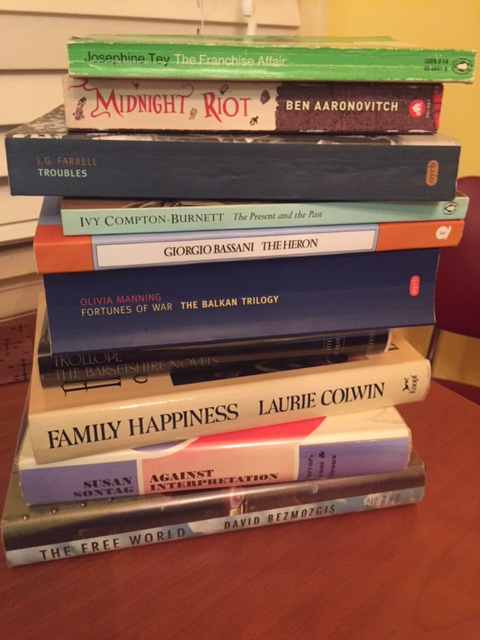
Ten From My Shelves

I stole this idea from someone on Twitter, but now I can’t remember from whom. Let me know if it was you so that I can credit you! [Note: It was Simon from Stuck in a Book. Thanks, Simon!]

IMG_0581

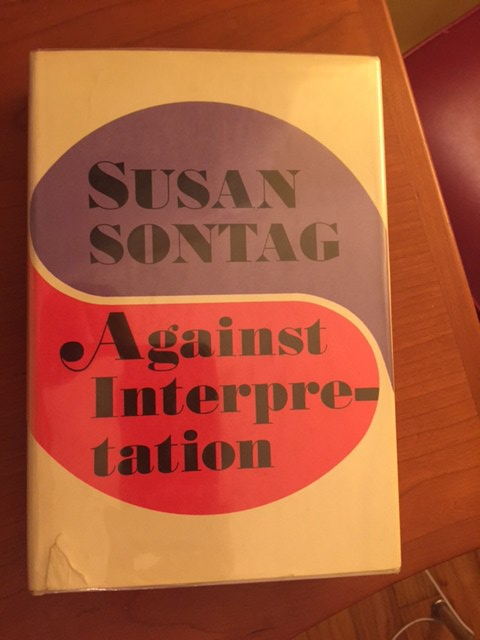
Susan Sontag, Against Interpretation

In my early to mid-twenties I was deeply infatuated with Sontag. Still am, really. I thrilled to her erudition—she’d read everything—and her elegant prose. Essays like hers are still the kind of writing I most admire. The title essay impressed me most of all, especially its famous, hortatory, gnomic last line: “In place of a hermeneutics we need an erotics of art.”

IMG_0582

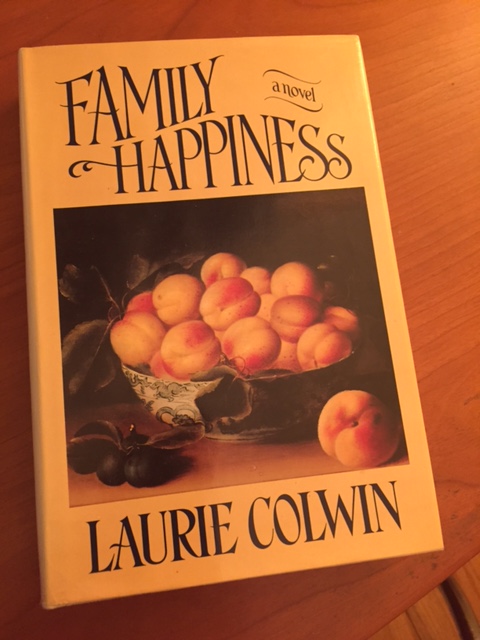
Laurie Colwin, Family Happiness

Another favourite from my twenties. I read all of Colwin’s books the summer between my Junior and Senior year; I was working as a bookseller then, and I hand-sold a ton of them. A few years ago I found this lovely hardcover at a library sale. I was a bit worried about re-reading it—would it hold up?—but I needn’t have. Not only was it as bittersweet as it had been then, but now I could see what at the time I couldn’t: I thought the book was about New Yorkers but it was really about (thoroughly assimilated) Jews. At the time I’d never have imagined that twenty years later I too would be Jewish, but I like to think my philo-Semitism was unconsciously at work. Colwin is so funny, but also so sad.

IMG_0583

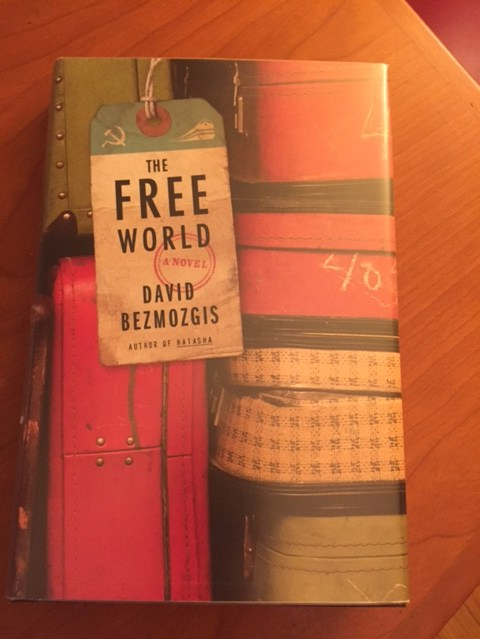
David Bezmozgis, The Free World

Speaking of Jewishness, I’ve loved each of Bezmozgis’s three books, but I think this one might be the best. It’s about the Soviet Jews who were allowed to emigrate in the 1970s. Three generations of the Krasnansky family (like Bezmozgis, Latvian Jews) wait in Italy for visas to come through from Canada, the US, Australia, anywhere that will take them. Rather than focusing on the young children—that is, the characters who would have been the same age as he was when his family left the USSR for Canada—Bezmozgis focuses on their parents and grandparents. We see what the Soviet Union meant to each of them and how differently they experience even this tentative experience of the ironically named Free World. Smart, funny, no schmaltz.

IMG_0585

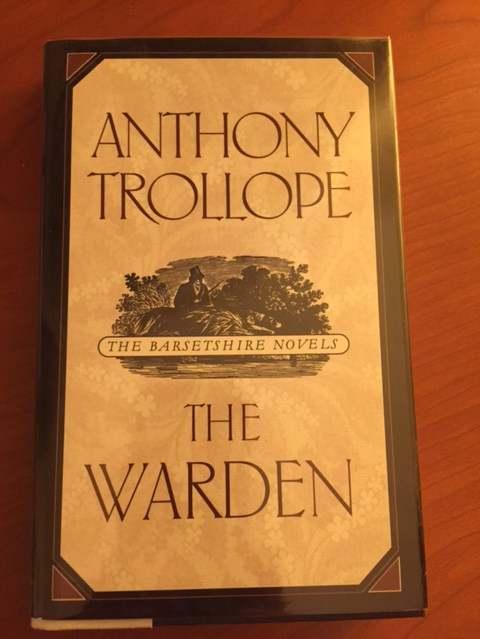
Anthony Trollope, The Warden

I read this in college and liked it well enough but I think I’d appreciate it a lot more now. Might have been a bit too subtle for me back then. I really want to tackle Trollope soon and the Barsetshire novels seem like a good place to begin.

IMG_0586

Olivia Manning, The Balkan Trilogy

Three wonderful novels, pretty closely based on Manning’s own experiences, about a British couple in Romania and Greece before and during WWII. The scenes of denuded, starving Athens haunt me still. Yaki is one of the great characters in 20th century literature.

IMG_0590

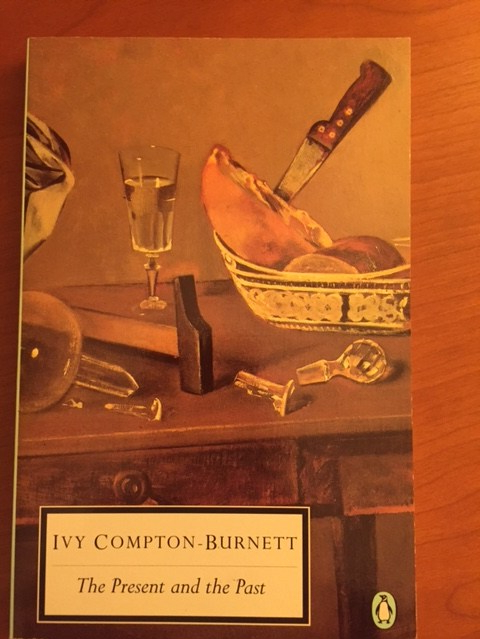
Ivy Compton-Burnett, The Present and the Past

Do you have writers you’re convinced you love but have never actually read? Probably you are less crazy than I am. But I have at least five or six books by Compton-Burnett around here and haven’t read a one.

Here’s what the publishers say about this one:

Nine years after her divorce from Cassius Clare, Catherine re-enters his life in order to re-establish contact with her children. Her arrival causes a dramatic upheaval in the Clare family, and its implications are analyzed and redefined not only in the drawing room but also in the children’s nursery and the servants’ quarters.

(Sounds like Henry Green!) Anyway, odd, uncanny women 20th Century British writers (Comyns, Rhys, Bowen, etc) are my thing, so I really ought to get around to reading Compton-Burnett soon.

IMG_0584

J. G. Farrell, Troubles

A great, great novel set during the Anglo-Irish war and featuring an English Major, Brendan Archer, who comes to Ireland to claim a bride he can’t quite remember proposing to. Angela Spencer is the eldest daughter of an Anglo-Irish family who lives with her family in a once glorious seaside hotel called, no longer quite appropriately, the Majestic. At once funny and macabre, Troubles sets itself the task of trying to figure out how to represent decline. I had a lot to say about this terrific, engrossing book here.

IMG_0587

Ben Aaronovitch, Midnight Riot

First in the Urban Fantasy Rivers of London series. Peter Grant is a rookie cop who can speak to the dead and stumbles into a little-known unit of the Met that deals with magic and the uncanny. Perfect light reading.

IMG_0589

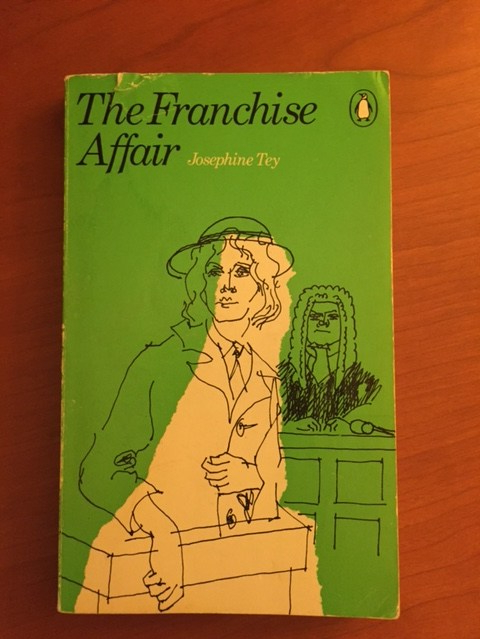
Josephine Tey, The Franchise Affair

My favourite Tey (though admittedly I have rationed them and kept a couple in reserve), an unsettling novel about a woman and her mother who are accused by a fifteen-year old schoolgirl of having locked her up in their attic for a month. Have they been falsely accused? If so, how will they be acquitted when all evidence points toward their guilt? Can justice be done without prejudice? Unconventional, suspenseful, and thought provoking.

IMG_0588

Giorgio Bassani, The Heron

Regular readers know that together with some fellow bloggers, I recently read Bassani’s The Garden of the Finzi-Continis. This, Bassani’s last novel, is the newest addition to my library. I started reading the first page just now and it was all I could do to stop. Elegant mournfulness really does it for me.

IMG_0591

There you have it, ten books plucked from the many thousands in this too-small house. Do you have thoughts about any of them? Let me know if you’re inspired to share some from your shelves.

Guest Post: Nathaniel Leach on The Garden of the Finzi-Continis

I’m so pleased that my friend Nathaniel Leach has written a guest post to accompany the Bassani readalong Scott & I have been hosting this week. Nathaniel teaches at Cape Breton University in Nova Scotia, Canada. He’s a brilliant reader and an eloquent writer. (Plus he’s a lovely person.) Sadly for the rest of us, Nat doesn’t have his own blog, but he agreed to let me post his thoughts on the novel here.

I’m sure he’d be delighted to talk with you further in the comments, so please let him know what you think.


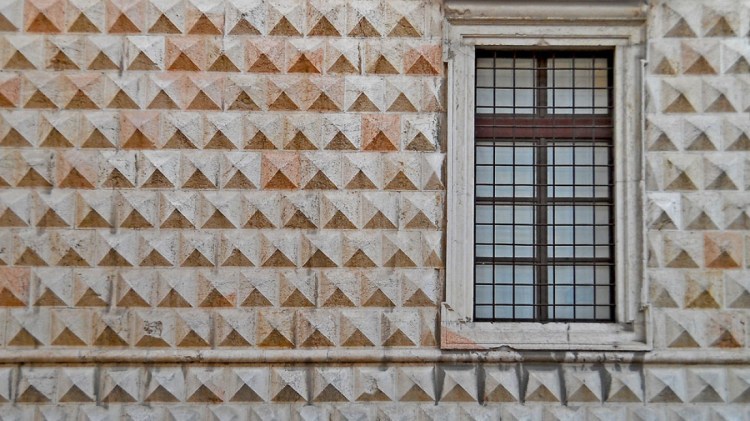
ferrara03-1150x647

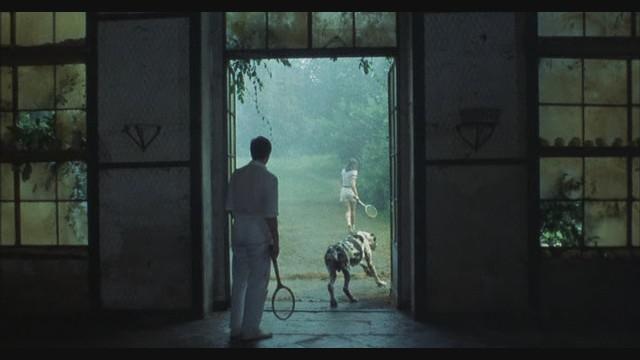
My initial interest in joining this group reading of The Garden of the Finzi-Continis came from having first seen the film many years ago and having a decidedly ambivalent reaction to it. It’s directed gorgeously by Vittorio De Sica, but it also rings some false notes for me, seeming just a bit too nostalgic and sentimental.

Bassani’s novel, however, seems to be doing something a bit more interesting than that; there is plenty of nostalgia here too, but it is much more self-aware and critical. Micol, for example, diagnoses both herself and the narrator: “the past counted more than the present, possession counted less than memory of it” and dismisses Perotti’s attempts to maintain the illusion created by the family carriage, which Micol calls a “pathetic relic.” She knows nostalgia is a problem even if she can’t avoid it.

While the narrator is less self-aware, the novel uses him to show the harmful effects of nostalgia, as he seeks to recreate a past moment that never was. Micol debunks his belief that if he had kissed her that moment in the carriage, she would have reciprocated his feelings, but he nevertheless attempts to kiss her every chance he gets, as if doing so would bring back that lost moment. If Dorian is right that we need to be suspicious of the narrator (and I think we do), we have to be suspicious of the aura of nostalgia that he casts over the whole novel.

There is a tension in both film and book between this nostalgic view of the Finzi-Continis and a more critical one. The first time I watched the film, I felt that the judgmental side was dominant, that the Finzi-Continis were being criticized for being themselves relics of the past, unable to adapt to the needs of the future by connecting with the community around them. And there is surely some of this in the book; the narrator’s father is the primary voice for this view, and in some ways he is clearly not wrong that they seem to think that the walls around them will protect them from every intrusion. This is proven false. But on the other hand, theirs is a more general fate; assimilated Jews (like the narrator’s father) were just as affected by racial laws and policies of extermination. Even Malnate, who is politically conscious and who does embrace the ideal future ends up just as dead as the Finzi-Continis. So, nostalgia is dangerous, but rejecting it is not necessarily helpful. Perhaps, then, there is no moral to the tale, and it is just to be taken as a memorial of those who are gone (but again, the narrator is the only one left to give his version of events).

What struck me upon watching the film a second time (after reading the novel) is how much De Sica in fact plays up the political angle. Virtually every incident pertaining to the racial laws is included in the film, and a few additional scenes are even added. When Giorgio (our poor nameless narrator gets a name in the film) visits his brother in Grenoble, one of Ernesto’s friends describes having been in Dachau, and the final 15 minutes of the film is devoted to an event that gets two sentences in Basssani’s Epilogue: the rounding up of the Finzi-Continis and the other Jews of Ferrara. De Sica puts the novel’s politics in the foreground in a way that gives the film a more pointed political message and a more elegiac tone than the book.

The film’s conclusion, then, is entirely different from the book; two more incidents bear further discussion (Spoiler alert for anyone who hasn’t seen the film). The film’s final lines are incredibly sentimental, and even more so for anyone who has read the novel; Micol and Giorgio’s father are being held in the same schoolroom; Micol asks with great concern about Giorgio and his father reassures her warmly that he left earlier that day and is hopefully on his way to safety. Although Micol has been separated from her own father, Giorgio’s father expresses the hope that they will at least keep all of the Jews of Ferrara together. De Sica deftly manipulates the complex emotional strands of the narrative into simplistic resolutions; Micol’s true affection for Giorgio is revealed, while the father’s resentment of the Finzi-Continis’ aloofness is resolved into a hope for community that we know is coming far too late.

But the most significant divergence between film and book comes in the final dramatic scene of the narrator/Giorgio approaching the Hutte. Dorian’s reading of Bassani’s version of this scene rightly questions the veracity of the narrator’s conclusion that Micol and Malnate are having a tryst in the Hutte. The narrator’s words, “What a fine novel” do seem to suggest his own awareness of the fiction he has constructed for himself (although they could, admittedly, also refer to his feeling of being himself a character within such a novel). However, in the film, this incident is presented in a thoroughly objective way. Alberto looks out the window to see Micol running across the garden before Giorgio arrives to look in the window. Micol even turns on the light to return Giorgio’s gaze. Again, De Sica’s treatment of Bassani’s material seems to simplify complex personal relationships in order to put the emphasis on the political implications of events.

It is futile to attempt to compare the merits of a book and its film adaptation, but putting them side by side in this way has at least enabled me to identify some of the sources of my discontent with the film, but also to some extent with the book. The frame that opens the novel seems to promise a historical awareness similar to that of the film, but this frame is never closed. The hasty glossing over of the fate of the Finzi-Continis clearly signals Bassani’s desire to tell a different story, but this means, in a way, leaving the story partially told.

fe7ff1e28185951c0c331895f11e039a

Which returns me to the beginning of the book: the epigraph from Alessandro Manzoni’s I Promessi Sposi: “The heart, to be sure, always has something to say about what is to come, to him who heeds it. But what does the heart know? Only a little of what has already happened.” The importance of this epigraph is underlined by its frequent echoing in the text; the narrator asks “What can we know, of ourselves, and what lies ahead of us?” The final line of the novel also alludes to “what little the heart has been able to remember”.

In the context of The Garden of the Finzi-Continis, this again suggests the importance of recognizing the narrator’s limitations; what lies between these two expressions of the heart’s lack of knowledge is a purely subjective account from the point of view of a heart that does not have access to the whole story. The epigraph also seems to obliquely allude to the Holocaust; the characters clearly do not know what lies ahead of them, and even if, from the point of view of hindsight, it is easy enough to say that the signs of what was to come were already there within Italy’s racial laws, it is not reasonable to suggest that they should have been able to see it from their own limited viewpoints.

In the context of I Promessi Sposi, the good priest, Father Cristoforo, is helping the young lovers, Renzo and Lucia escape from the grasp of the wicked Don Rodrigo who wants Lucia for himself. In order to save them, they must all separate, but Father Cristoforo reassures them that “my heart tells me that we shall meet again soon.” The epigraph quoted is the narrator’s response to this statement. And indeed, the three must go through numerous hardships before they are indeed reunited, and Father Cristoforo’s intuition proves to be wrong. The line thus suggests the naïveté of even the idealized Father Cristoforo. We want to believe and hope and trust that everything will work out for the best, and this is an understandable human desire, but not something that we can ever really be sure of.

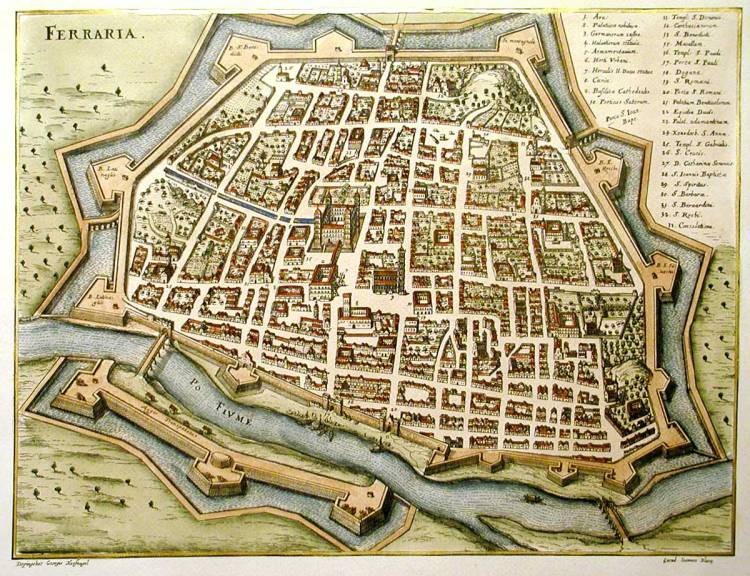
Ferrara-1600

The epigraph, then, seems to encourage us not to pass judgment on the characters of the novel as their weaknesses and failings are inevitable human qualities and entirely understandable. But I can’t forebear to point out one additional reference to I Promessi Sposi; Alberto compares Professor Ermanno’s obedience towards the dictates of the authorities to that of Don Abbondio, who is the polar opposite of Father Cristoforo: the bad priest, cowardly and hypocritical, only interested in saving his own skin. This reference seems particularly harsh to me, as if the novel were indeed being highly critical of his (and others’) refusal to stand up to authorities.

So, perhaps Bassani is asking us to be tolerant of human weakness, but also to be aware of the real failings that it leads to. Ultimately, it seems to me that the real strength of the book lies precisely in its understanding of the human heart with all its warmth and vitality, but also its vicissitudes and bitterness. The epigraph is a call to recognize this complexity, as well as our own limitations in the face of it.

“Mysterious, Statuary Fatality”: A Conversation on The Garden of the Finzi-Continis

Wise-Writers-Tomb-of-Words-1200-630-15185458-1

A while ago I convinced Scott of seraillon to help me host a discussion of Giorgio Bassani’s The Garden of the Finzi-Continis (1962). I hope others will join in, and as they do I’ll link to their posts here:

Meredith at Dolce Bellezza

Jacqui at Jacquiwinejournal 

Grant at 1streading’s Blog

Nathaniel Leach

I’ve written up my thoughts on what for me are some of the key aspects of this fascinating and beautiful novel. Scott has responded and added some of the issues that most struck him. In a separate post at Scott’s blog we’ll reverse the roles.

Thanks, Dorian! Since you’ve divided your thoughts into discrete sections, I’ll respond in italics after each one.

First, a brief summary of the book:

On a Sunday in April 1957, the unnamed narrator is on a day trip from Rome with friends. They unexpectedly end up at some Etruscan tombs. A little girl in the party asks her father why ancient tombs are not as sad as new ones. With those who have been dead so long, he replies, it’s as if they never lived. To which the girl rather precociously (one of the book’s few false notes) responds:

‘But now, if you say that’, she ventured softly, ‘you remind me that the Etruscans were also alive once, and so I’m fond of them, like everyone else.’

He doesn’t say so directly, but the narrator seems to be moved by these remarks. We might even say that he is unsealed. The Etruscan tombs remind him of the grandiose tomb of the Finzi-Contini family in his native Ferrara. Perhaps emboldened by the girl’s insistence that everyone who is dead deserves to be remembered, the narrator thinks of the fate of Italy’s Jews during the war. He tells the story—a story it seems he has held inside for a long time: that’s what I mean by his coming unsealed—of his relationship to the Finzi-Contini family in the years before the war. (Interestingly, he only tells us, not his traveling companions. I’m not sure what to make of this, other than to suggest that, as befits this tightly wound character, even emotional catharsis is restrained.)

Beginning with the end, the narrator explains that the story of the Finzi-Continis is one of catastrophe. Of all the members of the family the narrator “had known and loved” only one had managed to find the eternal rest promised by the tomb:

In fact the only one buried there is Alberto, the older son, who died in 1942 of a lymphogranuloma. Whereas for Micòl, the second child, the daughter, and for her father, Professor Ermanno, and her mother, Signora Olga, and Signora Regina, Signora Olga’s ancient, paralytic mother, all deported to Germany in the autumn of ’43, who could say if they found any sort of burial at all?

The plot then shifts to the narrator’s childhood, highlighting his occasional encounters with the Finzi-Continis, before moving forward to 1938 and the promulgation of racial laws in Italy. When the wealthy Jews of Ferrara are forced out of the tennis club, Micòl and Alberto invite the younger set to play on the court on the estate surrounding the family home.

The narrator, who had always been drawn to the mysterious family, quickly falls in love with the Finzi-Continis and especially with Micòl, and over the following year they become increasingly close but never intimate. Micòl evades and eventually rejects the narrator. He is distraught and eventually forces himself or is forced to get over it. And then the war begins and this idyllic (if that’s the right word) time in the narrator’s life ends. That’s the story he wants to tell—the story of the days in the garden of the Finzi-Continis’ estate—not the story of what happened to them all later.

When I put it like this, the book might sound dull, but I found it completely riveting. Whoever chooses to read along with us in the coming days will help us build a picture of the novel. For now I want to talk about three things that struck me, and then mention a fourth.

I too found The Garden of the Finzi-Continis beautiful and riveting – so much so, in fact, that I’ve now read it twice since January, first in the Jamie McKendrick translation and now in the translation you read by William Weaver. I can well understand why this could be someone’s favorite novel; it is moving, exquisitely constructed and has a delicacy and sense of closeness to lived experience that few novels attain from one end to the other. Both times I’ve read it I came away unable to think about much of anything else for days.

 Bassani’s choice to place his “end” of the novel at the beginning, the revelation of the fate of the Finzi-Continis, signals to the reader that the author’s interest lies not in depicting the horrors of the Holocaust but elsewhere: in the world(s) that it destroyed. One might argue that the novel shouldn’t be categorized as “Holocaust literature” because it deals more directly with Italian Fascism, but I’d counter that Bassani is aiming precisely at overturning the sentiment that if Mussolini had not formed an alliance with Hitler, the country’s situation might have been tolerable. Something of this view gets conveyed in the intense political discussions the narrator has towards the end of the novel with his friend Malnate, one of the novel’s only non-Jews, but Bassani clearly wants to lay bare Italian culpability. For all of the peace that Bassani portrays within the walls of Edenic garden of the Finzi-Contini family, he also provides increasingly palpable glimpses of the hell that is growing beyond the garden walls, of the insidious, creeping intolerance and oppression that are alluded to subtly but frequently for much of the novel. For me this worked brilliantly – focusing on the bright lives at the center of an encroaching darkness rather than on the darkness itself. At the end one feels – but only afterwards, after the gentle impression of the final words have subsided – the colossal weight of all that has been pressing inward. The effect is devastating.

Hilltop at Evening 1928 by Giorgio Morandi 1890-1964

I. (Jewish) Outsiders

I really love books about outsiders who fall into (or maybe insinuate themselves into) worlds that are different—and, in their perception, better, richer, more enlivening, more satisfying—than their own. L. P. Hartley’s The Go-Between is a fine example. Alan Hollinghurst’s The Line of Beauty is another.

I think I’m drawn to this scenario because, as a child of immigrants, I was tasked with helping my parents find their way in a new place. At the same time, I wanted to escape that role by finding worlds or social situations that were just for me. Literature has of course been for me the most important and all encompassing of those worlds. But my decision to move to another country is another example as is, more pertinently to Bassani’s novel, my conversion to Judaism.

I fell in love with Judaism for many reasons, mostly generous and anything but self-serving, but certainly one reason was the sense I had of it as a kind of refined minority. I realize this way of thinking verges perilously close to anti-Semitic stereotypes of secret cabals. But I understood the narrator’s attraction to—what he calls his “deep solidarity” with—the Finzi-Continis. The comparison I’m making is inexact. The narrator isn’t a Gentile, drawn by some sort of philo-Semistism to this Jewish family. No, he’s Jewish too. So in what sense is he attracted to something other or foreign in the Finzi-Continis? The Jewish community in the Ferrara of the novel is small—a handful of families—but as in all Jewish communities (and the smaller they are the truer this seems to be) divisions are as important as similarities.

In his introduction to the Everyman Edition, Tim Parks notes, “One of the curiosities of Bassani’s writing is that, while deploring persecution, he actually seems to relish the phenomenon of social division, that fizz of incomprehension that occurs when people of different cultures, backgrounds, and pretensions are obliged to live side by side.” I agree, though “deploring” seems too unequivocal, too dutiful, too mildly liberal and progressive for Bassani’s narrator, who is a slippery figure.

At any rate, the narrator’s family prides itself on being modern. The father joined the Fascist Party already in 1919. That might sound crazy to us, but Italian fascism was not initially anti-Semitic and might never have been had Hitler not pushed Mussolini in that direction, leading to the Nuremberg-style racial laws of 1938 that I mentioned in my plot summary.

The Finzi-Continis, by contrast, are conservative; Professor Ermanno refuses to join the Fascists, not out of any anti-Fascist or progressive/communist/socialist conviction but because he doesn’t want to join anything, not least the modern world. (It’s interesting that Micòl more than anyone else in the family shares her father’s views, more than her brother, that’s for sure, who is all about his gramophone and modern design, though Micòl also avails herself of certain privilege of modernity, like taking a university degree for example.)

Yet the narrator’s family and the Finzi-Continis are united in their form of worship: they belong to the Italian rather than the German synagogue (these differing congregations meet on different floors of the same building, a wonderful example of what Freud called “the narcissism of small differences.”) I’m confused by Bassani’s distinction here: I think it might be something like Orthodox (Italian) versus Reform (German) (Reform Judaism started in Germany in the 19th Century), but I’m not sure. Later, the Finzi-Continis and one or two other families (but not the narrator’s) decide to worship at even more exclusive synagogue (they call it the Spanish). I wondered if the suggestion was that they were Sephardic rather than Ashkenazi. Can anyone shed light here?

This wonderful essay by Adam Kirsch is smart on the paradoxical function of Judaism in the novel. He doesn’t explain the different congregations, but he has a lot to say about how the Finzi-Continis are positioned as “the Jews of the Jews,” an elite within an elite. The narrator’s father is convinced that the Finzi-Continis are in fact anti-Semites, adducing as proof their rejection, or, more accurately, lack of interest in the rest of the Ferranese Jewish community, as symbolized by the walls that surround their estate.

And yet the narrator’s father also thinks it’s embarrassing, even wrong, to be too devoutly or overtly Jewish: he barely speaks Hebrew, knows only a little of the liturgy, thinks of himself more as a freethinker than anything else. And yet that doesn’t contradict his strong sense of being a Jew, and his conviction that all Jews share a kinship he faults the Finzi-Continis for rejecting.

This sort of complicated emotional response—veering between pride and self-loathing—manifests itself in the narrator too, as in the scene where he runs into a Jewish boy of his own age: “Rapidly, between him and me, there passed the inevitable glance of Jewish complicity that, with anxiety and disgust, I had already foreseen.” The complicity might be good, but the anxiety and disgust sure aren’t.

The narrator remembers how, as a child, he would gather with the rest of his family under his father’s talit (prayer shawl) for the benediction. Because the shawl, which had belonged to the narrator’s grandfather, is so old and full of holes, the narrator is able to look out from, perhaps even to plot his escape from, what in the words of the blessing is the loving embrace of the family.

And what he looks out at is of course the Finzi-Continis performing the same ritual. He is drawn to the father—a scholar, a mild man, perhaps ineffectual but, we learn, genuinely kind, someone who will eventually become almost a colleague to the narrator—but even more so to the children. Yet where Professor Ermanno is the emblem of everything the narrator wants (what he calls “culture and rank”), his children, Alberto and Micòl, are at once more appealing and more off-putting:

I looked up, with always renewed amazement and envy, at Professor Ermanno’s wrinkled, keen face, as if transfigured at that moment, I looked at his eyes, which behind his glasses, I would have said were filled with tears. His voice was faint and chanting, with perfect pitch his Hebrew pronunciation, frequently doubling the consonants, and with the z, the s, and the h much more Tuscan than Ferranese, could be heard, filtered through the double distinction of culture and rank…

I looked at him. Below him, for the entire duration of the blessing, Alberto and Micòl never stopped exploring, they too, the gaps in their tent [the prayer-shawl]. And they smiled at me and winked at me, both curiously inviting: especially Micòl. (Ellipsis in original)

The narrator always wants to penetrate the closed-off space that is the life of the Finzi-Continis (the children don’t go to school, for example, and when they do have to appear for the end-of-year exams they arrive in a coach from the last century). The family, especially Micòl, seems to encourage him in doing so. But in the end he is just there on sufferance. Of course the ultimately irony is that whatever distinctions Jews make among themselves will be leveled by the terrorizing hate of National Socialism.

I’m drawn to your personal response to the work and how it resonated with you as an outsider, an immigrant and as someone who chose Judaism. The outsider element resonated with me too, and probably with many readers. I love how Bassani constantly literalizes this sense of exclusion, from the narrator seeing the Finzi-Contini children’s eyes peeking out from beneath the talit, to his initial inability to penetrate the Finzi-Contini estate during the beautiful young adolescent scene at the garden wall, to the lengthy, almost To the Lighthouse–like postponement of his entry onto the grounds then only much later into the house, and the remoteness of Micòl’s own room, which he is forced to conjure through imagination until he finally, too late, gets to see it for himself. Incidentally, that slow attainment of this “inner sanctum” appears to have as its countermeasure the slow encroachment of Fascism into the garden.

Of course another element that drew me into the novel is one you mention here: “At the same time, I wanted to escape that role by finding worlds or social situations that were just for me. Literature has of course been for me the most important and all encompassing of those worlds.” On the second read through, I was astounded at all the literature in this novel, which in addition to providing something of a crash course in late 19th century Italian poetry alludes to an astonishing variety of works, from Ariosto, to Stendhal (and the narrator, if anything, is a Stendalian figure), to Dumas, to Melville (I can’t recall whether Enrique Vila-Matas makes use of the “Bartleby” discussion in his Bartleby and Co., but if not, he missed a stellar example) and even possibly invents – in a curious passage – a Jewish poetess of 17th century Venice. A central literary figure is the renowned poet Giosuè Carducci, some letters of whom have come into the possession of Professor Ermanno, and around whom literary discussion sometimes revolves, especially arguments over Carducci’s nationalist sentiments and Republicanism (putting aside for a moment the characters’ religion, there is also in the novel an examination of their Italian-ness as relates to a glorified past now threatened by Fascism). Both the narrator and Micòl are by choice literature scholars, he in Bologna, she in Venice, he writing a dissertation on Enrico Panzzachi, a poet in Carducci’s vein, and she on Emily Dickinson. It’s telling that Micòl prefers “real novels” like The Three Musketeers to contemporary works like Cocteau’s Les Enfants terribles. It’s also telling that so little of what was transpiring in literature during the explosive literary decade of the 1930’s Italy appears in the novel. For all their obsession with literature, the narrator and Micòl seem little aware of what is being written around them, at least until the narrator argues with his father, towards the end, that “the only living literature” is contemporary literature. But again he names no names. Another thing I appreciate about Bassani is his avoidance of “literariness” by cleverly making his characters literary scholars themselves, thus allowing him to bring in discussion of all kinds of literature without having to shoehorn it awkwardly into the narrative. I can think of few novels with more literature in them – okay, maybe Roberto Bolaño’s The Savage Detectives.

Your dissection of the Jewish inter-relationships is fascinating. I assumed that the Finzi-Continis were Sephardic because of their obvious Spanish roots – the two uncles Herrera from Venice who are Spanish, their tendency to speak “Finzi-Continian” as the narrator calls it, a hybrid of Ferrarese and Tuscan Italian peppered with Spanish words. I don’t really subscribe to Tim Parks’ notion that Bassani “seems to relish” the idea of social division. Rather, I think this is part and parcel of a style that pushes things apart so as to make them more distinct, to gain some clarity. The remarkable Chapter IV of the first part, for instance, that portrays the inside of the synagogue, possesses the same kind of clarity with regard to the divisions among Ferrara’s Jews that Bassani applies to spaces and interiors, which he almost treats like staging. In addition, the use of such distinctions helps underscore Bassani’s emphasis on the democratizing, leveling force of death. Ironically, I think he’s actually more interested in commonality than in division, since from the beginning, with the visit to the Etruscan tombs in the Prologue, he stresses the universality of death and of remembrance. One could write an entire essay on the description of the Finzi-Contini tomb, with its weirdly international Greek, Egyptian and Roman features and garish conglomeration of materials that seem to come from all over.

II. Telephones

Telephones are really important in this book. Why? One idea is that telephones are a way to combine intimacy with distance. In another novel, characters might write letters to each other. But here they call each other—at least until they know each other well enough to simply drop in. (Well, the narrator drops in on the Finzi-Continis; they never come to his family’s apartment. That would be unthinkable.)

Telephones also a sign of wealth and privilege. Malnate, for example, a friend of Alberto’s, an engineer, a Gentile, a communist, and a rival to the narrator in a way he doesn’t foresee, doesn’t have one; the narrator has to wait outside his rooms when he wants to see him. Maybe it’s important that only the Jewish characters have telephones (though admittedly, there aren’t very many non-Jews in this book). I seem to recall reading someone—maybe it was the philosopher Jacques Derrida—who argued that the telephone is a particularly Jewish mode of communication because it concerns the voice: Derrida or whoever connected it to the Jewish prohibition on representations of God. In the Torah, God speaks (to Moses, to Abraham, etc), but is never seen, indeed, is not to be seen.

These speculations aren’t meant to suggest that the telephone is some kind of divine technology—yes, it facilitates important narrative events (Micòl invites the narrator to the inaugural tennis party over the phone; later, after Micòl decamps for university, Alberto invites him over for what become regular evenings with Malnate and the family) but it can also foil them (as when the narrator misses Micòl’s call to tell him she is leaving town).

So telephones can keep people apart as much as bring them together. But perhaps their most important function is as yet another way that otherwise inaccessible spaces can be entered. But always in mediated form. The telephone is a form of intimacy that is never too intimate: talking on the phone is different than talking to someone in person. Yet talking on the phone, especially to Micòl, is surprisingly intimate, or at least promises intimacy, because the Finzi-Continis have separate extensions in their rooms, so that when the narrator talks to Micòl she is typically in bed. And the narrator wants badly to know what that room looks like. Micòl refuses to tell him. The narrator always wants—and assumes—more intimacy with the Finzi-Continis than he is given.

What a great element to zero in on! I’d of course noticed the phones, but frankly hadn’t given them much thought other than as appurtenances of a wealthy family that wants to be up with the latest technology. I especially like your observation of them as “yet another way that otherwise inaccessible spaces can be entered.” This novel is chock full of inaccessible spaces, and/or of spaces that seem enclosed yet endless, Piranesian tunnels and abysses (I’m thinking in particular of the strange mounds near the city walls that had served as munitions caches, into one of which the narrator enters, at Micòl’s insistence, in order to hide his bicycle, but also of the configuration of the Finzi-Contini house, which like something in a dream the reader can never quite puzzle out – I couldn’t anyway). I found it almost painful how Micòl, who nearly always answers the phone, later lets others answer when she is avoiding the narrator – even that tenuous line to her cut off.

Material objects in general inhabit a strange space in this novel. Some – like the American elevator in the house or the ancient but still meticulously maintained carosse in the garage, appear to stretch the Finzi-Continis mystical aura temporally similar to how the vastness of the house and estate stretches it spatially.
5d102a0b310d054f2b1db28229253f7e

III. The Narrator

For me, the narrator is the crux of this novel. The more I read, the more uncertain I became about him. I didn’t like or trust him. (So what could it mean that I identified so strongly with his desire to be accepted?) I couldn’t figure out what we’re supposed to make of him. He reminded me of the narrators of Kazuo Ishiguro’s novels—not showily or vertiginously unreliable (like Humbert Humbert in Lolita, say), but profoundly blind to himself, his emotions, and the world around him. Clueless, but with more menace.

Actually, by the end of the novel, I sensed we were supposed to think he’s been hard done by. But I couldn’t quite manage to sympathize with him, despite the one thing we learn about what happened to him during the war.

This piece of information comes at the end of an apparently heartwarming scene. The narrator has been kicked out of the public library (Jews are banned), and this is particularly humiliating because he’s completing a dissertation on 19th Century Italian literature. Once he learns the news, Professor Ermanno invites the narrator to use the family library. With its twenty thousand (!) volumes, the professor wryly notes, he should be able to make good progress. The narrator works in the library every morning, and he and the professor, whose study is next door, fall into a routine of checking in on each other:

Through the door, when it was open, we even exchanged a few sentences: ‘What time is it?’ ‘How’s the work progressing?’ and so on. A few years later, during the spring of ’43, the words I was to exchange with the unknown man in the next cell, shouting them towards the ceiling, towards the air vent, would be of that sort: uttered like that, chiefly through the need of hearing one’s own voice, of feeling alive.

The narrator, we learn here, becomes a member of the Resistance (perhaps by being jailed for that reason he avoids being deported as a Jew—that almost happened to Primo Levi, for example). And his political commitment to fighting fascism should make us admire him. But I’m unconvinced. Even here the language is typically solipsistic. It’s probably more a commentary on the nature of imprisonment and the tactics the fascists used to crush their opposition than a criticism of his personality, but notice how the narrator’s prison “conversation” is really a monologue, practiced for selfish, though admittedly important, reasons, “the need of hearing one’s own voice.”

I can feel myself being unjust to the narrator here. But I wonder why this is the only reference to the narrator’s wartime experiences. Why not make more of it? After all, in the years after the war, everyone in Italy, it seemed, claimed to have been in the Resistance. It seems an obvious way to make us feel more strongly for the narrator. To me, it’s suggestive that Bassani downplays the option he’s given himself. Instead, he chooses to portray the narrator much more ambiguously.

Here’s a passage that stood out to me as particularly hard to parse. The narrator is celebrating Passover at home with his family. It’s 1939, and life for Italy’s Jews is getting ever more restricted. So what should be a joyous occasion is somber. The irony of celebrating the Israelites’ journey to freedom in a climate of anti-Semitism isn’t lost on anyone. But these societal concerns are less important—less irritating—to the narrator than his reluctance to be there. He chafes at his family; he wants to be with the Finzi-Contins. (Later, on Alberto’s invitation, he steals over to the Finzi-Contini’s Seder and notes that the same pastries he’d eaten with reluctance at home now taste delicious.)

Looking over the family members who have gathered to celebrate the holiday, the narrator sees faces that are “sad and pensive like the dead”:

I looked at my father and mother, both aged considerably in the last few months; I looked at Fanny [his sister], who was now fifteen, but, as if an occult fear had arrested her development, she seemed no more than twelve; one by one, around me, I looked at uncles and cousins, most of whom, a few years later, would be swallowed up by German crematory ovens: they didn’t imagine, no, surely not, that they would end in that way, but all the same, already, that evening, even if they seemed so insignificant to me, their poor faces surmounted by their little bourgeois hats or framed by their bourgeois permanents, even if I knew how dull-witted they were, how incapable of evaluating the real significance of the present or of reading into the future, they seemed to me already surrounded by the same aura of mysterious, statuary fatality that surrounds them now, in my memory…. Why didn’t I evade, at once, that desperate and grotesque assembly of ghosts, or at least stop my ears so as to hear no more talk of ‘discrimination’ and ‘patriotic merits’ and ‘certificates of services,’ of ‘blood quotients,’ and so on, not to hear the petty lamenting, the monotonous, gray futile threnody that family and kin were softly intoning around me?

What are we supposed to make of this? Even though the passage is divided between past and present, even though the responses at the time are coloured by the knowledge of how things would turn out, I don’t sense much compassion for the past.

It’s a trope of Holocaust literature to juxtapose past innocence to present knowledge, and some writers are famous for their ruthless and judgmental hindsight (Elie Wiesel in Night and Aharon Appelfeld in almost all of his works are classic examples). The narrator is similarly callous here: “The same aura of mysterious, statuary fatality that surrounds them now” isn’t much of a compliment. In fact, the whole logic here is hard to fathom. The narrator is saying: Even though they were so ignorant of what was to come, they nonetheless already had the same kind of fatality that they now have for me in my memory of them. It’s not that they were once vital, nor that their obliviousness has been ennobled or mitigated by the horrors that befell them. It’s that they haven’t even changed.

Is the idea then that the narrator’s prolepses—his flash forwards to future events—don’t make any difference? (Here’s an example from early in the book when as a boy he wanders around the walls of Finzi-Contini estate: “I stopped under a tree: one of those ancient trees… that a dozen years later, in the icy winter of Stalingrad, would be sacrificed to make firewood, but which in ’29 still held high.”)

I don’t know about you but I can’t warm to someone who listens to his frightened relatives and hears only “petty lamenting.” What does he want from them? Is it to be as blithely uninterested in the future as the Finzi-Continis? Maybe so: the scorn at the little bourgeois hats and hairdos sounds like something the Finzi-Continis might think, though would never say. Or, actually, it sounds like something they wouldn’t even concern them with. If anything, this is the narrator seeking—and failing—to ape what he thinks of as his betters.

It’s hard for me to excuse the narrator because of his youth: rather than callow he seems callous. Or somehow emotionally deadened, almost a bit autistic, though I’m uneasy at applying that kind of anachronistic diagnostic label. The novel often compares the narrator to Perotti, the Finzi-Continis’ servant, who disparages modernity even more than the family he has spent his life working for. You’d think that the suggestion that he is only a retainer to the family he admires so much—and possibly so pointlessly? I’m not sure what the novel wants us to think about them—would make us sympathetic to him. But I don’t think it does.

Not even the final “revelation” of why Micòl has spurned his often clumsy, even violent advances doesn’t change my feelings—SPOILER ALERT: he thinks Micòl has been having an affair with her brother’s friend Malnate—especially because I don’t see any evidence that this outcome is anything other than a self-serving construction on the part of the narrator.

Please tell me what you make of the narrator. Why is it that he doesn’t seem to have any present-day (that is, post-war) existence? He’s just a ghost in that opening section, as if he lives only to tell this story of the past.

I’m a little surprised by the degree of your negative reaction to the narrator, as I found him more sympathetic than not. True, he displays a great deal of immaturity – it’s not at all difficult to understand Micòl’s rejection of his groveling, possessive behavior – but at the same time he seems to grow in ways that the other characters do not. Micòl seems to retreat further and further into her Finzi-Continism. Alberto fades almost literally, recusing himself from the intense political discussions the narrator and Malnate engage in together and then, of course, slipping into terminal illness. And Malnate adheres to a fairly strict and pat Communist party line (despite his unexpected appreciation of poetry as revealed near the end; one other minor reason to read Garden is that one gets a rare English translation of Milanese poet Carlo Porta!). The narrator, despite having changed his dissertation interest from Italian Renaissance painting to Panzacchi, in the end advocates for living, contemporary literature, pushes back against those who seem to be inhabiting the past and lacking in foresight as regards the dangers Fascism poses for the future. And yet I agree that it’s unclear how much of the narrator’s “awareness” of that danger is supplied through his backwards glance. Still, if one thinks of Garden as a Holocaust novel, then the narrator plays the essential role of witness, one for whom the question of reliability is almost beside the point. It’s not as though the Finzi-Continis’ fate or the ravages of the Racial Laws are in question. Bassani’s own father disappeared into the camps, and it’s significant – almost irresistible to a writer, I would think, a Jewish writer from Ferrara no less – that of the 183 Ferrarese Jews rounded up and deported to Germany, only one survived. The narrator is obviously not that one, but he plays a role one could imagine that person playing, of having alone survived to tell the tale.

While I also thought the Passover supper scene complicated and puzzling, the narrator’s attitude made some sense to me given the dark constellation of tensions under which he had fallen: the rupture with Micòl; the somber, empty celebration given the dinner talk of increasing restrictions; the abeyance in which he finds himself after completing his dissertation yet – partly because of those restrictions – having no clear option for his future; and perhaps above all his complicated attraction to the Finzi-Continis, who have appeared from the beginning to represent for him wealth, culture, education, beauty even, and perhaps most of all what he refers to early on – and I can’t find the quotation – to their isolation, an aloofness, an outsider quality, that he himself feels almost as a privilege. Though at this point of the novel, the Passover dinner, the narrator is in his mid-twenties, I almost see him as a rebellious teen just itching to get out of the house and go where he’s understood – or perhaps more accurately where he’s among people with whom he aspires to belong.

There’s another element to this behavior hinted at not very obliquely in the remarkable father/son scene near the end of the novel and given a significant clue in light of that scene’s mention of the incident with “Dr. Fadeghi,” which must strike some readers as puzzling since it’s never explained and seems gratuitous. This is a reference to Bassani’s The Gold-Rimmed Spectacles, and thus to the narrator’s possible, even probable homosexuality. His father is on the cusp of suggesting as much but can’t say it. Suddenly the narrator’s timid, aloof, unconsummated attraction to Micòl makes sense. I wondered about this too in relation to the prologue, where he’s traveling with “friends” from Rome as a lone man in a car with a family. There’s a second car of friends too, but who is in it? Why is the narrator stuck with the family? What’s his relation to them? They’re likely not Jewish, as we suspect from the father, laughing, telling his the daughter to ask the man in the back seat to answer a question she has about the Jews. I’m not sure that helps with your questions.

IV The Translation

William Weaver’s translation seemed to me excellent, but I don’t have any Italian, and I’m eager to hear your thoughts. I’m especially curious to hear how other translators have dealt with the text’s references to Hebrew and Yiddish, in particular, and Jewish custom and tradition in general.

I can only address the translations to the extent of my ability amateur opining, so I’ll only say that they struck me as quite different. McKendrick’s seems more precise, formal and elegant, which I suspect might be the right fit for Bassani. But Weaver’s seems warmer, more casual, closer to the blood that pulses through Bassani’s young characters. In the end, I could toss a coin and be content either way it landed, though I might hope slightly that it would land with McKendrick face-up. I took a look at the Hebrew/Yiddish language references in both translations, and while neither translator resorts to awkward English equivalents, McKendrick uses quite a bit more of the Hebrew/Yiddish terminology than does Weaver. I certainly get the sense that McKendrick is more careful than Weaver.

To summarize my main points: I’m really drawn to a novel narrated by a character I’m skeptical, even, it’s not too much to say, repulsed by. What’s especially weird about that is that I really sympathize with the narrator’s desire to be accepted by a family and a social world not his own. Maybe what I can’t take is the rejection of his background entailed by what at its best is not mere social climbing but rather a way to express who he most fully wants to be.

I did not get a sense of the narrator engaging in “social climbing” so much as wanting to escape from a relatively limiting environment – and in this regard the novel did have personal resonance, since I could not wait, as an adolescent, to escape the confines of a bourgeois home and find others interested in art, literature, travel, a wider view. So we have different takes – and therein lies the value of doing this sort of collaborative reading. I’d like to continue the discussion, and may send you a few meditations of my own about Bassani’s novel and ask for your responses. I’m eager now to go see what others have written.
My Personal Canon

Anthony of Time’s Flow Stemmed started what’s become something of a trend among book bloggers: a personal canon. I’m understanding this to mean the books that have meant the most to me. In most cases, I’ve read all of these books many times. Most of them I have taught. I’m sure I’ll read many of them many more times.

I made the list quickly, and have surely forgotten many titles. Tomorrow I would make a different list, I’m sure.

hoefer_047

But here they are, in no particular order:

Engel, Bear

Ransom, Swallows & Amazons

Wodehouse

Barthes, S/Z

Nabokov, Pnin

Bernhard, The Voice Imitator

Davis, Samuel Johnson is Indignant

Larsen, Passing

Rhys, Voyage in the Dark

Büchner, Lenz

Kleist, “The Marquise von O.”

Proust

Lawrence, Women in Love

Lawrence, The Rainbow

Lawrence, Sons & Lovers

Woolf, The Waves

Green, Loving

Mann, The Magic Mountain

Malamud, The Magic Barrel and Other Stories

Mavis Gallant

Dickens, Great Expectations

Beckett, Molloy

Kafka—all the short fiction, especially “Knock at the Manor Gate”

Spiegelman, Maus

Levi, If this is a Man

Fink, A Scrap of Time and Other Stories

Taylor, A Wreath of Roses

Walser, most everything, especially “Nervous”

Bowen, The Heat of the Day

Fallada, Alone in Berlin

Fermor Trilogy

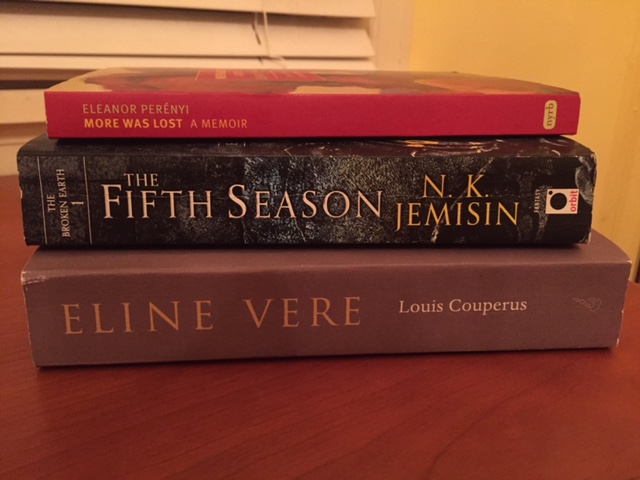
Perenyi, More Was Lost

Manning, School for Love

Collins, No Name

Brontë, Villette

Mowat, Lost in the Barrens & Curse of the Viking Grave

I’m feeling too lazy to link to some of the other lists I’ve enjoyed reading. But I’d be grateful if you linked to your list in the comments, or just added your own favourites. See anything here you like?

Reading Giorgio Bassani’s The Garden of the Finzi-Continis: An Invitation

IMG_0556

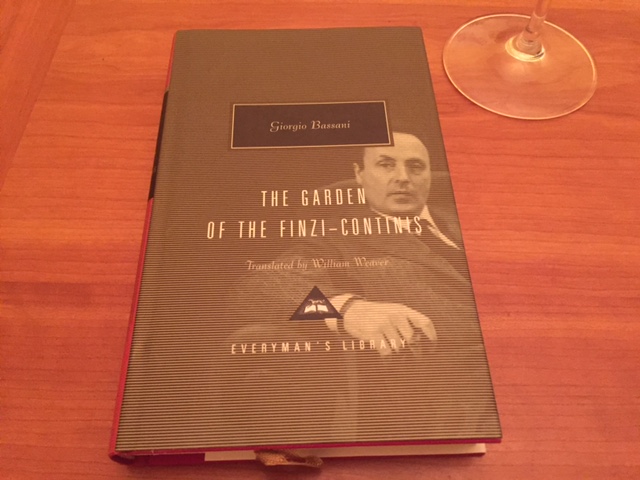
Following last year’s successful group reading of Jean Giono’s Hill, Scott (of the wonderful blog Seraillon) & I are hosting another group reading later this spring. Keeping with the Mediterranean theme we have in no way consciously established, our choice this year is Giorgio Bassani’s The Garden of the Finzi-Continis (1962).

The blurb on the flap of my Everyman Edition says:

The Garden of the Finzi-Continis is a richly evocative and nostalgic depiction of prewar Italy. The narrator, a young middle-class Jew in the Italian city of Ferrara, has long been fascinated from afar by the Finzi-Continis, a wealthy an aristocratic Jewish family, and especially by their daughter Micol. But it is not until 1938 that he is invited behind the walls of their lavish estate, as local Jews begin to gather there to avoid the racial laws of the Fascists, and the garden of the Finzi-Continis becomes an idyllic sanctuary in an increasingly brutal world. Years after the war, the narrator returns in memory to his doomed relationship with the lovely Micol, and to the predicament that faced all the Ferranese Jews, in this unforgettably wrenching portrait of a community about to be destroyed by the world outside the garden walls.

Okay, so that last sentence is a bit rich (“unforgettably wrenching”–ugh!) but the book sounds intriguing nonetheless, especially in its narrative structure. (It actually sounds a bit like L. P. Hartley’s near-contemporary The Go-Between.)

Scott knows a lot about Italian literature, and I know something about Holocaust literature: between the two of us, I think we’ll have some helpful to context to offer. (Assuming that it even makes sense to call this a novel of the Holocaust–my sense is perhaps not quite, but it’s certainly a novel about the Fascist persecution of Europe’s Jews.) Beyond our own areas of interest, though, I’m excited to see what contexts and interpretations others will bring to the effort.

Scott & I will both be reading the William Weaver translation from 1977, though as Scott points out in his post there are two other translations available in English, including a recent one by the English poet Jamie McKendrick (2007) that I am curious about. (McKendrick seems to be translating a number of Bassani’s works.)

We’ll be posting our reviews the week of May 22. The book’s less than 250 pages. Won’t you join us?

On Being Too Generous

I was invited to give the d’var Torah (literally, “a word of Torah,” but in practice an essay on the week’s Torah portion, or parsha) at our synagogue last night.

This week’s parsha is Vayak’hel-Pekudei (it’s actually a double portion–you can read about what that means here) if you want the context for my remarks, which I titled “On Being Too Generous.”

Thanks to Rabbi Barry Block for the opportunity.

On Being Too Generous

This week’s parsha—actually a double parsha, a generous serving—offers us a mixed message.

It begins with Moses reminding the Israelites that G-d has commanded them to observe Shabbat, and not to kindle fire on that day. Interestingly, he says: “These are the things that the Eternal has commanded you to do” (my emphasis), as if these were the only things G-d had ever commanded. Moses’s phrasing tells us how important these particular commandments are. Above all else we are enjoined to observe the day of rest.

But the Israelites do not rest. In fact, they do just the opposite. For the very next thing Moses says puts them to work. G-d, Moses says, has also commanded that “everyone whose heart is so moved” shall bring gifts for the Eternal. He names a long list of precious objects that the people might bring: gold, silver, and copper; beautiful yarns and linens; animal skins and acacia wood; oils and incense. I’m interested in this commandment that apparently doesn’t apply to everyone—only “everyone whose heart is so moved” is commanded to bring what he or she can. What does it mean to command something for only a few? Aren’t the commandments for everyone? Maybe a gift that doesn’t come from a moved heart isn’t really a gift. Or maybe this way of putting it is Moses’s strategy for making everyone participate. After all, who wants to admit to being unmoved? Whatever the case, the commandment works. In fact, we soon learn, it works almost too well.

The gifts will be used to make the mishkan, the tabernacle, as well as the priestly vestments for Aron and his sons. Many commentators note that by beginning with a reminder of the commandment to observe Shabbat the parsha implicitly connects this creative work with the creation of the world itself.

Which is another way of saying that what is happening in the desert here is really important.

No wonder, then, that the Israelites are so generous with their gifts. In fact, they are too generous. They keep bringing gifts “morning after morning” until the master craftsmen who are leading the project have to talk to Moses about it: “The people,” the craftsmen say, ”are bringing more than is needed for the tasks entailed in the work that the Eternal has commanded to be done.” Moses responds immediately:

Moses thereupon had this proclamation made throughout the camp: “Let no man or woman make further effort toward gifts for the sanctuary!” So the people stopped bringing: their efforts had been more than enough for all the tasks to be done.

I’m really struck by this demand to stop giving. It seems counterintuitive to me. I would have thought the more gifts the better; the more gifts the more powerful the sign of the Israelites’ recognition of G-d. But that’s apparently not the case. Which leads me to wonder: can we ever be too generous?

Some people are instinctively and openly generous. I married someone like that. But some people, like me, aren’t. Not that we’re cheap or defensive or selfish. But we fear the toll that giving takes on us, emotionally, physically, maybe even financially. Do I have it in me to give? I ask myself that question a lot. This week’s parsha might be saying: an important part of giving is knowing when to stop giving. Not because we’re lazy or selfish or protective of what we have, but because we need to recognize our limits.

This isn’t the only place in our tradition where we find the exhortation to value what we have, what we have done, and what we are capable of doing rather than what we don’t have, what we haven’t yet done, and what we feel we should be able to do. I’m reminded in particular, as Passover approaches, of dayenu—the principle of sufficiency we shout out in joyous song. Dayenu is less about making do or being satisfied with whatever crumbs the world gives us than it is about valuing the meaning of what is and what has been given.
Giving, the parsha suggests, is a kind of doing. The Israelites’ problem isn’t that all their gifts are getting in the way of the craftsmen’s ability to work. Giving, in this story, isn’t an inferior or second-rate version of doing, the way we sometimes criticize ourselves for writing a check instead of, say, marching at the Capitol. Rather, the Israelites’ problem is that they’ve given more gifts than the craftsmen could ever possibly need. Some kind of proportion or balance has been undone. As the text puts it, the people bring “more than is needed,” “their efforts have been “more than enough.” That surfeit, that plenitude, that extra just isn’t needed. And it counters the point of the gifts, which is to allow us to honour G-d.

So it turns out that what I thought was a mixed message is in fact quite consistent. We must be busy, we must be generous, we must gather the particular gifts we have to give. But then we have to stop giving. We have to appreciate what we’ve done and what we’ve made possible. If we give too much we’re actually doing harm, making a problem for ourselves and for others. What attracts me about this week’s parsha is that it’s not a lesson about overweening pride or about the inevitability of scarcity. It’s pleasantly un-punitive. It’s as generous in its thinking about generosity as the Israelites are. No one is harmed by the Israelites’ generosity—except maybe the Israelites themselves. Once they stop bringing more and more they are able—as the parsha goes on to do at great length—to admire the beautiful creation that comes from their gifts. And to do that, they—and we—need to stop kindling our literal and metaphorical fires and observe the literal and metaphorical Shabbats in our lives.

If we rest from our giving, the parsha explains, it’s only so that we can gain the gift of our rest.

Shabbat shalom!

“Snow, Heavy at Times”: Joseph Kertes’s The Afterlife of Stars

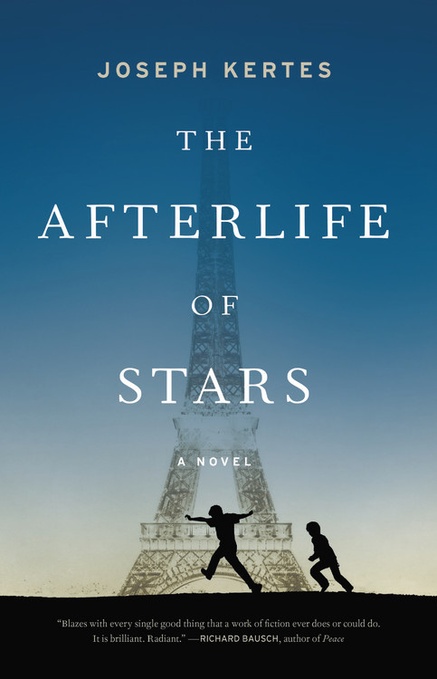
Three years after its first Canadian publication, Joseph Kertes’s The Afterlife of Stars has appeared in the US. Was it worth the wait? I’m honestly not sure. Although I read it quickly, even avidly, I have mixed feelings. Sometimes it’s terrific. But sometimes it’s unconvincing and clunky.

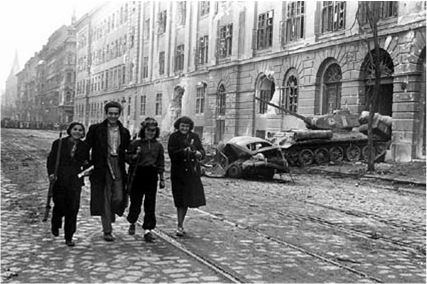
The novel begins in Budapest. The narrator, Robert Beck, turns 9.8 years old, as he puts it, on October 24, 1956. But that’s hardly the most important news of the day: the city is in upheaval. Students protesting the Communist government have been fired upon by the secret police; it won’t be long before Soviet tanks would be in the streets. The Becks—who we learn survived the last war in dramatic fashion—don’t wait to see how things turn out. Any hesitation they might have had about leaving is erased when Soviet officials arrive to requisition their apartment. They manage to get on one of the last trains leaving Budapest and walk across the border to Austria, where they are welcomed, if not with open arms, then at least with food and shelter. Robert and his older brother, Attila, treat it all as a bit of an adventure. But their father, in particular, wants nothing more to do with Europe. He arranges passage first to Paris, where his wife’s sister, a former opera star, lives in comfort, and then eventually to a new life in Canada.

43eff0030b7e4b9519dbab174c7b9475

As befits his name, Attila is a firebrand, equal parts annoying and entertaining, though I found him more the first than the second. The thirteen-year-old Attila knows more than Robert, though mostly what he knows is how, in the self-satisfied yet probing way of teenagers, to ask irritating questions, demanding to know everything from why sperm, so important, so exciting, so able “to make babies, humans, soldiers, beauties, love, courage, heroism” should be such a “drab pearly cream color” to why, if heaven is so wonderful, God and the angels should spend so much time looking down at the world.

Attila is a bit larger-than-life, supercilious, world weary before his time, mostly desperately uncertain. Robert is kinder, gentler, young and a bit naïve. Kertes chooses to narrate from within events: the older isn’t looking back on the events of his past and considering them with the knowledge of hindsight. This means the book eschews exposition: it helps to know something about the Hungarian Revolution. But it’s impressive how clearly we can follow what’s going on. We don’t need to know the full complexity of the crisis. We just need to know that this family, which has been persecuted before and barely survived, is determined to avoid getting into the same situation. The Becks, we gradually learn, are Jewish. And we see how much they have to fear when, on the bus to Paris, an older man spews anti-Semitic invective that leads to a fight.
Even before that Kertes has made clear how dangerous the situation in Hungary has become. Robert and Attila slip out of the apartment where the grownups are frantically packing and slink through the suddenly dangerous streets of Budapest. We feel the menace all the more because Robert isn’t really sure exactly what’s happening. The boys hoist themselves up onto the plinth of a toppled statue of Stalin and burrow into the shoes that are the only part left standing. They narrowly avoid being shot at. Minutes later, they get caught up in a group of protesters and again they are fired on. They duck into a side street and come across a movie theater. A man is standing calmly outside it:

He was dressed in a brown gabardine suit and wore a matching brown fedora. He was lighting a cigarette, turning away from the wind that brought us. … We caught up to the man just as he exhaled his first full puff of smoke, and a shot sounded, taking off his hat. For a stark and childish moment, I tried, in my own mind, to trace the path of the bullet through the man’s head as it knocked over everything in his path: his day, his night, his next puff of smoke, his dinner plate of veal paprkas, his smiling daughter holding up a glass to the light to see if it was cracked, his wife entering the dining room with the wine, wiping a damp hand on her apron.

This is just the sort of thing I meant when I said I didn’t know how to take the book. I’m not buying the last part of this passage. The childish tracing of the bullet through the man and his life, okay, fine, but that the boy would imagine the man’s daughter and his wife, I don’t buy it. Maybe this contradicts what I said before—maybe this is retrospective narration, though it isn’t cued as such. I think it’s just a bit of a slip, a sentimental litany of the small things in life that undoes what’s best about the passage, namely, how suddenly the man dies.

At first I thought this scene was going to be played for laughs, the way the scene with Stalin’s statue mostly is: it would be fitting to place the sort of gag that might appear in silent film—man lights cigarette, bullet takes his hat, man continues to smoke calmly—in front of a movie theater. But as we soon learn it’s the man’s head not his hat that’s shot. The boys speed into the theater, through “white doors now spattered with blood.” They stay for a Tarzan movie, not sure what else to do, part terrified and part interested in the show.

00bb5dcd2f3900f102d55262df4ec4fb

The Budapest scenes use this unstable tone to mimic the utter uncertainty of the situation. But the scenes in Paris work less well. Without the chaos of the revolution it’s hard to understand why the text veers from jaunty to somber, from laughs to horrors.

There are horrors in Paris, but they turn out to be in the past, specifically in the wartime experiences of the elder members of the Beck family (Robert wasn’t yet born, Attila was only a baby). Behind their aunt’s house, the brothers find a trunk filled with letters that explain how the boy’s uncle Paul, who worked for Raoul Wallenberg, saved the Becks from deportation, managing in the most dramatic and implausible way (though admittedly this was a time when implausible things happened regularly) to get them off the train that was taking them to the camps in the East. Wallenberg is the Swedish diplomat who in 1944 saved thousands of Jews by issuing certificates of protection; he disappeared late in the war under mysterious circumstances—he was last seen with Soviet officials in January 1945 who is thought took him back to Moscow.  More than likely he was executed at K G.B. headquarters.

Wallenberg is only a peripheral figure in the novel, and I’m really not sure what he’s doing in it. I’m similarly unsure what the book wants to say about the relation of the past to the present. The brothers’ investigation into the family’s past has none of the lightness and menace of the descriptions of the escape from Hungary. Instead it feels lumbering and clunky. It’s implausible how easily the boys find out what their elders have steadfastly refused to tell them, though I suppose it’s possible the novel could, through the ease of the way the past comes to light, be satirizing the very idea that traumatic memories can be understood.

But notwithstanding its title, which intimates that the past does indeed linger into and even distort or contaminate the present, The Afterlife of Stars fails to convince that it’s as in control of its depiction as that reading would require.

That lack of control is most evident in a scene towards the end of the book when the boys, implausibly on the trail of the Nazi who tortured their aunt, and in thrall to the Paris that they only know from Les Miserables, make their way through the sewers of Paris. The main function of the scene seems to be allows Kertes to offer an extensive description of the filth of Paris:

We had to pause to admire the dark river glubbing by, this wonder of the world. Lights down below lit up everything the city had expelled from the land above: leftover cabbage soup, even digested cabbage soup, fingernails and toenails, and earring, the nightly bathwater, a razor blade with a bit of face still stuck to it, cigar butts, the flow of a bad stomach, the flow of a good one, a gold wedding band, bones, knives, guns, vomit, dead goldfish, live mollies, hairs—blond, brunette, gray, auburn, true black, dyed black, dyed blond, dyed red—hairs by the millions and trillions, short hairs, long ones, curly ones, eyelashes….

The passage continues for almost another page. I do like that “glubbing,” though.

We could read this as a metaphor for repression—for all the things no one wants to acknowledge about the traumas of the past. And indeed the razor blade “with a bit of face still stuck to it” recalls the man shot outside the Budapest theatre. But my sense is that the text is interested in this underground world for its own sake. It seems to share the boys’ wonder at the place they’ve found their way into. Kertes likes lists, they seem to stand for him for an idea about the world’s plenitude—is the fulsomeness of these descriptions supposed to console his characters for their many losses?

These questions lead me back to the question of the book’s tone. Is it supposed to be a boys’ own adventure? Or a depiction of 20th century horrors? I guess it could be both: there’s nothing necessarily wrong with a book that’s hard to pin down. And certainly the adventure ends soon enough, with grave consequences for the Beck family. (At first I thought this was an accomplished YA novel, but although its style is straightforward and its protagonists young it’s awfully dark, even by the standards of today’s grim and apocalyptic YA fiction.)

But the book’s inability to choose a note and sustain it ultimately seems to me more a failure of execution than a commentary on the world the Beck brothers are forced to navigate.


23-1-formozov-1

My favourite passage—another list—is the only clearly retrospective one in the novel. It comes right at the end, when Robert, on board the ship to Canada, meets a boy who is eager to play his shortwave radio for him. Robert doesn’t understand what he’s listening to. The other boy, who has some English, explains:

“The man is saying snow—there’s lots of snow falling. It’s a weather forecast, and he’s naming the Ontario counties and towns. An early blast of winter—in November!”

“Snow,” I repeated, my new English word.

We listened. The radio man’s voice sounded soft and calm. I did not know the names then, but I have heard them many times since, lying alone in my room, listening to the feathery snow tick against the window as I wait for sleep: Essex, Kent, Lambton, Elgin, Middlesex: snow, high of twelve. Huron, Perth, Grey, Bruce, Waterloo, Wellington, Oxford, Brant: snow, heavy at times, high of eight. York, Durham, Bellville, Quinte, Northumberland: snow, mixed with freezing rain. Peterborough and the Kawarthas, Parry Sound, Muskoka: heavy snow, whiteout conditions through the night, and bitterly cold, high of minus twenty-two. Algonquin, Renfrew, Pembrooke, Barry’s Bay, periods of snow, clearning in the morning, high of eight. Ottawa, Prescott, Russell, Cornwall, Morrisburg: light snow, but very cold, high of minus seven. Wawa, the Sault, Cocrane, Timmins, Lake of the Woods: whiteout conditions, high of minus twenty.

It sounded as if the gentle radio announcer were calling each of his children to bed, by name, one by one.

I’m all over this passage. It feeds my homesickness and nostalgia; it promises to support my need to believe that Canada really is as good a place as it thinks it is. At a time when my adopted country wants to turn away those in need and repudiate the generosity that is its best characteristic, it’s nice to be reminded that my native land has been—and still is, though I worry for how much longer—a place welcoming to others.

It would be false and indeed stupid to think that Canada is a perfect place, a place with no problems other than the weather, but coming at the end of this novel, the weather forecast is indeed a kind of lullaby. No matter how bitter the cold or fearsome the whiteouts, this scenario feels like a relief after the events the Beck family has been through.

My pleasure in this passage was dimmed only by the references to Fahrenheit temperatures. Surely this was changed from the Canadian edition. Although I suppose it matters when the “many times since” of this passage is supposed to be. If it’s in the years shortly after Robert’s arrival in Canada—that is, if he’s still supposed to be a boy—then I guess it would make sense, since no one used Celsius before 1975. If it’s supposed to be much later, closer to our present time, if the narrator is now an old man, then it wouldn’t.

Anyway, that quibble doesn’t dim the book’s ending for me. Although I wasn’t totally sold on The Afterlife of Stars I liked it enough to get Kertes’s first novel, Gratitude, form the library. It’s about the Beck family’s wartime experiences, and I’m curious how the new book does or doesn’t complement it. Has anyone read it?


“A Long Smudge of Faces”: Elizabeth Bowen’s The Hotel

500px-flickr_-_e280a6trialsanderrors_-_la_riviera_italienne_travel_poster_for_enit_ca-_1920

If ever there was a writer who improved upon re-reading, it’s Elizabeth Bowen. Bowen’s style isn’t simple or easy to follow. Her syntax is famously knotty, often baffling until you figure out which words to emphasize and everything clicks into place. Here’s a classic from her masterpiece, The Heat of the Day (1948), which describes London during the Blitz:

Parks suddenly closed because of time-bombs—drifts of leaves in the empty deckchairs, birds afloat on the dazzlingly silent lakes—presented, between the railings which sill girt them, mirages of repose.

Until you realize that the subject of the sentence is the long noun phrase “parks suddenly closed because of time-bombs” rather than just parks, and that the verb is “presented” not “closed” this makes no sense at all. A reader at Jonathan Cape, Bowen’s publisher, said that her sentences were baffling until you understood the emphasis and then everything clicked into place.

At any rate, Bowen is never straightforward in her syntax. She can contort even simple sentences. Again from Heat: “He seldom was, and was not this time, put out.” Honestly, that one almost parodies itself.

But Bowen’s circumlocution, misdirection, even apparent clumsiness serves a function. I think Rohan is spot on when she says of Bowen’s prose: “that sense of interference between our attention and the point prevents us from imagining that the point is, itself, in any way direct or obvious.”

Nonetheless, especially in her first novel, The Hotel, which I’ve just been reading with Jacqui, Bowen is sometime just plain opaque. Consider for example this sentence:

Her reprehensible undistress had been a constant temptation.

A character, a young man, is here reflecting on why he’s left Germany with its economic crisis to come to be with his mother in Italy: the undistress refers to the mother’s lack of interest in the crisis. At least I think so—it’s really hard to tell! The substance of the sentence is as tricky as its context. What is “undistress” anyway? I can just about make sense of it as an adjective, but as a noun it flummoxes me. Is undistress the same as lack of distress? Is that the same as calmness? And why would it be reprehensible? So reprehensible, in fact, as to be tempting. It seems the distress we can’t help hearing in “undistress” ought to have carried the day: as if his mother should have been worried about it. We might think it would be nice to be drawn to someone who’s refusing to be worried about a political crisis, but the language here is more alarming than reassuring.

Not everything in Bowen is hard going, though. There are plenty of good bits. We find, for example, the occasional piece of social commentary, a la the Dowager Lady Crawley in Downton Abbey: here two characters are reading the English papers:

“There’s been the pit disaster.”

“Miners,” said the lady distastefully, “always seem to be getting into trouble. One is so sorry, but it is difficult to go on and on sympathizing.”

More frequent are striking apercus. Sometimes these are given to characters—“She had found that in actually dealing with children theories collapse and one must retreat on the conventions”—and sometimes to the narrator: “Sydney, who was still near enough to her own childhood to mistrust children profoundly, wondered what Cordelia could be getting at.”

And best of all are things that are just plain weird: a woman suddenly plucks a bitter orange from a tree and bites into it: “She glanced shamefacedly at her tooth-marks in the orange, then guiltily up at the windows of the Hotel, then she wiped the orange and tucked it quietly away behind her.” The tooth-marks are good, and so is the wiping and that “quietly.”

More conventional but quite beautiful are some moments of description: “She must have been made conspicuous by her abstraction or by her yellow dress; people turned to stare at her and a tram announced by a hum of overhead wires rushed past with a long smudge of faces turned her way.” I like the smudge.

If I haven’t said much about what The Hotel is about, it’s because I’m not sure. (And also because Jacqui is so good at summaries. Be sure to read hers.) I think—and this is what most makes the book worthwhile, even if it’s not always easy going—it’s about queerness.

The hotel of the title is on the Italian Riviera. The guests are British, and they’re mostly women. Most interesting to me are two pairs: Miss Pym and Miss Fitzgerald, and Sydney Warren and Mrs. Kerr, the mother of the young man who comes to visit from Germany.

The novel begins brilliantly, with Miss Pym and Miss Fitzgerald wandering dazedly around the hotel and the resort after having had a terrible fight. We don’t see the fight, we never learn what it was about, we don’t even know who these women are, and we have to piece together what they mean to each other. It’s pretty clear they are lovers, though, and I really wished they’d been more present in the book. Even in this episodic novel, they disappeared for long stretches of time, though they importantly close the book. On a picnic together, they remember the day they almost lost each other, which gives a kind of happy ending that nonetheless reminds us of loss just when it clams to be celebrating togetherness.

In this sense they comment on the more oblique and much less resolved relationship between Sydney—a young woman who had planned to be a doctor and who has been sent to the Riviera by her family to accompany her cousin, one of those invalids who are really just women who need a break from life of the sort you find in so much fiction in the late 19th and early 20th century, and, they hope, to get married—and the much older Mrs. Kerr. It seems pretty clear that Sydney loves Mrs. Kerr. It’s not at all clear what Mrs. Kerr thinks of her. Sydney is a kind of factotum to the older (richer) woman, sometimes a kind of daughter or even a pet who Mrs. Kerr deigns to take an interest in, and sometimes something much more like a lover.

Bowen’s refusal to clarify is brilliant. But she’s clear that other characters (men especially but not only) wonder and worry about it. Consider this exchange, three-quarters of the way through the novel. A visiting clergyman, James Milton, is talking with Mrs. Kerr’s son, Ronald:

“An hotel, you know, is a great place for friendships.”

“Mustn’t that be,” said Ronald, “what people come out for?”

“Perhaps some—”

“But are there really people who would do that? asked Ronald sharply, in a tone of revulsion, as though he had brought himself up more squarely than he had anticipated to the edge of some kind of abyss. “You mean women?”

Well, as the kids say these days, that escalated quickly. The reference to friendship is redescribed as a code for same-sex desire, a desire that Ronald, at least, is revolted by. The book is at its best when it’s at its queerest: that is, when it offers us relationships that challenge the homo-hetero binary, relationships that are hard to name.

If Miss Pym and Miss Fitzgerald are straightforwardly gay, Sydney and Mrs. Kerr are, I don’t know, not. They’re something else. But whatever it is it’s powerful. Partly through the book—here come some spoilers now, watch out—the clergyman Milton proposes to Sydney, out of nowhere. She rejects him as gently as she can. But then just as unaccountably she later accepts. All of which leads to an amazing scene near the end of the book when the couple along with Sydney’s cousin and Mrs. Kerr rent a driver to take them on an excursion into the mountains. Coming back down they run up against a timber wagon that has almost tipped over one of the hairpin turns that Sydney has spent the ride silently wishing the party would plunge over. Something about the moment—the shock, or maybe the shock is just a cover for a decision she’s already come to, unconsciously—prompts Sydney to break off the engagement. It has to do with her feelings for Mrs. Kerr, but we don’t know how exactly. Nor do we find out. At the end of the novel, Milton leaves in embarrassed chagrin. Sydney is set to leave too. And only on one of the last pages do we sense that Mrs. Kerr will in fact be devastated by the loss, though whether out of love or out of loss of power is uncertain.

The Hotel is a chilly novel, which isn’t necessarily a bad thing, but I did have a hard time with it, never able to get stuck in it, always reading a few pages at a time, and often having to go back over those knotty sentences.

cropped-elizabeth-bowen

However lukewarm I am about The Hotel I certainly do love Bowen in general. She’s sadly underrated and definitely poorly classified. People often compare her to Woolf—with whom she had a rivalrous but also mutually admiring relationship—for no other reason as far as I can see than that they were both women writing at around the same time. But Bowen is much better understood as part of that great British mid-twentieth century tradition of women writers who defy the longstanding and increasingly useless distinction between modernism and post-modernism. This tradition—which for me includes writers like Jean Rhys, Barbara Comyns, Elizabeth Taylor, Angela Carter, and Penelope Fitzgerald: a pretty heterogeneous bunch!—is uncannily experimental, the strangeness of the works heightened by how ordinary they first seem.

In The Hotel Bowen seems to still be finding her way. When we were talking about it on Twitter, Jacqui said it’s as if Bowen were rooting through English fiction of the period for ideas. Milton seems like someone out of a Forster novel, though perhaps less interested in art. And sometimes the prose, which at its worst is sub-Jamesian, overtly imitates The Master: “The party hung fire, embarrassed by this choice of attractions, then continued to move slowly up the avenue in a close formation.” I thought only James was allowed to use the expression “hung fire”!

In other words, if you’ve never read Elizabeth Bowen before, I wouldn’t recommend starting here. It is, after all, a first novel. (Though first novels often seem to me most representative of a writer’s preoccupations, and that’s not the case here.) I’m curious about her two earlier collections of stories. Bowen’s wartime stories are justly famous—if you’ve never read “The Demon Lover,” you’re in for something special—and I wonder if she had already mastered the form. At any rate, it’s impressive how quickly Bowen improved as a novelist. Her next one, The Last September—a moving description of the Anglo-Irish war—is miles better and a terrific point of entry into her work. More conventional in structure and more compressed in scope than The Hotel, The Last September feels like a novel in a way that the earlier book doesn’t. After that I’d recommend two terrific but dark novels of the 30s, The Death of the Heart and To the North (which has one of the most ominous final scenes ever) and of course her absolute masterpiece, maybe the greatest novel about the Blitz, The Heat of the Day.

Has anyone read any of her late novels (Eva Trout, The Little Girls, etc)? I wonder what they’re like.

2016 Year in Reading

Considering its tumultuous and largely depressing events as well as my own poor physical and mental health at various times, I’m surprised I read as much as I did last year. But those challenges meant I needed the comfort of books more than ever.

I read 79 books in 2016: 54% were by women and 46% by men; 68% were written in English and 32% in translation.

A few words about my favourites, in no particular order:

The Best of the Best:

I wrote about (and have already linked to) my absolute favourites for Open Letters Monthly. But I can’t say enough good things about them so I’ll list them again here:

More was Lost—Eleanor Perényi

I adore this book—just thinking about it makes me smile. But I haven’t heard anyone else talking about it, and so I just want to trumpet its moving elegance over and over again. Do you like Lubitsch? Of course you do. Then you’re going to like this book. My list is stacked with New York Review Books, but this year I am most grateful to my favourite press for reissuing this little marvel, the story of an American who falls in love with a Hungarian and experiences a world that is on the point of vanishing. I wrote about it here.

Eline Vere-Louis Couperus

You can read my thoughts on this magnificent 19th century Dutch novel of female anxiety here.

The Fifth Season & The Obelisk Gate—N. K. Jemisin

2016 was the year I started reading science fiction again after a twenty or thirty year absence. I’ve a long way to go to get up to speed, but I think we’re all going to need more SF in the coming years, not as escapism but as laboratories for how to resist the coming darkness.

These two novels, the first parts of the Broken Earth Trilogy, offer an allegory for the psychic damage minorities experience every day—as if Du Bois’s double consciousness was used as the basis for an exciting and carefully detailed epic story. I hope the final volume will be out in 2017.

Best of the rest:

The Trespasser—Tana French

French made the list last year, too. For me she is the best crime writer today, period, and shows no signs of falling off with this excellent, smart novel that continues her preoccupation with friendship. What’s new is how overtly the twists of the investigation are offered as an allegory for the process of storytelling. I hope that doesn’t sound boring or airy-fairy. The book’s as gripping as all her others.

The Door—Magda Szabó

On vacation at the end of the year I had some good reading time and made my way through a number of interesting books. But the most amazing one—so great that it’s jumped on to this list—was this Hungarian novel from 1987. Szabó has this power, I don’t know how to describe it, it’s not as though her style is particularly flashy or anything. It’s the story of a woman and her housekeeper. And about the history of Hungary in the 20th Century. It’s as good on psychology as on politics. None of these things come even close to suggesting how awesome it is. All I can say is that I was just riveted. I’ve got another of her books now and hope to write about them together soon.

Three by Patrick Leigh Fermor

A Time of Gifts; Between the Woods and the Water; The Broken Road

I wrote a short appreciation of these extraordinary travel books for Open Letters Monthly back in the summer. In 1933, the eighteen-year-old Fermor set off to walk across Europe, from the Hook of Holland to Constantinople. It took the rest of his life to tell the story, but what amazing books these are, so full of joy and life, and neither naïve nor knowing. Can’t think of anyone else who has captured as well as Fermor that sense of heady reinvention you sometimes feel, especially as a young person, when living abroad.

The Vegetarian—Han Kang

Wasn’t sure about this one at first—kept wanting it to be more like Atwood’s Edible Woman, which it superficially resembles—but decided to teach it later in the year and seeing my students take to it so strongly made me like it so much more. A book about a woman who just really wants to be a plant, and the people in her life who want other things for her. Han tackles this without ever letting us inside the protagonist’s head: impressive. Feel I could get a lot more from this book if I knew more (i.e. anything) about modern Korean history. Looking forward to reading Human Acts in 2017.

What Belongs to You—Garth Greenwell

Critically acclaimed for a good reason. Proustian sentences, good sex scenes, impressive ability to generate menace. Had the good fortune to hear Greenwell at the Little Rock Literary Festival: he was smart and kind. Started to write about the book and got bogged down but one day I am going to write an essay about the uncanny parallels between what happens to the narrator of this novel and to Patrick Leigh Fermor, as recounted in The Broken Road, in Varna, Bulgaria.

Our Spoons Came from Woolworths—Barbara Comyns

Less bleak than Comyns’s amazing The Vet’s Daughter (on the 2015 list) but just as terrific. The wonder here is the vast tonal range of the narrator’s voice. Sometimes Sophia is naïve (“I had a kind of idea if you controlled your mind and said ‘I won’t have any babies’ very hard, they most likely wouldn’t come”) and sometimes she’s hilariously, ruefully inept (making an impromptu meal of spaghetti she finds a piece of dry cheese: “it grated so fine I thought afterwards it must have been a knife handle”). She’s also no-nonsense (she tells a man who has fallen in love with her and is masochistically kissing the bottom of her skirt, “Don’t do that. The hem is coming undone already”) and knowing (describing that same man, who for a time becomes her lover, she says, “His dark face became full of animation when he talked (I think the right word to use for his face would be mobile)”). British women writers of the mid twentieth century are still criminally underrated.

Best group reading experience:

Jean Giono’s Hill. A terrific book that speaks to us today in ways its author surely couldn’t have anticipated. My take here. Thanks to Scott for co-hosting and to Meredith, Grant, Frances, Melissa and others for reading along with.

Most revelatory experience of a book I’ve taught many times:

Lots of contenders here (Woolf, Jacob’s Room, To the Lighthouse, Three Guineas (I really love that one), Lawrence, Sons and Lovers) but the winner has to be Imre Kertesz’s Fatelessness, which is one of the greatest novels about the Holocaust. Only now, on my fourth or fifth go round with this book, and thanks in large part to some stellar students who really responded to it, do I feel I’m getting the hang of this one.  I blogged about teaching it here.

Most revelatory experience of a writer I’ve taught many times:

Ida Fink. I’ve taught a few of her amazing short stories about the Holocaust before but only this year, thanks to the scholar Sara Horowitz, did I really get what Fink was up to. She didn’t write much, just two short story collections and a novel, but man, what a writer. Want to write about her in 2017.

Two books about hotels:

Grand Hotel by Vicky Baum (1929) and A Gentleman in Moscow by Amor Towles (2016). In my head I composed a mini-essay comparing these books, which I happened to read back to back. Both consider the transience of hotel life, though Gentleman inverts the idea by making its protagonist a nobleman in 1920s Russia who can’t quite be done away with by the new regime because of his service to the cause in the past and so is put under house arrest in Moscow’s luxurious Metropol Hotel.

Baum’s book might be better—it holds up amazingly well, and becomes a real page-turner in its last third—but I enjoyed Towles’s more. It’s sweeter and that’s what I needed in the days after the election. I kept wondering if its pleasures weren’t in fact too regressive, but the book would regularly throw little curve balls, show its self-consciousness about the difficulties of structuring a book around a seemingly perfect protagonist. And sometimes you just want a suave, kind, handsome, intelligent, well-manner character! Anyway, you should read both of these books, they are terrific. I’m unconvinced anyone will be reissuing Towles in 80 years, but that’s okay, some books we just need for today.

Best book about life during the rise of fascism:

Plenty of contenders, but Irmgard Keun’s After Midnight made a big impression on me.

Reliable pleasures:

Ellis Peters’s Cadfael books (have read the first four so far, but need to ration: important to know they are still out there for me to savour); Hans Olav Lahlum’s K2 series (the last one was a bit bloated but I’m still a fan); Denise Mina (she keeps on going from strength to strength)

Light reading winners:

Natasha Pulley, The Watchmaker of Filigree Street (pleasing alternate history-steampunk-thing all about queer and non-queer friendship—very much look forward to the sequel in 2017); Joe Ide, IQ (smart and funny Sherlock update in East Long Beach. Not suspenseful, really, but totally enjoyable); Dorothy Sayers, Strong Poison (I finally met Harriet Vane! Must read the others)

Finally, although, I didn’t actually read that much Jean Rhys this year, one of the most satisfying parts of the year was contributing this post on my experiences teaching her work to students to the Jean Rhys event co-hosted by Jacqui and Eric.

Above all, my heartfelt thanks to everyone who’s visited the blog in the past year. Your comments, whether here or on Twitter or Facebook or even in person, mean so much to me. Here’s to more good reading and good talk about our reading in 2017.

Recent Publications: Henry Green/Year in Reading/Holocaust Literature

Hoping to get one more post in before leaving for a vacation, but for now here’s a little self-promotion.

henry-green

I recently published a review essay on Henry Green’s terrific Loving (recently reissued by my beloved NYRB classics) in Numéro Cinq. I’m pleased with the way it turned out–Green has been dear to me since graduate school, when I wrote about him in my dissertation, and I’m glad he’s finally starting to get some recognition, especially in North America. This is my first piece for this terrific journal, and I look forward to working with them more in the coming years.

img_0503

Over at Open Letters Monthly, the journal closest to my heart, I wrote about My Year in Reading. I’m honoured to have been asked to contribute, and to be in such good company. I’ll write a longer post here at the very end of the year adding to what I wrote there (still two more good reading weeks left in this wretched year…).

ci_holocaustlit

Last but not least, a book of essays about Holocaust Literature that I edited was recently published by Salem House Press. The Critical Insights series is intended for undergraduates and their teachers, but I’d like to think that anyone who is interested in the topic will find something useful here. The essays are written for the intelligent general reader rather than for specialists, but I’m pleased to say that nonetheless many of the essays cover new ground. I wrote the introduction to the volume and the first essay, entitled “On Holocaust Literature.” Alas the cost of the book might put it out of reach for non-institutional readers (i.e. individual readers, not libraries). If you are interested in seeing all or part of the collection, please let me know in the comments. Here’s the Table of Contents, to give you an idea of what’s inside:

Critical Insights: Holocaust Literature

Acknowledgements

Contents

About this Volume

— Dorian Stuber

On Holocaust Literature

— Dorian Stuber

Critical Contexts

The Canonical Testifiers

—Sue Vice

Narrative Voice and the Struggle Against Silence: Wolfgang Hildesheimer, Ruth Klüger, and Fred Wander as Case Studies in German Jewish Holocaust Literature

—Corey L. Twitchell

Changing conceptions of Holocaust Literature

—Rebekah Sloduonik

Through Fractured Glass: Three Theoretical Lenses for Viewing Sebald’s Austerlitz

—Okla Elliot

Critical Readings

Looking at/in Maus: A Survey of Critical Approaches

—Michael Rotenberg-Schwartz

The Influence of Gender Performance on Women’s Resistance to Nazi Dehumanization in Charlotte Delbo’s Auschwitz and After

—Vanessa Rachel Marsden

Jewish Identity in Crisis: Philip Roth and the Holocaust

—Seth Rogoff

Three Generations of Holocaust Literature for Young People

—Jennifer Askey

Holocaust Film and the Ethics of Representation

—Nathaniel Leach

Travels in Yiddishlands: Three Centers of Yiddish Responses to the Holocaust

—Naya Lekht

Between Mimesis and Allegory: Vasily Grossman, Boris Slutsky, the Strugatsky Brothers and the Meaning of the Holocaust in Russian

—Marat Grinberg

Flowerless Gardeners: Poetry after Auschwitz

—Jennifer M. Hoyer

“Nothing is Meant Quite Literally”: Adorno and the Barbarism of Poetry After Auschwitz

—Marianne Tettlebaum

The Daunting Task of Approaching Holocaust Literature for the First Time

—Brian Tucker

Resources

 Further Reading

Bibliography

Contributors

About the Editor

Index

With no book project to keep me busy and my time as Department Chair coming to a close in a mere 230 days (oh, I’m counting), I want to write a lot more in 2017. If you want to commission me, drop me a line!