James Morrison’s Year in Reading, 2025

Regular readers will know that for the last several years I’ve solicited Year in Reading reflections from friends and trusted readers. As we’re well into February, I’ve scaled the project back considerably this time, but quality takes quantity every time… Today’s installment, his fifth, is by James Morrison, reader extraordinaire. James lives and works in Adelaide, on unceded Kaurna territory.
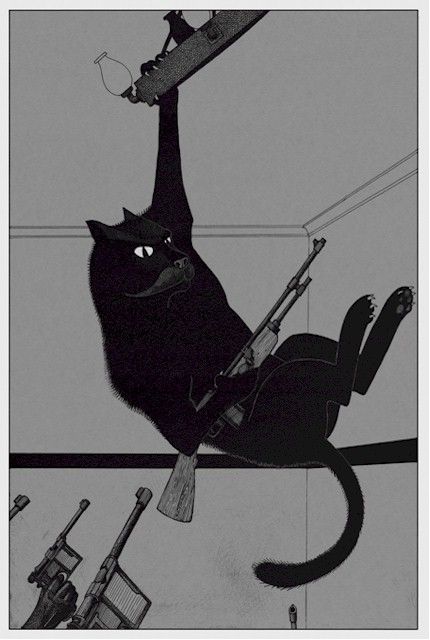
Charlie Stone, Behemoth from ‘The Master & Margarita’ (1999)

Working out which books to write about for these discussions is always fraught—there are easily another twenty great books I could have raved about, but neither you nor I are made of infinite time. I’ve tried to narrow things down to a few broad categories, but even then a few books would not be restrained by such, so they’re tacked on at the end.

In a couple of other people’s year-end reading round-ups on Bluesky, they talked not about what they’d read, but why they’d read it—what had prompted them to buy or pick up the books they ended up reading. It was strangely interesting, at least to a big horrible nerd like me, so I’m including that here for my own choices. Feel free to pass over it with glazed eyes. [Ed. – No way! I think people love that stuff. I know I do.]

RAMUZ

My most compelling new-to-me writer discovery of the year was Swiss novelist Charles Ferdinand Ramuz (1878–1947). The three of his books that I read all have the same basic premise—Something Horrible Happening in the High Alps—but go off in very different directions. Great Fear on the Mountain (translated by Bill Johnston) was what got me hooked first: a historical novel where a group of men set off to take the village’s flock up through a mountain pass to find feed, and then everything goes to hell. It has all the rhythms of an 1980s horror movie, but is beautifully written and was first published in 1926. Derborence [When the Devils Came Down] (translated by Laura Spinney) features an avalanche and its spooky survivor, while Into the Sun (translated by Olivia Baes and Emma Ramadan) is an impressionistic, atmospheric early climate change novel. As the Earth slowly falls into the sun, the snows melt, the mountain lakes boil, and society collapses into violence and despair.

Why: Nathaniel Rich’s splendid overview of Ramuz’s work in the NYRB.

BIG FAT EPICS

For some reason 2025 became a year in which I started, and sometimes finished, a number of big fat epics. [Ed. — Always big and fat, the epics.] Look at me, aren’t I tough?

Miklós Bánffy, The Transylvanian Trilogy/The Writing on the Wall (translated by Katalin Banffy-Jelen and Patrick Thursfield): I had actually read this massive Hungarian modern classic before, some quarter-century ago, but remembered very little other than it was hugely enjoyable. If anything it was even better this time around, now that I am older and theoretically wiser. Aristocratic Hungarians in Transylvania scheme and gamble and party and fuck, fighting for their rights as a minority in the Habsburg Empire while simultaneously being unable (for the most part) to see how they are simultaneously repressing and neglecting the Transylvanians whose land they rule. And all the politicking and manoeuvring takes place as the Great War draws closer, ready to sweep their whole world away. It’s like a vastly more incident-packed counterpoint, set at the other end of the Empire, to one of my other favourite books, Musil’s The Man Without Qualities. [Ed. – James and I as always on the same wavelength…]

Why: Over recent years I’ve been going back to a number of books I remember as brilliant, to see if they actually are. For the most part, fortunately, they have been.

Solvej Balle, On the Calculation of Volume (translated by Barbara J. Haveland, Sophia Hersi Smith and Jennifer Russell): Happy to say I fell for the hype and read the three books of this septology so far available in English. It’s a closely observed and beautifully written variation on the “Groundhog Day” premise of being stuck reliving the same day endlessly, but adding more and more wrinkles and complexities as the looping time passes. Fortunately this seems to be doing extremely well in English, so there’s every chance that, assuming Balle finishes the series, we’ll get to see all of it in translation. If she doesn’t, you’ll see me frothing blood in a tempest of rage.

Why: Though not original, the premise is fascinating, and I fell for the hype.

Dorothy Richardson, Pilgrimage: I read the first four books of this 13-volume modernist masterpiece, and while each book individually was excellent, the cumulative effect of this subtle, witty and awkward fictionalised autobiography is even more impressive. I hope to read the rest of this massive thing in 2026.

Why: I’ve wanted to read this for decades, but Virago’s treatment of their Modern Classics heritage being what it is, it’s never been possible to get all four volumes of the collected edition. Fortunately, Brad Bigelow of Neglected Books published his own edition, and I finally got my disgusting paws on it.

Len Deighton, the Bernard Sampson series: In terms of pure, sardonic, exciting and bleak reading pleasure, it’s hard to go past this trilogy of trilogies about the much put-upon spy Sampson, his extremely complicated wife, and his infuriating superiors. I still have the last three books to go, so that’s another treat in store for 2026, assuming any of us live. [Ed. – James. A little less truth-telling, please. As to these books, I’ve only read the first three so far, but they are terrific.]

Why: I’d only ever read a couple of Deightons in the past, and they were excellent, so why it took me until now to realise just how good he is and just how pleasingly extensive his back catalogue is must stand as a testament to my general dimwittedness.

C. J. Cherryh, The Morgaine Saga: Extremely futuristic science-fiction masquerading as swords-and-magic fantasy, this trilogy of novels (there’s a fourth, published much later, which I have yet to get) is so richly imagined, and so cleverly paced and written, that it makes you despair about how crap most of its genre competition remains. Outcast prince, magical witch queen, brutal politics, war, extremely difficult moral choices, aliens; the whole shebang.

Why: Every now and then I get the urge to read some fantasy to recapture the kick it used to carry when I was a teenager. Sadly I am no longer a teenager with a teenager’s standards, and almost every time I give up on whatever overpraised nonsense I’ve been tricked into reading. This was one of the rare exceptions.

Homer, The Odyssey (translated by Emily Wilson): Only a single (big fat) book this time, but one I haven’t read in 20 years, and the newish Wilson translation was calling to me. And it’s great! I’d forgotten just how oddly structured the book is (the famously interminable journey home of the hero taking up a relatively small part of the story), and how mental some of the developments. And apparently, she’s going to retranslate it and publish a whole new version? [Ed. – Seriously???] Seems like sheer madness to me, but I guess that’s what working in academia does to someone. [Ed. — Laughs bitterly]

KILL ALL NAZIS

Why: All the worst people seemed to be enraged by Wilson’s translation, and her gender, so I could not resist. [Ed. – Yeah, those guys suck.]
Charlotte Mano, From the Mythologies series (2021)

All Nazis must fuck off and die. Here are some books about what they were like, and how they were dealt with, first time round…

Marie Chaix, The Laurels of Lake Constance (translated by Harry Mathews): Astonishingly good in English, and the French original is apparently even better? How can this be? An autobiographical novel from the point of view of the daughter of an enthusiastic French Nazi and traitor before and during WW2. Unsensationalised, elliptical, and marvellous.

Why: It looked both pretty and interesting in the bookshop, and that’s all I needed to see.

Uwe Wittstock, Marseille 1940: The Flight of Literature (translated by Daniel Bowles): A day-by-day, sometimes hour-by-hour, account of the lives, desperation, plots and betrayals of the huge array of German and Austrian writers and artists who fled the Nazis to France, only to have France fall soon afterwards. Lucid and utterly fascinating.

Why: Wittstock’s previous book, February 1933: The Winter of Literature, did the same thing for the month the Nazis came to power, so there was no way I was not going to read this follow-up when it appeared.

Grete Weil, Last Trolley from Beethovenstraat (translated by John Barrett): An obsession with a lost friend taken by the Gestapo in Amsterdam spills into the post-war life of a man now living in Germany. He marries the man’s sister in a confused, guilt-fuelled attempt to try to bring him back to life. Complications ensue, as you might expect. Rich and compact, and highly recommended. [Ed. – More on Weil here…]

Why: If I see a book in the Verba Mundi series, I buy it. It’s an eclectic but extremely well-selected library of translated literature from all over the world.

Lorenza Mazzetti, The Sky is Falling (translated by Livia Franchini): Another fictionalised memoir, about a pair of sisters sent to stay with Jewish relatives in Tuscany—relatives then slaughtered by the Germans in 1944 (Mazzetti always believed they were killed for the Nazi-perceived crime of being related to Albert Einstein). The beautifully observed child’s viewpoint contrasts with the horrors of the confused world she inhabits, and the book’s brevity gives it the intense kick of all the best novellas. [Ed. – Fascinating! Ordering now…]

Why: This was the first book released by a new feminist publisher, Another Gaze Editions, whose output focuses on the work of women filmmakers like Mazzetti. It’s a hell of a promising way to kick things off.

Niaz Uddin, Airplane Home in Hillsboro, Oregon'(2017?)

HOPELESS FUTURES

Jane Rawson, Human/Nature: Rawson is a fine and unusual Australian novelist whose first book was a manual on climate change survival. In this non-fiction return she takes a simultaneously despairing and bleakly funny look at the horrible state of things, what it all means, and where it’s all leading. None of it’s good, but at least it’s wonderfully written. We still have good prose, if nothing else.

Why: I love the author and would buy anything she wrote.

Jack Womack, Random Acts of Senseless Violence: Somehow I missed this in 1993 when it first came out, more fool me. In the convincing form of a young girl’s diary over several months in (then) near-future New York as everything falls apart under gun-wielding late-stage capitalism, it’s amazing how much this gets right, yet it’s also a strangely analogue vision of the future. It also posits a series of successful US presidential assassinations, and sadly the real world seems unable to provide any of those.

Why: It’s now an established science-fiction classic and I needed to read it.

Bradley Somer, Extinction: A ranger tries to protect the last living bear in North America from poachers. Gripping and downbeat and all-too believable. [Ed. – Why are these all so depressing???? *re-reads section heading* Oh.]

Why: Impulse remainder purchase that panned out extremely well.
Nicolas-Edmé Restif de la Bretonne, ‘The Serpent-People’ from ‘Découverte Australe par un Homme Volant, ou Le Dédale Français’ (1781)

PARENTS AND OUR MYRIAD FAILURES

Krystelle Bamford, Idle Grounds: Astonishingly good debut in the collective first person, told by a group of unmonitored children at a family party as they get bored, muck around, encounter something wrong in the garden, and go searching for one of their number who vanishes. Spooky, funny, original stuff. I couldn’t recommend this book more highly, to be honest.

Why: The cover of the UK edition, with a picture of roped-together monochrome children lost in a field of fluorescent green, was enough to convince me. [Ed. – I wish more people talked about how book covers influence their buying.]

Violette Leduc, Asphyxia (translated by Derek Coltman): A well-named book if ever there was one, this dense little novella details the suffocated life of a young girl with an unloving mother in rural pre-War France. But, flinty matriarchs aside, it’s also a richly drawn world of natural wonders and discoveries.

Why: I only discovered Leduc in the last few years, and she was such an extraordinary writer. This was published as part of a very small collection of French classics by female writers by Gallic Books.

Adrian Nathan West, My Father’s Diet:  A wonderful book that takes some well-known signifiers of modern American fiction (hollowed-out suburbs, emptying malls, masculinity in crisis, etc etc) and does new and strange things with them. A depressed son learns his father has, out of nowhere, become an obsessive bodybuilder, determined to win the Body You Choose competition. The characters are never caricatures, and it’s extremely funny despite the quiet desperation of it all.

Why: One of the many excellent books put out by And Other Stories, and this is from before they went for their current ugly typographic covers. [Ed. – James! I love those covers!]

GRAPHIC NOVELS

Lee Lai, Stone Fruit and Cannon: Australian (but now based in Canada) artist Lai’s two graphic novels are both minor masterpieces, and genuinely full novels in complexity and subtlety. Sad and perceptive dissections of failing relationships, parenthood, faltering elders, exploitative friendship, and being part of the Chinese diaspora.

Why: This review in Meanjin, an 85-year-old Australian literary magazine currently being put to death by the witless timid bureaucrats who cower in terror of angry letters from the Zionist lobby and who are ruining pretty much all the arts in Australia at the moment.

Emily Carroll, A Guest in the House: A seriously Gothic tale of madness, downtrodden femininity and hapless stepmotherhood, drawn with Carroll’s usual visual flair and attention to detail.

Why: I’ve raved about Carroll before, and love all her work. Somehow, to my annoyance, I didn’t even know this book, published in 2023, existed until I saw a copy a couple of months ago. My spies failed me. [Ed. – Maybe they were busy failing to assassinate US Presidents.]
VOYAGER 2 – Europa (1979)

UNCATEGORIS[ED/ABLE]

Mariette Navarro, Ultramarine (translated by Eve Hill-Agnus): Wonderfully unsettling novel about a woman captaining a cargo ship with a male crew. In the middle of the Atlantic they stop for everyone to have an illicit swim—and when everyone climbs back on board there’s one extra person.

Why: The Deep Vellum edition (already a recommendation) has a great cover with a vast cube of ocean on it, and I am only weak flesh.

Li Qingzhao, The Magpie at Night (translated by Wendy Chen): A beautiful collection of the complete surviving poetry by one of China’s greats, from the Twelfth Century. I mean, get a load of her perfect description of a lazy, drunken evening, from ‘As in a Dream’:

Remember that day

spent on the stream,

watching the sunset glaze

the pavilion.

So drunk, we could not find

our way back.

It was late when we had enough.

We turned the boat around

and were caught, accidentally, in the deep

tangle of lotus roots.

Rowing through, rowing through –

startling, from the banks,

herons.

Why: Having only read a couple of her poems in anthologies, it was a pleasure to find her complete works available in English.

J.M. Coetzee & Mariana Dimópulos, Speaking in Tongues: If you’re at all interested in translated literature, and in the process of translation itself, this is a very rewarding book. Two novelists and literary translators discuss what translation is, what it does, how it works, and a peculiar but intriguing project they undertook (and which was foiled by commercially minded publishers) to make the translated Spanish text of one of Coetzee’s novellas the “original” version of the book.

Why: If the topic is this interesting and the two writers involved this good, what sort of a fool would I be to not read it, I ask you?

[Ed. — A fool indeed. As is anyone who reads this and doesn’t head to their local bookstore or library ASAP on the hunt for some of these recs. Thanks, James!]

Hope Coulter’s Year in Reading, 2025

Regular readers will know that for the last several years I’ve solicited Year in Reading reflections from friends and trusted readers. As we’re well into February, I’ve scaled the project back considerably this time, but I’ve got some good stuff coming your way over the next few days. Today’s installment, her fifth, is by Hope Coulter, my friend and former colleague. Hope is a writer in Little Rock.

Robert Gober, Bag of Donuts, 1989

Like Dorian, I retired from Hendrix College last May. One of the joys of retirement has been more time to read. With more free hours in the day and no class prep I’ve been able to read gluttonously, leisurely-ly, reminding me of how I read as a child in our long low house on the bayou—stretched out for hours at a time with a book, changing position whenever a propping arm got tired. Once, I remember, I was performing the cliché of reading late into the night with a flashlight under the covers (I’m not sure where I even got this idea) when my father walked in and flipped on the light. “What in the world are you doing? We don’t mind if you stay up and read, but for heaven’s sake don’t strain your eyes.” [Ed. – Good Dad.] My body is bigger and creakier now, but the sense of abandon, of decadent pleasure in reading, is much the same.

In 2025 a third of the books I read happened to be memoirs, and of these, as I followed my nose and my algorithms, one-third were by chefs, restaurateurs, or gastronomes [Ed. – gastrognomes, you say???]. My favorites are as good a way as any to start off this list.

Best food-related memoirs:

  • Most Likely To Make You Hungry, Make You Laugh, and Make You Want To Cook: Stanley Tucci, Taste: My Life Through Food and What I Ate in One Year (and related thoughts) – Pure delight. I love this guy. He’s unpretentious, exuberant, and funny.
  • Most Likely To Make You Wince: Keith McNally, I Regret Almost Everything – Frank, well-written, painful and witty by turns. An inside scoop on the restaurant business.
  • Most Likely To Make You Drop Everything and Move to Southern France: Peter Mayle, A Year in Provence, Twenty-Five Years in Provence, Toujours Provence [Ed. – Blasts from the 90s past!]

Best non-foodie memoir:

  • Amy Liptrot, The Outrun – The narrator leaves her dissipated twenties in London and returns to Orkney, in far northern Scotland, to find her footing. Interesting setting, well written.

Best novels:

  • Kiran Desai, The Loneliness of Sonia and Sunny – For many years Desai’s previous book, The Inheritance of Loss (2006), has been my favorite novel; I’ve waited with much anticipation to see what she would do next. The wait was not short. But Loneliness, which was shortlisted for the Booker Prize, is so worth every bit of time Desai took to conceive and compose it. It’s a big, complicated book about art and identity and love and family and borders. Along with the big themes, she remains fantastic at rendering small moments: passing observations and exchanges so apt and droll you want to keep them at your fingertips.

In fact, this book has many of the same qualities that shone in Inheritance: sly humor, exasperating minor characters who unexpectedly endear themselves to you, and tensions between isolation and community, truth and cant, haves and have-nots. But over two decades those polarities have become more extreme and their effects more pernicious. Desai’s sensibility has grown more weary and embittered (hasn’t everyone’s?) [Ed. – yes], and to encompass all it sets out to, this new novel is necessarily larger, messier, more brooding and less ebullient.

  • Kevin Barry, The Heart in Winter – Irish love story meets American Western. [Ed. – Good description, good book.]
  • Niall Williams, This Is Happiness and The Time of the Child – Wonderful reads, with an Irish lilt to the prose that only deepens enjoyment. These are connected and I recommend starting with This Is Happiness.
  • Megha Majumdar, A Guardian and a Thief – A nail-biter set in the all-too-believable near future; the writing is strong and fresh. For instance: I happen to be aware that there are lots of saccharine quotations out there about hope (even by Dickinson!—“‘Hope’ is the thing with feathers…”—ugh). [Ed. – Surprising fighting words!] Majumdar’s take on hope is gloriously unsweet:

Hope for the future was no shy bloom but a blood-maddened creature, fanged and toothed, with its own knowledge of history’s hostilities and the cages of the present. Hope wasn’t soft or tender. It was mean. It snarled. It fought. It deceived. On this day, hope lived in the delivery of gold to a man who might be a scammer, and, perhaps, hope lived also in opening the doors to a thief.

Another great line:

He [the interloper] smelled of the soap Dadu [the protagonist’s father] had used, palming old sliver to new bar, decade after decade.

“Palming old sliver to new bar, decade after decade”—I know Dadu from that line, as well as if I smelled his soap scent. [Ed. – Indeed! And “palming,” which I only usually hear in reference to cards, makes it sound like he’s doing something a bit disreputable.]

Runners-up: Another near-sweep for the Irish!

John Boyne, Mutiny: A Novel of the Bounty [Ed. – Allowing this only because it’s you, Hope. We don’t like the Striped PJ man around here.]

Cólm Toibín, Nora Webster

Mary Costello, Academy Street

Weike Wang, Rental House

Most Unusual Best Novels:

  • Isabel Cañas, Vampires of El Norte – I thought I didn’t like vampire novels. Yawn. But this novel serves them up veiled in themes of colonialism and environmental exploitation, while also working well as a love story and as plain old horror. [Ed. – Horror one of the most vital genres right now!]
  • Samantha Harvey, Orbital – Great premise for a novel, and so many stunning descriptions—but too many plotlines are left flying at the end.

Best Classic That Stands Up to Time:

Willa Cather, Death Comes for the Archbishop – Bestowing superlatives in literature is kind of silly, ever more so as time goes by. Still, if I were forced to name the Greatest American Novelist, I would say Willa Cather. In this novel Father Jean Latour, a French-born priest, gets appointed to serve a vast area of New Mexico just after its annexation. His life in Santa Fe provides the central narrative, and on this armature Cather strings a number of side stories that she took in during her long visits to the area—some harrowing, some strange, stories of depravity or folly or pity, but all told with her characteristic quietness and exactitude. A lesser writer might have expanded one or two of these to fashion a more conventional main plot, say the story of the lost El Greco, or Father Latour’s lifelong dream of building the Santa Fe Cathedral. But Cather avoids imposing such a goal-driven form. The more organic structure that she chooses instead keeps our attention on the place and its inhabitants, emerging gradually into solidity. [Ed. – Such an enticing description!]

One of the book’s brilliant strokes is its prelude on a terrace in Rome, where over dinner three Cardinals and a Bishop are hashing out the jurisdiction of these territories so remote they might as well be on another planet. After this the novel returns to Europe only in brief flashes. Yet these bits of Old World context, in a novel about the relentless development of the American West, are somehow key to its power.

Louise Catherine Breslau, Young Girl Reading by a Window, 1912

Series That Never Disappoint:

Robert Galbraith,* Cormoran Strike series | new in 2025: The Hallmarked Man

Michael Connelly, Harry Bosch and Renée Ballard series | new series in 2025 set on Catalina Island: Nightshade

These series are my jam: character-driven investigator mysteries possessed of zest and depth. Authentic settings, dialogue that people would actually say, multiple unfolding plots.

*Yes, Galbraith is aka J. K. Rowling, and yes, she is toxic on the subject of trans rights. I’m shocked by how a writer with her insight and empathy into human character can be so hateful toward an entire subjugated group of people… yet I continue to love her books. Read Monsters: A Fan’s Dilemma by Claire Dederer if you judge me for this or if you too struggle with this conundrum. [Ed. – I don’t judge you, but I had to give up these books, which I very much enjoyed because she really seems a terrible person, and TERFs suck. I would like to read the Dederer, though.]

Best Potato Chip Fiction:

This is my husband’s term for books that may not be the highest order of literature, but they’re well done and so satisfying to read that you just keep ingesting them like potato chips that you can’t stop eating.

Lian Dolan, Abigail and Alexa Save the Wedding – I’ve gone on to read a few more of Dolan’s books, but this one is my favorite, with little gems of observation such as:

Alexa was one of those women who had aged in place, meaning that Abigail could still see the eighties undergrad and the focused career gal and the bold single mom in her sixty-something face. Some people disappeared into their later years’ appearance, no trace of their young days left, thanks to injectables and surgery. But not Alexa. She was all she had been.

Lisa Jewell, The Night She Disappeared, Don’t Let Him In, etc. [Ed. – I have been eyeing these…]

Best Nonfiction:

Lynne Olson, Madame Fourcade’s Secret War: The Daring Young Woman Who Led France’s Largest Spy Network Against Hitler

Elizabeth Letts, The Ride of Her Life: The True Story of a Woman, Her Horse, and Their Last-Chance Journey Across America

Liza Mundy, The Sisterhood: The Secret History of Women at the CIA

Jordan LaHaye Fontenot, Home of the Happy: Murder on a Cajun Prairie

Most Depressing Nonfiction:

Kirk Johnson, The Feather Thief: Beauty, Obsession, and the Natural History Heist of the Century – Just typing the title, I get depressed all over again. [Ed. – Well, you made me look this up and now I’m intrigued. We really need a moratorium on these nonfiction book subtitles, though.]

Nonfiction Most Guaranteed to Make You Grip the Arms of Your Chair and Be Relieved They’re Not the Gunwales of a Boat:

Hampton Sides, The Wide Wide Sea: Imperial Ambition, First Contact and the Fateful Final Voyage of Captain James Cook

Children’s Notables:

For a middle-grade novel I’m writing, I’ve been reading some classics of that genre. Here are three that I read or reread last year that wowed me.

William Pène duBois, The Twenty-one Balloons – I loved this inventive book as a kid, and turns out I still do.

Marguerite de Angeli, The Door in the Wall – How did I miss this one during my middle-grade years? Maybe I thought I didn’t like medieval settings: they’re so often gussied up with stale trappings of fantasy. But here the world-building feels solid and genuine. Good read.

Ann Petry, Harriet Tubman: Conductor on the Underground Railroad – Before reading this I knew only the broad outlines of Tubman’s life, and the fuller story blew me away. It’s billed as a young adult book, but nothing about it felt juvenile. Highly recommend. [Ed. – Fascinating! I did not know Petry wrote for children, too. I will pick this up.]

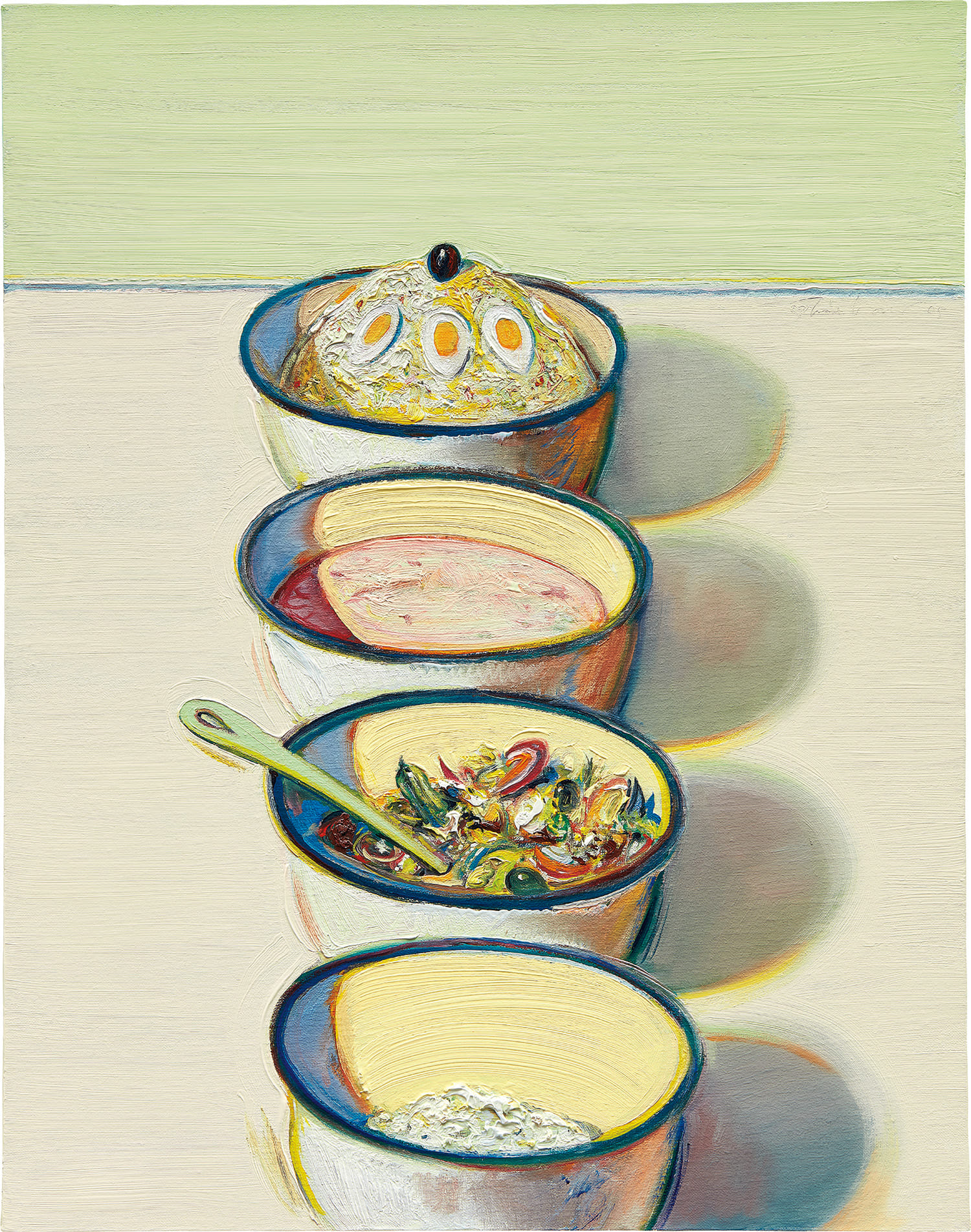
Wayne Thiebaud, Food Bowls, 2005

Thanks for reading; I welcome your comments on any of the above! And thank you, Dorian, for keeping this wonderful blog and for giving me a turn in your bully pulpit. [Ed. – Ha, nowhere near influential enough for that! Thanks for this piece, Hope!]

Nat Leach’s Year in Reading, 2025

Regular readers will know that for the last several years I’ve solicited Year in Reading reflections from friends and trusted readers. As we’re well into February, I’ve scaled the project back considerably this time, but I’ve got some good stuff coming your way over the next few days. Today’s installment, his seventh, is by my longtime friend Nat Leach. Nat is a nineteenth-century scholar turned college administrator who has spent the last 8 years reading the books on his shelves in alphabetical order. He lives in Ontario.

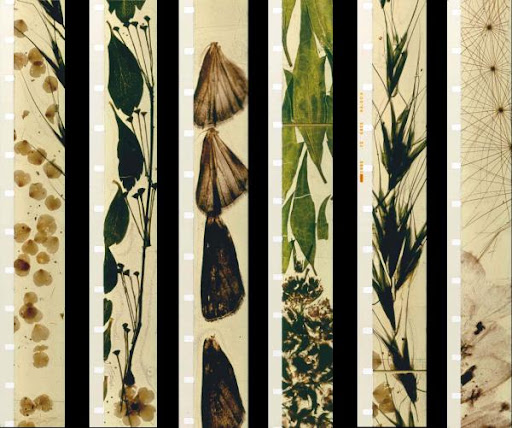
Stills from “Mothlight” (Dir, Stan Brakhage, 1963)

Looking back on my “year in review” posts, it occurs to me that I seem to have reached a reading plateau over the past few years: I’m reading more than I was able to some years ago, but still less than I wish I could. [Ed. – But don’t we always read less than we wish we could???] In the end, though, looking at the list below, I am grateful for what I have been able to read, and for this opportunity to write about my rather eclectic reading program.

In total, I read 35 books last year, though as always, this includes some works of philosophy, theory and criticism that I have been working on gradually for some time. In fact, I read only 10 novels, including finishing two that I already wrote about last year, although I did read more short stories and plays than in recent years.

As for my alphabetical reading project (last year was Year 8 if anyone is still counting), I spent pretty much the whole year working on “M” and didn’t quite get through it. But since “M” is a pretty massive literary letter, I am fairly satisfied with that progress, which means that, alphabetically at least, I am just about at the halfway mark of my project. [Ed. – Amazing!]

I notice that many of the reflections below contain memories and associations with my student days; this is perhaps natural, given that the intent of my project is to clear my TBR shelves of the books that have been there for a long time. I am in many cases finally reading those books I wanted to read during the first half of my life, and hopefully in that way achieving some kind of closure on that chapter before moving ahead to the next project (which, not coincidentally, I have already started to plan). [Ed. – Teaser!]

But before I get ahead of myself, here is what I read in 2025:

Marias, Javier – “Bad Nature” (1996) Trans. Esther Allen

I had never read Marias before, but stumbled across this story in an old edition of Granta that I was reading. It is a somewhat bizarre counter-factual narrative about a translator who worked for Elvis while he was shooting a movie in Mexico. [Ed. — !] I read it as a fable about translation itself; the translator strives very hard to render Elvis’s words accurately, but, in a dangerous context, finds himself facing the consequences of those words because the listeners hear only him saying them, and thus, they become his utterances, and no longer Elvis’s. This seems an apt emblem of the plight of translators in general, foregrounding the impossibility of complete transparency in rendering one language through another. Appropriate, of course, that I read it in translation.

Marlowe, Christopher – The Jew of Malta (1589)

It was perhaps a strange choice to read this terribly antisemitic Elizabethan play, but, as it was the only Marlowe play I hadn’t read, the completist in me felt the need to read it. It’s interesting mostly in contrast with Shakespeare’s The Merchant of Venice; while Shakespeare cultivates at least some level of sympathy for Shylock, Marlowe’s Barabas is a combination of an antisemitic stereotype and a Machiavellian schemer-villain common to Elizabethan revenge tragedy. Despite this, Marlowe interestingly makes clear that Barabas’s villainy is largely triggered by egregious injustices done to him by the Governor of Malta. Short on cash for the required tribute to pay off the Turkish empire not to invade the island, the Governor requires all Jews to pay half their wealth in tax. Those who refuse will have all their property confiscated. In fact, there is really nobody in the play who comes off particularly well (for example, there is a great deal of satire involving Catholic priests), but Barabas is clearly presented as the worst. [Ed. – Boo! Dislike!]

Marquez, Gabriel Garcia – One Hundred Years of Solitude (1967) Trans. Gregory Rabassa

I’m not sure whether Dorian remembers, but when we were both humble MA students, we had to sit a rather ridiculous “Graduate Record Examination” in literature as part of our applications to PhD programs. [Ed. – He sure does.] One of the few things I remember about this was that it included a section where we had to match up famous opening lines with the books from which they came. Most of the answers could be deduced from context fairly easily (the one about mines in Derbyshire was obviously Sons and Lovers, just as Colonel Aureliano Buendia remembering his father taking him to see ice had to be One Hundred Years of Solitude) but it did seem concerning to me that I hadn’t actually read any of these books, which apparently a well-read graduate student should know. [Ed. – Or know how to pretend they know.] This led me to buy all the books included in this question, although the fact that I am still working on finishing them gives the lie to the “well-read” part. [Ed. – See previous interjection.] Anyway, this is another one off that list, and is by turns great fun, horribly tragic, and totally exhausting (trying to remember all of the familial relations between the characters). And this exhaustion is, I think, part of the point of Marquez’s magic realist style, which contrasts linear history with a cyclical vision of human nature and development. The fictional setting of Macondo goes through a historical pattern that echoes that of many South and Central American countries: colonization, revolution, civil war, Imperialist/capitalist exploitation, etc. Against this backdrop, the Buendia family changes along with the country, even as it continually repeats and revises the past (a process most clearly demonstrated by the countless family members named Aureliano and Jose Arcadio throughout the many generations covered by the book). History changes and progresses, and at the same time, folds back on itself. [Ed. – I would like to read this book again. It’s been 35 years.]

Marquis, Don – archy and mehitabel (1927)

I still remember the day when my Grade 12 English class was assigned a poetry project, and our teacher pulled out a stack of photocopies of American poems (with no context) and asked us to select one. I immediately gravitated towards one called “The Lesson of the Moth.” Written in all lower-case letters with no punctuation, it describes the speaker’s encounter with a moth trying to fly into an electric light. The speaker asks why moths have this self-destructive urge and is told that it is because they crave beauty and excitement: “it is better to be happy for a moment and be burned up with beauty than to live a long time and be bored all the while.” The speaker disagrees with this view, saying that he would “rather have half the beauty and twice the longevity” but also rather ruefully concludes “i wish there was something i wanted as badly as he wanted to fry himself.” This poem resonated strongly with my teenaged self, and only later did I discover that the context is that the speaker is archy, a cockroach who types poems on Don Marquis’ typewriter after hours (hence the lack of upper-case letters or punctuation: archy can’t hold down the shift key). [Ed. — !!!] The poems typically revolve around archy’s interactions with other insects and animals, particularly mehitabel the cat, an aging feline who believes she is the reincarnation of Cleopatra. I realize now that this poem may not be quite as profound as my 17-year-old self found it, but I still love it, and I still have a soft spot for archy. I am also glad that I found a three-in-one volume that also includes archys life of mehitabel and archy does his part, so I still have more of him to look forward to. I also note that it is sad that the creation of archy would not have been possible in this computer age—unless we are to believe that a cockroach could turn on a computer and open Word. But that would be just plain silly, right?

Massinger, Philip – A New Way to Pay Old Debts (1625) and The Roman Actor (1626)

It must have been tough writing drama in the wake of some guy named Shakespeare. However well-crafted these plays may be, they invariably suffer by comparison. A New Way to Pay Old Debts is a comedy in which the avaricious Sir Giles Overreach [Ed. – Very subtle, the naming] is tricked by a would-be victim of his greed. It’s enjoyable, but a reader of Shakespeare’s plays can’t help but find the scheme by which the protagonists succeed to be quite simplistic. The Roman Actor is a tragedy of somewhat less merit, which begins with the conceit also explored in “The Mouse-Trap” scene from Hamlet, namely, that drama can be a surreptitious means to cultivate an awareness of guilt or wrongdoing in its audience. It doesn’t do a whole lot with this idea, though, and the play ends with fairly conventional devices depicting romantic jealousy and the downfall of a tyrant. And, frankly (spoiler alert!) [Ed. – No worries, Nat, you’ve read this for all of us, no one is gonna have anything spoiled], when the title character dies even before the final act, it’s hard to avoid the impression that the plot has not been fully thought through.

Maugham, Somerset – The Razor’s Edge (1944)

This book has the dubious distinction of being the book in this project that had been on my TBR pile for the longest time, having been first recommended to me by a friend in high school. [Ed. – That’s when I read it, and I think it’s the perfect time for it.] Fittingly, perhaps, it is a book that I think would land very differently for readers of different ages [Ed. – Aha!]; had I read this when I was younger, I certainly would have sympathized with Larry Darrell, a young man in search of greater meaning in his life than is being offered to him by capitalism and the American Dream. In my older age, though, I identified more with the perspective of Maugham’s narrator, a version of himself who provides a more critical view of Larry and his extended social set, including the compulsive socialite Elliot Templeman, and Larry’s erstwhile fiancée, Isabel Bradley, who has rejected him to retain her social position but still seems to harbour some regret. All in all, I enjoyed the book, although I can’t help but wonder whether the teenager who was so struck by “The Lesson of the Moth” might have found this book’s lessons much more profound than I did upon this reading.

Maupassant, Guy de – “L’Ermite” and “Mademoiselle Perle” (1886)

I have not read a whole lot of Maupassant, although back when I used to teach a course on the short story, I always included one by him. They tend to follow a similar pattern: the narrator/main character notices a seemingly mundane object or event, becomes curious about it, and upon further exploration, finds that it reveals an unexpected depth of insight into human nature, usually by way of a highly brutal or at least sorrowful experience. These stories fit that pattern very well. In “L’Ermite,” a traveller comes across an incredibly remote house on the southern coast of France, and decides to find out what could possibly possess someone to want to live there; he finds out more than he bargained for about the sordid past of the house’s owner. In “Mademoiselle Perle,” a chance incident at a celebration with family friends leads the narrator to uncover a tale of frustrated love. Both stories powerfully depict the normally hidden depths of human emotion that are caused to come to the surface as a result of these events.

Having read the novella/long short story (my bête noire is trying to tell the difference between these categories!) La Petite Roque (which is also fantastic and devastating, by the way), I am now making my way through the other stories in that volume, and am at about the halfway point in the book. [Ed. – More love for Maupassant, I say!]

Mauriac, Francois – Le Désert de l’Amour (1925)

I certainly got my French language reading in this year. This is another one that had been on my shelf for many years, having picked it up at Dorian’s recommendation when I was in grad school, and another one that probably would have landed very differently had I read it when I was younger, as the generational conflict between father and son (both suffering from feelings of unrequited love for the same woman) lies at the heart of this book. [Ed. – I did indeed read this at one point, but so long ago that I have no memory of it at all.] Mauriac reflects on questions of the continuity of the self, and on how people change – and do not change – over time. Despite being written in 1925, the book feels very cinematic, opening in a bar in present day Paris, filling in character histories through extended flashbacks, before concluding back in the present. In this way, we see the impact that the past has had on the development of Raymond Courrèges, whom we see both as a jaded thirty-five-year-old man (in the narrative present) and an irritable and awkward teenager (in the flashbacks), as we learn of the events that caused the latter to grow into the former. [Ed. – Feel like you are delicately, very Canadian-ly, saying “This book is no good.”]

McCarthy, Cormac – The Orchard Keeper (1965)

After that Grade 12 English class (in which we read exclusively American literature), I pretty much stayed away from American literature throughout the rest of my student days. Partly, this was because the only choice I had in my undergraduate program was between Canadian and American literature, and I chose Canadian every time. [Ed. – Imma tariff the fuck out of this post.] Partly, it stemmed from a perception that American literature was filled with toxic masculinity and grotesque celebrations of self-reliance (at least the texts that were being taught at that time often seemed to fit this description). As a result, I am aware that there are some significant gaps in my knowledge of American literature, and Cormac McCarthy was one of these. Although I did buy a three-novels-in-one volume of his work when I was in grad school, I still harboured a vague suspicion that he was not for me. I was surprised, then, by how quickly this book grabbed me. It has an almost dreamlike feel with its elaborate descriptive prose and with the nebulous quality created by its sparse use of proper nouns; most sections of the book are initially presented from the perspective of a “he” and readers have to figure out from the context which character is being referred to, often not getting the solid grounding of a proper noun until a few pages later. The effect of this is to blur the main characters whose lives are interwoven in this book – a bootlegger, a young boy and an old man, all living in rural Tennessee in the 1930s – and challenge the boundaries of identity that separate them. However, also like a dream, many loose ends remain, and I’m not entirely sure that it adds up to much in the end. Appreciating that this is McCarthy’s first novel, though, I look forward to exploring his later work; I still have Suttree and Blood Meridian in that three-novels-in-one volume.

Meredith, George – The Ordeal of Richard Feverel (1859)

In my final semester as an undergraduate, my friends and I, as a study break (or a study strategy, I’m not really sure), compiled a list of “Big Idiots in English Literature.” [Ed. – Strong David Lodge vibes!] At first designed for the Angel Clares and Othellos of the literary world, it soon became quite a voluminous list, as we determined that almost every character in every literary work we had studied over the course of four years had done something to merit inclusion. I mention this only to be clear that when I say that this book features some of the biggest literary idiots I have ever seen, I know whereof I speak. [Ed. – lol!] The plot in a nutshell: Sir Austin Feverel, a big idiot whose wife has run off with a poet, determines to educate his son, Richard, according to a system of his own devising in order to preserve him from the corrupting influence of women. This system of education in turn causes Richard to grow up into a big idiot who gets himself into a great deal of trouble, and runs away with practically the first girl he meets. Along the way, he is aided and abetted by a number of other big idiots, and he also ends up being a big idiot to his wife, who, despite being a version of the Victorian “angel in the house” commits some idiocies of her own.

I should be clear that this is in no way a criticism of the book; the presence of big idiots does not compromise its literary value, but man, does it make the book painful to read at times. Meredith doesn’t get talked about as much as many of his Victorian contemporaries, perhaps because of his more modern perspective, perhaps because his big idiots are not so thoroughly and cathartically tragic in the way that, say, Hardy’s are. Having said that, the painfulness level of this book is pretty close to Hardy at his best, even if it is leavened with a wry cynicism that perhaps more anticipates Oscar Wilde. In the end, it’s one of those books that I enjoyed reading, but really enjoyed finishing (just to get away from the big idiots). [Ed. – I will never read this, but if I ever did it would be because of this review.]

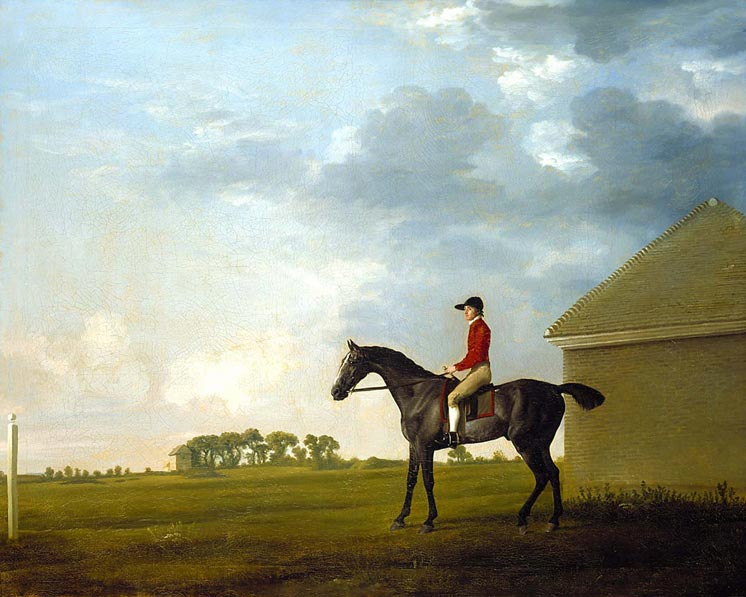
George Stubbs, Gimcrack with John Pratt up on Newmarket Heath, ca. 1765

Miller, Andrew – Now We Shall Be Entirely Free (2018)

This is the book that divided me the most this year, and raised questions about my own reading expectations. On the one hand, I always looked forward to reading the next chapter of this book, and its narrative drive – about the pursuit of an English officer accused of atrocities in the Napoleonic wars – thoroughly gripped me. One night, I binge-read the last 50 pages of the book, which is something I have not done in a long time. On the other hand, many things kept irritating me about the book’s representation of its historical period. At first, it was little things that just didn’t seem to fit the setting of the book in 1809. I began to feel the need to research some of these perceived anachronisms, even as I wondered if they were only bothering me because, as a scholar of Romantic literature, I have spent a lot of time reading about this period, and am perhaps over-sensitive to these details. For example, one of the soldiers swears a great deal – fair enough, I’m sure people swore much more in the 19th century than they do in a Jane Austen novel – but the language used is consistently modern (e.g. “wankers,” which I have now learned only took on its modern meaning in the mid-twentieth century, and “the fuck?” for “what the fuck?” which I certainly had never heard used prior to the 21st century). [Ed. – I feel sure we said “the fuck” in the 90s. Have I misremembered this???] But my most pedantic objection is the fact that the characters discuss the poetry of John Clare. In 1809, Clare would have been only 16 years old, and he did not publish his first book of poetry until 1820. There are also casual references to the future, which seemed to serve no purpose other than winking knowingly at the reader; for example, at one point, a character makes an offhand observation about how this new idea they call “police” might really catch on in the future.

But while I plead guilty to pedantry, I realized that these anachronistic details were not really what was bothering me. Rather, I came to recognize that the source of my frustration was that the characters feel thoroughly modern in their thoughts and actions despite the period setting. The protagonist, an English gentleman who purchased a commission as an officer in the British army, is not in the least rooted in the ideology of that class, and virtually all the characters exhibit attitudes that are much more modern than any that would have been around in 1809 – for example, most of the characters’ attitudes towards sexuality are not simply liberal, but unthinkable for their class and time period.

All of this led me to ask questions, the first and foremost being “does any of this matter?” Should it really affect my enjoyment of the novel if it is not entirely historically accurate? For one thing, I can readily imagine that if Miller had written a draft that rendered 1809 with impeccable period detail – and I should mention, by the way, that he does seem to have done a great deal of research, as evidenced, for example, by a description of the conditions of child labour in the period that tallies very closely with contemporary accounts – his editors would likely have compelled him to revise it extensively anyway, given that most modern readers would not be able to follow many period details of language and custom.

So, perhaps what my objections amount to is the fact that the book belies its appearance as a “historical novel”; to my mind, it does not reflect on the period in which it is set in any meaningful way. Which leads to the next questions: “if it’s not a historical novel, is it something else?” and “could that something else be considered good and enjoyable in its own way?” There is indeed a lot to like about the book, especially, for me, its thrilling climax. So, in the end, I guess I would say that I liked it, but felt like it could have been something more than it was, while also acknowledging that this could be an unfair expectation on my part. [Ed. – Ok this fascinates me, as a huge fan of the book who now feels the need to revise his opinion. The inaccuracies are unfortunate, definitely, but your questions about what this book is in fact doing are what really hit home. It does seem a book marked by a modern idea of trauma, that’s for sure.]

Mitchell, W.O. – Roses Are Difficult Here (1990)

I must admit that I only picked up this book because of a reference to it in a Tragically Hip song (“Impossibilium”) but given my fondness for all things CanLit, I expected I would enjoy this novel about a small town in the Alberta foothills in the 1950’s that is turned upside down by the arrival of a sociologist conducting a study. And this book does have plenty of that Canadian small-town charm and humour, but, like Now We Shall Be Entirely Free, Roses Are Difficult Here was another book that kind of gnawed at me. In this case, the novel feels like it is based in a kind of anti-woke panic avant la lettre. [Ed. – That tracks with the little I know of Mitchell’s personality FWIW.] The sociologist is villainized for suggesting modern ideas, such as the implication that the town maybe ought to be less racist towards the nearby Indigenous community, and that the feeling of unity in which all the town’s inhabitants take pride is actually based on its exclusion of outsiders, such as the half-Indigenous garbage collector, Rory Napoleon. Having said that, the scene in which Rory stampedes his goats through the town in retribution for his treatment at the hands of the townsfolk is definitely the highlight of the book. But aside from giving Rory a chance to air his grievances at a town meeting, the book clearly sides with the townsfolk, and, written in 1990, it seems nostalgic for a past where nobody complained about casual racism and sexism. [Ed. – Strong white guy vibes.]

And since I have already demonstrated my penchant for pedantry, I might as well lean into it: Mitchell begins a chapter set in the autumn of 1957 using the following passage full of historical detail:

The Russians had just shocked the world with the announcement of their successful satellite… The previous June, the Liberal government had been defeated by the conservatives after fifteen unbroken years in power; Canada had lost the world hockey championship to Sweden; the Milwaukee Braves had taken the World Series…

I concede Sputnik and the Braves, but Sweden did not defeat Canada in hockey even though they did win the championship – Canada and the U.S. boycotted the event being held in the U.S.S.R. that year in protest of the Soviet occupation of Hungary. And the Liberals had been in power since 1935 prior to the 1957 election, which actually makes it more like 22 consecutive years. OK, thank you, I just had to get that out. [Ed. – I’m glad you did! And that “Does no one edit these books???” was already a thing in 1990. Also, that sample paragraph is terrible!]

Modiano, Patrick – The Search Warrant (1997) Trans. Joanna Kilmartin

There seems to be an unwritten rule that every Holocaust-themed book translated into English must have its title altered unrecognizably from the original. Usually, the impulse is towards a title that moralizes or sensationalizes the narrative, but in this case it’s just baffling. Originally published as Dora Bruder, this book does not include a literal search warrant, although it is admittedly concerned with other kinds of official documentation used to give a legal veneer to otherwise unjustifiable deportations. And on the other hand, the title could only with difficulty be twisted to refer by analogy to Modiano’s own search for evidence of the titular 15-year-old Jewish girl who ran away from home during the Nazi occupation of Paris and was later deported to Auschwitz. In any case, the book is a fascinating exploration of memory and the way the traces of the past persist into the present, as Modiano weaves in his own experiences of Paris with what he has been able to learn about Dora’s experiences, and, more importantly, with what is not known, and will never be known about them. [Ed. – Modiano is not my guy, but you might be happy to know that at some point—maybe after the Nobel win?—the publisher reissued it under its original title.]

Piñero, Claudia – Elena Knows (2007)

Every year, I scale back my ambitions for Women in Translation month in August, and this year, I finally came up with a plan that I could complete before the end of August: one relatively short book (spoiler alert: it was so good, I couldn’t put it down and ended up finishing it within two weeks). I’d first heard about this book on, I believe, the first ever podcast of One Bright Book (those folks are great, huh?) and was sold on it. [Ed. – Now that you mention it, they are kind of great.] Nor did it disappoint; while the premise may not exactly sound like a page-turner (woman with Parkinson’s resolves to investigate her daughter’s murder), it is in fact a brilliant and devastating book. It’s a premise that compels readers to pause and take notice of mundane activities that most of us take for granted, increasingly drawing us into Elena’s perspective as she tries to find answers. I won’t risk spoilers by saying any more, but this is quite possibly the best book I read this year, and as someone who has a track record for not getting on with books written in this century, that is high praise indeed. [Ed. – This is one of those books that I like more and more as I think about it. You’ve made me want to re-read it!]

Barbara Hepworth, Kneeling Figure (1932)

Looking ahead to 2026

What’s next for me? Well, after M comes N, then O (both mercifully light letters, by the way)… but, as I mentioned last year, this reading project was really front-loaded in the first half of the alphabet, so even though I have almost reached the alphabetical mid-point of my project, I am actually over 2/3 of the way through. In fact, were it not for two very significant undertakings at the end of the “P” shelf (hint: Proust and Pynchon), I might be tempted to consider myself nearly home and dry. With about 75 books remaining, optimistically, I might imagine finishing this project within 2-3 years (keeping in mind that this was conceived as a 5-year project, and it won’t be finished in 10, so any optimism is pretty clearly misplaced).

But as I said at the top, I’ve already started to think about my next utterly ridiculous reading project, and, in fact, probably spent far too much of my valuable reading time this year planning it out and acquiring the necessary books. [Ed. – Nat, that is important and necessary work, especially the acquiring books part.] It may require a bit too much space to explain my plan fully here, but it will involve 250 novels, and I may still need some recommendations to fill out this number, so perhaps if Dorian hasn’t yet had enough of my nonsense, he will let me write another guest post about it later in the year. [Ed. – He 100% will.] In the meantime, Brian Moore and Toni Morrison are the only authors standing in the way of my getting to the second half of the alphabet. [Ed. – Ooh such good authors! Thanks for another wonderful piece, Nat!]