What I Read, January 2024

Chava Rosenfarb was born in Lodz in 1923 to parents enmeshed in the life of the Bund, a political and social justice movement that flourished in interwar Poland. In contrast to Zionists, Bundists believed that Europe could and should remain central to the future of Jewish life. Economically, they embraced socialism. (Bundism thrived in the highly Jewish, highly urbanized cities of Poland, especially Lodz, a center of textile manufacturing regularly compared to Manchester.) Linguistically, they championed Yiddish over Polish or the Hebrew that Zionists, aimed to resurrect. Spiritually, they turned Judaism’s emphasis on reparation (the messiah will not arrive until we have perfected the world) to social justice ends in their own community.

Like every other Jew her age in Poland, Rosenfarb’s education was interrupted when Germany invaded in September 1939. A few months later, she was interned with her family in Lodz’s sealed ghetto. Amazingly, she, her sister, and her parents remained together until the final liquidation of the ghetto in the late summer of 1944. Along with some friends, the family had prepared a hidden space in their apartment building; more than 20 people crammed into it in those final days. Although they escaped notice for more than three days, their luck eventually ran out and they were deported to Auschwitz. Rosenfarb’s father was separated from them at the ramp: they never saw him again; she would later learn that he died in an allied bombing raid in Germany in the last days of the war. The Rosenfarb women were sent to Sasel, a work site in a Hamburg suburb, where they rebuilt roads for several hard and cold months. Early in 1945 they were deported again, this time to Bergen-Belsen, where Rosenfarb, sick from the typhus infestation that swept that notoriously chaotic place (all camps were disaster zones in the last weeks of the war: the situation in Belsen was perhaps the most terrible of all), clung to life, more dead than alive, when the camp was liberated in April.

Remarkable experiences as a DP and an illegal alien in Belgium followed; by 1950 the Rosenfarbs, along with a man Chava had known in Lodz, reencountered in the ruins of postwar Germany, and later married, secured visas to Canada. (That man, Henry Morgenthaler would later champion the cause of legal abortion in Canada, becoming, in my 1980s childhood, a figure equally reviled and admired. My mind exploded when I learned this connection.) The refugees settled in Montreal, where Rosenfarb would spend most of the rest of her life. In this new world, along with caring for her mother and raising her children, Rosenfarb continued the writing she had begun in the Lodz ghetto. After poems came novels and short stories, her efforts culminating in her three-volume fictional chronicle of the Lodz Ghettto, The Tree of Life (1972, translated into English by her daughter, Goldie Morgenthaler).  

I learned all this and more in a wonderful course offered by the Yiddish Book Center, spurred by the publication of her collected short stories (excellent, especially the dramatic “Edgia’s Revenge,” which I immediately added to my syllabus). The Center offers courses and talks regularly; check them out if you have any interest in all things Yiddish.
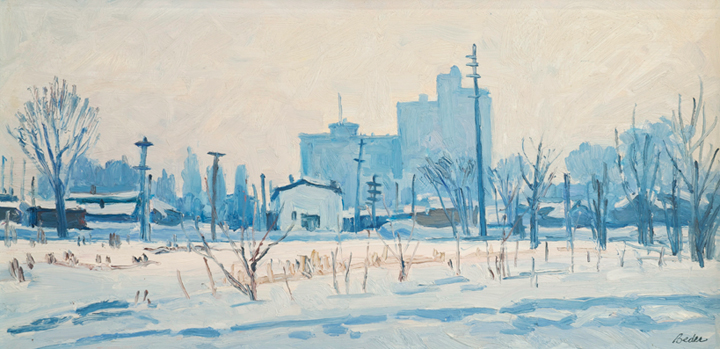
Jack Beder, Winter Morning, 1972

Rebecca Donner, All the Frequent Troubles of Our Days (2021)

Mildred Harnack née Fish grew up in Milwaukee to an intermittently employed father and a mother who was a stenographer. In the 1920s she attended the University of Wisconsin, where she met Arvid Harnack, an economist and jurist from Germany who could, unlike any man she had met before, match her as much in the seminar room as on the dance floor. By 1929 the young couple—they had married three years earlier—was living together in Berlin. Mildred would return home only a handful more times. Berlin was exciting, even for a poor couple like the Harnacks. All kinds of change seemed possible. But the rise of the Nazi party threatened all that. Mildred was fired from her position teaching American literature in 1932 because of her opposition to the party, even though it would not come to power until the following year. Needing to find work, Mildred took a job teaching working class students at night school. She loved her students, believed in their ability to transform their lives, and eventually recruited some of them as central figures in a resistance movement that she and her husband began building in the early years of the regime. The circle, as she called it, met to share ideas, often over book discussions, and distributed leaflets denouncing Nazi policies. It was loosely aligned with other resistance movements, including the one that included the pastor Dietrich Bonhoeffer, a cousin of Arvid’s, and the one led by Harro Schulze-Boysen and Libertas Haas-Heye, which eventually led Arvid to pass on military secrets he gained from his work in the Reich Ministry of Economics. Rebecca Donner, who happens to be Mildred’s great-great-nice, tells the story with flair and sympathy. 

I found it fascinating to compare Donner’s book to Norman Ohler’s Bohemians, in which Mildred is a bit player. Donner has much less sympathy with Haas-Heye than Ohler does—which makes sense since Haas-Heye ratted Harnack and the others in the so-called Red Chapel group out. It seems she was duped by a supposedly sympathetic secretary in the jail where she was held in custody—but duped rather easily, Donner implies.

Earlier in the 1930s, Mildred befriended Martha Dodd, daughter of the US ambassador. When Dodd was replaced, she became close to the wife of the new First Secretary, whose son, nine-year-old Don Heath, Jr., acted as a courier, carrying clips of paper in his backpack from his English lessons with Mildred (whom he adored) to his father. Typically, those messages consisted only of a time and place where Mildred or Arvid could meet with Heath to pass on information in person.

This work was dangerous, of course, and it some sense it was only a matter of time before she and Arvid were found out. Had the group’s Soviet handler not been so clumsy, they may have escaped detection. When they realized their cover had been blown in September 1942, the couple tried to get to Sweden, but they were arrested in East Prussia the day before they were to set sail. Mildred’s initial six-year prison sentence was overturned by Hitler himself. A new trial sentenced her to death; she was executed by guillotine in February 1943.

As its title implies, nothing is comforting about the subject matter of All the Frequent Troubles of Our Days. It’s a sad book. In her final days Harnack was miserable: eaten by lice, beaten by guards, almost unable to speak to the fellow prisoners who admired her. But grief and despair shadowed her long before her arrest; I was moved by the cost of Harnack’s convictions. Her commitment—compounded by her inability to say anything, lest it further endanger her—destroyed her relationships with almost everyone, especially her American family. By the end, Harnack has the remarkable but unenviable distance from the world of someone like Simone Weil. Donner admires her great-great-aunt, and makes us admire her, too. But she has the guts to admit that principled resistance to injustice can lead to the calcification of so much that is human. How painful to see the erosion of that Wisconsin college girl, wide-eyed and full of the desire to teach and to learn, in love with a man and the world. How loving and patient of Donner to have resurrected her.

[An aside: Donner relies heavily on William Shirer’s diaries. That surprised me: he seems so old-fashioned. Who reads The Rise and Fall of the Nazis anymore? But Donner knows what she’s doing: based these excerpts, he was a hell of a writer.]

Emily Tesh, Some Desperate Glory (2023)

The always reliable Adam Roberts tipped me on to this in his annual sff recap in The Guardian. Then Ian Mond praised it too. The Venn diagram of their tastes is close to being a circle, but everything in it is top-notch. Roberts calls Some Desperate Glory “a blend of space opera and military SF that refreshes both modes,” which sounds exactly right to me, even if I still don’t quite know what those terms mean.

Kyr has come of age on Gaea Station, the last redoubt of humanity after earth is destroyed by alien species who have decided that humans are irredeemably violent. (I mean, not wrong.) Her seventeen years have been marked by submission, dedication, and toughness, to others but above all to one’s self. Food is fuel; rest mandated so the machinery of the body and the station can keep going; families are split apart, the children, bred to emphasize traits necessary for survival, are raised in same-sex age cohorts after they leave the nursey.

Gaea, it becomes clear, is Sparta.

And Kyr loves it.

Along with her twin brother, she is the best of the best: fast, strong, smart, zealous, loyal to the cause. Yes, her “siblings” hate her—she’s always ratting them out and pushing them to exhausted, shameful tears—but such toughness is needed for humanity to enact its revenge. As the date of her cohort’s graduation approaches, Kyr can’t wait for her assignment. She knows she’ll be named to the warrior caste. And then she’ll be able to throw off her only black mark: a family history of treachery. Ten years earlier, her older sister fled the station with her infant child, probably for a planet where the aliens let humans live on sufferance, symbolically neutered, as pathetic as lap dogs. When Kyr’s assignment comes back all wrong—her shock compounded by the news that her brother has been selected for an even more prestigious, albeit suicidal mission—she hatches a plot to follow him. The journey will eventually revise her entire sense of the universe.

I admired Tesh’s accomplishment here: she lets us to read against Kyr (we know she’s more than insufferable: the perfect fascist, really) even as we can understand her zeal for her embattled mission. (I say “we” but a quick glance at Goodreads—I remembered why I never do that—shows me that Tesh’s skill with POV is lost on some readers…) In a brief afterword, Tesh lists some of the works she consulted in writing Some Desperate Glory: books on North Korea, Paxton’s classic study of fascism, and Lawrence’s Wright expose of the handful of people who have escaped scientology. All of which allows her to pull off her greatest trick: like Kyr, readers too are deprogrammed, the “facts” of the novel’s world cast into new light as we proceed. An unpredictable quest story follows, with plenty of plot twists and heart-in-mouth moments. (I was on the verge of tears by the end.) Queer love stories, found families, alternate realities: all the things contemporary sff is known for come into play. Good stuff.

Walter Kempowski, Marrow and Bone (1992) Trans. Charlotte Collins (2018)

I raved about this writer last month.

Marrow and Bone might be the least terrific of the three Kempowskis I’ve now read, but it’s still very good. (Don’t start here, though.) Jonathan Fabrizius is a freelance writer who, thanks to a small stipend from an uncle, lives in charming modesty in 1980s Hamburg, sharing one of those impossible German apartments (carved up willy-nilly from a grander space, bathrooms in the hall, no kitchen to speak of) with a girlfriend who has given up on him. Out of the blue, an invitation comes from, of all things, the organizers of a road rally across the former East Prussia: they want Jonathan to write about the sights attendees might enjoy as they follow the racers from east to west. Jonathan accepts with alacrity: he needs the money, but he also has ties to the region. His companions are a former racecar driver and a representative of the event organizers. Like all picaresques, Marrow and Bone shambles from one incident to another, most of which at first seem consequential, even dire, but prove to be irritants at worst, spurs to further discoveries at best. (When their car and luggage is stolen, for example, the company immediately sends another car, and the protagonists later find the luggage abandoned by the side of the road.) Jonathan, a bit of a schlemiel, need never worry about the consequences of his failures: in one moving scene, he promises to mail form the West some anxiety medication to the mother of a suffering young woman. Tragically, absurdly, he loses the address: he feels bad there’s no way to reach them, but he’s content to throw up his hands.

It’s clear that Kempowski is diagnosing the post-communist situation in this tale of the last days of divided Germany. How so and to what end are harder to say. Maybe that comes from the newness of the events (published only three years after the fall of the wall). Or maybe from Kempowski’s haziness, which can be hard to disentangle from Jonathan’s. Importantly, though, Kempowski does not think it would have been better had the Germans not lost East Prussia. He acknowledges that Poles have had opportunities and made a go of things—even if those things are sometimes muddled in the ordinary way of the world—that they might not have had under German hegemony. But he also laments a lost world—especially the mix of cultures that East Prussia, like all borderlands, once had. He’s similarly gentle with the 1980s leftist intellectual milieu to which Jonathan belongs. He pokes fun at their belief in the power of petitions and protests, but admires their conviction.

I guess I am writing myself into the position that it is not easy to tell what is mild (and therefore, possibly, generous) in the book and what is fuzzy (and therefore, possibly, lazy).

Oliver Burkeman, Four Thousand Weeks: Time Management for Mortals (2021)

If we’re lucky and live into our seventies, we spend about four thousand weeks in this life. To my numerically-hazy mind that seems lot, but it’s not. And when you’re in your 50s, you can’t help but conclude that you have hardly any weeks left at all. Burkeman’s self-help book for people who cringe at the idea of self-help gently asks us to recognize the fact that we all want to deny, the inescapable reality quantified in his title. Burkeman, a self-professed failed productivity expert, exhorts us to make those weeks count—but not by being more productive. (Some of the most amusing parts of the book concern the various productivity regimes to which he has pled fealty. As he wryly notes, work tends to beget work. Answering email is shit!) The point isn’t that we should spend our time only doing what we want—none of us have that freedom, especially those of us who aren’t independently wealthy. Rather, it’s simply that we should be intentional about our time. But what a huge “simply” that is! It means recognizing our mortality—something that I, for one, have had no interest in doing.

A short, well-written, often funny, and always accessible book (Burkeman makes even Heidegger intelligible), Four Thousand Weeks has kept its hold on me in the weeks since I read it. He demolishes the belief so many of us have that our real life will begin at some indefinite future time: as soon as I do x or figure out y, I’ll finally do z (clean the closets, commit to a relationship, write that book), when in fact our lives are nothing but the cluttered, half-hearted, scattered series of moments that we wrongly think of as garbage time before real meaning will arrive. He argues that our impatience, our “it would be funny if it weren’t so sad” drive to hurry through life, is really a sign of how strongly we deny our mortality. We feel time is wasted because we are reluctant to embrace discomfort and resistance. We don’t have to like traffic jams, checkout lines, or toddler games. But until we learn to experience them as time we will find them even more painful than they are.

Some of you might remember Emma Townsend from Twitter (I miss her). I raised an eye at her when she raved about Four Thousand Weeks; she gently encouraged me not to be so hasty. It took me a while to try the book for myself, but I’m so glad I did. Sorry for doubting you, Emma.

Rebecca West, Harriet Hume (1929)

A witchy book; I must confess, I am not much for witchy things.

West’s strange fantasia of a (non)-relationship over several decades is the subject of Episode 22 of One Bright Book—worth your time, in my opinion, especially if you want to hear smart readers wrestle with a book they don’t quite know what to make of. Fascinating for the contrast between West’s mode here and that of her gigantic Balkan travelogue, Black Lamb and Grey Falcon, which I spent some time with each day this month.

László Moholy-Nagy, 7 A.M. (New Year’s Morning) ca. 1930

I still have a few Rosenfarb stories to read, so I’ll save further comment on the collection for later other than to say how wonderful it is that these are now available in English. If I had more time—and, you know, didn’t spend my days teaching—I’d take classes like this one all the time.

And you? How did you spend January?

Scott Walters’s Year in Reading, 2023

Excited to once again present reading reviews from some of my favourite readers. Today’s installment, his third, is by Scott Walters. Scott launched a litblog, seraillon, in 2010, and expects to return to it one of these days. He largely follows Primo Levi’s model of “occasional and erratic reading, reading out of curiosity, impulse or vice, and not by profession.” He lives with his partner in San Francisco.

Barring a couple of possible late entries, here ends the 2023 edition of the EMJ Year in Reading series. Thanks to everyone who contributed–and all who read these engaging lists.

Édouard Boubat, Paris, 1949

Year in Reading 2023: 50 Books, Fat and Thin

Like several others who have already posted about 2023, I had a less than stellar reading year, finishing a little over half the number of books I did in 2022. On the other hand, several doubled as barbells for building up my muscles. On the third hand, some were slim. And on the fourth hand, some were slim pickings; I can’t recall ever reading so many works I didn’t especially like. I’m not sure to what to attribute that deflating phenomenon, but I hardly seem to be alone.

Best Quasi-Rereading

Michael Moore’s effervescent new translation marked my fourth time reading Alessandro Manzoni’s The Betrothed (1827/1842). As Moore explained at a reading I attended, he deliberately aimed his translation at an American audience lamentably unfamiliar with this 19th century masterpiece. An ingenious framing story cocoons this long tale of Renzo and Lucia, the affianced young couple whose wedding plans are dashed by the machinations of a lascivious warlord, forcing the couple to separate and flee into spiraling trials that challenge them (and several other characters) into becoming larger than themselves. Starting a beloved book in a new translation requires adjustment, but I was won over by Moore’s energetic, nimble, vivid and playful version, almost certainly the place to start for any American reader approaching this grand work for the first time. [Ed. – This book looks at me reproachfully from the shelf…]

Other Italian Explorations

Giovanni Boccaccio: The Decameron

G. W. McWilliams’ translation of Boccaccio’s 1353 classic accompanied me throughout the year as the perfect post-pandemic [Ed. – sic] companion. You know the framing story: five young women during the Florentine plague of 1348 abandon the city and invite along five male friends to an empty villa in the hills where, each day for ten days, each tells a story to entertain the others. The depiction of the plague in the book’s opening is terrific, and the 100 stories, splendidly diverse, are by turns tender, ribald, moving, pointed. So is the warm banter between the young people as they introduce their stories and encourage one another’s efforts, the whole serving as a kind of instruction manual on storytelling (and as a model for confronting calamity). Boccaccio has become a favorite; I also spent time this year with his Famous Women and Genealogy of the Pagan Gods, the latter especially highlighting Boccaccio’s talent as a great writer of prefaces. [Ed. – Ok, you sold me on this!]

Dominic Starnone: The House on the Via Gemita (2023)

The two short Starnone Neapolitan novels I’d read had impressed me, so I was excited to discover a fat new 500-page work also set in Naples. Starnone’s narrator recounts the history of his father, digging so thoroughly into strained father/son relationship that I can’t imagine The House on the Via Gemita not taking its place as a classic of the genre. To my surprise, the book also turned out to be an excellent novel about painting, in that the son must address both his father’s abusive personality and role as a peripheral figure in mid-century Italian art, a career layered on top of a day job as a railroad worker and the family responsibilities he largely leaves to others. Starnone gives us a brief history of postwar Italian art while exploring the qualities that make paintings great or mediocre and making personal an issue of our time: disentangling (or not) an artist from their art. I also noted the geographical precision employed by Starnone as a quality common to several contemporary Neapolitan novels; one can use a map to follow the narrative’s peregrinations around the city.

Maria Attanasio: Concetta et ses femmes

Concetta et ses femmes, written in 2021 when Attanasio was 80, sets out as a documentary rescue mission to obtain the story of Concetta la Ferla, organizer in the late 1960s, in Caltagirone, Sicily, of the first women’s branch of the Italian Communist Party (then the third largest in the world). Concetta’s grassroots project develops out of frustration with the municipality’s diversion of water to its wealthiest citizens, but runs into predictable obstacles in the form of chauvinistic attitudes in the city administration, in the Party, and at home. The story would be interesting enough simply as historical artifact. But Attanasio’s structuring of her novel, the first part narrated by Maria herself from the perspective of 20 years after the effort to preserve Concetta’s tale, and the second the tale itself in Concetta’s words, plays with questions of authorship and feminist solidarity, and emphasizes the continual nature of the struggle to gain legitimacy, to advance the advances of the past, to never go back.

Other Italian/Italy-related works included an Italian/French collection of short stories (Nouvelles italiennes contemporaines), with Tomas Landolfi, Massimo Bontempelli and especially Elisabetta Rasy’s contributions as standouts. Indian-American-now-Italian writer Jhumpa Lahiri’s Roman Stories (2023) revisits Alberto Moravia’s 1959 Roman Tales (Racconti Romani in the original Italian for both books), exchanging Moravia’s focus on Roman men in recognizable neighborhoods for immigrants, ex-pats, and tourists vaguely on the city’s periphery. Renato Serra’s Examination of Conscience of a Man of Letters (1915) presents a searing treatise on the relationship of literature and war, written three months before Serra perished in battle in World War I (read in French; while the essay has never gone out of print in Italy, it has not been translated into English). I devoured Janet Abramowicz’s monograph, Giorgio Morandi: The Art of Silence (1964), a deep appreciation of the Bolognese artist into whose family Abramowicz was essentially adopted. Despite this proximity, Abramowicz treats her former teacher judiciously and even unsparingly when it comes to Morandi’s blemishes, in particular his tacit involvement with fascism. German writer Esther Kinsky’s Rombo (2022), a polyphonic novel exploring the impact of a series of earthquakes on remote villages in the north of Italy, grew on me during my reading, with its Polaroid-like narrative approach in which the lives of the villagers gradually become more vivid and saturated. Finally, in Etruscan Places (posthumous publication 1932), D. H. Lawrence and a companion identified as “B” voyage through central Italy, exploring sites of the ancient Etruscan “12 cities.” Lawrence’s incisive, infectiously enthusiastic observations about Etruscan art and life turned me into a fan of this fascinating people whose culture was absorbed/obliterated by the Roman Empire. The narrative doubles as a travelogue through Mussolini’s Italy and, adding yet another layer, Lawrence’s views lay out an entire philosophy that has me determined to revisit his fiction this year. [Ed. – I support this plan!]

Stalingrad

I came away from Vasily Grossman’s Life and Fate convinced I’d encountered one of the essential literary documents of the 20th century’s experience of fascism. I did not know that the book was but a second volume in Grossman’s monumental effort to write the great World War II novel. The first, Stalingrad (1952), with still no definitive Russian edition, has only recently been translated into English by Robert and Elizabeth Chandler. As highly as I esteem Life and Fate, I believe Stalingrad may well be the superior novel [Ed. — !] in its immediacy and the sheer grandeur of its conception (but as the books were intended to form a whole, one need not set them against one another). Grossman, present at Stalingrad as a journalist, related some of his experiences in Life and Fate, but Stalingrad sets out to capture the whole story of the war’s most decisive battle, from August 23, 1942 to February 2, 1943. Grossman’s acute consciousness of his literary precursor, Leo Tolstoy, leads him to take his main character on two pilgrimages to Tolstoy’s house, Yasnya Polynka, and to muse on Tolstoy’s accomplishments: 

Krymov looked at the wounded who had fallen by the wayside, at their grim, tormented faces, and wondered if these men would ever enter the pages of books. This was not a sight for those who wanted to clothe the war in fine robes. He remembered a night-time conversation with an elderly soldier whose face he had been unable to see. They had been lying in a gully, with only a greatcoat to cover them. The writers of future books had better avoid listening to conversations like that. It was all very well for Tolstoy – he wrote his great and splendid books decades after 1812, when the pain felt in every heart had faded and only what was wise and bright was remembered.

With Life and Fate, Stalingrad now gives us one of the great documents of World War II – and one of the greatest works of fiction about war ever written.

An Essential Holocaust Novel

The Talmudic concept of the Lamed-Vov, the 36 righteous people on whom the continuity of the world depends, fascinated me when first I read about it. Only when I started André Schwarz-Bart’s 1956 Prix Goncourt-winning novel, The Last of the Just, did I realize that the Lamed-Vov were central to the book. Schwartz-Bart takes the reader though a thousand years of Lamed-Vov succession to arrive at Germany in the 1930s, where the narrative pace slows dramatically. His restrained, almost clinically factual language provides devastating testament as much as fiction. Some of its scenes are completely indelible, and Ernie Levy, Schwarz-Bart’s protagonist for this last half of the book, struck me one of the most remarkable characters I’ve encountered in a lifetime of reading. [Ed. – It feels like a professional failing that I have not read this book!]

José Revueltas: The Hole

A tiny but shockingly powerful novella, taut and tight with not a word out of place. [Ed. – Funny, that’s how people usually describe me!] The Mexican writer and activist Revueltas’s 1969 book, based on the author’s own 12-year experience as a political prisoner, resembles a Piranesi prison drawing in narrative form, an intensely concentrated exploration of incarceration. Everything in the narrative is compressed – time, space, hope, even the reader’s attention and the size of the book itself. An absolute masterpiece of prison literature.

Mariana Yampolsky, Estación Martell, 1988

Good King Xavier, Reino de Redonda

Spanish novelist Javier Marías died at age 70 on September 11, 2022. I encountered his work four times this past year, first in his final novel Tomás Nevinson (2022) which appeared last May in Margaret Jull Costa’s translation. I had come to anticipate each new Marías translation as nearly an annual tradition, so knowing that this his last novel made reading it deeply bittersweet. Tomás Nevinson follows up 2018’s Berta Isla, but also resurrects characters from Marías’s Your Face Tomorrow trilogy, most notably Bertram Tupra. Where Your Face Tomorrow engaged Spain’s experience of Franco and of the civil war, Tomás Nevinson takes as its starting point the Basque separatist terrorist attacks of the 1990s. As Nevinson is enlisted by Tupra to come out of retirement to track down a woman involved in the most heinous of these attacks, Marías uses the narrative to explore questions about our responsibility for seeking justice, how we deal with repentance and redemption, what justice seekers owe to their own loved ones, whether there may be some informal statute of limitations on bringing the guilty to account and how long justice should be sought – time being among the most prominent fixtures in Marías’s fiction. We are fortunate to have this novel; Marías’s time having run out seems completely unjust.

When I picked up Tomás Nevinson at Point Reyes Books, the literary mecca cultivated by Molly Parent and Stephen Sparks, Sparks asked if I’d read the new book about Redonda. I must have stared at him blankly, as, having not yet read Marías’s Oxford novels, I knew nothing. Thanks to Michael Hingston’s marvelously strange Try Not to Be Strange (2023), I now know quite a lot, including the fact that Marías had been, up until his untimely death, King Xavier I, monarch of this tiny nation, which, despite having no inhabitants, does have territory, a flag, its own currency and postage stamps, and a plethora of dukes and princesses, counts and ambassadors, and multitudes of other titles held by what seems a who’s-who of 20th century writers. This was by far my most fun book of the year, uncovering a great story, offering up a charming tale of obsession (including Hingston’s own), and digging a dizzying warren of rabbit holes for one to scurry down, which led to my filling quite a bit of empty shelf space with related works. [Ed. – Well, this all seems quite insane!]

One of those works, of course, was All Souls (1992), the Marías Oxford novel in which the author first mentions Redonda. I expect to have more to say about this book after I’ve read its sequel, Dark Back of Time, on deck for 2024.

Another addition, Cuentos únicos (1996), came from Reino de Redonda, Marías’s own Spanish-language imprint.This collection of 22 translated English language short stories selected by Marías presented a way to practice my poor Spanish and get to know some writers I didn’t know. Nugent Barker? Oswell Blakeston? Percival Landon? [Ed. – Are these imaginary???] My Spanish proved inadequate to the task, but I understood enough to have made the effort – to be continued this year – worthwhile.

The Ascent of Rum Doodle Mont Analogue

My next-to-most-fun book of the year, René Daumal’s Mont Analogue (1952), tells the story of Père Solgon’s organization of an expedition aboard the ship “Impossible” to find the rumored tallest peak on earth, mysteriously as yet undiscovered due to its isolation (guesstimated to be in the vast South Pacific) as well as certain tricks of light that keep it invisible except at a certain hour and from a certain approach. With a crew including such luminaries as an American painter of alpine scenes, one Judith Pancake, the voyage is half tongue-in-cheek, half mystical imponderables (Daumal had been a follower of Gurdjieff), half Jules Verne. Yes, I know that’s three halves, but that suggests the shape and character of this delightful novel, one of the rare “unfinished” works that actually ends mid-sent-….

(Note: for French readers: a lovely new hardcover illustrated edition of Mont Analogue comes with an introduction by musician Patti Smith).

Weak in Comparison to Dreams

I got to know art historian/theorist James Elkins’s work some 25 years ago while researching text and image for a conference paper. So it came as quite a shock to discover a 600-page novel by Elkins, especially as I’d recalled his having announced in an Amazon book review his intention to stop adding to an accretion of texts. Presumably Elkins only meant Amazon reviews, because Weak in Comparison to Dreams (2023) is a welcome contribution to contemporary literature and among the most unusual novels I’ve read in a long time.  In the book’s continuation of Elkins’s explorations of text/image interactions, I felt both that I was right back where I’d left off and in a whole new world. Incorporating scores of black and white images and increasingly nutty charts and graphs, the narrative follows its narrator, Samuel Emmer, a bacterial biologist for the city of Guelph, Ontario, on a series of visits to zoos around the world to evaluate mammalian behaviors and health protocols as Guelph plans its own zoo. [Ed. – The Guelph connection is… unexpected.] A dozen interchapters present Emmer’s dreams while on this mission, these too accompanied by images that suggest an intensifying fugue state. By turns sobering and hilarious, thematically touching on everything from animal welfare and incarceration to climate change and bureaucracy, from pseudo-science to contemporary experimental music, and playing in a space similar to that occupied by conceptual artist David Wilson’s Museum of Jurassic Technology, Elkins’s absorbing novel is… not at all what it seems. A 100-page final section entitled “Notes” delivers not so much “notes” as a surprising reframing of the first narrative, much in the way a caption might reframe an image. I can’t get the book out of my head, and shouldn’t, as Elkins has completed four other novels since 2008 that form a quintet of which Weak in Comparison to Dreams, though the first to be published, is volume three. I cannot wait to see what he does in the other four. [Ed. – How the hell do you find this stuff???]

The Queen of L.A. Noir

My familiarity with Dorothy Hughes’s In a Lonely Place (1947) had been limited to Nicholas Ray’s 1950 film starring Humphrey Bogart. Finally reading the novel left me incensed about the movie, a fairly egregious desecration of its source material. Fortunately, I felt no indignation in response to Hughes’s novel, which floored me as not just a masterpiece of Southern California noir, but perhaps the masterpiece of Southern California noir. I fell for it in the first pages, which captures the foggy, seeping chill of the California coast at night in a manner precise and true. She shies away from nothing in this penetrating psychological drama in which [Ed. – SPOILER INCOMING!] the narrator himself is the killer – presumably the quality that kept the studios from allowing Humphrey Bogart to be tarnished by such a role. Hughes covers the postwar L.A. noirscape exquisitely while managing to keep her narrator entirely human, a subtle literary feat that reads like one of Freud’s case studies. Raymond Chandler might be King of L.A. Noir, but if you asked me to pick a monarch, I’d go with Hughes on the basis of this novel alone.

Other mysteries included the marvelous Margaret Millar in Stranger in my Grave, a disappointing end to the Montalbano series in Andrea Camilleri’s Riccardino, and dismay as regards Mignon Eberhart, an author I’ve liked, whose Family Affair, in this year of too many books I did not like, marked the nadir.

Poetry

Aside from individual poems here and there, I read just three books of poetry. Reginald Dwayne Betts in Felon (2019) gives us a powerful collection of poems that go well beyond the experience of incarceration to address convict life beyond prison. I found Argentine poet Alexandra Piznarik’s Removing the Stone of Madness, Poems 1962-72 (Yvette Siegert, translator), relevatory. I did not know Piznarik, who, as the collection’s title suggests, fought a terrible battle with mental illness which she chronicled in short, sui generis poems as hard-edged and clean as crystals, powerful poem-objects one could almost hold in one’s hand. Finally, I loved Greg Hewitt’s intimate, resonant poems in Blindsight, structurally based on composer Olivier Messiaen’s prime-number system and which brought to mind Frank O’Hara’s personal poetic school of “Personism” (a mutual friend sent me Greg’s book).

Odds and Ends

The rest, an unorganized, mostly enjoyable mess, included Willa Cather, more Eve Babitz, Sándor Márai, Tatsuo Hori, Euripides, Chinua Achebe, Raphael Sánchez Ferlosio, more César Aira (an annual need), Daisy Hildyard and others. Larry McMurtry’s Lonesome Dove (1985) gave me exercise, as with Stalingrad in one hand, I built up my other bicep by hefting McMurtry’s 850-page narrative in late-night installments at approximately the same pace as the Texas border to northern Montana cattle drive the story depicts. I found it terrific fun, amplified by my subsequent reading of the story of a poor Texas legislator who made the mistake of trying to ban Texas’s national novel. No one should want to be that guy. A bit further south I ate up Charles Portis’s Gringos (1991), set in the Yucatan where rumpled ex-pat Americans are involved in archeological dealings and mis-dealings. Are all of Portis’s novels his best novel? I think so. I think so.  [Ed. – Well put!] Art historian Alexander Nemerov’s The Forest (2023), a collection of essays and corresponding plates, uses forests of the American frontier to cull idiosyncratic tales of 1830’s American art and culture, rescuing some fascinating figures from historical oblivion. I finally got around to reading Maggie Nelson, in Bluets (2009) and The Argonauts (2015) – respectively, musings on the color blue (with a towel snap at William Gass’s bare cheeks), and raw meditations on sex, gender and motherhood that I sent off to goddaughter pursuing gender studies. I’d been curious for some time about Michael McDowell six-volume Blackwater, and gorgeous and affordable new French paperback editions provided an opportunity to dive in. Blackwater 1: La Crue (1983) proved a Southern Gothic slow drip horror tale peeling away the veneer of Southern gentility. For the first time since high school, I revisited J. D. Salinger, in Raise High the Roof Beam, Carpenters (1955) and Seymour: An Introduction (1959). Salinger himself may not have aged well, but these two novels were far better than I expected them to be.  I found Tove Jansson’s The True Deceiver (1982) to be a stunningly good novella about truth, trust and deceit, not necessarily in that order, set in a fishing village on the Finnish coast. There seems to have been nothing Jansson couldn’t do right. While somewhat confined in a house in the mountains, I found appropriate companionship in Count Xavier de Maistre’s A Journey Round My Room (1795), a book born of boredom, a curious meditation on escaping it, created when, following a duel, de Maistre was put under house arrest for some six weeks. Alleviating boredom, Roy Lewis’s The Evolution Man, or How I Ate My Father (1960), though clearly dated, was still pretty damned funny as comedies about pre-history go. Finally, a couple of books with which I struggled still held enough of interest for me to get through them. Justin Torres’s Blackouts (2023) relies heavily on photographs, drawings, redacted text, dialogue as film script, and other novelties that I found a bit overcooked (in a way I did not with the Elkins novel). But the story Torres unearths of a 1942 study of homosexuality, and of the lesbian couple who helped drive the project and were betrayed by it, is remarkable. I had a tougher time with Gerald Reve’s The Evenings (1947) acclaimed by some as the great 20th century Dutch novel. A disaffected young man lives with his numbed parents in 1946 Amsterdam and battles his claustrophobic life with dark, acrid humor. I admired Reve’s allowing the war to drip into the narrative bit by bit, the horrors of the recent past seeping into normal life. But I couldn’t wait for the book to end.

Henri Cartier-Bresson, Naples, 1960

I’ll conclude with a dream. In a cluttered bookshop, I found a tattered but astounding volume amended with striking collages, vivid watercolor sketches, and dense margin notes. The (dream) author’s name seemed familiar, so upon waking I looked up James Gould Cozzens and plunged down a trail that led me to Dwight MacDonald’s 1958 review of Cozzens’ late novel, By Love Possessed.  I did not read Cozzens. I’m not sure I will ever read Cozzens. But I’m grateful to odd dreams for having pointed me to MacDonald’s review, which takes to task a generation of critics who, with log-rolling fealty and conformity to one another’s uncritical opinions, lavished praise on the novel. Eviscerating, illuminating, even necessary, his review models close textual analysis with an eye towards criticism’s larger role, relevant today when writer-critics blurb one another’s books and award prizes to mediocre works.  A pretty good way to end the reading year, and a better way to start off a new one which, I am happy to say, as far as books go, is off to a tremendous start. Thank you for reading. [Ed. –Thanks for writing, Scott! A delight as always.]

Scott Lambridis’s Year in Reading, 2023

Excited to once again present reading reviews from some of my favourite readers. Today’s installment, his third, is by Scott Lambridis (@slambridis). Before completing his MFA, Scott earned a degree in neurobiology, and co-founded Omnibucket.com, through which he co-hosts the Action Fiction! performance series. Read more at scottlambridis.com.

Each year I have a reading goal of at least 52 books. This year I read 151, including 37 new countries. Out of those, here’s the top ten, in the order in which they were read.

Edward Hopper, Tramp Steamer, 1908

1. Still No Word from You / Peter Orner (US, non-fiction)

A mix of short (often very short) stories, many centered on growing up in Chicago in a Jewish family, but Orner’s biggest gift is his ever-present love of books and reading. His soliloquys on books he loves, and his skill at tying life memories to the books and stories that resonate with him still are the most captivating and infectious. At the prose level, Orner can shatter you in a sentence. [Ed. – Sounds painful!]  And yet if you listen to him talk about stories (his or others’), you’ll notice he’s laughing the entire time. How can you deny that delight?

2. The Ice Palace / Tarjei Vesaas (Norway, fiction)

A Norwegian child takes a walk in the woods after school to see a frozen waterfall, and never returns. Seems simple, but no book has immediately filled me with a sense of coldness and vague menace, and kept it going like this one. The prose is sparse and spare, the story distilled to the very essence of wonder, mystery, and heartbreak. In memory, the book feels like an ice crystal itself. [Ed. – I hear so many wonderful things about this book: keen to read it!] 

3. The Summer Book / Tove Jansson (Finland, fiction)

A girl spends a summer with her grandmother, sharing little moments of wonder and delight, in this collection of interconnected stories (technically a novel, but each story is self-contained). It’s hard to explain why I love Jansson so much, but everything she touches is strange and delightful. She’s most known as the creator of the Moomins, that blob-like cast of characters for children, first appearing as a comic strip that swept through Europe and inspired not just a series of wonderful children’s novels, but the Disney-like Moominland (which I must visit some day). There’s also a great documentary on her as a “failed” artist called, simply, Tove. Her magical children’s stories can surprise you with their adult-ish realism, and her “realistic” adult stories read like fairy tales. Start anywhere: you may fall in love.

4. People from Bloomington / Budi Darma (Indonesia, fiction)

A collection of short stories based on the author’s time at Indiana University for grad school. Ho hum, you say? They’re absolutely crazy though! The utter strangeness of them, the people, the absurd human interactions, the grotesque portrayals of common human nature — I’ve never read anything like it. A simple mundane event sets off a series of events leading to completely unpredictable endings. The narrators in particular (or maybe “the” narrator, since they have similar voices) observe and make note of the most unusual things. The narrator in one story falls and smashes a cake and when he opens the box he says “it looked worse than Mrs Ellison’s face,” a face never mentioned before or after. In another: “Good thing her big ears didn’t fall off.” Hilarious and bizarre! The friend who recommended it said it best: “The book is described as a realistic world portrayed through an absurdist frame, but I would add that even the way he achieves this is unique.” This is a weird book where weird things happen to weird people, revealing the deep strangeness waiting beneath seemingly tranquil suburban life. Beware though: you’ll probably never want to visit Bloomington.

5. Treasures of The Thunder Dragon: A Portrait of Bhutan / Ashi Dorji Wangmo Wangchuck (Bhutan, non-fiction)

Written by the current Queen Mother of Bhutan! [Ed. – Probably the only book from Bhutan ever mentioned on this site—and absolutely the only book from Bhutanese royalty.] Bhutan is fascinating in its own right, as a mostly isolated piece of protected land in the Himalayas most notable for prioritizing Gross National Happiness over Gross National Product. Why is this important to them, how did they come to it, how do they legislate and realize this drive towards happiness day to day, and what does that mean for the rest of us? The Queen Mother weaves the answers to these questions as takes you along her own tour of the country, its villages, its wonders, and its people. Her love of this unique country, at once more primitive and further evolved than our own (and a great many others) is so gently omnipresent that you’ll start looking for flights before you finish.

6. Death and the Penguin / Andrey Kurkov (Ukraine, fiction)

I picked this up on the recommendation of a Russian friend just after the war in the Ukraine began. I normally don’t rank my top 10s, but I will dub this one my favorite of the year without hesitation. An aspiring writer is offered a job writing obituaries for a newspaper, for people whom it turns out aren’t dead yet. Oh and he also lives with a melancholic penguin named Misha he’s adopted from the local zoo. It’s a noir mystery in flavor, full of dark humor as the two of them are thrown into a mafia intrigue the protagonist never fully understands or even appreciates. There’s a sequel too, but this one was so good I’m scared to read it. [Ed. – Agree, terrific book. I too have had the sequel sitting here for years, unread…]

7. The English Understand Wool / Helen DeWitt (US, fiction)

What was this book? Who is this author? [Ed. – A genius!] A novella from my favorite publisher, New Directions, coming in at barely 70 pages, and dubbed a fairy tale by Google (it is not a fairy tale), it’s the story of a sassy 17-year-old girl obsessed with extreme taste and avoiding mauvais ton in all situations, who loses her family, and all her money, and must weigh her wits single-handedly against the sharks of the New York publishing world who want to sign a deal with her and sell her story. Brutal, savage, artfully heartless, absolutely precise, and with an ending that’s pure genius.

8. The Royal Game / Stefan Zweig (Austria, fiction)

RIYL The Queen’s Gambit, Zweig’s classic chess story written 80 years earlier tells the tale of an unnamed narrator who discovers a Russian chess master is traveling in the same boat from New York to Buenos Aires in the midst of WWII, and attempts to lure him into a casual game the narrator is sure to lose. He begins receiving whispered advice from a watching businessman, and what unfolds over the course of three matches that challenge the pompous Russian master’s assumptions and abilities is the parallel tale of this Austrian’s businessman’s arrest, imprisonment, and torture by the Gestapo. Memorizing chess moves in solitary confinement is his only means of survival and, as Zweig deftly describes in only 100 pages, both his triumph and undoing.

9. Every Man For Himself and God Against All / Werner Herzog (Germany, non-fiction)

The south German drawl of this prolific director of both documentaries (Grizzly Man) and features (Aguirre the Wrath of God) is legendary, narrating his films with metered precision the wondrous horror of existence (“Even the stars up here in the sky look like a mess; there is no harmony in the universe” is a classic, but my fav is the YouTube of an interview with him in which he’s shot and when asked about it simply waves the question away and remarks, “It was not a significant bullet”), so I highly recommend listening to this autobiography with Herzog reading it. [Ed. – Agreed that’s a classic, but don’t sleep on his retellings of Curious George, also on YouTube.] His films are renowned for the unique point of view of his protagonists, and the singularity of his images, but it’s challenging to have a conversation about him without addressing or succumbing to the mystique of his deeds as a filmmaker. The shit this guy puts himself through for a shot! For “truth”! So when he describes episodes from his life (filming or not), you start to wonder how much he’s nurturing his own myth. My favorite moments: nearly killing himself on skis on a dare, reading dead letters sent to the town of Northpole (it exists), and meeting a pair of identical twin diagnosed nymphomaniacs who finish each other’s sentences and stare into each other’s eyes instead of a mirror to fix their hair and makeup. The book will make you want to see every film, and imagine the ones he hasn’t gotten to make, but even more you might just find yourself envying (kinda) such a superhuman life. Enjoy it as an autobiography of an artist with a singular vision, or as a larger-than-life caricature of a man who is probably fully aware of his own mythology and how to keep it alive.

Edward Burtynsky, Shipyard #12, Qili Port, Zhejiang Province, China (2005)

10. Maniac / Benjamín Labatut (Chile, non-fiction) [Ed. – Listed by many as a novel, FWIW]

Last year, this science-loving essayist made my top 10 with When We Cease To Understand the World, his series of vignettes on famous physicists and mathematicians staring into the abyss in the act of or as a consequence of their insights and creations, each which reads more like dramatization than documentary. In Maniac, he narrows his focus and dives into one of the most singularly brilliant minds of all time, Hungarian John von Neumann, the one-man think tank behind everything from the atomic bomb to the invention of computing, game theory, genetics, and artificial intelligence, a genius coveted by the US government for his necessity in national security even more than Oppenheimer, and a guy many have heard of (including myself; there are math constants named after him), but couldn’t say much about. Heavily researched, and told through a chorus of voices, Maniac recreates a man everyone should know of, and captures with propulsive momentum the ascent of modernity alongside the decline of a mind too ineffable to endure. The last section leaps away from von Neumann and dramatizes the moment when AI categorically shifts its capabilities from chessmaster to confounding the masters of the world’s most esoteric ancient game, Go, and becomes something beyond a simple calculating machine, something new, and beyond our comprehension. Whether you believe the hype and horror of those who believed a computer could never a master the art of a game so complex as Go, it’s Labatut’s primary interest in and his ability to render our human fear of science and technology that makes this book stand out [Ed. – Thanks, Scott!]